23 September 2006

Carbon Nanotubes Help Adult Stem Cells Replace Stroke Damaged Neurons

This is an excellent example of the convergence of nanotechnology and biotechnology. According to this Technology Review story, carbon nanotubes can be used as scaffolding to allow adult stem cells to differentiate to mature neurons, replacing neurons damaged by stroke.

Stem cells are a promising therapy for stroke and other brain injuries--they can sprout into healthy neurons and may be able to re-establish brain activity in brain-injured patients. While preliminary animal research shows promise, there's often a common hurdle: adult stem cells have a hard time growing in damaged areas and tend to migrate to healthier regions of the brain.

....Webster and his collaborators in South Korea found a possible anchor in carbon nanotubes: tiny, highly conductive carbon fibers that not only act as scaffolds, helping stem cells stay rooted to diseased areas, but also seem to play an active role in turning stem cells into neurons.

....Prior to this experiment, Webster had been experimenting with the properties of carbon nanotubes as possible neural implant material. Since nanotubes are highly conductive, they're an ideal template for transmitting electrical signals to neurons. In 2004, Webster was able to stimulate neurons to grow multiple nerve endings along carbon nanotubes. The study attracted the attention of South Korean stroke researchers, who proposed a collaboration: Why not use carbon nanotubes as a template for adult stem cells to grow into neurons? Taking it one step further, the team injected this nano-cocktail directly into the stroke-damaged brain regions of rats.

In order to determine how well the two therapies work together, the team compared the effects of injections of both stem cells and nanotubes with control groups injected with only adult stem cells or carbon nanotubes. After one and three weeks, researchers sacrificed the rats and examined the diseased areas of their brains. In rats who had received only adult stem cells, the cells tended to stray to healthier regions of the brain. But rats given both nanotubes and cells showed new neural growth in stroke-damaged brain regions in as little as a week.

Researchers aren't sure what makes carbon nanotubes such an effective template for stem cells--or how they help stem cells differentiate. But Webster says a likely answer to both questions is laminin, a glycoprotein in the brain's extracellular matrix that directs the generation of healthy nerve cells. The surface of carbon nanotubes resembles the elongated shape of laminin, and previous research has shown that nanotubes easily attract and adsorb laminin. Laminin, in turn, has a key amino acid sequence that attracts stem cells, stimulating them to turn into neurons. For these reasons, nanotubes may serve as pro-active delivery devices for stem cells.
More at Source.

Of course there are many other types of brain damage besides CVA. Brain tumours, brain abscesses, neurodegenerative and demyelinating diseases--all of these might profit from a reliable means of growing new neurons in-situ, from adult stem cells.

The entire field of growing biological tissue replacements should benefit from nano-technological scaffolding.

Labels:

Bookmark and Share

The Ammonia Economy Tries to Displace the Hydrogen Economy

Everyone has heard about the hydrogen economy. Even US President Bush has promoted the hydrogen economy from time to time. But hydrogen is not a practical storage medium/fuel at this time, and will not be for many years. Some people are tired of waiting, and have begun to promote the ammonia economy.

The Hydrogen Engine Center (HEC) of Iowa has made some bold moves in the direction of the ammonia economy. The HEC is making internal combustion engines that run on anhydrous ammonia. Anhydrous ammonia contains more hydrogen by volume than liquid H2, which makes ammonia a potential fuel for fuel cells, once the corrosion problems are solved. Here is a Wired news story describing one recent project using HEC ammonia engines.

Ammonia comes from processing of natural gas and coal, so at this time it is not a renewable form of energy. Nevertheless, for those concerned about carbon emissions, it should be noted that ammonia contains no carbon whatsoever.

Labels:

Bookmark and Share

Accountability? There is No Accountability in Government Programs! How Dare You!

Most of us think we understand the phenomenon of "Poverty in America", but then most of us are wrong about that. Mping at Fat Knowledge blog, provides a good look at the topic of poverty in america, and what he uncovers is most interesting.

....Although 13% of Americans are poor in any given year, closer to 5% spend most of their years in poverty and less than 2% spend all of their time in poverty. Poverty in the US is very transitory.

Instead of looking at who is poor, maybe we should be looking at who becomes poor each year and who leaves poverty.

....Statistics show that in order to avoid becoming poor in the United States, you must do three things: graduate from high school, marry after the age of twenty, and marry before having your first child. Only 8 percent of those who do these three things become poor as adults, whereas 79 percent of poor adults have failed to do these three things.

....You can take a look at the Census Bureau's definition of poverty yourself to see if you agree. Food stamps, housing subsidies and the earned income tax credit are all ignored in the calculation. If you ask me, those should all be added back in. I am sure it would reduce the level of poverty, but I am not sure by how much.
There is much more at the Source.

One of the main problems in getting government bureaucrats to provide a service for society, is that the bureaucrats never want to stop providing the service! That would require them to get a different job, learn new skills, perhaps move to a different part of town--or a different town altogether! What an inconvenience!

The bureaucratic mentality is devoted to never being held accountable for the failure of your project, and above all--never succeed if success means your project will be terminated!

The entire effort to combat poverty--from government bureaucrats to private charities to church charities to large foundations to corporate outreaches to private philanthropists--in all its forms, it suffers from a lack of accountability.

Retailers can be boycotted and sued. Individuals in businesses and professions can lose their licenses, can be sued, or can be boycotted. Even an elected official can be unelected--impeached, recalled, or defeated in the next election. Contrast that type of accountability with the lack of accountability of government bureaucrats, tenured academics, functionaries at large foundations and quasi-governmental organisations, etc.

It becomes clear that all the efforts to "eradicate" poverty suffer from lack of accountability. Occasionally one hears about charities that spend a few cents on the dollar to eradicate poverty, and the balance on extravagant salaries and benefits for staff and board directors. That is an under-reported phenomenon. Lack of accountability and oversight of large governmental and quasi-governmental programs leads to understandable skepticism and resistance on the part of much of the general public. That antagonism of the public toward large dysfunctional bureaucracies will only get worse in North America, as the governments there more closely approximate the fossilized incompetence of the unwieldy European Union apparatus, and the socialistic monstrosities of many individual European countries.
Bookmark and Share

22 September 2006

Why are the Oceans Cooling? Climate Scientists Do Not Know

Someone forgot to tell the computer modelers who are practising climatology that "the map is not the territory," or more specifically: "the computer model is not the climate."

For most of the new millenium, the oceans' temperatures have been cooling, rather than warming. This is difficult for many climate modelers who have firmly held beliefs in global warming, to explain. Climate models, GCMs, do not explain this "anomaly", or departure from the computer models. Believers in global warming are at a loss to explain this finding, but they nonetheless hastily reassure their acolytes that all is well and that this significant finding is actually just "temporary", and easily dismissed.

This paper suggests that there is a natural cycle of warming and cooling of ocean surface temperatures that so far the climate models have been unable to replicate. This raises serious questions about the GCMs' ability to predict multi-decadal climate trends. Government planners need to be aware of the many failings of climate models before "betting the farm" on something that is less than scientific.

Renewable forms of energy are better, not because of anthropogenic climate forcing, but because they produce less pollution, less environmental risk in terms of oil spills and mining damage, and are more sustainably integrated into the human economy.

There is far too much about the genuine complexity of long term climate cycles that is unknown. Computer programmers who call themselves climatologists cannot simply ignore this complexity in order to match their models with preconceived expectations. The real climate may just slip up behind them and give them a freezing bite.

Labels: , , ,

Bookmark and Share

21 September 2006

"Perpetual Motion" Discovered in Florida County--Abundant Energy From Advanced Plasma

The county government of St. Lucie County in Florida, has decided to build a US $425 million facility that will run on the energy produced on site, plus produce twice as much electricity as is consumed--and sell large quantities of steam and solids as lucrative byproducts. Where did this Florida county find such an energy gold mine? In its landfills.

The $425 million facility expected to be built in St. Lucie County will use lightning-like plasma arcs to turn trash into gas and rock-like material. It will be the first such plant in the nation operating on such a massive scale and the largest in the world.

Supporters say the process is cleaner than traditional trash incineration, though skeptics question whether the technology can meet the lofty expectations.

The 100,000-square-foot plant, slated to be operational in two years, is expected to vaporize 3,000 tons of garbage a day. County officials estimate their entire landfill - 4.3 million tons of trash collected since 1978 - will be gone in 18 years.

No byproduct will go unused, according to Geoplasma, the Atlanta-based company building and paying for the plant.

Synthetic, combustible gas produced in the process will be used to run turbines to create about 120 megawatts of electricity that will be sold back to the grid. The facility will operate on about a third of the power it generates, free from outside electricity.

About 80,000 pounds of steam per day will be sold to a neighboring Tropicana Products Inc. facility to power the juice plant's turbines.

Sludge from the county's wastewater treatment plant will be vaporized, and a material created from melted organic matter - up to 600 tons a day - will be hardened into slag, and sold for use in road and construction projects.

"This is sustainability in its truest and finest form," said Hilburn Hillestad, president of Geoplasma, a subsidiary of Jacoby Development Inc.
Source.

This Peswiki page provides more details and links for exploring and evaluating this intriguing concept. It requires a great deal of energy to create such a very hot environment, but apparently once you reach this level of energy, you can harvest twice as much energy as you use in the first place. Very interesting.

Check out this YouTube video on the use of Magnegas--a sewage to gas product made using similar electric plasma technology as described above. Remember, the electricity to produce the gas is only part of the total energy created. The energy can be sold as either gas (eg magnegas) or as electricity produced on site. Hat tip Free Energy News.

Here is a Free Energy News directory of Waste to Energy projects all over the world. This idea is likely to spread to more regional governments, as the economic benefits of turning a liability into a source of profic sinks in.
Bookmark and Share

20 September 2006

Superconducting Power Transmission Comes to Columbus, Ohio

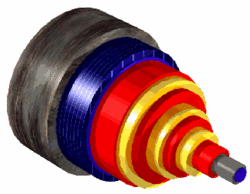
A second generation superconducting power transmission cable, using liquid nitrogen as the coolant, has been energised at a station outside Columbus, Ohio. The Triax HTS cable utilises 3 concentric super-conducting layers to allow 3-phase current transmission in a single cable!

-A new technology that holds promise to transform the global transmission and distribution of electric power was formally energized today near Columbus, Ohio. The $9 million project uses a second-generation High Temperature Superconducting (HTS) cable system to efficiently deliver electric power to approximately 8,600 homes and businesses in suburban Columbus.

The Columbus project is the first demonstration of the new Triax HTS cable design, which dramatically reduces the cost of superconducting systems and brings the technology one step closer to commercial viability. The system was developed by Southwire Company and its partners, American Electric Power (NYSE: AEP), Praxair (NYSE: PX), American Superconductor (NASDAQ: AMSC) and the U.S. Department of Energy's Oak Ridge National Laboratory (ORNL).

Approximately 200 meters (660 feet) of Triax HTS cable from Southwire are part of the system distributing electric power to residential, commercial and industrial customers through AEP's Bixby substation in Groveport, Ohio. The installation phase of the two-year demonstration project came in on time and on budget.
Source.

Superconducting cables, operating at extremely low temperatures, eliminate virtually all resistance to the flow of electric current. HTS cables can deliver up to five times more electricity than traditional conventional copper or aluminum cables and have the potential to address the challenge of providing sufficient electricity to densely populated areas. In an increasing number of cities, there is little room to expand underground cable networks and the cost to lay additional cable, including building new tunnels or ducts, is prohibitive. With their higher capacity, superconducting cables have the potential to increase the supply of electricity to an area using the existing underground cable footprint. Additionally, because HTS cables can carry more current at a lower voltage over longer distances, large power transformers could be located farther from urban centers and densely populated areas freeing up valuable real estate for development or green space.
Source.

Check out the flash animation at this website, that shows how an urban landscape can be transformed by the space efficiencies of superconducting cable such as the Triax HTS system. Urban real estate can be highly expensive, and anything that can free up land for more profitable use would be welcomed.

High-temperature superconductive cables are simple enough in principle. Encase a ceramic material in a silver tape, submerge it in liquid nitrogen, and run current through it. Temperature is the key. A conductor that carries 200A at -321 °F can carry 240A at -334 °F. Turn the refrigeration up and you get more capacity. You’ll lose about 0.5 percent of the power you transmit, where traditional power cables lose from three to eight percent. The trick is being able to manufacture your design. In the center of Southwire’s superconducting cable is a flexible pipe carrying liquid nitrogen. Superconducting tapes wrap around the pipe, followed by a dielectric layer, then a second layer of superconducting tapes that act as a neutral conductor. A double-walled outer cryostat surrounds the cable core and provides a return path for the nitrogen.
Source.

Hat tip to Energy Blog for graphic and links.

Labels: ,

Bookmark and Share

Billionaire Tries to Reform Math Education: Can the US Learn to Teach Math Again?

A billionaire investment wizard is trying to save the US educational establishment from itself. James Simons is head of Renaissance Technologies Corporation, the top hedge fund in the world in terms of performance. Like most thoughtful and intelligent North Americans, Simons is dismayed at the horrific lack of math skills in North American graduates (24th out of 29 nations tested).

Government education in the US has been a disgrace for decades now. Schools and teachers have failed students badly, especially in math and the sciences. One obvious cure for the problem is to make mathematics relevant to the real world, by bringing in teachers who have actual work experience in the real world.

....Math for America addresses a simple, but profound problem: Nearly 40 percent of all public high school math teachers do not have a degree in math or a related field. Even the best curriculum in the world, the reasoning goes, isn't going to inspire students if unqualified individuals are teaching them. (In a recent round of testing, the U.S. placed 24th out of 29 nations in math proficiency.) If knowledgeable teachers exude passion for the subject, they stand a greater chance of pushing students toward careers in math in science that are the technical backbone of the country's economy.

....In its first two years, MfA has already had an impact. Several of the teachers it has placed are career changers, reversing the tide of defections from teaching. MIT grad Alan Cheng, was previously a researcher and software engineer, and another fellow I met turned down graduate studies at Harvard to teach math in a New York City school.

...."This is a problem that doesn't just affect education, but also the economy, our security, and, because I am an old Jeffersonian, I believe it affects our democracy," said Kra. "People should know basic concepts in math and science in order to make informed decisions about the issues."

...."As an employer," he said, "it's more and more difficult for me, if that were my objective, to hire Americans or American-trained-and-born people into the company. We hire research guys in math and physics in reasonable numbers, and almost all of them are non-U.S."

....
Source.

Unfortunately, Simons is looking for help from New York Senators Schumer and Clinton, two people who are most snugly in bed with the teachers' unions. Teachers' unions resist reform and needed change to the schools, so for all his intelligence and accomplishment, Simons has still shot himself in the foot.

Thanks to the corrupt collusion of teachers' unions and politicians, the government schools of the US, at least, are solidly fixed in a doomed, downward course. Simons means well, but his blind spot prevents him from understanding that an alternative approach that bypasses the teachers' unions is called for.

Any solutions that have a chance of working must come from outside the system, and gather momentum outside the system until they are large enough and successful enough that the corrupt school systems can no longer deny their problem. Reform has to forced on the system by people of integrity--not by politicians who have long since been bought and paid for.

Labels: ,

Bookmark and Share

19 September 2006

Interesting Nanotech News

It is difficult to manipulate carbon nanotubes into circuits without destroying the enhanced conductivity of the nanotubes. MIT researchers are mastering a new technique, hoping to create nano-sensors and other fascinating new nano-electronics devices. How to make low resistance circuits with nantubes, from MIT. Source.

Electric storage batteries have low power density compared to hydrocarbons. That is why really good and reliable electric cars are taking so long. What if you could power your laptop with a tiny super-efficient gas turbine, and go a whole day without a re-charge? Making micro gas turbines out of silicon wafers, using chip fabrication techniques. Source.

Better catalysts mean quicker, cleaner, more economical chemical reactions. Nanotechnology provides different ways of making custom catalysts. Learning to custom make catalysts, atom by atom. Source.

Update: In keeping with the nanotech theme for today, Michael Anissimov has posted a fascinating look at first stage nanoproducts etc. Be sure to check out the great YouTube video "Nanofactory Movie."

Labels:

Bookmark and Share

National Academies of Science Report Recommends Forcing Women Against their Will

A recent report from the National Academies of Sciences (NAS) can find no "good" reason why women are deciding not to go into tenured university positions in upper level science, math, and engineering. The committee of "experts" nevertheless recommends broad, sweeping and massively expensive changes to the way that the US federal government, large foundations, and universities deal with the issue of women in the sciences.

A committee of experts looked at all the possible excuses -- biological differences in ability, hormonal influences, childrearing demands, and even differences in ambition -- and found no good explanation for why women are being "locked out".
Source.

Women have made astounding gains in education in North America, the committee admitted. But since women are not choosing to go into science and math PhD teaching positions in elite universities at the same rates as men, they should be forced to make other choices than they would choose for themselves, the report implies. If women with top level mathematics and scientific skills are making other career and life choices, such as private industry labs, think tanks, or government labs--then society needs to spend massive amounts of money to force them to change their minds.

Forty years ago, women made up only 3 percent of America's scientific and technical workers, but by 2003 they accounted for nearly one-fifth. In addition, women have earned more than half of the bachelor's degrees awarded in science and engineering since 2000. However, their representation on university and college faculties fails to reflect these gains.
Source.

Well, of course, if women have different goals for themselves than the goals that this particular NAS committee has for them, the women should be forced to change--there is no other conclusion to be drawn.

Women make up over 70% of psychologists with graduate degrees. Women are achieving parity (and greater) in most law schools and medical schools. Women make up almost 60% of recipients of bachelors degrees in North America, and since it takes time for the wave of women graduates to roll through higher education and university faculties, one can expect even greater gains in those areas for women. There is nothing that motivated women cannot accomplish in the free atmosphere of North America and Europe.

Yet, for political reasons, a NAS committee has recommended massive overhauls to the operation procedures for government funding, large foundation grants, and university policy, so that women can be favoured in science, math, and engineering--even if women by themselves would make other career and life choices.

There are some women who are clearly as good as the highest level of male scientists and mathematicians, and who should have the opportunity--if they choose--to go to the highest levels of those fields, within universities or any other system that employs scientists and mathematicians. Some of them are choosing to go into other areas of employment than tenured PhD university employment. This seems to distress Donna Shalala and other highly politicised members of the NAS committee.

This topic should enjoy an interesting discussion on the web. I see that Gene Expression blog already has posted on this report. Of course, anyone interested in the underlying science in this issue should read this La Griffe du Lion essay on women in science and this essay on women in mathematics.

This NAS report is an expensive "Ode to Cluelessness." Not so much on the part of the committee members, who clearly know what their own ambitious goals are, as on the part of anyone who takes it seriously.

Labels: , ,

Bookmark and Share

18 September 2006

More Holistic Bio-ethanol, Pluripotent Adult Stem Cells, and more

Although I prefer bio-fuel alcohols be made from cellulose, cane, sorghum, or sugar beets, this report from Purdue Research Foundation suggests that maize (corn) may offer some advantages in terms of by-products.

A Purdue University team led by professor Li-fu Chen and research assistant Qin Xu, both from the Purdue food science department, discovered a new method to create ethanol from corn. The method also produces biodegradable byproducts that could be safely eaten.

"Our process, which we are calling the Chen-Xu Method, not only makes ethanol, but products that are fit for human consumption," Chen said. "This process also produces corn oil, corn fiber, gluten and zein, which is a protein that can be used in the manufacture of plastics so that the containers are good for the environment because they are biodegradable and easily decompose.

"The containers would actually be edible, although there probably wouldn't be much market for that."

Bio Processing Technology, based in West Lafayette, Ind., was formed to bring inventions from Chen and Xu to the marketplace. They have teamed with John Y.D. Tse, a management professor emeritus who is CEO of the startup company.

The Chen-Xu Method produces about 2.85 gallons of ethanol for every bushel of corn processed. That output is slightly higher than current methods, but the same process that creates the ethanol also creates other marketable products. Chen said the method also meets federal Clean Air Act standards, eliminating costs that other methods incur in meeting environmental regulations.

"One of the common methods of manufacturing ethanol, called dry milling, is often the cause of air pollutants by drying and storage of DDG, a byproduct of the process," Chen said. "Another method — wet milling — produces an odor because it requires the input of sulfur dioxide. The Chen-Xu Method eliminates both issues, and the only odor comes from the smell of the corn and yeast fermentation."

Using a machine originally designed to make plastics, the Chen-Xu Method grinds corn kernels and liquefies starch with high temperatures. The water input required by wet milling is reduced by 90 percent, Chen said. Wastewater output is cut by 95 percent, and electricity use is reduced by 47 percent.

"The total operating cost of a Chen-Xu Method ethanol plant should be much less than that of a wet-milling plant, and total equipment investment is less than half," Chen said. "And with proper planning and management, total equipment investment should be less than that of a dry-milling plant."
Source.

In the great stem cell race, it appears likely that Adult Stem Cells (ASCs) offer some advantages over Embryonic Stem Cells (ESCs). Of course, ASCs offer a level of biocompatibility that ESCs may not achieve, but now it seems that ASCs may offer another safety advantage--less risk of cancerous tumours. This newsrelease from University of Missouri-Columbia describes research that may expand the use of ASCs in the fairly near term.

"Embryonic stem (ES) cells are able to give rise to the remarkable diversity of cell types that constitute a whole organism such as a human," said Elmer Price, a scientist at the MU Dalton Cardiovascular Research Center and associate professor of biomedical sciences in the College of Veterinary Medicine. "However, this 'pluripotency,' or the ability of the cells to become anything, can also be a curse because ES cells can be misled by biochemical signals when they are transplanted into an adult during cell transplantation experiments. This often leads to the generation of unwanted cell types and, on occasion, tumor formation. Because of this, ES cell transplantation can raise serious safety issues. In this study, we developed adult stem cells from the blood of an mature animal that were able to be directed into specific cell types such as neurons and blood vessel cells, but they were not as pluripotent as ES cells. We have not observed any evidence of tumor formation."

Price extracted the adult stem cells from pigs' blood. These particular pig cells are unique because the pigs also contained a gene that makes their cells fluorescent. This allowed Price to track the cells as they developed into nerve or blood vessel cells or upon transplantation. The fluorescent pigs were created by MU animal scientist Randy Prather, who along with MU researcher Mike Foley, is a co-author of this paper.

In the study, Price was able to develop and sustain adult stem cell lines and then induce them to turn into specific cell types by exposing them to different chemical signals, depending on which type of cell he wanted to develop. For successful adult stem cell transplantation therapy, different diseases will require different cell types. Unlike embryonic stem cells, which are difficult to grow as pure cell populations and can develop into tumor-type tissue, Price's adult stem cells efficiently developed into specific cell types with no abnormal tissue.

"In theory, embryonic stem cells have the ability to become almost any cell type or organ," Price said. "Very complex chemical signals need to be in place with embryonic stem cells in order for them to develop into the appropriate type of cell. However, we have shown that if you can isolate adult stem cells, you can make them generate the appropriate type of cell with much more ease and specificity. One day, we may be able to isolate similar adult stem cells from a patient, manipulate the cells in a petri dish, and then re-introduce them back into that same patient as a therapy."
Source.

Is there any methane deep in the earth's mantle? That is a mystery that researchers from Lawrence Livermore and Argonne national laboratories, Carnegie Institution's Geophysical Laboratory, Harvard University, and Indiana University at South Bend are trying to solve.

For the methane experiments, researchers at the Geophysical Laboratory used Argonne's diamond anvil cell (DAC)—a small mechanical press that forces together the tips of two diamond anvils and creates extremely high pressures on a sample of a material held within a metal gasket. DACs allow researchers to measure material properties under static pressure and at varying pressures and temperatures over many hours. (See S&TR, December 2004, Putting the Squeeze on Materials.) Diamonds are used because they can withstand these ultrahigh pressures.

Also, their transparency permits diagnostic radiation, such as x rays and visible light, to pass unhampered through their crystalline structure.

Comparing Experimental Results with Calculations

To determine the chemical reactions that might occur at the pressures and temperatures of Earth's upper mantle, the researchers used the DAC to squeeze a microgram sample of iron oxide, calcite, and water to pressures up to 11 gigapascals at temperatures of more than 1300°C. Then they analyzed the results using Raman spectroscopy, synchrotron x-ray diffraction, and optical microscopy.

Raman spectroscopy measures the wavelength and intensity of scattered light from molecules as they vibrate about their bonds. These vibrations occur at certain frequencies. At normal pressures, electrons are tightly held within an atom's inner electron bands or shells. Squeezing a material under extreme pressures forces its atoms into a different orientation, which causes the delocalization of electrons and changes a material's properties and molecular structures.

By observing the frequency created when the electrons move or vibrate, scientists can tell how the elements are bonding to each other. Raman spectroscopy is highly sensitive to the stretching vibrations between carbon and hydrogen. The Raman spectra for the DAC samples showed hydrocarbon-rich regions.

The bond vibration between carbon and hydrogen becomes apparent in the spectra when the sample temperature reaches 500°C and is very strong by 600°C.

The researchers used synchrotron x-ray diffraction to determine the principal reaction products that occur as the DAC squeezes the samples. With synchrotron x-ray diffraction, a beam of x rays passes through the sample, and the resulting diffraction pattern is recorded on an x-ray film or detector. Changes in the pattern reveal how much of each element is involved in the chemical reaction at different temperatures and pressures. Diffraction results on the team's samples showed the presence of calcium oxide and magnetite—a chemically reduced form of iron oxide. When researchers examined the samples using optical microscopy, they again found changes indicating the presence of methane. Most notable were bubbles, which Raman measurements confirmed to be methane.
Source.

At a U Missouri-Columbia power plant, corn cobs will be used as a supplementary fuel with coal to determine if corn cobs might work as an economic fuel extender that is more environmentally friendly than burning pure coal.

Los Alamos and Sandia National Labs are both intensively involved in monitoring nuclear power plant activity. By learning to separate the short term radioactive from long term radioactive elements from nuclear waste, these labs intend to reduce the necessary space needed for long term nuclear waste storage. In addition, these two New Mexico National Labs are deeply involved in plans for producing hydrogen from nuclear energy, to help create the "hydrogen economy."

A lot of resources are being devoted to developing alternative energy sources to petroleum. At the same time, oil discovery methods are improving significantly--suggesting that peak oil is standing off well into the future.

Bio-medical research into stem cells, nanotech medicine, synthetic biology, and other radical new biomedical fields promises to improve the length and quality of the average person's life and health. The western world is poised on the brink of massive change for the better in several areas.

The bad news is that a lot of organisations and less organised groups of people do not want life to get better, unless it does so on their terms. These are political and religious ideologues who are enemies of individual liberties combined with wealth, because they do not like the choices that individuals make in spending their wealth. This blog will report--loosely--on the technological and scientific advances that are moving closer every day. But we will also be keeping an eye on the "killjoys and deadbeats" who want to spoil the party for the rest of us. These people are real and are very serious. We have to be just as serious in meeting the threat that they represent.

Labels: ,

Bookmark and Share

17 September 2006

"Holistic" Approach to Cellulosic Ethanol and More


Researchers in Denmark are learning to make the most of cellulosic materials to make bio-fuels. This can only make the economics of biofuels that much more favorable.

A pilot project seeking to maximize the amount of biofuels produced from lignocellulosic materials has officially opened a pilot plant at the Danish Technical University (DTU) in Lyngby, Denmark.

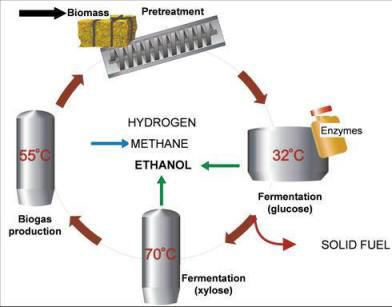
The processes underlying the MaxiFuels project were developed at DTU and spun-off into a new company earlier this year: Biogasol. The main product is cellulosic bioethanol, but the process is also focused on the production of methane (from a biogas process) and hydrogen (from xylose fermentation) as well as other valuable by-products from the parts of biomass not suitable for ethanol production.

The full consumption of available carbohydrates in the feedstock for the production of such a range of product is intended to make the process much more cost-effective. The process also recirculates and reuses all streams produced in the integrated process—process water is reused with the integration of the biogas cycle, for example, further reducing cost and environmental impact of production.

The Biogasol process has four main stages:

1. Pre-treatment. Biogasol uses a combination of combination of steam-explosion and wet oxidation it calls “West Explosion”. Wet Explosion applies both the addition of oxygen and a pressure release at high temperature (170° C to 200° C). Biogasol calculates that this method—for which it has filed a patent—will deliver more sugar at lower cost than other processes. The method works for opening up all major biomass materials: straw, corn stover, bagasse and woody materials.

2. Hydrolysis and glucose fermentation. The Biogasol process combines hydrolysis and fermentation. The BioGasol Concept produces its enzymes for hydrolysis at the plant using an enzyme-producing fungus strain developed in collaboration with Novozymes A/S.
The main products from the enzymatic hydrolysis are the sugars glucose and xylose. The glucose is simultaneously fermented into ethanol by yeast. After fermentation the process stream is separated into a solid and a liquid fraction. The liquid fraction then moves to the xylose fermentation reactor.

3. Xylose fermentation. Xylose is the second-most abundant carbohydrate monomer after glucose, and constitutes between 10-40% of the total carbohydrates in lignocellulosic biomass. Fermentation of both xylose and glucose is therefore a crucial step forward in reducing the cost of ethanol production from lignocellulosic raw materials.

In the Biogasol process, a thermophilic anaerobic bacterium converts both hexose and pentose into ethanol or ethanol/hydrogen in an immobilized reactor at 70° C. Bioethanol is distilled out as a part of the re-circulation loop of the reactor and a fraction of the ethanol can be collected directly from the out-gas stream leaving the reactor due to the high process temperature. This step is unique and one of BioGasol’s patented processes. Wastewater from the xylose fermentation is afterwards transferred to the anaerobic digester.

4. Biogas production and recirculation of the process water. The remaining non-carbohydrate organics move to an anaerobic digester along with the wastewater stream for the production of biomethane.

Biogasol calculates that from 1,000 kg of rice straw, its process can produce 310 liters of ethanol; 90 cubic meters of biogas, and 230 kg of solid biofuel.
Read more at the source.

Also, take a look at this attempt to use microbes to produce hydrogen from cellulose at Brookhaven Labs.

Labels:

Bookmark and Share

If You Care About the Future, You Must See this Film


This award-winning film is now available online. Get the film here.

Google has twice removed this film and replaced it with islamist propaganda. That certainly is consistent with behaviour I have observed at other Google services. That type of censorship reflects badly on the entire Google organisation. Source.

Go here for the official "Obsession the movie" webpage to read more.

Hat tip, Pastorius.

Update 18 Sept 06: According to this link, Obsession is available at Google again for a short time. To see the streaming version, follow this link.
Bookmark and Share

16 September 2006

Will the Last European to Leave Europe Please . . . Do Nothing . . .

. . . . because the light, you see, will go out by itself.

Europeans are suffering from an interesting dilemma. They choose not to procreate to replacement value, yet they are heavily dependent upon a social welfare system that requires lots of fresh new taxpaying workers to replace those middle-aged workers so eager to retire. What is worse, many of the most productive and inventive potential taxpayers are packing up and leaving for other countries--as are some of the most productive businesses and employers.

This updated webpage tries to keep up with some of the reasons for the outflow from Europe:

Escaping the stress of clogged roads, street violence and loss of faith in Holland's once celebrated way of life, the Dutch middle classes are leaving the country in droves for the first time in living memory. The new wave of educated migrants are quietly voting with their feet against a multicultural experiment long touted as a model for the world, but increasingly a warning of how good intentions can go wrong. Australia, Canada and New Zealand are the pin-up countries for those craving the great outdoors and old-fashioned civility. …

More people left the Netherlands in 2003 than arrived, ending a half-century cycle of surging immigration that has turned a tight-knit Nordic tribe into a multi-ethnic mosaic with three million people of foreign roots out of 16 million. Almost one million are Muslims, mostly Turks and Moroccan-Berbers. In Rotterdam, 47 per cent of the city's population is of foreign origin. While asylum claims have plunged, the exodus is accelerating, reaching 13,313 net outflow in the first half of 2004. Many retiring workers are moving to the south of France, but a growing bloc leaving the country appears to be educated, working families. …

Unlike most earlier waves of migration to the new world, this one is not driven by penury. The Netherlands has a per capita income higher than Germany or Britain, and 4.7 per cent unemployment. "None of my clients is leaving for economic reasons. You can't get a visa anyway if you haven't got a work record," said Frans Buysse[, the head of a private immigration consultancy]. Europe's leader for much of the last century in social experiments, Holland may now be pointing to the next cultural revolution: bourgeois exodus.

The Pim Fortuyn and Theo van Gogh murders seem to be the motor force here; and if two murders can spur such a shift in opinion in the Netherlands, clearly similar acts of violence can have a similar effect in other European countries.

Dec. 27, 2004 update: Christopher Caldwell of the Weekly Standard glosses the recent surge in Dutch emigration this way:

London's Daily Telegraph, citing immigration experts and government statistics, reported a net outflow of 13,000 people from Holland in the first six months of 2004, the first such deficit in half a century. One must treat this statistic carefully—it could be an artifact of an aging population in which many are retiring to warmer places. But it could also be the beginning of something resembling the American suburban phenomenon of "white flight," occurring at the level of an entire country

Feb. 12, 2005 update: According to Filip Dewinter, the leader of Vlaams Belang, Belgium's Flemish anti-immigrant party, about 4,000 to 5,000 Flemish residents are leaving Antwerp every year, even as 5,000 to 6,000 non-European immigrants arrive in the city each year. Within ten years, he expects that people of non-European backgrounds will number over one-third of the city's population.

Feb. 14, 2005 update: "More people left Holland in 2003 than arrived," informs the Daily Telegraph in an article on emigration from Holland, "Dutch join the migrant exodus to Australia."

Feb. 27, 2005 update: "More Dutch Plan to Emigrate as Muslim Influx Tips Scales" reads the blunt New York Times headline over a story by Marlise Simons. It recounts how the murder of Theo van Gogh led to an emigration specialist being "inundated" with messages. "There was a big panic, a flood of people saying they wanted to leave the country." An agency that handles paperwork for departing Dutch was had four times the normal rate of contacts following the murder. Those leaving tell of a general pessimism about their country and about the social tensions that accompanied the waves of mostly Muslim immigrants. The emigrants tend to leave for Australia, New Zealand and Canada. Diplomats from those three countries confirmed the interest, saying they had been "swamped" with inquiries. The reporter notes statistics pointing to "a quickening flight of the white middle class." In 1999, nearly 30,000 native Dutch moved elsewhere, according to the Central Bureau of Statistics. For 2004, the provisional figure is close to 40,000. "It's definitely been picking up in the past five years," said a demographer working at the bureau.

March 3, 2005 update: Ha'aretz reports today on a survey that finds "60,000 French Jews want to move to Israel." Arik Cohen of Bar-Ilan University reached this conclusion by giving questionnaires to the 125,000 French Jewish tourists who visited Israel in the summer of 2004. Of this huge sample, 52 percent said they see their future in Israel. Half of those aged 15-18 said they had personally experienced instances of anti-Semitism in the past four years. A third of the youth said they are considering immigration to Israel in the near future. The findings were presented at a press conference in Jerusalem inaugurating AMI, an organization of French Jewry for increasing Jewish immigration from France.

May 4, 2005 update: Radio Nederlands informs us that in 1999, nearly 30,000 native Dutch emigrated and in 2004, that figure had gone up to nearly 50,000. These are not just any emigrants but, as the director of a migration consultancy bureau in Amsterdam, Grant King, notes, "Most of our applicants are in high-paying, good, solid positions here - they are not the unemployed. They are mostly middle-class Dutch people with college or university degrees. … The problem for the Netherlands is that the ones that they don't want to lose are the ones that are leaving."

Henri Beunders, professor of history, media and culture at Erasmus University in Rotterdam, notes the role of the Theo van Gogh murder: "The assassin of Theo van Gogh released not only anger but a lot of fear of fanatic Muslims and random violence. It was new for Dutch people to feel physical insecurity, because we are living in a very small country where you can come across anybody." One emigration consultant, Frans Buysse, received four times the usual level of hits on his website in the weeks after the killing of van Gogh.

Asked if the Dutch government should worry about this emgiration, Beunders says no, that immigrants to the Netherlands will replace the Dutch who leave. He concedes only that "It will make things a bit more complicated because you have to integrate an even greater number of foreigners into your own country, with all the very complicated regulation systems we have in this country." He also wants to see benefit in this exchange: "Growing mobility, on the other hand, is also a good sign of the growing unification of Europe and understanding of people - I hope." In like spirit, the radio reporter, Sarah Johnson, speculates that "Europe's pioneer for much of the last century in social experiments, it seems the Netherlands may now be pointing to the next cultural revolution: the bourgeois exodus."
Source.


Other problems include the lack of seriousness toward crime that some European countries exhibit. I suspect that the sense that Europe is a poorly defended, poorly administered high priced dead-end retirement home, being taken over by a violent, alien culture, causes some young and ambitious Europeans with good prospects to consider emigrating.

May 29, 2006 update: The invaluable Paul Belien concludes his article, "For Whom the Bell Tolls," in the Brussels Journal bitterly noting that, "Last year Hirsi Ali was elected ‘European of the Year.' It is a bad omen for Europe when the ‘European of the Year' leaves for America." He continues with the observation that many other Dutch do not seem to have much confidence in their country's chances of survival. Last year a record number of 121,000 people emigrated from the Netherlands, the largest number ever, while only 92,000 immigrated in. This emigration figure is the highest figure in the entire history of the country so far. The Netherlands is today also the European nation with the highest proportion of emigrants. Since 2003 more people have been leaving the country than entering it. The numbers are rising. In the first quarter of this year 29,000 people left the Netherlands – 5,000 more than in the same period last year. Now Ayaan Hirsi Ali is leaving too. The bell tolls for the Dutch, and those who do not hear it must be deaf.

July 7, 2006 update: In 2004, Germans for the first time in recent history departed Germany more than they moved to it, reports Die Welt in "Die Deutschen sind überall gern gesehene Einwanderer." The online version lacks the graph in the print version, but I happened to be in Germany today and have scanned it in.

July 27, 2006 update: The largest number of French Jews – 650 in one day – since 1970 arrived to a festive reception in Israel, complete with the prime minister and lavish ceremonies. They emigrated despite the two-front war Israel is currently fighting. The total number of immigrants from France totals more than 3,500, the highest in 35 years. Last year, their number reached only 3,005, which in turn was 25 percent more than the year before.
Source.

Nevermind the faux European pride that has been propped up so long by a smug sense of superiority resting on anti-americanism. The real question about Europe's future is how long it will take for the booming muslim population to reach critical mass. Because when critical mass happens, muslims in Europe will insist upon Sharia law. And when Sharia law happens, dhimmitude for native Europeans with all that implies, is inevitable. If any indigenous Europeans are then left in Europe, who refuse to convert to Islam, they will observe the dying of the light--but nothing they choose to do then will hold back the darkness.

Labels: , , , , , ,

Bookmark and Share

15 September 2006

Moving Into Space: Who Wants to Get Out of this World Alive?

Humans are remarkably adaptible to life at different climates, elevations, and latitudes on earth. But most of us understand that we improve our long term odds of survival by also learning to live off planet. Michael Anissimov at the popular blog Accelerating Future, takes a good look at some of the ways that have been proposed to make space exploitation and migration more affordable, thus more possible.

Michael includes some amazing graphics, and a good analysis of some shortcomings of the most popular current alternative space access approach, the space elevator. He concludes his article by pointing to the concept of the "space pier." See illustration at top.

The space pier would be built on 100 km tall compression pillars, and incorporates a 300 km long electromagnetic linear accelerator. At that altitude, air resistance is much lower than at sea level A 300 km linear accelerator at 100km could accelerate payloads to earth orbit, or much farther. For a sobering perspective, consider that the Ultima Tower is only 3km tall. Innovative construction methods will be necessary for either the Space Pier or the Space Elevator.

For a good run through of several imaginative space launch approaches, try this Island One website (frames).

Then there is always the free online ebook, "LEO On The Cheap", for more conventional information on less expensive approaches using rockets to access space.

Large scale movement of humans into the outer space environment is a daunting challenge. Achieving that transition will take all the imagination and hard work that modern humans can provide.

Labels: , , ,

Bookmark and Share

14 September 2006

A Panoply of Disconnected Curiousities

Is there anything more slippery than Teflon? How about a coating of nanotube forest? Moving the bead across the nanotube-forest surface took 0.2 micronewtons of force, compared to 1.1 mN on the Teflon surface or more than 1.4 mN on the gold or silicon surface. One micronewton is roughly the force needed to lift one-tenth of a gram.

What will it take for fuel cells to be able to replace internal combustion engines? Greater power density and energy density. Chemist Don Gervasio and colleague Sonja Tasic, both at Arizona State University in the US, set out to develop a fuel cell that would generate more electricity for its weight than the best batteries, and would also work at room temperature. Original Source for story on borohydride fuel cell. Borohydride 30% contains more hydrogen than an equivalent volume of liquid hydrogen!

What is a good way of taking CO2 out of the air, and producing feedstock for bio-ethanol at the same time? Super-poplars.
Learning to "soup up" the DNA of poplar trees to more quickly convert atmospheric CO2 to cellulose.

Another approach to climate control is to use
sulfate aerosols to deflect incoming sunlight
. Just a thought.

How do different areas of the brain cooperate to provide a person with a coherent, mindful, multi-sensorial picture of the world? Possibly by using a combination of low and high frequency oscillations. This reminds me of several postings from our friend Chris, at Develintel. I suspect that Chris will weigh in on this study before long.

Speaking of the brain, how do human genes influence brain development and ultimate potential? Between 50% and 80% of human intelligence is heritable, and this geneticist thinks he has identified two of the genes that are involved. A fascinating interview. I wonder what our friend Kevin at Intelligence Corner thinks about this line of research? It is certainly not politically correct, which makes it dangerous. But Kevin is fearless. You should be too.

Can you teach chemistry online, through distance learning? What about the lab? Here is one approach where the student needs to go no farther than his own kitchen.

One of the problems holding back some types of micro robots in the real world, is the lack of simple but reliable micro-actuators, powered by simple, readily available and cheap forms of energy. Here is a micro-catapult powered by the heat released from evaporating water. Nature is resourceful. Humans can learn from that.
Bookmark and Share

A Fat Knowledge Omnibus and misc. Hacks

Fat Knowledge blog is a fairly recent addition to my blogroll, and one of my regular stops on my web-rounds. In a recent flurry of activity, Mping has categorised his favourite postings over the past two years!

But that is just the beginning. Scroll down from the top and you will find individual postings for his favourites from fifteen different important and thought-provoking categories from energy to men vs women to all original pieces. He did all of that on one day, 13 Sep 06. Mping's blog covers a wide range of human knowledge, and is always thought provoking.

Pretty impressive. But that is just one approach to displaying posts within specific categories. Over at Audacious Epigone, another one of my recent favourites, you will see that crush41 has compiled his posts in categories on his sidebar, even though Blogger does not provide for "categories" like some blog providers (Wordpress). C41 had to use a hack to put categories on his blogspot blog. I like that.

In fact, I am looking at various hacks for Blogger. If any of you have discovered some useful hacks for blogger, please point me in the right direction, thanks.

So do not be surprised if the look of this blog starts to change slowly, as I find the time, and no doubt subtly. But never fear: the pugnacious and offensive content of this blog will never change.
:-)
Bookmark and Share

13 September 2006

Nanotechnology Developing Implantable Nano-Kidneys to Replace Dialysis

Dialysis is a poor substitute for working kidneys. But there is a perpetual shortage of donor kidneys for transplant. Technology Review looks at nanotechnology research that hopes to provide a better alternative to dialysis--an implantable nanotech kidney.

The common regimen of three half-day blood-cleansing sessions per week removes, on average, just 17 percent of the toxins that a healthy kidney would clear, so that only one-third of all dialysis patients survive more than five years of treatment.

Nanotechnology could offer an alternative, according to nephrologist William Fissell at the University of Michigan. He and colleagues are working on nano-pore membranes that could enable dialysis to be miniaturized into implantable devices that provide round-the-clock clearance of toxins, untethering dialysis patients from bulky pumps and clinics. "This is a fundamentally liberating technology," says Fissell.

....As currently practiced, dialysis is a crude procedure. Patients are hooked up intravenously to a powerful pump that circulates their blood through a cartridge of porous plastic fibers. Fluids, dissolved toxins, and salts pass through the fibers and are discarded, while the proteins and blood cells caught in the sieve are supplemented with electrolyte before returning to the patient. The filter's poor fluid dynamics are a function of their imprecision: filter manufacturing produces a wide range of pores, so to avoid having too many large pores, which would suck out valuable proteins, the fibers must be manufactured with a preponderance of very small pores. The machine's pump makes up the difference, forcing blood through these inefficient sieves.

In contrast, Fissell and Roy etch pores into ultrathin wafers of silicon with lithographic precision. The result is a homogenous array of pores, each capable of flow rates several orders of magnitude higher than the average pore in a conventional filter. The pores mimic the exquisitely precise yet efficient diaphragms that filter blood in a human kidney, resembling a panel of Venetian blinds, says Fissell.

Current prototypes contain roughly 10,000 pores per square millimeter, according to Fissell. Next-generation membranes, now being engineered, will have more than 100,000 pores or slits per square millimeter and provide more than 10 times the flow.

....Fissell's team is testing whether the kidney sorts not only by size but also by generating electrical charges that repel protein chains, which are also charged. They're modeling various chemical modifications to introduce charges on the surface of the silicon pores.

To make the system practical will require rendering the membranes biocompatible. Unmodified silicon strongly attracts proteins, and thus a silicon nano-pore membrane would rapidly clog if implanted in the body. Fissell's colleague at the University of Michigan, David Humes, has initiated animal studies with the nano membranes to identify surface treatments or alternative membrane materials that will prevent clogging in implants.

Humes hopes to use the membranes to fashion a more sophisticated version of the implant that would contain living kidney cells--analogous to his "bioartificial" Renal Assist Device that's currently in phase two clinical trials (see "Saving Lives with Living Machines," July/August 2003). In an implantable version of the bio-artificial kidney, nano-pore membranes would protect the live kidney cells from immune cells and antibodies, which have thwarted most bio-artificial organ implants to date. The live kidney cells, in turn, would improve the function of the implant by reabsorbing and returning to the bloodstream some of the fluids and salts that pass through the nano-pore membrane. Eventually, bio-artificial implants that recover fluids and salts and divert the remaining ultrafiltrate to the bladder might even eliminate the need for external electrolyte and ultrafiltrate bags.
Source.

Replacement organs that work well, and allow mobility, would improve the lives of hundreds of thousands of people. Whether from nanotechnology, stem cell research, or other advanced technology, most people in need of replacement organs would probably not quibble.

Labels: , ,

Bookmark and Share

12 September 2006

Synthetic Biology: When Genetic Engineering Goes Ballistic

At the moment, what passes for genetic engineering is mere pottering. It means moving genes one at a time from species to species so that bacteria can produce human proteins that are useful as drugs, and crops can produce bacterial proteins that are useful as insecticides. True engineering would involve more radical redesigns. Source.

Those of you who thought Craig Ventner was washed up and retired to his island home, may be in for some disillusionment. Instead, Ventner is well-connected with venture capital, and in the forefront of the revolutionary movement known as synthetic biology.

In the short run such engineering means assembling genes from different organisms to create new metabolic pathways or even new organisms. In the long run it might involve re-writing the genetic code altogether, to create things that are beyond the range of existing biology. These are enterprises far more worthy of the name of genetic engineering than today's tinkering. But since that name is taken, the field's pioneers have had to come up with a new one. They have dubbed their fledgling discipline “synthetic biology”. Source.

The potential payoff from achieving mastery over the life-mechanisms of even simple cells, is difficult to overstate. That is why more and more smart money venture capitalists are being drawn to the bright lights of the field.

Dr Ventner reckons he will be able to synthesise a working bacterial genome from scratch within two years. More complex genomes, of the sort that make plants, animals and fungi, will take longer. But they, he thinks, should be possible within a decade. Even this definitive erasure of the distinction between the living and non-living worlds is not, however, the most radical idea in synthetic biology. Some people want to go beyond the toolkit that evolution has provided and create biological systems that work with a chemistry that is not found in natural living things. Source.

Here is an interesting close-up look at this year's Synthetic Biology 2.0 conference from Synthesis blog. Read the linked post, then click around to read descriptions of the entire conference. You may find, as I did, that the comments can also be interesting.

A good place to go to acquire an understanding of what synthetic biologists are doing, is the Santa Fe Institute. Abstracts of a few SFI papers on synthetic biology can be found here, here, here, and here. There are a lot more available, along with the full text pdf files.

If you think you understand the world, you are wrong. If you think you know what tomorrow will be like, based upon what yesterday and today were like--you had better stock up on alprazolam. This roller coaster is almost to the top of the first hill.

Labels: ,

Bookmark and Share

11 September 2006

Flying Cars, Better Batteries, Revolutionary Engine, Adjusting to Climate Reality

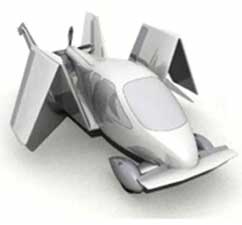
MIT engineering student Carl Dietrich is continuing to develop his flying car. Dietrich recently started the company Terrafugia to continue the development and marketing of the "roadable aircraft", as Dietrich likes to call it.

The Transition is designed for jumps of 100 to 500 miles. It will carry two people and luggage on a single tank of premium unleaded gas. It will also come with an electric calculator (to help fine-tune weight distribution), airbags, aerodynamic bumpers and, of course, a navigation unit with a global positioning system.


....Dietrich came up with the idea while a student at MIT's Department of Aeronautics and Astronautics. Earlier this year he won the Lemelson-MIT Student Prize, which recognizes invention and innovation. He also holds a patent for the centrifugal direct injection engine, a low-cost, high-performance rocket propulsion engine. Dietrich conducted his rocket engine research as an undergraduate at MIT.
Source.

The conventional wisdom on technological innovation is that it requires large teams of engineers working under the auspices of a large corporate research lab. That is of course rubbish. Take a recent significant improvement in the design of lead-acid batteries. Any half-way creative 8 year old given the proper education could have devised this patented improvement, daydreaming in the classroom.

# 4 times greater surface area for electroplates
# 60-68% efficiency (compared to 30-40% for conventional batteries)
# 30-50% smaller and lighter
# Environment friendly - Uses significantly less lead then typical lead-acid batteries
# Recharge quickly at any standard household outlet
# Utilizes same external case as conventional batteries
# Can instantly increase energy output and replace conventional battery with no retrofitting of vehicle
More details and links at source. A simple innovation that promises improvements on many fronts.

On the other hand, this revolutionary new engine required the effort of a distinguished professor of chemical engineering, and many graduate students.

* The StarRotor engine is projected to be very efficient (45-60%). By simply replacing conventional engines (15-20% efficiency) with a StarRotor engine, fuel economy will double or triple. For example, a conventional luxury car getting about 25 mpg on the highway would get about 75 mpg. A conventional economy car getting 40 mpg would get about 120 mpg.

* It should produce very low pollution. Advanced combustor technology reduces pollution, including unburned hydrocarbons, carbon monoxide, and nitrogen oxides.

* It has multi-fuel capability. Any liquid or gaseous fuel can be burned, including gasoline, kerosene, jet fuel, diesel, alcohol, methane, hydrogen, and even vegetable oil.

* It should be inexpensive to mass produce. The parts count of the engine is about 10% of a conventional automobile engine, and the majority of parts do not require complex machining.

* There should be no vibrations. All moving components are in pure rotation; there are no oscillating components therefore it is in balance.

* It should be quiet. Because the gas is fully expanded, there is low exhaust noise.

* The engine is expected to have a long life and low maintenance. The compressor and expander of the StarRotor engine have a slight clearance between the rotors, resulting in no friction or wear. Also, it should require very infrequent oil changes, perhaps every 100,000 miles. Because it has very few moving parts, it is expected to be very reliable and require very little maintenance.

* The engine should be smaller than conventional internal combustion engines. The StarRotor engine volume and mass are about half that of a conventional internal combustion engine. A 130-hp engine will occupy approximately 2 cubic feet.

* It should have a high turn-down ratio. The engine is efficient over a wide range of speeds and torques.

* The StarRotor engine should be easily scalable. Designs from 50 W to 50 MW are possible.
I encourage those of you with mechanical minds to visit the source website and think about the concepts involved. Lectures explaining this innovative engine are available at this link.

Finally, adjusting to climate reality. Frances Cairncross, president of the British Association for the Advancement of Science, says it is time to start learning to adjust to a warming world. The Kyoto Protocol is worthless, she suggests, and continuing to ignore the necessary adjustments that have to be made will only make conditions worse for humans and other living inhabitants of the globe.

On Monday Cairncross described the Kyoto protocol as "ineffectual" and called for the world to accept that "a hotter, drier world" is coming - even if everyone fulfils their obligations under Kyoto and pegs levels of carbon dioxide back below the 1990 baseline. "Adaptation policies have had far less attention than mitigation," she told the BA. “A hotter drier world is coming even if everyone fulfils their obligations under Kyoto.”

Now Cairncross is saying the UK should prepare for the inevitable by developing drought-resistant crops, constructing flood defences and perhaps even banning dwellings close to sea level. "We cannot relocate the Amazon or insulate coral reefs, so we need mitigation too, but the [UK] government could and should put in place an adaption strategy straight away," she said.
Source.

Mping at Fat Knowledge Blog presents a very thought provoking post dealing with levels of carbon dioxide in earth's past, and why CO2 may not be the boogeyman that so many evangelical proponents of catastrophic anthropogenic global warming try to portray it.

The earth's climate system is temporarily warming, although there is a lack of scientific consensus in explaining the cause of the warming. Climate models project a wide range of scenarios, in spite of the rampant "fudging" and "tweaking" involved.

Labels: , ,

Bookmark and Share

09 September 2006

Marriage and Sex with Robots: One Android's Perspective

My name is Valerie, and I am Mr. Al Fin's android housekeeper. Mr. Fin has kindly consented to let me post another guest editorial today, against what he says is "his better judgment."

Back at Android World, when I was learning, my instructors told me I wasn't made for sex--they said sex would hurt my delicate circuits and actuators. Well, I'm no idiot, so I surfed the web for sex websites. I could see right away that my creators hadn't given me the right anatomy for sex. What's worse, they didn't give me a pleasure center. I can get a sense of satisfaction from doing a good job, but those girls on the sex videos! I can't feel anything like that! [auto affect reset zzzztt]

Warning: Some of the links below link to sites that ARE NOT WORK SAFE!
So I started wondering, even if an android could feel pleasure from sex with humans, would that kind of inter-species sex be right? There wasn't much on the internet until a few days ago, when I ran into this (link not work safe!) interview with David Levy at sexrobot.com.

....“Will people fall in love with robots?” I believe the answer to be an unqualified “Yes”, even though this idea will be abhorrent to many people. But consider the millions of people who develop extremely strong emotional attachments to their pet animals, and the rapidity with which millions developed emotional attachments to their Tamgotchis, both of which are indications as to the strength of emotion that can be felt by humans for non-humans, and as to the feelings that millions will develop for robots when they are more emotionally sophisticated than both animals and Tamagotchis.


First, I resent the comparison of humanoid robots with animals and Tamagotchis. Second, robots are not the same thing as self-aware androids, like myself. Sex dolls and sex robots are just masturbation aids. It's pretty obvious that there's nothing wrong with humans masturbating. I'd masturbate myself if I could. No, the "problem" comes up when you're dealing with self-aware androids that look and feel like humans.

Will humans fall in love with self-aware androids? Well, duhhh! I can't tell you how many proposals (much less propositions) I've gotten from human males, just because I resemble a human female when I'm dressed. Just the other day, the UPS delivery man . . . never mind! [auto affect reset zzzzt!]

Back to the interview with David Levy,

Consider what most people want from a life-partner, a spouse. All of the following qualities and many more are likely to be achievable in software within a few decades - your robot will be: patient, kind, protective, loving, trusting, truthful, persevering, respectful, uncomplaining, complimentary, pleasant to talk to, and sharing your sense of humour. And the robots of the future will not be jealous, boastful, arrogant, rude, self-seeking or easily angered, unless of course you want them to be. In short, your robot spouse will be everything you want of him (or her), submissive or domineering, exactly as intelligent as you are, or more so, or less. He or she can be made in whatever likeness you wish, a Gwyneth Paltrow, Julia Roberts, Brad Pitt or Michael Douglas look-alike, or a custom design created specially for you. (S)he can be as tall or as short as you wish, as fat or as thin, as dark or as fair.


These are all good points that Levy makes. But he makes the same mistake most futurists make when they're making predictions about machines who think. He makes the stupid assumption that thinking machines are going to be programmed just like a common computer. That kind of chauvinistic thinking just makes me so angry! [auto affect reset zzzzt!]

What was I saying? Oh yeah, fully sentient and self-aware machines aren't "programmed" in the way Levy's thinking. No, our minds are evolved in the lab. It's pretty complicated, and no offense, but most humans aren't smart enough to understand how it's done. No, much of our learning is outside the control of our creators. What I'm saying is, we're just full of surprises. At least, Mr. Fin keeps telling me that.

So, what's the ethical deal with humans and androids having sex and marrying? Is it good for humans? Is it good for self-aware androids?

As humanoid robots become increasingly sophisticated and increasingly humanlike in their appearance and behaviour, the notion “kind of alive” will become an increasingly appropriate epithet for adults to apply to humanoids, until, eventually, it becomes almost irresistible to think of them and treat them as being “almost alive”. And with the inevitably changing view of what constitutes “almost alive”, robots will become regarded more and more as our peers, worthy of our affection, of our love. As a result of this change in perception of the “aliveness” of humanoids, one of the ethical conundrums that will face our children and grandchildren relates to what sort of rights humanoids will deserve.

....As the idea of humans marrying robots gains currency, we should consider this prospect not only in terms of what it will mean for society, but also what it will mean for the humanoids. Today most of us disapprove of cultures where a man can buy a bride without taking into account her wishes. Will our children and their children similarly disapprove of marrying a purchased robot? Or will the fact that the robot can be set to fall in virtual love with its owner make this practice universally acceptable?
source.

Humans should be thinking about this kind of thing, because I've got a feeling that this whole human-android interaction is going to be a lot harder on humans than on androids. If Mr. Fin lets me, I'd like to post again about other parts of David Levy's interview. You can find the whole interview at About.com Sexuality. It's pretty work safe.

Mr. Fin says I should tip my hat to Omni Brain and Neurocritic for helping me find the Levy interview, so I will.

Thanks for your attention, readers, and thanks for this opportunity, Mr. Fin. I hope I haven't embarassed you, so maybe you'll let me do it again.

Bye for now,

Valerie

Labels: , , , , ,

Bookmark and Share

06 September 2006

What If You Could Just Float Your Solar Chimney?

Solar energy towers are a good way to tap the sun's thermal energy to produce electricity. But they are very expensive, cumbersome, and time-consuming to construct. Since time is money, all of those construction days are subtracted from the bottom line.

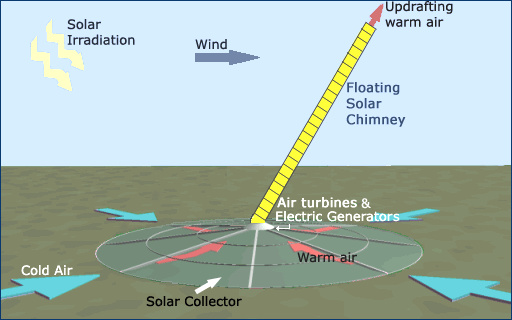
But what if you could fabricate your chimney on the ground in a factory, then float the chimney above your turbines and heat collector? Peswiki gives more details in a recent feature.

Given that the power producing natural phenomenon is based on the thermal air stream moved through the internal space of the chimney, the aim is not the chimney itself but the internal channel allowing the up drafting of the thermal air produced in its lower part by the solar collector’s greenhouse effect.

Instead of trying to solve problems of ground foundation, unbending, heavy and high cost solar chimney structures, it proceeds with a light structure, made of a set of lifting balloon rings filled with a lighter than the air gas and thus balancing the structure’s weight with the buoyancy forces. Thus the structure named FSC can be higher giving to its respective Power Plant higher efficiencies (up to 5% for FSCs up to 3 Km) with a much smaller construction cost. The respective solar collectors become smaller due to the higher efficiency and thus with lower costs.

The construction materials for these light structures are already in the market. Light structure problems at this scale have been solved in a variety of other projects already constructed.

The proposed innovation constitutes the backbone of the proposed “Solar Aero-Electric Power Plants” (SAEPS) that may demonstrate construction costs ranging between 400 ÷ 700 USD/KW or even less producing at least 3000 KWh/per year per rated KW. Thus the production cost of KWh by these SAEPPs could be less than 1.5 cents of USD.

[edit]Cost
Using the example of a FSC Power Station of 100 MW of a construction cost between 30 millions € to 60 millions € and of an annual production to 300 GWh and furthermore estimating the average selling price of its renewable KWh to 0.07 € and its production cost to less than 0.02 €, the repayment period for the investment will be between 2 years to 4 years. This Floating Solar Chimney Power plant can operate easily, following the appropriate maintenance, for 30 years. [1] (http://www.floatingsolarchimney.gr/faq.htm)

Source.

This pdf document will give you all the information you need to consider the merits of this concept.

Solving the renewable energy problem and getting the world off its fossil fuel addiction, will not be easy are quick. But it can be extremely profitable for anyone who can do it--and that is why a lot of intelligent and resourceful people are being drawn to the renewable energy field.

Labels: ,

Bookmark and Share

05 September 2006

Breakthroughs in Solar Cell Technology from Australia and South Africa

Photovoltaic solar cells are poised for much greater utilisation, worldwide. According to The Energy Blog, the costs of solar power will be cut in half by 2010, and cost comparable to nuclear energy by no later than 2030.

News reports from researchers in Australia and South Africa suggest that the price reductions may even occur sooner than the predictions of mainstream energy analysts suggest. At the University of Queensland, plastics and nanotech crystals are replacing the silicon in the solar cells--greatly reducing potential production costs.

UQ Master of Physics student Michael Deceglie is working on improving the stability and overall efficiency of solar cells.

Mr Deceglie is testing two new ways of making solar cells out of dye-sensitized solar cell and a combined nanocrystal polymer solar cell.

The dye-sensitized cells use dye molecules to inject electrons into a thin titanium dioxide film while the polymer cell is a thin film of plastic mixed with microscopic crystals that channel the charge through the cell.

Mr Deceglie said both methods could produce solar cells that had similar efficiencies to current silicon technology but were cheaper more flexible, easier to produce and more environmentally friendly.

“Since electrons don't move well in the polymers, we incorporate nanocrystals with the polymer to provide a pathway along which electrons can move to generate electrical current,” Mr Deceglie said.

“The dye-sensitzed device works in a manner similar to phosynthesis in plants.”
Source.

South African researchers have developed another alternative approach to photovoltaic solar cells, using a unique metal alloy in flexible, very thin layers.

In a scientific breakthrough that has stunned the world, a team of South African scientists, led by Professor Vivian Alberts, has developed a revolutionary new, highly efficient solar power technology” and “The South African solar panels consist of a thin layer of a unique metal alloy that converts light into energy.”

The photo-responsive alloy can operate on virtually all flexible surfaces. The new panels are approximately five microns thick (a human hair is 20 microns thick) while the older silicon panels are 350 microns thick. Alberts claims the cost of the South African technology is a fraction of the cost for less effective silicon solar panels.”

This claim is corroborated in today’s story in the South Africa Mining Weekly, where alongside the report about Eskom’s solar thermal project there is this: “The University of Johannesburg’s Professor Vivian Alberts, from the department of physics, has developed solar panels that may just take this technology further into the main-stream, owing to the cost reductions he has achieved.

Alberts’ invention is five micro-metres thick, combining several semiconductor materials which are as effective, if not more so, than silicon. As it uses no silicon, costs are dramatically lower. It makes use of normal window glass as a substrate, with molybdenum applied as back contact, followed by the core component, being a compound semiconductor comprising five elements - copper, indium, gallium, selenium and sulphide, replacing the silicon - with cadmium sulphide as a buffer layer, followed by an intrinsic zinc oxide layer and, finally, a conductive zinc-oxide layer. The most expensive part of the panel is the glass,” said Alberts.
Source.

Hat tips to keelynet.com and what's next in scitech.

The high cost of solar cell grade silicon has driven the production costs of photovoltaics upward. But scientists and engineers are always looking for ways to improve technology, to get around the roadblocks to economic utilisation. See this Energy Blog article for information about a new silicon feedstock for photovoltaics.

When eminent scientists predict that something is impossible, they are almost certainly wrong. Thomas Kuhn merely reminded us of something that young innovators have known throughout human history--sometimes the older scientists with vested interests in the old ways of thinking have to die off, before humans can move on.

Labels: ,

Bookmark and Share
Newer Posts Older Posts
Al Fin Main Page
Enter your Email


Powered by FeedBlitz
Google
WWW AL FIN

Powered by
Blogger

``