12 May 2012

The Ultimate Zombie Apocalypse Escape Vehicle?

The following article is cross-posted from Al Fin Potpourri blog


When the zombie apocalypse hits, you may not have much warning to get out of town. Freeways and surface roads will be jammed to a standstill, and walking out of the city with zombies on the loose could be extremely dangerous. In such an event, you will want a method of urban exfiltration. Helicopters are generally considered the best method of fast evacuation, but a flying car or flying motorcycle ranks high on the list. The Pal-V personal flying road vehicle is an auto-gyro and a three-wheel motorcycle all in one. Here's more:
On the ground this slim, aerodynamic, 3-wheeled vehicle has the comfort of a car with the agility of a motorcycle thanks to its patented, cutting-edge, ‘tilting’ system. It can be driven to the nearest airfield and take off just like any other airplane. The single rotor and propeller are unfolded to make the PAL-V ONE ready to fly. When airborne, the PAL-V usually flies below 4,000 feet (1,200 m), the airspace available for uncontrolled Visual Flight Rules (VFR) traffic; so there will be no interference from commercial air traffic. Furthermore, the PAL-V is powered by a very robust, flight certified aircraft engine. It runs on gasoline. It can reach speeds of up to 180 km/h (112 mph) both on land and in the air. The PAL-V ONE has a very short take off and landing capability, making it possible to land practically anywhere. When not using controlled airspace, you can take off without filing a flight plan. Flying a PAL-V is like a standard gyrocopter. It is quieter than helicopters due to the slower rotation of the main rotor. It takes off and lands with low speed, cannot stall, and is very easy to control. The gyroplane technology means that it can be steered and landed safely even if the engine fails, because the rotor keeps auto rotating. _PAL-V
Escaping a Zombie-Infested San Francisco
The PAL-V One can reach speeds up to 112 mph. On the road, the PAL-V One has a range of 750 miles from its gasoline engine and in the air it has a range of up to 315 miles. It runs on gasoline like a conventional car, but there will also be versions that use biodiesel or bio-ethanol. _Inhabitat
In a world of zombies, there are very few second chances. Best to plan ahead.

Labels: , , ,

Bookmark and Share

18 July 2011

Burt Rutan's BiPod Roadable Aircraft

Images via AviationWeek
Just as Terrafugia's roadable aircraft is receiving government approval for driving on the highway, Burt Rutan is experimenting with a twin-cockpit version of his own roadable aircraft: the BiPod.
The Model 367 BiPod is a two-seat, hybrid-electric roadable aircraft. Originally conceived as a rapid, low-cost electric testbed, the effort evolved into a flying car and was accelerated to allow Rutan, a long-time advocate of personal electric aircraft, to see the vehicle completed before his retirement.

The BiPod was brought from preliminary design to its first flight on 30 March 2011 in just four months. So far, the aircraft has made several short hops along the main runway at Mojave, California, each time propelled briefly into the air by building up speed using the battery-powered driving wheels. The electric-powered propellers are not yet installed. _AviationWeek

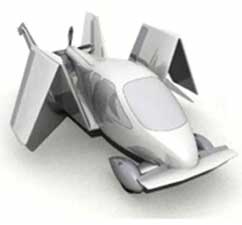
These views are images of what the roadable aircraft is likely to look like at a more advanced stage of development. You can see the engine placement most clearly in the image below.
The photographs are from an exclusive provided to Aviation Week magazine by Scaled Composites, Rutan's company.

Roadable aircraft are likely to be popular with multiple groups of people, from small business owners and salespersons who need to travel medium distances regularly for work, to ordinarily affluent persons who want a quicker and more trouble-free way to get to the beach or lake cabin, to longer-distance commuters, to the status seeker and early adopter who just wants another notch on his belt. And don't forget the survival advantages of being able to get out of a dying city when all the freeways and suface streets are gridlocked.

An EU attempt to clear up city streets and take commuting to the sky is called the myCopter. The US Defense Department's DARPA is also trying to get into the roadable flyer market, on a different level.

Once one roadable aircraft has succeeded, expect many more to try to push into the market. And how long before a Chinese flying car hits the virtual skies? Stay safe up there.

Labels: ,

Bookmark and Share

13 July 2010

Another Entry in DARPA's Flying HumVee Competition

Just after the new year, DARPA put out a broad agency announcement requesting a flying car, specifically a one-to four-person, vertical takeoff and landing-capable vehicle that can negotiate off-road conditions as well as take to the skies. Today, Fort Worth-based AVX Aircraft has responded with a proposal, releasing some mock-ups of a dual-rotor, ducted-fan driven aircraft that’s also road-ready.

AVX says the four-seater will be able to carry a 1,040-lb. payload 250 miles on a single tank of fuel, peaking at 80 miles per hour over land and 140 miles per hour in the air. It’s coaxial rotor design would certainly satisfy the vertical take-off and landing requirement, and at least the sketches make it look off-road rugged. Unfolding the rotor blades for flight should convert the vehicle from road warrior to aircraft in just one minute. _PopSci
The Fort Worth-based company says the four-seat vehicle will carry a 1,040lb payload, reach 80mph on the road (using the ducted fans to augment electric wheel drive) and 140mph in the air, take off and land vertically, cruise at 10,000ft altitude at max gross weight and travel 250 miles on one tank of fuel.

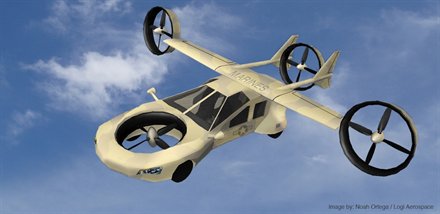
Conversion from road to flight mode will take 60 seconds, says AVX - basically unfolding the rotor blades. The design certainly looks simpler than Logi AeroSpace's Tyrannos, which has a foldable wing and tilting shrouded propellers. _AviationWeek

The AVX design is competing with the Logi Aerospace Tyrannos design pictured below. The Logi design relies entirely upon relatively unproven ducted fan propulsion units, whereas the AVX design is based upon a more conventional counter-rotating helicopter prop design.
The Tyrannos is a four-seat vertical take-off and landing roadable aircraft powered by a supercharged racing engine driving a generator and a battery pack. These drive electric motors on the wheels for road use and four variable-pitch shrouded propellers for flight. On the road, the wings fold back against the tail booms. The ducted prop in the nose is fixed at -12deg incidence while the other three pivot from horizontal for vertical flight to vertical for forward flight. _AviationWeek

Roadable aircraft and flying cars (or HumVees) provide a more versatile mobility for sportsmen and survivalists, in addition to their potential military applications. Adding the ability to land and take off on water as well as land, provides an even greater mobility.

Some of the competitors for the DARPA contract may eventually decide to build a civilian model, once they prove the concept and establish that a market exists. The likely success of Terrafugia should provide a positive example on that account.

Labels: , , ,

Bookmark and Share

01 July 2010

Flying Cars and Motorcycles Set You Free


Larry Neal's motorcycle / autogyro kits have been sold and flown for several years. Watch it drive around town, and fly above town, in the video above.

Terrafugia's Transition is now certified as a Light Sport Aircraft by the US FAA, which makes it much easier for novice pilots to get licensed to fly it. Watch it fly in the above video. The company is taking deposits for new planes, and plans to begin delivering finished models to new owners next year.

The Parajet Automotive Skycar is expedition tested. Watch it fly above the desert in the video above.
The Ramphos flying boat can also travel awkwardly on land.

An optimal escape craft would allow travel on all surfaces -- mud, sand, water, pavement, ice, snow -- plus provide full flight capabilities. Submersible travel safely down to 300 metres would be a big plus.

Hovercraft with flight and submersible capabilities would be ideal.

Check out Gizmag's roundup of flying cars and cycles

Labels: , , ,

Bookmark and Share

18 January 2009

Terrafugia Transition: Virgin Flight in 1 Month


The Terrafugia Transition flying automobile is scheduled for initial flight testing in February of this year -- next month.
Carl Dietrich, who runs the Massachusetts-based Terrafugia, said: “This is the first really integrated design where the wings fold up automatically and all the parts are in one vehicle.”...The Transition...is powered by the same 100bhp engine on the ground and in the air.

Terrafugia claims it will be able to fly up to 500 miles on a single tank of petrol at a cruising speed of 115mph. Up to now, however, it has been tested only on roads at up to 90mph.

Dietrich said he had already received 40 orders, despite an expected retail price of $200,000 (£132,000). _Times
This design has a good chance of being successful. The wing folding and unfolding will need to be foolproof, and driving visibility cannot be obstructed by airfoils. The engine must be of highest quality and highly reliable.

Al Fin's requirements for a full function vehicle remain the same: it must be able to fly above the weather, cruise on a water surface, travel submerged like a submarine, move swiftly over highways or all off-road terrain. It should be able to land on either water or firmer surfaces including sand, salt flat, snow, and ice. And the vehicle should provide for comfortable overnighting in virtually any climate. Is that really asking for so much?

Labels: , ,

Bookmark and Share

23 November 2008

Inflatable Wing Version of Flying Car

Take a careful look at the basic design of the Parajet "flying car." Only minor modifications would be necessary to allow the vehicle to skim across the surface of a lake, river, or snowfield. The rear propeller design already serves for all manner of craft, such as airboats, hovercraft, and ultralight flying craft.
In fly mode, the the Skycar will take off at 35 mph from any airstrip longer than 650 feet. It will hit a top speed of 68 mph and a cruising altitude of 2,000 to 3,000 feet and a max altitude of 15,000 feet -- though we don't know who's be brave enough to venture so high, given that hypoxia and altitude sickness become an issue at 10,000 feet if you aren't in a pressurized cabin. Range is 185 miles.

Flip the car to drive mode, which takes three minutes, and you're looking at a rear-wheel-drive vehicle the company says will do zero to 60 in 4.5 seconds and top out at 100 mph. _Wired
More versatile wing technology should accompany advances in nanotech materials engineering. We already have "paper" that is stronger than steel (in some dimensions). It becomes easy to imagine an inflatable wing made of nano-materials that is stronger than current wing designs--while being adaptable to changing flight conditions.The above Milner Motors AirCar is another candidate for the first reliable, affordable, flying car. The AirCar design is imaginative and photogenic, but no one knows how reliable it will be or whether it can live up to its ambitious flight specs. But notice the duel rear fan thruster design, which could potentially be adapted to other modes of transport for the same vehicle.

A time may come when you will want to make a quick getaway without being stuck behind miles of stalled freeway traffic. Imagine the sense of freedom, to be able to fly to the bugout location of your chapter of the Society for Creative Apocalyptology©, high above the madding crowds.

Labels: , ,

Bookmark and Share

07 January 2008

Personal Gyrocopter fromScappoose, Oregon

Gyrocopters--or autogyros--were invented in the early 1920s. Although they look like helicopters, they are actually more like airplanes--rotary wing airplanes. Sportcopter Inc., of Scappoose, Oregon, is flight-testing the sporty looking Sportcopter "Sport".
The cabin and engine of the Super Sport are completely enclosed, with removable doors and engine cowling, giving it all-weather capability, simplified maintenance, aerodynamic streamlining, added propeller efficiency and effective protection of vital components.

The engine and drive train is a special Subaru 2.5 liter liquid cooled engine which develops 190 hp.... A new Sport Copter feature on this design is a very Powerful Prerotator System which will allow incredibly short take-offs.

The large rudder and horizontal stabilizer provide stability in slow flight maneuvering and high-speed cruise, minimizing pilot workload. The fixed vertical stabilizer is less sensitive in-flight giving more stability and better handling....
Sportcopter Inc.
Powering the gyroplane forward using the front or rear-mounted thrust propeller causes air to flow over the top rotor, which begins spinning and develops enough lift to get the vehicle airborne. This doesn't take a long runway - as little as 40 feet is needed to develop enough upward lift to get off the ground, and it's possible using aftermarket kits to perform jump-style takeoffs with no ground roll at all.

Gyroplanes can cruise at roughly the speed of a helicopter, or float along so slowly you'd nearly call it hovering. The powered top rotors of helicopters cause a torque reaction that necessitates the use of a sideways-mounted tail rotor to control rotation – which makes them mechanically complicated, expensive and quite tricky to fly. The gyroplane's design is so simple that you can buy one for less than the cost of a touring motorcycle, build it and maintain it yourself.

...A range of between 300 and 400 miles from a 30 gallon tank full of ordinary 87 octane unleaded makes the Super Sport a good day tripper, and it should be good for thrills as well with a top speed in excess of 100mph.
Gizmag
As an alternative to the "flying car", the flying motorcycle incorporates an autogyro design. From the Dutch company PAL-V:
This hybrid vehicle will be able to reach speeds of 200 km/h (125 mph) both on land and in the air, requiring only a short runway of about 100 meters (330 feet) for take off and landing. Expected to be launched in 2009, this unique vehicle enables commuters to leap over traffic jams on their way to work....The Gyrocopter will run on regular petrol and most of the vehicle's components originate in the automotive industry rather than the more expensive aviation industry. In this way, both purchase and maintenance costs can be kept relatively low (although PAL-V has not published an exact cost estimate yet).
Source

Here is another approach to the flying motorcycle.

A hybrid motorcycle/gyrocopter will be a fine combination, once the glitches are smoothed away from the design. Enlarging the folding rotor-wing design to create an automobile/gyrocopter hybrid should not be difficult, with time. And on we go . . .

Labels: ,

Bookmark and Share

11 September 2006

Flying Cars, Better Batteries, Revolutionary Engine, Adjusting to Climate Reality

MIT engineering student Carl Dietrich is continuing to develop his flying car. Dietrich recently started the company Terrafugia to continue the development and marketing of the "roadable aircraft", as Dietrich likes to call it.

The Transition is designed for jumps of 100 to 500 miles. It will carry two people and luggage on a single tank of premium unleaded gas. It will also come with an electric calculator (to help fine-tune weight distribution), airbags, aerodynamic bumpers and, of course, a navigation unit with a global positioning system.


....Dietrich came up with the idea while a student at MIT's Department of Aeronautics and Astronautics. Earlier this year he won the Lemelson-MIT Student Prize, which recognizes invention and innovation. He also holds a patent for the centrifugal direct injection engine, a low-cost, high-performance rocket propulsion engine. Dietrich conducted his rocket engine research as an undergraduate at MIT.
Source.

The conventional wisdom on technological innovation is that it requires large teams of engineers working under the auspices of a large corporate research lab. That is of course rubbish. Take a recent significant improvement in the design of lead-acid batteries. Any half-way creative 8 year old given the proper education could have devised this patented improvement, daydreaming in the classroom.

# 4 times greater surface area for electroplates
# 60-68% efficiency (compared to 30-40% for conventional batteries)
# 30-50% smaller and lighter
# Environment friendly - Uses significantly less lead then typical lead-acid batteries
# Recharge quickly at any standard household outlet
# Utilizes same external case as conventional batteries
# Can instantly increase energy output and replace conventional battery with no retrofitting of vehicle
More details and links at source. A simple innovation that promises improvements on many fronts.

On the other hand, this revolutionary new engine required the effort of a distinguished professor of chemical engineering, and many graduate students.

* The StarRotor engine is projected to be very efficient (45-60%). By simply replacing conventional engines (15-20% efficiency) with a StarRotor engine, fuel economy will double or triple. For example, a conventional luxury car getting about 25 mpg on the highway would get about 75 mpg. A conventional economy car getting 40 mpg would get about 120 mpg.

* It should produce very low pollution. Advanced combustor technology reduces pollution, including unburned hydrocarbons, carbon monoxide, and nitrogen oxides.

* It has multi-fuel capability. Any liquid or gaseous fuel can be burned, including gasoline, kerosene, jet fuel, diesel, alcohol, methane, hydrogen, and even vegetable oil.

* It should be inexpensive to mass produce. The parts count of the engine is about 10% of a conventional automobile engine, and the majority of parts do not require complex machining.

* There should be no vibrations. All moving components are in pure rotation; there are no oscillating components therefore it is in balance.

* It should be quiet. Because the gas is fully expanded, there is low exhaust noise.

* The engine is expected to have a long life and low maintenance. The compressor and expander of the StarRotor engine have a slight clearance between the rotors, resulting in no friction or wear. Also, it should require very infrequent oil changes, perhaps every 100,000 miles. Because it has very few moving parts, it is expected to be very reliable and require very little maintenance.

* The engine should be smaller than conventional internal combustion engines. The StarRotor engine volume and mass are about half that of a conventional internal combustion engine. A 130-hp engine will occupy approximately 2 cubic feet.

* It should have a high turn-down ratio. The engine is efficient over a wide range of speeds and torques.

* The StarRotor engine should be easily scalable. Designs from 50 W to 50 MW are possible.
I encourage those of you with mechanical minds to visit the source website and think about the concepts involved. Lectures explaining this innovative engine are available at this link.

Finally, adjusting to climate reality. Frances Cairncross, president of the British Association for the Advancement of Science, says it is time to start learning to adjust to a warming world. The Kyoto Protocol is worthless, she suggests, and continuing to ignore the necessary adjustments that have to be made will only make conditions worse for humans and other living inhabitants of the globe.

On Monday Cairncross described the Kyoto protocol as "ineffectual" and called for the world to accept that "a hotter, drier world" is coming - even if everyone fulfils their obligations under Kyoto and pegs levels of carbon dioxide back below the 1990 baseline. "Adaptation policies have had far less attention than mitigation," she told the BA. “A hotter drier world is coming even if everyone fulfils their obligations under Kyoto.”

Now Cairncross is saying the UK should prepare for the inevitable by developing drought-resistant crops, constructing flood defences and perhaps even banning dwellings close to sea level. "We cannot relocate the Amazon or insulate coral reefs, so we need mitigation too, but the [UK] government could and should put in place an adaption strategy straight away," she said.
Source.

Mping at Fat Knowledge Blog presents a very thought provoking post dealing with levels of carbon dioxide in earth's past, and why CO2 may not be the boogeyman that so many evangelical proponents of catastrophic anthropogenic global warming try to portray it.

The earth's climate system is temporarily warming, although there is a lack of scientific consensus in explaining the cause of the warming. Climate models project a wide range of scenarios, in spite of the rampant "fudging" and "tweaking" involved.

Labels: , ,

Bookmark and Share
Older Posts
Al Fin Main Page
Enter your Email


Powered by FeedBlitz
Google
WWW AL FIN

Powered by
Blogger

``