01 July 2010

Flying Cars and Motorcycles Set You Free


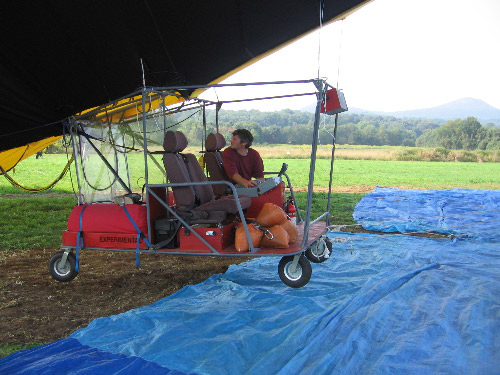
Larry Neal's motorcycle / autogyro kits have been sold and flown for several years. Watch it drive around town, and fly above town, in the video above.

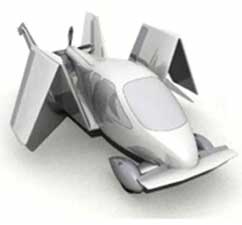
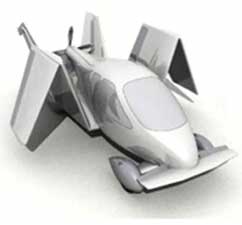
Terrafugia's Transition is now certified as a Light Sport Aircraft by the US FAA, which makes it much easier for novice pilots to get licensed to fly it. Watch it fly in the above video. The company is taking deposits for new planes, and plans to begin delivering finished models to new owners next year.

The Parajet Automotive Skycar is expedition tested. Watch it fly above the desert in the video above.
The Ramphos flying boat can also travel awkwardly on land.

An optimal escape craft would allow travel on all surfaces -- mud, sand, water, pavement, ice, snow -- plus provide full flight capabilities. Submersible travel safely down to 300 metres would be a big plus.

Hovercraft with flight and submersible capabilities would be ideal.

Check out Gizmag's roundup of flying cars and cycles

Labels: , , ,

Bookmark and Share

13 October 2009

Hovercraft Works Well Over Arctic Terrain

Scientists and explorers are discovering the utility of hovercraft for Arctic research and exploration. Equally adapt over snow, ice, water, mud, or dry land, the versatile craft allow you to keep going over ever-changing surface conditions.
Two polar scientists hot on the trail of an arctic mystery have a new tool for exploration: a hovercraft, specially outfitted for week-long trips over the ice with scientific instruments and solar panels.

Their quarry is a nearly 22,000 square-mile patch of disturbed Arctic sea floor that could be evidence of a massive asteroid strike. John Hall, a now-retired geoscientist, discovered the anomaly during his late-’60s graduate work aboard Fletcher’s Ice Island, a huge berg U.S. scientists inhabited for several decades.

Since then, no scientific vessel has been back over the area to collect more data. The massive icebreakers that have crunched through the Arctic since the 1990s can’t reach the spot, said Yngve Kristofferson, a scientist and explorer at the University of Bergen in Norway.

...“The neat thing with a hovercraft is that you drive with the same ease over 10 centimeter-thick ice as you do with five meter thick ice,” Kristofferson told Wired.com.

Despite their futuristic reputation, hovercraft have been commercially available for decades. The concept is actually quite simple. A big engine or turbine pumps air into a rubber skirt that allows the vehicle to tread lightly on whatever it’s touching. The R/H Sabvabaa, for example, weighs six tons but exerts no more pressure on any patch of ice than a seagull standing on one leg would by standing on it. The rest of the power from the engine is devoted to propulsion, allowing the craft to skip along at speeds up to 50 miles per hour. _Wired
Survival-oriented readers who anticipate the coming of a new Ice Age, will be particularly interested in the versatility of hovercraft travel.

Or consider the world after an EMP attack. Bridges over rivers would often become impassable due to congestion with undrivable vehicles. Major super-highways would become very long parking lots. Even if one could cross bridges and follow highways, in those conditions it might be wiser to bypass them -- for the sake of safety.

An ideal vehicle would be capable of all terrain travel, as well as running submerged, and intermediate distance flight. Hovercraft cannot fly and they cannot run submerged, but it takes time to design all the proper features into a craft -- and to develop the materials that allow such designs to function well.

Labels: , ,

Bookmark and Share

05 July 2009

Freedom For the High Seas and Beyond


The Aeroyacht 110 has been dubbed “the world’s most innovative super catamaran” by its designers and, while that’s a pretty big claim, it’s certainly an audacious concept. Capable of speeds of over 32 knots but able to cruise effortlessly at 20, boasting a superbly-appointed 32ft wide salon with 360º sea views and with its own fold-up amphibious plane as a tender, the Aeroyacht 110 looks to be the ne plus ultra of luxury sailing.

Designed from scratch by Gregor Tarjan, founder of Aeroyacht International, together with naval architect Pete Melvin, of the world-renowned Morrelli & Melvin multihull architects, the Aeroyacht 110 was designed from the outside-in. Tarjan started with the concept for a “pure sailing machine” and, once its streamlined shape was established, only then worked out how many people it could and should accommodate

The ICON amphibious craft on deck adds a completely new dimension of freedom to the maritime ensemble. All that is lacking is a small submarine. The decks appear ample for both a mini-sub and the small amphibious flier.

Perhaps the Aeroyacht people can correct that oversight by the time the super cat hits the market. The ability to roam on the sea, under the sea, and above the sea, is an absolute minimum of freedom for the advanced between levels human. For exploration on shore and throughout inland estuaries, a hovercraft may need to be included.

Labels: , , ,

Bookmark and Share

29 May 2009

100 mpg Spira With a Body Made of Foam

The three-wheeled 2 seater pictured here has a body made of foam. It only weights 300 pounds, and goes 100 miles on a gallon of gasoline. Its engine is only 110 ccs, but for city commutes it should get a person or two to a destination safely for little expense.
The Spira has been developed by its inventor Lon Ballard, largely around the properties of reinforced foam. Apart from the engine, wheels and lightweight aluminium frame, about 90 percent of the Spira's body is made from 6-inch thick foam, which can itself be made from renewable sources, like soybeans. The layers of foam are reinforced with fiberglass strips for extra strength.

The foam is so light that the entire weight of the Spira has been kept down to 302lb ( 137kg). For that you get a fully enclosed two-seater, with a 110cc scooter engine and three wheels, that will do 70mph comfortably on the freeway. The millions of air cells in the foam act as tiny airbags in a collision, giving both the occupants, and whatever they've crashed into, a good degree of protection.

The pointed front-end of the Spira is chosen for its aerodynamics and safety, although we're not sure how much we agree with the philosophy that "in a crash it is best to deflect and roll as in Judo", particularly when you're rolling on a crowded, chaotic Thai freeway. Still, crash testing is high on the priority list for the manufacturer.

If the thought of getting around in Thailand's humid heat in a fully enclosed vessel worries you, and the small slit of window you can open doesn't convince you, the entire roof of the Spira can be taken off to make it a sort of convertible. But then, you've got to leave the top at home - and you'd better have a strong noggin, because there's no roll bar on the prototype to support the "Judo roll" front-impact philosophy. Best to get something in place for that, I reckon.

A further unexpected benefit of a lightweight foam body is buoyancy. The Spira will happily float - which is great for all those occasions when your car ploughs into the water. It's not truly amphibious because there's no water drive system and the road-going componentry wouldn't be too fond of the drink in the long run - but still, I guess you could pack some oars, and there's no reason why a fully amphibious version can't be built sometime down the track. _Gizmag
Spira's makers should consider building a water-propulsion system, given that the vehicle should float so well.

As nanotechnology and materials science provide more advanced materials, engineers should feel more free to take their designs to the limit of what the new materials can do.

In an Obama depression, the temptation is to lie low and hope you have a job when the destruction finally ends. Perhaps a bit of daring is called for instead.

Labels:

Bookmark and Share

16 July 2007

We All Live in a Yellow Submarine

Many people own luxury yachts and houseboats, but very few people own luxury submarines for living aboard. That is the way the world's militaries would like it to remain, but times are changing nonetheless.

US Submarines builds a variety of civilian subs for many purposes. Their most luxurious sub, priced at US $80 million, is the Phoenix 1000. Now that is a sub that almost anyone could live aboard. US Subs Seattle 1000 is smaller, costing only US$20 million.

The Integrity Subs model 68 also provides comfortable living conditions for a far lower cost, around US$ 5 million. Operational depth and range are more restricted than with the US Subs luxury submersible, however.

As the world sees more billionaires--particularly ones with a sense of adventure intact--you can expect to see them trying to outdo each other in adventure and luxury. This will take them places most people never go, such as the underseas, the high atmosphere, and into outer space.

Here is an interesting description of a US Submarines design for an "ambient pressure undersea habitat." Such habitats would not require special breathing gases nor decompression time. They would have to be designed differently than typical undersea habitats up until now, but the advantage of allowing untrained personnel to inhabit them would no doubt draw a large tourist crowd.

The undersea world contains many riches. Not nearly as many as the asteroid belt and the rest of the solar system, but then the undersea world is more accessible. It is likely that some of the billionaires who approach the submarine world as a novelty, may decide to invest there more seriously.

Labels: , ,

Bookmark and Share

10 July 2007

Hobie Makes a Kayak Trimaran With Pedal Propulsion

This nifty one-person sail kayak has trimaran stability and pedal/flipper drive. The outriggers are retractable and the sail is fully reefing.
The Hobie Mirage Adventure Island is a 16-foot, single-person “Sail/yak” that combines the Hobie MirageDrive pedal-propulsion system with a 5.38 square meter sail and two amas (outriggers) that provide stability on the water and fold back into the hull for docking and beaching.

The newest edition to the Hobie line-up has a mast height of 15’2” (4.62m), weighs 115lbs (52.16kg) when fully rigged and can carry 350lbs (159kg). With the amas extended the craft is 112” (2.84m) wide, reducing to 42” when folded.

....The Hobie MirageDrive system employed in the company’s range of kayaks is a pedal/flipper mechanism that swings laterally underneath the hull like a penguin's fins to produce forward drive. Steering is via a hand-controlled rudder that can be retracted to the horizontal when not in use.
Source
Check out this video from Hobie that demonstrates the sail-yak in action!

I'm looking forward to getting one of these fun toys in the surf and seeing how she handles.

Labels: ,

Bookmark and Share

27 June 2007

If Only It Could Fly!

Sure, it can drive on the highway at speeds up to 100 mph, and it can skim the surface of the water at up to 30 mph--pulling a water skier. But for my needs, it should also fly 1500 miles at 250 knots. One more thing--it really should be able to submerge to a depth of 100 meters with an underwater range of 500 miles.

The instrument panel would have to be flat panel computer screen--software transformable between instruments for flying, driving, boating, and submarining.

I feel that I am not really asking for a lot, and I am certain that many of you agree with me.

Labels: ,

Bookmark and Share

The Ultimate Thrill Sport

Space diving is like sky diving, except higher, faster, and scarier. The only thing between you and vacuum is your space suit--made to shield you from the heat of re-entry.

This post gives more details.

Jumping out of a plane is scary enough, but jumping out of a spaceship in vacuum? That separates genuine thrillseekers from big talkers. Anyone can buy a ticket from Virgin Galactic or Blue Origin. But can they leave their spaceship at the peak of its trajectory, and return on their own?

It really comes down to the reliability of the space suit/individual re-entry vehicle, does it not?

Labels:

Bookmark and Share

09 April 2007

Submariners Do It Deeper

First it was Peter Robbins and his beautiful submarine. Then the company UBoat Worx began production of their sporty personal submarines, pictured above.

Now, Spanish designer Guillermo Sureda-Burgos has designed the subs pictured above. More information on the sleek design can be found here.


The most impressive personal sub of all, is the US Submarines deluxe model pictured above. Costing US $80 million, the submarine will be made explicitly for the billionaire who really does have everything.
The top of the line model is the Phoenix 1000, which at 213 feet (65.0 m) is just 8 metres short of the elephantine Airbus A380. On the surface it looks and acts very much like a normal yacht, with a flybridge and a deck for catching some sun, and a top speed of 17 knots.

But if the wind should pick up, and your stomach start to turn from riding the waves, all you have to do is dive, all the way to 1000 feet (305 m) if you want to, and enjoy the peace and quiet of the deep. And if that isn't deep enough for you, you can jump into the mini-sub and descend a further 300 metres.

....Range isn't much of a problem either, as it will easily take you across the Atlantic without pit stops. The oxygen reserves will last you for almost a month. In case of nuclear war, this would have to be the perfect get away vehicle.
Source

The perfect get away "in case of nuclear war"? Perhaps also the perfect get away in case of any number of other near existential catastrophes. All the same, it would be best to plan to expand not only undersea, but into the rest of the solar system. The best real estate may not be taken after all.

Labels: , ,

Bookmark and Share

20 February 2007

Rapid Ascent for Rescue and Assault Teams

As a climber and spelunker, I have reason to utilise "jumar" climbing devices from time to time. But firefighters and military/police assault teams often need to ascend several hundred feet very rapidly--more rapidly than even climbing stairs, much less using jumars. MIT engineering students have developed a rapid ascending device that allows the lifting of a 250 pound weight 30 stories (300 feet ++) at ten feet per second--or about 30 seconds.
The students founded a company, Atlas Devices, based in Cambridge, MA, to commercialize the device, which is about the size of a power drill. Nathan Ball, Atlas's chief technology officer, says that such a device has never been made before because the batteries and motors needed to generate enough power for rapid rope ascents have been bulky and heavy. Atlas's 20-pound machine uses a fast-charging, high-power-density lithium-ion battery made by A123 Systems, based in Watertown, MA. (See "More Powerful Batteries.") To use the device, a soldier or rescue worker wraps a rope around its cylinder and clips it to a harness worn around the waist.
Source.

The next time I find myself several hundred feet down a vertical cave, I will no doubt use jumars to ascend. But I'll be wishing I had something faster.

Labels: , ,

Bookmark and Share

11 February 2007

My Very Own Submarine For Christmas?

One can always hope, anyway. While Peter Robbins achieved his lifelong dream when he designed and oversaw the construction of his beautiful submarine, what are the rest of us to do?

That question has an easier answer, now that U-Boat Worx has a new line of personal submarines in production. The C-Quester model can dive to 50 meters and cruise submerged on electric propulsion for two and a half hours. The pressure hull keeps the pilot dry and at reasonable pressure, without requiring decompression. The price tag is US $85,000.

That price should fall well within the range of many affluent adventurers, and high end ocean resorts. Universities with marine studies departments may also want to look into possible external robotic add-on devices for collecting samples.

Labels: ,

Bookmark and Share

30 December 2006

For My Birthday Next Year . . .

. . . I would like a personal blimp.

The experimental aircraft, which has been in the works for about five years, still needs at least one more year of research and development. The current design doesn't yet live up to the company's standards of quiet flight.

In initial flight tests, Alberto uses a conventional gas-powered motor. Once the early tests are done, the airship will be fitted with electric motors, along with quieter hot-air burners.

Although a number of design refinements, as well as FAA certification, lie ahead, Skyacht says it expects the airship to be priced between $100,000 and $200,000.

That's about the cost of a new, small airplane and much less the the $2 million price tag on the cheapest helium airships, to say nothing of the $12 million for a high-end Zeppelin NT, according to the company.


So you see, it is quite affordable, and quite useful as an observation platform for surveying all your domains.

While I am still holding out for a universal vehicle that I can drive on the highway, fly like a plane, power over the water like a hydrofoil, and dive under the water like a submarine--I am not averse to using separate vehicles for each function while I am waiting for the combo.

Hat tip Impact Lab

Labels:

Bookmark and Share

26 December 2006

Peter Robbins and His Beautiful Submarine

Peter Robbins had wanted his own submarine since his teenage years.
Q: How old were you when you first dreamt of having your own submarine?

Peter Robbins: I was about 15 years old. I'd flunked out of a whole bunch of schools, and my father had sent me to Tabor Academy in Marion, Massachusetts. It was an honor naval school. During my time there, I got a summer job at Woods Hole [Oceanographic Institution], and I just got fascinated with the ocean. When I graduated from Tabor, I wanted to go into a program where you started in the navy as an enlisted man and then went to Annapolis to become a submarine officer. But I didn't get a chance to do that. Life didn't give it to me that way. So I said, "Someday when I retire, if I have enough funding, I'll get a submarine going." That's what started the whole idea.
Source.

The PBS NOVA special documented the story of the Alicia, Robbins' beautiful submersible. There is currently a short preview video here, but within the next month, PBS should put the full documentary up for viewing at this website.

Currently, the Alicia is at work off the Plymouth, England, coast, conducting tours for the National Marine Aquarium. For a spectacular online short film documenting some of the building of Alicia, and an English Channel dive looking for a submarine wreck, go to this context.tv website and click on the promo trailer link or screen. Interviews are in English, narration is in German, and the photography is excellent.

Peter Robbins' story is inspiring. Watching the fulfillment of Robbins' quirky dreams should give others encouragement that perhaps their own unconventional dreams are not completely out of reach.

Labels: , ,

Bookmark and Share

25 October 2006

Expecting More from Our Cars

Maybe it was all the James Bond films. The floating cars, the submarine cars, the flying boats, and so on. We simply want our transportation devices to do more than one thing.

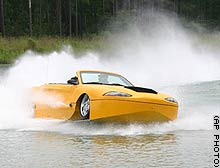
Take the new Hydra Spider super fast floating car.

With its snazzy snout, convertible top, Corvette V8 engine and jet "impeller" -- the stainless-steel cone protruding from the rear that propels it through water -- the Hydra Spyder is poised to become the first, mass-produced amphibious automobile in America.

"It's incredibly nimble in the water. The Spyder turns smoothly, docks easily," the 46-year-old inventor boasts.

It has one shortcoming, he concedes. On the water, "the parallel parking really sucks."

Giljam tingles at the idea of anglers taking their cars out on lakes for a day of fishing; of rush-hour commuters bypassing congestion by taking a river as an alternate route; of water-skiers bouncing along in the wake of a speedboat with four wheels.

Or take the flying car presently under development by former MIT engineering student Carl Dietrich and his company Terrafugia. Sooner or later, someone will develop a comfortable road car that also flies.

My personal choice would be a flying car that could also travel submerged like a submarine, or like a hovercraft over water, mud, or ice. It would have to also function as a motorhome, for overnight trips. I do not think I am asking too much, not really. At least I didn't ask for a built in warp drive or time machine. Not yet, anyway.

Labels:

Bookmark and Share

11 September 2006

Flying Cars, Better Batteries, Revolutionary Engine, Adjusting to Climate Reality

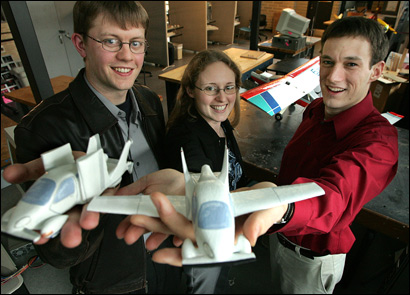
MIT engineering student Carl Dietrich is continuing to develop his flying car. Dietrich recently started the company Terrafugia to continue the development and marketing of the "roadable aircraft", as Dietrich likes to call it.

The Transition is designed for jumps of 100 to 500 miles. It will carry two people and luggage on a single tank of premium unleaded gas. It will also come with an electric calculator (to help fine-tune weight distribution), airbags, aerodynamic bumpers and, of course, a navigation unit with a global positioning system.


....Dietrich came up with the idea while a student at MIT's Department of Aeronautics and Astronautics. Earlier this year he won the Lemelson-MIT Student Prize, which recognizes invention and innovation. He also holds a patent for the centrifugal direct injection engine, a low-cost, high-performance rocket propulsion engine. Dietrich conducted his rocket engine research as an undergraduate at MIT.
Source.

The conventional wisdom on technological innovation is that it requires large teams of engineers working under the auspices of a large corporate research lab. That is of course rubbish. Take a recent significant improvement in the design of lead-acid batteries. Any half-way creative 8 year old given the proper education could have devised this patented improvement, daydreaming in the classroom.

# 4 times greater surface area for electroplates
# 60-68% efficiency (compared to 30-40% for conventional batteries)
# 30-50% smaller and lighter
# Environment friendly - Uses significantly less lead then typical lead-acid batteries
# Recharge quickly at any standard household outlet
# Utilizes same external case as conventional batteries
# Can instantly increase energy output and replace conventional battery with no retrofitting of vehicle
More details and links at source. A simple innovation that promises improvements on many fronts.

On the other hand, this revolutionary new engine required the effort of a distinguished professor of chemical engineering, and many graduate students.

* The StarRotor engine is projected to be very efficient (45-60%). By simply replacing conventional engines (15-20% efficiency) with a StarRotor engine, fuel economy will double or triple. For example, a conventional luxury car getting about 25 mpg on the highway would get about 75 mpg. A conventional economy car getting 40 mpg would get about 120 mpg.

* It should produce very low pollution. Advanced combustor technology reduces pollution, including unburned hydrocarbons, carbon monoxide, and nitrogen oxides.

* It has multi-fuel capability. Any liquid or gaseous fuel can be burned, including gasoline, kerosene, jet fuel, diesel, alcohol, methane, hydrogen, and even vegetable oil.

* It should be inexpensive to mass produce. The parts count of the engine is about 10% of a conventional automobile engine, and the majority of parts do not require complex machining.

* There should be no vibrations. All moving components are in pure rotation; there are no oscillating components therefore it is in balance.

* It should be quiet. Because the gas is fully expanded, there is low exhaust noise.

* The engine is expected to have a long life and low maintenance. The compressor and expander of the StarRotor engine have a slight clearance between the rotors, resulting in no friction or wear. Also, it should require very infrequent oil changes, perhaps every 100,000 miles. Because it has very few moving parts, it is expected to be very reliable and require very little maintenance.

* The engine should be smaller than conventional internal combustion engines. The StarRotor engine volume and mass are about half that of a conventional internal combustion engine. A 130-hp engine will occupy approximately 2 cubic feet.

* It should have a high turn-down ratio. The engine is efficient over a wide range of speeds and torques.

* The StarRotor engine should be easily scalable. Designs from 50 W to 50 MW are possible.
I encourage those of you with mechanical minds to visit the source website and think about the concepts involved. Lectures explaining this innovative engine are available at this link.

Finally, adjusting to climate reality. Frances Cairncross, president of the British Association for the Advancement of Science, says it is time to start learning to adjust to a warming world. The Kyoto Protocol is worthless, she suggests, and continuing to ignore the necessary adjustments that have to be made will only make conditions worse for humans and other living inhabitants of the globe.

On Monday Cairncross described the Kyoto protocol as "ineffectual" and called for the world to accept that "a hotter, drier world" is coming - even if everyone fulfils their obligations under Kyoto and pegs levels of carbon dioxide back below the 1990 baseline. "Adaptation policies have had far less attention than mitigation," she told the BA. “A hotter drier world is coming even if everyone fulfils their obligations under Kyoto.”

Now Cairncross is saying the UK should prepare for the inevitable by developing drought-resistant crops, constructing flood defences and perhaps even banning dwellings close to sea level. "We cannot relocate the Amazon or insulate coral reefs, so we need mitigation too, but the [UK] government could and should put in place an adaption strategy straight away," she said.
Source.

Mping at Fat Knowledge Blog presents a very thought provoking post dealing with levels of carbon dioxide in earth's past, and why CO2 may not be the boogeyman that so many evangelical proponents of catastrophic anthropogenic global warming try to portray it.

The earth's climate system is temporarily warming, although there is a lack of scientific consensus in explaining the cause of the warming. Climate models project a wide range of scenarios, in spite of the rampant "fudging" and "tweaking" involved.

Labels: , ,

Bookmark and Share

26 February 2006

Flying Cars, Swimming Planes--I Want One that Does Them All

JW Bats of Our Technological Future Blog reports on the "Flying Car Project" at MIT. Here is the link to the newspaper article describing the project. Carl Dietrich is a 28 year old aerospace engineer with a record of innovation.

''People tend to smirk when you say you're trying to make a flying car: 'Oh, you're one of those guys.' " But, he insisted, ''This isn't just another flying car concept. We're very serious about producing a flying car and selling it."

Few who know Dietrich would bet against him. Even by MIT's standards, he is considered a standout -- so much so, in fact, that today he will be announced as the winner of the $30,000 Lemelson-MIT Student Prize. An outside panel of scientists and technologists chose Dietrich for his ''portfolio of novel inventions," including not just the flying car but also a desktop-size fusion reactor and a lower-cost rocket engine.


I wish Dietrich and his team the best of luck, since they plan to begin manufacturing the flying car in 2009. This other fellow has been trying to get his flying car ready for production and marketing for a long time.

CNN.com has an interesting story about a swimming plane that will be launched from a submarine 150 feet below the ocean's surface. The plane will swim to the surface and take off for its flight. At the end of its flight, the plane will land on the ocean and wait to be picked up by a robotic underwater vehicle..

The Cormorant, a stealthy, jet-powered, autonomous aircraft that could be outfitted with either short-range weapons or surveillance equipment, is designed to launch out of the Trident missile tubes in some of the U.S. Navy's gigantic Cold War--era Ohio-class submarines.

....The tubes are as long as a semi trailer but about seven feet wide -- not exactly airplane-shaped. The Cormorant has to be strong enough to withstand the pressure 150 feet underwater -- enough to cave in hatches on a normal aircraft -- but light enough to fly.

....The craft is made of titanium to resist corrosion, and any empty spaces are filled with plastic foam to resist crushing. The rest of the body is pressurized with inert gas. Inflatable seals keep the weapon-bay doors, engine inlet and exhaust covers watertight.


The Cormorant does not shoot out of its tube like a missile. Instead an arm-like docking "saddle" guides the craft out, sending it floating to the surface while the sub slips away. As the drone pops out of the water, the rocket boosters fire and the Cormorant takes off.

After completing its mission, the plane flies to the rendezvous coordinates it receives from the sub and lands in the sea. The sub then launches a robotic underwater vehicle to fetch the floating drone.


Here is the thing: I would like a car that can function as a camper, can swim on the water's surface, can dive like a submarine, and can fly like a plane. Engineers are beginning to think out of the box--just a little. But not nearly enough.

It is not a good sign that engineering enrollment in North America has declined. Although India and China can certainly produce top notch engineers, the jury is still out as to whether engineers trained in Asia are as innovative as European and North American trained engineers. We will all hope so, given the trends.

By the way, I have posted on the issue of declining engineering enrollments here, here, here, and here. It is one thing to wish nature had done things differently, it is quite another to base the future of your society on that wishful thinking, when you know it is not true.

Labels: ,

Bookmark and Share
Older Posts
Al Fin Main Page
Enter your Email


Powered by FeedBlitz
Google
WWW AL FIN

Powered by
Blogger

``