23 July 2012

Inflatable Reentry Heat Shield Survives Hypersonic Test

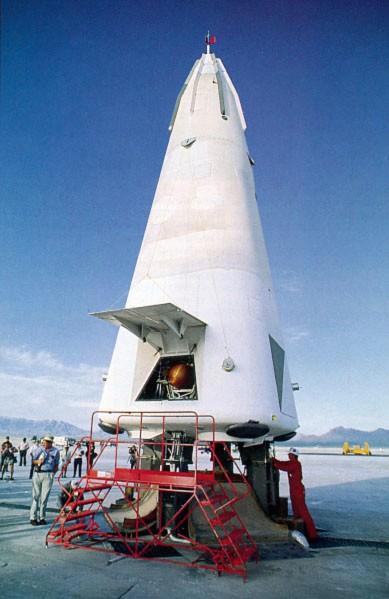
IRVE-3, a cone of uninflated rings covered by a thermal blanket of layers of heat-resistant materials, launched from a three-stage Black Brant rocket for its suborbital flight. About six minutes into the flight the 680lb inflatable aeroshell, or heat shield, and its payload separated from the launch vehicle’s 22in-diameter nose cone about 280 miles over the Atlantic Ocean.

An inflation system pumped nitrogen into the IRVE-3 aeroshell until it expanded to almost 10ft in diameter. Then the aeroshell fell at hypersonic speeds through Earth’s atmosphere.

Engineers in the Wallops control room watched as four on-board cameras confirmed the inflatable shield held its shape despite the force and high heat of re-entry. Onboard instruments provided temperature and pressure data, and researchers will study that information to help develop future inflatable heat shield designs.

After its flight, IRVE-3 fell into the Atlantic Ocean off the coast of North Carolina. From launch to splashdown, the flight lasted about 20 minutes. _Engineer

An inflatable heat shield might lend more versatility to reentry vehicle design. This type of research may also provide valuable data to hypersonic flight engineers and designers.

More from Universe Today:
A prototype for a large inflatable heat shield that could one day be used for landing large payloads on Mars was tested successfully on July 23, 2012, surviving a hypersonic speeds through Earth’s atmosphere. The Inflatable Reentry Vehicle Experiment (IRVE-3) traveled at speeds up to 12,231 km/h (7,600 mph) after launching on a sounding rocket from NASA’s Wallops Flight Facility on Wallops Island, Virginia.

“We had a really great flight today,” said James Reuther, deputy director of NASA’s Space Technology Program, after the test flight. “Initial indications are we got good data. Everything performed as well, or better, than expected.

IRVE-3 is a cone of uninflated high-tech rings covered by a thermal blanket of layers of heat resistant materials. NASA said the purpose of the IRVE-3 test was to show that a space capsule can use an inflatable outer shell to slow and protect itself as it enters an atmosphere at hypersonic speed during planetary entry and descent, or as it returns to Earth with cargo from the International Space Station. A larger version has been proposed for landing larger payloads on Mars, such as future human missions.

Watch the video from the flight below. _Universe Today


More from Popsci

Mastering the perils of hypersonic atmospheric flight and reentry is one of the large challenges confronting the coming human expansion into space. Up until now, it has been difficult to find the optimal outer skin for re-usable hypersonic and reentry craft. But given the potential rewards of developing outer space resources and infrastructure, such obstacles are not likely to hold back aerospace engineers for long.

Labels: , ,

Bookmark and Share

28 September 2009

Kicking the Dead End Kids Out of the Cradle

Unemployment for young Americans is now over 52%! Bad government policies such as minimum wage and "living wage" are inflating an already bad employment problem.
...millions of Americans are staring at the likelihood that their lifetime earning potential will be diminished and, combined with the predicted slow economic recovery, their transition into productive members of society could be put on hold for an extended period of time.

And worse, without a clear economic recovery plan aimed at creating entry-level jobs, the odds of many of these young adults -- aged 16 to 24, excluding students -- getting a job and moving out of their parents' houses are long. Young workers have been among the hardest hit during the current recession -- in which a total of 9.5 million jobs have been lost. _Post
Since Social Security relies upon a steady supply of FICA tax payments from young workers to keep the sinking old age pension afloat, it is not just the young unemployed who will be punished by foolish and corrupt government leaders.

What will you do with all the unemployed young people who should be learning good work practices, and building a nest egg for their future lives? How many will turn to gangs, drugs, crime, welfare, and other wastes of youthful potential?

The answer is to kick the dead end kids out of the cradle. Give them a challenge that provides a chance for a real payday at the end. Stop pampering and sheltering the young ones to death, and teach them the meaning of challenge and risk / benefit.

Western culture has drifted into a socialist quagmire of central planning and top-down regulation. Maximise security, minimise risk and individual initiative. In the end, you have a stagnant cesspool of wasted life potential. There is no future under the stifling universal controls of ubiquitous government. There is only the strangulation of hope and dreams.

Everyone needs to hold the image of a vibrant future in their minds -- but the young are in particular need of an expansive and exciting future. Government controls, restrictions, regulations, taxes, mandates, and creeping bureaucracy are drowning the hope for that exciting future under an ocean of debt, red tape, and prohibition.

Perhaps the singularity will save us? The Singularity Summit is being held in NYC on October 3,4, 2009. Or perhaps those who want to be free can join seasteads, and sail away into freedom on the open sea? The Seasteading Institute is holding their annual conference in San Francisco today, tomorrow, and Wednesday.

But to cure the modern malaise of the west, possibilities that are truly exciting and boundless are called for. Nothing is quite as boundless as the universe. That is the proper goal of anyone who wants a free future. For the masses of unemployed youth, consider space enterprise as a form of Outward Bound on steroids, where the participants could easily end up as millionaires or better at a very early age.

Space is risky, so some will die. But then they are already dying of gang violence, drunk driving, drug overdoses, and other forms of pointless risk taking, where the rewards are non-existent. Humans -- particularly young humans -- need some risk. But the risk needs to be accompanied by significant potential benefit.

Even before the current economic depression, we were raising crops of dead-end kids. We just didn't know it. Dead end education, child-raising, popular culture, all have led to dead end kids. Now that unemployment has mushroomed to historic proportions, we are starting to see what we have done. But those on top -- government officials and functionaries most responsible for the decay and rot -- they are not admitting a thing. They are too tied into corrupt lobbies that are getting wealthy from the murder of our children's futures.

We need to bypass these corrupt obstructionists, but it will not be easy. It is time for some creative ideas. But in order to think creatively to solve problems, it helps to understand the ultimate goal. Arriving at that understanding may take some time. Fortunately, new media has arrived to allow a bypass of mainstream (skank) media. Stay tuned.

Labels: ,

Bookmark and Share

15 March 2009

Fly Me To The Moon

"Hot air won't do the job," he continues, "so you must precool the air before it enters the compressor, a concept that had been lurking around since the 1960s." Bond conceived the idea of using the ultracold liquid hydrogen fuel as a heat sink to take the excess heat out of the incoming air and use some of the hot air to support fuel combustion. At the fringes of space, the dual-mode power plant would switch to a conventional rocket engine, drawing on the liquid hydrogen and a small supply of liquid oxygen to propel the winged craft into orbit at a final speed of Mach 25. _SciAm
The dream is to be able to walk outside one's house over to the neighborhood runway. Hop into a plane, and fly into space. Refuel in orbit, then on to the moon. Impossible? Yes, for now. But broken down, step by step, the problem is not insoluble. British company Reaction Engines Ltd. has secured a 1 million Euro grant to further develop its liquid hydrogen space plane propulsion engine, Sabre. The Sabre engine was developed for the Skylon pilotless space plane, but could be adopted for piloted ground launch-to-space vehicles. It is fueled by liquid hydrogen, plus either compressed air or liquid oxygen.
The hybrid propulsion concept was attractive enough that in the mid-1980s Britain's BAE Systems and Rolls-Royce seized on it for an SSTO space plane project called HOTOL (horizontal takeoff and landing). But after HOTOL was canceled in the late 1980s, Bond, Richard Varvill and John Scott-Scott established Reaction Engines to carry on. Bond serves as the firm's managing director, Varvill is technical director and chief designer, and Scott-Scott is engineering director.

Soon the team will begin a series of milestone ground tests using a scaled-down precooler unit and a Viper turbojet engine. If the trials are successful, they could open the way for full-scale development of the air-breathing rocket engine.

As currently envisioned, Skylon would cost an estimated $10 billion to develop, but Bond claims its operational cost per kilogram of orbital payload would be one fiftieth that of current vehicles. So far, the project has consumed about $7 million in private and public funds, and this week the European Space Agency kicked in another $1.25 million. "We hope to complete demonstrating the critical technologies in three years," Varvill states. After that, Reaction Engines will seek to establish a public–private partnership to build the prototype.

Pablo de Leon, Whalen's colleague at U.N.D., shares his co-worker's views: "The concept might work. If it does, Reaction Engines will reach an SSTO vehicle before anybody else." _SciAm
Okay. Realistically, you might want to dock the space plane at an orbiting Bigelow space station and transfer point, and take a moon shuttle on to Luna. The plane will be waiting for you when you get back from your lunar interlude, and will take you back to the neighborhood airstrip, and home.

Labels: , ,

Bookmark and Share

29 September 2008

First, You Have to Reach Orbit Successfully

Elon Musk's SpaceX has finally lofted a "homemade" Falcon 1 rocket to successful Earth orbit. This puts SpaceX on the fast track to space launch success--just at a time that NASA has abandoned space in favour of promoting "global warming catastrophe orthodoxy."
The Falcon 1 booster redeemed itself Sunday with an electrifying launch that put an exclamation point on six years of hard work and disappointment for SpaceX, a startup company chartered to revolutionize space travel. The 70-foot-tall rocket successfully delivered a 364-pound hunk of aluminum nicknamed "Ratsat" to orbit on the launcher's fourth flight, ending a streak of three consecutive Falcon 1 failures dating back to 2006.

"That was freakin' awesome," said Elon Musk, founder, CEO and chief technology officer of Space Technologies Corp.

Musk established SpaceX in 2002 and funded the company from the fortune he earned selling Zip2 and PayPal, his earlier startups.

...Musk estimates he has invested about $100 million of his own money into the development of the Falcon 1 rocket.

"SpaceX has designed and developed this vehicle from the ground up from a blank sheet of paper," said Max Vozoff, a mission manager with the company. "We've done all the design and testing in-house. We don't outsource." _SpaceflightNow
Space launch is incredibly expensive--largely due to the quasi-monopoly that government space agencies hold over the process. Governments are not known for meaningful innovation leading to lower costs. That is private enterprise's job. And Musk has done his job well.

Labels: , ,

Bookmark and Share

07 August 2008

"Southwest Airlines" of Space Suffers Setback--But Venture Capitalists Rush to Invest

SpaceX is on the verge of a huge commercial breakthrough. Dubbed "the Southwest Airlines of Space," the company founded by billionaire Elon Musk is just a launch or two away from putting itself in a position to profitably underbid all other space launch providers. The cause for SpaceX's third launch failure on 2 August 08 has been explained, and is said to be easily fixed. That is all venture capitalists wanted to hear.
Musk, who's invested more than $100 million in the company, was disappointed but not deterred. "On the plus side, the flight of our first stage, with the new Merlin 1C engine that will be used in Falcon 9, was picture perfect," he wrote in a message to employees. "Unfortunately, a problem occurred with stage separation, causing the stages to be held together. SpaceX will not skip a beat in execution going forward."

Indeed, just two days later, SpaceX announced that it had received a $20 million investment from the Founders Fund, a venture capital firm that is partially managed by other PayPal co-founders. Less than two months ago, one prominent VC partner insisted to PM that quick business reactions to the private space industry was "one of the big advantages" of investing in companies like SpaceX;

....the injection of cash comes at a crucial time for the company. SpaceX's original goal was to create the world's lowest cost space launcher..... SpaceX is developing more ambitious rockets such as the Falcon 9, a medium- to heavy-lift rocket whose mission will be to re-supply the International Space Station—if it beats out competitor Orbital Sciences for a NASA contract. _PopMech_via_Instapundit
Getting to heaven has never been particularly easy, but the potential profit up there is almost incalculable. A single asteroid could be worth trillions of dollars, at current mineral prices. And if you ever want to build large orbital structures, you have to get in a position where you can harness space resources and process them into building materials.

SpaceX's approach is not exactly frugal, but neither is it extravagant. The company has taken a methodical, step by step approach to developing and perfecting each component of its launch system. Neither Musk nore his backers appear to be deterred by the latest setback. In the long run, it may be better to be good than lucky.

Labels: , , ,

Bookmark and Share

26 March 2008

Meet Xcor's Lynx: The Two-Seater Space Coupe

This sweet ride will get you higher than any other hot rod you have driven. Xcor's Lynx, a two-seater spacecraft smaller than a business jet, can provide romantic vistas that a drive to Jennings Lake just cannot match.
The Lynx will take off from a runway, just like an airplane, and will climb high enough to provide a view of the earth's curvature and two minutes of weightlessness. The entire flight is expected to take about 25 minutes. Xcor spokesman Doug Graham said the company hopes the first test flight will take place in 2010.

Xcor's slower, incremental approach has attracted investors such as Esther Dyson, a tech analyst who has backed such start-ups as Flickr and del.icio.us.

In an interview, Dyson said she decided to invest because Greason "has a record of building things that work." She continued, "This is very much an implementation business. You need a vision to get started, but you really need practical, straightforward knowledge."

Xcor has already developed a prototype rocket engine for use in the forthcoming Rocket Racing League, and through that work received both funding and flight tests for the liquid-fuel engines. Xcor also expects to receive funding for the Lynx from the Air Force Research Laboratory, through a pending small-business innovation research contract. ___Wired

Esther Dyson, a technology analyst, is the daughter of Freeman Dyson, a physicist who has worked on some ideas for outer space resource development.

As mentioned before here at Al Fin, a number of billionaires are involved in building a new private space industry--including Robert Bigelow, Richard Branson, Elon Musk, Jeff Bezos, Paul Allen, and others. Google's billionaire founders have even put up funds for the Google Lunar X Prize, to stimulate the private development of technology for more frequent moon missions.

The ultimate payoff from space development will be measured in the trillions of dollars, rather than billions. It is not inconceivable that Earth's first trillionaire will be a space resource industrialist.

Labels: , ,

Bookmark and Share

21 February 2008

Space Tugs and Ferries--Getting Real About Space

Up until now, human space launches have been faltering baby-steps. There has been no significant effort to develop an ongoing, versatile space-based infrastructure. So far, it is almost as if humans had no intention of staying in space. That needs to change.

Over at Selenium Boondocks, a recent posting takes an interesting look at Space Tugs and Space Ferries--what they are and what they would do.
In a nutshell, tugs allow you to take all of the most complicated parts of getting people, propellants, and provisions to a station, and offloads it to either the launch vehicle, or to a reusable vehicle that always stays in orbit, doesn't have to reenter, etc. Why lug all of that hardware with you each and every time if you can leave it at the destination. Why require each and every company that wants to launch stuff to a station to then also have to come up with their own prox-ops solution? Solve the problem once, and then you don't have to keep solving it again.

...By having a ferry that operates between LEO and GEO, that has refueling capabilities in LEO, you can launch the largest commercial and government exo-LEO missions without requiring anything bigger than a bottom-of-the-line EELV. In fact, you can even launch manned lunar missions using launchers no bigger than an Atlas V 401 or a Falcon IX...Ferries can be based around either chemical or solar electric propulsion systems. Some cargoes don't mind a slow spiral out through the van Allen belts, and thus can be shipped by the more mass efficient (and hopefully therefore more cost efficient) solar-electric "slow boat". Other cargoes (people, cryogens, and possibly GEO satellites) can be shipped via a much faster chemical ferry. ___SB

If you understand the issues involved--why it is so important to develop these capacities if humans expect to establish a permanent presence in space--you will want to read the entire article, along with the comments.

Imagine if every airliner flying to a city had to taxi down city streets to deliver each passenger to his individual hotel? No, you say, there are taxis and rental cars for that purpose. Exactly! Each vehicle is specialised for particular purposes.

That is what is needed in space. Tugs to receive and deliver cargo and passenger vehicles, and place them reliably into docking. Ferries to transfer satellites to higher orbits, or to transfer passengers and cargo to habitats and stations in other orbits.

Until this minimal infrastructure is developed, one can not truly say that humans are serious about space.

Labels: ,

Bookmark and Share

07 June 2007

Carnival of Space #6: ISDC in Dallas

For those who could not attend the International Space Development Conference (ISDC) in Dallas earlier this month, this weeks Carnival of Space gives a good overview.

Here is another ISDC wrapup.

Anyone truly interested in the future of space development, exploration, tourism, and colonisation should take the trouble to attend one of the yearly space conferences sponsored by one of the several national and international space organisations. You can make connections with others involved in space, and learn a lot of new things before most other people.

It is worth the time.

Labels: ,

Bookmark and Share

22 May 2007

The Man Who Sold the Moon, Part II

The title of this post comes from a book by SF author Robert Heinlein. It details the quest of a private businessman to conquer cis-lunar space, for profit and the spirit of mankind.

Something similar is happening with internet tycoon Elon Musk, and his private company SpaceX. Musk is betting the farm that he can build a better launch vehicle--one that can compete with the tax-supported dinosaurs from the US, Europe, Russia, and other large governments.
Five years ago, Musk was just another lucky young Internet lion starting a commercial space company. But he was more audacious than his peers — he wouldn't be satisfied with a quick, touristy trip to the edge of Earth's atmosphere, like the X-Prize-winning SpaceShipOne. That rocket, and the passenger version that will make up Richard Branson's Virgin Galactic fleet, goes just over 60 miles high. And still it took the aeronautical genius of Burt Rutan and $20 million from Microsoft cofounder Paul Allen to get SpaceShipOne up and down. Musk wants to fly resupply missions — with astronauts! — to the International Space Station, at 250 miles up in low Earth orbit.

...But first he's got to get the thing off the ground. At the dawn of the space age, between 1957 and 1966, the US sent 429 rockets into orbit; a quarter of them failed. Musk is 36 years old and has spent a fortune to build the world's first privately funded, orbit-capable vehicle to take passengers into space. And now it's sitting on its launchpad, going nowhere. Worse, it's already failed once.

....Before he founded SpaceX in 2002, Musk created two Internet companies: Zip2, which he sold to Compaq in 1999 for $307 million in cash, and PayPal, which went public shortly before being sold to eBay. Musk, the largest shareholder, was 30 years old, crazy rich, and "tired of the Internet."

Sitting in traffic on the Long Island Expressway in 2001, mulling the problems of the world, Musk started wondering about NASA's plans to send people to Mars. Which, he discovered when he finally reached a computer, didn't exist. Musk was horrified. A native of South Africa, he had earned physics and business degrees from the University of Pennsylvania and dropped out of a graduate program in physics at Stanford. He had always been interested in space, convinced that humans were destined to be a multiplanet species. But where were the Columbuses and da Gamas of the 21st century?

...The list of companies that have tried and failed to go orbital is long enough to have spawned a hackneyed joke: What's the fastest way to become a commercial space millionaire? Start as a commercial space billionaire. "Moore's law does not apply to rockets," says John Pike, a space analyst at GlobalSecurity.org. "Humanity has spent hundreds of billions of dollars on space exploration in the past half century, and the numbers have not changed: about $10,000 per pound to put something in low Earth orbit. Elon Musk is asserting that his future is going to be remarkably different, and that's a tall claim."

So how will Musk charge half that? "I thought it would be hard, and it's harder than I thought," he admits. "But I want to make rockets 100 times, if not 1,000 times, better. The ultimate objective is to make humanity a multiplanet species. Thirty years from now, there'll be a base on the moon and on Mars, and people will be going back and forth on SpaceX rockets."
Source

Musk has the right attitude to make it work. In many ways, he seems like one of the heroes from a Heinlein or Ayn Rand novel. And he is spending his own money to try to reach his goal, unlike most of the space evangelists on the stump.

The internet, telecom, computer hardware/software, and consumer electronics have all launched billionaires and mega-millionaires into the financial stratosphere. Clearly, for many of these free spirits, the next big springboard to even greater things is outer space--and the potential to become the world's first trillionaire, even after adjusting for inflation.

Labels: , , , , , , ,

Bookmark and Share

13 May 2007

The Odds of Asteroid 2004 QQ47 Hitting Earth in 2014 Are One in 909,000

If an asteroid 460 feet in diameter hit Earth, it would produce problems on a regional level, according to NASA. An asteroid 1,000 feet in diameter could harm countries, and one 3,280 feet in diameter -- or one kilometer -- could produce global problems.

If an asteroid that is 32,808 feet in diameter -- or 10 kilometers -- hit Earth, it could cause life forms to become extinct, similar to the asteroid that many scientists believe caused dinosaurs to become extinct.
Source

Asteroid 2004 MN4 has a higher likelihood of striking the Earth in 2029--greater than 1%. Asteroid MN4 has achieved a threat level of 2 out of 10 on the Torino scale.

An asteroid strike is a real problem, not an ideological hobgoblin like CAGW. The consequences of an asteroid strike would not be subject to revisionist history, post-modernist deconstructualism, or simple human denial.

At the present time, there are no good or available means to divert a large, civilisation-ending asteroid or comet from its course. And to be honest, we will probably have insufficient time to prepare for it, if we wait until we have solid warning.

NASA maintains a list of near-earth objects, for those who enjoy keeping track of such things. And amateur and professional astronomers around the world are watching the night sky carefully for new and previously undiscovered space objects heading our way.
Throughout the world, asteroids have caused about 330 known craters on Earth, but there are probably many more that people haven't discovered yet or are hidden under the oceans, Ryan said.

"It's truly a problem," she said. "We have to worry about these things because we don't know. We have to prepare for any outcome."

....Possibilities for deflecting an asteroid include using a large mirror to focus solar energy on an asteroid and boiling off material, or positioning a spacecraft near an asteroid and using a laser to boil off material, according to the report.

The government could also use a spacecraft to attach mining material to an asteroid and eject material from the asteroid at a high velocity, the report says, or use a spacecraft to literally push it out of the Earth's path.

To dismantle an asteroid, NASA says using a nuclear-armed missile would be more effective than a conventional explosive. The study team looked at conventional explosives but found they would be ineffective in most situations.


The best way to minimise the threat of an asteroid impact is to already have a permanent large-scale space infrastructure in place, before any large asteroids or comets enter final approach to earth impact. If we wait until we are certain a large object will hit us, it will probably be too late.

Odds for QQ47 impact are from Daily Astronomy.

Graphic image is from Saturation.org

Labels: , ,

Bookmark and Share

10 May 2007

Second Carnival of Space!

The second Carnival of Space is now up!

More great links to recent outer space postings from the best space and futurist blogs. Check it out.

Labels: ,

Bookmark and Share

Mining Space--A Gold Rush that Never Ends

Cheaper space launch opens the door to the mining of space objects for useful materials.
In 2004, the world production of iron ore exceeded 1,000 million metric tons[1]. In comparison, a comparatively small M-type asteroid with a mean diameter of 1 km could contain more than 2,000 million metric tons of iron-nickel ore[2], or two to three times the annual production for 2004. The asteroid 16 Psyche is believed to contain 1.7×10¹⁹ kg of iron-nickel, which could supply the 2004 world production requirement for several million years. A small portion of the extracted material would also contain precious metals....
Source

Most people think in a small and limited scope. This leaves them completely unprepared for the changes that are coming.
Who will benefit from the exploitation of space? Information on this area has made plain that the costs of initial start-up and initial maintenance are beyond the capability of the non industrialized nations and can only be undertaken by nations with large developed economic infrastructures, specifically the European Union, The U.S., possibly Russia and Japan. Each of these has positive and negative factors which will determine how large a share of space industry and mining they will control. The U.S. has several advantages. First of all the previously mentioned public and private commitment to space research. Secondly a great deal of governmental research has gone into space "Space ventures require investments beyond the capacity of the private sector. Already the National Aeronautics and Space Administration (NASA) has spent more then $200 billion (in current dollars), much of it to create the infrastructure needed to exploit space." (Osborne 45) Like any momentous undertaking a planning stage is required, thanks to some far-sighted policy makers a fair amount of planning has already been accomplished.
Source

Because of the huge potential payoff from any invention that makes the riches of space more accessible to human developers, there is no shortage of people who make extraordinary claims for their inventions. But even if such inventions do not pan out, a more sober analysis suggests that no more than a few decades will pass before the space revolution will be fully in play.

Modern news media is far too short-sighted and unintelligent/uninspired to alert their clients to these immensely important possibilities. Media controllers are far too interested in trying to swing the next political elections to take the time to understand the huge and powerful forces that are likely to throw them and their antiquated industry on the junkheap of history.

There is no need for the rest of us to be so myopic.

Labels: , , , , ,

Bookmark and Share

09 May 2007

Making Space Launch More Affordable

Brian Wang at Advanced Nanotechnology Blog has posted a thoughtful entry on the prospects for cheap space launch within 10 years--via laser and magnetic launch technologies.
The $10,000/kg cost of getting things into space has been crippling what is possible in space. Any low cost system will also need to have a high volume purpose. I discuss the best system that would still involve chemical propulsion and laser and magnetic launch systems. The focus is on laser launch array systems (and mirror reflecting enhancement). I believe there is no technical roadblock for the laser array launch system being developed within 10 years. As with any significant project it would take a coordinated effort and funding.

....Laser photonic mirror system could launch things into orbit and could enhance the laser array launch system with mirrors to multiply efficiency by 1000 up to 100,000 times.

High volume magnetic launch (4000g) acceleration with ion propulsion at the top could bring launch costs down to $10/kg. High volume systems which have operational costs which are only the cost of electricity tend to converge to the $10/kg price. The laser launch and laser launch mirror systems also converge to those prices at high volume.
Go here for the original article, with excellent links and graphics.

Brian is talking about revolutionary changes in the cost of space launch--a reduction from $10,000 per kg to $10 per kg. There is no earthly way of describing to the uninitiated what this would mean for the future of humans on and near earth.

But throwing caution aside, I shall go cautiously insane for a moment in looking at the market value of near earth asteroid 3554 Amun. This asteroid is 2 km in diameter, and assuming typical nickel-iron meteorite composition, Amun is worth $8,000 billion in iron and nickel, $6,000 billion in Cobalt, with a total worth on the Earth metals market in the late '90s of $20,000 billion. Its worth to spacegoing enterprise, given it would already be in orbit and not need to be launched, would be in the vicinity of $300,000,000 billion, at current launch rates. At Brian's reduced rates it would be worth only $300,000 billion--a significant discount indeed.

Consider how much wealth $300,000 billion would be: roughly equivalent to the gross global product of Earth for the next thirty years or more. Source: Mining the Sky by John S. Lewis, Addison Wesley Press.

Think of it as a minor motivation for the few humans who value wealth--particularly in a rapidly expanding human universe.

A space rush would be similar to the many gold and silver rushes of previous centuries, and the oil rushes that continue even in an environment of so-called peak oil. The huge influx of wealth to the countries able to capitalise on this explosion of pioneering exploitation of space resources would sponsor accelerated research into biotechnology, nanotechnology, cognitive science--not to mention any number of new and decadent amusements.

This would not be the next level, but it would certainly be a good bypass around the economic implosion in the west being brought about by demographic aging and shrinkage combined with a worrying dysgenic population trend. With a new and rapidly expanding frontier full of near-instant billionaires and trillionaires, a lot of very interesting possibilities will inevitably come about.

Labels: , ,

Bookmark and Share

29 April 2007

Lasso the Moon


Humans should seriously consider returning to the moon to establish a permanent base--particularly if there is water (ice) buried under polar craters.

Very nice promotional video by NASA.
Hat tip KySat

Labels: , ,

Bookmark and Share

16 April 2007

Private Space Tourism by 2009?

Billionaire high school dropout Richard Branson is claiming that his company, Virgin Galactic, plans to begin taking tourists to space in 2009. Maverick aerospace designer Burt Rutan is playing it closer to the vest.
"You have a billionaire funding a rebel inventor. Putting those two together makes perfect sense," said space enthusiast Peter Diamandis, founder of the nonprofit X Prize Foundation, who has known both men for nearly a decade.

Aviation history has other odd couples: The wealthy Harry Guggenheim financed the early rocket work of the loner Robert Goddard; international arms dealer Charles Flint helped the Wright brothers sell their airplanes outside the United States; telephone inventor Alexander Graham Bell enlisted Glenn Curtiss, a brash motorcycle manufacturer, to help build a practical plane.

Now it's Branson, the adventuring chairman of the multibillion-dollar Virgin Group of companies, who is investing at least $200 million for a fleet of suborbital passenger spaceships being designed by Rutan. Rutan heads the obliquely named Scaled Composites LLC, the kind of techie operation where a new milling machine is announced on its Web site with an exclamation point.
Source

Read the entire story. Branson wants to sell his new service, but Rutan wants to keep his innovations under wraps for as long as possible. Paul Allen is in there somewhere, as well. The smarter billionaires seem to be attracted to space like a moth to the flame. Branson, Allen, Bigelow, Bezos, and more have put their money where their fancies lie--the future.


Notice how the journalist who wrote the news story tries to downplay the technical accomplishments that are necessary to make space more accessible to private citizens. It is as if journalists believe science and technology are a form of magic, that anyone with enough money simply goes to the magic store to buy.

That is the real story in the US and the west. A continuing adolescent slacker mindset that persists well into middle age for most university graduates with careers in education or the media. And that is decadence, my friends, in a human world whose only sustainable future is tech-based. Of course the world would do fine without humans, but most of us would like to stick around. Given that inclination, we had better learn sci/tech like we learned to read or do arithmetic. Scratch that! Most students in government schools are not really learning to read or do arithmetic.

Labels: , , ,

Bookmark and Share

12 April 2007

Space News

Humans want to know if intelligent life exists elsewhere in the universe. Although early hopes were pinned on Venus and Mars, those planets appear to be empty of intelligent life. So we are looking farther afield.
In the near future, with the launch of NASA’s Kepler Mission in 2008, we’ll have the tools to seek evidence of Earth-size planets in the habitable zone of distant stars.

The search for life beyond Earth is the search for a good place to live, a habitable planet, in orbit about a long-lived star where life may arise and evolve. The first place we looked was at stars like our own Sun, a middle-sized, middle-aged star. G-Stars like the Sun are stable for about 10 billion years, which is a good long time for planets to form, and life to evolve
Source

Future space telescopes may be able to detect an Earth twin. Astronomers have already found evidence of water on an extrasolar planet.

Japan is planning an expansive series of space missions. China and Russia both consider space development vital to their strategic interests.

Space missions to study earth systems are becoming more important, with questions about nuclear proliferation and climate change--among others--being susceptible to observation from space. A planned April 25th launch on a Pegasus rocket aims to send a satellite to observe high atmospheric clouds. AIM--aeronomy of ice in the mesosphere--plans to look at mysterious mesospheric clouds that may be related to earth's climate.

Many space enthusiasts are pinning their hopes on Space Tourism, to stimulate the movement of humans into space. Many wealthy individuals have visited the ISS aboard Russian launch vehicles, and Bill Gates may do the same. Of course, Paul Allen has invested in Burt Rutan's launch company, and Jeff Bezos of Amazon.com is backing his own launch company in west Texas. Several other billionaires are also involved in space enterprises.

Earth governments cannot afford to pay for all the entitlements owed to future generations, much less subsidize human settlements in space. If that is ever to occur, private investment will lead the way, looking to make a profit.

Labels: , ,

Bookmark and Share

15 September 2006

Moving Into Space: Who Wants to Get Out of this World Alive?

Humans are remarkably adaptible to life at different climates, elevations, and latitudes on earth. But most of us understand that we improve our long term odds of survival by also learning to live off planet. Michael Anissimov at the popular blog Accelerating Future, takes a good look at some of the ways that have been proposed to make space exploitation and migration more affordable, thus more possible.

Michael includes some amazing graphics, and a good analysis of some shortcomings of the most popular current alternative space access approach, the space elevator. He concludes his article by pointing to the concept of the "space pier." See illustration at top.

The space pier would be built on 100 km tall compression pillars, and incorporates a 300 km long electromagnetic linear accelerator. At that altitude, air resistance is much lower than at sea level A 300 km linear accelerator at 100km could accelerate payloads to earth orbit, or much farther. For a sobering perspective, consider that the Ultima Tower is only 3km tall. Innovative construction methods will be necessary for either the Space Pier or the Space Elevator.

For a good run through of several imaginative space launch approaches, try this Island One website (frames).

Then there is always the free online ebook, "LEO On The Cheap", for more conventional information on less expensive approaches using rockets to access space.

Large scale movement of humans into the outer space environment is a daunting challenge. Achieving that transition will take all the imagination and hard work that modern humans can provide.

Labels: , , ,

Bookmark and Share

23 July 2006

Passport to Space: West Texas? Ask Jeff Bezos of Amazon.com

Microsoft's Paul Allen financed Burt Rutan's group that won the Ansari-X Prize. Robert Bigelow, real estate billionaire, recently sent an inflatable space station prototype into space. Now Jeff Bezos of Amazon.com wants to make his mark on the nascent private space development industry.

Bezos is behind the new space launch company, Blue Origin. Bezos has purchased a large ranch in West Texas, with the goal of building it into a successful spaceport for space launch and landing. Here is a news story discussing some of Blue Origin's recent maneuvering:

An environmental study facing scrutiny this week offers a tantalizing glimpse into the secretive West Texas private spaceport project being bankrolled and developed by Amazon.com founder Jeff Bezos.

Under the banner of a Seattle-area company called Blue Origin, a spacecraft dubbed the New Shepard Reusable Launch Vehicle would take off vertically, like NASA's space shuttle. But unlike the shuttle, which glides to earth and lands like an airplane, the spaceship would land vertically.

The craft would hit an altitude of about 325,000 feet before descending and restarting its engine for a "precision vertical powered landing on the landing pad" located in sparsely populated Culberson County about 125 miles east of El Paso.

Those were among the plans detailed in a 229-page draft of an environmental review filed with the Federal Aviation Administration. The FAA has responsibility to issue permits and licenses for Blue Origin to go ahead with its launch plans.

A public hearing on the environmental review was scheduled Tuesday in Van Horn, a town of 3,000 and the closest center of population to the space base. Bezos, the 42-year-old billionaire who built Amazon into an Internet sales giant, won't be attending the hearing, Blue Origin spokesman Bruce Hicks said.

The report was assembled by Blue Origin and Tetra Tech Inc., a Pasadena, Calif.-based engineering and technical consulting firm.

The environmental assessment process is "only one of the steps prior to obtaining an experimental permit for a launch operator's license," FAA spokesman Hank Price said. "We have received permit applications from Blue Origin and are evaluating them for safety and other considerations as well."

As many as 10 flight tests lasting as long as a minute and reaching an altitude of about 2,000 feet could be launched this year from the site north of Van Horn on the 165,000-acre Corn Ranch purchased by Bezos. Over the following three years, as many as 25 launches would be made annually, growing in altitude to 325,000 feet and in duration to more than 10 minutes.

Commercial flights, a goal of the project, could begin in 2010, according to the timetable in the document, with as many as 52 a year.

"The flight rate would depend on market demand," said the document filed to the FAA.

The launch site is about 25 miles north of Van Horn and 35 miles south of Guadalupe Mountains National Park on the Texas-New Mexico border. The park contains many of the highest mountains in Texas, including the signature 8,085-foot El Capitan. It can be seen from a distance on Bezos' property amid desert and cattle-grazing terrain and salt lake beds.

Construction would cover 223 acres with buildings, launch and landing pads, storage tanks and parking lots, but that's just over 1 percent of the land. New fencing would be needed to enclose the actual launch site area, defined as some 18,600 acres of desert scrubland and grassland now in use as a private wildlife management area.

Within that fenced area is the likely landing area if something goes wrong with a flight.

....Bezos, who spent summers on his grandfather's ranch in South Texas as a child, has talked in the past of building spaceships that can orbit Earth and possibly lead to colonies in space.

According to its Web site, which offers few details, Blue Origin "is developing vehicles and technologies that, over time, will help enable an enduring human presence in space."

"We are currently working to develop a crewed, suborbital launch system that emphasizes safety and low cost of operations," the Web site says.

Blue Origin has been renovating a suburban site in Kent, Wash., south of Seattle, to design and build spacecraft and engines.

According to the environmental statement, the craft to be launched from West Texas includes one module for propulsion and one "capable of carrying three or more space flight participants to space." The two would be stacked atop one another to form a conical-shaped vehicle about 50 feet tall and 22 feet in diameter at the base.

The reusable propulsion module would have its own avionics and operate autonomously with onboard computers. The crew module would have similar computers and avionics and be equipped with small rocket motors for use in emergencies.
Much more at the source story.

Allen, Bigelow, and Bezos appear to be investing their hard-earned money in a long-shot business sector still in its infancy. The potential payoff is huge, but the investors will have to demonstrate a lot of staying power. Opening a new area of enterprise can be more beneficial to humankind than a million philanthropists like Bill Gates and Warren Buffett.

If these successful businessmen can open the door to a permanent human presence in space, free of the interference from western government agencies and totalitarian entities like China, the future of the human experiment will appear much brighter and more likely to succeed. The combination of vision and resources can be potent, if the people who are assigned to get things done are sufficiently inventive and persistent.

Labels: , ,

Bookmark and Share

21 July 2006

Human Habitat: Unblocking Evolution

Humans evolved near the tropics, then spread across the earth to occupy virtually every continent and large island except for Antarctica. Even in Antarctica and in the far north, humans maintain a permanent presence for scientific and military purposes. Humans learned to live in extreme heat, extreme cold, and at quite high altitudes. Humans even learned to spend long periods of time at sea, but always with a home port in mind.

Humans seem to have gotten stuck for some reason, unable to take the next logical steps. Marshall Savage wrote a visionary book in 1992, The Millenial Project: Colonizing the Galaxy in Eight Easy Steps. The idea was to learn to live in more environments, including building cities on the sea, constructing earth orbiting habitats, moon habitats and cities, mars settlements, with eventual dispersion to the outer solar system and beyond. Here is a good place to catch up on the Millenial Project's ideas.

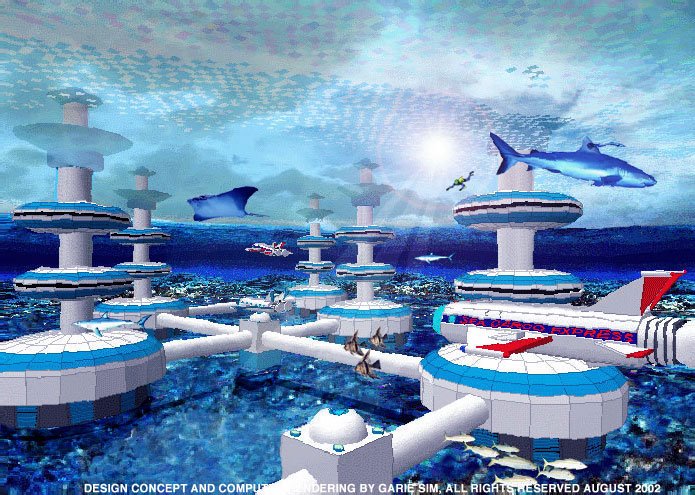
Anyway, the whole idea was to learn to adapt to increasingly harsh and difficult environments--to become more competent in dealing with hazards and threats in order to enhance our freedom of movement. With that enhancement of capability in mind, I want to look into the concept of undersea habitats.

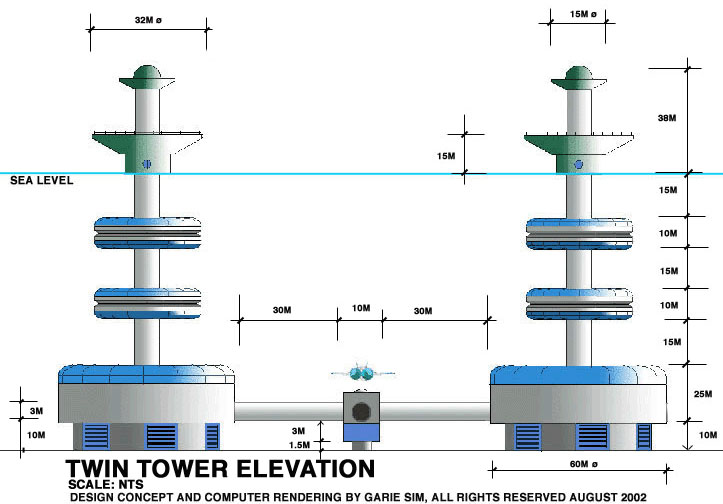
Two of the websites incorporating the more expansive concept of undersea habitats that I had in mind, are this, and this. The habitat needs to be large enough to be considered a "community". It must be permanent and must contain a full set of industries, including medical, educational, financial, manufacturing, and service industries.

Such a habitat would have to be prepared to "hunker down" for weeks at a time, should surface conditions require it. That almost certainly means nuclear power, unless it were situated near the edge of a continental shelf, making OTEC available. Of course, with access to the surface you could have solar, wind, wave, and other sources of power.

NASA uses the Aquarius undersea habitat off Key Largo for astronaut training. Obviously any resident of an undersea habitat would learn safety training that would be the equivalent of what is required to survive in a space environment.

There is obviously no room for the neotenous in a potentially hazardous environment such as an undersea city, orbiting space colony, or asteroid habitat. Government schools are training citizens of North America to be victimised inhabitants of the impoverished neo-third world, not for an exciting future undersea or off-planet. Too bad.

Labels: , , , ,

Bookmark and Share

18 May 2006

Underpopulation Bomb: World Turned Upside Down?

Paul Ehrlich's bestseller The Population Bomb (1968) made some dire predictions. . . . hundreds of millions of people are going to starve to death." The earth, he claimed simply could not support the 6 billion people projected to exist by the year 2000. In a 1969 article titled "Eco-Catastrophe!", Ehrlich later stated that "by 1985 enough millions will have died to reduce the earth's population to some acceptable level, like 1.5 billion people." Source. Interestingly, many journalists and university academics are still repeating the same lines, decades after they became obsolete.

Two years ago, Phillip Longman published an article in Foreign Affairs entitled The Global Baby Bust. He convincingly argues that western nations will soon be underpopulated, due to falling birthrates. Longman's article probably helped to jump start the discussion of this topic within the mainstream, although underpopulation had long been a growing concern among western conservatives and independents. After reading Longman's piece, you might consider readingthis article, which is also quite informative.

Japan, Russia, France, Germany, Sweden, Italy, South Korea, and a number of other Western/or European countries will either shrink in population, or experience severe cultural shock as populations are replaced by outsiders. Even China and India will face inevitable problems unique to their populations and economies, due to the slowing of birthrates.

If their populations shrink significantly, current social democratic governments are doomed. There will be no one to pay the pensions. If on the other hand, the indigenous populations are replaced by outsiders, it is by no means certain that the new workers will be willing to pay the pensions of the retired indigenous populations who refuse to emigrate. It is likewise by no means certain that the new populations will have the technical and professional skills to maintain European/Western civilisation at its current level of sophistication.

The problem, put bluntly, is that the productive part of the world is shrinking, and the non-productive parts of the world are expanding, population wise. There is no gentle or PC way to put it, which is why the topic is largely ignored in most social democracies--yet social democracies are certainly doomed by the phenomena unless it is addressed firmly. And if the social democracies are doomed, the third world is also doomed--since the undeveloped world is dependent on the developed world for aid and sustenance.

Today, Glenn Reynolds of "Instapundit" published an article called The Parent Trap in TCS Daily. Reynolds talks about the high costs and low prestige of parenthood in modern western societies. He wonders what it will take to induce young professional adults to have more children. Leaders of industrial nations are worrying about the same thing.

Here's a list of countries that are either decreasing in population or will decrease in population, if current birthrate is continued.
List of countries:

1. Bulgaria 1.13 children born/woman (2003 est.)
2. Czech Republic 1.18 children born/woman (2003 est.)
3. Latvia 1.2 children born/woman (2003 est.)
4. Singapore 1.24 children born/woman (2003 est.)
5. Hungary 1.25 children born/woman (2003 est.)
6. Slovakia 1.25 children born/woman (2003 est.)
7. Spain 1.26 children born/woman (2003 est.)
8. Italy 1.26 children born/woman (2003 est.)
9. Slovenia 1.27 children born/woman (2003 est.)
10. Andorra 1.27 children born/woman (2003 est.)
11. Estonia 1.27 children born/woman (2003 est.)
12. San Marino 1.31 children born/woman (2003 est.)
13. Macau 1.32 children born/woman (2003 est.)
14. Hong Kong 1.32 children born/woman (2003 est.)
15. Russia 1.33 children born/woman (2003 est.)
16. Belarus 1.34 children born/woman (2003 est.)
17. Ukraine 1.34 children born/woman (2003 est.)
18. Greece 1.35 children born/woman (2003 est.)
19. Romania 1.36 children born/woman (2003 est.)
20. Guernsey 1.37 children born/woman (2003 est.)
21. Germany 1.37 children born/woman (2003 est.)
22. Poland 1.37 children born/woman (2003 est.)
23. Japan 1.38 children born/woman (2003 est.)
24. Austria 1.41 children born/woman (2003 est.)
25. Lithuania 1.43 children born/woman (2003 est.)
26. Switzerland 1.48 children born/woman (2003 est.)
27. Portugal 1.49 children born/woman (2003 est.)
28. Liechtenstein 1.5 children born/woman (2003 est.)
29. Georgia 1.51 children born/woman (2003 est.)
30. Sweden 1.54 children born/woman (2003 est.)
31. Saint Helena 1.54 children born/woman (2003 est.)
32. Korea, South 1.56 children born/woman (2003 est.)
33. Armenia 1.56 children born/woman (2003 est.)
34. Jersey 1.57 children born/woman (2003 est.)
35. Taiwan 1.57 children born/woman (2003 est.)
36. Cuba 1.61 children born/woman (2003 est.)
37. Canada 1.61 children born/woman (2003 est.)
38. Belgium 1.62 children born/woman (2003 est.)
39. Gibraltar 1.65 children born/woman (2003 est.)
40. Barbados 1.65 children born/woman (2003 est.)
41. Man, Isle of 1.65 children born/woman (2003 est.)
42. Netherlands 1.65 children born/woman (2003 est.)
43. United Kingdom 1.66 children born/woman (2003 est.)
44. Luxembourg 1.7 children born/woman (2003 est.)
45. Finland 1.7 children born/woman (2003 est.)
46. China 1.7 children born/woman (2003 est.)
47. Bosnia and Herzegovina 1.71 children born/woman (2003 est.)
48. British Virgin Islands 1.72 children born/woman (2003 est.)
49. Denmark 1.73 children born/woman (2003 est.)
50. Moldova 1.74 children born/woman (2003 est.)
51. Macedonia, The Former Yugoslav Republic of 1.75 children born/woman (2003 est.)
52. Northern Mariana Islands 1.75 children born/woman (2003 est.)
53. Anguilla 1.76 children born/woman (2003 est.)
54. Monaco 1.76 children born/woman (2003 est.)
55. Australia 1.76 children born/woman (2003 est.)
56. Serbia and Montenegro 1.77 children born/woman (2003 est.)
57. Trinidad and Tobago 1.78 children born/woman (2003 est.)
58. Seychelles 1.79 children born/woman (2003 est.)
59. New Zealand 1.79 children born/woman (2003 est.)
60. Aruba 1.79 children born/woman (2003 est.)
61. Martinique 1.79 children born/woman (2003 est.)
62. Montserrat 1.8 children born/woman (2003 est.)
63. Norway 1.8 children born/woman (2003 est.)
64. France 1.85 children born/woman (2003 est.)
65. Cyprus 1.88 children born/woman (2003 est.)
66. Ireland 1.89 children born/woman (2003 est.)
67. Bermuda 1.9 children born/woman (2003 est.)
68. Tunisia 1.9 children born/woman (2003 est.)
69. Sri Lanka 1.9 children born/woman (2003 est.)
70. Malta 1.91 children born/woman (2003 est.)
71. Cayman Islands 1.91 children born/woman (2003 est.)
72. Thailand 1.91 children born/woman (2003 est.)
73. Guadeloupe 1.92 children born/woman (2003 est.)
74. Croatia 1.93 children born/woman (2003 est.)
75. Saint Vincent and the Grenadines 1.95 children born/woman (2003 est.)
76. Lebanon 1.98 children born/woman (2003 est.)
77. Iceland 1.98 children born/woman (2003 est.)
78. Mauritius 1.98 children born/woman (2003 est.)
79. Iran 1.99 children born/woman (2003 est.)
80. Dominica 1.99 children born/woman (2003 est.)
Source: CIA World Factbook 2003

It is easy to find academics, journalists, and various other uninformed groups who continue to believe Paul Ehrlich and the Club of Rome. For them, overpopulation is the problem, and they make no distinction between the productive and non-productive worlds. In fact, to those activists favoring the "die-off", disposing of the productive populations of the world appears to be a gift from above.

Many people may discern how "global warming" and "peak oil" have been inserted into the "catastrophe slot" of many of these groups. Catastrophes for many activist groups, are interchangeable. As long as you have a current catastrophe in the works, your noble cause is free to appeal for donations from the gullible.

When a person's predictions fail so badly as did Ehrlich's and the Club of Rome's, there is bound to be a great deal of fancy backstepping and sidestepping. We have the advantage of hindsight, and should not gloat. We should probably keep that in mind in twenty years, when looking back at the failed predictions of the "warmers" and the "peakers." There is far too much to be done to waste time in that way.

Labels: , , , ,

Bookmark and Share
Older Posts
Al Fin Main Page
Enter your Email


Powered by FeedBlitz
Google
WWW AL FIN

Powered by
Blogger

``