28 January 2008

Geothermal--To The Ends of the Earth

Geothermal power has found an unlikely location in Chena Hot Springs, Alaska. Why unlikely? Because Chena's geothermal temperatures only reach 168 degrees F--a temperature generally considered too low for profitable power generation.
When water cooler than 350 F is released from the pressure of a geothermal reservoir, it doesn’t convert to steam efficiently enough to drive a turbine directly. Anything less than 230 F was considered too marginal for the alternative: a binary system that uses water to heat a fluid with a lower boiling point. But that threshold was a product of geography, not technical feasibility, Holdmann realized. A binary system just requires a heat source and sink: 165 F water can produce electricity if the ambient air or surface water temperature is at least 100 degrees lower. While that may be tough to find in the deserts of Nevada, in Alaska cold air and water are abundant resources.

Now all she needed was a plant, built to one important spec: “We need things that work up here,” Holdmann says. “We don’t need a bunch of things that, yeah, you can do in a lab. We need something we can take to a village and use normal people to run it. And run it every day, because we don’t need it only half the time.”...Fortunately, United Technologies Corp. was looking for a partner to collaborate on a pilot project: an air-conditioning unit that had been reverse-engineered to run off geothermal water. Instead of putting in electric power to create areas of high and low temperature, Chena provides the heat differential and the plant puts out electric power.

The technology has the added benefit of solving two remaining hurdles to low-temperature power generation. First, air-conditioning refrigerant operates more efficiently at low temperatures than isopentane and other fluids typically used in power plants. Second, the components are already mass produced, which cuts the cost of a small, modular plant in half....Chena’s two 200-kilowatt modules provide more than enough power for the entire resort and have reduced the cost of electricity from 30 cents a kwh to only 5 cents. With a capital cost of $2.2 million, including exploration and drilling, the project is expected to pay for itself in four to five years.

This fall, Chena and United Technologies received a Department of Energy grant to install a demonstration plant at an oil or gas well in the United States. The nation’s wells produce at least 40 billion barrels of wastewater per year, much of it low to moderate temperature. That’s another 6000 to 11,000 megawatts of potential electricity, according to a study by Southern Methodist University in Texas. “We feel we just need to show that it works,” Holdmann says, “and companies will pick up on it.”___PopularMechanics
The United States is the world leader in geothermal development, with plants producing more than 3,000 megawatts of electricity. California is No. 1, but resources in such other Western states as Nevada, Utah, Idaho and Oregon are being developed. Nevada has been dubbed the "Saudi Arabia of geothermal."

A recent Massachusetts Institute of Technology study found the amount of geothermal power that realistically could be recovered from deep drilling would represent almost 3,000 times the amount of energy consumed in the United States....Petty, who worked on the MIT study, said the intermountain West has emerged as ground zero for geothermal resources. ____Source
New developments in geothermal energy go far beyond geothermal hot springs to "hot dry rock" geothermal power technology. An Australian company, Geodynamics, is helping to blaze the "hot dry rock" energy trail.
Hot dry rock technology was invented to draw energy from deep underground areas where geothermal heat is abundant, but no water exists to carry the heat to the surface. To tap the energy in this hot dry rock, a well is drilled into it and water is injected at high pressure, forming fissures in the rock to create a geothermal "reservoir" consisting of water-impregnated fractured rock. At least one "production" well is then drilled into the reservoir to draw the hot water back to the surface. A completed facility would direct the hot fluid from the production well to a power plant, which would extract the heat from it to produce power, after which the cooled fluid would be injected back into the ground__Technology Newsdaily
Much of the technology for geothermal power development has already been created by the oil and gas industries. Geothermal mining engineers will develop better ways of approaching specific drilling sites as more knowledge and experience with the techniques are accumulated.

The promise of clean, sustainable electric power--which unlike other renewables can be used as baseload power--will be welcomed by most communities that are able to maintain the facilities.

Labels: , , ,

Bookmark and Share

22 January 2008

Darkening the Dark Continent: Lights Out!

What do California and South Africa have in common? Neither jurisdiction is willing to upgrade its power generation infrastructure to meet demand--so both jurisdictions are facing serious repercussions and shortages. In the case of South Africa, it is shutting down power to its neighbors, because it cannot generate enough power for its own needs.
South Africa's state-owned electricity company Eskom has stopped supplying power to neighbouring countries because of acute domestic shortages.

Zimbabwe and Mozambique are thought to be the worst affected countries.

A BBC correspondent says the recent daily power cuts have caused chaos and are threatening to have a major impact on South Africa's economy...On Friday, enraged commuters set fire to trains in Pretoria after power cuts caused two-hour train delays...The BBC's Peter Biles in Johannesburg says many small businesses are being crippled by the blackouts.

President Thabo Mbeki on Sunday met Eskom's executives to discuss the power shortages...Mr Mbeki last month admitted the government had been wrong to refuse Eskom's request for more investment in power generation several years ago, reports the AFP news agency..."We were wrong. Eskom was right," Mr Mbeki said.
BBC

Where South Africa leads, can California avoid following? Probably not, given the general atmosphere of immunity from reality exuded by California state government, and by large city governments such as Los Angeles, San Francisco, and Oakland. Bad government in South Africa, and bad government in California. Different continents, similar results. Lights out?

Labels: , ,

Bookmark and Share

19 December 2007

Small Nuclear

Brian Wang writes about recent trends in small nuclear reactors. Small fission reactors in the 100 kw to 100 Mw range make it possible for large installations and smaller communities to make their own baseload power, independent of the energy grid or weather patterns. Small reactors are also appropriate for shipboard energy, for water desalination in remote, arid coastal locations, and for combined electricity and heat production--which would come in very handy in arctic or antarctic conditions (not to mention during a little or big ice age or on Mars).

The 200 kilowatt Toshiba designed reactor is engineered to be fail-safe and totally automatic and will not overheat. Unlike traditional nuclear reactors the new micro reactor uses no control rods to initiate the reaction. The new revolutionary technology uses reservoirs of liquid lithium-6, an isotope that is effective at absorbing neutrons. The Lithium-6 reservoirs are connected to a vertical tube that fits into the reactor core. The whole whole process is self sustaining and can last for up to 40 years, producing electricity for only 5 cents per kilowatt hour, about half the cost of grid energy.

Toshiba expects to install the first reactor in Japan in 2008 and to begin marketing the new system in Europe and America in 2009.

Source


The goal is to produce safe, limited supervision nuclear reactors of the appropriate size for a wide range of uses. These reactors would be built to reliably provide a specified level of power for a specific period of time, before needing service.
Some small reactors are conceived for areas away from transmission grids and with small loads, others are designed to operate in clusters in competition with large units. The cost of electricity from a 50 MWe unit is estimated by the U.S. Department of Energy (DOE) as 5.4 to 10.7 cents/kWh (compared with charges in Alaska and Hawaii from 5.9 to 36.0 c/kWh).

US Congress is now funding research on both small modular nuclear power plants (assembled on site from factory-produced modules) and advanced gas-cooled designs (which are modular in the sense that up to ten or more units are progressively built to comprise a major power station). A US DOE report in 2001 considered nine designs which could possibly be deployed by 2010.

Already operating in a remote corner of Siberia are four small units at the Bilibino co-generation plant. These four 62 MWt (thermal) units are an unusual graphite-moderated boiling water reactor (BWR) design with water/steam channels through the moderator. They produce steam for district heating and 11 MWe (net) electricity each. They have performed well since 1976, much more cheaply than fossil fuel alternatives in the Arctic region.
Encyclopedia of Earth
Read more at Advanced Nano.

Small reactors without on-site refuelling should have the following essential features [1]:
  1. • Capability to operate without refuelling for a reasonably long period consistent with the plant economics and energy security;
  2. • Minimum inventory of fresh and spent fuel being stored at the site outside the reactor during its service life;
  3. • Enhanced level of safety, consistent with the scale of global deployment of such
  4. reactors, through wider implementation of inherent and passive safety features and systems;
  5. • Economic competitiveness for anticipated market conditions and applications;
  6. • Difficult unauthorized access to fuel during the whole period of its presence at the site and during transportation, and design provisions to facilitate the implementation of safeguards;
  7. • The capability to achieve higher manufacturing quality through factory mass
  8. production, design standardization and common basis for design certification.
Source

There are many disturbing trends observable in the modern world that should serve as fair warning for forward thinking groups and individuals. The concurrent rise of religious and ideological fundamentalism--both proclaiming that the ends justify the means, no matter what--and the rapid empowerment of individuals of near-average intelligence in the areas of nanotechnology, synthetic biology, autonomous vehicles, explosives technology, genetic modification, sabotage of information and communications systems, biowarfare agents, etc etc, all suggest that the massively interconnected world which we now enjoy may soon be subject to segmentation.

I suggest keeping your eyes open as much as possible.

Labels: , , , , ,

Bookmark and Share

26 November 2007

Community-Scale Nuclear Power--Appropriate Technology for the Nuclear Age?

Bury this hot-tub sized nuclear-decay battery in an underground vault, connect it via heat-exchanger with a high-efficiency steam turbine, and use the 27 Megawatts of heat to provide power for 25,000 homes.
The company Hyperion Power Generation was formed last month to develop the nuclear fission reactor at Los Alamos National Laboratory and take it into the private sector. If all goes according to plan, Hyperion could have a factory in New Mexico by late 2012, and begin producing 4,000 of these reactors.

Though it would produce 27 megawatts worth of thermal energy, Hyperion doesn’t like to think of its product as a “reactor.” It’s self-contained, involves no moving parts and, therefore, doesn’t require a human operator.

...“The lab [ed: LANL] is doing a lot of work on oil shales and oil sands, but there’s no way to get power to those facilities,” Blackwell says. “So, this nuclear battery would be brought in and that would provide the power to run a small city of industrial use.”

Blackwell also envisions that the battery could be used at military bases, as well as in the developing world, where poverty is a product of a lack of electricity and clean drinking water. This week, Hyperion meets with its first potential clients, but Blackwell hopes to approach the United Nations and international humanitarian groups.
Santa Fe Reporter

Antinuclear activists and other naysayers say that it could never work, and even if it could, it would be "wrong." But atomic batteries have a long history of reliable service in space probes and other critical uses. Using such a battery (or small-scale reactors) for in situ recovery of oil shale and tar sands also makes sense.

If you are planning your large scale TEOTWAKI retreat, geared to provide a haven for individuals with the ability to "jump-start" civilisation after a large-scale disaster--this nuclear battery may be the reliable power supply you have been looking for.

With reliable power, a population could thrive underground, undersea, on/beneath polar ice, or in the starkest desert (even in nuclear winter conditions). Using aeroponic food-growing technology, artificial lighting, drilled or melted water supply, sophisticated filters etc. etc. small to medium communities of many types could find a way to develop in relative isolation.

Better, safer, more reliable ways to use nuclear decay to power civilisation (or civilisation's "restart") are coming. Anti-nuclear luddites of limited cognition and competence are a dime a dozen--being mass-produced by modern "educational" systems and pop culture. But just as many "gray" and "black" market economies inevitably exist alongside the mainstream economy, the same is true for intellectual and philosophical streams of thought. It is highly questionable whether our "dumbed down" society could restart civilisation after a global catastrophic event.

Brian Wang expands on the "nuclear battery" concept, and discusses ways it could be used to speed up the trip to Mars.

Labels: ,

Bookmark and Share

07 July 2007

The Ampere Strikes Back

The world is not about to start using less energy. Just our energy use for entertainment, communications, and other electronics will soon amount to over a third of the average household's energy use. That is only going to increase--particularly with India, China, and other populous nations beginning to ride the affluence train of internationalist trade. After all, they want their energy slaves too.
When someone discusses the amount of energy used to produce, harvest, transport and distribute a head of broccoli to a store three thousand miles away, the energy used can be expressed in terms of the number of energy slaves required to do that work.


If we replaced a car engine by human slaves cycling, the most modest subcompact car (a Twingo), with 42 kW of engine power (that is about 60 HP), would consume as much as 90 people cycling like hell, and, in terms of mechanical power, given the very poor efficiency of the human machine (10% at best when a thermal engine reaches close to 50%), it's rather 500 people cycling that it represents ! Another parallel might be used : knowing that a HorsePower used for an engine really represents the equivalent of a horse in terms of power, it means that any worker paid at the minimum wage, in France, can buy - then feed - the equivalent of 60 to 80 horses with 6 to 8 months of salary. And oil would be expensive (ter) ?

When flying, any passenger consumes 1 kWh for 2 km on average. A return flight from Paris to Rome, that anyone can afford today, represents 2.240 km, thus 1.100 kWh of energy. A single flight in Europe represents as much energy as 6 pairs of legs over a full year...

Even a small 50 cm3 moped, with its 2 ou 3 kW of engine power, is already the equivalent of 15 to 20 human beings
Source

We experience lives of ready affluence because of the energy servants placed at our disposal by our technological societies. The scientists, engineers, electricians, construction workers, maintenance workers, factory workers, truckers, dock workers, railroad workers, workers in shipping and receiving--all those and more keep our energy slaves functioning constantly. Most of us could not imagine life without our slaves.

Energy conservation is not good enough. We must have more energy sources, to feed the growing number of servants we acquire.
However, it is clear that energy conservation alone cannot solve the increasing global demand for energy. Thus, it is now more imperative that ever to foster research into new and alternative energy sources. Research into fuel cells, wave power, wind power, photovoltaics and micro-turbines with combined heat and power capability is now of critical importance to the development of modern sustainable electrical power systems. Indeed these sources may well have an impact on the fundamental structure of such systems in the future with the possibility of increased medium power dc transmission networks to accommodate smaller local distributed generation units.
Source

There are many solutions to the convergence of increasing energy demand with plateauing supplies of some fossil fuels such as sweet light crude oil. The first step is to stop denying the need to solve the problem.

Conservation alone will not solve it. Renewables such as solar and wind will not be in a position to put a dent in the problem until much better storage options (such as utility scale redox flow cells) are online. We can no longer afford to look at nuclear energy as unworkable. Once we accept that nuclear electric generation is a necessary bridge to a more renewable future, we can set about making nuclear energy safer and more economical/reliable in all the stages of its life cycle.

Over the next 20 to 30 years, the almost unlimited energy resources of geothermal , solar, wind and sea, will be more available. Perhaps within 50 years, nuclear fusion will be ready to provide large scale energy. But in the meantime, people are not going to give up their energy slaves, no matter how much lip service they give to conservation and cutting down "greenhouse gases." When it comes to their own comfort, these people will not go down gently.

Many people who call themselves "environmentalists" are actually dieoff.org sympathizers. They want to see billions of Earth's residents removed, or "cleansed," from the planet. Leaving them in charge of a pristine Gaia, of course.

Labels: , ,

Bookmark and Share

23 April 2007

Tidal Generation of Electric Power in East River NYC

The tide rises and falls twice a day, every day, as regular as clockwork. Why not tap into the tidal river to produce renewable energy?
Thanks to lessons learned by wind turbine designers, tidal power is already economically competitive, producing electricity at prices similar to wind power, according to feasibility studies by the Electric Power Research Institute, an industry R&D consortium. And it offers a big advantage over wind and other renewables: a precisely predictable source of energy. As a result, developers in the United States have laid claim to the best sites up and down the Atlantic and Pacific coasts. In the past four years the Federal Energy Regulatory Commission in Washington, DC, has issued preliminary permits for tidal installations at 25 sites, and it is considering another 31 applications.

.... "The whole point of doing kinetic hydro is to have a very small environmental footprint," says Dean Corren, Verdant's director of technology development, who designed the tidal turbines in the early 1980s while conducting energy research at New York University.

Corren's team installed its first two turbines in the East River in December. One has been delivering a maximum of 35 kilowatts of power to New York City, swiveling to generate power as the river swells with the high tides and empties with the low. The other turbine delivers performance data that Corren says will be crucial to refining the blades and gearbox, generator, and control system to optimize power generation.

This month Verdant added four more 35-kilowatt turbines. Corren says Verdant is now working on a next-generation design that will be cheaper to mass-produce, in anticipation of installing a farm of at least 100 turbines at the East River site.
Source

Although the absolute quantity of electric power available from the East River may not compare with a large coal or nuclear power plant, the potential is not insignificant. New nuclear power plants will be needed, but adding incremental sources such as wind, tidal, and wave power will help round out the symphony of power sources.

Labels: ,

Bookmark and Share

20 September 2006

Superconducting Power Transmission Comes to Columbus, Ohio

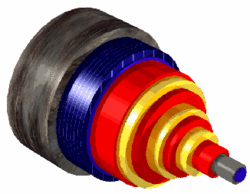
A second generation superconducting power transmission cable, using liquid nitrogen as the coolant, has been energised at a station outside Columbus, Ohio. The Triax HTS cable utilises 3 concentric super-conducting layers to allow 3-phase current transmission in a single cable!

-A new technology that holds promise to transform the global transmission and distribution of electric power was formally energized today near Columbus, Ohio. The $9 million project uses a second-generation High Temperature Superconducting (HTS) cable system to efficiently deliver electric power to approximately 8,600 homes and businesses in suburban Columbus.

The Columbus project is the first demonstration of the new Triax HTS cable design, which dramatically reduces the cost of superconducting systems and brings the technology one step closer to commercial viability. The system was developed by Southwire Company and its partners, American Electric Power (NYSE: AEP), Praxair (NYSE: PX), American Superconductor (NASDAQ: AMSC) and the U.S. Department of Energy's Oak Ridge National Laboratory (ORNL).

Approximately 200 meters (660 feet) of Triax HTS cable from Southwire are part of the system distributing electric power to residential, commercial and industrial customers through AEP's Bixby substation in Groveport, Ohio. The installation phase of the two-year demonstration project came in on time and on budget.
Source.

Superconducting cables, operating at extremely low temperatures, eliminate virtually all resistance to the flow of electric current. HTS cables can deliver up to five times more electricity than traditional conventional copper or aluminum cables and have the potential to address the challenge of providing sufficient electricity to densely populated areas. In an increasing number of cities, there is little room to expand underground cable networks and the cost to lay additional cable, including building new tunnels or ducts, is prohibitive. With their higher capacity, superconducting cables have the potential to increase the supply of electricity to an area using the existing underground cable footprint. Additionally, because HTS cables can carry more current at a lower voltage over longer distances, large power transformers could be located farther from urban centers and densely populated areas freeing up valuable real estate for development or green space.
Source.

Check out the flash animation at this website, that shows how an urban landscape can be transformed by the space efficiencies of superconducting cable such as the Triax HTS system. Urban real estate can be highly expensive, and anything that can free up land for more profitable use would be welcomed.

High-temperature superconductive cables are simple enough in principle. Encase a ceramic material in a silver tape, submerge it in liquid nitrogen, and run current through it. Temperature is the key. A conductor that carries 200A at -321 °F can carry 240A at -334 °F. Turn the refrigeration up and you get more capacity. You’ll lose about 0.5 percent of the power you transmit, where traditional power cables lose from three to eight percent. The trick is being able to manufacture your design. In the center of Southwire’s superconducting cable is a flexible pipe carrying liquid nitrogen. Superconducting tapes wrap around the pipe, followed by a dielectric layer, then a second layer of superconducting tapes that act as a neutral conductor. A double-walled outer cryostat surrounds the cable core and provides a return path for the nitrogen.
Source.

Hat tip to Energy Blog for graphic and links.

Labels: ,

Bookmark and Share

02 August 2006

Nuclear Fusion Energy--Too Good to Give Up On

Limitless energy from nuclear fusion? We have all heard the promises. But we continue to wonder when science will deliver on the promise. Some nuclear physicists claim that nuclear fusion energy is not possible. Certainly a lot of money is spent on fusion research with almost no tangible results. Why should society continue to pay for what seems to be a pipe dream?

Earth dwellers can survive very well on a combination of solar energy and geothermal energy for the next several hundreds of millions of years, at least. But humans can not afford to remain confined to earth for that time. Eventually a large space object will collide with earth, making the surface of earth unlivable. Also, a severe ice age is virtually inevitable within the next ten to thirty thousand years, which will make it impossible for all the earth's billions of human surface dwellers to to survive on the surface.

Fusion energy will expedite space travel expeditions to the limits of the solar system and beyond. Fusion energy will facilitate large underground and undersea habitats on earth and other solid planets and moons. Surviving an ice age underground would be much easier with fusion energy, combined with geothermal.

What are the odds for developing fusion energy in the next 20 years? The Wikipedia link above is a good place to look for the general state-of-the-art of nuclear fusion energy, with links to articles about all the major fusion approaches. Fusion.org is another good site for learning about modern fusion research.

What about the fusion "dark horses?" Cold Fusion is still being financed at a low level, though the potential for large scale energy production from cold fusion is less than the possibility that new science might be discovered.

The interesting "dark horse" of fusion currently, is "Focus Fusion." Jim at the Energy Blog wrote a good article about focus fusion last November. Here are some excerpts:

Focus Fusion reactors are small and decentralized, ideally suited for distributed power generation. Focus Fusion reactors can fit into a garage. Lawrenceville Plasma Physics (LPP) Focus Fusion project aims at developing an electric generator with a projected output of about 5 MW, sufficient for a small community. The Focus Fusion process can produce electricity directly without the need to generate steam, use a turbine or use a rotating generator. The reactors are extremely compact and economical, with expected costs of $300,000 apiece. As the fuel is an insignificant cost, electric power production is estimated at about one tenth of a cent per kWh, fifty times cheaper than current costs. Because it can be shut off and turned on so easily, a bank of these could easily accommodate whatever surges and ebbs are faced by the grid on a given day, without wasting unused energy from non-peak times into the environment, which is the case with much of the grid’s energy at present. On-site personnel are not needed on a daily basis, maintenance would be rare. One technician could operate a dozen facilities by themselves.

LPP has taken major steps towards proving these reactors feasible.

* In August, 2001, a small team of physicists led by Eric J. Lerner for the first time demonstrated the achievement of temperatures above one billion degrees in a plasma focus device-- high enough for hydrogen-boron reactions. This breakthrough, reported at an international scientific conference in May, 2002, took place at Texas A and M University and was funded by NASA's Jet Propulsion Laboratory.
* In March,2003, Lerner presented new theoretical analysis , showing that the magnetic field effect, known for thirty years but little applied in fusion, could greatly reduce the cooling of the plasmas by x-ray radiation, and thus make it far easier to achieve net energy production. The presentation, made in an invited talk at the prestigious 5th Symposium on Current Trends in International Fusion Research in Washington DC, was favorably received by some of the top fusion experts in the world.
* In February, 2004, Lawrenceville Plasma Physics completed a preliminary simulation of plasmoids that burns proton-boron (pB11) fuel. The simulation results confirmed that net energy production is possible with a small focus fusion device.

Process Description

Focus Fusion uses a dense plasma focus (DPF) device to form a plasma of hydrogen-boron gas, as described as follows, taken from the LPP website. The DPF device consists of two cylindrical copper or beryllium electrodes nested inside each other. The outer electrode is generally no more than 6-7 inches in diameter and a foot long. The electrodes are enclosed in a vacuum chamber with a hydrogen-boron gas filling the space between them.

....A pulse of electricity from a capacitor bank is discharged across the electrodes. For a few millionths of a second, an intense current flows from the outer to the inner electrode through the gas. This current starts to heat the gas and creates an intense magnetic field. Guided by its own magnetic field, the current forms itself into a thin sheath of tiny filaments; little whirlwinds of hot, electrically-conducting gas called plasma. The fuel is in the form of decaborane (H14B10), a solid at room temperature which sublimates a gas when heated to moderate temperatures of around 100 C. As in any fusion reaction, when the hydrogen nuclei (protons) and boron-11 nuclei collide at high enough velocities, a nuclear reaction occurs. In this case, three helium nuclei (also called alpha particles) are produced, which stream off in a concentrated beam, confined by powerful magnetic field produced by the plasma itself.

When the focus is used for fusion generation, collisions of the ions with each other in the dense plasmoid cause fusion reactions which add more energy to the plasmoid. This excess energy is expelled, together with the energy that went into forming the plasmoid, in the form of an ion beam. (The energy of the electron beam is dissipated inside the plasmoid to heat it.) This happens even though the plasmoid only lasts 10 ns (billionths of a second) or so, because the very high density in the plasmoid, close to solid density, make collisions very likely and they occur extremely rapidly.

The ion beam of charged particles is directed into a decelerator which acts like a particle accelerator in reverse. Instead of using electricity to accelerate charged particles they decelerate charged particles and generate electricity. Some of this electricity is recycled to power the next fusion pulse while the excess, the net energy, is the electricity produced by the fusion power plant. Some of the x-ray energy produced by the plasmoid can also be directly converted to electricity. The capacitor is pulsed on the order of 1000 times a second to keep the process operating.
Source.

The focusfusion.org website reports on an ongoing collaboration between the Chilean Nuclear Energy Commission (CCHEN) and the Lawrenceville Plasma Physics project to test many of the key components of the "focus fusion" approach. The collaboration is to take three years, and should produce some good indications of whether this approach will be fruitful in the long term. Check out the PesWiki entry on Focus Fusion for more information and links.

In mainstream fusion research, the ITER Tokamak experimental facility is being built in France, as a collaboration between the US, Russia, China, India, the EU, and Japan. ITER will cost over US $10 billion over several years, but should achieve higher energies than previous Tokamak facilities. The "spherical tokamak", a smaller, spherical shaped plasma confinement vessel, may prove to be better in the end than the toroid tokamaks. That would be a huge joke on mainstream fusion researchers.

Z-pinch fusion has evolved into a form of inertial confinement fusion, the biggest mainstream competitor to tokamak fusion, and ITER.

A lesser known "also-ran" approach to fusion energy is "migma fusion", a type of colliding particle beam fusion promoted by Bogdan Maglich. The many problems of focusing and confining particle beams has kept migma fusion from making significant progress for the past few decades. In spite of those difficulties, researchers at UC Irvine are working on another version of colliding beam fusion.

There is a tremendous amount of energy stored in the nucleus of atoms. Fusion is the best near-term approach to getting at that stored nuclear energy. In the longer term, more exotic methods of dissecting and re-arranging atoms should yield even greater quantities of energy.

Labels: ,

Bookmark and Share

22 January 2006

Flow Batteries are a new and Revolutionary Storage Technology

The Energy Blog reported a while back on a new energy storage technology, Vanadium redox flow batteries. Flow batteries are called that because the electrolytes flow through the cells, giving up electrons to an external circuit. The redox reaction is reversible, so the cells can be charged or discharged. The significant fact about flow batteries is the potential to scale to very large storage sizes into the megawatt and multi-megawatt ranges. This is the type of storage capacity utilities have been looking for.

Performance

*
The VRB has an availability of greater than 98%. Designed for unattended operation with very low maintenance costs.
*
No degradation from repeated deep charges and discharges. The system can be discharged and charged greater than 13,000 times (20% to 80% SOC) without deterioration in system efficiencies.
*
System round-trip efficiencies between 70% - 78%.
*
The VRB-ESS has a charge/discharge window of 1:1 - allowing off-peak charging for on-peak dispatch - a fraction of the time required by other battery systems and ideal for wind generation applications.
*
Cross mixing of electrolytes does not lead to contamination of electrolytes
*
indefinite life of electrolyte (no disposal or contamination issues).
*
Once charged, the electrolyte remains fully charged with low self-discharge.


Flow batteries are not generators, like regular fuel cells. Most fuel cells use up their fuel sources in an irreversible reaction. Flow batteries do not use up their electrolytes. The electrolytes are fully reusable, with recharging. And flow cells are not like regular batteries, since you recharge them by replacing the electrolyte. They are a new, hybrid form of chemical battery/fuel cell.

The best use for these cells will probably be as load levelers for utilities, and as backup power for large industrial facilities.

Here are more links:

Sandia
Wiki
ME
Geo

Labels: ,

Bookmark and Share
Older Posts
Al Fin Main Page
Enter your Email


Powered by FeedBlitz
Google
WWW AL FIN

Powered by
Blogger

``