13 January 2009

49,000 Sea Horses Will Graze the Wide Oceans

American Superconductor and Northrop Grumman have successfully tested a 49,000 hp (36.5 MW) superconducting electric motor at full power. The motor is built for naval ship propulsion, powered by a nuclear reactor capable of providing 36.5 MW of power. Don't try this at home, the cost of feed for 49,000 horses alone will bankrupt you.
WASHINGTON--(BUSINESS WIRE)--American Superconductor Corporation (NASDAQ: AMSC), a leading energy technologies company, and Northrop Grumman Corporation (NYSE: NOC) announced today at the Surface Navy Association’s 21st National Symposium the successful completion of full-power testing of the world’s first 36.5 megawatt (49,000 horsepower) high temperature superconductor (HTS) ship propulsion motor at the U.S. Navy’s Integrated Power System Land-Based Test Site in Philadelphia. This is the first successful full-power test of an electric propulsion motor sized for a large Navy combatant and, at 36.5 megawatts, doubled the Navy’s power rating test record.

This system was designed and built under a contract from the Office of Naval Research to demonstrate the efficacy of HTS motors as the primary propulsion technology for future Navy all-electric ships and submarines. Naval Sea Systems Command (NAVSEA) funded and led the successful testing of the motor.

Incorporating coils of HTS wire that are able to carry 150 times the power of similar-sized copper wire, the motor is less than half the size of conventional motors used on the first two DDG-1000 hulls and will reduce ship weight by nearly 200 metric tons. It will help make new ships more fuel-efficient and free up space for additional warfighting capability.

“The successful load test of our HTS motor marks the beginning of a new era in ship propulsion technology,” said Dan McGahn, senior vice president and general manager of AMSC Superconductors. “This motor provides the U.S. Navy with a truly transformational capability relative to size, stealth, endurance and survivability, providing our Navy with a clear performance advantage for years to come. We are grateful for the steadfast support from the Office of Naval Research, Naval Sea Systems Command and the Naval Surface Warfare Center.” _Source _ via _ NextBigFuture

The US Navy is the source for a great deal of important new technology, spinning off applications like NASA used to do when it was still devoted to space -- before being enslaved to the counter-factual climate orthodoxy of Gore, Obama, and Pelosi. Expect a similar downfall for all branches of the US military under the narcissist - in - chief, when instated.

Superconducting motors, generators, and transmission lines will eventually impact every part of modern society.

Adapted from a posting at Al Fin Energy

Labels: ,

Bookmark and Share

19 March 2008

Next Big Future: Every Day a Future Carnival!

Brian Wang regularly produces flurries of fascinating postings over at NextBigFuture blog. Formerly called "Advanced Nanotechnology Blog", Brian's blog covers an amazingly broad range of advancing future technologies--including nanotechnology, of course.

This look at the use of gene deletion for gene therapy, is one of my recent favourites at NBF.

Two write-ups about recent advances in high temperature superconductors here and here are worth a look.

This discussion of how we might use nuclear fusion reactors profitably--even before commercial scale fusion energy is achieved--should give you some new ideas.

News about DARPA research in rail gun technology applied to weapons systems is both timely, and applicable to the future of aerospace technology.

And don't forget to check out this evaluation of the potentially huge Bakken Oil Field straddling the US/Canada border.

The mainstream media is extremely spotty, in terms of covering relevant research topics and news events. Bloggers such as Brian carefully sift through dozens of the more careful and credible news sources, to provide consistently fascinating information about the advancing wave front of technology.

Try not to be blindsided. Learn as much as you can. Many bloggers such as Brian are quite accessible for questions and requests for information sources. Learn to take advantage of insider knowledge wherever you can.

The Al Fin sidebar is meant to be another resource--above and beyond the eclectic postings on this blog. To keep the sidebar as useful and relevant as possible, please notify us of any dead links that you may run across.

Labels: ,

Bookmark and Share

22 May 2007

New York City Plans Underground Superconducting Power Grid

A lot of infrastructure that takes up space above ground could be better placed underground. In this earlier Al Fin posting, Columbus, Ohio's project for placing superconducting electrical cable underground was discussed--and this link that contains an amazing flash video displaying the revolutionary possibilities of superconducting electrical cable was provided.

Now, New York City is planning to install a large electrical backbone of superconducting cable beneath the city, in 2010. They are calling it an "attack-proof power line", but of course that is just hype. What it is, is a revolution in urban planning.
The cable will link two substations in Manhattan. The department said the project could lead to further deployment of the technology, which also suppresses power surges.

"We have asked AMSC and Consolidated Edison to demonstrate superconductor solutions in New York City that will serve to keep our centers of commerce on line under all conditions--including grid events related to severe weather, accidents or terrorist attacks," Jay Cohen, the Department of Homeland Security's undersecretary for technology, said in a statement on Monday.

High-temperature superconducting cables made with ceramic materials can carry 10 times more power than traditional cables, but are costly and face technological challenges.

Superconducting cable must be cooled with liquid nitrogen to -382 degrees Fahrenheit (-230 Celsius). At that point, conductivity resistance falls, allowing the cables to carry the extra power.

The New York project will be carried out in two stages, with deployment of the cable by 2010, a spokesman for American Superconductor said.
Source


Modern superconductors do not have to be cooled to near absolute zero with expensive liquid helium, or potentially dangerous liquid hydrogen. Liquid nitrogen is relatively inexpensive, and safe. Superconducting electrical cables are within reach of most large cities, and are better buried underground. Superconducting levitating trains should not be far off. Superconducting magnetic space launch should significantly lower the launch cost for non-biological payloads.

The payoff from 20 year old advances in advanced superconductors is only just beginning to show. In 20 years from now, expect a lot more of the electrical power transmission and distribution infrastructure to be underground. Also expect several technological spinoffs from superconducting technology that as of now, not many people are talking about.

Labels:

Bookmark and Share

24 April 2007

Superconducting Electric Motors Half the Size and Weight of Ordinary Motors

Motors over 1,000 hp utilize approximately 25 percent of all electric power generated in the United States. The Department of Energy estimates that the lower electrical losses of HTS motors could save U.S. industry billions of dollars per year in electrical operating costs.

....American Superconductor's prototype 5,000-hp HTS motor is about the size of a household refrigerator. It is as little as half the size and weight of a conventional 5,000-hp motor. Its net electrical losses, including losses associated with cryogenic cooling of the HTS wires, are up to half the electrical losses of a conventional motor.
Source

The most significant energy losses in motors come from resistive heating in the windings, so superconducting motors with almost no electrical resistance in the windings could realize important efficiency gains. To be able to build such motors required significant advances in the design, fabrication, and winding of HTS wires in geometries required for motor winding.

In addition to industrial motors, the new technology would be useful in generators, transmission cables, and superconducting magnetic energy storage systems. It also has potential applications in x-ray lithography, ion implantation, medical cyclotrons, magnetically levitated trains, magneto-hydrodynamic ship propulsion systems, and magnetic separation for materials processing and ore recovery. Indeed, opportunities abound for reducing electric energy use via applications of the ATP-funded technology.
Source

Advances in superconducting materials over the past two decades allows superconducting wire to be cooled by inexpensive liquid nitrogen, rather than the much more expensive and difficult to contain liquid helium. The goal, of course, is the development of room temperature and higher superconductors that retain superconductivity under high magnetic flux.

South Korean company Doosan is currently working on a 1300 HP motor using AMSC's HTS wire.

The motor produced by Doosan and KERI utilizes approximately 5,000 meters of AMSC's HTS wire and is capable of generating 1,300 horsepower at 3,600 revolutions per minute. The system is significantly smaller, lighter, quieter and more efficient than the traditional motors sold today of the same power rating, which are made with copper coils.

Work on this motor program began in 2004 with the help of government research and development funding. Doosan plans to begin production of motors for the military and commercial markets in the 2010-2011 timeframe. AMSC estimates that the annual worldwide market for industrial motors with ratings of 1,000 horsepower or higher is over $1 billion.
Source

Beyond better efficiencies and size/weight improvements in motors and generators, high temperature electric cable has the potential to rejuvenate the entire urban landscape.

Hat tip advanced nano blog.

Labels:

Bookmark and Share

20 December 2006

Superconducting Ring Accelerator to Launch Payloads Into Space

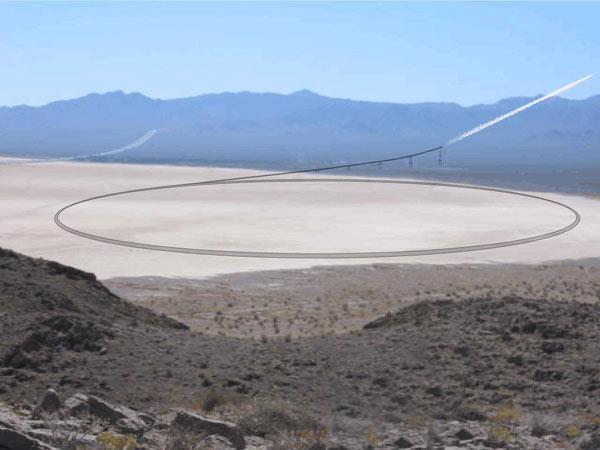
We are used to thinking of superconducting ring accelerators in the context of physics research with particle accelerators. The idea of accelerating macro-sized payloads up to 100 kgs in weight to a velocity of six miles per second in a ring accelerator, simply never occurred to most space launch theorists. The idea did occur to Jim Fiske at LaunchPoint Technologies in Goleta, CA,

The design calls for a high-speed accelerator that whips a projectile as heavy as 220 pounds around a circular 1.5-mile-radius vacuum tunnel. Powerful electromagnetic motors inside the tunnel will accelerate the unit, strapped to a magnetic sled, in circles until it reaches a velocity of six miles per second and then will eject the projectile from a launch ramp into space.

The system is still just an idea on paper, but the U.S. Air Force has awarded Launchpoint a two-year, $500,000 grant to prove it can work. Project leader Jim Fiske, an expert in magnetic levitation, believes that the magnetic forces would counteract the pulverizing G-forces generated by radial acceleration and prevent the sled from touching the tunnel wall.

As for the system’s cost, its low power requirements would allow spy micro-satellites to be slung into orbit for $50,000, a small fraction of the current $5-million launch cost. That explains the Air Force’s interest, but the system could also be a boon for space exploration. An inexpensive magnet-propelled pipeline could toss construction materials, food and other basic resources into orbit to supply tomorrow’s space colonies. “You could send a block of aluminum, water or even frozen mashed potatoes,” Fiske suggests—anything durable enough to handle the stress.
Source (hat tip Michael Anissimov)


Here is more from a Newscientist.com article:

The satellite, encased in an aerodynamic, cone-shaped shell that would protect it from the intense heat of launch, would be attached to a sled designed to respond to the forces from the superconducting magnets.

When the sled had been accelerated to its top speed of 10 kilometres per second, laser and pyrotechnic devices would be used to separate the cone from the sled. Then, the cone would skid into a side tunnel, losing some speed due to friction with the tunnel's walls.

The tunnel would direct the cone to a ramp angled at 30° to the horizon, where the cone would launch towards space at about 8 kilometres per second, or more than 23 times the speed of sound. A rocket at the back end of the cone would be used to adjust its trajectory and place it in a proper orbit.

Anything launched in this way would have to be able to survive enormous accelerations – more than 2000 times the acceleration due to gravity (2000g). This would seem to be an obstacle for launching things like communications satellites, but Fiske points out that the US military uses electronics in laser-guided artillery, which survive being fired out of guns at up to 20,000g.

....If the ring launched hundreds of satellites a year, it would be cheaper than conventional rocket launches. With 300 launches per year, the team estimates the ring could put payloads into orbit for $745 per kilogram. If the launch rate reached 3000 launches per year, they calculate that would drop to $189 per kilogram. Today, it costs more than 100 times that to send payloads into space.
Source.

Of course this type of mass accelerator could be used to boost supplies for space exploration, scientific study of earth from space, space colonization, and certainly could boost weapons to orbital or sub-orbital velocities. Anything that could stand the extreme acceleration.

Humans are too fragile for such high accelerations, but if most of the mass humans need could be boosted cheaply in this fashion, the relatively few humans going to space could get there via chemical rocket, for now.

Labels:

Bookmark and Share

20 September 2006

Superconducting Power Transmission Comes to Columbus, Ohio

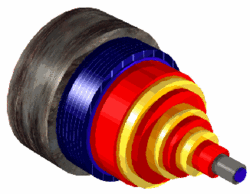
A second generation superconducting power transmission cable, using liquid nitrogen as the coolant, has been energised at a station outside Columbus, Ohio. The Triax HTS cable utilises 3 concentric super-conducting layers to allow 3-phase current transmission in a single cable!

-A new technology that holds promise to transform the global transmission and distribution of electric power was formally energized today near Columbus, Ohio. The $9 million project uses a second-generation High Temperature Superconducting (HTS) cable system to efficiently deliver electric power to approximately 8,600 homes and businesses in suburban Columbus.

The Columbus project is the first demonstration of the new Triax HTS cable design, which dramatically reduces the cost of superconducting systems and brings the technology one step closer to commercial viability. The system was developed by Southwire Company and its partners, American Electric Power (NYSE: AEP), Praxair (NYSE: PX), American Superconductor (NASDAQ: AMSC) and the U.S. Department of Energy's Oak Ridge National Laboratory (ORNL).

Approximately 200 meters (660 feet) of Triax HTS cable from Southwire are part of the system distributing electric power to residential, commercial and industrial customers through AEP's Bixby substation in Groveport, Ohio. The installation phase of the two-year demonstration project came in on time and on budget.
Source.

Superconducting cables, operating at extremely low temperatures, eliminate virtually all resistance to the flow of electric current. HTS cables can deliver up to five times more electricity than traditional conventional copper or aluminum cables and have the potential to address the challenge of providing sufficient electricity to densely populated areas. In an increasing number of cities, there is little room to expand underground cable networks and the cost to lay additional cable, including building new tunnels or ducts, is prohibitive. With their higher capacity, superconducting cables have the potential to increase the supply of electricity to an area using the existing underground cable footprint. Additionally, because HTS cables can carry more current at a lower voltage over longer distances, large power transformers could be located farther from urban centers and densely populated areas freeing up valuable real estate for development or green space.
Source.

Check out the flash animation at this website, that shows how an urban landscape can be transformed by the space efficiencies of superconducting cable such as the Triax HTS system. Urban real estate can be highly expensive, and anything that can free up land for more profitable use would be welcomed.

High-temperature superconductive cables are simple enough in principle. Encase a ceramic material in a silver tape, submerge it in liquid nitrogen, and run current through it. Temperature is the key. A conductor that carries 200A at -321 °F can carry 240A at -334 °F. Turn the refrigeration up and you get more capacity. You’ll lose about 0.5 percent of the power you transmit, where traditional power cables lose from three to eight percent. The trick is being able to manufacture your design. In the center of Southwire’s superconducting cable is a flexible pipe carrying liquid nitrogen. Superconducting tapes wrap around the pipe, followed by a dielectric layer, then a second layer of superconducting tapes that act as a neutral conductor. A double-walled outer cryostat surrounds the cable core and provides a return path for the nitrogen.
Source.

Hat tip to Energy Blog for graphic and links.

Labels: ,

Bookmark and Share
Older Posts
Al Fin Main Page
Enter your Email


Powered by FeedBlitz
Google
WWW AL FIN

Powered by
Blogger

``