04 February 2011

Nuclear Energy Needed to Prevent Blackouts in Age of Global Cooling

If Texas had made the same dollar investment in new coal and/or nuclear power plants they would probably be snug and warm tonight. Do we we really want to sacrifice our families’ safety and security along with business productivity during extreme cold for the sake of political correctness? _WUWT
The rolling blackouts experienced in Texas recently were caused by problems with wind, gas, and coal systems to adjust to freezing conditions and increased power demands. Nuclear power is different from the other power sources mentioned above, and is clearly the power source of choice for an ice age or an age of global cooling (possibly along with enhanced geothermal).

US President Obama's Nuclear Regulatory Commission has been excessively slow to license and approve safer, more reliable new reactor designs, which makes it almost impossible for the US to provide more secure and reliable power to the people. Amazingly, the Obama NRC has still not given approval for construction of new plants using the Westinghouse AP1000 reactor.
If the NRC approves the AP1000 design, the agency could decide by the end of 2011 on whether to issue construction licenses to Southern and SCANA to build their nuclear reactors, according to Jaczko.

"We will continue to work on a schedule that puts us in a position to make some final decisions possibly by the end of this year," he [NRC's Jazco] said. _Reuters
Take your time, Jazco. It's only the future of the American society and global security that is at stake. Bureaucrats rule in the modern US, so pay no attention to the little people and their needs.

It should be obvious that the US can no longer allow its bureaucracy and Luddite political class to drag its feet on the future.
It is clear that, were our reactors allowed to retire as originally planned, the nuclear industry’s contribution to clean energy production would all but disappear by 2035. Fortunately, some license renewals, which extend a reactor’s lifetime by 20 years, have been approved and others are in line.... even in the best case, in which all licenses are renewed, about 25% of our fleet will be retiring in 2035, making it very unlikely that the US’s clean energy portfolio can grow in that time frame.

This alarming scenario should hurry the construction of new reactors. Though building 784 new plants is an impossible target, the AEF Committee judged that 5 to 9 additional nuclear plants could be brought online by 2020. As espoused in my first article, there is no need to wait around for research breakthroughs; proven reactor technologies are ready to be built now, as China continues to demonstrate. _leadenergy
The Obama administration and its Luddite counterparts at state and local levels, continue to drag their feet on providing reliable power sources -- while they continue to spout nonsensical gibberish about the "promise of wind and solar power."

But what good are wind and solar power when solar panels are covered with snow and ice, and ice-covered propellers on wind turbines prevent power generation -- even in perfect winds?
Wind generators also appeared to be having problems, said Fraser; he had received reports of some turbines shutting down because of issues with ice on the blades. "The wind was blowing yesterday, but I'm not sure wind generation was available because they had problems with ice," he said. _MetMusings

In the recent Texas power blackouts, wind was not the only power source to fall down on the job. Water pipes at coal plants froze and broke, gas pipelines failed to provide adequate pressures to gas plants, and huge piles of coal froze to unusable condition in the ice and snow storms.

The problem had several causes, but we have learned one thing -- in conditions of extreme cold, wind power and solar power are not sources that can be reliably depended upon.
The system needed all of the power it could get. Had more thermal plants been built, at least some of them would have been in service and helpful. Outages would have been moderated a little. Wind generated power was used and useful, but couldn’t be dialed up to produce more during a time of need. Wind power was neither the cause of the problem, nor of any special value in reaching a solution. _MasterResource
It is time for voters and ordinary people to jettison the lefty-Luddite politicians and bureaucrats who are exposing them to potentially fatal risks, all in the name of a failed ideology of faux environmentalism and pseudo-scientific carbon hysteria.

Nuclear power is the best power source for extreme cold -- for most advanced nations -- since all components of the generation system are contained indoors, well protected from the elements -- and do not rely upon the supply of fuel from the outside, which can be disrupted in many ways during extreme weather.

Sure, we need to replace above-ground transmission and distribution lines with secure, buried, and preferably super-conducting lines. But that will take time, and will require severe budget cuts in entitlement spending and public sector union benefits to provide the necessary resources. Before that can happen, heads will need to roll -- in a figurative sense, naturally. (human heads are not perfectly round, so they do not roll as smoothly as one might wish) ;-)

Al Fin was once an enthusiastic supporter of all types of wind energy -- and still supports small wind turbines for niche and off-grid uses. But human minds which are functional will continually monitor the world around them, and take in new information and data. In the course of time, working minds will change and grow with experience. Those minds which are incapable of learning, growing, and changing, may as well not even exist, for all the harm they are likely to do. Particularly when they are in positions of power and responsibility.

Other perspectives on this issue from nuclear bloggers Charles Barton, and Rod Adams.

Power blackouts play hell with electric vehicles. Best to keep your own reliable backup power source at home or place of business -- along with necessary fuels. Relying on the dumbed-down commons for life and death needs can be a fool's play, but in a society of perpetual incompetents -- the Idiocracy -- it is what it is.

Hope for the best, plan for the worst. Always keep an ample supply of food, water, fuels, necessary medicines, cash, power source, communications gear, etc., and the means to prevent riff-raff from taking it from you. The police are never more than 10 minutes away, whenever a situation calls for an instantaneous response. Perhaps a bit longer if they belong to public sector unions.

Labels: , , ,

Bookmark and Share

08 January 2009

Not Just Your Imagination, It Really Is Getting Cold

Data from the NCDC shows a downward trend in North American temperatures over the past ten years. Also see here for another decadal decline in temperatures. Reasons for this apparent decline vary from sunspot cycles to ocean oscillations to volcanic eruptions and outright denial. According to a study published in the January 8 issue of Nature, part of the reason for the recent global cooling may be too small to see without a microscope.Diatoms are microscopic oceanic plankton which every year remove billions of tons of CO2 from the atmosphere. The history of plankton is being re-written by scientists at this very moment, and it is quite likely that the repercussions of new plankton research will be quite significant.
The evolutionary history of diatoms -- abundant oceanic plankton that remove billions of tons of carbon dioxide from the air each year -- needs to be rewritten, according to a new Cornell study. The findings suggest that after a sudden rise in species numbers, diatoms abruptly declined about 33 million years ago -- trends that coincided with severe global cooling.

..."Why diatom diversity peaked for 4 to 5 million years and then dropped is a big mystery," Rabosky said. "But it corresponds with a period when the global climate swung from hothouse to icehouse. It's tempting to speculate that these tiny plankton, by taking carbon dioxide out of the air, might have helped trigger the most severe global cooling event in the past 100 million years." _CornellChronicle
The new, re-written evolutionary history of diatoms may indeed shine an important light on our present climate. But perhaps the lesson to be taken from the study is that diatoms thrive in warmer water. As climate and the oceans grow colder, diatoms are unable to thrive as well and reproduce as quickly. Correlation does not equal causation.

Diatoms are very important in the overall carbon cycle, as are a number of other carbon-fixing oceanic species. Apocalyptic predictions of future ocean acidification fail to properly take into account the oceans' enormous capacity for removing and fixing atmospheric carbon in permanent or semi-permanent form. Such basic errors in reasoning, when combined with an irrational faith in simplistic climate models, lays the foundation for an incredibly unscientific quasi-religious faith in catastrophic anthropogenic global warming -- CAGW. The religious orthodoxy of manmade warming catastrophe is in the process of destroying the economic infrastructure of Autralia and the EU, and under the narcissist-elect Obama threatens to destroy the economic infrastructure of the US.

Climate science itself has become co-opted by political influences, such as the United Nations, the European Union, various leftist political fronts for environmental causes, and deranged activists such as Al Gore. Science has very little to do with media commentary on the climate. But science is still lurking in the background, and threatens a severe backlash against the political co-opters of climatology.

So before you buy into the climate fantasies of Gore, Hansen, and Obama, consider educating yourself in the evolutionary history of the humble diatom. Particularly for Obama voters, such self-education could prevent them from making themselves "twice the fool."

Labels: ,

Bookmark and Share

25 September 2008

How Did Climate Science Get It So Badly Wrong?

The long term cooling trend pictured above is likely due to colliding continents and other large-scale geologic and cosmologic phenomena. The short-term cooling trend Earth is currently experiencing, seems to be due to multidecadal oceanic climate oscillations--the PDO and the AMO.

Imminent global cooling due to changes in solar activity, is a more ominous possibility, Another little ice age spawned by a 21st century "Maunder Minimum" would condemn hundreds of millions of third worlders to death by famine. NASA has finally come out in the open about the current historic solar minimum currently detected by advanced satellite. This new information opens the door to the Svensmark Phenomena of cosmic ray induced global cooling.

Climate catastrophe has been vastly overrated, and derives from the most corrupted sector of science known to history, with the exception of Soviet and Maoist science in the communist dark ages. When politics takes over science--as it has in the case of the IPCC and the climate science mafia (PDF)--that area of science is no longer reliable.

We are living at an energy-critical period of time. Advanced civilisation relies upon abundant energy supplies to provide its citizens with both the necessities and luxuries of living. If erroneous scientific theories choke civilisation of the energy it needs to progress--as is happening under the current US Congress, the current European Union, the current government of Australia, etc.--progress will stop, economies will falter and fall, and most people will remain clueless as to the reasons that life became so hard and cruel, so quickly.

This is the pivot point between a time of true abundance, and a return to widespread poverty, famine, and pandemic. It is not a decision for our descendants nor our ancestors. It is our choice right now. If we choose to let foolish politicians choke our economies by choking our energy supplies, we will never see the singularity, never live the next level. All of the amazing advances discussed by Kurzweil and other visionaries are possible eventually. But not if we cut ourselves off at the knees by following erroneous "science."

We are already suffering from bad decisions made in the past by politicised science. As bad science is piled onto other bad science, we run the risk of chasing our own tails--digging ourselves more deeply into the dirt that will become our own graves. Worse than mere distraction, we are spending more and more of our hard-earned surplus on unsupportable theories--thus depriving our future selves and descendants of the infrastructure of abundance that would make their lives better than ours.

Much more information at Icecap, Watts Up With That?, Tom Nelson, and Climate Skeptic

More basic science information at Climate Audit, Climate Science, Willam M Briggs, Lucia, David Stockwell, and many other fine climate sites listed under the Al Fin sidebar Climate category.

Labels: ,

Bookmark and Share

26 August 2008

Global Cooling Descending: Will We All Be Forced to Live in a Giant Pyramid Arcology in Dubai?

Following up on observations from the Armagh Observatory, observations at the National Solar Observatory in Tucson add weight to predictions that solar activity may be dropping to levels lower than seen in over 100 years. An increasing number of solar scientists are contemplating the possibility of a "mini ice age" resulting from reduced solar activity.
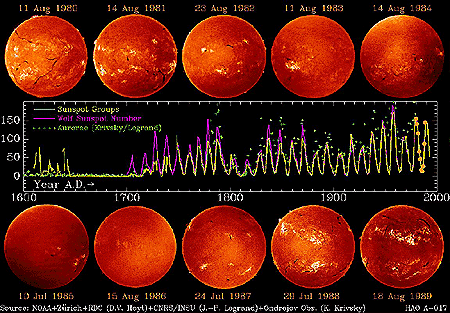
The number of sunspots visible on the Sun normally shows an 11-year periodicity, and the current sunspot cycle (cycle 23) had a maximum in 2001, and is entering a minimum phase with few sunspots currently visible. Our data show that there are additional changes occurring in sunspots, independent of the sunspot cycle, and these trends suggest that sunspots will disappear completely. Such an event would not be unprecedented, since during a famous episode from 1645-1715, known as the Maunder Minimum, the normal 11-year periodicity vanished and there were virtually no sunspots visible on the solar surface (Eddy 1976). Recent studies of the appearance rate and latitudinal drift of sunspots (Hathaway et al., 2004) and of the solar magnetic field (Svalgard etal, 2005) predict that the number of sunspots visible in future cycles will be significantly reduced......the occurrence of prolonged periods with no sunspots is important to climate studies, since the Maunder Minimum was shown to correspond with the reduced average global temperatures on the Earth (Foukal et al., 1990). _Icecap
During the "Little Ice Age", temperatures plunged, crops failed, and large areas of high latitude lands became uninhabitable. Should the same thing happen again in the first half of this century, the human toll would likely be far worse--given the much greater population of Earth currently. If climate grows much cooler, crops in the breadbasket regions of North America, Europe, Australia, Argentina, and parts of Europe will certainly either fail or be severely curtailed in yields. We had better hope the sun does not choose this time to take an extended vacation. More here.

Of course, more affluent people may choose to take refuge in huge self-contained "cities within single buildings", otherwise known as "Arcologies," located near the tropical zones. One such arcology--the Dubai Pyramid City--will stand 4000 feet high and contain a full time population of 1 million people.
The solar-powered pyramid project – dubbed Ziggurat after the ancient Mayan pyramids – was announced this week by Timelinks, an eco-design firm that plans to unveil the engineering wonder at Cityscape Dubai later this year.

If completed, it’s expected to be the largest man-made residential structure on the planet, with its foundation covering more than two square kilometres.

"The pyramid will be more than a kilometre tall and will house one million people inside," "It will be completely self-sustainable."

Using solar and wind power, the mega structure will create its internal weather. Steam generated from solar power and collected through photovoltaic cell panels on the pyramid’s exterior might well be piped from the ground level to the uppermost heights of the pyramid’s interior and then released, instantly turning into rain, which may then fall on the lush garden communities inside the pyramid.

An eco system, full of vegetation, mild temperatures and regular rainfall, may make this a highly marketable city for people living in dry desert conditions.

...Matonis said the pyramid project requires 90 per cent less land than a traditional city. "Cities can be accommodated in complexes that take up less than 10 per cent of the original land surface. Public and private landscaping will be used for leisure pursuits or irrigated as agricultural land." _NextEnergyNews
Besides generating its own energy and weather, an arcology might be largely self-sufficient in food production. Whether a pyramid is the best shape for such a structure is up for debate. Certainly the pyramids of Egypt and Central America have rather ghoulish histories, that might be better overlooked, should the energy economics of huge pyramids support arcologies.

Brian Wang has more on the Dubai building spree.

Labels: , ,

Bookmark and Share

20 July 2008

30 Years of Global Cooling Coming Right Up!

IPCC models do not properly take into account the multi-decadal oscillations of ocean temperatures and currents. The Pacific Decadal Oscillation (PDO) and the Atlantic Multidecadal Oscillation (AMO) hold enormous power over the ongoing climate of Earth. At this time, both the PDO and the AMO appear to be shifting into extended "cold phase."
The announcement by NASA that the (PDO) had shifted from its warm mode to its cool mode (Fig. 1) is right on schedule as predicted by past climate and PDO changes (Easterbrook, 2001, 2006, 2007) and is not an oddity superimposed upon and masking the predicted severe warming by the IPCC. This has significant implications for the future and indicates that the IPCC climate models were wrong in their prediction of global temperatures soaring 1°F per decade for the rest of the century.

Unlike El Niño and La Niña, which may occur every 3 to 7 years and last from 6 to 18 months, the PDO can remain in the same phase for 20 to 30 years. (NASA image by Jesse Allen, AMSR-E data processed and provided by Chelle Gentemann and Frank Wentz, Remote Sensing Systems. Caption by Rebecca Lindsey, adapted from a press release from NASA JPL).Instead of a rise of 1°F during the first decade of this century as predicted by IPCC climate models (Fig 2), global temperatures cooled slightly for the past nine years and cooled more than 1°F this year (Fig 3). Global cooling over the past decade appears to be due to a global cooling trend set up by the PDO cool mode and a similar shift in the Atlantic. The IPCC’s prediction of a 1° F warming by 2011, will require warming of about 1° F in the next three years and unless that happens, the IPCC models will be proven invalid. _IceCap_(PDF)
The convergence of an extended solar minimum, shifts in both PDO and AMO to cooling phase, and the possibility of extended weak solar cycles beginning with either cycle 24 (still delayed) or cycle 25, should make for some interesting climate watching over the next several years.

The triumphal march of Al Gore and the wholly warmer orthodoxy through the gates of Oslo and Hollywood may have been slightly premature. The Earth is a tiny part of the Cosmos, and its planet is affected by events taking place far from Earth. On the surface of our planet, the titanic forces of ocean, biosphere, and atmosphere hold sway.

Labels:

Bookmark and Share

31 May 2008

Cold Winter in South Africa: IQ and Incompetence

The southern hemisphere of Earth is bracing for a cold winter, similar to what much of the northern hemisphere recently experienced, only worse. Cold weather is more dangerous than hot weather--up to ten times more people die from cold weather than hot. For a society to survive truly cold winters, it must be technically competent to protect its people from the effects of cold.

The average IQ of the population of South Africa is 72. A quick glance at an enlarged view of the image below, will show that very few South Africans possess a high enough IQ to acquire technical competence in the technologies of the modern world. So long as the weather stays warm, populations with low IQs can survive despite the heat, for the most part. It is only when temperatures plummet that the importance of IQ and competence are revealed in stark calamity.
Falling temperatures will push up electricity demand across South Africa - and with it the real prospect of winter blackouts...The national power grid remains stable, but for the first time this week, demand went past the summer's high of 31 000MW and peaked at 34 000MW.

...Even though South Africa does not have a history of sustained cold fronts, Eskom expects that even "a little freezing cold" will put its grid under pressure...According to the Weather Service's winter forecast, the country could experience "below normal temperatures" on average in June and July.

The seasonal forecast also says the country could experience more severe cold snaps than last year. __Source
Bland words in a news report. Nothing to worry about, right? Wrong. Although South Africa's latitude extends only slightly further into the cold zone than Florida, Kuwait, or Mexico, the country's cities are not accustomed to prolonged cold weather.

What if the sun enters a prolonged solar minimum, as predicted(PDF)? Temperatures in many traditionally warm locations would dive into dangerous ranges of cold. Humans can adjust to different circumstances. If they possess the "human capital." What if the majority of the people cannot be trained to operate and maintain the machinery of modern western civilisations--the machinery that allows western nations to survive in temperate and near polar environments in urban environments?

As long as a low-IQ population coexists with a sufficiently large market dominant minority, the minority can operate and maintain modern machines and technologies, and the majority can benefit from their expertise. But when a low-IQ majority overthrows its market dominant minority--persecutes that minority and drives it from the country--the burden for maintaining a technological infrastructure rests upon the country's majority. South Africa is better off without Apartheid. But it is not better off without skilled and talented high-IQ technicians, engineers, scientists, medical professionals, farmers, and business persons.

If the machinery of civilisation begins to break down due to various stresses--expected and unexpected--the population will grow unruly and demand to be taken care of. The political elites in low-IQ countries live a far more luxurious existence than the average person, a fact that will not escape the majority of the population when everyday machinery begins to break down.

We should hope that the weather in warm, traditionally low-IQ population countries will never turn unseasonably cold for a prolonged period. But too many things in the natural universe are beyond the control of humans, the climate being one of them. The natural state of Earth's climate for the past several million years has been one of extensive glaciation. Our current warm period is just a short, lucky intermission between the iceball Earth norms.

The tribes of Earth that migrated to colder climates developed over time to match their environment. The tribes that remained in the warmth nearer the equator were never challenged in the cyclical, systematic ways in which the more polar oriented tribes were tested.

Think about what happens when the Earth turns cold again. The ice will march equator-ward. Human populations will be pressed together. Cold weather humans will need warm weather lands to grow crops and to live out of the ice. Warm weather humans will need the technical expertise of cold weather humans to survive the unwelcome cold. But it will not go that smoothly. Disputes over control of territory are typical in all animal species, including man. Cold is a killing thing.

H/T Tom Nelson

Labels: , , ,

Bookmark and Share

23 April 2008

Sunspots and Ice Ages

Sunspot cycles average about 11 years in length. But cycles that are particularly long, with much lower numbers of sunspots per time period, tend to be accompanied by colder climates on Earth. Australian astronaut Phil Chapman is concerned that Earth may be approaching such a time of low sunspot activity--and colder climate--in the next several years.
The sunspot number follows a cycle of somewhat variable length, averaging 11 years. The most recent minimum was in March last year. The new cycle, No.24, was supposed to start soon after that, with a gradual build-up in sunspot numbers.

It didn't happen. The first sunspot appeared in January this year and lasted only two days. A tiny spot appeared last Monday but vanished within 24 hours. Another little spot appeared this Monday. Pray that there will be many more, and soon.

The reason this matters is that there is a close correlation between variations in the sunspot cycle and Earth's climate. The previous time a cycle was delayed like this was in the Dalton Minimum, an especially cold period that lasted several decades from 1790.

...There is no doubt that the next little ice age would be much worse than the previous one and much more harmful than anything warming may do. There are many more people now and we have become dependent on a few temperate agricultural areas, especially in the US and Canada. Global warming would increase agricultural output, but global cooling will decrease it.

Millions will starve if we do nothing to prepare for it (such as planning changes in agriculture to compensate), and millions more will die from cold-related diseases. __Australian
This fascinating PDF paper by David Archibald presents a very confident prediction of a coming period of extraordinarily cold climate due to hit Earth within the next 12 years, as a result of a cyclic solar downturn. We do not have long to wait, to see if Archibald is correct. If he is wrong, we can all sit back and have a good laugh at the ice age alarmists. If he is correct, we will all be too busy trying to mitigate the effects of a genuinely catastrophic climate change.
The “Little Ice Age” was a period of time between the late 1500s and the mid 1800s when glaciers advanced, winters in the northern hemisphere were unusually cold and the summer growing seasons were shortened. These conditions were well-documented in art and writings from the times, and are still, to this day, perceived as being unusual. One of the leading theories for why the climate changed so dramatically has to do with the number of sunspots observed during that same time period. Solar activity was extremely low, with some years having no sunspots at all. Fewer sunspots indicates fewer releases of solar radiation and hence less solar energy reaching the Earth.

Over a few years, this does not make a large impact on our climate. However over several decades, the lower amount of overall radiation reaching the Earth can have an impact on long-term weather patterns. ___Source
You will not likely read about these alarmist predictions in the New York Times, nor hear them from the BBC. The IPCC will almost certainly ignore these Chicken Little pronouncements from the "cooling alarmists", and Al Gore is too busy with his own "grand tour of doom" to consider an alternative--and much worse--catastrophe than his own pet warming apocalypse.

If the IPCC models are truly worthless, as IPCC insider and expert reviewer Vincent Gray maintains, then it is unlikely that the IPCC models will ever give us a hint of warning about a potential cooling disaster. IPCC models have all been carefully tuned to the warmer side of the scale.

Solar cycle-based predictions of climate change are refreshingly falsifiable. Solar Cycle 24 is slow off the starting blocks, and may signal a downturn in solar activity. But Solar Cycle 25 is the one that is predicted to be truly depressed. Solar Cycle 25 is due to start anywhere between 2017 and 2019, depending upon when Cycle 24 finally gets started in earnest--and how long Cycle 24 lasts. If solar energy input to Earth does turn down, and Earth's climate responds by cooling, then other predictions--such as a downturn in atmospheric CO2 levels--made by climate skeptics can be easily tested.

There are several possible physical mechanisms of solar influence on climate, which will need to be tested one by one. But it will be nice for science to return to climate studies. Falsifiable science is much to be preferred to the tautological climate models that provide only garbage out in response to garbage in.

H/T Tom Nelson

Labels: , ,

Bookmark and Share

13 April 2008

Climate Science in Disarray: Fraying at the Seems

Recent revelations that the oceans are no longer warming, and satellite readings showing that Earth land temperatures have stabilised over the past ten years, have caused much concern among believers of catastrophic anthropogenic global warming (CAGW). Skeptics of the catastrophic climate interpretation have begun to grow bolder in looking at alternative climate forcings besides CO2. The catastrophic branch was in need of rescue from malignant moderates. Imagine their relief, when Lancaster scientists Sloan and Wolfendale announced that they had proven that there is no sun-climate link! The celebration in orthodox circles was jubilant, and much publicized. But then, scientists began pointing out that what Sloan and Wolfendale claim to have proved, was not proven at all.
The basic theory as promoted by Svensmark is illustrated in the image above. Galactic cosmic rays interact with the atmosphere to promote formation of low level clouds--which reflect sunlight away from earth before it can heat the oceans and land. An active solar wind will deflect many of the galactic cosmic rays so that they cannot instigate Terran cloud formation. The lack of low level clouds allows more sunlight to heat the land and seas, thus heating the Earth more. Sloan and Wolfendale (PDF) claimed to have refuted Svensmark's hypothesis, and the news media believed them. Unfortunately, the Lancaster scientists looked at the wrong type of cosmic ray, so they seem to have missed the mark.
Sloan and Wolfendale raised three critiques which supposedly discredit the CRF/climate link. A careful check, however, reveals that the arguments are inconsistent with the real expectations from the link. Two arguments are based on the expectation for effects which are much larger than should actually be present. In the third argument, they expect to see no phase lag, where one should actually be present. When carefully considering the link, Sloan and Wolfendale did not raise any argument which bares any implications to the validity or invalidity of the link.

One last point. Although many in the climate community try to do their best to disregard the evidence, there is a large solar-climate link, whether on the 11-year solar cycle (e.g., global temperature variations of 0.1°C), or on longer time scales. Currently, the cosmic-ray climate link is the only known mechanism which can explain the large size of the link, not to mention that independent CRF variations were shown to have climatic effects as well. __Source__via__Lubos
In addition, the new Solar Cycle 24 is still reluctant to come out to play. The longer cycle 24 takes to commence in full, the lower its eventual activity is expected to be. We are already expecting cycle 25 to be of extremely low activity. If the low activity begins earlier, with cycle 24, we may see global cooling of earlier onset, greater extent, and longer duration than anyone expected.

To top it off, some very public figures in climate science are beginning to defect from the up-till-now well managed "consensus herd." Kerry Emanuel, hurricane modeler and researcher, has expressed public doubts about the GCM's ability to predict severe weather activity.
The models are telling us something quite different from what nature seems to be telling us. There are various interpretations possible, e.g. a) The big increase in hurricane power over the past 30 years or so may not have much to do with global warming, or b) The models are simply not faithfully reproducing what nature is doing. Hard to know which to believe yet. __Source
More on Emanuel here

And here

More on the great unraveling here

H/T Tom Nelson


At this time the alarmist CAGW movement is the politically correct interpretation of climate science. That means that research that follows the PC line are more likely to be funded, and more likely to be published and cited by mainstream media.

As long as the research is politically correct, it is passed through the checkpoints almost automatically, with little scrutiny.

Only when the research begins to question the politically popular viewpoints does it come under the microscope, and every small blemish is magnified in an attempt to disqualify the challenging viewpoint.

Under the government of the USSR, all challengers to Lysenkoist biology were put in their place by the powers of the state. As the EU and other inter-governmental agencies gain more power, and approach the authoritarianism of the old USSR, perhaps we will see similar punishments meted out to skeptics of CAGW? It is quite likely to happen, unless a new renaissance of enlightenment thinking descends upon the university and society at large. But don't hold your breath.

Labels: , , , ,

Bookmark and Share

23 February 2008

A School Bus for an Ice Age

If solar signs are being read correctly (PDF), we could very well be in for at least a little ice age, beginning in about a decade--if we are lucky. If we are unlucky, we may be in for more than just a "little" ice age. It all depends upon the brightest deity in our sky--the Sun God. As an atheo-agnostic, I do not actually believe in a Sun God, but it is quite true that humans at this stage in their development can not very well live without the Sun.

Suppose we do have a little ice age. How will we get around from place to place, on all of that ice? The red contraption pictured above may be one answer to the question. Believe it or not, it is used during colder winters as a School Bus, to ferry children living on Madeline Island to their mainland school in lovely Bayfield.
Though the trip offers a breathtaking panorama in a winter-wonderland sort of way, with this part of Lake Superior taking on the look of the grandest, most pristine ice rink the imagination can conjure, the windsled is purely utilitarian.

The 9,000-pound vehicle, propelled by its twin fans and steered by a driver much the way a regular bus would be, is heated and has padded benches with room for about 20 students. Beyond that, there are no luxuries. Loud and bumping along at 18 miles an hour, it hardly qualifies as a thrill ride...Because of the pounding it takes on the ice, the windsled is a high-maintenance machine. It was built in 2000 with a grant of half a million dollars from the federal Department of Transportation.

...The windsled was built by Arnie and Ronald Nelson, brothers who own a local construction business and who operate the sled under contract with La Pointe and the school district. It is kept light on its feet by its forward motion and the way the design disperses its four and a half tons over its 336 square feet.

The Nelsons regularly check the ice for safety. Once it freezes to a depth of greater than 11 inches, as it typically does by mid-to-late winter, the bay is deemed safe for cars and light trucks. A road is then plowed in the top layer of ice, and at that point the students are shuttled across by minivan. The ice road is open to anyone who wants to drive it. And many people do.____ImpactLab

So the ice sled is mainly used when the ice is too thick for boats but too thin for cars and trucks. I have ridden in air boats before, and driven many miles over frozen lakes. But an air-boat ice sled is a bit of a novelty for me.

I suspect that some type of hovercraft--similar to some US Navy vessels I observed in operation--would also be capable of carrying several dozen school kids across many miles of ice and snow. But honestly, when the weather gets too bad, would it not be simpler just to provide a classroom at home?

Whether we are truly headed into an extended duration ice age (lasting for decades at least) or not, it is not a bad idea to consider our options, just in case.

Remember: if the sun does decide to take it easy for a while, we will need to burn more fuel to stay warm. And since our capacity to grow biomass for electricity and fuel will be diminished during a period of weaker sun, we will have to look elsewhere for our sustaining heat and energy. Unless westerners get cracking, building new fission reactor power plants, we will no doubt have to burn more coal. A lot more coal.
The interesting thing to me about Archibald's predictions for an ice age beginning within the decade, is that he is putting his predictions boldly within the near future--where they can be refuted by reality. Contrast that boldness with the weasels at the IPCC, NASA Goddard, etc. who place their catastrophes well into the future. There is no fudging Archibald's theories. If they are wrong, we will soon know it. The CAGW orthodox tautology, on the other hand, can be used to explain virtually any climate whatsoever--short of a genuine ice age.

Labels:

Bookmark and Share

06 February 2008

The Sun is Dimming--Meteoroligical Scientists are Being Forced to Fight for Funding to Monitor the Harbingers of a New (little) Ice Age

The sun is in a "funk"--unsure of what to do, when to kick into its new cycle: Solar Cycle 24.
The last such solar funk corresponded with a period of bitter cold that began around 1650 and lasted, with intermittent spikes of warming, until 1715. While there were competing causes for the climatic shift—including the Black Death’s depopulation of tree-cutting Europeans and, more substantially, increased volcanic activity spewing ash into the atmosphere—the sun’s lethargy likely had something to do with it.

...The planet’s climate is a messy picture, with all sorts of influences and feedback cycles that need to be taken into account. In order to build more accurate computer models, scientists need to understand both anthropogenic factors and the link between the sun and our planet, Tapping says. To help get at the sun’s influence, he and other researchers connect Earth’s temperature with historic sunspot records of sky watchers from Europe and China, as well as with carbon-14 isotopes­—residue from cosmic rays delivered by the sun’s magnetic field—found in tree rings. To understand our role in climate change,” he says, “we need to understand the natural process.”....“Things [new solar research telescopes] are all on hold due to the consequences of the huge science funding cuts in the U.S. and the U.K.,” Tapping says. “This is impacting other partner countries because of the possible need to cover financial holes. Nobody is clear yet as to how this will unfold so they are hanging onto their wallets, for the moment.”
PopMech

At least one veteran meteorologist is predicting the start of a global cooling, based upon satellite measured temperature trends combined with recent global weather patterns. The reluctance of the Sun to go ahead and do its job is simply an additional reason to be concerned.

Update:
R. Timothy Patterson, professor of geology and director of the Ottawa-Carleton Geoscience Center of Canada's Carleton University, says that "CO2 variations show little correlation with our planet's climate on long, medium and even short time scales."

Rather, he says, "I and the first-class scientists I work with are consistently finding excellent correlations between the regular fluctuations of the sun and earthly climate. This is not surprising. The sun and the stars are the ultimate source of energy on this planet."

Patterson, sharing Tapping's concern, says: "Solar scientists predict that, by 2020, the sun will be starting into its weakest Schwabe cycle of the past two centuries, likely leading to unusually cool conditions on Earth."

"Solar activity has overpowered any effect that CO2 has had before, and it most likely will again," Patterson says. "If we were to have even a medium-sized solar minimum, we could be looking at a lot more bad effects than 'global warming' would have had."___IBD


Global cooling is a potentially civilisation-stopping development--depending upon how far it goes. It could be a genuine catastrophe--in contrast to current overfunded CO2 hysteria. Scientific funding agencies have become steeped in a neo-Lysenkoism of climate, that is quickly taking on fascist overtones in terms of lack of tolerance of debate and dissent.

Westerners are being failed by their governments and scientific foundations. It is within the ability of many of the world's "concerned billionaires" to make up governmental deficits in funding for the vital heresies. Unfortunately, men such as Bill Gates, Warren Buffett, George Soros, etc. cannot be bothered with such things.

Labels: , ,

Bookmark and Share

24 January 2008

Waiting for Apocalypse

The demise of two recent frontrunners in the race to apocalypse--peak oil and global warming--appears to place doomseekers in a curious position. Waiting for an apocalypse that may not appear in their lifetime. Imagine the disappointment! Peak oil has always been a long shot, but why has the global warming doomsday been cancelled?
The High Court in London recently ordered the British Government to correct nine of the 36 serious errors in Al Gore’s climate movie before innocent pupils were exposed to it. It was Gore who, in 1994, announced that Mars was covered in canals full of water. This notion had been disproved before his birth. It was Gore who recently spent $4 million of the profits from his sci-fi comedy horror movie on a luxury condo just feet from the supposedly rising ocean at Fisherman’s Wharf, San Francisco. No surprise that he and the mad scientists with whom he has close financial and political links are under investigation for racketeering -- peddling a false prospectus to investors in his “green” investment corporation by distorting climate science even after the UK judge’s ruling.

It is not so well known that the UN’s [IPCC] climate reports are also error-packed and misleading.

.....global temperatures were warmer than today in the medieval warm period. It overlooks the dozens of peer-reviewed papers that establish this fact, and continues to rely on the bogus and now-discredited “hockey-stick” graph by which its previous assessment in 2001 had tried to rewrite history.

It was also warmer than today in Roman times, and in the Minoan warm period or Holocene climate optimum, when temperatures were warmer than today for 2000 years in the Bronze Age, firing the emergence of great civilizations worldwide. In each of the four previous interglacial periods, temperatures were 10F warmer than today’s. For most of the past half billion years, temperatures were nearly always 12.5F warmer than the present. So the warming that has now stopped (there has been no statistically significant warming since 1998) was well within the natural variability of the climate.

....The UN’s computer models predict that in the tropics the rate of increase in temperature five miles above the surface will be three times the rate of increase down here. But 50 years of atmospheric measurement, first by balloon-borne radiosondes and then by satellites, show that the air above the tropics is not merely failing to warm at three times the surface rate: for 25 years it has been cooling. The absence of the tropical mid-troposphere “hot-spot” indicates that the computer models -- expensive guesswork -- on which the UN’s rickety case is founded are, in a fundamental way, misunderstanding the way the atmosphere behaves (Douglass & Knox, 2004; Douglass et al., 2007).

On top of the “radiative forcings” from greenhouse gases, the UN says the mere fact of temperature change will cause more change still, through what it calls “feedbacks.” The UN has hiked the feedback multiplier by more than 52 percent since its 1995 report, without quite saying why. Shaviv (2006) and Schwartz (2007) calculate that the sum total of all feedbacks is either nil or very small; Wentz et al. (2007) report that the UN has missed out two-thirds of the cooling effect of evaporation in its assessment of the water-vapor feedback; Spencer (2007) finds that the cloud albedo feedback, which the UN says is strongly positive, is in fact negative; Ahlbeck (2004, 2005) says the CO2 feedback has been enormously exaggerated.....Schulte (2008: in press) reviewed 539 papers on “global climate change” in the scientific journals. Only one paper mentioned that “global warming” might be catastrophic, and even that paper offered not a shred of evidence for the supposed apocalypse.
Hawaii Reporter via Icecap and Tom Nelson

To top it off, solar cycles are lengthening--which is generally a sign of a cooler climate to come. Is the coming apocalypse to be an ice age???
"By the mid-21st century the planet will face another Little Ice Age, similar to the Maunder Minimum, because the amount of solar radiation hitting the Earth has been constantly decreasing since the 1990s and will reach its minimum approximately in 2041," he said.

The Maunder Minimum occurred between 1645 and 1715, when only about 50 spots appeared on the Sun, as opposed to the typical 40,000-50,000 spots.

It coincided with the middle and coldest part of the so called Little Ice Age, during which Europe and North America were subjected to bitterly cold winters.
Dalton Minimum ReturnsSolar activity is beginning to resemble pre-Maunder activity. We are only now recovering from Maunder, so if you like winter year round, you should be pleased.

Labels: , , ,

Bookmark and Share

11 August 2007

ICE! God's Eye View of the Arctic Ice Cycle


The oscillation of the ice is like the heartbeat of a living animal. Awesome to watch. I suspect that sometime in the next few decades the ice will dip farther south--just like in the little ice age. When that happens, the earth will have much more difficulty trying to support all its billions. Newsweek was right back in the 70s. Global cooling is far more dangerous to humans than warming.

But for now, humans can relax and enjoy the modern cornucopia, and polar bears can relax and enjoy the seals (and any climate alarmists who wander out onto the ice!)
;-)

Hat tip Reference Frame

Labels: , , ,

Bookmark and Share

24 July 2007

Eternal Mindshine of the Spotless Sun

We take the sun's light and heat for granted, particularly during the summer. But the sun's activity is cyclic. Today is the fifth day without a sunspot.
The 11 year long solar cycle is marked by two extremes, solar minimum and solar maximum. Solar minimum is the period of least solar activity in the solar cycle of the sun. During this time sunspot and solar flare activity diminishes, and often does not occur for days at a time.

When spots begin to appear on the sun once again, scientists know that the sun is heading into a new season of extreme solar activity. At the cycle's peak, solar maximum, the sun is continually peppered with spots, solar flares erupt, and the sun hurls billion-ton clouds of electrified gas into space.
Source

If you are interested in monitoring solar activity, check in with Solar Cycle 24.
Analysis of Solar Active Regions and Activity from 22/2100Z to 23/2100Z: Solar activity was very low. The visible disk remains spotless.

Solar Activity Forecast: Solar activity is expected to remain very low.


NASA scientists tell us that the solar conveyor, which helps determine solar activity, is expected to continue slowing--possibly triggering decades of sub-normal temperatures beginning around 2015 to 2020.

The Little Ice Age, from which we are still recovering, was thought to have been triggered by a solar minimum similar to the one we are expecting within the next decade or so. We need our Sunshine for warmth and food.

How ironic would it be for the sun to "fade" when oil supplies were beginning to plateau, and so many of the developed nations are firmly fixed in a politically correct prejudice against nuclear power? So many neotenates of pristine mind, who have never experienced hunger, cold, or deprivation. What in their experience could possibly have prepared them for the difficult decisions they will need to make?

Why, nothing at all. Which is why they will not be able to think the thing through, and make good decisions.

Labels: , , , ,

Bookmark and Share

06 June 2007

Geoengineering for Climate Control

Humans dislike things they cannot control. The weather and climate are two things that humans cannot control, but would like to be able to. Similar to central air and heating in homes and automobiles--set the thermostat and let the machinery control the climate to suit your comfort and convenience. Such climate control falls under the category of "geoengineering."

Geoengineers consider such control within the realm of possibility.
The experiments, described in the June 4 early online edition of The Proceedings of the National Academy of Sciences, look at what might happen if we attempt to slow climate change by “geoengineering” a solar filter instead of reducing carbon dioxide emissions. The researchers used a computer model to simulate a decrease in solar radiation across the entire planet, but assumed that that the current trend of increasing global carbon dioxide emissions would continue for the rest of this century.

....Although the term “geoengineering” describes any measure intended to modify the Earth at the planetary scale, the current study focuses on changes that reduce the amount of solar radiation that reaches the planet’s surface. Several methods to accomplish this have been suggested, from filling the upper atmosphere with light-reflecting sulfate particles to installing mirrors in orbit around the planet.
Source

Several scientists have expressed concern that such schemes might not work well enough, or might fail prematurely and result in catastrophic heating of the Earth. More intelligent scientists might ask whether reducing solar radiation might actually work too well--resulting in a far more deadly and dangerous out-of-control global cooling.

At least the people at the Lifeboat Foundation Climate Shield Project are looking at all sides of the problem, preparing for all eventualities. You may need to reduce insolation or you may need to increase it, depending upon the circumstances. Even so, humans should always approach such levels of mega-control cautiously.

This convenient online Geoengineering paper describes a "Climate Change Manhattan Project." Those who wish more background on the topic might wish to look through that paper, which deals with the rationale for such intervention, along with possible problems.

According to NASA, the sun's activity points to a possible transition in magnetic activity beginning within ten years or so. If solar climatologists are correct, and this change is pointing toward a cooler climate for earth in the 2020's, it would probably be counter-productive to further reduce insolation with geoengineered projects.

There is nothing wrong with studying and preparing for projects of geo-engineering which may be needed sometime in the future. Climate is unstable. Climate has always been unstable. If humans require stability from the climate, they will need to become far more powerful in relation to nature than they are currently.

Labels: ,

Bookmark and Share

29 May 2007

Gamma Ray Bursts And Climate--I Hope You Like Cold Weather

Gamma Ray Bursts(GRBs) occur with frightening regularity across the cosmos. Space scientists consider GRBs important enough to warrant an orbiting satellite observatory, SWIFT, to monitor the sources of GRBs.

SWIFT is responsible for several important discoveries about GRB sources, including this recent news item:
GRBs release in seconds the same amount of energy our Sun will emit over its expected 10 billion-year lifetime. The staggering energy of a long-duration GRB (lasting more than a few seconds) comes from the core of a massive star collapsing to form a black hole or neutron star. In current theory, inrushing gas forms a disk around the central object. Magnetic fields channel some of that material into two jets moving at near-light speed. Collisions between shells of ejected material within the jet trigger the actual GRB.

Early in the mission, Swift’s X-ray Telescope (XRT) discovered that the initial pulse of gamma-rays, known as prompt emission, is often followed minutes to hours later by short-lived but powerful X-ray flares. The flares suggested — but did not prove — that GRB central engines remain active long after the prompt emission.After analyzing GRB 060714, named for its detection date of July 14, 2006, Hans Krimm of Universities Space Research Association, Columbia, Md. and NASA’s Goddard Space Flight Center in Greenbelt, Md., and eight colleagues, have demonstrated that X-ray flares are indeed a continuation of the prompt emission, showing that GRB central engines are active much longer than previously thought.
Source

Not so long ago, scientists began speculating that GRBs could have had a dramatic effect on Earth's history.
The idea that GRBs could have affected the course of evolution was first suggested two years ago (New Scientist print edition, 15 December 2001, p 10). John Scalo and Craig Wheeler of the University of Texas at Austin estimated that GRBs close enough to affect life in some way might occur once every five million years or so - around a thousand times since life began.

Now Melott believes he has palaeontological evidence that this actually happened at the end of the Ordovician period 443 million years ago, causing one of the five largest extinctions of the past 500 million years. Working with Bruce Lieberman, a specialist in fossil trilobites also at the University of Kansas, and other colleagues, he looked at the pattern of extinctions in the late Ordovician.
Source

Now all of that is no doubt interesting in the context of Earth's biological past, but what might it mean to modern-day humans?
There are two bad things that happen if you get enough gamma rays smacking into you:

"1) They dissociate ozone molecules. Bad. Worse, they also zap nitrogen molecules, which then go out and zap ozone molecules. Either way, a lot of ozone goes away. It depends on how close the supernova or gamma-ray burst is, of course, but some studies have shown that a gamma-ray burst ... could eradicate 30 percent of ozone globally, with some local places dropping by more than 50 percent. In technical terms, that would suck.

"2) Those nitrogen atoms go on and make NO2 molecules, which is a reddish brown toxic substance. Not enough would be made, most likely, to hurt folks, but it's dark and absorbs sunlight, so they can contribute to global cooling. The Ordovician event may have been from a nearby supernova or gamma-ray burst, as there is evidence of increased UVB [ultraviolet light B] hitting phytoplanktons and also cooling at the same time.

"There is a third thing: cosmic rays, atomic nuclei accelerated to relativistic speeds, may also be sent our way by supernovae or gamma-ray bursts. No one is really sure. But there is a lot of evidence (and this shocked me) that the cosmic rays affect our weather by seeding clouds (I am unclear how this works in detail but I'll know better as I read more). More clouds means more cooling, so more cosmic rays could trip an ice age. Seriously.
Source

A worldwide glacial epoch could easily be triggered by one of these events in our galactic neighborhood. There would be no warning to speak of.

We are lucky to have our warm, sunny days--long growing seasons for crops, plenty of time to soak up the gamma rays I mean sun's rays. For those who complain about a marginally warmer earth, may I suggest that you disconnect your air conditioners, and park your automobiles immediately. That would be most kind of you, for all of our sakes, and would partially excuse you for your lack of discrimination in your beliefs about the natural world. Thanks.


More on gamma ray bursts here, here, here and here.
Here are several abstracts of papers dealing with GRBs.

Hat tip Cocktail Party Physics

Labels: , , , ,

Bookmark and Share

27 May 2007

Build Your Own Cosmic Ray Detector for £40 And Be The First On Your Block to Announce the Coming Global Cooling

If cosmic rays do have the effect on climate that several authors claim, then it might be nice to monitor them more closely.

An 18 year old Scottish schoolgirl has built her own cosmic ray detector for £40, and has been named the world's brightest young physicist for her work.
Holly Batchelor, 18, a pupil at the Mary Erskine School in Edinburgh, made her own cosmic ray detector - out of a plastic fish tank, an aluminium sheet and some felt - to win the Intel International Science and Engineering Fair's (ISEF) First Award for physics and astronomy.

Her cloud chamber device, which makes the particle trails of the rays visible, cost less than £40 to make - far cheaper than commercially available machines - and she hopes this will enable schools to build their own versions, inspiring more young scientists.

Holly also studied the energy and angle of cosmic rays, which come from the Sun and supernovae explosions.

This has recently become a hot topic, because it is thought the rays have an effect on cloud formation and climate change.
Source

Of course, all of this is happening at the same time as the important CLOUD experiment at CERN1 is preparing for its first results.
The collaboration comprises an interdisciplinary team from 18 institutes and 9 countries in Europe, the United States and Russia. It brings together atmospheric physicists, solar physicists, and cosmic ray and particle physicists to address a key question in the understanding of clouds and climate change. "The experiment has attracted the leading aerosol, cloud and solar-terrestrial physicists from Europe; Austria, Denmark, Finland, Germany, Switzerland and the United Kingdom are especially strong in this area" says the CLOUD spokesperson, Jasper Kirkby of CERN. "CERN is a unique environment for this experiment. As well as our accelerators, we bring the specialist technologies, experimental techniques and experience in the integration of large, complex detectors that are required for CLOUD." An example in the present CLOUD prototype is the gas system, designed by CERN engineers, which produces ultra-pure air from the evaporation of liquid oxygen and liquid nitrogen. "It's probably the cleanest air anywhere in the world", says Kirkby.

The first results from the CLOUD prototype are expected by the summer of 2007.
Source

Al Gore in his docuganda "An Inconvenient Truth", conveniently neglected to mention the cosmic ray hypothesis. But then, that is the whole purpose of docugandas, no?

Anyway, the whole reason for mentioning the inexpensive cosmic ray detector, is that we are inexorably approaching a significant slowdown in the solar conveyor belt. According to the theories explained by these climate books, the slowing of the conveyor belt is a harbinger of drastically reduced solar magnetic activity. This reduction of solar activity leaves the solar system wide open to extra-solar cosmic rays, which could trigger much increased cloud formation in earth's atmosphere. The resulting global cooling could very well make most rational people nostalgic for "global warming."

And of course it is "clouds" that are the glaring weakness in the greenhouse gas theory of CAGW--catastrophic anthropogenic global warming, according to MIT's cloud expert Richard Lindzen. In fact, there are no General Circulation Models (GCMs) that give credible modeling results for the effects of clouds on climate.

Labels: , , ,

Bookmark and Share

13 May 2007

The Solar Conveyor Belt, Sunspots, and Climate

NASA has found that the "solar conveyor belt", which is intimately connected with future sunspot cycles, has slowed significantly. This slowing points to a long and weak sunspot cycle, peaking in the early 2020s.
The Sun's Great Conveyor Belt has slowed to a record-low crawl, according to research by NASA solar physicist David Hathaway. "It's off the bottom of the charts," he says. "This has important repercussions for future solar activity."

see captionThe Great Conveyor Belt is a massive circulating current of fire (hot plasma) within the Sun. It has two branches, north and south, each taking about 40 years to perform one complete circuit. Researchers believe the turning of the belt controls the sunspot cycle, and that's why the slowdown is important.

...."Normally, the conveyor belt moves about 1 meter per second—walking pace," says Hathaway. "That's how it has been since the late 19th century." In recent years, however, the belt has decelerated to 0.75 m/s in the north and 0.35 m/s in the south. "We've never seen speeds so low."

According to theory and observation, the speed of the belt foretells the intensity of sunspot activity ~20 years in the future. A slow belt means lower solar activity; a fast belt means stronger activity. The reasons for this are explained in the Science@NASA story Solar Storm Warning.

"The slowdown we see now means that Solar Cycle 25, peaking around the year 2022, could be one of the weakest in centuries," says Hathaway.
Source

The relationship between cycle length and Earth temperatures is not well understood. Lower-than normal temperatures tend to occur in years when the sunspot cycle is longest, as confirmed by records of the annual duration of sea-ice around Iceland. The cycle will be longest again in the early 2020's.
Source

We know that the IPCC approach to climate is ludicrously myopic and inadequate. We know this because the metric most commonly referenced by IPCC reports--surface temperatures--is logically the wrong metric to use for measuring Terran heat content.
The IPCC SPM conclusion that “warming of the climate system is unequivocal” is wrong as it ignores the lack of such warming in recent years by these other metrics of climate system heat changes. Their focus on the global average near surface temperature trends neglects to report that there are major issues with the robustness of this climate metric of global warming as reported in the papers cited in

Pielke Sr., R.A., C. Davey, D. Niyogi, S. Fall, J. Steinweg-Woods, K. Hubbard, X. Lin, M. Cai, Y.-K. Lim, H. Li, J. Nielsen-Gammon, K. Gallo, R. Hale, R. Mahmood, R.T. McNider, and P. Blanken, 2007: Unresolved issues with the assessment of multi-decadal global land surface temperature trends. J. Geophys. Res. in press,

many of which were available to the writers of the IPCC SPM but conveniently ignored. At the very least, the lack of recent tropospheric warming and stratospheric cooling in the RSS data and the warming claimed for the near surface air temperatures conflicts with the multi-decadal global climate models in terms of how these temperatures are predicted to change.
Source

Hat tip Cuanas and M. Simon


One of my favorite bloggers recently asked for me to prove that human released CO2 is not responsible for "global warming." Such a demand is prima facie evidence of lack of training in causation and epistemology. Yet the blogger in question is undeniably talented, intelligent, and broad in outlook.

Of course, youth and inexperience may account for much of the inability of the public to sort through evidence and reasoning that deals with such issues as CAGW. But what about the masses of older people who are easily swayed by the media, and by special-interest science? What excuse do they have? Public school education? Post modernist scrambled brains?

Anyway, recent research suggests a link between solar magnetic activity and cosmic ray penetration into earth's atmosphere. Further, this research suggests that increased cosmic ray penetration leads to increased cloud cover, and decreasing solar heating effect.

A curious phenomenon, which I have been rather slow to take seriously--yet it certainly bears watching. Certainly if cosmic ray penetration can affect speciation and extinction of life forms on earth, it is not a great stretch to think they could also affect cloud formation and climate. We shall see.

Labels: , , , , , ,

Bookmark and Share

16 March 2007

Contemplating Life Without the Sun


The ancients worshiped the sun--for good reason. Without the sun, this planet would be a pitch dark ball of ice doomed to wander the void of space without life or purpose. The upcoming motion picture "Sunshine" presents one scenario--based loosely on science--that would see our sun going out within fifty years.
Well, it's true that the Sun is expected to die, but not for five billion years or so. That, says Cox, is too far in the future for audiences to be able to relate to. By setting the action just 50 years in the future, when for example we see the roof of Australia's Sydney Opera House poking from a huge ice sheet, it gives us something we can worry about.

Cox and his CERN colleagues had to come up with an explanation for how the Sun could be failing so far ahead of time. “It was like: 'the Sun is going to die in 50 years, think of something, will you?'” says Cox. The “something” involves a "Q ball", the nucleus of a supersymmetric particle, getting itself lodged in the Sun. The hypothetical Q ball eats through normal matter, ripping apart the Sun's neutrons and protons and converting them into supersymmetric particles.

Do such Q balls exist? We don't know, but CERN are planning to search for them, says Cox.
Source

Labels: ,

Bookmark and Share

25 January 2007

Ice Age Theory: More on the Natural Cycle of Cooling and Warming

A new theory trying to explain the natural warming/cooling cycles of the earth's climate has been proposed by astrophysicist Robert Ehrlich of George Mason University.
In an article appearing in the journal New Scientist, Ehrlich describes how some of these oscillations reinforce one another and become long lasting temperature variations, with the sun's core temperature to oscillating around its average temperature of 13.6 million kelvin in cycles lasting either 100,000 or 41,000 years.

According to the scientist random interactions within the sun's magnetic field could flip the fluctuations between the two cycles which correspond to the Earth's ice ages.

Over the past million years, ice ages have occurred roughly every 100,000 years and before that roughly every 41,000 years.
Source.

We know the sun goes through natural cycles of radiative output that significantly affect the climate. Current alarmist factions in politics, the media, and computer modeling have tried to downplay the importance of solar forcing, for obvious reasons. Time is not on their side.

The earth naturally goes through cycles of cooling and warming. Whether this is caused by the changing orbital patterns of the earth around the sun, or whether it is due to a natural cycle of solar dimming and warming--or a combination of both with other natural and human activities--remains to be established.

Current climate patterns are not extraordinary, despite alarmist claims. The sooner the public is given a balanced assessment of the climate, the sooner it can turn to more significant concerns that need addressing.

Labels: , , ,

Bookmark and Share

16 January 2007

Solar Power: Driving the Climate

The science behind climate change is anything but settled. Just ask Cambridge astrophysicist Nigel Weiss, or astrophysicist and mathematician Habibullo Abdusamatov, head of the space research laboratory at the St. Petersburg-based Pulkovo Observatory.
Typically, sunspots flare up and settle down in cycles of about 11 years. In the last 50 years, we haven't been living in typical times: "If you look back into the sun's past, you find that we live in a period of abnormally high solar activity," Dr. Weiss states.

These hyperactive periods do not last long, "perhaps 50 to 100 years, then you get a crash," says Dr. Weiss. 'It's a boom-bust system, and I would expect a crash soon."

In addition to the 11-year cycle, sunspots almost entirely "crash," or die out, every 200 years or so as solar activity diminishes. When the crash occurs, the Earth can cool dramatically. Dr. Weiss knows because these phenomenon, known as "Grand minima," have recurred over the past 10,000 years, if not longer.
Source.

The upper layers of the world's oceans are - much to climatologists' surprise - becoming cooler, which is a clear indication that the Earth has hit its temperature ceiling already, and that solar radiation levels are falling and will eventually lead to a worldwide cold spell, Abdusamatov said.

"Instead of professed global warming, the Earth will be facing a slow decrease in temperatures in 2012-2015. The gradually falling amounts of solar energy, expected to reach their bottom level by 2040, will inevitably lead to a deep freeze around 2055-2060," he said, adding that this period of global freeze will last some 50 years, after which the temperatures will go up again.

"There is no need for the Kyoto Protocol now, and it does not have to come into force until at least a hundred years from now - a global freeze will come about regardless of whether or not industrialized countries put a cap on their greenhouse gas emissions," Abdusamatov said.
Source.

The rush to reduce CO2 levels is not only massively expensive, but totally unnecessary, according to these learned solar experts. Certainly everyone with any knowledge should understand that global cooling is far more threatening to human life than the mild global warming currently being experienced.

Politicians such as Al Gore have vested monetary interests in exaggerating the climate effects of CO2. Likewise, climatologists such as Michael Mann have achieved fame, prestige, and easy grant money through the use of shoddy research methods. The route to grant money in climate science currently lies through the gate of CAGW--catastrophic anthropogenic global warming. Those are the magic words.

Reality is much larger than that. It is foolish to fixate upon one seemingly obvious explanation for cyclic climate behaviour of epochal duration. Many junkies of "global warning" enjoy the thrill of the apocalypse. Others have more mundane motivations, such as going along with the perceived flow.

Regardless, it pays for people who actually want to know what is going on, to keep their eyes and minds open.

Labels: , ,

Bookmark and Share
Older Posts
Al Fin Main Page
Enter your Email


Powered by FeedBlitz
Google
WWW AL FIN

Powered by
Blogger

``