18 June 2012

Endless Possibilities at Sea: 650 Abandoned Oil Rigs in Gulf of Mexico; Over 4,000 Worldwide

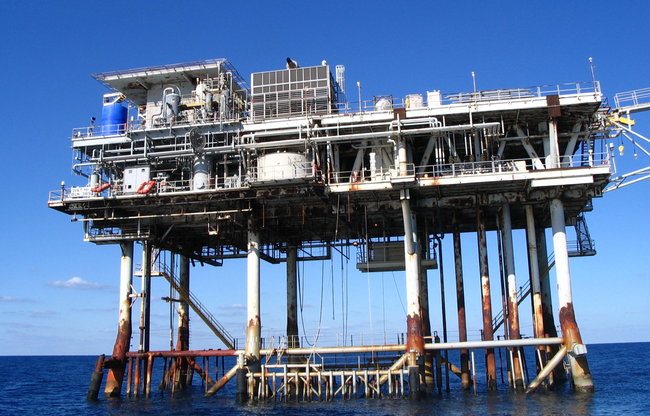
A fight is raging over abandoned oil platform High Island 389-A, pictured below. Obama's Interior Department, led by Ken Salazar, wants to dynamite the structure, killing thousands of fish in the process, and damaging delicate seafloor ecologies -- including coral reefs. But there may be more economical and ecologically sound ways of dealing with abandoned oil platforms.
Now, 30 years after it was built and months after it was abandoned, it is set to be demolished under Interior Department rules governing nonproducing ocean structures. And when it goes, the lush ecosystem that has grown around it will also vanish. There are now about 650 such oil and gas industry relics, known as idle iron, that may meet this fate.

The federal government estimates that the blasts needed to remove one platform kill 800 fish, although others who have observed the process put the number in the thousands. Much of the marine life on or around the structure dies, either from the explosions to separate the platform from its supports or when it is toppled or towed to shore and recycled as scrap metal. _NYT

Texas governor Rick Perry is one of the people trying to stop the Obama-Salazar wanton destruction of ecosystems and fish life. Years ago, President George W. Bush tried to put an end to the bureaucratic rules which make it possible for government to intrude so destructively in offshore waters, proposing to allow abandoned platforms to be used by offshore fish farms.
Oil Rig Conversions

There have been many proposals for ways in which to convert abandoned offshore platforms and rigs to more economic and ecologically sound uses. Here is a rather ambitious and stylish proposal for creating a mini-city from an abandoned offshore rig.

One offshore sea platform originally used as a sea fort, was even declared an independent country -- the Principality of Sealand. But there are many other potential uses for the structures, including as resorts, hotels, diving sites, aquaculture farms, zen monasteries, and more.

Ken Salazar is likely to want to wipe away all traces of oil & gas activity from all US offshore waters. He has done his best to retard and obstruct such activity in the Gulf of Mexico under President Obama's watch. The Obama - Salazar policies toward the Gulf of Mexico waters have harmed the economies of local states far worse than any combination of oil spills could have done. And these policies continue to hurt Gulf economies. Too bad such self-important bureaucrats cannot learn to be more open-minded in their dotage.

Worldwide, there are thousands of abandoned offshore structures, with more likely to become available every year. More recent versions of offshore platforms can even be moved from one location to another. In fact, the Seasteading Institute's main design for an early seastead is derived from the same floating architecture as state of the art floating oil rigs.

Keep an eye on this legal battle over the status of High Island 389-A. It may set a precedent for future policy on abandoned offshore platforms and rigs.

Oil Rig Photos

Labels: ,

Bookmark and Share

29 December 2011

"Sea Tree," A Seastead for Birds, Fish, and Bats

The Sea Tree would be a tiered structure moored underwater with a cable that serves as the frame for series of layers. The layers above and below water would, over time become their own ecosystems — much like a sunken ship does underwater. Like an oil rig, the structure would rise above water and be self sufficient, but serves nature only.

The Sea Tree is a concept created by Amsterdam-based Waterstudio.nl. What is unique about this concept is that their plan was always to create the structure for nature only rather than retrofitting a green space into an urban structure or create a mixed use building. The idea was meant offset the trend of city sprawl and could be located in any water source — lakes, rivers or oceans. Wherever there is a need to bring some green back to the environment. _DVice
Humans have intentionally created artificial reefs for thousands of years for military purposes, and since the 17th century for purposes of increasing fish yields. Of course, humans have unintentionally created artificial reefs since the first ship sinkings and offshore garbage dumps.

Humans have also created island bird refuges for nesting birds, for some time.

This Dutch creation combines the artificial reef concept with the island bird refuge concept. To top it off, they have included an interior "bat cave" as a bat sanctuary and habitat.
A lush variety of plant life should provide abundant nesting areas for birds, as well as providing food for insects, which in turn provides food for birds, bats, and fish.
Once the multi-level animal seastead is placed off-limits to humans, it is apt to evolve its ecosystem in any number of directions. As an ecological experiment, it might hold more than a few surprises.

Just be sure to locate it away from any onshore or offshore wind farms, and keep feral cats far away. Maintenance would best be carried out by robotic telepresence. Monitoring should be done by webcam and UAV flyover. Keep tourists far away. Shoot to kill, if you must. ;-)

Labels: , ,

Bookmark and Share

Bringing Coral Reefs Rapidly Back From the Brink


"I was devastated. Basically, all the corals were dead. It was gravel and sand," Rani recalled.

But when German architect and marine scientist Wolf Hilbertz told her about a discovery he had made in the 1970s, the diver's ears pricked up. _Discovery

Discovery

The story talks about how corals were killed by cyanide poisoning and dynamite fishing. The same kind of devastation of coral reefs occurs after severe storms. Fortunately, coral is incredibly prolific at spreading its seed far and wide across seas and oceans -- spreading over hundreds of miles from the parent reef.

Hilbertz had sought to "grow" construction materials in the sea, and had done so by submerging a metallic structure and connecting it to an electric current with a weak and thus harmless voltage.

...When he tested out his invention in Louisiana in the United States, Hilbertz saw that after a few months oysters progressively covered the whole structure, and colonized the collected limestone.

More experiments were carried out and the same phenomenon was confirmed for corals.

"Corals grow 2-6 times faster. We are able to grow back reefs in a few years," Thomas J. Goreau, a Jamaican marine biologist and biogeochemist, told AFP.

Goreau began working with Hilbertz in the mid-1980s to develop Biorock technology, and he has continued their work since Hilbertz's death four years ago.

When Rani saw the discovery, it gave her an idea for how she might save "her" bay.

She decided to expand the project to 22 structures using her own money with the help of Taman Sari, the holiday resort in front of the coral restoration project.

...Today there are around sixty of these "cages" in Pemuteran bay, across a surface of two hectares, and the reef has not only been saved from near-death, it is flourishing better than ever before.

"Now we've got a better coral garden than we used to have," said Rani.

Biorock not only revives the corals but it makes them more resistant... _Discovery
Of course, cyanide and dynamite -- not to mention storms and trophy-taking tourists -- are quite hard on a reef. How wonderful to find such an easy remedy for such an unsightly problem.

For reporters to claim that the fluctuating ocean temperatures are killing reefs -- reefs which evolved to survive in a wide range of temperatures and dissolved CO2 levels -- is pure dishonesty and political activism.

It is past time for science reporters to come clean, and to report science news honestly and in a balanced fashion. The current crop of science journalists too often come across as just plain biased and incompetent.

First published at Al Fin Potpourri

Labels:

Bookmark and Share

13 May 2011

Oceans: More Complex and Resilient than We Know

Wiki

Popular culture is soaking in the dogma that "humans are killing the oceans" and "man is destroying the planet." But science is so abysmally ignorant about what is actually happening in the seas and on land, that the faux environmentalist message of doom is based upon a blooming ignorance, and little else.

Take a recent declaration of "plankton apocalypse" by researchers from Dalhousie University in Nova Scotia. Faux environmentalists seized on the single, unsubstantiated report as confirmation that the end of the world is near. More knowledgeable and intelligent persons knew -- or at least sensed -- that the Dalhousie report was hagwash. And so it seems to have been. Much of modern published "science" dealing with the environment and climate is unmitigated hogwash, albeit politically correct.

But there is much valid and valuable science to be learned from the oceans, if one can work objectively and without prejudicial biases.
Physorg
"The big mystery about bacteria is what they are doing in nature," Whitman said. "The organisms metabolize compounds for their own needs. We need to understand what they are getting out of it to understand what it means for the ocean, and now it will be possible to look at the environmental importance of this process and how it's regulated." That will help to answer the "why" of the two sulfur fates. _Physorg
Notice that the U. of Georgia scientists are microbiologists -- not "climatologists." Although the microbiologists link their study to climate -- for reasons of funding among others -- their results help to expose the abysmal ignorance of climate "science" with regards to the oceans and cloud formation.
SeaFriends

Scientists have discovered that marine diatoms, tiny phytoplankton abundant in the sea, have an animal-like urea cycle, and that this cycle enables the diatoms to efficiently use carbon and nitrogen from their environment.

The researchers, from the J. Craig Venter Institute (JCVI) and other institutions, published their findings in this week's issue of the journal Nature.

The team, led by lead author Andrew Allen from JCVI and co-author Chris Bowler, Institute of Biology, Ecole Normale Supérieure, Paris, believes that the cycle could be a reason for the domination of diatoms in marine environments, especially after upwelling events--the upward movement of nutrient rich waters from the deep ocean to the surface.

In response to ocean upwelling, diatoms are able to quickly recover from prolonged periods of nutrient deprivation and rapidly proliferate. _Physorg
Nature
Here again, we see a significant finding that relates importantly to global carbon balance, ocean phytoplankton levels, and atmospheric oxygen levels. How many other momentous and paradigm-changing discoveries are waiting for humans to discard their politically correct prejudices in order to better perceive the reality of the universe?

Taken from an earlier posting at Al Fin the Next Level

Labels: ,

Bookmark and Share

06 April 2011

Offshore Oil Production Moving to Seafloor Robotic Cities: So What Can We Do With All Those Abandoned Oil Rigs?

Neal Asher

There are over 1.3 trillion barrels of untapped oil under the seafloors. But what is the safest way of retrieving all of that oil -- much of it at deadly crushing depths?

Brazil intends to replace its fleet of floating offshore oil rigs with 2,000 metre deep "underwater cities" of robotic oil workers, part automated and part controlled from a remote location by human operators. So far, so good. But what will be done with all the huge, obsolete floating oil rigs? Why not turn them into floating resorts and marine research centres?
Inhabitat

The idea is not new. In fact, the (disputed) world’s smallest country is an old oil platform. In the design by Ku Yee Kee and Hor Sue-Wern, the reclaimed oil rig is layered in rings of habitation units sharing center common and recreation areas. The stacked units share an incredible view of the vast ocean. Beneath the water are circular labs for marine research. The designers looked like they were having some fun, inserting a pleasure boat launch, cantilevered pool, and a huge domed assembly room crowning the rig. _Inhabitat_via_Dvice

Inhabitat

Notice the subsurface marine science research labs -- or are they undersea restaurants or hotel rooms? There is room for flexibility in design, depending upon the outfitters and management.

And there is no reason why serious and progressive-minded seasteaders should not substitute small modular nuclear reactors in place of unreliable and intermittent wind and solar power devices. The last thing you want is to be stuck in the middle of the ocean without enough power to make freshwater, keep the lights on, or to cook your seafood.

Always keep your eyes open for opportunities to go beyond the ordinary.

Labels: ,

Bookmark and Share

21 January 2011

Undersea Nuclear Reactors to Power Undersea Cities?

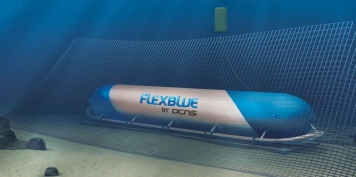
DCNS, the French state-controlled naval company, said it will work in partnership with French companies Areva, EDF, and the French Atomic Energy Commission to build small- and medium-sized underwater reactors to provide electricity to consumers....Radio France Internationale reported Wednesday.

The company said its Flexblue project, expected to enter the building phase in 2013, is in response to global energy challenges and renewed interest in nuclear power. _UPI


Video h/t NextBigFuture
Small, portable nuclear reactors that are made for placement under the sea, could be used for many porpoises purposes. Besides running power cables to land to serve terrestrial customers, such undersea reactors could also serve floating installations and seafloor industries -- even undersea cities.
Akin to the submarines that DCNS has been making for the French navy for 40 years, Flexblue is a cylindrical unit 100 metres in length and 12 to 15 metres in diameter. Inside would be a small nuclear power reactor and well as steam generators, turbines and a generator to produce 50 to 250 MWe.

The vision is for such a unit to be installed on the seabed under 60 to 100 metres of water, several kilometres from a centre of power demand such as a city, industrial base or remote community which it would serve via underwater cables.

A video released today depicts the unit's deployment under naval guard. It is transported to sea on a heavy lift ship which lowers itself to allow Flexblue to maneuvre under its own power. Descent occurs under the watch of divers before a cutaway view reveals four stories of plant within the hull. The structure is then covered by a net and power is transmitted by cable to shore. _WorldNuclearNews_via_NextBigFuture
WNN

Brazil is already planning for "undersea cities" as replacements for deep ocean offshore oil rigs:
The plan is to construct 'cities’ more than 2,000 metres under water, containing machines, giant pieces of equipment and robots that could inspect the systems being used to extract millions of barrels of oil. Many operations would be fully automated while others would be controlled by humans at a distance.

“Our target is that we won’t need platforms in ten years from now,” said Carlos Tadeu Fraga, executive manager of the Petrobras Research Centre.

Petrobras already owns virtual reality laboratories where engineers can inspect 3D images of oil fields. But now they want to take a further technological leap by installing floating rig equipment on the sea bed.

The machinery under the sea would be capable of separating oil, gas, water and sand, compressing substances and generating enough energy to keep the operation functioning.
As deep sea mineral mining and deep sea science and exploration joins deep sea oil & gas drilling, the need for self-powered seafloor installations will grow in urgency. Sealed nuclear reactors that can run between 20 and 50 years on a single fueling will provide the necessary energy security for such installations.

A few years ago, the Estonian Maritime Academy proposed the development and installation of a subsea nuclear reactor off the Estonian coast in the Baltic Sea, for provision of basic power to the country. US naval submarines have traversed the world's oceans for several decades, powered safely and reliably by small nuclear reactors, so the concept of undersea reactors is well proven.

The idea of nuclear powered undersea cities may seem like the stuff of science fiction, but show me a better way to power a post-apocalyptic undersea civilisation. And what better place to survive the great lefty-Luddite environmentalist-engineered dieoff of humans on the surface? Abundant electricity allows for producing freshwater via desalination, oxygen for breathing via electrolytic splitting of water, hydrogen for fuel cells and chemical processes, etc. Nuclear reactors produce plenty of heat, so there would be no reason to be cold, regardless of outside sea temperatures.

Last but not least, plentiful small modular nuclear reactors -- both on land and sea -- should put a quick end to all of the EROEI nonsense one hears batted around at peak energy religious websites. ;-)

Labels: , , ,

Bookmark and Share

06 January 2011

Sun Agrees with Oceans: A Cooler Earth

Knox et Douglass IJG Vol 1 #3 PDF

According to an Internationl Journal of Geosciences paper (PDF), ocean temperatures from Argos floats show a recent cooling between 2003-2008 (via NCMediaWatch). It is difficult for the planet to warm when most of its significant thermal mass is cooling.
In summary, we find that estimates of the recent (2003–2008) OHC rates of change are preponderantly negative. This does not support the existence of either a large positive radiative imbalance or a “missing energy.” _IntJlGeosci PDF
More on ocean cooling from Roy Spencer
WattsUpWithThat
On the solar front, the sun has experienced another sudden drop in activity recently. More from WUWT:
NOAA’s Space Weather Prediction Center (SWPC) produced their monthly solar cycle progression update yesterday. The news is not encouraging. We’ve had a drop in solar activity again in December, The sunspot count is lower, but the really worrisome thing is the Ap geomagnetic index. The solar dynamo has now dropped to magnetic activity levels last seen in late 2009. Readers may recall this post from December 23rd: Solar Geomagnetic Ap Index Hits Zero which was a bit unusual this far into cycle 24. _WUWT
As this September 2010 Science Now article states: "...something peculiar has been happening."

Flashback to a 2008 warning: Sunspots May Vanish by 2015

Let's hope not. Most humans enjoy experiencing at least one warm season per year. If the planet endures many years without a summer, humans will run out of food -- as will most other animals.

Labels: , ,

Bookmark and Share

04 November 2010

World's Oceans, Coral Reefs, Feel Better After US Election

Al Fin recently attended a conference with representatives of all the world's oceans and seas, along with representatives from 600 of the world's largest coral reef formations, plankton communities, and kelp forests. After intensive discussions over the significance of the November 2010 elections in the US for the future of the world's oceans, and Al Fin's explanations of the ramifications of recent US elections for science and the oceans, the expressed conclusion of all attendees was one of massive relief.
Theoretical predictions indicate that coral calcification rates should decline as a result of increasing atmospheric CO2 concentrations by as much as 40% by 2100. However, real-world observations indicate that elevated CO2 and elevated temperatures are having just the opposite effect. _ScienceandPublicPolicy
Of the four 'states' that CO2 can assume, carbondioxide CO2 is a mere 1%, bicarbonate HCO3 is 93% and carbonate CO3 8% . But the total amount of carbon dissolved in the oceans is just short of 40,000Gt (Pg) compared with less than 700Gt in the atmosphere. The sea is a massive carbon dioxide reservoir, in balance with an even more massive limestone reservoir of 40,000,000Gt carbon in marine sediments .

...It is thought that the carbondioxide in the sea exists in equilibrium with that of exposed rock and bottomsediment containing limestone CaCO3 (or sea shells for that matter). In other words, that the element calcium exists in equilibrium with CO3. But the concentration of Ca (411ppm) is 10.4 mmol/l and that of all CO2 species (90ppm) 2.05 mmol/l, of which CO3 is about 6%, thus 0.12 mmol/l. Thus the sea has a vast oversupply of calcium. It is difficult therefore to accept that decalcification could be a problem as CO3 increases. To the contrary, it should be of benefit to calcifying organisms. Thus the more CO2, the more limestone is deposited. This has also been borne out by measurements (Budyko 1977).

The bit missing at the beginning is that CO2 (atmosphere) <=> CO2 (sea water) or in other words, that the carbondioxide in the air is in balance with that in the surface water.

If the amount of CO2 in the atmosphere rises, then more of it will dissolve in the water, working all the way through the chemical reactions, to an increase in acidity and an increase in carbonate CO3. Scientists believe that the sea in pre-industrial times was 'saturated' relative to dissolved limestone, and that recent increases in CO2 have 'desaturated' the sea (beginning in the antarctic sea), with possible dire consequences for sea life. But we have observed that calcium skeletons dissolve back into what scientists call 'saturated' CO3. _SeaFriends
The oceans are not acid but alkaline, with an average pH of about 8.15 (0-7 being acid, 7-14 being alkaline). But they vary both in space and time, Arctic seas being less strongly alkaline than tropical, and some bays and reefs being actually acid because of underwater volcanic emissions. The dissolution of carbon dioxide in the oceans may lower the pH slightly to about 7.9 or 7.8 by the end of the century at the worst – still alkaline.

Environmentalists like to call this a 30% increase in acidity, because it sounds more scary than a 0.3 point (out of 14) decrease in alkalinity, but no matter. It is still well within the bounds of normal variation over space and time: the pH of the water intake at the Monterey aquarium varies by almost twice as much as this every month. The difference between the pH of the seas off Hawaii and Alaska is greater than this.

Enough numbers. Try chemistry. The scary reasoning rests on the argument that lower pH will mean less dissolved carbonate in the water. But a new paper from scientists in North Carolina proves what many scientists have long suspected, namely that corals and other species do not use carbonate as raw material to make their shells; they use bicarbonate. And dissolving carbon dioxide in water actually increases bicarbonate concentrations.

This may explain why study after study keeps finding that far from depressing growth rates of marine organisms, high but realistic levels of carbon dioxide either do not affect them or increase them. By far the most important calcifiers in the oceans are plankton called coccolithophores, which account for about a third of the total marine calcium carbonate manufacture. There is now strong evidence that coccolithophores are growing faster and larger as a result of human carbon dioxide emissions. Stands to reason if they use bicarbonate. _MattRidleyinTheTimes
The persistence of coral reefs through geologic time – when temperatures were as much as 10-15°C warmer than at present, and atmospheric CO2 concentrations were 2 to 7 times higher than they are currently – provides substantive evidence that these marine entities can successfully adapt to a dramatically changing global environment. Thus, the recent die-off of many corals cannot be due solely, or even mostly, to global warming or the modest rise in atmospheric CO2 concentration over the course of the Industrial Revolution. _CO2 Science

It is unusual for representatives from all the world's seas and oceans, plus the largest communities of corals and sea plants and plankton, to gather in one place at one time. But the recent distortions of ocean science by persons who should know better, forced concerned saltwater representatives into action.

When the seas and oceans learned that corrupt land and ocean scientists were concocting a fake crisis to enrich themselves, political sponsors, and collaborators, they decided that they simply must speak out against the travesty of distorted ocean science.

Al Fin interviewed the chairman of the proceedings after the conclusion of the conference:

Al Fin: Thank you for speaking with me today, Chairman GBR (Great Barrier Reef).

Chmn: It is certainly my pleasure, Al. And thank you so much for taking time out of your schedule to attend our conference.

AF: I would not have missed it for all the world. Can you tell me why the oceans and ocean communities are so relieved by the findings of this conference?

Chmn: Well, Al, the oceans of the world have been very angry -- and you don't want to make them angry, Al, you really don't. They have been hearing all this news about humans killing the oceans with acid and CO2 until they were beginning to believe it. Having you here to explain the dishonesty of corrupt science, media, and politicians has helped us understand what is really going on.

AF: Certainly humans are doing some bad things to the seas and oceans, and for that I am sorry. But those are local problems, such as dumping toxins, untreated sewage, and other excess nutrients into the local ecosystems. Some harbours, bays, and estuaries are being stressed -- and that problem needs to be addressed.

Chmn: Yes, of course it does, Al. But all the hoopla about acid oceans and CO2 only distracts from the real problems you point out. If the crooked scientists are eating up all the resources which could have been used for remediation and finding solutions for real problems, it only hurts us more, Al.

AF: You are certainly correct. And that is why you should feel relief at the results of the November 2010 US elections. The criminal enterprise which could only do untold damage to both humans and the oceans has at least been slowed down by the election of less corrupt and less gullible elected representatives at the US federal and state levels.

Chmn: We understand all that now, thanks to you, Al. Thanks again for attending this important summit and conference.

AF: Thank you, Chairman GBR, for speaking with me for the benefit of Al Fin blog readers.

More from Matt Ridley here

Labels: , ,

Bookmark and Share

08 October 2010

Deep Sea Prospecting for Minerals, Oil, Gas -- The Motherlode

No one knows how many hydrothermal vent sites are in the oceans, but there is a best guess. Amazingly, when scientists who have studied different parts of the ridge system compared notes at the April WHOI conference, they realized they were all coming up with the same distance between known, large active vent sites: 100 kilometers. If those numbers hold true, about 600 districts spewing metal-rich fluids and potentially holding sulfide deposits may decorate the mid-ocean ridge. Nautilus Minerals estimated in a September 2009 corporate presentation that "thousands of underwater sulphide systems exist," and "if only half of underwater systems are geographically viable, seafloor production would represent several billion tons of copper per annum." _Minerals from the Seafloor

Earth's seafloors are loaded with mineral wealth. Humans have just begun to learn to tap into the huge reserves of deep sea oil and natural gas. And seafloor methane clathrate reserves may be more than twice as abundant than all other forms of hydrocarbon deposits combined. Seafloor coal deposits are likewise huge beyond previous calculations.

But beyond hydrocarbon energy wealth, the ocean floors are rich with other minerals. From precious metals to uranium to large deposits of copper, zinc, iron, sulfur and more -- the oceans are likely to be Earth's richest repository of minerals. All we need to do is to learn how to get them safely and responsibly.
In a review paper published June 23 online in the journal Mineralium Deposita, Cathles, Cornell professor of earth and atmospheric sciences, writes that while land-based deposits may be a dwindling source of valuable minerals, deposits on the ocean floor could power humanity for centuries.

The minerals, including sulfur, copper, zinc, iron and precious metals, are contained in volcanogenic massive sulfide (VMS) deposits that form on the ocean floor where tectonic plates pull apart and allow magma (molten rock) to invade the Earth's 3.7-mile- (6 kilometer-) thick crust. The magma heats seawater to 662 degrees Fahrenheit (350 degrees Celsius) and moves it through the ocean crust via convection; and the seawater deposits the minerals where it discharges along the ridge axis.

...If just 3 percent of the dissolved minerals precipitate -- an estimate based on earlier studies -- the ocean floor would hold reserves vastly greater than those on land, Cathles said.

In the case of copper -- a key component in construction, power generation and transmission, industrial machinery, transportation, electronics, plumbing, heating and cooling systems, telecommunications and more -- calculations show that just half of the total accumulated amount could be enough to bring the world's growing population up to a modern standard of living and maintain it for centuries.

"I think there's a good chance that it's a lot more than 3 percent," Cathles said. "But even just taking 3 percent, if you calculate how long the copper on the ocean floor would last, just half of it could last humanity 50 centuries or more. _RD

New Zealanders have begun exploring the mineral riches near local undersea volcanoes
. And the Aussies have begun installing deep sea observatories to compile records of what is happening along deep sea vents -- where most metals tend to come up. US institutions are likewise beginning to map undersea resources.

Nautilus Minerals (see image at top) is already bringing deep sea minerals to market. Bluewater Metals Ltd. is another ambitious company eager to jump into the deep sea gold rush.

Little by little, mining companies are working their way through the international laws, committees, and bureaucracies in order to try out some of the advanced undersea technologies that are being developed.

Remotely piloted prospecting robots will be followed by autonomous robot prospectors and miners. Semi-permanent seafloor installations -- perhaps supervised by station-keeping manned submarines overhead -- are likely to evolve if the promise of the resource proves out. Ships are subject to surface storms, but submarines -- particularly nuclear submarines -- can stay submerged below surface turbulence and maintain data communication with equipment on the seafloor.

Deep sea robotic submersibles have come a long way since the early, heady days of speculation about deep sea mineral resources. If the mining companies currently pushing to get a hand in the game can exploit the resource cleanly and responsibly, this may be the beginning of the era of deep sea resources.

Brian Wang has also taken a look at this topic.

Labels: ,

Bookmark and Share

19 July 2010

White House Panics Over Natural Oil Seep

Officials had worried that the seep — usually a flow of hydrocarbons from the seafloor — could have been evidence that oil, gas or both were escaping from the well up to the seafloor, forcing the government to order BP to remove the cap and resume oil collection.

But seeps also occur naturally, and in a briefing for reporters Monday afternoon, BP said that government and company scientists were coming to the conclusion that the seep was probably of natural origin and unrelated to the well. _NYT

Image Source
BP's Kent Wells reports that pressures at the well head continue to rise -- a good sign -- and are now above 6811 psi. But the discovery of a natural gas seep on the seafloor -- located roughly 2 miles from the Macondo well head -- almost caused the White House to order the re-start of a nearly 1 million gallons a day oil spill into the Gulf of Mexico. Just when Gulf residents had begun to hope their long nightmare was nearly over, the squirrelly Obama administration threatens to start it all up again.

Officials in the Obama administration have become so jumpy that the presence of tiny amounts of oil and gas leaking around the new sealing cap have them on the phone to BP nearly around the clock, seeking constant reassurance.
Some thoughts on all the oil spill handwringing this afternoon. The government says seeps have been spotted within two miles of the site of the blowout. So what? Does that mean it's time to be panic that oil from the Macondo well is finding a new path to the surface, and is set to burst open through the seafloor in a new, unstoppable gusher? Probably not....Natural seeps occur constantly in the Gulf of Mexico, and had been spotted around the blowout well by NOAA's science ship Thomas Jefferson long before this recent capping maneuver. The good news is that according to BP, pressure readings from the well continue to climb roughly 2 psi per hour, to 6,811 psi as of late afternoon. Climbing pressure is a good sign. If the oil were to pop a new hole in the seafloor, we would see pressure plunge. _Forbes
So it looks as if the sealing cap will remain -- despite the panic at the White House -- for at least another 24 hours.
Leaks in the valve stack atop BP Plc’s Macondo well and seepage at the base of the blowout preventer are “inconsequential,” so valves that prevent it from gushing oil will remain closed for now, National Incident Commander Thad Allen said.
Pressure inside the well is 6,811 pounds per square inch and rising, a “positive” sign that there’s no leakage that could accelerate into another gusher of oil and gas, Allen said today at a press conference in Washington.
The well will be shut “day to day,” starting with the next 24 hours, so long as BP continues monitoring the seeps of methane as directed by the government there’s no sign of significant leaks, he said.
The seeps consist of methane, or natural gas, he said. A seep found 3 kilometers (1.9 miles) away was not from the BP well, he said. _BW
President Obama was quite eager to claim credit when it looked as if the sealing cap was successfully closing off the well. But all it took were a few bubbles to shake the White House to the foundation.
From the beginning, authorities said that if the pressure hit 7,500 psi it would indicate that the well was intact. If it went below 6,000 psi, it would indicate that cracks or other damage to the well was allowing oil to escape. So far, the pressure has remained in the indeterminate range between those two numbers. On Monday afternoon it was 6,811 psi, and gradually rising a pound or so every hour, Allen said.

The fact that it's increasing slightly over time -- rather than decreasing -- is a good sign that there's not a leak, says David Rensink, incoming president of the American Association of Petroleum Engineers. _PBS
The possibility remains that the well will lose integrity before the first relief well -- now only 4 feet from the Macondo bore, horizontally -- is able to finally secure the well. If that happens, BP will be forced to resume containment efforts to surface ships such as the Q4000 and the Helix Producer. In that case, some additional oil would spill into the Gulf, during the changeover.

But can you imagine how Obama would be seen in the Gulf and the US as a whole, should he decide to re-open the oil spill into the Gulf based upon a few bubbles of methane from a natural seep? You may suppose that Obama could not appear any more inept than he already does, but he may surprise you over the next few months and years.

More: 5 Wild Technologies used to clean up Macondo spill The problem with "A Whale" may have been that the underwater dispersant used was too efficient. The surface slick was simply too skimpy for the huge supertanker--skimmer.
Causes of marine oil pollution: notice that "extraction" (such as the BP spill) represents a relatively small contributor to ocean oil contamination -- particularly compared to natural seeps and everyday rain runoff from land.

Labels: , , ,

Bookmark and Share

24 June 2010

Hungry Plankton Gobble CO2, Astound Scientists

Physorg

There is so much that scientists still do not know about Earth's climate, the oceans, the carbon cycle, and so much more. Recently, scientists were surprised to learn that plankton travel relatively long distances -- in terms of ocean depth -- to seek out both nutrients and CO2. Back to the drawing boards.
For almost three decades, oceanographers have been puzzled by the ability of microscopic algae to grow in mid-ocean areas where there is very little nitrate, an essential algal nutrient. In this week's issue of Nature, MBARI chemical oceanographer Ken Johnson, along with coauthors Stephen Riser at the University of Washington and David Karl at the University of Hawaii, show that mid-ocean algae obtain nitrate from deep water, as much as 250 meters below the surface. This finding will help scientists predict how open-ocean ecosystems could respond to global warming.

...Surface waters in this and other mid-ocean areas contain almost no nitrate or other plant nutrients. Yet each year, microscopic algae (phytoplankton) flourish in these vast, open-ocean areas. Although miniscule in size, these mid-ocean algae consume about one fifth of all the carbon dioxide taken up by plants and algae worldwide.
To solve this mystery, Johnson and his fellow researchers used a robotic drifter called an Apex float, which automatically moves from the sea surface down to 1,000 meters and then back again, collecting data as it goes. Researchers at the University of Washington outfitted this drifter with an oxygen sensor and a custom version of Johnson's In Situ Ultraviolet Spectrophotometer (ISUS), which measures nitrate concentrations in seawater.

...From January through October of each year, the instruments on the drifter showed a gradual increase in oxygen concentrations in the upper 100 meters of the ocean. At the same time, the float detected a gradual decrease in concentrations of nitrate in deeper waters, from 100 to 250 meters below the surface.
Johnson and his coauthors found that the amount of oxygen being produced near the surface through photosynthesis was directly proportional to the amount of nitrate that was being consumed in deeper water. _Physorg
Science is still relatively ignorant about the deep processes of life and climate on Earth. Certainly far too ignorant for humans to base the future of their civilisations upon half-baked computer models which leave out the most critical parameters -- and include too much uncertainty to reliably predict anything at all.

Science is just barely beginning to learn a few of the things it would need to know to predict a future climate. It is time for the rational humility of our present limitations to enter science at all levels once again -- particularly in the areas where science intersects with politics and public technological and economic policy.

There are a large number of ocean organisms that take CO2 out of the atmosphere on a semi-permanent basis -- as is obvious from observing geologic phenomena such as limestone and chalk. Fossil fuels are still being formed under the oceans, as well as the massive layers of fossil rock. All of that carbon was cycled through life forms -- including the lowly plankton.

Labels: , ,

Bookmark and Share

09 May 2010

Methane Clathrates Clog Deep Horizon Oil Recovery Effort

Methane clathrate, also called methane hydrate, methane ice or "fire ice" is a solid clathrate compound (more specifically, a clathrate hydrate) in which a large amount of methane is trapped within a crystal structure of water, forming a solid similar to ice.[1] Originally thought to occur only in the outer regions of the Solar System where temperatures are low and water ice is common, significant deposits of methane clathrate have been found under sediments on the ocean floors of Earth.[2] _Wikipedia
Wikipedia

Oil recovery efforts at the Deepwater Horizon spill site have been foiled by the accumulation of frozen methane clathrates -- covering and clogging the containment dome that had been lowered over the leak. Apparently as the leaking gas hit the cold 4 degree Celsius water on the sea floor, it formed into a frozen combination of methane and water -- methane hydrate, or clathrate. Unless BP and Coast Guard personnel can find a way around this problem, the containment dome approach may fail completely.
It could be at least a day before BP can make another attempt at putting a lid on a well spewing thousands of gallons of crude into the Gulf of Mexico, as a big containment box meant to siphon the oil away sat idle and encased in ice crystals.

The company's first attempt to divert the oil was foiled, its mission now in serious doubt. BP said it could be Monday or later before a decision is made whether to make another attempt to capture the oil and funnel it to a tanker at the surface. The box was moved hundreds of feet away while officials tried to figure out their next move. _NOLA
Meanwhile,containment efforts on the surface continue. Officials scramble to locate more containment booms, and more dispersants are being applied to the surface spill as necessary. It is anticipated that over the next 48 hours the spill will be pushed toward the coast West of the river, with a smaller area of light slick pushed toward Breton Sound on the East.

Full news coverage of oil spill

Methane clathrates are believed to constitute a reserve of natural gas equivalent to between 2 and 10 times all other known natural gas deposits worldwide. More on methane hydrates

As the Deepwater Horizon episode illustrates, working in the cold, dark, pressurised atmosphere of the deep sea floor is unlike any other work environment. Engineers and scientists are learning a great deal from this disaster -- which is often how important lessons are learned. Now it is vital that the important lessons be put to work in safely developing the mineral resources of the deep sea floor -- from oil to gas to methane clathrates to mineral nodules and so on.

Labels: , ,

Bookmark and Share

08 May 2010

Negative Climate Feedbacks Mock Carbon Hysteria

Bill Gates has donated $300,000 to Silver Lining, a San Francisco group that wants to spray a microscopic seawater mist into the sky -- to reflect sunlight back into space -- for purposes of cooling the planet. Such "anthropogenic negative climate feedback" would be adjustable -- so that if the planet became too cool, they could turn off the misting until things heated up again.

But are such geoengineering schemes really necessary? Climate scientist Roy Spencer says the oceans are already doing a very fine job of natural negative feedback moderation of global heat cycles -- whether natural or manmade. Recent "unprecedented" drops in ocean temperatures suggest that there is more going on than the climate catastrophe orthodoxy understands. And while climate change is real (climate always changes), the underlying mechanisms of climate change remain largely unknown to human science.
WattsUpWithThat

In fact, human science has barely begun to grasp the mechanisms of climate and climate change. Mobs of criminals have grasped onto "climate change" as a means of ripping off investors and taxpayers (via ClimateDepot). And the further governments dig themselves into the climate hysteria hole, the more devastating will be the economic fallout for their citizens.
WattsUpWithThat

It is time to call a "time out" from the hysteria, and to begin an intensive program of data collection, correlation, and analysis. There is nothing moral or enlightened about being hoodwinked and bamboozled by criminals and opportunists.

H/T Tom Nelson

Labels: , ,

Bookmark and Share

01 May 2010

Watts Up With That Provides Good Look at Oil Rig Disaster

In articles here and here, Anthony Watts provides the best coverage of the Gulf of Mexico oil well head disaster to be found on the web or on the air. Anthony provides a wide array of photographs and a clear analysis of what likely happened.
Conspiracy theorists are burning up the web debating who blew up the oil rig: North Korea vs. environental activists? The mainstream media is attempting to exploit the potential environmental and commercial catastrophic implications of the disaster -- which is barely a notch above the conspiracy theorists at this point.

The immediate problems have to be dealt with: the oil flow must be stopped, and the existing oil slick must be contained. BP may have to drill another well in order to get into position to stop the current well from leaking. And a massive oil containment effort is ongoing, involving a growing army of commercial, governmental, and private participants.

Other than those immediate important concerns, it is crucial that time-critical information regarding the actual events be collected and analysed before conditions change too drastically. Any lessons learned from this disaster will help to plan and design subsequent deep sea oil drilling efforts.

Labels: ,

Bookmark and Share

Extreme Measures Necessary to Shut Down Leaking Well

ImageSource

BP concedes that a relief well will eventually have to be drilled in order to successfully shut down the existing leaking well. The graphic below explains what's happening on the ocean floor, and how the relief well will work. _NOLA

The graphic image makes clear that the blowout preventer at the wellhead failed, and that the drilling riser is leaking from multiple sites.
Blowout preventers (BOPs) are designed to deal with bubbles. Different control valves and rams can close in the well to various degrees (i.e. think of the difference between a sphincter and a guillotine). Why wasn't the BOP engaged at the time of the "kick." Perhaps there wasn't enough time to act. Even then, the big mystery is why the BOP still can't be activated now by the robotic submarines (ROVs) sent to the scene.

Some scenarios. Assume the workers did try to engage the BOP, but it didn't work. Why? One analyst I spoke with suggested that it could be that the kick pushed newly poured cement out of the casing, gumming up the controls. I ran that idea by a subsea engineer who has been responsible for BOPs in deepwater drilling offshore Brazil, and he felt it could be within the realm of possibility.

Another possibility--they tried to engage the BOP's shear ram (which is supposed to slice through the riser and seal off the hole) but there was something too big to shear. That could have been a solid steel joint between two sections of drill pipe. These joints come along about one foot in every 30 feet of pipe, so it would have been very unlucky for such a joint to be sitting right where the shear ram would try to cut--but possible.

Video shot by the robotic submarines (a.k.a. remote operated vehicles or ROVs) seems to indicate that oil is leaking from three spots in a pipe that is laying on the seafloor. The pipe would have to be a portion of the riser, which would have to still be attached to the BOP, but crimped and bent over. An uncuttable piece of joint lodged in the shear ram would perhaps explain why the ROVs haven't been able to subsequently engage the ram. _Forbes
Bad weather has complicated efforts to stop the leak and contain the spill. Estimates of the rate of leakage have ranged from 1,000 barrels per day up to 25,000 barrels per day. At a rate of 25,000 barrels of oil leaking per day, it would take only 10 days to match the oil discharge of the Exxon Valdez. The true amount of leakage will not be determined for some time.

Deep ocean drilling is a very hazardous undertaking. Apparently the Transoceanic blowout occurred at one of the most critical points of securing the wellhead. The entire process will have to be put under the magnifying glass and dispassionately examined.

Nature deals with large natural oil spills every day. Human intervention and mitigation of the oil slick should be able to limit the temporary damage to natural ecosystems.

This episode does bring up an important concern about human limitations. Only certain types of people can work with the unpredictable hazards of deep sea construction and industry. The supply of such persons is not unlimited. Peak manpower is probably the most critical peak we will confront in the struggle to get out of the "between levels" quagmire that humans find themselves in.

Likewise, too many nations have outsourced most of their heavy industrial equipment manufacturing to just a few East Asian countries. In the event of catastrophic failures and destruction of heavy industrial equipment -- such as high voltage transformers, large power turbines, or heavy drilling equipment -- replacements may take a long time to arrive. In other words, by relying too much on outsourcing of manufacturing, some advanced nations may be making their industrial and commercial infrastructure unnecessarily vulnerable to unexpected breakdowns, sabotage, or natural disaster.

Labels: ,

Bookmark and Share

30 April 2010

More Oil Seeps Naturally Than from Human Spills

Update 19 July 2010: The Macondo bore Gulf spill has spilled considerably more oil to this point, than the Exxon Valdez. It has certainly spilled more oil than a typical year of natural seeps in the Gulf. But warm waters recover from oil spills very quickly -- as was seen in the 1979 Ixtoc 1 spill -- which lasted 10 months. One more thing: Every year, rain runoff carries at least 3 or 4 times as much oil to the sea as the Transoceanic spill. (see graph at bottom of post) Let that cue your thinking as to whether the Gulf is naturally able to dispose of large quantities of oil.
The Exxon Valdez oil spill in Alaska's Prince William Sound released 10.8 million gallons of oil -- or almost 250,000 barrels of oil. But natural oil seeps off California release up to 80 times that amount. And natural seeps in the Gulf of Mexico release twice the amount as the Exxon Valdez every year.

The Transocean oil spill may eventually match that of the Exxon Valdez -- if it continues leaking at the current rate for the next month or two or more. Politicians and environmentalists are already declaring states of emergency, but better technology may yet break up the oil spill and allow natural forces to dissipate it.

Curious claims are being made from various sources regarding the origin of the oil platform fire, explosion, and sinking. But even if the oil platform was deliberately destroyed, as some are claiming, the well itself should have had some type of inbuilt mechanism -- a blowout preventer -- to stop oil flow in case of a catastrophic disruption in continuity of the piping. [Update 1 May 2010: Apparently the blowout preventer at the site failed to operate. At this time no one knows why the blowout preventer failed. Certain automatic safety switches that were not included in the operation may have been able to trigger the blowout preventer.]

Other offshore wells incorporate such safety features, which would likely have stopped the oil spill very early in its course.

So the problem is not offshore drilling so much as it is making sure the best technology is utilised when drilling offshore. And, yes, try to maintain a sense of perspective.

This Denver Post article presents a bit of background
Causes of Oil Pollution

Labels: , , ,

Bookmark and Share

20 February 2010

Seastead Basics: Building On a Foundation

Above, you can see the basic "Clubstead" design from Seasteading.org, and one final design using the basic concept as a foundation. Your choice of foundation will pre-determine much of your final design.

The Clubstead is built upon four vertical pontoons, one at each corner. This is similar to many oil drilling platform designs, and seeks to minimise the cross-section to oncoming waves.  Wind exposure can be significant, however.   Failure of the structure can be catastrophic should sustained waves exceed the design parameters.
Above you can see the "Lilypad" design from Vincent Callebaut Architectures of Belgium.  It features a central bowl-shaped hull which is augmented by supporting flotation located about the outer ring -- of an unconventional "multi-hull" variety.  This design presents a significant exposure to wave fronts, and to the wind.  Failure of this design is likely to be less sudden than for Seasteading's Clubstead -- allowing more time for occupants to escape and be rescued.
The Gyre design is an inverted seastead design -- all of the occupied real estate is under the surface. This presents very little exposure to wind and above-surface wave, but may present a greater hazard in the event of a hull breech or abandon ship situation. The deeper the pressure hull, the stronger it must be.

The Gyre offers obvious solutions for floating breakwater protection of an intrinsic harbour. The longer the outrigger arms, the greater the subsequent stresses during sustained storms. Finding the optimal material combining resilience, strength, and probably self-healing of cracks, will require some R&D.

More traditional designs based upon mono-hulls and multi-hulls offer their own advantages and disadvantages. There is a limit to how large a traditional "cruise ship" design can be built, but multiple mono-hulls can be connected in a raft-like design to form a larger structure, as long as proper measures for dealing with large waves are followed.

And then there are the quasi-absurdist designs that are meant to demonstrate an architects ability to think outside the box:


In this case, the tetrahedral New Orleans design clearly wins out over the braced rectangular Boston design, on the basis of stability alone. Imagine the topheavy Boston design dealing with heavy seas and high winds.

Most architects appear to treat the idea of a floating city as a joke, without seriously considering the raw elements of nature that must be dealt with.  It will be fascinating to watch the evolution of designs at the Seasteading Institute, and to watch for any serious competition that may appear on the horizon.

Labels: ,

Bookmark and Share

08 January 2010

Seamounts of the World, Unite! New Nations Arise

Seamounts are literally undersea mountains rising from the bottom of the sea that do not break the water's surface. Scientists generally define them as as steep geologic features rising from the seafloor with a minimum elevation of 1,000 meters and with a limited extent across the summit. _EncyclopediaofEarth

Seamounts are undersea peaks rising from the ocean's floor. These submerged mountaintops could be used to tether floating seasteads + their floating breakwaters. More interestingly, seamounts could be used as building platforms for giant towers -- part underwater, part above water.
How would you build a tower with a foundation hundreds or thousands of feet under the seafloor? This discussion from seasteading.org looks at a few of the issues involved.  But taking into account advances in undersea construction technology related to deep sea oil drilling, and future advances in nanotechnological construction methods, it is likely that we will be able to build undersea tower-foundations capable of supporting significant above-the-surface tower structures.


Exclusive Economic Zones

As long as you avoid building within the exclusive economic zone (EEZ) of an existing nation, it is unlikely that any existing nation could prove a claim against your structure.

To visualize what a nano-assembled foundation might look like, visualize a gigantic  Eiffel Tower, with about 1/3 of the structure submerged.  The tower would be built molecule by molecule, using materials resistant to the corrosive effects of seawater -- such as  tough hybrid diamond / silicon compounds.   Creative use of floatation would allow for surface level expansions.    An alternative design might look like a fractal pyramid -- a 3-D Sierpinski triangle.  The idea is to provide a strong, broad foundation fixed to the seamount, capable of supporting an appreciable above-surface construction.

Such mid-ocean de novo nations could provide the nucleus for duty free economic zones, experimental medical procedures, mid-ocean space launch, tourism, deep ocean mining and drilling, oceanic research institutes, and a nascent seastead construction industry.

Labels: ,

Bookmark and Share

02 December 2009

Concealed Love Affair Between Sea Life and CO2

We recently learned that atmospheric CO2 nourishes coral reefs using the lowly sea sponge. Now we are learning that sea creatures can ramp up shell production when exposed to higher levels of dissolved CO2 in sea water.
Oceanographic Institution (WHOI) scientists report that some shell-building creatures -- such as crabs, shrimp and lobsters -- unexpectedly build more shell when exposed to ocean acidification caused by elevated levels of atmospheric carbon dioxide (CO2).

Because excess CO2 dissolves in the ocean -- causing it to "acidify" -- researchers have been concerned about the ability of certain organisms to maintain the strength of their shells. Carbon dioxide is known to trigger a process that reduces the abundance of carbonate ions in seawater -- one of the primary materials that marine organisms use to build their calcium carbonate shells and skeletons....

....But in a study published in the Dec. 1 issue of Geology, a team led by former WHOI postdoctoral researcher Justin B. Ries found that seven of the 18 shelled species they observed actually built more shell when exposed to varying levels of increased acidification. This may be because the total amount of dissolved inorganic carbon available to them is actually increased when the ocean becomes more acidic, even though the concentration of carbonate ions is decreased. _SD
Oceans have been exposed to much higher levels of CO2 in the past than humans could possibly produce from fossil fuels. Ocean life loves CO2. Photosynthetic algae blossoms in the presence of higher CO2, providing fodder for the rest of the ocean's food chain. As mentioned above, sea sponges convert half their weight in CO2 per day to nutrient-rich excretia -- feeding much of the rest of the coral reef in the process. And now that scientists are finally admitting that higher dissolved levels of CO2 actually drive formation of sea shell in many sea creatures, the public no longer has an excuse for its absurd "ocean acidification mania and panic!".

The oceans are not being acidified. They are embracing the CO2 -- begging for as much as they can get! -- and turning it into sea life.

See WattsUpWithThat!!?? for more.

More detail on ocean carbon chemistry (via comments in WUWT)

Labels: ,

Bookmark and Share

05 July 2009

Freedom For the High Seas and Beyond


The Aeroyacht 110 has been dubbed “the world’s most innovative super catamaran” by its designers and, while that’s a pretty big claim, it’s certainly an audacious concept. Capable of speeds of over 32 knots but able to cruise effortlessly at 20, boasting a superbly-appointed 32ft wide salon with 360º sea views and with its own fold-up amphibious plane as a tender, the Aeroyacht 110 looks to be the ne plus ultra of luxury sailing.

Designed from scratch by Gregor Tarjan, founder of Aeroyacht International, together with naval architect Pete Melvin, of the world-renowned Morrelli & Melvin multihull architects, the Aeroyacht 110 was designed from the outside-in. Tarjan started with the concept for a “pure sailing machine” and, once its streamlined shape was established, only then worked out how many people it could and should accommodate

The ICON amphibious craft on deck adds a completely new dimension of freedom to the maritime ensemble. All that is lacking is a small submarine. The decks appear ample for both a mini-sub and the small amphibious flier.

Perhaps the Aeroyacht people can correct that oversight by the time the super cat hits the market. The ability to roam on the sea, under the sea, and above the sea, is an absolute minimum of freedom for the advanced between levels human. For exploration on shore and throughout inland estuaries, a hovercraft may need to be included.

Labels: , , ,

Bookmark and Share
Older Posts
Al Fin Main Page
Enter your Email


Powered by FeedBlitz
Google
WWW AL FIN

Powered by
Blogger

``