17 August 2008

Russia Takes the Path of Violence

Russia's attack on Georgia has sparked fears across the young democracies of Eastern Europe that Moscow is once again hungry for conquest — and they are scrambling to protect themselves by tightening security alliances with Western powers. _AP
The Russian invasion and occupation of Georgia continues. It is not just the Eastern Europeans who are beginning to be concerned about the loose cannon running Moscow. Western European leaders are also beginning to wonder how they leased their energy future to a reincarnation of one of the mad imperialists of Europe's past.
Anxiety in the Baltic states runs deep in part because, like Ukraine, they have large Russian minorities.

There is fear that Moscow could repeat there what it did in South Ossetia, the breakaway republic where fighting began: Hand out passports to ethnic Russians. Moscow justified its attack on Georgia as necessary to protect its citizens.
Looking at the map, one can see two vast northern hemisphere nations, rich in mineral wealth and bordering a large area of the Arctic: Canada and Russia. Both nations are sparsely populated in relation to land area and the richness of the land. One nation is deathly afraid of having its land and wealth taken away, the other is not concerned in the least. Why the difference?

Canada could not defend its territories from a determined attack by stronger militaries from Russia, China, UK, France, Germany. Even Iran could likely conquer Canada. Why is Canada so unconcerned, where mighty Russia with its huge army, navy, and nuclear arsenal is so unhinged by fear that it is willing to undo the difficult diplomatic work of almost two decades?

Think about it. Clint Eastwood always says, "a man's got to know his limitations." The same is true for a nation. Already on a one way superhighway to oblivion, Russia is in the process of destroying its bridges behind it.
Russia has now shown itself to be a bully. Russia has been trying to annex two parts of Georgia that border Russia, and this war was all about showing Georgians that Russia would rather fight than give up this land grab. The UN was created to deal with this sort of thing, but Russia is doing well, so far, intimidating the UN into inactivity.

It's not a clear win for the Russians, but, short-term, many things appear to be going their way. Long term, things are rather more murky. Europeans have been reminded that the Russian bully they have feared and despised, for so many centuries, is back in town. That could have interesting consequences down the road. _StrategyPage

Labels:

Bookmark and Share

16 August 2008

Russia Steps More Deeply Into Its Quagmire

Russian troops are digging into positions deep inside Georgian territory--despite signing a cease-fire committing them to honour Georgia's territorial integrity. To Putin, it is something personal. He wants Saakashvili's head on a platter. Georgia's president failed to give Putin the respect Putin demands. So Putin orchestrated a premeditated invasion of Georgia--timed to coincide with the Beijing Olympics.

Putin's gambit has clearly failed, but Putin is too stupid to realise it. By immersing his armed forces and national prestige in a border conflict with a tiny and inconsequential country, Putin has set the stage for an extended quagmire-like debacle for Russia's entire autocratic, but fragile government.

It took a decade for Russia to incompletely pacify tiny Chechnya, an enclave with little international support. Georgia is a completely different story. Georgia represents a lot of things to Europe and the west, but the most practical thing it represents is a means of sidestepping Putin's chokehold on Europe's energy supplies. Europe really needs the energy that would flow through the Georgian pipelines. If Russia closes the energy supply route to Europe by force of arms, the precedent Putin sets will be almost impossible for him to outlive.

Look at the map of Russia. Look at the size of that country! Russia is immense, and full of natural resources. A country that large requires a strong, vigorous, forward-looking population to develop and defend it. It requires a strong and broadly based economy, with a scientific and technological infrastructure at the cutting edge of human discovery. But what is the reality? The Russian people are dying off. Almost a million ethnic people drop off the face of the Earth every year, without being replaced. Russian men die in their 50s of complications of drug and alcohol use. Russian women advertise themselves as mail order brides in the desperate hope of a new and better life in the west. They certainly do not want to bring new babies into the hollow dying world of today's Russia.

The vast energy wealth of Russia is concentrated in the hands of a few, and flows constantly out of the country into the banks of Switzerland and other financial havens. Russia's wealth and infrastructure is being dismantled under the noses of the people, converted into hard currency, and shipped to safer places than Russia has become. Who can object? They would only end up dead.

Putin's personal vendetta against Saakashvili has landed the faltering giant in a particularly deep mess. Russia has no friends, and is quickly turning neutrals into its enemies. Putin uses Russia's oil wealth like a weapon. But oil is only wealth so long as it is scarce and in demand. Those days are numbered.

Putin throws the Russian army around as if he were in command of the Soviet Union at its height. Most of the world knows better. The Russian military is in rapid decay, just like the Russian population at large. The equipment is old and breaking down, the infrastructure for improving and maintaining the military machine is crumbling. Even the vast nuclear stockpile that Russia inherited from the USSR is deteriorating.

But as long as Putin can maintain the illusion of military might for the undiscerning analysts in western media, academia, and government, he will have a few more turns in this game. But his time is running out.

The wise move for Putin would be to withdraw from Georgia, begin making genuine alliances with neighbors and rivals, and act as a responsible world power. But then, that would not be the Putin we have come to know. Such a more friendly Putin would have to give up his dreams of Bonapartist empire, and godfather thuggishness, and become a cooperative player in the larger game. That is most unlikely.

Russia is dying. A huge land mass loaded with wealth, Russia is surrounded by peoples that it has bullied for hundreds of years. Soon Russia will be too de-populated to defend itself, too empty of workers to man the oilfields, too lacking in manpower to maintain basic infrastructure. Long before that time, Russia's neighbors will begin moving in, like scavengers feeding on a large animal that is still alive, but barely.

Putin believes it is better to be feared than liked. So Putin has made Russia the enemy of the entire world--except perhaps for Iran, North Korea, Venezuela, and a dying Fidel's Cuba. China is merely waiting for the chance to grab Siberia away from the bear. The rapidly growing populations of the muslim nations surrounding Russia have no love for the bear. Russia's time for making meaningful alliances is running out, and Putin is wasting that precious time getting bogged down in Georgia!

Labels:

Bookmark and Share

15 August 2008

Are Today's Kids "The Dumbest Generation"?

Mark Beurlein's book "The Dumbest Generation" points to a generation so self-absorbed and lacking in intellectual curiosity that they cannot be trusted to do much beyond cell texting and Facebook scanning.
Like many others, I share their concerns: a vacuous popular culture, a lost interest in reading for pleasure and, of course, the Internet, which makes information and disinformation easy to access but harder than ever to distinguish.

Critics often point to the loss of required survey courses and a core curriculum as evidence of the "dumbing down" of our colleges and universities. But one place where the finger of blame should probably not be pointed is at America' s colleges and universities.

...The real problem is that these young men and women, through no fault of their own, are showing up on campuses undereducated and unprepared for college-level work. They should have received a good general education before they arrived on campus.

That was the view of pre-college education adopted in the great 1893 "Committee of Ten" report on pre-college education. The report said that all American children should have a sound general education that prepares them for college--whether they go or not. That policy is even more important today when the very general knowledge that prepares students for college-level work is also the knowledge that is needed for competence in the information-age workplace.

...They need remedial courses--including "core curriculum" courses in science, history, the arts and civics--at the time in their lives when they want to launch out on their own, exploring, discovering and pursuing interests at a high level. A required core curriculum in college is not something to be devoutly wished for, but rather a concession to the consequences of a third-rate preparation for first-rate colleges and universities.

...The cost of their poor preparation is staggering. Colleges and universities spend an estimated $1 to $2 billion annually on remedial classes for undergraduates. More than 60% of freshmen in California's public university system require at least one remedial course, typically in math or English. Even if you don't like to view education in purely economic terms, the billions spent on remediation is clearly money that shouldn't have to be spent--critical dollars at a time when states are hard-pressed to fund their public school systems. If education is the gift that keeps on giving, the lack of education is a curse that keeps on taking.

...To be full participants in our cultural life and democratic institutions, every citizen needs a sound and broad education. But we are pushing this problem in exactly the wrong direction. It is not the job of our colleges and universities to make up for the shoddy education offered by K-12 schools. It is the job of those schools to ensure they produce future undergraduates who are fully prepared to do college-level work.

There is a real danger that in making colleges the academic safety net of last resort, we'll absolve the public schools of their obligation to provide students with a sound, well-rounded education. It's damaging to our students, to our country and to our higher education system, which is the lone bright star in our educational firmament. Everyone loses. _Forbes_via_CoreKnowledge_via_JoanneJacobs
Al Fin readers may recognise the problem of "psychological neoteny" hiding within the problem described in the Forbes piece. Kids steeped in self-esteem, but lacking in competence or a sense of responsibility. Kids who have been sheltered from the real world for so long that they may never find a way to connect with the world they might have created for themselves--if adults had only helped them to genuine competence and self-reliance when the kids were open to those possibilities.

Not only is it too late by the time they get to college, but with the post-modern faux-multicultural, victimist indoctrination they will encounter at university, many of them will sink even deeper into an incompetent inability to meet their realities responsibly.

So who is to blame for the dumbing down of successive generations? Parents? K-12 schools? Universities? Popular culture and media? All of the above, of course. If ever a generation were in need of the next level, it is the one due to be raised by "the dumbest generation." Because that next generation will be the dumbest--and on and on and on--unless a better integration of rationality with emotionality and wisdom arrives soon.

Labels: , , ,

Bookmark and Share

Animal Proteins: Which is Most Efficient?

We all know that it takes a lot more crop area to produce beef steak and ham for human food, than it would to produce crops for humans directly. How do different animal protein foods compare in terms of efficiency?
Among major commercial species, poultry is the most efficient, with two kilograms of food making one kilogram of chicken, followed by three to five kilograms for hogs and then seven for sheep and seven to eight for cattle.

Among lesser species, rabbits are similar to poultry, as are fish with one to two kilograms of grain needed, which is more efficient than any land species, potentially making them a very attractive commodity investment. _source
If fish is the most efficient animal protein for human food, what would be a good high protein food to feed the fish? Neptune Industries Inc. believes that insect protein can become a most economical fish feed, easily produced using residual algae cake left over from biodiesel production. Neptune coincidentally raises fish in a unique, clean environment called an "Aqua-Sphere", and uses fish waste to grow algae for biodiesel. You can see the fascinating circle of resourcefulness: Insect protein to feed the fish --> Fish waste to feed the algae for biodiesel --> algae cake residue to feed the insects --> and so on.

Of course, you might ask why humans have to eat meat in the first place? Here is an interesting study relating to that question:
In the study led by Dr. Cheskin, and funded by the Mushroom Council, study participants were randomly chosen to receive either beef or mushroom lunch entrées over four days – lasagna, napoleon, sloppy Joe and chili. Subjects then switched entrées to consume the other ingredient (mushroom or beef) the following week.1

Energy (calorie) intakes were significantly higher during meat meals than mushroom meals, a difference that averaged 420 more calories and 30 more fat grams per day over the four-day test period. Subjects' ratings for palatability (meal appeal), appetite, satiation (after meal fullness) and satiety (general fullness) did not differ between groups.

"The most intriguing finding was that subjects seemed to accept mushrooms as a palatable and suitable culinary substitute for meat," said Dr. Cheskin. "They didn't compensate for the lower calorie mushroom meal by eating more food later in the day."

The preliminary findings of Cheskin's team follow findings from other initial data that suggested if men substituted a 4-ounce Portabella mushroom for a 4-ounce grilled hamburger every time they ate a grilled hamburger over the course of a year, and didn't change anything else, they could save more than 18,000 calories and nearly 3,000 grams of fat.3 That's the equivalent of 5.3 pounds or 30 sticks of butter. More research is needed to further understand mushrooms' role in weight management as a low-energy density food. _Eurekalert
Losing weight by eating well? Sounds good to me.

Update 15 August 08: The Speculist is throwing Kangaroo into the running for best protein, based upon environmental factors. Free range kangaroo may be a bit tough and gamey, but it should put a spring in your step! ;-)

Labels: , ,

Bookmark and Share

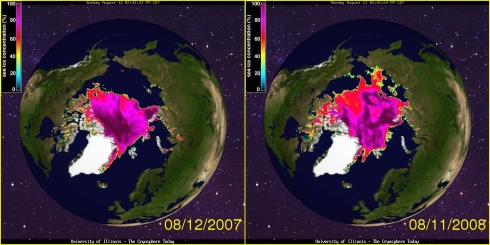
Recovering Arctic Ice


Be sure to check out this article from the mainstream, and Anthony Watts' take on the issue.

Labels:

Bookmark and Share

14 August 2008

Spotless Sun, Armagh Observatory: Freeze Watch

After all the hype over catastrophic anthropogenic global warming (CAGW) doom, it may come as a shock to many readers that scientists do not understand the Earth's climate very well. Forget Al Gore, forget James Hansen, forget Michael Mann. Pay attention to what the sun is telling us, by its quietness.
The observatory [Armagh] notes that solar cycles 21 and 22, which were characterized by being short and intense in their activity, led to the natural global warming observed in the 80’s and 90’s.

“Cycle 23, which hasn’t finished yet, looks like it will be long (at least 12 to 13 years) and cycle 24, which has still to start, looks like it will be exceptionally weak,” writes one observatory scientist.

“Based on the past Armagh measurements, this suggests that over the next two decades, global temperatures may fall by about 2 degrees C — that is, to a level lower than any we have seen in the last 100 years….“Temperatures have already fallen by about 0.5 degrees C over the past 12 months and, if this is only the start of it, it would be a serious concern,” concludes David Watt. _PrisonPlanet_via_TomNelson
Natural climate variation is driven by multiple overlapping solar cycles, by the ocean multidecadal oscillations, by volcanic activity, by chaotic biological cycles on land and in the sea, all influencing and being influenced by ice and snow cover. None of these factors are well understood. Yet the wholly warmer climate orthodoxy claims to be able to simplify climate to one parameter: anthropogenic greenhouse gases! These high priests of the orthodoxy exhibit a sad combination of laziness and arrogance.

They are like the lazy and incompetent physician who jumps at the first diagnosis that enters his mind, and refuses to consider any other factors. But having jumped onto the political and media bandwagon of climate doom, these alarmist orthodoxers have set their course, regardless of how the reality may develop.

Labels: ,

Bookmark and Share

Surprise! Pelosi Promotes Political Peak Oil

Washington has become paralyzed by dysfunctional government. France and China can build nuclear electric plants in just years; in the U.S. it takes a decade. Brazil will bring offshore oil online in 24 months, while for U.S. companies it takes 10 years. New refineries are virtually illegal to build. New electricity-generating plants using coal are now unable to obtain financing because of environment constraints.

This is destroying the value of the dollar and wrecking our balance of trade, making oil prohibitively expensive, and sending hundreds of billions of dollars to foreign lands—many of whom are no friends of America. No wonder 80 percent of Americans think their nation is on the wrong track. Washington needs to declare a national emergency program to produce energy. The reasons we don't are political, not technical.
Political peak oil is the only kind of peak oil hardship the world will experience. Americans can thank Nancy Pelosi and her comrades in congress--plus their friends the trial lawyers--for that. Think of them every time you fill your gas tank.
......the world oil shortage is political, not geological. In the U.S., the government prohibits drilling offshore. In Nigeria, civil strife has shut down major production. In Libya and Iran, Washington effectively blockaded and isolated the nations for years to inhibit new production. In Iraq, of course, the U.S. destroyed much of the infrastructure since the first Gulf war in 1991 and then blockaded reconstruction. In nations such as Russia and Mexico nationalism and corruption curtail increased production.

Outside of developed Western countries, the single largest reason for oil "shortages" is government incompetence and ownership of the subsoil rights so that landowners don't benefit from oil discoveries. In Patagonia, Argentina (a nation with abundant oil), I was told how it was common for landowners to try to hide any evidence of oil seepages from underground, lest the government oil company come in and ruin their lands with no benefit to themselves. Private mineral rights ownership is the reason some 90 percent of all oil wells drilled have been in the U.S. Scientific advances and innovative engineers keep coming up with ways to both discover new fields and keep old ones in production almost indefinitely.

ANWR could become the fastest way to generate hundreds of billions of dollars of new oil. But laws need to be changed to fast track the leasing (there are 11 litigation choke points) and to create special courts to expedite environmental issues, as recently proposed by Rep. Michele Bachman (R-Minn.). Under current laws, it could indeed take 10 years to produce oil, compared to two or three years for the actual drilling and pumping. Additionally, leasing is done slowly, thanks to laws written when oil was plentiful. Such laws were designed to gain maximum upfront money for the government, not for speed. For example, BP recently paid $1.2 billion for a new offshore lease, some 400 miles East of Canada's Alaska's Prudhoe Bay. The cost and distance gives some idea of industry expectations as to the extent of oil reserves. _Reason

Labels: , ,

Bookmark and Share

Russia Loses Planes to Own Missile Systems

The basic ineptness of the Russian military is further exposed by its inability to protect its planes against missile systems designed in Russia. This is not surprising, since the Russian military sits atop an inept science and technology infrastructure. When the Ukraine joins NATO, Russia will begin feeling the pinch.
The Russians have admitted to losing four aircraft (three Su-25 ground attack bombers and a Tu-22 bomber flying a reconnaissance mission.) Most, or all, appear to have been brought down by the SA-11 BukM1 surface-to-air missile systems...Georgia claims to have downed ten Russian aircraft as of August 11th, and the true air losses won't be known until photos appear of all the aircraft wreckage. It is interesting that Russia was unable to come up with effective countermeasures against missile systems they had designed. _strategypage_via_Instapundit
Russia is losing half its population every 40 years, due to high death rates and low birth rates. Meanwhile, Russia's Muslim population is exploding rapidly, as are the Muslim populations of Russia's central Asian neighbors. And don't forget China, who desperately needs Siberian mineral assets.

Labels:

Bookmark and Share

13 August 2008

Russia Running on Fumes

For all its big-power bluster, Russia is weak and vulnerable. Russian tanks and aircraft may have smashed the fledgeling Georgian Army with ease, but most of the weaponry was Cold War-era and many of the troops conscripts. Anyone who has seen the Russian Army operating in the Caucasus knows that the military will need a generation to modernise. Meanwhile America, and its main Nato allies, are decades ahead in military technology and combat experience.

Russia is also facing a severe demographic crisis. Its population is shrinking by 700,000 people a year. The UN estimates the population will fall below 100 million by 2050, down from around 146 million today.

As for the economy, it is booming thanks to natural resources that account for 70 per cent of the country's wealth. But the oil price is in a state of flux. Russia has failed to diversify. Should energy prices fall sharply, the economy could collapse, as it did a decade ago. _TimesOnline
Russia has been building up to its invasion of Georgia for several months. It managed to scrape together enough tanks, planes, and elite troops to subdue one tiny neighboring country. Putin hopes that this act will send a message to Europeans and the rest of the west, that the Russian bear still has a mean bite. But is that the message that comes across?
Western powers may not do much immediately about his squeeze on Georgia, but over time he will find he has created conditions for the emergence of a coalition to contain Russian energy power. His immediate neighbors, with fresh memories of Soviet domination, will be even more eager to align themselves with the West and NATO. Possibly even the myopic Germans will discern they've gone too far in putting themselves in energy hock to Moscow. _WSJ
Russia's weapons are old technology. Most of its ships, submarines, and large transports are poorly maintained. Its men are mostly draftees, lacking basic equipment and almost entirely unmotivated to fight for a country in decay.

Russia depends upon its energy resources for most of its wealth. But Russia lacks the technical expertise to develop its own resources. It must contract with outside corporations to develop oil and gas fields--then inevitably Russia nationalises (steals) the assets from the multinationals. Eventually, Russia will find it hard to get business partners, and the flow of oil and gas will drop rapidly.

Russia's rapidly shrinking population can no longer supply the manpower needed in defense, technology, energy, and other vital fields. As related here before:
The share of high-tech products in Russia’s exports is only 0.6%, “a shameful rate” according to Vladimir Fortov, a member of the Russian Academy of Science. Over the past 15 years, he says, Russia has not brought to the market a single significant drug. The average age of Russia’s scientists is well over 50. One of the main commercial activities of Russian research institutes is leasing or selling their property and land.

Scientific inventions tend to be developed abroad. The chain that turns a scientific innovation into a marketable product simply does not exist, says Mr Fortov. And the key to creating it, he argues, is not setting up state corporations, but unshackling the system from bureaucracy and letting private companies operate freely. “We have tried everything else and we know it does not work,” he concludes. _Economist
But Russia under Putin will never allow private companies to operate freely. Free enterprise creates wealthy individuals, who could develop their own powerful networks of people and resources. Putin would never stand for rivals of any kind.

So Russia is a doomed country, with not much time left for this strutting and posturing. Even the invasion of tiny Georgia required almost a year's buildup, and severely stressed Russia's logistical capacity. When Russia falls from overreach, its neighbors will rush in to loot the country. But Putin and his cronies will be gone, living on billions in Swiss bank accounts. The Russians still alive inside Russia will pay once again for allowing corrupt leaders to sell them phony national greatness for their sheeplike complicity.

Labels:

Bookmark and Share

The Obamanation of Energy Obstructionism

If humans are to transition from a fossil fuel economy to an electric and renewable economy, they will absolutely have to maintain the flow of energy in all available forms--that means offshore oil, arctic oil, shale oil, coal to liquids, etc. If we allow energy supplies to drop enough to destroy our economies, the ability to develop alternatives will slip through our fingers. Why does Obama pretend not to realise this?
Contemporary 4-D surveying adds the dimension of time. Satellites help find and quantify sub sea deposits, track their flows, and predict their next steps. Some 70 percent of 4-D wells hit oil.

Obama's Don't Ask, Don't Drill policy spurns these marvels and embraces outdated information gathered with obsolete instruments. This is the audacity of ignorance.

Adults should not make decisions in willful oblivion. Democrats like Obama prefer not to know what riches rest off America's coasts. They resemble kindergartners who cover their ears and hum loudly to muffle their parents' unwelcome words.

Meanwhile, Americans struggle to fuel planes, trains, and automobiles. Despite this national nightmare, congressional Democrats fled on a five-week summer vacation, rather than vote on Republican amendments to extend offshore drilling. Democrats chose suntan oil over oil production.

Instead of voting on Republican energy proposals, House Speaker Nancy Pelosi, D- Calif., dispatched her colleagues to build sandcastles. Nevertheless, GOP representatives unofficially are pleading their case to tourists inside the House chamber. _Source
Obama, Pelosi, Boxer, Reid, and the rest of the Luddites apparently want to destroy the current economy--in hopes that a grand and glorious utopian energy economy will rise from the ashes, by magic. Al Fin has devoted a lot of effort to promote biomass, biofuels, solar energy of all forms, nuclear energy, and a number of other alternatives to fossil fuels--as well as some innovative ways to exploit unconventional fossil fuels. We have to have all of these forms of energy in order to make the transition!
By 2006, after major advances in seismic technology and deepwater drilling techniques, the MMS resource estimate for that area had ballooned to 45 billion barrels. In short, there could be much more oil under the sea than previously known. The demand for energy is going up, not down. And for a long time, even as alternative sources of energy are developed, more oil will be needed. _WaPo
Congressional Democrats are living in a fantasy world, believing that they can mould reality to fit their distorted beliefs and impressions. The entire country suffers as a result of their mismanagement. If congressional Democrats can get one of their own into the White House, the Obamanation of magical utopianism will unfold. Let me know how you like it.

Labels: , , ,

Bookmark and Share

11 August 2008

Doing More with Less -- No Limits

There are two dominant themes in the western world today: the limited world view that wants to slash energy use, slash human populations, and release most of the human world back into the wild -- and there is the theme of upward evolving, and growing into a peaceful world of abundance, without limits. Julian Simon represented the latter view, par excellence.
The ultimate embarrassment for the Malthusians was when Paul Ehrlich bet Simon $1,000 in 1980 that five resources (of Ehrlich’s choosing) would be more expensive in 10 years. Ehrlich lost: 10 years later every one of the resources had declined in price by an average of 40 percent.
Buckminster Fuller was another person who believed that human ingenuity would allow humans to continue to do more -- with less.
Doing "more with less" was Fuller's credo. He described himself as a "comprehensive anticipatory design scientist," setting forth to solve the escalating challenges that faced humanity before they became insurmountable.
The key to humanity evolving (as opposed to devolving into a collectivist lifelong larval colony) is in learning to do more with less. Recent spikes in commodities prices convinced many superficial students of resource economics that Simon would finally be proven wrong. But scientists and engineers are beginning to catch the spirit of Fuller and Simon in their work. We may yet escape the collectivist larval farm.

Brian Westenhaus at New Energy and Fuel describes an Australian innovation that will allow the substitution of a cheap Teflon compound in place of ultra-expensive Platinum in fuel cell catalytic membranes. The cost savings will be immense, and should rapidly speed the transition to fuel cell applications for automobiles and stationary installations. It will also greatly extend the world's supply of platinum.

Brian Wang at Next Big Future presents several innovations that will make automobiles lighter and more fuel efficient. These include several new uses of carbon nano-fibers, ways of making titanium cheaper for use in cars, and the use of graphene enhanced plastics.

The ability to substitute cheaper, smaller gasoline engines for larger more expensive diesel engines, should introduce cost savings into many industrial applications.

Of course, the holy grail of "more with less" is molecular nano-assemblers that can manufacture an almost limitless array of products quickly, precisely, and relatively cheaply. Brian Wang presents an update on carbon nano-assemblers.

When confronted with a challenge, humans can either try to find workable solutions, or they can hide behind "limits." Whether "peak oil doom", "climate catastrophe", "overpopulation", the challenge of militant Islam to secular western ideals--a dominant refrain from modern left-limitists is "cut back!"

Instead of cutting back, however, ingenious and resourceful humans will substitute and innovate, and do more with less. The limits are in the mind. Think laterally, as well as logically.

Labels: , , , , ,

Bookmark and Share

09 August 2008

Infrastructure Breakdown? I'll Show You An Entire Continent w/ Infrastructure Breakdown

Power failures are sweeping across post-colonial Africa, from South Africa to Zambia to Zimbabwe and beyond. The entire power grid of the Central African Republic has gone down from lack of maintenance.
Over half a century of poor maintenance and neglect, the power grid of the Central African Republic has collapsed. The capital has gone dark. Two nearby hydroelectric power stations, which provide most of the nation's electricity, have failed from years of neglect. The government is calling on foreign aid donors to fly in generators for hospitals and other essential services. Generators that have been brought in previously have not been maintained, and wear out quickly. This is not an exceptional event, for colonial era infrastructure, from roads to power plants, are collapsing from decades of post-independence neglect. This causes more unrest, as factions battle for a dwindling supply of resources.
This is an unfortunate but commonplace situation for much of Africa. Through corruption, poor planning, and non-existent maintenance, power grids across Africa are overloading and failing.

Sub-Saharan Africa is suited to a more decentralised approach to power. With small, decentralised power plants, infrastructure breakdowns only affect limited areas--not the entire country. Maintenance of a high technology infrastructure is beyond large portions of the third world--including most of Subsaharan Africa. The same problem crops up in tribal areas of Asia and South America, but is not quite as bad. Unfortunately, urbanisation is sweeping across most parts of the world, bringing the need for central power generation stations and power grids. It may be an insoluble problem.

Maintenance technicians and supervisors for the repair and upkeep of sophisticated power systems, need to be both intelligent and experienced. In much of the third world, such jobs are often given out as political rewards to cronies of powerful government officials. Maintenance is regarded in the third world with much the same disdain that many college educated persons in the west regard skilled manual labour. Maintenance funds are either not allocated, or are skimmed away by government bureaucrats. In the third world, maintenance just doesn't get done. And systems inevitably fail.

It would be bad enough just dealing with corruption, poor planning, lack of maintenance, and general neglect. But the third world often has to deal with rampant violence created by "youth bulge demographics." This is the fatal blow to infrastructure and national integrity.

Why is so much of the third world going backwards, so long after de-colonisation? Something similar happened in Europe after the fall of the Roman Empire, during the Dark Ages. But Europe was actually re-organising and re-tooling for a more complex world. A lot of things that happened during the European "Dark Ages" were not so dark at all. Africa seems to be doing the opposite.

Foreign aid projects, NGO projects, UN projects, etc. seem to do as much good in Africa as they do in Gaza and the West Bank. The resources simply get swallowed up and disappear.

It is said that a high technology infrastructure is impossible to maintain when the average IQ of a population is below 85 (in the absence of a significant market dominant minority). The average IQ of SubSaharan Africa consistently measures close to 70, or 75 at most. IQ is not enough, of course. In China, where corruption is rampant, infrastructure collapse can happen too. In Detroit, where city government corruption is a way of life, maintaining the infrastructure is a daily battle.

But if you have both low IQ and corruption--with no market dominant minority--forget about it. It is not going to happen. Build as much as you want, it will surely crumble without maintenance.

Perhaps improved nutrition and education will shift the IQ curve upward by as much as 10 points. After 2 or 3 more generations. Should the intervention be done? Of course! Grandchildren and great-granchildren of today's Africans may benefit.

But understand that technologies should be matched to the population being served. Anything else on the part of aid providers is criminal.

Labels: , ,

Bookmark and Share

Russian Corruption and Authoritarianism Holding Russia Back in Nano Technology Race

A year ago, Russia placed US $5.5 billion into a state corporation that was meant to boost Russian nanotechnology R&D into competition with the west. Most veteran Russian observers were skeptical of the gesture, and they are being proven correct in their skepticism.
..... in 2007 Russia put 130 billion roubles ($5.5 billion) into a state corporation for nanotechnologies that is being likened to the Manhattan Project. Even China, which quit Dubna after Khrushchev’s denunciation of Stalin in 1956, has been lured back to the nuclear institute.

But the big problem for high technology in Russia is neither money nor ideas. It is the country’s all-pervasive bureaucracy, weak legal system and culture of corruption. This may explain why the nanotechnology corporation has so far found only one project to invest in (and that is registered in the Netherlands). The share of high-tech products in Russia’s exports is only 0.6%, “a shameful rate” according to Vladimir Fortov, a member of the Russian Academy of Science. Over the past 15 years, he says, Russia has not brought to the market a single significant drug. The average age of Russia’s scientists is well over 50. One of the main commercial activities of Russian research institutes is leasing or selling their property and land.

Scientific inventions tend to be developed abroad. The chain that turns a scientific innovation into a marketable product simply does not exist, says Mr Fortov. And the key to creating it, he argues, is not setting up state corporations, but unshackling the system from bureaucracy and letting private companies operate freely. “We have tried everything else and we know it does not work,” he concludes. _Economist_via_Nanodot_via_Instapundit
Many of the same impediments preventing Russians from developing new technology, also exist within the state-owned companies and research institutes in CCP-controlled China. A culture of collectivism promoted by Mao's communists, combined with a self-effacing Eastern culture millenia old, stifles individual initiative. Chinese scientists who move to western labs are often able to adapt to a more individualistic culture, and thrive.

In fact, scientists from virtually every authoritarian culture--whether Islamic, Communist, Fascist, etc--frequently thrive in a freer western atmosphere, once they are able to adapt to being under less restraint. Collectivism and invention are poor partners. Throw in the corruption that is always present in collectivist cultures, and you can see why in a world of accelerated technological advancement, collectivist and authoritarian cultures have a hard time keeping up.

Remind me again, why anyone in the US would want to bring in an Obama collectivism? What type of perverse security-craving culture-in-devolution would breed such a death wish? Psychological neoteny, academic lobotomy, legalised nepotism (affirmative action), and faux multi-cultural monoculturalism.

Labels: ,

Bookmark and Share

08 August 2008

Algae Has Never Believed in Peak Oil

Algae doesn't think in terms of limits. A single-celled algae, gazing out across the Pacific Ocean, has only one thought: "That looks like a good place to spread out and grow!" In fact, algae thinks exactly the same thing about a wastewater pond, a brackish estuary, or a large freshwater lake. Algae was meant to grow fast, needing only sunlight, CO2, and a few nutrients from water--wastewater will do. Algae has never believed in peak anything.
• Algae can thrive in fresh, brackish, or seawater — and very little of that is required.

• There is no need for any soil, much less good soil, as algae grow hydroponically.

• With more than 20,000 known varieties of algae, species can be chosen for high lipid content (e.g., for diesel fuel) or high sugar content for distillation purposes.

• In desert climes it can be harvested on a day-by-day basis because it grows so quickly.

All it takes is sunlight, water, and carbon dioxide to provide the energy for arguably the most complex process we see in nature: photosynthesis. _Source
What about cellulosic biofuels? Is there a conflict between cellulosic fuels and algae biofuels?
.....the market for transportation fuels is big enough for cellulose and algae; they compete with petroleum, not with each other......extraction of fuel from algae depended on flat land, abundant water, sun and injections of CO2. _EcoWorld
At this time, algae biodiesel costs between $15 and $20 a gallon to produce. Dozens of research efforts are aimed at bringing the cost of production for algal biodiesel into the competitive range. The University of Virginia, University of Arkansas, Cal Poly, and other research institutions are rushing to make breakthroughs in the economic production of algal fuels. One particularly innovative approach to algal fuels is the use of algae as part of a three-pronged bio-energy-food eco-industry, combining a fish farm, algae production, and feed production.
Instead of having a waste stream [from the fish farm] that contaminates the environment or needs costly disposal, combining the Aqua-Sphere with algae production creates a second income stream by producing feedstock for biodiesel. Papadoyianis also sees benefits to the biodiesel industry as aquaculturists move into algae production. “The way I see it, buying a piece of land and constructing an algae facility and having a whole staff just to produce the algae will make your cost of production go way up,” he says. “We are looking at this as a secondary crop that doesn’t take a huge secondary investment. For a medium-sized operation you can basically use the same staff as you have for the fish operation.

The process could be diversified even further as the company develops a third product, an insect-based fish food it calls Ento-Protein. The product would replace food currently made from fish meal, which has more than doubled in price since 2006, and is made from insects grown on agricultural waste and industrial coproducts, including distillers dried grains from ethanol plants. Papadoyianis foresees using the algae cake remaining after the oil is extracted as another feedstock for the Ento-Protein operation. _Biodiesel
A two day conference dealing with algae as "the new oil" is coming up October 23-24 at the Woodlands, in Texas. More from the National Algae Association

More energy and bioenergy news at Al Fin Energy blog.

Labels: ,

Bookmark and Share

07 August 2008

Attention Chris Matthews: This Will Really and Truly Send a Tingle Up Your Leg!


Chris Matthews will never outlive his gushing tribute to Barak Obama: "he makes a tingle go up my leg!" Well, Chris, here is a device you can keep with you at all times, and it really does send a tingle up your leg.
The device stimulates the nerves sending gentle pulses up the woman’s leg for between 10 and 30 minutes leaving women on the verge of climax....

“It gently stimulates the sexual nerve pathways taking the woman to a pre-orgasmic plateau where she dangles on the edge of orgasm for as long as she wants.

“From there, gentle stimulation can then effect the orgasm.” _ImpactLab
If it works for women, no doubt it will work for Obama supporters of either sex. Particularly if their legs are quite susceptible to tingles anyway.

This is not exactly a robotic sexual device, but one can easily imagine a robotic companion that incorporates such a "tingler" as part of its basic repertoire.

Also posted at Al Fin, You Sexy Thing!

Labels: ,

Bookmark and Share

"Southwest Airlines" of Space Suffers Setback--But Venture Capitalists Rush to Invest

SpaceX is on the verge of a huge commercial breakthrough. Dubbed "the Southwest Airlines of Space," the company founded by billionaire Elon Musk is just a launch or two away from putting itself in a position to profitably underbid all other space launch providers. The cause for SpaceX's third launch failure on 2 August 08 has been explained, and is said to be easily fixed. That is all venture capitalists wanted to hear.
Musk, who's invested more than $100 million in the company, was disappointed but not deterred. "On the plus side, the flight of our first stage, with the new Merlin 1C engine that will be used in Falcon 9, was picture perfect," he wrote in a message to employees. "Unfortunately, a problem occurred with stage separation, causing the stages to be held together. SpaceX will not skip a beat in execution going forward."

Indeed, just two days later, SpaceX announced that it had received a $20 million investment from the Founders Fund, a venture capital firm that is partially managed by other PayPal co-founders. Less than two months ago, one prominent VC partner insisted to PM that quick business reactions to the private space industry was "one of the big advantages" of investing in companies like SpaceX;

....the injection of cash comes at a crucial time for the company. SpaceX's original goal was to create the world's lowest cost space launcher..... SpaceX is developing more ambitious rockets such as the Falcon 9, a medium- to heavy-lift rocket whose mission will be to re-supply the International Space Station—if it beats out competitor Orbital Sciences for a NASA contract. _PopMech_via_Instapundit
Getting to heaven has never been particularly easy, but the potential profit up there is almost incalculable. A single asteroid could be worth trillions of dollars, at current mineral prices. And if you ever want to build large orbital structures, you have to get in a position where you can harness space resources and process them into building materials.

SpaceX's approach is not exactly frugal, but neither is it extravagant. The company has taken a methodical, step by step approach to developing and perfecting each component of its launch system. Neither Musk nore his backers appear to be deterred by the latest setback. In the long run, it may be better to be good than lucky.

Labels: , , ,

Bookmark and Share

06 August 2008

Peak Oil Bulls Out of Their Elements

Oil and commodities have officially slipped into a bear market. Speculators, hedge funders, pension fund managers, and peak oil/peak commodities bulls bet the bank that this would be the year for peak oil to manifest. This would be their year to strike it rich.
Global supply is now creeping back into surplus.

The Saudis are adding 500,000 bpd. Deepwater projects are coming on stream off the US, Mexico, China, and Africa. The Caspian is cranking up a gear. Non-Opec will add 2.2m bpd over this year and next, says the International Energy Agency.

"Demand destruction" has reached tipping point. Americans drove 3.7pc fewer miles in May, year-on-year. Thirteen hybrid car models went on sale in the US last year, exploiting the new lithium ion battery technology.

China, India, and rising Asia - the chief victims of the oil spike, with energy use per unit of GDP four times Western levels - have begun to cut fuel subsidies. The IEA said this alone would trim demand by 100,000 bpd.

Above all, the economic sick list is lengthening. Japan's industrial output fell 2pc in June; petrol sales slumped 8.9pc. China's purchasing managers' index (CLSA) fell below 50 in July.

If this turns out to be accurate, manufacturing output is now contracting in China. The closure of Beijing's smokestacks before the Olympics may have contributed, but slumping export orders led the slide.

Mingchun Sun, Lehman Bros' China expert, says the country is at risk of a "vicious circle" as crumbling asset prices combine with tight credit, a strong yuan, and the global downturn.

As of May, property prices had fallen by 19pc from their peaks in Guangzhou, 9.5pc in Beijing, and 9.4pc in Shenzen. They are still falling. Indeed, China's house price upset may soon match the Anglo-Saxon, Baltic, and Club Med debacles.

The entire economic system of the North Atlantic is now in or near recession. European Central Bank insiders are saying the eurozone may have contracted in the second quarter. Europe's credit crunch is getting worse, not better. _Source_via_POD
It is one thing to lose all of your own money on a foolish peak oil bet. But to lose the money of pensioners who trusted your fundamental investment soundness, is the mark of an irresponsible neotenate. Remember: all those things you think you know? They just aren't so.

Labels: , ,

Bookmark and Share

Make Every Meal Fit for Royalty

There is a reason that fortunes were made and wars were fought throughout history over spice routes and salt deposits. We in modern countries have an abundance of spices and seasonings to suit our every whim. But are we taking best advantage of them?
“Because herbs and spices have a very low calorie content and are relatively inexpensive, they’re a great way to get a lot of antioxidant and anti-inflammatory power into your diet,” said study co-author James Hargrove, associate professor of foods and nutrition in the UGA College of Family and Consumer Sciences....

...The researchers found a strong and direct correlation between the phenol content of common herbs and spices and their ability to inhibit the formation of AGE compounds. Spices such as cloves and cinnamon had phenol levels that were 30 percent and 18 percent of dry weight, respectively, while herbs such as oregano and sage were eight and six percent phenol by dry weight, respectively. For comparison, blueberries – which are widely touted for their antioxidant capabilities – contain roughly five percent phenol by dry weight.

Study co-author Diane Hartle, associate professor in the UGA College of Pharmacy, said various phenols are absorbed differently by the body and have different mechanisms of action, so it’s likely that a variety of spices will provide maximum benefit.

“If you set up a good herb and spice cabinet and season your food liberally, you could double or even triple the medicinal value of your meal without increasing the caloric content,” she said.

She added that controlling blood sugar and the formation of AGE compounds can also decrease the risk of cardiovascular damage associated with diabetes and aging. She explained that high blood sugar accelerates heart disease partly because AGE compounds form in the blood and in the walls of blood vessels. The AGE compounds aggravate atherosclerosis, which produces cholesterol plaques. _PO
While you are adding healthy spices to your foods, you can also gain significant benefit by substituting potassium salts for sodium salt in routine food seasoning. The taste is quite similar to table salt, and persons of all ages and states of health (except kidney failure with high serum potassium) can safely take extra potassium.

Throughout most of human history, only a few lucky persons were able to enjoy most of the spices, beverages, and foods that are available to even the poorest person in the modern world. We are living in an epicurean age. Are we to blame if eating and drinking well can also be good for us?

Labels: , ,

Bookmark and Share

05 August 2008

Even the National Science Foundation Couldn't Care Less About Real Science

American culture and American schools are not preparing American students for a world of science and technology. Even the National Science Foundation is more concerned about what is between the legs of scientists than what their heads are producing. The 21st century will not be kind to cultures with such misplaced priorities.
In the United States, students are insulated from the commercial market's demand for their knowledge and skills. That market lies a long way off — often too far to see. But they are not insulated one bit from the worldview promoted by their teachers, textbooks, and entertainment. From those sources, students pick up attitudes, motivations, and a lively sense of what life is about. School has always been as much about learning the ropes as it is about learning the rotes. We do, however, have some new ropes, and they aren't very science-friendly. Rather, they lead students who look upon the difficulties of pursuing science to ask, "Why bother?"

Success in the sciences unquestionably takes a lot of hard work, sustained over many years. Students usually have to catch the science bug in grade school and stick with it to develop the competencies in math and the mastery of complex theories they need to progress up the ladder. Those who succeed at the level where they can eventually pursue graduate degrees must have not only abundant intellectual talent but also a powerful interest in sticking to a long course of cumulative study. A century ago, Max Weber wrote of "Science as a Vocation," and, indeed, students need to feel something like a calling for science to surmount the numerous obstacles on the way to an advanced degree.

At least on the emotional level, contemporary American education sides with the obstacles. It begins by treating children as psychologically fragile beings who will fail to learn — and worse, fail to develop as "whole persons" — if not constantly praised. The self-esteem movement may have its merits, but preparing students for arduous intellectual ascents aren't among them. What the movement most commonly yields is a surfeit of college freshmen who "feel good" about themselves for no discernible reason and who grossly overrate their meager attainments.

The intellectual lassitude we breed in students, their unearned and inflated self-confidence, undercuts both the self-discipline and the intellectual modesty that is needed for the apprentice years in the sciences. Modesty? Yes, for while talented scientists are often proud of their talent and accomplishments, they universally subscribe to the humbling need to prove themselves against the most-unyielding standards of inquiry. That willingness to play by nature's rules runs in contrast to the make-it-up-as-you-go-along insouciance that characterizes so many variants of postmodernism and that flatters itself as being a higher form of pragmatism.

The aversion to long-term and deeply committed study of science among American students also stems from other cultural imperatives. We rank the manufacture of "self-esteem" above hard-won achievement, but we also have immersed a generation in wall-to-wall promotion of diversity and multiculturalism as being the worthiest form of educational endeavor; we have foregrounded the redistributional dreams of "social justice" over heroic aspirations to discover, invent, and thereby create new wealth; and we have endlessly extolled the virtue of "sustainability" against the ravages of "progress." Do all that, and you create an educational system that is essentially hostile to advanced achievement in the sciences and technology. Moreover, those threads have a certainty and unity that make them not just a collection of educational conceits but also part of a compelling worldview.

The antiscience agenda is visible as early as kindergarten, with its infantile versions of the diversity agenda and its early budding of self-esteem lessons. But it complicates and propagates all the way up through grade school and high school. In college it often drops the mask of diffuse benevolence and hardens into a fascination with "identity."

That could be a good thing if the introspections were enriched by professors who could show students where Plato or Shakespeare had touched such depths, or who could startle them by showing where Hobbes or Tocqueville had seen them coming. But in a curriculum dissolved in the sea of minutiae and professorial enthusiasms, the opportunity to pass through moody introspection and back into the sturdy world of real people grows rare.

The science "problems" we now ask students to think about aren't really science problems at all. Instead we have the National Science Foundation vexed about the need for more women and minorities in the sciences. President Lawrence H. Summers was pushed out of Harvard University for speculating (in league with a great deal of neurological evidence) that innate difference might have something to do with the disparity in numbers of men and women at the highest levels of those fields. In 2006 the National Academy of Sciences issued a report, "Beyond Bias and Barriers: Fulfilling the Potential of Women in Academic Science and Engineering." Officials of the National Science Foundation and the Department of Education are looking to use Title IX to force science graduate programs to admit more women. The big problem? As of 2001, 80 percent of engineering degrees and 72 percent of computer-science degrees have gone to men.

A society that worries itself about which chromosomes scientists have isn't a society that takes science education seriously. In 1900 the mathematician David Hilbert famously drew up a list of 23 unsolved problems in mathematics; 18 have now been solved. Hilbert has also bequeathed us a way of thinking about mathematics and the sciences as a to-do list of intellectual challenges. Notably, Hilbert didn't write down problem No. 24: "Make sure half the preceding 23 problems are solved by female mathematicians."

Obsession with the sex and race of scientists is just one more indication of how American higher education has swung into orbit around the neutron star of identity politics. _Commentary
It should no longer be such a mystery how science can be so easily corrupted and perverted to pimp political movements such as climate catastrophe. The deeper spirit of science as the pursuit of insight into the deep and dynamic state of the universe has been bred out of students along the way. Some of these new breeds are now tenured professors, and will be training grad students to see science as social construct like themselves.

Labels:

Bookmark and Share

Is It the Teachers Stupid?

The problems with government education in the US are almost too numerous to mention. Donna Foote spent time observing the efforts of Teach For America teachers in a Los Angeles inner city school. She thinks that improving the teacher corps will fix the schools:
It's the teachers, stupid! The single most important factor in student achievement is the quality of the teacher. And yet, we have no effective system to attract, train, retain and promote high-caliber candidates for our schools. Today's teachers score in the lowest quartile of college grads and too many of the schools that train them are diploma mills. By making its program highly selective and attaching status to the job, Teach For America has proved that it is possible to get the best and the brightest into our classrooms. But no one—not TFA, not the districts, not the unions—has figured out how to keep them there. TFA's most recent alumni survey indicates that one third of former corps members are still teaching K–12. Critics charge that the recruits' short forays into the classroom exacerbate the critical issue of staff churning in our neediest schools and gibe that TFA really stands for Teach For Awhile. But the truth is, up to half of all the country's 3.5 million teachers bail within five years. Low pay, low status and low satisfaction undoubtedly drive many out. The transformation of teaching into a financially rewarding profession with high standards of admission—and accountability—would go a long way toward establishing staff stability.

.....In Washington, D.C., the reforming schools chancellor, Michelle Rhee, is a 1992 TFA alum. The founders of the Knowledge Is Power Program (KIPP), the wildly successful chain of 57 charter schools, are 1992 TFA alums, too. Nationwide, there are now 360 school leaders and 16 elected officials who got their start in public service with Teach For America. By 2010, the ranks of America's next generation of leaders will be seeded with 20,000 high-achieving alums who will have seen the crisis in our classrooms firsthand. _ Newsweek_via_JoanneJacobs
As long as schools of education are dominated by ideologues rather than educators, and as long as teachers' unions protect teachers who cannot teach, and as long as teachers' unions apply political pressure to restrict school choice, the problems with most government schools will remain intractable.

Teachers' unions and their enablers among the US Democratic Party, think that throwing money at the problem will do the trick. Just pay teachers a professional wage and give them a professional's respect, and things will be fine. Certainly unions would collect more dues that way. Bad teachers would be paid more just like good teachers. The unions and their enablers in the US Democratic Party would simply ratchet expenditures on schools into the stratosphere, without requiring better outcomes. Government education: an oxymoron? No, the education is there. An education in drugs, delinquency, drinking, lifelong psychological neoteny. It's the system, stupid!

Labels:

Bookmark and Share
Newer Posts Older Posts
Al Fin Main Page
Enter your Email


Powered by FeedBlitz
Google
WWW AL FIN

Powered by
Blogger

``