20 January 2013

Peak Oil Doom In Context

Previously published on Al Fin Energy


...Peak Oil catastrophism is largely a manifestation of our primary cultural myth: that all things end with suffering, death, and then resurrection. Belief in apocalypse is programmed into western civilization. Given our heritage, “the end is nigh” is the nearly unavoidable personal and collective response to times of uncertainty and rapid change. _Pattern Literacy
Peak oil predictions go back at least to the 1850's. Predictions of "the end of oil" have been with us as long as oil itself.

Peak oil has a longer history than you think. Although the models that define the American peak oil hypothesis were first advanced in the 1950s, predictions of the imminent depletion of American oil reserves can be found much earlier. In fact, one of the earliest known warnings that the United States would run out of oil was released on Jan. 19, 1922, when the U.S. Geological Survey warned the public that only two decades of oil remained in the ground, if present consumption patterns held steady. _Motley Fool
King Hubbert is the originator of modern peak oil models, but most of Hubbert's real world predictions are proving wrong.

Most people acknowledge that the Earth's supply of petroleum is finite, and will one day become too expensive to extract. The problem, to many people, seems to be in timing the peak.

Modern history of peak oil predictions (Wikipedia)

But the issue of peak oil is secondary to the issue of peak affordable energy. Modern societies are slowly shifting much of their energy load to electrical power sources, which can be generated by multiple forms of energy besides oil.

Newer, safer, more scalable, reliable, and affordable forms of nuclear power would be the obvious goal of rational societies, in the pursuit of an electrical energy future. But ample supplies of natural gas, coal, gas hydrates, bitumens, kerogens, and eventually advanced biomass, could supply careful societies with power and heat for centuries to come.

The question seems to revolve around the issue of "liquid fuels," for powering airplanes, ships, trains, and other transportation vehicles. And yet we know that with the assistance of high temperature gas-cooled nuclear reactors (HTGRs) -- already well along in the design and development stage -- the world's massive supplies of gas, coal, hydrates, bitumens, kerogens, and biomass can be converted affordably into high quality liquid fuels, chemicals, polymers, lubricants, fertilisers, and other useful substances.

The problem, though, is neither "peak oil," nore "peak energy." The problem is "peak ingenuity," or the shortage of good ideas and the will the implement them.

For readers who have freed themselves from "the apocalyptic compulsion," and who are honestly looking for a path out of the apparent abyss, take a careful and open look at The Ultimate Resource.

As long as human minds remain free, solutions to problems can be devised. Whether governments and other powerful interests will allow problems to be solved, or not, is another question. Many of those governments and powerful institutions are led by people who are in thrall to the apocalyptic instinct.

But we will do what we can to find pathways to a more abundant future. Nobody said it would be easy.

Labels: ,

Bookmark and Share

23 November 2012

Peak Oil Doomers Must Adapt to New Realities or Go Insane

Something very odd has happened on the way to peak oil doom and societal collapse: Reality happened, and it spoiled all the doomers' fun.

Some doomers have proven themselves able to adapt. They have rolled with the punches and come up singing a new song more closely in tune with real world developments. Andrew McKillop is such an example of a former doomer who started to pay attention to what was happening in the real world:
The Olduvai Gorge theory of Richard Duncan was that human society would be forced back to the anthropoid ape stage of evolution by peak oil and energy scarcity... Duncan's angle, developed in the late 1990s, was that peak oil and energy resource depletion would firstly make inevitable, then speed up this retreat and defeat of Humanity, as human society was forced back to hunting and gathering....

Among the admirers of Richard Duncan and his "back to the jungle" theory, Britain's Prince Charles and the USA's Bill Clinton have surely consumed a lot of jetfuel kerosene as well as motor gasoline in their lives, to date, and kept away from hunter gathering, as shown by their ability to avoid paperazzi and photo opportunity hunters. They also kept Duncan's gory theory of mass human die off and backward evolution to hunting-gathering, due to Peak Oil and fossil energy depletion, out of nearly all of their speeches. As we know, certainly in recent years, the elite fear of peak oil has been replaced by global warming fear - as the best excuse to impose "world government", unelected of course.

GOOD BYE PEAK OIL

Duncan's theory was given significant media attention about 10 years ago, and was heavily cited by supporters of the US Gas Cliff theory, promoted by writers including Julien Darley and Michael Ruppert in 2004-2006, and by promoters of Doomsday energy shortage and oil soaring to $200 a barrel, such as Matt Simmons. The Gas Cliff theory, we can note, argued that gas resource depletion was running so fast, that US gas resources would be "practically exhausted" by about 2015. Today, we know that we face a towering cliff of unconventional gas resources - discovered since only 2007. Discoveries of unconventional gas march on and up, implying that probably 200 years, or more, of current world gas consumption are now available as exploitable resources, worldwide.

...Olduvai Gorge theory may have been exciting, to Prince Charles or Bill Clinton, but other changes have happened and are happening in global energy in a global macroeconomic context that itself is changing very fast. These fundamental changes will continue to build going forward, making for the unsurprising forecast of further decline in oil's role in world energy, geopolitics and the economy. This role will gradually erode and fade as the oil price starts to converge, at a lower level, with prices for all other forms and types of energy. Like Hubbert's theory of the 1950s, and the PO theory of 1998-2008, the Olduvai Gorge theory posited ever declining world consumption of oil - dictated by supply side decline. Demand side decline is also possible, in fact current reality, but the mechanism and process of decline and shift, away from oil, are light years away from Olduvai Gorge._Andrew McKillop
But for some peak oil doomers, the money is just too good to pass up. They struggle to keep the faithful within the flock, so as to keep their cash flow coming in. One of those who continues to make a lucrative living off of doom is James Howard Kuntsler. Although he may take a licking from reality's callous slings and arrows, he keeps ticking along with the same old message of doom & collapse:
Here’s why the shale oil story is not the “game changer” that the wishful claim it is: the price required to get it out of the ground (between $80-90 a barrel) will crush the US economy. Since prices are already in that range, the economy is already being crushed.

The result is an economy in more-or-less permanent contraction. As demand for oil falls with declining economic activity the price of oil falls – below the level that makes it worthwhile to conduct expensive shale oil drilling and fracking operations.

...I have one flat-out prediction, one I have made before but deserves repeating: Japan will be the first society to consciously opt out of being an advanced industrial economy. They have no other apparent choice really, having next-to-zero oil, gas, or coal reserves of their own, and having lost faith in nuclear power. They will be the first country to enter a world made by hand. They were very good at it before about 1850 and had a pre-industrial culture of high artistry and grace – though, granted, all the defects of human psychology.

I don’t think the US can make that transition in an orderly way. We’re too stricken with techno-narcissism and grandiosity...My guess is that being predisposed to superstition and religious fanaticism, the American public will violently reject science and rationality and retreat into a world of shadows.

We’re already well on our way. _JamesHowardKuntsler
Kuntsler was very angry at a recent IEA report that predicted that the US would soon out-produce Saudi Arabia in terms of oil production.

Kuntsler feels threatened by the idea that industrial societies may not be on the brink of collapse after all. And he should feel that way. If his many followers begin to doubt his gospel, he may soon lose the greater portion of his income.

The peak oil doom believers are in a quandry. Who are they to believe? Their prophets of doom, or their lying eyes that tell them that -- year after year -- their societies do not seem to be ready to collapse just yet, despite the decades of doom predictions.

For the quasi-religions of overpopulation doom, environmental doom, and energy scarcity doom there is no scarcity of true believers. There is "a sucker born every minute." In a rapidly ageing western society, there is a senile brain born every minute. And these senile brains are ripe for the picking by the doom prophets.

Not to mention the millions of young and dumbed down brains, courtesy of government factories of indoctrination and perpetual incompetence otherwise known as government schools. Abundant fodder for the prophets of doom indeed.

But as the years pass by without such dooms coming to pass -- despite the best efforts of sensationalist news media, opportunistic politicians, and a well-conditioned academia to drum up deep feelings of crisis, doom, and imminent collapse -- a cognitive dissonance tends to set in. Either the true believer will adapt to real trends that break through the cultural smokescreen, or he will begin to lose his ability to reason independently.

Much money is riding on mass belief. Whoever controls public opinion -- and counts the votes -- will stand to gain power and wealth beyond imagining.

An analysis of predictions that the world will starve for lack of phosphorus and potash

Matt Ridley: Apocalypse Maybe?

Labels: ,

Bookmark and Share

20 November 2012

Peak Oil, Meet 3 Trillion Barrels Oil Equivalent: Bringing the Heat

The following article is adapted from 2 earlier Al Fin Energy postings.


More Oil Than OPEC


There's no question, says Rusco, that the oil is there, all 3 trillion barrels of it...

...Both the GAO and private industry estimate the amount of oil recoverable to be 3 trillion barrels.

"In the past 100 years — in all of human history -- we have consumed 1 trillion barrels of oil. There are several times that much here," said Roger Day, vice president for operations for American Shale Oil (AMSO). _ABCnews


Will Advanced Kerogen Production Put a Ceiling on Global Oil Prices?

Enefit, an oil producer headquartered in Estonia, has been producing oil from oil shale in Europe for more than 30 years, according to the CEO of its Utah subsidiary, Enefit American Oil. Rikki Hrenko says Enefit brings the shale to the surface, then heats it in retorts.

"It's more labor intensive to have to mine the shale," Hrenko said. "But the economics are still quite feasible." She puts the break-even price at about $65 a barrel. The cost of producing in Utah, she thinks, will be only slightly higher than in Estonia. _ABCNews
But in reality, in situ production would be cheaper in the Utah, Colorado, and Wyoming than mining in Estonia -- if producers used a cheap enough source of abundant, high quality heat. In fact, being able to produce a resource of 3 trillion boe, at a price of between $60 and $70 a barrel, might seem to place a price ceiling on global oil.

The only problem is that it will probably take 20 years before the technology for cheap, abundant, high temperature process heat are ready to meet the government regulations and prevailing prices for oil.

Yes, it will probably take 20 years before modular high temperature gas cooled nuclear reactors are approved and licensed by the US NRC, and produced in high enough numbers to be placed at Green River well heads.

But even when the technology, the cheap heat, the environmental approvals, and the market prices all come together -- there is still the problem of getting the oil to global markets. The big price gap between WTI and Brent points out the problem nicely. Adding refined oil shale kerogens to the North American mix would not help the problem of lack of access to ports.

Getting the product to market is a serious problem, in a political environment where the US Democratic Party has stonewalled the export of abundant shale gas, and obstructed LNG terminal construction in US ports. Current agendas of energy starvation cause the cost of doing all business -- including energy business -- to shoot up accordingly.

Overall, US demand for oil has been on a downward slope, while US shale oil production has grown exponentially. US oil & gas production combined with energy imports from Canada and Mexico, leave little need for imports from the middle east.

So US demand for oil shale kerogens at this time is minimal. The US economy overall is "hunkered down" and shell shocked -- uncertain about the prospects of 4 more years under the Obama administration.

But, there is still the possibility that the US might eventually clean up its economic act and stop accumulating Obama-debt and stop devaluing the Obama-dollar. If that happens, the US will need a lot more energy.

If the US should ever need to produce its 3 trillion barrels of oil equivalent from Green River Shale kerogens, will the cheap, abundant, high temperature heat be ready?

A group of far-sighted companies, including AREVA, ConocoPhillips, Dow Chemical, Entergy, Graftech International Ltd., Mersen, Petroleum Technology Alliance Canada, SGL Group, Technology Insights, Toyo Tanso Co. Ltd., and Westinghouse are pursuing the development of a true next-generation nuclear technology referred to as the High Temperature Gas Cooled Reactor (HTGR) for the past few years. Without too much technical detail, HTGRs are helium-cooled, graphite-moderated reactors with robust ceramic-coated fuel that operate at temperatures at or above 750 Degrees Celsius (1400 Fahrenheit) where conventional light water reactors operate at temperatures less than half that. In short:

The design is intrinsically safe. It requires neither active or passive systems nor operator interventions to remain safe, thereby allowing co-location near major industrial facilities.
High temperature output that allow direct substitution for fossil fuel use in industrial process heat applications.
Much higher efficiency leading to lower energy cost, making it competitive with natural gas in many places of the world today without any price for carbon. _NGNPAlliance_via_NBF
The importance of cheap, plentiful, high quality industrial process heat cannot be overstated . . .

Here is a short link list of some things that you can do with cheap, virtually unlimited high quality process heat:

  1. Unlock the trillions of barrels oil equivalent in oil sands (PDF)
  2. Unlock the trillions of barrels oil equivalent in coal to liquids and gas to liquids (PDF)
  3. Unlock the trillions of barrels oil equivalent in oil shale kerogens 
  4. Provide abundant industrial process heat for production of fertilisers, refining fuels, making plastics, etc 
  5. Split CO2 into CO to use as a hydrogen carrier 
  6. Overturn conventional fears of EROEI and Peak Oil 
Those things, and many more -- including biomass to liquids and gas hydrates to liquids -- will be accomplished by next generation gas-cooled high temperature nuclear reactors.
NGNPAlliance Home Page

4 Page PDF HTGR Description w/ Images

The image above matches different industrial processes with the level of heat required. Since HTGRs can provide abundant heat up to 850 C or 900 C, all of the lucrative processes listed in the image suddenly come within economical reach -- once HTGRs are perfected, licensed, and mass produced in factory-built modular units.

The image above provides thumbnail images of different processes that will become more profitable with the abundant availability of high temperature, high quality process heat.

Why do we at Al Fin Energy continue to emphasise the importance of HTGRs? Because if the US government had devoted half as much attention to developing and perfecting the mass production of safe, relatively inexpensive, and reliable HTGR modules -- instead of wasting hundreds of $billions on intermittent unreliable forms of energy -- the "energy crisis" would have been solved by now.

The fact that this has not been done, reveals for a certainty that government is not serious about providing inexpensive, clean, abundant energy for industry and society at large. Government energy policy is instead based upon more corrupt and ideological motivations, which delay the era of energy abundance unnecessarily.

Labels: ,

Bookmark and Share

08 August 2012

High Prices are the Cure for High Prices; An Obscure Lesson in Human Nature

The error of the peak oil alarmists was not understanding that the cure for high prices is high prices. When prices rise, this may indeed signal scarcity, but if so, it also provides a financial incentive to throw investment, ingenuity and effort at the problem. Moreover, a high price for one commodity makes alternatives more competitive by comparison. _DailyMaverick
Alarmists and doomers -- no matter what their particular choice of doom -- never seem able to get a handle on human nature and human motivations. Doomers seem unable to look beyond the natural traits of human greed and sloth. They cannot seem to understand the human capacity for invention, innovation, and hard work. Why is that?

Peak oil theory fits neatly into the larger topic of "resource scarcity." And the scarcity of resources is precisely what the field of economics is all about. Therefore one cannot rationally think about resource scarcity and peak oil without at least a foundational level understanding of basic economics.

It would be difficult for an area to be more closely tied to basic human nature than is simple market economics. But how many resource doomers understand even the bare basics of simple market economics? Apparently very few, if any.

Even famous Canadian economist Jeff Rubin failed miserably when he attempted a basic, short term prediction of a simple commodity.
In April 2008, Jeff Rubin, chief economist at CIBC World Markets, predicted a barrel of oil would cost $225 by 2012. With oil at $118, it was a controversial call.

...These days, it’s trading under $90 a barrel. So not only was Rubin off by a huge margin, he got the direction wrong. And for Rubin, the stakes couldn’t be higher.

In 2009, he famously quit CIBC to publish his first book, Why Your World Is About to Get a Whole Lot Smaller. It was a No. 1 bestseller and won the National Business Book Award. Rubin argued peak oil supply and rising prices would push up transportation costs and slam the brakes on globalization. Say goodbye to New Zealand lamb in Canadian fridges. Air travel would also become prohibitively expensive. We’d drive less, shop closer to home and generally live in a smaller world.

You can still get New Zealand lamb, of course, as well as cheap vacation deals in Mexico. But Rubin is undeterred. The End of Growth, his new book, continues his argument that oil is the single most important factor guiding global economic progress, or lack thereof. Because of insatiable energy demand from developing countries, oil will become permanently and prohibitively expensive, Rubin claims. And this will bring our era of cushy First World prosperity to an abrupt end. “Living in the static world will be much different than the world we’ve come to know,” he warns. _Canadian Business
Why are the resource scarcity doomers so wrong, time after time -- even those who should know better? Does their perennial "wrongness" testify to their ignorance of human nature?

It depends upon whether or not they are honest in their predictions. If they are honest, then they are ignorant of at least some aspects of human nature.

But it is just as likely that they are cynically playing to the peanut gallery -- the dumbed down mobs who salivate at the thought of the collapse of civilisation. Masses of doomers are willing to pay a lot of money for cleaned-up, barely modified, oft-recycled prophecies of doom.

There is a lot of money to be made in playing down to the masses and their dreams of a great doom-reckoning and judgment day. Such an unscrupulous posture on the part of doom-purveyors might indicate a superior grasp of another aspect of human nature.

But back to the original question: Why do doomers repeatedly fail to grasp the aspects of human nature dealing with the motivations which underlie hard work, innovation, invention, substitution, and other clever ways of dealing with common and predictable economic obstacles (PDF)?

It doesn't really matter except insofar as doomers affect public policy. And as that happens, public policy becomes just another predictable economic obstacle to be worked around. Other than that, doomers have made themselves into an irrelevant side show.

For those who wish to understand basic, human nature level economics, a good place to start is: "Economics in One Lesson."

The economic primer can be read online at the link above, or can be downloaded in PDF form.

We are not talking about Nobel Prize economics, academic economics, or Wall Street investment bank economics. We are talking about basic human nature economics. Without an understanding of that, anyone who attempts economic predictions of mass consumer activity, is largely whistling in the dark.

One of my favourite books on basic human nature economics was written by economist Thomas Sowell, entitled "Knowledge and Decisions." Those who already have a basic level understanding of simple human nature economics may wish to start there.

These are concepts which doomers will rarely take the time to understand. But it would save them a great deal of time, trouble, and expense in the long run, if they would.

More: Commenter Yamahaeleven aptly reminds us of the very pertinent online book by Julian Simon: Ultimate Resource II

Bruce Hall takes a look at the Malthusian mindset

In the blogosphere, consider following the most famous anti-doomer blog, NextBigFuture

Labels: , ,

Bookmark and Share

04 June 2012

Who Says Peak Oil Doom is Not a Religion?

Life can be frighteningly uncertain, even in the most placid of times. In times of rapid change, uncertainty about the future can drive many people to the breaking point. Religious myths and beliefs have been very helpful for tens of thousands of years, in fending off uncertainty. Paradoxically, many of the most attractive and popular of these religious movements, have been religions of doom.

Modern times seem particularly uncertain -- perhaps because of the misplaced confidence modern humans have placed in their technology and science. Surely, they feel, if humans can walk on the moon, they can master the global economy, heal the environment, provide sufficient food and energy for all, and make the world a safe and certain place for everyone?

But as if to mock the scientific and technological prowess of humans, that great evil "uncertainty" continues to lurk outside the firelight, haunting our dreams.

Once one understands the disconcerting nature of uncertainty, it becomes easier to understand why so many people turn to doom as a shield and comfort. Doom has been the central strut of many religious movements because a firm belief in doom can vanquish uncertainty better than almost any other belief or attitude.

Here is a look at the religion of peak oil doom, as revealed at a recent "Age of Limits" convocation of believers:
The Age of Limits conference held at the end of May offered some new insights on how religion, as an organized institution, could play a key role in helping people deal with the collapse that the conference’s speakers think has already hit many parts of the world, including much of the US.

The speakers, collapsitarians all — Dmitry Orlov, John Michael Greer, Gail Tverberg and Carolyn Baker...

To paraphrase Orlov, if you want the government and your neighbors to leave you alone in the future, especially in America, then start a church. And that’s just what the sponsors of the Age of Limits conference did. _Peakoil.com
More at the link.
Below, old-time religious doomer and archbishop of the mass movement of peak oil doom, Colin Campbell, speaks at the New Energy Era Forum, another religious convocation of believers.
New Energy Era Forum 2012 - Dr. Colin J. Campbell by LocalCampus
Archbishop Colin Campbell at a Sacred Peak Oil Convocation

This 2012 talk by revered peak oil leader Colin Campbell -- who declared in 1989 that world oil production had already peaked -- illustrates the quasi-religious nature of a peak oil gathering.

One can get a good feeling for the "one true faith" nature of the true believers gathered together, huddled against the ignorance and uncertainty in the world beyond.

For these good disciples, doom is far preferable to uncertainty. Doom gives them special knowledge and a sense of purpose. Not to mention a sense of superiority.

For many people, religions of doom are addictive, and become integral to who they are as individuals. Attempting to reason with such a person is almost always futile, since reason is simply not in it.

Just accept the fact that such mass movements of doom give such people something to do, and a sense of self-worth and self-importance. That is better than having them sell crack cocaine on the corner to school children.

Those, on the other hand, who have something important to do, should probably get on with it, and leave the doom worshipers to their litany.

Labels:

Bookmark and Share

08 May 2012

Your Regularly Scheduled Peak Oil Doomsday Has Been Postponed Several Decades to Allow Humans to Convert to Advanced Nuclear Power

The following article was adapted from multiple articles previously published at Al Fin Energy and Al Fin Potpourri blogs

Massive Hydrocarbon Resources Beginning to Unfold
Humans have been unexpectedly handed several decades in which to convert their power infrastructure from a dependency on combustion energy to the use of advanced nuclear power. The explosion in the available natural gas resource -- from the shale gas bonanza to the coming gas hydrates boom and beyond -- should reassure us that we have time to move to advanced nuclear fission, and eventually fusion. For the next few decades, it is likely that natural gas -- particularly LNG and GTL -- will assume a rapidly growing role in the global energy trade.
New giant gas fields have been discovered in such previously unpromising places as the Mediterranean off Israel’s shores and deep Atlantic waters offshore near Brazil. There are extensive deposits of gas-bearing shales in Europe (particularly in Poland) and enormous resources in Asia. Recent reductions in the cost of gas liquefaction coupled with increased sizes of LNG tankers (they now rival the size of ships carrying crude oil) made LNG into a trade equivalent of oil: It can now be transported to consumers on any continent, bought without restrictive long-term contracts, and delivered at increasingly affordable prices. The totals speak for themselves: Global LNG trade rose roughly eightfold between 1980 and 2010, and it now accounts for 30 percent of the worldwide natural gas trade.

...Before the end of 2005, the U.S. price of natural gas rose above $15/1,000 cubic feet, nearly 12 times the all-time low reached in 1995. Production was down by about 8 percent compared to 2001, news reports speculated about supply shortages, and gas companies were gearing for expanded imports of liquefied natural gas (LNG) from overseas. Six years later, by the second week of April 2012, the market price of U.S. natural gas fell to less than $2/1,000 cubic feet (to levels not seen since January 2002), nationwide gas extraction in 2011 was nearly 12 percent above the 2009 level, and record production was expected in 2012, when all storages would be filled to capacity. No wonder that gas companies are now planning to export LNG, and that new drilling projects have been shelved in the anticipation of gas glut.

...Little has to be said about high oil prices (the price spread between liquid and gaseous hydrocarbons has reached an unprecedented level), but the conversion efficiencies achievable by furnaces and turbines burning natural gas are not sufficiently appreciated. New, super-efficient household gas furnaces convert up to 97 percent of the fuel into heat; combined-cycle generation (using the waste heat from a gas turbine to raise steam and generate more electricity in an associated steam turbine) now produces electricity with 60 percent efficiency (and 70 percent will be possible in the future).

This amazingly abrupt change of gas fortunes has been due to the rising production of shale gas. _Vaclav Smil
But an even larger resource of unconventional hydrocarbons has recently presented itself for human use: gas and methane hydrates. Methane hydrates represent the largest resource of hydrocarbons in the planetary crust. Up until now, humans had not devised a good way to tap into this immense energy wealth. But a report from the DOE today may point the way to a new era in abundant energy for human societies:
May 2 (Reuters) - The U.S. Energy Department on Wednesday announced a breakthrough in research into tapping a possibly vast fuel resource that could eventually bolster already massive U.S. natural gas reserves.

By injecting a mixture of carbon dioxide and nitrogen into a methane hydrate formation on Alaska's North Slope, the department was able to produce a steady flow of natural gas in the first field test of this method. The test was done from mid-February to about mid-April this year

"While this is just the beginning, this research could potentially yield significant new supplies of natural gas," Energy Secretary Steven Chu said in a statement.

The department, which partnered with ConocoPhillips and Japan Oil, Gas and Metals National Corp for the test, said it will offer $6.5 million this year for further research on tapping methane hydrates, and will request an additional $5 million for research next year.

Gerald Holder, dean of the engineering program at University of Pittsburgh and who has worked with the DOE's National Energy Technology Laboratory on the hydrate issue, said before this announcement he had been skeptical about what researchers would be able to accomplish. He said the main problem until now was finding a way to extract natural gas from solid hydrates without adding a whole lot of steps that made the process too expensive, so the success of this new test is significant. "It makes the possibility of recovering methane from hydrates much more likely," Holder said. _Reuters


While it is true that experts are probably understating the actual resource of gas hydrates by a significant factor, the same could be said for estimates of crude oil, coal, natural gas, bitumen, and kerogen resources.

But today's announcement should initiate renewed research in labs around the world, toward devising more efficient and economical ways of extracting gas hydrates from the enormous, "quasi-renewable" resource.


Using unconventional gas and gas hydrates as substitutes for crude oil in the production of fuels, electricity, high value chemicals, lubricants, polymers, and other important materials, will give us extra decades to convert to high energy density, safe, clean, abundant, cheap advanced nuclear power. But that is just the beginning of the energy bonanza coming our way, if we can only eject the energy starvationists who have hijacked our governments and other important institutions.

Advanced high temperature nuclear reactors give human industry the abundant power and high quality process heat to achieve clean economies of production only dreamed of in the past.

It comes down to the high quality, high temperature process heat that gas-cooled reactors provide. Here are some of the things that high quality process heat can do:
  1. Unlock the trillions of barrels oil equivalent in oil sands (PDF)
  2. Unlock the trillions of barrels oil equivalent in coal to liquids and gas to liquids (PDF)
  3. Unlock the trillions of barrels oil equivalent in oil shale kerogens 
  4. Provide abundant industrial process heat for production of fertilisers, refining fuels, making plastics, etc 
  5. Split CO2 into CO to use as a hydrogen carrier 
  6. Overturn conventional fears of EROEI and Peak Oil 
_Source
Brian Wang has also taken a look at this topic

One particular gas cooled modular reactor has been selected by the Next Generation Nuclear Plant Industry Alliance as the best design for the category:
The Alliance said that it had selected an unspecified Areva reactor concept, presumably based on the Antares design, "as the optimum design." It said, "The Areva HTGR technology's capability and modular design would support a broad range of market sectors, providing highly-efficient energy to industries such as electrical power generation, petrochemicals, non-conventional oil recovery and synthetic fuel production." Areva, it said, "has the technical and design capabilities to develop a HTGR for the process heat co-generation and generation markets."

It added that "additional investors are being pursued to fully capitalize a venture in order to build an initial fleet of HTGR plants for industry." The Alliance noted, "Deploying next generation nuclear technology is a critical step in solving the long-term needs for secure sources of energy, conserving fossil fuels and slowing the growth of greenhouse gas emissions. Clean, safe nuclear energy from HTGR would increase US energy independence and extend the life of domestic oil and natural gas resources." _WorldNuclearNews
More here

Perhaps a stimulus from the private sector will help to spur the revolution that the US federal government under Obama appears to be resisting with all its might. Regardless, it is critical for a wide range of intelligent people within various industries and sectors of the economy to understand the importance of this potential qualitative transition in possibilities for production of future energies and fuels.

Nuclear energy systems that utilise efficient fuel burn and recycling (with combined Gen III and Gen IV + reactor synergies) offer thousands of years of electrical power and optimised fuels production. Only rational nuclear energy possesses the energy density and massive fuel supplies to allow humans to transcend fears of energy scarcity in order to move into a future of relative abundance.

We are developing clean and cheap ways of utilising the truly massive energy resources of this planet. But that is just the beginning. The resources discussed above can take humans ahead centuries or longer. But it is likely that forms of economical fusion power will be developed before the turn of the century. Once fusion is tamed and scaled, we are looking at the opening of the resources of the entire solar system -- out to the Oort cloud.

Your regularly scheduled peak oil / resource scarcity doomsday has been cancelled. Enjoy the unexpected age of abundant energy which will be coming to you instead -- contingent upon your disposing of the energy starvationist parasites of the lefty-Luddite green dieoff.orgy persuasion, who have latched onto your institutions of government, academia, news media, and popular cultures.

Labels: , ,

Bookmark and Share

10 April 2012

A Fear That There Is Enough Oil Left for Centuries More

This article was first published on Al Fin Energy
Rather than running out of oil and/or gas any time soon, I think the bigger danger is that we have more than enough oil and other fossil fuel energy resources to sustain us for quite a few decades if not centuries. Any efficiency and/or conservation of energy, combined with some replacement of fossil fuel energy with renewables than these finite resources, will extend hydrocarbon resources quite a few additional decades. _George Wuerthner, Ecologist
When M. King Hubbert offered his simplistic analysis of regional and global oil depletion back in the 1950s and 1960s, most people didn't know any better. Bestselling books such as "Silent Spring" and "The Population Bomb" were predicting the near-term collapse of the global ecosystem and global civilisation. According to those now-or-soon-to-be decomposing prophets of doom, we shouldn't even be here discussing the topic of our future. And yet, here we are.

The modern doom-equivalents of Rachel Carson and King Hubbert are warning of global collapse of civilisation and the ecosystem, due to peak oil and / or carbon hysteria / climate change. Some things never change, particularly the attraction of humans to doom and predictions of doom.

But why was Hubbert wrong, and why are his modern-day disciples just as wrong?
The problem for anyone trying to predict future resource availability is discerning the initial starting amount of a resource such as oil when one cannot readily see or gauge accurately the resource. This lack of transparency presents huge opportunities for error, in particular, erring on the side of under estimation of the total resource. And time has consistently shown that under estimation of total resource is the most common error, and as we shall see this is exactly the error that Hubbert made with regards to his estimates of our remaining oil and gas reserves. Hubbert can be forgiven because new technology can make previously unavailable resources accessible, even less expensive to exploit. In fact, he even anticipated this to a degree in his paper, another point that Hubbert’s admirers today tend to overlook.

...Hubbert grossly underestimated total oil supplies, and thus his predicted high point of the bell curve deviates significantly from reality. Indeed, there is good evidence we haven’t even reached the top of the bell curve, much less past it in 1970.

...Predicting future oil and gas supplies is fraught with dangers. Many factors influence oil extraction other than geological limits. A rapid shift to renewable energy, a decline in global economies, new technological innovation, energy conservation, a high oil price that dampens consumer demand, political instability and wars all significantly affects energy production, thus when and how “peak” is achieved. Many believe a more realistic model rather than a bell curve is a rapid run up in production to a spike or series of spikes followed by a long drawn out plateau and production decline with ultimately more oil production occurring after the apparent peak, but less rapidly than prior to the “peak” which of course wouldn’t really be a peak in the traditional sense of the word.

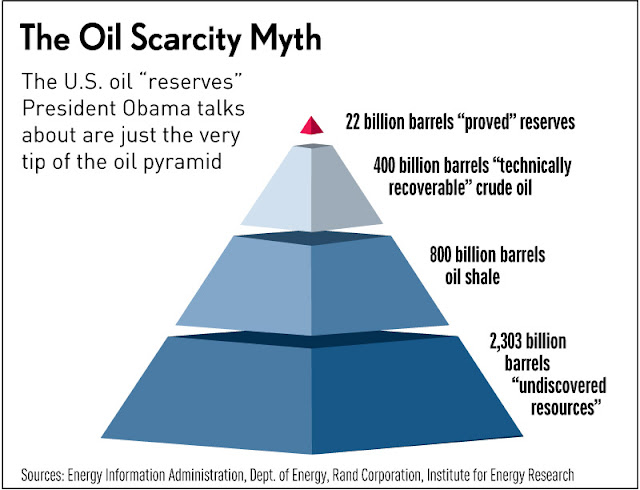
...Hubbert estimated that the “ultimate potential reserve of 150 billion barrels of crude oil for both the land and offshore areas of the United States.” Hubbert’s estimate was based on the crude oil “initially present which are producible by methods now in use.” Using the 150 billion barrel estimate he predicted US Peak Oil occurring in 1965. But to be cautious, he also used a slightly higher figure of 200 billion barrels which produced a peak in oil production around 1970—the figure that Hubbert advocates like to use to demonstrate that Hubbert was prophetic in his predictions. However, by 2006 the Department of Energy estimated that domestic oil resources still in the ground (in-place) total 1,124 billion barrels. Of this large in-place resource, 400 billon barrels is estimated to be technically recoverable with current technology.

...Obviously if Hubbert were correct, and we had reached Peak Oil in 1970 (point where we had consumed half of our oil) and we started out with only 200 billion, we could not have nearly 200-400 billion still left to extract—and total resources are likely even higher than this figure.

It’s also important to keep in mind that “technologically recoverable” resources are not the “total” amount of oil thought to exist in the US, so the total in-place reserves are much, much larger. It does not take a lot of imagination to predict that many of these oil resources will eventually be unlocked with new technological innovation thus added to the total “proven reserves.” _Counterpunch
Read the entire piece, for a better understanding of the author's claims that planet Earth has at least several decades of oil remaining. [Note: The author of the piece suffers from carbon hysteria, and is quite worried that there may indeed be enough oil left for centuries of use.]

Everything in the piece above has been discussed on Al Fin Energy at one time or another. But the Counterpunch article is an interesting refresher piece, counter-acting much of the daily drone of doom coming from peak oil cathedrals and seminaries.

What attracts otherwise normal people to these religions of doom and catastrophe? You may as well ask what attracts otherwise normal people to smoking, excess drinking, drug abuse, or overeating. Humans are just barely advanced apes. They are apable of language and rudimentary reasoning but are often not capable of overcoming innate weaknesses and counterproductive instincts.

Doomers will feed relentlessly on doom, at the cost of problems that might have been solved, and essentials that might have been produced. The rest of us have work to do.

Labels: , ,

Bookmark and Share

08 April 2012

Peak Oil: If Not for Carbon Hysteria, We Wouldn't Be Having This Conversation

This article was posted originally on Al Fin Energy blog:
In 1920, the U.S. Geological Survey estimated that the world contained only 60 billion barrels of recoverable oil. But to date we have produced more than 1,000 billion barrels and currently have more than 1,500 billion barrels in reserve. World petroleum reserves are at an all-time high. _newsok
For over 150 years, "knowledgeable insiders" have been predicting the end of oil. Over that time period, oil has endured multiple cycles of boom and bust, with high and very high oil prices alternating with low and very low oil prices. High oil prices -- if they are sustained over several years without a "price bust" -- lead to increased exploration and improved technologies for production.
...technological advances have opened up resources beyond the limits of our ancestors' imaginations. We can drill offshore in water up to 8,000 feet deep. We have enhanced recovery techniques, horizontal drilling and four-dimensional seismic imaging. Oklahoma oilman Harold Hamm is turning North Dakota into Saudi Arabia by using hydraulic fracturing technology. U.S. oil production has reversed its 40-year decline. By the year 2020, it is anticipated that the U.S. will be the world's top oil producer.

...Nine years ago, I predicted that the age of petroleum has only just begun. I was right. The Peak Oil theorists, the malthusians and the environmentalists were all wrong. They've been proven wrong, over and over again, for decades. A tabulation of every failed prediction of resource exhaustion would fill a library.

Sustainability is a chimera. No energy source has been, or ever will be, sustainable. In the 11th century, Europeans anticipated the industrial revolution by transforming their society from dependence on human and animal power to water power. In the 18th century, water power was superseded by steam engines fired by burning wood. Coal replaced wood, and oil and gas have now largely supplanted coal. In the far distant future we'll probably use some type of nuclear power. But for at least the next hundred years, oil will remain our primary energy source because it's abundant, inexpensive and reliable.

...What's stopping us isn't geology. What's stopping us is ignorance and bad public policy. _New Age of Oil
But why are we even having this conversation about "peak oil" in the first place? The graphics pictured below should show anyone with intelligence that energy collapse will not be in the cards anytime soon.
Look at the tiny amount of liquid hydrocarbon that has been consumed by humans so far. Then look at the nearly infinite amount of liquid hydrocarbons and liquid substitute fuels which remain in the wings, waiting for sufficient need and ingenuity on the part of humans.

Discussion about EROEI -- energy returned on energy invested -- is just so much trash talk. When you consider the potential of high quality, abundant industrial process heat from advanced nuclear reactors, EROEI fears begin to sound like a joke. Whether it takes 10 or 20 years to develop and build gen IV high temperature gas cooled modular reactors, the die is cast, and peak oil doom is itself doomed, along with EROEI fears.

So what is this conversation truly about? Beneath all the smokescreens, it is about lefty-Luddite carbon hysteria, and the fear of of an advanced technological future for humans. If not for a trumped-up and irrational fear of carbon, a true hydrocarbon abundance suddenly opens up before us -- along with an abundance of electricity from advanced, safe, clean, nuclear reactors.

But if we listen to the lefty-Luddite green dieoff.orgiast fears coming from the highest levels of human governments and inter-governments, we face a new dark age of energy starvation. An age where unreliable intermittent-renewables -- ever prone to breakdown and failure -- replace reliable forms of power and energy.

The green world view is based upon several delusional beliefs, including carbon hysteria, energy scarcity, overpopulation, an environment doomed by global pollution. But these green lefty-Luddite fears are several decades old. Many of these same greens predicted that the great human dieoff was certain to occur in the 1970s, 1980s, and 1990s. They predicted doom from global cooling -- from CO2 and pollution, no less.

But when a temporary cooling trend was replaced by a temporary warming trend, these greens of doom quickly changed tack and jumped aboard a global warming train -- caused by the same things, supposedly, that were to have brought about global cooling! They are nothing if not versatile.

But the underlying cause of doom -- in the mind of a green -- is always human industry, human science, human technology, human commerce. That is what they fear and what they attack -- the fruits of human ingenuity itself.

The end result of human ingenuity is a cleaner and more sustainable -- but more abundant -- human future. That is what greens fear. They fear that we will move beyond the more primitive stages of human technology into cleaner, sustainable -- but very abundant -- forms of technology. This possibility is a distinct threat to the leftist green vision of the future, and must be opposed by greens in every way possible, using every green tool and green trick in the book.

That is what carbon hysteria is, of course. It is a tool to be used until it is of no more use, then it will be discarded for whatever else might serve. Just like "energy depletion and scarcity," carbon hysteria is a useful tool of ideology, without which the "peak oil myth" could never survive long.

The green fear is not that there is not enough oil, not enough hydrocarbon fuel. The fear is that there will always be more than enough. As a tool to stoke that fear, carbon hysteria cannot be improved upon. Peak oil: without carbon hysteria, we wouldn't be having that conversation.

More: Recycling Doomsday: How Failed Predictions of Doom Are Recycled Every 30 years or so. Stranger than fiction. And if not for the fact that these purveyors of contrived doom are influential at the highest levels of national and international government, we could all have a good laugh on the poor sods.

Labels:

Bookmark and Share

26 March 2012

What Are You Willing to Bet On the Peak Oil Dogma?

The following article was first published on Al Fin Potpourri:

We are being told once again to expect ever-higher fuel and energy prices in the coming years, with a consequent drag on economies. Underlying these gloomy predictions is an underlying belief that humans are running short on sources of energy -- the peak oil dogma -- and will have to pay more as shortages worsen. But is the peak oil dogma based upon superstition, or fact?
Myth of Scarcity

Unless humans look for energy, they are unlikely to find it. But if they are willing to use their brains and their eyes, they can detect ever more geologic locations where a wide variety of hydrocarbon fuels were formed.
EnergyTribune

It is said that the cheap and easy oil is all gone, and that the low hanging fruit has been picked. But the "cheap and easy oil" was not that cheap and easy when it was first tapped. Technology had to be developed for each type of deposit to be exploited. This will continue to be the case.
This is an IEA estimate of hydrocarbon resource. It is very likely to be a vast unerestimate, as is typically the case.
Here is another scholarly estimate of world hydrocarbon resources, also likely to have significantly underestimated the true resource.
Here is another estimate, which clearly fails to account for the economic impact of cheap and abundant nuclear process heat from high temperature gas-cooled reactors, in the processing of gas to liquids, coal to liquids, kerogens to liquids, etc.
This graphic includes an estimate of comparison between relative carbon resources of gas hydrates and all other hydrocarbons.
This graphic compares relative gas hydrate resources in various locations.
This graphic looks at recoverable fossil fuel resources by nation. It underestimates a number of probable resources across the board, including shale oil & gas and several others.

When humans are confronted with resource shortages, they take a number of parallel approaches to relieving the resource scarcity.

But when shortages are caused by political or ideological perversity, there may be much less that humans can do, until the political or ideological constrictions are removed. That appears to be the situation associated with the multiple political dogmas of peak oil, carbon hysteria, overpopulation, and various other faux environmental political dogmas.

In the modern world, Russia, China, India, and a number of third world and emerging states stand out as distinct outliers from the global faux environmental rush to energy suicide. It is unlikely that Europe, Oceania, and North America will be willing to take the final faux environmental step of cutting their own throats (figuratively speaking), when such a large part of the world stands ready to loot their corpses in a very un-PC, un-green manner.

Labels:

Bookmark and Share

26 September 2011

Seeking the True Shape of Peak Oil

The most simplistic graphic description of peak oil is shown above. The curve moves smoothly upward to the peak, then drops quickly to negligible levels. This is how unsophisticated peak oil doomers typically see the "peak oil" phenomenon.
A more sophisticated observor of oil and liquid fuels production is likely to be aware of the economic "recruitment" of new oil supplies and substitute fuels, as the cheaper, low-hanging fruit is plucked and prices trend upward. Notice the unsophisticated peak oil curve in dotted orange, labeled "Peak oil--Campbell."
Sine / Cosine Graph Simulating Out of Phase Oil Price and GDP Curves

But that is not to say that all peak oilers and peak oil consultants are as unsophisticated as Hubbert, Campbell, or Simmons. A new breed of more economically informed peak oil consultant is beginning to describe "peak oil" as more of a cyclical phenomenon, driven by the interaction between oil prices and economic growth.
Peak Oil is, in fact, a complex but largely an economically driven phenomenon that is caused because the point is reached when: The cost of incremental supply exceeds the price economies can pay without destroying growth at a given point in time. While hard to definitively prove, there is considerable circumstantial evidence that there is an oil price economies cannot afford without severe negative impacts.

The corollary is that if oil prices fall back to and sustain levels that do not inhibit growth, then economic growth will resume, with both recoveries and downturns lagging oil price changes by 1-6 months. _ChrisSkrebowski

You can easily see in the above definition of "peak oil," the driving forces of a co-cyclical pattern involving oil prices and economic growth, simulated by the out of phase sine and cosine curves.
But for peak oil to mean anything at all, it must incorporate an element of doom, catastrophe, and collapse. The above graphic simulates a cyclic economic pattern with attenuation, damping to very low levels of economic activity. This graphic might best depict the new, more sophisticated economic / geologic synthesis of peak oil doom consultants, as described by Skrebowski, when economies do not have enough time enough to fully recover from the previous crash before the next oil price hike hits the system. Each successive cycle leads to a worsening economic picture, in this scenario -- since the economy is thrown too far off balance to develop substitute fuels or power sources in time to prevent collapse.

Now, contrast the "peak oil plateau" graphic that is the second image from the top, with the damped sine wave depiction of peak oil collapse in the lowest graphic. In the case of the "complex plateau," there would seem to be time for advanced societies to move to safe, clean, advanced nuclear sources for power and industrial heat. But in the case of the damped sine pattern, it is not clear that societies could recover from the downward spiral.

A thinking person might perceive that different nations possess different resources -- both natural resources and human resources. Logically, the response curves to "peak oil" for different nations and societies would not be identical to each other. Rather, the response to "peak oil" -- no matter how it is defined -- is likely to vary widely between different economies, depending upon the available resources and the competence of national leadership. In other words, collapse is more likely to be regional in all but the worst price-shock cycle scenarios.

A careful reading of the Skrebowski piece linked above, will reveal that government policies will have a great deal to do with how a society weathers high energy costs. If governments pursue policies of energy starvation -- such as the Obama government and certain European governments are doing -- economic hardship within the society will multiply.

More:

Two sides to peak oil
An interesting historical look at the evolution of viewpoints toward oil resources and peak oil.

How an excessively gloomy view of peak oil might distort markets and cause unnecessary disruption and hardship

Cross published at Al Fin Energy

Labels: ,

Bookmark and Share

10 September 2011

Peak Oil: Meet Sophisticated Coal and Biomass to Liquids

There is more than 250 billion tons of recoverable U.S. coal reserves – equivalent to an estimated 800 billion barrels of oil, compared to Saudi Arabia’s proven reserves of 260 billion barrels

_National Mining Association_via_Accelergy.com
EERC PDF

Accelergy's Coal Biomass to Liquids (CBTL) process utilises direct liquifaction of coal (using hydrogen from gasification of algal biomass and coal), combined with advanced catalytic processing of hydrotreated coal and hydrotreated algal lipids, to produce advanced hydrocarbon liquid fuels at high yields.

Accelergy is developing its coal biomass to liquids technology in several locations across the US, in China, and for the US military.
In the United States, Accelergy is working on demonstration facilities in Pennsylvania, Montana, and North Dakota. Accelergy's process can be tuned to utilize a wide range of feedstocks, and the company is currently exploring the use of both coal and natural gas in the U.S, along with biomass.

The company is also targeting its efforts in China since the country already has a small number of synthetic fuels plants where coal is converted to a liquid, he said. China is also the world's largest producer and consumer of coal. _Energy.AOL.com

Consider these facts about CBTL [Coal Biomass to Liquids]:

Abundant Supply: There is more than 250 billion tons of recoverable U.S. coal reserves – equivalent to an estimated 800 billion barrels of oil, compared to Saudi Arabia’s proven reserves of 260 billion barrels. (Source: National Mining Association)

Environmental Benefits: Combining the Coal-to-Liquids (CTL) and Biomass-to-Liquids (BTL) processes, Accelergy removes 20% of the CO₂ emissions associated with standard refining methods, resulting in cleaner fuels that reduce nitrogen oxide and particulate emissions and enabling use of higher efficiency engines.

Reliable Sources: Coal currently provides more than half of the nation’s electricity and is the largest single source of overall domestic energy production at more than 31% of the total, according to the National Mining Association. Additionally, our feedstocks can be grown domestically an land deemed unsuitable for food crop cultivation. _Accelergy

More on direct coal liquefaction:
• Direct liquefaction processes add hydrogen to the hydrogen deficient organic structure of the coal, breaking it down only as far as is necessary to produce distillable liquids.
• Coal dissolution is accomplished under high temperature (~400 0 C) and pressure (~1500-3000 psi) with hydrogen and a coal-derived solvent.
• The coal fragments are further hydrocracked to produce a synthetic crude oil.
• This synthetic crude must then undergo refinery upgrading and hydrotreating to produce acceptable transportation fuels. _Direct Liquefaction of Coal PDF
More on Accelergy's licensing of Exxon Mobil technologies

Accelergy patent dealing with a related but variant process

More on Accelergy's potentially lucrative move into the Chinese market

Accelergy's approach to CBTL is rather sophisticated, involving some advanced Exxon Mobil technology along with other imaginative innovations. The fact that Accelergy is working with the US military, with civilian US entities, and inside China, indicates that the company is following an aggressive path of expansion and development.

Taken from a previous posting at Al Fin Energy

With its vast resources of coal, natural gas, bitumens, kerogens, oil, uranium, thorium, and more, North America is well situated to transition from the fossil fuel age to the advanced fission / fusion age.

Bad government is a far greater threat to North America and Europe than resource depletion, climate catastrophe, or overpopulation doom. Fear only bad government and the accompanying twin demons of debt and demographic decline.

Labels: ,

Bookmark and Share

20 August 2011

Peak Oil: Meet the Heat that Spells Your Doom

With plentiful process heat provided at temperatures between 700 C and 950 C, a person could kill peak oil and have plenty of energy left to power industry and a broad spectrum of industrial processes.   Specifically, one could:
  1. Unlock the trillions of barrels oil equivalent in oil sands (PDF)
  2. Unlock the trillions of barrels oil equivalent in coal to liquids and gas to liquids (PDF)
  3. Unlock the trillions of barrels oil equivalent in oil shale kerogens 
  4. Provide abundant industrial process heat for production of fertilisers, refining fuels, making plastics, etc 
  5. Split CO2 into CO to use as a hydrogen carrier 
  6. Overturn conventional fears of EROEI and Peak Oil 
Those things, and many more, will be accomplished by next generation gas-cooled high temperature nuclear reactors. Helium gas coolant will run gas turbine generators at high temperatures, which provides electrical power at higher efficiencies than older steam cycle generation systems. And as mentioned above, the higher temperature process heat will find a wide range of practical uses in industrial processes and energy production.

Conventional fears about EROEI and peak oil will be overturned since the energy used to produce hydrocarbon fuels, fertilisers, plastics, and other products of industry and energy, will come from the high temperature heat effluent of nuclear reactions -- of which there is no conceivable near term shortage.

The "green dream" of modern faux environmentalism is a dysfunctional fantasy that will lead to the energy starvation of industry and commerce, and an ongoing widescale economic hardship. Greens have pushed governments away from most forms of reliable energy -- out of deeply felt carbon hysteria and nuclear phobia. The green rainbow fantasy love affair with wind and solar is eating away at European economies, and any other economic entity that comes to rely on those inherently unreliable sources of power.

Don't let your government lead your society down that ruinous primrose path.

Adapted from an article originally published at Al Fin, The Next Level, and cross-posted to Al Fin Energy

Labels: ,

Bookmark and Share

25 July 2011

Biological Substitutes for Petroleum Scaling Up Economically

As the price of petroleum edges up in fits and starts, booms and busts, substitution products are coming on board to replace petroleum in many uses -- including fuels, plastics, high value chemicals, lubricants, and more.
Making plastic from sugar can be just as cheap as making it from petroleum, says Dow Chemical. The company plans to build a plant in Brazil that it says will be the world's largest facility for making polymers from plants. _TechnologyReview
Rather than jumping on board the peak oil bandwagon of doom, many dozens of startups and large industrial players are lining up to produce substitution products and feedstocks.  The process of substitution takes time, of course.  But given the abundant energy resources of the planet, and the political will to develop them, there will be more than enough time to make the different transitions which will be needed.
Bio-based chemicals production has grown quickly in recent years, but it still represents just 7.7 percent of the overall chemicals market. Production has been limited in many cases to specialty chemicals or niche products. But Dow now says chemicals made from plant feedstocks may be ready to compete head-to-head with petrochemicals made in large volumes.

Most large-volume chemicals are made from petroleum. About 80 million tons of polyethylene are made annually around the world. But high oil prices have increased the costs of petrochemicals. And in Brazil, long-standing government support for sugarcane ethanol production has allowed the industry to drive down costs, making ethanol competitive with fossil fuels. Making polyethylene from sugar "would not necessarily be attractive in other regions," says Luis Cirihal, Dow's director of renewable alternatives and business development for Latin America.

The technology for converting ethanol into ethylene, the precursor for polyethylene, is not new. "The dehydration process for converting ethanol to ethylene has been known since the 1920s. The only thing that's really new here is the scale," Cirihal says. _TechnologyReview

Oil prices have been bouncing around from very high to very low for over 150 years.  Boom and bust has been the name of the oil game since it began.  Predictions of global oil depletion and consequent economic doom have been made over that same 150 year time period, and all have failed.  But that does not stop a lot of people from selling books, newsletters, seminars, and workshops in order to cash in on the cyclical sentiments of impending depletion doom which seem to come on with every boom cycle.

Trivial truisms lie at the heart of most mass delusions. The delusion of impending peak oil doom (POD) is no exception. The truisms at the heart of POD include: "the total supply of oil in the Earth is finite," and "oil wells deplete rapidly, once tapped." But the truisms can only take you so far, without questionable assumptions and educated guesses. A lot of people want to believe in doom, and are willing to take those leaps of faith into the unknown.

But there is no need to do that, if all you want to do is live a full, abundant, and satisfying life, despite the finite nature of world oil supplies. To do that, you merely need to keep a few general concepts in mind, and follow a small number of central parameters. More on that later.

Labels: ,

Bookmark and Share

20 July 2011

A Pandemic of Malthusian Illiteracy?

Global economy optimists however say that "Malthusian illiteracy" lurks behind remaining adherents of Peak Oil theory - which basically says conventional oil production will stagnate and fall but demand will go on growing. _MarketOracle
As knowledgeable analysts come to understand that oil demand, rather than oil supply, is currently in the driver's seat, some of the impetus behind the peak oil panic has subsided. And yet the "Malthusian Impulse" continues to drive many observers, against their more rational proclivities. Still, global hydrocarban reserves continue to grow, year after year, and oil demand is slated to decrease in time.

New sources for transport fuels are likely to come from many directions, including new gas-to-liquids (GTL) technologies. Oxford Catalyst's microchannel GTL technology is very much in demand, as are other new varieties of GTL technologies. The market for GTL fuels may be more than 20 million barrels per day! Imagine the impact of that huge new supply on the global oil market. (Note that approximately between 5 and 10 million barrels per day could be produced via GTL from currently flared gas alone. Stranded gas could double that number.) More information at this PDF white paper download from Velocys, creator of the Oxford Catalysts microchannel technology.

A more conventional source for GTL transport fuels is the large scale technology championed by Shell.
In 2011, Shell began shipments from its Pearl GTL project in Qatar...The project is able to produce 140,000 b/d of fuel and 120,000 b/d of ethane and condensates... _Petroleum Economist

And that is just the beginning. As long as the huge price spread between the cost of natural gas and the cost of crude oil remains, more and more GTL projects will kick in to take advantage of this "easy money."

Second and third generation biofuels from biomass technologies are beginning to come on line, slowly (consult Al Fin Energy blog for updated news on this topic). Advanced biofuels technologies are not likely to take an appreciable bite out of crude oil demand for another 5 or 10 years. As long as natural gas prices stay this low, only the most efficient biofuels projects will be able to compete in the liquid fuels markets without government subsidies. But by the year 2030 if the technology continues to develop, the writing will be on the wall. This is a biological world, after all.

Advanced nuclear power technologies are likely to aid the development of new fuels technologies of all kinds, supplying safe and abundant power and heat for a multitude of energy development projects from oil sands to oil shales to biomass and aquaculture projects in cold climates, irrigation and desalination of saltwater in arid climates etc etc.

Other factors leading to a decreased demand for crude oil includes the increasing use of both natural gas and biomass as feedstock for the vast chemicals industry -- an industrial sector previously dependent upon petroleum for feedstock. (see Al Fin Energy blog for much more)

The ongoing global economic downturn and demand destruction extends from Europe to Japan to the US, and is beginning to put stress on the Chinese and Indian economies -- despite all the rah! rah! hype about the coming age of the Chindian global economy. Many nations which have maintained hefty consumer subsidies for transport fuels are being forced to reduce the subisidies. More downward pressure on demand.

Malthusian theories are appealing for their simplicity. And yet the never-ending and never-fulfilled Malthusian predictions of doom ignore the most salient and disruptive human technology of all -- the goal-oriented innovativeness of the human mind.

Despite the best efforts of energy-starvationists in the Obama administration, in the EU bureaucracy, in national bureaucracies of EU nations and advanced nations around the globe -- the prospects for abundant energy and fuels in the future are quite good, as long as the clowns in power do not destroy the economies they oversee.

If you have abundant clean energy and fuels, everything else is doable.

Labels: , , ,

Bookmark and Share

07 April 2011

Scratching the Surface of Global Hydrocarbons

From Rogner(PDF 1997) via GWPF

It is odd that the vast size of global hydrocarbon resource is largely overlooked in the many discussions of "peak oil" and "resource depletion." It almost seems as if persons of influence would prefer to forget all about the huge resources which are out there waiting for humans to find, retrieve, and develop.

The image above was taken from a 1997 assessment of global hydrocarbon resources by Rogner (PDF). As you can see on the left, the amount of hydrocarbon already consumed by humans is negligible in comparison to all the hydrocarbon reserves and resources still remaining.

Recent large discoveries of oil off Brazil and Norway, plus the discovery of huge unconventional gas resources worldwide, added to the already incomprehensibly large resources of coal, unconventional oil, and methane hydrates -- and one's mind is in danger of boggling from all the hydrocarbon that has been sitting around waiting for someone to notice it.

But wait! That's not all. The planet itself is busy making more hydrocarbon, while you are sleeping -- deep in the hot pressured mantle. Some of this hydrocarbon is constantly migrating upward into the crust, providing vast future resources for intelligent beings to discover down the road.

And we have not even mentioned the immeasurable resources of uranium and thorium, waiting at our beck and call -- as soon as our bureaucratic obstructionists in government get out of the way of safe, new, more economical reactor construction.

What about enhanced geothermal? Orbital solar? Low energy nuclear reactions? etc etc. It is almost enough to make one forget about peak oil doom.

Labels: ,

Bookmark and Share
Older Posts
Al Fin Main Page
Enter your Email


Powered by FeedBlitz
Google
WWW AL FIN

Powered by
Blogger

``