30 January 2012

Global Cooling: A Return to the Age of a Frozen Thames?

The supposed ‘consensus’ on man-made global warming is facing an inconvenient challenge after the release of new temperature data showing the planet has not warmed for the past 15 years.

The figures suggest that we could even be heading for a mini ice age to rival the 70-year temperature drop that saw frost fairs held on the Thames in the 17th Century. _DailyMail
A Frozen Thames During Little Ice Age DailyMail

Meanwhile, leading climate scientists yesterday told The Mail on Sunday that, after emitting unusually high levels of energy throughout the 20th Century, the sun is now heading towards a ‘grand minimum’ in its output, threatening cold summers, bitter winters and a shortening of the season available for growing food.

Solar output goes through 11-year cycles, with high numbers of sunspots seen at their peak.
We are now at what should be the peak of what scientists call ‘Cycle 24’ – which is why last week’s solar storm resulted in sightings of the aurora borealis further south than usual. But sunspot numbers are running at less than half those seen during cycle peaks in the 20th Century.

...According to a paper issued last week by the Met Office, there is a 92 per cent chance that both Cycle 25 and those taking place in the following decades will be as weak as, or weaker than, the ‘Dalton minimum’ of 1790 to 1830. In this period, named after the meteorologist John Dalton, average temperatures in parts of Europe fell by 2C.

However, it is also possible that the new solar energy slump could be as deep as the ‘Maunder minimum’ (after astronomer Edward Maunder), between 1645 and 1715 in the coldest part of the ‘Little Ice Age’ when, as well as the Thames frost fairs, the canals of Holland froze solid. _DailyMail
Using the Livingston and Penn Solar Cycle 25 amplitude estimate, this is what the solar cycle record is projected to look like:
Slowing Sun, Cooling Climate WUWT

And, yes, that means the end of the Modern Warm Period. _WUWT David Archibald
Normal Temperature Fluctuation Daily Mail

This graph indicates what global temperatures have done since 1997. Rather than shooting skyward as the "hockey stick" graphs of IPCC fame predicted, temperatures have rather plateau'd, and may be trending downward.
400 Years of Sunspots DailyMail
It is too early to predict whether the sun is approaching a multi-decadal "Dalton Minimum" type decline in activity, or whether it may be on the verge of a more extended "Maunder Minimum" type decline. The difference between the two could be quite important, and solar physicists and astronomers are beginning to take notice.

On the global climate front, ocean scientists are already beginning to note that improved ocean heat content measurements are failing to confirm high priced computer climate models.
WUWT Ocean Temps Diverge From Model Predictions

Because ocean temperatures exhibit a "thermal flywheel effect," ocean temperatures can continue to gradually warm for some time after incoming solar energy has declined. Water, with a 4X higher specific heat than air, takes longer to reverse a temperature trend.

Of course there is a lot more going on with the climate than solar cycles. But thanks to the impressive solar changes that we are witnessing, we may be closer to seeing who the big boss of the climate truly is.

But since many hundreds of billions of dollars in carbon taxes, carbon trades, carbon reparations, and carbon hysteria oriented research are at stake, do not expect the orthodoxy of climate alarmism to take all of this lying down, frozen Thames or no frozen Thames.

Labels: ,

Bookmark and Share

05 July 2011

Earth's Climate Has Always Been Chaotic & Out of Control

Average temperatures in Britain could fall by two degrees centigrade, according to the study led by Mike Lockwood, professor of space environment physics at Reading University, because of a drop in the amount of sunspot activity. _DailyMail

Little Ice Age Plunging In?

The Earth's climate is chaotic by nature, and given to drastic changes and shifts as a matter of course. The many overlapping natural cycles which contribute to global climate have been largely ignored by climate scientists -- until now.
Professor Lockwood's findings could mean the average winter temperature could drop below 2.5C, compared to the average British winter now of 5C, the newspaper reported.

In June, three different studies all concluded that sunspot activity looks set to decline over the next 10 years.

Experts said the next upswing in sunspot activity, which follows an 11-year cycle, will not be as strong as normal - or might not even happen at all.
The findings were presented at a meeting of the American Astronomical Society's solar physics division.

They said a decrease in global warming might result in the years after 2020, the approximate time when sunspots are expected to disappear for years, maybe even decades. _DailyMail

Meanwhile, climate scientists are just now beginning to admit the importance of the urban heat island effect, which has biased global temperature records upward -- contributing to the carbon hysteria which has sustained the orthodoxy of catastrophic anthropogenic global warming, and helped drive the bandwagon and steamroller of the great climate panic of the late 20th and early 21st centuries.

More honest scientists are likewise admitting that extreme weather events have nothing to do with atmospheric carbon dioxide levels.

You Mustn't Believe the Lies that Green Zealots Tell. Not only about nuclear power, but about climate change, resource depletion, overpopulation, etc.

Previously published at Al Fin, the Next Level

Prolific and innovative thinker and scientist J Storrs Hall takes a look at where the climate has been, compares current climate with similar climate curves in the past, and slyly invites readers to guess where the climate is likely to be heading.

First -- Where the climate has been over the past 10,000 years or so... :

Images from WUWT

Next -- Comparing our current climate curve with similar climate curves from the past, to get an idea of a possible trajectory... :
Here I’ve plotted the 400 years following each minimum in the record that leads to a sustained sharp rise. There were 10 of them; the first five are plotted in cyan and the more recent 5 in blue. You can see that in the latter part of the Holocene the traces settle down from the wilder swings of the earlier period. Even so, every curve, even the early ones, seems to have an inflection — at least a change in slope — somewhere between 200 and 250 years after the minimum.

The hatched black line is the average of the 5 recent (blue) spikes. The red dots are the uptick at the end of GISP2 and HadSST, spliced at 1850. Note that ALL the minima dates are from GISP2. _WUWT

Then Josh invites readers to guess what will happen next, if history is any guide.

For some parts of the northern hemisphere, it may be time to get out the summer parkas.

Climate simpletons who believe that the global climate is controlled by one trace gas which constitutes less than 0.04% of the planetary atmosphere, have controlled the microphones, printing presses, funding agencies, and public stage for far too long. It is time for science to displace the politically convenient (and economically lucrative) climate hysteria, so that ordinary people can make rational plans.

Previously published at Al Fin Potpourri

Humans cannot control the climate. Humans cannot even significantly influence the climate except on a regional basis -- via land use changes and black soot effluents etc. The popular madness and delusion of catastrophic anthropogenic global warming reflects badly on human governments, inter-governments, environmental organisations, and human gullibility in general.

A resilient, more skeptical, and less easily led type of human is badly needed.

More__ 6July11 __: A Reminder that Climatology is just an infant science

Labels: , ,

Bookmark and Share

15 June 2011

Solar Cycle Shutting Down: New Ice Age Next?

"The sunspot cycle may be going into hibernation," says Frank Hill of the National Solar Observatory in Sunspot, New Mexico. He and other researchers are presenting their findings this week at a meeting of the American Astronomical Society's Solar Physics Division in Las Cruces, New Mexico.

...The sun's solar cycle was interrupted once before during the so-called Maunder minimum from 1645 to 1715, when almost no sunspots appeared.

Some scientists have suggested this 70-year lull may have triggered or contributed to the pronounced cooling observed in northern Europe during this period... _NS
WUWT

Solar scientists do not understand what is up with the sun these days. Just as physicists are discovering that the sun may be driving the climate, solar scientists are frantically trying to understand what is driving the sun. Because if the sun does decide to shut down for a while, things on Earth may grow very cold of a sudden.
Three different lines of evidence suggest that the sun, which is expected to reach its maximum sunspot and magnetic activity in the current cycle in 2013, might even be entering a prolonged quiet period similar to the so-called Maunder Minimum, a 70-year period from 1645 to 1715 in which virtually no sunspots were observed. _SMH
It has been clear for some time that global climate closely tracks solar activity, mediated largely via clouds and ocean oscillations. But scientists are still in a fog as far as understanding the controlling forces of solar cycles.
A missing jet stream, fading spots, and slower activity near the poles say that our Sun is heading for a rest period even as it is acting up for the first time in years, according to scientists at the National Solar Observatory (NSO) and the Air Force Research Laboratory (AFRL)....All three of these lines of research to point to the familiar sunspot cycle shutting down for a while.

“If we are right,” Hill concluded, “this could be the last solar maximum we’ll see for a few decades. That would affect everything from space exploration to Earth’s climate.” _WUWT

Scientists are forced to monitor second and third order phenomena, and to guess at the primary -- likely chaotic -- forces at the heart of the sun, which control the observable phenomena. As for the climate of tiny planet Earth, it is at the mercy of cosmic forces.

When unscrupulous politicians and grant-hungry climatologists scream for greater funding and more control over government budgets and economic activity -- that is clearly self-interest talking. But when voters, citizens, and the public at large take these climate grifters seriously -- that is the Idiocracy.

CERN CLOUD experiment hopes to shed light on Sol :: Cosmic Ray :: Global Climate connection

David Archibald's PDF on Solar Cycle 24 and possible climate repercussions

Article: PDF on Cosmic Ray Theory by originator Henrik Svensmark

Mini Ice Age within a decade? Register via GWPF

10 Reasons to be cheerful about the coming ice age... Delingpole

National Geographic: Sun Headed into Hibernation

Remember, global cooling is far more devastating than global warming. Global cooling leads to widespread crop failures and a dramatic drop in agricultural yield. Another "little ice age," such as occurred the last time the sun went to sleep, could lead to hundreds of millions of human deaths from starvation and associated disease and warfare. Or worse. Because without current huge agricultural yields from temperate climate crops, the world's human population would be too large to sustain, as per Malthus.

Labels: , , ,

Bookmark and Share

19 January 2011

What the Hell Is Going On With the Sun?

WattsUpWithThat?!?

About 2 years ago in comments at WUWT, Al Fin remarked to solar scientist Leif Svalgaard that it appeared that solar scientists did not know what the hell was going on with the sun. Leif took exception to the remark at the time. But subsequent events suggest that solar scientists do not indeed know what the hell the sun is up to. The GIF animation below from WUWT illustrates the changes in predictions over the last 3 years.
This will be at the level of the Maunder Minimum of 1675 -1715.
Previous NASA predictions below:
2010 October: Predicted peak 60-70
2009 May 29: predicted peak: 80-90 range
2009 Jan 5: predicted peak: 100-110 range
2008 Mar 28: predicted peak: 130-140 range

From the NASA page:

Current prediction for the next sunspot cycle maximum gives a smoothed sunspot number maximum of about 59 in June/July of 2013. We are currently two years into Cycle 24 and the predicted size continues to fall. _WUWT

Want to see something really scary? Check out Solar Cycle 24 PDF download from David Archibald

More 21Jan11: Here is information on a related topic -- the influence of cosmic rays on climate. Apparently cosmic rays may play a much larger role in climate swings than the IPCC is willing to admit. Which means that the sun would play a much larger role as well.

Labels: , ,

Bookmark and Share

06 January 2011

Sun Agrees with Oceans: A Cooler Earth

Knox et Douglass IJG Vol 1 #3 PDF

According to an Internationl Journal of Geosciences paper (PDF), ocean temperatures from Argos floats show a recent cooling between 2003-2008 (via NCMediaWatch). It is difficult for the planet to warm when most of its significant thermal mass is cooling.
In summary, we find that estimates of the recent (2003–2008) OHC rates of change are preponderantly negative. This does not support the existence of either a large positive radiative imbalance or a “missing energy.” _IntJlGeosci PDF
More on ocean cooling from Roy Spencer
WattsUpWithThat
On the solar front, the sun has experienced another sudden drop in activity recently. More from WUWT:
NOAA’s Space Weather Prediction Center (SWPC) produced their monthly solar cycle progression update yesterday. The news is not encouraging. We’ve had a drop in solar activity again in December, The sunspot count is lower, but the really worrisome thing is the Ap geomagnetic index. The solar dynamo has now dropped to magnetic activity levels last seen in late 2009. Readers may recall this post from December 23rd: Solar Geomagnetic Ap Index Hits Zero which was a bit unusual this far into cycle 24. _WUWT
As this September 2010 Science Now article states: "...something peculiar has been happening."

Flashback to a 2008 warning: Sunspots May Vanish by 2015

Let's hope not. Most humans enjoy experiencing at least one warm season per year. If the planet endures many years without a summer, humans will run out of food -- as will most other animals.

Labels: , ,

Bookmark and Share

20 December 2010

Global Cooling Strikes Earth With a Vengeance?

SpotlessSun

An unusually cold and snowy December has struck across Europe, Wales, Ireland -- even Australia!!! This extreme cold goes against a brief, but multi-decadal trend of warming winters, and has many people asking whether there is an underlying (and unforeseen by climatologists) reason for the apparent switch in climate regimes?

Climate researcher David Archibald believes that there is something different about Solar Cycle 24 PDF. Archibald has come out publicly predicting that this solar cycle, and the one following, will be cycles of extremely low solar activity. Such an extended period of low solar activity may be similar to a historic cold spell that occurred between 1790 and 1830.
The Dalton Minimum was a period of low solar activity, named after the English meteorologist John Dalton, lasting from about 1790 to 1830.[1] Like the Maunder Minimum and Spörer Minimum, the Dalton Minimum coincided with a period of lower-than-average global temperatures. The Oberlach Station in Germany, for example, experienced a 2.0°C decline over 20 years.[2] The Year Without a Summer, in 1816, also occurred during the Dalton Minimum. _WUWT
It is best for humans to keep in mind that their lives are deeply affected by phenomena which are far larger than any human activity -- and go far beyond the ability of humans to influence.

Labels: ,

Bookmark and Share

09 October 2010

Power to Control Everyone in the World: Controlling the Sun

Today, we take another look at Josh Hall's climate machine, a system which reaches into the outer atmosphere in order to control how much sunlight can get through. Brian Wang has more:
The Hall Weather Machine is a thin global cloud consisting of small transparent balloons that can be thought of as a programmable and reversible greenhouse gas because it shades or reflects the amount of sunlight that hits the upper stratosphere. These balloons are each between a millimeter and a centimeter in diameter, made of a few-nanometer thick diamondoid membrane. Each balloon is filled with hydrogen to enable it to float at an altitude of 60,000 to 100,000 feet, high above the clouds. It is bisected by an adjustable sheet, and also includes solar cells, a small computer, a GPS receiver to keep track of its location, and an actuator to occasionally (and relatively slowly) move the bisecting membrane between vertical and horizontal orientations. Just like with a regular high-altitude balloon, the heavier control and energy storage systems would be on the bottom of the balloon to automatically set the vertical axis without requiring any energy. The balloon would also have a water vapor/hydrogen generator system for altitude control, giving it the same directional navigation properties that an ordinary hot-air balloon has when it changes altitudes to take advantage of different wind directions at different altitudes.

By controlling a tenth of one percent of solar radiation is enough to force global climate in any direction we want. One percent is enough to change regional climate, and ten percent is enough for serious weather control. _NextBigFuture
Of course, if controlling one tenth of one percent of incoming sunlight can force global climate "in any direction we want", what about 20% or 50%? (Can you say "Instant Ice Age?") Of course, we humans really do not know enough about global climate to be qualified to adjust solar radiation wisely.

In fact, such a scheme is far better suited for large-scale blackmail and ransom. "Either pay us $1 trillion or next year's crops are guaranteed to fail." Or, "Give us all of your oil output for the next 20 years at 1/2 the market rate, or prepare to live in total darkness for that period of time." Even worse: "Give us all the natural resources we may require, whenever we demand, or we will burn all your cities into ashes."

Control over sunlight gives you the power to cut insolation to virtually nothing, or to magnify incoming radiation to unbearable levels. It is an ultimate control over a regions ability to feed itself, a chokehold on a people's ability to survive.

With that kind of power, what would an Obama regime do? What would China's CCP do? What would Putin do, or Kim, or Chavez?

As we contemplate the grand schemes of geo-engineering climate, perhaps we need to consider the sociopathic nature of most of the world's current leaders. Who will be in control, and what might they do with these new powers?

The same type of persons who are attracted to piracy and organised crime, are also attracted to government leadership -- and for the same reasons. Power, loot, being above the law. Give them more power at the peril of your lives.

Labels: , ,

Bookmark and Share

08 January 2010

Sun Takes Unprecedented Holiday


As the theory goes, lower magnetic activity of the sun lets more GCR’s into our solar system, which produce microscopic cloud seed trails (like in a Wilson cloud chamber) in our atmosphere, resulting in more cloud cover, resulting in a cooler planet. Ric Werme has a nice pictorial here.

When I saw the SWPC Ap geomagnetic index for Dec 2009 posted yesterday, my heart sank. With the sunspot activity in December, I thought surely the Ap index would go up. Instead, it crashed. _WUWT

Many of us were hoping that the modest resumption of sunspots in mid December -- after a few years of very rare sunspots -- would signal the sun's intention to "power up" to full strength. Unfortunately, an important measure of solar activity -- the geomagnetic index "Ap" -- has recently crashed to unprecedented levels. Ap is now too low to measure, for all practical purposes.
With the Ap index dwindling to a wisp of magnetism, it bolsters the argument made by Livingston and Penn that sunspots may disappear altogether by 2015. See Livingston and Penn – Sunspots may vanish by 2015....The theory goes that once the magnetic strength falls below 1500 gauss, sunspots will become invisible to us. _WUWT
According to the Svensmark cosmic ray theory, it is a low geomagnetic index -- such as we see now -- that allows galactic cosmic rays to penetrate the heliosphere, reaching Earth's atmosphere and inducing more cloud formation. More clouds tend to block solar rays, leading to a cooler climate. NASA has already predicted that the next solar cycle -- cycle 25 -- will have very low activity, as the solar conveyor slows. What NASA failed to see was that cycle 24 would have such low activity.

If multiple long, slow solar cycles begin to line up in a row -- like airliners waiting in a queue at Chicago's O'Hare -- Earth's climate may be in for a long, cold few decades.


Labels: ,

Bookmark and Share

29 October 2009

In Solar Powered Climate CO2 is Secondary


The following is excerpted from a PDF document titled "The Sun Defines the Climate" by Russian academician Habibullo Abdussamatov. (see here or here for more discussion) The document describes one means by which solar variability drives Earth's (and Mars') climate, in conjunction with the ocean cycles and the water cycle. The reason for the far less important influence of CO2 on the climate is explained.
Over the past decade, global temperature on the Earth has not increased; global warming has ceased, and already there are signs of the future deep temperature drop (Fig. 7, 11). Meantime the concentration of carbon dioxide in the atmosphere over these years has grown by more than 4%, and in 2006 many meteorologists predicted that 2007 would be the hottest of the last decade. This did not occur, although the global temperature of the Earth would have increased at least 0.1 degree if it depended on the concentration of carbon dioxide. It follows that warming had a natural origin, the contribution of CO2 to it was insignificant, anthropogenic increase in the concentration of carbon dioxide does not serve as an explanation for it, and in the foreseeable future CO2 will not be able to cause catastrophic warming. The so-called greenhouse effect will not avert the onset of the next deep temperature drop, the 19th in the last 7500 years, which without fail follows after natural warming.

The earth is no longer threatened by the catastrophic global warming forecast by some scientists; warming passed its peak in 1998-2005, while the value of the TSI by July - September of last year had already declined by 0.47 W/m2 (Fig. 1).
For several years until the beginning in 2013 of a steady temperature drop, in a phase of instability, temperature will oscillate around the maximum that has been reached, without further substantial rise. Changes in climatic conditions will occur unevenly, depending on latitude. A temperature decrease in the smallest degree would affect the equatorial regions and strongly influence the temperate climate zones. The changes will have very serious consequences, and it is necessary to begin preparations even now, since there is practically no time in reserve. The global temperature of the Earth has begun its decrease without limitations on the volume of greenhouse gas emissions by industrially developed countries; therefore the implementation of the Kyoto protocol aimed to rescue the planet from the greenhouse effect should be put off at least 150 years.

Consequently, we should fear a deep temperature drop, but not catastrophic global warming. Humanity must survive the serious economic, social, demographic and political consequences of a global temperature drop, which will directly affect the national interests of almost all countries and more than 80% of the population of the Earth. A deep temperature drop is a considerably greater threat to humanity than warming. However, a reliable forecast of the time of the onset and of the depth of the global temperature drop will make it possible to adjust in advance the economic activity of humanity, to considerably weaken the crisis. _
When you hear yet another news story describing how modern humans must revert to the stone ages to prevent catastrophic global warming, keep in mind that there is no catastrophic global warming outside of overheated brains of corrupt politicians, UN officials, and grant hungry former scientists.

Labels: ,

Bookmark and Share

30 September 2009

Solar System Slammed by Unprecedented Cosmic Rays

Earth and the solar system are experiencing a bombardment of cosmic rays higher than ever recorded. This unprecedented onslaught of high energy cosmic particles is allowed to happen by the weakening sun. Since cosmic rays seed cloud formation in Earth's atmosphere, climatic cooling can be anticipated over this period of weak sun.
"In 2009, cosmic ray intensities have increased 19% beyond anything we've seen in the past 50 years," says Richard Mewaldt of Caltech.

...The cause of the surge is solar minimum, a deep lull in solar activity that began around 2007 and continues today. Researchers have long known that cosmic rays go up when solar activity goes down. Right now solar activity is as weak as it has been in modern times, setting the stage for what Mewaldt calls "a perfect storm of cosmic rays."..."We're experiencing the deepest solar minimum in nearly a century," says Dean Pesnell of the Goddard Space Flight Center...

Galactic cosmic rays come from outside the solar system. They are subatomic particles--mainly protons but also some heavy nuclei--accelerated to almost light speed by distant supernova explosions....The sun's magnetic field is our first line of defense against these highly-charged, energetic particles. The entire solar system from Mercury to Pluto and beyond is surrounded by a bubble of solar magnetism called "the heliosphere." It springs from the sun's inner magnetic dynamo and is inflated to gargantuan proportions by the solar wind. When a cosmic ray tries to enter the solar system, it must fight through the heliosphere's outer layers; and if it makes it inside, there is a thicket of magnetic fields waiting to scatter and deflect the intruder.

"At times of low solar activity, this natural shielding is weakened, and more cosmic rays are able to reach the inner solar system," explains Pesnell. _SD
Henrik Svensmark and colleagues continue to elaborate the connection between cosmic rays and cloud formation in Earth's atmosphere.

Other connections between cyclic solar activity and Earth's climate are likely. As the infant science of climatology matures into a form that will finally deserve the respect of scientists, we will learn more of the myriad factors that play into cyclic climate activity.

Labels: ,

Bookmark and Share

28 August 2009

No Sunspots Throw Climate Models Into Disarray

Modern climate models make many erroneous assumptions. Bad assumptions lead to errors in inference, when examining model output. One of the most significant data crimes of modern climate modelers is in ignoring the variability of Sol, our variable star.Fortunately, real scientists (not mere modelers) are beginning to examine the very real climate effects that arise from the solar energy flux when going from solar maximum to solar minimum.
A new study in the journal Science by a team of international of researchers led by the National Center for Atmospheric Research have found that the sunspot cycle has a big effect on the earth's weather. The puzzle has been how fluctuations in the sun's energy of about 0.1 percent over the course of the 11-year sunspot cycle could affect the weather? The press release describing the new study explains:

The team first confirmed a theory that the slight increase in solar energy during the peak production of sunspots is absorbed by stratospheric ozone. The energy warms the air in the stratosphere over the tropics, where sunlight is most intense, while also stimulating the production of additional ozone there that absorbs even more solar energy. Since the stratosphere warms unevenly, with the most pronounced warming occurring at lower latitudes, stratospheric winds are altered and, through a chain of interconnected processes, end up strengthening tropical precipitation.

At the same time, the increased sunlight at solar maximum causes a slight warming of ocean surface waters across the subtropical Pacific, where Sun-blocking clouds are normally scarce. That small amount of extra heat leads to more evaporation, producing additional water vapor. In turn, the moisture is carried by trade winds to the normally rainy areas of the western tropical Pacific, fueling heavier rains and reinforcing the effects of the stratospheric mechanism.

The top-down influence of the stratosphere and the bottom-up influence of the ocean work together to intensify this loop and strengthen the trade winds. As more sunshine hits drier areas, these changes reinforce each other, leading to less clouds in the subtropics, allowing even more sunlight to reach the surface, and producing a positive feedback loop that further magnifies the climate response.

These stratospheric and ocean responses during solar maximum keep the equatorial eastern Pacific even cooler and drier than usual, producing conditions similar to a La Nina event. However, the cooling of about 1-2 degrees Fahrenheit is focused farther east than in a typical La Nina, is only about half as strong, and is associated with different wind patterns in the stratosphere.
_Reason
We are currently experiencing a rather unusual transition from solar cycle 23 to cycle 24. Sunspots have been very slow in appearing, and solar scientists are at a loss to explain why all of their predictions for the current cycle transition have failed.
...something is unusual about the current sunspot cycle. The current solar minimum has been unusually long, and with more than 670 days without sunspots through June 2009, the number of spotless days has not been equaled since 1933 (see http:// users . telenet .be/ j . janssens/ Spotless/ Spotless .html). The solar wind is reported to be in a uniquely low energy state since space measurements began nearly 40 years ago [Fisk and Zhao, 2009].

Why is a lack of sunspot activity interesting? During the period from 1645 to 1715, the Sun entered a period of low activity now known as the Maunder Minimum, when through several 11- year periods the Sun displayed few if any sunspots. Models of the Sun’s irradiance suggest that the solar energy input to the Earth decreased during that time and that this change in solar activity could explain the low temperatures recorded in Europe during the Little Ice Age [Lean et al., 1992]. _Eos_PDF_via_Reason
Real scientists are teaching the climate modelers a lesson: models are not the climate. Climate models are merely hypotheses in mathematics and computer code. They have to be thoroughly tested by scientific observations, before society is massively disrupted to suit the models.

Climate catastrophists wish to skip the normal steps of the scientific method, and pass from hypothesis directly to a massive overhaul of society and economy. I can hear you saying, "but that is sheer folly!!" Yes, I quite agree, but unfortunately, the US government has recently fallen into a quagmire of folly. Escape from the quagmire will not come easily.

Daily solar photos and solar status are available from SpaceWeather.

Update 28 Aug 2009, Further Reading:
How Small Fluctuations in Solar Radiation Lead to Large Climate Effects

The Oceans Really Are Getting Cooler

The Idiots and Their "Collapsing Ice Sheets"

Why the Oceans are such a good measure of Earth's heat content

Labels: , , ,

Bookmark and Share

22 May 2009

Obama's Policies Based on Pseudo-Science -- Real Scientists Hard At Work Doing Experiments

Obama's religion of manmade climate catastrophe is based upon pseudo-science. But since the debate is not over, and since the science is not yet in, real scientists are looking at some huge gaps in atmospheric knowledge. These gaps in the science of climate are huge and demand to be studied and filled in. Once the ignorance is dispelled, it should soon be clear that Obama and his bubble-headed cronies of green fantasy are simply destroying the economy of the US based upon a false premise.

One of the largest gaps in scientific knowledge pertaining to the Earth's climate, is how clouds affect the heat balance of the planet. Scientists from Brookhaven, Argonne, and UC Boulder aim to reduce that knowledge deficit, using high-tech microwave scanning of clouds.
“Clouds play a critical role in Earth’s weather and climate,” said Brookhaven atmospheric scientist Dong Huang, lead researcher for this study. “But poor understanding of clouds has long limited scientists’ ability to make accurate predictions about weather and climate change.”

One major challenge is the sheer scale of the problem: Cloud processes occur on spatial scales ranging from sub-micrometers (millionths of a meter) to thousands of kilometers. The typical probes used by scientists sample a tiny volume. “Using these methods, it would take hundreds of years to take readings from an entire cloud, while the typical lifetime of a cloud is just tens of minutes,” said ARM chief scientist Warren Wiscombe, a co-investigator on this study.

...The scientists will use a network of five microwave sensors to probe clouds’ thermal emission, or release of heat energy, along with two cloud radars, a variety of optical and infrared sensors, and weather balloons to measure other characteristics.

“Using this combination of instrumentation, we will be able to obtain three-dimensional ‘maps’ of the distribution of clouds, atmospheric moisture, and other characteristics over a domain of about 10 kilometers,” said Huang. _Physorg
Better data from actual experiments -- instead of an infinite regress of navel-gazing computer models based upon faulty data.

Another area of ignorance in computer climate models, is how clouds are actually formed. Cosmic rays affect cloud formation, and are strongest during times of weak solar activity. A giant balloon-based cosmic ray experiment by U Delaware researchers will add further knowledge to our understanding of the interaction of cosmic rays with our atmosphere.
AESOP's chambers contain five parallel aluminum plates connected, in alternate order, to ground and a high-voltage pulser. The medium between the plates is a slow-moving mixture of neon and helium. As a charged particle passes through a chamber, it leaves behind an ion trail in the gas. In the presence of a high electric field, the ions in the gas are accelerated toward the plate surface, resulting in a bright red vertical spark, which is digitized and recorded by a linear charge-coupled device (CCD) camera.

According to Clem, the level of solar activity rises and falls over a period of approximately 11 years and influences cosmic ray intensity. As solar activity rises, cosmic ray activity decreases. Currently, solar activity is low, and we are in a period of high cosmic ray intensity, Clem said.

“We're working to better understand how the sun's changing magnetic field affects cosmic ray propagation through the solar system,” Clem noted. _ScienceDaily
Yet another huge gap in knowledge for computer climate models, is the effect of the oceans on Earth's climate. The oceans appear to be losing heat at the very time that climate catastrophists such as Obama and Gore claim the Earth is warming. Climate alarmists cannot explain the discrepancy, so they ignore it, in the grand traditions of pseudo-science.

And then, of course, there is the 200 ton elephant in the climate room -- the sun. NASA's solar scientists are at a loss to explain their total failure in predicting the activity of the sun over the past two years, and its likely behaviour in the coming years. The sun is the source of heat input to Earth's climate. We are learning that the sun is a variable star. Its activity and energy output changes cyclically over time. The Earth necessarily responds to the sun's variation by varying its climate.

The climate orthodoxy (NASA GISS etc) neglects many of the most important drivers of climate in order to focus on anthropogenic CO2. This tunnel vision plays well on the media, and on the political stage. But it is a piss-poor way of doing science. In fact, it is pseudo-science at its worst. The fact that Obama is basing his destruction of the US economy on delusional pseudo-science tells us a great deal about the lack of substance of the narcissist-in-chief.

Labels: , , , ,

Bookmark and Share

25 April 2009

How Much Farther Down Can the Sun Slide?

Go to Watts Up With That for more background information. Compare the plot for the current minimum with the plot for the previous solar minimum in 1996. Why are the two plots so different? No one knows.

Modern satellites and scientific instruments for studying the sun have only been around for a short time, historically. It is still too early to say how the developing minimum ranks alongside historical minimums such as the Dalton or the Maunder.

The sun is too far away to tax, so most governments pay little attention to its comings and goings, its lapses and its waxes. But there is a lot of money to be made from faux climate catastrophes and from carbon hysteria. Cap and trade, carbon tax, fines and penalties out the gazoo. Create a boogeyman out of plant food to scare the kids and zombies. Anything to sell papers. Anything to get elected. Anything to shift the center of power from the marketplace to the reich.

Update 27 April 2009: More on sun - climate link

http://www.independent.co.uk/news/science/the-missing-sunspots-is-this-the-big-chill-1674630.html

http://climateresearchnews.com/2009/04/quiet-sun-who-saw-it-coming/

Labels: ,

Bookmark and Share

22 April 2009

Sun to Earth: Look, Still No Spots!

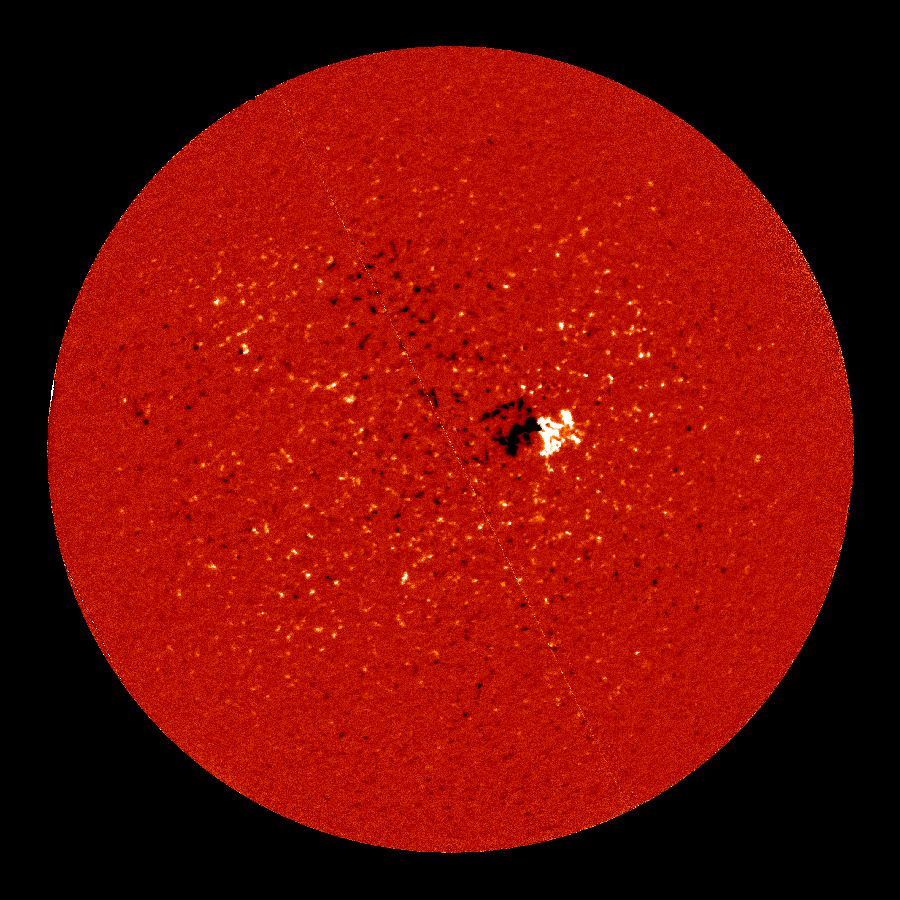
Compared to all the spots in 2001 (on the left), our 2009 sun (on the right) looks quite nude. Is it just a coincidence that the Earth is experiencing global cooling at this time? Despite all the dire predictions of dying reefs, melting icecaps, and worldwide droughts, the reefs and icecaps keep coming back from cyclical downturns. Antarctic sea ice is growing so fast that it threatens to create a cooling feedback effect in the Southern Hemisphere. It is important to understand that Antarctic sea ice has an order of magnitude greater effect on Earth's heat balance than Arctic sea ice.

What does the spotless sun portend for our near-future climate?
.....This was a period in the Little Ice Age when sunspots became very rare, as noted by observers of the era. During one 30-year period within the Maunder Minimum, astronomers recorded only about 50 sunspots. Although a simplistic correlation is rightly contested, the Maunder Minimum thus appears to coincide with the middle - and the severest part - of the Little Ice Age.

Moreover, a second time a cycle was delayed like our current ‘Solar Cycle 24’ occurred during the so-called Dalton Minimum, an especially cold period that lasted several decades from 1790. Northern winters became ferocious: in particular, the rout of Napoleon’s Grand Army during the retreat from Moscow in 1812 was at least partly due to the lack of sunspots.

Thus, what currently is happening to the average temperature of the Earth’s surface? Since at least 2001, it has been falling, and dramatically so during the last two years. _Source
The connection between sunspots and Terran climate is not direct, but is rather mediated by energy fluxes and particle "winds" interacting with the Earth's magnetic field and atmosphere, with the likely involvement of extra-galactic cosmic rays to boot. Ocean oscillations are a more proximate manifest determinant of climate control.

H/T Tom Nelson

Labels: ,

Bookmark and Share

16 April 2009

As the Sun Weakens, the Earth Cools

You may be aware that the sun is in a deep solar minimum, with an ultra-low sunspot count. Besides sunspot number, the sun is behaving strangely in other ways.
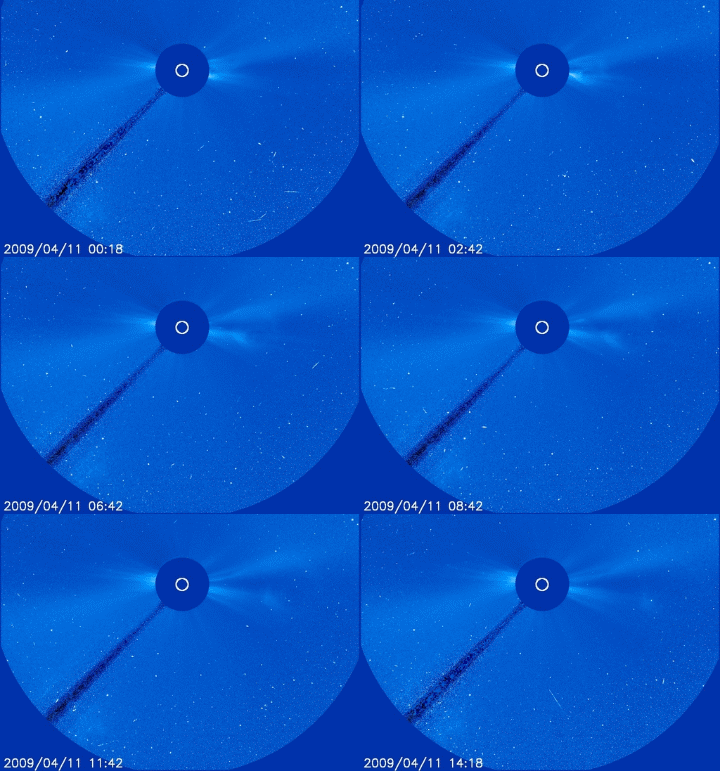
"Lately, coronal mass ejections (CMEs) have become very slow, so slow that they have to be dragged away from the sun by the solar wind," says researcher Angelos Vourlidas of the Naval Research Lab. Here is an example from April 11th:

Each second in the SOHO animation corresponds to an hour or more of real time. "The speed of the CME was only 240 km/s," says Vourlidas. "The solar wind speed is about 300 km/s, so the CME is actually being dragged."

Vourlidas has examined thousands of CMEs recorded by SOHO over the past 13 years, and he's rarely seen such plodding explosions. In active times, CMEs can blast away from the sun faster than 1000 km/s. Even during the solar minimum of 1996, CMEs often revved up to 500 or 600 km/s. "Almost all the CMEs we've seen since the end of April 2008, however, are very slow, less than 300 km/s."

Is this just another way of saying "the sun is very quiet?" Or do slow-motion CMEs represent a new and interesting phenomena? The jury is still out. One thing is clear: solar minimum is more interesting than we thought. _spaceweather_via_FreshBilge
Meanwhile, back on Earth, the climate is getting distinctly colder. March 2009 was the coldest March this millenium, and April is on track to be even colder compared to other Aprils.

The sun is in a deep slumber. Arctic sea ice is growing ever thicker since 2007, and Antarctic sea ice extent is growing alarmingly. More reputable scientists are disputing the IPCC's myopic anti-scientific fascism.

More up to the minute news about the dismantling of the faux crisis of catastrophic anthropogenic global warming (CAGW) here and here.

Labels: , , ,

Bookmark and Share

02 April 2009

The Sun's Startling Plunge: Deep Solar Minimum Perplexes World's Solar Science

The world's premier solar scientists are confounded by their own failed predictions for cycle 23 and 24. The sun has failed to rise out of its deep minimum that lasted all of 2008 -- in fact, the sun appears to be diving even more deeply into quiet inactivity. What does the sun's deepening quiescence mean for planet Earth -- already almost a decade into a global cooling phase?
The sunspot cycle is behaving a little like the stock market. Just when you think it has hit bottom, it goes even lower.

2008 was a bear. There were no sunspots observed on 266 of the year's 366 days (73 percent). To find a year with more blank suns, you have to go all the way back to 1913, which had 311 spotless days. Prompted by these numbers, some observers suggested that the solar cycle had hit bottom in 2008.

Maybe not. Sunspot counts for 2009 have dropped even lower. As of March 31st, there were no sunspots on 78 of the year's 90 days (87 percent).

It adds up to one inescapable conclusion: "We're experiencing a very deep solar minimum," says solar physicist Dean Pesnell of NASA's Goddard Space Flight Center in Greenbelt, Md.

"This is the quietest sun we've seen in almost a century," agrees forecaster David Hathaway of NASA's Marshall Space Flight Center in Huntsville, Ala. _SpaceDaily_via_Wattsupwiththat
Put harshly, solar scientists do not understand wtf the sun is doing at this time. Their computer models of the sun are proving less than useful -- just like economists' computer models of the economy and climate science's models of the climate. The modelers' hubris has hoisted them on their own petards.

Given the current cooling phase of global climate, what does it mean that the sun continues to go ever more quiescent over the past 36 months -- since entering the current minimum? It is too early to tell. The sun is setting record recent lows in solar wind pressure, total solar irradiance, and solar radio emissions. There is a correlation between solar activity and global climate, but there are other factors involved -- particularly the effects of ocean heat dynamics along with atmospheric thermal dynamics.

If you are one of those who fell for the Al Gore - James Hansen catastrophic warming scam, don't throw away your home heating devices just yet. Gore and Hansen have achieved notoriety, job security, and not just a little wealth through their little scam. But reality has the last word. It's not nice to fool mother nature.

Labels: ,

Bookmark and Share

11 January 2009

Sun Goes on Strike! Ice Age Imminent?

Contrary to NASA predictions, the number of sunspots appearing in the year 2008 were the second lowest number since the year 1900. As solar scientists at NASA ponder where they went wrong in failing to foresee the flagging solar cycle 24, more far reaching scientists see their predictions of slowing solar cycles vindicated (PDF).

Russian solar scientists have been predicting an imminent ice age for a few years now. A recent story in Pravda provides some background:
The earth is now on the brink of entering another Ice Age, according to a large and compelling body of evidence from within the field of climate science. Many sources of data which provide our knowledge base of long-term climate change indicate that the warm, twelve thousand year-long Holocene period will rather soon be coming to an end, and then the earth will return to Ice Age conditions for the next 100,000 years....

The main flaw in the AGW theory is that its proponents focus on evidence from only the past one thousand years at most, while ignoring the evidence from the past million years -- evidence which is essential for a true understanding of climatology. The data from paleoclimatology provides us with an alternative and more credible explanation for the recent global temperature spike, based on the natural cycle of Ice Age maximums and interglacials....

The reason that global CO2 levels rise and fall in response to the global temperature is because cold water is capable of retaining more CO2 than warm water. That is why carbonated beverages loose their carbonation, or CO2, when stored in a warm environment. We store our carbonated soft drinks, wine, and beer in a cool place to prevent them from loosing their ‘fizz’, which is a feature of their carbonation, or CO2 content. The earth is currently warming as a result of the natural Ice Age cycle, and as the oceans get warmer, they release increasing amounts of CO2 into the atmosphere.

Because the release of CO2 by the warming oceans lags behind the changes in the earth’s temperature, we should expect to see global CO2 levels continue to rise for another eight hundred years after the end of the earth’s current Interglacial warm period. We should already be eight hundred years into the coming Ice Age before global CO2 levels begin to drop in response to the increased chilling of the world’s oceans. _Pravda
Global warming celebrities such as Gore, Hansen, Jones, Mann, etc. have ridden a tsunami of credulous political and media acclaim, giving them fame, fortune, or at least job security. These "legends in their own minds" will not take kindly to a cooling climate. So they must deny, deny, deny, for as long as they can.

From Watts Up With That, we find yet another reason for global cooling: accumulating sea ice around Antarctica. Due to its lower latitudes, Antarctic sea ice has a much greater effect on Earth's energy balance than does Arctic sea ice. Consequently, the excessive attention played to Arctic sea ice extent has distracted world attention from the much more relevant Antarctic sea ice extent.

How long can we continue to tolerate this media misdirection, a clear abdication of media's role to inform the public of the facts. As long as mainstream media -- including reporting by science journals such as Science and Nature, and science news websites such as Scientific American, Sciencedaily, and Physorg.com -- continue to function as little more than cheering squads for the climate orthodoxy, rather than as honest reporters of the best science data, intelligent searchers will be forced to go out of the mainstream. Fortunately, they can easily find honest reporters of the data such as Roger Pielke Sr., Steve McIntyre, Anthony Watts, Roy Spencer, Matt Briggs, and the many others who have donated their own time and resources to provide a fuller and more objective view of the many unresolved issues in climate.

The new Obama / Pelosi reich wants to waste trillions of taxpayer dollars chasing after the global warming phantom. They want to starve the US of vital energy resources and place the US at the mercy of foreign oil suppliers, in the same way that Europe is at the mercy of Russia and Iran. These deranged dilettantes want to put the US in precisely the wrong posture to be ready for anything that an unpredictable climate sends our way.

It was moronic for American voters to place these fools in such a position of power. Forget about that now. Is it too late for enough Americans to wake out of their deep slumber of psychological neoteny, academic lobotomy, and programmed attitudinal obsolescence, in order to prevent a catastrophe of global proportions? We may soon see.


More on solar cycles here and here.

H/T Tom Nelson

Labels: , ,

Bookmark and Share

24 December 2008

How to Destroy Any City On Earth With Mirror Balloons: Did This Idea Come From Pottersville or Bedford Falls?

The city-destroying idea is a variation of a weather-modification idea from J. Storrs Hall. Hall's idea was to use a large array of small floating mirror-balloons positioned in the stratosphere and oriented by GPS to reduce solar energy influx to Earth. Josh's intentions are completely honourable, in that he is hoping only to save the planet from global warming catastrophe. No one can blame him for wanting to save an entire planet occupied by many billions of sentient beings. Here is how his idea would work:
Here’s the basic idea for the machine: construct a small aerostat—a hydrogen balloon—at a guess an optimal size is somewhere between a millimeter and a centimeter in diameter. It has a very thin shell of diamond, maybe just a nanometer thick. It’s round, and it has inside it (and possibly extending outside, giving it the shape of the planet Saturn) an equatorial plane that is a mirror. If you squashed it flat, you would have a disc only a few nanometers thick. Although you could build such a balloon out of materials that we build balloons of now, it would not be economical for our purposes. Given that we can build these aerostats so that the total amount of material in one is actually very, very small, we can inflate them with hydrogen in such a way that they will float at an altitude of twenty miles or so—well into the stratosphere and above the weather and the jet streams.

Each aerostat contains a mirror, and also a control unit consisting of a radio receiver, computer, and GPS receiver. It has just barely enough power and fans or other actuators to tilt itself to a preferred orientation. That’s all it does—listens for commands on the radio, and tilts to an angle that is a function of its latitude and longitude. It’s not really a complicated machine.

Now make enough of them to cover the entire globe. For the centimeter size, you’d need about five quintillion of them. This is why nanotechnology makes a big difference. If you tried to cover the earth with something the total thickness of even a current-day party balloon, let’s say about 100 microns, you need on the order of 100 billion tonnes of material, but with the nano-engineered design, just a few nanometers thick, you only need about ten million tonnes. To compare that with the scope of current-day construction, ten million tonnes is roughly the amount of material that is used to make a hundred miles of freeway. This is an amount of material that current-day technology, much less nanotech, can handle straightforwardly.

...the radiative forcing associated with CO2 as a greenhouse gas, as generally mentioned in the theory of global warming, is on the order of one watt per square meter. The weather machine would allow direct control of a substantial fraction of the total insolation, on the order of a kilowatt per square meter—1000 times as much. _Nanodot _ via _ Instapundit
That much control over the total insolation of any region on Earth would put any location at the mercy of the controllers of the stratospheric mirror array. One could easily destroy the agricultural output of any country by blocking most of the sunlight to the food crops in the fields. The crops would die long before harvest time. Rivers and irrigation channels would freeze.

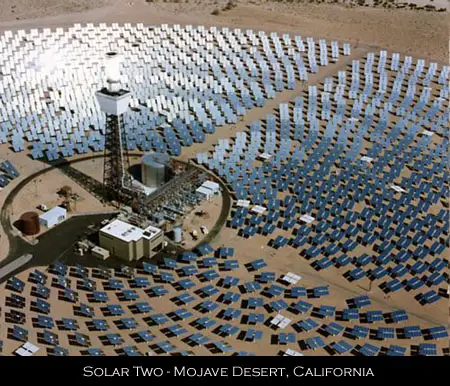
But imagine turning the mirrors to reflect far greater amounts of sunlight on a small area -- such as a city. We know that relatively small mirror arrays can easily heat water to steam in a solar thermal tower. Imagine focusing the sunlight meant for an entire continent onto just a few dozen or hundred square miles of metropolis. How long would it take to boil rivers, harbours, lakes and reservoirs? How long could a human survive exposed to such focused light? How long could any human structure survive before bursting into flames, exploding from its own heated vapour? Few human structures above ground could survive.It sounds like a plot from James Bond. Evil genius blackmails entire cities, countries, an entire planet, using climate weapon!

Josh is extremely creative and intelligent, but perhaps he did not get the memo that explains how the Earth has not warmed significantly for the past decade? It is likely that no one told him that the effects of the PDO and AMO far outweigh the effects of CO2 on Earth's climate. Probably no one cued him in on the shenanigans of James Hansen and Michael Mann in exaggerating human effects on the climate. Of course no one told him. There is no money in waiting to get better data. All the money is in Al Gore's carbon trading scheme, and in NASA GISS' budget and billion dollar research grants to "official climatology institutes" who are willing to toe the IPCC line of alarmism and carbon hysteria. Why would anyone bother to correct the misinformation, when doing so might cut off some of those billions in carbon trades, climate institute budgets, and research grants? No reason. Except perhaps a desire to save science from one of the biggest hoaxes in history.

Observing all the global hysteria over climate nothings would be enough to turn even the gentlest humanitarian into a brooding misanthrope. I certainly hope that never happens to J. Storrs Hall. Because Josh would make a very formidable misanthrope indeed. If he chose the dark side. Or the super-bright side, whichever suited the occasion.

H/T Brian Wang

Labels: , ,

Bookmark and Share

04 September 2008

Glasgow Scientists Aim to Make Fuel from Sunlight

The Solar and Bioenergy Research Centre at the University of Glasgow is targetting research in biofuel crops and various biological processes that could see sunlight and atmospheric carbon dioxide turned into liquid biofuels.....

Scientists at the University of Glasgow are researching several different approaches to turning sunlight into liquid fuels. From artificial photosynthesis, to sun-energised conversion of CO2 to fuel, to the development of microbes and crops for converting solar energy to liquid fuel--Glasgow researchers are on the job.
The four main areas of the new centre's research will be:

*Biofuel Crops - Development of BioFuel crops for high biomass production on marginal land.
*Biomimetic Systems - Application of biological principles to designing efficient artificial systems for converting sunlight into liquid biofuels.
*Catalysis - Development of catalysts for generating liquid biofuels from carbon dioxide and complex biopolymers such as lignocellulose.
*Microbial Fuel Cells - Development of microbial fuel cells for generating electricity, and liquid and gaseous biofuels from organic waste and sunlight.

... _NewEnergyFocus_via_Bioenergy
The one potential problem for all solar energy approaches including bioenergy, is that the sun seems to be slowing down temporarily. Less intensity of sunlight, more cloud cover and rain, shorter growing seasons, and cooler temperatures are all expected from the quieter sun. Sunspot activity is the lowest in 100 years.

If the Earth's current cooling trend accelerates due to less solar energy reaching Earth, Luddites such as Nancy Pelosi, Barbara Boxer, Ken Salazar etc. who try to block access to life-saving fuels such as coal and oil shale and vital electric power from nuclear energy, will be treated most unkindly.

Much more coverage of energy topics at Al Fin Energy

Labels: ,

Bookmark and Share

14 August 2008

Spotless Sun, Armagh Observatory: Freeze Watch

After all the hype over catastrophic anthropogenic global warming (CAGW) doom, it may come as a shock to many readers that scientists do not understand the Earth's climate very well. Forget Al Gore, forget James Hansen, forget Michael Mann. Pay attention to what the sun is telling us, by its quietness.
The observatory [Armagh] notes that solar cycles 21 and 22, which were characterized by being short and intense in their activity, led to the natural global warming observed in the 80’s and 90’s.

“Cycle 23, which hasn’t finished yet, looks like it will be long (at least 12 to 13 years) and cycle 24, which has still to start, looks like it will be exceptionally weak,” writes one observatory scientist.

“Based on the past Armagh measurements, this suggests that over the next two decades, global temperatures may fall by about 2 degrees C — that is, to a level lower than any we have seen in the last 100 years….“Temperatures have already fallen by about 0.5 degrees C over the past 12 months and, if this is only the start of it, it would be a serious concern,” concludes David Watt. _PrisonPlanet_via_TomNelson
Natural climate variation is driven by multiple overlapping solar cycles, by the ocean multidecadal oscillations, by volcanic activity, by chaotic biological cycles on land and in the sea, all influencing and being influenced by ice and snow cover. None of these factors are well understood. Yet the wholly warmer climate orthodoxy claims to be able to simplify climate to one parameter: anthropogenic greenhouse gases! These high priests of the orthodoxy exhibit a sad combination of laziness and arrogance.

They are like the lazy and incompetent physician who jumps at the first diagnosis that enters his mind, and refuses to consider any other factors. But having jumped onto the political and media bandwagon of climate doom, these alarmist orthodoxers have set their course, regardless of how the reality may develop.

Labels: ,

Bookmark and Share
Older Posts
Al Fin Main Page
Enter your Email


Powered by FeedBlitz
Google
WWW AL FIN

Powered by
Blogger

``