05 December 2012

Which is Better? Mining Oceans for Platinum, or Mining Asteroids?

Platinum from space
The Earth's oceans contain a massive amount of platinum, worth many $trillions. So why do people keep talking about mining the asteroids for platinum?
Lets do some basic calculations to explore this:

The approximate concentration of Platinum in seawater is about 2.34E-10 grams per liter. That’s a 2 with 9 zeros before it, a very small number:

0.000000000234 grams per liter

On the other hand, lets consider how many liters of water there are in the ocean: 1.3E21 liters

That’s a 1 with 21 zeros after it, a very big number!

1,300,000,000,000,000,000,000 liters

Multiply this together, and we end up with approximately 300,000 tonnes of Platinum in the seawater. At today’s price for Platinum (about US$1600 per ounce), this is $16 Trillion, or a $16 million million. That is a kingly sum.

Sounds attractive, right? But now we need to process all the water in all the oceans, and it’s a big task. We’re going to need to pump a lot of water, so lets get a big pump.

How about something Niagra Falls-sized?

Flow rate of Niagra falls: 5.7E6 liters per second.

It would only take 7 million years to work through all the [sea]water on Earth (if we had a pump and processing plant that big). This will certainly introduce some other problems. So, lets be a little more reasonable and say we could process 1 millionth of the ocean (1.3E15 liters) in 7 years, with a processing plant with the flow rate of Niagra Falls (still quite a challenge).

We’d then have about 300 kg of Platinum, with a market value of around $16 Million.

Thankfully, in asteroids similar to LL chondrites and iron meteorites that have been studied here on Earth, the concentration of precious metals like Platinum is a BILLION times higher than the ocean.

Conclusion: While asteroid mining is a big task, its much more tractable than processing enormous amounts of seawater! _Planetary Resources
The ocean is certainly a lot closer and more accessible than the asteroids. But taking that approach is a little bit like the drunk who lost his keys in a dark alley, but decided to look for them a block away under the street light -- because the light was better. Convenience can be the crutch that prevents things from getting done.

If we had to get the platinum from seawater we could, given enough time and resources. But getting platinum and other valuable materials from the asteroids will begin to make a lot more sense, once humans have done the difficult preliminary work, and once they have established a permanent private industrial presence in space.

This is not a job for governments. The job of governments is to get out of the way, so that larger possibilities for the future of humanity can be developed. Governments would have their hands full just guaranteeing basic protections and equitable justice for their own citizens -- if they could only restrict themselves to the few justifiable rationales for governments in the first place.

More at the Planetary Resources website

Labels:

Bookmark and Share

01 June 2012

Why All the Excitement over Successful SpaceX Mission?

The first private space flight to the International Space Station has ended with a successful splashdown in the Pacific Ocean. _Wired
The successful mission to the ISS by private space company SpaceX has been covered extensively by US and international media. In many circles, there is an excitement over the possibility of an expansion of private space activity that has not been seen since the early days of the space shuttle, or the days of the moon launches.
via Wired

... the SpaceX mission lasted 9 days, 7 hours and 58 minutes from launch to splashdown.

Elon Musk said the Dragon performed very well, exceeding expectations on some fronts, including solar panels that produced more power than expected. There were a few problems during the mission, starting with an aborted first launch attempt as the Falcon 9′s rocket engines were starting. A problem with the Dragon’s laser range-finding device that caused some unplanned maneuvers during the approach to the station was also fixed, according to Musk. He says the device was checked as Dragon moved away from the ISS this morning, and appeared to be working well.

With the success of the demonstration mission, SpaceX now needs the official confirmation from NASA, and then it will begin fulfilling cargo resupply missions to the ISS later this year. The company has a contract for 12 cargo missions while it continues to develop the manned version of Dragon for flying astronauts to the ISS and elsewhere in low Earth orbit. _Wired
Overall, the SpaceX mission is being seen as an overwhelming success, likely opening the door to further private space activity by a growing number of private space contractors. But why is private space activity -- as opposed to governmental and intergovernmental space activity -- so exciting to many?

A large scale, for-profit development of outer space resources (PDF) is seen as the best argument against the resource scarcity doom mentality of lefty-Luddite green dieoff.orgiast catastrophists who populate governments, media bureaus and corporations, and universities across the western world. It is the self-limited thinking of the dieoff.org crowd which has convinced so many leftist greens that the only way to save the Earth is by drastically reducing the human population of the planet by 90% or more.

With the coming of for-profit groups such as SpaceX, Planetary Resources, Stratolaunch, and a growing number of private space enterprises, the possibility for the movement of human enterprise -- and humans themselves -- far beyond the gravitational and resource limits of planet Earth, suddenly seems much closer and more real.

We have an open time window of about two decades in which to move ahead. If the US can eject its current government of energy starvationists and anti-private sector zealots, and re-build a solid economic infrastructure -- including safe, clean, reliable, and affordable gen III and gen IV nuclear reactor designs at all scales -- the road into the future will be much better paved than at present.

Threats to the future remain, both internal and external. Those will have to be dealt with as necessary. But if more western youth are raised with a positive and constructive vision of the future -- instead of a green dieoff indoctrination -- we will be on the right path.

It is never too late to have a dangerous childhood.


More: Interesting analysis of SpaceX success from Rand Simberg

Labels: ,

Bookmark and Share

25 April 2012

Is This the Door to a Human Springtime?

....the metals we prize most — all the gold, platinum, iron, manganese, molybdenum, nickel, tungsten, and several others — wouldn't exist in Earth's crust if they hadn't been delivered here by asteroids in the final throes of planetary formation. _Sky & Telescope


Spacehabs.com Asteroid Mining Info Screen Capture

Dreams of asteroid mining aren't new — the first speculations date back a hundred years...What gives the Planetary Resources plan credibility are two key factors that've been missing from prior schemes: a space-savvy management team, and investors willing to fund them.

...Plans call for a three-phase approach. First, a series of small orbiting telescopes to find and track thousands of of NEOs. The first of these — dubbed Arkyd 101 is already under construction at the company's plant in Bellevue, Washington, and should be launched within two years. Next come clusters of Arkyd 200 satellites, equipped with propulsion packs to rendezvous with promising targets and assess their resource potential.

Finally, perhaps a decade from now, robotic miners will land and start harvesting the cosmic paydirt. "We're creating simple, elegant designs," says Lewicki. "We're going to create robotic explorers that cost one to two orders of magnitude less than current systems."

By then, the investors should start seeing a return on their investment. "An asteroid the size of this auditorium would be hundreds of billions of dollars," Diamandis noted. _Sky & Telescope
The new generation of robots will be smaller, cheaper, faster, and better. They will be networked in swarms, capable of communicating with other classes of robots which will serve other functions.

Not every observer is optimistic about the prospects for this venture. But even the naysayers have to admit that there are positive aspects to the plan:
Platinum and gold to one side, asteroids are thought to contain untold riches held in other precious metals and rare minerals -- asteroids, after all, are built from the same "stuff" as Earth (albeit in varying quantities) as they were formed in the same proto-planetary disk of material when the sun was a baby. It's reasonable to say that if we have the technology and if we can establish a mining outfit in space, the first company to do so could have access to resources that would make today's oil companies drool.

But Planetary Resources isn't just going to build the world's first refinery tomorrow. Like the majority of commercial space companies, they are going to take an incremental approach to the endeavor, building an observation satellite first and then developing new technologies for robotic probes that could autonomously prospect nearby asteroid candidates. They hope to make some profit along the way to develop the next technology needed to reach their ultimate goal.

It is known that asteroids contain water, so the first operation carried out on asteroids probably wouldn't be mining per se, it'll be extracting water and refining it for spaceship fuel. One of the costliest things to launch into space is propellant for in-space maneuvers; if there's a supply of fuel already floating in orbital "fuel stops," cheap and sustainable spaceflight may be possible -- the spin-off technology potential seems more exciting than asteroid mining itself.

"Water is perhaps the most valuable resource in space," said Eric Anderson, co-founder of Planetary Resources. "Accessing a water-rich asteroid will greatly enable the large-scale exploration of the solar system. In addition to supporting life, water will also be separated into oxygen and hydrogen for breathable air and rocket propellant." _DiscoverNews
Of course, all of these asteroid mining robots will need a way to get into space in the first place, and for them, Elon Musk's SpaceX hopes to be the main space transportation company.

The entire human space enterprise has been waiting for the chance to begin -- waiting for the "killer app" that would start the cash flow to feed the entire snowballing process. Near Earth asteroid mining may be that killer app (PDF).

More from Scientific American

More: The Re-Invigoration of the West through Outer Space Development

This is the real goal -- the jump-starting of a new phase of human horizons. Until now, it was not certain that enough persons of sufficient heft cherished the same vision. Doomers are a dime a dozen. But dreamers with a well-thought out plan and enough clout to see the dream through -- those have been vanishingly rare.

Labels: ,

Bookmark and Share

24 April 2012

Asteroid Mining: An InfoGraphic and Announcement


Source: SPACE.com: All about our solar system, outer space and exploration

More about Planetary Resources Inc.:

Following a few days of excited build-up, Planetary Resources, a new space startup backed by heavy hitters including Larry Page and James Cameron, officially announced its plans to mine asteroids near Earth. At the Tuesday morning event, which took place at the packed Space Gallery in the Museum of Flight in Seattle, the company said it would launch phase one of its mission within two years and use the next decade to just identify resource rich asteroids.

The Museum of Flight’s chief executive, Doug King, opened the event with a few words about how excited he was to be working with Planetary Resources and to have the project take place in Seattle: “Maybe we should start thinking of this as the Silicon Valley of space.”

The first speaker was Planetary Resources c0-founder and co-chairman Peter Diamandis, who is best known as the chief executive of the X Prize Foundation. “Since my early teenage years I wanted to be an asteroid miner,” Diamandis told the audience. “If you think about what has driven human exploration, it has really been the search for resources.”

Diamandis cited the factors that have come together to make now the right time for asteroid mining. Today’s technology allows small companies to create low-cost and powerful spacecraft, and people like Jeff Bezos, Paul Allen, and Elon Musk have shown how private teams can enter what was once the realm of governments. There is a new generation of billionaires now investing in space, such as Richard Branson, and now is when we need these people the most because resources are becoming scarce. Finally, NASA is partnering with private companies on its goal of extending humans’ presence in space.

‘When I look at what Shell has done, they have created robotic cities on the bottom of the ocean. It’s extraordinary what humanity what can now do. For me, it makes going to asteroids look easy,” said Diamandis.

—-

Eric Anderson, founder of Space Adventures, took the stage to talk about the mining plan in more technical detail. How valuable is an asteroid? What is the plan for actually mining these near-earth asteroids? These asteroids “have existed for literally billions of years and have some of the most valuable materials we will need for the future of space and for future of earth,” said Anderson.

There are two types of resources that the company wants to access: water and platinum metals.

Water and its constituent elements, hydrogen and oxygen, are “the best rocket fuel out there.” They would be able to supply NASA exploration missions, fuel private exploration missions, boost satellites, fuel space stations, support private colonization efforts, fuel tugs that could be used to clean up space debris.

Platinum metals on Earth are found in spots where asteroids have struck our planet. While the water will fuel the in-space economy, the metals will be brought back to earth, according to Anderson.

The line of spacecraft that will make this sci-fi dream a reality is called the Arkyd line. They will be used to prospect and then extract the resources.

The second phase of the venture is prospecting, which will involve “swarming” the potential asteroids with telescopes and spacecraft to find the right targets. “There are 8,931 near earth asteroids we know of. This represents one percent of the near-Earth asteroids that are larger than 50 meters,” said Anderson.

The third phase is going to be deciding what to do next, and exactly how to do it, including working with NASA to decide what the top targets are. “”By that time, we’re going to ask, ‘Does NASA need gas stations?’”

Anderson thanked the investors behind the project and with a few reassuring words about the potential for a large windfall in the future: “We’re going to create depots and gas stations that open the roadway to the rest of the solar system… we can use these asteroids to grow our prosperity for the future.”

—– “I’m Chris Lewicki, and I’m an asteroid miner”

Planetary Resources’ president and chief engineer, Chris Lewicki, talked about the technology, the spacecraft, and the people on his team. Lewicki gave a few details about the series of custom space telescopes the company will be using to identify resource rich asteroids, starting with the 100 series, which he described as a personal space telescope. The 300 series will be used later in the process for direct targeting.

“We’re building a new kind of company, a new kind of spacecraft team,” said Lewicki. He visibly choked up while talking about the staff, investors, and advisers on the project, and then started welling up as he mentioned all the recent excitement about the company in the press.

—-

Tom Jones came to the podium to introduced the audience to the different types asteroids. Jones, a planetary scientist and former NASA astronaut, is an advisor to Planetary Resources. One asteroid is the size of Seattle of Manhattan. The company will find the right types of asteroids by looking at the color of their reflected light.
“The ultimate goal is goal to be to generate new wealth in space,” said Jones. “Generating that wealth in space can support far more ambitious exploration.”

— A special guest made an appearance over the phone from Texas, Ross Perot Jr., who has an extensive history of flying in addition to his more well know business successes. Perot is one of the investors in the Planetary Resources.
“I’m a big believer in private space,” said Ross, who was excited to tell his children and nephews about his involvement with the undertaking. “They said ‘Uncle Ross is pretty cool’ … I was shocked at how quickly the younger generation picked up on it.”

—- Finally, another investor, Charles Simonyi, touched on the investing angle, including a shout out to Pets.com. Simonyi is Chairman of Intentional Software Corporation. He discussed having looked at the “astronomical numbers” involved with supporting humans in space, and saw that it was the mass of the materials being shipped to space that mattered, not what the material actually was. Water costs the same to ship to space as expensive photographic equipment. Being able to access water in space would change everything. —-

During a closing question and answer session, Lewicki had a few more details about the Arkyd line, calling it a “Swiss Army knife in terms of what it can do… I want something that we can communicate with, gather data with.” Engineers are using some commercial technology in the development.
“We can’t just build one precious tool that we treat with kid gloves. We need to make something on an assembly line,” said Lewicki.

The company is based in Bellview, Wash. and currently has about two dozen engineers on staff. Part of the reason it’s coming out of stealth mode now is because it is searching for talented new engineers for its team. _VentureBeat


Near Earth Asteroid Resources

Labels:

Bookmark and Share

Tech $Billionaires Want to Be Space $Trillionaires

It will cost as much as $3 billion to finance a credible assault on near Earth asteroids, in search of $trillions of dollars worth of space minerals, such as platinum, according to this PDF white paper from the Keck Institute, CIT, and JPL. And as mentioned here recently, it looks as if a group of private investors with sufficient clout is prepared to do what the US government space agency NASA has never considered doing -- making space exploration and development an enterprise that can pay for itself.
A group of wealthy, adventurous entrepreneurs will announce on Apr. 24 a new venture called Planetary Resources, Inc., which plans to send swarms of robots to space to scout asteroids for precious metals and set up mines to bring resources back to Earth, in the process adding trillions of dollars to the global GDP, helping ensure humanity’s prosperity and paving the way for the human settlement of space.

...Despite the promise of astronomical profits, the long time-scales and uncertain return on asteroid mining has historically driven most investors away from such undertakings. But the new company is also backed by a number of other billionaire luminaries, including Google’s CEO Larry Page and executive chairman Eric Schmidt, former Microsoft chief architect Charles Simonyi, and Ross Perot Jr. The venture also counts on filmmaker James Cameron, former astronaut Tom Jones, former JPL engineer Chris Lewicki, and planetary scientist Sara Seager as advisers. _Wired

Image Credit
On Tuesday, Planetary Resources Inc., whose mission has been shrouded in secrecy, will outline in Seattle its plan to send an unmanned spacecraft to an asteroid and mine it for valuable metals and water that could be used in further space exploration or returned to earth.

The company, backed by several billionaires, is working to recruit engineering and mission-planning expertise and allow private companies to bid to help it launch the spacecraft, said John S. Lewis, a University of Arizona planetary-science professor who said he is an adviser to Planetary.

...Mr. Lewis, whose 1997 book, "Mining the Sky," helped popularize the idea of extracting natural resources from asteroids, said Planetary's president already owns a small firm that builds spacecraft.

Despite the early financial support from wealthy investors and the backing of well-known space-exploration researchers, Planetary Resources faces many technical questions and uncertainties about costs and the technology required to extract materials from asteroids.

Scientists have said such a pursuit could cost hundreds of millions of dollars at least....The 70-year-old Mr. Lewis said the technical requirements for sending an unmanned mission to an asteroid near Earth is "easier than landing on the moon because there is almost no gravity" to contend with on asteroids.

Scientists, including some researchers from National Aeronautics and Space Administration, have said they believe mining asteroids is crucial to future space exploration. Mr. Lewis said asteroids could yield "astronomical quantities" of minerals such as iron and nickel that could be used to build components for housing space explorers, and supply water for a fuel source.

"We could cut the umbilical cord that ties us to Earth," he said.

In addition, studying asteroids could help humans figure out methods to prevent large ones from colliding with Earth, he said. _WSJ
Private space enterprise is the best hope for establishing a permanent and expanding human presence off-planet. The biggest obstacle is governmental and inter-governmental fears that private groups might become powerful enough to escape the control of Earth governments.

While such an escape is likely to happen eventually -- unless humans give themselves up to lefty-Luddite green faux environmental primitivism -- the kind of people who are attracted to top governmental and inter-governmental office these days are not usually the kind of persons who willingly give up control over others.

For now, as long as money-making space enterprises are willing to pay their taxes and tributes to Earthly bureaucracies, they may be allowed to sample a tiny part of the resource wealth which has always circled above, just out of reach.

Labels: ,

Bookmark and Share

19 April 2012

Can Ross Perot Jr. and the Google Founders Save the Earth from Obama, Putin, Castro, etc.?

There is no better way for a $billionaire to become a $trillionaire than by breaking through into a lucrative space enterprise -- by exploiting a new frontier. The table below lists a number of super-rich individuals who would like to bring about a brave new future in outer space and elsewhere, and to hopefully profit by doing so.
Wired
Now Ross Perot Jr. -- the son of the billionaire former US presidential candidate -- and the founders of Google, are getting involved with a few other investors in a new space venture, which may have the goal of mining the asteroids.
On Tuesday, a new company called Planetary Resources will announce its existence at the Charles Simonyi Space Gallery at The Museum of Flight in Seattle. It's not clear what the firm does, but its roster of backers incudes Google cofounders Larry Page and Sergey Brin, filmmaker James Cameron, former Microsoftie (and space philanthropist) Charles Simonyi, and Ross Perot Jr., son of the former presidential candidate. According to the company's press release (below):
[...] the company will overlay two critical sectors – space exploration and natural resources – to add trillions of dollars to the global GDP. This innovative start-up will create a new industry and a new definition of ‘natural resources’.
That sounds like asteroid mining. Because what else is there in space that we need here on earth? _TechnologyReview
While details of the new company, called Planetary Resources, Inc., have been kept secret, officials familiar with the firm said that “the company will overlay two critical sectors — space exploration and natural resources — to add trillions of dollars to the global GDP,” according to media reports on April 18.
As well as support from Cameron, director of blockbuster movies Avatar and Titanic, the company is being backed by Google cofounders Larry Page and Eric Schmidt, former Microsoft exec Charles Simonyi, and Ross Perot Jr., son of former presidential candidate Ross Perot.
Planetary Resources Inc. was co-founded by commercial space pioneers Peters Diamandis and Eric Anderson. Diamandis is chairman and CEO of the X Prize Foundation, which offers prizes for technological feats. He is also co-founder of Zero-G Corporation, which offers commercial flights to experience weightlessness aboard a modified Boeing 727-200 jet. Anderson is the chairman and co-founder of Space Adventures, a multi-million-dollar flight company that offers space flights to the International Space Station for private citizens, such as Simonyi, who flew to the ISS twice with Space Adventures, most recently in 2009, which cost somewhere in the neighborhood of $35 million.
Tuesday’s event will also include former NASA Mars mission manager Chris Lewicki and planetary scientist and veteran NASA astronaut Tom Jones, PhD. The conference will begin at 10:30 a.m. and be available online via webcast. Tickets to the event cost $25.

When Planetary Resources reveals its plans next week, it will be the second billionaire-backed private space company launched within the last six months. _RedOrbit
More from Forbes
Brian Wang at NextBigFuture is likely to provide more details as they become available

There are very few true frontiers, beyond the deadening influence of autocrats and would-be autocrats such as Vladimir Putin, Barack Obama, Hugo Chavez, and the rest of the usual suspects who are seemingly dedicated to preventing an abundant and open ended human future.

But it is the frontiers where truly revolutionary change is likely to be generated. Humans have been tied down by the political forces of stasis for most of their modern existence. A bit of frontier excitement seems long overdue.

More: Brian Westenhaus weighs in on the promise of asteroid mining

Labels: ,

Bookmark and Share

10 December 2010

Must We Kill All Tort Lawyers Before We Can Go Into Space?

ImageSource

Over at NextBigFuture, Brian Wang looks at the supply and demand economics of space colonisation. Brian points to a more extensive posting by Paul Gilster at Centauri Dreams, "The Economics of Space Infrastructure." Brian and Paul are correctly looking at the economic costs and benefits of space infrastructure and space colonies. But the topic goes far beyond mere economics.

Science Fiction author Charles Stross downplays arguments in favour of space colonies as "quasi-religious." Physicist Stephen Hawking wishes for humans to colonise Mars and Luna, as a way to preserve the human race and Terrestrial life, should Earth be destroyed by comets, asteroids, geologic catatrophe or other forms of massive upheaval. Physicist Freeman Dyson has thought along similar lines since the mid-1960s. The idea of "not having all of one's eggs in a single basket" appeals to the long term thinker who wishes the human enterprise to be ultimately successful.

Humans appear to possess an "exploratory instinct," a natural urge to explore. From the very beginning, humans have been willing to risk what they have, in order to find something more. The urge for outer space is another manifestation of this instinct.
At times it may seem that we have lost this exploratory urge, but always it returns, reshaped by current events. Why is it that we strive to understand our place in the heavens and seek other intelligences out there? _Planetary
Exploration is risky. Explorers often die. In an outward-looking, exploratory society, the acceptance of risk is so commonplace as to become second nature. Such a society will spawn many explorers, and many pioneers who are willing to follow close behind the explorer to create a more settled life in the new, risk-filled territories.

Modern affluent societies become more risk-averse, more fixed on security over time. This security-fixation often approaches pathological levels, depending upon whether it becomes accepted and codified within legal, cultural, educational, and legislative institutions.

In modern western nations -- particularly the US -- risk aversion in the form of tort is often costing societies their birthright and their future.
Economists have long understood that America's tort system acts as a serious drag on our nation's economy. Although many excellent studies have been conducted, no single work has fully captured the true total costs, both static and dynamic, of excessive litigation.

The good news: We now have some reliable figures. The bad news: The costs are far higher than anyone imagined.

Based on our estimates, and applying the best available scholarly research, we believe America's tort system imposes a total cost on the U.S. economy of $865 billion per year. This constitutes an annual "tort tax" of $9,827 on a family of four.

...litigation doesn't just transfer wealth, it also changes behavior, and often in economically unproductive ways. Any true estimate of the costs of America's tort system must also include these dynamic costs of litigation -- the impact on research and development spending, the costs of defensive medicine and the related rise in health-care spending and reduced access to health care, and the loss of output from deaths due to excess liability. _WSJ
Most recent attention to tort reform in the US has focused upon medical tort. But the economic destruction of out-of-control US tort law is felt in every part of society, industry, and the economy. In a society ruled by tyranny of tort, all risk is punished pro-actively. In other words, most great ventures are never even attempted, due to the tight noose of tort -- and other effects of excess government -- around the necks of entire societies. As of 2006, costs of tort in the US had been growing at an average rate of almost 10% annually PDF.

In order to advance, humans must take risks. The elimination of risk from society is also the elimination of growth and advancement. Eliminating risk means inevitable stagnation and decline. It is the great human dieoff by backdoor means, albeit in slow motion form -- at first. Decline has a way of accelerating, however, once it passes a certain point.

Massive -- and still growing -- bureaucracies of government shut in most possibilities of escape from this inbuilt decline. When humans are cut off from expressing their natural instincts, they tend to rebel if they can. Eventually, they grow passive, fatalistic.

It appears as if western educational, news media, and entertainment systems are dedicated to the suppression of the exploratory urge in humans. This society-wide trap appears to be closing more tightly every year, with every pseudo-cause and crusade such as carbon hysteria, or resource scarcity doom.

How can we escape this suffocating atmosphere of security-fixation and excessive risk-aversion? There are few ways to escape other than to emigrate to a less regulated nation, or to build a seastead. Every so often a few people try to start a new country, where they can set their own rules so as to allow greater personal freedoms. Of course, new countries in space -- on the moon, Mars, in the asteroid belt, and beyond -- would represent a big step up from previous efforts.

But people will die in the attempt to establish a permanent human presence and economy in space. That is inevitable. People die in hazardous environments on Earth every day, and outer space is far more hazardous than almost anywhere on Earth. Whenever there is a chance of people dying, lawyers flock like flies on excrement.

We can see in the inability of advanced societies to develop a larger, safer, cleaner nuclear power industry, how tort lawyers combined with government regulators drive up costs to the point of abandonment of multi-billion dollar enterprises and loss of future plans and possibilities.

Established powers aim to remain established powers. That is what the vast inbred and corrupt system of government and law has become in the west. Free humans are hemmed in and restricted. Economies stagnate and the human spirit dies a little with every new encroachment by government and its army of allied extortionists.

People do emigrate to Costa Rica and other small countries where there may be less intrusive regulation and more freedom of activity in many ways. Other people "go Galt" and drop out, go off the grid as it were. Expect to see more of that unless something drastic occurs to reverse the creeping strangulation of the government-legal- quasi organised crime complex.

Can SpaceX and other private space companies provide an escape from the ongoing choking of human freedom in the developed world? Even if improvements in technology allowed the costs of space launch were to come down enough to make travel to the moon economical for middle class incomes, the inbred risk-aversion of modern societies places a limit on how far the movement could progress -- without massive changes in western government and legal systems.

Must we kill all tort lawyers and their fellows in crime, before the human instinct to explore and pioneer can find an outlet in space?

Labels: , , , ,

Bookmark and Share

06 October 2010

SSI 29-31 October NASA Ames: These People Seem Serious

The agenda for the upcoming (29-30 October 2010) Space Studies Institute Space Manufacturing 14 Conference is quite impressive. The conference begins on Friday night with the question: "Moon, Mars, Asteroids: Where to Go First for Resources?" On Saturday expert speakers and panelists will look at ways to get to LEO (low Earth orbit), best ways to go to the moon, space rock resources, space life support, orbital solar satellites, large orbiting habitats, and space robotics. Craig Venter will top off the day's talks with a look into the future of synthetic biology. John Lewis -- an expert on asteroids and economic use of space resources -- will give the Saturday night dinner talk.

On Sunday, speakers will move on to the engineering aspects of dealing with lunar and asteroidal materials for energy storage, building construction, transportation infrastructure, and space-based solar power satellites. Sunday afternoon sessions take a look at space robots for mining, long term space life support facilities, and the economics and law of space manufacturing, mining, and colonising.

Attendance will be limited to 200, but I have not been told that registration is closed. Registration information

Downloadable papers from the SSI on topics pertinent to space exploration, colonies, and industry.

One of the best papers I have seen on why this topic is so important.

Labels: ,

Bookmark and Share

29 August 2010

Growing Awareness of Solar System's Population Density

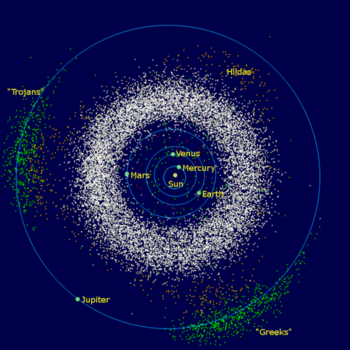
The image above looks only at the inner solar system. If you expand the view to include the outer system and the huge cloud and belt of comets and asteroids extending far out from the planetary orbits, you may begin to appreciate some of the material resources of this one solar system.

There is a huge amount of valuable real estate swirling around our solar system, waiting to be claimed by bold explorers and prospectors. Who will be the ones to lay claim to the richness of the asteroids, the outer system, the Kuiper Belt and the Oort Cloud? Who are the brave adventurers and explorers, and who are the good-for-nothing incompetent couch potatoes?


Created by British astronomer Scott Manley, the three-minute clip – which is the equivalent of two months per second – starts with a sprinkling of white ‘dust’ around the edge of the planets....The footage shows the discovery of every new asteroid over the past three decades and charts it on an increasingly congested map of the solar system.

Over the years, and as more telescopes are added to the experiment and detection methods improve, this becomes a dense green ‘ring’ as the number of ‘minor planets’ found in the asteroid belt increases. _ImpactLab_from_DailyMail

Humans are faced with many challenges -- challenges both true and fabricated. Many of these "earth-shaking" challenges can only be taken seriously if humans are to be stuck on this one planet for the next thousand years, restricted to using technologies of the past and confined by nonsensical rules based upon phantom fears such as carbon hysteria.

If, on the other hand, we unleash the human imagination and human resourcefulness, we will begin to discover resources far beyond our ability to exploit for tens of thousands of years.

Labels:

Bookmark and Share

05 June 2010

Private Space Companies: The First Trillionaires?

Update 6June: Brian Wang takes a closer look at private space launch vehicles
Space.com
The successful orbital launch yesterday, of the SpaceX Falcon 9 rocket and Dragon spacecraft, opens the door for the further expansion of private enterprise in space. The vast riches of outer space resources offer the best opportunity for a rejuvenated global economy, and perhaps the creation of the first human $trillionaire. Space.com takes a look at 6 likely private space companies:
The era of private spaceflight is breaking new ground with the first test launch of the new Falcon 9 rocket by the company Space Exploration Technologies (SpaceX), which hopes to use the booster to fly its Dragon spaceship on space station trips. And with NASA's space shuttles retiring this year, SpaceX is not alone in the bid to launch cargo and astronauts into space.

NASA has tapped SpaceX and another company – Virginia's Orbital Sciences – to build unmanned cargo ships to stock up the International Space Station after its final two shuttle missions fly later this year. SpaceX's Falcon 9 rocket is poised to make its first test flight this week.

After that, the agency plans to modify the Lockheed Martin-designed Orion capsule as a space station lifeboat. Aerospace juggernaut Boeing is also hoping to compete for commercial crew capabilities.

But while giants like Lockheed Martin and Boeing duke it out, some smaller – but equally ambitious – companies have joined SpaceX in the race to build the next spacecraft to put Americans in space. Here's a look at six companies vying for the future of human spaceflight:

Space Exploration Technologies (SpaceX)

Company: SpaceX
Spaceship Name: Dragon spacecraft and Falcon 9 rocket|
Founder(s): Elon Musk, co-founder of PayPal
Backing: $100 million of Musk's personal fortune, $20 million more from outside investors
Location: Hawthorne, California
Launched the Business: 2002
Plans to Launch into Space: Debut launch tests in 2010, first operational flights in 2011...

Orbital Sciences

Company: Orbital Sciences
Spaceship Name: Cygnus and Taurus 2 rocket
Founder(s): David W. Thompson, Bruce W. Ferguson, Scott L. Webster
Backing: Publicly traded company, $1.1 billion in revenue
Location: Dulles, Virginia
Launched the Business: 1982
Plans to Launch into Space: 2011...

Blue Origin

Company: Blue Origin
Spaceship Name: New Shepard
Founder(s): Jeff Bezos
Backing: His personal fortune as founder of Amazon.com
Location: Kent, Washington
Launched the Business: 2004
Plans to Launch into Space: Mid-2012...

Bigelow Aerospace

Company: Bigelow Aerospace
Spaceship Name: Sundancer and BA-330
Founder(s): Robert Bigelow
Backing: $180 million of his personal fortune as owner of the Budget Suites of America hotel chain.
Location: North Las Vegas, Nevada
Launched the Business: 1999
Plans to Launch into Space: 2015...

SpaceDev/Sierra Nevada Corp.

Company: SpaceDev
Spaceship Name: Dream Chaser
Founder: Jim Benson (deceased), now led by Fatih Ozmen
Backing: Sierra Nevada Corp., of Sparks, Nev.
Location: Poway, Calif.
Launched the Business: 1997
Plans to Launch into Space: Under Development...

Virgin Galactic

Company: Virgin Galactic
Spaceship Name: SpaceShipTwo
Founder(s): British Billionaire Sir Richard Branson
Backing: His personal fortune as founder of Virgin Group
Location: London, England, and Spaceport, New Mexico
Launched the Business: 2004
Plans to Launch into Space: end of 2011 or early 2012...
... _Much more at Space.com


Note that most of the 6 highlighted new space companies are founded by billionaires in their own right, independent of space activities. But here's the thing: once independent human enterprises establish a foothold in space, they will start to get ideas. Some of these ideas will include an awareness of the vast resource wealth that is sitting in space, waiting to be made good use of.
The market value for a single moderate sized asteroid is considerably more than the entire accumulated US national debt. _ SpaceExploration
Even a modest sized asteroid's mineral (and volatiles) wealth could easily create the first human $trillionaire.

Yes, there is the law of supply and demand which will impact mineral prices. But if you are so small-minded as to believe that $trillion asteroids do not exist, then you truly know nothing about real world economics.

The 1980s and 1990s boom and balloon in economic activity and technological development led to the creation of several billionaires. Many of these billionaires have turned to new ventures which have the potential to be totally disruptive to the status quo economic infrastructure. Space access and development is merely one of these activities.

As space (and other new-venture) entrepreneurs hit paydirt and achieve personal and company wealth in the hundreds of $billions range and higher, they will inevitably funnel this excess wealth into newer and even more disruptive new ventures. That is the creative destruction of capitalism, and anyone who ignores that (currently relatively latent) force has made an obsolete fool of himself. Most university academics in the social, political, and economic sciences fall into that category.

People who believe in zero growth economics assume that vast new mineral wealth from space would quickly saturate the terrestrial market for those minerals. But they neglect the sprouting up of entirely new extra-terrestrial markets that have the potential to dwarf the value of anything happening at the bottom of the gravity well.

How can that be? More on this later.

More: Take a look at Brian Wang's comparison of costs to orbit between SpaceX, the Delta IV, and Ariane 5

Labels: , , ,

Bookmark and Share

20 October 2009

Another Good Reason for Going Into Space

Gold, platinum, iron, uranium, and other metals so valuable to modern life may not be native to this planet. In fact, the highly valued goodies so painstakingly mined from Earth's crust may only be a small sample packet of what celestial bodies hold in store for whoever wants to go out and get it.
"The extreme temperature at which the Earth's core formed more than four billion years ago would have completely stripped any precious metals from the rocky crust and deposited them in the core," says James Brenan of the Department of Geology at the University of Toronto and co-author of the study published in Nature Geoscience on October 18.

"So, the next question is why are there detectable, even mineable, concentrations of precious metals such as platinum and rhodium in the rock portion of the Earth today? Our results indicate that they could not have ended up there by any known internal process, and instead must have been added back, likely by a 'rain' of extraterrestrial debris, such as comets and meteorites." _SD
We know that there are single asteroids likely to be valued well over $1 trillion for their mineral content. _ Even a relatively small asteroid with a diameter of 1 km can contain more than $20 trillion US dollars worth of industrial metals (e.g., iron and nickel), precious metals (e.g., cobalt, gold and platinum) and rare earth elements. Wikipedia

As off-Earth infrastructures build, the value of concentrated mineral resources in space is apt to increase in a boot-strap fashion, in an unprecedented economic boom and expansion of human activity.

We have been trained by our politicians, our media, our professors, to expect increasing limits on economic growth and activity. But what if such arbitrary limits are unnecessary -- are in fact lethally dangerous to the future of humans?

It is time to transcend arbitrary authority and arbitrary limits at the same time. Petty dictators need to be put in their proper place -- in museums and zoos.

Labels:

Bookmark and Share

19 October 2009

The Moon Is Determined to Make Its Own Water

Image Source
Sure, the moon could orbit passively, waiting for a stray comet or water-laden asteroid to come along and deliver a load of ice. But Luna wanted to be proactive, she wanted to make her own water. And so she does.
The Moon is a big sponge that absorbs electrically charged particles given out by the Sun. These particles interact with the oxygen present in some dust grains on the lunar surface, producing water. This discovery, made by the ESA-ISRO instrument SARA onboard the Indian Chandrayaan-1 lunar orbiter, confirms how water is likely being created on the lunar surface. _SD
This "Made On Luna" H2O is necessarily near the surface. Water that crash landed on celestial objects would more likely be deeper, and near the poles -- sheltered from the sunlight.

It will take time to quantify the amount of water that is available for human use on Luna. An ample, self-renewing supply of water would make a permanent moonbase much more viable.

Labels: , ,

Bookmark and Share

27 September 2009

Asteroids vs. the Moon: Taking Your Best Shot

Now that we know that there is water on the moon (via Neil Craig) (also see here), is the moon now the best jumping off point for exploring the rest of the system? No, but it does make the moon one possible springboard to the solar system.

We have recently learned that Mars has more water than previously believed (also see here), which makes Mars more attractive for permanent bases and settlements. But Mars is much more distant than Luna, requiring a more expensive expedition with greater risks.

But besides Luna and Mars, we also need to consider non-planetary locations for exploration, commercialisation, and colonisation. The asteroids located in several orbital configurations -- including the massive asteroid belt between Mars and Jupiter -- contain a massive amount of wealth, vital volatiles, and strategic aerospace materials. In fact one near-earth object known as El Dorado may be worth as much as $1 Trillion! El Dorado is not a particularly large asteroid, and not nearly the richest either, in all likelihood.

Here is an interesting comparison between mining asteroids vs. mining the Earth's crust:
Almost any random asteroid has a higher concentration of the platinum-group and precious metals than the richest mineral deposits on Earth, and many are fated to end up on Earth in the long run: thousands of asteroids that cross Earth's orbit or approach it closely are likely to survive less than 10 million years: the main threat to them is collision with Earth. These bodies are energetically much closer to us than the surface of the Moon, they are enormously more diverse in composition than the lunar crust, and many or most of them have not undergone geochemical differentiation. _JohnLewis L5Review
When Lewis says "the rich asteroids are energetically much closer to us than the surface of the moon," he is telling us that it would be cheaper, energy-wise, to boost a mining venture to some asteroids than to the moon, if you choose the proper launch window. The same applies to the return trip for the ore -- assuming you would be shipping the ore Earth-ward rather than processing and utilising it in space. As humans move into space, Earth trade will grow less and less important to space enterprises. And mining a problem asteroid may be the best way to reduce the threat of Earth collision, while making a handsome profit.
The asteroids, though smaller and faster-cooling, seem a match for the Moon as targets for speculative prospecting. Vesta, for example, appears basaltic and differentiated (like the Moon) and has over one-tenth the Moon's diameter. Many meteorites were melted and resolidified; asteroidal materials contained water, which perhaps mobilized incompatible elements. Further, comparing rock to rock, metal to metal, and sulfide to sulfide, concentrations of trace elements have been found to vary from sample to sample by factors of several hundred or more (4). _KEricDrexler L5
The gold rush to space will require infrastructure in Earth orbit for building space vehicles and habitats out of mostly space materials. These materials can be supplemented by Earth materials boosted into orbit via cheap high frequency, high-G electromagnetic boost. Large amounts of crucial volatiles can likewise be boosted electromagnetically.

But the approach to exploring, colonising, and commercialising space must change. Rather than taking the hyper-cautious, bureaucratic, idiocratic approach to exploring space, humanity will need to jump right in to seize the day. Design the nuts and bolts of basic, no-frills space vehicles, habitats, and infrastructure. Explain the risks and potential payoffs of outer space environments to anyone crazy enough to volunteer. And let human nature take its course.

The alternative to the opening of a new frontier, is the complete stagnation of life on this planet, under an all-encompassing nanny-state of uniform poverty that grows to be a constant torment and oppressor to everyone except those few at the top of the inside controlling structure. Think North Korea, Cuba, USSR under Stalin, China under Mao, Zimbabwe, Burma, etc. Death of the spirit, as in Orwell's 1984.

Most people are not cut out for exploration and high-risk employment. Every year, security grows more important to the dumbed down masses than freedom. The majority of idiocrats can easily out-vote the minority of free thinkers and freedom lovers. But it is the free thinkers and freedom lovers who tend to be important producers and creators of new ideas and new employment.

Governments such as the Obama / Pelosi reich that purposely penalise the producers so as to pamper the freeloaders, cultivate disaffection among the ranks of those who like making their own choices for themselves.

Expect change. Lots of change. But to get the kind of change you want, you will need to take power over your lives back into your own hands. Promote the opening of the new frontiers.

Labels: , ,

Bookmark and Share

26 September 2009

Sea Launch from Seastead? Perhaps the Only Way

We have found a thin layer of water mixed with lunar surface dust -- enough to make a difference to nascent moon colonies and explorers. The problem is that international space treaties prevent private colonies and explorers from using that water -- or any other lunar resources.

At Samizdata.net blog, they are trying to work out some way around the counter-productive international restrictions on the use of lunar and space resources. One commenter even suggested forming a micro-nation on Earth for purposes of space launch. Such a nation could refuse to sign the space treaties, and carry on unhindered by the idiocratic obstructionist tactics of the UN and the international community.

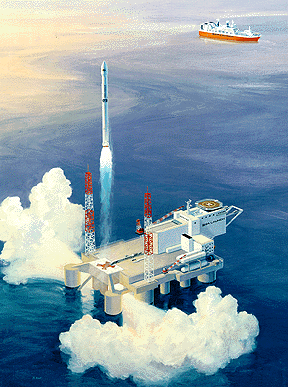
It is interesting that the Seasteading Institute is holding its annual conference in San Francisco on 28-30 September 2009. Because there is no more logical location for a space launching micro-nation than in the mid-ocean, near the equator. A seastead micro-state engaging in space launch, would be the ideal launching pad for a network of independent lunar and orbiting space colonies.

The UN and other international organisations have become a caricature of human ineptitude. The new US president Obama is receiving the praises of bloody-handed dictators, while being mocked by steadier hands, such as French president Sarkozy. Sarkozy is correct, Obama is making a mockery of responsible leadership. Now that the US president has become the friend of third world dictators, there really is no hope for the UN, the G20, or any other international organisation. It is time for independent persons to begin thinking of genuine independence from the Idiocracy.

Outer space is full of resources -- including water and mineral riches -- but they are spread out over an expansive volume. The asteroid belt orbiting between Mars and Jupiter contains a mass approximately 4% that of Luna. The belt appears rich in both minerals and volatiles, and is conveniently broken up into many pieces, so that aspiring asteroid miners can have easier access to the riches within.

As soon as we break the constrictive and oppressive bands holding adventurous and ambitious humans to the surface of Earth, we will find that we are desperately short of hands -- human and robotic. To explore the vast regions of space out to the asteroid belt and beyond, we will need many millions of astronauts, cosmonauts, robotic explorers, and virtual reality explorers-by-proxy.

Ideally, we would have intelligent machines capable of making the necessary decisions, technical repairs, and legal agreements that a prosperous gold rush to space would entail. Lacking that, we would certainly want large numbers of artificial wombs for in vitro fertilisation, in order to rapidly grow a population of space explorers and adventurers -- untainted by the perverse indoctrination of stagnancy that is so prominent in Earth universities, in Earth (skank) media, and in Earth international politics.

But lacking both intelligent machines and artificial wombs, we need to find a way to grow intelligent, adventurous explorers of sound mind very quickly. When the desperate need presents itself, we will discover that we have not nearly enough Michelle Duggars to meet the need. And the truth is, one child every 9 months to a year will not be nearly enough, if we want to grow the necessary millions of first wave explorers that we will need.

We are left with two viable approaches: Superfetation, and multiple births, eg twins, triplets etc. Superfetation is the process of getting pregnant while already pregnant -- which is really just a more awkward and more confusing method of having multiple births. Much simpler to just fertilise eggs in vitro, then implant multiple embryos into the (well-paid) volunteer woman's womb. Voila! When the time is right the future astronauts can be delivered, and the now wealthy woman can contemplate a prosperous future -- on Earth or in space if she prefers.

Water and other volatiles will be in short supply initially, even with the newly found water resource on the moon. The best way of solving that problem would be via high frequency electromagnetic space launch. Working out such a launch from a floating platform in mid-ocean may require a bit of ingenious improvisation, but already several ideas are pushing their way into the minds of Al Fin engineers.

The point is, it can all be done -- if we can bust the monopoly currently held by dysfunctional national and international organisations. The Idiocracy, in other words. Think on it. It's only your future.

If you want to contemplate a future ruled by resource dictators of the bloody-handed third world, then you don't need space. Not for that. Obama is clearing the path for that future already.

But if you want an expansive future of "no limits," then you will need to start thinking independently.

Images courtesy of Space Today and Wikipedia

Labels: , ,

Bookmark and Share

16 April 2009

Still Waiting for Space Solar Power, 40 Years On

Back in 1968 Peter Glaser detailed an ambitious plan for energy independence, using solar power from orbiting photovoltaic arrays. The technology for large-scale solar panel manufacture wasn't ready for anthing that ambitious back then, although heavy space launch infrastructure was in much better shape. Regardless, the idea is being resurrected by a startup company:
Now Solaren Corporation, a startup based in Manhattan Beach, CA, is trying to get the idea off the ground. It's working with the California utility Pacific Gas and Electric (PG&E), which intends to enter into a power-purchase agreement with the company. If the agreement is approved by regulators, starting in 2016, the utility will purchase 200 megawatts of power from Solaren at an undisclosed price--that is, if the startup can get a system into space and working by then. The company has already selected a site in California for the receiving station; it hasn't said exactly where, but it will be close to a PG&E substation and won't require long-distance transmission lines.

Solaren hasn't released many details about the system. CEO Gary Spirnak says that it's conceptually the same as communications satellite technology: it uses solar panels to generate electricity, which gets sent to Earth in the form of radio waves, which are received by antennas on Earth. In a Q & A published by PG&E, he said that the design is "a significant departure from past efforts," so it will be economically feasible. The first system will reportedly be able to generate 1,000 megawatts--about the size of many conventional power plants. The company will need to raise billions of dollars to construct the plant. Right now, it only has 10 employees. _TechReview
More information at Next Big Future, and at New Energy and Fuel

From Al Fin Energy

Labels: ,

Bookmark and Share

07 August 2008

"Southwest Airlines" of Space Suffers Setback--But Venture Capitalists Rush to Invest

SpaceX is on the verge of a huge commercial breakthrough. Dubbed "the Southwest Airlines of Space," the company founded by billionaire Elon Musk is just a launch or two away from putting itself in a position to profitably underbid all other space launch providers. The cause for SpaceX's third launch failure on 2 August 08 has been explained, and is said to be easily fixed. That is all venture capitalists wanted to hear.
Musk, who's invested more than $100 million in the company, was disappointed but not deterred. "On the plus side, the flight of our first stage, with the new Merlin 1C engine that will be used in Falcon 9, was picture perfect," he wrote in a message to employees. "Unfortunately, a problem occurred with stage separation, causing the stages to be held together. SpaceX will not skip a beat in execution going forward."

Indeed, just two days later, SpaceX announced that it had received a $20 million investment from the Founders Fund, a venture capital firm that is partially managed by other PayPal co-founders. Less than two months ago, one prominent VC partner insisted to PM that quick business reactions to the private space industry was "one of the big advantages" of investing in companies like SpaceX;

....the injection of cash comes at a crucial time for the company. SpaceX's original goal was to create the world's lowest cost space launcher..... SpaceX is developing more ambitious rockets such as the Falcon 9, a medium- to heavy-lift rocket whose mission will be to re-supply the International Space Station—if it beats out competitor Orbital Sciences for a NASA contract. _PopMech_via_Instapundit
Getting to heaven has never been particularly easy, but the potential profit up there is almost incalculable. A single asteroid could be worth trillions of dollars, at current mineral prices. And if you ever want to build large orbital structures, you have to get in a position where you can harness space resources and process them into building materials.

SpaceX's approach is not exactly frugal, but neither is it extravagant. The company has taken a methodical, step by step approach to developing and perfecting each component of its launch system. Neither Musk nore his backers appear to be deterred by the latest setback. In the long run, it may be better to be good than lucky.

Labels: , , ,

Bookmark and Share

14 April 2008

A Skeptical Look at Space Colonisation

Science Fiction author Charles Stross has thrown a bucket of cold water over the enthusiasm of would-be space travelers and colonisers. In his article "The High Frontier, Redux, Stross explains the incredible challenges that space colonisation presents to Earth dwellers. Stross concludes that the problems are simply too great to take the idea of space colonies seriously, at this time.

Stross's pessimism is a useful counter-point to much of the "gee-whiz futurism"--unrealistic fantasies of space and the astounding future. There is nothing easy about the idea of creating a future of abundant possibilities. It will not happen by magic. And a lot of people are going to die trying to achieve what seems to many to be unachievable and to others, simply our destiny.

The basic argument by Stross in a nutshell is that space travel is:
  1. Too hard
  2. Takes too long
  3. Takes too much energy
  4. Too Dangerous
  5. Involves distances that are too enormous
Underlying it all is the belief that human beings are just too lazy, too poor, and probably too stupid to do something that hard. And Stross is right about most of it. Most people are too lazy, too poor, and too stupid to even think about stepping up to a challenge that huge.

Most of the near-term space exploration of the solar system will have to be done by robot explorers. When humans are ready to start mining the moon, the asteroids, Mars etc., it is likely that robot miners will do most of the heavy prospecting, lifting, assaying, and processing. Humans will not become a significant presence in space until cheaper ways are devised for boosting people into space, and supporting them once there.

It is a long way from a Virgin Galactic space tourist flight--"look at me, I'm in suborbital space!" -- to a permanent Lunar, Martian, or asteroidal presence, for profitable mining, construction, and long term living.

But the very difficulty of the task is what attracts the gamblers of the world to a high stakes proposition like commercial space. Problems exist to be solved. Anyone who looks at it any differently should stick to science fiction.

H/T Gorillamask

Labels: , , ,

Bookmark and Share

04 April 2008

Heaven is a Long-Shot Gamble

Asteroid Apophis, a 390 m Aten asteroid (see graphic above), has a rendezvous with near-Earth space on 13 April 2036. We will not really know how close a rendezvous Apophis will have with Earth in 2036, until its 2029 near-Earth fly-by. Earth-crossing asteroids such as Apophis represent both hazard and opportunity. The hazard of being struck by a mountain-sized rock-from-space should be evident. The opportunity perhaps less so.

Suppose that the chance of Apophis striking planet Earth were 30% or greater. That would be a significant level of threat from above. Would such a risk justify an expensive intercept space mission, to attempt to deflect Apophis to a safer orbital distance? I would think so. Yet, there are potentially devastating, but earth-bound, dangers lurking even closer in time than 2036, which have much higher odds of occurring than the current odds for Apophis to contact Earth.

The earth-bound catastrophe being created by human governments is not dramatic enough, not dazzling enough to warrant the attention of the gatekeepers of the human mind--news media and popular media outlets. And certainly government officials want no part of exposing the nightmare they are inexorably bringing down on the heads of the citizens they are supposed to be serving and protecting. But there are ways to avoid catastrophe, both from the threat from above and the earthly threat from below.

We can avoid danger from Earth-crossing asteroids by establishing an active and expanding infrastructure in space. If we are already in space, we can build intercept missions to Near Earth Asteroids (NEAs) at our leisure--for purposes of exploring, mining, or deflecting. The value of a single NEA, Eros, is estimated to be at least $ 20-30 Trillion! That is for one asteroid, albeit one somewhat larger than Apophis. Just a few such asteroids would suffice to make up the budgetary deficits of even the most profligate of Earth governments.

In fact, there is enough value in the solar systems asteroid belt to provide each citizen of Earth with approximately $100 Billion--more wealth than any single super-rich billionaire currently possesses. Not that the wealth of the asteroids will ever be distributed equally to everyone, no. No more than was the wealth from any of a large number of gold-rushes, silver-rushes, diamond-rushes, or large scale rushes to other mineral resources including oil and gas equally distributed. The wealth of the asteroids will go to those who can get there, establish a claim (for now just being there will do that), mine the valuables, get the goods to market, and sell to the highest bidder.

And that is precisely what we are involved in--a NEA "gold rush"--although not many people are aware of it at this time. We do occasionally hear that we are in "The Next Space Race", being driven by hungry young billionaires and entrepreneurs.
Alaska serves as an excellent analogy. Once thought of as worthless territory (in 1867 William Seward, America’s secretary of state, was criticised for paying $7.2m to the Russians for Alaska, known then as “Seward’s folly”), Alaska has since become a trillion-dollar economy. The transport infrastructure has made Alaska’s gold, oil, timber and fishing industries super-profitable. The same will hold true for space. A 0.5km (0.3-mile) diameter asteroid is worth more than $20 trillion in nickel, iron and platinum-group metals.

Aside from the economic incentives, technology is reaching a critical point, making space exploration an inevitable component of human progress. Moore’s Law has given us exponential growth in computing technology, which in turn has led to exponential growth in nearly every other technological industry. Breakthroughs in rocket propulsion will allow us to go farther, faster and more safely into space.

...Recently, the X Prize Foundation joined with Google to announce a $30m Google Lunar X Prize, to be paid out to the first teams able to land on the lunar surface, rove for 500 metres and send back two video/photographic moon-casts. Amazingly, within the first two weeks following the announcement, we received over 190 requests from 25 countries from prospective teams looking for registration materials. This is the new generation of entrepreneurs who will reinvent space exploration the same way that Apple and Dell reinvented the computer industry. ___Economist
Most people think the goal of these hungry young entrepreneurs is space tourism, space hotels, and other local space fun and games. But with the stakes as high as $20 Trillion (!) for one asteroid, something tells me that a lot of these young guns may be secretly gunning for a bigger long-shot gamble than shooting a few overweight tourists into suborbital space.

Getting into space is expensive. Moving mining equipment into a matching orbit with an NEA, landing, setting up, and staying for years to mine and perhaps process the materials on site, will cost many billions of dollars--assuming you can acquire the necessary technical expertise to accomplish the task. That means dealing with financing organisations, insurance companies, and space lawyers. Getting mined materials back to market may be a greater challenge than getting to the NEA in the first place. Then you can expect to face a wide array of lawsuits based upon international space law, which is still being hammered out.

In the end, the greatest obstacle to achieving super-wealth from the asteroids may be in being allowed to keep the wealth after returning to Earth. Certain to face lawsuits from NGOs, Earth governments, UN agencies, and private parties, where are the entrepreneurs who are willing to risk everything for an uncertain chance to keep the hard-won loot?

Mainstream corporations would want strong assurances of protection from lawsuits by their governments. But in a realm where world courts, inter-governmental, and international non-governmental agencies lead the legal charge, single governments can be quite limited. Which means that many early-generation space miners might choose to establish and work with a space-based economy that does not fall under the authority of Earth's United Nations or any of its government members.

How could such an economy start? Incrementally, and with a lot of luck to those who succeed. The idea would be to first start mining the more likely and accessible NEAs. Then using the wealth and the mass from the NEAs, the more successful "space 49ers" work toward the main asteroid belt--and the massive riches waiting there. Any long term permanent space enterprises have to eventually be able to pay their own way--or at least be lucrative enough to attract ready financing on good terms. The alternative is the "long-shot gamble."

Such a space-based infrastructure--independent of the UN and Earth governments--would have to be very resourceful, ingenious, and even disreputable. They will have to be skilled with improvising rocket propellant and reaction mass, space robotics, orbital maneuvers, life support systems, and quick thinking in emergencies, among other things necessary for survival and acquiring mineral wealth. Almost every step of the way from Earth to the main belt would be a long shot gamble. But once in possession of that type of wealth and resources, the Earth would be in no position to dictate terms.

Think of it as a "The Moon is a Harsh Mistress" scenario, except in the main asteroid belt instead of on the moon. What type of person is capable of throwing the dice that far? Not George Bush. Not Barack Obama. Not Kevin Rudd or Al Gore. None of the people who occupy the news pages of most media outlets have even a fraction of the substance necessary for such a play as is described here.

There's still a place in the world for a gambler. But to get to heaven, only long-shot gamblers need apply.

Update 6 April 2008: To better understand some of the issues in this post, browse through the links here, and try to read as much of this as you can. The issue is a critical one that you will likely never be acquainted with unless you go looking yourself.

Check out The Future of Space Mining

Labels: ,

Bookmark and Share

26 March 2008

Meet Xcor's Lynx: The Two-Seater Space Coupe

This sweet ride will get you higher than any other hot rod you have driven. Xcor's Lynx, a two-seater spacecraft smaller than a business jet, can provide romantic vistas that a drive to Jennings Lake just cannot match.
The Lynx will take off from a runway, just like an airplane, and will climb high enough to provide a view of the earth's curvature and two minutes of weightlessness. The entire flight is expected to take about 25 minutes. Xcor spokesman Doug Graham said the company hopes the first test flight will take place in 2010.

Xcor's slower, incremental approach has attracted investors such as Esther Dyson, a tech analyst who has backed such start-ups as Flickr and del.icio.us.

In an interview, Dyson said she decided to invest because Greason "has a record of building things that work." She continued, "This is very much an implementation business. You need a vision to get started, but you really need practical, straightforward knowledge."

Xcor has already developed a prototype rocket engine for use in the forthcoming Rocket Racing League, and through that work received both funding and flight tests for the liquid-fuel engines. Xcor also expects to receive funding for the Lynx from the Air Force Research Laboratory, through a pending small-business innovation research contract. ___Wired

Esther Dyson, a technology analyst, is the daughter of Freeman Dyson, a physicist who has worked on some ideas for outer space resource development.

As mentioned before here at Al Fin, a number of billionaires are involved in building a new private space industry--including Robert Bigelow, Richard Branson, Elon Musk, Jeff Bezos, Paul Allen, and others. Google's billionaire founders have even put up funds for the Google Lunar X Prize, to stimulate the private development of technology for more frequent moon missions.

The ultimate payoff from space development will be measured in the trillions of dollars, rather than billions. It is not inconceivable that Earth's first trillionaire will be a space resource industrialist.

Labels: , ,

Bookmark and Share

17 February 2008

Energy, the Outer Limits

In Outer Space, there are no limits. That is why any true capitalist would not be satisfied to own a business empire that is limited to one planet. Elon Musk, Jeff Bezos, Paul Allen, Richard Branson, Robert Bigelow, and other successful capitalists wish to extend their empires beyond Earth.

And for good reason. There are enough resources in the asteroid belt alone to make every human being on Earth into mega-billionaires. And beyond the belt?

Consider Titan, the orange moon of Saturn. Titan is awash with hundreds of times more hydrocarbons than all of Earth's known reserves of oil and natural gas.
"Titan is just covered in carbon-bearing material -- it's a giant factory of organic chemicals," said Lorenz. "This vast carbon inventory is an important window into the geology and climate history of Titan."___Source
Can there be any question about the possibility of abiotic hydrocarbons beneath the surface of Earth?

But one does not have to go into outer space to run into the limits of scientific explanation for energy phenomena. As close as the Ottawa area, one can find a home experimenter playing with forces that even MIT engineers cannot explain.
Just before the big day at MIT, the Star spoke with professor Markus Zahn about what he expected to observe..."It's hard for me to give an opinion," said Zahn, who admitted he was excited to see the demonstration. "I don't believe it will violate the laws of physics. You're not going to get more energy out than you put in."

...Contacted by phone a few hours after the test, Zahn is genuinely stumped – and surprised. He said the magnet shouldn't cause acceleration. "It's an unusual phenomena I wouldn't have predicted in advance. But I saw it. It's real. Now I'm just trying to figure it out."

There's no talk of perpetual motion. No whisper of broken scientific laws or free energy. Zahn would never go there – at least not yet. But he does see the potential for making electric motors more efficient, and this itself is no small feat.___Star__via NewEnergyandFuel
No, there is no perpetual motion, as such. But there is acceleration where it is not exactly clear that there should be any.
To quote Professor Zahn again with his thoughts that strongly seized my attention, “To my mind this is unexpected and new, and it’s worth exploring all the possible advantages once you’re convinced it’s a real effect,” he added. “There are an infinite number of induction machines in people’s homes and everywhere around the world. If you could make them more efficient, cumulatively, it could make a big difference.”___NewEnergy

YouTube Video Demonstration(parts 1 and 2--others available at YouTube)

Labels: ,

Bookmark and Share
Older Posts
Al Fin Main Page
Enter your Email


Powered by FeedBlitz
Google
WWW AL FIN

Powered by
Blogger

``