17 November 2012

An Accelerating Collapse of Empire

Russia is haunted by the history of empire -- an empire that is rapidly slipping the grasp of a bleeding bear. The collapse of Russia's male population is related to alcohol abuse and drug abuse. Russia's politically connected wealthy are stashing tens of $billions in foreign bank accounts, her best and brightest youth vie for overseas jobs, and her beautiful young women seek husbands in Australia, North America, and Europe. Besides oil & gas, Russia's main asset is bluster.
Russian Men and Vodka


The mansions and gardens of old imperial Russia have faded or crumbled, as have many of the collective farms that fed communist Russia. Today, the hamlets dot a forsaken land of rampant poverty where men drink from morning to night. The interconnected crises of low fertility, high death rates and ragged infrastructure have left much of the nation barren.

... Even darker times may lie ahead.

A major study that the United Nations released in April, authored by leading Russian experts, projected that Russia would lose at least 11 million more people by 2025. Another U.N.-sponsored report said last year that the population could fall to as low as 100 million in 2050.

That report cited a recent improvement in fertility but cautioned that, "while these favorable trends may last another five or six years, all recent forecasts . . . predict that Russia's population decline will only intensify."

"There's a risk that in the most negative situation, Russia will stop existing as a state," said Olga Isupova, a senior demographic researcher at the Higher School of Economics, a leading private Russian university in Moscow.

...Russia as a whole lost 12.3 million people from 1992 to 2008. An influx of immigrants, mainly from former Soviet territories, helped hide the extent of the problem. The population is now 142 million, but it would have been 136.3 million without that surge from outside.

...— the decay in the heartland suggests that Russia isn't a resurgent superpower so much as a nation that's trying not to come apart at the seams._NewsTribune

In a worst-case scenario, the population drops from a peak of around 145 million at the turn of the century to about 60 million by 2100, a catastrophic loss of 85 million people at an average rate of 850 000 per year. Unless the government brings in hundreds of millions of foreign migrant workers to compensate, Russia’s productivity and GDP would shrink along with its population.

Strategically, Goldman (2010) points out that a potential problem for Russia is that the depopulation rate in its far east, near the border with China, is higher than the national average. By contrast, the Chinese population on that increasingly sparsely populated border is growing rapidly. Will trouble brew on this border as a result? _Russia's Future
How can Russia help but come apart at the seams? It is only a matter of time before the country no longer has the manpower to hold its vast land area -- particularly when neighboring population overflow has been slipping into Russia for decades, diluting Russia's core population and national spirit.
Despite the rhetorical bluster by Putin and others, critics say that Russia's leadership is largely at fault for not diversifying the economy and helping modernize companies.... During the past decade or so of booming oil and gas exports that brought wealth and prestige, very little was done to revamp a nation still largely stuck in Soviet-era practices. _NewsTribune
On the local level, the problem is poisoning by vodka, drugs, and despair. On the national level, the problem is rampant corruption -- with Russia's heritage being stolen by government officials and their cronies, and shipped overseas.

There is no reason to expect Russia to be any more careful with its huge nuclear arsenal than it has been with any other national assets that might be stolen by insiders and sold to the highest bidder.

With few exceptions, the entire nation is in decay and decline. Expect trouble ahead as a result.

Labels:

Bookmark and Share

24 May 2012

International Capital Seeks Safe Haven

Russia's capital flight is intensifying under a threatened international economic crisis and collapse of the global oil & gas price bubble

Russia, which relies on oil and gas exports for half of its budget revenue and Europe as a market for more than 50 percent of its exports, may suffer a worse recession than in 2009 if energy prices plunge, according to Dmitriev.

..."There is large-scale capital flight from Russia, despite the economic recovery," Dmitriev said. "And this capital is flying into the epicenter of the global financial crisis, which is in Europe. That is actually the same as creating a food supply in the center of an atomic explosion." _SFGate

China's rich elites are unnerved by the twin political and economic situations popping up in the middle kingdom, and are looking for a safe place to stash their cash and valuables.

The two China crises are entwined, although the China bubble had been looking for an excuse to deflate for a few years.

The Eurozone is beginning to feel the stress of the building chaos and fiscal crises in Greece, Italy, Spain, and Portugal. An underswell of capital flight is starting to build, even in Europe.

The world is watching the US for any sign that the former global economic bulwark is willing to turn away from its mindless and wasteful spending spree of the last few years that has occurred for no better reason than support for political cronies and a suicidal green energy starvation.

If November elections in the US provide reassurance of a long needed change in US fiscal and monetary policies, global markets may be reassured before the bottom completely erodes.

Labels: , , ,

Bookmark and Share

07 March 2012

Escaping Putin's Russia the Hard Way

Vladimir Putin -- one of the world's wealthiest men with assets exceeding $40 billion in value -- will be president of Russia for at least another term. And that means more of the same, only worse, for the people of Russia. Those who can leave for better opportunities elsewhere, do so. Those who cannot leave, sometimes take more drastic measures.

via chartsbin.com
Besides being burdened by high rates of alcoholism, TB, HIV, crime, corruption, smoking, and drug addiction, Russia is suffering a stealth epidemic of suicide.
Child and teenage suicide in Russia came into spotlight after a series of suicides last month. On February 6 two teenage girls jumped from the roof of a high-rise building. The next day a 15-year-old boy jumped from the window of his apartment presumably after a row with his father. Subsequently, at least four other children committed suicide in about one week.
On Monday afternoon a seven-year-old boy hanged himself on a synthetic cord in his house. His stepfather and sister were in the house at the moment, but could not rescue him.
“After the boy witnessed his father’s suicide, he occassionally asked his mother what happens when you put a rope around your neck,” investigation department spokesman Yegor Markov said. _ria.ru
Russia is hard on its children, and Yelizaveta Petsylya and Anastasia Korolyova finally decided, at the age of 14, to do what thousands of other Russian teenagers have done. There was one way to assert control over their lives, and that was to end them.

Russia has the third-highest teenage suicide rate in the world, just behind its neighbors Belarus and Kazakhstan and more than three times that of the United States. On an average day, about five Russians under age 20 take their own lives.

...The suicide rate is highest in the Far East and in parts of northwestern Russia, said Bertrand Bainvel, head of the UNICEF office in Moscow. It is much higher in small towns than in cities. More boys kill themselves than girls. There is not a big seasonal variation, despite the long hours of darkness in a northern winter. _WaPo
The articles focus on teens, but the problem is severe across all age groups past the onset of adolescence. Children take to alcohol, tobacco, and drugs at an early age. Home life can be oppressive, given the oppressive sense of futility that hovers over so much of Russia.

Despite claims that low Russian birthrates have reversed themselves, the truth is that without immigration from the Central Asian republics, the ongoing demographic collapse of ethnic Russians could not be covered up nearly so easily.

Russians need hope and opportunity, not more of the same forced march to oblivion.

Labels:

Bookmark and Share

07 January 2012

Is Giant Russia a Dying Bear?

The people won't be fooled again. The demonstrations have been going on since December, and despite hundreds of arrests, the people keep coming out... Putin is...finding that many of his publicity and information management techniques that had served him so well for over two decades, no longer work. It was that damn Internet again, where a lot of smart Russians had collaborated to pick apart the reality from the myth that Putin had created in the media. There are many real problems in Russia and the Internet has allowed details, and names, to be collected and made available to all. _StrategyPage
Russia is in decline on several fronts:
  • The very high death rates for men reflects a horrendous public health situation in Russia.
  • The core population of Russia -- ethnic Russians -- continue to die faster than they can reproduce
  • Russia is losing a large proportion of its best people via emigration to countries offering higher wages and greater opportunities to achieve
  • Russia's educational system is in free-fall collapse
  • Capital flight out of Russia continues to grow
  • The Russian military is in decline in terms of both human capital and weapons competence
  • Russia is declining in power and population at the same time that its neighbor China seems to be growing in power economically, politically, and militarily.
  • Russia's economic trump card -- its oil and gas reserves -- are doomed to decline in importance as some of its best customers discover and learn to exploit massive reserves of unconventional hydrocarbons within their own borders.
There have been many attempts to deny the ongoing and accelerating decline of Russia as a world power, but these have not been convincing. The main reason for this is that such Russian apologists are typically reduced to comparing Russia with its Eastern European neighbors, rather than comparing Russia with genuine world powers. Such irrelevant comparisons should not even be printed in reputable media outlets.
Russia is likely to remain a net mortality society for the foreseeable future.Official Russian statistics anticipate a continuing and widening gap separating deaths and births between now and 2030. Rosstat envisions a surfeit of 205,000 deaths over births for 2011, rising to more than 725,000 in 2030, with a cumulative total of 9.5 million more deaths than births between 2011 and 2030. Even in Rosstat’s most optimistic scenario, the agency projects a mortality surfeit of 2.7 million between 2011 and 2025, reaching 4.7 million by 2030. In these official Russian forecasts, further depopulation can be fore-stalled only by massive immigration from abroad.

Russia has certainly benefited over the past two decades from a net influx of millions of workers, most of whom hail from former Soviet states in the Caucasus and Central Asia.

...Although Russia today accounts for about six percent of the world’s population with a post-secondary education, barely 0.1 percent of the worldwide patents granted by the U.S. Patent and Trademark Office over the last decade and a half were awarded to Russians. This is not some U.S. conspiracy against Russian inventors: the records of the UN’s World Intellectual property Organization show that Russia’s share of out-of-country patent applications over that same period was less than 0.2 percent of the global total. The picture is hardly better when it comes to the output of scientific papers: the number of articles by Russians in peer-reviewed journals was no higher in 2008 than it had been in 1990,whereas output almost everywhere else in the world rose over those same years. By 2008, Russian authors were publishing far fewer scientific papers than the authors of Russia’s bric peers: Brazil, China, and India. In effect, Russia stands as a new and disturbing wonder in today’s globalized world: a society characterized by high levels of schooling but low levels of health, knowledge, and education.

...Unlike Beijing, which is committed to military modernization in the coming decades, Moscow is in effect preparing to fight this century’s wars with last century’s technology. In fact, as the Russia analysts Anders Aslund and Andrew Kuchins noted in 2009, as China’s military capabilities have improved, Beijing has reduced its imports of Russian military technology and even exports its own versions to traditional Russian clientssuch as Angola,Ethiopia and Syria. Russia’s dwindling conventional military is on track to become the Polish cavalry of coming generations. _AEI Dying Bear PDF
Putin is taking Russia in exactly the wrong direction. Instead of giving Russians greater opportunities and more reasons to form families and build a better Russia from the bottom up, Putin is moving the nation back toward a Soviet style of authoritarianism and hyper-centralisation that will only accelerate the nations decline and dissolution.

Eventually, Russians will grow tired of being manipulated by Putin's and the communist's endless paranoid ravings about "western foreign provocateurs," and will begin to look much closer to home for the sources of Russia's accelerating decline.

Labels: ,

Bookmark and Share

28 November 2011

A Steady Loss of Talent Makes Russia's Demographic Collapse Worse

Russia has not seen anything like it since 1917, Newsru.com reported. Over 1.25 million people have left in the last 10 years, the news portal reported. “The country is hemorrhaging intellectual potential,” Newsru.com cited political analyst Dmitry Oreshkin as saying. “The most active, the cleverest and the most mobile are leaving.” _MoscowNews


Recent polls suggest around 20% of Russians are considering leaving. The high cost of living, the poor quality of medical services and widespread corruption are often to blame.

The prospect of Vladimir Putin serving another term as President isn’t helping, either. Many fear under him that opportunities will further diminish. Experts say this latest “brain drain” isn’t about earning more money – it’s about the inability to find a place in Russian society.

Bottom line: Russia’s experiencing a new wave of emigration and “brain drain” as its best minds flee instability and stagnation, looking abroad for a breath of fresh air and career opportunities. _WallStreetDaily
The situation is most acute among Russia's up and coming scientists, technologists, and professionals -- the very people who are needed to bring Russia into the 21st century.
Not for the first time, Russian scientists are taking their considerable knowledge and moving abroad. Some of the brainy emigrants cite funding problems and Russian red tape as reasons to move. For others, heading West is simply a lifestyle choice.

...Russian graduate students prefer just about any small, unknown laboratory in Europe over the brand-new Russian scientific complex [Skolkovo]. “A stable trend has been established: 100% of working young people who get the opportunity to work abroad leave Russia,” said one scientific analyst. “If a young researcher gets the opportunity to enter the international arena, he or she will do it.”

Indeed, the trend extends beyond scientists. In October, 2011, a survey found that 22% of Russian citizens in general were prepared to leave the country. The only thing that sets the scientists apart is that they tend to be much more welcome by the receiving countries. “It’s not even really about the lack of financing for scientific projects, but general quality of life,” said one of the scientists. “If regular people are not coming back to Russia, then why would scientists do so?” _WorldCrunch

Russia is the world's largest country, in terms of land mass. It is a land rich with natural resources, and one of the world's foremost energy exporters. But not all is well in the land of the Russian bear. Alcoholism, suicide, mental illness, crime, and infectious diseases such as HIV and Tuberculosis, are all endemic. Russia's men die before they can retire, leaving Russian women with nothing but vodka to keep them warm at night.

Beautiful young Russian women compete to be mail order brides for European, North American, and Australian men. Ambitious and competent young Russian men compete for overseas positions -- anything to escape the dreary dead-end that Russia has come to represent to so many of its young.
“It turns out that in only two years the number of articles published by Russian scientists has dropped by 10%. That is unprecedented,” said a researcher at a Physics Institute in Moscow, who like other protesters interviewed, asked to remain anonymous. “That hasn’t happened in the United States, where funding is still plentiful for scientists, in Japan, which has suffered through several years of economic stagnation, or even in Greece, which is drowning in its own debt.”

...“Scientists have always left our country, but now we are talking about a large increase in the number of people who are moving away. Nearly all of our friends have packed up their things,” said one of the protest organizers. “Dissertation advisors don’t discourage young scientist from choosing to leave. Now we’re seeing a huge wave of people who are leaving the country. The only thing keeping most of them here is that they haven’t defended their dissertation yet.”

There are no specific statistics on the number of scientists who leave – emigrants don’t generally notify the Russian migration office that they are leaving. But this is not the first exodus. There was a massive wave of scientists who left Russia after the fall of the Soviet Union. Mathematicians, physicists, and biologists took whole laboratories to the United States. The second most popular destination was Israel, where a previous wave of Russian scientists had already set up shop in the 1970s.

By the beginning of the 2000s, nearly all the top names from Soviet science were working outside of Russia. According to the Association of Russian Speaking Scientists, there are around 100,000 Russian-speaking scientists and researchers working outside of the Russian Federation, counting those who left Russia before and after the fall of the Soviet Union.... _WorldCrunch
Russia's core population would be shrinking even without the outgoing emigration. But the loss of Russia's most ambitious, competent, and fertile young people to the outside world does nothing to improve the morale of those left behind.

Parts of the above were re-published from abu al-fin

Labels: ,

Bookmark and Share

04 November 2011

The Ongoing Decline and Fall of a Former Superpower

While Russia’s population began to fall in absolute terms in 1992, the seeds of the decline were planted two decades earlier. In the mid-1960s, when Stalin-era policies to promote childbirth ended, birth rates began to decline and death rates edged up.

Indeed, the birth rate today of 12.5 per 1,000 people is less than half the Stalin-era high of 26.9 in 1950. The death rate, at 14.2 per 1,000 people, is also almost double that of 1960, when the figure was 7.4.
_FT
Imagine Russia Without Siberia

Population decline among Russians was already in full swing before the collapse of the USSR. But with the loss of superpower status in 1991, and a seeming loss of purpose for the Russian nation, birthrates plummeted further, suicides rose, and public health across Russia disintegrated.

The Russian government claims to have gotten things under control. They say that the suicide rate is down, although it is still sky-high. They say that birthrates are going back up -- but let's look at that claim a bit more closely:
Then in 2009, Rosstat, the government statistics agency, measured a small uptick at last: the population rose by 23,000 compared with a year earlier, the first annual rise since 1992.
This statistic was, however, controversial among professionals. Igor Beloborodov, director of the Demographic Research Institute in Moscow, is one of a number of experts who believe the increase was arrived at by a statistical sleight of hand – the rules on the registration of immigrants were changed prior to the study. “They relaxed a number of criteria, and voila!, there was growth,” he says.

“It was [politically] impossible that so many policies could be announced and they would have no effect,” he says, “so they had to make some effect happen.”

Rosstat denied the charge, insisting its methodology was credible. Since then the population has resumed its downward trend. Figures released last month revealed that the population of the Russian Federation declined by 80,000 in the first eight months of the year, to 142.8m, and births fell from 1.27m over the same period to under 1m.
_FT

The Russian military is having difficulty procuring enough spare parts to keep their machines operating. And whenever they can, Russia's own military buys equipment and parts from outside Russia -- for the better prices and higher reliability.

Morale within the Russian military remains extremely low. As the number of fit military age Russians declines, Russia must stock its armed forces with the unfit and the disloyal. Hazing runs rampant, suicide is common. But Russia's defence forces may learn something from US military quartermasters, and start spiking their MRE's. Put the right chemicals in your K rations and the troops may perk right up.

The writing is on the wall for the huge Bear, the former superpower. While Russia still maintains a giant arsenal of world-ending nuclear weapons, and can still afford to send assassination teams around the world to hunt down and kill the enemies of the regime, the nation and its defence forces are becoming more of a huge and empty shell.

The next 20 years are crucial, for future cartographers of Asia. China will continue to grow in military power over the next 2 decades, while Russia will continue to collapse. China's huge human population needs the resources which Russia's dwindling numbers claim to control.

Imagine Russia without Siberia. It isn't hard to do.

Labels:

Bookmark and Share

19 September 2011

When BRICs Crumble, Will Commodity Prices Collapse?

Common wisdom assumes that commodity prices, including oil prices, will continue to rise on exponential demand from emerging nations, such as China, India, Brazil, Turkey, Russia, etc. But under the sheen of those rosy projections, exists a growing excremental stench of corruption and decay. If the magical trajectory of the BRICs should falter, how far would commodities prices fall? And what would be the repercussions for already stressed world financial markets, desperate for safe havens and hedged to the hilt?
China's property bubble is set to implode, and when it does, the Chinese economy will cool far more than anyone thinks, taking commodities along for the ride. Commodity producers like Australia and Canada are at extreme risk as well. _Mish
Not just Australia and Canada are at extreme risk. Two BRICs -- notably Russia and Brasil -- are gambling on continued high commodity prices into the indefinite future. Corruption in all of the BRICs is hampering genuine market-based growth, but economic dependence on raw commodities prices is particularly bad in Russia.

When commodity prices dive, Russia may well grow desperate.
Prime Minister Vladimir Putin, the country's uncrowned czar, has linked his legitimacy to the economy's performance by offering the Russian people a grand bargain: submit to his increasingly autocratic rule and the state will compensate with economic goodies like higher incomes and hefty social-welfare spending. Now that the economy is faltering, Putin is under intensifying pressure from a discontented public to restore Russian democracy, potentially destabilizing Russian politics. He has already faced protests in Moscow against his rule amid the economic downturn. There's also a risk that leaders in Moscow will resort to nationalistic appeals to distract the public from problems at home, escalating tension with Russia's neighbors, the rest of Europe and the U.S. _Time

Russia's ongoing demographic collapse, and the threat of losing much of Eastern Siberia to Chinese influence, is not helping the mood in Moscow. But without the clout that comes from high energy prices, Russia becomes an angry dancing toy bear with nuclear weapons.

Venezuela, Iran, the Arab states of MENA, Mexico, and many countries in tribal Africa and Asia, are also pathologically dependent on high commodity prices, due to internal corruption having squeezed natural markets to death. How will their people deal with the many difficulties and hardships they will face when their governments cannot feed, clothe, house, or water them?

Even the US is vulnerable to a fall in commodities prices. The US is the world's third largest oil producer. The recent boom in US shale oil & gas production is one of the few bright lights in an otherwise dim Obama economy. And although the jobs, housing, manufacturing, and other sectors in the US economy continue to sag, Obama has not had enough time to entirely destroy the US private sector.

Few readers of this blog understand the precarious state of China's economic house of cards. That is because almost all of the economic information coming out of China is closely controlled, and coated with a shiny facade. But it is time for readers to begin asking themselves about the global repercussions of a more sustained commodities price slump than they have seen.

Labels: , , , , , ,

Bookmark and Share

21 July 2011

The Largest Russian Charity Takes in $4.2 Million

The most well-supported American charity by the American public is the Salvation Army, which every year collects public donations well in excess of $1.5 billion. Every one of the top 18 American charities ranked by income collects at least $100 million in public donations. Since Russia’s economy is only one-tenth the size of America’s, you would expect the top Russian charity to receive about $150 million in yearly public support. But the Give a Life foundation, Russia’s best performer, doesn’t even get close to raking in $5 million per year. _LRP

CSMonitor
Charity is something of a novel concept to most Russians. Coming from a culture of totalitarianism, an attitude of callous neglect toward fellow citizens might be expected.
Russians simply don’t care what happens to their fellow citizens, much less their fellow man. If you examine Russian history, you see a consistent and reckless failure of the Russian people to stand up for the rights of their neighbors. This was particularly vivid during the time of Stalin.

But corruption too is critical. Take for instance a recent charity concert promulgated by something called the Federation Foundation. Sharon Stone showed up to listen to Russian “prime minister” Vladimir Putin sing “Blueberry Hill” in order to raise piles of cash for sick children. The only problem was that there was no such thing as the Federation Foundation and Russia Beyond the Headlines reports that “a real uproar broke out after the mother of a gravely ill girl” who had been used in the Foundation’s propaganda materials “alleged in an open letter that the hospital where her daughter was being treated hadn’t received a penny from the foundation.” Oops. _LRP


Overall, Russia is far more impoverished than the US, with a much greater disparity of income between the very top and very bottom of the scale. Most Russian men do not live to see their 60th birthday (the Russian age of retirement for men). Russia suffers from extraordinarily high rates of TB, HIV, suicide, alcoholism, violent crime, and child poverty, when compared with western and other advanced nations. The need for charity in Russia is incredibly great. And yet, the more affluent Russians do not seem to feel the tugs at their heartstrings which you might expect.

This callous Russian attitude toward the suffering of others is quite common in the third world, and no doubt derives from historical times when almost no one could afford to lend a hand to a stranger or even to a neighbor. Rather than asking why Russian contributions to charity are so low, perhaps we should ask what it is about North Americans that causes them to want to give?

Labels:

Bookmark and Share

01 April 2011

Russia's Looming Population Crisis

Russia's population declined by nearly 3.4 million over the past decade, a census showed on Monday, offering more evidence that Russian economic growth will lag behind that of rival emerging powers China and India.

The Kremlin has tried to boost population growth, fearing that fewer births in an aging population will sap the economy, especially with a pension age of 55. The demographic black hole is expected to take 1 million workers out of the economy every year until 2017. _Sun
VOANews

The collapse of Russia's demographic infrastructure is nearly complete. Infections such as tuberculosis and HIV are running out of control. Alcoholism, mental illness, suicide, and poverty run rampant. Russian women are unwilling to bring children into this ugly world that Putin has made. In time, Russia's military will no longer be capable of defending the nation's rich and vast Eastern Siberian land holdings, and China's huge population will naturally spill over to inherit the energy, mineral, and lumber wealth.
Russia still has serious, serious public health problems, notably AIDS and multi-drug resistant TB. With regards to the latter, the WHO recently issued a report indicating that Russia has the third largest number of infections in the world. Consider. China has almost 10 times the population as Russia, but only about double the number of infections, meaning that Russia’s infection rate is about 5 times China’s. The ratio is only slightly better when compared to India. These problems are bad in themselves, but are symptomatic of deeper problems that have baleful implications for Russian health and the potential for population growth. _SeekingAlpha
Russia's population could shrink by more than 20 million over the next few decades. There will not be enough young Russian men to run the civilian economy, much less to man the military.
A report published by Standard & Poor's says Russia’s population might shrink from roughly 140 million people to 116 million people by the middle of the century. At current spending rates, this would increase government age-related expenditures from 13 percent to more than 25 percent of gross domestic product. And analysts warn that Russia's national debt could be nearly six times the country's GDP by 2050 as a result.

Sergei Zakharov, deputy director of the Institute of Demography in Moscow, says a high morbidity rate is one of the main reasons for the imbalance. "Our death rate from outside reasons, such as accidents, traumas, poisoning, murders, suicides - everything that is not connected to disease. The level of human loss here is similar to the countries at war such as Columbia, which is at war with is drug barons. So the first thing that needs to be dealt with is that," Zakharov said. _VOANews
High mortality and low fertility are burning Russia's demographic candle at both ends. Meanwhile, highly placed ex-KGB officials and other government thugs are sucking Russia's wealth dry, and sending it to private accounts out of the country.

Russia is wealthy, in terms of energy and mineral deposits, and other natural resources. But Russia cannot access and produce its vast wealth without outside help. And every time outsiders come in to develop Russia's resources, Russia steals all the infrastructure the outsiders bring in and develop. And so Russia's main export of note is its young, beautiful women -- both as mail order brides to the west, and as workers for the world's brothels.

Of course, women are exploited inside Russia as well -- which is why so many of them are desperate to leave. Neither is Russia a very child-friendly place. And men tend to die before the age of 60 -- never living long enough to reach retirement age.

The Russian tragedy is that Russia's people never grew out of serfdom and obeisance to authority. Putin's Russia is slipping back into the Soviet and Tsarist repressionism of ages past. But modern Russia has satellite TV, the internet, and many other connections to the outside world. Any Russians who bother to make comparisons between their own sad state of affairs, and conditions in the western world -- even a western world experiencing a prolonged economic downturn -- become progressively crushed under the weight of despair and hopelessness.

Labels:

Bookmark and Share

19 February 2011

Americans Not Drinking Enough Alcohol


DailyMail_World_Ethanol_Consumption

According to maps released by the World Health Organisation, Americans are not doing their part to support the world alcohol industry. Clearly Russians are holding up their end much better than North Americans or Brazilians, on average.

MoscowTimes
Meanwhile the small Russian child is becoming something of an endangered species, with ethnic Russian birthrates at very low levels, while Russian death rates -- particularly among men -- are quite high due to a combination of factors.
The population will probably shrink to 116 million by 2050 from 140 million last year, forcing the government's age-related expenditures to rise to 25.5 percent of GDP from 13 percent in 2010 in the rating agency's "base-case scenario," S&P credit analysts led by Frank Gill in London said in a research note last week.

..."Russia's aging population will likely place substantial pressure on economic growth performance and public finances," the analysts wrote. "By 2035, we expect that Russia's fiscal indicators will have weakened such that they would be more in line with sovereigns currently rated in the speculative-grade category, because, in our view, the projected improvement in GDP per capita would not be able to offset the potential fiscal deterioration." _MoscowTimes_via_LaRussophobe

The Russian retirement age is 60 for men and 55 for women, whereas life expectancy for Russian men is 59 and for Russian women is 72. This gives Russian women a much longer time span to drink after retirement, than men -- who typically will never reach retirement age. [Al Fin comment: Russian men are forced to drink much more than Russian women to compensate for their much shorter lifespans.]

Out in the wild Russian East of Siberia, ethnic Russians are losing the majority to illegal immigrants from China. Freed from the one-child policy, Siberian Chinese are likely to propagate at a higher rate than the more vodka-oriented Russians, which makes it likely that the Chinese will eventually inherit the natural wealth of East Siberia by demographic default.

The bursting of the Chinese economic bubble may provide an impetus for even faster Chinese out-migration to areas such as Siberia and overseas locations.

Al Fin futurists do not claim that demography alone is destiny. But when you combine debt, demography, and drinking, you come much closer to the mark.

Bad weather, both hot and cold, in Russia is contributing to lower crop harvests, which only adds to the immediate economic woes of the nation. When you combine the lack of any rule of law with a dictatorial mafiacracy of a government, and a generalised societal malaise and sense of futility, Russia does not seem a good place to raise a family or plan for the future. That widespread feeling keeps birthrates depressed, and drinking rates high.

Russia needs a change, but with its current government, it can only look forward to more of the same -- only worse. At least Russians understand the need to support the global alcohol industry, in these times of prolonged global recession.

Labels: ,

Bookmark and Share

05 November 2010

Without Siberia, What Will Become of Russia?

With an area of over 3,727,000 square miles, Siberia makes up roughly 75 percent of the total territory of Russia. If Siberia were to secede from Russia, it would be the world's second-largest country, with only Canada being larger. Major geographical zones include the West Siberian Plain and the Central Siberian Plateau. _Source
The population of ethnic Russians in Russia has been collapsing in a morass of high death rates and low birth rates. The Nicholas Eberstadt video below goes into much more detail in explaining the what of ethnic Russia's collapse.
Growing numbers of Russian children are being abandoned to the streets, where drugs, violence, alcoholism, TB, and HIV hold sway.

It should be obvious that Russia's time as a grand empire is running out. It is uncertain how long Russia can hold onto the resource rich but relatively unpopulated regions of Siberia -- with a shrinking number of Russians to project power into what are essentially colonies of Moscow.

When will Siberia secede from Russia? Siberian separatism has been simmering below the surface for many years, and the centrifugal forces pulling Siberia away from Moscow can only grow stronger as the number of Russians shrinks.

The recent trial of Mikhail Khodorkovsky, former chairman of Yukos Oil, highlights the problem of perennial recurrent Russian autocracy and tyranny -- and much of the reason for a pessimistic view of Russia's economic future. Russia's "one trick pony" reliance on energy to prop up an otherwise crumbling economy, is a fool's game. The stupidity of the strategy will be made painfully clear when Siberia finally does break away from Moscow, taking most of Russia's energy wealth with it.

Who has the most to gain from Siberian secession? Clearly China will be in a dominant position to control Siberia's destiny, assuming China does not collapse or lose its economic shine first. International energy companies will likewise have much to gain from access to Siberia's rich oil and gas fields. The US is also likely to find many opportunities for advantage within a nascent independent Siberia.

In addition, Alaskan and Northern Canadian secessionists would find much to celebrate in a free Siberia. If destructive US central government autocratic policies are not reined in, more and more Alaskans will view separation more positively. Likewise, many Northern Canadians will consider breaking away from Ottawa should the leftists regain control and resume the destructive policies of earlier leftist governments.

Governments can be overthrown very precipitously, as was demonstrated in Eastern Europe of the late 1980s and early 1990s. They can fall like dominoes in a row, should conditions shift in certain directions. Watch and learn.

Labels: , ,

Bookmark and Share

06 May 2010

Conversation with Casey on Russia and Demographics

Louis James, editor of International Speculator, interviews Doug Casey on the ailing Russian bear.
Doug: .....The population seems to have fallen into a terminal decline curve. It takes about 2.2 children per female to maintain a stable population, and in Russia, the birth ratio is down to something like 1.2 - 1.4. This is not just a decline; the population is actually collapsing. That's true of most of Europe, Japan and other relatively advanced countries as well, so it's not just a Russian problem, but when you add this factor to Russia's other problems – like a high death rate – the future looks considerably less bright.

L: .....It's hard to create new businesses here and most young people simply don't see many opportunities. So they put off having children… If that's the culture in Russia too, I can definitely see the problem.

Doug: I don't know how much the population collapse relates to perceived lack of opportunity, the alcoholism, a remnant culture of fear from the Soviet era, or any number of other variables, but it's a very serious problem.

L: And this isn't a problem for which one can look to history for solutions. Effective, widespread birth control is a recent innovation. And in the agrarian economies we've known for most of history, having a lot of children was a good thing; they helped on the farm.

Doug: That's right, kids were financial assets then. They were your pension plan, if you had enough that some might survive to look after you, if you were lucky enough to reach old age. In an industrial, urbanized setting, they are expensive liabilities – at least from an economic point of view. And in the modern world, the state is supposed to steal money from everyone else to take care of you in your old age. So, if people feel less economic necessity and, perhaps subtly or not so subtly, that their world is not the nice place they want to have kids in, it's hardly surprising to see birth rates falling across the developed world.

L: Hm. As you say, this doesn't apply to Russia alone. I wonder why we don't hear more about this problem?

Doug: Well, since Paul Ehrlich wrote his famous book, The Population Bomb, and perhaps farther back, since Malthus' paradigm-shifting 1798 Essay on the Principle of Population, overpopulation has been the bugaboo of intellectuals around the world.

L: Radical environmentalists have taken up the cause as well; too many people making too much trash. We're going to bury the rain forests in Styrofoam cups – if we don't chop them down first to make toilet paper.

Doug: Hysteria is the ruling psychological state in today's world. But population decline is something intellectuals approve of because, I believe, they basically hate people. The chattering classes want to see, but don't particularly want to report on, terminal population decline in the developed world. That might lead to the conclusion humans aren't going to destroy the planet after all. It's the elephant in the room nobody's talking about...

....Demographics are as important, or even more important, than any other megatrend you can point to. It is, for example, the factor that will ultimately result in the demise of Israel. One of the more shrewd things said by a leading political figure in recent history was Yasser Arafat's comment that the most potent weapon the people of Palestine had was the womb of the Palestinian woman. And he's right, because, as in most advanced cultures, the rich, urban Israelites aren't reproducing quickly, but the Palestinians are. There's really not much they can do to overcome the demographic trend; it is what it is.

The same is true for the Russians, who also have a rapidly growing Muslim population, among other rapidly growing minorities.

Demographic trends are huge factors that carry a lot of momentum; they change slowly over long periods of time, and rarely respond to the feeble efforts of officialdom. The whole world is going to look very different in 100 years – even if we don't first go through something resembling World War III, which I think we will.

L: Sounds like "the dismal science" should be demographics, not economics.

Doug: Right. But no one will talk about this. It's partly because the chattering class doesn't want to admit that it was wrong about the population bomb. Just as the same people won't ever own up to the scam of global warming. But also because the places where there is explosive population growth are among the poorest populations, which goes beyond social and cultural to racial implications. And it's a total no-no to even talk about that, as people like Charles Murray and Philip Rushton have discovered.

L: But facts are facts, and the current trends indicate that the average skin color will be much darker in each succeeding generation for the foreseeable future.

Doug: That's just the way it is. During the 19th century, it seemed the whites were going to take over the world. Now non-Europeans are in the ascendant....

L: Okay, so back to Russia. I visited Moscow two summers ago, and I came to two very strong impressions of the people I met. First, they were very hungry for better lives. Everyone everywhere wants a better life, but apathy and sloth are also common human traits. Russians impress me as highly motivated and intensely focused on getting ahead. That's normally a very good thing.

But their traditional ethics were paved over by the Soviets, and whatever collectivist ethics they tried to instill have blown away on the wind with the Soviet empire itself, leaving most of the people with no moral compass. Many are turning to religion again, but the old Orthodox Church doesn't seem to have much impact on moral choices made by modern Russians. This is not a good thing; ambitious people with few ethical constraints on what they are willing to do to get ahead can be very dangerous.

Added together, this gives me an impression that feels like new barbarians at the gates of Rome. It's no surprise to me that people fear new Russian military expansion, Russian hackers, Russian pirates, etc.

Doug: That's a good analogy, but these barbarians are highly educated barbarians. They're using computers and mathematics, rather than clubs and swords. On the other hand, I'm not sure they are much more thoughtful than the barbarians of the Middle Ages.

Another thing about barbarians; they don't manufacture much. Production is mostly in natural resources, which is certainly the case with Russia. They do sell some high-tech spin-offs of old defense industry research and development, but that's nothing compared to the oil and gas exports, minerals and other resources. There's a lot of truth to the joke that in places like Russia the chief import is stolen cars, and the chief export is prostitutes. Did you see anything else going on there?

L: That was pretty much it. Gazprom rules. Lukoil is coming to America (I'm sure we'll have more to say on the implications of all this in our energy newsletters). Some people see a new world order in which Russia supplies the resources, Chindia the labor and manufacturing, and the West the high-tech applications. I suspect that may be giving the West too much credit, and perhaps the Chinese too little, but the Russians should prosper regardless, with all the resources they have to deliver to a hungry world, shouldn't they?

Doug: Well, there are groupings within the Russian Federation that may do well, but for all the reasons we cited above, I think the whole cobbled-together society won't last. But even among those groups, abundant natural resources may not be a blessing. When such riches fall into the laps of people who don't have a culture for putting them to productive use, the kleptocrats in charge get rich while the masses continue to suffer. Look at Nigeria, for example, or Saudi Arabia, for that matter. Oil is the worst thing that's ever happened to Venezuela. Without a culture that respects individual rights and productivity, upholds the sanctity of contracts, honors honest effort and achievement, etc., inequality and misery just get worse. They'd be better off if all anyone had in such a society were sand and rocks. And, in fact, that's why Hong Kong and Japan, to name just two places, prospered. They had nothing, except what they created.

Actually, it was the commodities boom back in the 1970s that helped make it seem at the time that communism would triumph. There were high metals prices, high oil prices, and that was stuff they had. What little capital this accumulated was directed into their space and military programs, which made them look like a formidable power. But it didn't last, of course. Commodities cycled down, and knocked the last leg out from under their stool.

L: What about the barbarian propensity for plunder? Do you see no danger of renewed Russian militarism?

Doug: No. The chances of Russia going on the march in some sort of new effort aimed at conquest are almost zero. They have enough on their plates, they're busting apart at the seams as it is.

Another thing: backward cultures don't usually understand the importance of sustaining capital and the Russians were no exception. Most of their submarines and other military hardware turned into junk shortly after the collapse of the Soviet Union.

Putin may want to be a new Tsar. That sort of thing is just natural for the kind of sociopath who rises to the top in such political environments. But I don't think it will go anywhere. For all the reasons we've been discussing, the place is on a one-way slope downhill.


This gets back to our starting point: Russia doesn't belong among the BRIC countries. It's simply not headed in the same direction.

L: Well, whether you like China or not, it's certainly true that they have a powerful, almost Yankee can-do attitude that gets things done in a third of the time it takes to do them in the West. And they certainly don't have a collapsing population there, nor in India, nor in Brazil.

Doug: Right, and the workers in those places will work two jobs, will save for the future, and so forth. None of those productive Confucian values exist in Russia. You mentioned that they are focused on getting ahead – but that's not the same thing as having a work ethic and an appreciation for the importance of accumulating capital through greater production than consumption. The Chinese will eventually take over Siberia, demographically.

L: So… In spite of the great wealth of resources Russia has waiting to be developed, you're not investing in Russia. Not even a high-stakes speculation?

Doug: No, I'm not interested in investing in Russia. Maybe at some point in the future, when the place has really melted down and the stock market gets very, very cheap, it might be worth a punt. But I don't see the country as a growth environment in which you can count on steady average growth rates. There might be occasional hit and run speculative opportunities, but good ones will be rare indeed. It's a place to watch, but not one to enter, financially, without great caution.

L: If that changes, I'm sure you'll let readers know in The Casey Report. What might you advise our Russian readers who have not already stopped reading our obviously hateful and slanderous conversation?

Doug: The smart ones will take their education and training and leave. Russia just doesn't have the capital to make the best use of them, or provide them with the best opportunities. Most of the capital accumulation seems to flow to the oligarchs, who don't reinvest it in ways that produce more; they just spend it to consume more. That's why there are these jokes going around about Russians, like the one about Yuri and Boris who go to London. Yuri tells Boris, "Look at this new tie I bought for £1000." Boris replies: "You should have asked me first; I could have shown you a place where you can get the exact same tie for £2000!"

Look, I had a friend, an American of Russian background. He decided to go back to the old world and scrambled around for years trying to get into one business or another. It's not easy. I don't want to be negative, but in general, I have to say that trying to make any serious investments in Russia is a mistake. The Russian stock and bond markets are worth watching, but you'd need to dedicate yourself to becoming an expert in them, so you can identify exceptional opportunities – it's like speculating on penny mining stocks, but even riskier.

I'm not really looking to buy in the current global economic environment, but I could be talked into buying and holding select Chinese, Indian or Brazilian stocks much more easily. Not Russia. They're just hot potatoes, and the country is heading for trouble.

Time to get out of Dodge. _HoweStreet.com

Regular readers of Al Fin will find very little new information here. Russia is a drunken, depressed, diseased, and dying nation, ruled by a psychopath. As its population melts away, so will its vast land holdings. Beginning with the far East, and moving westward, Russia will lose its grasp on its vast Siberian conquest.

Population decline is not just a Russian phenomenon, of course.

The European Union is barely in better economic shape than Russia, and barely reproducing at a faster rate. Although it cannot afford it, the EU will probably need to put together something of a defense force soon, because as Russia disintegrates it will almost certainly foment violence on a national and international scale.

Even China is going through a demographic transition -- without a significant social safety net. When China turns old, we are talking about hundreds of millions of old people at once. That will not be an easy time, if much of the younger generation of Chinese are infected with syphilis and other debilitating social diseases.

Even so, China will be able to staff a sizeable army much farther into the coming century than Russia. Much of the Russian far East will become Chinese within a few decades.

Labels: , ,

Bookmark and Share

22 April 2010

Putin Holds Russia in Accelerating Death Spiral

There is only one way that Russia could stop its accelerating population implosion. That is to give the Russian people something to live for, a reason to procreate -- the dream of a better life. But that is the one thing that Vladimir Putin refuses to provide to the long-suffering people of Russia, because it might get in the way of his dream.
Moscow’s excessive reliance on profits from the export of oil and gas -- the centerpiece of Vladimir Putin’s policies – has been contributing to a significant decline in the standard of living of most Russians beyond the capital’s ring road even as it has boosted the country’s GDP, according to a UN report on “Energy and Stable Development.”

As a result, Nataliya Zubarevich, a geographer at Moscow State University who helped prepare the report says, “there is oil and gas [in Russia] but no happiness,” at least outside Moscow, the oil and gas producing regions of Khanty-Mansiisk and Yamalo-Nenets, and the processing center in Tyumen (www.polit.ru/news/2010/04/21/paras.html).

Because the Russian government has “incorrectly” relied on oil and gas profits alone to show economic growth, she continues, there has been a decline in the well-being of Russian citizens, not only in terms of income but also in health, education and other social services.

... as long as the oil and gas money is flowing in, “the Russian powers that be really are not interested in innovations.”

Such people don’t need or want change, and they talk about innovations only to make themselves look better “in the eyes of the world.” Because that is so, Zubarevich argues, the distribution of profits is unlikely “to simulate innovations.” Instead, even if money is redistributed more equally, that alone will not promote positive change.

Indeed, the Moscow geographer says, for innovation, there will need to be “a change of institutions and the rules of the game in society.” People will have to be rewarded not because of where they sit and what they control but rather for what they think up, a complete transformation from the current situation.

...“In the institutional design which now exists in the Russian Federation,” Zubarevich said, noting that this was her “personal opinion,” “innovative development is impossible.” And some of the proposals for innovation, such as Academic Zhorez Alferov’s call for a Manhattan Project-style effort, simply won’t work.

Alferov, Zyubarevich pointed out, “is a member of the Communist Party of the Russian Federation.” He always put the state in first place, and while the state can play some role, the kinds of innovations Russia needs are not “’nano’ and not ‘nuclear research’” but rather a broadening of opportunity for “small innovation improvements in the entire structure.”

Indeed, she says, even if Russians came up with a breakthrough in nano technology, the country would not be able to introduce it because “we do not have the stimuli and drivers which would be necessary for that kind of innovation.” Perhaps the country can change so that this will be possible, Zubarevich concludes, but it will have to change in major ways. _enerpub

Putin will not allow these infrastructural changes toward greater freedom for individuals and small businesspersons. Putin fears entrepreneurs -- who might grow too large and powerful, upsetting Putin's carefully orchestrated balance of power (and terror).

It is much easier to maintain a stranglehold on a few giant enterprises than on hundreds of thousands of small to intermediate enterprises -- any of which might suddenly grow larger and more powerful without warning.

It should now be easier to understand why Obama - Pelosi has taken the steps it has taken to control ever-larger aspects of the US economy. The masses of people may suffer and lose their freedoms, but the class of oligarchs at the top will have a much firmer control of things.

Labels:

Bookmark and Share

02 April 2010

Smoking, IQ, Russia's Demographic Decline

ImageSource

Researchers have recently determined that young smokers tend to have lower IQs than their non-smoking peers. In Russia, teen smoking is considered "an epidemic," even though the IQ of Russians is not much lower than that of western Europeans or white North Americans.
Russia has one of the world's highest smoking rates. The government says 44 million Russians smoke. That's a third of the population, including more than 60 percent of all males.

It's having a major effect on the country's health. Up to 400,000 Russians die each year from tobacco-related causes. But as health campaigns in the West encourage growing numbers of smokers to give up the habit, Russia is becoming increasingly important for international tobacco firms, and the number of Russia's newest smokers -- women and teenagers -- is skyrocketing.

...packs of Western cigarettes in Russia can cost as little as $0.50, compared to around $10 in some European countries.

"It's a lot easier for a child to buy a packet of cigarettes than a chocolate bar," she says.

Knorre says tobacco companies are now aggressively targeting women and teenagers. Around 15 percent of women smoke, twice more than in the early 1990s, and the number is steadily growing.

"You see mostly women's cigarettes behind store counters," she says. "They're thin, carry deceiving labels saying they're less harmful, and come in different flavors and bright packages." _Source

The billboard shown above is seen on Moscow streets. It reveals a lot about the perverse psychology of Russia under the thumb of Putin.
The infamous billboards appeared in Moscow in March. They depict a sleeping baby with a cigarette butt put down against her back. The slogan on the billboard says: “Smoking in child’s presence is a much bigger torture for him.” _MikeHitchen
Smoking -- particularly heavy smoking -- is a form of slow suicide. Ironically, it is also a form of Russian roulette. You never know whether your heart or your lungs will give out first. Whether cancer will settle in the mouth, throat, or lungs, before spreading to the brain and bones. Whether your blood vessels will close off, depriving organs and muscles of vital blood supply. You never really know.

It is not just a question of low IQ leading to smoking. It is also a question of will to live -- and what you have to live for. In Russia, there is little reason to sacrifice current pleasure or comfort for future gain. The future looks less and less likely to be a pleasant place, for those ethnic Russians who manage to survive. Why not smoke, drink, let things go?

Citizens of the US are allowing despotism to creep up on them incrementally. But Russians have never had freedom, never enjoyed an independent life, free from despotic governments. Americans are letting the wealths of freedom slip away after deciding that freedom is too much trouble to fight for. What does that suggest about national IQ?

Labels:

Bookmark and Share

20 November 2009

Russia Corrupt and Uninsurable

Over-reliance on one source of income is a curse to any nation, and to Russia in particular. Countries with vast energy resources -- such as Russia -- tend to be corrupt, with power and wealth concentrated at the center. As long as the criminals at the top of the regime are comfortable and wealthy, they do not care that the bulk of the country and its people are impoverished and dying.
"Economic crime is and will remain a very serious risk for Russian organizations," its report said. "The economic downturn is changing the nature and scale of the fraud and integrity risks that organizations face. The speed of change is such that opportunities to commit fraud will be prevalent."

"More people will feel real pressure to 'cross the line' or look the other way while others do so," it said. _CNBC
Russia desperately needs outside investment and expertise. Outside help is not only needed to expand Russia's economy beyond the confines of oil and gas. Russia is badly in need of outside help just to keep up with maintenance and new technology in its core oil and gas industry itself. But outside companies are being stung by Russian crime and corruption -- and international insurance companies are bailing out of the high-risk Russian economy.
The [insurance] industry is particularly concerned over risks in Russia, where extractive projects have become almost uninsurable.

BP (BP.L) faced a difficult battle for control of its local joint-venture TNK-BP last year, but problems have not been limited to the oil sector and Norwegian telecom Telenor faced a similar battle this year over its stake in mobile operator Vimpelcom. _Reuters
The rot goes to the center of Russian government and power. But the manifestations of the rot go out to all areas of Russia, from Europe to the Pacific. Drug addiction, alcoholism, HIV/AIDS, Tuberculosis, suicide -- all are Russian diseases growing in severity. A combination of tragically high death rates and low birth rates among ethnic Russians, guarantees that Mother Russia will soon be occupied by non-Russians, who die more slowly and continue to breed.

Denial of Russia's problems only allows them to grow worse. Making excuses for Russia's bad behaviour in its death throes will only make the ending scenes more violent and destructive.

Labels:

Bookmark and Share

09 November 2009

It's Not Far From Afghanistan to Russia


The Russian population is disappearing at both ends of the life spectrum -- high death rates and low birth rates. Spiraling drug addiction in Russia is not helping.
Russia's drugs crisis is real enough: between 2000-05 the number of drug users grew by 400%. Even official figures reckon the number of addicts as between 2-2.5 million, some 2% of the population, while independent estimates put the figure at closer to 3-5 million. Unlike the rest of the world, in Russia, the HIV epidemic shows no signs of slowing down.

Drug addiction has become a significant factor in Russia's demographic crisis. According to the head of the Federal Drug Control Agency (FDCS), Viktor Ivanov, the average life expectancy of addicts is 5-7 years, and two thirds of addicts are under 30. A report last month by the United Nations Office on Drugs and Crime (UNDOC) estimates that 30,000 people a year are dying from drugs, more than the overall number of soldiers killed in the Soviet campaign in Afghanistan. If present trends continue the country's population will shrink by 18 million by 2025.

...The extent of the problem has clearly caught Russian officialdom unprepared. Though the influx of opiates is widely regarded as one of the many social ills which has entered the country since the fall of communism, it has its origins in Russia's disastrous military campaign in Afghanistan in the 1980s. A generation of traumatised young conscripts returned home having acquired the heroin habit and today the country is now the world's top consumer of heroin.

...Prof Vladimir Mendelevich of Kazan State Medical University maintains that ‘the most serious barrier to tackling the problem is the incompetence of officials.' Monaghan agrees. ‘I'm mesmerised by the lack of knowledge in this field. They keep telling us "we've conducted our own research." But no research exists that has been internationally peer reviewed! "‘Russian addicts are different," they say. But how can they be? To some extent, I can stomach their indifference and their lack of knowledge, but the crass stupidity is much harder to digest.

...Recent Russian pronouncements suggest that it regards attempts by the UN's Office on Drugs and Crime to set up harm reduction programmes in the CIS countries as a part of the larger battle for control by the West of the post-Soviet space. ‘All CIS countries are today actively introducing harm reduction and substitution programs,' Minister of Health Tatiana Golikova reported to Russia's Security Council last month. ‘This is of course accompanied by programmes for the legalization of drugs prohibited on the territory of the Russian Federation.' Having lost its battle to persuade Belarus, Ukraine and Georgia to drop such programmes, Russia is now putting pressure on Kazakhstan. Earlier this year Uzbekistan did pull the plug on its OST programme having ‘conducted research' - research which Uzbek officials have refused to make public.

It is this kind of politicisation of the issue, which is condemning young addicts in Russia to death and exacerbating the HIV epidemic that makes Geoffrey Monaghan despair: ‘I say to them ‘Look, if we really wanted to damage Russia we would be saying "Don't set up OST programmes, stop NSPs and whatever you, don't promote harm reduction..!" _OpenDemocracy_via_laRussophobe
Russia is dying a slow and painful death, and shows no signs of being reborn. The fault lies deep within the Russian people themselves -- their inbred complacency to living under tyranny. The Russian people have never known freedom, having gone from living under a Tsar to living under brutal communist dictatorship.

20 years after the fall of the Berlin Wall, Russia is traveling the reverse path back toward belligerent dictatorship. It can only end badly.

Labels:

Bookmark and Share

12 September 2009

Educating for Oblivion, Surviving on the Dole and Cheap Spirits

If you want to make an enterprise antiquated, unresponsive to real world needs, make it a part of the government. Perpetuate the institution regardless of any actual success in real world terms. Do that for enough of society, and before long people have forgotten that other means exist besides government, for solving real world problems. By then, it is too late. Oblivion of the mind has set in. Russia is slightly farther along that road than the US, but the new US government is making great strides to catch up.
In 2008, 35.7 percent of the country’s GDP came from manufacturing, natural resource mining, agriculture, construction and housing and utilities. But only 14 percent of today’s students will major in engineering, 3.2 percent in geology and 2.9 percent in agriculture science. At the same time, 45 percent of students will choose business, management and law as their major focus of study. The problem is that Russia’s financial and legal sectors account for only about 8 percent of GDP. Clearly, there are not enough jobs for all of these students dreaming of becoming wealthy — or even middle-class — bankers and lawyers.

Moreover, higher education has lost much of its value. In Moscow in 2007 and 2008, 10 percent of university graduates — 90 percent of them women — did not work at all after graduating, and another 24 percent took jobs that did not require a higher education. Fewer than 50 percent started careers in their area of study. The situation is the reverse in the United States, where 94 percent of graduates holding degrees in business administration found jobs in their profession, 86 percent of engineers did likewise, as did 76 percent of those specializing in agriculture. What’s more, the percentages were the same for the first three years after graduation. If these statistics apply to Moscow — where an excessively high percentage of the country’s business activity and wealth are concentrated — just imagine how worse the situation is in the regions.

Thus, Russia is churning out far more graduates than it needs..... _MT_via_LaRussophobe
Russia's population has an average IQ just below 100, like the United States. With that IQ distribution, it is likely that over half of Russia's college student population do not actually belong in a challenging university course of study. Just as in the US, college is seen as the way to succeed for everyone, when quite obviously that cannot be true. Not everyone can be above average -- particularly at least 1 standard deviation or more above average, which is required for success in a demanding college degree.
Russia cannot modernize its economy without first modernizing its entire educational system — and its universities, in particular. Russia needs to move away from the goal of “higher education for the masses” and restructure the system to train specialists who can help the country gain a strategic global position in manufacturing and innovation-driven sectors. One place to start is for colleges and universities to make their admissions requirements stricter, which will lower the number of students admitted. This is the best way to move from high quantity to high quality. _MT
But rather than create a society where opportunities for success abound, Russia continues as a corrupt oligarchy of insider power. Recent assassinations of journalists who were outspoken critics of Russia's Dear Leader, proclaim a lack of openness seen only in countries like North Korea, Cuba, Venezuela, or China.

But the US could easily trend in that direction. Its educational system is already well along the path. The journalism community of the US has largely adopted a subservient position to the current governmental regime, without needing to be threatened. Of course, the US needs a national medical system like Russia's -- where bureaucrats can forget to order critical TB drugs and doom hundreds of thousands to needless deaths.

Russia's population is shrinking steadily, and will be only 1/3 the population of the US in a few decades. Its medical system is crap, its journalistic media is crap, its educational system is crap, and its military is crap. Russia cannot man its own vast mineral resources infrastructure, and is letting many billions of resource dollars slip away each year from crumbling machinery due to neglect.

Psychologically and spiritually, Russia is engaged in a slow but sure suicide. Its educational system is playing a crucial role in maintaining the downward course. Its journalistic media are keeping quiet, staying subservient. Its bureaucratic health care system is likely killing more people than it is saving.

Meanwhile, everyone praises Dear Leader.

Labels: , ,

Bookmark and Share

27 August 2009

Russia, Still a Third World Country in Many Ways

Image Source
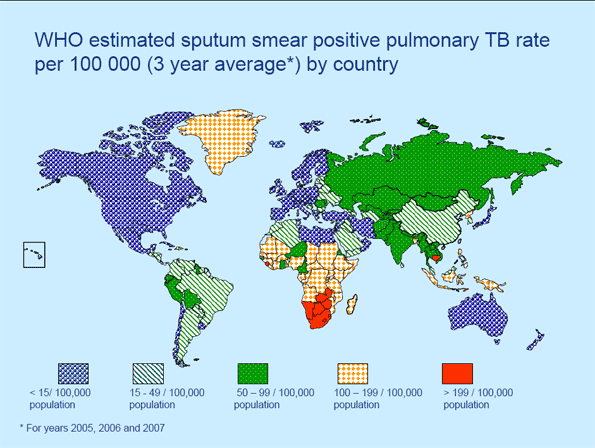
Tuberculosis, an ancient killer once considered under control, is experiencing a new resurgence in Russia. For reasons known only to Russian government functionaries, the Russian government neglected to order new supplies of anti-TB drugs. The result was entirely predictable:
MOSCOW -- Russia's severe tuberculosis problem is about to get much worse, increasing the risk that the dangerous drug-resistant strains that are common here will spread, causing outbreaks elsewhere, local health officials and other experts warn.

Preliminary surveys have recorded an uptick in infections, which experts say could be the start of a surge fueled by declining living standards and deteriorating medical care resulting from the country's worst economic slowdown in a decade.

But Russian officials and health specialists also blame the government's failure to order supplies of key medicines last year, a blunder that could strengthen antibiotic-resistant forms of TB and threaten wealthier countries that have all but eradicated the disease.

Russia already has one of the highest rates of TB in the world. In parts of its Far East, the infection rate is three times what the World Health Organization considers epidemic levels. The government has made progress in recent years, with infection rates falling from a peak in 2000, but health officials are worried that those gains are now in jeopardy.

Preliminary state statistics show the rate of infection growing from 83.2 cases per 100,000 people in 2007 to 85.2 in 100,000 last year, and anecdotal evidence from hospitals and clinics around the country suggests that the numbers are still climbing.

By comparison, the infection rate in the United States is about 8 in 100,000, with about 0.2 percent of American TB cases ending in death. In Russia, about 18 percent of TB patients die of the disease, according to WHO figures. _WaPo_via_LaRussophobe
As the ethnic Russian population dies away, and is replaced by third world tribal people, the health and industrial infrastructure of the country can be expected to shrivel. It is not an image of Russia that one wishes to cling to, but it will not go away unless the travesty that is modern Russia experiences drastic reform.

More on Russia's woes at abu al-fin.

Labels:

Bookmark and Share

29 May 2009

Too Late for Oil to Save Russia -- at Any Price

Putin’s Kremlin made a fateful bet that natural resources—oil, gas, and other extractive saleable commodities—would be the springboard for the restoration of Moscow’s influence as a great power on the world stage. In this gamble, Russian authorities have mainly ignored the nation’s human resource crisis. During the boom years—Russia’s per capita income roughly doubled between 1998 and 2007—the country’s death rate barely budged. Very much worse may lie ahead. How Russia’s still-unfolding demographic disaster will affect the country’s domestic political situation—and its international security posture—are questions that remain to be answered. _WAJ
Expert opinions are split on the near and medium term future of oil prices. Jim Rogers predicts high oil prices soon and for the indefinite future. Many analysts see steady drops in oil production due to low prices erasing the widespread oversupply in oil stockpiles. Since it can take years for many oil producers to gear back up to higher production, such a trend suggests a period of extended oil under-supply -- and higher prices -- in the not so distant future.

Russia is hoping that oil prices do indeed jump above $100 a barrel, and stay there! But is it too late for Russia, regardless of oil and commodities prices? Certainly Russia has no hope if the world economy remains stuck in the doldrums.
Russia has lost more than 12m people since depopulation started in 1992. This trend currently shows no signs of slowing down, and Russia will continue to lose people – the only question is: how quickly? An expert at the Russian Academy of Sciences Anatoly Vishnevsky painted an even gloomier picture, predicting a population of 98m for Russia in 2050....

....Even more troubling is that the number of able-bodied adults is declining faster than any other demographic category. This group is expected to absorb the bulk of the losses, declining by 14m by 2025. According to the RBC daily, in 16 years every 1,000 employed Russians are going to be providing for some 800 dependents...

...Education and careers are the priorities now, and starting a family is often on the backburner, for women as much as for men. Various proposals have been championed to combat people’s unwillingness to have more children. _Telegraph
But Russia has been burning the candle on both ends -- fewer births, more deaths. HIV, Tuberculosis, alcoholism (an often fatal disease), suicide, homicide -- these are modern Russia's epidemics.

Corruption in Russia's government is so bad that unless a person has connections to state power, their future prospects are not favourable. During the oil boom of 2007 and 2008, there was enough wealth flowing through Russia's economy to paint a patina of glitz over the drunken rot beneath. With the crash in commodities and the global economic downturn, Russia has suffered inordinately due to government corruption and its overreliance on a nationalised energy industry.

So Russia's only hope is to be able to stick it to the rest of the world via high energy prices. But is it too late for Russia, no matter how high the price of fossil fuels go?

Yes, it is too late. Prosperity from another boom in oil prices will accrue to the top of the government power pyramid first of all. From there, it will slowly flow downward in a very uneven course. Foreign investment will be slower in coming than in past years, due to the Russian government's kleptocratic tendency to nationalise anything it wishes.

Most Russians -- particularly those in the endangered zones far away from Moscow and St. Petersburg -- will see little improvement in personal circumstances, due to corrupt concentrations of power, profits, and resources. They will continue to die early, and neglect to reproduce. Fertile Russian women will continue to flock overseas as mail and internet brides. They will have their babies in what used to be termed "the free world", to non-Russian fathers.

The western world is helping Russia's corrupt kleptocracy continue to rape and exterminate its own people via its carbon hysteria quasi-religion -- which leads to political peak oil and artificially inflated oil prices. For that, you can thank Brock O'Bomba and his merry gang of green apocalyptics.

Russia has never had the benefit of an enlightened government. Its people have always been "slavs" to their leaders. America does not have such an excuse of a dozen generations of slavic mind programming. Russians were dragged downward over the many centuries until fatalism and passive nihilism became a part of the innate psychology. Americans made a conscious choice to go down the irrational path.

Labels:

Bookmark and Share

07 May 2009

Geopolitical Miscellany

China's central bank, The People's Bank of China, is warning that the country's economic recovery is not yet on a solid foundation.

Meanwhile, China continues to poison the world through contamination of the atmospheres and the oceans.

Russia's corrupt state-run energy company Gazprom is being forced to raise domestic energy rates. The Russian people are already unhappy over their economic nightmare, and may not take kindly to these rate hikes.

Hugo Chavez is back to his old tricks of stealing private assets to finance his failing revolution in Venezuela. No doubt you will pay "fair market value" for these private assets, at least as you see it -- eh, Hugo, mi amigo?

Labels: ,

Bookmark and Share
Older Posts
Al Fin Main Page
Enter your Email


Powered by FeedBlitz
Google
WWW AL FIN

Powered by
Blogger

``