14 July 2012

Brave New Cuisine: Eating Bugs and Molecules

The ability to feed our population is incredibly important.... Land-use for meat could be cut by 90% which would drastically lower greenhouse gas emissions from cattle. There would also be no need for large-scale transport. Post hopes one day each kitchen would be capable of making its own meat. _Molecular Food and Lab Grow Meat - Cosmos

Kitchen grown meat, synthetic molecular food, and insect farms -- O brave new world, that has such cuisine in it!
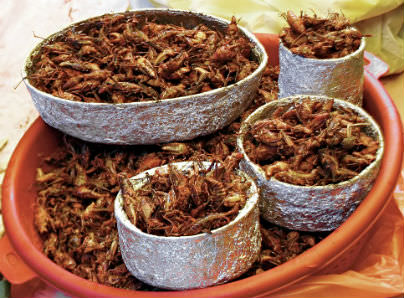
The population of the Earth's third world is growing rapidly -- particularly in Africa. North America, Oceania, and Europe will probably have no problem feeding themselves for the foreseeable future. But in the face of relatively high birthrates, and decreasing aid from the developed world, Africa and parts of Asia and Latin America may be pushed to the limits by even occasional revolutions, insurrections, and bad growing seasons.

Food scientists have been hard at work devising methods to feed parts of the world which may run short from time to time. Building insect farms is one of the proposed approaches:
Today’s insect farms primarily serve the pet food and bait markets. In the U.S., they produce enough food to keep approximately 13.6 million pet frogs, toads, and lizards satisfied, but humans tend to have bigger appetites, and there are a lot more of us. In the future, we will not only need far more insect farms; we will need bigger, more productive farms as well.

...There will also be a great demand for processing—increasing shelf life, ensuring product safety and consistency, and, most of all, making mealworms and crickets look and feel and taste a little less like mealworms and crickets. While many people may never eat insects even after they’ve been beheaded, declawed, and dewinged, they might eat insect flour or sports bars fortified with insect protein. _Reason

Another approach to brave new foods, is molecular cuisine -- as in synthesized food, a la Star Trek.
Molecular gastronomy in the lab can also lead to new, and rather odd, combinations on the plate. It turns out that foods that go well together often contain the same aroma molecule, as do fish and chips and, surprisingly, coffee and garlic.

...rather than growing meat from a complex set of compounds, Post’s lab uses cow stem cells. These cells are given the right nutrients to grow within the lab to create tissue. So far meat has grown into small strips about 3cm long, meaning around 3,000 of these will be needed to make the long-anticipated hamburger. _Cosmos
This is just the beginning, of course. If chemical engineers can make gasoline, diesel, plastics, and high value chemicals from garbage and biomass waste, it is likely that they can also learn to make edible food from the same materials.

Such skills will be invaluable for generational space missions, or for permanent manned space colonies far from Earth. Clever chefs can make just about anything taste good, given the right spices -- synthetic or natural.

Labels: ,

Bookmark and Share

26 January 2012

Radical Future of Food

Food, farm and water technologists will have to find new ways to grow more crops in places that until now were hard or impossible to farm. It may need a total rethink over how we use land and water. So enter a new generation of radical farmers, novel foods and bright ideas.

Algae

....Algae are at the bottom of the food chain but they are already eaten widely in Japan and China in the form of seaweeds, and are used as fertilisers, soil conditioners and animal feed. "They range from giant seaweeds and kelps to microscopic slimes, they are capable of fixing CO2 in the atmosphere and providing fats, oils and sugars. They are eaten by everything from the tiniest shrimp to the great blue whales. They are the base of all life and must be the future," says Edwards.

Artificial meat

It looks like meat, feels like meat and it is meat, although it's never been near a living, breathing animal. Instead, artificial or "cultured" meat is grown from stem cells in giant vats.

...Much of the research into artificial meat is being done in Europe with scientists in Holland and Britain developing edible tissue grown from stem cells in laboratories. But while the first artificial hamburger could be developed next year, it might taste of nothing at all...studies show that artificial meat wins hands down in the environmental stakes, using far less water, energy and land.

New crops

Few people have heard of Zhikang Li, but history may judge the Chinese plant breeder to be one of the most important people of the century. Last year, after 12 years' work with the Chinese Academy of Agricultural Sciences and the International Rice Research Institute in the Philippines, he and his team developed "green super rice", a series of rice varieties which produce more grain but which have proved more resistant to droughts, floods, salty water, insects and disease.

...Green super rice, which could increase yields in Asia enough to feed an extra 100 million people, will be rolled out in the coming years....Last year more than 350m acres – about 10% of global cultivated area, or the same area as Germany, France and the UK together – were planted with GM crops, but this mainly covered only three big foods – maize, oilseed rape and soya – most of which went to animal feed.

Desert greening

Much of the world is arid, with its only nearby water being the sea. So could a technology be found to green coastal deserts in places such as Chile, California, Peru and the Middle East using salt water?
Charlie Paton, a British inventor, has a vision of vast "seawater greenhouses" to grow food and generate power. The idea is simple: in the natural water cycle, seawater is heated by the sun, evaporates, cools to form clouds, and returns to earth as refreshing rain. It is more or less the same in Paton's structures. Here, hot desert air going into a greenhouse is first cooled and then humidified by seawater. This humid air nourishes crops growing inside and then passes through an evaporator. When it meets a series of tubes containing cool seawater, fresh water condenses and is then collected. And because the greenhouses produce more than five times the fresh water needed to water the plants, some of it can be released into the local environment to grow other plants. [also see Sahara Forest]

Insects

Locusts, grasshoppers, spiders, wasps, worms, ants and beetles are not on most European or US menus but at least 1,400 species are eaten across Africa, Latin America and Asia. Now, with rising food prices and worldwide land shortages, it could be just a matter of time before insect farms set up in Britain.

Not only are many bugs rich in protein, low in fat and cholesterol and high in calcium and iron, but insect farms need little space. Environmentally, they beat conventional farms, too. The creatures are far better at converting plant biomass into edible meat than even our fastest growing livestock, they emit fewer greenhouse gases and they can thrive on paper, algae and the industrial wastes that would normally be thrown away._Guardian
It is also worth revisiting the topic of "Aeroponics," a form of agriculture that requires no soil at all, can be built up in 3 dimensions, and is very thrifty with water. Aeroponics could be used on seasteads -- using "seawater greenhouse" techniques, on space stations and lunar outposts using recycled water, in polar colonies on Antarctica -- even on submarines or undersea habitats.

H/T NextBigFuture

Labels: , , ,

Bookmark and Share

23 September 2011

Will European Populations Be Reduced to Eating Insects?

Telegraph

Food riots have occurred in many parts of the third world recently, but Europeans have always felt immune from food concerns -- ever since the introduction of the potato from the Americas, in the 1500s. But recent financial concerns of government debt and demographic decline across the continent, are raising concern in Brussels about future food supplies in Europe.

It is easy to grow tasty insect larvae almost anywhere, on scraps and waste. But these plump, juicy larvae are not only suitable for fish bait. According to the EU food experts, an entire continent of humans can, and perhaps should, be taught to live on insects.
Experts in Brussels believe insects and other creepy crawlies could be a vital source of nutrition which will not only solve food shortages but also help save the environment.

They have launched a three million euro (£2.65 million) project to promote the eating of insects while also asking national watchdogs like the UK's Food Standards Agency to investigate the issue.

...According to one study, small grasshoppers offer 20 per cent protein and just six per cent fat, to lean ground beef's 24 per cent protein and 18 per cent fat.

Crickets are also said to be high in calcium, termites rich in iron, and a helping of giant silkworm moth larvae apparently provides all the daily copper and riboflavin requirements. There are even claims that bees boost the libido.

Insects emit less greenhouse gases than cattle and require less feed, supposedly making them environmentally-friendly. And supporters claim they could help feed [Europe], because they are so abundant they provide at least 200kg of biomass for every human.

The European Commission is offering the money to the research institute with the best proposal for investigating "Insects as novel sources of proteins". _Telegraph

Europe's population is imploding, due to low birthrates. Europe's elites and overseers are looking for ways to cut costs, to meet the increasingly burdensome social obligations of Euro nanny-states, in the face of a shrinking demographic and disappearing taxpayers. One should probably not feel surprised to see grub and larvae soup and salad appearing on the menus of future bistros.

It is not yet clear how the rapidly growing Muslim population of Europe will accept new EU insect food guidelines. But everybody's gotta eat, right?
H/T ImpactLab

Adapted from an earlier article at Al Fin, the Next Level

Labels: ,

Bookmark and Share

04 August 2010

Saving the World by Eating Closer to the Earth

More than 1,000 insects are known to be eaten by choice around the world, in 80% of nations. They are most popular in the tropics, where they grow to large sizes and are easy to harvest. _Guardian
ImpactLab

Insects can provide an excellent source of high protein food almost everywhere in the world. After reading a bit more about the wisdom of eating insects, study the nutritional table at the bottom. Think of all the human beings who have starved throughout history who might have been saved through a smarter use of the food chain.
Being cold-blooded, insects convert plant matter into protein extremely efficiently, Van Huis says. In addition, he argues, the health risks are lower.

... Locusts and crickets are calcium-rich and 90% of people in Laos have eaten insects at some point, he says.Durst says the FAO's priority will be to boost the eating of insects where this is already accepted but has been in decline due to western cultural influence.

He also thinks such a boost can provide livelihoods and protect forests where many wild insects are collected. "I can see a step-by-step process to wider implementation."

First, insects could be used to feed farmed animals such as chicken and fish which eat them naturally. Then, they could be used as ingredients.

Van Huis adds: "We're looking at ways of grinding the meat into some sort of patty, which would be more recognisable to western palates."

...LOCAL TREATS

Thailand Dishes include fried giant red ants, crickets and June beetles

Colombia "Fat-bottomed" ants are a popular snack, fried and salted

Papua New Guinea Sago grubs in banana leaves are a local delicacy

Ghana Winged termites are collected and fried, roasted, or made into bread

Japan Dishes include aquatic fly larvae in sugar and candied grasshoppers

Mexico The agave worm is eaten on tortillas, and grasshoppers are toasted

Cambodia Deep-fried tarantulas are popular with locals and tourists

South Africa Locusts lend interest to the staple dish of cornmeal porridge

Australia Witchetty grubs are a traditional part of the Aboriginal diet _Guardian


Nutritional Value of Various Insects
Per 100 Grams

Insect

Protein (g)

Fat (g)

Carbohydrate

Calcium (mg)

Iron (mg)
Giant Water Beetle 19.8 8.3 2.1 43.5 13.6
Red Ant 13.9 3.5 2.9 47.8
5.7
Silk Worm Pupae 9.6 5.6 2.3 41.7 1.8
Dung Beetle 17.2 4.3 0.2 30.9 7.7
Cricket 12.9 5.5 5.1 75.8 9.5
Small Grasshopper 20.6 6.1 3.9 35.2 5.0
Large Grasshopper 14.3 3.3 2.2 27.5 3.0
June Beetle 13.4 1.4 2.9 22.6 6.0
Caterpillar 6.7 N/A N/A N/A 13.1
Termite 14.2 N/A N/A N/A 35.5
Weevil 6.7 N/A N/A N/A 13.1
Beef (Lean Ground) 27.4 N/A N/A N/A 3.5
Fish (Broiled Cod) 28.5 N/A N/A N/A 1.0
Source

If you are thinking about getting into the insect farming business, here is a vast resource of information about the worldwide phenomenon of insects-as-food.

As part of their food foraging training, members of the Society for Creative Apocalyptology are expected to demonstrate the ability to harvest insects and grubs from the wild, and prepare them for eating. Such a skill when combined with the ability to forage wild plants, mushrooms, and small animals for food, could keep a small group alive for an extended period of time on just a few acres of apparently "useless" land.

Under Obama Pelosi, the US economy has not been doing well. In fact, thanks in large part to Obama Pelosi, an enormous pension tsunami is threatening to bankrupt several US states. Should that happen, the chain reaction of consequences will reverberate globally....Considering that virtually everything the Obama Pelosi government is doing will have further devastating effects on the US economy, you may want to seriously consider learning to enjoy the idea of eating grasshoppers.

Labels: ,

Bookmark and Share

07 February 2010

Gourmet Fare: Bugs and Mushrooms

Can you imagine eating grasshoppers "more savoury than shrimp?" It's easy if you try. Costa Rican scientists at the National Biodiversity Institute are researching insect farming for purposes of food production. It makes sense: insects are high in protein, low in carbs, and produce very high quality fats including omega 3s. And insects can learn to eat a wide range of cheap feed -- even algal carcases left over from the production of algal biofuels!
At the institute, Costa Rican scientists mingle with Bhutan mycology expert Ugyen Yangchen and Elisabeth Zannou, an entomologist from Benin.

Costa Rica and Benin share historical ties, as many slaves were taken from the western African country to Central America during the colonial era.

“Benin knows a lot about insect consumption and Bhutan about eating mushrooms, while Costa Rica is bringing its experience in managing biodiversity,” Marianella Feoli, who manages the foundation coordinating the research program, told AFP.

In Benin, termites, grasshoppers and crickets, as well as butterfly and moth larvae are a common part of people’s diet, explained Zumbado, who traveled with his colleagues to explore the phenomenon in the coastal country.

“In other countries, gourmet restaurants serve insects,” he noted. _ImpactLab
If Obama is US President for much longer, humans will have to learn to eat lower on the food chain. Elections have consequences.

Labels: , ,

Bookmark and Share

20 November 2008

Following Zimbabwe Down

Americans look at images of Zimbabweans eating insects, secure in the knowledge that "it can't happen here." Widespread starvation is something that happens in Africa or Southeast Asia. The US government would never allow things to get so bad here--unless the US were controlled by a leadership as corrupt as Zimbabwe's.
Rebecca Chipika, a child of 9, prods a stick into a termite mound to draw out insects. She sweeps them into a bag for her family's evening meal.


These scenes from a food catastrophe are unfolding in Doma, a district of rural Zimbabwe where journalists rarely venture. It's a stronghold of President Robert Mugabe's party and his enforcers and informants are everywhere.


...Survival is the obsession.


Cell phones operate only sporadically. State radio has not been received since the district relay beacon broke down eight months ago.


Mhangura, a town of about 3,000 people, has had no running water for months. Power outages happen daily because of a lack of cash to maintain utilities. People walk about three miles to a dam to fill pails or gasoline cans.


Some of the scarce water is used to embalm the dead in wet sand, a centuries-old African tradition to preserve a body until family members gather for the burial.


"There's nothing here. People are dying of illness and hunger. Burial parties are going out every day," said Michael Zava, a trader in Mhangura.


The hospital that serves the district is closed, and so is its small morgue, so there's no way of telling how many are dying, Zava said. Children's hair is discoloring, a sign of malnutrition. Adults are wizened and dressed in rags — they have no cash for new clothes.


Zava said he has seen villagers plucking undigested corn kernels from cow dung to wash and eat. A slaughtered goat is eaten down to everything but hooves, bones and teeth. Crickets, cicadas and beetles also can make a meal. _Yahoo
The Republic of South Africa is on a similar trajectory, perhaps a decade or so behind Zimbabwe in its descent. Both Zimbabwe and South Africa were once booming and prosperous exceptions to a continent full of post-colonial hell. With a change in leadership in both countries came rising violence and discrimination against the market-dominant minorities that had created their booming economies. As oppression against productive members of society grew, prosperity declined, and infrastructure rotted close to collapse.

Similar decline occurred in Uganda under Idi Amin, when he forced his market-dominant minority populations out of the country. Indonesia almost made the same mistake recently.

Any government of a relatively prosperous nation needs to understand where the productivity and prosperity of the nation comes from. It does not come from the size of the government bureaucracy, from the size of the military, or from the amount of taxes collected. The country's prosperity comes from profits produced by market enterprises. Anything that reduces or chokes off market enterprise reduces prosperity.

Market dominant minorities exist in third world countries--and third world regions of first world countries--because the indigenous majorities in those countries and regions are unwilling or unable to generate enterprise as productive as that generated by the market dominant minority.

When a new leadership arises in a nation, it is tempting for the new leaders to consider impinging on the freedoms of productive groups--to increase taxes, prohibitions, and regulations far beyond what productive members consider tolerable. Whenever leaders consider such harsh measures, they should consider the examples of Zimbabwe and South Africa--nations that flogged and are flogging their productive classes out of their respective countries.

As the ongoing third worldification of the developed western world's populations continues, it would behoove governments of the west to maintain the somewhat libertarian freedoms of relative equality under the law that have allowed current levels of prosperity. If the bounds on western governments put in place by enlightened documents such as the US Constitution are loosened by populist demagogues such as those who have destroyed and are destroying much of the third world, the future of the west--and the US--may become a replay of the descent of Zimbabwe into hell.

H/T Carl Brannen

Labels: , , ,

Bookmark and Share

01 October 2008

Obamanation: Learning to Eat Bugs and Like It!

Famine and starvation go along with socialism like hand and glove. This has been the case in North Korea, Zimbabwe, Cambodia, China, the Soviet Union, and other less famous cases. Should Americans elect Obamanation, and bring socialism to their country, they would be wise to take precautions to "starvation-proof" themselves ahead of time.

One of the best ways of starvation-proofing, is to learn how to eat bugs--and like it! Liking it makes it less probable that you will regurgitate the insects--thus making yourself even weaker.
Some insects are edible. In fact, most insects are edible, but there are a few species that are especially palatable, nutritious, and easily obtainable. I will concentrate on these.

Many species of insects are lower in fat, higher in protein, and have a better feed to meat ratio than beef, lamb, pork, or chicken.

Insects are tasty. Really! Even if you are too squeamish to have them as a main dish, you can make insect flour and add it to bread and other dishes for an added protein boost.

Insects are easy to raise. There is no manure forking. No hay bale lifting. No veterinary bills. You can raise them in an apartment without getting complaints.

.....Most people do not mind butchering insects. The butchery of insects is very simple compared with that of cattle or poultry, and nowhere near as gory.

Raising insects is environmentally friendly. They require minimal space per pound of protein produced, have a better feed to meat ratio than any other animal you can raise, and are very low on the food chain. They are healthy, tasty, and have been utilized for the entire history of mankind (after all, it is easier to catch a grub than a mammoth).

Also, as far as I know, no animal rights activists object to the eating of insects. You don't need to destroy any wildlife habitat to eat insects, and you can incorporate insects and earthworms into a recycling program......vegetable waste in, yummy insect protein out. _Source
In many societies, insects are considered delicacies to savour. Attitudes in western countries may prove counter-productive, should the Obamanation of socialism bring starvation upon the land. It is not too early to begin preparing. Start building your insect pens and corrals in a spare bedroom. Buy some barbed wire. Order insect eggs and grubs over the internet, ahead of the rush. But do not---do not!!!! tell your neighbors about the reasons for those insect barns going up in the back yard. Tell them it is an eccentric hobby, that the insects are poisonous if ingested. That should prevent those annoying late-night bug raids to feed starving neighborhood children. I hate when that happens.

Labels: , , ,

Bookmark and Share

15 August 2008

Animal Proteins: Which is Most Efficient?

We all know that it takes a lot more crop area to produce beef steak and ham for human food, than it would to produce crops for humans directly. How do different animal protein foods compare in terms of efficiency?
Among major commercial species, poultry is the most efficient, with two kilograms of food making one kilogram of chicken, followed by three to five kilograms for hogs and then seven for sheep and seven to eight for cattle.

Among lesser species, rabbits are similar to poultry, as are fish with one to two kilograms of grain needed, which is more efficient than any land species, potentially making them a very attractive commodity investment. _source
If fish is the most efficient animal protein for human food, what would be a good high protein food to feed the fish? Neptune Industries Inc. believes that insect protein can become a most economical fish feed, easily produced using residual algae cake left over from biodiesel production. Neptune coincidentally raises fish in a unique, clean environment called an "Aqua-Sphere", and uses fish waste to grow algae for biodiesel. You can see the fascinating circle of resourcefulness: Insect protein to feed the fish --> Fish waste to feed the algae for biodiesel --> algae cake residue to feed the insects --> and so on.

Of course, you might ask why humans have to eat meat in the first place? Here is an interesting study relating to that question:
In the study led by Dr. Cheskin, and funded by the Mushroom Council, study participants were randomly chosen to receive either beef or mushroom lunch entrées over four days – lasagna, napoleon, sloppy Joe and chili. Subjects then switched entrées to consume the other ingredient (mushroom or beef) the following week.1

Energy (calorie) intakes were significantly higher during meat meals than mushroom meals, a difference that averaged 420 more calories and 30 more fat grams per day over the four-day test period. Subjects' ratings for palatability (meal appeal), appetite, satiation (after meal fullness) and satiety (general fullness) did not differ between groups.

"The most intriguing finding was that subjects seemed to accept mushrooms as a palatable and suitable culinary substitute for meat," said Dr. Cheskin. "They didn't compensate for the lower calorie mushroom meal by eating more food later in the day."

The preliminary findings of Cheskin's team follow findings from other initial data that suggested if men substituted a 4-ounce Portabella mushroom for a 4-ounce grilled hamburger every time they ate a grilled hamburger over the course of a year, and didn't change anything else, they could save more than 18,000 calories and nearly 3,000 grams of fat.3 That's the equivalent of 5.3 pounds or 30 sticks of butter. More research is needed to further understand mushrooms' role in weight management as a low-energy density food. _Eurekalert
Losing weight by eating well? Sounds good to me.

Update 15 August 08: The Speculist is throwing Kangaroo into the running for best protein, based upon environmental factors. Free range kangaroo may be a bit tough and gamey, but it should put a spring in your step! ;-)

Labels: , ,

Bookmark and Share
Older Posts
Al Fin Main Page
Enter your Email


Powered by FeedBlitz
Google
WWW AL FIN

Powered by
Blogger

``