14 July 2012

Brave New Cuisine: Eating Bugs and Molecules

The ability to feed our population is incredibly important.... Land-use for meat could be cut by 90% which would drastically lower greenhouse gas emissions from cattle. There would also be no need for large-scale transport. Post hopes one day each kitchen would be capable of making its own meat. _Molecular Food and Lab Grow Meat - Cosmos

Kitchen grown meat, synthetic molecular food, and insect farms -- O brave new world, that has such cuisine in it!
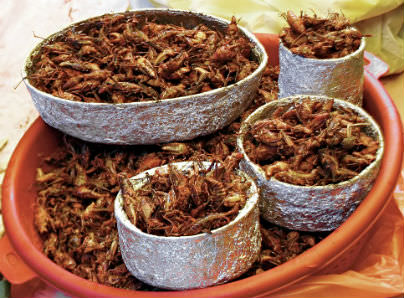
The population of the Earth's third world is growing rapidly -- particularly in Africa. North America, Oceania, and Europe will probably have no problem feeding themselves for the foreseeable future. But in the face of relatively high birthrates, and decreasing aid from the developed world, Africa and parts of Asia and Latin America may be pushed to the limits by even occasional revolutions, insurrections, and bad growing seasons.

Food scientists have been hard at work devising methods to feed parts of the world which may run short from time to time. Building insect farms is one of the proposed approaches:
Today’s insect farms primarily serve the pet food and bait markets. In the U.S., they produce enough food to keep approximately 13.6 million pet frogs, toads, and lizards satisfied, but humans tend to have bigger appetites, and there are a lot more of us. In the future, we will not only need far more insect farms; we will need bigger, more productive farms as well.

...There will also be a great demand for processing—increasing shelf life, ensuring product safety and consistency, and, most of all, making mealworms and crickets look and feel and taste a little less like mealworms and crickets. While many people may never eat insects even after they’ve been beheaded, declawed, and dewinged, they might eat insect flour or sports bars fortified with insect protein. _Reason

Another approach to brave new foods, is molecular cuisine -- as in synthesized food, a la Star Trek.
Molecular gastronomy in the lab can also lead to new, and rather odd, combinations on the plate. It turns out that foods that go well together often contain the same aroma molecule, as do fish and chips and, surprisingly, coffee and garlic.

...rather than growing meat from a complex set of compounds, Post’s lab uses cow stem cells. These cells are given the right nutrients to grow within the lab to create tissue. So far meat has grown into small strips about 3cm long, meaning around 3,000 of these will be needed to make the long-anticipated hamburger. _Cosmos
This is just the beginning, of course. If chemical engineers can make gasoline, diesel, plastics, and high value chemicals from garbage and biomass waste, it is likely that they can also learn to make edible food from the same materials.

Such skills will be invaluable for generational space missions, or for permanent manned space colonies far from Earth. Clever chefs can make just about anything taste good, given the right spices -- synthetic or natural.

Labels: ,

Bookmark and Share

26 January 2012

Radical Future of Food

Food, farm and water technologists will have to find new ways to grow more crops in places that until now were hard or impossible to farm. It may need a total rethink over how we use land and water. So enter a new generation of radical farmers, novel foods and bright ideas.

Algae

....Algae are at the bottom of the food chain but they are already eaten widely in Japan and China in the form of seaweeds, and are used as fertilisers, soil conditioners and animal feed. "They range from giant seaweeds and kelps to microscopic slimes, they are capable of fixing CO2 in the atmosphere and providing fats, oils and sugars. They are eaten by everything from the tiniest shrimp to the great blue whales. They are the base of all life and must be the future," says Edwards.

Artificial meat

It looks like meat, feels like meat and it is meat, although it's never been near a living, breathing animal. Instead, artificial or "cultured" meat is grown from stem cells in giant vats.

...Much of the research into artificial meat is being done in Europe with scientists in Holland and Britain developing edible tissue grown from stem cells in laboratories. But while the first artificial hamburger could be developed next year, it might taste of nothing at all...studies show that artificial meat wins hands down in the environmental stakes, using far less water, energy and land.

New crops

Few people have heard of Zhikang Li, but history may judge the Chinese plant breeder to be one of the most important people of the century. Last year, after 12 years' work with the Chinese Academy of Agricultural Sciences and the International Rice Research Institute in the Philippines, he and his team developed "green super rice", a series of rice varieties which produce more grain but which have proved more resistant to droughts, floods, salty water, insects and disease.

...Green super rice, which could increase yields in Asia enough to feed an extra 100 million people, will be rolled out in the coming years....Last year more than 350m acres – about 10% of global cultivated area, or the same area as Germany, France and the UK together – were planted with GM crops, but this mainly covered only three big foods – maize, oilseed rape and soya – most of which went to animal feed.

Desert greening

Much of the world is arid, with its only nearby water being the sea. So could a technology be found to green coastal deserts in places such as Chile, California, Peru and the Middle East using salt water?
Charlie Paton, a British inventor, has a vision of vast "seawater greenhouses" to grow food and generate power. The idea is simple: in the natural water cycle, seawater is heated by the sun, evaporates, cools to form clouds, and returns to earth as refreshing rain. It is more or less the same in Paton's structures. Here, hot desert air going into a greenhouse is first cooled and then humidified by seawater. This humid air nourishes crops growing inside and then passes through an evaporator. When it meets a series of tubes containing cool seawater, fresh water condenses and is then collected. And because the greenhouses produce more than five times the fresh water needed to water the plants, some of it can be released into the local environment to grow other plants. [also see Sahara Forest]

Insects

Locusts, grasshoppers, spiders, wasps, worms, ants and beetles are not on most European or US menus but at least 1,400 species are eaten across Africa, Latin America and Asia. Now, with rising food prices and worldwide land shortages, it could be just a matter of time before insect farms set up in Britain.

Not only are many bugs rich in protein, low in fat and cholesterol and high in calcium and iron, but insect farms need little space. Environmentally, they beat conventional farms, too. The creatures are far better at converting plant biomass into edible meat than even our fastest growing livestock, they emit fewer greenhouse gases and they can thrive on paper, algae and the industrial wastes that would normally be thrown away._Guardian
It is also worth revisiting the topic of "Aeroponics," a form of agriculture that requires no soil at all, can be built up in 3 dimensions, and is very thrifty with water. Aeroponics could be used on seasteads -- using "seawater greenhouse" techniques, on space stations and lunar outposts using recycled water, in polar colonies on Antarctica -- even on submarines or undersea habitats.

H/T NextBigFuture

Labels: , , ,

Bookmark and Share

27 June 2010

Wanted: Crops that Plant, Cultivate, and Harvest Themselves

NextBigFuture

Humans have always dreamed of a Garden of Eden where they could pick their food fresh from the vine every day, without want or toil. One possible step in that direction is the development of perennial grain crops, which survive to grow in the same soil year after year.
Perennial grains would be one of the largest innovations in the 10,000 year history of agriculture, and could arrive even sooner with the right breeding programs, said John Reganold, a Washington State University Regents professor of soil science and lead author of the paper with Jerry Glover, a WSU-trained soil scientist now at the Land Institute in Salina, Kansas.

“It really depends on the breakthroughs,” said Reganold. “The more people involved in this, the more it cuts down the time.”

Published in Science’s influential policy forum, the paper is a call to action as half the world’s growing population lives off marginal land at risk of being degraded by annual grain production. Perennial grains, say the paper’s authors, expand farmers’ ability to sustain the ecological underpinnings of their crops.

“People talk about food security,” said Reganold. “That’s only half the issue. We need to talk about both food and ecosystem security.”

Perennial grains, say the authors, have longer growing seasons than annual crops and deeper roots that let the plants take greater advantage of precipitation. Their larger roots, which can reach ten to 12 feet down, reduce erosion, build soil and sequester carbon from the atmosphere. They require fewer passes of farm equipment and less herbicide, key features in less developed regions.

By contrast, annual grains can lose five times as much water as perennial crops and 35 times as much nitrate, a valuable plant nutrient that can migrate from fields to pollute drinking water and create “dead zones” in surface waters.

“Developing perennial versions of our major grain crops would address many of the environmental limitations of annuals while helping to feed an increasingly hungry planet,” said Reganold.

Perennial grain research is underway in Argentina, Australia, China, India, Sweden and the United States. Washington State University has more than a decade of work on perennial wheat led by Stephen Jones, director WSU’s Mount Vernon Research Center. Jones is also a contributor to the Science paper, which has more than two dozen authors, mostly plant breeders and geneticists. _WSUNews_via_BrianWang

NextBigFuture
Original study in Science (via Brian Wang)

Al Fin would prefer that more effort go into the development of a perennial barley -- rather than wheat. Beer made from barley is infinitely better than beer from wheat, and who has ever heard of a single-wheat Scotch? No, the best whisky is single malt, the malt being made from barley.

We are in the midst of a biological revolution. That revolution will certainly spread to agriculture, and everything else that biology touches. Fuels, chemicals, animal feeds, plastics, and more.

Expect conventional food crops and innocuous ornamentals and wild forage to be modified to produce virtually any chemical, any compound. I think you can see with a little imagination, that things are already well out of hand and soon to be completely out of control. Try to use your brain, because by the time the reality of tomorrow's harvest hits the mainstream, it will already be too late for the dull majority.

Cross-posted at abu al-fin

Labels: ,

Bookmark and Share

29 April 2010

Super - Lentil to be Unleashed On US Northwest

Essex is a new lentil variety developed by Agricultural Research Service (ARS) scientists. The lentil has a lot to offer, with high seed yields for growers, nitrogen-fixing bacteria for wheat crops, and a tasty source of protein for consumers to add to soups, salads and other fare.

Essex was chosen for public release based on its outstanding performance in advanced yield trials conducted over the past couple of years in Washington State, Idaho, North Dakota and Montana. _PrairieStar
Better forms of ordinary food crops, such as rice, wheat, and legumes -- such as lentils -- can provide more nutritious food at higher yield per acre. Sometimes the new super-crops are developed via genetic engineering, and sometimes they are developed via old fashioned cross breeding.
“The line is the result of a cross made by Fred Muehlbauer at the ARS in Pullman. He's retired now but this plant is part of the legacy he developed while there,” said McPhee.

The lentil produces a little larger seed than the Eston variety, which is considered the market standard. During trials, Essex averaged 1,220 pounds of seed per acre, which is 21 percent more than Eston and 22 percent more than Athena, another leading commercial variety.

“Essex is similar in appearance and very high yielding. It has performed very well,” said McPhee. He described the lentil as being a small, green lentil with a yellow interior. “It is in the Eston type market class in that it is a small green lentil that lacks speckling or extra pigmentation in the coat.” _PrairieStar

Plants of Essex matured at about the same time as Eston and produced small seeds with yellow interiors and green coats. Besides protein levels of 20 to 30 percent by dry weight, the seeds are high in fiber, minerals and vitamins.

Essex also enjoys a symbiotic relationship with beneficial soil microbes-specifically, root-colonizing Rhizobium bacteria, whose ability to take nitrogen from the atmosphere and turn it into a form plants can use for growth helps naturally replenish the soil's fertility for subsequent crops of wheat and other grains. Other benefits of using lentils as a rotation crop in small-grain cultivation systems include reduced soil erosion, improved weed control and reduced disease severity and incidence.

Derived from conventional breeding, Essex is intended for production in the Pacific Northwest and Northern Plains, with primary markets in Mexico and other Latin American nations anticipated. _ScienceDaily

Such simple and rarely remarked-upon advances lead to more plentiful food supplies from less cropland. As more synergies of different rotations of human crops are discovered, more food can be grown using less chemicals, while still maintaining soil quality. Good news, that you will not likely hear from the doomsayers who control the environmental alarmist lobbies, the media, government, and intergovernmental agencies of the world.

Labels:

Bookmark and Share

19 February 2010

Can You Kill the Chicken?


In some cities, organic farmers are cult heroes, photographed for magazines and name-dropped on restaurant menus. Boomers flock to pasture tours while their Ivy League kids vie for farm internships. But the most unusual manifestation is the emergence of the slaughter-your-own-animal workshop. At more than a dozen farms across the nation, a small fee (usually $15 to $40) buys the opportunity to butcher your very own chicken, turkey or rabbit. _SmartMoney


Most people buy their meat, fowl, and fish at the supermarket, already dead and butchered. But what if you had to kill the chicken, and butcher it. Could you do it?

There are workshops available where for a small fee you can go to learn if you have the right stuff for cutting throats, putting a shotgun to an animal's skull, or otherwise shuffling off the critter's mortal coil. Then you butcher the carcass.

On the web you can learn to butcher pigs, or chickens, or rabbits, and probably just about any other animal that requires butchering prior to eating.

Do you think you could do it?
Even the most philosophical students can be surprised by their own hesitation. New York cheesemonger Laura Heifetz felt confident until she had the knife in her hand. Suddenly, she was struck with what she now refers to as a “weird dichotomy”—she didn’t mind killing the chicken, but she didn’t want to hurt it. Bellingham, Wash., food-bank coordinator Max Morange arrived at a pig-processing workshop thinking he’d slit the animal’s throat. It wasn’t until he got a look at the 300-pound porker that he realized the truth: “Pigs don’t really have necks.” He had to shoot the pig with the farmer’s shotgun and before pulling the trigger felt a flash of doubt. “I had to question whether this was a fair arrangement.” _SmartMoney


In a survival situation, you will probably be under a lot of stress. The more necessary things that you are already somewhat prepared to do, the better. For any difficult situation, it is always better to be overtrained. That is the secret of competent survivors like Sully Sullenberger -- get yourself overtrained well in advance of the crisis.

This is also an issue in politics, where voters tend to elect person's on the basis of everything except whether he is actually overtrained and overexperienced for the job. Green rookies in positions of responsibility can make a horrible mess. They are unlikely to be competent to clean up their own messes, either.

Be over-prepared.

Labels: ,

Bookmark and Share

07 February 2010

Gourmet Fare: Bugs and Mushrooms

Can you imagine eating grasshoppers "more savoury than shrimp?" It's easy if you try. Costa Rican scientists at the National Biodiversity Institute are researching insect farming for purposes of food production. It makes sense: insects are high in protein, low in carbs, and produce very high quality fats including omega 3s. And insects can learn to eat a wide range of cheap feed -- even algal carcases left over from the production of algal biofuels!
At the institute, Costa Rican scientists mingle with Bhutan mycology expert Ugyen Yangchen and Elisabeth Zannou, an entomologist from Benin.

Costa Rica and Benin share historical ties, as many slaves were taken from the western African country to Central America during the colonial era.

“Benin knows a lot about insect consumption and Bhutan about eating mushrooms, while Costa Rica is bringing its experience in managing biodiversity,” Marianella Feoli, who manages the foundation coordinating the research program, told AFP.

In Benin, termites, grasshoppers and crickets, as well as butterfly and moth larvae are a common part of people’s diet, explained Zumbado, who traveled with his colleagues to explore the phenomenon in the coastal country.

“In other countries, gourmet restaurants serve insects,” he noted. _ImpactLab
If Obama is US President for much longer, humans will have to learn to eat lower on the food chain. Elections have consequences.

Labels: , ,

Bookmark and Share

13 April 2009

Robots Will Farm and Log the Future


The six-legged robotic logger featured in the above video is just the beginning of the infiltration of robots into logging and farming. Maintaining healthy forests and healthy crops is a lot of work. Physically demanding and often menial, these chores are almost perfectly designed for a robot's strengths.
The successful development of [agricultural] robots could potentially bring a two-fold advantage to modern agricultural techniques. Firstly, the specificity with which robots work – the ability to deliver nutrients directly to the plant on an as-need basis – could greatly reduce the amount of resources and money spent on crop maintenance. Second, the ability to harvest specialty crops could significantly lower the amount of time and back-breaking labor associated with picking fruits and vegetables

“Agriculture contributes a lot of damage to the land, the soil, the water and environment,” Rus explained. “So if we can figure out a way of using robots and automation to deliver nutrients to plants – pesticides, fertilizers, water when it’s needed – instead of sort of mass spreading them, then we hope we would have an impact on the environment.” _RedOrbit
This development is inevitable, particularly with the coming of biofuels from agricultural and forestry waste. Robots can be perfectly equipped to gather, compress, and otherwise densify agricultural and forestry waste biomass. After preliminary on-site densification, waste biomass can be economically transported to local and regional pre-processing and processing plants for conversion into various forms of portable energy such as torrefied biomass, pyrolysis oils, syngas, biomass cubes and pellets, etc. Or the compacted biomass may be co-fired with coal to produce electricity.

Eveything depends upon the economical collection and densification of the waste biomass on-site. Robots -- perhaps solar-powered robots -- are potentially perfect for the task.

Cross-posted on Al Fin Energy

Labels: , ,

Bookmark and Share

01 October 2008

Obamanation: Learning to Eat Bugs and Like It!

Famine and starvation go along with socialism like hand and glove. This has been the case in North Korea, Zimbabwe, Cambodia, China, the Soviet Union, and other less famous cases. Should Americans elect Obamanation, and bring socialism to their country, they would be wise to take precautions to "starvation-proof" themselves ahead of time.

One of the best ways of starvation-proofing, is to learn how to eat bugs--and like it! Liking it makes it less probable that you will regurgitate the insects--thus making yourself even weaker.
Some insects are edible. In fact, most insects are edible, but there are a few species that are especially palatable, nutritious, and easily obtainable. I will concentrate on these.

Many species of insects are lower in fat, higher in protein, and have a better feed to meat ratio than beef, lamb, pork, or chicken.

Insects are tasty. Really! Even if you are too squeamish to have them as a main dish, you can make insect flour and add it to bread and other dishes for an added protein boost.

Insects are easy to raise. There is no manure forking. No hay bale lifting. No veterinary bills. You can raise them in an apartment without getting complaints.

.....Most people do not mind butchering insects. The butchery of insects is very simple compared with that of cattle or poultry, and nowhere near as gory.

Raising insects is environmentally friendly. They require minimal space per pound of protein produced, have a better feed to meat ratio than any other animal you can raise, and are very low on the food chain. They are healthy, tasty, and have been utilized for the entire history of mankind (after all, it is easier to catch a grub than a mammoth).

Also, as far as I know, no animal rights activists object to the eating of insects. You don't need to destroy any wildlife habitat to eat insects, and you can incorporate insects and earthworms into a recycling program......vegetable waste in, yummy insect protein out. _Source
In many societies, insects are considered delicacies to savour. Attitudes in western countries may prove counter-productive, should the Obamanation of socialism bring starvation upon the land. It is not too early to begin preparing. Start building your insect pens and corrals in a spare bedroom. Buy some barbed wire. Order insect eggs and grubs over the internet, ahead of the rush. But do not---do not!!!! tell your neighbors about the reasons for those insect barns going up in the back yard. Tell them it is an eccentric hobby, that the insects are poisonous if ingested. That should prevent those annoying late-night bug raids to feed starving neighborhood children. I hate when that happens.

Labels: , , ,

Bookmark and Share

27 August 2008

How to Make Your Own Milk Even If You're a Man

No, I'm not suggesting taking hormones. I'm suggesting you look into buying a pet animal the size of a German Shepherd dog, that can give you 16 pints of milk a day and will also crop your lawn without costing a cent for gasoline. How? What? No need to stay in suspense, my friends. The answer is the mini-cow, a family pet that will provide milk, companionship, and free lawn care for many years--then when it dies you can put it in your freezer as fresh beef.
For between £200 and £2,000, people can buy a cow that stands no taller than a large German shepherd dog, gives 16 pints of milk a day that can be drunk unpasteurised, keeps the grass “mown” and will be a family pet for years before ending up in the freezer.

The Dexter, a mountain breed from Ireland, is perfect for cattle-keeping on a small scale, but other breeds are being artificially created to compete with it, including the Mini-Hereford and the Lowline Angus, which has been developed by the Australian government to stand no more than 39in high but produce 70% of the steak of a cow twice its size.....

“With high food prices, they are actually quite an attractive option if you like producing your own food,” said Sue Farrant. “Both my husband and I have full-time jobs so we’re keeping them on the side as an interest. They do largely look after themselves and they’ve been hugely popular with the children.” Her husband said: “They have a phenomenal reputation for the quality of the beef. I think they are proving very attractive to families who have a bit of land and are interested in organic produce. From an economic point of view, we get to eat as much meat as we want and we roughly break-even, but you can sell what you don’t eat.

“As long as you’ve got plenty of grass they will be fine. You don’t really have to feed them.” _TimesOnline
By considering all the aspects of keeping a mini-cow, the economics can be quite favourable. This is what Swamp Woman was trying to tell me a few weeks ago, but I was too busy to listen. I suspect that a person would need a couple of acres of grass to provide feed for the critter. You'd best tell the kids not to give it treats without clearing them with the Vet first.

Labels:

Bookmark and Share

15 August 2008

Animal Proteins: Which is Most Efficient?

We all know that it takes a lot more crop area to produce beef steak and ham for human food, than it would to produce crops for humans directly. How do different animal protein foods compare in terms of efficiency?
Among major commercial species, poultry is the most efficient, with two kilograms of food making one kilogram of chicken, followed by three to five kilograms for hogs and then seven for sheep and seven to eight for cattle.

Among lesser species, rabbits are similar to poultry, as are fish with one to two kilograms of grain needed, which is more efficient than any land species, potentially making them a very attractive commodity investment. _source
If fish is the most efficient animal protein for human food, what would be a good high protein food to feed the fish? Neptune Industries Inc. believes that insect protein can become a most economical fish feed, easily produced using residual algae cake left over from biodiesel production. Neptune coincidentally raises fish in a unique, clean environment called an "Aqua-Sphere", and uses fish waste to grow algae for biodiesel. You can see the fascinating circle of resourcefulness: Insect protein to feed the fish --> Fish waste to feed the algae for biodiesel --> algae cake residue to feed the insects --> and so on.

Of course, you might ask why humans have to eat meat in the first place? Here is an interesting study relating to that question:
In the study led by Dr. Cheskin, and funded by the Mushroom Council, study participants were randomly chosen to receive either beef or mushroom lunch entrées over four days – lasagna, napoleon, sloppy Joe and chili. Subjects then switched entrées to consume the other ingredient (mushroom or beef) the following week.1

Energy (calorie) intakes were significantly higher during meat meals than mushroom meals, a difference that averaged 420 more calories and 30 more fat grams per day over the four-day test period. Subjects' ratings for palatability (meal appeal), appetite, satiation (after meal fullness) and satiety (general fullness) did not differ between groups.

"The most intriguing finding was that subjects seemed to accept mushrooms as a palatable and suitable culinary substitute for meat," said Dr. Cheskin. "They didn't compensate for the lower calorie mushroom meal by eating more food later in the day."

The preliminary findings of Cheskin's team follow findings from other initial data that suggested if men substituted a 4-ounce Portabella mushroom for a 4-ounce grilled hamburger every time they ate a grilled hamburger over the course of a year, and didn't change anything else, they could save more than 18,000 calories and nearly 3,000 grams of fat.3 That's the equivalent of 5.3 pounds or 30 sticks of butter. More research is needed to further understand mushrooms' role in weight management as a low-energy density food. _Eurekalert
Losing weight by eating well? Sounds good to me.

Update 15 August 08: The Speculist is throwing Kangaroo into the running for best protein, based upon environmental factors. Free range kangaroo may be a bit tough and gamey, but it should put a spring in your step! ;-)

Labels: , ,

Bookmark and Share

05 July 2008

Food, History, and Perspective

Human lifespan is bumping into diseases of the brain such as Alzheimer's Dementia. Modern medicine is temporarily stymied as to how to deal with such problems of degeneration over time. You may consider it ironic that ancient herbs and spices may hold a key to dealing with this dilemma brought about by longer life.

The history of foods, spices, seasonings, and beverages makes a fascinating side-bar to the history of human settlements, trade, and conquest.

The quest for spice, was a huge motivation behind the competition of the various European peoples to lay claim to trade routes to the far east. It was this competition for favourable trade routes that led to the discovery of the Americas by 15th century Europeans, and the colonisation of the Americas, Africa, and significant parts of Asia and Oceania.

Even the humble seasoningsalt, played a very significant role in the trade and conquest of early people. At one time, salt was used as payment for services rendered. Hence the saying, "he is not worth his salt." The table below gives a rough overview of the history of human herbs, spices, and vegetables.


Mediterranean

(Used B.C.)


Mushroom, beet, radish, turnip,
carrot, parsnip, asparagus, leek, onion, cabbage,lettuce, artichoke,
cucumber, broad bean, pea, olive, apple,pear, cherry, grape, fig,
date, strawberry, basil, marjoram, oregano, mint, rosemary, sage,
savory, thyme, anise, caraway, coriander, cumin, dill, parsley,
fennel, bay, caper, fenugreek, garlic, mustard, poppy, sesame, saffron.


(Later)


Spinach, celery, rhubarb,
cauliflower, broccoli, Brussels sprouts.


Asia:


(Used BC)


Citron, apricot, peach,
cardamom, ginger, cinnamon, turmeric, black pepper.


(Later)


Yam, water chestnut, bamboo,
eggplant, lemon, lime, orange, melon, clove, nutmeg, mace, tarragon.


New World:

(Used BC)


Potato, pumpkin, squash, tomato,
kidney bean, lima bean, sweet pepper, avocado, pineapple, allspice,
red pepper, chilli pepper, vanilla

_Source

When future humans look back on the fall of western civilisation, and its conquest by more primitive humans, they will likely wonder whether there was something in the drinking water that made us weak, or perhaps something in our diets?

Of course, next level humans will understand most of the multi-factorial reasons for the fall of enlightened, multiculturalised postmodern western society. But next level humans will probably be spending their time pushing the limits outward, lightyears beyond the pedantic and pedestrian scholars of future Earth--who try to understand the rise and fall of great empires of the past.

We should not forget to take what is important along with us, including the spices, foods, passions, and beverages that make an ambitious and accomplished life enjoyable.

Labels: , ,

Bookmark and Share

01 May 2008

China's Enormous New Appetite Drives Food Price

There are many reasons for higher world prices for food. High energy and fertiliser costs, local droughts-famines-wars, the low value of the dollar driving commodities market speculation, etc. But one particular country appears to be more responsible than the rest of the world combined: China.
A change in Chinese meat consumption habits since 1995 is diverting eight billion bushels of grain per year to livestock feed and could empty global grain stocks by September 2010, according to a new study from Biofuels Digest, now available for download here in an expanded version.

...even if the U.S. ethanol industry were shut down tomorrow, rising Chinese demand for meat, and the ensuing livestock feed demand, will empty global grain stocks as soon as 2013. The report offers gloomy news for policymakers who have hoped to address global food vs. fuel concerns by restraining U.S. ethanol demand.

“It’s not food, it’s not fuel, it’s China,” said Jim Lane, editor of Biofuels Digest and author of the report....The US ethanol industry, which has been criticized as the primary cause of grain shortages and rising prices, increased its grain usage by 31 million tonnes during the 12 year period. By contrast, livestock grain demand to supply Chinese meat consumption increased by 199 million tonnes.

“Given that the US population has grown 15 percent in the past 13 years, the 82 percent increase in US corn production left plenty for people, plenty for livestock, and plenty for ethanol.” said Lane. “The truth is that the grain was Shanghaied, leaving us with a fuel crisis and a food crisis. The good news is that it’s easier to find a good steak in Beijing.” __BiofuelsDigest
While the clueless blankers continue blaming biofuels for high costs of food, the reality of the problem is far more complex--and possibly too much of a political hot potato for most of them to touch! While it is politically correct to blame the US for the world's problems, China is often given a free pass.

The media has made a monkey of itself over global warming (CAGW). Now it is making itself the fool over food prices. It is past time for a new media regime that looks at all the evidence, rather than following cliquish fads and political correctness in deciding what news it will cover, and what spin it will take. It is rumoured that journalism students are required to fail IQ tests before being admitted to journalism school. Perhaps they must also take an oath of oafishness as well.

Update: Another factor adding to food shortages is crop damage from frost and unanticipated cold climate (both northern and southern hemisphere). See here and here. H/T Tom Nelson

Here's a look at a country that is truly facing food shortages.

Labels: , ,

Bookmark and Share

14 November 2007

Building Farms Up--Using the Third Dimension to Solve Two+ Problems at Once

By the year 2050, nearly 80% of the earth's population will reside in urban centers. Applying the most conservative estimates to current demographic trends, the human population will increase by about 3 billion people during the interim. An estimated 109 hectares of new land (about 20% more land than is represented by the country of Brazil) will be needed to grow enough food to feed them, if traditional farming practices continue as they are practiced today. At present, throughout the world, over 80% of the land that is suitable for raising crops is in use (sources: FAO and NASA).
Vertical Farm

By building "high-rise farms" we solve the problem of the shortage of agricultural land--AND--by building these farms inside urban areas and just outside the urban perimeter, transportation costs of bringing crops to market are slashed appreciably. The food will be fresher as well.

If only a portion of a high-rise was dedicated to hydroponic and aeroponic agriculture, the building would be able to process its waste water - as well as waste water from elsewhere on the utility grid - using it to water the plants AND to reuse as drinking water. Here’s how: The grey water extracted from sewage would be subjected to biological and mechanical filtration, then it would be used to water the plants. The plants, in turn, would transpirate heavily in the indoor environment, and dehumidifiers would harvest this water - this transpirated water would be pristine drinking water, able to be pumped back upstairs or into the utility grid for reuse. This concept of using transpiration from plants in a commercial high-rise agricultural operation to provide the last mile of grey water purification in the urban environment is revolutionary. Along with the surprisingly low, and dropping, cost of desalination, and advances being made in primary sewage treatment, this innovation could SOLVE the issues of potential water scarcity in the urban environment.
EcoWorld

But there are even more advantages to "vertical farming" than these three.
  • Year-round crop production; 1 indoor acre is equivalent to 4-6 outdoor acres or more, depending upon the crop (e.g., strawberries: 1 indoor acre = 30 outdoor acres)
  • No weather-related crop failures due to droughts, floods, pests
  • All VF food is grown organically: no herbicides, pesticides, or fertilizers
  • VF virtually eliminates agricultural runoff by recycling black water
  • VF returns farmland to nature, restoring ecosystem functions and services
  • VF greatly reduces the incidence of many infectious diseases that are acquired at the agricultural interface
  • VF converts black and gray water into potable water by collecting the water of transpiration
  • VF adds energy back to the grid via methane generation from composting non-edible parts of plants and animals
  • VF dramatically reduces fossil fuel use (no tractors, plows, shipping.)
  • VF converts abandoned urban properties into food production centers
  • VF creates sustainable environments for urban centers
  • VF creates new employment opportunities
  • We cannot go to the moon, Mars, or beyond without first learning to farm indoors on Earth
Vertical Farm

Aeroponic farming methods may hold the greatest promise for liberating farming from rural countryside. Aeroponic farming can be quite economical as the economies of scale and innovation come into play.

Finally, vertical urban farming frees up more land for recreation, animal reserves, and biofuel cultivation.

Thanks to EcoWorld

Labels: , ,

Bookmark and Share

27 May 2007

Topsoil: It's the Organisms, Stupid!

There is nothing magical about topsoil. For thousands of years, humans have been able to detect when soil was healthy and capable of growing good crops. Although pre-scientific humans knew nothing about the details of decomposition, they could tell a good crop from a bad crop--and quickly learned the external characteristics of good soil.

Now we are being told that the earth is losing its topsoil, and that such a loss can never be recovered. Regular readers of this blog may recognise such claims as "appeals to the pseudo-apocalypse." Which is precisely what they are.

It is certainly true that mining and other industrial processes destroy topsoil. And while conventional methods of remediating soil from mining and from other industry may be effective, they can also be extremely expensive.

Scientists in Russia have developed complex mixtures of micro-organisms that can be placed in situ, to remediate soil from petro-chemical contamination. Canadian scientists have gone farther, creating symbiotic combinations of plants and microbes, to clean contaminants from soil in situ.

Researchers are always looking for new bacteria in the strangest places. Or perhaps, not so strange, if you are looking for assistance for petroleum cleanup.

Here is a short description of the micro-world of soil:
• Bacteria -- Bacteria are the tiniest and most diverse of all soil organisms. A single teaspoon of topsoil typically contains more than 100 million bacteria that belong to over 1,000 different species. Bacteria help to decompose residue in the soil and increase nutrient availability for plants by dissolving phosphorus and fixing atmospheric nitrogen. Some bacteria that live on plant surfaces can also prevent plant diseases, either by antagonizing pathogens or stimulating the plant’s own immune systems.

• Fungi -- Fungi are important in the break down of plant residue, and they can transport nutrients through the soil profile. Because they are tougher than bacteria, they tend to release nutrients more slowly so that plants can have access to them throughout the growing season. Some fungi, called mycorrhizae, develop beneficial relationships with plants that allow for nutrient and water absorption by plant roots. Fungal cells also help to stabilize soil structure by secreting a sticky gel that glues mineral and organic particles together into aggregates. These aggregates allow for natural breaks to occur in soil, allowing for greater aeration and water infiltration.

• Protozoa -- Protozoa are single-celled animals that act as secondary consumers of organic matter. They feed on bacteria, fungi, other protozoa, and organic molecules. Protozoa are believed to be responsible for mineralizing a small fraction of the nitrogen in soils.

• Nematodes -- Nematodes are simple worms that are less than one-tenth of an inch long. They help breakdown organic residues and feed on bacteria, fungi and protozoa. They also convert some nitrogen into usable forms for plants.

• Free-living mites -- Soil mites are arthropods that graze on decomposing organic matter, fungi, algae and nematodes. Mite populations are slow to develop, so their appearance indicates a highly stable soil environment.

• Springtails -- Springtails are arthropods found in decaying material. They are one of several biological agents responsible for the creation of soil, and are considered to be the most abundant of all macroscopic animals living in the topsoil.

• Earthworms -- Earthworms round out the list as important keepers and restorers of soil fertility. While less numerous than nematodes, they account for up to 10 times the biomass of the other secondary consumers. Earthworms feed on bacteria-laden plant residues and organic matter mixed with mineral particles. The resulting material is given off as worm casts, which are generally higher in available nitrogen, calcium, magnesium and phosphorus than the soil itself. Earthworms also constantly bring soil up to the surface, providing anywhere from one to 100 tons per acre of organic-laden soil for plant use each year.

“There are countless other organisms that contribute to the soil community. The variety of soil organisms is so high that even today we don’t have the tools to say what an average community really looks like from a small scale to a large scale,” said Gardener. “But it can be said that a healthy soil is often marked by multiple trophic levels of diverse microflora, microfauna and mesofauna.”
Source

Up until now, most of the microbe-hunting has been done by pharmacology researchers, looking for magic bullets against human infection, cancer, and other disease. More and more, such hunts are being done to find cures for environmental ills.

Plants can certainly be grown without soil, and in certain environments aeroponic crops will be the only source of fresh vegetables and fruits.

But the Earth itself has needs beyond the needs of humans. That is the concern. That is why humans have to learn to care for the health of the planet. Humans can learn to take care of themselves. They can also learn to care for the planet, even when their own welfare is not directly concerned.

Labels: , , ,

Bookmark and Share

25 April 2007

Growing the World's Crops in a High Rise

A lot of people begrudge biofuels their use of cropland. But that is not thinking clearly. With the growing success of aeroponics, land is not needed to grow crops.
Crops can be planted and harvested in the system year round without interruption, and without contamination from soil, pesticides, and residue. Since the growing environment is clean and sterile, it greatly reduces the chances of spreading plant disease and infection commonly found in soil and other growing media.

The suspended system also has other advantages. Seedlings don't stretch or wilt while their roots are forming. Once the roots are developed, the plants can be easily moved into any type of growing media without the risk of transplant shock, which often sets back normal growth.

Aeroponics systems can reduce water usage by 98 percent, fertilizer usage by 60 percent, and pesticide usage by 100 percent, all while maximizing crop yields. Plants grown in the aeroponic systems have also been shown to uptake more minerals and vitamins, making the plants healthier and potentially more nutritious.

Tomato growers traditionally start their plants in pots, waiting at least 28 days before transplanting them into the ground. Using an aeroponic system, growers can start the plants in the growing chamber, then transplant them just 10 days later. This advanced technology produces six tomato crop cycles per year, instead of the traditional one to two crop cycles.

Successful long-term missions into deep space will require that crews grow some of their own food during flight. Aeroponic crops are also a potential source of fresh oxygen and clean drinking water. But this is about more than a breath of fresh air or taking a quick shower. Each ounce of food and water produced aboard a spacecraft reduces payload weight, allowing space for other cargo that can't be produced onboard.
Source

With advanced high rise building techniques, very large crop producing structures can be built--providing many thousands of acres of growing area with just a few acres footprint on the ground.

It should go without saying that aeroponics will be extremely useful for long duration space missions, for lunar bases, for seasteads, and for undersea and underground habitats. Given water, air and CO2, nutrients, and full-spectrum lighting, you will be good to go.

Labels: ,

Bookmark and Share
Older Posts
Al Fin Main Page
Enter your Email


Powered by FeedBlitz
Google
WWW AL FIN

Powered by
Blogger

``