23 April 2008

Drug to Treat Accelerated Aging in Phase I Trial

Prodarsan is a combination of small protein molecules devised by Pharming NV[PHGUF.PK] for treatment of premature aging including Cockayne's Syndrome.
Leiden, The Netherlands, April 23, 2008. Biotech company Pharming Group NV (Pharming) (NYSE Euronext: PHARM) announced today that its wholly owned subsidiary DNage has started a Phase I clinical study to evaluate the pharmacokinetics and tolerability of Prodarsan(R) in humans.

Premature ageing, the primary target of Prodarsan(R), is a group of rare genetic diseases which manifests itself in several forms that are genetically and clinically similar although not identical. Dependent on the specific form of the disease, patients have a strongly reduced life expectancy and exhibit many ageing-related diseases early on in their lives. There is currently no effective therapy available for these patients.

Pharming has demonstrated that Prodarsan(R) as an oral, liquid formulation has significant effects in animal models for Cockayne Syndrome (CS). CS is one of the more common forms of premature ageing and is characterized, amongst others, by growth failure, mental retardation, eye abnormalities and a reduced life expectancy. The positive effects of Prodarsan(R) in preclinical testing on life expectancy in general and more specifically on the eye abnormalities are promising for further development of the product and its testing in humans.

The Phase I trial that is now being conducted consists of a combined single and multiple dose escalating clinical study in healthy volunteers. By studying the pharmacokinetics and tolerability of Prodarsan(R) and the effects of food intake on the absorption and elimination of the product, an oral dosing scheme will be determined that targets the pharmacological effective concentration range effectively. It is expected that following a successful completion of this trial the first clinical studies in patients will start later in 2008. Source
Prodarsan's proposed mechanism of action is via the DNA repair mechanism of the cell.
CKN1 is caused by a defect in the Cockayne syndrome type A gene (CSA or ERCC8) located on chromosome 5. Affected persons inherit 2 mutant genes, one from each parent. Cells carrying ERCC8 mutations are hypersensitive to UV light. They do not recover the ability to synthesize ribonucleic acid (RNA) after exposure to UV light. In addition, the cells cannot remove and degrade deoxyribonucleic acid (DNA) lesions from strands that have active transcription.

Mutations in the DNA excision repair gene ERCC6 located on band 10q11 cause CS type 2 (MIM number 133540; CSB). This gene encodes helicase, a protein that is presumed to have DNA unwinding function. Mutations include a deletion of exon 4, an amino acid substitution at the 106th glutamine to proline (Q106P) in the WD-40 repeat motif of the CSA protein, and large deletion in the upstream region, including exon 1 of the CSA gene. The Q106P mutation could alter the propeller structure of the CSA protein, which is important for the formation of the CSA protein complex. Additionally, a missense mutation (A205P) and a nonsense (E13X) mutation have been identified, as well as a new common single nucleotide polymorphism in CKN1. No genotype-phenotype correlation exists. _EMedicine
We can hope that experience in augmenting DNA repair in the tragic accelerated aging syndromes may be helpful in devising strategies to augment DNA repair in helping to delay normal aging.

Previously published in Al Fin Longevity

Labels: ,

Bookmark and Share

How to Learn and Remember Anything

The mind remembers things--anything--best when the items to be learned are presented to the mind according to a particular schedule of "re-minding." This has been known for many decades. A computer program called "Supermemo" helps to organise information for proper presentation scheduling, according to this 100 year old + theory of learning.
SuperMemo is based on the insight that there is an ideal moment to practice what you've learned. Practice too soon and you waste your time. Practice too late and you've forgotten the material and have to relearn it. The right time to practice is just at the moment you're about to forget. Unfortunately, this moment is different for every person and each bit of information. Imagine a pile of thousands of flash cards. Somewhere in this pile are the ones you should be practicing right now. Which are they?

Fortunately, human forgetting follows a pattern. We forget exponentially. A graph of our likelihood of getting the correct answer on a quiz sweeps quickly downward over time and then levels off. This pattern has long been known to cognitive psychology, but it has been difficult to put to practical use. It's too complex for us to employ with our naked brains.

Twenty years ago, Wozniak realized that computers could easily calculate the moment of forgetting if he could discover the right algorithm. SuperMemo is the result of his research. It predicts the future state of a person's memory and schedules information reviews at the optimal time. The effect is striking. Users can seal huge quantities of vocabulary into their brains.

...Our capacity to learn is amazingly large. But optimal learning demands a kind of rational control over ourselves that does not come easily. Even the basic demand for regularity can be daunting. If you skip a few days, the spacing effect, with its steady march of sealing knowledge in memory, begins to lose its force. Progress limps. When it comes to increasing intelligence, our brain is up to the task and our technology is up to the task. The problem lies in our temperament....You must clarify your goals, gain knowledge through spaced repetition, preserve health, work steadily, minimize stress, refuse interruption, and never resist sleep when tired. This should lead to radically improved intelligence and creativity. The only cost: turning your back on every convention of social life. It is a severe prescription. Wired__via__kurzweilai.net
More information about Supermemo here.

Supermemo is just one of twelve mind hacks presented by Wired at this webpage.

Of course, everyone will not be able to learn and remember everything. Each person has his limits. But in a world where educational systems seem more concerned about proper political indoctrination and orientation than in teaching students to use their minds, approaches to learning that actually work are most welcome.

Why do the schools not try to copy the brains natural methods of learning and remembering better? Many reasons, I suspect. Foremost among them is sheer incompetence on the part of those who teach the teachers. University schools of education are staffed by the ideologically correct, who seem intellectually inadequate to prepare the next generation of teachers to help future generations of students grow up to face a more challenging world.

Labels: , ,

Bookmark and Share

Sunspots and Ice Ages

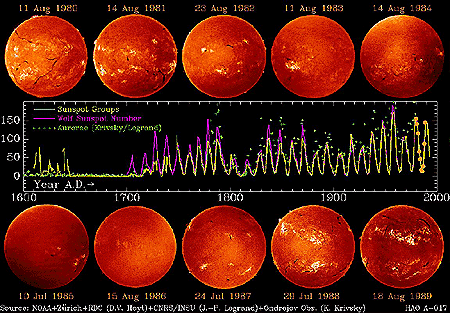
Sunspot cycles average about 11 years in length. But cycles that are particularly long, with much lower numbers of sunspots per time period, tend to be accompanied by colder climates on Earth. Australian astronaut Phil Chapman is concerned that Earth may be approaching such a time of low sunspot activity--and colder climate--in the next several years.
The sunspot number follows a cycle of somewhat variable length, averaging 11 years. The most recent minimum was in March last year. The new cycle, No.24, was supposed to start soon after that, with a gradual build-up in sunspot numbers.

It didn't happen. The first sunspot appeared in January this year and lasted only two days. A tiny spot appeared last Monday but vanished within 24 hours. Another little spot appeared this Monday. Pray that there will be many more, and soon.

The reason this matters is that there is a close correlation between variations in the sunspot cycle and Earth's climate. The previous time a cycle was delayed like this was in the Dalton Minimum, an especially cold period that lasted several decades from 1790.

...There is no doubt that the next little ice age would be much worse than the previous one and much more harmful than anything warming may do. There are many more people now and we have become dependent on a few temperate agricultural areas, especially in the US and Canada. Global warming would increase agricultural output, but global cooling will decrease it.

Millions will starve if we do nothing to prepare for it (such as planning changes in agriculture to compensate), and millions more will die from cold-related diseases. __Australian
This fascinating PDF paper by David Archibald presents a very confident prediction of a coming period of extraordinarily cold climate due to hit Earth within the next 12 years, as a result of a cyclic solar downturn. We do not have long to wait, to see if Archibald is correct. If he is wrong, we can all sit back and have a good laugh at the ice age alarmists. If he is correct, we will all be too busy trying to mitigate the effects of a genuinely catastrophic climate change.
The “Little Ice Age” was a period of time between the late 1500s and the mid 1800s when glaciers advanced, winters in the northern hemisphere were unusually cold and the summer growing seasons were shortened. These conditions were well-documented in art and writings from the times, and are still, to this day, perceived as being unusual. One of the leading theories for why the climate changed so dramatically has to do with the number of sunspots observed during that same time period. Solar activity was extremely low, with some years having no sunspots at all. Fewer sunspots indicates fewer releases of solar radiation and hence less solar energy reaching the Earth.

Over a few years, this does not make a large impact on our climate. However over several decades, the lower amount of overall radiation reaching the Earth can have an impact on long-term weather patterns. ___Source
You will not likely read about these alarmist predictions in the New York Times, nor hear them from the BBC. The IPCC will almost certainly ignore these Chicken Little pronouncements from the "cooling alarmists", and Al Gore is too busy with his own "grand tour of doom" to consider an alternative--and much worse--catastrophe than his own pet warming apocalypse.

If the IPCC models are truly worthless, as IPCC insider and expert reviewer Vincent Gray maintains, then it is unlikely that the IPCC models will ever give us a hint of warning about a potential cooling disaster. IPCC models have all been carefully tuned to the warmer side of the scale.

Solar cycle-based predictions of climate change are refreshingly falsifiable. Solar Cycle 24 is slow off the starting blocks, and may signal a downturn in solar activity. But Solar Cycle 25 is the one that is predicted to be truly depressed. Solar Cycle 25 is due to start anywhere between 2017 and 2019, depending upon when Cycle 24 finally gets started in earnest--and how long Cycle 24 lasts. If solar energy input to Earth does turn down, and Earth's climate responds by cooling, then other predictions--such as a downturn in atmospheric CO2 levels--made by climate skeptics can be easily tested.

There are several possible physical mechanisms of solar influence on climate, which will need to be tested one by one. But it will be nice for science to return to climate studies. Falsifiable science is much to be preferred to the tautological climate models that provide only garbage out in response to garbage in.

H/T Tom Nelson

Labels: , ,

Bookmark and Share

22 April 2008

Solar Thermal Kicking PV's Arse

Solar thermal energy plants have advantages over photovoltaics (PV) plants. Thermal energy is easier to store than electrical energy, for matching production to load. In addition, solar thermal is more efficient than PV. And, electricity from solar thermal plants can be produced by steam turbine driven generators, in three phase AC--just like in the most common form of electrical power systems. Eleven solar thermal companies are currently vying for desert space in the US Southwest.
California’s Mojave desert sure is getting crowded as more and more companies are raising money in an effort to build large solar power plants to harness the sun’s heat. Yesterday, eSolar said it had raised a massive $130 million from the likes of Google and Idealab for its small-scale solar thermal designs, while Stirling also said it had raised $100M from Irish renewable energy developer NTR for its SunCatcher solar thermal dishes. And this morning Infinia, which makes Stirling engines for solar thermal, said it had raised $57 million in a second round of funding. __Read more at earth2techfor information about 11 solar thermal companies
eSolar has been quite successful in raising funding, and has developed a modular design to match the power plant to the available land and required power loads.
Based on eSolar’s 33 MW pre-fab form-factor, the company’s modular design translates to minimal land requirements and are tailored to fit local resources and produce a low environmental footprint, favoring a straightforward sitting and permitting process. Various locations with multitude interconnection options mean that eSolar can deliver more clean, carbon free power where it is needed; close to the cities and towns where it is consumed.

“The eSolar power plant is based on mass manufactured components, and designed for rapid construction, uniform modularity, and unlimited scalability,” said Asif Ansari, CEO of eSolar. “Rather than over-engineering the solution, eSolar’s smart scalable solar architecture targets what we see as the four key business obstacles facing the sector: price, scalability, rapid deployment, and grid impact.”

eSolar’s approach to power plant design revolves around a tiered delivery model, beginning with a 25 MW base unit, called a module, consisting of several thermal receiver towers, each with a field of heliostats. These modules are replicated as many times as necessary to fit specific power requirements. ___ImpactLab
The rush is on to cash in on abundant solar energy in the desert regions of the US, in Spain, and soon the Persian Gulf countries. Solar thermal plants range from the 25 MW eSolar module up to 500 the MW installation being installed by Stirling Energy Systems, which can be expandable to over 850 MW eventually.

Someday, PV will be ready to compete with solar thermal. But that day will not appear within the next 15 or 20 years.

And if you need a lot of baseload energy--in the multi-GW range--nuclear is still your best bet for large scale baseload energy, other than coal.

The US is unfortunate in having what appears to be an incompetent US Congress at this time, on energy matters. The current US Congress seems determined to choke US energy sources and to create a large scale economic crisis in the US economy. I say the Congress "seems determined" to do this. If there is a better explanation for the extreme incompetence of the US Congress on energy matters, I am open to hearing it. Perhaps the Congress is simply stupid. That is possible. I prefer stupid over criminal.

Labels: , ,

Bookmark and Share

Arab Emirates Push for Nuclear Power

The United Arab Emirates is pushing hard to develop its "post-oil economy" in time to sail through the rougher days ahead. By establishing itself as an economic "gateway to the Arab world", as well as a world financial center in its own right, the Emirates are attempting to build a prosperous future that is less dependent upon local production of oil. Nuclear power will provide baseload energy for the huge new developments being built in Dubai and Abu Dhabi. Air conditioning demands for the growing population centers within the Emirates will require a much greater expenditure of energy.
The UAE’s plan to acquire nuclear technology for power generation and other peaceful uses will allow it to save its oil and gas wealth and maximise its income from hydrocarbon exports in the long term, according to information from analysts.

Although it is importing gas from Qatar and is planning to get more supplies from Iran, the UAE could curb any increase in such imports by introducing nuclear technology for power generation, they said.

The nuclear programme, which is expected to be implemented in phases in the long term, could also help offset a steady and rapid increase in oil consumption in the UAE because of growth in most non-oil sectors.

“This will of course enable the UAE to save its oil and gas wealth for future generations,” said an economist at an Abu Dhabi-based bank....In a comment yesterday, the Abu Dhabi-based Emirates Centre for Strategic Studies and Research said the UAE nuclear plans would support its efforts to preserve the hydrocarbon wealth, meet growing domestic energy demand, protect the environment and boost the economy.

“Generating power through nuclear energy is a very viable option commercially… it will effectively contribute to economic development,” it said. _Business24/7
A growing population within a very hot, arid desert, will require a large amount of electrical energy for air conditioning and desalination. Nuclear energy makes sense, given the high costs of natural gas and oil currently.

Does the same energy calculus apply to Iran as well? Certainly. Unfortunately, Iran has been caught enriching uranium for other, less innocent purposes. Combined with Iran's hostility toward its Middle Eastern neighbors and outspoken belligerence and threatening posture, Iran will have to be looked at as a special case.

Labels: , ,

Bookmark and Share

Cellulosic Fuels to Come Online 2008-2017

We are just now entering the era of cellulosic fuels, according to a new report from Research and Markets.
  1. - The US biofuel industry especially ethanol production is expected to lead the global production during the forecasted period of 2008-2017.
  2. - Corn is anticipated to dominate the [Ed: near] future ethanol production in the US, however, cellulosic ethanol requirements are expected to boom during the period 2008-2017.
  3. - US biodiesel sector need strong support from the government as well as from technology point of view to sustain growth in future.
  4. - Biodiesel prices in the US are expected to see a declining trend to push up commercial usage during 2008-2015.
  5. - Supply of raw material (corn and soybean oil) will be a major concern for the US biofuel industry in coming years. Source_via_BusinessWire
Here again, we see a mixture of valid conclusion and popular misconception. Biocellulosic alcohols will lead one charge away from "food as feedstock." Biomass to liquids (BTL) will lead another--ultimately much larger--charge away from foods for feedstocks. Biodiesel from algae and non-edible oilseeds such as jatropha, is yet one more important leap from "foods as feedstocks" to foods and food-prices as a non-issue. Cellulosic electricity--substituting biomass for coal in co-generation plants--is yet another way that bioenergy will help to reduce oil costs--and thus reduce food costs.

Zeachem, Coskata, and a number of other small to medium bio-fuel plants will bring cellulosic biofuel product to market starting within the next year. In Europe, Choren is ready to bring BTL biodiesel to market, and looking to expand within North America in the next year.

Biomass, farm waste, agricultural waste, forestry waste, municipal waste, and industrial waste, are all available for making important contributions to the energy supply. It is a matter of making the necessary technological and managerial adjustments that will allow more industries and regions to take advantages of these resources which are currently going to waste.

Labels: , ,

Bookmark and Share

Manure & Garbage Cut Biofuels Costs

Producing bio-ethanol takes a lot of energy. And energy is expensive--especially natural gas and oil. Bio-ethanol manufacturers are substituting manure, plastics, paper, rice hulls, and other garbage for natural gas--saving many millions of dollars in production costs!
The world's first manure fired ethanol plant is expected to go online in the next two months. Not only will it be environmentally friendly but it will also save Panda Ethanol about $30M a year. ___Source (good video)__via__QiBioenergy
A wider array of garbage and waste can be used to fire bio-ethanol plants using a new flex-fuel boiler developed by EPI.
Substantial savings are realized by using in-plant waste streams as fuel. Paper mills produce a paper sludge waste that is typically land filled but can be utilized as a fuel to produce steam for the paper making operations. Other industries may have plastics, paper, cardboard, oat hulls, rice hulls, distiller’s grains, syrup, glycerin or other byproducts that could be converted into usable energy utilizing EPI’s flexible fuel fluidized bed system. ___Source (PDF)__via__QiBioenergy
This move away from natural gas and oil-fired boilers for bio-ethanol production helps reduce costs of production for bio-ethanol--making it more competitive economically--and it makes more natural gas available to the parts of thegeneral market which may have more difficulty making the same type of substitution.

Such flex-fuel boilers will be equally as useful when cellulosic alcohol processing is more common in 5 to 10 years. The same technology will be useful as well for various biomass to liquid fuel thermochemical processes which are expected to take over most of the biofuels industry within 20 years--unless Craig Venter and his merry band of synthesists can create a new life-form that makes a better, cheaper biofuel from CO2 and sunlight.

Most analysts of bio-energy seem to be lost in a haze of misinformation. Blaming biofuels for high food costs is one clear sign of confusion on an analyst's part. But these things have a way of sorting themselves out.

Oil costs between now and the November US Presidential elections are likely to be kept high, by various machinations. Behind the scenes currency manipulation is only one tactic that seems to be working for now. US government budgetary and Federal Reserve Bank monetary policies have made such manipulation fairly easy. Other reasons for high oil costs--high demand, temporary short supplies due to manpower and infrastructure shortages etc.--are simply part of doing business in any industry. Oil is not just any business, however, and its price has repercussions that propagate throughout the geopolitical globe.

Labels: , ,

Bookmark and Share

21 April 2008

A Marriage Made in Heaven--Courtesy of Virgin

Richard Branson of Virgin Galactic Airways intends to begin presiding over marriages performed in sub-orbital space. You had best plan your wedding far enough in advance. Oh, and make it a small and intimate ceremony. Virgin's spaceships can only accomodate a small wedding party.
He's married a couple on board a Virgin America jet, he's also officiated the marriage of Google's co-founder Larry Page on his private island in the Caribbean, now Richard Branson wants to marry couples as they reach the apex of their Virgin Galactic flights into space. The British billionaire already has two wedding-related bookings, one marriage and one honeymoon, and it is hoped he will obtain a licence to conduct the ceremonies for more. Certainly unique, but I wonder how popular getting hitched in zero gravity will be…..Virgin Galactic already has 200 people booked to fly into space proving there is a market for space tourism out there. Construction of SpaceShipTwo has already begun and the first test flights are expected to commence in 2009.
__UniverseToday
Being the first couple from your home town to be married in space may be a large enough novelty to attract hundreds--even thousands--of couples to space tourism, despite the hundred thousand dollar price tag. Next, people will want to actually spend the night in an orbiting hotel--perhaps one of Bigelow's--and experience a weightless honeymoon that lasts long enough to actually enjoy.

None of these things are actually doing anything to put human enterprise, and colonies, into space permanently. That will require ongoing commercial ventures that require a human presence in space, and that pay very well for the risk that such a presence entails.

Unfortunately, for such ventures, human governments and inter-governments are turning out to be the enemy. When governments oppose a burgeoning market based upon rational returns, it is often the government that loses in the end.

Labels:

Bookmark and Share

Climate Always Changes; The Question is Why?

Are CO2 emissions from human activities changing the planet's climate and devastating its biosphere? Or is it possible that Earth's climate changes for reasons other than varying CO2 levels, with humans playing a minimal role?
The experience curve shows the huge capacity of the oceans to absorb the carbon dioxide emissions of humankind. It seems likely that within about three years we will be experiencing natural global cooling, and with that a decline in levels of carbon dioxide in the atmosphere. In essence, it is impossible for carbon dioxide to accumulate in the atmosphere other than to the level determined by the long-term behaviour of the oceans. ___Source
The oceans have tremendous ability to sequester CO2--both in solution and by creating calcium carbonate and other carbon containing compounds using sea organisms.

One fascinating look at the relationship between CO2 and temperature was recently posted by William M. Briggs at his climate statistician website:
The question we hope to answer is, given the limitations of these data sets, with this small number of years, and ignoring the measurement error of all involved (which might be substantial), does (Hypothesis 1) increasing CO2 now predict positive temperature change later, or does (Hypothesis 2) increasing temperatures now predict positive CO2 change later? ___Much more at the source
Briggs is attempting something quite amazing for climate science: he is attempting to generate a falsifiable hypothesis in order to test it! Although a few scientists involved in climate-related science are attempting to generate and test climate hypotheses via experiment, such a rational approach remains too often the exception in climate science, rather than the rule.

All three candidates for US President still in the running promise to shift US climate policy to better suit the United Nations and the European Union. "It had better be worth the huge economic tumult which that would cause", you might say. Unfortunately, the underlying science is much too weak for the type of bold moves that Obama et al are proposing. Even though China is now the world's largest emitter of CO2--with India trying to catch up--the US is still blamed for most of the world's woes, including "climate change." You might see Obama's and the US Congress' rush to leap off the carbon cliff as being a suicidal gesture to placate the zeitgeist, rather than being a rational act based upon realistic expectation of benefit to US citizens and taxpayers.

2008 has been a cold year so far. Solar Cycle 24 seems in no hurry to commence with normal sunspot activity. In large parts of the northern hemisphere, spring does not seem to be in a hurry to bring its warmer ambience. As time goes by, more scientists, statisticians, and ordinary persons with good powers of observation, are beginning to look at the chinks in the climate alarmist's armor. Climate models are not holding up so well, and the better look we get at climate parameters--the oceans, the atmosphere, the biosphere--through our better and more advanced scientific instruments, the less convincing the pronouncements of holy warmers such as Gore and Hansen actually appear.

More time. Better data. Falsifiable hypotheses. Elegant experiments. Better models. Less hysteria.

Labels: ,

Bookmark and Share

20 April 2008

Climate Hysteria Slowly Yields to Better Science

As better science is applied to climate science, much of the early hysteria is beginning to yield to tempered optimism. Consider the panic over "acid oceans", and the "impending death" of corals, phytoplankton, and the entire ocean.
In Friday’s issue of the journal Science, however, scientists led by M. Debora Iglesias-Rodríguez of the National Oceanography Center at the University of Southampton in England and Paul Halloran, a graduate student at the University of Oxford, report that they found the exact opposite. The algae grew bigger in the more acidic water.

Dr. Iglesias-Rodríguez said the conflicting findings probably arose from differences between how the experiments were conducted. In the earlier work, the researchers lowered the pH by directly adding acid to the water.

In the work reported in Science, the scientists added the acid indirectly by bubbling carbon dioxide into the water, which more closely mimicked the chemical reactions that are occurring in the oceans. As a consequence, in addition to the lowered pH, levels of carbon dioxide in the water also rose — speeding up the algae’s photosynthesis machinery — as did the levels of bicarbonate ions, the building material for the carbonate disks.

“It’s a really complex problem,” Dr. Iglesias-Rodríguez said. “You cannot look at calcification in isolation. You have to look at photosynthesis as well.” __NYTimes
What these findings mean is that bad science can be overcome by better science. This study was only one data point among many. Better research is also needed on the pH reactions of various species of coral.

Coral evolved over a hundred million years ago, when atmospheric CO2 was much higher, and oceans much more acidic. It defies logic to claim--as many climate hysterics have done--that modern levels of atmospheric CO2 and ocean pH present a global threat to the world's coral species. Better science. More data. Clearer heads. It will take at least a decade, perhaps two, to clean up after climate hysterics such as Gore, Hansen, and the rest of the usual suspects.

Jennifer Marohasy also looked at this issue, among others.

Labels: ,

Bookmark and Share

19 April 2008

Brain-Building Through Early Childhood Music

Lately, parents have taken to playing Mozart to their infant children, in hopes that the music will provide an advantage in brain development for the child. Music and math, at least, are related. Many mathematicians are also skilled musicians. The long relationship between music and mathematics apparently runs deep in the structure of the human brain. But to provide a true advantage to the young, growing brain, may require more active participation than merely listening to the music.
Schlaug, now at Harvard Medical School in Boston, and colleagues including Marie Forgeard and Ellen Winner at Boston College, studied 31 children. The researchers collected detailed magnetic resonance images of the children's brains at age 6 and again at 9. Of the original group, six children faithfully practiced at least 2.5 hours a week in the time between the scans. In these budding musicians, a region of the corpus callosum that connects movement-planning regions on the two sides of the brain grew about 25% relative to the overall size of the brain. Children who averaged only an hour or two of weekly practice and those who dropped their instruments entirely showed no such growth. All of the children practiced instruments, such as a piano or a violin, that required two hands.

In every subject, the researchers found that the size of increase in the corpus callosum predicted the improvement on a nonmusical test that required the children to tap out sequences on a computer keyboard. Schlaug says the findings should settle the earlier debate by showing that musical training can enhance neural connections related to planning and coordinating movements between the two hands. His team is now following up with the same children to investigate whether their training had other benefits, such as improved memory or reasoning skills. __Science
Schlaug's findings appear quite significant, and you would expect that 25% growth in the corpus callosum, which connects the two cerebral hemispheres, would contribute to significant differences in other brain functions, and probably behaviours, besides musical performance. It is important to note that both instruments practised by the children required the use of both hands. Other instruments that require complex planning and coordination between the two hands would likely produce similar neuro-structural changes.

Music possesses an inner, mathematical structure. As young brains struggle to reproduce the inner structure of music through practise, is there any doubt but that their brains are changing--modifying themselves--to be better able to instantiate the musical structure through the musical instrument of choice?

The neuroanatomical changes only occurred in children who began regular musical practise before the age of 7, which suggests that an early start on musical training is important for those who eventually are to become virtuosos--for these particular instruments anyway.

The young brain develops along a sequential pathway. Critical periods or windows for different brain functions occur at different points in time. The window for vision is from two months to eight months. The social development and emotional control window is particularly open from ten to eighteen months. The window for math and logical skills is widely open between one and four years, and the window for musical development is between three and ten years--although perhaps one should not wait much beyond the sixth year to start. Source Other sources suggest waiting until five years before intense fingering training on musical instruments begins. Each child's developmental windows will be unique, although they should roughly follow the sequence suggested.

If children are to learn to speak a second language like a native, they should be introduced to the language by age ten. Source for more windows of development According to this source, social developmental windows remain open until ten years, particularly for empathy and envy.

The brain's neural axons myelinate in a roughly back-of-the-brain to front-of-the-brain direction, over the years. Trying to jump-start a particular brain function before the particular nerve pathways are myelinated, may produce less than satisfactory results. The windows of development for thought/emotional/motor skills follow the myelination sequence of the brain.

The pre-frontal lobes are the last parts of the brain to myelinate and mature--finally completing anywhere between the early twenties to the late twenties. Adolescents lack perspective and judgment at least partially due to the delayed maturity of the prefrontal lobes. Other neural functions can be mature, and the adolescent capable of phenomenal performance in many areas--and still lack basic adult-level maturity. This is common knowledge to any observer of adolescents and young adults.

We are all unique. We begin as unique individuals genetically, and grow more unique with every passing and diverging experience. Even identical twins display uniqueness in both genetics (copy number variants [CNV] and environmentally triggered epigenetic controls) and environment (intra- and extra-uterine).

The more we know about the unfolding of a child's being with time, the better able we will be to provide a more optimal environment for child development, and the acquisition of real world talents and competence.
But as the imaging technologies have become more sophisticated, the scientists have found many other neuroanatomical effects of the practice of music. Musicians have enlarged Broca's areas--the famous language area named after the 19th century psychiatrist.
Music practice correlates with an enlarged left planum temporale which is in Wernicke's area and lights up during both speech and music processing. What's going on with these language centers? One very clever study revealed the "bottomline". The scientists hooked up some musicians to the fMRI machines and had them listen to and follow the score of a Bach chorale. Unbeknownst to the musicians the investigators introduced an error into both teh performance and the score, to see what what would happen with this kind of 'exception processing' What happened was that the unexpected event lit up half a dozen areas of the brain which had prior thereto been considered part of the language-specific cortical circuitry.

So that's the bottom line of a decade of PET, MRI, fMRI and other imaging studies on the effect of the practice of music on the brain. The practice of music develops the language circuitry of the brain.
Source

Labels: , , , , ,

Bookmark and Share

Black-White Test Score Gap

"The Black White Test Score Gap: An Introduction" by Jencks and Phillips is a book length look at the problem.
African Americans currently score lower than European Americans on vocabulary, reading, and mathematics tests as well as on tests that claim to measure scholastic aptitude and intelligence...the typical American black still scores below 75% of American whites on most standardized tests. __TBWTSG Chapter1

Nothing perpetuates the racial divide within societies so much as the "achievement gap." It begins early, and persists--even widens--throughout the lifetime. Despite society's best efforts to narrow the racial test score gap, it persists.
It is well documented that scores on cognitive tests taken by adolescents are predictive of future labor market outcomes, such as educational attainment and earnings.1 Even test scores at age seven have been shown to be correlated with measures of labor market success.2 These findings have led many researchers to assign a large role to "premarket factors" in explaining adult earnings inequality, where premarket factors are broadly interpreted to represent endowed ability, the effects of family background and the influence of schools. Premarket factors are also thought to be an important part of the explanation for racial disparities in test score performance.3 __(PDF) Source
Is it possible that tests are biased against some races, in favour of others?
The FDNY test was not the only test to show a gap. So did the SAT, GRE, GMAT, MCAT, LSAT, bar exam, police exams, IQ test - every test of aptitude. All of them are supposed to be racist....All of them show about the same gap - what psychometrists call one standard deviation. And all of them show that Asians are about a third of a standard deviation above whites.

Consider how difficult it must be to maintain this gap year in and year out if it were not real, but the result of a conspiracy...Every year, the test makers must work to make that the gap remains the same - and not just one one test, but for everyone from children taking the SAT and AP exams to doctors taking medical boards.

At the same time, East Asians must score better than whites - again, always by the same margin. The White Racist Conspiracy allows Asians to score higher because… why is it again? If the tests are developed by whites, why are whites failing to score higher than East Asians?...To make sure that hundreds, maybe thousands, of different tests conform perfectly to each other in terms of racial/ethnic/gender averages, and achieve those unfair differences through racist cheating for dozens of years, we would expect that there would be a conspiracy of hundreds of thousands of people over the generations since these tests were implemented.

Would it be racist to suggest that East Asians have higher IQ scores than whites? Would it be racist to say that Asians are better educated than whites? Would it be racist to say that Asians have significantly lower crime rates than whites? That they save more and waste less of their income than whites?...So why then is it racist to say all those things about whites as compared to blacks when all the tests and statistics show that these statements are factually accurate?

White people don’t break out in tears when they hear that they have lower IQ than Asians, on average of course. They do not feel that now they can’t go to school or that society is against them. They do not suffer low self-esteem as a result of knowing this fact. __Source
Researchers Charles Murray and James Flynn debated the question of whether the black-white gap is likely to every close. Here is the link for viewing the debate. H/T Reason

The test score gap has been persistent over the time period that aptitude testing has been commonplace. In Nazi Germany, IQ tests were outlawed when it was discovered that Jews were routinely outscoring Germans on measures of intelligence. Something similar has occurred in many institutions in North America.

But sweeping inconvenient data under the rug does not mean that the underlying phenomena no longer exists. That is the fallacy of Wikipedia censorship, and the censorship practised by Google in China. The phenomena are still there. All they accomplish by covering it up is to keep the masses of people clueless about the reality they are dealing with.

If there is ever to be a solution to problems of poverty, crime, civil disorder, lack of achievement, etc. that emanate from low IQ, humans must face problems squarely and study them intently. The long term aim is to raise the IQ of everyone, regardless of race and ethnicity. Many of the most severe problems facing humans today come from low achievement and poor problem solving. Low IQ and decadent culture both contribute to low achievement and poor problem-solving. Both of these lower level problems are likewise based upon problems even lower.

It is time to honestly get to the base of these problems so that we can open the way to a more widely participatory future, where human problems are solved rather than used as political hockey pucks.

Image Source

Addendum 20 April 08: The above posting takes no stand on the nature vs. nurture debate, regarding underlying causes for achievement and test score gaps between populations. Here is a brief, readable summary of both sides of the issue--nature and nurture.

For those drawn to more international comparisons, this Wiki article contains a table that gives comparisons of estimated average population IQ scores for 81 different countries.

Labels: , ,

Bookmark and Share

18 April 2008

Bioenergy is Actually Reducing the Cost of Food

The costs of food today are high mainly due to the high cost of energy. The only way to reduce the cost of energy is to economically make energy more plentiful. Since most of the world's oil is under the control of dictators who have no interest in reducing the cost of energy--since they are getting wealthier every day based on high energy costs--the world must look elsewhere for new sources of energy. Bio-energy stands as one of the more immediate and expandable sources of new energy.
A Merrill Lynch analyst recently noted that oil and gasoline prices would be 15 percent higher than they are now without the use of biofuels (subscription).
AdvancedBiofuels
The fashionable "lynch mob" attack on biofuels resembles the "holy warmer" approach to climate in overall hysteria and irrationality. The deeper fundamentals of the problem clearly highlight high petroleum prices as the overwhelming cause of higher food prices. Bio-energy, on the other hand, is one of the long term solutions to the problem.

The only way to reduce energy costs to farmers, food wholesalers, and shippers, is to provide more energy. Bio-energy is still a young industry, with many obstacles to overcome. If it can survive the current hysteria to grow into the regional powerhouse it is capable of becoming, many bio-rich areas of the world will find themselves beneficiaries of a prosperous new industry.

New Texas A&M PDF report detailing underlying reasons for higher food prices (PDF)
From the executive summary:
The underlying force driving changes in the agricultural industry, along with the economy as a whole, is overall higher energy costs, evidenced by $100 per barrel oil.

With rising energy costs, corn and other commodity prices would have to increase. Rising fertilizer costs led to a 3 million acre reduction in planted corn acres in the 2006-07 crop year. Higher production costs will continue to pressure acres.

Speculative fund activities in futures markets have led to more money in the markets and more volatility. Increased price volatility has encouraged wider trading limits.

__Source(PDF)
Much more in full PDF report.

Labels: ,

Bookmark and Share

17 April 2008

Wikipedia: Quis Custodiet Ipsos Custodes?

I made the changes again, and this time confirmed that the changes had been saved. But then, in a twinkle, they were gone again! I made other changes. And others. They all disappeared shortly after they were made.

Who watches Wikipedia to make sure that it is a democratic information source, not a fascist dictatorship of politicized paranoiacs? You will never really know the answer to that question until you "bump into a sensitive point" in the Wikipedia system of control. This story illustrates the problem:
As I'm writing this column for the Financial Post, I am simultaneously editing a page on Wikipedia. I am confident that just about everything I write for my column will be available for you to read. I am equally confident that you will be able to read just about nothing that I write for the page on Wikipedia.

The Wikipedia page is entitled Naomi Oreskes, after a professor of history and science studies at the University of California San Diego, but the page offers only sketchy details about Oreskes. The page is mostly devoted to a notorious 2004 paper that she wrote, and that Science journal published, called "Beyond the Ivory Tower: The Scientific Consensus on Climate Change." This paper analyzed articles in peer-reviewed journals to see if any disagreed with the alarming positions on global warming taken by the United Nations Intergovernmental Panel on Climate Change. "Remarkably, none of the papers disagreed with the consensus position," Oreskes concluded....

...When Oreskes's paper came out, it was immediately challenged by science writers and scientists alike, one of them being Benny Peiser, a prominent U.K. scientist and publisher of CCNet, an electronic newsletter to which I and thousands of others subscribe. CCNet daily circulates articles disputing the conventional wisdom on climate change. No publication better informs readers about climate-change controversies, and no person is better placed to judge informed dissent on climate change than Benny Peiser.

For this reason, when visiting Oreskes's page on Wikipedia several weeks ago, I was surprised to read not only that Oreskes had been vindicated but that Peiser had been discredited. More than that, the page portrayed Peiser himself as having grudgingly conceded Oreskes's correctness.

Upon checking with Peiser, I found he had done no such thing. The Wikipedia page had misunderstood or distorted his comments. I then exercised the right to edit Wikipedia that we all have, corrected the Wikipedia entry, and advised Peiser that I had done so.

Peiser wrote back saying he couldn't see my corrections on the Wikipedia page. Had I neglected to save them after editing them, I wondered. I made the changes again, and this time confirmed that the changes had been saved. But then, in a twinkle, they were gone again! I made other changes. And others. They all disappeared shortly after they were made. NationalPost
Go to the source and read the rest of this fascinating detective story. It is not an isolated circumstance.

If you want to understand what has happened to the university and the public information space, why the news media of 2008 may resemble the Ministry of Truth in 1984 more than you are willing to accept, you need to look at Wikipedia and understand how the good intentions of Wiki can be twisted to autocratic ends by ideologically driven--though deeply disturbed--individuals.

You do not have to go to China or back in time to the old USSR to find 1984-style information control.

H/T Jennifer Marohasy

While I've been writing this column, the Naomi Oreskes page has changed 10 times. Since I first tried to correct the distortions on the page, it has changed 28 times. If you have read a climate change article on Wikipedia -- or on any controversial subject that may have its own Kim Dabelstein Petersen -- beware. Wikipedia is in the hands of the zealots. Source
Update: Kim Dabelstein Petersen apparently edits several pages on climate change at Wikipedia. All of them are apparently administered with the same degree of mindless tyranical despotism as the Naomi Oreskes page. These are the guardians of public information. If you think I am going too far, then all you have to do is go to the sites and change them. Go ahead. Just do it. I dare you.
;-)

Labels: , ,

Bookmark and Share

16 April 2008

The Future of BioEnergy I: Biomass to Liquid (BTL)

This image illustrates one reason why biomass to liquid (BTL) approaches to producing biofuels will quickly surpass current food-to-fuel government mandated schemes. BTL is simply more efficient, does not use food as feedstock, and does not require high quality food cropland to grow the feedstock. BTL is an example of biomass gasification to liquid fuel, which has been discussed here at Al Fin many times.The particular version of BTL highlighted here is the Choren venture, which is heavily backed by Shell Oil, and partnered by Mercedes and Volkswagen. Here is more on Choren, from Spiegel:
€180 million ($285 million) has been injected into the Choren venture, says Tom Blades, who has led the company for the past four years. The savvy Brit, who formerly worked for the oilfield drilling giant Schlumberger, turned out to be just the man for one of the company’s major diplomatic missions: An oil company had to come on board, ideally one that was a leader in green technology.

It took Blades a little over a year. In the summer of 2005, Shell acquired a stake in the company. The oil corporation contributed a key component in the refining process, the Fischer-Tropsch technology, which converts the synthesis gas into a BTL (biomass-to-liquid) fuel.

Researchers at the oil conglomerate appear to be completely convinced: “BTL is a dream fuel,” says Wolfgang Warnecke, CEO of Shell Global Solutions in Hamburg, "the best of all the biofuels."

Toward the end of the year, the plant at Freiberg will go into operation, fed primarily with old, untreated bits of lumber and other scrap wood. It will take approximately five tons of dry material to produce one ton of fuel. The small refinery will consume nearly 70,000 tons of waste wood a year. “It should be pretty easy for us to get our hands on this amount,” says Michael Deutmeyer, who is responsible for supplying biomass to Choren.

It will be considerably more challenging to keep up with the needs for raw materials at the full-scale refineries Choren is planning to build. The first of these larger plants should go into service in 2012 in the eastern German city of Schwedt, right near the border with Poland. The planned facility will produce 200,000 tons of BTL diesel a year -- and devour a million tons of wood and other dry material. Waste products alone won’t be enough to satisfy this hearty appetite.

To meet this increased demand, Deutmeyer is planning to plant trees. Wood is the most suitable raw material for biofuel processing. Three years ago, just east of Schwerin, the capital of the federal state of Mecklenburg-Western Pomerania, Choren converted 20 hectares (50 acres) into experimental “rapid sapling-to-sawmill plantations,” where willows and other fast-growing trees are flourishing.

Such cultivation, says Deutmeyer, requires significantly smaller amounts of pesticides and fertilizers than crops like rapeseed. This type of forestry also reaps considerable public subsidies. The Ministry of Agriculture in the state of Brandenburg has already indicated that it will provide government funds for the plantations destined to supply the wood for a plant to be built in Schwedt. Up to 45 percent of the investments for saplings, preparations and soil-improvement measures will derive their financing from state coffers.

The experimental fields in Mecklenburg have already been harvested once, the trees reduced to wood chips by a special chopper from Sweden. The results look very promising. Annual yields of up to 20 tons of dry material per hectare can be harvested from good soils. This would work out to a top production rate of four metric tons -- or 5,000 liters -- of BTL diesel. Until now, rapeseed fields that are comparable in area have only yielded 1,500 liters.

With numbers like these, BTL is the first plant-based liquid fuel that could constitute a viable replacement for fossil fuels while not directly competing with food production. According to the FNR, up to six million hectares of land in Germany could be used to grow energy-producing plants. This corresponds to over a third of the area currently used for agriculture. The agency says this acreage could form the basis for BTL products to satisfy a quarter of Germany’s domestic fuel needs. On a Europe-wide scale, the replacement potential could even reach as high as 40 percent, owing primarily to the vast areas available in the new EU states in Eastern Europe. __Spiegel
Although this particular approach to large scale biomass-to-liquid-fuel is better financed than most, and more advanced in terms of production schedule, it is by no means an isolated example of BTL by gasification. As knowledge of this obviously superior approach to bio-fuels and bio-energy slowly percolates up through the layers of bureaucracy in government, academia, and the media, perhaps you will finally hear about it in the mainstream North American press. But don't hold your breath. Currently, the media is too busy scapegoating biofuels to waste its time looking at genuine solutions.

Labels: ,

Bookmark and Share

Attacks on Biofuels Poorly Conceived

The future of bio-energy involves the use of biomass to fuels, not food to fuels. Current demonisation of biofuels as the cause of current high food prices and future famine, is a wasteful diversion of attention from the productive solution of both energy and food price problems. Current higher costs of food is caused by a variety of factors:
  1. High energy prices (which affects production and shipping costs).
  2. Increase in demand from developing countries: “going from 1 meal a day to 2 meals a day” leads to an increase in the amount of food needed.
  3. More meat in diets in developing countries.
  4. Droughts in important growing regions, including Australia and Europe.
  5. Reduced food stocks.
  6. Commodities trading/futures trading: food being used as a financial instrument.
  7. Increased production of biofuels.
_source_[editorial reassortment by order of importance AF]
It is important to understand that all of these factors--in varying degrees--impact upon food prices. Other unlisted factors are even more important to particular regions, such as food being used as a weapon against the people by vindictive governments and officials, civil wars, and other local political factors. Food prices--like all global commodity prices--are subject to multi-factorial fluctuations. When an analyst selects one factor out of many to blame, he is engaging in irrational scapegoating. (This mis-attribution of causes is common among financial analyst commentators in the media. In an attempt to appear omniscient, they instead come across as clueless.)

The use of food crops to make fuel will not last beyond the next few years--so even this minor effect on food prices will be removed.
Now Choren wants to mark the dawn of a new age. The plant in Freiberg uses non-food biomass instead of traditional crops and is the first of its kind to cross the threshold from theoretical research into industrial production. This advanced refinery was designed to furnish proof that the new fuels are feasible - and can be produced on a much larger scale.

Instead of sugar beets and rapeseed, the new plant processes wood as its raw material. In a pinch, it can also use straw. Using these materials significantly increases the yields from cultivated areas. According to estimates provided by the German Agency for Renewable Resources (FNR), the annual energy yields using the Choren process, based on a Central European climate, are 4,000 liters of fuel per hectare (1,057 US gallons), which is up to three times as much as previous biofuel production methods. What’s more, in contrast to production methods using rapeseed oil and ethanol, this technique does not produce fuel of inferior quality. Choren manufactures extremely pure diesel with virtually no sulfur. Moreover, these second generation biofuels do not harm particle filters or engines and meet top emissions standards. __Spiegel__viaCheckBiotech
It appears that the inordinate focus on biofuels--the scapegoating of biofuels--is a terrible distraction and waste of time, when the real problems are crying out for attention.

Intelligent people look for local and regional solutions to both energy scarcity and food scarcity. The misguided tendency to fixate on global solutions to all problems--even if they are local and regional problems--is at the root of many of the disasters caused when the developed world tries to help the undeveloped world. We need a more intelligent approach than most bureaucrats, academics, and journalists are capable of conceiving.

PDF document of images showing available land for crops globally via NewEnergyandFuel

Labels: ,

Bookmark and Share

15 April 2008

Science on Trial: School Children Putting Grown Scientists In Their Place

A 16 year old schoolgirl from Portland, Maine, says there is no need to fear global warming. Earth will survive and prosper, without any near-term climate disasters. A 13 year old schoolboy from Germany, on the other hand, says asteroid Apophis has a 1 in 450 chance to hit Earth --not 1 in 45,000 as NASA had claimed. If Apophis collides with an artificial satellite on its 2029 flyby of Earth, its chances of hitting Earth in 2036 will be significant.
If the asteroid strikes a satellite in 2029, that will change its trajectory making it hit earth on its next orbit in 2036.

Both NASA and Marquardt agree that if the asteroid does collide with earth, it will create a ball of iron and iridium 320 metres (1049 feet) wide and weighing 200 billion tonnes, which will crash into the Atlantic Ocean.

The shockwaves from that would create huge tsunami waves, destroying both coastlines and inland areas, whilst creating a thick cloud of dust that would darken the skies indefinitely. Source
But while the German schoolboy tweaked the nose of NASA scientists with his bad news, the American schoolgirl from Maine is tweaking the nose of Nobel Prize winning inventor of the internet, Al Gore.
Kristen had no fear. She took on Al Gore the Nobel laureate, Academy Award winner and former vice president. She went after Jim Hansen, one of NASA's top climate scientists. E-mail poured in, mostly from skeptics happy a young person had taken up the cause.

"I got a letter in the mail on my birthday from a senator," she says.

...Mainstream scientists would argue that many of the issues on her Web site are red herrings or have been put to rest — and Kristen did get emails from people challenging her science. But after a few exchanges, she says, her opponents backed down. ...

...And the truth is, for people who want to get down into the details, climate change science can get very hairy. There are oceans to consider, which can absorb heat, water vapor and cloud cover to account for. NPR
The fact is, it isn't necessary to have a long list of degrees and credentials to get the science right. You just have a nose for the truth, and be careful and smart. The history of science is a record of distinguished and accomplished scientists making horrendous mistakes. Apparently, it is not just the history of science, but the present as well. And probably the future.

It is important to focus on the likely disasters, not the fantasy disasters of politicized science like CAGW. Humans have only so many resources under their control for catastrophe preparedness. If they spend all their resources and potential on what turns out to be a hoax, the genuine catastrophe is apt to turn out the lights for a long time.

Update: New information suggests that NASA is sticking to their original calculations, and claims to the contrary were wrong. Live by the scoop, die by the scoop. Update: Al Gore claims that this new information exonerates him of all wrongdoing in his carbon trading scam. Gore is now demanding a presidential pardon. ;-)

Update 16April08 from Slashdot comments:
This just in: Kindergarten kid corrects 13 year old student's earlier correction of NASA calculation...Chance of impact now 1 in 4.

Toddler's have be banned from using calculators for fear they will doom us all...
Doom Us All, I tells ya!___Source

Labels: ,

Bookmark and Share

Dying of Leukemia, With No Scientific Credentials, John Kanzius Invents an Exciting New Approach to Treating Cancer

CBS show 60 Minutes profiled John Kanzius--retired broadcast executive, dying leukemia patient, and self-taught inventor. Kanzius has invented a new approach to cancer therapy. In his Florida garage, he has spent hundreds of thousands of dollars of his own money, to improve his focused RF thermal therapy for cancer.

In collaboration with surgical oncologist Steven Curley at MD Anderson Medical Center in Texas, Kanzius has worked against time--his own slow losing battle with leukemia--to develop a safe and effective therapy that could start saving lives.Kanzius suspected that nano-particles of metal might work particularly well for receiving the heat from the RF energy, and heating tumours. So oncologist Curley contacted nanotechnolgist Richard Smalley--Nobel Prize winning discoverer of the buckyball--to request a vial of Smalley's nanoparticles to test Kanzius' theory in mice. Although Smalley was highly skeptical of Kanzius' intuition--he said the idea "wouldn't work"--Curley and Kanzius proceeded to test Smalley's nanoparticles in the mice. The RF + nanoparticle approach worked brilliantly.

So we have yet another example where experts are proven wrong by amateur scientists and inventors!
Richard Smalley initially thought that the radiowave to heat up metal nanoparticle technique to cook cancer tumors would not work. Richard's scientific intuition was that this would completely fail. He was converted into being a believer when proven wrong with successful experimentation. __NextBigFuture
And sadly, Richard Smalley himself died of lymphoma not long after changing his mind about Kanzius RF cancer tx.

Kanzius himself expects no personal benefit to ever come to him from his hard work and years of toil on RF thermal cancer therapy. But he hopes to live long enough to see the first patient successfully treated by his device.
But if this one does work, it most likely won't be developed in time to help the man who invented it. John Kanzius may have the option of a bone marrow transplant that could buy him more time, but after six years of chemo it would be another grueling ordeal.

"Did you ever say, 'I’m not going to do this anymore. I’m not going to put myself through it,'?" Stahl asked.

"Yes. I said that-only about a year and a half ago," Kanzius replied. "I changed my mind because I think with all the research that’s going on with the institutions, that maybe, I'd like to be around for the first patient to get treated and just have a smile."

"Oh my God," Stahl said.

"And then I don't care anymore," Kanzius replied. __60Minutes


CBS News web story on Kanzius

Labels: ,

Bookmark and Share

Your Tax Dollars at Work: Spending More Money for Worse SAT Scores

Government education costs are growing two times the rate that the cost for gasoline is rising, over the past twenty years. The results of all these spiraling tax expenditures is disheartening.

Bad results from government education are simply a microcosm of the downside of big government approaches to ordinary problems. The best thing you can say about big government is that it gives a lot of otherwise unemployable people decent jobs, with much earlier retirement and better pension benefits than most real working people will get.

Labels:

Bookmark and Share

14 April 2008

Whatever Spins Your Top, Terra

Here is an interesting way to gauge the Earth's heat content: the Earth's rate of spin on its axis. This is how it works: when the Earth is warming, polar ice melts and the water distributes itself outward--away from the polar axes. This causes the Earth to slow its spin. When the Earth cools, more polar ice accumulates, bringing more mass in line with the polar axes--the Earth's spin speeds up.It is an indirect and rather elegant way to measure polar ice, and Earth's heat content.
The IERS determines the rotation of the Earth. Data only exists from 1972 to the present. From 1972 thru 1998 (26 years) 21 leap seconds were added. From 1999 to the present (9 years) only 1 leap second has been added. This means since 1999 to the present the Earth's rate of rotation has increased. There are two possible (but not mutually exclusive) causes for this. 1. Some of the Earth's mass has moved closer to the Earth's axis of rotation similar to a spinning skater bringing his arms closer to his sides, and thus spinning faster. For the Earth this would occur when some of its ocean water is moved to the polar ice caps to form snow and ice. Satellite data shows the Earth's atmosphere has been cooling since 1998. This would cause a build up of snow and ice at the polar ice caps and thus increase the Earth's rate of rotation. The time lines for the increase in the Earth's rotation and the atmosphere's cooling match. The Ice Caps are growing. __IceCap (PDF)
Another alternative is that the decrease in the sun's magnetic field reduces the induced EMF in Earth's conductors (oceans and ionized atmosphere). But that effect is apparently too small to account for observed speeding of Terra's top. Yet another alternative would be if geologic activity deep within the Earth was causing a rearrangement of Earth's mass closer to its axis. But that would take longer than just the last several years.

So it appears that Earth is spinning up to maintain conservation of angular momentum. Interesting, eh?

And what does the sea ice actually measure recently?
Arctic sea ice is now about the same as 1980. Antarctic sea ice is 1.5 million square kilometers more than 1980. __Heliogenicclimate__via__TomNelson


Plus, you may want to check out a guest article from David Smith over at WattsUpWithThat: Mixed Signals. H/T Tom Nelson

A lot of people are starting to look at the many different climate signals and are putting the pieces of the puzzle together, slowly but surely. And there is no guarantee that the "big herd consensus" is going to like how it all shapes up.

Labels:

Bookmark and Share

A Skeptical Look at Space Colonisation

Science Fiction author Charles Stross has thrown a bucket of cold water over the enthusiasm of would-be space travelers and colonisers. In his article "The High Frontier, Redux, Stross explains the incredible challenges that space colonisation presents to Earth dwellers. Stross concludes that the problems are simply too great to take the idea of space colonies seriously, at this time.

Stross's pessimism is a useful counter-point to much of the "gee-whiz futurism"--unrealistic fantasies of space and the astounding future. There is nothing easy about the idea of creating a future of abundant possibilities. It will not happen by magic. And a lot of people are going to die trying to achieve what seems to many to be unachievable and to others, simply our destiny.

The basic argument by Stross in a nutshell is that space travel is:
  1. Too hard
  2. Takes too long
  3. Takes too much energy
  4. Too Dangerous
  5. Involves distances that are too enormous
Underlying it all is the belief that human beings are just too lazy, too poor, and probably too stupid to do something that hard. And Stross is right about most of it. Most people are too lazy, too poor, and too stupid to even think about stepping up to a challenge that huge.

Most of the near-term space exploration of the solar system will have to be done by robot explorers. When humans are ready to start mining the moon, the asteroids, Mars etc., it is likely that robot miners will do most of the heavy prospecting, lifting, assaying, and processing. Humans will not become a significant presence in space until cheaper ways are devised for boosting people into space, and supporting them once there.

It is a long way from a Virgin Galactic space tourist flight--"look at me, I'm in suborbital space!" -- to a permanent Lunar, Martian, or asteroidal presence, for profitable mining, construction, and long term living.

But the very difficulty of the task is what attracts the gamblers of the world to a high stakes proposition like commercial space. Problems exist to be solved. Anyone who looks at it any differently should stick to science fiction.

H/T Gorillamask

Labels: , , ,

Bookmark and Share

13 April 2008

Basic Concepts in Science: Lists

Evolving Thoughts blog is helping to maintain a list of postings that explain basic concepts in science. It is an ambitious and worthy project, and I congratulate Science Blogs and Evolving Thoughts on the ongoing achievement.

Here is a similar list of posts and applets explaining basic concepts in modern physics.

This list of basics science concepts is geared toward lesson plans for adolescent students and younger.

This list from Cocktail Party Physics explains some basic physics concepts.

If any readers know of similar lists, feel free to post links in comments, and I will add them here.

Update: Sensible Energy suggested HyperPhysics, a great collection of short physics tutorials on basic physics concepts.

Labels:

Bookmark and Share
Newer Posts Older Posts
Al Fin Main Page
Enter your Email


Powered by FeedBlitz
Google
WWW AL FIN

Powered by
Blogger

``