06 September 2009

Fear the Cold: Solar Magnetic Activity Dropping

Right now, the sun is stuck in a period of extremely low sunspot activity, not unlike the "Maunder Minimum" that may have been responsible for the Little Ice Age that cooled Europe in the late 17th century as well as the fall of imperial dynasties in China. _SciAm
Sunspots underlying solar magnetic activity.
“Sunspot magnetic fields are dropping by about 50 gauss per year,” says Penn. “If we extrapolate this trend into the future, sunspots could completely vanish around the year 2015.”

This disappearing act is possible because sunspots are made of magnetism. The “firmament” of a sunspot is not matter but rather a strong magnetic field that appears dark because it blocks the upflow of heat from the sun’s interior. If Earth lost its magnetic field, the solid planet would remain intact, but if a sunspot loses its magnetism, it ceases to exist.

“According to our measurements, sunspots seem to form only if the magnetic field is stronger than about 1500 gauss,” says Livingston. “If the current trend continues, we’ll hit that threshold in the near future, and solar magnetic fields would become too weak to form sunspots.”"This work has caused a sensation in the field of solar physics,” comments NASA sunspot expert David Hathaway, who is not directly involved in the research. “It’s controversial stuff.” _NASA
Anthony Watts has more

The Ap Solar Magnetic Index is at its lowest level in over 75 years, and sinking lower. Solar scientists are at a loss to explain the sun's behaviour -- unprecedented in recent times.
The sun is in the pits of the deepest solar minimum in nearly a century. Weeks and sometimes whole months go by without even a single tiny sunspot. The quiet has dragged out for more than two years, prompting some observers to wonder, are sunspots disappearing? _NASA
If the sunspots "disappear" for decades or longer, the chances for another little ice age -- or worse -- grow far more significant.

Earth doesn't need a nuclear war or a large comet crash to throw the climate into a long-term state of glaciation. All it needs is an incremental increase in cloud layers that reflect more of the sun's heat back out into space. Time would do the rest. And there is nothing that humans could do to bring back the heat. Without the heat, growing seasons shrink to the point that many crops become non-viable.

At that point, the breadbaskets of the world become basket cases. Third world dictatorships perpetually dependent upon food aid suddenly go without outside food. The four horsemen of the apocalypse follow as naturally as night follows day.

Cold kills. We should not be fearing the warmth. Warmth has made the Earth a more prolific producer of food. Fear the cold.

Labels: ,

Bookmark and Share

28 August 2009

No Sunspots Throw Climate Models Into Disarray

Modern climate models make many erroneous assumptions. Bad assumptions lead to errors in inference, when examining model output. One of the most significant data crimes of modern climate modelers is in ignoring the variability of Sol, our variable star.Fortunately, real scientists (not mere modelers) are beginning to examine the very real climate effects that arise from the solar energy flux when going from solar maximum to solar minimum.
A new study in the journal Science by a team of international of researchers led by the National Center for Atmospheric Research have found that the sunspot cycle has a big effect on the earth's weather. The puzzle has been how fluctuations in the sun's energy of about 0.1 percent over the course of the 11-year sunspot cycle could affect the weather? The press release describing the new study explains:

The team first confirmed a theory that the slight increase in solar energy during the peak production of sunspots is absorbed by stratospheric ozone. The energy warms the air in the stratosphere over the tropics, where sunlight is most intense, while also stimulating the production of additional ozone there that absorbs even more solar energy. Since the stratosphere warms unevenly, with the most pronounced warming occurring at lower latitudes, stratospheric winds are altered and, through a chain of interconnected processes, end up strengthening tropical precipitation.

At the same time, the increased sunlight at solar maximum causes a slight warming of ocean surface waters across the subtropical Pacific, where Sun-blocking clouds are normally scarce. That small amount of extra heat leads to more evaporation, producing additional water vapor. In turn, the moisture is carried by trade winds to the normally rainy areas of the western tropical Pacific, fueling heavier rains and reinforcing the effects of the stratospheric mechanism.

The top-down influence of the stratosphere and the bottom-up influence of the ocean work together to intensify this loop and strengthen the trade winds. As more sunshine hits drier areas, these changes reinforce each other, leading to less clouds in the subtropics, allowing even more sunlight to reach the surface, and producing a positive feedback loop that further magnifies the climate response.

These stratospheric and ocean responses during solar maximum keep the equatorial eastern Pacific even cooler and drier than usual, producing conditions similar to a La Nina event. However, the cooling of about 1-2 degrees Fahrenheit is focused farther east than in a typical La Nina, is only about half as strong, and is associated with different wind patterns in the stratosphere.
_Reason
We are currently experiencing a rather unusual transition from solar cycle 23 to cycle 24. Sunspots have been very slow in appearing, and solar scientists are at a loss to explain why all of their predictions for the current cycle transition have failed.
...something is unusual about the current sunspot cycle. The current solar minimum has been unusually long, and with more than 670 days without sunspots through June 2009, the number of spotless days has not been equaled since 1933 (see http:// users . telenet .be/ j . janssens/ Spotless/ Spotless .html). The solar wind is reported to be in a uniquely low energy state since space measurements began nearly 40 years ago [Fisk and Zhao, 2009].

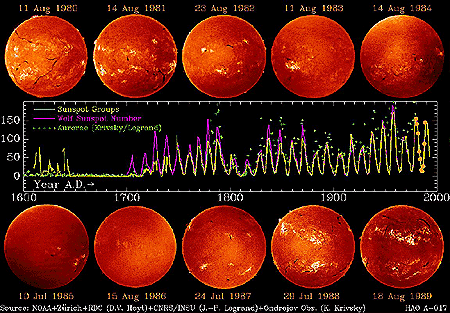
Why is a lack of sunspot activity interesting? During the period from 1645 to 1715, the Sun entered a period of low activity now known as the Maunder Minimum, when through several 11- year periods the Sun displayed few if any sunspots. Models of the Sun’s irradiance suggest that the solar energy input to the Earth decreased during that time and that this change in solar activity could explain the low temperatures recorded in Europe during the Little Ice Age [Lean et al., 1992]. _Eos_PDF_via_Reason
Real scientists are teaching the climate modelers a lesson: models are not the climate. Climate models are merely hypotheses in mathematics and computer code. They have to be thoroughly tested by scientific observations, before society is massively disrupted to suit the models.

Climate catastrophists wish to skip the normal steps of the scientific method, and pass from hypothesis directly to a massive overhaul of society and economy. I can hear you saying, "but that is sheer folly!!" Yes, I quite agree, but unfortunately, the US government has recently fallen into a quagmire of folly. Escape from the quagmire will not come easily.

Daily solar photos and solar status are available from SpaceWeather.

Update 28 Aug 2009, Further Reading:
How Small Fluctuations in Solar Radiation Lead to Large Climate Effects

The Oceans Really Are Getting Cooler

The Idiots and Their "Collapsing Ice Sheets"

Why the Oceans are such a good measure of Earth's heat content

Labels: , , ,

Bookmark and Share

22 April 2009

Sun to Earth: Look, Still No Spots!

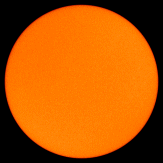
Compared to all the spots in 2001 (on the left), our 2009 sun (on the right) looks quite nude. Is it just a coincidence that the Earth is experiencing global cooling at this time? Despite all the dire predictions of dying reefs, melting icecaps, and worldwide droughts, the reefs and icecaps keep coming back from cyclical downturns. Antarctic sea ice is growing so fast that it threatens to create a cooling feedback effect in the Southern Hemisphere. It is important to understand that Antarctic sea ice has an order of magnitude greater effect on Earth's heat balance than Arctic sea ice.

What does the spotless sun portend for our near-future climate?
.....This was a period in the Little Ice Age when sunspots became very rare, as noted by observers of the era. During one 30-year period within the Maunder Minimum, astronomers recorded only about 50 sunspots. Although a simplistic correlation is rightly contested, the Maunder Minimum thus appears to coincide with the middle - and the severest part - of the Little Ice Age.

Moreover, a second time a cycle was delayed like our current ‘Solar Cycle 24’ occurred during the so-called Dalton Minimum, an especially cold period that lasted several decades from 1790. Northern winters became ferocious: in particular, the rout of Napoleon’s Grand Army during the retreat from Moscow in 1812 was at least partly due to the lack of sunspots.

Thus, what currently is happening to the average temperature of the Earth’s surface? Since at least 2001, it has been falling, and dramatically so during the last two years. _Source
The connection between sunspots and Terran climate is not direct, but is rather mediated by energy fluxes and particle "winds" interacting with the Earth's magnetic field and atmosphere, with the likely involvement of extra-galactic cosmic rays to boot. Ocean oscillations are a more proximate manifest determinant of climate control.

H/T Tom Nelson

Labels: ,

Bookmark and Share

04 June 2008

Sunspots Vanish, Earth Cools, CAGW Dying

Although total solar irradiance (TSI) may vary by only 0.1% over time, the effect this small variance has on the climate of Earth is profound. By charting trends in solar activity, and factoring in ocean oscillations such as the AMO, PDO etc, one can explain most of the cyclic variations in Earth's climate without considering variations in atmospheric CO2. Since H2O is the predominant greenhouse gas in the Earth climate system, it is likely that a better understanding of the water cycle will fill in large gaps remaining in the understanding of ordinary changes in Earth climate. Catastrophic changes--like glaciations--will likely need longer time scale explanations that can easily reach outside of our solar system.The Earth's temperature has not warmed over the past 10 years, even 20 years by some estimates. The recent month of May was quite cool, globally speaking. There are no sunspots yet again today. We have had nothing but "sun specks" recently, and the long overdue Solar Cycle 24 has yet to come out to play with the planets.

Some scientists are even predicting that sunspots will disappear altogether by the year 2015. It is unlikely that the sunspots themselves are causing warming or cooling, but the current paucity of sunspots reveals an unusual, unpredicted prolongation of solar cycle 23--and a delay to the start of solar cycle 24. Historically, longer solar cycles correlate with cooler temperatures, and lower numbers of sunspots correlate with lower temperatures. Please do not confuse "correlation" with "causation." Such confusion has made monkeys out of Al Gore and James Hansen, along with Ramachandra Pachauri.

CAGW is dying for lack of substantiation. It is being propped up by Nancy Pelosi, Barbara Boxer, other corrupt politicians, the news and entertainment media, and a few outspoken "climate celebrities" whose futures hinge upon keeping the public believing in catastropohic warming.

It is a matter of time. The current neurosyphilitic US Congress is gambling the economic future of the US on the CAGW hypothesis. If the hypothesis fails--which so far it is doing spectacularly--the futures of the climate crusading congressmen and celebrities will fail equally spectacularly. They simply must keep the charade going as long as they can, for their own sake.

H/T Tom Nelson

Labels: , ,

Bookmark and Share

23 April 2008

Sunspots and Ice Ages

Sunspot cycles average about 11 years in length. But cycles that are particularly long, with much lower numbers of sunspots per time period, tend to be accompanied by colder climates on Earth. Australian astronaut Phil Chapman is concerned that Earth may be approaching such a time of low sunspot activity--and colder climate--in the next several years.
The sunspot number follows a cycle of somewhat variable length, averaging 11 years. The most recent minimum was in March last year. The new cycle, No.24, was supposed to start soon after that, with a gradual build-up in sunspot numbers.

It didn't happen. The first sunspot appeared in January this year and lasted only two days. A tiny spot appeared last Monday but vanished within 24 hours. Another little spot appeared this Monday. Pray that there will be many more, and soon.

The reason this matters is that there is a close correlation between variations in the sunspot cycle and Earth's climate. The previous time a cycle was delayed like this was in the Dalton Minimum, an especially cold period that lasted several decades from 1790.

...There is no doubt that the next little ice age would be much worse than the previous one and much more harmful than anything warming may do. There are many more people now and we have become dependent on a few temperate agricultural areas, especially in the US and Canada. Global warming would increase agricultural output, but global cooling will decrease it.

Millions will starve if we do nothing to prepare for it (such as planning changes in agriculture to compensate), and millions more will die from cold-related diseases. __Australian
This fascinating PDF paper by David Archibald presents a very confident prediction of a coming period of extraordinarily cold climate due to hit Earth within the next 12 years, as a result of a cyclic solar downturn. We do not have long to wait, to see if Archibald is correct. If he is wrong, we can all sit back and have a good laugh at the ice age alarmists. If he is correct, we will all be too busy trying to mitigate the effects of a genuinely catastrophic climate change.
The “Little Ice Age” was a period of time between the late 1500s and the mid 1800s when glaciers advanced, winters in the northern hemisphere were unusually cold and the summer growing seasons were shortened. These conditions were well-documented in art and writings from the times, and are still, to this day, perceived as being unusual. One of the leading theories for why the climate changed so dramatically has to do with the number of sunspots observed during that same time period. Solar activity was extremely low, with some years having no sunspots at all. Fewer sunspots indicates fewer releases of solar radiation and hence less solar energy reaching the Earth.

Over a few years, this does not make a large impact on our climate. However over several decades, the lower amount of overall radiation reaching the Earth can have an impact on long-term weather patterns. ___Source
You will not likely read about these alarmist predictions in the New York Times, nor hear them from the BBC. The IPCC will almost certainly ignore these Chicken Little pronouncements from the "cooling alarmists", and Al Gore is too busy with his own "grand tour of doom" to consider an alternative--and much worse--catastrophe than his own pet warming apocalypse.

If the IPCC models are truly worthless, as IPCC insider and expert reviewer Vincent Gray maintains, then it is unlikely that the IPCC models will ever give us a hint of warning about a potential cooling disaster. IPCC models have all been carefully tuned to the warmer side of the scale.

Solar cycle-based predictions of climate change are refreshingly falsifiable. Solar Cycle 24 is slow off the starting blocks, and may signal a downturn in solar activity. But Solar Cycle 25 is the one that is predicted to be truly depressed. Solar Cycle 25 is due to start anywhere between 2017 and 2019, depending upon when Cycle 24 finally gets started in earnest--and how long Cycle 24 lasts. If solar energy input to Earth does turn down, and Earth's climate responds by cooling, then other predictions--such as a downturn in atmospheric CO2 levels--made by climate skeptics can be easily tested.

There are several possible physical mechanisms of solar influence on climate, which will need to be tested one by one. But it will be nice for science to return to climate studies. Falsifiable science is much to be preferred to the tautological climate models that provide only garbage out in response to garbage in.

H/T Tom Nelson

Labels: , ,

Bookmark and Share

22 March 2008

Sunspots and Little Ice Ages

The solar science community is at a loss to explain the much delayed start of Solar Cycle 24.In the next 20 years, humans should take enormous steps forward in the scientific understanding of their planet's climate. We are not there yet. Until we have the chance to collect more data from satellites, robotic ocean buoy monitors, solar observations, and better ground stations we will not truly know what has been driving Earth's climate. We have to get this right.
Solar irradiance has been monitored from satellites for three sunspot cycles. The sunspot numbers and solar irradiance were shown to be highly correlated. Since sunspot numbers have been increasing since 1935 the irradiance must also be increasing.

The sun was once considered to be constant in its output, hence the term “Solar Constant”. Recent observations suggest that the sun is a variable star. Observations of solar irradiance have been made with great precision from orbiting satellites since about 1978.___WattsUp
The sun remains spotless while Easter blizzards fall across large parts of the northern hemisphere. When trying to explain and predict a chaotic climate, it is difficult to separate cause and effect. But while warmer temperatures could easily cause higher atmospheric CO2 levels, it should be obvious that cooler climates on Earth cannot possibly cause fewer sunspots on Sol.

Update: For an interesting look at an unusually open media glimpse of recent startling climate change, check out this Australian article.

Labels: , ,

Bookmark and Share

01 March 2008

No Sunspot, Mumblings of Mutiny

The sun continues quiet--eerily quiet. People are starting to notice.
Cooler weather has the blogosphere alight with speculation about the climate’s real changes. Short-term temperature moves fire up both camps. From Planet Gore:

Hopefully this will cool the hysteria in the U.S. Congress and parliaments around the world so that we can understand the science of our climate before we pursue policies that could wreck our economy and quality of life.

Environmental Defense says one month does not a trend make:

Global warming is a process that occurs over decades. It can’t be proven or disproven by a single month’s temperature.

There are theories for all tastes. Daily Tech started it all, arguing that last year’s nippy weather “wipes out a century of warming.” Energy Outlook pored through the data and points at the sea. Maybe it’s the sun? Environmental Economics did the heavy lifting, parsed all the sunspot data from Goddard, and concluded that’s not to blame:

The current downturn in temperatures may be caused by a valley in the sunspot cycle. But that doesn’t mean that global cooling is taking place. It just means that temperatures are likely to be more variable until sunspot activity increases again.

Whether it’s sunspots, La Nina, or something else altogether, the timing couldn’t be better for the Heartland Institute, set to host a global warming skeptics powow Monday on Broadway. Friends in high places?___WSJblog

Who would have thought a few cold days and a little snow in Baghdad would get people talking about "global cooling?" What is worse, northern polar ice caps are growing and thickening, glaciers on Mount Kilimanjaro are growing again, and preliminary research findings on the cosmic ray hypothesis of solar climate influence are provocative.

Periods of extended low sunspot activity correspond historically to cooler climates on Earth. The details are still being worked out.

Image from SolarCycle24.com H/T TomNelson and GreenWatch

Labels: ,

Bookmark and Share

14 February 2008

Waiting for Sunspot

The sun has gone quiet. Really quiet.

It is normal for our sun to have quiet periods between solar cycles, but we’ve seen months and months of next to nothing, and the start of Solar cycle 24 seems to have materialized (as first reported here) then abruptly disappeared. The reverse polarity sunspot that signaled the start of cycle 24 on January 4th, dissolved within two days after that.___Anthony Watts___via TomNelson

Solar Cycle 24 is still trying to get started. Sunspots are a reflection of violent activity deep within the fluid sun. A lack of sunspots should tell us something about what is and is not happening within the star.
The Babcock model says that the differential rotation of the Sun winds up the magnetic fields of it’s layers during a solar cycle. The magnetic fields will then eventually tangle up to such a degree that they will eventually cause a magnetic break down and the fields will have to struggle to reorganize themselves by bursting up from the surface layers of the Sun. This will cause magnetic North-South pair boundaries (spots) in the photosphere trapping gaseous material that will cool slightly. Thus, when we see sunspots, we are seeing these areas of magnetic field breakdown.___Watts
The ancients understood the importance of the sun, and had their ways to jumpstart the sun god, whenever he got lazy. In the movie "Sunshine", scientists had invented an exotic matter bomb, to re-ignite a cooling sun.

What we may be seeing is a prelude to a solar minimum(PDF). If so, it is too early to determine whether it will be of short duration or intermediate duration. The Maunder Minimum of the 17th century had repercussions lasting over a century.

Labels: , ,

Bookmark and Share
Older Posts
Al Fin Main Page
Enter your Email


Powered by FeedBlitz
Google
WWW AL FIN

Powered by
Blogger

``