22 November 2012

China's Green Bubble: Just One of Many

This article is cross-posted and adapted from Al Fin Energy


China has achieved a great success in building up a gigantic productive capacity of wind turbines and photovoltaic panels. But what will China do now, with that success?
[China] now has the capacity to generate 6.2 gigawatts of solar power and 68.3 gigawatts of wind... the U.S. has 5.7 gigawatts of installed solar capacity and 51.6 gigawatts of wind power... _BW


One-quarter of China’s wind farms are not connected to a power grid—a reflection of poor planning, insufficient transmission lines, and technical concerns by regional utilities that the intermittency of wind power can be disruptive to normal operations. Wind-related power failures have caused blackouts in three provinces, while exploding equipment has been blamed in the deaths of several workers, according to local press accounts. _BW

Responding to a perceived market for green energy in Europe and North America, China engaged in a massive production build-up of wind turbines and photovoltaic panels. China was successful in building a vast production capacity of green energy generation. And now, China must face the consequences of its great success.
China’s $30 billion solar power industry is overbuilt and heavily in debt. Analysts say even billions of dollars in new government loans may not be able to pull it out of the hole.... Suntech Power Holdings (STP), the world’s largest solar panel maker, announced in September it would cut or reassign 1,500 workers at its photovoltaic cell factory in Wuxi. Suntech is counting on a $32 million loan from local authorities to avoid more job losses. To stay solvent, LDK Solar (LDK), China’s second-largest maker of solar wafers, was forced to sell a 20 percent stake to a renewable energy investor part-owned by the city of Xinyu, where LDK is headquartered. The support comes as the companies prepare to report combined 2012 losses of $987 million... Regional governments are loath to let their local solar panel makers fail.

... Help from local governments may be the biggest hurdle to making China’s solar industry competitive, says Shyam Mehta, solar analyst at the Boston consulting company GTM Research: “Until they stop supporting the uncompetitive manufacturers, this won’t go away.”

...LDK and Suntech both have balance sheets “so egregious” they would be “imminent bankruptcy candidates if they were American or European,” says Pavel Molchanov, an analyst at Raymond James & Associates. The companies didn’t respond to requests for comment. Molchanov believes infusions of government money won’t stop the losses until China grapples with its massive overcapacity—the same glut of panels that cut global prices by half in the last two years and drove U.S. solar panel makers such as Solyndra out of business. “Every province, every city, every bank is going to try to protect their vested interest as best they can,” he says. “That’s why kicking the can down the road has been the dynamic so far.” Aaron Chew, an analyst at Maxim Group in New York, concurs: “The government’s subsidy plan is better than nothing, but I don’t think it will save the industry as it’s still not profitable.”

The nation’s investments in wind power are faring no better. One-quarter of China’s wind farms are not connected to a power grid—a reflection of poor planning, insufficient transmission lines, and technical concerns by regional utilities that the intermittency of wind power can be disruptive to normal operations. Wind-related power failures have caused blackouts in three provinces, while exploding equipment has been blamed in the deaths of several workers, according to local press accounts....

China’s wind turbine manufacturers, responsible for 40 percent of the world’s output, are suffering a double squeeze, as demand has stalled both at home and abroad. Sinovel Wind Group, the world’s largest wind turbine maker by market value, posted a $45 million third-quarter loss this year on an 82 percent drop in sales—its largest loss since its initial public offering in January 2011. _Businessweek
China's green energy woes should have been expected, given the experience of other nations that followed a similar slippery downhill path.

Epic Failure of Spain's Grand Green Energy Gesture

Obama's Legacy of Corrupt Green Failures

Germany pays the price for its green foolishness

Modern industrial power grids cannot tolerate the huge moment-to-moment energy fluctuations of intermittent unreliable energy sources such as big wind and big solar. Whenever attempting a large scale conversion to "green power," initial economic costs are exorbitant. The cost of the power plants themselves, the cost of new power grid infrastructure, and the huge cost of maintaining spinning backup power sources. And then there is the cost to society as lower and middle income customers strain to pay skyrocketing power bills.

But the real costs of such an ideologically driven, top-down attempt to transform a national power grid and power supply, begin to emerge as the unreliables approach 20% or more of total power capacity to the grid. The violent and unpredictable intermittency of big wind power in particular, leads to power failures -- blackouts, brownouts, selective shutdowns of power customers, etc.

Industries begin to bail out of countries that are unable to provide reliable electrical power. A trickle becomes a flood, and before you know it a former continental powerhouse such as Germany begins to resemble a national ruin such as Greece. A world powerhouse such as the US -- if not for its shale fracking, coal, and remaining old-style nuclear power generation -- gradually decays to become an international ruin like Zimbabwe.

Russia and Saudi Arabia would love nothing better than to see the US and Germany bet their futures on intermittent unreliable green energy. Dictators love the fools who guarantee their job security into the indefinite future.

Labels: , ,

Bookmark and Share

26 October 2012

Haughty Huns Threaten Czechs and Pols: The Energy Wars

This article is cross-posted from Al Fin Energy


Germany is conducting an energy war, using the erratic and unpredictable wind as a covert weapon against its neighbors.
Germany is dumping electricity on its unwilling neighbors and by wintertime the feud should come to a head...

...Central and Eastern European countries are moving to disconnect their power lines from Germany’s during the windiest days. That’s when they get flooded with energy, echoing struggles seen from China to Texas over accommodating the world’s 200,000 windmills.

...Renewable energy around the world is causing problems... At times, the glut can be so great that utilities pay consumers to take the power and get rid of it.

...The problem may intensify with the approaching winter. With an insufficient north-south connection, Germany’s power network came close to a collapse last February when high winds in the Baltic sea flooded it with power and the Czech Republic and Poland threatened to disconnect their grids.

...“The Germans are using our infrastructure in an excessive manner,” CEPS board member Zbynek Boldis said in an interview in Prague. “At this point they’re getting a free lunch.”

...“Electricity follows a path of least resistance in the grid, according to the laws of physics,” Boldis said. “The result is that our transmission system is overloaded, we have security threats.” _Bloomberg
Big wind energy generates large and erratic power irregularities in the grid, on an almost instantaneous basis. These large power shifts cause expensive damage to critical power backup infrastructure, and significantly shorten the useful lifetimes of backup systems worth tens of billions of Euros or more.

Wind advocates claim that the problems of big wind can be solved using geographical averaging, supergrids, and energy storage. But a close analysis demonstrates that such is not the case.

The wind does not generally blow at times when the power grid needs the most power. And it tends to blow the most when the power grid is already well supplied -- forcing the grid to dump excess power at significant cost.

This de facto energy war is actually a religious war -- a crusade. Underlying green philosophies which drive the compulsion to overbuild wind and solar infrastructure, are equivalent to religious dogma, unsupported by science or empirical observations.

Over the past hundred years, Germany has had a tendency to start wars that devastated large areas of the world, leaving most of Europe in tatters for decades. Let us hope that this German-instigated war does not achieve the same dismal result. Preliminary analysis, however, does not provide much hope.

Labels: ,

Bookmark and Share

25 October 2012

Guest Article: 20 Bad Things About Wind Energy

The following is a guest article by John Droz
This guest article is being cross-posted to Al Fin Energy


1 – Wind energy was abandoned well over a hundred years ago, as even in the late 1800s it was totally inconsistent with our burgeoning, more modern needs for power. When we throw the switch, we expect that the lights will go on – 100% of the time. It’s not possible for wind energy, by itself, to EVER do this, which is one of the main reasons it was relegated to the dust bin of antiquated technologies (along with such other inadequate energy sources as horse and oxen power).

2 – Fast forward to several years ago. With politicians being convinced that Anthropogenic Global Warming (AGW) was an imminent catastrophic threat, lobbyists launched campaigns to favor anything that would purportedly reduce carbon dioxide. This was the marketing opportunity that the wind energy business needed. Wind energy was resurrected from the dust bin of power sources, as its promoters pushed the fact that wind turbines did not produce CO2 while generating electricity.

3 – Of course, just that by itself is not significant, so the original wind development lobbyists then made the case for a quantum leap: that by adding wind turbines to the grid we could significantly reduce CO2 from those “dirty” fossil fuel electrical sources (especially coal). This argument became the basis for many states implementing a Renewable Energy Standard (RES) or Renewable Portfolio Standard (RPS) – which mandated that the state’s utilities use (or purchase) a prescribed amount of wind energy (“renewables”), by a set date.

Why was a mandate necessary? Simply because the real world reality of integrating wind energy made it a very expensive option. As such, no utility companies would likely do this on their own. They had to be forced to. For more on the cost, please keep reading.
4 – Interestingly, although the stated main goal of these RES/RPS programs was to reduce CO2, not a single state’s RES/RPS requires verification of CO2 reduction from any wind project, either beforehand or after the fact. The politicians simply took the sales peoples’ word that consequential CO2 savings would be realized!

5 - It wasn’t too long before utility companies and independent energy experts calculated that the actual CO2 savings were miniscule (if any). This was due to the inherent nature of wind energy, and the realities of necessarily continuously balancing the grid, on a second-by-second basis, with fossil-fuel-generated electricity. The frequently cited Bentek study (How Less Became More) is a sample independent assessment of this aspect. More importantly, there has been zero scientific empirical proof provided by the wind industry to support their claims of consequential CO2 reduction.

6 – Suspecting that the CO2 deception would soon be exposed, the wind lobbyists took pre-emptive action, and added another rationale to prop up their case: energy diversity. However, since our electricity system already had considerable diversity (and many asked “more diversity at what cost?”) this hype never gained much traction. Back to the drawing board….

7 - The next justification put forward by the wind marketers was energy independence. This cleverly played on the concern most people have about oil and Middle East instability. Many ads were run promoting wind energy as a good way to reduce our “dependence on Middle Eastern oil.”

None of these ads mentioned that only about 1% of our electricity is generated from oil. Or that the US exports more oil than we use for electricity. Or that our main import source for oil is Canada (not the Middle East). Despite the significant omissions and misrepresentations, this claim still resonates with many people, so it continues to be pushed. Whatever works.

8 – Knowing full well that the assertions used to date were specious, wind proponents manufactured still another claim: green jobs. This was carefully selected to coincide with widespread employment concerns. Unfortunately, when independent qualified parties examined the situation more closely, they found that the claims were wildly exaggerated. Big surprise!

Further, as attorney and energy expert Chris Horner has so eloquently stated:

There is nothing – no program, no hobby, no vice, no crime – that does not ‘create jobs.’ Tsunamis, computer viruses and shooting convenience store clerks all ‘create jobs.’ So that claim misses the point. Since it applies to all, it is an argument in favor of none. Instead of making a case on the merits, it is an admission that one has no such arguments.

See a very detailed critique of the jobs situation at PTCFacts.Info. Listed there are TEN major reasons why using jobs as an argument is not appropriate or meaningful. Additionally there is a list of some 45 reports written by independent experts, and they all agree that renewable energy claims are based on numerous fallacies.

9 – Relentlessly moving forward, wind marketers then tried to change the focus from jobs to “economic development.” The marketers typically utilized a computer program called JEDI to make bold economic projections. Unfortunately, JEDI is a totally inadequate model for accurately arriving at such numbers, for a variety of technical reasons. The economic development contentions have also been shown to be inaccurate, as they never take into account economic losses that result from wind energy implementation – for example agricultural losses due to bat killings, and job losses due to higher electricity costs for factories, hospitals and numerous other employers.

Additionally, as with jobs, economic development in-and-of-itself has nothing to do with the merits of wind energy as a power source. Let’s say we have a transportation RES mandating that 20% of a state’s vehicles be replaced by horse power by 2020. There would be a LOT of “economic development” (making horse carriages and buggy whips, building horse barns, growing and shipping hay) that would result from such an edict. But would that be any indication that it is an intelligent, beneficial policy?

10 – Along the way, yet another claim began making the rounds: that wind energy is low cost. This is surprisingly bold, considering that if that were really true, RES/RPS mandates would not be necessary. For some reason, all calculations showing wind to be “low cost” conveniently ignore exorbitant subsidies, augmentation costs, power adjusting (see next item), additional transmission costs, and so on. Independent analyses of levelized costs (e.g. from the EIA) have concluded that (when ALL applicable wind-related costs are accurately calculated) wind energy is MUCH more expensive than any conventional source we have.

11 – A subtle (but significant) difference between wind energy and other conventional sources of electricity is in power quality. This term refers to such technical performance factors as voltage transients, voltage variations, waveform distortion (e.g. harmonics), frequency variations, and so forth. The reality is that wind energy introduces many more of these issues than does a conventional power facility. Additional costs are needed to deal with these wind-caused problems. These are rarely identified in pro-wind economic analyses.

12 – When confronted with the reality that wind energy is considerably more expensive than any conventional source, a common rejoinder is to object to that by saying that once the “externalities” of conventional sources are taken into account, wind is less expensive than those conventional sources.

To gullible sheeple, this might make sense. But consider the following two points. First, externality analyses posited by wind zealots never take into account the true environmental consequences of wind energy (rare earth impacts [see below], human health effects, bird and bat deaths, the CO2 generated from a two million pound concrete base, etc.).

Second, the “externalities” for things like coal are always only the negative part. If these advocates want a true big picture calculation, then they need to also add in the benefits to us from low-cost coal-based electricity. Considering that coal played a major part in our economic success and improved health and living standards over the past century, such a plus factor would be enormous.

[BTW there is some evidence that the negative externalities (e.g. about coal related asthma claims) are exaggerated. What a surprise!]

13 – A key grid ingredient is Firm Capacity. (A layman’s translation is that this is an indication of dependability.) Conventional sources (like nuclear) have a Firm Capacity of nearly 100%. Wind has a Firm Capacity of about 0%. Big difference!

14 – Since this enormous Firm Capacity discrepancy is indisputable, wind energy apologists then decided to adopt the strategy that wind energy isn’t a “capacity resource” after all, but rather an “energy resource.” Surprisingly, this may be the first contention that is actually true! But what does this really mean?

The reality is that saying “wind is an energy source” is a trivial statement, on a par with saying “wind turbines are white.” Lightning is an energy source. So what? The fact is that your cat is an energy source too. In this Alice-in-Wonderland reality, connecting the cat to the grid (after heavily subsidizing it, of course), makes as much sense as does connecting puff power.

15 - Wind marketers then hit on a new tactic: that we should use wind as it is a plentiful resource. This is a strategy based on a part truth: that we should be utilizing energy sources that are abundant, reliable, and low-cost. There are two major deficiences in this thinking.

First, abundant sources that are not reliable and that are not low-cost (i.e. wind energy), are a net detriment to our economy. Second, if they are really saying that abundance should be our primary focus, then they should be promoting nuclear power and geothermal energy. Both of these sources have something like a million times the available energy that wind does. Both of those are orders of magnitude more reliable than wind is. Both are lower cost when comparing the actual levelized cost of wind energy (e.g. Wind+ Gas).

16 - One of the latest buzz-words is sustainability. One has to give these marketeers credit for being persistently imaginative. The truth about sustainability is:

a) It is totally hypocritical to have wind advocates attacking fossil fuels as unsustainable, when the wind business has an ENORMOUS dependency on fossil fuels for their construction, delivery, maintenance and operation. This article explains some of it.

b) Nothing is sustainable, as this piece accurately explains.

c) Wind energy is our LEAST sustainable option!

17 – A related pitch is that our adoption of wind energy will help us break “our fossil fuel dependence.” Guess what? The reality is that wind actually guarantees our perpetual dependence on fossil fuels! In addition to wind turbines’ dependence on fossil fuels for manufacture, delivery and maintenance, the only way wind energy can quasi-function on the grid is to have it continuously augmented by a fast responding power source – which for a variety of technical and economic reasons is usually gas.

It’s rather amusing that the same environmental organizations that support wind energy are also against shale gas. That’s like saying that you love Italian food but hate tomato sauce. The two are paired together like Fred Astaire and Ginger Rogers.

Realizing that their best defense is a good offense, some of these hucksters are now contending the inverse: that wind actually augments gas! So wind that generates electricity 25±% of the time is “augmenting” gas, which has to supply the 75±%! This immediately brings to mind the British army band playing “The World Turned Upside Down.”

18 – The claim that wind energy is “green” or “environmentally friendly” is laugh-out-loud hilarious – except for the fact that the reality is not funny at all. Consider just one part of a turbine, the generator, which uses considerable rare earth elements (2000± pounds per MW).

The mining and processing of these metals has horrific environmental consequences that are unacknowledged and ignored by the wind industry and its environmental surrogates. For instance, a typical 100 MW wind project would generate approximately:

a) 20,000 square meters of destroyed vegetation,

b) 6 million cubic meters of toxic air pollution,

c) 33 million gallons of poisoned water,

d) 600 million pounds of highly contaminated tailing sands, and

e) 100,000 pounds of radioactive waste. (See this, and this, and this.)

19 – Modern civilization is based on our ability to produce electrical POWER. Our modern sense of power is inextricably related to controlled performance expectations: when we turn the knob, we expect the stove to go on 100% of the time – not just on those wildly intermittent occasions when the wind is blowing within a certain speed range.

Underlying a lot of the wind lobbyists’ claims is a carefully crafted, implied message that there is some kind of wind energy “equivalency” to conventional sources. This assumption is the basis for such assertions that XYZ wind project will power 1,000 homes. Such claims are totally false. They are dishonest from several perspectives: the most obvious error being that XYZ wind project will NEVER provide power to any 1000 homes 24/7 (or really seconds or fractions of a second within each minute of each hour). It might not provide power for even one home 86400/1440/24/7.

Yet we see this same “equivalency” message conveyed even more subtly on EIA tables for levelized costs. Wind and conventional sources should not be on the same table, but they are (defended only by a small footnote). One useful analogy is to consider the cost, speed, reliability and load capacity of a single eighteen-wheeler truck in making daily interstate deliveries of furniture, heavy equipment or other large products. This semi-truck is equivalent to a nuclear plant.

In energy generation terms, the wind turbine equivalent is to attempt to replace the single truck with golf carts. How many golf carts would it take to equal the cost, speed, reliability and load capacity of a single eighteen-wheeler in making daily interstate deliveries? This is a trick question, as the answer is that there is no number that would work: not ten, not a hundred, not ten thousand, not a million. Exactly the same situation exists in the electricity sector: no number of turbines will ever equal the cost, reliability and output of one conventional electricity plant.

20 – A close cousin of the prior illegitimate contention is that “The wind is always blowing somewhere, so spreading wind projects out will result in a combination that has a dependable output.” Like essentially all the wind industry mis-infomercials do, this bald assertion has a soothing, reassuring ring. But this marketing claim is unsupported by any empirical, real world evidence. For instance, in southeastern Australia about 20 wind projects are spread out over a single 1000± mile long grid. Yet the combined result in no way even approximates the consistent dependable performance of our primary conventional sources.

Again, our modern society is based on abundant, reliable, affordable electric power. All these specious claims for wind energy are simply part of a long line of snake oil sales spiels – intended to fool the public and enable politicians to justify favoring special interests by enriching various rent-seekers (which will then return the favor via campaign contributions and other reelection support).

They get away with this primarily for three basic reasons.

1 - Wind proponents are not asked to independently PROVE the merits of their claims before (or after) their product is forced on the public.

2 - There is no penalty for making bogus assertions or dishonest claims about their product’s “benefits,” so each successive contention is more grandiose than the last.

3 - Promoting wind is a political agenda that is divorced from real science. A true scientific assessment is a comprehensive, objective evaluation with transparent real world data – not on carefully massaged computer models and slick advertising campaigns, which are the mainstay of anti-science evangelists promoting political agendas.

So, in effect, we have come around full circle. A hundred-plus years ago, wind energy was recognized as an antiquated, unreliable and expensive source of energy – and now, after hundreds of billions of wasted tax and consumer dollars, we find that (surprise!) it still is an antiquated, unreliable and expensive source of energy. This is what happens when science is relegated to a back-of-the-bus status.

Paraphrasing Dr. Jon Boone:

Let’s see the real world evidence for the lobbyists’ case. I’m weary of these relentless projections, uncontaminated as they are by reality. In a nutshell, what these profiteers are seeking to do, through methodological legerdemain, is to make wind appear to be what it is not. This is a plot lifted out of Cinderella and her step-sisters, or the Emperor’s New Clothes. It’s really a story of class aspirations, but one that is bizarrely twisted: giving wind a makeover to make her seem fetching and comely when in fact she’s really a frog.

When you hear that wind opposition is all about NIMBYs, think about the above points, and then reflect on what NIMBY really means: The Next Idiot Might Be You.


__ written by John Droz and originally published at Master Resource

For a more thorough discussion, see this John Droz slideshare presentation.

Labels:

Bookmark and Share

17 October 2012

Germany Screws the Energy Pooch Bigtime

German Consumers Pay Big Price for Government's Energy Mistakes


Germany is attempting the impossible: It is attempting to replace safe and reliable nuclear power with exorbitantly expensive intermittent unreliable energy sources such as big wind and big solar. German consumers of electric power are already paying the price of this ill-advised policy of quasi energy suicide.

Oddly for a so-called green government, the Germans are rapidly building up their coal generation capacity, in an effort to avert total energy disaster from the intermittent unreliables.
Germany’s foray into renewables has not converted most of its neighbors and a number of them are planning to construct nuclear power plants of their own, just as Germany is getting rid of hers. _Germans Pay the Price
Of course most intelligent leaders would not follow Germany's path to energy suicide. It is easy to understand what happens to industrial economies when their power grids can no longer supply high quality, reliable electric power: They lose their industries to other countries that are still capable of supplying industrial quality power.
Despite technological advances, wind, solar, hydro and other green energy sources still remain an unprofitable investment in a fair market. The way to encourage their exploitation is through a set of feed-in tariffs, a policy where energy companies are forced to buy electricity from green generators at a price set by the government (which is usually legislated to remain the same for two decades).

The German government has passed the cost of the payment from the energy companies to the consumer. Every German on the grid pays something called Umlage, a special surcharge for supporting green fuels that covers all the green energy subsidies, however much energy is produced.

_RT
Germany is one of the worst conceivable places to build solar power infrastructure. Constantly cloudy, at relatively high latitude -- with almost no useful sun over large parts of the year.

Wind is even worse, with an erratic unpredictability that is said to be more threatening to power grids than throwing live hand grenades into grid control centres.

Industries are already leaving Germany, and more will soon follow. The loss of energy and jobs will damage the German economy almost as much as the exploding cost of new infrastructure required to deal with the intermittent unreliables. And the cost -- THE COST!!! Hundreds of thousands of lower class workers in Germany already cannot afford to pay their skyrocketing power bills. That number will only grow larger.

In an effort to stay in power just a few years longer, Germany's leadership has made one of the worst decisions that a modern government can make.

Germany was unlikely to be destroyed by outsiders, in the absence of another provocateur such as Hitler. But in this case, it is the Germans who are doing it to themselves.

With Germany as the pivot point for the European power grid and the European economy, what does this tell you about the future of Europe?

h/t The GWPF

More:

Germany faces power blackouts this winter

More energy price explosions confronting German rate payers

One may wonder, "what is the point of all this, if global warming stopped 15 years ago?"

Political left crucifies itself on a great green cross

Labels: , , ,

Bookmark and Share

07 October 2012

Big Wind Energy: A Green Fantasy of Destruction

Leftist greens fantasise of replacing all nuclear and fossil fuel power plants with big wind farms and big solar energy arrays. But there is a huge problem with that approach, which if pursued will lead to a drastic reduction in available electric power and a general impoverishment of any society that proceeds too far.

The most that big wind, for example, can safely contribute to a modern power grid, is between 6% and 20%, at the most.
The analysis reported in this study indicates that 20% would be the extreme upper limit for wind penetration...

Very high wind penetrations are not achievable in practice due to the increased need for power storage, the decrease in grid reliability, and the increased operating costs. Given these constraints, this study concludes that a more practical upper limit for wind penetration is 10%.... _Reason Foundation

The Korchinski Report "The Limits of Wind Power" (PDF)

More:
...wind turbines by themselves do not add electrical capacity to a grid. They must be paired with other generators of equivalent power to compensate for wind variations and for the stability of the electricity grid.

This pairing—wind and backup—has limits because of the huge rapid variability of wind that must be compensated for by the backup power source. It is estimated that this pairing can account for only 20 percent of the capacity of the grid. This means that wind can be only 6 percent of the generation (.20 x .3). This limit has already been reached in Europe by countries such as Germany and Denmark. _Ulrich Decher PhD

In addition to Germany and Denmark, other countries under EU environmental laws and regulations -- including the UK -- are in danger of entering the blackout zone via a green dysfunction of faux environmental zeal.

Al Fin began his exploration of energy with a strong a priori belief in support of both big wind and big solar energy. In the course of teaching himself about energy, he assisted a number of installations of home-scale wind, solar, and micro-hydro systems. These projects were educational as well as fun. People who are willing to work to build off-grid small scale power can be fun to be around, and often know how to party.

But there is a huge difference between using wind (and solar) for off-grid residencies, and attempting to use large-scale wind as a large proportion of total energy generating capacity for a finely balanced continental power grid. That is the lesson that Al Fin had to learn, and which modern societies must now learn -- before they destroy themselves in pursuit of impossibilities.

Good intentions can make one feel good about himself, but hard-headed, knowledge-based policy is what will keep a society prosperous and healthy. Green policies -- such as the lefty-Luddite green dieoff.orgiast policies promoted by the US Obama administration, the Julia Gillard government in Australia, or any one of a number of European governments (and the EU in general) -- will eventually destroy a society through energy starvation and impoverishment. Such societies eventually pollute the air, water, and soil in far more damaging ways than societies which were allowed by prosperity to move up the energy technology curve -- eventually arriving at safe, clean, and abundant sources of reliable and predictable power supplies.

Ideological efforts to short-circuit that trajectory of development -- such as modern green leftist ideologies -- will doom any societies which adopt them to ultimate failure.

Wind energy is unpredictably intermittent -- and thus unreliable. It is also enormously expensive in terms of materials, land, money, and other scarce resources.

Big wind will take any problem you are trying to solve -- and make it worse.

The renewable energy industry cannot survive without massive government handouts and stimulus. As economic slowdowns settle over Europe, the US, China, etc., governments can not afford to be as generous to big wind and big solar as in the heady days of economic booms and bubbles. Consequently, the renewables industry is beginning to suffer.

It is fine to hold strong opinions. But make sure that they are backed up with something stronger than good intentions. Parts of this article were adapted from an earlier Al Fin Energy piece.

h/t Anti-Green blog

Labels:

Bookmark and Share

13 August 2012

China: The Biggest Loser in Green Energy?

This article is cross-posted to Al Fin Energy blog

China is losing a lot of money on solar -- even more than Obama lost betting on the intermittent unreliable form of energy!
China’s top ten photovoltaic makers have accumulated a combined debt of 17.5 billion U.S. dollars so far, leading the whole industry to the brink of bankruptcy, data from U.S. investment agency Maxim Group showed.
Goodness. That’s 35 Solyndras!

LDK Solar, the world’s second-largest maker of solar wafers, and Suntech Power, the world’s largest solar panels producer, are the mostly likely to be headed for bankruptcy, Maxim noted. LDK reported a net profit loss of 1.08 billion yuan in the first half of this year, with a total liability of 26.7 billion yuan, about 88 percent of its total assets. 2.42 billion yuan of debts will come due in 2013, compared with a cash pile of only 830 million yuan. With its debt-to-equity ratio at 7.4, the Jiangxi-based LDK has already been in insolvency based on corporate accounting standards in the Europe and the United States, according to Maxim. A bankruptcy filing or restructuring could be needed for LDK, it added. _Reason

Unfortunately for the Chinese people, solar companies in China are devastating the landscape with toxic waste on a monumental scale.

And more than half of China's installed wind power lies fallow -- disconnected from the power grid! Imagine all the wasted resources, just to be able to claim a large installed wind power base.

But knowledge of the grand green charade of China's wind and solar industries has not reduced the fervour of US green political activists such as Barack Obama or Senator Harry Reid of Nevada. In fact, Senator Reid is indulging in a grand corrupt and nepotistic scheme in his home state of Nevada, involving a public lands give-away to a Chinese solar company and an associated US company involving his own son!

Of course this type of insider political deal is not unusual for either Nevada - style or Chicago - style political operators.

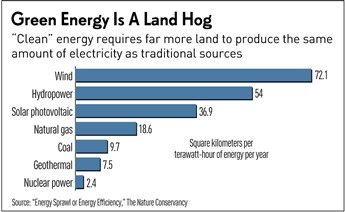
Energy Producer Land Requirements


China's grand scheme of infrastructure buildup -- including green infrastructure -- is proving to be something of a big bomb. China has been spending money hand over fist, stalling for time in hope that its big export customers -- Europe and North America -- would pull out of their economic doldrums, and start to buy Chinese products on a grand scale, once again.

China is getting a bit desperate, and cannot help but be relieved every time a foreign sucker -- in Germany, the US, Australia ect. -- gets sucked into another green energy scam.

Yes, China is poisoning itself to build and sell intermittent unreliable products such as big wind and big solar energy generation equipment. But if foreign devils like Harry Reid, Barack Obama, Angela Merkel, etc. are stupid enough to buy this junk at high prices, why not? It's not as if China's people can do anything about it.

Labels: , , , ,

Bookmark and Share

12 May 2012

Obama Regime Seeks to Allow Killing Bald Eagles

Up until now, it has been a federal crime to kill a bald eagle inside the United States, without a difficult to obtain permit. But now, Obama officials are moving ahead to expand decriminalisation of the act of killing the US national bird. The regime has never cared for patriotic symbols, of course. But the reason for the impending open season on bald eagles has more to do with carbon hysteria and promoting unreliable and intermittent forms of energy, than with any latent anti-American tendencies residing within the administration.
The USFWS [US Fish and Wildlife Service, Division of the US Department of the Interior] explains at FederalRegister.gov:

We have reviewed applications from proponents of renewable energy projects, such as wind and solar power facilities, for programmatic permits to authorize eagle take that may result from both the construction and ongoing operations of renewable energy projects. During our review, it became evident that the 5-year term limit imposed by the 2009 regulations (see 50 CFR 22.26(h)) needed to be extended to better correspond to the timeframe of renewable energy projects.
Current law allows permitting for “programmatic” killing of bald eagles, which “is recurring, is not caused solely by indirect effects, and that occurs over the long term or in a location or locations that cannot be specifically identified.”

The USFWS notes that permits “may authorize lethal take that is incidental to an otherwise lawful activity, such as mortalities caused by collisions with rotating wind turbines.”

According to the regulation, measures will be taken to attempt to minimize bald eagle mortalities, and additional actions may be authorized if mortalities exceed “anticipated” levels. USFWS began investigating numerous bald eagle deaths associated with wind turbines in early 2012.

Without the proper permit, the killing of a bald eagle is a federal crime. _Foundry_via_GWPF
The killing of bald eagles in order to permit the overbuilding of an unreliable, intermittent, exorbitantly expensive and wasteful form of energy production, is a double crime to many Americans. Not only is the Obama administration cynically facilitating the killing of a national symbol. They are doing so in the name of an expensive and heavily subsidised form of energy which will only destabilise the power grid, without providing any tangible benefit.

Inept leadership is bad enough. Unfortunately, the Obama regime is far worse than merely inept. It is becoming devotedly destructive.

Labels: ,

Bookmark and Share

11 January 2012

Big Wind and Solar Power: When Al Fin Changed His Mind

Actually, Al Fin has changed his mind on many things over the years. But this is one topic that you can check for yourselves. Do a topic search on "Renewable Energy" on either alfin2100 (Al Fin) or alfin2300 (Al Fin Energy). You can trace the progression of Dr. Fin's attitude toward big wind and big solar from "very favourable" all the way to "very unfavourable." What happened? No money changed hands to prompt the transformation. It was merely a question of looking at verifiable facts over time, and being compelled logically to change.

But in the larger world, big wind and big solar still have their champions -- from the US White House to the big money green activist groups to the EU bureaucratic apparatus to big money investors who benefit from government subsidies and tax breaks, such as Warren Buffett.

Now we are being told that "renewable energy" has surpassed nuclear power in terms of "energy generation." Does this mean that big wind and big solar are delivering on their promises? Well, no, not really. Look at the chart below, which breaks down the categories of "renewable energy."
RealClearEnergy
The recent reports that renewable energy has overtaken nuclear power as a source of primary energy for the nation have created the mistaken impression that all the windmill and solar panel construction is having a decisive impact. In fact, as the Energy Information Administration's December Monthly Report reveals, 80 percent of "renewable energy" is still supplied by hydroelectricity, wood and biofuels. Twelve percent comes from wind and 1.2 percent from solar. An additional 6 percent comes from burning waste - which not everyone regards as "renewable" - and 2.5 percent comes from geothermal energy.

...Under this set of definitions, the consumption of renewables actually exceeded nuclear power before 1987, until nuclear gained ground as more reactors were completed. Renewables declined after 2000 while nuclear continued to expand from improved performance by existing reactors, even though no new reactors have been built. The slight ascent in renewables over the last few years has come from the expansion of wood, biomass and wind. _RealClearEnergy
It is important to emphasise that no matter how much big wind "capacity" is built, that is not the same thing as power production. And just as important, one must point out that the wind tends not to blow at the time the power is needed. This is a fatal flaw in the big wind scheme. Not only must expensive backup power capacity be built and kept on constant standby to supply any wind deficits, but if wind power output should happen to be excessive in relation to demand, the utility must find a way to dump significant power. In the US Pacific northwest, federal judges have forced utilities to pay wind developers for power, even if the utility could not use it!

This moment-to-moment unreliability of wind generation has been likened to "throwing a live grenade into the power grid control booth." Wind farms are also harmful to the health of people living nearby, and to birds and bats -- for what that is worth to your tender hearts.

Big solar power has many of the same problems, except it is even more expensive than wind. Mr. Obama invested billions of dollars in US taxpayer dollars into already failed or soon-to-fail big wind and big solar projects. But since the backers of these projects were political backers of Mr. Obama, a few $billion wasted here or there doesn't amount to much.

The Obama administration -- for reasons of its own -- is rather slow at catching on to the ruinous effects of the mad pursuit of big wind and big solar, on the national power system and economy. But the governments of Spain and Japan have already been forced to drop their most of their generous government subsidies for these green wastrels, out of a return to basic economic common sense.

Sharp contraction ahead for solar power industry

Vestas Wind Systems shares lost 92% of value since 2008

General problems with wind power ... articles from Master Resource blog

This slideshare presentation on wind power started the shift in Al Fin's opinion of big wind power

It should be noted that Al Fin took a sabbatical from his day job a number of years ago, in order to get involved in one of his greatest enthusiasms -- renewable energy, esp. wind and solar power. He expanded his knowledge of power systems, electrical engineering, and residential, commercial, and industrial electricity, in order to be able to participate in the installation of renewable power systems. He had a great deal of fun in the process, and felt he was accomplishing some good things.

He had to return to his day job, but he retained his warm feeling toward wind and solar power. But along the way, Dr. Fin learned that there is a tremendous difference in justifiability between a small, off-grid wind or solar installation and a giant wind farm or solar plant. With a small installation, one keeps a close watch on his power usage, power generation, and battery storage state. With large wind or solar installations, there is no way to control for intermittency, unreliability, the huge cost of power standby, and many other problems.

And thus was a mind changed. And a voice that had once promoted big renewables changed to one that criticises them quite harshly.

Minds that are incapable of changing, are minds that have passed their due date -- regardless of the age of the individual. The most fruitful way of understanding a controversial field where the opponents are closely matched, is to study the arguments of those who have changed their minds. Sometimes the arguments justify the change, and sometimes not, but they are typically informative and educational both for what they include and for what they leave out.

Trillions of dollars are on the line in connection with the catastrophic anthropogenic global warming argument. If you want to study a high stakes disagreement, that would be an excellent place to start. BTW, Al Fin changed his mind on that topic as well.

Labels: , , ,

Bookmark and Share

20 June 2011

China's Wind Infrastructure to Nowhere

China is trying to increase its use of alternative sources of energy. To that end, the country has installed billions of dollars worth of wind turbines. In fact, in 2010, China surpassed the United States as the country with the most wind turbines installed.

But despite China's recent upsurge in wind farms, Ma says, there's an infrastructure problem that hasn't been widely reported. Many of China's wind turbines can't connect to the country's larger electric grid. There aren't enough cables, wires, and related technology to bring wind-generated electricity from rural Mongolia. That's where most of China's wind turbines are located--far from the densely populated hubs of China's northeast and south, where electricity is most needed _FastCompany
In the midst of China's mad rush to build infrastructure, the weakness of its command economy is exposed. Despite its impressive GDP numbers, China is a poor nation filling itself with ghost cities, ghost highways and railways, ghost infrastructure of every kind -- much of which is destined to crumble and fall prematurely due to rushed, shoddy construction.

Even worse than low quality overbuild, is China's bloated financial and economic infrastructure, corrupt to the core.

The ghost numbers of China's ghost economy impress only those who are incapable of looking to the heart of China's economic problem -- the lack of meaningful market level decision making and housecleaning. China's human masses are its greatest value, yet due to China's corrupt government the incredible creative power of China's people is being constrained and oppressed, wasted, like the massive ghost infrastructure to nowhere that begins crumbling even before it is completed.

Labels: ,

Bookmark and Share

14 February 2011

Why Big Wind Power Won't Work

WUWT

Obama's regime and faux environmentalists around the globe have been gung ho over big wind power farms for years now. And every time anyone takes a close look at the economics and the details of wind energy, they come back to the same fact -- wind doesn't work.
The operating characteristics of turbine and generator mean that only a small part of wind energy can be captured.

Wind power is also intermittent, unreliable and hard to predict. Therefore large backup or storage systems are required. This adds to the capital and operating costs and increases the instability of the network. Wind farms are uniformly hated by neighbours and will not be willingly accepted without heavy compensation payments. Their noise, flicker, fire risk and disturbing effect on domestic and wild animals are well documented.

The wind is free but wind power is far from it. Its cost is far above all conventional methods of generating electricity. Either taxpayers or consumers will pay this bill.

...Electric generators achieve maximum efficiency at their design capacity. This is planned to suit the "average" wind speed, and the generator produces maximum safe output at this speed. If the wind drops, so does the power generated. If the wind rises, the energy generated is limited to the design capacity of the generator (by varying the pitch of the blades) and at some point the generator is shut down to prevent burnout. So the generator cuts off all the high-energy infrequent wind, in order to capture the maximum energy from the winds expected by the turbine designers at that location. These unavoidable operating characteristics of the turbine also reduce the power generated.

...Wind energy promoters usually quote the maximum attainable output as the capacity of the wind farm. This is the maximum power that could be produced if ideal winds blew all the time at all turbines (the 100% level in the figure above). However, this needs to be multiplied by the "capacity factor" to get the actual power likely to be generated. Because of the variable winds and the energy unable to be captured by the generator, the capacity factor lies in the range 25% - 35%. However it can be much lower. UK offshore wind rarely exceeds 20%.

In summary, wind power is very dilute and it takes a huge area of land to collect significant quantities of energy. Then vagaries of the wind mean that only a small proportion of the wind energy can be captured by the blades. Then only a proportion of this energy is converted by the electrical generator into electrical energy.

...In the recent frigid snap in Britain end 2011, when power demand was at a record high, the average power generation from Britain’s wind developments – the majority of which are in Scotland – was just about 11% of the total possible of 2,430 MW. On 30 Dec 2010 UK's 3,000 operational wind turbines produced only 0.04% of the country’s power. There were days when the contribution from Scotland's forests of wind turbines was precisely nothing. At times it was even worse than that. As the temperature fell to record lows, the wind turbines had to be heated to prevent them seizing up. So, at a time when all Britain needed every bit of power, the wind industry was using more electricity than it generated.

...Depending on the vagaries of the weather, wind power produces anything from zero to 100% of design capacity. This change can come in a short time and affect large areas of land. Therefore, to maintain grid stability and the ability to supply customer demand for continuous electricity, every wind farm has to have a backup generating facility for 100% of the wind capacity, and this backup must be able to swing into production immediately.

It is even worse than that. Suppose a wind farm is producing an average of 50 MW, but varying from zero to 100 MW. The backup has to be able to handle both changes, namely a drop of 50 MW and an increase of 50 MW. So basically, you have to have 100 MW capacity on spinning reserve, but running at 50% so that you can increase or decrease power by 50 MW. So the backup facility has to have TWICE the real rated capacity of the wind farm. Imagine what this does to the capital, operating and maintenance costs if the power company is forced to include wind power in its inventory.

Only hydro power and gas have the ability to sit idle until needed and then swing into production swiftly. Coal and nuclear could do it but at great cost – all fired up, idling, using fuel, but not producing saleable electricity. Even for gas or hydro, a backup facility incurs the full additional capital cost which has to be recovered from a lower output of electricity. Any sensible person would say "If we have to spend all that capital to build a gas/hydro power plant, why not use the reliable plant full time and forget about the costly, intermittent and un-predictable power from wind towers?"

The unreliable Danish wind farms only survive because they call on hydro power from Norway and Sweden to step in at short notice when wind fails. Then they sell excess wind power produced at times of low demand back into the Scandinavian grid.

...A wind tower is a massive industrial plant. Each turbine requires a foundation of almost 1,500 tonnes of concrete and a base of about 5 acres. Each structure stands nearly 200 metres tall and they could be as close as 140 metres apart. UK has a plan to generate 30% of its electricity from renewables by 2020. For wind power to do this would require about 15,700 wind towers. At 140 metres apart, they would stretch from the north of Scotland to the south of Spain.

...And it is unsafe anywhere near them. Lumps of ice, burning embers, and broken blades get slung off and towers collapse. In one case, a broken blade was flung through the window of a house over 5 km away.

...Danish electricity consumers pay higher prices than any other Europeans. And well before they could repay the initial capital, the wind towers are reaching the end of their life and will need to be replaced. Not one coal power plant has been replaced by wind power. It is doubtful if all this community pain and suffering has reduced carbon dioxide emissions. It has certainly caused no measurable improvement to global climate and has brought great environmental damage and human worry. The sorry story of wind power in Denmark is mirrored in Spain, Hawaii and California.

... _Why Wind Won't Work PDF_ via_ WattsupWithThat?!?!

If you want to understand the modern clusterfuck of big wind power, read the PDF document linked above, together with John Droz' presentation on wind power, Ted Rockwell's Energy Facts PDF, and David MacKay's Without Hot Air.

Such documents changed the minds of Al Fin energy analysts about big wind, as you will see if you go back far enough in the archives. Al Fin engineers particularly hate the idea of placing fine machines out in the elements to be tortured and destroyed long before their time. This has been particularly true of offshore wind installations, where fine turbines and gearboxes are exposed to salty spray, wind, and the constant inertial stresses of wind, wave, and storm.

Clearly President Obama and former Vice President Albert Gore are both world class dunces, besides both having won the Nobel Peace Prize. They are also corrupt, team-playing dunces who will end up personally benefiting in the hundreds of millions of US$, at the least, for their destructive influence on economies, energy supplies, and R&D budgets.

Labels: ,

Bookmark and Share

04 February 2011

Nuclear Energy Needed to Prevent Blackouts in Age of Global Cooling

If Texas had made the same dollar investment in new coal and/or nuclear power plants they would probably be snug and warm tonight. Do we we really want to sacrifice our families’ safety and security along with business productivity during extreme cold for the sake of political correctness? _WUWT
The rolling blackouts experienced in Texas recently were caused by problems with wind, gas, and coal systems to adjust to freezing conditions and increased power demands. Nuclear power is different from the other power sources mentioned above, and is clearly the power source of choice for an ice age or an age of global cooling (possibly along with enhanced geothermal).

US President Obama's Nuclear Regulatory Commission has been excessively slow to license and approve safer, more reliable new reactor designs, which makes it almost impossible for the US to provide more secure and reliable power to the people. Amazingly, the Obama NRC has still not given approval for construction of new plants using the Westinghouse AP1000 reactor.
If the NRC approves the AP1000 design, the agency could decide by the end of 2011 on whether to issue construction licenses to Southern and SCANA to build their nuclear reactors, according to Jaczko.

"We will continue to work on a schedule that puts us in a position to make some final decisions possibly by the end of this year," he [NRC's Jazco] said. _Reuters
Take your time, Jazco. It's only the future of the American society and global security that is at stake. Bureaucrats rule in the modern US, so pay no attention to the little people and their needs.

It should be obvious that the US can no longer allow its bureaucracy and Luddite political class to drag its feet on the future.
It is clear that, were our reactors allowed to retire as originally planned, the nuclear industry’s contribution to clean energy production would all but disappear by 2035. Fortunately, some license renewals, which extend a reactor’s lifetime by 20 years, have been approved and others are in line.... even in the best case, in which all licenses are renewed, about 25% of our fleet will be retiring in 2035, making it very unlikely that the US’s clean energy portfolio can grow in that time frame.

This alarming scenario should hurry the construction of new reactors. Though building 784 new plants is an impossible target, the AEF Committee judged that 5 to 9 additional nuclear plants could be brought online by 2020. As espoused in my first article, there is no need to wait around for research breakthroughs; proven reactor technologies are ready to be built now, as China continues to demonstrate. _leadenergy
The Obama administration and its Luddite counterparts at state and local levels, continue to drag their feet on providing reliable power sources -- while they continue to spout nonsensical gibberish about the "promise of wind and solar power."

But what good are wind and solar power when solar panels are covered with snow and ice, and ice-covered propellers on wind turbines prevent power generation -- even in perfect winds?
Wind generators also appeared to be having problems, said Fraser; he had received reports of some turbines shutting down because of issues with ice on the blades. "The wind was blowing yesterday, but I'm not sure wind generation was available because they had problems with ice," he said. _MetMusings

In the recent Texas power blackouts, wind was not the only power source to fall down on the job. Water pipes at coal plants froze and broke, gas pipelines failed to provide adequate pressures to gas plants, and huge piles of coal froze to unusable condition in the ice and snow storms.

The problem had several causes, but we have learned one thing -- in conditions of extreme cold, wind power and solar power are not sources that can be reliably depended upon.
The system needed all of the power it could get. Had more thermal plants been built, at least some of them would have been in service and helpful. Outages would have been moderated a little. Wind generated power was used and useful, but couldn’t be dialed up to produce more during a time of need. Wind power was neither the cause of the problem, nor of any special value in reaching a solution. _MasterResource
It is time for voters and ordinary people to jettison the lefty-Luddite politicians and bureaucrats who are exposing them to potentially fatal risks, all in the name of a failed ideology of faux environmentalism and pseudo-scientific carbon hysteria.

Nuclear power is the best power source for extreme cold -- for most advanced nations -- since all components of the generation system are contained indoors, well protected from the elements -- and do not rely upon the supply of fuel from the outside, which can be disrupted in many ways during extreme weather.

Sure, we need to replace above-ground transmission and distribution lines with secure, buried, and preferably super-conducting lines. But that will take time, and will require severe budget cuts in entitlement spending and public sector union benefits to provide the necessary resources. Before that can happen, heads will need to roll -- in a figurative sense, naturally. (human heads are not perfectly round, so they do not roll as smoothly as one might wish) ;-)

Al Fin was once an enthusiastic supporter of all types of wind energy -- and still supports small wind turbines for niche and off-grid uses. But human minds which are functional will continually monitor the world around them, and take in new information and data. In the course of time, working minds will change and grow with experience. Those minds which are incapable of learning, growing, and changing, may as well not even exist, for all the harm they are likely to do. Particularly when they are in positions of power and responsibility.

Other perspectives on this issue from nuclear bloggers Charles Barton, and Rod Adams.

Power blackouts play hell with electric vehicles. Best to keep your own reliable backup power source at home or place of business -- along with necessary fuels. Relying on the dumbed-down commons for life and death needs can be a fool's play, but in a society of perpetual incompetents -- the Idiocracy -- it is what it is.

Hope for the best, plan for the worst. Always keep an ample supply of food, water, fuels, necessary medicines, cash, power source, communications gear, etc., and the means to prevent riff-raff from taking it from you. The police are never more than 10 minutes away, whenever a situation calls for an instantaneous response. Perhaps a bit longer if they belong to public sector unions.

Labels: , , ,

Bookmark and Share

22 August 2010

Wind Turbines Blow

Most people wonder how much power a wind turbine can produce, and never stop to wonder how much power a wind turbine requires to operate. Mechanical engineer Jerry Graf believes that it is long past time for people to ask that question:
Big turbines often incorporate rechargeable batteries or ultracapacitors to power their own electrical systems. When those get depleted, the power must come from the grid. This power goes into running equipment such as yaw mechanisms that keep the blades turned into the wind; blade-pitch controls that meter the spinning rotor; aircraft lights and data-collection electronics; oil heaters, pumps, and coolers for the multi-ton gearbox; and hydraulic brakes for locking blades down in high winds.

Turbines in northern climes also need blade heaters to prevent icing. Reports I’ve seen say these heaters can consume up to 20% of a turbine’s rated power output. Many big turbines also need dehumidifiers and heaters in their nacelles. And until recently, large turbines employed doubly-fed induction generators that bleed power from the grid to create their magnetic fields. (It should be said, though, that designs now on the drawing boards use permanent magnets instead.)

Instances of low or no wind pose another problem. Large turbines may need to use their generators as motors to help get the blades turning. And some wind skeptics have posed a question about the direct-drive turbines now emerging from the labs: Large ships frequently must expend energy to slowly turn their heavy driveshafts when at port to prevent them from sagging. Could the same be said of these superlarge wind turbines?

Wind-farm operators don’t say much about turbine-power demands. Typically, turbine-power consumption is one of the factors that gets lumped into a wind-farm’s operation and maintenance costs. I’ve never found either a wind-farm operator or a wind-turbine maker willing to discuss these costs. It would not be much of an exaggeration to say the wind industry treats such information as a state secret. _MachineDesign
There are too many aspects to the operation of big wind farms which are treated as state secrets. No wonder the O-P reich promotes wind power so heavily. Politicians are no doubt attracted to the "all image and no substance" aspects of big wind power.

More bad news about big wind

...Jeffry Michel, an MIT engineering graduate living in Germany, once informed me that the average capacity factor in Germany is about 21%. In other words, if 1000 kilowatt hours of (electric) electricity from a windmill are theoretically available during a year, the average (or better the expected) amount accessed during the same time period would only be 210 kilowatt hours. A year or so ago one of the leading energy/environmental bureaucrats in Sweden calculated that with a capacity factor of 25%, four (4) windmills with a capacity of e.g. 1000 kilowatts could replace a nuclear installation of 1000 kilowatts with a capacity factor of 100%, and as a result, with existing (construction and variable) costs, the windmills were a better economic prospect. Bizarre calculations of this nature were probably responsible for making (and keeping) Sweden one of the poorest countries in Europe until the Second World War....
Adapted from an earlier Al Fin Energy posting

Labels:

Bookmark and Share

07 June 2010

Green Bubbles of Wind and Solar Threaten to Burst

Small wind and small solar can fit very nicely into particular niches -- such as off-grid energy production. But large wind and large solar projects are another thing entirely.

There has never been a good economic justification for large scale wind or solar projects. Europe fell head over heels for the green energy -- carbon hysteria scams long ago, but is just now beginning to pay a tremendous price for its folly. Any other economies that are foolish enough to join Europe in its delusional pursuit of wind and solar power -- to the neglect of clean nuclear and advanced coal $ gas, will pay a huge economic penalty.
... few if any wind energy, solar energy, and other green electric power installations could make money without subsidies. As governments across Europe curb spending and cut subsidies in response to the Greek crisis, the props to green energy are being cut back. As almost each day is marked by a new, and harsher national austerity plan announcement in countries ranging far up the scale from small-size Greece, we can be sure that reining in deficits will not be kind to green energy vanity projects.

On May 6, German lawmakers reduced subsidies to new solar plants by as much as 16%, dealing another blow to the generally high cost German solar energy industry, already faced with rising, low cost competition from China and India. Italian solar industry groups expect government support for new wind and solar energy power generation plants to be scaled back by 25% or more, in June.

In Spain, where subsidies to the country's massive windfarms and their dependent industries is estimated to have attained as much as 12 billion Euros in 2009, either directly or through "feed-in tariff" subsidy for power sales, government proposals target at least a 30% cut in subsidies.

... Sales and profits for North American and Chinese renewable energy companies selling their products in Europe have declined, as the Euro has lost about 15% against the US dollar this year. Affecting profits more than sales in first impact, profits for China's leading solar-cell maker Yingli Green Energy will fall more than 40%, and Yingli's major home rival Suntech Holdings will suffer a 79% drop in profits, according to Barclays Capital analysts, if the Euro stays below $1.25 in the next 6 months.

This has quickly spilled over to stock price valuations. European, North American, Chinese, and Indian wind and solar energy companies are suffering large falls in their stock price value. The higher priced, higher tech sectors have been most affected, shown by Canadian Solar's stock falling about 50% since April 1, while stock of Suntech Holdings is off by 35% since April 1. Spain's biggest producer of wind turbines, Gamesa Corporacion, has lost 43% of its share price value since January 2010, and 19% since April 1. _EnergyTribune

Without Hot Air Energy Facts
Wind Energy Facts
Nuclear Energy Facts Report PDF

Previously published at Al Fin Energy

More:
Arizona's problems with grid-tied photovoltaic
Waiting for big wind and big solar to become competitive
Obama painting US energy into a corner?

Labels: ,

Bookmark and Share

27 April 2010

Wind Power Emerges as Scandalous Failure

Hundreds of European offshore wind turbines have a design flaw that causes them to slide on their bases . More, expensive gearbox failures are an industry-wide problem . Worst of all,wind energy is unpredictable and massively expensive for power utilities to integrate into a dynamic power gridPDF. Big wind turbines are gaining a well-deserved reputation as expensive failure-prone hobby-horses for incompetent green activists and politicians.

Now that we have discovered how deep and wide the problem of organised crime infiltration into the wind industry is becoming, it is long past time for taxpayers to begin to confront their elected officials with the massive waste and fraud that their tax dollars are being diverted to support.

Whenever klutzy monolithic governments are made to scramble to solve a nonexistent manufactured problem such as carbon climate catastrophe, waste and fraud are guaranteed to occur -- probably on a massive scale. Indeed, that is what we are seeing across a broad panorama of wind industry investment, lobbying, and media public relations. There are literally trillions of dollars to be made in the "clean energy industry", and political reputations to be made. Nothing can be allowed to stand in the way of the juggernaut -- not even the stark cruel facts.

Wind power is expensive, unreliable, and prone to massive breakdown at any time. Siemens and General Electric are attempting to evade one massive problem of wind turbines -- ubiquitous gearbox failures -- but the new turbines have their own problems, and faulty gearboxes are just one piece of the ugly puzzle. Even if wind turbines could perform as specified for their full "20 year lifetime", they would not be close to competitive with nuclear, coal, or gas for electric power production.

The Obama - Pelosi regime is in too deeply to back out of the crime-ridden enterprise now. They have to "tough it out" and hope that they can keep the media under their thumb so that the masses of taxpayers never learn what they are doing.

Labels: , ,

Bookmark and Share

Shocker! Why Organised Crime Likes Carbon Hysteria

Anthony Watts looks at an aspect of the global climate complex that is more than a little bit alarming. Is it possible that organised crime has penetrated much more deeply into the politics and "science" of global warming than anyone thought? We know that organised crime has penetrated the European carbon trading schemes. Could the rot go even deeper?
Much like the late 19th century produced plenty of sordid stories and crime in the development of the oil industry, there is a lot of organised crime rushing to get involved in renewable energy. We can either praise the mafia’s newfound sense of ecological correctness or note the large amount of government subsidy being thrown around rather carelessly.

... In 2009 alone, 19 were arrested in Spain in connection with corruption surrounding a wind farm, there was a scandal regarding recycled carbon trading permits in Hungary, a regulator in Maine accepted an ownership interest in a company he regulated and which he went on to lead, a Washington biologist is accused of steering wind farm funding to his non-profit, Canada is investigating lobbying violations by green lobbyists, the list literally goes on and on. _Wattsupwiththat
Anthony goes on to disclose that Lord Oxburgh -- chairman of a recent official investigation into wrongdoing by climate scientists at EAU's CRU (ClimateGate) -- has close connections to companies that would be badly harmed should the investigation disclose any wrongdoing on the part of the climate scientists. Not surprisingly, Oxburgh cleared the scientists of any serious mischief or deception.

It is increasingly clear that the worldwide crusade of carbon hysteria is itself a colossal scam, meant to relieve developed countries of trillions of taxpayer dollars over the next few decades -- for no good reason except graft on the part of UN officials and third world leaders. Is it so surprising that the mafia and other criminal organisations would want to get in on such a grand scam?

Labels: , ,

Bookmark and Share

28 March 2010

Jive Castles In the Air

President Obama promises to save us from carbon climate doom, using the wind. Should you trust this man's promises?
A recent detailed analysis (focusing mainly on Spain) finds that for every job created by state-funded support of renewables, particularly wind energy, 2.2 jobs are lost. Each wind industry job created cost almost $2-million in subsidies. _FP
In an earlier Al Fin post, I alluded to the high cost of maintenance for wind turbines. We are not supposed to notice or talk about such things as maintenance -- even though such mundane matters are often the ruin of great and ambitious undertakings. But wind turbines are expensive, precision made machines that are exposed to the elements, and subject to prolonged and violent motion. They break down -- expensively and often.
The wind energy industry has experienced high gearbox failure rates from its inception [1]. Early wind turbine designs were fraught with fundamental gearbox design errors compounded by consistent under-estimation of the operating loads. The industry has learned from these problems over the past two decades with wind turbine manufacturers, gear designers, bearing manufacturers, consultants, and lubrication engineers all working together to improve load prediction, design, fabrication, and operation. This collaboration has resulted in internationally recognized gearbox wind turbine design standards [2]. Despite reasonable adherence to these accepted design practices, wind turbine gearboxes have yet to achieve their design life goals of twenty years, with most systems requiring significant repair or overhaul well before the intended life is reached [3,4,5]. Since gearboxes are one of the most expensive components of the wind turbine system, the higher than expected failure rates are adding to the cost of wind energy. In addition, the future uncertainty of gearbox life expectancy is contributing to wind turbine price escalation. Turbine manufacturers add large contingencies to the sales price to cover the warranty risk due to the possibility of premature gearbox failures. In addition, owners and operators build contingency funds into the project financing and income expectations for problems that may show up after the warranty expires. _NREL.gov PDF
Gearboxes for large turbines will cost many millions of dollars to replace. And think of all the downtime for all those turbines sitting out in the weather, waiting to be restored to action.
The multiple wheels and bearings in a wind turbine gearbox suffer tremendous stress because of wind turbulence, and a small defect in any one component can bring the turbine to a halt. This makes the gearbox the most high-maintenance part of a turbine. Gearboxes in offshore turbines, which face higher wind speeds, are even more vulnerable than those in onshore turbines. _TechReview
Part of the problem is the constant need for expensive human labour and upkeep -- an expense which many operators of wind farms are reluctant to undergo.
Many wind farm operations and maintenance teams are so resource constrained that they are barely able to keep up with unscheduled maintenance repairs. Even regularly scheduled preventative maintenance such as gearbox lubrication and oil changes are falling behind. It has also been reported that some wind farm operators do not want third-party companies to do the work for them as they want to keep control of the maintenance.

Gearbox failures account for the largest amount of downtime, maintenance and loss of power production for wind farm operators. Failures can total between 15%-20% of the price of the turbine itself. _GearboxMaintenance
Living anywhere within 5 miles of a wind farm can be an unbearable torture as well as a hazard to life and property when blades break and go flying.

These huge wind turbine behemoths are exquisitely susceptible to metal fatigue and mechanical failure. Placed out in wind, rain, ice, and sun, these expensive space-age materials begin to break down the moment they are put in place.

It is not uncommon to pass by a large wind farm on a windy day and see only a relatively small number of turbines actually driven by the wind. In fact, wind energy has become more symbol than substance. Both Warren Buffet and Boone Pickens understand that the tax breaks and other government incentives alone are enough to justify a quick investment in big wind -- whether or not these giant hunks of steel ever produce meaningful power for electrical customers.

Take several minutes to look over this slideshare presentation on wind energy facts. Then ask yourself whether it is worthwhile to build Obama's jive castles in the air, knowing what you know.

Cross-posted to Al Fin Energy

Labels: ,

Bookmark and Share
Older Posts
Al Fin Main Page
Enter your Email


Powered by FeedBlitz
Google
WWW AL FIN

Powered by
Blogger

``