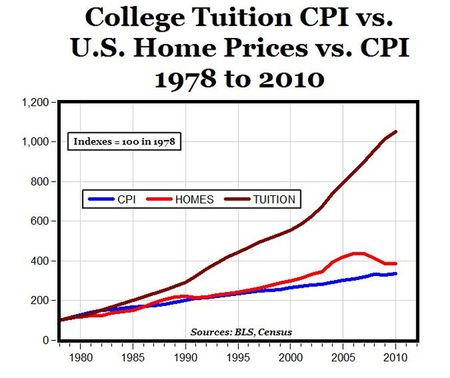
16 December 2012

Putting the Corrupt University System Out of Our Misery

US college students can end up hundreds of thousands of dollars in debt at the end of their university experience, with very little to show for it. Even middle and lower tier universities are growing exorbitantly priced, without providing students, parents, or society, value for their financial sacrifice.
In fifty years, if not much sooner, half of the roughly 4,500 colleges and universities now operating in the United States will have ceased to exist. The technology driving this change is already at work, and nothing can stop it. The future looks like this: Access to college-level education will be free for everyone; the residential college campus will become largely obsolete; tens of thousands of professors will lose their jobs; the bachelor’s degree will become increasingly irrelevant; and ten years from now Harvard will enroll ten million students.

... universities that have spent the past few decades spending tens or even hundreds of millions to offer students the Disneyland for Geeks experience are going to find themselves in real trouble. Along with luxury dorms and dining halls, vast athletic facilities, state of the art game rooms, theaters and student centers have come layers of staff and non-teaching administrators, all of which drives up the cost of the college degree without enhancing student learning. The biggest mistake a non-ultra-elite university could make today is to spend lavishly to expand its physical space. Buying large swaths of land and erecting vast new buildings is an investment in the past, not the future.

...The biggest obstacle to the rapid adoption of low-cost, open-source education in America is that many of the stakeholders make a very handsome living off the system as is. In 2009, 36 college presidents made more than $1 million. That’s in the middle of a recession, when most campuses were facing severe budget cuts. This makes them rather conservative when it comes to the politics of higher education, in sharp contrast to their usual leftwing political bias in other areas. Reforming themselves out of business by rushing to provide low- and middle-income students credentials for free via open-source courses must be the last thing on those presidents’ minds.

Nevertheless, competitive online offerings from other schools will eventually force these “non-profit” institutions to embrace the online model, even if the public interest alone won’t. And state governments will put pressure on public institutions to adopt the new open-source model, once politicians become aware of the comparable quality, broad access and low cost it offers. _The End of University as We Know It
Modern universities are memorials to mediocre education, corrupt excess, and academic intolerance. The $1 trillion in student loans which hobble young people at the start of their adult lives is being revealed as a dangerous financial bubble. The university system now occupies a central part of the ongoing US financial misery -- and heaven help the US taxpayer if Obama includes universities in his next round of multi- $trillion bailouts.


The system is corrupt and rotting to the core, and cannot last. It is time to build an affordable, trimmed down replacement system that returns value for money spent. It is time to put the rotten and corrupt university system out of our misery.

Labels: , , ,

Bookmark and Share

16 October 2012

Abolishing College: No More Academic Lobotomies?

Alternatives to conventional higher education are experiencing explosive growth. Coursera offers free online courses from at least 33 respected universities worldwide. And EdX recently added the entire University of Texas system of institutions, to join Harvard, MIT, and UC Berkeley.
The shift to online college-credit courses is occurring three to five years faster than expected because of demand from students and universities, said Anant Agarwal, president of Cambridge-based EdX and an MIT professor.

The University of Texas System plans to put up $5 million to join the EdX online venture, started by Harvard University and the Massachusetts Institute of Technology, to help meet demand for low-cost college courses.

...Most universities realize major structural changes are needed, though moving lectures online doesn’t go far enough, said Jeff Sandefer, a Perry adviser who taught entrepreneurship courses at the University of Texas and started the Austin-based Acton School of Business, which offers graduate management degrees. EdX and Coursera, another university group offering free online studies, “will hasten the flight of full-price customers to less-expensive alternatives, accelerating the demise of traditional academia,” Sandefer said by e-mail. _BusinessWeek

Modern universities are known for their antagonism to students' freedom of speech rights, and for an intolerance to diverse points of view. The steep rise in tuition rates over the past few decades has skyrocketed, driving student debt above $1 trillion, and rising. Administrative bloat is out of control, and the quality of education on campus is suffering as a result.


If any institution deserves to be made obsolete -- besides big media and big govenment -- it is the big college bubble. The EdX, Coursera, and Khan Academy approaches to free online education will not result in the actual abolition of college indoctrination and intolerance. Making a destructive institution obsolete is far quicker and cleaner than going to the trouble of abolishing it.

Imagine a world with free speech for everyone, no more academic lobotomies, no more academic intolerance / indoctrination. A world of self-directed learners, with the entire universe of knowledge available to pursue.

It sounds like a very dangerous world! ;-)

And remember: It is never too late for a dangerous childhood.

Labels: , ,

Bookmark and Share

15 October 2012

"Unschooling" the University

Never Let Schooling Interfere With Your Education


Unschooling is a growing trend among children old enough to attend primary or secondary school. It is a type of homeschooling that is child-directed, taking place both at home and other places where children can learn about the world.
The advantage of this method is that it doesn't require you, the parent, to become someone else, i.e. a professional teacher pouring knowledge into child-vessels on a planned basis. Instead you live and learn together, pursuing questions and interests as they arise and using conventional schooling on an on-demand basis, if at all. This is the way we learn before going to school and the way we learn when we leave school and enter the world of work. _Unschooling: Holt

In the US, with university student dept around $1 trillion, more people want to bring "unschooling" to the university level -- and make it very low cost, sometimes free.
[US] student debt now tops $1 trillion and that a third of college students drop out–with debt and without a degree. Nearly a third of the average 18-to-24-year-old’s income goes toward debt repayment, much of it owing to student loans.

...Yet if [Vivek] Wadhwa is right the student debt problem will take care of itself—at least as it relates to the next generation and those that follow. Online courses will proliferate to such a degree that acquiring knowledge will become totally free. There will still be a cost associated with getting a formal degree. But most universities, he says, “will be in the accreditation business.” They will monitor and sanction coursework; teachers will become mentors and guides, not deliver lectures and administer tests. This model has the potential to dramatically cut the cost of an education and virtually eliminate the need to borrow for one, he says.

...Wadhwa allows that there will always be students able and willing to pay for a traditional college experience and for them it will be a worthwhile investment. But for the vast majority, from a financial standpoint that kind of education makes no sense and is fast becoming unnecessary. He believes the higher education revolution is coming soon and will happen fast—perhaps fast enough to keep the next generation from finishing school with debts they may never be able to pay. _Moneyland.Time

University has become a place for young adults and adolescents to receive a political indoctrination, form bad personal habits, and avoid responsibility while spending "other people's money" for as long into adulthood as possible.

In other words, for a large number of young people, university has become the capstone on an edifice of dysfunctional education and child-raising that leaves the young person incompetent and unfit for taking meaningful responsibility in world growing less friendly to the unskilled by the day.

The problem with "unschooling the university" is that most graduates of primary and secondary public education never learned to be self-directed toward their own education. They and their parents trustingly counted on the government educational system to provide the child's education. And now, here they are, unable to pick up the ball and run with it.

We anticipate that in the future, more and more parents will opt for "The Dangerous Child" approach to child rearing, which is a type of "unschooling" -- although much more dangerous, of course.

The dangerous child learns multiple skills and competencies from an age at which most parents and educators would believe it impossible. But it is not only possible -- it is vital, if the child is to develop his full potential of dangerousness. Dangerous children must achieve high enough skill levels to be able to support themselves financially in at least three different ways by the time they are 18 years old.

Needless to say, the future would look quite different in a world full of dangerous children -- quite unlike the present world full of lifelong adolescents and incompetent psychological neotenates.

And remember, it is never too late to have a dangerous childhood.

Labels: , , ,

Bookmark and Share

21 August 2012

Ode to Lifelong Incompetence: Shite on a Silver Platter

The Wall Street Journal offers an disturbing perspective on the emerging listless incompetence of generations of young adults without a cause, purpose, or meaningful goal. But should we blame the Journal and its writer Melinda Beck for such an enabling of societal decay, or should we blame the "experts" who were quoted?

The article is framed as an attempt to reassure the parents of sluggish and vacant twenty-somethings, suggesting that their vapid little darlings have simply not found themselves yet -- just give them time. After all, the article suggests, their brains do not fully mature until their middle twenties or later. How could we expect them to make important decisions?

Psychologists and cognitive scientists are quoted, backing up this acquiescent and neglectful approach to child-raising and fledging. But where would those "experts" be if their own parents had raised them to be dormant blockheads well into their twenties and beyond? They would probably not be considered worthy of being quoted in the WSJ. We could ask author Melinda Beck the same question: Where would you be if you had been content to wile away the years until you were a thirty-something, before you began your career and/or family?

Here is Jay Giedd, neuroscientist of the US NIMH:
"Until very recently, we had to make some pretty important life decisions about education and career paths, who to marry and whether to go into the military at a time when parts of our brains weren't optimal yet," says neuroscientist Jay Giedd at the National Institute of Mental Health, whose brain-imaging studies of thousands of young people have yielded many of the new insights. Postponing those decisions makes sense biologically, he says. "It's a good thing that the 20s are becoming a time for self-discovery." _Melinda Beck in WSJ
Is the man completely insane? "It's a good thing that the 20s are becoming a time of self-discovery???" That type of disconnectedness from the reality of life reminds me of people who say it is a good thing that robots will take over almost all manual jobs, relieving human workers of their responsibilities. That way, "humans can devote themselves to art, literature, travel, and other enobling leisure pursuits."

Here is Jeffrey Arnett, psychology professor at Clark in Worcester:
"It should be reassuring for parents to know that it's very typical in the 20s not to know what you're going to do and change your mind and seem very unstable in your life. It's the norm," says Jeffrey J. Arnett, a professor of psychology at Clark University in Worcester, Mass., who coined the term "emerging adulthood" in 2000. _WSJ
Oh. Are you, Professor Clark, volunteering to pay the child's living expenses, his university bills for 6 different half-finished courses of study, and otherwise support this overgrown child for the foreseeable future? I didn't think so.

More from Dr. Arnett:
"It pays to relax and not panic because your 21-year-old or even your 26-year-old doesn't know what he or she is going to do. Almost nobody still has that problem at 40 or 50. We all figure it out eventually." _WSJ
And if they still have that problem at 40 or 50, can we call you for advice, professor?

Here is Jennifer Tanner, developmental psychologist:
Even young adults who are financially dependent on their parents can practice independence in other ways. "My advice is, if your parents are currently doing things for you that you could do for yourself, take the controls. Say, 'No. Mom, Let me get my own shampoo,' " says Jennifer Tanner, a developmental psychologist and co-chair of the Society for the Study of Emerging Adulthood, an academic organization. _WSJ
I see. If only we can get our children to get their own shampoo, everything else will take care of itself? Very reassuring indeed.

To illustrate how stressful and trying young adulthood can be, we are presented with 28 year old Nikki Cohen, case study:
At age 28, Nikki Cohen has explored more careers than many people do in a lifetime. After a year as a pre-med student at Emory University, the Long Island native moved back to New York to attend Parsons School of Design. "I decided fashion was more exciting than science and a little more 'me,' " Ms. Cohen says.

She opened a clothing boutique when she was 23 and starred in a short-lived reality show, "Downtown Girls," on MTV. When the show was canceled and her store fell victim to the economic downturn, Ms. Cohen decided she was passionate about health issues after all and is now completing her master's thesis in health education at Columbia University.

"It's definitely a scary time," says Ms. Cohen. "I'm fearful that I'm not going to get a job or meet a man that makes me happy for more than a month. But I'm also happy that I get to try out different things." _WSJ
It does tear at one's heartstrings.

It is certainly true that a person's brain is not "fully mature" until the middle to late 20s. But that does not mean that a person should not be held responsible as an adult until then. After all, no sooner does a brain become "fully mature" than it begins to lose its power of focus and memory -- little by little. Should we view these 30 something, 40 something, 50 something and beyond as disabled by reason of normal aging?

Modern education and child-raising is geared toward delaying adult responsibility and achievement until a much later time than earlier generations were geared. Once, the late teens were seen as proper ages to set out on one's own. More recently it was the early twenties. Now we are being told that autonomy from parents may have to wait until into the thirties.

Rather than following this path of the pop PC skankstream mainstream, the WSJ should be pushing for the kinds of changes which will strengthen the future innovative and productive foundational core of a society, rather than enabling a passive weakening the foundations.

But it seems that the WSJ is merely another part of the skankstream mainstream, after all. If people want to lay the groundwork for a more solid and abundant future, they will have to look elsewhere than the media, the academy, or the government.

But then, you already knew that, right?

It is never too late for a dangerous childhood.

Labels: , ,

Bookmark and Share

13 May 2012

Making the Bad Lady Shut Up

This article is adapted from a previously published piece on abu al-fin blog

In an excellent demonstration of the motto of leftist higher education: "Free speech for me but not for thee," the Chronicle of Higher Education has fired a blogger who was paid to contribute a contrary viewpoint. She was fired for publishing a viewpoint that was too contrary for the comfort of the academics to whom the Chronicle of Higher Education caters.
The Chronicle of Higher Education has fired our former editorial-page colleague, Naomi Schaefer Riley, for a blog posting on the Chronicle's website that offended 6,500 professors. Well, they're not all professors yet, but they are members of what calls itself the "higher-education community," for which the Chronicle is its trade paper. As best we can make out, the Chronicle's editor, Liz McMillen, fired Naomi Riley for doing what she was hired to do—provide a conservative point of view about current events in academe alongside the paper's roster of mostly not-conservative academic bloggers. _WSJ
Ms. Schaefer Riley tells the story from her point of view:
Recently, the Chronicle of Higher Education published a cover story called "Black Studies: 'Swaggering Into the Future,'" in which the reporter described how "young black-studies scholars . . . are less consumed than their predecessors with the need to validate the field or explain why they are pursuing doctorates in their discipline." The "5 Up-and-Coming Ph.D. Candidates" described in the piece's sidebar "are rewriting the history of race." While the article suggested some are skeptical of black studies as a discipline, the reporter neglected to quote anyone who is.

Like me. So last week, on the Chronicle's "Brainstorm" blog (where I was paid to be a regular contributor), I suggested that the dissertation topics of the graduate students mentioned were obscure at best and "a collection of left-wing victimization claptrap," at worst.

For instance, the author of a dissertation on the history of black midwifery began her research, she told the Chronicle, because she "noticed that nonwhite women's experiences were largely absent from natural-birth literature." Another graduate student blamed the housing crisis in America on institutional racism. And a third argued that conservatives like Thomas Sowell, Clarence Thomas and John McWhorter have "played one of the most-significant roles in the assault on the civil-rights legacy that benefited them."

The reaction to my blog post ranged from puerile to vitriolic. The graduate students I mentioned and the senior faculty who advise them at Northwestern University accused me (in guest blogs posted by the Chronicle editors) of bigotry and cowardice. The former wrote that "in a bid to not be 'out-niggered' [their word] by her right-wing cohort, Riley found some black women graduate students to beat up on." (I confess I don't actually know what that means.) One fellow blogger (and hundreds of commenters) called my post "racist."

Gina Barreca, a teacher of English and feminist theory at the University of Connecticut, composed a poem mocking me. (It begins "A certain white chick—Schaefer Riley/ decided to do something wily.") MSNBC host Melissa Harris-Perry spewed a four-minute rant about my post, invoking the memory of Trayvon Martin and accusing me of "small-mindedness."

Scores of critics on the site complained that I had not read the dissertations in full before daring to write about them—an absurd standard for a 500-word blog post. A number of the dissertations aren't even available. Which didn't seem to stop the Chronicle reporter, though. And 6,500 academics signed a petition online demanding that I be fired.

At first, the Chronicle stood its ground, suggesting that my post was an "invitation to debate." But that stance lasted for little more than a weekend. In a note that reads like a confession at a re-education camp, the Chronicle's editor, Liz McMillen announced her decision on Monday to fire me: "We've heard you," she tells my critics. "And we have taken to heart what you said. We now agree that Ms. Riley's blog posting did not meet The Chronicle's basic editorial standards for reporting and fairness in opinion articles."

When I asked Ms. McMillen whether the poem by fellow blogger Ms. Barreca, for instance, lived up to such standards, she said they were "reviewing" the other content on the site. So far, however, that blogger has not been fired. Other ad hominem attacks against me seem to have passed editorial muster as well. _Naomi Schaefer Riley_in_WSJ

The suppression of free speech on university campuses is being contested on a daily basis by FIRE -- the Foundation for Individual Rights in Education. But the suppression of ideas and speech by publications and information outlets is a more difficult enemy to overcome.

Fortunately, the internet provides a number of ways to expose and counteract the grand project of information bias that infiltrates and permeates modern societies.

Labels: , , , ,

Bookmark and Share

20 January 2012

Half of All Universities to Go Out of Business in 10 Years?

Michael Horn, co-author with Clayton Christensen of several studies and publications on education, predicts: "I wouldn't be surprised if in 10 to 15 years half of the institutions of higher education will have either merged or gone out of business." According to Christensen, this change will not seriously threaten exclusive top-brand universities like Harvard and Yale, given the perceived high value of their brands and the connections and other extras they provide. Public universities, however, are in for a real shock. _NationalAffairs
Al Fin education analysts say that Harvard and Yale will be very much threatened by the coming revolution in education -- from K-12 through post-grad. By the time they and other overpriced palaces of mediocrity understand the hole they have dug for themselves, it will likely be too late.

But Christensen is correct when he says that US states will be devastated by the education revolution. Already forced to slash budgets and raise tuition, when the full impact of their dilemma hits them, heads will roll. A large part of the bloodshed will be caused by public sector union pension explosions and the state employee pension explosion.
As state budgets come under increasing pressure, tuition costs are likely to continue growing and services at state schools are likely to be slashed further by hard-pressed legislatures. California, for instance, hiked in-state tuition by 21% this year; over the next few years, the University of California system envisions annual tuition increases ranging from 8% to 16%. Other states face similarly grim prospects.

And the problem is only exacerbated by public universities' politicized governance structures — which, when combined with the state schools' lack of endowments to rival private universities', makes it much more difficult for public schools to adjust and innovate in response to changing conditions and competition. Those looking for signs of the coming revolution in higher education would thus be wise to keep their eyes on America's bloated public universities. _National Affairs
The article linked above is interesting, but it is largely beside the point. The reason for that is political correctness -- the author cannot come out and say what needs to be said about higher education and educational institutions in the post-modern world.

Outside of particular circumscribed areas of education -- professional schools, schools of engineering and science, business schools, etc. -- universities are no longer places of education, but are rather centres of indoctrination. Professors and administrators grasp onto tenure, bloat their own departments, assure their own futures, and to hell with students and their needs, and the long term vitality and survivability of the institution.

Affirmative action stuffs classrooms with students destined to fail bitterly. Title IX type mandates devastate economic opportunities formerly available to gifted athletes -- diverting the funds to feminist causes. Student loan debt across the US is greater than all credit card debt, and continues to grow -- although destined to burst in a huge conflagration of default.

Universities exist primarily for the vultures who feed upon failed students' carcasses. The various interlocking infrastructure of government, education, finance, and labour which have brought things to their current stage of impending doom.

The revolution could not come too soon.

Labels: ,

Bookmark and Share

18 December 2011

Casting a Spell of Governance: What a Fool Believes

It used to be that tribal leaders; i.e., governments; would throw a few virgins into the volcanoes to placate the gods and prevent eruptions. Now governments in developed countries want to throw their economies into the cauldron in repentence for their prosperity. It all stems from some cultural notion that if one makes a sacrifice then surely one will get something in return. For millenia religions have been organizing sacrifices to placate the gods and everyone of those sacrifices has been a complete and total waste. The names have changed [but] the game is the same.
_Backcasting Climate Models, in reference to climate reparations.

Thinking of government officials as witch doctors may take a bit of getting used to, but it will take you dangerously close to the truth of the matter. Neither witch doctors nor government officials understand the complexity of the issues with which they deal. And each has his own ulterior motives in creating outcomes which augment their power and prestige, and wealth.

But do you want to know the truth about those who hold power over the lives of everyone you care about, including yourself? You would have much less cognitive dissonance if you would merely believe everything the witch doctors government, media, and academics tell you. If you just tell yourself that they wouldn't take drastic measures which adversely affect your future, unless there were a good reason for it -- you will sleep better at night.

Take the drastic measures that Mr. Obama and the UN IPCC wish to take, in order to tame a naturally chaotic climate: They wish to transfer trillions of dollars from Europe and North America, to third world nations and emerging nations. They wish to use the UN as an intermediary, for purposes of distributing the funds. The UN, the most corrupt institution on the planet. They say, "Trust us, we know what we are doing. We are acting on the basis of the very best climate models that modern science can devise."

But how good are these models which the thoroughly corrupt UN is using to try to convince us to impoverish ourselves?
The general shape of the model value line is "sort of" the same as the observation line, but it misses the global warming which occurred from about 1915 to about 1938 and the global cooling from 1940 to 1960. In terms of the temperature change over the entire period the model is pretty good, being only 12 percent too small. However looking at the graph the two curves cross at six points and it appears to be just a coincidence that one of the crossings was close to the end of the backcasting interval. At about 1955 the error would have been about 200 percent. This indicates that the measure of performance should be some average error over the backcasting period. However clearly the Hadley Centre model is superior the model of the Canadian Centre for Climate Modeling and Analysis. However it is not certain whether even the Hadley Centre model is sufficiently accurate to have any relevance in economic policy decisions. In particular, it does not seem accurate enough to be the basis for the developed countries imposing a trillion dollar a year cost to their economies. And that trillion dollar a year cost may end up being a trillion dollar a year transfer to the governments of developing countries for the purchase of their carbon emissions quotas. _Backcasting Climate Models

The climate change caper is only one of the many pieces of wool which our witch doctors governments, media, and academics are trying to pull over our eyes. Associated scams include the great wind energy scam, the great solar energy scam, the great overpopulation and resource scarcity scams, and so on.

We can choose whether to accept the current "spell of governance" which is being cast by the unsavoury crew of controllers, educators, and information disseminators. But it takes a lot of work to replace programmed "knowledge" with verified knowledge. Particularly when we are bombarded by programmed "knowledge" from all quarters, 24 hours a day.

Every child should be given the power to determine the truth of matters which are important. It is time to stop raising herds of trusting sheep, and to begin raising clear thinking human beings who can see through the illusions of the spell casters. Children must be given the power to verify the truth in a wide range of situations.
The truth of an idea is not a stagnant property inherent in it. Truth happens to an idea. It becomes true, is made true by events. Its verity is in fact an event, a process: the process namely of its verifying itself, its veri-fication. Its validity is the process of its validation. _William James PDF
As long as humans trust "authorities" to tell them what to believe, they are no better than primitive tribesmen who put themselves and their families at the mercy of witch doctors. Time to make a real change.

Labels: , ,

Bookmark and Share

15 December 2011

When Everyone is Thinking the Same Thing, Someone is Not Thinking

He, who has learned to doubt and to ask questions where the norms forbid it, can never stop the habit. As such, every creative person is building bridges to those masses of people who are tied up helplessly by the pressures of peers and society. His is a step out and above the group. And however strong the creative person is enchained by conventions, he has unshackled himself on his way as a free and autonomous personality. As such, he may have cleared a new path for his group, his society and perhaps humankind in order to transform culture and to create space for other free personalities who want to set new goals.--Franz Oppenheimer (1864-1943)
_Tahoe is Walking On
The established order is always threatened by innovation and creative ideas. That is why the persons who display a great deal of creative talent and potential for disruptive thought are generally either co-opted, marginalised, or disposed of in some way.

The lopsided ideological nature of modern media and the modern professoriate and intellectual celebrities, suggests that almost everyone is thinking the same thing. Which means that almost no one is actually thinking.

A lot of people are emoting, and intuiting. But few are thinking.

And that is a huge problem, when modern societies are faced with the huge problems of debt and demography, among others.

If you are wondering what people and societies can do to get themselves out of this groupthink conundrum, this would be a good place to start.

Labels: , , ,

Bookmark and Share

12 December 2011

Everything You Think You Know, Just Ain't So

Here are two ways in which we typically go wrong on a regular basis:
1. Cognitive hubris: each of us believes that his map of the world is more accurate than it really is.

2. Radical ignorance: when it comes to complex social phenomena, our maps are highly inaccurate. _American
We have learned from cognitive psychologists such as Daniel Kahneman that our intuition -- no matter how solid it feels -- is often built on a shaky foundation.
What's interesting is that many a time people have intuitions that they're...confident about except they're wrong. That happens through the mechanism that I call "The mechanism of substitution". You've been asked a question, and instead you answer another question, but that answer comes by itself with complete confidence, and you're not aware that you're doing something that you're not an expert on because you have one answer. Subjectively, whether it's right or wrong, it feels exactly the same. Whether it's based on a lot of information, or a little information, this is something that you may step back and have a look at. But the subjective sense of confidence can be the same for intuition that arrives from expertise, and for intuitions that arise from heuristics, that arrives from substitution, and asking a different question. _Edge
This phenomenon of "false expertise" is extremely common -- particularly among college professors, journalists, politicians, and others who are not typically held to a high standard of performance and proof. It is also a common part of everyday existence for virtually everyone.
Suppose you were to ask yourself how well you understand the world around you. How accurate is your map of reality?

If you interrogate System Two [slow, logical mind], it might reply, “There are many phenomena about which I know little. In the grand scheme of things, I am just blindly groping through a world that is far too complex for me to possibly understand.”

However, if you were to interrogate System One [fast, intuitive mind], it might reply, “My map is terrific. Why, I am very nearly omniscient!”

Evidently, in order to perform its function, System One has to have confidence in its map. Indeed, elsewhere Kahneman has told a story of a group of Swiss soldiers who were lost in the Alps because of bad weather. One of them realized he had a map. Only after they had successfully climbed down to safety did anyone discover that it was a map of the Pyrenees. Kahneman tells that story in the context of discussing economic and financial models. Even if those maps are wrong, we still feel better when using them.2

In fact, a number of the cognitive biases that Kahneman and other psychologists have documented would appear to serve as defense mechanisms, enabling the individual to hold onto the view that his map is the correct one. For example, there is confirmation bias, which is the tendency to be less skeptical toward evidence in support of one's views than toward contrary evidence.

System Two is evidently not able to overcome cognitive hubris, even in situations where one would expect System Two to be invoked, such as forecasting the difficulty of a major undertaking. _American

We have to rely upon our fast, intuitive, unconscious mind in order to get through a normal day. So much of our lives are performed on "auto pilot" simply because we cannot reason through every split second of our conscious lives. It would be a tremendous waste of very expensive conscious attention to do so.

And yet, so much of the time when we should give careful conscious attention to an action, choice, or verbal / written expression, we fail to do so. We are accustomed to trusting our intuitions, and we generally muddle through okay. But not always. And who can teach us when to take the time and make the effort to apply our consciousness, and when we can safely and effortlessly slide by on our unconscious intuition? That is where wisdom comes in.

Arnold Kling applies Kahneman's ideas to the political realm:
When two ideological opponents wind up on different hilltops, neither can believe that the other has sincerely arrived at a different conclusion based on the evidence. As Friedman puts it,

Consider the most reviled pundit on the other side of the political spectrum from yourself. To liberal ears, a Rush Limbaugh or a Sean Hannity, while well informed about which policies are advocated by conservatives and liberals, will seem appallingly ignorant of the arguments and evidence for liberal positions. The same goes in reverse for a Frank Rich or a Paul Krugman, whose knowledge of the “basics” of liberalism and conservatism will seem, in the eyes of a conservative, to be matched by grave misunderstandings of the rationales for conservative policies.5

Indeed, our cognitive hubris is so strong that, according to David McRaney, people believe they understand other people better than others understand themselves. He calls this phenomenon “asymmetric insight.”6

The illusion of asymmetric insight makes it seem as though you know everyone else far better than they know you, and not only that, but you know them better than they know themselves. You believe the same thing about groups of which you are a member. As a whole, your group understands outsiders better than outsiders understand your group, and you understand the group better than its members know the group to which they belong.

In our context, this would mean that liberals believe that they understand better than conservatives how conservatives think, and conservatives believe that they understand better than liberals how liberals think. According to McRaney, such beliefs have indeed been found in studies by psychiatrists Emily Pronin and Lee Ross at Stanford along with Justin Kruger at the University of Illinois and Kenneth Savitsky at Williams College. _Arnold Kling
These are very important insights which should be applied to our own everyday thinking. They could save you from a great deal of embarassment and unnecessary interpersonal friction. But just because "conservatives" and "liberals" make the same types of mistakes when judging the other side, does not make them equally right and equally wrong on every issue. Look for people who have changed their minds, and try to understand their reasons for changing.

Some changes may be a quasi-cohort effect. The old saying, "If you are a conservative at age 20, then you have no heart. But if you are not a conservative at age 30, you have no head," is a reflection of a common tendency for the "hard knocks" of life to beat a bit of conservatism into almost anyone, over time. If one is born into wealth, achieves early success, commits irrevocably to a cause in his youth, or acquires a sinecured position at a fairly early age, he is more likely to be able to avoid many of the uncomfortable changes in perspective which others may feel compelled to go through.

Simple observation over time demonstrates to most intelligent people that utopian ideas -- when implemented -- do not bring about the grand results they promise, but generally produce the opposite effect.

More on why this topic is important, to come.

Labels: , ,

Bookmark and Share

09 November 2011

Footnotes on the Higher Education Bubble's Many Failures

The following excerpts are taken from a NYBooks.com article by Anthony Grafton. Grafton tries to take a wide angle view of the performance of US universities, using several recent books on higher education as springboards. His conclusions are not encouraging.
The Collegiate Learning Assessment reveals that some 45 percent of students in the sample had made effectively no progress in critical thinking, complex reasoning, and writing in their first two years. And a look at their academic experience helps to explain why. Students reported spending twelve hours a week, on average, studying—down from twenty-five hours per week in 1961 and twenty in 1981. Half the students in the sample had not taken a course that required more than twenty pages of writing in the previous semester, while a third had not even taken a course that required as much as forty pages a week of reading.

...Second, and more depressing: vast numbers of students come to university with no particular interest in their courses and no sense of how these might prepare them for future careers. The desire they cherish, Arum and Roksa write, is to act out “cultural scripts of college life depicted in popular movies such as Animal House (1978) and National Lampoon’s Van Wilder (2002).” Academic studies don’t loom large on their mental maps of the university. Even at the elite University of California, students report that on average they spend “twelve hours [a week] socializing with friends, eleven hours using computers for fun, six hours watching television, six hours exercising, five hours on hobbies”—and thirteen hours a week studying.

...Fewer than 70 percent of high school students graduate. Just over 70 percent of those graduates will enter some form of postsecondary education. But barely more than half of those who start BA programs will finish them in six years, and only 30 percent of those who start community college will win an associate degree in three years. After that point, most people don’t manage to graduate.

...Americans, as Malcolm Harris recently pointed out, now owe almost a trillion dollars in student loans, more than they owe in credit card debt. Student debt, he explained, “is an exceptionally punishing kind to have. Not only is it inescapable through bankruptcy, but student loans have no expiration date and collectors can garnish wages, social security payments, and even unemployment benefits.”

...All this to pay for an education that—as we have already seen—means little, intellectually, to many of those who are courting debtors’ prison to pay for it. The unkindest cut of all, of course, is that those who drop out must still carry the full burden of the loans that so many of them have taken out—even though they will, in all probability, earn less and fare worse in hard times than graduates. Yet even unemployment among graduates has been rising—as have rates of student loan default.

... Students drink too much alcohol, smoke too much marijuana, play too many computer games, wreck cars, become pregnant, get overwhelmed trying to help anorexic roommates, and too often lose the modest but vital support previously provided by a parent who has been laid off.

...the dark hordes of forgotten students who leave the university as Napoleon’s army left Russia, uninspired by their courses, wounded in many cases by what they experience as their own failures, weighed down by their debts, need to be seen and heard.
_NYBooks.com Anthony Grafton
We are likely to see and hear them in news coverage from their crime-ridden "Occupy" camps -- perhaps in your hometown. Or maybe they can get jobs as professional activists, community organisers, union enforcers or get-out-the-vote strong armers.

Never prepared for genuine responsibility by their parents or "the system", they learned to put off growing up until the last possible moment. And "surprise!" they never did accomplish the feat.

This is one piece of the puzzle, which in toto reveals the collapse of human capital across a society. Someone will need to come along and pick up the pieces of former wholes which a massive -- in some cases, designed -- neglect by responsible parties has fractured to shards.

Anthony Grafton, the author of the above review, suggests that the answer may lie in the public dissection of the university by skilled writers -- including fiction writers. He feels that if readers were to see the reality in all its poignant destructiveness, that changes might then be forced upon the university. But honestly, who reads anymore? Not the power brokers who would have to be swayed in order to effect the necessary changes. And even if they did read, their vested interests in the current system penetrate so deeply, that nothing short of a nuclear explosion under their chairs would do the trick.

Labels: , ,

Bookmark and Share

30 September 2011

Thinking More Deeply: Building Innovation Engines

Innovative Thinking

In research and development, the most revolutionary discoveries are often hidden beneath the flash and whiz-bang of fancy products, processes, and therapies. But here are two examples of discoveries of a more subtle and important type:
A TEAM of North-East academics and industry experts have "cracked the DNA code of plastic" which could mean massive cost and energy savings for business. Researchers at Durham University and the University of Leeds have collaborated with the Tees Valley chemical process sector to solve a long-standing problem that is set to revolutionise the way new plastics are developed.

Before the discovery, industry would develop a plastic and then find a use for it, or try hundreds of different recipes until they stumbled across the right mix. _Source

Alert readers will see the similarity between this new innovation engine for creating plastics-on-demand, and approaches to "rational design" of drugs and proteins. This type of breakthrough often sets the stage for large numbers of rapid-fire innovations to follow.

University of Utah chemists developed a method to design and test new catalysts, which are substances that speed chemical reactions and are crucial for producing energy, chemicals and industrial products. By using the new method, the chemists also made a discovery that will make it easier to design future catalysts. The discovery: the sizes and electronic properties of catalysts interact to affect how well a catalyst performs, and are not independent factors as was thought previously. Chemistry Professor Matt Sigman and doctoral student Kaid Harper, report their findings in the Friday, Sept. 30, 2011, issue of the journal Science.

“It opens our eyes to how to design new catalysts that we wouldn’t necessarily think about designing, for a broad range of reactions,” Sigman says. “We’re pretty excited.” _Physorg

This is another example of a discovery that could potentially set off a chain reaction of new discoveries and revolutionary products.

Some people intuitively understand the deeper nature of such discoveries, and the infinitely larger potential of such developments to revolutionise entire fields and societies. Others, failed by modern dumbed-down educational systems, may need to think about the idea for a while.

A great deal of attention is given to the concept of "higher order effects (PDF)," but too little attention is given to "higher order causes."

The modern mass production methods of education do not generally help students to learn how to think. Ideologically driven educators assume that if the student is indoctrinated in the proper ideology, she will then naturally think in the "correct" manner. And so indoctrination replaces education, and graduates and future leaders become lifelong incompetents, because they never learned to think.

This is not just about logic and resolving contradictions. It is also about generative thinking, lateral thinking, problem solving, and growing beyond ideology. A society whose graduates can think rationally and generatively is less likely to fall into a quagmire of malaise such as currently entraps much of the advanced world.

Generative thinkers do not merely solve problems as they arise. They also solve problems that lead to other problems -- before they arise. They do this by thinking more deeply, and further out of the ideological box.

Let's be clear: Although ideology can make a person's life easier and his choices more automatic, an honest person who is bound tightly by ideology cannot truly think -- the cognitive dissonance becomes too great. Thus the heated and perpetually unresolved arguments one sees in religion, politics, and on environmental issues.

It is always a pleasure to confront an ideological opponent, and to mutually penetrate beneath the level of ideology to a generative level and mode of thinking. The productive output of such sessions can be much greater than any number of brainstorming sessions occurring within a circle of "self-anointed truth-bearers."

Generations of children are being short-changed and mind-stunted by inappropriate educational methods. This stunting and starving of brains occurs from kindergarten through university, and beyond. Those who have been paying attention understand that this is not happening by accident, just as the "energy starvation agenda" of modern governments is not happening by accident.

If a society is marinated in ideological thinking -- as virtually all human societies have been -- change can be very slow in coming. Since the converging problems of debt and demographic decline in the west are occurring at a rate which will probably not allow the needed changes to occur at high enough levels, it is up to persons at more local levels to instigate necessary changes to the best of their ability.

Do not make the mistake of thinking that a magical singularity will miraculously solve the human world's problems. Singularities help those who help themselves. Humans will have to make this transition from ideological thinking to generative thinking.

What proportion of humans will need to move beyond conventional thinking? Al Fin futurologists estimate that at least 10% and perhaps as many as 20% of humans within a society will have to forsake ideology and learn to think for themselves. The odds of finding such an innovation-rich environment by accident are very poor.

Labels: , , , ,

Bookmark and Share

28 September 2011

Can the Best Part of Higher Education in the US Be Salvaged?

US higher education is in danger of collapse when the education bubble bursts. Rapid inflation of tuition charges combined with administrative bloat, an oppressive air of political correctness, and the too-frequent substitution of ideological indoctrination in place of genuine education -- these things and more spell the doom of US higher education. Unless things can quickly and decisively change.
Many universities, and not a few colleges, have come to resemble Fortune 500 companies with their layers of highly paid executives presiding over complex empires that contain semi-professional athletic programs, medical and business schools, and expensive research programs along with the traditional academic departments charged with providing instruction to undergraduate students. Like other industries, higher education has its own trade magazines and newspapers, influential lobbying groups in Washington, and paid advertising agents reminding the public of how important their enterprise is to the national welfare. In contrast to corporate businesses, whose members generally agree on their overall purpose, colleges and universities have great difficulty defining what their enterprise is for. What is a college education? On just about any campus, at any given time, one can find faculty members in intense debate about what a college education entails and what the mission of their institution should be. Few businesses would dare to offer a highly expensive product that they are incapable of defining for the inquiring consumer. Yet this is what colleges and universities have done at least since the 1960s, and they have done so with surprising success. _NewCriterion
James Piereson has published an incisive review of US higher education -- and of recently published scholarly books which examine US higher education. He summarises some key reforms which should bring about critical improvements in relatively short order:
(1) Shelve the utopian idea that every young person should attend college and also the notion that the nation’s prosperity depends upon universal college attendance. Many youngsters are not prepared or motivated for college. Let them prepare for a vocation. The attempt to push them through college is weakening the enterprise for everyone else.


(2) Terminate most Ph.D. programs in the humanities and social sciences. There is little point in training able people in research programs when they have no prospect of gaining employment afterwards. The research enterprise has also corrupted all of these fields, particularly in the humanities.

(3) Develop programs in these fields that will allow students to earn graduate degrees based upon teaching rather than research. Such programs will be intellectually broad rather than specialized and will equip graduates to teach in several fields in the humanities. This will strengthen teaching in the liberal arts and perhaps even revive the field from its current condition.

(4) Reverse the expansion of administrative layers, especially those offices and programs created to satisfy campus pressure groups. If campus groups want their own administrative offices, they should pay for them themselves, rather than asking other students (and their parents) to do so. Colleges and universities should make it a practice to hire at least three new faculty members for every new administrator hired.

(5) Bring back general education requirements and core curricula to ensure that every student is exposed to the important ideas in the sciences and humanities that have shaped our civilization. There are many ways of doing this. Columbia University has always done it through a “great books” approach; other institutions do it through a series of survey courses in the sciences and liberal arts. How it is done matters less than that it is done. _NewCriterion
Al Fin education specialists assert that these reforms should be seen as a bare beginning. US higher education is in need of a thorough overhaul, which is only likely to happen in the lee of some very unfortunate events for society as a whole. Much of the dead weight in the staff and faculty of US colleges will be ejected as a result of upcoming economic difficulties occurring in both the private and public sectors of the US economy.

Dead weight government programs which affect education, such as affirmative action, Title IX, etc. will cling to existence for as long as possible -- to the detriment of affected institutions and society at large. Eventually, they too will have to fall by the wayside.

First published at Al Fin, the Next Level

Labels: ,

Bookmark and Share

21 April 2011

Science Unshackled: Putting Knowledge in Real People's Hands

Modern humans have become slaves to the "hyperspecialist," the so-called experts who tell us what to think and how we should act. But the hyperspecialisation of modern society is a huge step backward to an authoritarian society, ruled from the top down. Much better for as many people as possible -- credentialed or not -- to acquire the specialised knowledge and tools which will reveal the path to a higher level of knowing and being.

One of the pivotal areas of knowledge and research which should be propagated widely, is the new biology and genetics. Bio-hobbyists and bio-hackers are pushing against legal and institutional constrictions and biases, asserting the rights of individuals to master these important tools. Journalist Marcus Wohlsen recently published the book "Biopunk," which looks more closely at the phenomenon of bio-hacking.
In Biopunk, journalist Marcus Wohlsen surveys the rising tide of the biohacker movement, which has been made possible by a convergence of better and cheaper technologies. For a few hundred dollars, anyone can send some spit to a sequencing company and receive a complete DNA scan, and then use free software to analyze the results. Custom-made DNA can be mail-ordered off websites, and affordable biotech gear is available on Craigslist and eBay.

Wohlson discovers that biohackers, like the open-source programmers and software hackers who came before, are united by a profound idealism. They believe in the power of individuals as opposed to corporate interests, in the wisdom of crowds as opposed to the single-mindedness of experts, and in the incentive to do good for the world as opposed to the need to turn a profit. Suspicious of scientific elitism and inspired by the success of open-source computing, the bio DIYers believe that individuals have a fundamental right to biological information, that spreading the tools of biotech to the masses will accelerate the pace of progress, and that the fruits of the biosciences should be delivered into the hands of the people who need them the most.

With all their ingenuity and idealism, it's difficult not to root for the biohackers Wohlsen meets. Take MIT grad student Kay Aull, who built her own genetic testing kit in her closet after her father was diagnosed with the hereditary disease hemochromatosis. "Aull's test does not represent new science but a new way of doing science," Wohlsen writes. Aull's self-test for the disease-causing mutation came back positive.

Or take Meredith Patterson, who is trying to create a cheap, decentralized way to test milk for melamine poisoning without relying on government regulators. Patterson has written a "Biopunk Manifesto" that reads in part, "Scientific literacy empowers everyone who possesses it to be active contributors to their own health care, the quality of their food, water and air, their very interactions with their own bodies and the complex world around them."

Biohackers Josh Perfetto and Tito Jankowski created OpenPCR, a cheap, hackable DNA Xerox machine (PCR stands for "polymerase chain reaction," the name for a method of replicating DNA). Interested biohackers can pre-order one for just over $500 or, once it's ready, download the blueprint free and make their own. According to the website, its apps include DNA sequencing and a test to "check that sushi is legit." Jankowski "hopes to introduce young people to the tools and techniques of biotech in a way that makes gene tweaking as much a part of everyday technology as texting," Wohlsen writes. Jankowski, together with Joseph Jackson and Eri Gentry, also founded BioCurious, a collaborative lab space for biohackers in the Bay area. "Got an idea for a startup? Join the DIY, 'garage biology' movement and found a new breed of biotech," their website exhorts.

Then there's Andrew Hessel, a biohacker fed up with the biotech business model, which he believes is built on the hoarding of intellectual property and leads companies to prioritize one-size-fits-all blockbuster drugs. "During the sixty years or so that computers went from a roomful of vacuum tubes to iPhones, the pace of drug development has never quickened," Hessel tells Wohlsen. Hoping to change that, Hessel is developing the first DIY drug development company, the Pink Army Cooperative, whose goal is to bioengineer custom-made viruses that will battle breast cancer. "Personalized therapies made just for you. In weeks or days, not years. Believe it. It's time for a revolution," the company's website proclaims. "We are trying to be the Linux of cancer," Hessel explains. _TechnologyReview
Bio-hackers tend to be as intelligent as mainstream researchers, but a bit more unorthodox, and sometimes skeptical of mainstream approaches. In science, skepticism and lack of orthodoxy can be very good things, leading to new approaches to problem-solving. Conventional scientists and other academics and institutional workers too often get caught up in "groupthink," where they fear the risks of moving too far away from the herd.

A good example of this "herd thinking" is the reaction of many scientists to 81 year old celebrated biologist Edward O. Wilson's new ideas on group selection in evolution. Wilson has moved away from the popular concept of "kin selection" to a broader concept of evolutionary selection that applies to groups, rather than only to individuals and their close kin. The blowback from "the group" has been furious.
His position is provoking ferocious criticism from other scientists. Last month, the leading scientific journal Nature published five strongly worded letters saying, more or less, that Wilson has misunderstood the theory of evolution and generally doesn’t know what he’s talking about. One of these carried the signatures of an eye-popping 137 scientists, including two of Wilson’s colleagues at Harvard.

The last time Wilson found himself embroiled in controversy as scalding as the current one was after the publication of his book “Sociobiology: The New Synthesis” in 1975. In that landmark book, he made an argument about the power of genetics, demonstrating how all manner of social behaviors observed in insects and animals could be seen as the result of natural selection. What landed Wilson in trouble was the last chapter, in which he extended his argument to humans. That chapter thrust Wilson into a long and loaded debate over how much our genetic heritage — as opposed to, say, culture — has shaped our behavior. Amid the outcry over “Sociobiology,” Wilson was pilloried by critics on the left as an agent of biological determinism and racist science. Protestors once interrupted Wilson while he was speaking at a science conference and poured a glass of water on his head.

....What Wilson is trying to do, late in his influential career, is nothing less than overturn a central plank of established evolutionary theory: the origins of altruism. _boston
Notice that the focus of the controversy circles around the concept of the origin of "altruism" and "self-sacrifice." But such concepts have almost nothing to do with the main thrust of evolution, or the most important questions which evolutionary theorists must answer. Far more important to evolutionary progress than altruism, is "cooperation." Politically correct scientists and science journalists are attempting to construct PC moralistic edifices upon tangential scientific and pseudo-scientific foundations. And they get away with it because knowledge is "supposed to" come from the top down.

It is this "beside the pointness" of much of scientific argument -- and most of the journalistic inspired arguments about science -- which reflect and reveal the destructiveness of hyperspecialisation and "top-down science" and scholarship. The need for citizen science, and citizen scholarship in general, has never been clearer than in modern times, when the "experts" have been so widely coopted by political interests and political correctness.

Bio-hacking should be one useful restorative to the balance of knowledge tools -- and the balance of knowledge power. But much more is needed. We are on the fast road to Idiocratic authoritarianism, aided by the dual crises of skyrocketing debt and demographic decline.

Give it some thought. You may come up with some solutions on your own, which is what all of this is about.

Labels: , ,

Bookmark and Share

08 March 2011

IQ and Human Capital: The Limits of a Particular Society

In a recent NextBigFuture article, Tech/Science blogger extraordinaire Brian Wang takes a cautious look at the IQ of nations and possible relationship between a nation's wealth and its average population IQ. Brian's modest observations were greeted by a veritable firestorm of politically correct monkeys lobbing handfuls of shite in comments. This is par for the course, whenever contemporary university "educated" people are confronted with uncomfortable observations.

The facts, of course, remain the same, regardless of wounded sensibilities or ideological indignation. The problem for society is that their brightest youth are increasingly unable to deal with minimally digested data. Instead, these "brightest lights" must have their data thoroughly processed and filtered, and slanted in the correct orientation. Given the convergence of significant problems facing the youth of today and tomorrow, this trend toward an Idiocracy -- even among the brightest humans -- is becoming a serious problem.

If not for their "Smart Fraction," most nations would be in much more difficulty than at present.
For example, in Brazil, it is the Japanese who are the highest-achieving group. They were brought in as indentured labourers to work the plantations after slavery was abolished in 1888. Yet, today, the Japanese outscore Whites on IQ tests, earn more, and are over-represented in university places. Although they are less than one percent of the total population, they comprise 17 percent of the students at the elite University of Sao Paulo.

In Caribbean countries such as Cuba, Trinidad, and Guyana, it was the Chinese and South Asians who were brought in after the end of slavery. Subsequently, they too began to do well, with the Chinese excelling and the South Asians placing intermediate to Whites and Blacks.

...seven studies of Jews in Britain yield a median IQ of 110. In educational achievement, East Asians in Britain also outperform the indigenous Whites.

Similarly in Australia, East Asians (mostly Chinese and Vietnamese) average higher than Whites in IQ, educational achievement, and earnings. Lynn describes pockets of ethnic Chinese elsewhere in the world such as in Mexico, Argentina, and especially Hawaii, where they also do well.

In Canada too, there is an IQ hierarchy: Jews (109), East Asians (101), Whites (100), Amerindians (89), and Blacks (84).

These results are remarkably consistent over time, place, and situation, irrespective of the original status of the people, or the language, history, and political organization of the country concerned. _Global Bell Curve Review
Racial stratification of multiethnic and multicultural societies is a well-known -- if generally left unsaid -- fact of everyday life. The smarter groups are the "smart fraction" who typically run the high tech and most demanding segments of society. The political "inside group", on the other hand, tends to occupy most civil service positions and other "placeholder" or "feather-bedding" jobs.

In other words, the smart fraction gets things done, while favoured groups receive a free ride. But since the obvious truth is uncomfortable to favoured groups and politically correct insiders, no one ever comes out and expresses it -- at least not in polite company.

Brian Wang provides a rare and valuable service on the internet, by exposing a general audience to much of the cutting edge of technology and science -- in easily understood language. His website has become quite popular for its considerable value. But well-indoctrinated quasi-zombies of the psychologically neotenous and academically lobotomised variety, do not take well to having their deepest prejudices contradicted. The empire of indoctrination fights back in Brian's comments.

Cross-posted to Al Fin the Next Level

It would be worth your while to read through researcher Volkmar Weiss' treatment of this issue. His comparison of national IQ's using the PISA test, and his hunt for "high-IQ genes" are provocative, and food for thought.
Generally, the differences between Lynn-Vanhanen IQ, PISA IQ and Educational IQ do not exceed plus or minus two points. Whereas Lynn-Vanhanen IQ is based on IQ tested samples (in some countries even on a single, small and local sample), and PISA IQ is based on large and representative samples of schoolchildren, Educational IQ is based on data of the total adult population. The data on educational attainment, scaled as Educational IQ, and PISA results confirm, in most cases within the limits of measurement error, the results of a century of IQ testing, summarized by Lynn and Vanhanen (2002, 2006). Whoever active in the field of educational economy had ever imagined such a possibility?

However, not in all countries educational attainments are well calibrated to allow international comparisons. Obviously, the Educational IQ of the United States does not fit with its Lynn-Vanhanen IQ and PISA IQ. Because of the decline in the value of a US college education arising form increases over time in the number of persons graduating from college, there is a stronger deflation of educational degrees in the United States than in other OECD countries. Also Scandinavian degrees seem be more deflated than degrees in the Netherlands. _VolkmarWeiss
Indeed, the correlation between IQ testing, achievement tests by schoolchildren, and educational attainment by adults is nothing short of astounding. Only a total nincompoop could argue against the relevancy of the concept of IQ given those widespread and consistent findings.

As global demographic trends continue to enforce a downward trend in global average population IQ (yes, Virginia, despite the "Flynn Effect"), the significance of these findings should wipe the PC complacency from the faces of even the most indoctrinated. Should, but probably won't. PC is a powerful and killing dogma.

Labels: ,

Bookmark and Share

15 February 2011

U Cinci Don't Do No Computer Science, Man!

But U Cinci does do Africana, Queers y Women, Political Correctness, and all the really cool stuff!

U. Cincinnati Ohio

As university budgets grow ever tighter, institutions of higher learning must make very difficult choices about what to cut, and what to keep. It is unthinkable for a university to cut its administrative staff -- no matter how bloated and unsightly. But academics is another matter, since teaching has always been secondary for politically correct universities. So, what is the University of Cincinnati in Ohio cutting out? Computer Science, man!
The University of Cincinnati will stop accepting undergraduate majors in computer science starting in fall 2012.

About 125 current students in the program will be able to complete their programs.

The move by the College of Engineering and Applied Science is one step toward reducing the college's academic programs to 11 from the current 17, Dean Carlo Montemagno said.

It's driven by impending budget cuts that could slice $4.9 million off this year's $24 million budget, he said. _news.cincinnati.com
Dwindling resources must be focused upon what is central to the currents' flow. Science and engineering are not nearly so important in the age of Obama as are queer ethnic women's studies, and the crucial indoctrination of students by administrative staffing. Consequently, the money must be spent on administration and departments which provide the type of student considered desirable in this age.

H/T Instapundit.com

Labels: ,

Bookmark and Share

10 February 2011

A Bright Clear Knowledge Threatens the Established Order

No one comprehends the world in which he is immersed. Consider it a given starting point. There are ways to bring up a child capable of a far better understanding of his surroundings, but the established order has a vested interest in keeping things the way they are.

In Australia, scientists are working on a "thinking cap" which boosts creativity. They are at a very primitive stage, as of yet. But Allan Snyder, director of the University of Sydney's Centre for the Mind, thinks he is making progress.

Another interesting Australian innovation which may lead to improved thinking and brain development, is "Mathletics." Mathletics gives learning power to families and students themselves, leaving massive and extortionate educational systems with fewer justifications for their existence.

Scientists are learning more about how the brain is connected in networks. We are learning how young brains develop and prune themselves to become more efficient over time.

We are also becoming more interventionist when things go wrong. Brain implants are becoming smaller, more sophisticated, and more biocompatible. We are seeing a cyborg future, for many.

As we learn to grow more powerful, more imaginative, and clearer thinking brains, the massive infrastructure of inter-locking institutions grows at risk. Justification for the ruinously expensive system of institutions underlying modern societies is already vanishingly weak. As humans grow smarter and less tolerant of institutional bullshit from the power structure, a revolution will be brewing.

Labels: , , , ,

Bookmark and Share

07 February 2011

Women Choose Their Destinies in Science

Since 1970, women have made dramatic gains in science. Today, half of all MD degrees and 52% of PhDs in life sciences are awarded to women, as are 57% of PhDs in social sciences, 71% of PhDs to psychologists, and 77% of DVMs to veter-inarians.* Forty years ago, women’s presence in most of these fields was several orders of magnitude less; e.g., in 1970 only 13% of PhDs in life sciences went to women (1). In the most math intensive fields, however, women’s growth has been less pronounced (2–4). Among the top 100 US universities, only 8.8–15.8% of tenure-track positions in many math-intensive fields(combined across ranks) are held by women, and female fullprofessors number ≤10%. _PNAS Ceci, Williams
Famous Women in Science
Is the relatively low number of women professors in math-intensive fields due to discrimination, or do women choose their destinies in their field of choice? A recent study published in PNAS suggests that the choice depends on the woman, and how she interprets her ensemble of personal and professional needs.
It's not discrimination in instances of different hiring, but rather differences in resources attributable to career and family-related choices that set women back in science, technology, engineering and math (STEM) fields, say Stephen J. Ceci, professor of developmental psychology, and Wendy M. Williams, professor of human development and director of the Cornell Institute for Women in Science, both in Cornell's College of Human Ecology.

The "substantial resources" universities expend to sponsor gender-sensitivity training and interviewing workshops would be better spent on addressing the real causes of women's underrepresentation, Ceci and Williams say, through creative problem-solving and policy changes that respond to differing "biological and social realities" of the sexes.

The researchers analyzed the scientific literature in which women and men competed for publications, grants or jobs in these fields. They found no systematic evidence of sex discrimination in interviewing, hiring, reviewing or funding when men and women with similar resources – such as teaching loads and research support – were compared.

"We hear often that men have a better chance of getting their work accepted or funded, or of getting jobs, because they're men," Williams said. "Universities expend money and time trying to combat this rampant alleged discrimination against women in the hope that by doing so universities will see the numbers of women STEM scientists increase dramatically over coming years."

The data show that women scientists are confronted with choices, beginning at or before adolescence, that influence their career trajectories and success. Women who prioritize families and have children sometimes make "lifestyle choices" that lead to them to take positions, such as adjunct or part-time appointments or jobs at two-year colleges, offering fewer resources and chances to move up in the ranks. _WomenInScience
From the abstract to the study:
Explanations for women's underrepresentation in math-intensive fields of science often focus on sex discrimination in grant and manuscript reviewing, interviewing, and hiring. Claims that women scientists suffer discrimination in these arenas rest on a set of studies undergirding policies and programs aimed at remediation. More recent and robust empiricism, however, fails to support assertions of discrimination in these domains. To better understand women's underrepresentation in math-intensive fields and its causes, we reprise claims of discrimination and their evidentiary bases. Based on a review of the past 20 y of data, we suggest that some of these claims are no longer valid and, if uncritically accepted as current causes of women's lack of progress, can delay or prevent understanding of contemporary determinants of women's underrepresentation. We conclude that differential gendered outcomes in the real world result from differences in resources attributable to choices, whether free or constrained, and that such choices could be influenced and better informed through education if resources were so directed. Thus, the ongoing focus on sex discrimination in reviewing, interviewing, and hiring represents costly, misplaced effort: Society is engaged in the present in solving problems of the past, rather than in addressing meaningful limitations deterring women's participation in science, technology, engineering, and mathematics careers today. Addressing today's causes of underrepresentation requires focusing on education and policy changes that will make institutions responsive to differing biological realities of the sexes. Finally, we suggest potential avenues of intervention to increase gender fairness that accord with current, as opposed to historical, findings. _PNAS
People tend to do what they are good at. A great deal of research demonstrates that at the most elite levels of math performance men outnumber women by as much as 7 to 1 or higher. Not only do math-proficient women tend to find themselves badly outnumbered by men in fields which are math intensive, but the higher testosterone levels of men in those fields tends to drive them to work harder over longer hours in order to achieve success -- even at the sacrifice of the men's personal and family lives. For men, it is a biological imperative to compete and excel.

For many women who happen to be good at math, other motivations and needs take precedence over the academic rat race. For women in fields dominated by other women -- such as psychology -- the competition is against other women who have lower testosterone levels like themselves. Stress levels are consequently not as high in terms of competitive performance anxiety -- although staff meetings may occasionally take on the ambience of a screeching cat fight. ;-)
Women who prioritize families and have children sometimes make “lifestyle choices” that lead to them to take positions, such as adjunct or part-time appointments or jobs at two-year colleges, offering fewer resources and chances to move up in the ranks. These women, however, are not held back by sex discrimination in hiring or in how their scholarly work is evaluated. Men with comparably low levels of research resources fare equivalently to their female peers. Although women disproportionately hold such low-resource positions, this is not because they had their grants and manuscripts rejected or were denied positions at research-intensive universities due to their gender.

Also, females beginning before adolescence often prefer careers focusing on people, rather than things, aspiring to be physicians, biologists and veterinarians rather than physicists, engineers and computer scientists. Efforts to interest young girls in these math-heavy fields are intended to ensure girls do not opt out of inorganic fields because of misinformation or stereotypes.

Also, fertility decisions are key because the tenure system has strong disincentives for women to have children — a factor in why more women in academia are childless than men. Implementation of “flexible options” to enhance work-family balance may help to increase the numbers of women in STEM fields, the researchers say. _SB
Women should be free to choose the nature of their careers, and not be pushed into career tracks which they feel do not suit them, by political feminists.

There is far too much denial of human biodiversity (HBD) inside politics, the media, and the academy. By denying the natural statistical diversity of human biology in the genders and other population groupings, these HBD deniers do untold amounts of damage to generation after generation of young people -- and to society at large.

Labels: , , , ,

Bookmark and Share

25 November 2010

College: The Five Year Party

If college is a rite of passage, what is a five-year party of binge drinking, fornication, and indoctrination into dysfunctional philosophy and lifestyle a rite of passage into? If modern employers are forced to give remedial training and education to college graduates, what was that five-year party all about?

In high-priced private colleges, students may become indebted by as much as $200,000 or more. If they graduate with a bachelor's degree in queer ethnic women's studies, literature, or social sciences, they may never pay back their college debt. In government-subsidised colleges, low tuition fees allow students more latitude in their leisure activities, without worrying so much about later debt to themselves. They can begin cultivating better tastes in liquor at an earlier age, in other words.
...artificially low fees attract some students to higher education who simply aren't suited to the academic rigors of a university. Ultimately, the presence of these lower-achieving students hurts those who are more academically inclined, as they end up in watered-down courses in which professors have to focus on bringing the low achievers along. _LATimes


Only students with IQs of 115 or higher should be studying for a rigorous 4 year degree. In the US, that might include 30% of Asian students, 25% of Europeans, 15% of Hispanics, and 5% of African Americans, to be generous. Even many of the brighter students can be uninterested in learning, when presented with all the other opportunities available at a party college -- and these days, what college is not a party college?
...only 10 percent of students are really interested in academics. The rest are there for mostly social purposes.

The slackers take dumbed down courses in which grade inflation results in 90 percent of students getting As and Bs. Learning is optional, neither required nor expected. Even mental midgets who do no work are too big to fail. Nobody fails. That would make the professor look bad, and the school would risk losing a paying customer. _UnionLeader

Why not just relax, party, accumulate debt (either personal debt or societal debt), and simply go for broke with the devil taking the hindmost? Take advantage of your 5 year party to learn about life (?!?) at parental or societal expense, in preparation for a lifetime of unemployment?

I suppose someone will have to pay for it all eventually, but there will be plenty of time to worry about that.

Five Year Party Blog

H/T Instapundit

Labels: ,

Bookmark and Share

19 October 2010

FIRE Battles University Brown Shirts on Campus


A pitched battle has been waging on campuses across the US for several years now, largely out of public awareness. The mainstream media generally ignores the battle, since the media usually agrees with the values of the fascist brownshirts on university staff and faculty, who work to stifle the constitutional freedoms of speech and action for their students.

Political correctness reigns among university administrations and faculties from coast to coast, and students are generally powerless to assert their rights to free speech and assembly. Or, they would be helpless, if not for FIRE. The Foundation for Individual Rights in Education is an organisation which goes wherever students are denied their rights under the constitution, and fights the brownshirts to a standstill on their own turf.

If you are of the mind to donate to organisations that are worth their weight in gold, consider FIRE. At the very least, visit their website and spread the word about the good work they are doing.

Labels: ,

Bookmark and Share

03 September 2010

A Mind Is a Terrible Thing to Waste, As Is a Country

University tuition costs have been rising at least twice as fast as inflation and home prices. A large part of this higher education bubble-bloat is due to an explosive hiring of non-faculty staff members. People such as "sexual orientation counselors" and "diversity co-ordinators" are laughing about the bubble all the way to the bank.
The buyers think what they're buying will appreciate in value, making them rich in the future. The product grows more and more elaborate, and more and more expensive, but the expense is offset by cheap credit provided by sellers eager to encourage buyers to buy.

Buyers see that everyone else is taking on mounds of debt, and so are more comfortable when they do so themselves; besides, for a generation, the value of what they're buying has gone up steadily. What could go wrong? Everything continues smoothly until, at some point, it doesn't.

Yes, this sounds like the housing bubble, but I'm afraid it's also sounding a lot like a still-inflating higher education bubble. And despite (or because of) the fact that my day job involves higher education, I think it's better for us to face up to what's going on before the bubble bursts messily." _mjperry_quoting_GlennReynolds
If the housing bubble brought down the economies of the western world, what will happen when the "higher indoctrination bubble" bursts? Overpriced university re-programming has been shifting away from providing a useful education in favour of providing a "consciousness-raising" brainwashing experience -- while simultaneously putting students and families in debt for decades.

This is a far more destructive process than buying an overpriced home and being foreclosed upon. In the case of institutions of higher indoctrination, it is your mind and the minds of your children that have been fore-closed by dogmatic professors and staff.

Get your download of the report on administrative bloat in higher education: the real reason for high costs in higher education. __ PDF Download __This is the report that is creating such a stir in the media and on university campuses.

Bonus: An interactive US map allowing you to examine the condition of K-12 education state-by-state. via_Jay P Greene

PLUS on the state of US K-12 Ed: 7 MB PDF report card on K-12 American Education via_Jay P Greene

Here is more coverage from US media on administrative bloat and rising tuition costs in US higher indoctrination:
Op-eds
Atlanta Journal Constitution
Baltimore Sun
Indianapolis Star
AOLNews
News
Dallas Morning News
Indianapolis Star
USA Today
Chronicle of Higher Education
Arizona Republic
Arizona Daily Star
Sunshine News
Phoenix Business Journal
AZ Daily Sun
Arizona Capitol Times
Inside Higher Ed
Modesto Bee
Time
Kiplinger’s
Fort Wayne Journal Gazette
Baylor Lariat
Columnists / Editorials
The Economist
Forbes
Arizona Republic
Dallas Morning News
Milwaukee Journal Sentinel
Denver Post
Dallas Morning News
Selected Blogs
Instavision
National Association of Scholars
Instapundit
Cato@Liberty
Phi Beta Cons
Reason Foundation — Nick Gillespie
Reason Foundation — Lisa Snell
George W. Bush Institute
Pelican Institute
MacIver Institute
Nevada Policy Research Institute
The Five Year Party
Carolina Journal
American Council of Trustees and Alumni
The Volokh Conspiracy
Minding the Campus
And here is our rebuttal to ASU’s statement attacking the report.  The rebuttal works for most of the issues raised by other universities as well:
Our Rebuttal
_JayPGreene

Labels: , ,

Bookmark and Share
Older Posts
Al Fin Main Page
Enter your Email


Powered by FeedBlitz
Google
WWW AL FIN

Powered by
Blogger

``