02 January 2012

Preventing Large Earthquakes by Intentional Triggering of Small Quakes

Scientists are continuously thinking of ways to try and reduce earthquake power. Some are trying to lessen the friction between colliding plates. They poured water down a fault where two plates were grinding together. The water “lubricated” the fault, letting one piece jerk free with a number of little earthquakes and preventing a large tremor. _EarthquakePrevention
Large earthquakes have killed millions of people, and are a constant threat to hundreds of millions of people living in cities within prominent seismic zones. If there were any possible way to reduce the deadly danger in which these people are living, earth science must investigate the possibility.

Deep injection of fluids into the Earth's crust has the potential to trigger earthquakes, typically small, multiple quakes. Do not confuse this type of deep fluid injection with fracking for oil or gas. The two things are not the same at all.
"Injection induced earthquakes" are NOT caused by hydrofracturing. Injection of fluids for the purpose of waste disposal or well stimulation is NOT "fracking." Injection of fluids CAN induce earthquakes in some circumstances. Hydrofracturing has NOT been found to induce earthquakes. _Injection Induced Earthquakes Reference
An interesting case mentioned in the New York Times of 1 Jan 2012 (yesterday), is a series of small earthquakes in the Youngstown, Ohio, area, associated with the deep injection of waste fluids into the Earth's crust:
An official in Ohio said on Sunday that the underground disposal of wastewater from natural-gas drilling operations would remain halted in the Youngstown area until scientists could analyze data from the most recent of a string of earthquakes there.

The latest quake, the 11th since mid-March, occurred Saturday afternoon and with a magnitude of 4.0 was the strongest yet....a 2.7-magnitude temblor on Dec. 24, showed that it occurred less than 2,000 feet below the well. Because of a lack of data, depth estimates of earlier earthquakes had been far less precise.

... Scientists had suspected that some of the wastewater might have migrated into deeper rock formations, allowing an ancient fault to slip. Similar links between disposal wells and earthquakes have been suspected in Arkansas and Texas. _NYT
Injection-induced earthquakes have been noted in Germany in 1997, in Colorado in the 1990s, in Texas, and Arkansas.

This reference website contains over 130 references to reports of injection associated quakes. The association between deep crust fluid injection and small earthquakes appears to be well founded. But it is important to note that there is no such association between fracking and earthquakes. Keep that distinction in mind.

Geothermal power at the Geysers in Lake County, California, has been associated with thousands of tiny earthquakes above magnitude 1 since 1975 when the resource was tapped.

Earthquakes are triggered by a number of different things, including the construction of hydroelectric dams.
Depth of the reservoir is the most important factor, but the volume of water also plays a significant role in triggering earthquakes.

RIS [Reservoir Induced Seismicity] can be immediately noticed during filling periods of reservoirs.

RIS can happen immediately after the filling of a reservoir or after a certain time lag.
It would be best for humans to invest in the best accelerated research possible to clearly and unequivocally define the risks and benefits of small scale induced seismicity. One of the best ways of doing this would be for seismic scientists to work closely with deep drilling enterprises which also involve the deep injection of fluids into the earth's crust. By piggy-backing onto economic activity which is already being done, seismologists can increase the detail of their seismic maps, and can also collect abundant data on the impact of deep crustal fluid injection into different fault configurations.

The risk of causing small earthquakes associated with deep geothermal drilling for enhanced geothermal power, and in CO2 sequestration injection into the crust, are both real -- although perhaps minimal. Whether such injections will serve to reduce the risk of later larger earthquakes is something that needs to be determined.

One thing is very clear, however: While lefty-Luddite greens of the energy-starvationist persuasion are screaming about the unlikely possibility that fracking might conceivably cause small earthquakes, the very real possibility that deep injection CO2 sequestration will likely cause small quakes is ignored by the same activists.

If there is a way to prevent large, destructive earthquakes by triggering multiple smaller quakes in a prophylactic manner, such technologies should be studied very carefully and expeditiously.

Part of this article was taken from a previous article at Al Fin Energy.

Labels: , ,

Bookmark and Share

27 May 2008

China: a Nation Humbled Before a Greater Power

Both China and Chile are watching and waiting for the other shoe to drop. In China, strong aftershocks continue, adding to the already extensive damage and casualty list. The Olympics and Tibet must take a back seat for now.

In Chile, Mt. Chaiten's lava dome continues to build. More information at The Volcanism Blog. Chileans and Argentinians may not know for weeks whether this will be the big one for Chaiten in the modern era.

Al Gore might say that these signs of a restless Earth are due to manmade global warming (CAGW). But the rest of us know better. We know that the gods are restless.

Labels:

Bookmark and Share

18 May 2008

Apocalypse Chile: Lightning from Mt. Doom?

Ominous rumblings accompany the startling images of lightning surrounding the erupting volcano, Mt. Chaiten in Chile. On the scale of volcanoes, Mt. Chaiten is building from a Plinian toward an Ultra-Plinian magnitude eruption.
I have been watching the eruption of Mt Chaitén in Chile, South America very closely for the last few weeks. It appears as if it may produce a major eruption soon. The last known eruption was in 7420 BC ± 75. The progress of the 2008 eruption has been as follows.

April 30: A significant earthquake preceded the first explosions;
May 2: More earthquakes arrayed radially around the caldera implying a very large magma chamber;
May 15: Near steady-state explosive eruptions (Plinian) releasing about two cubic kilometers of ejecta of 4-5km in altitude.

Eruptions are rated by the Volcanic Explosivity Index (VEI). The following are examples of recent eruptions and their VEI.

VEI=5 Plinian, ejecta > 1 km³, e.g. St. Helens (1980)
VEI=6 Plinian/Ultra-Plinian, ejects > 10 km³, e.g. Mount Pinatubo (1991)
VEI=7 Plinian/Ultra-Plinian, ejecta > 100 km³, e.g. Tambora (1815)
VEI=8 Ultra-Plinian, ejecta > 1,000 km³, e.g. Toba (73,000 BP) __NicheModeling
Chaiten began quite small, and has been building since. Seismic activity suggests the potential for much larger eruptions to come. Stay tuned.
Update 20May08:Image Source

Labels: ,

Bookmark and Share

02 March 2008

Wiping Out the Human Population of Earth Lovelock: This is the Real Thing Dammit

James Lovelock is the revered, grand old man of doom. Lovelock is quite cheerful about the coming demise of humanity. After all, what has humanity ever done for Lovelock?
Lovelock believes global warming is now irreversible, and that nothing can prevent large parts of the planet becoming too hot to inhabit, or sinking underwater, resulting in mass migration, famine and epidemics. Britain is going to become a lifeboat for refugees from mainland Europe, so instead of wasting our time on wind turbines we need to start planning how to survive. To Lovelock, the logic is clear. The sustainability brigade are insane to think we can save ourselves by going back to nature;....But he fears we won't invent the necessary technologies in time, and expects "about 80%" of the world's population to be wiped out by 2100. Prophets have been foretelling Armageddon since time began, he says. "But this is the real thing."

Faced with two versions of the future - Kyoto's preventative action and Lovelock's apocalypse - who are we to believe?...when I ask if he attributes the conflicting predictions to differences in scientific understanding or personality, he says: "Personality." ___Guardian
Lovelock...appears to have laughed and grinned and smiled his way through this interview. He predicts doom for almost all, and laughs about it.

"Well I'm cheerful!" he says, smiling. "I'm an optimist. It's going to happen."___Source
Lovelock is not the only one of his generation to predict massive human die-off. Modern prophets of doom have been profiting from the apocalypse since the late 1960s and early 1970s, when eco-apocalyptic books became best sellers. Paul Ehrlich, the Club of Rome, Rachel Carson--all these and more preceded Lovelock and Al Gore through the Valley of the Shadow of Human Apocalypse, and made money doing it.

According to these prophets, NYC should be underwater, the population of the Earth should already be below 1 billion from starvation and resource depletion, the entire Earth should be a wasteland, and the new Dark Ages should have long since fallen onto surviving human populations.

Remember Y2K? Sure you do. Unless you are too intent on the prophets making profits from the crises du jour, such as CAGW and Peak Oil? The Ozone hole scare has taken a backseat for now, but it can always be re-cycled, once the climate scare dies down and alternative energy sources predictably come on line one by one.

Or perhaps as Lovelock says, this is "the real thing." The evidence suggests otherwise, and it should be noted that Lovelock is promoting a new book. Should we simply put Lovelock up on the shelf alongside Ehrlich, the Club of Rome, the Y2K thrillers, and Al Gore? Perhaps we will.

Labels: , , , ,

Bookmark and Share

23 January 2008

Global Temperature? Which Global Temperature?

When you talk about a "global average temperature," do you know what you are really talking about? It is not as easy as you might think.
The global average temperature exists as a theoretical concept. If we were able to place a large number of sensors around the world at regular spacings, we would be able to establish a meaningful estimate of the instantaneous average, which could then in turn be averaged over a year to produce a number that is a reasonable representation of the thermal state of the surface of the planet. Unfortunately, such a ground station network does not exist. Not only are the existing sensors poorly distributed, many are placed in thermally atypical sites such as cities and airports, others are in primitive rural areas where they are poorly maintained. Ironically though, it is over the oceans that the most discrepant surface measurements occur. Thus surface weather stations provide a very poor basis for determining average global temperature.

Fortunately there is an alternative, which is satellite surveillance. Microwave radiation from oxygen in the atmosphere is temperature dependent and therefore provides a convenient remote thermometer. Because the satellite orbit is continuously scanning the Earth’s surface like a television raster, it is equivalent to a very large number of well-distributed thermometers. As a result it produces a credible estimate of a global average temperature. The results cross calibrate well with data collected by balloons.

Less fortunately, the satellite record is relatively short, as the technology has not been around for very long. It shows a slight cooling trend, but all finite data sets show trends that are not necessarily properties of the parent distribution. All the satellite data tell us at the moment is that there are no dramatic changes of temperature occurring.
Numberwatch

Climate scientist Roger Pielke believes the only credible way to measure the heat content of the Earth, is by following the ocean heat content. Other than the sun, the oceans appear to be the clear driver of Earth's climate, due to their ability to hold and release large amounts of solar energy.

The huge problem of determining global mean temperature via ground surface stations is apparent when none of the large climate organisations can agree on rankings of "warmest recent years."
Here's what three of the world's leading agencies monitoring climate change say.

NASA's Goddard Institute for Space Studies, headed by James Hansen who is an advisor to Al Gore, says 2007 was the second warmest year on record.

Meanwhile, the U.S. National Oceanic and Atmospheric Administration says it was the fifth warmest.

And Britain's Meteorological Office (the MET), which does its analysis in conjunction with the University of East Anglia, and which at the start of the year predicted 2007 would likely be the warmest on record, says it was the seventh warmest.
TorontoSun via Tom Nelson

Since the US surface station network is the best in the world--and is a bloody mess--we should not base our futures upon projections that rest upon surface temperature readings. What is left? Satellite measurements--a distinct improvement but still imperfect--and ocean heat content estimates.

It may take several decades to upgrade temperature surface stations in the developed world. The undeveloped world may take centuries. So, clearly, while going about that difficult and time-consuming task, we should also look to satellite temperature and ocean heat readings. In other words, we need data--lots of data. The IPCC has a lot of "guesses" and projections based upon worthless ground temperature data combined with difficult to interpret "proxies" of past temperatures. That is not good enough to overturn the economies of the world. We need more, and better, data.

More on global temperature here.

More on lack of warming here.

Labels: , ,

Bookmark and Share

21 January 2008

Two Eras of Oil Creation on Earth

Era I: During periods of intense global warming--90 million and 150 million years ago--large quantities of algae were produced. As the planet went through geologic transformation, the large algae deposits were buried under massively heavy layers of rock, and transformed by time, heat, and pressure into petroleum.

Era II: During the 21st century CE, blessed by mild temperatures and relative wealth, humans learn to grow algae themselves. Humans then convert the algae to oil, using fairly simple chemical techniques.
...PetroSun BioFuels Refining has entered into a joint venture to construct and operate a biodiesel refinery near Coolidge, Arizona. The feedstock for the refinery will be algal oil produced by PetroSun BioFuels at company owned and operated algae farms to be located in Arizona....The refinery will have an annual production capacity of thirty million gallons and will produce 100% renewable biodiesel. PetroSun BioFuels will process the residual algae biomass into ethanol....Petrosun claims that Independent studies have demonstrated that algae is capable of producing in excess of 30 times more oil per acre than corn and soybean crops.

The biorefinery and algae farm complex will generate all of its own electrical and heat requirements, utilize non-potable or saltwater, consume no fossil fuels and will be carbon neutral. The joint venture anticipates that all permits will be approved and construction on the biorefinery should commence during the third quarter of 2008.
Source

Since producing algal biodiesel is more efficient than maize (corn) biodiesel, it is anticipated that industrial production of biodiesel will shift away from food crops such as maize. Algae can be grown on sewer plant effluent, which does not deplete crops or cropland. Consequently, and with good conscience, industry is preparing for larger scale use of biodiesel.
Safeway announced today that it has converted its entire California and U.S. truck fleet to cleaner-burning biodiesel fuel.

The biodiesel initiative makes Safeway one of the first major retailers in the United States to convert its entire fleet of more than 1,000 trucks to cleaner-burning biodiesel fuel. The decision by Safeway will help reduce carbon dioxide emissions by 75 million pounds annually, the equivalent of taking nearly 7,500 passenger vehicles off the road each year.
Source

As humans learn to do in a short time what took nature hundreds of millions of years, the problem of sustainable energy will be solved. Although near-term "Peak Oil" appears to be a fantasy, basic prudence suggests that a renewable energy approach is preferable to one that depends upon non-replenishable stocks.

Approaches to sustainable energy other than liquid biofuels which are very promising, include concentrated full-spectrum photovoltaics, and geothermal.
The organic Rankine cycle-based power system is an advanced binary cycle system that is driven by a simple evaporation process and is entirely enclosed, which means it produces no emissions. The only byproduct is electricity, and the system’s “fuel” -- geothermal hot water -- is a renewable resource.

PureCycle geothermal systems have been in operation since 2006 at Chena Hot Springs Resort in Alaska, as a U.S. Department of Energy Geothermal Technologies demonstration project. It is the first geothermal project in Alaska and the lowest temperature geothermal resource (165° F) ever used for commercial power generation.The PureCycle system makes it possible to tap into a significant new domestic renewable energy resource because it operates at previously unusable low temperatures -- from 165 to 300 degrees Fahrenheit.
Source


Image credit to Energy Blog and Biodiesel America

Labels: , , ,

Bookmark and Share

28 December 2007

Ocean Planet: Time to Go Home?

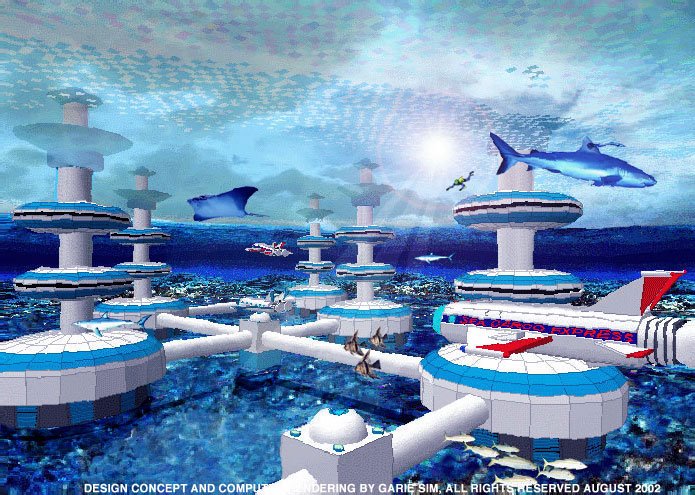
While the larger part of Earth's surface is covered by ocean, almost all of the human inhabitants of the planet huddle together on 6 of the 7 continents and assorted islands. What excuses are humans waiting for, before they will move out onto mother ocean?

Cloudmaking ships:
Sunlight heats the planet, but puffy, low-flying clouds reflect sunlight. So to reduce global temperatures, National Center for Atmospheric Research physicist John Latham and Edinburgh University engineer Stephen Salter want to make clouds.

In October, Latham explained his vision for a fleet of unmanned, self-propelled vessels crossing the world's oceans and seeding clouds by misting seawater high into the air. Just a thousand ships would offset temperature rises resulting from a global CO2 doubling, Latham said. He and Salter recently joined with climate-modeling guru Phil Rasch to determine the ships' potential to upset weather systems, including rainfall. "Questions like that have to be answered first," Latham said. "But I'm much more confident than I was a year ago." Source


Seasteading
Floating cities can serve as offshore tax havens, financial centers, retirement meccas, tourist destinations, marine and atmospheric science research core facilities, international centers for advanced medical treatments, and more. A floating seastead could cultivate its own fisheries in mid-ocean, via undersea infrastructure creating artificial reefs.

OTEC
Ocean thermal energy conversion provides electric power, fresh water, and water cooling/air conditioning on a large scale. OTEC combined with aeroponic agriculture would supply a seastead with ample power, fresh food, fresh water, and indoor climate control. The nutrient-rich deep ocean water would encourage plankton growth, which would allow fisheries and aquaculture to flourish.

Ocean Space Launch
Launching spacecraft from mid-ocean avoids many serious complications of a failed launch. Ocean launching also allows more optimal latitudinal placement for efficient matching specific types of earth orbits. Potential profits from ocean launch are considerable.

Frontier Opportunity Society:
A developing society offers many opportunities that older, more mature societies do not provide. The opening of the American west was but one example of a large-scale frontier opportunity. Such opening frontiers as the oceans, and outer space, breed hope, ambition, and ingenuity in the human imagination. The alternative to opportunity is stagnation and hopelesness.

Frontiers tend to attract and breed more adventurous and creative humans, who open new and broader horizons for the human future.

Labels: , , ,

Bookmark and Share

21 July 2006

Human Habitat: Unblocking Evolution

Humans evolved near the tropics, then spread across the earth to occupy virtually every continent and large island except for Antarctica. Even in Antarctica and in the far north, humans maintain a permanent presence for scientific and military purposes. Humans learned to live in extreme heat, extreme cold, and at quite high altitudes. Humans even learned to spend long periods of time at sea, but always with a home port in mind.

Humans seem to have gotten stuck for some reason, unable to take the next logical steps. Marshall Savage wrote a visionary book in 1992, The Millenial Project: Colonizing the Galaxy in Eight Easy Steps. The idea was to learn to live in more environments, including building cities on the sea, constructing earth orbiting habitats, moon habitats and cities, mars settlements, with eventual dispersion to the outer solar system and beyond. Here is a good place to catch up on the Millenial Project's ideas.

Anyway, the whole idea was to learn to adapt to increasingly harsh and difficult environments--to become more competent in dealing with hazards and threats in order to enhance our freedom of movement. With that enhancement of capability in mind, I want to look into the concept of undersea habitats.

Two of the websites incorporating the more expansive concept of undersea habitats that I had in mind, are this, and this. The habitat needs to be large enough to be considered a "community". It must be permanent and must contain a full set of industries, including medical, educational, financial, manufacturing, and service industries.

Such a habitat would have to be prepared to "hunker down" for weeks at a time, should surface conditions require it. That almost certainly means nuclear power, unless it were situated near the edge of a continental shelf, making OTEC available. Of course, with access to the surface you could have solar, wind, wave, and other sources of power.

NASA uses the Aquarius undersea habitat off Key Largo for astronaut training. Obviously any resident of an undersea habitat would learn safety training that would be the equivalent of what is required to survive in a space environment.

There is obviously no room for the neotenous in a potentially hazardous environment such as an undersea city, orbiting space colony, or asteroid habitat. Government schools are training citizens of North America to be victimised inhabitants of the impoverished neo-third world, not for an exciting future undersea or off-planet. Too bad.

Labels: , , , ,

Bookmark and Share

15 February 2006

Global Warming! Global Warming!

Climate scientists are not the most scrupulous citizens of planet earth as you will find by visiting Climate Audit. But there are excellent scientists in other, more established branches of science, who are attempting to meet the challenge.

You can tell who the real scientists are by whether they approach a problem as doomsayers, or whether they try to devise solutions to a problem.

Global warming just may have met its match. In research recently completed at Emory University School of Medicine, scientists have discovered a mutant enzyme that could enable plants to use and convert carbon dioxide more quickly, effectively taking more of that gas out of the atmosphere.

The findings were published online on January 19 and will appear in the February issue of the journal Protein Engineering Design and Selection. Ichiro Matsumura, PhD, assistant professor of biochemistry at Emory University School of Medicine, is the senior author and principal investigator. The lead author is research specialist Monal R. Parikh.

During photosynthesis, plants and some bacteria convert sunlight and carbon dioxide into usable chemical energy. Scientists have long known that this process relies on the enzyme rubulose 1,5-bisphosphate carboxylase/oxygenase, also called RuBisCO. While RuBisCO is the most abundant enzyme in the world, it is also one of the least efficient. As Dr. Matsu-mura says, �All life pretty much depends on the function on this enzyme. It actually has had billions of years to improve, but remains about a thousand times slower than most other enzymes. Plants have to make tons of it just to stay alive.�


Of course, plants could be designed to make diamonds out of the CO2 in the air just as well as be designed to grow faster. One approach creates a crystalline mineral, the other makes more cellulose. It really is a matter of choice.

The Kyoto Protocol has been shown to be ineffective, and unenforceable. It is an excuse for corrupt governments to feel they are actually doing something about a problem, when they are not. Fair enough. No one expects more of them at any rate. But please, you whankers, do not get in the way of people actually trying to achieve solutions.

Labels: , , ,

Bookmark and Share
Older Posts
Al Fin Main Page
Enter your Email


Powered by FeedBlitz
Google
WWW AL FIN

Powered by
Blogger

``