12 January 2013

Greenland Is Still Too Cold for the Vikings

Around the time the Vikings disappear from the island’s archaeological record, temperature appears to have plunged. _Source
The Vikings had things very nice in Greenland for a few hundred years, during the medieval warm period -- a warm period just as warm or warmer than modern times. It was so warm during that time, that the Vikings were able to grow barley, for beer.
We know that the little ice age cooled the Greenland climate to a point where the Viking's traditional foods and livestock were more difficult to grow. But were there other reasons why the Vikings packed up and went back to Iceland?
When settlement began in the early 11th century, only between 20 and 30 percent of their diet came from the sea. But seal hunting played a growing role in the ensuing centuries. "They ate more and more seal meat, with the animals constituting up to 80 percent of their diet in the 14th century," explains team member Jan Heinemeier, a dating expert from the University of Aarhus, in Denmark.

His fellow team member Niels Lynnerup, an anthropologist and forensic scientist at the University of Copenhagen, confirms that the Vikings of Greenland had plenty to eat even as the climate grew colder. "Perhaps they were just sick and tired of living at the ends of the earth and having almost nothing but seals to eat," he says.

The bone analyses show that they rarely ate meat from their own herds of livestock. The climate had become harsher on the island starting in the mid-13th century. Summer temperatures fell, violent storms raged around the houses and the winters were bone-chillingly cold. For the cattle that had been brought to Greenland, there was less and less to eat in the pastures and meadows along the fjords.

On the smaller farms, cattle were gradually replaced with sheep and goats, which were easier to rear. The isotope analyses show that pigs, valued for their meat, were fed fish and seal remains for a while longer but had disappeared from the island by around 1300...

...if it wasn't starvation or disease, what triggered the abandonment of the Greenland settlements in the second half of the 15th century? The scientists suspect that a combination of causes made life there unbearable for the Scandinavian immigrants. For instance, there was hardly any demand anymore for walrus tusks and seal skins, the colony's most important export items. What's more, by the mid-14th century, regular ship traffic with Norway and Iceland had ceased.

As a result, Greenland's residents were increasingly isolated from their mother countries. Although they urgently needed building lumber and iron tools, they could now only get their hands on them sporadically. "It became more and more difficult for the Greenlanders to attract merchants from Europe to the island," speculates Jette Arneborg, an archeologist at the National Museum of Denmark, in Copenhagen. "But, without trade, they couldn't survive in the long run." _Spiegel.de
The Spiegel article above cites archaelogical research that suggests that the abandonment of Greenland was more of a tactical retreat than a "dieoff." The young women had long since been packed off for greener pastures, there were no more babies, and toward the end of the colony, it was apparently only the die-hard old cobbers who remained.

It is only relatively recently that the glacial ice has melted back to allow a better examination of crops and wild forage and forest that grew on the edge of Viking settlements. In other words, Greenland is just now recovering from the icy ravages of the deep freeze conditions of the Little Ice Age.

In the final phase, it was young people of child-bearing age in particular who saw no future for themselves on the island. The excavators found hardly any skeletons of young women on a cemetery from the late period.

...In addition, there was a rural exodus in their Scandinavian countries at the time, and the population in the more remote regions of Iceland, Norway and Denmark was thinning out. This, in turn, freed up farms and estates for returnees from Greenland.

However, the Greenlanders didn't leave their houses in a precipitous fashion. Aside from a gold signet ring in the grave of a bishop, valuable items, such as silver and gold crucifixes, have not been discovered anywhere on the island. The archeologists interpret this as a sign that the departure from the colony proceeded in an orderly manner, and that the residents took any valuable objects along. "If they had died out as a result of diseases or natural disasters, we would certainly have found such precious items long ago," says Lynnerup. _Spiegel.de
Lately, it is beginning to warm up again on Greenland -- although cattle and barley growers have been slow to jump at the opportunity to put in new herds and crops there.

Perhaps Greenland is still just too cold -- even for the Vikings and Vikings at heart.

Labels: ,

Bookmark and Share

06 February 2009

The Settlement of the South Pacific

Dienekes Anthropology Blog looks at the evidence behind different theories dealing with the populating of the South Pacific by Austronesians. Anthropologists can use genetic evidence along with linguistic evidence to study the migrations of groups over long periods of time. The current consensus is that this vast migration began in Taiwan, and spread southward, then eastward, and branched to all points of the compass, eventually settling the Philippines, Indonesia, parts of New Guinea, and most of the South Pacific including New Zealand, Hawaii, and Easter Island (almost to South America).

Where else might these intrepid sea migrants have gone? Could they have formed settlements along the Chilean coast? If so, the evidence has not turned up yet.

One thing is clear, the old myth that the South Pacific islands were settled from South America is all but destroyed. Thor Heyerdahl's idea was adventurous enough and excited many romantic hearts, but doesn't seem to have proven out in the end.

The idea of the "lost civilisation" is persistent throughout the volumes of human myths and tales. When humans brave so much and travel so far to establish a home, it is likely that many promising starts ended up badly. There is a basis in fact for the "lost civilisation." Probably a much vaster basis than we can imagine.

Labels: ,

Bookmark and Share

03 January 2009

Impact 10,900 BCE? A Possible Solution to Several Coincidental Mysteries of Pre - Historia

Several pre-historic mysteries have been waiting for a solution.
  1. What caused the Lesser Dryas abrupt global cooling 12,900 years ago?
  2. Why did the Clovis culture of SW North America disappear?
  3. Why did technology migrate from South and Central America northward, when human migration from Asia went the opposite direction?
  4. What caused the extinction of large mammals such as mammoths?
Those and other mysteries may have a common solution: a devastating asteroid impact into mile-thick ice covering southern Canada 12,900 years ago.
Now researchers are reporting that the abrupt cooling — which took place about 12,900 years ago, just as the planet was emerging from an ice age — may have been caused by one or more meteors that slammed into North America.

That could explain the extinction of mammoths, saber-tooth tigers and maybe even the first human inhabitants of the Americas, the scientists report in Friday’s issue of the journal Science.

...But if true, the hypothesis could explain the disappearance of ice age mammals like mammoths and argue against the alternative idea that the animals were hunted to extinction by humans.

It might also help explain the disappearance of the Clovis people, a culture named after a distinctive arrow point discovered in a mammoth skeleton in Clovis, N.M., who are believed to have arrived in the Americas more than 13,000 years ago.

Douglas J. Kennett, a University of Oregon archaeologist who is the lead author of the Science paper, said no Clovis points or bones of the extinct animals had been found above the diamond layer. “It seems those two things synchronously end,” he said.

Dr. Kennett said there also appeared to be a gap of several centuries between the disappearance of the Clovis and the resettlement by other people. _NYT_via_Instapundit
Even more mysterious to me than the disappearance of the Clovis culture, is the fact that more advanced technology appears to have been discovered and heavily utilised first in South and Central America, then migrated northward to tribes of southern and eastern North America. A destruction of northern cultures and a disruption of southward migration paths would have isolated the early migrations south of the devastation zone, where their cultures would have evolved separately from source cultures.

The return to glaciation represented by the Lesser Dryas no doubt destroyed or disrupted earlier human attempts at civilisation in both the old and new worlds. Old legends of "Atlantis" and other mythical lost civilisations might have their origins in pre-impact times between the emergence from the last glaciation and the Lesser Dryas. Much has been lost to human history, and much that human history partially captured is ignored.

It is likely that a catastrophic cutting off of partially civilised cultures has occurred multiple times to human and primate cultures. These groups would have had to "start over" in building a civilisation, revert to barbarity, or die off (with a few other possibilities perhaps best suited for fiction writers).

Future humans may soon face the same challenge of starting over.

Labels: , ,

Bookmark and Share

02 March 2008

Wiping Out the Human Population of Earth Lovelock: This is the Real Thing Dammit

James Lovelock is the revered, grand old man of doom. Lovelock is quite cheerful about the coming demise of humanity. After all, what has humanity ever done for Lovelock?
Lovelock believes global warming is now irreversible, and that nothing can prevent large parts of the planet becoming too hot to inhabit, or sinking underwater, resulting in mass migration, famine and epidemics. Britain is going to become a lifeboat for refugees from mainland Europe, so instead of wasting our time on wind turbines we need to start planning how to survive. To Lovelock, the logic is clear. The sustainability brigade are insane to think we can save ourselves by going back to nature;....But he fears we won't invent the necessary technologies in time, and expects "about 80%" of the world's population to be wiped out by 2100. Prophets have been foretelling Armageddon since time began, he says. "But this is the real thing."

Faced with two versions of the future - Kyoto's preventative action and Lovelock's apocalypse - who are we to believe?...when I ask if he attributes the conflicting predictions to differences in scientific understanding or personality, he says: "Personality." ___Guardian
Lovelock...appears to have laughed and grinned and smiled his way through this interview. He predicts doom for almost all, and laughs about it.

"Well I'm cheerful!" he says, smiling. "I'm an optimist. It's going to happen."___Source
Lovelock is not the only one of his generation to predict massive human die-off. Modern prophets of doom have been profiting from the apocalypse since the late 1960s and early 1970s, when eco-apocalyptic books became best sellers. Paul Ehrlich, the Club of Rome, Rachel Carson--all these and more preceded Lovelock and Al Gore through the Valley of the Shadow of Human Apocalypse, and made money doing it.

According to these prophets, NYC should be underwater, the population of the Earth should already be below 1 billion from starvation and resource depletion, the entire Earth should be a wasteland, and the new Dark Ages should have long since fallen onto surviving human populations.

Remember Y2K? Sure you do. Unless you are too intent on the prophets making profits from the crises du jour, such as CAGW and Peak Oil? The Ozone hole scare has taken a backseat for now, but it can always be re-cycled, once the climate scare dies down and alternative energy sources predictably come on line one by one.

Or perhaps as Lovelock says, this is "the real thing." The evidence suggests otherwise, and it should be noted that Lovelock is promoting a new book. Should we simply put Lovelock up on the shelf alongside Ehrlich, the Club of Rome, the Y2K thrillers, and Al Gore? Perhaps we will.

Labels: , , , ,

Bookmark and Share

21 January 2006

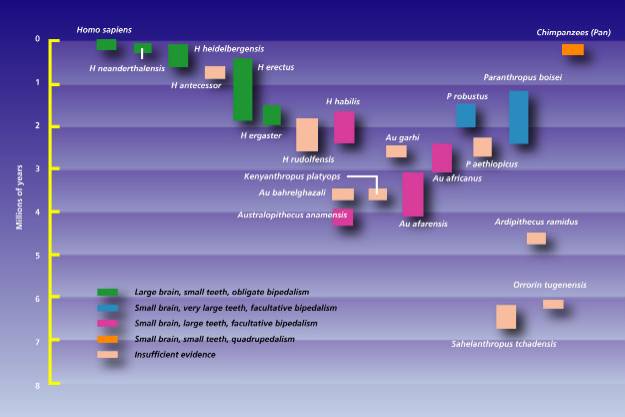
What are these Humans? From whence came they?

TalkOrigins

Talkorigins.orgprovides a good introduction to the scientific study of human origins.

If you have a high speed connection, this website will give you an interactive experience through four million years of human evolution.

Wikipedia has a good article about human origins. Homo Sapiens has been around for over a quarter of a million years, since the last inter-glacial period. Homo sapiens sapiens, or modern humans, came on the scene sometime in the past 100,000 years. When humans developed language and technology, things began to happen.

After the Ice by Steven Mithen covers the period of time between 20,000 B.C. and 5,000 B.C. During that time, a great deal of human migration occurred. As the weather warmed, plant life and animal life exploded. Human populations multiplied and overfilled the islands of thaw. Tribes were pushed outward in all directions. The ice had not melted, sea levels were low, and many present day islands were accessible to migrating humans and animals. When the ice melted, sea levels rose, islands formed, and hundreds of human populations were cut off. At the same time, the western hemisphere was populated by migrating tribes from Siberia.

The Human Web, by John Robert McNeill and William Hardy McNeill, picks up where "After the Ice" leaves off, at the dawn of agriculture. From Publishers Weekly
The spread of agriculture, the growth of world religions and the rise of European civilization to world dominance are some of the themes explored in this engrossing addition to the distinctive McNeill brand of broad-brush macro-history. The motor of history this time is the growing "web" of interactions-weaving together hunter-gatherer bands, then civilizations and finally the whole world-by which people, goods, diseases and ideas spread. As it binds ever more people ever more tightly, the web both brings them into conflict and lets them share and build on each other's achievements; thus Columbus's extension of the web to the Americas led to conquest but also to the exchange of New World potatoes and maize for Old World horses and smallpox. The father-son historian duo also revisit ideas from William's previous books, discussing the co-evolution of humans and microbes, the uneasy symbiosis between warrior elites and the farmers they protect and exploit, and the social solidarity imparted by group singing and dancing. More ecological than humanistic, the McNeill outlook sees conflict and cooperation as twin outcomes of the struggle for survival that drives developments in technology, political organization, social habits and even religious beliefs. This approach can be reductionist (Europe's vibrant civil society is said to spring from its use of mold-board plows); and as impersonal historical meta-agents go, the trendy "web" conceit is less substantive and fertile than other McNeill brainstorms. Still, this concise and beautifully written synthesis brims with revealing insights that make history comprehensible and enthralling. 25 illus., maps.
Copyright 2003 Reed Business Information, Inc.


Human Accomplishment by Charles Murray, looks at human accomplishments in the sciences and the arts. The leading names are predictable: Galileo, Newton, Einstein, and Darwin in the sciences, Beethoven and Bach in music, Shakespeare and Schiller in literature, Michelangelo in painting, Euler in mathematics, and so forth. Murray is at pains to eliminate Eurocentrism in his analysis: there is separate coverage of Chinese and of Indian philosophy to match Western philo- sophy, Chinese painting, Japanese art, Japanese literature, Arabic literature, and Chinese literature. These include, at a level he views as comparable to Aristotle and Mozart, such names as Gu Kaizhi, Basho, al-Mutanabbi, and Kalidasa. Murray’s goal is not, however, merely to make a list of 4002 all-time greats. He wants to build up a general view of the historical conditions that allow for the flourishing of artistic and scientific innovation and discovery.

Speaking of cultural histories, Jacques Barzun's "From Dawn to Decadence" is a useful addition to the list. Barzun looks specifically at the last 500 years of western culture.
From Dawn to Decadence, [1] Mr. Barzun’s overview of the last five-hundred years of Western cultural history, is a magnificent summa of his concerns as a thinker and historian. It synthesizes as well as summarizes a long lifetime’s reflection about the fate of those distinctive energies that define Western culture: “the great achievements and the sorry failures of our half millennium.” The first thing to be said about From Dawn to Decadence is that reading it is an exhilarating experience. I mention this partly to reassure those intimidated by the book’s length, partly to mollify those put off by its admonitory title. At nearly nine-hundred closely printed pages, From Dawn to Decadence certainly is long, but it is also a rich tapestry of a book—the product, Mr. Barzun remarks, of accidents like “insomnia and longevity,” as well as of immense scholarship. Despite the book’s intimidating girth, I suspect that many readers will, like me, come to feel about it the way one feels about certain long novels. For the first hundred pages or so, a mixture of wariness and anticipation predominates: will the book really repay the time and effort it demands? These feelings give way, as one settles into the story, to eager excitement. Finally, as the end approaches, one finds oneself madly trying to prolong the experience and delay coming to the final page.

National Geographic's Atlas of the Human Journey website is a fascinating glimpse at the sweep of human pre-history. The graphics are exceptionally good.

The New Geneva Center website presents an engaging discussion of human culture from ancient to modern, including cultures from east and south asia, the levant, africa, pre-columbian america. The author discusses both secular and spiritual aspects of culture which shaped ancient and modern civilisations.

This website is packed full of links about western civilisation.

To understand where humans are today, you must understand western civilisation. No other civilisation has created such an environment so conducive to learning, scientific and cultural freedom, and societal ferment. It is almost certainly from western civilisation that the next level will grow.

Labels: , , ,

Bookmark and Share
Older Posts
Al Fin Main Page
Enter your Email


Powered by FeedBlitz
Google
WWW AL FIN

Powered by
Blogger

``