23 May 2008

Another Look at Seasteading, Rich Man Style

Seasteading is a familiar topic here at Al Fin. Now there is a new player in the game, who is playing with high stakes--Peter Thiel.
With a $500,000 donation from PayPal founder Peter Thiel, a Google engineer and a former Sun Microsystems programmer have launched The Seasteading Institute, an organization dedicated to creating experimental ocean communities "with diverse social, political, and legal systems."

"Decades from now, those looking back at the start of the century will understand that Seasteading was an obvious step towards encouraging the development of more efficient, practical public-sector models around the world," Thiel said in a statement....The seasteaders want to build their first prototype for a few million dollars, by scaling down and modifying an existing off-shore oil rig design known as a "spar platform."

This schematic illustrates the ballasting system that Wayne Gramlich imagines would keep the seastead from tipping over. The amount of water in the ballasts could be raised or lowered to move the seastead up and down.
Holl Liou/Wired.com

In essence, the seastead would consist of a reinforced concrete tube with external ballasts at the bottom that could be filled with air or water to raise or lower the living platform on top.

The spar design helps offshore platforms better withstand the onslaught of powerful ocean waves by minimizing the amount of structure that is exposed to their energy. __Wired__via__NextEnergy
Seasteading is an expensive and dangerous game. Any serious attention given to creating intelligent and durable seastead architecture is welcome. The ocean is one of the most hazardous environments on Earth, aside from the polar regions and extreme mountain heights.

Previously, seasteading was in the hands of the savvy and hardy folks who wrote the Seastead Book, at Seastead.org. The book is a work in progress, and should see some new material later this summer. Anyone who wishes a good introduction to the topic should go there first.

But there is something that big money brings to a project that can not so easily be done on a shoestring. Expensive and hopefully competent sea architects. Expensive ship-building facilities and crew. The ability to build and launch impressive structures in a timely manner.

That is not to say that Thiel's approach will be the first or last seastead floating defiant against whatever the ocean may throw at it. Thiel is also invested in The Methuselah Foundation, which suggests that he has a healthy degree of caution when viewing the future. He may want his seastead over-engineered with redundant systems which will make it impossible for those of more modest means to replicate. Or it may turn out to be an expensive piece of junk that sinks like a stone.

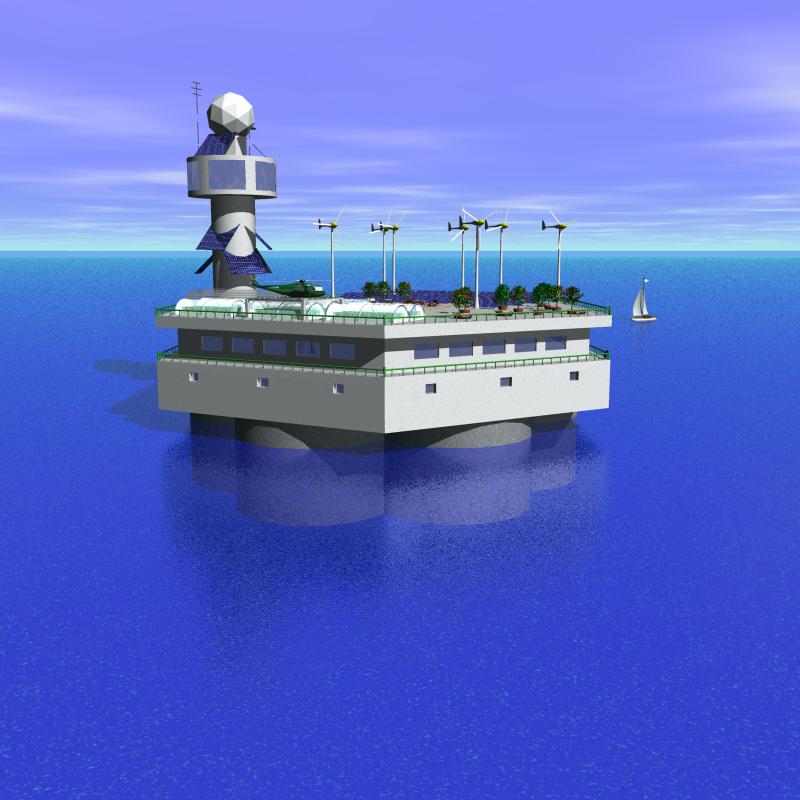
The long term viability of ocean living will be determined by multiple approaches, just as in any biological or economic niche. The design shown above appears far too limiting. It is not modular or expandable. It looks more like a very expensive toy, than a genuine attempt at a sustainable mid-ocean human living environment. But wait and see.

Seasteading.org (as opposed to seastead.org) is not the first word on seasteads, and will not be the last.

Labels: , ,

Bookmark and Share

28 December 2007

Ocean Planet: Time to Go Home?

While the larger part of Earth's surface is covered by ocean, almost all of the human inhabitants of the planet huddle together on 6 of the 7 continents and assorted islands. What excuses are humans waiting for, before they will move out onto mother ocean?

Cloudmaking ships:
Sunlight heats the planet, but puffy, low-flying clouds reflect sunlight. So to reduce global temperatures, National Center for Atmospheric Research physicist John Latham and Edinburgh University engineer Stephen Salter want to make clouds.

In October, Latham explained his vision for a fleet of unmanned, self-propelled vessels crossing the world's oceans and seeding clouds by misting seawater high into the air. Just a thousand ships would offset temperature rises resulting from a global CO2 doubling, Latham said. He and Salter recently joined with climate-modeling guru Phil Rasch to determine the ships' potential to upset weather systems, including rainfall. "Questions like that have to be answered first," Latham said. "But I'm much more confident than I was a year ago." Source


Seasteading
Floating cities can serve as offshore tax havens, financial centers, retirement meccas, tourist destinations, marine and atmospheric science research core facilities, international centers for advanced medical treatments, and more. A floating seastead could cultivate its own fisheries in mid-ocean, via undersea infrastructure creating artificial reefs.

OTEC
Ocean thermal energy conversion provides electric power, fresh water, and water cooling/air conditioning on a large scale. OTEC combined with aeroponic agriculture would supply a seastead with ample power, fresh food, fresh water, and indoor climate control. The nutrient-rich deep ocean water would encourage plankton growth, which would allow fisheries and aquaculture to flourish.

Ocean Space Launch
Launching spacecraft from mid-ocean avoids many serious complications of a failed launch. Ocean launching also allows more optimal latitudinal placement for efficient matching specific types of earth orbits. Potential profits from ocean launch are considerable.

Frontier Opportunity Society:
A developing society offers many opportunities that older, more mature societies do not provide. The opening of the American west was but one example of a large-scale frontier opportunity. Such opening frontiers as the oceans, and outer space, breed hope, ambition, and ingenuity in the human imagination. The alternative to opportunity is stagnation and hopelesness.

Frontiers tend to attract and breed more adventurous and creative humans, who open new and broader horizons for the human future.

Labels: , , ,

Bookmark and Share

09 May 2007

Making Space Launch More Affordable

Brian Wang at Advanced Nanotechnology Blog has posted a thoughtful entry on the prospects for cheap space launch within 10 years--via laser and magnetic launch technologies.
The $10,000/kg cost of getting things into space has been crippling what is possible in space. Any low cost system will also need to have a high volume purpose. I discuss the best system that would still involve chemical propulsion and laser and magnetic launch systems. The focus is on laser launch array systems (and mirror reflecting enhancement). I believe there is no technical roadblock for the laser array launch system being developed within 10 years. As with any significant project it would take a coordinated effort and funding.

....Laser photonic mirror system could launch things into orbit and could enhance the laser array launch system with mirrors to multiply efficiency by 1000 up to 100,000 times.

High volume magnetic launch (4000g) acceleration with ion propulsion at the top could bring launch costs down to $10/kg. High volume systems which have operational costs which are only the cost of electricity tend to converge to the $10/kg price. The laser launch and laser launch mirror systems also converge to those prices at high volume.
Go here for the original article, with excellent links and graphics.

Brian is talking about revolutionary changes in the cost of space launch--a reduction from $10,000 per kg to $10 per kg. There is no earthly way of describing to the uninitiated what this would mean for the future of humans on and near earth.

But throwing caution aside, I shall go cautiously insane for a moment in looking at the market value of near earth asteroid 3554 Amun. This asteroid is 2 km in diameter, and assuming typical nickel-iron meteorite composition, Amun is worth $8,000 billion in iron and nickel, $6,000 billion in Cobalt, with a total worth on the Earth metals market in the late '90s of $20,000 billion. Its worth to spacegoing enterprise, given it would already be in orbit and not need to be launched, would be in the vicinity of $300,000,000 billion, at current launch rates. At Brian's reduced rates it would be worth only $300,000 billion--a significant discount indeed.

Consider how much wealth $300,000 billion would be: roughly equivalent to the gross global product of Earth for the next thirty years or more. Source: Mining the Sky by John S. Lewis, Addison Wesley Press.

Think of it as a minor motivation for the few humans who value wealth--particularly in a rapidly expanding human universe.

A space rush would be similar to the many gold and silver rushes of previous centuries, and the oil rushes that continue even in an environment of so-called peak oil. The huge influx of wealth to the countries able to capitalise on this explosion of pioneering exploitation of space resources would sponsor accelerated research into biotechnology, nanotechnology, cognitive science--not to mention any number of new and decadent amusements.

This would not be the next level, but it would certainly be a good bypass around the economic implosion in the west being brought about by demographic aging and shrinkage combined with a worrying dysgenic population trend. With a new and rapidly expanding frontier full of near-instant billionaires and trillionaires, a lot of very interesting possibilities will inevitably come about.

Labels: , ,

Bookmark and Share

22 July 2006

Permanent Space Colonies: Humanity's Rite of Passage


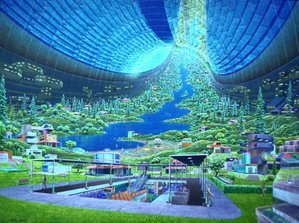
Princeton physicist Gerard O'Neill helped to kick-start the space colonies movement during the 1970's. Stewart Brand of the Coevolution Quarterly, was another driving force for the space colonies movement, and edited a book on space settlements that is available online. NASA also did several studies on space settlements, including the original 1975 design study that is available online in ebook form.

Several private grassroots organisations were founded during that magical time of citizen space enthusiasm. Some of the best known included the L5 Society, Permanent, Artemis, and TMP/LUF, discussed in a previous posting here at Al Fin.

NASA maintains an excellent site dealing with space settlements resources, organisations, and links, here. Wikipedia's Space Colonization site is a good complement to the NASA site, with fine links to resources.

Humans will still be in their childhood, until they learn to live off-planet. Sea-steads and under-sea communities will be important rites of passage for humans, but only permanent space colonies will truly mark the passage to adulthood of the species.

The natural human trait is to concentrate on the disaster du jour, or the local cause, fad, or fashion--and forget that dinosaurs were once the top pedestal species, like humans are now. But somewhere out there in the Oort Cloud, the Kuiper Belt, the Asteroid Belt, the Earth Crossing Asteroids, or even interstellar space--there is a large fast moving object with the Earth's name on it. When that hunk of matter hits this planet, that will be all she wrote, folks. Being natural is not going to help humans survive. Growing up is dangerous. Never growing up is a dead end.

Labels: , , , ,

Bookmark and Share

25 June 2006

A Life on the Sea--Seasteading: The Book

Through the years, a lot of people have looked to the sea for a type of freedom they imagined was not possible on the land, locked in by traditions hundreds or thousands of years old. The thought of starting one's own country at sea, or under the sea, and making up the rules for oneself, has occurred to a large number of people. Finally, someone has thought to write a book, free on the internet, describing many of the failed approaches, and many more possible approaches that might possibly work.

The sea is is an ever changing environment, sometimes placid, sometimes hellish and unforgiving. It is up to the persons who plan the sea-going human environment to plan for the possibilities, to ensure freedom, survival, and hopefully prosperity.
A small but passionate minority is deeply dissatisifed with current political systems. These people seek the autonomy to live under and experiment with different political, social, and economic systems than currently exist. It is this search for sovereingty, for the freedom of self-government, which is the fundamental motivation for seasteading. Utopia is different for everyone, and so there are a wide variety of theoretical new systems and gripes with the old ones. We'll present only broad outlines of the most common schools, leaving the explanations of what the Problems are and how each philosophy is the Answer to the partisans themselves:

* Many people are interested in sustainable, environmentally friendly ways of living [Celestopia], which are well-suited for seasteading, where renewable energy generation and closed-loop gardening will be facts of life.

The residents of these future cities, throughout the world, will show by exemplary actions that people of different races and divergent political, religious, cultural and social beliefs can live and prosper together while also being good stewards of the earth, respecting, and thereby benefiting all inhabitants and ecosystems of the planet.[Celestopia]

* Capitalists want low taxes and regulatory freedom [Atlantis1994].

There are tax benefits: no federal tax on coroporate profits, no state corporation tax, no social security tax. And any open sea facility is a free port. You can bring in any raw materials and ship out any finished products, without paying tariff duties. Outside government jurisdiction on the open sea, there are no regulatory agencies to contend with. You can dispense with the expense and bother of excessive paperwork, forms, and reports. You won't be ordered to waste your time appearing before government bodies. Licenses and permits will be things of the past. Government litigation and harassment, and the uncertainty caused by changing laws, regulations, and interpretations will be eliminated.
[Fisher1985, pp. 48-49]

* Few opportunities remain for pioneers, and the oceans are the obvious next frontier for civilization.
* It seems likely that the next major frontier, after the oceans, will be space. We can look at seasteads as a dry (er...wet) run for spacesteading:

If we are going to colonize space, it is best to colonize the easiest space first...Living in colonies at sea will teach us many crucial lessons about life in space. The isolation, self-sufficiency, and political autonomy of sea colonies are the same as those of space colonies. Both types will impose many of the same requirements on their inhabitants...The Moon is a harsh mistress; we would be wise to learn these early lessons while still in Earth's gentle lap.
[Savage1992 pp. 23-24]

If humankind is to survive, I see no alternative to expanding outward into space. And this doesn't just mean settling on other planets and moons. They will be just as vulnerable to doomsday weapons as the Earth, and there aren't enough of them to insure that some will survive an Armageddon. Only a large number of communities well dispersed in the volume of space seems likely to have a chance...The establishment of such communities space would constitute a Golden Age of new-country formation in the next few centuris. Those who gain experience in the new-country field now are the most likely to be ready to seize the new opportunities when they arise -- or to see their children and their children's children in a position to do so.
[Strauss1984 p. 47]

* Devoted proponents of peace seek places where they can live without being taxed to fund violence.
* Drug users care deeply about the freedom to ingest whatever chemicals they desire [Island]. In many current societies, they are subject to arrest, jail, and the confiscation of their property.
* Individuals who are Environmentally Intolerant (EI), such as those suffering from Multiple Chemical Sensitivity, seek environments with minimal contamination from human chemicals:

Waterfront property offers some of the cleanest air anywhere by virtue of the high rate of ambient air exchange afforded by ocean or lake breezes. Even regions with relatively bad general pollution levels enjoy orders of magnitude cleaner air along the shore, as long as there are regular breezes. Unfortunately, few people can now afford such property -especially those who need it most. A floating home offers a potentially unlimited amount of waterfront real estate with no land cost. You can have as much as you can afford to build. There are no surrounding lawns and trees to generate pollen, no roads with cars to generate pollution -though, of course, boats are still a pollution issue albeit far less than automobiles.
[Hunting]

Our personal motivation is the belief that monolithic, land-based societies are too big and too politically static. We think political flexibility and experimentation with many different political systems is the right way to find new and better ways to live. Seasteads would allow for a rich diversity in forms of governance because they lower the barrier of entry to the market of government. When it takes a revolution or millions of votes to take over a country, small groups have no opportunity for self-government. But if, for the cost of their houses, they can band together and create new sovereign territory, many will do so. While living their own ideal lifestyle, they will also be researching innovations in the basic institutions of society, which will increase our collective wisdom and benefit all humankind. These ideas are explored more under dynamic geography below.

Whatever the specific motivations, the popularity of new country projects make it clear that there is a great deal of interest in this topic [Alexandisle, Atlantis1994, Celestopea, FloatingCities, FreedomShip, Freedonia, Island, LFC, NewUtopia, NewAtlantis, Nexus, Pelagic, ResidenSea, Salsbury1992, Savage1992, Sealand, Seascape, Strauss1984, VenusProject].

While few people are devoted enough to drop everything and go found a new society, we think that everyone is, to some degree, a revolutionary. After all, who was the last person you met who was completely happy with everything about their society? While utopia is not an option, we do believe there are some fundamental reasons why seastead societies are likely to work better than terrestrial ones. As experimenting with new social systems becomes cheaper and easier, it will be a viable alternative for an increasingly large segment of humanity. Seasteading is a realistic way to make a significant leap forward.

The authors then go on to discuss the philosophy of seasteading and the approaches most likely to achieve success.

There is no single "right" approach to seasteading. Thus we will present you with many ideas, exploring those we think are the most viable in the most detail. However, it does seem like there are some "wrong" approaches, as we can see from the many failures of projects with the same goal. What we've learned from the movement's (admittedly dismal) history has to a large degree shaped our philosophy. Because of this, explaining our approach goes hand-in-hand with identifying common points of failure and indicating how we think they can be overcome.

The root cause of most of these failures seems to have been lack of realism. So our solution is simply to be as pragmatic as possible about our vision. Realism is our philosophy's foundation, and more specific polices are just the application of realism to various areas. Important areas include incrementalism, politics, technology, and finances.

Incrementalism

We believe that a realistic approch to the difficult problem of nation-founding must be incremental. Large, successful things usually start out small and expand organically, rather than springing forth full-formed like Athena from the brow of Zeus. Rome wasn't built in a day and a succesful business leverages each stage into the next. Big things (cruise ships, skyscrapers, factories) do get built all at once at times, but they are almost always proven concepts that were first demonstrated successfully on a smaller scale. For example, we bet that the first multistory building had exactly 2 stories. In our case, if there was a nation-founder with the financial resources to jump the intermediate stages and create a vast floating city, it would already exist. After all, there are plenty of people ready to design and build one as soon as the multi-billion dollar check gets cut. Since no such deus ex machina appears to be forthcoming, we recommend humbler methods.

There are plenty of grand conceptual ideas out there, but we see a key link between being grand and staying conceptual. We find the notion that the first sea-city will be for ten thousand people is ludicrous. If you make the first step too high, you will never even get started, as the many participants who became frustrated with and dropped out of new-country projects can attest. Instead, we believe that almost all the focus should be on the current and immediate next stage, not on far-distant visions. Watch the path in front of you, not the sky.

There is an inherent difficulty in getting people involved in something that has value only if people are involved in it. How do you start? Contingent contracts help, ie all participants sign something which says "I will pay for my share and move onboard if 99 other people also sign this contract". This approach is working for the Free State Project in its quest to get 20,000 libertarians to move to New Hampshire. In our case, however, there are difficulties. We think that its best to try out this new way of life with fewer people at first. Also it appears difficult to get enough interest for even contingent signatures on floating-cities without demonstrating viability. For these reasons, our plan includes a series of distinct stages, each involving a greater number of people.


First we complete a design, and build an aquarium-sized model. Then a pool-sized version. Next we build a habitable Baystead prototype for 5-10 people, anchored in sheltered waters within US boundaries, to demonstrate our seriousness and our design. This is the first point at which we need other people's participation. We just need to find 5-10 people who are willing to live together, and don't mind the level of creature comforts that can be achieved on a fairly small platform. While it will require a rare level of dedication to the concept to join this group of aquatic pioneers, we don't have to find very many such people.

Next we need to find 25-100 people (or the equivalent in timeshares) who weren't quite sure if seasteading was legit before, but seeing the demonstration by the first group, find it worthwhile to participate. They build the first deep-water, self-sufficient seastead. Next we find the 100 people who weren't quite convinced by the small group ... and so on. Smaller steps can be added if necessary.

There is plenty of historical precedent for this strategy of zealots seeding settlements. North America, for instance, was colonized mainly by members of minority religions such as the Puritans seeking to escape persecution. These dedicated folk were willing to put up with the discomfort of pioneering in exchange for religious freedom. The result of this passionate committment to a cause was, eventually, an increased level of civilization, and a beachhead for the less dedicated to follow.

At every step in incremental development, the standard of living increases due to economies of scale, refinement of techniques, and the network effects of the larger community. Rather than convincing 10,000 people from the beginning, you just keep bringing in those at the margin, who needed things to be just a little bit better to get involved. As interest in seasteading steadily grows, more units are steadily built. Each may cater to a slightly different audience, or experiment with different engineering designs and social systems. They will be modular and eventually cluster together into the grand vision many have proposed [Atlantis1994, Nexus, NewUtopia, VenusProject].

With advanced technology, the pioneering cycle is much shorter nowadays. It doesn't take centuries to go from Conestoga wagons to skyscrapers, and we'll get to start out with electricity, hot running water, and satellite telephones. But at the beginning, we still must be pioneers. We aren't focusing on these humble first steps because we lack imagination, or don't think a huge luxurious floating city would be amazingly cool. That sea city is our ultimate goal, but it is our firm belief that a sea village must come first - and a single sea house before that.


This is just a short excerpt from the second chapter of the book. Here is the Table of Contents for the entire book. I will revisit this book in future posts.

Every child learns to dream about other worlds, worlds of possibilities beyond the present. The facility to dream is too easily lost in the dystopian atmosphere created by much of popular media, and the smothering academic world of postmodern emasculating political correctitude. That is society's loss. Fortunately a small number of people refuse to give up the ability to dream of what they might achieve under their own power, given the freedom. The future depends, to a large extent, on these few being able to hold out a little longer.

Labels: , ,

Bookmark and Share
Older Posts
Al Fin Main Page
Enter your Email


Powered by FeedBlitz
Google
WWW AL FIN

Powered by
Blogger

``