04 January 2012

How Humans Cause Earthquakes

The best-known case is the earthquake caused by the Zipingpu Dam, in China’s Sichuan province, in 2008. Zipingpu held 42.3 billion cubic feet of water, the weight of which precipitated what Klose says is the largest human-triggered earthquake to date: a 7.9-magnitude quake that killed nearly 80,000 people. Klose estimates that Zipingpu, with nearly 320 million tons of water pressing down on a fault line, contributed enough stress to trigger the quake through a process called impoundment. “If you push your finger on top of a paper plate, the plate will bend,” he says. “That same effect works on all the tectonic plates on the Earth’s crust.” The quake occurred two years after the dam’s completion, and its epicenter was a mere three miles from the structure.

Authorities in Basel, Switzerland, shut down the city’s geothermal plant after a 3.4 quake in 2006. Tapping geothermal energy involves boring into rock miles beneath the Earth’s crust in search of steam as a source of energy. Engineers in areas without much water, such as Basel, sometimes create boreholes by way of hydraulic fracturing, or “fracking,” which involves forcefully injecting water to create fissures. Fracking can generate small tremors, but the real damage may happen as excess liquid pools in the cracks between rocks, making them less stable. Although dams have caused some 76 earthquakes, mining is responsible for at least 137 earthquakes, over half the number of man-made quakes to date.

In 1989 a 5.6-magnitude earthquake hit Newcastle, Australia, the direct result of coal mining. Extracting millions of tons of coal added stress to the fault lines, but the real danger resulted from the water that was extracted during mining. For each ton of coal produced, Klose estimates, 4.3 times as much water was pumped out of the ground, a necessary step to prevent flooding inside the mine. But removing so much water dramatically altered the stability of the earth surrounding the mine. Klose says the earthquake caused $3.5 billion in damage—an amount that nearly equaled the profit of all the coal produced by the mine over its 200-year history. _PopSci
More here

Other human-caused micro-quakes have occurred via deep well injection of fluids, and by experimental deep hydraulic fracturing into crystalline rock (such as granite) near faults. It should be noted that shale fracturing -- such as is done for oil & gas production -- has not produced a causal link to earthquakes.

The recent small quakes in the Youngstown, Ohio area are associated with deep well injection of waste fluids -- a completely different process from shale fracturing.

Unfortunately, a large part of the news media has reported the quakes as having been caused by shale fracturing -- which is not the case. This type of skanky behaviour by news media is nothing new, but one has to wonder whether it is caused by ignorance or by willful deception.

We expect the faux environmental and green sites to misreport such events -- out of both ignorance and willful deception, depending upon the outlet. But in the case of the Ohio micro-quakes, normally careful sites such as oilprice.com, slate.com, and other mainstream outlets produced news copy that was not fit for a third grade newsletter, due to the inaccuracies. This is a troubling trend that should be watched very carefully.

It has been shown for decades that deep fluid injection into the crust can induce micro-quakes, if it takes place near known and discovered faults. And of all energy-related drilling, the type most closely associated with inducing micro-quakes is geothermal -- both enhanced and the geyser type. Deep CO2 injection is likewise liable to induce micro-quakes. Shale fracturing is probably the least likely cause of micro-quakes due to the more shallow nature and due to the type of rock involved.

But if one wishes to be absolutely sure that one is not performing shale fracturing near a fault zone, a thorough seismic survey (for about $10 million) can be done prior to any drilling. Clearly a less expensive method of reassuring the panicky public, skankstream media, and less than honest environmental media is needed.

Scientific research is the best antidote to the type of superstitions being purveyed by the modern skankstream.

Some European experience:
The data generally support the view that injection in sedimentary rocks tends to be less seismogenic than in crystalline rocks. In both cases, the presence of faults near the wells that allow pressures to penetrate significant distances vertically and laterally can be expected to increase the risk of producing felt events. All cases of injection into crystalline rocks produce seismic events, albeit usually of non-damaging magnitudes, and all crystalline rock masses were found to be critically stressed, regardless of the strength of their seismogenic responses to injection. Thus, these data suggest that criticality of stress, whilst a necessary condition for producing earthquakes that would disturb (or be felt by) the local population, is not a sufficient condition. The data considered here are not fully consistent with the concept that injection into deeper crystalline formations tends to produce larger magnitude events. The data are too few to evaluate the combined effect of depth and injected fluid volume on the size of the largest events. Injection at sites with low natural seismicity, defined by the expectation that the local peak ground acceleration has less than a 10% chance of exceeding 0.07 g in 50 years, has not produced felt events. _Geothermics

Enhanced geothermal drilling is a far greater micro-earthquake hazard than is any drilling or fracturing in porous shale for oil & gas. But even so, it is best to avoid overreacting to the risk, but rather to plan deep drilling and hydraulic fracturing of crystalline rock very carefully, to minimise risks.
The risk of overreaction to the risks inherent in deep geothermal projects is very real. The establishment of an overly harsh regulatory framework would penalize the geothermal industry in comparison to other energy sectors that carry a recognized risk of inducing seismicity, such as gas extraction or coal mining.

From their outset, EGS projects need to be thought of both as pilot projects with scientific unknowns and as commercial ventures with technological and financial risks. Companies need to have allocated enough of their budget to scientific investigations not directly related to the exploitation of heat. Local authorities need to avoid being enticed by the promises of alternative energy, and to remember to ask the right questions. Risk evaluations need to be done before — not after — these projects begin. _Nature
In such cases where the risks are small but clear, appropriate care must be used in conjunction with any deep geothermal drilling, or deep well injections -- particularly near fault zones.

But the risks of shale drilling and fracturing are completely different -- and orders of magnitude smaller -- than the risks of drilling and fracturing crystalline rock such as granite. If regulatory agencies rush in to ban economically important procedures which have been demonstrated to be safe over decades of experience and geological testing, they will be doing a grave disservice to their constituents.

Cross-posted from an orignal Al Fin Energy article

It should be noted that by inducing multiple small quakes, built-up stresses within faults can be slowly dissipated over time -- theoretically reducing the devastation caused by later earthquakes. This is an area of science begging for funding. Perhaps the many billions that have been mis-allocated to carbon hysteria research would be better spent on genuinely important research such as this.

Labels: , ,

Bookmark and Share

02 January 2012

Preventing Large Earthquakes by Intentional Triggering of Small Quakes

Scientists are continuously thinking of ways to try and reduce earthquake power. Some are trying to lessen the friction between colliding plates. They poured water down a fault where two plates were grinding together. The water “lubricated” the fault, letting one piece jerk free with a number of little earthquakes and preventing a large tremor. _EarthquakePrevention
Large earthquakes have killed millions of people, and are a constant threat to hundreds of millions of people living in cities within prominent seismic zones. If there were any possible way to reduce the deadly danger in which these people are living, earth science must investigate the possibility.

Deep injection of fluids into the Earth's crust has the potential to trigger earthquakes, typically small, multiple quakes. Do not confuse this type of deep fluid injection with fracking for oil or gas. The two things are not the same at all.
"Injection induced earthquakes" are NOT caused by hydrofracturing. Injection of fluids for the purpose of waste disposal or well stimulation is NOT "fracking." Injection of fluids CAN induce earthquakes in some circumstances. Hydrofracturing has NOT been found to induce earthquakes. _Injection Induced Earthquakes Reference
An interesting case mentioned in the New York Times of 1 Jan 2012 (yesterday), is a series of small earthquakes in the Youngstown, Ohio, area, associated with the deep injection of waste fluids into the Earth's crust:
An official in Ohio said on Sunday that the underground disposal of wastewater from natural-gas drilling operations would remain halted in the Youngstown area until scientists could analyze data from the most recent of a string of earthquakes there.

The latest quake, the 11th since mid-March, occurred Saturday afternoon and with a magnitude of 4.0 was the strongest yet....a 2.7-magnitude temblor on Dec. 24, showed that it occurred less than 2,000 feet below the well. Because of a lack of data, depth estimates of earlier earthquakes had been far less precise.

... Scientists had suspected that some of the wastewater might have migrated into deeper rock formations, allowing an ancient fault to slip. Similar links between disposal wells and earthquakes have been suspected in Arkansas and Texas. _NYT
Injection-induced earthquakes have been noted in Germany in 1997, in Colorado in the 1990s, in Texas, and Arkansas.

This reference website contains over 130 references to reports of injection associated quakes. The association between deep crust fluid injection and small earthquakes appears to be well founded. But it is important to note that there is no such association between fracking and earthquakes. Keep that distinction in mind.

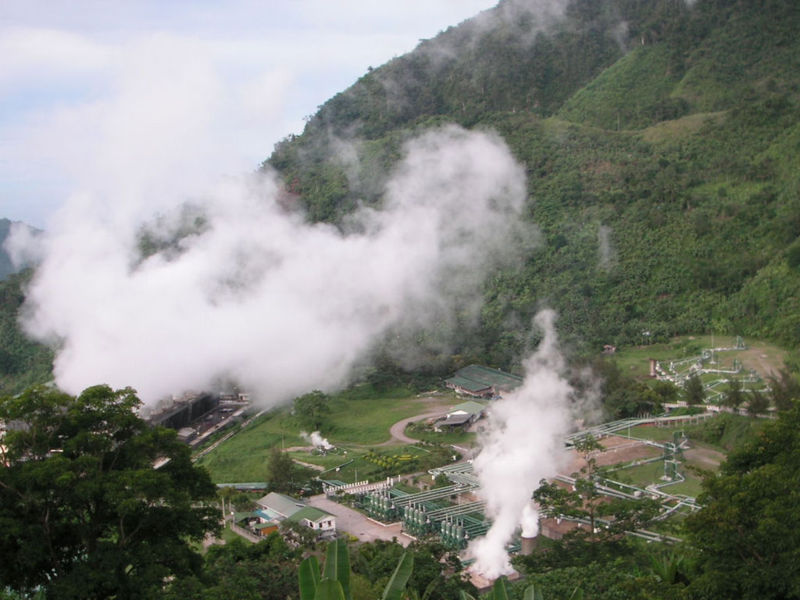
Geothermal power at the Geysers in Lake County, California, has been associated with thousands of tiny earthquakes above magnitude 1 since 1975 when the resource was tapped.

Earthquakes are triggered by a number of different things, including the construction of hydroelectric dams.
Depth of the reservoir is the most important factor, but the volume of water also plays a significant role in triggering earthquakes.

RIS [Reservoir Induced Seismicity] can be immediately noticed during filling periods of reservoirs.

RIS can happen immediately after the filling of a reservoir or after a certain time lag.
It would be best for humans to invest in the best accelerated research possible to clearly and unequivocally define the risks and benefits of small scale induced seismicity. One of the best ways of doing this would be for seismic scientists to work closely with deep drilling enterprises which also involve the deep injection of fluids into the earth's crust. By piggy-backing onto economic activity which is already being done, seismologists can increase the detail of their seismic maps, and can also collect abundant data on the impact of deep crustal fluid injection into different fault configurations.

The risk of causing small earthquakes associated with deep geothermal drilling for enhanced geothermal power, and in CO2 sequestration injection into the crust, are both real -- although perhaps minimal. Whether such injections will serve to reduce the risk of later larger earthquakes is something that needs to be determined.

One thing is very clear, however: While lefty-Luddite greens of the energy-starvationist persuasion are screaming about the unlikely possibility that fracking might conceivably cause small earthquakes, the very real possibility that deep injection CO2 sequestration will likely cause small quakes is ignored by the same activists.

If there is a way to prevent large, destructive earthquakes by triggering multiple smaller quakes in a prophylactic manner, such technologies should be studied very carefully and expeditiously.

Part of this article was taken from a previous article at Al Fin Energy.

Labels: , ,

Bookmark and Share

01 August 2010

Can We Survive Without the Sun?

Ring of Fire

We like to say that life on Earth could not survive without the sun, but that isn't actually true. Without the sun the surface of the planet would freeze down to a certain depth, but the amount of energy contained in the molten planetary core could provide ample heat and electric power to maintain human civilisation for hundreds of thousands of years or longer.

From the western US to Australia (Queensland and Victoria), Indonesia, the Phillipines, Kamchatka, Alaska, and New Zealand, the Pacific Ring of Fire makes thermal energy available to much of the world's population. Similar "rings of fire" over the rest of the Earth extends this ample fund of energy to Europe, western and central Asia, and parts of Africa.
Jefferson Tester: The figure for the whole world is on the order of 100 million exojoules or quads [a quad is one quadrillion BTUs]. This is the part that would be useable. We now use worldwide just over 400 exojoules per year. So you do the math, and you know you've got a very big source of energy.

How much of that massive resource base could we usefully extract? Imagine that only a fraction of a percent comes out. It's still big. A tenth of a percent is 100,000 quads. You have access to a tremendous amount of stored energy. And assessment studies have shown that this is thousands of times in excess of the amount of energy we consume per-year in the country. The trick is to get it out of the ground economically and efficiently and to do it in an environmentally sustainable manner. That's what a lot of the field efforts have focused on. _TechReview

If you drill far enough down into the Earth, you will find hot rock. Circulating a heat exchange fluid into the rock allows you to utilise the heat to drive a heat engine to generate electric power. Using both the heat and the electricity obtained from below ground, life on planet Earth could be maintained under large domes for millions of years, even without the sun. Add the energy you can get from nuclear fission and fusion, and human civilisation could go on even longer.

Since the sun is likely to go on for another billion years or longer, what we are talking about is two things: 1. geothermal energy as supplementary, baseload energy for parts of the world where nuclear power is not practical or safe, and 2. human settlements on molten-core planets which are too far away from a star for conventional star-powered photosynthetic life cycles and atmospheric heating.

Geothermal is expensive, and is a low-grade form of energy. But it is 24 hour a day baseload energy which can also be load-following power. Enhanced geothermal requires deep drilling and regular maintenance. And there is the fear of earthquakes:
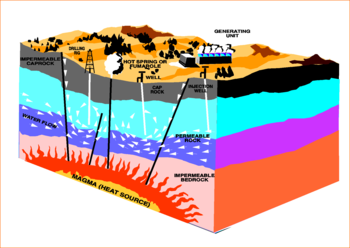
Using EGS, producers drill deeply into hot rocks and pump surface water to them. The heat is transferred to the water and it is pumped back to the surface with geothermal energy that is used in a standard geothermal power plant. Much heralded until recently, EGS began to garner controversy when its deep fracturing of geologic structures seemed to be associated with increased seismic activity, first in Basel, Switzerland, and later in California.

..."The thing is, you've got to address it," Gawell said. "If you've got major slip faults in the area, you don't do a project there. You simply stay away. When somebody permits a geothermal project in Basel, Switzerland, the site of the biggest earthquake in European history, you have to wonder whether they did any screening or thinking" beforehand. _GreentechMedia
But think about it: Earthquakes come from faultlines where plates are pushing and sliding against each other. The best way to prevent a large earthquake is to trigger multiple small earthquakes to relieve the pressure that is building over time.

The hysteria over EGS-caused mini-quakes is misplaced. The danger comes from not relieving the pressure.

And so massive quantities of baseload energy goes untapped, because for now it is cheaper to use other forms of energy -- such as coal, gas, oil, hydro. How does geothermal compare to wind?
According to Tantoco, the company may spend as much as $3.5 million to produce a megawatt of geothermal power through its greenfield facilities, and about $2.5 million per megawatt for its wind power project. [EDC Philippines] _BusinessInquirer
But geothermal is 24 hour baseload and potentially load-following power. Wind power is intermittent, with a capacity factor of 0.3 or less -- and essentially unpredictable! Wind machines often break down within 5 to 10 years, whereas geothermal can last for several decades or longer.

No one is saying that geothermal is better than small modular nuclear reactors in terms of portability, versatility, efficiency, or affordability. But for demographic reasons, some parts of the world are simply not safe places to put nuclear plants -- even SMRs. If geothermal energy is available, it represents a better alternative, for those particular places.

Taken from an earlier article at Al Fin Energy

Labels:

Bookmark and Share

26 April 2010

Spallation Drilling Says: Don't Write off Geothermal Just Yet

Brian Westenhaus took a recent look at the growth in the number of geothermal projects across the US. And a recent Seeker Blog article on geothermal energy suggests that spallation drilling should provide an economic means for drilling at the necessary depths for high quality heat.  The graph below shows the projected economic benefit of spallation drilling vs. conventional deep rock drilling.

Hydrothermal spallation was invented and patented by cofounder Bob Potter and Jefferson Tester of MIT. The patent is owned by MIT and licensed exclusively to Potter Drilling.
An animation of how hydrothermal spallation works.


An animation of how hydrothermal spallation works.
Chad Augustine MIT PhD Thesis Chemical Engineering

Summary of Potter Geothermal project funded by US DOE

Description of hydrothermal spallation drilling at Energy Boom

2006 Technology Review interview with patent holder Jefferson Tester

Adapted from a post published at Al Fin, The Next Level

Labels:

Bookmark and Share

19 June 2008

DOE Pushing Progress in Enhanced Geothermal

EGS are systems of engineered reservoirs created by drilling deep wells into hot rock, fracturing the rock, and circulating a fluid through the wells to extract heat. __GCC
The US Department of Energy is offering up to $90 million to advance the state of the art in enhanced geothermal energy production. By the year 2050, enhanced geothermal may generate 20% of the electricity produced by US utilities.
The DOE report found that there are three critical assumptions about EGS technology that require thorough evaluation and testing before the economic viability of EGS can be confirmed:

1. Demonstration of commercial-scale reservoir. This requires stimulation and maintenance of a large volume of rock (equivalent to several cubic kilometers) in order to minimize temperature decline in the reservoir. Actual stimulated volumes have not been reliably quantified in previous work.

2. Sustained reservoir production. The MIT study concludes that 200°C fluid flowing at 80 kg/sec (equivalent to about 5 MWe) is needed for economic viability. No EGS project to date has attained flow rates in excess of ~25 kg/sec.

3. Replication of EGS reservoir performance. EGS technology has not been proven to work at commercial scales over a range of sites with different geologic characteristics. __GCC
The actual available energy in the hot dry rock layers far exceeds all energy used by humans on Earth. It will require new technology to retrieve that energy, however. Geothermal is baseload energy--available 24 hours a day, every day. Until we have space-based solar, or until utility scale electrical storage is cheaper than dirt, that advantage puts geothermal far ahead of other renewables.

Let's see, 20% of US electricity from enhanced geothermal, another 20% of US electricity from waste heat recovery--before you know it, you're talking about real power.

Previously published at Al Fin Energy

Update: An assessment of China's geothermal potential

Labels:

Bookmark and Share

28 May 2008

Hot Rocks Geothermal: Google Looks to Invest

Enhanced geothermal power uses drilling technology to punch two or more holes down into the "hot dry rock" layer of the Earth's crust. Water is then pumped into one hole and steam is extracted from the other hole(s), to drive a turbine generator for electric power. Enhanced geothermal is being pursued in Israel by Ormat Technologies. Google is taking a look at the technology for possible investment.
Executives at Google have been clear that so-called enhanced geothermal is on the list of technologies they see as cost effective, compared with fossil fuel energy.

The idea behind enhanced, or engineered, geothermal systems is to inject water underground to enhance the permeability of rock, allowing for the release and capture of more heat.Ormat is working on an enhanced geothermal project organized by the U.S. Department of Energy, which says that these advanced techniques can dramatically increase geothermal potential--by 40 times. __Cnet_via_NextBigFuture
The US DOE believes enhanced geothermal to have the potential to generate thousands of times the energy and power used by humans over the entire planet.

Humans have access to three virtually unlimited sources of energy that can supply their energy needs thousands of times over into the indefinite future. Solar--which needs better storage. Geothermal--which needs technology development. Nuclear fusion--which needs technology development. Biomass could easily supply all of humanities energy needs given more development--but probably not thousands of times over.

We are living in and near an abundance of energy.

Taken from Al Fin Energy

More at Brian Wang's NextBigFuture

Labels:

Bookmark and Share

21 February 2008

InnovaRig: Versatile Deep Drill Rig

The InnovaRig is an advanced deep drilling rig designed for scientific and geothermal exploratory purposes. It can drill to 5000 metres, and requires a minimal drilling crew--compared to oil exploration rigs capable of similar depths. Now, geothermal exploration and other deep earth drilling projects, will no longer need to compete with oil exploration for drilling rigs.
The need for a modern drill rig such as the InnovaRig became apparent in the many research drillings worldwide in which the GFZ participates and is, also, in many cases Principal Investigator. Drilling implies physical strain for the personnel and very often dangerous, hazardous work. Environmental restrictions and - in the case of industrial rigs – often insufficient tools for the scientific investigation of the drilled rocks, pose further problems. InnovaRig thinks conceptionally: hazardous work has been minimised or even completely abolished, due to optimised noise protection-measures, compliance with the exhaust-emission norms and the avoidance of contamination, the rig leaves behind only very minor ecological footprints and it functions cheaper than conventional drill rigs.___Eurekalert

More here and here (PDF)

Labels:

Bookmark and Share

11 February 2008

Peak Manpower: Geothermal

Although there is enough potential geothermal power under the US to provide 3,000 times US yearly energy needs, geothermal only supplies a small percentage of US energy. Why? Manpower shortage. A shortage of skilled geothermal engineers--trained to locate promising fields of "hot rocks" that are likely to pay out in energy generation.
The drilling for oil has sucked up every qualified drilling person worldwide.....The oil guys have it pretty well down with the best explorers getting results form nearly half of their attempts (Chevron). However, the best tools to determine where to drill for heat are not worked out yet. It will be a wildcat, risky kind of thing for a while. The seismic geology that the petroleum business uses so adroitly isn’t being applied to heat and may not in fact be convertible in recognizable sense. This leads to the second issue about the people: the innovation, creativity and education hasn’t gotten started yet to find, train and educate the people who can cut the risks from trying for a geothermal play.

...Engineering might well play a big role to determine what a good hole is compared to a loser. The directional drilling expertise offers the potential to get more locations productive for geothermal than would otherwise be possible. A pair of parallel bores allowing one fluid down and one fluid back might well change the risk picture dramatically.....

It will take people....those [technology] people can’t come in until another group of people gets in first. Those are the visionaries, leaders and risk takers. That’s the first thing kind of people we need. The payoff could be a reserve that never depletes....
Read More at New Energy and Fuel
A lot of things that sound good on paper will never happen, until the right people are working on the problem, hands-on. People who are resourceful and capable of innovating in the middle of a job. Those people are retiring every year, and not being suitably replaced. Why?

Because the innovative, resourceful, creative people who would have been able to solve problems on the worksite, are being mishandled in schools. A vital human capital resource is being squandered by an ideology-heavy educational system that is blind to the real-world needs of the present and the future. I am referring, of course, to boys. Boys who need male teachers, boys who need all-male classrooms, boys who need a completely different teaching style than the one created by post-modern university schools of education.

Montessori schools, and perhaps Waldorf schools, know better, and allow boys the type of "hands-on" learning they need from the earliest years. These Montessori boys (and other non-conventionally educated boys) will grow up able to choose the area of work best for them. But they are only a few percentages of all the school-aged boys. They are not enough to provide the skilled manpower in technology and industry that is sifting away, year by year.

Labels: , ,

Bookmark and Share

28 January 2008

Geothermal--To The Ends of the Earth

Geothermal power has found an unlikely location in Chena Hot Springs, Alaska. Why unlikely? Because Chena's geothermal temperatures only reach 168 degrees F--a temperature generally considered too low for profitable power generation.
When water cooler than 350 F is released from the pressure of a geothermal reservoir, it doesn’t convert to steam efficiently enough to drive a turbine directly. Anything less than 230 F was considered too marginal for the alternative: a binary system that uses water to heat a fluid with a lower boiling point. But that threshold was a product of geography, not technical feasibility, Holdmann realized. A binary system just requires a heat source and sink: 165 F water can produce electricity if the ambient air or surface water temperature is at least 100 degrees lower. While that may be tough to find in the deserts of Nevada, in Alaska cold air and water are abundant resources.

Now all she needed was a plant, built to one important spec: “We need things that work up here,” Holdmann says. “We don’t need a bunch of things that, yeah, you can do in a lab. We need something we can take to a village and use normal people to run it. And run it every day, because we don’t need it only half the time.”...Fortunately, United Technologies Corp. was looking for a partner to collaborate on a pilot project: an air-conditioning unit that had been reverse-engineered to run off geothermal water. Instead of putting in electric power to create areas of high and low temperature, Chena provides the heat differential and the plant puts out electric power.

The technology has the added benefit of solving two remaining hurdles to low-temperature power generation. First, air-conditioning refrigerant operates more efficiently at low temperatures than isopentane and other fluids typically used in power plants. Second, the components are already mass produced, which cuts the cost of a small, modular plant in half....Chena’s two 200-kilowatt modules provide more than enough power for the entire resort and have reduced the cost of electricity from 30 cents a kwh to only 5 cents. With a capital cost of $2.2 million, including exploration and drilling, the project is expected to pay for itself in four to five years.

This fall, Chena and United Technologies received a Department of Energy grant to install a demonstration plant at an oil or gas well in the United States. The nation’s wells produce at least 40 billion barrels of wastewater per year, much of it low to moderate temperature. That’s another 6000 to 11,000 megawatts of potential electricity, according to a study by Southern Methodist University in Texas. “We feel we just need to show that it works,” Holdmann says, “and companies will pick up on it.”___PopularMechanics
The United States is the world leader in geothermal development, with plants producing more than 3,000 megawatts of electricity. California is No. 1, but resources in such other Western states as Nevada, Utah, Idaho and Oregon are being developed. Nevada has been dubbed the "Saudi Arabia of geothermal."

A recent Massachusetts Institute of Technology study found the amount of geothermal power that realistically could be recovered from deep drilling would represent almost 3,000 times the amount of energy consumed in the United States....Petty, who worked on the MIT study, said the intermountain West has emerged as ground zero for geothermal resources. ____Source
New developments in geothermal energy go far beyond geothermal hot springs to "hot dry rock" geothermal power technology. An Australian company, Geodynamics, is helping to blaze the "hot dry rock" energy trail.
Hot dry rock technology was invented to draw energy from deep underground areas where geothermal heat is abundant, but no water exists to carry the heat to the surface. To tap the energy in this hot dry rock, a well is drilled into it and water is injected at high pressure, forming fissures in the rock to create a geothermal "reservoir" consisting of water-impregnated fractured rock. At least one "production" well is then drilled into the reservoir to draw the hot water back to the surface. A completed facility would direct the hot fluid from the production well to a power plant, which would extract the heat from it to produce power, after which the cooled fluid would be injected back into the ground__Technology Newsdaily
Much of the technology for geothermal power development has already been created by the oil and gas industries. Geothermal mining engineers will develop better ways of approaching specific drilling sites as more knowledge and experience with the techniques are accumulated.

The promise of clean, sustainable electric power--which unlike other renewables can be used as baseload power--will be welcomed by most communities that are able to maintain the facilities.

Labels: , , ,

Bookmark and Share

03 January 2008

"Enhanced Geothermal": Abundant Clean Sustainable Energy Available 24h Every Day

Geothermal energy is a virtually unlimited source of renewable power, which--unlike solar--is available 24 hours a day, year round. "Enhanced Geothermal" is a relatively new approach to commercial power generation, that is set to change all the rules for geothermal power:
To-date geothermal systems have relied on existing underground reservoirs of geothermally heated water, which they have tapped with wells that bring this heated water up, under pressure, using the steam to drive an electric turbine. This technique is cost-effective, but limited to the relatively rare areas where geology has delivered a source of naturally heated water fairly close to the earth’s surface....Enhanced geothermal is another ballgame entirely. Instead of finding ready-made reservoirs of geothermally heated water, the developer looks to “mine the heat” present at various depths throughout the earth’s crust, and bring the water to this heat by creating (or connecting) enough fractures and cavities beneath the earth to allow a sufficient volume of water to be injected to power a turbine.

...According to a study done two years ago at MIT [ed: 14MB pdf], there are over 100,000 exajoules of potentially exploitable geothermal energy in the earth’s crust - by comparison, the entire human race only consumed about 500 exajoules of energy in 2007 (an exajoule is approximately 1.o5 quadrillion BTUs - a convenient coincidence since back-of-the-envelope calculations can pretty much interchange exajoules and quad BTUs).

Petty at Altarock was quick to point out this entire resource cannot be accessed - but she agreed with the MIT study that somewhere between 2,300 and 23,000 gigawatts could be commercially tapped in the USA, depending on the level of research and funding enhanced geothermal technologies receive. When one considers 1,000 gigawatt-years is equivalent to 30 quadrillion BTUs - it is clear that enhanced geothermal technology could be a huge opportunity.
EcoworldSo according to Altarock, a conservative estimate of "enhanced geothermal" power available to the US is 2300 gigawatts--the equivalent of 2,300 new nuclear power plants. Imagine what the US could do with the electricity from 2,300 new nuclear plants. There would no longer be any question about where all the electricity for converting transportation to EVs would come from. No more brownouts in California--where the state government decision-making apparatus apparently runs on hallucinogens.

Stay tuned.

Labels:

Bookmark and Share

30 November 2007

Peak Oil: Meet Geothermal

With the urgent need to find energy sources that are renewable and don't emit greenhouse gases, geothermal energy is ideal — "the best renewable energy source besides the sun," Kennedy says. Accessible geothermal energy in the United States, excluding Alaska and Hawaii, has been estimated at 9 x 10¹⁶ (90 quadrillion) kilowatt-hours, 3,000 times more than the country's total annual energy consumption. Determining helium ratios from surface measurements is a practical way to locate some of the most promising new resources.

There are two Terran sustainable energy sources huge enough to completely displace fossil fuels and nuclear fission: solar (with advanced storage) and geothermal. Geothermal has a big advantage over solar, in that it is "always on."

Science is learning more about plentiful geothermal all the time:
Currently, most developed geothermal energy comes from regions of volcanic activity, such as The Geysers in Northern California. The potential resources identified by Kennedy and van Soest arise not from volcanism but from the flow of surface fluids through deep fractures that penetrate the earth's lower crust, in regions far from current or recent volcanic activity. The researchers report their findings in the November 30, 2007 issue of Science.

"A good geothermal energy source has three basic requirements: a high thermal gradient — which means accessible hot rock — plus a rechargeable reservoir fluid, usually water, and finally, deep permeable pathways for the fluid to circulate through the hot rock," says Kennedy, a staff scientist in Berkeley Lab's Earth Sciences Division. "We believe we have found a way to map and quantify zones of permeability deep in the lower crust that result not from volcanic activity but from tectonic activity, the movement of pieces of the Earth's crust."

Kennedy and van Soest made their discovery by comparing the ratios of helium isotopes in samples gathered from wells, surface springs, and vents across the northern Basin and Range. Helium-three, whose nucleus has just one neutron, is made only in stars, and Earth's mantle retains a high proportion of primordial helium-three (compared to the minuscule amount found in air) left over from the formation of the solar system. Earth's crust, on the other hand, is rich in radioactive elements like uranium and thorium that decay by emitting alpha particles, which are helium-four nuclei. Thus a high ratio of helium-three to helium-four in a fluid sample indicates that much of the fluid came from the mantle.

High helium ratios are common in active volcanic regions, where mantle fluids intrude through the ductile boundary of the lower crust. But when Kennedy and van Soest found high ratios in places far from volcanism, they knew that mantle fluids must be penetrating the ductile boundary by other means.
Berkeley Lab via Physorg and Eurekalert

If accessible geothermal energy comprises many thousands of years worth of energy--not counting solar--does anyone doubt that humans could develop clean fusion energy in that time? With the wealth of geothermal, solar, and fusion energies, I believe humans could learn how to travel between stars in large numbers. At that point, even the dimming of the sun would be only a footnote in the history of humanity.

Of course we need to get from here to there. It will take decades to develop geothermal "hot rocks", and almost as long to develop solar to the point it is not hampered by diurnal cycles of light and dark. Fusion may take 50 years or longer.

That means we will have to use cleaner and safer nuclear fission, vigilant conservation, cleaner fossil fuel technology, and wise use of biofuels--without displacing crops and cropland.

Labels: , ,

Bookmark and Share

15 April 2007

Nuclear Power is Green, Nuclear Power is Natural

Most electrical energy produced by humans comes from heat engines. Most energy produced by nature is nuclear energy. Besides the nuclear fusion in the sun, which bathes the solar system in radiative energy, the planets themselves host abundant nuclear reactions that produce heat. Such is the case with the Earth's mantle and core.
Geodynamics Ltd told the Australian Stock Exchange yesterday it had sped up plans to harness the heat generated by natural nuclear activity deep beneath the central Australian desert.

The company plans to pipe high-pressure hot water from the granite bedrock four kilometres beneath the Queensland-South Australia border, where the slow decay of potassium, thorium and uranium generates temperatures as high as 300 degrees.

"The granite is hot because of the natural nuclear activity in there - it's green nuclear," said the company's chief executive, Adrian Williams.

Dr Williams expects the company to send electricity to the national power grid by 2010 and later directly to western Sydney. By 2015, it could produce as much electricity as the Snowy Mountains hydro scheme.

Some scientists say hot-rocks technology could soon deliver huge volumes of economically viable power, thanks to the continent having the hottest and most geologically favourable granite deposits on earth.

"There's enough energy to run the country for thousands of years," said Prame Chopra, a scientist who sits on the Geodynamics board.
Source

Abundant,clean, green natural energy from nuclear power. Nuclear is green. Nuclear is natural. Eventually, human designed nuclear energy will be clean and natural as well.

After all:
You are a child of the universe,
no less than the trees and the stars;
you have a right to be here.
And whether or not it is clear to you,
no doubt the universe is unfolding as it should.

Therefore be at peace with God,
whatever you conceive Him to be,
and whatever your labors and aspirations,
in the noisy confusion of life keep peace with your soul.

With all its sham, drudgery, and broken dreams,
it is still a beautiful world.
Be cheerful.
Strive to be happy.

Max Ehrmann, Desiderata, Copyright 1952.


For more on geothermal, look here.

Labels: , ,

Bookmark and Share

09 April 2007

Hunting Buried Treasure

The surface of the earth hides much treasure, buried below. Oil, gas, precious metals, scientific findings, and potentially valuable geothermal heat. How nice it would be to have the ability to look beneath the earth, to find all the treasures there.
High-resolution images that reveal unexpected details of the Earth's internal structure are among the results reported by MIT and Purdue scientists in the March 30 issue of Science. The researchers adapted technology developed for near-surface exploration of reservoirs of oil and gas to image the core-mantle boundary some 2,900 kilometers, or 1,800 miles, beneath Central and North America.

"Rather than depth, it's the resolution and lateral scale that are unique in this work," said lead author Rob van der Hilst, professor of earth, atmospheric and planetary sciences (EAPS) and director of MIT's Earth Resources Laboratory. "This could lead to a new era in seismology and all the other deep Earth sciences. In addition, our new expertise may be able to improve how we look for oil in or beneath geologically complex structures such as the Gulf of Mexico salt domes," he said.

The technique--akin to medical imaging such as ultrasounds and CAT scans--led to detailed new images of the boundary between the Earth's core and mantle. These images, in turn, help researchers better understand how and where the Earth's internal heat is produced and how it is transported to the surface. They also provide insight into the Earth's giant heat engine--a constant cycle of heat production, heat transfer and cooling.
Source

A recent seismic survey in California located a 50 million year old impact crater three miles in diameter, buried 4300 feet deep under sediment.

A better understanding of geologic structure would help to utilise the geothermal energy trapped in dry hot rocks.

Finally, should the a large comet or asteroid hit the planet before humans learn to utilise the lebensraum available in the greater solar system, it might be necessary to establish large scale communities underground, powered by nuclear energy. It might even be necessary to build these communities as "generation ships", suitable for long term survival until the surface of earth became livable again.

It is, after all, our planet. Understanding it better--inside and out--is simply smart thinking. Preparing for all contingencies.

Labels: , , , , ,

Bookmark and Share

08 October 2006

Here is A Good Approach to the Energy Problem

The Kohkala technology recovers waste heat (or uses solar heat) and produces electricity as well as hot water and space heating from low temperature heat that is usually wasted. This approach will be a boon to homes and small industries that have not been able to utilise cogeneration technologies due to the low level of heat produced. This is one approach to small scale power generation that can be widely applied--especially when combined with newer geothermal technologies. Making use of relatively low temperature energy is like snatching usable energy from the jaws of the monster entropy.

Here is more from Kokhala:


Kokhala's solution uses a unique heat-to-electricity closed loop power cycle solution optimized to generate electricity from external heat sources above 120F. The heart of the EnergyCell® are two proprietary, oil-free variable speed positive displacement expander engines, optimized to efficiently convert the external heat into mechanical rotary power, and then into electricity. The modular components are designed to function in a compound thermal relationship such that a high temperature power cycle is optimized with working fluid circulates between 600F and 250F and a low temperature power cycle is optimized with a different working fluid circulates between 250F and 120F. Since the heat transfer and expansion occurs in a biphase mode, cycle efficiency are optimized and the heat exchangers are minimized. Each expander turns an efficient permanent magnet DC generator with a high turned down ratio. The residual heat from the low power temperature cycle is provide to heat domestic hot water and provide comfort heating for the facility. Based on principles of organic Rankine thermodynamics, the EnergyCell®. exhibit excellent efficiency, low acoustical and electrical noise, no polluting emissions, high reliability and long life.

Source.

Hat tip Peswiki.

Labels: ,

Bookmark and Share

06 August 2006

99% of Earth's Mass is Hotter than Hell--Global Warming from the Inside Out

Yes, you read that correctly, and it has nothing at all to do with climate change or mainstream ideas of global warming. The massive heat is coming from the interior of the earth. To follow up on an earlier Al Fin article on geothermal energy, this report from Engineer Live gives further information:

Roughly 99 per cent of the Earth’s mass is hotter than 1800 E C and, about three miles down, the temperature reaches several hundred degrees. The optimum way of accessing this energy at the moment is Hot Dry Rock (HDR) or Hot Fractured Rock (HFR) technology. These are referred to as Enhanced Geothermal Systems (EGS) because they go beyond the drilling of a simple well.

The HDR system comprises at least two depth drillings and one subterranean heat exchanger. The heat exchanger consists of natural joints in plutonite rock which are fractured and connected to each other with the help of water pressure, known as hydraulic simulation.

This enables the exploration of the Earth’s interior heat outside known geothermal provinces. In contrast to a geothermal field in a volcanic or tectonic anomaly, an EGS depends on the artificial stimulation of otherwise tight formations by hydraulic fracturing to create an underground heat exchanger. Fluid is then circulated in a closed circuit.

It has been suggested that there could be sufficient energy to produce hundreds of megawatts of electricity per network and, at these depths, the technology enables geothermal power production virtually anywhere in the world. It is predicted that plants could work over a reservoir for 30 years without experiencing a significant drop in temperature. And this would be available 24 hours a day because it does not rely on variables such as tides, waves, wind or sun. But drilling is an expensive business.

....The United States continues to produce more geothermal electricity than any other country, comprising some 32 per cent of the world total. But this is being challenged, particularly in the Philippines and Indonesia. HDR technology is also expected to produce hundreds of megawatts in Australia.

....Increasing the efficiency of power generation is the subject of a Siemens Industrial Solutions and Services Group project, which plans a geothermal power plant based on the Kalina Cycle. This uses a binary working fluid of water and ammonia instead of water alone. In contrast to pure media with a constant boiling point such as water or pentane, this mixture boils across a larger temperature range at a given pressure.
Kalina Cycle power plants use less energy to heat the working fluid, allowing more of the energy to go directly to generating power and improving the cost effectiveness of the power plant.

The steam power plant now used to make electricity was invented 150 years ago by Scottish engineer William Rankine. It uses a heat source-coal, oil, natural gas, geothermal heat-to produce high-pressure steam that drives a turbine. The excess steam is condensed into water, which is then pumped back to a boiler. But, in a Rankine cycle, only about 35 to 40 per cent of the heat energy released ever becomes electricity, which means an excess depletion of heating resources.

Mixing the water with ammonia, which evaporates at lower temperatures, can raise efficiency at the heat stage of the cycle. But ammonia also condenses less readily, forcing engineers to use smaller turbines and lowering efficiency. Kalina’s invention solves that problem, using sophisticated thermodynamics to draw off most of the ammonia before the condensation stage. A Kalina cycle can boost efficiency by as much as 40 per cent.

....Geothermal power generation offers many benefits over other renewable sources of energy. It is constantly available and so is ideal for supplying base load requirements, where reliability of supply is paramount. Wells could be operational for 30 years or more before they cool too far, providing plenty of opportunity for recouping the initial investment.

And the technology of obtaining heat from hot dry rock formations can be applied virtually anywhere in the world. It can also draw on the experience of the oil industry in drilling very deep wells to access energy pools that are well below the earth’s surface.

Finally, even modest wells can produce megawatts of electricity, making the technology a very valuable contributor to society’s needs.
Source.
There is much more information about European efforts to exploit geothermal energy at the link above.

Geothermal heat is a massive store of energy, far more than humans can ever use--much like solar energy. Kalina cycle heat engines promise to increase efficiencies of heat energy by as much as 20% or more.

As I suggested here, heat is a fairly good method of storing solar energy. With better efficiencies from heat engines, heat is becoming an even more attractive form of storage.

Geothermal heat is not exactly solar energy, but it is energy from the formation of the solar system. All other "renewable energies" are secondary to solar, and not even close in magnitude. Only geothermal stands alongside solar as a virtually inexhaustible source of renewable energy, on time scales that humans can comprehend.

Hat tip, Keelynet.com.

Labels: , ,

Bookmark and Share

01 August 2006

More Energy than You Will Ever Need

There are 100 million exojoules (quads) of energy available from geothermal energy in the earth. The total human energy use per year is a mere 400 exojoules per year. At that rate, it would take 250,000 years for humans to use all the energy available from the earth's stored heat.

This Technology Review interview with MIT Chemical Engineer Jefferson Tester sheds a great deal of light on this vastly under-utilised energy technology:

Technology Review: How much geothermal energy could be harvested?

Jefferson Tester: The figure for the whole world is on the order of 100 million exojoules or quads [a quad is one quadrillion BTUs]. This is the part that would be useable. We now use worldwide just over 400 exojoules per year. So you do the math, and you know you've got a very big source of energy.

How much of that massive resource base could we usefully extract? Imagine that only a fraction of a percent comes out. It's still big. A tenth of a percent is 100,000 quads. You have access to a tremendous amount of stored energy. And assessment studies have shown that this is thousands of times in excess of the amount of energy we consume per-year in the country. The trick is to get it out of the ground economically and efficiently and to do it in an environmentally sustainable manner. That's what a lot of the field efforts have focused on.

TR: We do use some geothermal today, don't we?

JT: In some cases nature has provided a means for extracting stored thermal energy. We have many good examples. The Geysers field in California is the largest geothermal field in the world -- it's been in production for over 40 years and produces high-quality steam that can readily be converted into electric power, and it's one of the rarities nature-wise in terms of what we have worldwide. In the mineral vernacular they would be regarded as sort of high-grade gold mines.

....TR: How do you plan to harvest stored heat from more areas?

JT: What we're trying to do is emulate what nature has provided in these high-grade systems. When we go very deep, [rocks] are crystalline. They're very impermeable. They aren't heat exchangers like we really need. We'd like to create porosity and permeability. [The rock] actually is filled with small fractures, so what you're trying to do is find those weak zones and reopen them. We need to engineer good connectivity between an injection set of wells and a production set of wells, and sweep fluid, in this case, water, over that rock surface so that we extract the thermal energy and bring it up another well.

TR: What technology do you need to open up the rock and harvest the heat?

JT: All the technology that goes into drilling and completing oil and gas production systems, [such as] stimulation of wells, hydraulic fracturing, deep-well completion, and multiple horizontal laterals, could in principle be extended to deep heat mining. Hydraulic methods have been the ones that hold the most promise, where you go into the system and you pressurize the rock -- just water pressure. If you go higher than the confinement stress, you will reopen the small fractures. We're just talking about using a few thousand pounds per square inch pressure -- it's surprising how easy this is to do. This is a technique that's used almost every single day to stimulate oil and gas reservoirs.

....TR: You're working on new drilling technology. How does this fit in?

JT: We feel that as part of a long-term view of the possibility of universal heat mining, we should also be thinking about revolutionary methods for cutting through rock and completing wells. Most of the drilling that's done today is made by crushing and grinding our way using very, very hard materials to crush through and grind through minerals in the rock. And it's been very successful. It's evolved tremendously over the past century, and we can do it, certainly, routinely, to 10 kilometers. But it costs a lot. So we're looking for a fundamental way to change the technology that would change the cost-depth relationship, and allow us to drill deeper in a much more cost-effective manner. It would open up the accessibility tremendously.

TR: What are the advantages compared with other renewable sources of energy?

JT: Geothermal has a couple of distinct differences. One, it is very scalable in baseload. Our coal-fired plants produce electricity 24 hours a day, 365 days a year. The nuclear power plants are the same way. Geothermal can meet that, without any need for auxiliary storage or a backup system. Solar would require some sort of storage if you wanted to run it when the sun's not out. And wind can't provide it without any backup at 100 percent reliability, because the typical availability factor of a wind system is about 30 percent or so, whereas the typical availability factor of a geothermal system is about 90 percent or better.

....TR: How fast do you think artificial geothermal systems can be developed?

JT: With sufficient financing and a well-characterized field, you can go into existing areas right now and build a plant, getting it operational within a few years. But to get universal heat mining is going to take an investment which won't be quite that quick. It might take 10 or 15 years of investment to get to the point where you have confidence that you can do this in virtually any site that you can go to. Once it gets in place, though, it can be replicated. I think it's very reproducible and expandable. That's the great hope at least.
Source.

Between solar power and geothermal power, you would think there would be no need to burn oil, coal, or gas. Unfortunately, it takes time to develop alternative technologies. But knowing they are available, and on a scale that humans will never exhaust, should give forward thinking persons something to work on. Working productively is a good alternative to wetting your pants over ever-present fears of doom.

Labels: ,

Bookmark and Share
Older Posts
Al Fin Main Page
Enter your Email


Powered by FeedBlitz
Google
WWW AL FIN

Powered by
Blogger

``