14 September 2012

We Are All Cyborgs Now: Brain Implants that Think

A collaborative team of US scientists have developed a neural prosthesis which seems to exhibit the ability to restore lost cognitive functions -- and even to improve the function above the normal ability.

The study was performed in monkeys, but the findings will almost certainly apply to human brains, with the proper safeguards and modifications.

More from Technology Review:
The researchers used an array of electrodes to record the electrical activity of neurons in the prefrontal cortex of monkeys while they performed a memory task. The prefrontal cortex is involved in decision making and directs many types of cognitive responses associated with memory or other types of information processing.

The five monkeys in the study were trained to play a matching game in which they were shown an image on a screen and then had to use hand movements to steer a cursor to that same image out of two to seven others that they were shown anywhere from one to 90 seconds later.

...From their recordings in the prefrontal cortex, the research team extrapolated a mathematical model of the electrical activity of neurons involved in the movement decision. The study authors had previously shown that this kind of mathematical model, called MIMO—short for multi-input/multi-output—could interpret and replace memories in rats with the neural implant (see "A First Step Toward a Prosthesis for Memory").

In the new study, the model took multiple signals produced by the brain layer that integrates sensory information related to the task. It then extracted the relevant information to choose a particular movement. The implant can stimulate neurons in order to influence the decision to move the hand to select the correct image.

To test the implant's ability to improve or recover the decision process, the researchers gave the monkeys cocaine intravenously, since cocaine disrupts decision making. Without the activity of the implant, cocaine-affected monkeys frequently could not choose the correct image. But with the device, their decision making was on par, if not slightly better, than normal, even under the influence of cocaine. _TechnologyReview

This research represents the early stages of a neuroscientific campaign to gain the ability to replace damaged brain tissue after trauma, stroke, tumours, and abscesses -- as well as the ability to compensate for non-functioning and atrophied tissue from degenerative diseases such as Alzheimer's and Parkinson's.

It will be decades more before such prostheses are able to restore brain damaged persons to normal function -- or to convert normal brains into super-brains. But even marginal and incremental improvement can make a huge difference in the lives of those with brain impairment -- and in the lives of their families and caretakers.

Study Abstract

Labels: , ,

Bookmark and Share

Russia Faces a Troubled Future

Russia of today is an oil-rich country controlled by corrupt politicians, mafias and wealthy elitists who buy foreign goods and keep their wealth in foreign banks; send their children to Western schools and universities; take vacations abroad; and even seek health care in the Europe and the United States.

Vladimir Putin exemplifies this focus on personal gain. Shlapentokh said the Russian president and his friends have gone so far as to merge Russian companies with foreign corporations for the promise of owning Western stocks. Further, while Putin indulges his personal whims – such as organizing expensive international sporting events – the country suffers from low-quality medical services, inept education, bad housing and many other problems...

...“This desire to secure their wealth abroad stems from the uncertainly that comes with living in a politically unstable country,” Shlapentokh said. _Michigan State University
This corrupt leadership style is similar to what one sees across the third world. While a corrupt leadership thrives on a nation's natural resources, the masses of people tend to suffer.

One should not be surprised, then to see the significant brain drain and ongoing capital flight out of Russia.
Putin cracks down on any opposition threatening his administration, with the Kremlin routinely suggesting protestors leave or face harassment or even imprisonment. Nearly 1.3 million citizens have left Russia during the past three years. Ultimately, the many problems facing Russia are collectively eroding the cultural beliefs and institutions that make a country united and strong, Shlapentokh says.

“This has put Russia in a weak position for resisting terrorism or potential attacks from her neighbors. In short, Russia is not in a position to be a major global force despite its nuclear arsenal, the size of the country, its natural resources, and its position on the UN Security Council.” _Futurity
Such corrupt, counter-productive, intolerant governing style inevitably creates a society where the masses of people avoid risk, and thus avoid taking chances in search of opportunity. It is an atrophying society, which goes along with the ongoing demographic atrophy of Russia's core ethnic Russian population.

Any gains seen in Russia's population are coming from a ballooning Muslim immigrant sub-population. This growing sub-population within the core population is already generating problems with crime, intolerance, and ethnic violence.

Russia's leadership is living it up as if there would be no tomorrow. And in a significant sense -- for the masses of ethnic Russians -- they may be right.

Labels: ,

Bookmark and Share

13 September 2012

The Obama EPA is the Primary Enemy of US Economic Growth

Even before Obama, the US EPA was an engine of demolition against US industry, jobs, and energy. EPA rules and regulations have been used to attack energy of all kinds, from oil to coal to nuclear and more. Obama is using the EPA to destroy the US domestic coal industry. He would have done the same to the shale oil & gas bonanza -- but the resulting jobs destruction would have assured his own defeat in the upcoming presidential elections.

The EPA was always bold, brash, and destructive. Under Obama, it has become even more so.
The EPA gets away with it because rather than employing the actual U.S. court system, it has created its own internal system of “administrative courts” whose “judges” are employees of the EPA and subject to promotion, transfer, or discipline by the agency. Not surprisingly, these EPA courts find in favor of EPA prosecutors in nearly every case, and when they don’t, their verdicts can be set aside by the EPA administrator. And while it is true that subsequent to exhausting their resources within this rigged process, defendants can appeal to the real court system, the EPA process itself can take years, during which defendants’ property can remain confiscated, their liberty endangered, and their credit and businesses wrecked. As a result, most prefer to settle and submit. _Bob Zubrin
Other bureaucracies of the US government also have their own "administrative courts" which are rigged in favour of the prosecution and against US citizens. But whereas other bureaucratic courts may unfairly injure civilians singly, by family, and small business, the EPA courts destroy economic opportunity across wide swaths of the American landscape.
In carrying out these vendettas, the EPA has acted without any sense of justice or environmental concern. For example, companies that chose to pay a certified waste-disposal firm to dispose of a small amount of waste for them in a certified manner have found themselves hit with huge fines when the EPA decided to reclassify the disposal area as a Superfund site and, regardless of how tiny was the firm’s contribution to the waste collection there, chose to penalize the company with the entire cost of the dump cleanup....

...The outrageous behavior, threats to liberty, and devastating harm to prosperity done by the EPA are so vast and varied that they cannot be adequately covered in an article of this length. To even get a handle on the problem, a book­length treatment is required. Fortunately, several are available.... _Bob Zubrin
Sources for further research on the US EPA and its damaging effects on the US economy and US liberty, can be found at end of the article linked above.

The shocking thing about Obama's EPA is that the destructive impact it is having is precisely the effect that Obama wanted to see. He promised to bankrupt coal companies, and seems to have always intended to shut down other fossil fuel industries as it became possible.

With all the problems being experienced by the US government under this president, you might think that he would have no chance to be re-elected. But with almost all of the US mass media willing to go to the wall to defend Obama -- and to attack anyone who criticizes their empty stool -- Obama receives a 15% to 20% handicap from the outset.

While the 2008 US election was a "make or break" election, the presidential candidate facing Obama was particularly weak, and the US voting public was never given a chance to see what kind of president Obama might be. In 2012, the opposition to Obama is stronger, and anyone who has a non-flatline EEG should have wised up to Obama and his regressive regime.

If Obama wins a second term, he will have no reason to hold back his EPA any longer. The islands of economic prosperity that have occurred across the US due to oil & gas fracking are likely to be submerged under a tsunami of Obama attacks -- via his EPA attack dogs.

And then, you might want to find a good, dry, warm, well-lighted place to hunker down.

Labels: , , ,

Bookmark and Share

12 September 2012

China Chokes on Its Green Dysfunction

China's massive investment bubble has taken many forms over the past few years. One of the most damaging aspects of China's overproduction bubble is the great green dysfunction -- massive overproduction of wind and solar hardware and infrastructure.
President Barack Obama has held up China’s investments in green energy and high-speed rail as examples of the kind of state-led industrial policy that America should be emulating. The real lesson is precisely the opposite. State subsidies have spawned dozens of Chinese Solyndras that are now on the verge of collapse.

Unveiled in 2010, Beijing’s 12th Five-Year Plan identified solar and wind power and electric automobiles as “strategic emerging industries” that would receive substantial state support. Investors piled into the favored sectors, confident the government’s backing would guarantee success. Barely two years later, all three industries are in dire straits.

This summer, the NYSE-listed LDK Solar, the world’s second largest polysilicon solar wafer producer, defaulted on $95 billion owed to over 20 suppliers. The company lost $589 million in the fourth quarter of 2011 and another $185 million in the first quarter of 2012, and has shed nearly 10,000 jobs. The government in LDK’s home province of Jiangxi scrambled to pledge $315 million in public bailout funds, terrified that any further defaults could pull down hundreds of local companies.

...Wind power is seeing similar overcapacity. China’s top wind turbine manufacturers, Goldwind and Sinovel, saw their earnings plummet by 83% and 96% respectively in the first half of 2012, year-on-year. Domestic wind farm operators Huaneng and Datang saw profits plunge 63% and 76%, respectively, due to low capacity utilization. China’s national electricity regulator, SERC, reported that 53% of the wind power generated in Inner Mongolia province in the first half of this year was wasted. One analyst told China Securities Journal that “40-50% of wind power projects are left idle,” with many not even connected to the grid.

A few years ago, Shenzhen-based BYD (short for “Build Your Dreams”) was a media darling that brought in Warren Buffett as an investor. It was going to make China the dominant player in electric automobiles. Despite gorging on green energy subsidies, BYD sold barely 8,000 hybrids and 400 fully electric cars last year, while hemorrhaging cash on an ill-fated solar venture. Company profits for the first half of 2012 plunged 94% year-on-year.

...Many in Washington have developed a serious case of China-envy, seeing it as an exemplar of how to run an economy. In fact, Beijing’s mandarins are no better at picking winners, and just as prone to blow money on boondoggles, as their Beltway counterparts.

In his State of the Union address earlier this year, President Obama declared, “I will not cede the wind or solar or battery industry to China . . . because we refuse to make the same commitment here.” _Patrick Chovanec
China's huge overinvestment in wind and solar is becoming a serious problem for the middle kingdom, as bad investment and bad debt threaten the destroy all the economic gains previously made in the 1990s and 2000s up to 2008. But despite all that, Obama -- and several leaders in the EU -- have still not learned their lesson.

If the great global green dysfunction has made a monkey out of Warren Buffett and T. Boone Pickens, US President Obama should not feel too badly about being hoodwinked.

But Obama has already done untold damage to the current and future US economies, but the US cannot afford to let the "empty stool" continue to spew his purulent green policies all over the landscape.

Perhaps China is "in too deep" to cut its losses and move on, but if the US can throw off its own green dysfunction -- as embodied by the Obama regime from top to bottom -- it can still step through the doorway into an abundant energy future.

More -- China: Getting three times the GDP bump when a bridge collapses

Labels: ,

Bookmark and Share

11 September 2012

You Never Know What May Happen Today, or Tomorrow


On another September 11, eleven years ago, Muslim terrorists used civilian aircraft full of innocent people to attack three iconic buildings within the USA. The attack killed over 3,000 people, shut down US civilian air travel for a week, cost over $1 trillion in damages, and spawned multiple wars and military actions in reprisal.

You never know what may happen today, or tomorrow. It could be another Islamic terror attack -- but in another form, such as a radioactive dirty bomb to deny use of entire cities, or an EMP attack that could shut down the electrical power grid for most of entire continent for an extended period of time.

Here is something to think about:
here’s a passage from Lee Harris’s Civilization And Its Enemies.
Forgetfulness occurs when those who have been long inured to civilized order can no longer remember a time in which they had to wonder whether their crops would grow to maturity without being stolen or their children sold into slavery by a victorious foe.

They forget that in time of danger, in the face of the Enemy, they must trust and confide in each other, or perish.
They forget, in short, that there has ever been a category of human experience called the Enemy. And that, before 9/11, was what had happened to us. The very concept of the Enemy had been banished from our moral and political vocabulary. An enemy was just a friend we hadn’t done enough for — yet. Or perhaps there had been a misunderstanding, or an oversight on our part — something that we could correct. And this means that that our first task is that we must try to grasp what the concept of the Enemy really means.
The Enemy is someone who is willing to die in order to kill you. And while it is true that the Enemy always hates us for a reason — it is his reason, and not ours._Instapundit

Historically, we are living through exceptionally peaceful and prosperous times. There is no particular reason why that should continue to be the case, particularly when entire citizenries are being dumbed down into veritable Idiocracies.

Hope for the best, plan for the worst. If you are currently raising one or more children, or intend to do so, consider making them dangerous. And remember: It is never to late to have a dangerous childhood.

Labels: , ,

Bookmark and Share

Surviving a Modern Race War Part I

Since the Soviet days, Russian intelligence agencies (see Mitrokhin Archive) and other groups have sought to incite racial hatred and violence in western countries. Isolated outbreaks of semi-organised racial mob violence has occurred in the US and Canada for more than 50 years.

Now, under US President Obama, racial antagonism has grown significantly worse. When the president of the United States tells all black audiences that "we've got to stick together," it is clear that racial divisions and antagonisms are also being stoked from the inside.

Humans are territorial animals, and history shows that it doesn't require a great deal of encouragement for racial, ethnic, religious, and cultural groups to resort to violence against one another.

In the US under Obama, one sees a growing malaise among people who have been forced out of work, or have been forced to work in areas other than ones for which they were trained or are better suited. One sees growing frustration among entrepreneurs and businessmen when they are restricted or prohibited by arbitrary government regulations from building and growing businesses and jobs. Greater malaise leads to greater frustration which may eventually lead to violence -- under extreme circumstances.

An example of how a limited, local, modern race war might develop in an inner city location, might help to visualize ways in which the reader might escape the violence before it begins:
The results of these clashes will frequently resemble the intersection of Florence and Normandie during the Rodney King riots in 1992, where Reginald Denny was pulled out of his truck’s cab and beaten nearly to death with a cinder block. If you don’t remember it, watch it on Youtube. Then imagine that scene with the mob-making accelerant of texting and other social media technology added to stoke the fires. Instead of a few dozen thugs terrorizing the ambushed intersections, in minutes there will be hundreds.

Rioters will throw debris such as shopping carts and trash cans into the intersection, causing the more timid drivers to pause. The mobs will swarm the lines of trapped cars once they have stopped. Traffic will be forced into gridlock for blocks in all directions. Drivers and passengers of the wrong ethnic persuasions will be pulled from their vehicles to be beaten, robbed, and in some cases raped and/or killed. It will be hyper-violent and overtly racial mob behavior, on a massive and undeniable basis.

Some of those trapped in their cars will try to drive out of the area, inevitably knocking down MUY pedestrians and being trapped by even more outraged MUYs. The commuters will be dragged out of their cars and kicked or beaten to death. Other suburban commuters will try to shoot their way out of the lines of stopped cars, and they will meet the same grim fate once they run out of bullets and room to escape.

The mob will be armed with everything from knives, clubs and pistols to AK-47s. A bloodbath will result. These unlucky drivers and their passengers will suffer horribly, and some of their deaths will be captured on traffic web cameras. Later, these terrible scenes will be released or leaked by sympathetic government insiders and shown by the alternative media, which continue to expand as the traditional media become increasingly irrelevant. _How America's Cities May Explode into Violence
Such "flash riots" will be facilitated by tweets, instant messaging, cell calls and texts, and other tools of modern communication -- making them more agile and targeted than earlier race riots that most cities may have seen in the past.

It is unlikely that police forces will be able to act quickly or effectively to such agile riots -- deadly though they may be. A citizen reaction -- in the face of ineffective police response -- is highly likely.
When word is received that a flash mob is forming at one of their pre-reconnoitered intersections or highway interchanges, the SAV team will assemble. Sometimes cooperating police will pass tactical intel to their civilian friends on the outside. Some clever individuals will have exploited their technical know-how and military experience to build real-time intel collection tools, such as private UAVs. Police will have access to urban security camera footage showing MUYs moving barricade materials into position—a normal prerequisite to a flash mob riot intended to stop traffic. Tip-offs to the vigilantes will be common, and where the networks are still functioning, citizens may still be able to access some video feeds. Sometimes, police will even join the SAV teams, incognito and off-duty, blurring the teams into so-called “death squads.”

The operation I will describe (and it’s only one of dozens that will be tried) uses two ordinary pickup trucks and eight fighters. Two riflemen are lying prone in the back of each truck, facing rearward, with removable canvas covers concealing their presence. Their semi-automatic, scoped rifles are supported at their front ends on bipods for very accurate shooting. A row of protective sandbags a foot high is between them and the raised tailgate.

In the cab are a driver and a spotter in the passenger seat who also serves as the vehicle’s 360-degree security. The two trucks don’t ever appear on the same stretch of road, but coordinate their movements using one-word brevity codes over small FRS walkie-talkie radios. Each truck has a series of predetermined elevated locations where the intersection in question will lie between 200 and 500 yards away. Each truck is totally nondescript and forgettable, the only detail perhaps being the non-MUY ethnicity of the suburbanite driver and spotter driving relatively near to a riot in progress.

By the time the two SAV pickup trucks arrive at their firing positions on different streets and oriented ninety degrees to one another, the flash mob riot is in full swing. A hundred or more of the rampaging youths are posturing and throwing debris into traffic in order to intimidate some cars into stopping. The riflemen in the backs of the pickups are waiting for this moment and know what to expect, trusting their spotters and drivers to give them a good firing lane. The spotters in each truck issue a code word on their radios when they are in final position. The tailgates are swung down, and the leader among the riflemen initiates the firing. All-around security is provided by the driver and spotter.

Lying prone and using their bipods for support, the shooters have five to ten degrees of pan or traverse across the entire intersection. Individual rioters are clearly visible in the shooters’ magnified optical scopes. Each of the four snipers has a plan to shoot from the outside of the mob toward the middle, driving participants into a panicked mass. The left-side shooters start on the left side and work to the middle, engaging targets with rapid fire, about one aimed shot per two seconds. Since the two trucks are set at ninety degrees to one another, very complete coverage will be obtained, even among and between the stopped vehicles.

The result is a turkey shoot. One magazine of thirty aimed shots per rifle is expended in under a minute, a coded cease-fire is called on the walkie-talkies, and the trucks drive away at the speed limit. The canvas covering the truck beds contains the shooters’ spent brass. If the trucks are attacked from medium or close range, the canvas can be thrown back and the two snipers with their semi-automatic rifles or carbines will add their firepower to that of the driver and spotter.

Back at the intersection, complete panic breaks out among the rioters as a great number of bullets have landed in human flesh. Over a score have been killed outright, and many more scream in pain for medical attention they will not receive in time. The sniper ambush stops the flash mob cold in its tracks as the uninjured flee in terror, leaving their erstwhile comrades back on the ground bleeding. The commuters trapped in their vehicles may have an opportunity to escape. _American Cities Explode in Violence
More theoretical background behind the above author's thinking

As the violence heats up on both sides, those who wish to remove themselves from the cauldron of killing may discover that they have waited too late. This website is full of lessons for survival for those who find themselves caught on the front lines due to failure to plan ahead... via Forward Base B

Under circumstances developing in the US under Obama, limited race war in multiple US inner city locations is not out of the question. Such a limited race war -- if it received enough publicity -- would likely spread to the cities in other western nations beyond the US, including Canada, the UK, and France.

This unfortunate aspect of modern demographic change in the western world should be faced head on, if you wish to maximise the survival chances of yourself and your loved ones. h/t Forward Base B

Labels: , ,

Bookmark and Share

08 September 2012

Shell Oil's Gas to Liquids Plant in Qatar could Earn $ 10 Billion a Year

This article is cross-posted from an article originally published on Al Fin Energy blog

Gas to liquids (GTL) is becoming a very profitable enterprise. Not everyone can invest $20 billion in a GTL plant. But to reap $10 billion per year in profits from an investment of $20 billion, is very close to true alchemy.

More on Pearl Qatar GTL:
Now gradually increasing production, Pearl sucks in huge volumes of natural gas from the gargantuan North Field under the aquamarine Gulf and — in a feat of seeming alchemy — transforms the gas into jet fuel and diesel and other liquids far more valuable than natural gas these days. Eventually, Pearl could earn Shell $10 billion per year, justifying its nearly $20 billion cost. _NYT

Notice that the $10 bn figure is for "eventual profits." For now, Shell will have to settle for a mere $4 bn free cash flow per year -- at an oil price of $70 per barrel. At higher oil prices, profits will exceed $4 bn proportionately.
Shell has said that the project would generate USD 4 billion of free cash flow a year at full production in a market with crude oil prices, the main determinant of the price of diesel, at USD 70 per barrel.

Shell will say only that returns are in line with other integrated gas projects, but given that Brent crude now sells for over USD 110 per barrel while the gas going into Pearl is effectively free, it could clearly be a significant contributor to one of the world's biggest corporate capital spending budgets at some USD 30 billion this year alone.

Analysts said that crude prices would have to fall below USD 40 per barrel before the plant loses money. The Qatari government's decision to buy a stake in Shell, reported to be approaching 3% may be further evidence of Pearl's cash delivery potential. _SteelGuru

Russia's Gazprom needs to take a long hard look at Shell's GTL achievements in Qatar -- particularly at a time when global gas prices are falling, and Gazprom's customers are pulling out the long knives for the corrupt Russian national gas company:
Gazprom said Thursday its profit plunged by a quarter due top falling gas exports and billions in back payments to EU nations now probing the Russian giant for price fixing and intimidation tactics. The world's largest natural gas company attributed its 23.5 percent drop in first-quarter net income to a sharp decline in sales to both Europe and the ex-Soviet states - two of the slowest-growing regions in the world.

It also reported a one-off $2.4 billion (78.5 billion ruble) payment to European clients who managed to negotiate a lower price after threatening to take the Russian state firm to court. The profit was still a strong $11.1 billion (357.8 billion rubles) and debt was down heavily. Brussels is formally probing Gazprom for effectively trying to bully eastern and central European nations into buying its pipeline gas at elevated prices and then preventing them from trading any excess supply.

The probe comes a year after official raids on the offices of Gazprom's European partners and amid widening EU efforts to diversify its sources of energy supplies. Gazprom on Wednesday suggested that Russia's broader national interests were being threatened by the investigation and demanded respect for its "status as a strategic organisation" under federal law. _Profits Plunge at Gazprom

Al Fin energy analysts have promoted scalable GTL for years now. While a $20 billion plant is not considered small scale, several companies are competing to provide technology for small and medium scale GTL plants -- to take profitable advantage of stranded gas, offshore gas, and currently flared gas.

These small and medium scale GTL plants will not earn $10 bn a year -- or even $4 bn a year -- but they will provide a handsome profit return on investment as long as oil prices remain high.

The best long term solution for global energy involves advanced factory-built scalable nuclear technology, along with advanced development of unconventional liquid fuels from gas, coal, bitumens, kerogens, gas hydrates, and biomass.

The move to GTL, in the light of high oil prices and low gas prices, is a good place to start.

Labels:

Bookmark and Share

President Putin Cements Russia's Alliance with Animal Kingdom

MOSCOW-- In a surprise announcement this morning, President Vladimir Putin announced the signing of a binding alliance between Russia and the entire animal kingdom. Al Fin was able to interview the Russian president shortly after he made his announcement.

Al Fin: President Putin, what do you hope to gain from this alliance, and how much of the animal kingdom is involved?

President Putin: Yes, I know what you western media people will say, that this just involves sheep and horses, and baby goats. But you are in for a big surprise. We are now allied with the entire animal kingdom, from the smallest to the largest, and the most deadly.

AF: But what do you hope to prove with all of this?

Putin: Have you ever ridden on a shark's back, whatever your name is?

AF: Well, no. But what benefit will the Russian people obtain from an alliance with the animal kingdom?

Putin: Finally we have found a way to force you all to do whatever we want you to do!

AF: What do you mean?

Putin: Let us say that we give you an ultimatum to abandon all your military installations. You cannot refuse. If you do, all of your animals will revolt and kill you in your sleep!

AF: But what if we don't sleep with animals?

Putin: Stupid fool whoever you are! We will send mosquitoes, flies, ticks, fleas, tiny animals too small to see. All of them carry deadly diseases that will wipe the smirks off your complacent western faces.

AF: Yes, I see. But what can you offer the animal kingdom in return for its willingness to turn against your enemies?

Putin: We have agreed to sign on to the great green global human dieoff, to reduce the non-Russian population of Earth to around 100 million, mostly in South Africa, Patagonia, and Newfoundland.

AF: Do the animals truly want to do away with almost all humans? What about domestic dogs and cats, wouldn't they object to your plan?

Putin: We had some trouble with those, but the bears, wolves, tigers, and lions soon got them back in line with the rest.

AF: What about your allies in China and India? You seem to be implying that most of their populations will have to die off.

Putin: Implying? No, you idiot! I am telling you that we and the animal kingdom have come to an agreement that leaves everyone else very little choice.

AF: Are you quite certain that the animal kingdom will do all of these things that you claim?

Putin: Do you truly wish to take that chance, whatever your name is, western propagandist?

AF: Well. Thank you very much for your time, President Putin. [Putin stomps off and mounts a crane for a publicity flight over Moscow]

Image Credits: TNR

Labels: ,

Bookmark and Share

07 September 2012

Are These the 10 Smartest People Alive?

Of course not. But they make a flashy infographic. And they are certainly "10 of the smartest people alive".
The 10 Smartest People Alive Today
Source: SuperScholar.org

But don't despair if you are not pictured on the graphic above. The US agency DARPA is working to develop "superlearning," for the next generation supersoldier.
The Accelerated Learning program will develop quantitative and integrative neuroscience-based approaches for measuring, tracking and accelerating skill acquisition while producing a twofold increase in an individual's progress through the stages of task learning. Accelerated Learning will identify the neural basis of expert performance by integrating behavioral data with neurophysiological measures to track the progression of novices on the training path to expertise.

Accelerated Learning will develop reliable, quantitative methods to track task progression based on noninvasive measures of brain activity, including neurophysiologically driven training regimens, neurally optimized stimuli and stimulatory or modulatory interventions. Complementary components to help attain this goal include development of neurally based techniques to maintain acquired skills, prediction of skill acquisition based on real-time neural activity, preferential brain network activation, and strategies for understanding relationships between cognition and emotion in skills learning. _DARPA Accelerated Learning

It is too bad that we have to wait for the US Defense Department to develop these methods for accelerated human learning. I suppose the US Education Department is too busy devising better methods of "dumbing down" and mental indoctrination to be concerned about anything that might contribute to personal empowerment and increased personal productivity.

We need to work both on improving average human intelligence levels and on developing better methods of compensating for our undeniably limited intelligence. Both of these goals should take higher priority than the drive to develop human-replacing artificial intelligences.

As always, we should remind ourselves that executive function (EF) is even more important to life success than is IQ. Any efforts to improve IQ and to compensate for low IQ, must also include efforts to improve EF.

Labels: , ,

Bookmark and Share

06 September 2012

A Nation Turns its Worried Eyes to . . . . John Galt!


Atlas Shrugged Part 1 did better than Al Fin expected, both at the box office and particularly in DVD sales and the pay TV aftermarket. Even more work was put into making Part 2 into great entertainment, as well as an accurate reflection of the author's (Ayn Rand) intent.


AtlasShruggedMovie.com


For those wanting to learn more about the story and the phenomenon of Atlas Shrugged, the website Atlasshrugged.com provides much more information.

More information on Atlas Shrugged from the Ayn Rand Institute

The Atlas Society

Reason Magazine coverage of Ayn Rand and Atlas Shrugged

A Finance.Fortune.CNN story on the upcoming Part II release

It is no coincidence that Part 2 of Atlas Shrugged is being released within a month of Obama's re-election attempt. Atlas Shrugged was published in 1957, yet the events portrayed could have come out of today's newspaper. Barack Obama has recycled some very old ideas with which to wreak havoc on the US economy and US personal liberties.

As Barack Obama might say: "If you think the last 4 years have been bad, re-elect me and I'll show you just how bad things can get!"

Who is John Galt? John Galt is just about the most dangerous child who could be imagined. If Barack Obama is re-elected, you will hear his name much more often.

Labels: , ,

Bookmark and Share

Will Commodities Prices Collapse by 2015?

China economist and observer Michael Pettis expects commodities prices to crash by up to 50% over the next few years. Here is a rough outline of his argument:
China currently is the leading consumer of a wide variety of commodities wholly disproportionate to its share of global GDP.  The country represents roughly 11% of global GDP if you accept the stated numbers, and substantially less if you believe, as I do, that growth has been overstated because of the difference over many years between reported investment, i.e. its input value, and the actual economic value of output.  China nonetheless accounts for between 30% and 40% of total global demand for commodities like copper and nearly 60% of total global demand for commodities like cement and iron ore.

The only reason China has provided such an extraordinarily disproportionate share of global demand for hard commodities has been the nature of China’s growth model.  While China may represent only 11% or less of the global economy, it represents a far, far greater share of the world’s building of bridges, railroad lines, subway systems, skyscrapers, port facilities, dams, shipbuilding facilities, highways, and so on. 

Over the next decade, two things are going to change.  The first is increasingly recognized, and that is that Chinese growth rates will drop sharply.  The second is that China will rebalance its economic growth away from its appetite for commodities.

Which Way Can Prices Go?

For these reasons I am very pessimistic about hard commodity prices and expect them to drop substantially further in the next two to three years. 

Production capacity for hard commodities is rising much too quickly, in a belated response to the unexpected surge in demand just under a decade ago. Expected economic growth rates in the country that has been biggest source of new demand – virtually the only source – have fallen sharply and commodity prices have fallen with them.  Historical precedents and the arithmetic of rebalancing suggest, however, that the current consensus for medium-term Chinese growth is still too optimistic.  Expected growth rates will almost certainly fall further in the next two years.

Beijing has finally become serious about rebalancing China’s economy, and rebalancing means shifting Chinese growth away from being disproportionately commodity intensive. 

Instead of representing 30-60% of global demand for most hard commodities, Chinese demand will shift to a more “normal” level.  Remember that even a very limited shift – from 50% of global demand, for example, to a still high 40% of global demand – represents a sharp drop in global demand.

There has been so much stockpiling of commodities and finished goods with implicit commodity content in China that the country could well become a net seller, and not net a buyer, of a wide variety of commodities in the next few years.

This is going to come as a shock to many people.  In my discussions with senior officials in the commodity sectors in Brazil, Australia, Peru, Chile and even Indonesia, it seems to me that many analysts have been insufficiently skeptical about the Chinese growth model and are unaware of how dramatically the consensus has changed in the past two years. 

They have failed to understand how deep China’s structural problems are and how worried Beijing has become (this worry may be best exemplified by the extraordinary growth in flight capital from China since early 2010).

Under these conditions I don’t see how we can avoid a very nasty two or three years ahead for commodity producers.  This isn’t all bad news, of course.  What will be a disaster for hard commodity producers will be great news for companies and countries that are commodity users or importers.  One way or the other, however, we are going see a big change in the distribution of winners and losers. Read more at http://globaleconomicanalysis.blogspot.mx/2012/09/by-2015-hard-commodity-prices-will.html#VS6Z04Tib0oovfOx.99 _Michael Pettis _ via _Mish
More at the link above.

More: 6 Signs of China's Deteriorating Economy

We have looked at exactly this issue previously in relation to both oil prices and the commodities markets generally. China is the second largest national economy in the world, and the champion of the emerging nations known as the BRICs. Many people thought that China was ready to lead the world as a replacement superpower hegemon to the US.

Many people still believe in the idea of China as global leader, continuing to support exponentially growing global demand for oil, commodities, food, etc.

But it might be best to use caution when investing in any venture that is dependent upon continued massive economic growth in China. Only a fool bases expectations upon extrapolations without limits, constraints, and qualifications.

Labels: , ,

Bookmark and Share

05 September 2012

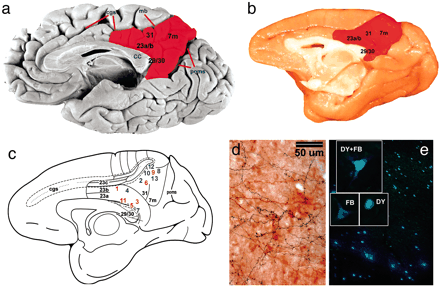
Posteromedial Cortex: Pathway to the Self?


One of the interesting aspects of human consciousness is the sense of the "autobiographical self," which provides us with a sense of personal identity and continuity. Recent research at Stanford U. School of Medicine adds new pieces to the human consciousness puzzle, which cognitive scientists are attempting to assemble. They discovered that the posteromedial cortex was extremely active when recalling events in the person's life, but that this activity was shut down immediately when the patient was asked to do a simple arithmetic problem.

The posteromedial cortex is tucked so deeply into the brain that it is often difficult to examine its ongoing function, using traditional imaging tools such s fMRI. In the Stanford study, researchers took advantage of a previously scheduled neurosurgical procedure being done in a group of epileptic patients, using intracranial electrode monitoring of the PMC.

In a study published online Sept. 3 in Proceedings of the National Academy of Sciences, Parvizi and his Stanford colleagues found a way to directly and sensitively record the output from this ordinarily anatomically inaccessible site in human subjects. By doing so, the researchers learned that particular clusters of nerve cells in the PMC that are most active when you are recalling details of your own past are strongly suppressed when you are performing mathematical calculations.

...The researchers took advantage of a procedure performed on patients who were being evaluated for brain surgery at the Stanford Epilepsy Monitoring Unit, associated with Stanford University Medical Center. These patients were unresponsive to drug therapy and, as a result, suffered continuing seizures. The procedure involves temporarily removing small sections of a patient’s skull, placing a thin plastic film containing electrodes onto the surface of the brain near the suspected point of origin of that patient’s seizure (the location is unique to each patient), and then monitoring electrical activity in that region for five to seven days — all of it spent in a hospital bed. Once the epilepsy team identifies the point of origin of any seizures that occurred during that time, surgeons can precisely excise a small piece of tissue at that position, effectively breaking the vicious cycle of brain-wave amplification that is a seizure.

...The experimenters found eight patients whose seizures were believed to be originating somewhere near the brain’s midline and who, therefore, had had electrode packets placed in the crevasse dividing the hemispheres. (The brain’s two hemispheres are spaced far enough apart to slip an electrode packet between them without incurring damage.)

...Significant portions of the PMC that were “tapped” by electrodes became activated during self-episodic memory processing, confirming the PMC’s strong role in recall of one’s past experiences. Interestingly, true/false statements involving less specifically narrative recall — such as, “I eat a lot of fruit” — induced relatively little activity. “Self-judgment” statements — such as, “I am attractive” — elicited none at all. Moreover, whether a volunteer judged a statement to be true or false made no difference with respect to the intensity, location or duration of electrical activity in activated PMC circuits.

This suggests, both Parvizi and Foster said, that the PMC is not the brain’s “center of self-consciousness” as some have proposed, but is more specifically engaged in constructing autobiographical narrative scenes, as occurs in recall or imagination.

Foster, Dastjerdi and Parvizi also found that the PMC circuitry activated by a recall task took close to a half-second to fire up, ruling out the possibility that this circuitry’s true role was in reading or making sense of the sentence on the screen. (These two activities are typically completed within the first one-fifth of a second or so.) Once activated, these circuits remained active for a full second.

Yet all the electrodes that lit up during the self-episodic condition were conspicuously deactivated during arithmetic calculation. In fact, the circuits being monitored by these electrodes were not merely passively silent, but actively suppressed, said Parvizi. “The more a circuit is activated during autobiographical recall, the more it is suppressed during math. It’s essentially impossible to do both at once.” _Parvizi _via SD
As the researchers suggest, the PMC is not likely to be "the centre of self-consciousness." Rather, the PMC is one part of the human brain's mechanism of self-consciousness -- and a crucial part at that.

It is usually a mistake to claim that a specific part of the brain is "the centre" for a specific cognitive or behavioural function. Rather, different brain modules are integrally tied to various behavioural and cognitive functions, and work in concert to perform cognitive and behavioural functions and actions.

PNAS Neural Connections of PMC in Macaque

PLoS One: Functional Connections of the Human PMC

More: CUNY researchers have discovered that androgen receptors in the visual cortex appear to affect how males see the world through their eyes, as opposed to the way that females see the world. Since androgen receptors are scattered throughout the human cerebral cortex, it is likely that male brains not only see the world differently (statistically), but also perceive the world differently in all of their senses, and feel driven to react to what they perceive in a different manner (statistically) than do females.

Labels: , , ,

Bookmark and Share

04 September 2012

Can Oil Prices Rise Indefinitely Without Strong Economic Recovery in Europe and the US?

Clouds of recession hover over Europe and are threatening the US, unless significant policy changes are enacted from those existing now. Most advanced nations also suffer from both exploding debt and a demographic decline of their core populations.

Unless the world's wealthy nations resume the buying spree of the "economic bubble period" of the 1990s and early 2000s, rapid economic growth in exporting nations of the emerging world and third world nations remains in doubt.


What would be the effect of such a "top-down economic stagnation" on global oil and commodities prices?

The article below, which considers that question in an oblique fashion, is adapted from an article previously published on Al Fin Energy blog


Why are oil prices so much higher now than they were prior to the 2000s? Much of the difference has to do with the steady stealth devaluation of the US dollar, reflecting the US government's massive debt and deficit spending practises.

Compared to the price of oil in 2010 dollars -- or to the price of oil in gold -- prices prior to the year 2000 were not so much lower as we might think. Two price spikes prior to the year 2000 were comparable to -- or higher than -- our current inflated oil prices.

But there is more to the story than the pitiful performance over time of the US dollar. An explosion of demand for oil from emerging nations -- from the late 1990s to the present -- explain a great deal of the ongoing oil price bubble. Particularly when one takes into account government subsidies for oil which hold the cost of oil use artificially low from Mexico to Venezuela to many MENA countries, China, India, and beyond.

This explosion in demand was the natural result of exploding populations in those countries combined with an emerging consumption sense within those populations fed by global media and a subsequent growing sense of entitlement.
Oil in Nominal vs 2010 Dollars


Comparing oil prices in "dollars of the day" vs. oil priced in either standardised 2010 dollar or gold, brings out more aspects of the dynamic than are generally discussed.
Oil in Dollars vs Gold

In addition to the ongoing stealth dollar devaluation and the demand explosion from the emerging world, oil has become a deeply emotional repository of value for many investors -- reflecting a widespread belief in oil scarcity -- or "peak oil". Savvy traders have exploited this superstition by helping to bring about multiple whiplash spikes and troughs of oil price -- which in the aftermath often leave the smart traders richer, and the superstitious true believers that much poorer.

Of the three drivers of higher oil prices mentioned above, the most likely candidate for the "largest" contributor, is demographic change. Let's look at why this "largest contributor" may not end up being the most important long term contributor to changes in oil prices.

We all know that commodity prices depend upon both supply and demand, as well as a number of somewhat arbitrary and changeable government policies, mandates, regulations, taxes, prohibitions, and other caprices of the generally clueless political class.

Demographic change affects both supply and demand, but demand is the more immediate factor affected by the type of population growth we have seen recently. The explosion of both populations and demand in emerging nations shook the ability of national oil companies to respond -- in large part due to a corrupt failure to pay for necessary maintenance and technological upgrades in oil production. And since most conventional oil reserves fall under the control of corrupt national oil companies, the demand explosion was not immediately accompanied by an equivalent explosion in supply. This mismatch pushed oil prices upward.

But population growth without the ability to pay for more commodities, will not necessarily convert to higher demand, and higher prices. If the regions of population growth cannot pay for more commodities, they will either go without or will be the recipient of unearned aid from wealthier countries.

This is what we are beginning to see across Africa, much of Asia, and other parts of the third world and emerging world. As advanced world demand for the products of emerging and third world nations drops, the ability of third world nations to pay for imported commodities likewise drops.

It so happens that the prospects for advanced world economies is looking more and more dim, while the other bubble -- the demographic bubble -- deflates.
More:
Between the Baby Boom of 1945-1964 and the “baby bust” that followed it, the result is a projected ballooning in the relative numbers of the elderly. From 12% of the population today, the proportion of those over the age of 65 is forecast to rise to 25% by 2030 — and stay there for decades afterward.

We are about to be hit by a double whammy, in other words. On the one hand, a rapid escalation in public spending — not so much for pensions, though that is part of it, but for health care. Not only will more of the population be over 65, but a greater proportion of them will be living past 80, 90 and beyond. And the longer they live, the more they tend to cost. _NP

Old people do not typically use as much oil and other commodities, they do not build as many houses, or buy as many cars -- as a rule.

Demographics are economics. The advanced countries with the worst demographics problem and the advanced countries with the most uncertain economic futures are often the same. High social spending promised to aging generations that aren't supported by enough young workers leads to the kind of debt crises, economic stagnation, and political upheaval that we can see sweeping Europe -- and might yet lie ahead for a country like Japan. This is ironic, in a way. Two centuries ago, Malthus said that growing populations would tax growing economies. In fact, it's stagnating populations that constrain economic growth in rich countries. _Atlantic

With the contraction of demand from economies in the advanced world, comes a reduction in ability to pay for both luxuries and necessities -- including commodities -- in the emerging and third worlds.

That is not the worst of it. Piling on top of the debt and demographic problems of the sinking nations of the advanced world, is an amazingly destructive dysfunctional energy ideology which threatens to sink many of these nations -- both individually and in groups -- beneath the waves.

Intelligent people understand that the intermittent unreliable energy sources such as big wind and big solar, cannot supply more than a small portion of grid power, without destabilising the grid itself.

Nations of the advanced world -- the ones that thrive -- will discover and develop more sources of energy, and will learn to do more with less at the same time. Improved efficiencies and productivity will contribute to the declining demand for imported commodities which will also be driven by the declining demographic.

Increasing use of robotics and other automation will help to raise productivity, even as core populations decline. But energy will always be key. Newer, cleaner, cheaper, safer generations of nuclear energy will be a long term solution, but we will need to utilise our large supplies of conventional and unconventional hydrocarbons to get us there.

Which is why the energy starvationists -- from Merkel to Obama to Gillard and beyond -- will have to be moved out to make way for a better future.

Labels: , , , ,

Bookmark and Share

03 September 2012

American Labor Day Holiday Cancelled Due to Insufficient Jobs: National Empty Chair Day Celebrated Instead

Empty Chair?  Empty Stool?  Empty Suit?  Empty Skull?  Obama's Many Faces


America Celebrates National Empty Chair Day

Barack Obama: The Empty Stool
President Obama has consistently been absent, more concerned about branding than leadership, with image and atmospherics than truly rallying the troops and harnessing our resources and solving our most pressing problems.

...According to most accounts, even friendly ones, President Obama is haughty and surly. To those with eyes to see, he is an act. A vacuous promise. An illusion. An empty stool. _EmptyStool
As a legislator in both the Illinois Senate and the US Senate, Obama became known as "Senator Present," even though he was most often absent -- out campaigning for his next election. Perhaps he was warming up for his role as "the empty stool" even then.

Even when he appears to be sitting in the chair, there is something clearly missing. It is not exactly that the emperor has no clothes. . . It is more that the clothes have no emperor. "There is no there, there" as Al Fin once remarked to Gertrude Stein, sitting in an Oakland cafe in a previous life.

Perhaps America should send out an expedition of scatologists in search of "the real Obama." The fate of the next century may just depend on what is discovered.

Outside observers may blame American voters for electing this mystery man, but if the American media failed to do its job of investigation, it deserves a large share of any blame to be placed.

It is not entirely clear as to why America replaced the Labor Day Holiday with National Empty Chair Day, other than the general lack of jobs. Some claim that it has something to do with what is depicted in the photograph to the left.

Since the image depicts only a single person -- an American cinema star -- it is possible that it is a scene taken from a motion picture. But if so, where is the rest of the movie? Historians may fight over the question for decades.

No matter. The change may represent a coming trend of changes to American national holidays. It is rumoured that up until now, efforts to change the Christmas Holiday to "O Holy Bama Day" have been rebuffed. But now, who can predict such things?

One thing is for certain: If US President Obama is re-elected in November, Thanksgiving Day will receive some serious scrutiny for change, if not hope.


Photo credits: Top, Bottom

Labels: ,

Bookmark and Share

02 September 2012

The Waking Trance

Human consciousness is an odd pickle. We all experience it every waking day, but no one understands it well enough to build a good imitation. What are we missing?

Quite a lot, actually. For example, why are we so changeable from day to day or moment to moment? Is it possible that much of what we call ordinary consciousness is simply the slipping from one state of automatic trance into another?

Let's try to define "trance:"
To many psychologists a trance is a state of limited awareness. Some psychologists would also characterize trance as a form of sleep, or dreamlike awareness or a kind of altered state of consciousness.

... it is relatively easy to hypnotize a person and to keep that person in a trance state without their being aware that they are in fact in a trance. The technique of pacing and leading a subject from a rich or varied set of thoughts to a limited or impoverished set of thoughts is a technique used consciously by hypnotists, advertisers, sales people, preachers and politicians.

...how can you tell if you are in one of these ordinary, unconscious trances? You are in a trance when your attention is limited and there is a certain repetition of thoughts. In an extreme case, your attention is so limited that it feels like "tunnel vision."... Concentration, when the mind is focused on a specific problem or thought, is also a form of trance. You could characterize trance cybernetically as an awareness loop, or a circular flow of consciousness. _Unconscious Trance

Most of us spend most of our time in one type of trance or another. Even the experience of unconscious mastery is a type of trance.

In general this is fine, if we are in control of which trance we choose to be immersed within -- and if we can exit the trance whenever we wanted.

Almost every human being on Earth will revert back to what is known as "the consensual trance," the limited world of the particular social consensus within which the person happens to be immersed. It is a trance into which we are born and to which we are conditioned. Later, when we enter -- or are close to -- adulthood, we may be presented with a choice as to whether we wish to move into a different consensual trance. Very few discover the ability to experience large portions of their lives outside of the consensual trance. Even fewer make the choice to step outside the consensual trance into a greater freedom of the mind.


It is possible to move other persons into a trance, shift them from one trance state to another, or to help them emerge -- temporarily -- from a typical trance state. It is worth learning how to manipulate other persons' trance experiences in order to better apprehend when someone is attempting to do the same to you, typically in an attempt to enlist you into some kind of mass movement or ideology:
1. Build Rapport with the Listener

Your first task is to gain rapport with the listener. Rapport is simply put that feeling of connection and trust between two people. It doesn’t have to be too deep. You already have a rapport with your friends, parents and others. You can easily gain rapport with other people just by making compliment, laughing at their jokes etc.

2. Switch off the Critical Mind

After building rapport, you can now use covert hypnosis techniques to switch off the critical mind of the listener.

One of the ways to do this is to use the words “Imagine”, “What if” etc. When you use these words, the critical mind immediately shuts off, thus making the imagination work. This is very important, because we are only doing the things that we could imagine before, so invoking the mind’s eye of the listener will help you to send commands to his (her) subconscious.

3. Make Irresistible Hypnotic Commands

After bypassing the critical mind of the listener, you can now make your irresistible commands and describe the things you want a person to do.

Covert hypnosis is that simple. In covert hypnosis, your success will depend on the depth of rapport, your hypnotic language and how you follow the covert hypnosis technology. _Covert Hypnosis

It is no accident that these are simultaneously the tools of sexual seduction, religious conversion, and political enlistment and indoctrination. These are tools that are used in government and religious school classes, sports team pep talks, pick-up bars, cathedrals and mosques, clubs, associations, gangs, and mass movements of all kinds.

The tools of conversational trance manipulation have been perfected by ethical persons such as Milton Erickson, and by unethical persons such as your charismatic politician of choice.

But no one needs to put you into a trance. You do that every day, all by yourself. It is possible to go through days, weeks, months, and years without ever truly emerging from the waking trance, the consensual trance. In general, the possibility that one may emerge from such a trance is so disturbing that it can lead to psychic trauma, drug addiction, membership in a cult, or worse.

But just in case one wished to experience a different state of existence, how would he go about emerging from the waking, consensual trance?
How can anybody distinguish, then, between dream, hypnotic trance, and reality? Dehypnotization, the procedure of breaking out of the normal human state of awareness, according to both mystics and hypnotists, is a matter of direct mental experience. The method can be learned... _Howard Rheingold on Charles Tart

Maybe, maybe not. A lot depends upon the person's experience up to the point when he tries to break free. If the person were raised to be a dangerous child, he will likely have already learned ways of breaking out of the consensual trance -- at least temporarily, for specific purposes. But if the person were raised to be a psychological neotenate -- like most modern children -- his chances of learning to break free of the waking consensus will depend upon his strength of character and his motivation.

Human societies are moving toward a point where it becomes more crucial for persons to wake up. Whether this will involve waking up into yet a higher trance, or waking up outside of trance altogether, may be more a matter of semantics than we would like to think.

If a person wants you to "wake up" to his way of thinking, that is a clue that he wants you to share his trance. This is a typical experience for university students in the modern classroom of indoctrination, and for consumers of mainstream media news and commentary.

But if you want to wake up outside the consensual trance -- and perhaps into your own trance -- you will need to do some creative thinking and experimenting.

If it seems like I am trying to "dumb down" and generalise the definition of trance to the point that it encompasses all experience and consciousness, that is not my intent. I am leaving room for several types of consciousness outside of trance states.

But it takes work to reach them, and even more work to stay in them for any appreciable period of time.

Most people will never wake from the consensual trance, and that is just how they want it. But as push comes to shove, and shove comes to strike, someone will have to devise some workable alternatives. Hopefully, at least some of these alternatives will involve a larger scale emergence from the limited consensus.

Labels: , , , ,

Bookmark and Share

30 August 2012

Cyber War Envelops Middle East

Iran has already been hit by Flame, Duqu, and Stuxnet. Now we are learning of a more mysterious attack against Iran's oil infrastructure by malware called "Wiper:"
Wiper was an aggressive piece of malware that targeted machines belonging to the Iranian Oil Ministry and the National Iranian Oil Company in April.

...No one has ever found a sample of Wiper in order to study its code and determine exactly what it did to machines in Iran, but Kaspersky did obtain mirror images of “dozens” of hard drives that had been hit by the malware.

Although the disks were thoroughly wiped in most cases, leaving no malware behind – or much of anything else – the researchers did find evidence of its previous existence on some of the systems that weren’t completely wiped. The evidence came in the form of a registry key that pointed to files that had been on the machines before being erased.

According to Kaspersky, the wiping activity occurred between April 21 and April 30. Wiper’s erase operation focused initially on destroying data on the first half of a disk, then systematically erasing system files, causing the systems to crash and preventing them from rebooting... _Wired
Spread of Duqu

But Iran has not been entirely passive in this cyber-war. A recent cyber attack against Saudi Aramco -- Saudi Arabia's state energy company -- is thought to have originated with groups allied with Iran.
Saudi Aramco, Saudi Arabia's national energy company, said on Sunday it had repaired 30,000 workstations infected with a malicious virus earlier this month....

...A group calling itself the "Cutting Sword of Justice" claimed responsibility for the attacks. The group accused the Saudi Arabian government of supporting "crimes and atrocities" in countries such as Syria and Egypt, according to a post on Pastebin.

Saudi Aramco said it expected further intrusions. "Saudi Aramco is not the only company that became a target for such attempts, and this was not the first nor will it be the last illegal attempt to intrude into our systems, and we will ensure that we will further reinforce our systems with all available means to protect against a recurrence of this type of cyber-attack." _CW

Saudi Aramco is right to expect further attacks, just as the Iranian Oil Ministry should expect further attacks. In fact, all middle eastern oil production in and around the Persian Gulf is vulnerable to one type of malware or another. Whoever controls the flow of oil will be able to hold global oil markets hostage to potentially devastating price swings.
Earlier this year, a group of international experts at the Herzliya Conference imagined a very different scenario — a far more drastic one — in which a sophisticated attack on Abqaiq was directed by Iran and carried out from within. In the simulation, a series of explosions, along with a cyber-weapon, crippled the facility...

...The results of this simulated attack, detailed here in full for the first time, were profoundly disturbing. The price of oil skyrocketed to over $200 per barrel. The House of Saud, and the territorial integrity of the kingdom, were existentially threatened. Saudi Arabia’s neighbors — Jordan, Iraq, the UAE, Bahrain, Qatar, Kuwait and Oman — were destabilized. Developing countries that use oil for electricity were propelled into war, both civil and external.

And Iran, the world’s third-largest producer of oil, authoritatively recognized as the perpetrator of the attack, reaped the rewards, its influence growing throughout the Middle East as the demand for oil outpaced the supply, and the Shiite populations in the Gulf — increasingly unrestful throughout the Arab Spring revolutions — rose up in arms.

“The simulation showed that global over-reliance on Saudi oil and our over-reliance on Saudi stability, would give Iran, in the case of such an attack, carte blanche in the Middle East — and that’s without a nuclear weapon,” said Tommy Steiner, the author of the report... _How Iran Might Triumph Even Without Nukes

The evolution of increasingly sophisticated cyber attacks has just begun, and every industrial facility and information network is clearly at risk.

There is a limit to how well protected large networks can be and still function. In this situation, resilient backups will be increasingly important.

Labels: , , ,

Bookmark and Share

29 August 2012

Russia, Gazprom, Change Their Tune On Shale Gas

Cross-posted to Al Fin Energy

Gazprom's top managers have for years said that shale gas production would never threaten demand for Russian gas. Gazprom has recently started to change its view...

Russia's economy ministry sees "serious" risks posed by shale gas to the revenue of Gazprom (GAZP.RS) beginning in 2014, as higher supply from the nontraditional hydrocarbons may hurt prices and demand for Russia's pipeline gas.

"Gazprom had undervalued the importance of shale gas, but is starting to look at it seriously," Deputy Economy Minister Andrei Klepach said Tuesday as he presented a weaker outlook for the country in 2012 and beyond.

Russia satisfies about a quarter of Europe's demand for gas, which generates revenue for the budget.

Mr. Klepach added that the ministry also saw a lower outlook for gas prices in Europe, driven by both the euro-zone economic crisis and a higher supply of shale oil and gas from other sources. _WorldOil
After years of denial by Putin and Gazprom's top executives, Russia is finally acknowledging what Al Fin energy analysts have been saying all along. But political deception is nothing new for Russia or Putin. It is only those who still give the Russian government credibility who were fooled.

Meanwhile, Russia is jumping into shale fracking for oil & gas big-time, despite all that Putin has said about the evils of shale fracking. I suppose the shale oil & gas bonanza would look evil to a corrupt pol such as Putin, when it threatened his corrupt system.
Present recovery rates at various tight oil projects across Russia are between 2 to 8 percent. However, tight oil reserves could account for as high as 62 percent of Russia’s total reserves.

In the face of all this, Russia looks eagerly to the success experienced by North America in its shale revolution. The geology of the Bazhenov is quite similar to that of the Bakken shale here in the U.S., meaning fracking could be the solution to Russia’s oil situation.

The Russian oil producer Rosneft has already paired up with ExxonMobil (NYSE: XOM) to jointly work the Bazhenov formation. They will begin drilling in the Bazhenov and Achimov formations in 2013, following completion of an ongoing geological study. Rosneft has also reached an arrangement with Norwegian firm Statoil (NYSE: STO) to develop Russian oil assets in Southern Russia and West Siberia.

Other major oil companies like Lukoil (PINK: LUKOY) and Gazprom (MCX: GAZP) are also exploring ways of developing tight oil reserves.

The Russian unconventional oil and gas market could be heading for a time of profit and success. _Energy & Capital
This development points out some interesting things about Russia's economic future:
  1. Russia's "prosperity" depends primarily on its energy production
  2. For Russia to maintain its production, it must attract the expertise of foreign companies
  3. Everything that Russia has said about the dangers and the inconsequential nature of shale oil & gas, was nothing but a politically expedient smoke screen
  4. Russia needs to exploit its own vast shale oil & gas reserves
There are other interesting tidbits that can be read from between the lines, but that is enough for now.

Meanwhile, Europe's emerging recession is already having an effect on Russian gas profits:
Russia’s Economy Ministry is reportedly cutting its gas export forecast for this year due to sluggish demand from recession-mired Europe.

The forecast is said to be reduced to 193 billion cubic metres (bcm) from an earlier 212 bcm.

A government source has told Reuters that it will also reduce its average export price estimate.

State-controlled Gazprom has a monopoly on Russian gas exports.

Earlier this week the Deputy Economy Minister Andrei Klepach had said the gas export forecast would be reviewed, in the face of competition from US shale gas and liquefied natural gas. _Euronews
This tells us that Russia is reluctant to admit its earlier lies, when it claimed that US - style development of the global shale gas resource was no threat to future Gazprom profits.

It is important to understand that Russia's budget (official and unofficial) not only depends upon oil profits, but also depends upon gas profits. If Gazprom profits begin to fall because its customers in Europe and Asia begin to develop their own tight oil & gas resources, Russia's government will come under serious financial pressure.

Labels: , ,

Bookmark and Share

28 August 2012

Socialism in Venezuela vs. Cronyism in Russia vs. ...

Hugo Chavez' socialist revolution has been championed by many Americans, who would like to see Chavez' experiment repeated in the US. Here is more about Chavez' revolutionary success in Venezuela:

It is clear that the Chávez regime has been squeezing every last penny out of the oil sector...the money hasn’t just been used for social programs, but also to fund Venezuela’s expensive foreign policy, as well as its efforts to cover up the results of poor policy, rampant cronyism, and the general mismanagement of the public sector. When things go wrong, Venezuelan citizens are the ones who pay the price for the state’s poor choices.

Three things seem likely at this juncture: first, no one will be able to trust whatever “investigation” the Chavez government undertakes. It will be an obvious whitewash. Second, conditions for oil workers are unlikely to improve. Third, the usual crew of Chavez defenders in the United States, desperate after all these decades of misery and failure to point to some place some where, where authoritarian socialism isn’t a dreary charnel house and economic failure zone, will struggle to convince themselves that things are just fine in Bolivarian Venezuela. _Walter Russell Mead
Chavez' is up for re-election, but with the total control he has seized over every aspect of Venezuela's government, elections in Venezuela may not mean the same thing as they mean in an actual democratic country.

Meanwhile in Russia, cronyism is alive and well, with the Pussy Riot safely locked up and no longer a threat to the state. Oil prices are high, and the Russia's crony classes are living well for now. But Russia and its cronies have many other problems that must be concealed from the public eye:
A recent government crackdown on Russian media, particularly online information portals specialising in health tips and harm reduction methods for drug users, has sparked widespread public opposition, with critics claiming that the 'draconian silencing' of public health advocates could worsen an already perilous health situation in the country. _Russia-Health

Besides suffering from a sub-par system of medical care and public health, Russia's men are being poisoned.

Largely due to cronyistic suppression of opportunity in Russia, the men of Russia have sunk to such a pathetic state that more and more Russian women have given up on finding a suitable mate.
"...Russian women simply have no interest in marrying Russian men,” says Irina Zhuravleva, the head of Russia’s census department at the Federal Statistics Service. A single woman herself, Zhuravleva says she “never had any interest in marrying a drunk...

The dating prospects are so grim, in fact, that Shpakova and many other Russian women of her generation are consciously deciding to stay single. Moscow alone boasts more than 3 million single women between the ages of 25 and 50, out of a population of 11.1 million (that’s three times the number of single Muscovite men). In Russia as a whole, there are 11 million more women than men, due in part to a century of bloody revolutions, gulags, and wars that drained the country’s male population. Add to that the fact that male life expectancy is particularly grim in Russia—on average, 59 years, as opposed to a woman’s 73 years, the largest gap of any country in the world—and you’ve got a serious demographic imbalance. _Simply Beastly

Russian males barely live long enough to claim a pension, on average.

Meanwhile, crony Russia is looking westward to socially democratic Europe, hoping to squeeze some wealth from the continent before the tight oil & gas revolution reaches European shores. But in the land of the ubiquitous welfare state and ongoing demographic collapse, poverty is returning to claim its due. In the land which China is counting on to re-start its moribund exporting enterprise, recession is setting in, and Euro leaders are doubling down on the foolish policies which led them to this state of affairs.

And in the US -- the only country that is actually capable of turning the global economy away from the abyss -- voters cannot decide. They cannot seem to choose between a failed US president who is leading their country more deeply into debt, despair, and demographic decline . . . and a former Massachusetts governor who was also successful in the private sector -- a man who -- unlike his opponent -- is bold enough to lay out a broad array of tangible plans for the nation's future.

We are seeing a world that is growing more unstable, with a dumbing down of electorates in the advanced world, and the ascendancy of corruption in Russia, China, India, in several failing states of Europe, and in Obama's America.

Hope for the best. Prepare for the worst.

Labels: , ,

Bookmark and Share

27 August 2012

Do Bigger Governments Work Better?

Government always wants to grow bigger and more powerful. Cities want to engulf surrounding communities to become bigger cities. But are bigger governments truly more efficient?
It is not that the elected officials in smaller jurisdictions are better or that the electorate is better. The superior performance stems from the reality that smaller governments are closer to the people, and decision-making tends more to reflect their interests more faithfully than in a larger jurisdictions. _NewGeography

The reality is that there is a single measure of efficiency: spending per capita. Here there is a strong relationship between smaller local government units and lower taxes and spending. Our review of local government finances in four states (Pennsylvania, New York, Indiana and Illinois) indicates that larger local governments tend to be less efficient, not more. Moreover, the same smaller is more efficient dynamic is evident in both metropolitan areas as well as outside. "Smaller is better" is also evident at the national level (Figure 1).

...special interests have more power in larger jurisdictions, not least because they are needed to finance the election campaigns of elected officials, who always want to win the next election. They are also far more able to attend meetings – sending paid representatives – than local groups. This is particularly true the larger the metropolitan area covered, since meeting are usually held in the core of urban area not in areas further on the periphery. This greater influence to organized and well-funded special interests – such as big real estate developers, environmental groups, public employee unions – and drains the influence of the local grassroots. The result is that voters have less influence and that they can lose financial control of larger local governments. The only economies of scale in larger local government benefit lobbyists and special interests, not taxpayers or residents. _NewGeography
One reason why larger governments -- with their larger special interests -- become less efficient and less sustainable, is the swelling bloat of public sector pay, pensions, and benefits. This can be a huge problem for national governments as well as for provincial and state governments. Public sector unions are always corrupt, with ties to elected officials as well as to even less savoury elements of society.

Public Sector Union Pensions are Unsustainable

The same type of corruption found in larger local and regional governments is also seen in national governments. As illustrated below, the more of a nation's output that is confiscated by government, the less economic output the nation typically will have. <

US President Obama has accelerated the accumulation of debt significantly, rapidly leading the US government toward an economic point of no return.

Even before Obama, the US budgetary system was headed for a cataclysm. But Obama has accelerated the time table to the train wreck by a matter of decades.

The chart shows that by 2030, Government spending will exceed historical levels of receipts and lead to ever increasing amounts of borrowing. The chart also shows that if receipts remain at their historical level of 18.3 percent of GDP, by 2070, receipts will be sufficient to cover the costs of only Social Security, Medicare and Medicaid. _Unsustainable US Spending
About the time the US runs headlong into its inability to finance its aging citizens' infinite demands and "needs," China will be splitting into warring fiefdoms, Russia will be collapsing from demographic implosion and population pressure from the outside, the senile former EU will be history, dotted with rival Revolutionary Islamic Republics, and Japan will be an island museum dedicated to the phenomenon of demographic decline. Africa, of course, will be on fire.

All of this unfortunate messiness might have been prevented, had citizens of advanced western nations thought to keep their governments small enough to be efficient and answerable to their people.

Let that be a lesson to you.

Labels: ,

Bookmark and Share
Newer Posts Older Posts
Al Fin Main Page
Enter your Email


Powered by FeedBlitz
Google
WWW AL FIN

Powered by
Blogger

``