29 December 2012

Survival is Not Politically Correct -- It May Even Be Illegal

Adapted from an article previously published on Al Fin, the Next Level


“The BBC offers this advice for anyone in Britain who is attacked on the street: You are permitted to protect yourself with a briefcase, a handbag, or keys. You should shout ‘Call the Police’ rather than ‘Help.’ Bystanders are not to help. They have been taught to leave such matters to the professionals. If you manage to knock your attacker down, you must not hit him again or you risk being charged with assault.” _Gun Tutor

Humans of the advanced world have entered a brave and dangerous new phase of existence. We are moving through a stage where it is politically incorrect -- and sometimes illegal -- to protect oneself and one's family in order to survive a growing range of threats which one is not supposed to be aware of, much less mention in polite company.

Nevertheless, if you want to play through to the next level, you must survive this phase of existence with enough resources and in good enough condition to proceed to the next phase.

For those who are raising children, this point cannot be made strongly enough. Your children need to be raised to be dangerous. Competent, yes. Highly skilled, yes. Technologically savvy, yes. And very, very, dangerous.

But where do children go to learn skills of survival, teamwork, discipline in dangerous settings, calmness under fire, etc. in the modern hyper-feminised politically correct world? That is a very good question (but be careful where you ask it).

There is a national program in the US that is called the Young Marines, which should give program designers some useful ideas. The Young Marines is open to boys and girls from the age of 8 all the way through the high school years. The organisation provides summer camp and a wide range of training programs, including community service.

Several ranks and awards are available throughout the course of training -- similar to the Boy Scouts' ranks and badges. Here is a list of skills and goals for the most basic level of Young Marines:
  • Drill movements, including march, halt, fall-in and fall-out of ranks, positions of attention, parade rest, at ease and rest
  • Execution of column movements, saluting, and facing movements
  • Uniform regulations
  • Grooming and personal appearance standards
  • Rank structure of the Young Marines
  • Military customs and courtesies
  • Practicing Formation
  • Young Marine history
  • Military terms and jargon
  • Outdoor tools safety
  • Assembling survival kits
  • Stove & lantern safety
  • Constructing a shelter
  • Knot tying
  • Lighting fires
  • Reading of maps
  • Signs on topographical maps
  • Orient a map without the use of a compass
  • Introduction to the compass.
  • Drug Resistance
  • Basic elements of speech preparation
  • Duties of both a team member and team leader
  • Duties of a Young Marine Flag Bearer
  • Duties of fire watch
  • Responsibilities of US citizens
  • History of the US flag
  • Components of physical fitness
  • Developing personal physical fitness plans
  • Tips on healthy eating
  • Basic first aid techniques
  • In order to proceed to Junior ranks, each Young Marine must perform 50 hours of community service
_Basic Rank Skills & Goals

Information on Ranks and Rank Advancement

The Young Marines programs should be seen as idea generators for most parents, since such programs will not be available everywhere -- and will not necessarily be exactly what many parents are looking for regardless.

But many children will learn important skills of survival, group cohesion and support, and self-discipline, when training with other children of various skills levels but with a generally unified intention to succeed and excel.

The various curricula which we have discussed in connection with dangerous child training have had little to do with military tactical or strategic thought or training. And yet, a well-rounded dangerous child should know something about military tactics -- if only to understand how to avoid being caught up in a combat situation.

For some communities that wish to establish a certain degree of independence from potentially dangerous and aggressive outside groups, a more intimate knowledge of small unit tactics, and infantry weapons may become important to acquire.

Under the US constitution, the right of individuals and communities to organise militias and to bear arms is guaranteed in the second amendment. Up to this point, very few US communities and regions have taken advantage of their constitutional rights to organise such small fighting units.

But as the US moves more deeply into its paradoxical and surreal world of politically correct denial in the face of growing and deadly threats inside the homeland itself, even a "conspiracy of silence" on the part of government, academia, and popular news media outlets will not stop a growing trend toward organised self-defense.

It is never too late to have a dangerous childhood.

Basic small unit tactics (PDF)

Out of control third world violence may be coming to a city near you

One of many potential threats

Labels: , ,

Bookmark and Share

24 November 2012

Charts of US Government Debt & Doom: Descent and Reaction

The US Government has been growing rapidly for well over 60 years. National debt has grown rapidly along with the size and power of government agencies. The embedded presentation below provides a graphical representation of many of these changes, and suggests some implications of this trend for the future.

50 Charts From Marc Faber
__Source

Most citizens may submit to an overbearing government, but others -- who worked hard, sacrificed, and saved all their lives only to see governments confiscate and diminish their assets -- may consider other actions and reactions.

The recent popularity of "secession from the union" petitions in the US demonstrate that some citizens are unhappy with the growth of government power & debt, and the consequent curtailment of individual rights and opportunity.

Another reaction to the recent explosion in government arrogance toward productive citizens, is the movement to acquire personal weapons and other survival tools and materials.

Several weeks ago, there was much excitement over the demonstrated ability to "print" a gun -- actually the receiver of a firearm -- with a 3D printer. But it has been possible for individuals to make their own firearms for several centuries. And with modern machine shops, it has become much easier. And in the US, it is also legal.
Dmitri Harris runs the Ares Armor store, along with his buddies, some Marine Corps infantry veterans. The shop is busy because more people are finding out about the chance to build your own gun without having to go through any registration or government signups of any kind.

It is possible because of the Gun Control Act of 1968. It reads, "an unlicensed individual may make a firearm," but also says it has to be for personal use and cannot be for sale or distribution.

...Team 10 purchased a piece of aluminum and watched as it was turned into a receiver for an AR-15. It can take four or five hours to do this, depending on how busy the shop is. Inside that machine shop is a computer-controlled milling machine that cuts out the aluminum.

What Team 10 ended up with was a receiver that can have parts added to it, such as the trigger, the barrel, the stock and the magazine. Team 10 fired the AR-15 at a nearby range when the receiver was finished and it worked just fine.

... _Untraceable Firearms


Not all the economic news for the US is bad. Several state and local governments are benefiting enormously from the boom in shale oil & gas -- and the boom's secondary benefits within US industry. US President Obama probably owes part of his re-selection to the shale booms in Ohio and Pennsylvania -- although many inside of Obama's administration would have gleefully shut down shale fracking and its economic benefits if they were given a free hand. Watch them very closely.

The economic effects of Obamacare were cleverly deferred until after the Obama Outfit's re-selection. But now, US employment is likely to take a severe hit from the many provisions of the Obama - Pelosi - Reid health care plan from hell. And that is just the beginning of the economic problems that will be exacerbated by the progressive enforcement of Obama era policies.

Without an amazing level of organisation, the Obama Outfit -- comprising organised labour, organised community actists, organised academics, organised news media, organised faux environmentalists, organised vote "handlers" ( and of course elements of organised crime ;-) etc. -- Obama would be hiring a moving van in the near future.

There is nothing preventing US citizens from organising themselves. While government possesses a monopoly on the organised use of force, the US Constitution has provisions for the private use of force for self defense etc.

But organisation is far more useful for other things than the use of force. In fact, as new technologies are developed which will allow citizens to make many of the things they need to survive at home -- cheaply and with little effort -- the need to support an oppressive and deeply indebted government will appear less and less necessary to growing numbers of citizens.

Organising to provide for the needs of one's family and community -- apart from official government -- is the type of organisation which US citizens should be contemplating, very seriously.

Not all citizens possess the aptitudes or competencies for working along those lines, of course. But that has always been the case. 10% of people at the most, do 90% of the work at the least. In some areas it seems closer to 5% / 95%.

The smart fraction -- better known as the competent fraction -- is incredibly important to the present, and to the future. Perhaps it is time for the competent fraction to learn how to be truly dangerous, in a peaceful but efficacious way.

It is never too late to have a dangerous childhood.

More:

Heiner Rindermann's paper on the impact of smart fractions on social development (PDF)

Steve Sailer's analysis of Rindermann's paper

Labels: , ,

Bookmark and Share

26 October 2012

America's Haute Noblesse: Living Well on Other People's Money

Haute Noblesse to Citizens:  Back in the soup line, little people!

The following article is adapted from a piece first published on abu al-fin

The US is a nation struggling with economic uncertainty and cultural decline. While real unemployment is well above 10% and underemployment approaches 25%, America's new political nobility provides itself a lavish lifestyle in which previous president's and their families never thought to indulge.

President Obama has spent far more lavishly on White House state dinners than previous chief executives... current and former government officials said the documents obtained by The Examiner point to an unprecedented upsurge in White House spending on such events.

...A knowledgeable government official who made the documents available to The Examiner said the extravagant spending seemed unfair with so many Americans out of work.

"It just kind of takes your breath away to see the expenditure of money that has occurred since 2009," the official said.

Gary Walters, who ran presidential household operations for 21 years during Democratic and Republican administrations, before retiring in 2007, told The Examiner the costs reflected in the documents were "excessive. They are high." _Examiner
Not surprisingly, the government agency responsible for paying for these extravaganzas of the haute noblesse, is run by a US State Department official who also happens to be a business partner of the man who caters these exorbitantly costly events.

Of course, that is but one side of the story. The very costly vacations taken by the nouveau haute noblesse would make a billionaire blush -- if his vacations were taken at taxpayer's expense.

But to the nouveau haute noblesse, such costly pleasures are considered minimal perquisites, for the many duties required of them as official and unofficial figures of state. "If you cannot live well on other people's money, what good is becoming involved in government?" they are likely to ask.

And America drifts backward toward the autocratic rule which the founders of the original republic had tried to hard -- at such a high cost -- to escape. Welcome to the Idiocracy.

More: The following is just a partial list of some of the pleasures taken by the haute noblesse at the expense of other people, while the citizens were struggling to get by --
– March 19, 2012, The elder daughter, is spending her springbreak in Mexican city of Oaxaca in the company of 12 friends, Malia Ann Obama, are staying at a downtown hotel in this city famous for its colonial architecture and well-preserved native American traditions. Malia and her friend are guarded by 25 US Secret Service agents as well as Mexican police.
President’s Day 2012, Michelle and the first daughters in Aspen, Colorado to ski. Michelle Obama and her daughters are on a ski trip to Aspen, Colo., the White House confirmed to POLITICO. The first lady and the Obama daughters are on a private family trip to Colorado.
– Christmas 2011, the first family in Hawaii for an extended vacation. The Obamas celebrated the holiday by attending a Christmas service at the Kaneohe Bay Chapel on Marine Corps Base Hawaii, followed by a visit with military families at Anderson Hall.
Summer 2011, in Martha’s Vineyard, Mass., for the annual beach break. the first family, their Vineyard haven is taking on the flavor of a summer White House. President Obama, for the third straight year, is planning to return to Martha’s Vineyard for vacation this summer, according to a White House official. The Obamas are scheduled to spend seven to 10 days on the island in mid- to late August, according to the official, who spoke on condition of anonymity because of security concerns.
June 2011, the first lady, her mother and daughters traveled to South Africa and Botswana. Michelle Obama, her family and her staff to South Africa and Botswana. Judicial Watch received mission expense records and passenger manifests for the Africa trip that described costs of $424,142 for the flight and crew alone. Other expenses, such as off-flight food, transportation, security, etc. were not included.”
In the past two weeks, we have:
-$800,000 for the GSA’s lavish Las Vegas vacation
-$470,000 for Michelle Obama’s Spanish getaway
-95+ Rounds of golf played by Barack…during a recession.
-$850,000 for Defense Secretary Leon Panetta’s $32,000 round trip tickets home to see his family.
-Secret Service Agents involving themselves with prostitution
-Barack Obama seen in a video telling a crowd part of his job is to scout out vacation spots for Michelle
President’s Day 2011, the first lady and first daughters travel to Vail to ski. Michelle Obama and her two daughters are spending the Presidents Day weekend on the ski slopes in Aspen, Colo., a newspaper reports. Obama arrived Friday.
– Christmas 2010, in Hawaii. The Obama’s go back to Hawaii for what is expected to be a 17-day vacation. The total cost for a 17-day round trip vacation to Hawaii for the President and his family and staff and security is estimated at around $4,113,038.. Obama’s $4 million Hawaii Christmas vacation,
August 2010, the first family traveled to Panama City Beach, Fla., for some sun and fun at the beach.
August 2010, Obama spent the weekend alone in Chicago for his 49th birthday bash. Barack Obama is coming home to celebrate his 49th birthday. Obama will be in Chicago on his birthday– August 4. The White House said he is looking forward to spending the night in his family’s home in Hyde Park on the city’s’ South Side and gathering with friends.
August 2010, the first lady and daughter Sasha traveled to Spain for a mother-daughter vacation. Michelle Obama and her daughter Sasha, 9, are vacationing at a lavish resort in Spain. The first lady and her entourage landed at Malaga, on Spain’s Mediterranean coast, at 10:30 a.m.
August 2010, summer vacation again at Martha’s Vineyard. Obama and his family arrived August 19 for a 10-day visit. The President and Me, we invite you to post photographs of your encounters with the first family, whether you’re dining with the leader of the free world, swimming or golfing with him, playing a game of Horse, or just offering advice.
July 2010, the first family went to Mount Desert Island, Maine. President Obama and his family are arriving Friday for the weekend. The summer playground of the Astors, the Rockefellers and the Morgans – as well as newer social titans like Martha Stewart.
May 2010, the first family had a four-day trip to Chicago. Obama in Chicago working out Sunday morning. Obama Secret Service agents in Chicago in sort of “standoff” with Farrakhan’s Fruit of Islam guards
March 2010, first lady and daughter spend Spring Break in New York City. Obamas arrived in New York on Saturday, when they visited Dylan’s Candy Bar and caught a performance of Blue Man Group. Before seeing “Memphis” on Sunday, they ate brunch at Mesa Grill. After the show, they got a private tour of the Empire State Building, devoured cupcakes at Magnolia Bakery in the West Village and ate at the Russian Tea Room.
Christmas 2009, Hawaii again for the annual break. The president, first lady and their daughters came to the island of Oahu for a more-than-weeklong vacation away from Washington. The Obamas have no public schedule and are expected to celebrate the holidays in private at a rented compound in Kailua.
August 2009, at Yellowstone National Park and the Grand Canyon for a short vacation. the president, First Lady Michelle and the kids are heading west on Aug. 14 for a long weekend to visit Grand Canyon and Yellowstone National parks. Just days later, the First Family travels to Martha’s Vineyard, off the coast of Massachusetts. On Friday, Aug. 14, the First Family will visit the Bozeman, Mont., area. On Aug. 15 they will travel to Yellowstone, Wyo., and Grand Junction, Colo. They will then travel to the Grand Canyon and Phoenix, Ariz., on Aug. 16, and return to Washington, D.C., on Monday, Aug. 17. The First Family’s visit to the national parks occurs during a free weekend for our national parks. Mrs. Obama and her daughters have already made two overseas trips this summer.
August 2009, their first summer vacation as first family at Martha’s Vineyard, Mass. The 28.5-acre Martha’s Vineyard estate where President Obama, his family and, of course, the Secret Service will spend part of the president’s summer vacation. Caroline Taylor, another Martha’s Vineyard realtor, estimated that the property would go for $35,000 to $50,000 a week. The Obamas will pay for at least a portion of the rental, but taxpayer funds will be used to pay for Secret Service and staff housing on the property.
_EmptySuit
American politicians often become very wealthy either while in office, or soon after leaving office -- regardless of the prior state of their finances. Is it corruption? Hush! That kind of talk is for the little people, softly and behind closed doors.

La haute noblesse to the little people: Apres nous, le deluge!

Labels: , , ,

Bookmark and Share

13 September 2012

The Obama EPA is the Primary Enemy of US Economic Growth

Even before Obama, the US EPA was an engine of demolition against US industry, jobs, and energy. EPA rules and regulations have been used to attack energy of all kinds, from oil to coal to nuclear and more. Obama is using the EPA to destroy the US domestic coal industry. He would have done the same to the shale oil & gas bonanza -- but the resulting jobs destruction would have assured his own defeat in the upcoming presidential elections.

The EPA was always bold, brash, and destructive. Under Obama, it has become even more so.
The EPA gets away with it because rather than employing the actual U.S. court system, it has created its own internal system of “administrative courts” whose “judges” are employees of the EPA and subject to promotion, transfer, or discipline by the agency. Not surprisingly, these EPA courts find in favor of EPA prosecutors in nearly every case, and when they don’t, their verdicts can be set aside by the EPA administrator. And while it is true that subsequent to exhausting their resources within this rigged process, defendants can appeal to the real court system, the EPA process itself can take years, during which defendants’ property can remain confiscated, their liberty endangered, and their credit and businesses wrecked. As a result, most prefer to settle and submit. _Bob Zubrin
Other bureaucracies of the US government also have their own "administrative courts" which are rigged in favour of the prosecution and against US citizens. But whereas other bureaucratic courts may unfairly injure civilians singly, by family, and small business, the EPA courts destroy economic opportunity across wide swaths of the American landscape.
In carrying out these vendettas, the EPA has acted without any sense of justice or environmental concern. For example, companies that chose to pay a certified waste-disposal firm to dispose of a small amount of waste for them in a certified manner have found themselves hit with huge fines when the EPA decided to reclassify the disposal area as a Superfund site and, regardless of how tiny was the firm’s contribution to the waste collection there, chose to penalize the company with the entire cost of the dump cleanup....

...The outrageous behavior, threats to liberty, and devastating harm to prosperity done by the EPA are so vast and varied that they cannot be adequately covered in an article of this length. To even get a handle on the problem, a book­length treatment is required. Fortunately, several are available.... _Bob Zubrin
Sources for further research on the US EPA and its damaging effects on the US economy and US liberty, can be found at end of the article linked above.

The shocking thing about Obama's EPA is that the destructive impact it is having is precisely the effect that Obama wanted to see. He promised to bankrupt coal companies, and seems to have always intended to shut down other fossil fuel industries as it became possible.

With all the problems being experienced by the US government under this president, you might think that he would have no chance to be re-elected. But with almost all of the US mass media willing to go to the wall to defend Obama -- and to attack anyone who criticizes their empty stool -- Obama receives a 15% to 20% handicap from the outset.

While the 2008 US election was a "make or break" election, the presidential candidate facing Obama was particularly weak, and the US voting public was never given a chance to see what kind of president Obama might be. In 2012, the opposition to Obama is stronger, and anyone who has a non-flatline EEG should have wised up to Obama and his regressive regime.

If Obama wins a second term, he will have no reason to hold back his EPA any longer. The islands of economic prosperity that have occurred across the US due to oil & gas fracking are likely to be submerged under a tsunami of Obama attacks -- via his EPA attack dogs.

And then, you might want to find a good, dry, warm, well-lighted place to hunker down.

Labels: , , ,

Bookmark and Share

27 August 2012

Do Bigger Governments Work Better?

Government always wants to grow bigger and more powerful. Cities want to engulf surrounding communities to become bigger cities. But are bigger governments truly more efficient?
It is not that the elected officials in smaller jurisdictions are better or that the electorate is better. The superior performance stems from the reality that smaller governments are closer to the people, and decision-making tends more to reflect their interests more faithfully than in a larger jurisdictions. _NewGeography

The reality is that there is a single measure of efficiency: spending per capita. Here there is a strong relationship between smaller local government units and lower taxes and spending. Our review of local government finances in four states (Pennsylvania, New York, Indiana and Illinois) indicates that larger local governments tend to be less efficient, not more. Moreover, the same smaller is more efficient dynamic is evident in both metropolitan areas as well as outside. "Smaller is better" is also evident at the national level (Figure 1).

...special interests have more power in larger jurisdictions, not least because they are needed to finance the election campaigns of elected officials, who always want to win the next election. They are also far more able to attend meetings – sending paid representatives – than local groups. This is particularly true the larger the metropolitan area covered, since meeting are usually held in the core of urban area not in areas further on the periphery. This greater influence to organized and well-funded special interests – such as big real estate developers, environmental groups, public employee unions – and drains the influence of the local grassroots. The result is that voters have less influence and that they can lose financial control of larger local governments. The only economies of scale in larger local government benefit lobbyists and special interests, not taxpayers or residents. _NewGeography
One reason why larger governments -- with their larger special interests -- become less efficient and less sustainable, is the swelling bloat of public sector pay, pensions, and benefits. This can be a huge problem for national governments as well as for provincial and state governments. Public sector unions are always corrupt, with ties to elected officials as well as to even less savoury elements of society.

Public Sector Union Pensions are Unsustainable

The same type of corruption found in larger local and regional governments is also seen in national governments. As illustrated below, the more of a nation's output that is confiscated by government, the less economic output the nation typically will have. <

US President Obama has accelerated the accumulation of debt significantly, rapidly leading the US government toward an economic point of no return.

Even before Obama, the US budgetary system was headed for a cataclysm. But Obama has accelerated the time table to the train wreck by a matter of decades.

The chart shows that by 2030, Government spending will exceed historical levels of receipts and lead to ever increasing amounts of borrowing. The chart also shows that if receipts remain at their historical level of 18.3 percent of GDP, by 2070, receipts will be sufficient to cover the costs of only Social Security, Medicare and Medicaid. _Unsustainable US Spending
About the time the US runs headlong into its inability to finance its aging citizens' infinite demands and "needs," China will be splitting into warring fiefdoms, Russia will be collapsing from demographic implosion and population pressure from the outside, the senile former EU will be history, dotted with rival Revolutionary Islamic Republics, and Japan will be an island museum dedicated to the phenomenon of demographic decline. Africa, of course, will be on fire.

All of this unfortunate messiness might have been prevented, had citizens of advanced western nations thought to keep their governments small enough to be efficient and answerable to their people.

Let that be a lesson to you.

Labels: ,

Bookmark and Share

25 August 2012

The Best Way to Predict the Future is to Invent It

...The best way to predict the future is to invent it. Really smart people with reasonable funding can do just about anything... _Alan Kay... 1971

Modern humans living in the advanced world, stand at a crossroads. They can choose to continue down a frightened green collectivist road of stasis and stagnation, or they can choose to invent a bold and abundant future for themselves. The difference in mental and emotional outlook is crucial, making all the difference in the choices that such people will make.

A powerful surge of technological development during the 1980s and 1990s spurred a fabulous global economic boom and expansion. It was natural that politicians, global investors, and bankers would turn such a boom into a bubble, and that the bubble would eventually burst -- as it did in 2008.

The bursting of financial bubbles is a common event that should have led into the next round of technological advance and economic expansion. Instead, we are seeing a "great reversal and retreat" being led by the EU, Barack Obama, and assorted green collectivists in governments, intergovernments, and NGOs around the globe. Still, academics and the skankstream aside, is that truly the road that most people want to choose?

Scientists and technologists are producing a huge deluge of data that could be used to build a new era of economic expansion. But the mechanism for moving from ideas and concepts to fully realised enterprises has become glommed up by unlimited government mandate, regulation, code, and prohibition.

Opportunity evaporates as government grows. The best way to grow opportunity is to limit government.

Perhaps history could be a guide:
That long, post-1980 run of “irrational exuberance” happened because of an underlying technological revolution: The advent of distributed computing and the Internet. Technological innovation is pivotal to whether the American economy will experience prosperity growth again. In a world with a growing population but a tepidly expanding economic pie, we see shrunken expectations and a reversion to fighting over how to get one’s “fair share.” People lose faith that the pie will ever grow again; in essence, they lose faith in the future itself. Certainly there’s limited optimism today about technology’s future and what that might mean for the economy, jobs, debt, taxation, and fairness.

We’ve been here before. Back in 1980, America was deep in the mire of the Carter recession with a wounded economy barely limping along. The real estate and the job markets were in a shambles. Boomers faced dim prospects as they poured out of colleges in record numbers. Then as now, the Middle East was in turmoil, and energy entered center stage for the first time as a subject for national debate. And most people thought the big innovations that transformed the world during the preceding three decades were essentially played out.

The big worry of the day was that Japan, having launched a national effort to leapfrog America’s mighty computer industry, was about to overtake our economy. The Japanese juggernaut seemed unstoppable. The journalism and headlines of that era are eerily similar to those today bemoaning China’s ascendance and America’s lethargy.

Then came the post-1980 boom arising from the confluence of two great forces. There was a government that, through three successive administrations, held a favorable attitude toward the private sector. And that private sector was unleashed at the right moment in history, just when the next cycle of information industries began to emerge. _American.com
When Ronald Reagan was elected president the Dow Jones Industrial Average hovered around 1,000 (less than 2,800 inflation adjusted) — and had dipped, under President Carter, as low as 759. Unemployment stood at an unacceptable 7+%. The Soviet Union was aggressive, bellicose, and, in the eyes of the Western policy elite, could be but contained, not challenged. At the end of Reagan’s eight years in office, the Dow had tripled in value, on its way much higher. Job growth was vibrant. The USSR was well on its way to dissolution. _Forbes
The current road being traveled is a road to stagnation. When government is the driving force in society, opportunities are rare, and almost always involve crony connections of a corrupt nature.

If the government can be turned away from its current path to unlimited tyranny, the natural human tendency to improve their lot can be unleashed.

Labels: ,

Bookmark and Share

26 February 2012

Just Because You're Paranoid Doesn't Mean They're Not Out to Get You

There have always been multiple strains of anti-government paranoia in the US, which tend to wax and wane depending upon the policies and reputations of the particular presidential administration in office. Depending upon the ideology of the anti-government group and the ideology of the presidential administration, some of these groups are more likely to be ignored, and others more likely to be prosecuted, at any particular time.

At this time, theUS FBI is turning its brightest spotlights away from run of the mill violent gangs and organised crime, onto a movement known as the "Sovereign Citizens" movement. The "sovereign citizen" is more of a loosely knit network comprising a wide range of ideologies, personalities, and outlooks. They read a range of books which converge around the idea that their own government is out to get them. In other words, they are paranoid. So how will such a group -- the vast majority of whom are generally non-violent loners -- respond when the US federal government neglects career criminals in order to go after the separatist loners, specifically.

How do paranoid people typically react when they are made the targets of criminal investigations, night-time no-knock raids, and are otherwise framed as public enemies number 1? One might remember the 1990s, and the ill-conceived and deadly government raids on places known as "Ruby Ridge" or "Waco." Something tells me that the people in charge of US federal law enforcement at this time, learned nothing from the bloody disasters that took place 20 years ago in "flyover country USA."

The FBI did not choose to focus on the "sovereign citizens" by happenstance. Although most of the "sovereigns" would like nothing more than to be left alone by what they see as an over-intrusive government, as with any large movement a few of the sovereigns are violent criminals, by nature.

Ideological activist lobbies such as the Southern Poverty Law Center (SPLC), have long focused upon what they see as right-wing separatists. Under Obama, the SPLC is enjoying significantly greater influence within the US federal government.

News coverage of the sovereignty movement has picked up lately, perhaps signaling a pre-election intensification of federal government focus on this particular anti-government group -- just one group out of a wide range of anti-government groups representing ideologies from the left, the center, the right, and any number of other philosophies and religions.

The sovereignty movement makes a fine target for Obama's FBI, since such a movement would have no friends among Obama's political supporters and financers. It also makes a fine target for the news media, since it is unlikely that most mainstream journalists, editors, or producers are acquainted with or sympathetic with any sovereign citizens. Even Wikipedia is unable to provide more than a superficial, insubstantial article dealing with the sovereignty movement, but opts instead for a boiler-plate, officially approved 1st grade level primer exposing "all those bad people." There are no links to any spokespersons of the movement itself. There are no objective estimates of the actual size or influence of the movement. It is the type of Wikipedia article that shames the brand for its lack of encyclopedic nature.

So if even Wikipedia has lost its objectivity over the "sovereign citizens," and the US FBI is being led around by the short hairs in the grip of the highly ideological SPLC, what can we expect between now and the US presidential election in November?

Well, anything that distracts attention away from the dismal and worsening economic condition of tens of millions of formerly middle-class Americans, can be seen as a good thing by the Obama administration. "Law enforcement as circus entertainment" is a grand political tradition of diverting distraction dating back centuries at least. Mr. Obama's situation as he approaches his most difficult political contest, suggests that he will not be reluctant to pull the trigger on a large scale clamp-down on the sovereign citizens -- as a form of political theatre and political distraction.

And what effect would such a clamp-down have on the wide ideological array of anti-government paranoids? It would have a mixed effect. But political strategists supporting the US President cannot help but hope that something dramatic -- but not too dramatic -- will happen. Something that can be spun in the media to the president's benefit. Something closer to Ruby Ridge than to Waco, with no mothers shot dead while holding their infant in their arms, this time.

Perhaps I should put it bluntly: The ignoramuses in Washington think that they can provoke a limited violent response from an already well-demonised, putatively right wing "extremist" group. They believe that they can contain the popular blowback to manageable levels, while discrediting their political opposition in the general election by linking them to the extremists. But are they reading the public mood correctly?

It is more than possible that the Obama organisation could successfully win the next election, by enlisting federal law enforcement in a scheme geared to induce an explosive reaction from the violent fringe of a paranoid fringe group. Congratulations, Obama people! You have won another election. Now, what do you do to contain the growing damage from the methods you used to win?

President Obama's war against the US energy sector and the US private sector in general, has not been exactly subtle. Mr. Obama's antagonism to many of the US Constitutional protections against government power granted to citizens, is not a well kept secret. These "anti-constitutional" and "anti private sector" tendencies of the current US president are well known to large numbers of North Americans. Those who approve of such tendencies are more likely to support Obama in November. Most of those who disapprove will go no further than to vote against the president.

Of course, if the president's organisation manages to inflate the paranoia of all pro-constitutional Americans -- and not just those few fringists who go so far as to declare themselves "sovereign" -- they will have a somewhat different situation on their hands leading into the lame duck 4 year final term.

No one doubts that Mr. Obama will continue to run up $trillion deficits as long as he is president, thus making the economic future of the country ever more unstable. No one doubts that Obama will keep trying to contain US energy production if he can, thus continuing to cripple US commerce and industry. And those are just the president's better qualities.

When the president decides to get serious about "setting things right," when he feels he has nothing left to lose and everything to gain by going after his lifelong enemies and demons, that is when the paranoids will truly come out to howl at the moon. And when that happens, you might want to take cover.

Just because you're paranoid, doesn't mean they're not out to get you.

Cross-posted to abu al-fin

Labels:

Bookmark and Share

12 February 2012

Celibrating Perversity: US Orgy of Ethno-Gender Neo-Tribalism

A great society will find ways to bring its people together around a central organising principle. A society that is in decline will fragment into competing tribes and pseudo-tribes. A perverse society will actually feed this fragmentation into competing interest groups. As a perverse society destroys opportunity in the private sector in order to feed the bloating public sector, the in-fighting between the tribes around the public trough grows vicious at times.

The US celebrates Black History Month in February. Significant parts of 8 months of the year are dedicated to one special interest group or another, in the US. The only group that is not celebrated is the hard working producers who keep the economy running to compensate for all of the neo-tribalistic waste of resources centered in Washington DC.
Month
Occasion and Description


February


Black History Month


To recognize the contributions of African Americans and foster a better

understanding of the African American experience. Carter G. Woodson, who in

1926 spearheaded Negro History Week, started the observation. It was

expanded to a month in 1976. February was chosen because of the birthdays of

Frederick Douglas and Abraham Lincoln, two people who had a dramatic affect

on the lives of African Americans.


March


National Women’s History Month


Women’s History Month started as Women’s History Week in 1978. In 1987,

Congress was petitioned to expand the week to an entire month. The month

recognizes the important contributions made by women through programs in

school, workplaces and communities.


May


Asian/Pacific American Heritage & Older Americans


Asian/Pacific American Heritage observation originally began as

Asian/Pacific Heritage week on July 10, 1978. In 1992, President Bush signed

legislation designated May as Asian/Pacific American Heritage Month. The

term Asian/Pacific American includes many ethnic groups with diverse

cultures. The month celebrates the collective achievements of the many

different communities.


Older Americans Month


Older Americans Month was established by presidential proclamation to honor

the contributions of older Americans to society. Begun in 1962, Older

Americans Month is a time to celebrate and reflect on the unique

contributions of older Americans in our society.


June


Gay and Lesbian Pride Month


Gay and lesbian Americans have made important and lasting contributions to

our nation in every field of endeavor. In June of 2000, William J. Clinton,

President of the United States of America proclaimed June as Gay and Lesbian

Pride Month. All Americans are encouraged to observe this month with

appropriate programs, ceremonies, and activities that celebrate our

diversity and recognize the gay and lesbian Americans who have contributed

and enriched our national life.


Caribbean American Heritage Month


On June 5, 2006, President George W. Bush signed a proclamation making June

officially Caribbean American Heritage Month. This month has been

established to recognize the historic relationship between the people of the

Caribbean and the people of the United States as well as to recognize the

many contributions Caribbean immigrants and their descendants have made to

the well-being of America.


September/October


Hispanic Heritage Month


The first Hispanic Heritage Week was approved on September 15, 1968. The

month gives people the opportunity to plan and participate in ceremonies and

activities that recognize the contributions of the many diverse cultures

within the Hispanic community. In 1988, the celebration was expanded to a

month and goes from September 15 to October 15.


October


National Disability Employment Awareness Month


In 2003, previously known as National Employ the Handicapped Week, President

George W. Bush proclaimed October as National Disability Employment

Awareness Month. During this month, we recognize the many contributions

citizens with disabilities make to our society, and we reaffirm our

commitment to helping them achieve their full inclusion in our workforce.


November


National American Indian Heritage Month


National American Indian (or Native American) Month was enacted with a

presidential proclamation in 1990. During the month, all Americans are

encouraged to participate in programs ceremonies and activities that

celebrate American Indian and Alaskan Native peoples’ important contribution

to the United States.
There are many forces threatening to spin the US apart at its seams, diminishing any sense of common goals or destiny.

In the modern US, blacks are best known for high crime rates, low IQ, and maintaining a high level of grievance at all times. No matter how high the level of preferential treatment toward blacks in the US, the level of discontent and simmering anger in the tribe as a whole appears to grow worse every year.

Mexican immigrants to the US maintain several organisations dedicated toward "the reconquista" of parts of the US. Large numbers fail to learn to speak English after decades of residence. Dependency on public assistance is widespread among both legal and illegal hispanic immigrants. Crime rates and crime gangs are far more common in hispanic neighborhoods, than in all other neighborhoods except black.

In general, the best way to honour a population group within a society, is to make sure opportunities are equal for all, and that the rule of law applies equally to everyone. That way, no group will be singled out by officials for punishment or discrimination.

In the US, political leaders continue growing the central government at the expense of the private sector -- raising the general dependency upon the government, particularly among those of low aptitude. Separating the population into neo-tribes and special interests in an environment of high public sector dependency, puts an inordinate amount of power into the hands of government officials, bureaucrats, and politicians.

Such is a perverse society, which is on its way down -- unless significant changes occur.

Competent persons in the US who are concerned about the futures of their progeny will want to consider how they can free up their own productivity within an environment of opportunity -- given the general trend toward perversity generated by the Obama government and previous central governments.

More: Society's confusion over race

Labels: , , ,

Bookmark and Share

31 January 2012

When Public Servants Become Public Overlords

The Congressional Budget Office found Monday that federal workers are compensated 16 percent more than comparable private-sector workers on average.

..."While millions of Americans continue to struggle with stagnant wages and high unemployment, government bureaucrats in Washington continue to enjoy significant advantages over those whose tax dollars finance their compensation," House Budget Committee Chairman Paul Ryan's (R-Wis.) office said in reaction to the finding. _TheHill
Once new government agencies, departments, and bureaus form, they are forever. They grow and expand their mandates, jurisdictions, and budgets as quickly and widely as they can.

The US federal government will continue to expand to consume whatever the shrinking private sector can give it. Every time a US president, senator, or congressman makes a promise to supply a service to a taxpayer, he is inflating the problem by growing the government.
Federal benefits include:

More expensive health benefits.

Both a defined-benefit and defined-contribution pension plan.

Full retirement at 56.

Retiree health benefits.

Significantly more paid leave than private-sector workers. A federal employee with three years on the job receives all 10 federal holidays, 20 paid vacation days, and 13 sick leave days per year.

Federal employees enjoy job security irrespective of the state of the economy. Since the recession began, federal employment (not including the Postal Service) has risen by 230,000, or 12 percent. Federal employees are almost never fired for poor performance.

Federal employees demonstrate with their actions that they receive better compensation in the public sector than in the private sector: They quit their jobs at one-third the rate of private employees.

Policy Concerns

Taxpayers should not sacrifice so that federal employees can enjoy better pay and benefits than they could hope to receive in the private sector.

Many federal employees retire in their late 50s, collect their pension and retiree health benefits, and then take a second job in the private sector. Taxpayers should not have to subsidize this double-dipping.

The General Schedule does not connect pay and performance. Workers automatically receive step and grade increases in pay whether they work diligently or not. It is almost impossible to fire an underperforming federal employee. This reduces the productivity of federal workers. _Government Pay Is Inflated
We know that government does not create wealth or prosperity, and yet we sit by as government balloons and bloats itself in ways that disrupt and destroy genuine wealth creating, productive entities in the private sector.

The US government is a bloated and somewhat consolidated — but antagonistic — block of catering services, which prepare US taxpayers and private concerns to be eaten by fat, unscrupulous, and well-connected party-goers of the lifelong vulture persuasion.

One does not expect either competence or benevolence from such entities. One merely tries not to be utterly consumed before one is dead.

Labels:

Bookmark and Share

12 September 2011

How a Rational US President Would Create Jobs Now

A rational US president who was genuinely concerned about revitalising the American economy, would first remove all unnecessary and nonsensical government impediments to business investment and enterprise. Commerce and industry are particularly susceptible to government restrictions on the energy, power, and fuels that run society's crucial machinery. That would be a good place to start.

Video h/t Washington Examiner

Imagine if all of Obama's devastating policies of energy starvation were revoked. The resulting growth of jobs, revenues, and energy production would be astounding. Growth of jobs directly involved in energy production, transport, and sales, would be just the beginning. Each new energy job would stimulate the creation of supporting jobs in services, housing, manufacturing, infrastructure, etc. And so it goes: growth breeds growth.

The images below are taken from a report released last week by Wood MacKenzie, looking at the impact of relaxing just a few of President Obama's anti-energy policies (h/t Powerlineblog).
Job Creation Under Relaxation of Obama Rules
Wood Mackenzie’s analysis found that U.S. policies which encourage the development of new and existing resources could, by 2030, increase domestic oil and natural gas production by over 10 million boed, support an additional 1.4 million jobs, and raise over $800 billion of cumulative additional government revenue.
_quoted_in_Powerlineblog
Enhancement of Government Revenues Under Relaxation of Obama Anti-Energy Rules
The report assumes that the following changes would be made to existing Obama policies in order to allow energy and economic recovery to occur:
• Opening of Federal areas that are currently “off limits” to exploration and development
• Commencement of leasing, drilling and development activity in currently closed regions. Regions to be opened include: Eastern Gulf of Mexico, portions of the Rocky Mountains, Atlantic OCS, Pacific OCS, Alaska National Wildlife Refuge (ANWR) – 1002 Area, National Petroleum Reserve, Alaska (NPRA) and Alaska offshore

• Lifting of drilling moratorium in New York State
• Commencement of drilling and development of Marcellus shale in New York State

• Increased rate of permitting in the offshore Gulf of Mexico
• Allows for a return to pre-Moratorium exploration and development activity

• Approval of the Keystone XL and other future Canada to U.S. oil pipelines
• Facilitates additional Canadian oil sands development, thereby increasing the demand for U.S. supplied equipment and infrastructure

• Regulation of shale resources remains predominately at the State level
• Environmental regulation of shale gas and tight oil plays are not duplicative or unduly burdensome. Permitting levels are at sufficient rates to develop resources in a timely manner _quoted_in_Powerlineblog
Increased Energy Production Due to Relaxation of Just a Few of Obama's Energy Starvation Rules

The improvements projected in the Wood MacKenzie report (PDF) are based largely on the revocation of Obama's de facto offshore oil moratorium, the approval of pipelines from Canada through the US for oil sands transport, and a cleaner and more streamlined set of regulations overseeing shale oil & gas production. The report also assumed an opening of currently blocked oil & gas resources in the Arctic and in the US mountain states, for development, and a reduction of duplication of bureaucratic environmental regulations.

In reality, according to Al Fin energy analysts, a more rational pro-energy policy would improve North American jobs, government revenues, and energy production far more quickly and to higher levels than the Wood Mackenzie report suggests. The reason our analysts are so confident is that potential for development of massive coal and kerogen deposits were not closely considered in the projections. Nor was the potential for development of advanced nuclear energy technologies for both uranium and thorium cycle reactors carefully considered.

Abundant energy opens the doors to other industries and commerce, which means more jobs and more revenues even in areas far removed from direct energy production or sales. The converse is true: energy starvation reduces jobs and revenues not only in the energy-related industries, but in society as a whole. And that is where the US stands under President Obama's policies.

Energy starvation -- shutting down reliable energy in favour of unreliable forms of energy such as big wind and solar -- is never a smart policy. It is a strongly ideological policy promoted by green faux environmental activists, with the unspoken aim of whittling away at the industry and commerce which support advanced economies. Economies which fall under the curse of energy-starvation policies slowly succumb to worsening economic conditions.

Adapted from an article published on Al Fin Energy

More: Three more places where Obama policies are holding back wealth and energy creation: Julia, Arctic, Bakken

The Obama agenda could not be more destructive of US jobs and the US economy if it were designed specifically to wreck the private sector.

Labels: , , ,

Bookmark and Share

16 August 2011

Global Control of Economic Super-Network

Brian Wang links to a 36 page PDF report which attempts to tease apart the tangles of the global financial super-network of control. Who is pulling the strings of global economies and governments?
36 page PDF at ArXiv
In 2007, a mere 147 companies controlled nearly 40 percent of the monetary value of all transnational corporations, researchers report in a paper published online July 28 at arXiv.org.

...The structure of the control network of transnational corporations affects global market competition and financial stability. So far, only small national samples were studied and there was no appropriate methodology to assess control globally. We present the first investigation of the architecture of the international ownership network, along with the computation of the control held by each global player. We find that transnational corporations form a giant bow-tie structure and that a large portion of control flows to a small tightly-knit core of financial institutions. This core can be seen as an economic "super-entity" that raises new important issues both for researchers and policy makers. _NBF

NBF
The superentities listed above exist in order to acquire more control so as to climb ever higher on the ladder and especially to avoid dropping to a lower rung. In order to achieve this goal, superentities must maintain close connections with national governments around the world, and with supranational and multinational entities of all kinds.

At this level of action, all is fair as long as one is not caught or punished too severely.

Libertarians typically focus their efforts against government regulations, taxes, and controls of all kinds -- because government entities are a more immediate problem and conern. But multinational and supranational entities can cause severe limitations of freedom just as surely as local, regional, and national governments. But the superentities must act through the authority of local, regional, and national governments -- which is a key point.

These superentities could not exist without the complicity and cooperation of national governments. Powerful individuals frequently occupy positions of authority in either governments, multinational entities, international agencies, or superentities -- at any given time. The movement of persons of influence at these high levels of power, between these various power structures, is quite fluid.

Popular media tends to ignore the actual wielding of power, in favour of circus side shows to keep the public's attention occupied. The public, of course, is complicit in the entire charade, and would apparently prefer to be kept in the dark so as to avoid responsibility on a personal level.

Men of peace have long dreamed of a supranational entity which could limit the power of governments to make war on each other, or on their own people. High hopes were placed in the League of Nations after WWI, and in the United Nations after WWII. But what has evolved instead of a world government is a shadow network of superentities which exert significant -- although not total -- control of most of the world's governments.

As noted, competition within this network can be fierce and brutal. While the supernetwork would generally prefer to handle differences via established channels, there is always the possibility that a superentity will consider the risk of limited war to be acceptible.

Larger wars would upset the balance of power unduly, and are generally discouraged by the supernetwork. This attitude is important, given the large influence which superentities exert upon national governments.

But if something unexpected were to come along to potentially upset the balance of power, it is possible that a portion of the supernetwork would be willing to go to war on a large scale pre-emptively, to maintain its clout. Issues of war and peace are often considered, like other bargaining pieces on the table, albeit behind the scenes and secretly.

If these ideas make you uncomfortable, your best means of protecting yourself is probably via your representative government. But since governments are so deeply interconnected with supranational entities, your task will be very difficult if you actually want to change anything about the influence of the supernetwork on your life.

Best to start with your own situation, then work outward from there. Take care of things -- and make suitable preparations -- on a local level first. Then proceed as you can. Take your time. If you are old, try to inform persons of the younger generation, so that they can work to expand personal freedoms in the future.

Superentities exist in many forms -- not just as financial, commercial, and industrial powerhouses. The environmental-political complex has become a global superentity with enormous influence and power -- a significant threat to personal freedoms. It must be considered along with the rest. And so on.

Hope for the best, but prepare for the worst. In general, group action is more effective than individual action. Focus on what you can do, not on what you can't.

Labels: ,

Bookmark and Share

27 April 2011

Crime and Immigrant Welfare by Region

Intentional homicide rates per 100,000 population by region and subregion, 2004[6] Rate
Southern Africa 37.3
Central America 29.3
South America 25.9
West and Central Africa 21.6
East Africa 20.8
Africa 20
Caribbean 18.1
Americas 16.2
East Europe 15.7
North Africa 7.6
World 7.6
North America 6.5
Central Asia and Transcaucasian countries 6.6
Europe 5.4
Near and Middle East/South-west Asia 4.4
Oceania 4
South Asia 3.4
Asia 3.2
South-east Europe 3.2
East and South-east Asia 2.8
West and Central Europe 1.5


Table from Wikipedia

An Audacious Epigone

Welfare use by immigrants from particular countries and regions.
International Homicide Rates Neglecting Subsaharan Africa and South America

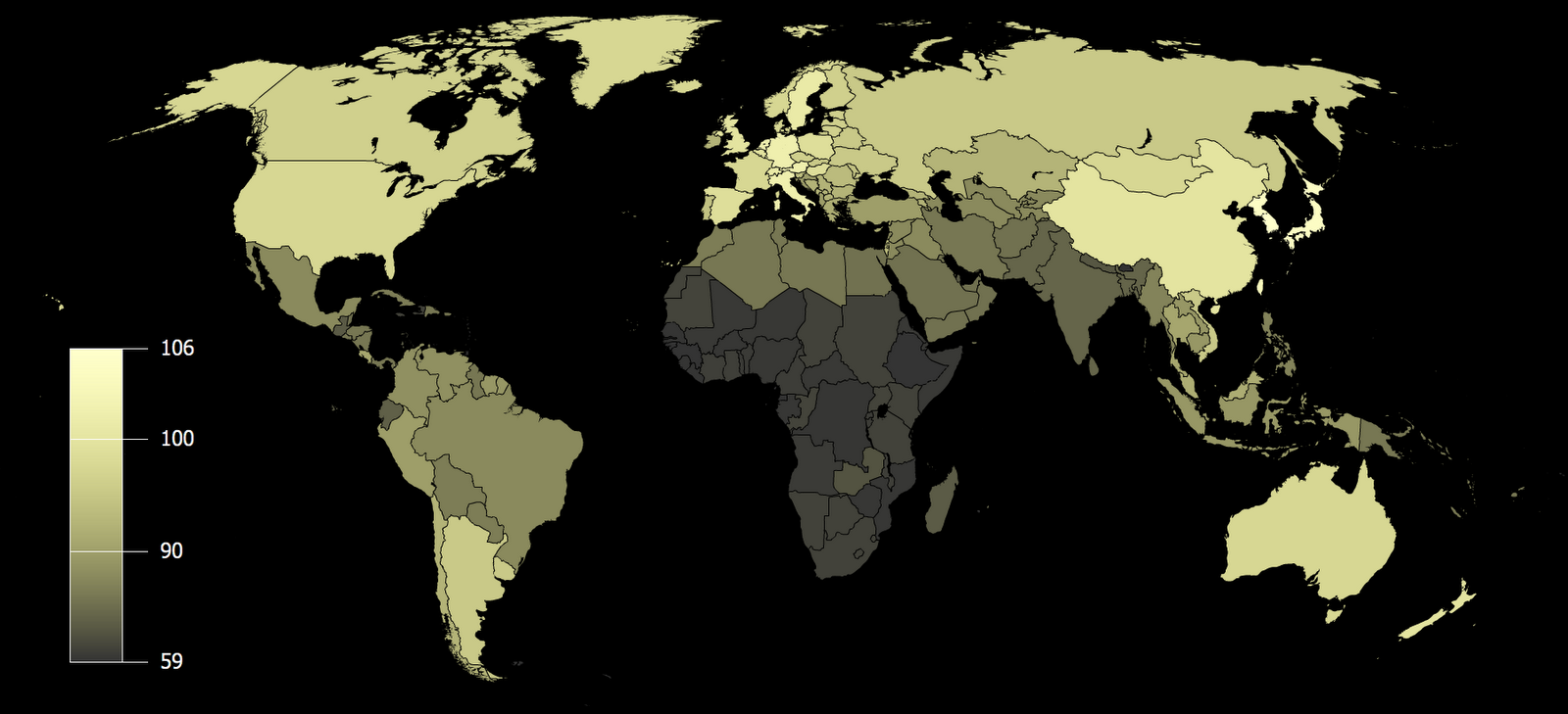
World IQ Map via Wikipedia

If one were designing a rational immigration policy in a time of massive national debt and prolonged economic downturn, one would tend to favour immigrants who were more likely to contribute positively to national productivity and achievement. In general, one would not favour immigrants from nations with high crime rates, low average IQ, or nations whose previous immigrants had high rates of welfare dependency.

Unfortunately for the US, current immigration policies are leading to a high influx from just such regions. How stupid is that? Welcome to the coming Idiocracy.

Who is John Galt?

Labels: , ,

Bookmark and Share

14 April 2011

Makers vs. Takers; Moochers vs. Producers

Makers are essential to life. Humans must exert effort to create the food, housing, clothing, and other things we need and want. Producers are the people who make that effort and deliver the goods.

Some think producers are limited to corporate moguls, but in fact, they include anyone on any level — from janitors to company presidents, in small or large organizations — who earn what they have and don’t steal from others.

Producers offer their goods through voluntary trade — capitalism. Whenever producers have been the freest, the result has been an explosion of wealth and prosperity and a high standard of living for everyone. Witness 19th-century America or today’s least-regulated fields, like technology.

The opposite type is the taker, who wants to forcibly live off others’ efforts. Looters are takers who jockey for positions in government in order to seize wealth and gain power over producers. Moochers vote the looters into power in order to receive government benefits like welfare, subsidies, grants, business advantages, or jobs.

Since its inception, America has been a land of producers. The world’s most can-do people cleared farms, opened shops, lived and traded with one another in harmony, and created the great middle class — the producer class. Now, many Americans take no responsibility for their lives. Instead, they line up for money that’s not theirs; it’s simply “Obama money.” _DC
From Madison, Wisconsin to Washington, DC, the battle of moochers vs. producers is being played out across the US. Interestingly, this contemporary battle was foreseen half a century ago by an author whose magnum opus is just now making it to the silver screen.
Atlas Shrugged: Part I,” which opens April 15th, is a movie unlike any other. Based on Ayn Rand’s novel, it dramatizes the fundamental conflict gripping our world: the battle between those who create value and wealth through their own efforts (the producers) and those who seek them through force (the looters and moochers).

With eerie accuracy, Rand’s novel depicted — in 1957 — the very struggle between these diametrical opposites that we’re witnessing today. This battle couldn’t be more important because the fate of civilization rests on the outcome. Since this conflict inescapably affects everyone, it’s crucial to know which side you’re on.

In Atlas Shrugged, producers like railroad executive Dagny Taggart and self-made steel titan Hank Rearden create new products and services, offer them in free trade, and consequently become rich. They are exploited by looters and moochers like Dagny’s brother James Taggart and steel executive Orren Boyle, who seek government intervention that favors them and thwarts their competition. In the story, the producers are vilified and their property expropriated, until they disappear. Without them, the country collapses.

Sound familiar? Today, America is in decline. The Wall Street Journal reports that “the number of U.S. IPOs has plunged to an annual average of about 130 since 2001 from an average of 503 during the 1990s.” Our nation’s debt is skyrocketing. Government has seized unprecedented control over industries like healthcare and banking. Corruption, group warfare, and the sense of “entitlement” to other people’s money are rampant. As Steve Moore notes in “We’ve Become a Nation of Takers, Not Makers,” public jobs, money, and power are burgeoning while the private sector is shrinking _DC

More on how the US became a "looter state."
Producers may either generate something of value, or they may trade items of value on the open market. Moochers tend to beg, borrow, and steal with no intention of reciprocating value for value. When governments and government employees become net moochers, citizens often have nowhere to turn for redress of grievances. That is how life has been for the governed since the inception of central governments above a certain size.

As the above article states, the US was set up to benefit producers -- either creators of value or merchants of value. But the moochers have creeped into control over time, portraying themselves as protectors of the disenfranchised -- much to their own benefit, and to the gradual but accelerating ruination of the entire nation's economy and productive base.

Consider reading Atlas Shrugged, or seeing the movie, just to get your subconscious working on solutions to the problem. It will not be easy, because things have degenerated much too far. Start with planning a competent community able to pick itself up and take off from there. Then consider how such communities might work together over time to build entire regions that are more producer friendly.

The idea is too important to leave to just one nation.

Labels: ,

Bookmark and Share
Older Posts
Al Fin Main Page
Enter your Email


Powered by FeedBlitz
Google
WWW AL FIN

Powered by
Blogger

``