02 September 2012

The Waking Trance

Human consciousness is an odd pickle. We all experience it every waking day, but no one understands it well enough to build a good imitation. What are we missing?

Quite a lot, actually. For example, why are we so changeable from day to day or moment to moment? Is it possible that much of what we call ordinary consciousness is simply the slipping from one state of automatic trance into another?

Let's try to define "trance:"
To many psychologists a trance is a state of limited awareness. Some psychologists would also characterize trance as a form of sleep, or dreamlike awareness or a kind of altered state of consciousness.

... it is relatively easy to hypnotize a person and to keep that person in a trance state without their being aware that they are in fact in a trance. The technique of pacing and leading a subject from a rich or varied set of thoughts to a limited or impoverished set of thoughts is a technique used consciously by hypnotists, advertisers, sales people, preachers and politicians.

...how can you tell if you are in one of these ordinary, unconscious trances? You are in a trance when your attention is limited and there is a certain repetition of thoughts. In an extreme case, your attention is so limited that it feels like "tunnel vision."... Concentration, when the mind is focused on a specific problem or thought, is also a form of trance. You could characterize trance cybernetically as an awareness loop, or a circular flow of consciousness. _Unconscious Trance

Most of us spend most of our time in one type of trance or another. Even the experience of unconscious mastery is a type of trance.

In general this is fine, if we are in control of which trance we choose to be immersed within -- and if we can exit the trance whenever we wanted.

Almost every human being on Earth will revert back to what is known as "the consensual trance," the limited world of the particular social consensus within which the person happens to be immersed. It is a trance into which we are born and to which we are conditioned. Later, when we enter -- or are close to -- adulthood, we may be presented with a choice as to whether we wish to move into a different consensual trance. Very few discover the ability to experience large portions of their lives outside of the consensual trance. Even fewer make the choice to step outside the consensual trance into a greater freedom of the mind.


It is possible to move other persons into a trance, shift them from one trance state to another, or to help them emerge -- temporarily -- from a typical trance state. It is worth learning how to manipulate other persons' trance experiences in order to better apprehend when someone is attempting to do the same to you, typically in an attempt to enlist you into some kind of mass movement or ideology:
1. Build Rapport with the Listener

Your first task is to gain rapport with the listener. Rapport is simply put that feeling of connection and trust between two people. It doesn’t have to be too deep. You already have a rapport with your friends, parents and others. You can easily gain rapport with other people just by making compliment, laughing at their jokes etc.

2. Switch off the Critical Mind

After building rapport, you can now use covert hypnosis techniques to switch off the critical mind of the listener.

One of the ways to do this is to use the words “Imagine”, “What if” etc. When you use these words, the critical mind immediately shuts off, thus making the imagination work. This is very important, because we are only doing the things that we could imagine before, so invoking the mind’s eye of the listener will help you to send commands to his (her) subconscious.

3. Make Irresistible Hypnotic Commands

After bypassing the critical mind of the listener, you can now make your irresistible commands and describe the things you want a person to do.

Covert hypnosis is that simple. In covert hypnosis, your success will depend on the depth of rapport, your hypnotic language and how you follow the covert hypnosis technology. _Covert Hypnosis

It is no accident that these are simultaneously the tools of sexual seduction, religious conversion, and political enlistment and indoctrination. These are tools that are used in government and religious school classes, sports team pep talks, pick-up bars, cathedrals and mosques, clubs, associations, gangs, and mass movements of all kinds.

The tools of conversational trance manipulation have been perfected by ethical persons such as Milton Erickson, and by unethical persons such as your charismatic politician of choice.

But no one needs to put you into a trance. You do that every day, all by yourself. It is possible to go through days, weeks, months, and years without ever truly emerging from the waking trance, the consensual trance. In general, the possibility that one may emerge from such a trance is so disturbing that it can lead to psychic trauma, drug addiction, membership in a cult, or worse.

But just in case one wished to experience a different state of existence, how would he go about emerging from the waking, consensual trance?
How can anybody distinguish, then, between dream, hypnotic trance, and reality? Dehypnotization, the procedure of breaking out of the normal human state of awareness, according to both mystics and hypnotists, is a matter of direct mental experience. The method can be learned... _Howard Rheingold on Charles Tart

Maybe, maybe not. A lot depends upon the person's experience up to the point when he tries to break free. If the person were raised to be a dangerous child, he will likely have already learned ways of breaking out of the consensual trance -- at least temporarily, for specific purposes. But if the person were raised to be a psychological neotenate -- like most modern children -- his chances of learning to break free of the waking consensus will depend upon his strength of character and his motivation.

Human societies are moving toward a point where it becomes more crucial for persons to wake up. Whether this will involve waking up into yet a higher trance, or waking up outside of trance altogether, may be more a matter of semantics than we would like to think.

If a person wants you to "wake up" to his way of thinking, that is a clue that he wants you to share his trance. This is a typical experience for university students in the modern classroom of indoctrination, and for consumers of mainstream media news and commentary.

But if you want to wake up outside the consensual trance -- and perhaps into your own trance -- you will need to do some creative thinking and experimenting.

If it seems like I am trying to "dumb down" and generalise the definition of trance to the point that it encompasses all experience and consciousness, that is not my intent. I am leaving room for several types of consciousness outside of trance states.

But it takes work to reach them, and even more work to stay in them for any appreciable period of time.

Most people will never wake from the consensual trance, and that is just how they want it. But as push comes to shove, and shove comes to strike, someone will have to devise some workable alternatives. Hopefully, at least some of these alternatives will involve a larger scale emergence from the limited consensus.

Labels: , , , ,

Bookmark and Share

29 January 2011

If You Think You Know, Understand, or "Get It", You Probably Don't

If you think you have a solution to the problem of consciousness, you haven't understood the problem. _Susan Blackmore, Consciousness (An Introduction)
The human mind hates to be wrong. But it hates uncertainty even more. The end result of any particular struggle between the "fear of being wrong" and the "fear of not knowing" cannot be predicted -- but in the long run people tend to "take sides" in the face of uncertainty.
Inside the brain of every human, sits a little person who is watching the ongoing theatre of his life. Well, that's one way of looking at it anyway. It makes sense in a simple-minded way, as long as you understand the theatre analogy. Otherwise you might find a similarly simple-minded analogy to help you "understand."
One problem with "being on the inside looking out", is that you will certainly see yourself out there -- even though you may not realise that is what you are seeing. When faced with gaps or ambiguities, the mind has a way of painting them over or filling them in. The world makes sense to us because we prefer it that way -- not because we actually understand what is happening.
When one says "a picture paints a thousand words," he is not strictly accurate. Pictures express thoughts which words cannot possibly express. Music, movement, and touch can also easily outrun the capacity of verbal language.

But reality is incomprehensible in any form of expression or human comprehension. We really do not understand the present and cannot predict the future in any meaningful way -- and that bugs the crap out of us. So we make things up. We pretend we understand what is happening, and that we know what will happen in the future. It makes us feel better to do that.

We have found ways to deal with uncertainty in certain parts of our lives. We may have faith that a power greater than ourselves is watching out for us, is balancing the bad with the good, making everything turn out right in the end. Or we may think that everything is going to hell, and that nothing and no one can help. Either way, we are compensating for our lack of knowledge and understanding -- attempting to replace uncertainty with certainty.

A Panglossian utopian is utilising the same compensatory mechanisms as a catastrophist doomer, when imagining the future. Whether a religionist or an atheist, the same mental processes are constantly at work conjuring up an acceptable future -- even if it is a future of doom.

Part of the reason that people who believe themselves terminally ill sometimes commit suicide, is to remove the uncertainty of when they are going to die. Similarly, doomers and apocalyptics of the dieoff.orgy persuasion often pursue policies which will bring about the very doom they claim to be warning against.

Peak oil doomers, for example, often lobby against the mining of coal, oil & gas drilling, nuclear energy, oil sands, and other alternative fuels and energies -- seemingly unaware that their political activism is making their peak oil predictions into self-fulfilling prophecies. In such a case, they are taking a strong predictive stand, then taking subsequent actions to help assure the accuracy of their prediction. Sadly, everyone will suffer if they are right, but it is very important to them, so they persist.

Humans are irrational, and they will have their religion -- regardless of their denials of faith.

As for you, dear reader, look to the essential core. Emphasise competence for yourself and those around you. Expect things to go wrong from time to time and be prepared. Expect the unexpected. Embrace uncertainty, and turn it to serendipity. Hope for the best, prepare for the worst.

And although it is almost certainly futile in the long run, never stop trying to understand. ;-)

Labels: , , ,

Bookmark and Share

05 December 2009

Putting the I Back Into Imagination and Imaging

Curiosity and imagination are inextricably tied to each other. When our curiosity is aroused, we begin to imagine how things might be -- and how they might be different than they are. Cascading emotions triggered by our imaginings raise our curiosity even higher -- or sometimes shut our curiosity down in fear and anxiety.

Imagination calls upon "mental images", which may be visual, auditory, otherwise sensory, or emotional in nature. Mental images call upon much of the same brain real estate that is utilised when we perceive sights, sounds, tastes . . . or emotionally-tinged situations.
We used functional magnetic resonance imaging (fMRI) to assess the maximal degree of shared neural processing in visual mental imagery and visual perception. Participants either visualized or saw faint drawings of simple objects, and then judged specific aspects of the drawings (which could only be evaluated properly if they used the correct stimulus). The results document that visual imagery and visual perception draw on most of the same neural machinery. _Ganis, Thompson, Kosslyn 2004 CognitiveBrainResearch
Mental images "connect up" with a wide array of sensory, motor, cognitive, and emotional centers of the brain. Understanding the broad nature of connectiveness of mental imagery should give a hint to the power of image and imagination.
Brain studies now reveal that thoughts produce the same mental instructions as actions. Mental imagery impacts many cognitive processes in the brain: motor control, attention, perception, planning, and memory. So the brain is getting trained for actual performance during visualization. _SeeingIsBelieving
Mental imagery has been used by world class athletes for over 50 years. Even golf champion Tiger Woods has used mental imagery for decades (although he probably didn't see that 9 iron coming). Imagery is also useful in rehabilitation from stroke and brain surgery.

Recent research in Lausanne, Switzerland suggests that mental imagery can improve our perceptual skills. In other words, if we train ourselves to "see" ambivalent visual phenomenon more precisely -- using our imagination with a bit of (non-visual) feedback -- we can actually learn to perceive such phenomena more precisely. A tricky concept to put into practise, no doubt. But highly suggestive nonetheless.

So -- how would we go about putting the I back into imagination and imaging? What I mean by that is how do we compensate for generations of neglect by governmental institutions of education, to train individuals in constructive, creative, and productive imagination and imagery? We have spawned generations of low-curiosity graduates, who instinctively appeal to authority rather than puzzling a situation out for themselves. Their imaginative facilities are atrophied -- except in regard to popular topics within a very superficial zeitgeist. The events occurring underneath the very foundations of their existences go undetected, in their dull-witted and incurious ignorance. All of this obliviousness occurs within minds of high and low IQ alike.

Why?

Education is currently dominated by highly verbal indoctrinists, professors in university schools of education caught in the ambiguous verbal slipstream of meaning. Modern philosophies of pedagogy are prone to fad and fashion, lacking basic grounding in any meaningful or sustainable reality. A society built upon graduates of such educational theories will be prone to the type of failure that leads to authoritarianism and totalitarianism. This is precisely what has been happening throughout the western world.

Visual images tend to be more permanent and lasting than verbal "imagery." Visual images often contain their own "falsifiability" criteria. Consider the ice age cave paintings found in southwestern Europe. One can easily identify the objects represented, and can judge the level of accuracy in representation, tens of thousands of years later. Those paintings predate any evidence of written language by tens of millenia.

Just as painted imagery predates printed language, so did mental imagery precede verbal thought. That is true evolutionarily and it is true in individual human development. Our brains may have evolutionary advantages that allow us to use language, but images and non-verbal imagination came first.

It is important to understand how human minds are built -- more sophisticated and artifactual tools are built upon the simpler and more natural structures of "thought." Language is built upon image, in a sense. Even verbal thought is based upon imagery -- often emotion-loaded imagery. (of course, skillful language conjures emotional images just as emotional images can trigger involuntary verbal utterances) Basic language metaphors are built of images of various types. More complex language constructs are built of basic language metaphors.

What is imagery built upon? Emotions? Well, they certainly work together. Curiosity is an emotion, after all. And curiosity uses imagery and is also triggered and stimulated by imagery. If a child is deprived of both curiosity and imagination, he is doubly damned by the frivolous gods of pedagogy and neglectful sprites of parenting.

Imagery is built upon pre-verbal, pre-image metaphor. More on that later.

It is enough to understand that our kludgy consciousness is built from lower level spare parts, all the way down to the turtles. (from there, it's turtles all the way down...) Some levels are accessible and trainable, and some are not. We are neglecting much of what is trainable.

The point is, that the "play pedagogy" that permeates Montessori education and also is used in executive function training programs for young children, is a form of training of imagination and imaging. It is an approach that boys are desperate for, and that could also benefit girls immensely.

Uh-oh! By stating that boys might benefit more from training in visual imagination, I have alienated leftist and feminist curriculum designers. There is, after all, an undeclared "war on boys" happening. No matter how desperate the condition of boys in education becomes, they must not be favoured in any way -- not even a little!

That, too, is beside the point. There are other types of images than visual images. Training in many of those forms of images would benefit girls more than boys, on average. But curriculum designers themselves lack imagination. They never learned to use imagery themselves, so of course they would never think to design a curriculum to help children learn these vital skills.

It is a blindspot for leftists, largely due to the focus on the "I" in imagination and imagery. Think about it, and you may see what I mean. But the rest of us can act without their permission, can't we?

Addendum: Imagination, Mental Imagery, Consciousness and Cognition, is the best one-stop information source on this general topic, according to Al Fin cognitive scientists. The author is Nigel J.T. Thomas, PhD.

Labels: ,

Bookmark and Share

19 October 2009

The Long Awakening and Oft the Long Goodnight

Recent articles in the website Machines Like Us (by Eric Schwitzgebel and Peter Hankins) send me into a bit of a whimsy. Both articles are fairly short, and the points being made are easily grasped.

Eric Schwitzgebel is amazed that consciousness can arise sometime between the moment of conception and the age of two years. He says he has difficulty understanding the idea of a "not quite consciousness", and the nature of such an intermediate state between the conscious and the not conscious.

And yet, Eric -- like all the rest of us -- loses consciousness every evening, and comes back to consciousness every morning. It is not usually like a light switch turning on and off, either. The transition usually takes time, although many humans lack the awareness of the intermediate states.

There are also intermediate states of intoxication, of emotional overload, of extreme fatigue without sleep or sleepiness, of extreme pain, pleasure, and of hypnotic tunnel vision that are not quite conscious and not quite unconscious.

Some of us are aware of our not-so-conscious states and our hyper-conscious states, in contrast to "normal" consciousness. Some of us are not.

Obviously there is not one exact moment when a developing infant acquires consciousness, and is conscious from that moment on. Instead the infant over time approaches richer and more meaningful conscious states, then draws away from them -- losing them altogether in anger or sleep -- then must often struggle to regain lost ground. It is an oscillating sweep of consciousness, a ragged rise, then a plateauing, and an inevitable subsequent fall over long time to the inevitable long goodnight.

Peter Hankins ruminates over a three year grant given a researcher to unravel the mystery of "common sense." The idea is to give machines the ability to generalise, to use inductive inference to build ever more complex models of the world -- subject to confirmation or falsification.

Hankins expresses skepticism over whether machines can ever truly emulate human thought. He suggests that since we do not actually understand how humans perform the act of "common sense", that we may have to be satisfied with machines that only imitate human thought -- as long as they imitate human thought really well.

Both short articles have a whiff of the "dorm room bull session", which may be unavoidable using common language terms in such a small allowable space. Both articles are connected to each other at an intimate level by the mysterious pre-verbal metaphor. Being pre-verbal, it is almost impossible to express in words. But to try to grasp the essence of the origin of consciousness, or the nature of "common sense", without at least trying to shine a light on the essential embodiment of consciousness, seems not so much misguided as "unguided."

And of course, it is the "unguided" nature of education and child-raising as much as the misguided nature of the same, that occupies too much of my time these days. But it is unavoidable, given my compulsion to try to understand root causes of complex multi-causal phenomena.

We have only so much time to grab the essentials of conscious thought, and to run with them. Because it is not so long before the powers of cognition -- that we once thought would only grow stronger -- begin to fade. Another transition.

It is important to understand these issues in order to maximise our consciousness over the course of our lives. When we do better understand the origins of embodied consciousness, we will be in a better position to evolve consciousness within a machine. We lack the hardware tools yet, but they are beginning to come along.

The problem of decline may be a much more difficult problem to solve. Even without atherosclerosis, amyloid plaques, genetic transcription / translation error, metabolic diseases, and mitochondrial dysfunction, the failure of the human brain to deal with building complexity of overlapping categories and memories over time can place unwelcome limits upon the growth of consciousness.

The intermediate goal is a lifespan of multiple hundreds of years old. But can the human brain continue to function at a high level for that long? No one knows. But it is worth finding out.

Labels:

Bookmark and Share

30 August 2009

Wildfire and Human Violence

In the forest, on the plains, across the prairie and mountainside -- there is a history of fire that stretches back farther than life. Natural wildfires sweep through the countryside, clearing away debris and nature's offal, making way for a clean start, new growth. Fire is a part of nature.

Humans use fire for their own purposes, but they wish to keep fire confined. As humans build their estates deeper and deeper into countryside that has been subject to periodic cleansing by fire, the natural human tendency is to prevent wild, unconfined fire at all cost, year after year.

Whenever humans have prevented the natural cycle, or have attempted to freeze nature into one particular arrangement in time, they have set the stage to reap hell on Earth. By interrupting the natural cycle of cleansing by wildfire and subsequent re-growth, humans allow the accumulation of fuel to grow so dense and explosive that when the inevitable fire does sweep through, there is very little left behind, for starting over.

Likewise, wherever humans walked the Earth, there is a history of violence that sweeps back through history to the beginning of homo and beyond. Natural disagreements would escalate into fights. The energy to sustain the fight would soon be exhausted, life would go on. Sometimes old coalitions would often be swept aside, making way for something new.

Human societies have come a long way from their violent pasts, but human nature still retains all the violent impulses that causes murder and war. As civilisations developed, and humans came to live closely packed amongst one another in cities, it was in the interests of the ruling classes to confine violence into a restricted volume of space, away from the main. Certain neighborhoods were left alone to fend for themselves. Men who were naturally good at fighting were recruited for armies. Dangerous men who could not be controlled were either confined in prisons, or ended up as rulers themselves.

Human societies use violence for their own purposes, but they try to keep it contained. Inevitably, violence spills out of containment, and society must try to deal with it. When society tries to suppress all violence, the problem may be swept under the rug temporarily. Disagreements that might ordinarily grow into physical fights are suppressed, sometimes brutally and beyond all reason. The underlying disagreements often simmer over time into bitter resentments. Then as its fuel supply builds, resentment flares up into bloody battles and outright war.

When society enforces laws that perpetuate and inflame natural resentments -- yet attempts to confine all disagreement to sanctioned arenas where the conclusion is foegone -- the ability of that society to maintain control grows more tenuous by the day.

Violence is currently bursting through the seams of containment by way of youth gangs and religious gangs. Much of modern violence has an ethnic component -- as when ethnic minorities across Europe, Oceania, and North America commit a wildly inordinate amount of crime. Crime committed by minority populations is committed against other minorities, and often against weak members of the majority -- such as rape. It is possible (perhaps likely) that the threshold for violence is largely genetic, more easily triggered by environment when particular alleles are active.

Wildfires in nature can be prevented and minimised by particular preventative measures, such as controlled burns, regular cleanup of undergrowth, controlled logging and periodic clearing of forests, etc. In some cases, humans should probably evacuate particular areas of wilderness.

Uncontained violence in humans can be similarly prevented or minimised, using ethical prudence, compassion, wisdom, and common sense. Hotbeds of violence should not be ignored or patronised. They should be confronted and evaluated dispassionately. They should not be fertilised and then fanned into flames, as has been the case in western countries over the past few decades.

Violent impulses are far more common for some than others. They are more common for males than females. They are more common for the pubertal and post-pubertal young, than for the old. They are more common for some ethnic groups and religions than for others.

Better ways of safely expending and sublimating that violence can be developed, than our current crop of video games, spectator sports, and other sanctioned arenas of violence.

Labels:

Bookmark and Share

27 May 2009

Morality Goes Far Deeper than Religion

Prof Marc Bekoff, an ecologist at University of Colorado, Boulder, believes that morals are "hard-wired" into the brains of all mammals and provide the "social glue" that allow often aggressive and competitive animals to live together in groups.

He has compiled evidence from around the world that shows how different species of animals appear to have an innate sense of fairness, display empathy and help other animals that are in distress.
Before humans invented religion, they experimented with a wide range of ethical systems. Based upon a dizzying mix of inner instincts and perceived influences from the outer world, each generation taught the next one how they should live and treat other people (the members of the extended family who alone were considered to be human) and live in the natural world.

Religions evolved for many reasons, one of which was to assist in the development of an inner morality and system of ethics within each group member. Another purpose of religion has been to provide a sense of "awe and transcendence", the idea of something greater than oneself which can assist one in overcoming personal obstacles. Religions have become so instrumental in these roles, that even in the modern age of science it has proven difficult to dispense with them.

Religion is often a considerable obstacle to over-ambitious governments. The CCP in China persecutes its Falun Gong and Tibetan religionists because these believers hold to a transcendant view of life that goes beyond secular authority. Religious believers are also likely to have a good recall of the many misdeeds of the secular government -- which is something Chinese leaders wish to stamp out.

The totalitarian state seeks to integrate the uses of religion within the state itself. Hitler's Nazi totalitarianism rested upon the cult of personality. Kim's North Korean totalitarianism does the same, as did Fidel Castro's total state. Hugo Chavez and the other baby dictators of South and Central America would like to achieve the same ends. Such personality cults are actually "pocket religions" in their own "rite." Something similar might occur again in the west -- perhaps even in the US? Imagine an Ameircan "Big Brother" and Ministry of Truth kept constantly busy obscuring reality and modifying history. The only morality is the morality of the state. Can you picture it?

In the Muslim world, Islamists want to integrate the secular and the religious into a totalitarian unity. Such a unity could not tolerate competitors in the intellectual, spiritual, political, or economic / military worlds. Religion becomes the death of morality under such a regime. Any threats to the totality would be eliminated.

The majority of the world, in terms of population, is set to devolve into a broadly anarchic "warlordism" and gangsterism such as one sees across Africa and parts of Central Asia (and the inner cities of the western world). The dominant ethics under such gangster systems derives from the power to deprive members of health, sustenance, and life. Insiders prosper, outsiders are punished or are eliminated, and the masses simply endure.

A system of life that would allow Matthew Crawford to get a PhD in political science, work in a think tank for a few months, then quit the intellectual life in order to work as an amateur philosopher and full-time motorcycle mechanic -- is a system of many luxuries.
It's satisfying to complete a task from start to finish. Start a small business, or learn a trade—really! Do you know how much plumbers make? It also helps to imbue what you do with a sense of craftsmanship. Strive not for flimsy new economy "flexibility" but for real, handy expertise in a chosen field. The point is to achieve mastery, which in turn gives you a skill not subject to the whims of office politics.
How many societies can afford to educate persons at the PhD level, only to see them leap into the blue collar world voluntarily? Of course, Crawford's journey has not ended. In fact, from the blue collar world, he has leapt into the intellectual world of authors, with the publication of Shop Class as Soulcraft: An Inquiry Into the Value of Work.

Systems of ethics depend entirely upon the degree of luxury a society extends to its members. Richer, more liberal societies can afford a much more intricate -- even counter-productive -- system of ethics, than can the brute force gangster existences of a growing portion of the world's populations in both the third world and the developed world (ethnic ghettoes of the central city and banlieus).

Morality preceded religion, and goes far deeper than religion. If humans in the developed world cannot develop a workable system of morality and ethics that persons of all religions can adhere to, they are in for violent clashes in the not so distant future.

In the United States, leftists have gained power in a quasi-stealthy manner reminiscent of how Hitler's Nazis gained power in Germany. With the early actions of the leftist reich, including the first Supreme Court nominee -- a left-radical extremist --, it is clear that the regime in power intends to enforce a leftist ethics upon the population at the point of a gun, via the force of law. It is an ambitious and revolutionary attempt to overhaul a system that has worked exceptionally well over a period of centuries.

Forced revolutions are either based on violence or lead to violence. Ethics and morality run too deeply within the human soul to be wrenched about by social engineers and crusaders. This interlude will end badly for everyone who has jumped upon the crusader bandwagon. And there will be a great deal of collateral damage.

A much wiser approach would be to work in the manner of the US Constitutional Congress to achieve a broadly applicable secular morality upon which a wise and acceptable system of law could be structured and extended.

The brute force, stealth revolutionary approach taken by Brock O'Bomba and his crew will run into objections of morality. Not only from established religions and churches. But from the deeper morality of the inner self.

Brock's only chance is for the economic situation to become so dire, and to bring so many people into dependency upon government benefits, salaries, and subsidies, that the US will fall essentially into the quasi-welfare state category -- with elements of dictatorship "insider chic", kowtowing to the gangsta leada.

In dire circumstances, most people will sell their ethical reservations for a pittance. Obama zombies have already sold their pittances to Brock O'Bomba. So have many public sector workers, academics, and journalists. But for Brock to succeed in the long run, the economic devastation would have to grow far more severe than it is likely to become before the next few elections.

Labels: , ,

Bookmark and Share

31 December 2008

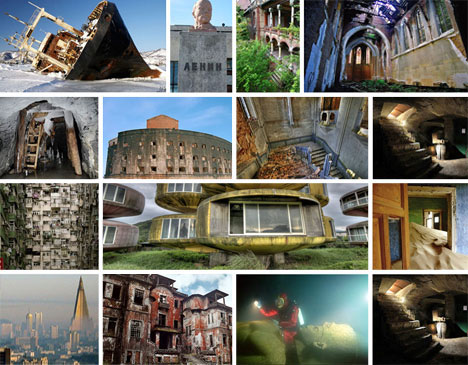
Abandoned Outposts Disappearing into Time

From the glacial Greenland interior to the Antarctic wastes, once active and thriving human outposts lie abandoned.

Growing ice in Greenland is reclaiming the old Dye-2 and Dye-3 early warning radar sites, abandoned in 1990/91.
In looking back at the time the sites were abandoned, one console operator lamented “We were very busy during this time and I was sad to see it end. I remember thinking of all the waste,” he said. The site is slowly disappearing into the snow. Its outbuildings are no longer visible and drifting snow will consume it completely one day, but that day appears to be decades away.” _Source
Across Antarctica and on circa-Antarctic islands, multiple exploratory outposts and settlements have been abandoned over the decades, for reclamation by the growing ice fields.
The most famous and disturbingly well-preserved of these [abandoned] places is the camp built by Robert Scott and his party on Ross Island in 1911. The seaweed-insulated wooden cabin and its outbuildings were supposed to be the team’s shelter when they returned from their attempt to be the first people to visit the South Pole. _DarkRoastedBlend_via_GrimReviews_via_DepressedMetabolism
Be sure to view this array of photos of abandoned Antarctic sites.

Depressed Metabolism has posted several articles dealing with abandoned sites at this posting, including abandoned mines in Sardinia and abandoned underground stations in London.

Here is an amazing guide to abandoned places from WebUrbanist.

Abandoned buildings and installations are treasures for exploration, particularly for young boys. Older boys such as myself can find their hearts beating a little faster contemplating an expedition to such abandoned sites -- ghost towns and outposts waiting for living souls to haunt.

New Year's Eve may be the best of times for the contemplation such places, a sober devotional to auld lang syne, as anodyne to the hedonistic excesses of the evening.

Happy New Year and beyond. Be sure to do your best this year to grasp the big picture view, in dynamic supersensivision. Look for all the poetry and treasure that washes up on your shore.

Labels: ,

Bookmark and Share

27 October 2008

Counterintuitive Graphs vs. Steamrolling Delusions

This graphic demonstrates an inverse relationship between CO2 concentration and temperature. Watts Up With That?
This graphic demonstrates the growth of US government spending in the human resources sector while spending on national defense and everything else stagnates or even declines slightly. Under a President Obama defense spending would drop significantly while increases in human resource spending and other new spending would accelerate even faster.

The "Catch 22" of human resource spending is that it is tied to cost of living, and can only go up. As the elderly population grows older, as the highly skilled craftsmen of industry grow old and retire and are not replaced, as highly skilled populations die off and are often replaced by less capable immigrants who can never replace them--paying for the exponential increases in government spending coming down the pipe will be impossible.

Over the past summer we witnessed the "demand destruction" of the global economy by hugely inflated oil prices. But that was nothing compared to the economic destruction of the anti-energy policies that the Obama-lution would bring to the US and the world. And to think it was all based upon a temporary correlation between rising CO2 and rising average surface temperatures over a few decades.

Labels:

Bookmark and Share

26 August 2008

Only a Coward is Totally Innocent

Innocence is vastly over-rated. Besides being virtually impossible to attain, who would want to be a member of the cowardly, mediocre innocent? We live by various overlapping systems of ethics. Our society is divided along the lines of different ethical systems. We are taught that innocence is good, so we want to be "innocent", but if we act in the real world--which we must--we necessarily break ethical rules of one system or another.

For example, to many ideologues it is impossible for a person of European extraction not to be a racist. The accused may protest the charge, asserting that they are not racists, that they have close friends among the minorities, work amicably alongside persons of colour, and may even be married to a non-European. It does not matter. They are racists by the very definition of some ethical system. And since in this society, persons guilty of "racism" cannot be members of polite company, the guilty must be driven out. That is merely one example of the assortment of "original sins" bestowed on large groups by the dominant ethical system in modern academia, media, and much of society at large (post-modern faux-multicultural monoculturalism).

Everyone who exists, acts, more or less. It is not possible that anyone is truly 'innocent.' That is just how oppressive police states like it, since "having something on everyone" is the best way of staying in control. It is also how political activists like it, because they do not have to actually prove someone's malfeasance to have that person fired, disgraced, or driven from public life.

The pretense of innocence is necessary if one is to make a life of loud and pompous judgments against others. And the best way of maintaining a pretense of innocence is not to act, overtly, other than performing acts of loud, clangorous judgment. Such loud ceremonial or demonstrative acts of judgment are best done in groups--as in protest marches, echo chambers, or political rallies. The strength of numbers in pronouncing judgment should never be underestimated by anyone susceptible to a lynching.

When susceptible to attack, a feeling of safety may be found within anonymity inside a group--as in a school of fish or a herd of grazing animals. An even stronger feeling of safety is anonymity within the group that is doing the attacking. A member of a lynch mob who stays back a bit from the front can be safe from the mob, yet still claim innocence.

Politicians exhibit this sort of "leading from behind" behaviour as often as possible. Particularly legislators, who are far less restricted in the claims they can make during campaigns, if their records are somewhat "undistinguished." A clear record of overt action can be somewhat inconvenient when conjuring up conveniently changeable images of oneself--depending upon the audience of the day.

When claiming the role of innocent judge of the guilty, it is best for one's prior actions to be few and mild, somewhat obscured, or conveniently deniable.

These innocent judges are not of any use to anyone whatsoever, but it is possible for them to acquire loud and powerful public voices, and to rise to positions of significant power in government, academia, media, and society. Particularly in a strongly divided political environment, the more chameleon-like a person can make himself, the better his prospects--up to a point.

What kind of society would grow such cowardly innocents to prominence? Dangerously brittle societies. Probably the society in which you live.

Labels: , ,

Bookmark and Share

18 November 2006

Morality Only Applies if You Are Alive


....morality and compassion are things you can only afford when you're in a nation that's isn't fighting for survival.Source.

Morality has become fashionable in politics, with both sides of the US political debate claiming the moral high ground. Always be suspicious of politicians appealing to morality. By definition, politicians and lawyers are liars. Priests and Pastors are almost as bad. Special interest morality is unsatisfying to anyone who values truth. The media laps it up like dogs, though. So do people with little experience in life, or little personal ballast despite experience.

There are different approaches to morality, some of which are fairly objective. Special interest morality is a focused morality that ignores far more than it includes. It is very useful to lawyers, politicians, and priests--not to mention partisan media pundits. The problem is being able to detect the stunted morality before it causes you to change your behaviour. Most people are incapable of doing that.

If schools wanted to provide a service to students, they would require them to analyse a full spectrum of arguments on a particular issue, and not only identify the logical parts of the argument, but locate logical fallacies and logical shortcomings--including blatantly ignored alternative premises. The reasons schools rarely do this, is that such an exercise presents a danger to the school's (or professors') underlying argument or point of view. We cannot have that.

So I will do something similar. I present links to three point of view articles--here, here, and here. You may choose the topic that interests you most and analyse it.

Morality exists on many levels. The failure to distinguish between levels of morality, and how they might affect an argument, is a major shortcoming of modern education and public discourse.

Finally, there is Marc Hauser's book, Moral Minds. I have skimmed the book and read several reviews. I have read other books by Hauser. I consider the new book an essential early step in looking at the biology of morality. I plan to read the book in detail fairly soon, as it may fit in the reading rotation.

Philosophy once encompassed ethics. Now biology is elbowing its way in, quite rudely. There is something offensive about biological imperatives that force their way into polite conversation, over cocktails. Nevertheless, a growing number of dissenters from politically correct self-censorship are beginning to speak more loudly--and publishers are finding it harder not to publish them. This is a trend.

The popular media has temporarily hit on a "formula of morality" that seems to sway the majority of voters in some parts of the developed world. What the popular media may not realise is that morality is a fickle servant, subject to significant recoil.

For interested observers, I strongly recommend reading Hauser, Pinker, Dennett, Dawkins, and other students of human behaviour with Darwinian perspectives. Then look at what societies' liars--politicians, lawyers, media pundits, clerics, PC professors--are doing to morality arguments. Fascinating.

Labels: ,

Bookmark and Share

28 May 2006

Hobbling Time

There is a quantum of time for every thought. Our bandwidth of thought lies well under one hundred bits per second at best. In spite of our ability to chunk information and utilise massive parallelism of cortical columns. When we are tired or otherwise indisposed, our bandwidth is reduced accordingly.

Our consciousness is arranged so as to focus our attention on one thing at a time. Women manage a limited type of multi-tasking due to better balancing of the cortices, but men are confined practically to one thought at a time. That is one limitation, the real time limitation of thought rate.

Within hours after waking, the human brain requires nutrient and fluids, and periodically through the waking hours this must be repeated. For many humans, periodic infusions of nicotine, caffeine, ethanol, and other chemicals are required in the waking time. For most modern humans, the waking brain requires a period of rest and rejuvenation, so it watches pre-digested "information" or entertainment content, or reads or listens to particular sounds. After around fourteen or sixteen hours of "waking", human brains require rest, so they sleep.

Humans can, of course go for much longer times without chemicals, sleep, and recreation. I myself have worked for periods of up to and longer than sixty hours without sleep, with little food or fluid, and no chemicals except the rare and treasured caffeine. That is not something humans will do willingly, unless given strong motivation. In general, the preceding paragraph applies.

When humans are born, they cannot think, not like adult humans. It requires years to acquire language and the forms of thinking that adult humans use. Up to half of each day of those early years is occupied by sleep and other non-thinking activities. If the child goes to school, well over half.

The frontal lobes do not fully myelinate before the early to middle twenties. Judgement suffers during this time prior to brain maturation, and very often the brain is well indoctrinated and innoculated against independent thought before the brain has grown to dynamic completion. In many of these cases, there is no amount of time that can remedy the loss. In other cases, the coming of full brain function allows a growth out of childhood and university indoctrination.

In all these years, particularly if the child is in school, most hours of his day are spent in non-thinking activity, even allowing for the limitations on thought in the immature brain. These hours of non-thinking become a habit not easily broken after the hobbles of childhood and youth are removed.

We think very slowly, when we think at all. Much of our time is devoted to performing duties of various types in exchange for currency, currency that gives us choices in what we do with our "free" time. We would rather talk on the cell, watch a film, relax with a cigarette or cup of coffee, drink a fine wine, and exchange non-thoughts with our friends. This is life, this is time.

Grasping for companionship thinking this will stop time this will be forever this eternal moment. Attending weddings, our own, our friends. Surprised by time by babies by new emotions. Surprised by strangers with the names of our spouse and our children. Gray hair and wrinkles time sneaks strange.

All too soon, we are spending time at the clinic, at the diagnostic center. Visiting the hospital or being visited. Attending funerals for those whose time elapsed. Seeing ourselves in the casket reflected in the bathroom mirror, seeing ourselves in the hospital bed from the medicines inside the cabinet. That is our time.

What is the bandwidth of thought when one never thinks? When what passes for thought is pre-digested hyper-processed slurm? A lifetime of it and then nothi

All the marvelous ways we have of forgetting the passage of time. We say we are killing time but really we are just ignoring time while time is killing us. What can people do? Is it enough to be wise and to age gracefully, to achieve balance and peace of mind? Yes, that is preferable to suffering. Most humans never think, never think about this except in bad dreams or tragedies, but if they did they would not accept the buddha's answer.

Humans would want to hold time rather than to be held by time. Perhaps it comes down to the daily conflict between the will to act willfully when awake, and the will to sleep in peace. Understanding this, understanding one gulf between people. Further dividing among those who want to act while awake, those who want to achieve primacy over others, from those who only want to act out their own lives free from unnecessary hobbles.

Time hobbles when hobbling time, when hobbling time comes. Which will it be?

All of this will still be operative when "the singularity" hits us. If you understand the terrain, you can trace the future of the watercourse after the deluge.

Labels: ,

Bookmark and Share

30 December 2005

Philosophy of Fear

Here is an incisive analysis of popular fear mongering by the pseudo-intelligentsia over the past few decades. It is immensely humorous and revealing at the same time. The signal is fear, although the carrier wave may change, and the amplitude is always at full blast volume. Read it all, and enjoy all the great graphics.

"...David Brinkley once said, “The one function TV news performs very well is that when there is no news we give it to you with the same emphasis as if there were.”"

The dismaying thing is that students in government schools are being taught by the same type of pseudo-intellectuals who thrive on the climate of faux fear. In Running Screaming from Phantoms I briefly touched on similar issues.


credit to Rand Simberg at Transterrestrial Musings.

Other clear minded social commentary can be found at this link.

Labels: ,

Bookmark and Share

01 October 2005

Running Screaming From Phantoms

Only a tiny proportion of humans are directly involved in pushing human evolution forward. Billions will eventually benefit from the work of a mere thousands. When contemplating the future, nothing is more important than lifting up humanity's capacity to think and live completely. For some reason most people are otherwise occupied.

What are all of these people doing? Most people in the world are too poor to do much more than subsist. Try to find food, maintain shelter, provide for a family, avoid suffering as much as possible. Life is hard, then you die.

People in the developed world are also otherwise occupied. They are hanging on the words of media reports, drowning in crass entertainments and chemical numbing agents. Are they alive? They imagine they are. Their fear makes them think so. They are afraid much of the time, their culture is based on fear and insecurity.

The propagation of fear, combined with moral outrage, is the standard staple of the news media organisations in the developed world. The hugest achievement for news media executives and producers is to create a mindless stampede, to drive the public into mass action. To do this, to create mass panic that leads to mass action, they must create objects of fear and loathing. Then they must shove these feared objects into the faces of the viewing public, in every shape, manner, and permutation possible.

There is a political force at work, a thirst for power and the collusion with the powerful. News company executives are humans, with human biases and weaknesses. They want their "team" to win. They developed the tools of inciting fear, hatred, and loathing for a reason. You cannot expect them to abstain from their use, when so much power is on the table? The executives recruit the producers, anchors, reporters, researchers, who will play on their team, by their rules. The purpose of the entire team is to use the tools of fear creation to move the public to act in ways that cause the team to win. That is what dictates the content and the flavour of the news.

Be afraid. Be very afraid. Emerging viruses, climate change, corporations, globalisation, modern science, George Bush, americans, nuclear energy, western civilisation, european males, pollution, rationality, mathematics, automation, nanotechnology, artificial intelligence, genetically modified foods, genetic engineering, Israel, Jews, the rich, Halliburton, oil companies, mining, space exploration, drug companies, the US military, fossil fuels, automobiles, insurance companies, biomedical research . . .

Run screaming from the phantom fears. It gives one a purpose, albeit a purpose originating first in the mind of a propagandist, and filtered through the propaganda machines. Mass insanity is the salvation of the modern news media. This mass media propagated delusion apparatus may or may not have an effect on the effort to lift humans into a more conscious and fruitful life. Only a few are doing the work for the benefit of the many.

When it is time for people to begin making the transition, the mass media will portray the change as a great threat to the masses. For a critical time period next levels will become another phantom, perhaps the top phantom. The mass media needs all the phantoms it can get. It is constantly on the move, seeking out new phantoms to feed the machine, to manufacture fear, to make the people scream.

Labels: ,

Bookmark and Share
Older Posts
Al Fin Main Page
Enter your Email


Powered by FeedBlitz
Google
WWW AL FIN

Powered by
Blogger

``