11 January 2013

Germany's Bad Energy Choices Leading into Cul de Sac?

Previously published on Al Fin Energy


Big wind and big solar are hopelessly intermittent and unreliable forms of energy production. But Germany has rashly committed itself to supplying 40% of its power from the intermittent unreliables by 2020. As a result of this giant leap of faith, German energy planners are scrambling for ways to convert big wind and big solar energy to more reliable forms of energy that can be stored, and used whenever needed.
As seen in the diagram above, a new €3.3 million project aims to produce methane from wind and solar generated electricity, using alkaline electrolyser stacks.
Once the hydrogen has been produced it passes through a methanisation process. The resulting methane can be injected directly into the natural gas grid, thus allowing for renewable energy storage on a timescale of months or more. The gas contributes to decarbonising the grid, and can be used for electricity generation or to fuel natural gas vehicles. _FuelCellToday
Here is more information about an earlier, preliminary research project to prove the concept:
The Centre for Solar Research Baden-Württemberg (ZSW) has inaugurated a research facility to convert solar power to methane. The methane is then added to the natural gas grid.

The project uses solar power to electrolyse water in a pressurised alkaline electrolyser, producing hydrogen and oxygen. The hydrogen gas then undergoes methanation, and with the facility able to produce up to 300 cubic meters of renewable methane per day, it is the largest of its type in the world. _FuelCellToday
More information from ZSW (in German)

Needless to say, the concentration of CO2 in the Earth's atmosphere is vanishingly small (0.04%) -- making atmospheric CO2 far too rare and expensive as a CO2 source, for an industrial-scale project. This being the case, it is clear that the project will have to use concentrated CO2 effluent from a hydrocarbon-burning power plant, cement plant, or other industrial scale plant.

And as it happens, Germany is burning much more coal lately, as a result of its impulsive decision to shut down its nuclear power plants. All of which brings up a very good question: "If Germans want to produce methane from CO2 and H2 from the electrolysis of water, why not use nuclear power as your source of electricity?" Nuclear power is cheaper, more reliable, and more potentially abundant than the intermittent unreliables -- big wind and big solar.

Perhaps the answer to the question is that the Germans are not actually serious about all of this, but are merely posturing for the energy and environmental media -- and for green oriented voters and power blocs.

That would be a shame. Germany is in dire need of competent people who are willing to take a serious approach to present and future electrical power needs.

Today's bad choices by German leaders will have the effect of limiting possible good choices in the future. Germany is being painted into a corner, led into a cul de sac, by faux environmental greens who have been given too much power across the EU.

The green ideology is doing for Germany and the EU what the communist ideology did for the former USSR.

Labels: , ,

Bookmark and Share

22 November 2012

China's Green Bubble: Just One of Many

This article is cross-posted and adapted from Al Fin Energy


China has achieved a great success in building up a gigantic productive capacity of wind turbines and photovoltaic panels. But what will China do now, with that success?
[China] now has the capacity to generate 6.2 gigawatts of solar power and 68.3 gigawatts of wind... the U.S. has 5.7 gigawatts of installed solar capacity and 51.6 gigawatts of wind power... _BW


One-quarter of China’s wind farms are not connected to a power grid—a reflection of poor planning, insufficient transmission lines, and technical concerns by regional utilities that the intermittency of wind power can be disruptive to normal operations. Wind-related power failures have caused blackouts in three provinces, while exploding equipment has been blamed in the deaths of several workers, according to local press accounts. _BW

Responding to a perceived market for green energy in Europe and North America, China engaged in a massive production build-up of wind turbines and photovoltaic panels. China was successful in building a vast production capacity of green energy generation. And now, China must face the consequences of its great success.
China’s $30 billion solar power industry is overbuilt and heavily in debt. Analysts say even billions of dollars in new government loans may not be able to pull it out of the hole.... Suntech Power Holdings (STP), the world’s largest solar panel maker, announced in September it would cut or reassign 1,500 workers at its photovoltaic cell factory in Wuxi. Suntech is counting on a $32 million loan from local authorities to avoid more job losses. To stay solvent, LDK Solar (LDK), China’s second-largest maker of solar wafers, was forced to sell a 20 percent stake to a renewable energy investor part-owned by the city of Xinyu, where LDK is headquartered. The support comes as the companies prepare to report combined 2012 losses of $987 million... Regional governments are loath to let their local solar panel makers fail.

... Help from local governments may be the biggest hurdle to making China’s solar industry competitive, says Shyam Mehta, solar analyst at the Boston consulting company GTM Research: “Until they stop supporting the uncompetitive manufacturers, this won’t go away.”

...LDK and Suntech both have balance sheets “so egregious” they would be “imminent bankruptcy candidates if they were American or European,” says Pavel Molchanov, an analyst at Raymond James & Associates. The companies didn’t respond to requests for comment. Molchanov believes infusions of government money won’t stop the losses until China grapples with its massive overcapacity—the same glut of panels that cut global prices by half in the last two years and drove U.S. solar panel makers such as Solyndra out of business. “Every province, every city, every bank is going to try to protect their vested interest as best they can,” he says. “That’s why kicking the can down the road has been the dynamic so far.” Aaron Chew, an analyst at Maxim Group in New York, concurs: “The government’s subsidy plan is better than nothing, but I don’t think it will save the industry as it’s still not profitable.”

The nation’s investments in wind power are faring no better. One-quarter of China’s wind farms are not connected to a power grid—a reflection of poor planning, insufficient transmission lines, and technical concerns by regional utilities that the intermittency of wind power can be disruptive to normal operations. Wind-related power failures have caused blackouts in three provinces, while exploding equipment has been blamed in the deaths of several workers, according to local press accounts....

China’s wind turbine manufacturers, responsible for 40 percent of the world’s output, are suffering a double squeeze, as demand has stalled both at home and abroad. Sinovel Wind Group, the world’s largest wind turbine maker by market value, posted a $45 million third-quarter loss this year on an 82 percent drop in sales—its largest loss since its initial public offering in January 2011. _Businessweek
China's green energy woes should have been expected, given the experience of other nations that followed a similar slippery downhill path.

Epic Failure of Spain's Grand Green Energy Gesture

Obama's Legacy of Corrupt Green Failures

Germany pays the price for its green foolishness

Modern industrial power grids cannot tolerate the huge moment-to-moment energy fluctuations of intermittent unreliable energy sources such as big wind and big solar. Whenever attempting a large scale conversion to "green power," initial economic costs are exorbitant. The cost of the power plants themselves, the cost of new power grid infrastructure, and the huge cost of maintaining spinning backup power sources. And then there is the cost to society as lower and middle income customers strain to pay skyrocketing power bills.

But the real costs of such an ideologically driven, top-down attempt to transform a national power grid and power supply, begin to emerge as the unreliables approach 20% or more of total power capacity to the grid. The violent and unpredictable intermittency of big wind power in particular, leads to power failures -- blackouts, brownouts, selective shutdowns of power customers, etc.

Industries begin to bail out of countries that are unable to provide reliable electrical power. A trickle becomes a flood, and before you know it a former continental powerhouse such as Germany begins to resemble a national ruin such as Greece. A world powerhouse such as the US -- if not for its shale fracking, coal, and remaining old-style nuclear power generation -- gradually decays to become an international ruin like Zimbabwe.

Russia and Saudi Arabia would love nothing better than to see the US and Germany bet their futures on intermittent unreliable green energy. Dictators love the fools who guarantee their job security into the indefinite future.

Labels: , ,

Bookmark and Share

07 November 2012

US Election Sets Obama Free to Pursue "Final Solutions"

This article is adapted from a posting on Al Fin Energy

President Obama's powerful interlocking network of campaign support organisations has succeeded in making sure that the US President can sit in the White House for another four years. This feat opens the door for a great deal of new regulation which has been held back until after the US elections.
President Obama has spent the past year punting on a slew of job-killing EPA regulations that will destroy millions of American jobs and cause energy prices to skyrocket even more,” Senator Inhofe said. “From greenhouse gas regulations to water guidance to the tightening of the ozone standard, the Obama-EPA has delayed the implementation of rule after rule because they don’t want all those pink slips and price spikes to hit until after the election. But President Obama’s former climate czar Carol Browner was very clear about what’s in store for next year: she told several green groups not to worry because President Obama has a big green ‘to-do’ list for 2013—so they’ll get what they want. As a result, hard working Americans will lose their jobs and be subjected to skyrocketing energy prices

This report also importantly puts the spotlight back on an Obama-EPA that has, as the Washington Post said, earned a ‘reputation for abuse.’ It serves as a stark reminder that President Obama has presided over a green team administration that works every day to ‘crucify’ oil and gas companies and make sure that ‘if you want to build a coal plant you got a big problem.’ _Independent.org
Not just the EPA, but the Department of the Interior, the Bureau of Land Management, and a number of other US federal agencies, have prepared regulations which will work to strangulate US energy industries:
... the proposed BLM rule would drive oil and gas developers off federal and tribal lands. Complying with the rules is too complicated and costly. Producers can realize a much faster and much better return on their capital investment by developing oil and gas reserves on adjoining private lands.

Federal and tribal lands hold large reserves of oil and natural gas. At a time when the United States desperately needs to move toward, not away from, energy independence, it makes no sense to let bureaucratic meddling effectively place these valuable domestic reserves out of reach. _Killing US Shale
Mr. Obama is certainly the president of the US, and probably will be for a number of years to come. He has the right to put his personal stamp on government policy.

In his first term, Mr. Obama largely kept his hands off the shale energy boom. That was fortunate for him, because without the shale boom, the US economy would have been in much worse condition. He "confined" his executive meddling on energy to a stonewalling of offshore oil, a slow regulatory death of coal, an attack against Canadian oil and oilsands, and what is essentially a freeze on new nuclear development.

But now, elections have consequences, and Mr. Obama has no reason to fear the full implementation of his agenda of energy starvation. The greatest uncertainty remaining is: How is it to be done, and when? These things must be done delicately __attributed to the Wicked Witch of the West.

Labels: , ,

Bookmark and Share

22 October 2012

Big Wind: Without the Corruption It Would Just Blow Away

This article is adapted from an earlier posting on Al Fin Energy


What Happens to Wind Without Massive Government Subsidy
The wind energy lives and dies by its tax credit. That's because there is no money to be made in generating electricity from windmills. They are tremendously materials intensive, consuming steel and concrete in prodigious amounts. Each 40-story windmill produces 2 megawatts at best, so you need hundred of them to equal a conventional power plant. Even then, they generate unpredictably and only 30 percent of the time. The only thing that makes them worth building is the production tax credit. _RealClearEnergy

But the PTC makes them VERY worthwhile to businesses looking for tax write-offs. Before it went bankrupt in 2003, Enron was the country's largest owner of windmills. Later it was supplanted by the Marriott Hotel chain. A major corporation looking for tax advantages can make money from windmills without ever generating a kilowatt of electricity.

So when Congress fails to renew the tax credit, the industry collapses. This is indicated on the bar chart. Before 2005, the renewal was on a one-year cycle. When Congress failed to renew in 2000, 2002, and 2004, production fell by at least 73 percent each time. In 2005 the PTC was extended to a two-year cycle and was last renewed in the Stimulus Act of 2009. With Republicans now in control of the House of Representatives, however, the PTC will probably not be renewed unless Democrats achieve a remarkable victory in November. As a result, windmill construction is about to end almost completely. Layoffs have already begun. _RCE
It is time to put the faux environmentalist chimera of big wind energy out of the US' misery.

It may be too late for Europe to save itself from the monstrous economic debacle of big wind. But the UK can still save itself.

Green Corruption: Obama Cronies and Economic Failure on the Taxpayer's Dime

Beware of politicians bearing gifts of big wind, big sun, and carbon credits. Do what you must to preserve the future for yourselves and your progeny.

Labels: ,

Bookmark and Share

13 September 2012

The Obama EPA is the Primary Enemy of US Economic Growth

Even before Obama, the US EPA was an engine of demolition against US industry, jobs, and energy. EPA rules and regulations have been used to attack energy of all kinds, from oil to coal to nuclear and more. Obama is using the EPA to destroy the US domestic coal industry. He would have done the same to the shale oil & gas bonanza -- but the resulting jobs destruction would have assured his own defeat in the upcoming presidential elections.

The EPA was always bold, brash, and destructive. Under Obama, it has become even more so.
The EPA gets away with it because rather than employing the actual U.S. court system, it has created its own internal system of “administrative courts” whose “judges” are employees of the EPA and subject to promotion, transfer, or discipline by the agency. Not surprisingly, these EPA courts find in favor of EPA prosecutors in nearly every case, and when they don’t, their verdicts can be set aside by the EPA administrator. And while it is true that subsequent to exhausting their resources within this rigged process, defendants can appeal to the real court system, the EPA process itself can take years, during which defendants’ property can remain confiscated, their liberty endangered, and their credit and businesses wrecked. As a result, most prefer to settle and submit. _Bob Zubrin
Other bureaucracies of the US government also have their own "administrative courts" which are rigged in favour of the prosecution and against US citizens. But whereas other bureaucratic courts may unfairly injure civilians singly, by family, and small business, the EPA courts destroy economic opportunity across wide swaths of the American landscape.
In carrying out these vendettas, the EPA has acted without any sense of justice or environmental concern. For example, companies that chose to pay a certified waste-disposal firm to dispose of a small amount of waste for them in a certified manner have found themselves hit with huge fines when the EPA decided to reclassify the disposal area as a Superfund site and, regardless of how tiny was the firm’s contribution to the waste collection there, chose to penalize the company with the entire cost of the dump cleanup....

...The outrageous behavior, threats to liberty, and devastating harm to prosperity done by the EPA are so vast and varied that they cannot be adequately covered in an article of this length. To even get a handle on the problem, a book­length treatment is required. Fortunately, several are available.... _Bob Zubrin
Sources for further research on the US EPA and its damaging effects on the US economy and US liberty, can be found at end of the article linked above.

The shocking thing about Obama's EPA is that the destructive impact it is having is precisely the effect that Obama wanted to see. He promised to bankrupt coal companies, and seems to have always intended to shut down other fossil fuel industries as it became possible.

With all the problems being experienced by the US government under this president, you might think that he would have no chance to be re-elected. But with almost all of the US mass media willing to go to the wall to defend Obama -- and to attack anyone who criticizes their empty stool -- Obama receives a 15% to 20% handicap from the outset.

While the 2008 US election was a "make or break" election, the presidential candidate facing Obama was particularly weak, and the US voting public was never given a chance to see what kind of president Obama might be. In 2012, the opposition to Obama is stronger, and anyone who has a non-flatline EEG should have wised up to Obama and his regressive regime.

If Obama wins a second term, he will have no reason to hold back his EPA any longer. The islands of economic prosperity that have occurred across the US due to oil & gas fracking are likely to be submerged under a tsunami of Obama attacks -- via his EPA attack dogs.

And then, you might want to find a good, dry, warm, well-lighted place to hunker down.

Labels: , , ,

Bookmark and Share

12 September 2012

China Chokes on Its Green Dysfunction

China's massive investment bubble has taken many forms over the past few years. One of the most damaging aspects of China's overproduction bubble is the great green dysfunction -- massive overproduction of wind and solar hardware and infrastructure.
President Barack Obama has held up China’s investments in green energy and high-speed rail as examples of the kind of state-led industrial policy that America should be emulating. The real lesson is precisely the opposite. State subsidies have spawned dozens of Chinese Solyndras that are now on the verge of collapse.

Unveiled in 2010, Beijing’s 12th Five-Year Plan identified solar and wind power and electric automobiles as “strategic emerging industries” that would receive substantial state support. Investors piled into the favored sectors, confident the government’s backing would guarantee success. Barely two years later, all three industries are in dire straits.

This summer, the NYSE-listed LDK Solar, the world’s second largest polysilicon solar wafer producer, defaulted on $95 billion owed to over 20 suppliers. The company lost $589 million in the fourth quarter of 2011 and another $185 million in the first quarter of 2012, and has shed nearly 10,000 jobs. The government in LDK’s home province of Jiangxi scrambled to pledge $315 million in public bailout funds, terrified that any further defaults could pull down hundreds of local companies.

...Wind power is seeing similar overcapacity. China’s top wind turbine manufacturers, Goldwind and Sinovel, saw their earnings plummet by 83% and 96% respectively in the first half of 2012, year-on-year. Domestic wind farm operators Huaneng and Datang saw profits plunge 63% and 76%, respectively, due to low capacity utilization. China’s national electricity regulator, SERC, reported that 53% of the wind power generated in Inner Mongolia province in the first half of this year was wasted. One analyst told China Securities Journal that “40-50% of wind power projects are left idle,” with many not even connected to the grid.

A few years ago, Shenzhen-based BYD (short for “Build Your Dreams”) was a media darling that brought in Warren Buffett as an investor. It was going to make China the dominant player in electric automobiles. Despite gorging on green energy subsidies, BYD sold barely 8,000 hybrids and 400 fully electric cars last year, while hemorrhaging cash on an ill-fated solar venture. Company profits for the first half of 2012 plunged 94% year-on-year.

...Many in Washington have developed a serious case of China-envy, seeing it as an exemplar of how to run an economy. In fact, Beijing’s mandarins are no better at picking winners, and just as prone to blow money on boondoggles, as their Beltway counterparts.

In his State of the Union address earlier this year, President Obama declared, “I will not cede the wind or solar or battery industry to China . . . because we refuse to make the same commitment here.” _Patrick Chovanec
China's huge overinvestment in wind and solar is becoming a serious problem for the middle kingdom, as bad investment and bad debt threaten the destroy all the economic gains previously made in the 1990s and 2000s up to 2008. But despite all that, Obama -- and several leaders in the EU -- have still not learned their lesson.

If the great global green dysfunction has made a monkey out of Warren Buffett and T. Boone Pickens, US President Obama should not feel too badly about being hoodwinked.

But Obama has already done untold damage to the current and future US economies, but the US cannot afford to let the "empty stool" continue to spew his purulent green policies all over the landscape.

Perhaps China is "in too deep" to cut its losses and move on, but if the US can throw off its own green dysfunction -- as embodied by the Obama regime from top to bottom -- it can still step through the doorway into an abundant energy future.

More -- China: Getting three times the GDP bump when a bridge collapses

Labels: ,

Bookmark and Share

17 August 2012

Countdown to the End of Days: December 21, 2012

The end date of the Mayan calendar has been confirmed as December 21, 2012. Doomers of all stripes have latched onto this date, convinced -- once again -- that the end is near.

Modern humans have lived in the shadow of doom for as long as we have had printing presses. And before that, for as long as we have had scribes to copy religious texts and assorted prophecies. And before that, for as long as we have had a spoken tradition, and the "wisdom" of the village shaman. The tradition of predicted doom goes back as far as language.

But as always, there are skeptics and doubters among us:
Religious zealots hardly have a monopoly on apocalyptic thinking. Consider some of the environmental cataclysms that so many experts promised were inevitable. Best-selling economist Robert Heilbroner in 1974: “The outlook for man, I believe, is painful, difficult, perhaps desperate, and the hope that can be held out for his future prospects seem to be very slim indeed.” Or best-selling ecologist Paul Ehrlich in 1968: “The battle to feed all of humanity is over. In the 1970s ["and 1980s" was added in a later edition] the world will undergo famines—hundreds of millions of people are going to starve to death in spite of any crash programs embarked on now … nothing can prevent a substantial increase in the world death rate.” Or Jimmy Carter in a televised speech in 1977: “We could use up all of the proven reserves of oil in the entire world by the end of the next decade.”

Predictions of global famine and the end of oil in the 1970s proved just as wrong as end-of-the-world forecasts from millennialist priests. Yet there is no sign that experts are becoming more cautious about apocalyptic promises. If anything, the rhetoric has ramped up in recent years. Echoing the Mayan calendar folk, the Bulletin of the Atomic Scientists moved its Doomsday Clock one minute closer to midnight at the start of 2012, commenting: “The global community may be near a point of no return in efforts to prevent catastrophe from changes in Earth’s atmosphere.”

...In the 1970s scientists discovered a decline in the concentration of ozone over Antarctica during several springs, and the Armageddon megaphone was dusted off yet again. The blame was pinned on chlorofluorocarbons, used in refrigerators and aerosol cans, reacting with sunlight. The disappearance of frogs and an alleged rise of melanoma in people were both attributed to ozone depletion. So too was a supposed rash of blindness in animals: Al Gore wrote in 1992 about blind salmon and rabbits, while The New York Times reported “an increase in Twilight Zone-type reports of sheep and rabbits with cataracts” in Patagonia. But all these accounts proved incorrect. The frogs were dying of a fungal disease spread by people; the sheep had viral pinkeye; the mortality rate from melanoma actually leveled off during the growth of the ozone hole; and as for the blind salmon and rabbits, they were never heard of again.

There was an international agreement to cease using CFCs by 1996. But the predicted recovery of the ozone layer never happened: The hole stopped growing before the ban took effect, then failed to shrink afterward. The ozone hole still grows every Antarctic spring, to roughly the same extent each year. Nobody quite knows why. Some scientists think it is simply taking longer than expected for the chemicals to disintegrate; a few believe that the cause of the hole was misdiagnosed in the first place. Either way, the ozone hole cannot yet be claimed as a looming catastrophe, let alone one averted by political action.

...“It is already too late to avoid mass starvation,” said Denis Hayes, organizer of the first Earth Day in 1970. Sending food to India was a mistake and only postponed the inevitable, William and Paul Paddock wrote in their best seller, Famine—1975!

What actually happened was quite different. The death rate fell. Famine became rarer. The population growth rate was cut in half, thanks chiefly to the fact that as babies stop dying, people stop having so many of them. Over the past 50 years, worldwide food production per capita has risen, even as the global population has doubled. Indeed, so successful have farmers been at increasing production that food prices fell to record lows in the early 2000s and large parts of western Europe and North America have been reclaimed by forest.

...In 1977 President Jimmy Carter went on television and declared: “World oil production can probably keep going up for another six or eight years. But sometime in the 1980s, it can’t go up anymore. Demand will overtake production.” He was not alone in this view. The end of oil and gas had been predicted repeatedly throughout the 20th century. In 1922 President Warren Harding created the US Coal Commission, which undertook an 11-month survey that warned, “Already the output of [natural] gas has begun to wane. Production of oil cannot long maintain its present rate.” In 1956, M. King Hubbert, a Shell geophysicist, forecast that gas production in the US would peak at about 14 trillion cubic feet per year sometime around 1970.

All these predictions failed to come true. Oil and gas production have continued to rise during the past 50 years. Gas reserves took an enormous leap upward after 2007, as engineers learned how to exploit abundant shale gas. In 2011 the International Energy Agency estimated that global gas resources would last 250 years. Although it seems likely that cheap sources of oil may indeed start to peter out in coming decades, gigantic quantities of shale oil and oil sands will remain available, at least at a price. Once again, obstacles have materialized, but the apocalypse has not. Ever since Thomas Robert Malthus, doomsayers have tended to underestimate the power of innovation. In reality, driven by price increases, people simply developed new technologies, such as the horizontal drilling technique that has helped us extract more oil from shale.

...Over the past half century, none of our threatened eco-pocalypses have played out as predicted. Some came partly true; some were averted by action; some were wholly chimerical. This raises a question that many find discomforting: With a track record like this, why should people accept the cataclysmic claims now being made about climate change? After all, 2012 marks the apocalyptic deadline of not just the Mayans but also a prominent figure in our own time: Rajendra Pachauri, head of the Intergovernmental Panel on Climate Change, who said in 2007 that “if there’s no action before 2012, that’s too late … This is the defining moment.” _Matt Ridley in Wired
And so it goes, from apocalyptic crisis to apocalyptic crisis. "Defining moments" come and go, according to the pleasure and convenience of one vested interest or another. In the case of climate change, the lure of $trillions of funds to be redistributed via the United Nations' climate and environmental agencies would seem to be ample motivation for the climate grifters to twist and falsify the evidence.

But every prophet of false doom has his price, for which he will be willing to do and say almost anything. Fame, wealth, power -- or simply something to do.

Meanwhile, mind the countdown. You will not want to be caught flatfooted when the world ends on December 21, 2012, at precisely 11:11 PM.

Labels: , ,

Bookmark and Share

13 August 2012

China: The Biggest Loser in Green Energy?

This article is cross-posted to Al Fin Energy blog

China is losing a lot of money on solar -- even more than Obama lost betting on the intermittent unreliable form of energy!
China’s top ten photovoltaic makers have accumulated a combined debt of 17.5 billion U.S. dollars so far, leading the whole industry to the brink of bankruptcy, data from U.S. investment agency Maxim Group showed.
Goodness. That’s 35 Solyndras!

LDK Solar, the world’s second-largest maker of solar wafers, and Suntech Power, the world’s largest solar panels producer, are the mostly likely to be headed for bankruptcy, Maxim noted. LDK reported a net profit loss of 1.08 billion yuan in the first half of this year, with a total liability of 26.7 billion yuan, about 88 percent of its total assets. 2.42 billion yuan of debts will come due in 2013, compared with a cash pile of only 830 million yuan. With its debt-to-equity ratio at 7.4, the Jiangxi-based LDK has already been in insolvency based on corporate accounting standards in the Europe and the United States, according to Maxim. A bankruptcy filing or restructuring could be needed for LDK, it added. _Reason

Unfortunately for the Chinese people, solar companies in China are devastating the landscape with toxic waste on a monumental scale.

And more than half of China's installed wind power lies fallow -- disconnected from the power grid! Imagine all the wasted resources, just to be able to claim a large installed wind power base.

But knowledge of the grand green charade of China's wind and solar industries has not reduced the fervour of US green political activists such as Barack Obama or Senator Harry Reid of Nevada. In fact, Senator Reid is indulging in a grand corrupt and nepotistic scheme in his home state of Nevada, involving a public lands give-away to a Chinese solar company and an associated US company involving his own son!

Of course this type of insider political deal is not unusual for either Nevada - style or Chicago - style political operators.

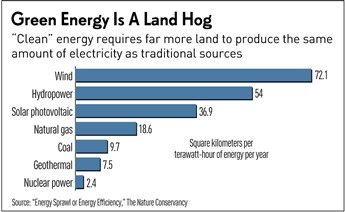
Energy Producer Land Requirements


China's grand scheme of infrastructure buildup -- including green infrastructure -- is proving to be something of a big bomb. China has been spending money hand over fist, stalling for time in hope that its big export customers -- Europe and North America -- would pull out of their economic doldrums, and start to buy Chinese products on a grand scale, once again.

China is getting a bit desperate, and cannot help but be relieved every time a foreign sucker -- in Germany, the US, Australia ect. -- gets sucked into another green energy scam.

Yes, China is poisoning itself to build and sell intermittent unreliable products such as big wind and big solar energy generation equipment. But if foreign devils like Harry Reid, Barack Obama, Angela Merkel, etc. are stupid enough to buy this junk at high prices, why not? It's not as if China's people can do anything about it.

Labels: , , , ,

Bookmark and Share

25 June 2012

Coal Will Be Thriving Long After Obama Is Gone

This article was previously published on Al Fin Energy blog

The National Coal Council delivered a report to the US DOE which points to increasing uses of coal -- to generate electric power, to produce large quantities of liquid fuels via CTL, and to expedite enhanced oil recovery (EOR) using CO2 recovered from coal gasification (both IGCC and CTL).
  • By 2035, the combination of coal-based EOR and CTL technology could provide up to 30 percent of U.S. liquid fuel demand and ensure America's energy security for decades....
  • Use of ... CTL could generate $200 billion in economic activity, more than 1 million skilled jobs and $60 billion in tax revenues.
  • At least 100 gigawatts of advanced coal generating capacity could be built or retrofitted over the next two decades. These advanced plants would use an additional 300 million tons of coal annually.
  • CTL plants with carbon capture could convert coal into more than 2.5 million barrels a day of additional oil. An additional 450 million tons of coal would be used annually in these operations.
  • Capturing a high volume of CO2 for commercial purposes, coupled with CTL operations, would increase coal use to 1.75 billion tons annually. This production level is well within the capability of the United States, home to 30 percent of the world's coal reserves.
_Nat.Coal Council Report to US DOE

Obama's misguided war against coal -- along with his war against all other forms of viable energy -- mark him as a political activist rather than a true leader. Obama's war against energy and against the US private sector has led to a stagnant economy with very slow job creation.

Meanwhile, Primus Green Energy is pushing ahead with a shale gas - to - liquids project which hopes to produce 100 million gallons of gasoline from shale oil per year.
The allure of cheap nature gas has altered the course of a New Jersey biofuel start-up’s path to commercialization. Shale gas will serve as Primus Green Energy’s (PGE) bridge fuel until it shifts to biomass feedstocks.

PGE today held a dedication ceremony for a demo plant at its Hillsborough, NJ headquarters. Local luminaries and a swarm of politicians, including former governor Jim Florio, Representative Leonard Lance, and an Obama administration agricultural official, were in attendance.

The plant will create up to 5 barrels of fuels per day, which will be used for customer certification testing and approvals. It is also a proof of concept for technology that PGE says can scale to upwards of 100 million gallons per year at a significantly higher yield (35 percent) than the industry average.

The company is hoping to raise US$150 million to build a facility next year that would produce 20 million gallons of fuel annually. In comparison, the Pearl GTL (gas to liquids) facility in Qatar has cost over $19 billion to build. _SP
The Pearl GTL plant in Qatar expects to yield profits of $6 billion a year, for as long as the price of crude oil (Brent) remains above $80 a barrel.

Primus Green Energy had intended to be a biomass-to-liquids (BTL) company rather than a GTL company, but basic economics dictated Primus' decision to go with shale gas rather than biomass -- at least in the beginning.

Meanwhile, commodities prices remain well above 2007 levels, suggesting that without big government stimulus from the US, Europe, and China, there is still significant deleveraging and deflating of bubbles that could occur.

The billions which Obama spent on his green energy crusade created almost no jobs, and has had a negligible effect on the nation's energy supplies. Most of the $billions went to political cronies of the president, and that money is long gone. Several of Obama's startups have gone bankrupt, with others in very deep financial trouble. Mr. Obama's great green crusade is turning out to have been a grand political gesture to get elected. What will he do for an encore?

The Obama government has injected about $1.5 trillion per year of fiat stimulus into the US economy, with very little positive effect to show for it -- except a rapidly growing debt which could destroy the economy if interest rates should be forced upward.

The energy world does not exist apart from the political and economic worlds, but is rather inextricably enmeshed within both.

Obama has attempted to re-shape the energy worlds, the political worlds, and the economic worlds -- as a legacy to his own unique greatness. Time will tell what lasting impact Obama's policies have had on those worlds -- if any.

See also: The Slow Sinking of Obama's Green Energy Policy

Labels: , ,

Bookmark and Share

19 June 2012

Truthland: The Movie


This 34 minute documentary was made by a Pennsylvania farm wife, who became concerned about the natural gas well on her farm when she and her family watched Josh Fox's propumentary "Gasland."

After talking it over with her family, the farm wife went on the road to interview a number of world-class experts on various aspects of the fracking phenomenon. You can view her odyssey in search of the truth, in Truthland.

video h/t Master Resource

You may remember that "Gasland" was nominated for an academy award in the best documentary category. After watching "Truthland," you may well wonder why.

Labels: , ,

Bookmark and Share

18 June 2012

Pathetic Germany: Who Can Save You Now?

This article is cross-posted from Al Fin Energy blog

Germany intends to produce 40% of its electric power from big wind and big solar by 2020 -- and 80% of its power from big green by 2050. German politicians say it will work. They are betting the entire country on it. The cost of Germany's great energy experiment -- Energiewende -- has risen to upwards of $250 billion over the next 8 years. That is about 7% of Germany's 2011 GDP. Electricity costs are already going up, and German electricity consumers must pay a 15% renewable-energy surcharge tax with every monthly bill.

Germany's government is betting its industry and its economy that green energy technologists can somehow pull a herd of rabbits out of a thimble, and save the day. Pathetic Germany: Who can save you now?
In 2010, the German government declared that it would undertake what has popularly come to be called an Energiewende—an energy turn, or energy revolution. This switch from fossil fuels to renewable energy is the most ambitious ever attempted by a heavily industrialized country: it aims to cut greenhouse-gas emissions 40 percent from 1990 levels by 2020, and 80 percent by midcentury. The goal was challenging, but it was made somewhat easier by the fact that Germany already generated more than 20 percent of its electricity from nuclear power, which produces almost no greenhouse gases. Then last year, responding to public concern over the post-tsunami nuclear disaster in Fukushima, Japan, Chancellor Angela Merkel ordered the eight oldest German nuclear plants shut down right away. A few months later, the government finalized a plan to shut the remaining nine by 2022. Now the Energiewende includes a turn away from Germany's biggest source of low-­carbon electricity.

To some German economists, the country's energy policy is simply wrong-headed. Hans-Werner Sinn, president of the Ifo Institute for Economic Research at the University of Munich, is especially scathing. "The Energiewende is a turn into nowhere-land, because the green technologies are just not sufficient to provide a replacement for modern society's energy needs," he says. "It is wrong to shut down the atomic power plants, because this is a cheap source of energy, and wind and solar power are by no means able to provide a replacement. They are much more expensive, and the energy that comes out is of inferior quality. Energy-intensive industries will move out, and the competitiveness of the German manufacturing sector will be reduced or wages will be depressed." _TechnologyReview

The problems with Germany's plan are too many, too obvious, and too grave to dismiss. And yet that is exactly what Germany's politicians are doing, to the ultimate demise of the nation's industrial might and its economy. And when Germany goes, it will drag the rest of Europe down with it.
There is much about the current policy that arguably isn't logical. In the short term at least, the decision to close the nuclear plants means that the Energiewende will actually push utilities to rely more heavily on coal. Last year, for example, RWE fired up two long-planned new boilers at an existing facility near the Belgian border that burns the dirtiest fossil fuel of them all: brown lignite coal. Though these boilers are cleaner than the ones they're replacing, the coal plant is the largest of its kind in the world, and it's going full blast these days to keep up with power demand.

...Inevitably, some hot July week will come when a high-pressure system stalls over Europe, stilling turbines just when sunburned Germans reach for their air conditioners. Until large-scale, cheap storage is available, gas power plants, which can start up quickly and efficiently, will be the most practical way to cope with these situations. But there's little incentive to build such plants. Owners of gas plants meant to meet peak power needs can no longer count on running for a certain number of hours, since the need will no longer fall on predictable workday afternoons but come and go with the sun and wind. Says ­Ottmar ­Edenhofer, chief economist at the Potsdam Institute for Climate Impact Research, "The design of the electricity market will change fundamentally. You have fluctuating demand, and at the same time a fluctuating supply. The linkage and the interplay in these two dimensions has become the subject of intense research. There could be new and emerging market failures." _TechnologyReview
Market failures? Certainly. But more importantly, power failures. As power blackouts and cascading failures become more common across Germany -- and thus across Europe -- Germans will find themselves immersed in the true experience of big green: Freezing or roasting in the dark.
Without enough cheap, reliable power to support the high-technology industry and the transportation system, Germany's economy—and that of Europe as a whole—could be in trouble. Already some German firms are building new manufacturing facilities elsewhere; for example, last year the chemical producer Wacker ­Chemie decided to build a polysilicon plant in Tennessee, partly because energy costs in Germany were so high. Weale says, "The quality of the supply would only have to deteriorate a little bit and it would be quite serious for this high-­technology industry. We've already seen, even without the lights going out, that industry is getting nervous." _TechnologyReview

Not long ago, German politicians were talking about having to spend $25 billion on new power infrastructure to facilitate new offshore wind installations and new solar power plants. Now, they are talking about up to $250 billion -- a significant portion of German GDP.

But in reality, German economists admit that no one knows how high the ultimate cost of the Energiewende will grow to be.

And in the end, what will Germany have? A former economic powerhouse of Europe, reduced to dependency upon intermittent unreliable forms of energy. A nation in demographic decline, stripped of its most profitable industrial producers -- because these producers could not depend upon Germany's power supply.

Rarely has a nation gone through the rapid ups and downs that Germany has undergone over the past century. It is not certain that the much depleted German character can survive the next collapse.

Labels: , ,

Bookmark and Share

31 May 2012

Big Green and the Coming Collapse of Europe

Taken from a previously published article on Al Fin Energy blog

Germany is proceeding along a path that puts it at greater and greater risk of potentially catastrophic power blackouts. Recent changes to German energy infrastructure introduce increasingly dangerous levels of instability which become more and more difficult for power grid managers to control. And the German grid is the power hub of Europe -- if it fails, Europe's grid fails.

Germany is phasing out its nuclear power plants and attempting to replace its infrastructure of baseload power generation with an infrastructure of intermittent unreliable energy sources -- big wind and big solar installations. Germany publicly hopes to provide as much as 50% of its electrical power from wind and solar within the next few decades.

Unfortunately, large power grids grow unstable when big wind and big solar -- intermittent unreliables -- attempt to provide more than 20% of overall power. Going far beyond that level of dependency on intermittent unreliables would place the German gird -- and thus the European grid -- in an untenable position.

More information on the danger of relying on intermittent energy sources
A look at Denmark's unfortunate experience with wind energy (PDF)

German Chancellor Angela Merkel is unrepentant -- and almost boastful -- over her energy plan which commits Germany to invest at least $25 billion to upgrade its power grid.

The high cost of upgrades to the power grid could not come at a worse time for Germany or Europe, already stressed by a banking crisis. But the $25 billion or $30 billion needed to improve the grid systems is only the barest down payment toward the ultimate costs of Merkel's suicidal energy decisions.

Spain was once caught up in the green fantasy of the intermittent unreliables, just like Merkel's Germany. But Spain was forced to admit that it could not afford the green fantasy any longer. Eventually, Germany will be forced to come to the same conclusion. The only question is the price that the German people will have to pay for the stubborn stupidity of its leaders.

Greens are reluctant to admit the problems which intermittent unreliables pose for grid stability, particularly the higher the levels of penetration of the intermittent unreliable sources. But the truth will come out in the most painful ways, and many people will remember who has led them to suffer unnecessarily.

Europe is undergoing a demographic implosion, which is putting increasing -- although still subtle -- pressures on the ability of European nations to maintain technological infrastructures and to pay back large debts. If Europe goes through with this suicidal abandonment of reliable power sources in favour of the intermittent unreliables -- and goes even more deeply in debt in the process -- future generations of Europeans will pay the the price.

Labels: , , ,

Bookmark and Share

30 May 2012

If the Great Green Global Agenda is to Succeed, Most of You Will Have to Die

The great green global agenda -- from carbon hysteria to resource scarcity to overpopulation doom to pollution apocalypse -- has been promoted by blowhards such as James Hansen and Paul Ehrlich, and supported by politicians from Barack Obama to Al Gore to Angela Merkel to Kevin Rudd. But prophets of the green apocalypse have been forecasting doom and devastation to occur "in the next ten or fifteen years" for the past 50 years or more. People are beginning to notice that the dire green predictions have not been coming true. And frankly, more and more people are getting a bit nervous about the undercurrent talk about "the great human dieoff" that seems to take the stage whenever green elites think that no outsiders are within earshot.
Concern about the climate, ..., the crazy set of unrealistic objectives, laughable foreign aid boondoggles, Malthusian panic mongering and cockamamie treaty plans made this UN process a clown circus that was doomed to fail — and the sooner, the better. There was a time — as recently as early 2010 — when the Great and the Good, the Champions of the Conventional Wisdom and the Oracles of the Davoisie identified this forlorn negotiation as the wave of the future and the last best hope of man.

Let the futility and failure to which all this led be a reminder to us and to them: those who guide the world’s destiny aren’t nearly as discerning as they think they are. Between the American housing bubble, the European meltdown and the climate disaster, it almost begins to look as if the Establishment consists mostly of overpaid, egotistical blowhards. _WR Mead


Overpaid egotistical blowhards? That could accurately describe the top levels of academia, journalism, government, law, and environmental activism in one short phrase. Too bad there is no way to send such top-floating scum on its merry way to oblivion. Indeed.

Consider energy, and the enormous amounts of reliable and affordable energy that any advanced society needs to provide its people with their many needs and opportunities: The earth contains vast and unknown quantities of fossil fuels, including coal. But greens of the lefty-Luddite dieoff.orgy persuasion want all advanced nations to abandon coal, and to move willy-nilly to a dependency on big wind and big solar energy.

Most intelligent and sober analysts understand that such a precipitous move away from coal toward dependency on intermittent unreliable green energy sources such as big wind and big solar, would trigger the very type of dieoff which global green elites (not-so) secretly cherish and wish for.

In fact, while US greens inside and outside of the Obama administration are trying to shut down the use of coal in the US, nations from China to Germany to Vietnam and more are gearing up to use more and more coal. Many of these nations would be happy to buy and use US coal, at the same time that US greens would like to keep Americans shivering in the dark for lack of reliable and affordable energy.

Modern leftist greens are Malthusians by nature, and doomers by inclination -- victims of their own limited thinking. They not only believe that humans are a vermin pest on the pristine landscape of Earth. They actually want to behave as responsible and sustainable pest exterminators, so as to save the planet, while also giving themselves more lebensraum.

The green apocalyptic theories of climate catastrophe and carbon hysteria are based upon computer models that have been fed much erroneous data, while having omitted crucial data that would have helped avoid much of the destructive and disruptive hysteria.

This failure to look at as many aspects of the problem as possible, along with the failure to brutally test their own models and theories (as scientists should always do), has painted the green doomers into a corner. They have no choice but to screech ever louder songs of doom, regardless of what the outer world reality indicates.

The destructiveness of this approach is just now being calculated in the cost of energy to European commerce, government, and industry, and the subsequent demand destruction that is beginning to sweep through those countries, working its way from south to north. The consequent capital flight within Europe has so far landed in continental safe havens, the stronger European economies such as Germany and Switzerland.

But as the consequences of their green energy starvationist approaches hit even the relatively strong industrial economies of Germany, France, and the UK, even these economic strongholds of Europe will suffer from both capital flight and a renewed brain drain to countries with fewer restrictions on energy production and use. All of this will happen on top of an underlying demographic collapse, which is quite real for all its stealth and popular denial.

For the great green global agenda to succeed, most of you are going to have to die. Because, to put it bluntly, the intermittent unreliable sources of energy that the greens are foisting on modern nations will not be able to support the needs of those nations. Systems will collapse like tilting dominoes, and the offal will flow downhill -- doing the most damage to third world nations and their populations as more advanced nations can no longer afford to provide life support to a perpetually failing and conflicted third world.

Will this great green doom and dieoff.orgy actually come to pass? Only if we allow it.

Take your time. Think about it. Here's a riddle to help with your meditations:

What is the difference between an onion and a green activist?

(answer: When you chop up the onion, you cry.)

Heh. Just kidding, of course. If we let it get to the chopping up stage, we are all in big trouble.

Labels: ,

Bookmark and Share

21 May 2012

Behind the Scenes of The Green Doomer Eco-Fascist Cult

This article was previously published on Al Fin Energy blog

Green doomer eco-fascist cultists all follow similar guidelines: Slash the human population of the planet, although they themselves are unwilling to go first.. Blame free markets and western civilisation for most of the world's problems. Eschew all viable forms of large-scale energy in favour of those which are exorbitantly expensive and innately unreliable. Hate advanced technology, and want to push the world toward primitive lifestyles and global poverty. They are essentially anti-individual and pro-collective.

Members of any doomer cult will recognise the litany, whether from the climate change catastrophe cult, the peak oil doomer cult, the overpopulation doom cult, the global pollution doom cult, the biodiversity doom cult, etc.

Here is more from one of the horses' mouths:

This is Finnish writer Pentti Linkola — a man who demands that the human population reduce its size to around 500 million and abandon modern technology and the pursuit of economic growth — in his own words.

He likens Earth today to an overflowing lifeboat:

What to do, when a ship carrying a hundred passengers suddenly capsizes and there is only one lifeboat? When the lifeboat is full, those who hate life will try to load it with more people and sink the lot. Those who love and respect life will take the ship’s axe and sever the extra hands that cling to the sides.

He sees America as the root of the problem:

The United States symbolises the worst ideologies in the world: growth and freedom.

He unapologetically advocates bloodthirsty dictatorship:

Any dictatorship would be better than modern democracy. There cannot be so incompetent a dictator that he would show more stupidity than a majority of the people. The best dictatorship would be one where lots of heads would roll and where government would prevent any economical growth .

We will have to learn from the history of revolutionary movements — the national socialists, the Finnish Stalinists, from the many stages of the Russian revolution, from the methods of the Red Brigades — and forget our narcissistic selves.

A fundamental, devastating error is to set up a political system based on desire. Society and life have been organized on the basis of what an individual wants, not on what is good for him or her.

As is often the way with extremist central planners Linkola believes he knows what is best for each and every individual, as well as society as a whole:

Just as only one out of 100,000 has the talent to be an engineer or an acrobat, only a few are those truly capable of managing the matters of a nation or mankind as a whole. In this time and this part of the World we are headlessly hanging on democracy and the parliamentary system, even though these are the most mindless and desperate experiments of mankind. In democratic coutries the destruction of nature and sum of ecological disasters has accumulated most. Our only hope lies in strong central government and uncompromising control of the individual citizen.

_azizonomics.com

H/T Zerohedge

This fellow is not actually so extreme, for a green. He may be a bit more honest and open about his convictions than most, but that is changing. Even the WWF -- which has written many of the supporting "studies" for the IPCC climate change reports -- has come out in support of policies which would ultimately result in a large scale human dieoff.

Is this also the face of the peak oil doomer cult? Certainly you find a lot of peak oil cult wankers fixated on doom porn, compulsively getting their doom fix whenever possible. It would be easy to assume that they actually want to see suburbia burning, that they would like to see the end of civilisation as we know it.

Not that most of the incompetent athols would survive very long after such an event. More: Europe as the canary in the coal mine

Early dissent among former believers in the CAGW orthodoxy and carbon hysteria warming cult

Labels: , , ,

Bookmark and Share

15 May 2012

Government Radiation Hysteria May Do More Harm Than Good

This article is cross-posted to Al Fin Energy blog

A recent study from MIT suggests that government guidelines to protect from low-level radiation exposure may be verging on the the hysteric -- if not downright harmful.
The study, led by Bevin Engelward and Jacquelyn Yanch and published in the journal Environmental Health Perspectives, found that when mice were exposed to radiation doses about 400 times greater than background levels for five weeks, no DNA damage could be detected. _MITNews
Life on Earth has always been exposed to variable levels of low level radiation. Background radiation has been a powerful driving force behind evolution, over the aeons.

Until now, governments have arbitrarily set radiation exposure limits, without basing them on realistic scientific studies. That may be about to change.
Until now, very few studies have measured the effects of low doses of radiation delivered over a long period of time. This study is the first to measure the genetic damage seen at a level as low as 400 times background (0.0002 centigray per minute, or 105 cGy in a year).

“Almost all radiation studies are done with one quick hit of radiation. That would cause a totally different biological outcome compared to long-term conditions,” says Engelward, an associate professor of biological engineering at MIT.

...Background radiation comes from cosmic radiation and natural radioactive isotopes in the environment. These sources add up to about 0.3 cGy per year per person, on average.

“Exposure to low-dose-rate radiation is natural, and some people may even say essential for life. The question is, how high does the rate need to get before we need to worry about ill effects on our health?” Yanch says.

Previous studies have shown that a radiation level of 10.5 cGy, the total dose used in this study, does produce DNA damage if given all at once. However, for this study, the researchers spread the dose out over five weeks, using radioactive iodine as a source. The radiation emitted by the radioactive iodine is similar to that emitted by the damaged Fukushima reactor in Japan.

At the end of five weeks, the researchers tested for several types of DNA damage, using the most sensitive techniques available. Those types of damage fall into two major classes: base lesions, in which the structure of the DNA base (nucleotide) is altered, and breaks in the DNA strand. They found no significant increases in either type.

DNA damage occurs spontaneously even at background radiation levels, conservatively at a rate of about 10,000 changes per cell per day. Most of that damage is fixed by DNA repair systems within each cell. The researchers estimate that the amount of radiation used in this study produces an additional dozen lesions per cell per day, all of which appear to have been repaired.

Though the study ended after five weeks, Engelward believes the results would be the same for longer exposures. “My take on this is that this amount of radiation is not creating very many lesions to begin with, and you already have good DNA repair systems. My guess is that you could probably leave the mice there indefinitely and the damage wouldn’t be significant,” she says. _MITNews
What is the cost of government-instigated radiation hysteria? Look at how the world reacted to last year's tragic earthquake and tsunami in Japan. Instead of focusing on the human tragedy of 30,000 human casualties, the media focus was on a nuclear power plant that lost power due to a poor design, discovered in hindsight, after an unanticipated natural disaster. And all of that, in spite of no one being killed or badly harmed from radiation exposure!

Advanced human societies are badly in need of reliable electrical power. The best source for that power is advanced nuclear reactors from gen III, gen IV, and beyond. But instead of pursuing an all out campaign of research and development to produce the needed electrical power generators, humans are retreating from the future in Germany, Japan, Switzerland, Italy, and more -- out of radiation hysteria.

It is time to return to a careful scientific study and to get away from hysterical herd behaviours, led by cynical governments and big money green organisations. That applies not only to nuclear hysteria, but to carbon hysteria, overpopulation hysteria, resource scarcity hysteria, and all the other forms of pseudoscientific hysteria that governments and the skankstream media love to torture the public with.

Labels: ,

Bookmark and Share

01 May 2012

Climatology: A Textbook Example of Groupthink

In groupthink, organizations value consensus more than free thought. The emphasis on consensus leads to group polarization, in which a group’s positions become more extreme than any individual would come up with. Alarmist climate science is a textbook example of groupthink in action.

...The groupthink syndrome...

This consists of three main categories of symptoms:

1. Overestimate of the group’s power and morality, including “an unquestioned belief in the group’s inherent morality, inclining the members to ignore the ethical or moral consequences of their actions.”

2. Closed-mindedness, including a refusal to consider alternative explanations and stereotyped negative views of those who aren’t part of the group’s consensus. The group takes on a “win-lose fighting stance” toward alternative views.[5]

3. Pressure toward uniformity, including “a shared illusion of unanimity concerning judgments conforming to the majority view”; “direct pressure on any member who expresses strong arguments against any of the group’s stereotypes”; and “the emergence of self-appointed mind-guards … who protect the group from adverse information that might shatter their shared complacency about the effectiveness and morality of their decisions.”[6]

_Paul McRae...in_WUWT
A description of "the groupthink syndrome" also happens to be a good description of the current state of climate scientology science. Particularly troubling is the lack of sceptical doubt among climate orthodoxy insiders. Without scientific scepticism and critical self-monitoring, the climate orthodoxy becomes indistinguishable from a religious belief.

Instead of a healthy scepticism, orthodox climate science and a suspiciously compliant mainstream press attempt to block all thoughtful consideration of the deeper issues involved in climate -- which go far beyond concerns about greenhouse gases such as CO2. But it is only through consideration of the deeper issues that a true scientific examination of climate can be carried out.

Here are a few of the current debates and theories which are being blocked by the orthodoxy:

Total Cloud Cover from Satellite Observations and Climate Models

How Stratospheric Temperature is Decoupled from Surface Temperatures

Levitus on Ocean Forcing

etc etc etc

The astoundingly insular nature of modern climate science would not be particularly important, if it were not for the political, economic, and industrial implications for modern societies. Modern societies would be ruined -- bankrupted -- if they were to take the policy recommendations of the climate orthodoxy seriously. Such societies would be left without reliable energy supplies, starving industry and commerce. Trillions of dollars in redistribution payments from the first world to the third world would drive modern nations even more deeply into debt than at present -- and for no good reason at all. Perhaps worst of all, the barrage of propaganda directed at modern societies to keep them compliant with the "greenhouse agenda" would create generations of schoolchildren and adults incapable of thinking logically, beyond their groupthink greenhouse programming.

And yet that is precisely what orthodox politicians such as Barack Obama, Al Gore, and other fringe greens currently and formerly in power want to do.

Groupthink is toxic to the ability of the human mind to think clearly and independently. It is destructive of creativity and productive imagination. It is destructive of any hopeful or livable future for the majority of humans -- those living outside the inner circles of power.

Unless the voters of the western democracies wake up to the nightmare of groupthink conformity which is being forced on them by the climatological - political - faux environmental complex, it will be too late for them to stop the top-down steamroller of hopelessness and opportunity destruction.

At that point, alternative plans would have to be called upon.

Hope for the best. Plan for the worst.

More: The Shocking Rise of Eco-Fascism

Labels: , , , ,

Bookmark and Share

01 March 2012

The Need for Vital Energy vs. the Giant Green-Industrial Complex

...in the U.S., new technologies such as hydraulic fracking and vertical drilling have vastly increased estimates of North America’s energy resources, particularly natural gas. By 2020, the United States, according to the consultancy PFC Energy, will surpass Russia and Saudi Arabia as the world’s leading oil and gas producer. _Kotkin
All healthy, modern industrial economies require abundant supplies of energy. Any organisation or institution which obstructs the supply of energy to a modern nation is the deadly enemy of that society and those people. Today, the huge, well-funded green-industrial complex is exposing itself as opposed to all reliable and affordable forms of energy. This means that there is a war, of sorts, taking place in modern industrial nations, between the pro-prosperity forces and the energy-starvation forces.
ImageSource

More:
The divide between the fossil-fuel industry and the green movement is increasingly dividing the country by region, class, and culture....President Obama in recent days has gone out of his way to sound reassuring on energy, seeming to approve an oil pipeline to Oklahoma this week after earlier approving leases for drilling in Alaska. Yet few in the energy industry trust the administration’s commitment to expanding the nation’s conventional energy supplies given his strong ties to the powerful green movement, which opposes the fossil-fuel industry in a split that’s increasingly dividing the country by region, class, and culture.

...No single sector affects more people and industries than energy, and none is more deeply affected by the disposition of government. Energy divides the nation into two camps. On one side there are the regions and industries dependent on the development and use of energy. They include the increasingly expansive energy-producing region stretching from the Gulf Coast and the Great Plains to parts of Ohio, Pennsylvania, and the Appalachian range.

...Nine of the 11 fastest-growing job categories are related to energy production, according to an analysis by Economic Modeling Systems Inc. Energy jobs pay an average of $100,000 annually, about the same as software engineers earn in Silicon Valley.

Perhaps more important politically, this bonanza is now spreading to historical battleground states Ohio, Pennsylvania, and Michigan. Long-depressed areas like western Pennsylvania are reversing decades of decline as new finds and advances in natural-gas drilling have opened up vast new stores of domestic energy. The new energy wealth has created new jobs, enriched property owners, and provided states with potential huge new sources of revenue.

...Given the success in the other energy states, California—with double-digit unemployment—might reconsider its policies, but this is unlikely. “I asked [Gov.] Jerry Brown about why California cannot come to grips with its huge hydrocarbon reserves,” John Hofmeister, a former president of Shell Oil’s American operations and a member of the U.S. Department of Energy’s Hydrogen and Fuel Cell Technical Advisory Committee, told me recently. “After all, this could turn around the state."

Brown’s answer, according to Hofmeister: “This is not logic, it’s California. This is simply not going to happen here.’”

...If all [national] energy subsidies were removed, the fossil-fuel industry likely could shrug off the hit, while the heavily subsidized green-industrial complex would markedly diminish. Yet even if Congress refuses to continue the green subsidies, it’s probable that administration regulators would find ways to slow fossil-fuel expansion in a second Obama term. Responding largely to the Democratic environmental lobby, they have already overruled the State Department to delay the Keystone XL pipeline from Canada.... _Joel
Kotkin
It is slowly sinking into Barack Obama's mind that he confronts perhaps the first real political test of his charmed career. This time, the abysmal economic condition of the country can be laid squarely at his feet. With a real unemployment rate of 11% and an underemployment rate above 20%, the housing market continuing to decline across large swathes of the country, and 73% of the US population saying the country is "on the wrong track" -- Mr. Obama's spin machine has its work cut out for it.

Canada, on the other hand, appears to have been taking a more rational pro-energy approach from the very start of its current administration.
The [Canadian] government’s notion of an energy strategy — emphasize the power and efficiency of markets, get rid of red tape, finger environmental radicals, and remind the U.S. how secure Canadian supplies are — received a double boost this week...

...the main reason for both the strong Canadian dollar and high petroleum prices is that government money factories from the U.S. Federal Reserve to the European Central Bank are trying to bail out their political masters by debasing their currencies. It’s got little or nothing to do with Fort McMurray.

The good news on the policy front is that this spat helps put paid to the notion that Canada is ever likely to get a comprehensive and intrusive energy strategy of the kind usually embraced by left liberal governments _GWPF Peter Foster
Countries across the western world had best get out the disinfectant, to remove the green rot which is eating away at their industrial and economic strength. The alternative to such vigorous spring cleaning is a progressive sinking into the twin quagmires of debt and demographic decline.

You are not likely to enjoy that alternative.

Labels: , , ,

Bookmark and Share

27 February 2012

A Policy of Energy Starvation in Germany: A Cautionary Tale

Last spring, Chancellor Angela Merkel set Germany on course to eliminate nuclear power in favor of renewable energy sources. Now, though, several industries are suffering as electricity prices rapidly rise. Many companies are having to close factories or move abroad. _Spiegel
When governments embrace the green fantasy, their economies inevitably suffer. Germany's government went even more deeply into energy starvation than US President Obama's government. Germany actually closed its cleanest and most reliable source of electric power: nuclear plants.
Since Chancellor Angela Merkel's government abruptly decided to phase out nuclear energy last spring in the wake of the nuclear disaster in Fukushima, Japan, the situation for industries that consume a lot of electricity has become much more tenuous.

Energy prices are rising and the risk of power outages is growing. But the urgently needed expansion of the grid, as well as the development of replacement power plants and renewable energy sources is progressing very slowly. A growing number of economic experts, business executives and union leaders are putting the blame squarely on the shoulders of Merkel's coalition, which pairs her conservatives with the business-friendly Free Democrats (FDP). The government, they say, has expedited de-industrialization.

The energy supply is now "the top risk for Germany as a location for business," says Hans Heinrich Driftmann, president of the Association of German Chambers of Industry and Commerce (DIHK). "One has to be concerned in Germany about the cost of electricity," warns European Energy Commissioner Günther Oettinger. And Bernd Kalwa, a member of the general works council at ThyssenKrupp, says heatedly: "Some 5,000 jobs are in jeopardy within our company alone, because an irresponsible energy policy is being pursued in Düsseldorf and Berlin."

...There is no sign yet of the green economic miracle that the federal government promised would accompany Germany's new energy strategy. On the contrary, many manufacturers of wind turbines and solar panels complain that business is bad and are cutting jobs. Some solar companies have already gone out of business. The environmental sector faces a number of problems, especially -- and ironically -- those stemming from high energy prices.

...the immediate shutdown of seven nuclear power plants last March is affecting supply, as the Krefeld example shows. The steel mill requires massive amounts of electricity to produce stainless steel, used in such products as sinks and auto bodies. The metal is heated to more than 1,600 degrees Celsius (2,912 degrees Fahrenheit) in giant furnaces. A single smelter consumes about as much energy in an hour as 10 single-family homes in an entire year. Electricity makes up a fifth of the mill's total costs, says Harald Behmenburg, the plant manager.

The price of electricity is moving in only one direction: steeply up. For the Krefeld plant, the cost of a kilowatt hour of electricity has tripled since 2000.

And there is no end in sight. When Merkel's new energy policy was introduced last year, says plant manager Behmenburg, planning for the future became virtually impossible. Behmenburg says that it is impossible now to know what will happen to the supply situation and the price of electricity in the coming years. The mill, steeped in tradition, didn't stand a chance of surviving, he says.

..."The promotion of renewable energy has led to substantial displacement effects on employment in the conventional energy production sectors, as well as in downstream industries that are particularly energy-intensive," concludes the report on a conference held at the Federal Ministry of Education and Research last year. The political opposition has also recognized the importance of the issue. Some believe that the green economy is everything, warns Sigmar Gabriel, chairman of the center-left Social Democratic Party (SPD). "But they forget that they can't make a wind turbine without steel, plastic, mechanical engineering and electrical engineering."

It is equally important to stabilize the power grid as quickly as possible to prevent blackouts from occurring. Until now, the reliability of the German electricity supply was seen as a significant advantage for doing business in the country. But the loss of several nuclear power plants, coupled with the unpredictability of electricity from wind and solar sources, has changed the situation. _Spiegel
Germany's ongoing demographic decline will only be made worse by such abysmally irresponsible policies as the current energy starvation policy. Shutting down reliable sources of large scale power makes a wide range of important industries instantly untenable. The inevitable loss of industry and jobs is accompanied by a tragic loss of opportunity at all levels of society.

US president Obama has embarked upon a similar path to green oblivion, but fortunately for the US, he has been more tentative and cautious than Germany has been. Obama has also been lucky, in that his government has been unable to shut down oil & gas fracking of tight hydrocarbons. As a result of Obama's fortunate failure to shut down the North American shale bonanza, the US economy is still able to tread water.

But Obama has shut down several coal energy plants -- de-stabilising the power grid to a small but significant degree. He has delayed the Keystone XL oil pipeline from Canada, thus unnecessarily reducing global supplies of crude. Future US nuclear development under Obama and NRC chairman Jaczko has been set back many years. But at least they have not shut down the crucial existing nuclear plants. Not yet.

Extra Bonus: Here is a summary of a recent set of 5 future scenarios for the year 2050, from the Deutsche Post DHL. Al Fin futurists find it fascinating that the German futurists failed to include the ongoing demographic decline in the German welfare state, or the ominous consequences of German green policies such as carbon hysteria and anti-nuclear hysteria.

It is possible that the scars from 1930s and 1940s Nazism, and from Communist dysfunction in the East, have not yet healed cleanly in the national psyche of Germany. Wiser Germans had best find a solution quickly, because it is the dysfunctional German psyche that is at the root of the nation's problems.

Labels: , , ,

Bookmark and Share

19 February 2012

Germany's Sunshine Fairy Fantasy

Germans have paid about $130 billion for a climate-change policy that has no impact on global warming. They have subsidized Chinese jobs and other European countries’ reliance on dirty energy sources. And they have needlessly burdened their economy. As even many German officials would probably attest, governments elsewhere cannot afford to repeat the same mistake. _GWPF
Germany has been caught up in a dreamy fantasy of a golden shiny green future, full of sunshine fairies and wind sprites. But artificial, made-up euphorias have a way of turning into despair, eventually. Bjorn Lomborg has more:

Sunshine Fairy Image Source

Germany once prided itself on being the “photovoltaic world champion”, doling out generous subsidies – totaling more than $130 billion, according to research from Germany’s Ruhr University – to citizens to invest in solar energy. But now the German government is vowing to cut the subsidies sooner than planned, and to phase out support over the next five years. What went wrong?

There is a fundamental problem with subsidizing inefficient green technology: it is affordable only if it is done in tiny, tokenistic amounts. Using the government’s generous subsidies, Germans installed 7.5 gigawatts of photovoltaic (PV) capacity last year, more than double what the government had deemed “acceptable.” It is estimated that this increase alone will lead to a $260 hike in the average consumer’s annual power bill.

According to Der Spiegel, even members of Chancellor Angela Merkel’s staff are now describing the policy as a massive money pit. Philipp Rösler, Germany’s minister of economics and technology, has called the spiraling solar subsidies a “threat to the economy.”

...Germany – like most of the world – is not as sunny as the Sahara. And, while sunlight is free, panels and installation are not. Solar power is at least four times more costly than energy produced by fossil fuels. It also has the distinct disadvantage of not working at night, when much electricity is consumed.

In the words of the German Association of Physicists, “solar energy cannot replace any additional power plants.” On short, overcast winter days, Germany’s 1.1 million solar-power systems can generate no electricity at all. The country is then forced to import considerable amounts of electricity from nuclear power plants in France and the Czech Republic. When the sun failed to shine last winter, one emergency back-up plan powered up an Austrian oil-fired plant to fill the supply gap.

Indeed, despite the massive investment, solar power accounts for only about 0.3% of Germany’s total energy. This is one of the key reasons why Germans now pay the second-highest price for electricity in the developed world (exceeded only by Denmark, which aims to be the “world wind-energy champion”). Germans pay three times more than their American counterparts. _Bjorn Lomborg_via_GWPF
Even if photovoltaic panels were 100% efficient and given away free of charge, utility-scale solar power would be a hugely wasteful and exorbitantly expensive mistake. Remember that every time you read a headline trumpeting "dramatic gains in photovoltaic efficiency" or "huge reductions in solar panel costs." Solar power is okay for off-grid applications of relatively small scale. But the intermittency of solar power (and wind power) is a deal-killer in terms of large scale grid power.

Germany would have known that if not for its green euphoric fantasy facade. What is the facade obscuring? You probably do not want to know.

Labels: , ,

Bookmark and Share

11 December 2011

The Coming Human Die-Off: A Little Goes a Long Way

The idea of a coming great human die-off is gaining popularity among those of the lefty-Luddite green enviro persuasion. Whether the die-off will be triggered by resource scarcity, by a voluntary reduction of human fertility, or by more aggressive means, such a great die-off is being seen as a positive event by the trendy and green forces which have taken over most media outlets, Green NGOs, funding agencies, and large segments of academic institutions.

The great human die-off is being backed by some famous names:
“A total population of 250-300 million people, a 95% decline from present levels, would be ideal.”
- Ted Turner, CNN founder and UN supporter

“In searching for a new enemy to unite us, we came up with the idea that pollution, the threat of global warming, water shortages, famine and the like would fit the bill … All these dangers are caused by human intervention and it is only through changed attitudes and behaviour that they can be overcome. The real enemy, then, is humanity itself.” - Club of Rome, The First Global Revolution, pg.75

“We must speak more clearly about sexuality, contraception, about abortion, about values that control population, because the ecological crisis, in short, is the population crisis. Cut the population by 90% and there aren’t enough people left to do a great deal of ecological damage.” - Mikhail Gorbachev

"I believe that human overpopulation is the fundamental problem on Earth Today” and, “We humans have become a disease, the Humanpox.” - Dave Foreman, Sierra Club and co founder of Earth First!

“If I were reincarnated I would wish to be returned to earth as a killer virus to lower human population levels.” - Prince Phillip, Queen Elizabeth’s husband, Duke of Edinburgh, leader of the World Wildlife Fund

Advanced societies are considered "soft targets," because their populations have become so accustomed to things running relatively smoothly. Just a bit of disruption can go a long way toward upsetting such societies.

It is becoming easier for individuals and small groups to trigger events which can lead to momentous calamity in the advanced world. Increased networking of vital infrastructure is making it easier for hackers to commit cyber-terrorism:
Government pressure to create "smart power grids" to replace traditional grids, provides malicious hackers with a wide range of new targets to attack, at various scales.

The threat of an EMP attack -- capable of taking out continental scale power grids -- is likewise increased, as nuclear proliferation proceeds across the Pakistan-Iran-N.Korea axis (aided by China and Russia). As many as 90% of an advanced society can be expected to die within 1 year as a result of a large-scale EMP attack.

Chemical terrorism is another way in which advanced cultures could be targeted specifically. Coordinated chemical attacks using various vectors could decapitate leadership and expertise in several vital areas, leading to widespread paralysis of normal infrastructure. Such a paralysing strike might well be a set-up for a more devastating followup attack.

Increasing sophistication of inexpensive tools for "bio-hacking" are also making it more likely that individuals or small groups will create novel microbial agents of mass contagion.
Security futurist Marc Goodman says that synthetic biology will lead to new forms of bioterrorism — opportunities for the bad guys to create never-before-seen forms of bio-toxins. These bio-threats might be nearly impossible to detect because they can be customized to the genome of a certain person or groups of people. Goodman, who has long worked on cyber crime and terrorism with organizations such as Interpol and the United Nations, believes the potential bio-threat is greatly underestimated. “Bio-crime today is akin to computer crime in the early 1980s,” said Goodman at the Singularity University executive program this week. “Few initially recognized the problem, but one need only observe how the threat grew exponentially over time.” _WaPo
It is not necessary to target the third world, in order to achieve a high magnitude die-off such as is depicted in the chart above. The third world has become so dependent upon the technological infrastructures and products provided by more advanced societies, that if the advanced world goes, most of the third world will quickly follow.

The resulting world of much lower human population, will also be much less technologically capable than the world at present, in a quantitative sense. In a qualitative sense, however, most of human technology will be saved in digital and book form. This means that within 1 to 2 centuries after the great die-off, the higher intelligence populations of the presently advanced world would grow to a large enough size to begin implementing modern technologies on a global scale once again.

In other words, if lefty-Luddite greens are engineering the great human die-off to permanently eliminate high tech civilisations and infrastructures, their efforts will ultimately fail.

But that will be cold comfort for your children and grandchildren who will have to suffer through the bloody mess aftermath left to them by the possibly well-intentioned greens.

It is up to you to make sure that they survive that bloody mess. Hope for the best, prepare for the worst.

Some of the above is cross-published from abu al-fin

More: The conspiracy zone...

SOME of America’s leading billionaires have met secretly to consider how their wealth could be used to slow the growth of the world’s population....The philanthropists who attended a summit convened on the initiative of Bill Gates, the Microsoft co-founder, discussed joining forces to overcome political and religious obstacles to change.

Described as the Good Club by one insider it included David Rockefeller Jr, the patriarch of America’s wealthiest dynasty, Warren Buffett and George Soros, the financiers, Michael Bloomberg, the mayor of New York, and the media moguls Ted Turner and Oprah Winfrey.

...They gathered at the home of Sir Paul Nurse, a British Nobel prize biochemist and president of the private Rockefeller University, in Manhattan on May 5. The informal afternoon session was so discreet that some of the billionaires’ aides were told they were at “security briefings”.

Stacy Palmer, editor of the Chronicle of Philanthropy, said the summit was unprecedented. “We only learnt about it afterwards, by accident. Normally these people are happy to talk good causes, but this is different – maybe because they don’t want to be seen as a global cabal,” he said. _Prison Planet

These are some of the people with the ability to sway media outlets -- which they largely own -- along with NGOs, academic research and pronouncements via funding, and a significant number of elected officials, via campaign support, job offers, board directorships, and the funneling of significant investments.

It is not surprising that the super-wealthy would be concerned about population overgrowth, if they truly believed that it would bring about the end of the world. But it is a bit troubling when they deliberately take a cause such as "the great carbon hysteria orthodoxy and climate change crusade," wrap it into a trans-global agenda, and push it into the heart of each new generation's training and education -- from K-12 through university and beyond.

Does this mean that these people are intentionally contaminating third world immunisation efforts, so as to help bring about the great human die-off -- using the UN and NGOs as intermediaries? Probably not. I am acquainted with a lot of the people involved in such international programs, and do not believe for one second that they would be a part of such a travesty.

But now that we know that the richest of the rich have taken an interest in limiting -- and even slashing -- the human population of the planet, we may want to watch what they do more carefully, through their almost countless intermediaries.

Labels: , , ,

Bookmark and Share
Older Posts
Al Fin Main Page
Enter your Email


Powered by FeedBlitz
Google
WWW AL FIN

Powered by
Blogger

``