17 March 2009

Fast Forward Evolution: Advanced Microbe Fab

LS9 biofuels company aims to create "magic microbes" to solve the world's energy problems, and other problems besides. To that end, they have developed a machine to create rapid multiple changes in a bacterial genome. They have put evolution on "fast forward" in the hope of riding the magic microbes into the future.
"What once took months now takes days," says Stephen del Cardayré, vice president of research and development at LS9, a biofuels company based in South San Francisco of which Church is a founder. LS9 soon plans to use the technology--called multiplex-automated genomic engineering, or MAGE--to accelerate development of bacterial cells that can produce low-cost renewable fuels and chemicals.

...Church and his collaborators attack the genome on a broad scale. They design numerous genetic changes targeting genes throughout the genome, and then implement them all at once, looking for the resulting bacterial strain that can best produce the desired product. "It allows you to make modifications to the genome much more rapidly than the traditional one-step processes we have," says Kristala Jones-Prather, a metabolic engineer at MIT who was not directly involved in the research.

...As a test run of the device, Church and his team created bacteria that could more efficiently produce lycopene, an antioxidant abundant in tomatoes. They designed DNA strands targeting genes known to be involved in lycopene production, and then monitored multiple tubes of engineered bacteria for production of the bright-red compound. In just three days, they had generated a strain that could produce five times more lycopene, according to findings presented at a conference at Harvard this month. The best lycopene producer had 24 genetic changes--four that completed blocked production of the gene's protein, and 20 that resulted in small or large changes in the expression of that gene.

Church and his collaborators, who ultimately plan on making a commercial version of the device, are now working on creating different types of chemicals, including biofuels and drug precursors. _TechnologyReview
Biofuels from microbes will not take up croplands, will not destroy rainforests, will not produce pollutants -- but count on faux environmentalists to dream up some reason that abundant microbial biofuels will destroy the planet. In the meantime--before they dash our childish hopes-- let us cultivate our simple-minded optimistic belief that humans can somehow find a way to live in the world without destroying it.

Labels: , ,

Bookmark and Share

Where Are "You"?

A new scientific study conducted on people suffering from epilepsy may have just supplied scientists with the answer to one of the most difficult questions about the human brain, namely where does consciousness come from? Is it based in certain areas of the brain, or is it generated by the organ functioning as a whole? The new research seems to favor the second option, as the scenarists in charge of the investigation say that consciousness arises from the coordinated activity of the entire brain, and not from certain portions of the cortex. _Softpedia

Are you a conscious being? If you are conscious, then your consciousness is "you". Where are "you"? The ancients believed that consciousness, "the soul", was in the heart. The heart was obviously doing something, whereas the brain just sat there taking up space. Now we know that the activity of the brain determines consciousness, but where in the brain? Do we have a homunculus -- a little man -- inside our brains watching through our eyes, hearing with our ears, smelling and tasting and feeling with our sense organs?

Scientists in and near Paris have used intracranial EEG electrodes to monitor consciousness and unconscious (masked) evaluation of visual word images. By comparing conscious and unconscious brain activity when evaluating words, the French neuroscientists were able to determine what parts of the brain were active exclusively during the conscious evaluation of the visual word stimulus.
We compared conscious and nonconscious processing of briefly flashed words using a visual masking procedure while recording intracranial electroencephalogram (iEEG) in ten patients. Nonconscious processing of masked words was observed in multiple cortical areas, mostly within an early time window (<300 ms), accompanied by induced gamma-band activity, but without coherent long-distance neural activity, suggesting a quickly dissipating feedforward wave. In contrast, conscious processing of unmasked words was characterized by the convergence of four distinct neurophysiological markers: sustained voltage changes, particularly in prefrontal cortex, large increases in spectral power in the gamma band, increases in long-distance phase synchrony in the beta range, and increases in long-range Granger causality. We argue that all of those measures provide distinct windows into the same distributed state of conscious processing. These results have a direct impact on current theoretical discussions concerning the neural correlates of conscious access. _PLOS_via_Eurekalert
Not many neuroscientists are able to use large arrays of intracranial electrodes to study human brain function. In this study, the electrodes were placed to facilitate epilepsy treatment. The researchers were able to take advantage of the medical opportunity to collect data for analysis.

The short answer to the question "where are 'you'?" is everywhere and nowhere. "Everywhere", because consciousness is an active process that takes place across the different lobes of the cerebrum and in subcortical structures. "Nowhere", because consciousness is such an ephemeral activity, flitting on and off, here and there over time.

When the mind examines thought images, different parts of the brain activate simultaneously and in close sequence, in order to "flesh out" the components of the image. Different parts of the brain that are in "synchrony" oscillate in the same frequency bands -- either lower frequency beta bands (roughly 13 to 30 Hz) or higher frequency gamma bands (centered around 40 Hz but up to 100 Hz). This synchrony of separated brain regions with each other allows the brain to construct more complex thought images. The added complexity of sequential synchronies and overlapping synchronies provides for ever more intricate and presumably ever more exquisite conscious experience.

Basic physics and neurochemistry set limits to consciousness, of course, but most humans come nowhere near those limits.

The study linked above is worth reading, even if you need several reference books handy to check terminology and technique. The concepts underlying human consciousness are basic to who we are and why. There are already too many zombies roaming the halls of government, media, academia, and industry. It is time to begin an anti-zombie movement. Up with consciousness.

More commentary on this research here

Labels: ,

Bookmark and Share

16 March 2009

Silicon Brain Can Simulate Day in One Second

Since the neurons are so small, the system runs 100,000 times faster than the biological equivalent and 10 million times faster than a software simulation. “We can simulate a day in one second,” Meier notes. _NW
Image Source

The EU is sponsoring an ambitious silicon brain project called FACETS.
The FACETS project aims to address the unsolved question of how the brain computes with a concerted action of neuroscientists, computer scientists, engineers and physicists. It combines a substantial fraction of the European groups working in the field into a consortium of 13 groups from Austria, France, Germany, Hungary, Sweden, Switzerland and the UK. Since September 2005 more than 80 scientists join their efforts over a period of 4 years._FACETS.
The groups have completed a "stage 1" silicon brain with 300 neurons and a half million synapses on a single chip. Stage 2 development is underway for a brain chip containing 200,000 neurons and 50 million synapses. The nearer term goals are not to replace the human brain with a chip, but rather to use the unique strengths of brain-type reasoning -- at ultra high silicon speeds -- to supplement the data processing, analysis, and computational abilities of more conventional super computers.
To build it, the team is creating its network on a single 20cm silicon disk, a ‘wafer’, of the type normally used to mass-produce chips before they are cut out of the wafer and packaged. This approach will make for a more compact device.
So called ‘wafer-scale integration’ has not been used much before for this, as such a large circuit will certainly have manufacturing flaws. “Our chips will have faults but they are each likely to affect only a single synapse or a single connection in the network,” Meier points out. “We can easily live with that. So we exploit the fault tolerance and use the entire wafer as a neural network.”

...Practical neural computers could be only five years away. “The first step could be a little add-on to your computer at home, a device to handle very complex input data and to provide a simple decision,” Meier says. “A typical thing could be an internet search.”

In the longer term, he sees applications for neural computers wherever there are complex and difficult decisions to be made. Companies could use them, for example, to explore the consequences of critical business decisions before they are taken. In today’s gloomy economic climate, many companies will wish they already had one!
The FACETS project, which is supported by the EU’s Sixth Framework Programme for research, is due to end in August 2009 but the partners have agreed to continue working together for another year. They eventually hope to secure a follow-on project with support from both the European Commission and national agencies. _Nanowerk
As impressive as this effort appears, the end result of the project will come nowhere near the complexity or specific competencies of the human brain. But they will add enormous variety and capacity to our current computational skills. One more step toward androids that can emulate humans convincingly.

Labels: ,

Bookmark and Share

15 March 2009

Fly Me To The Moon

"Hot air won't do the job," he continues, "so you must precool the air before it enters the compressor, a concept that had been lurking around since the 1960s." Bond conceived the idea of using the ultracold liquid hydrogen fuel as a heat sink to take the excess heat out of the incoming air and use some of the hot air to support fuel combustion. At the fringes of space, the dual-mode power plant would switch to a conventional rocket engine, drawing on the liquid hydrogen and a small supply of liquid oxygen to propel the winged craft into orbit at a final speed of Mach 25. _SciAm
The dream is to be able to walk outside one's house over to the neighborhood runway. Hop into a plane, and fly into space. Refuel in orbit, then on to the moon. Impossible? Yes, for now. But broken down, step by step, the problem is not insoluble. British company Reaction Engines Ltd. has secured a 1 million Euro grant to further develop its liquid hydrogen space plane propulsion engine, Sabre. The Sabre engine was developed for the Skylon pilotless space plane, but could be adopted for piloted ground launch-to-space vehicles. It is fueled by liquid hydrogen, plus either compressed air or liquid oxygen.
The hybrid propulsion concept was attractive enough that in the mid-1980s Britain's BAE Systems and Rolls-Royce seized on it for an SSTO space plane project called HOTOL (horizontal takeoff and landing). But after HOTOL was canceled in the late 1980s, Bond, Richard Varvill and John Scott-Scott established Reaction Engines to carry on. Bond serves as the firm's managing director, Varvill is technical director and chief designer, and Scott-Scott is engineering director.

Soon the team will begin a series of milestone ground tests using a scaled-down precooler unit and a Viper turbojet engine. If the trials are successful, they could open the way for full-scale development of the air-breathing rocket engine.

As currently envisioned, Skylon would cost an estimated $10 billion to develop, but Bond claims its operational cost per kilogram of orbital payload would be one fiftieth that of current vehicles. So far, the project has consumed about $7 million in private and public funds, and this week the European Space Agency kicked in another $1.25 million. "We hope to complete demonstrating the critical technologies in three years," Varvill states. After that, Reaction Engines will seek to establish a public–private partnership to build the prototype.

Pablo de Leon, Whalen's colleague at U.N.D., shares his co-worker's views: "The concept might work. If it does, Reaction Engines will reach an SSTO vehicle before anybody else." _SciAm
Okay. Realistically, you might want to dock the space plane at an orbiting Bigelow space station and transfer point, and take a moon shuttle on to Luna. The plane will be waiting for you when you get back from your lunar interlude, and will take you back to the neighborhood airstrip, and home.

Labels: , ,

Bookmark and Share

Raping Lesbians: For Their Own Good?

Significant numbers of black South African men believe that raping a lesbian will cure her of her lesbianism. Police in this failing nation generally choose to overlook rape and other vicious crimes of bigotry.
Lesbians living in South Africa are being raped by men who believe it will 'cure' them of their sexual orientation, a report has revealed.

Women are reporting a rising tide of brutal homophobic attacks and murders and the widespread use of 'corrective' rape as a form of punishment.

...A statement released by South Africa's national prosecuting authority said: 'While hate crimes – especially of a sexual nature – are rife, it is not something that the South African government has prioritised as a specific project.' _DailyMail
Once, South Africa was the economic engine of Sub-Saharan Africa. The shift to majority rule was a huge opportunity for black South Africans to demonstrate their ability to lead in a just and balanced manner. But sadly, South Africa is no longer a semi-developed nation. It is not even a developing nation. The nation on the southern tip of Africa is an example of a low IQ (72) nation that is in the process of driving its market dominant minority -- its source of former prosperity -- away.

Rape as a "punitive corrective" is becoming more common in cities such as Oslo, Stockholm, Brussels, Marseilles, Amsterdam, Melbourne -- anywhere large numbers of third world immigrants have flocked to "European" cities. If western women are seen as being too provocative, behaving too "loosely", punitive rape will be the corrective agreed upon by most uneducated third world immigrants of tribal mentality. Lesbianism is only an added motivation -- sufficient, but not necessary.

Labels: , ,

Bookmark and Share

14 March 2009

Reinvent the Wheel? Not a Bad Idea

Interesting set of ideas for a wheel design. I wonder what type of vehicle they are envisioning mounting a set of these babies on? More at technovelgy

Here is a story about another interesting wheel invention you may have missed, from Al Fin Potpourri.

Labels:

Bookmark and Share

Dry Sport Submersible Flies Underwater: "Falcon"

"Super Falcon" to be precise. Designed with wing surfaces for super-maneuverability underwater, and powered to go against the flow.
The craft is powered by batteries and the turbines that drive the ship were made with special care to be incredibly quiet. The maneuverability also lets it navigate in strong currents that stifle other underwater craft, the creators said.

A submarine driver wouldn't recognize the cockpit of the Super Falcon. "There are no valves, there are no gauges," Hawkes said. "You just power up the thrusters, start your take-off run, put the joystick forward, then the nose goes down. The wings literally pull it down." That's very different from conventional submarines, which basically dive by changing the ballast of the ship to make it sink. "It's not just that they look like airplanes, they actually are," Hawkes said. "The machines we build underwater should look like airplanes, not submarines. Airplanes don't look like balloons." _Technovelgy
Although dry subs require more care in design and construction, I prefer the option of diving in water that is extremely cold -- without a special wet suit or dry suit.

For diving in good visibility, the fast and sporty approach taken by the Super Falcon's designers is just about perfect. For murky water dives, you will probably need more instruments for safety.

Labels:

Bookmark and Share

Iran & North Korea Building EMP Weapons?

Iran and North Korea are far behind their sponsors Russia and China in the high technology arms race. But that doesn't mean they aren't trying -- nor does it mean they are not receiving a little help.
...in at least two earlier ballistic missile launches, the Iranians launched in ways that “appear they were designed to optimize an EMP burst,” according to a Pentagon source with detailed knowledge of the Iranian’s efforts and of space technology.

...EMP stands for electro-magnetic pulse and it is one byproduct of a nuclear blast. EMP destroys power sources, communication capabilities and would cripple or destroy the abilities of most satellites to function. A percentage of military communication and other satellites are hardened against EMP but the gravest effect would be on the ground, the space expert said. “As bad as the space part of this is, that is pretty bad, but the ground part of it is much, much worse. Effectively, whoever was subjected to an EMP burst would be shoved back to an agricultural state.” Few civilian assets such as power grids, generators, telephone systems and commercial communications satellites are hardened against EMP. _DefTech
One advantage that China and Russia enjoy, is the ability to use belligerent client states as cat's paws -- proxies for doing dirty work while maintaining deniability. Iran is receiving a lot of help from Russia on the nuclear front, and receiving significant protection against international interference from both China and Russia.

North Korea has announced plans to launch an orbital payload of undetermined nature within the next few weeks. Given North Korea's nuclear ambitions and multiple threats against South Korea, the US, and the west in general, the ability to loft nuclear weapons -- and perhaps EMP weapons -- into orbit would be a tremendous morale booster for the pariah dictatorship.
A 2007 report by the congressionally-mandated Commission to Assess the Threat to the United States from Electromagnetic Pulse Attack detailed the devastation that could result from a relatively unsophisticated EMP strike. It also detailed how EMP works and what measures the U.S. government might take to reduce the risk from it.

One independent study, “Initial Assessment of Electromagnetic Pulse Impact Upon Baltimore-Washington-Richmond Region,” says a Scud-type missile launched from a small ship 200 miles off our coast could cause up to $771 billion in damage, equal to 7% of gross domestic product. _DODBuzz
A combination EMP / radioactive dirty bomb attack of limited sophistication could easily do over $1 trillion in damages and render much of the Baltimore - Washington - Richmond area uninhabitable for decades.

To this point, neither Russia nor China has been pushed to the point where they might orchestrate a proxy attack of this type against the US. But with the failing economy and demographics of Russia, and with a growing threat of political instability within China, it is impossible to know how easily either nuclear power might expend some of their overseas assets. Particularly during the special window of opportunity that an Obama depression in the US represents.

We should understand that the djinn is out of the bottle. India is developing EMP weapons because it suspects that Pakistan is planning a pre-emptive EMP strike against Indian cities such as Bangalore, a high tech research hub.
"Any nation with even a 1940s technology base could make them," says Carlo Kopp, an Australian-based expert on high-tech warfare. "The threat of E-bomb proliferation is very real." POPULAR MECHANICS estimates a basic weapon could be built for $400. _PM

Labels: , ,

Bookmark and Share

13 March 2009

EMP Weapons Keep Getting More Powerful

Previous e-bomb designs were based on explosively driven magnetic flux compression generators. They used a series of tightly wound, current-carrying metal coils that are rapidly compressed by an explosion. The new technology is much more compact. It's based on research showing that some magnets will spontaneously demagnetize when hit by a powerful enough shock wave, releasing a pulse of energy, in the process. The technical term is "pressure-induced magnetic phase transition." _Wired
Researchers are developing new ways to project a powerful electromagnetic field outward through space. We are all familiar with nuclear EMP. The method described above, using tightly wound metallic coils -- explosively compressed -- is one conventional, non-nuclear approach. A newer, more destructive method is described below:
Hybrid munitions would give warheads the added punch of an e-bomb that can "destroy and disable electronic systems and their operators" all in one blast. The key is a magnet that blows up and spontaneously demagnetizes, releasing energy as a pulse of power.

...Having proved the principle by blowing up neodymium magnets (like the ones in your headphones) the Army's Aviation and Missile Research Development and Engineering Center (Amrdec) have moved on to lead zirconate titanate magnets. The current state of the art is described as a completely explosive ultracompact high-voltage nanosecond pulse-generating system, occupying about one-fifth of a cubic inch.

There are engineering challenges at the other end. For this new weapon to work, you need an antenna that can fit inside a warhead, but is big enough to do the job. The problem is, the size is dictated by the properties of the electromagnetic pulse to be generated. You could used some sort of folding antenna, perhaps. The Army is going one step further and using an antenna made out of fire. To be more exact, Allen Stults of Amrdec is using the jet of ionized plasma produced by the explosion as an antenna.

...The multifunction warhead technology is being applied to several types of weapon, including TOW missiles, 70mm helicopter rockets and the bomblets dispensed by MLRS artillery. The effects of e-bombs are notoriously unpredictable. A lot depends on the exact type of electronic component and its orientation compared to the e-bomb. The new munitions will have two crucial advantages over previous e-bombs: they are small, and should not cause electronic "friendly fire" casualties hundreds of meters away. And because they still have the same blast, fragmentation and armor-piercing properties as they did, commanders can be confident that they're not wasting space carrying rounds that might have no effect. _Wired
Being able to knock out an enemy's command and control structure is more than half the battle, on a modern electronic battlefield.

The US has used simple weapons such as long metallic ribbons to short out high voltage transmission lines, against Iraq and against Serbia. More sophisticated, focused methods of destroying electronics and electrical equipment have also been used by US forces in battle.

High tech societies are exquisitely vulnerable to loss of communications and loss of power. Ordinary citizens sometimes appear incapable of imagining what their life without electronic communications and without electrical power would be like. That is not a problem. They may learn soon enough, from direct experience.

Labels: ,

Bookmark and Share

Obama Depression, Soon Obama Dark Age?

An electromagnetic pulse starts with a short, intense burst of gamma rays produced from nuclear detonation. The gamma rays interact with the atoms in air molecules through a process called the Compton effect, wherein electrons are scattered at high energies, thus ionizing the atmosphere and generating a powerful electrical field. The strength of the EMP depends highly on the altitude at which it is released. At altitudes above 30,000m, it is the strongest. It is also significant at surface or low altitude bursts, but is not as effective between the two extremes. _EMPTerror
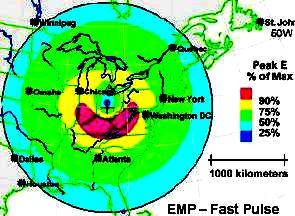
Image Source
Modern societies base much of their economies and affluence on the ability to manipulate electricity. Each American has the equivalent of dozens of "energy slaves" working for him. How easy would it be for an antagonist to turn off the power -- to a town, to a region, to a nation, to a continent?

This posting deals with EMP - electromagnetic pulse. EMP is a side effect of the detonation of a nuclear weapon, but it can also be produced by conventional methods. The "lights out" effect of a nuclear detonation can travel well over a thousand miles -- effectively transporting large areas of a continent into a "dark age".

All modern societies that are reliant upon plentiful electricity for their way of life are vulnerable. Research into portable, conventional EMP weapons, has produced effective emp's from hand grenade size weapons.
"They" are electro-magnetic grenades -- not something you'll find in the typical armory but apparently something that could soon be in the hands of GIs.

"EMP grenade technology is out there, but I've never had my hands on one," said Col. Laurie Buckhout, chief of the newly formed Electronic Warfare Division, Army Operations, Readiness and Mobilization, during a bloggers roundtable Tuesday from the Pentagon. _DefenseTech_via_NextBigFuture
It seems that such light-weight electromagnetic radiation burst weapons are available that are capable of knocking out the power for a college campus, a small town, or a central part of Washington DC. Larger weapons, that could knock out power for large cities and entire states or provinces, would be easier to produce. But they require transport by truck, rail, barge, or ship. These are conventional EMP weapons, not detectable by radiation or hazmat detectors. Your next-door neighbor may be storing one in his garage. (:-0

The US could be knocked backward into a quasi-dark age in just a few seconds. Orbiting nuclear weapons, for example, could detonate in space without killing anyone on the surface via blast effect, radiation, thermal effects, or radioactive fallout. The EMP from the detonations would knock out power on the ground, and destroy scores of sensitive communications satellites in orbit. Airplanes and helicopters would drop like hail from the sky. Large bloody pile-ups would occur on countless freeways. Trains would crash into each other without warning. Hospital power supplies and backup power would fail, and many patients would die. Thousands would be stuck between floors on elevators, that for some would become their tombs. Trillions of dollars of electronic wealth would vanish in a flash.

It is difficult for most psychologically neotenous, academically lobotomised incompetent perpetual adolescents to come to grips with a nation where all cities are simultaneously rendered powerless. Where almost all emergency services and law enforcement services were suddenly helpless.

The online novel, Lights Out, is one man's look at a community in middle America trying to survive after such a surprise EMP attack. Or check out this blurb about a similar book in the stores:
New York Times best selling author William R. Forstchen now brings us a story which can be all too terrifyingly real...a story in which one man struggles to save his family and his small North Carolina town after America loses a war, in one second, a war that will send America back to the Dark Ages...A war based upon a weapon, an Electro Magnetic Pulse (EMP). A weapon that may already be in the hands of our enemies. _Macmillan
Go here for a longer excerpt.

We are at multiple points of bifurcation. The world we know could cease to exist in the blink of an eye, with another -- much harsher -- world taking its place. Such a rapid transition could happen many different ways, but there are only a few ways a society could recover from such transitions. The best way to recover is to have been prepared ahead of time.

EMP is only one easy way for an antagonist to finish off an Obama-weakened US. There are multiple biological, chemical, nuclear (dirty bomb) -- and soon nanotechnological -- ways to knock America flat on its back. And this America is not the same country that bounced back from the 1930s/1940s depression.

Modern america is split into tribes warring among themselves. Many of the newer American tribes are fresh from the third world, with no idea how to run a technological society, and no allegiances to the rule of law or the US Constitution.

America is still rich, still powerful despite its economic problems and current run of bad governmental decision-making. But America and all the western nations, Japan, South Korea, Taiwan, Singapore, etc. are all extremely vulnerable to the new would-be hegemons and would-be world caliphates. Weapons that could separate the thin threads that bind western societies together are becoming less expensive and more widely available.

Much more on the EMP threat

Hope for the best, prepare for the worst.

Labels: , ,

Bookmark and Share

12 March 2009

More Problems for Russia

First of all, morale is bad, due to a failing economy. Russia's economic problems are mainly due to the fall in oil and gas prices -- Russia's main source of income. Weapons sales are also hurting, thanks to a new competitor to the south.
Only about a third of the Soviet era defense manufacturers are still in business, and now about half of them are faced with bankruptcy because of a shortage of orders and increased competition from China. This is complicated by the fact that the Chinese competition is mainly in the form of cheaper copies of Russian weapons and equipment. Russia thought it had signed a deal to halt this plagiarism and technology theft, but the Chinese continue to sell copies of Russian stuff on the international market. The Chinese know that Russia will not go to war over this, and otherwise can do nothing. So the Chinese either ignore Russian complaints, or issue empty apologies, and continue stealing Russian secrets and reselling them.

In an effort to aid the defense industry, Russia is negotiating a new arms reduction treaty with the United States. This will mainly reduce nuclear weapons, which are very expensive to maintain and guard. Russia would rather spend its defense dollars on new tanks and radios to replace Cold War era stuff. The Russian military is still the same old post-Cold War mess. Reforms have had a hard time taking hold. Meanwhile, training levels and readiness are low. Ships rarely go to sea, pilots get a few dozen hours a year in the air, armored units rarely go out and train as they would fight. Troops rarely fire their weapons. Except in a few parachute or commando units, morale is pretty bad. Things were looking up for the past five years, as high oil prices pumped up the economy. But that's gone now, and so is the glow. _StratPage
Russia is trying to save the rouble, which has been under siege for months now. There is no guarantee of success. A lot of Russian wealth has fled the country due to fears that the entire system will collapse.
One of Moscow's sharpest financial pains came in the form of a slumping Russian ruble, which has dropped by about one-third against the dollar since August 2008. Thus far, the Kremlin has spent $200 billion defending its currency, a startling number given that the currency still dropped by 35%. The Russian government has allowed dozens of mini-devaluations since August; the ruble's fall has pushed the currency past its lowest point in the 1998 ruble crash. _MoneyWeek
Russia's oil production is expected to continue falling due to failure to invest in new infrastructure. To top it all off, Russian vodka distillers are beginning to suffer from bootleg vodka. It seems that higher taxes on vodka sales are driving Russian drinkers to moonshine. Bootleggers have never had it so good.

And then there is the huge demographic decline, with the loss of several hundred thousand Russians every year due to lack of replacement via childbirth. Fertile women are either fleeing the country or refusing to have children.

Very strange that a Russian academic has been predicting the split-up of the USA into several pieces, and the re-acquisition of Alaska by Russia. In reality, it is Russia that faces a certain breakup within a few decades at most.

Labels:

Bookmark and Share

Peak Oil? 2008 New Oil Production Record

Instead of declining, oil production set a new record yet again in 2008 -- despite the drop in prices and voluntary "production cuts" by OPEC members. It seems that the more eager Peak Oil fanatics are to see oil production decline, the higher production gets.
My current conjecture is that oil will never peak as long as Ken Deffeyes is making predictions. That's how truly rank his predictions are. But whenever Ken finally shuts up and oil actually peaks, it's not going to be Ken who is proven right. We're all going to be proven right. Me, Mike Lynch, Daniel Yergin, CERA... literally everyone (aside from the mentally retarded) concedes that oil will peak. So on that glorious day when we're all proven right, I say we all go out for a rousing mutual backslap and group hug!

More broadly, we should note that Ken, like many peak oilers, has been trying to stack the deck by restricting his prediction to conventional crude. The reality is that Ken's "peak" is being swamped by flows of unconventional liquids such as tar sands and (most importantly) NGL, as you can see in the IEA figures for total liquids:

A while back, Ken liked to talk about the "Cornucopian Cemetery", where cornucopians go when they admit that oil has already peaked. We have a similar feature here at Peak Oil Debunked. I call it the Peak Oil Prophet's cemetery. It's where you go after your 9th incompetent prediction of the peak oil date craps out. _PeakOilDebunked
Read the whole thing at the link above, and check out the other posts at POD. Among the badly educated and thoroughly indoctrinated teeming masses of mediocre minds, peak oil and global warming are taken very seriously. Obama is a fitting Messiah for such dysfunctional lobotomised hordes. Smarter folks weigh the evidence and come to their own conclusions.

Labels:

Bookmark and Share

Cars Will Heal Their Own Scratches and Scrapes

University of Southern Mississippi University scientists have developed a new coating material that can heal scratches within an hour when exposed to UV light.
The key ingredient of the new material created by polymer scientist Marek Urban and his doctoral student Biswajit Ghosh is a dash of a precursor to chitosan, a structural element in the shells of crabs, shrimp, insects and fungi. To the chitosan precursor, the scientists added oxetane, a ringed molecule that can be broken without much energy. Then they incorporated this new OXE-CHI molecule into polyurethane, the material that might need repair.

Scratching the new material breaks the oxetane rings, exposing a reactive end hungry to bind to something, explains Urban, of the University of Southern Mississippi in Hattiesburg. UV light then cleaves the chitosan component, which in turn binds to the reactive ends made by the scratch.

Test scratches made with a razor blade healed after less than an hour of exposure to a 120 watt florescent UV lamp, a little more power than you’d get from sitting in the sun, the researchers report. _ScienceNews
Several approaches have been taken to self-healing materials, and as humans begin to colonise more treacherous environments -- such as outer space, the sea bottom, the open seas, and polar environments -- it will become more important for their habitats and transport vehicles to be able to heal any breaches, perforations, or structural fatigue.

Our brave new future of rising hazard requires better materials. Anything less would be uncivilised.

Labels:

Bookmark and Share

Intelligence is Inherited, More Than You Know

THE first images to reveal the quality of the brain's wiring show that more aspects of intelligence are inherited than previously known. The finding hints at ways to boost intelligence. _NewScientist
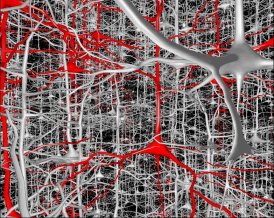
Image Source
Intelligence is between 50% and 80% heritable. Probably closer to 80 than 50. It has been difficult to locate specific genes and gene clusters that account for differences in intelligence between matured human brains, but scientists keep trying.

The speed of brain processes correlates with IQ, and brain speed is partially determined by the integrity of the myelin wrapping around nerve axons that make up the communication pathways (white matter) in the brain. To explore the issue of inheritance and brain speed further, UCLA researcher Paul Thompson conducted a twin study comparing 23 sets of identical twins with 23 sets of fraternal twins.
It is clear that intelligence is at least partly genetically determined. This was supported by the discovery in 2001 that the volume of the brain's grey matter, made up of "processor" cells, is heritable and correlates with certain elements of IQ (Nature Neuroscience, DOI: 10.1038/nn758). The amount of white matter, which provides the connections between these processors, has since been shown to be heritable too (Journal of Neuroscience, vol 26, p 10235).

...By comparing brain maps of identical twins, which share the same genes, with fraternal twins, which share about half their genes, the team calculate that myelin integrity is genetically determined in many brain areas important for intelligence. This includes the corpus callosum, which integrates signals from the left and right sides of the body, and the parietal lobes, responsible for visual and spatial reasoning and logic (see above). Myelin quality in these areas was also correlated with scores on tests of abstract reasoning and overall intelligence (The Journal of Neuroscience, vol 29, p 2212).

...Identifying the genes that promote high-integrity myelin could lead to ways to enhance the genes' activity or artificially add the proteins they code for. This may in turn provide therapies for multiple sclerosis, autism and attention deficit disorder, which are associated with degraded myelin. Intelligence enhancement in people who just want help passing an exam, say, is also "within the realm of possibility", Thompson reckons. _NS
So you can see that high heritability for intelligence can make it easier for biomedical scientists to intervene in order to raise intelligence levels. As long as the underlying causes of higher intelligence are held to be mysterious, humans are doomed to exist in a low IQ state.

The leftist ideologues who frequently occupy university faculty and staff positions are opposed to the study of human biodiversity, and population / genetic differences in brain function. Such leftist Luddism in high places is one of the majour obstacles in the path to a better future for all humans. And now the US has to live with a leftist Luddite president who is also a fascist, economically. Quite a setback to the human enterprise, but not insurmountable.

Hope for the best, prepare for the worst.

Bonus: This study shows that the human brain collects traces that reveal the steps to navigate a landscape -- virtual landscapes and probably real landscapes as well. This suggests that good enough brain imaging combined with clever and powerful psycho-informatics technology will allow psychoneurologists to trace much of a person's inner life, before long. Lie detectors will be easy. Testing intelligence using interactive imaging will be easy. Reproducing a person's entire inner mental world will take a bit longer.

Labels: , ,

Bookmark and Share

11 March 2009

Visualizing Intelligence & Genetics of Fear

Brain imaging is improving so quickly that soon we may be able to measure intelligence using brain scans, and simply skip the IQ tests altogether.
... lesions in the left frontal cortex were associated with lower scores on the verbal comprehension index; lesions in the left frontal and parietal cortex (located behind the frontal lobe) were associated with lower scores on the working memory index; and lesions in the right parietal cortex were associated with lower scores on the perceptual organization index.

Somewhat surprisingly, the study revealed a large amount of overlap in the brain regions responsible for verbal comprehension and working memory, which suggests that these two now-separate measures of cognitive ability may actually represent the same type of intelligence, at least as assessed using the WAIS.

The details about the structure of intelligence provided by the study could be useful in future revisions of the WAIS test so that its various subtests are grouped on the basis of neuroanatomical similarity rather than on behavior, as is the case now.

In addition, the brain maps produced by the study could be used as a diagnostic aid. Clinicians could combine the maps with their patients' Wechsler test results to help localize likely areas of brain damage. "It wouldn't be sufficient to be diagnostic, but it would provide information that clinicians could definitely use about what parts of the brain are dysfunctional," Adolphs says.

The converse--using brain-scan results to predict the IQ of patients as measured by the Weschler test--may also be possible. Although the results wouldn't be as clear-cut as they are in patients with brain lesions, Adolphs says, "you could take a large sample of healthy brains and measure the relative volumes of specific brain areas and draw some associations with these IQ factors." _Eurekalert
This study used scans of persons with brain lesions to correlate with Wechsler test scores. Future brain scans will reveal far more detail anatomically and functionally. As spatial and temporal resolution of brain imaging improves, the newer brain imaging should provide far more insight into the neural correlates of intelligence.

On another topic, research into the neuroscience of fear is revealing the importance of genetic polymorphisms in the experience and recovery from fear and anxiety in everyday life.
The results showed that while the participants with the shorter version of the serotonin transporter gene developed a very strong physiological fear response to picture A, participants with a longer version of the gene did not. In addition, a variation in the gene coding for the COMT enzyme was associated with fear extinction - volunteers with this particular variant were able to very quickly overcome their fear while volunteers with the other variant failed to do so.

The researchers note that these findings have very interesting implications for understanding gene-environment interactions and that "genes may act through the environment by making carriers of particular gene combinations more likely than other individuals to easily pick up and retain fear of stimuli associated with threat and trauma." The authors go on to suggest that these findings may indicate that individuals with specific polymorphisms may be more susceptible to anxiety disorders by being more prone to developing fear and being less likely to overcome that fear by common cognitive behavioral treatments which are based on the extinction principle. _SD
We are all unique in our responses to our different environments. While some are certainly predisposed genetically to experience more fear and anxiety in response to ordinary everyday experiences, we should all be allowed to learn how to overcome fear and anxiety responses in order to be able to pursue our life's goals. In the absence of such training to overcome innate anxiety responses, individuals can be prone to obsessing on perceived external obstacles to success. Such obsession on externals makes it almost impossible to understand the far more important internal obstacles to reaching satisfactory plateaus of achievement.

Labels: , , ,

Bookmark and Share

Making the Right Choices When Time is Short


H/T Kurzweilai.net

The above is a vivid computer animation / recreation of Flight 1549's adventure involving a flock of Canada Geese and an unscheduled landing in the Hudson River. The animation is accompanied by radio transmissions between pilot and air trafic controllers (ATC), and between ATC and ATC. Follow the events in real time and decide how long it would have taken most pilots to make all the right choices -- in time.

Such finely detailed competence is generally domain-specific, although persons who learn to think clearly in stressful situations can often transfer that skill to a range of situations. Pilots, surgeons, EMS workers, ICU / ER workers, supervisors in large power and industrial plants, heavy construction engineers and supervisors, etc. etc. all need to be competent to keep people alive, healthy, and prosperous.

It doesn't help when the political leadership is not only incompetent, but doggedly insistent on following a path of economic destruction.

Labels:

Bookmark and Share

Becoming More Fully Human: Music Training

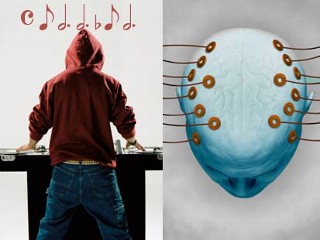
Most children are being short-changed in brain development. Much of the potential of that multifunctional tool for survival -- the human brain -- goes undeveloped due to neglect by parents, teachers, communities, and entire societies. One important human brain function -- emotional competency -- can be more fully incorporated into the developing brain via music training.
Musicians heard an emotion-packed, complex sound with an enhanced sensitivity, and they also were less distracted by simple sounds, according to the study, published in the current issue of the European Journal of Neuroscience.

"What we found in this study is both an enhancement and an economy of resources varies as a function of the extent of musical experience," Kraus said. "The more years the person has been playing an instrument, and the earlier the person began musical training, the larger the effect."

Although many other studies have tried to show the beneficial effects of musical training, the researchers said their findings "provide the first biological evidence for behavioral observations indicating that musical training enhances the perception of vocally expressed emotion." The findings have implications far beyond the world of music.

"The same neural transcription process that is enhanced in musicians is found to be deficient in some children with language disorders such as dyslexia and autism," Kraus noted.

The research suggests that something as basic as musical training may be a useful therapeutic device, along with other more traditional techniques.

..."Our results provide evidence for a subcortical role in the processing of emotional cues by showing that auditory brainstem responses to emotionally salient vocal sounds are dynamic, shaped by life-long, multisensory experience with auditory signals," the researchers note. "These responses are not hardwired but malleable with extensive auditory training."

In other words, we aren't just who we are. We're also what we have done. _ABCNews
The brain goes through very rapid growth and modification in the first few years of life. By the time a child's brain is 5 years old, most of his brain is already shaped by early experiences. But important developmental windows will open and close over the next several years -- and a child's mind is not fully matured until the middle 20s.

We know that infants not exposed to sight or sound in early infancy will lose much of their brain's ability for fine distinction of auditory and optic stimuli if later restored. Children who are not exposed to language in the early years will never develop any language skill. Children not exposed to music before the age of 10 or 12 will find it difficult to achieve mastery from later training. The same opening and closing of developmental windows applies to frontal lobe functioning: the best time to teach a child pre-frontal executive functions that are so vital to life success, is between the ages of 4 and 6-7. Waiting any later will doom a child to lesser degrees of success than he would have otherwise been capable of.

The brain has its own schedule of development and maturation. If caretakers of children are not willing to work within those developmental windows that are constantly opening to some functions and closing to others, too bad for the child.

Labels: , , ,

Bookmark and Share

Electric Cars: How Soon and What Kind?

Electric storage batteries cannot store enough energy to transport an electric powered automobile very far. This is a serious drawback, and one of the reasons that some people are predicting that it may be more than 50 years before electric cars are taken seriously by most of the buying public.

Brian Westenhaus takes a look at new competition for EESTOR, the maker of a mysterious hybrid battery : supercapacitor. He discusses a "Reticle Carbon", a new electrode material for ultracapacitors that may give electric cars a big boost. As described by Brian, the technology looks fascinating. They may have to wait for financing, however, in this extreme economic slowdown of 2009.

One California startup plans to boost the range of electric cars by placing charging machines at convenient locations. They call them "vending machines for charging electric cars." An important development for California, where daily commutes can be far and long. These special re-charging stations may become more practical if new, super-fast re-charging batteries come on the scene.

For those wondering, Elon Musk's Tesla electric car is still out there working, planning to make a big splash soon.

Hybrids are a necessary link in the development chain, combining internal combustion engines with electric motors. Here is an interesting look at the hybric car, going back to the 1800s.

Some electric car enthusiasts are promoting a "battery swapping" approach to extending range, but executives at Mercedes are giving that idea a thumbs down. Mercedes is promoting permanent lithium ion batteries with a driving range of just over 100 miles.

The bottom line is that traditional internal combustion engine automobiles are in no immediate danger of being replaced by all-electric cars. So far, hybrids have not lived up to their promise, and are more expensive in both short and long term calculations, when taking into account battery replacement.

Al Fin's prediction? Fuel cells that run on all types of hydrocarbon including ethanol and methanol will begin to replace the ICE within 10 years. The new power plants may very well also incorporate newer, lighter hybrid ultracapacitor : battery storage packs for extended boosting power when passing or accelerating onto a turnpike. Fuel cells are on a rapid developmental trajectory, as are ultracapacitors and batteries. But all electric (battery only) autos are an impractical solution looking for a cause. First come hybrids. Then come fuel cells paired with ultracapacitor:nextgen battery hybrids. Only carbon hysteria delusions underlie the persistent demands for all-electric (battery only) cars.

Cross posted at Al Fin Energy

Labels:

Bookmark and Share

10 March 2009

Escape the System Like Jason Bourne

Multiple passports, moving assets, lock-picking, escape and evasion, foraging, even how to cross borders without detection (one preferred location: McAllen, Texas, page 390)–it’s a veritable encyclopedia of for those who want to disappear or become lawsuit-proof global citizens… _ 4DWW
The author of the best seller "The 4-Hour Workweek" devoted a recent long post on his blog (via Keelynet.com) to the topic of how to slip the system:
I took Spencer’s advice and opened an account with a Canadian bank that had a branch in St. Kitts. Since both Canada and St. Kitts are part of the British Commonwealth, he’d explained, I would have easy access to my money if anything happened in America. Unfortunately, in the process, I discovered that keeping international accounts secret is now illegal: the IRS requires Americans with over $10,000 in foreign accounts to file an annual report disclosing not just the amount of money and the banks it’s kept in, but the account numbers.

Meanwhile, Spencer was moving forward with his ten-year plan. He started an Internet business in Singapore, enabling him to open a private banking account in the country, which he claimed was fast becoming the new Switzerland. Though he hadn’t gotten his St. Kitts passport yet either, Spencer had done more research into buying an island.

“I’m looking at islands in the north, around Iceland, because no one will think of looking for anyone there,” Spencer said, his thick lips spreading into a self-satisfied smile. “If I can get some other B people [billionaires] to go there with me, we can build underground homes and use geothermal energy.”

“What about your submarine?”

“It’s a great way to move between islands undetected, but we’re running out of time. We need to move faster. This is only the beginning.”

“How bad do you think it’s going to get?” Spencer seemed to understand the economy at a higher level than most people did, perhaps because he knew so many of the people who ran it.

“I don’t think the whole country’s going to collapse, but we’re looking at the worst economic disaster in America since the Great Depression. What I’m also concerned about is the increase in violent crime that’s going to accompany this.” _4-HourWorkWeek
To get the information straight from the horse's mouth, check out the book "Emergency" by Neill Strauss.
I’ve begun to look at the world through apocalypse eyes. It usually begins in airports. That’s when I get the first portent of doom. I imagine explosions, sirens, walls blown apart, bodies ripped from life. Then, as I gaze out of the taxi window on my way home, I see people bustling around on their daily routine, endless rows of office buildings and tenements teeming with activity, thousands of automobiles rushing somewhere important. And it all seems so solid, so permanent, so unmovable, so absolutely necessary. But all it would take is one war, one riot, one dirty bomb, one natural disaster, one marauding army, one economic catastrophe, one vial containing one virus, to bring it all smashing down.

We’ve seen it happen in Hiroshima. In Dresden. In My Lai. In Rwanda. In Baghdad. In Halabja. In New Orleans. Our society, which seems so sturdily built out of concrete and custom, is just a temporary resting place, a hotel our civilization checked into a couple hundred years ago and must one day check out of. It’s an inevitability tourists can’t help but realize when visiting Mayan ruins, Egyptian ruins, Roman ruins. How long will it be before someone is visiting American ruins? _Emergency
Update: Dennis Mangan has also taken a look at this topic and has some interesting comments.

Labels: , ,

Bookmark and Share

Drug Legalisation as a Last Resort?

Image Source
Illegal drugs are fueling crime, terrorism, and violent insurrection around the world. High profit from producing, transporting, and selling drugs with artificially inflated prices, is one of the worst de-stabilising forces in the modern world.
.....prohibition itself vitiates the efforts of the drug warriors. The price of an illegal substance is determined more by the cost of distribution than of production. Take cocaine: the mark-up between coca field and consumer is more than a hundredfold. Even if dumping weedkiller on the crops of peasant farmers quadruples the local price of coca leaves, this tends to have little impact on the street price, which is set mainly by the risk of getting cocaine into Europe or the United States.

Nowadays the drug warriors claim to seize close to half of all the cocaine that is produced. The street price in the United States does seem to have risen, and the purity seems to have fallen, over the past year. But it is not clear that drug demand drops when prices rise. On the other hand, there is plenty of evidence that the drug business quickly adapts to market disruption. At best, effective repression merely forces it to shift production sites. Thus opium has moved from Turkey and Thailand to Myanmar and southern Afghanistan, where it undermines the West’s efforts to defeat the Taliban.

Al Capone, but on a global scale

Indeed, far from reducing crime, prohibition has fostered gangsterism on a scale that the world has never seen before. According to the UN’s perhaps inflated estimate, the illegal drug industry is worth some $320 billion a year. In the West it makes criminals of otherwise law-abiding citizens (the current American president could easily have ended up in prison for his youthful experiments with “blow”). It also makes drugs more dangerous: addicts buy heavily adulterated cocaine and heroin; many use dirty needles to inject themselves, spreading HIV; the wretches who succumb to “crack” or “meth” are outside the law, with only their pushers to “treat” them. But it is countries in the emerging world that pay most of the price. Even a relatively developed democracy such as Mexico now finds itself in a life-or-death struggle against gangsters. American officials, including a former drug tsar, have publicly worried about having a “narco state” as their neighbour.

....Legalisation would...drive away the gangsters; it would transform drugs from a law-and-order problem into a public-health problem, which is how they ought to be treated. Governments would tax and regulate the drug trade, and use the funds raised (and the billions saved on law-enforcement) to educate the public about the risks of drug-taking and to treat addiction. The sale of drugs to minors should remain banned. Different drugs would command different levels of taxation and regulation. This system would be fiddly and imperfect, requiring constant monitoring and hard-to-measure trade-offs. Post-tax prices should be set at a level that would strike a balance between damping down use on the one hand, and discouraging a black market and the desperate acts of theft and prostitution to which addicts now resort to feed their habits. _Economist_via_BrianWang
How would one go about legalising drugs in a world where the "war on drugs" generates so much income on both sides of the law? Very carefully. A pampered population such as those that exist in Europe, North America, and Oceania, are apt to behave rather unpredictably if suddenly given access to very powerful drugs that can potentially make them feel better, smarter, and more powerful than they have ever felt in their lives. For many, psychological addiction would happen almost instantly, with physical dependency following in due order.

Al Fin has long favoured a graded approach to legalisation, beginning with marijuana and moving to low potency forms of other plant-derived drugs. The amount of cocaine originally in Coca Cola, for example, was far less of a threat to public health and order than cheap beer and many video games freely available. And so on. The issue needs very careful and dispassionate review and revision.

What is happening in Mexico is an illustration of what is happening in many other countries of the world, including Afghanistan. Terrorism, bloody insurrection, crime, etc. are all being financed by high drug prices in Europe, North America, and other more developed parts of the world. The drug war is a failure even if it succeeds -- especially if it succeeds. The higher the prices paid for drugs, the more profits earned by drug cartels and criminal terrorist organisations. In addition, the higher the prices for safer drugs such as marijuana, the more likely children and adolescents are to experiment with dangerous substitutes such as gasoline, toluene, airplane glue, and other rapid brain killers.

Mexico is sinking under the weight of criminality, a large part of which is financed by side effects of "the drug war." It is human nature to seek out risky behaviours and experiences of altered consciousness. An enlightened society would attempt to make such innately motivated experimentation and recreation more survivable, with fewer dangerous spinoffs such as drug cartel violence.

Labels: ,

Bookmark and Share
Newer Posts Older Posts
Al Fin Main Page
Enter your Email


Powered by FeedBlitz
Google
WWW AL FIN

Powered by
Blogger

``