19 July 2010

Crude Oil Has Already Peaked!

...crude oil itself has already peaked – at least five times since 1950, Prof. Boyce says – without beginning to approach the demise of oil anticipated by peak oil theory’s famous Bell curve. Indeed, crude oil reserves have doubled roughly every 15 years since 1850 and the world now has more proven reserves than it has ever had in the ensuing 150 years. _CTV
Crude oil may just peak a few more times before humans discard oil in favour of better sources of energy. Oil production is responsive to price signals, although oil producers will watch the price curves closely, to be sure that a rise in prices will last long enough to justify a ramp-up in production. The ephemeral rise in oil prices in the summer of 2008 clearly did not last long enough to justify a full-scale build-up in production.
THERE is only one rule when it comes to the availability of oil: experts are always convinced it will run out – but it never seems to. Brent crude is now at close to $75 a barrel, which is high but hardly excessively so by historical standards....

But one thing is clear: the peak oil theorists, who constantly predict that prices are about to explode, keep on getting it wrong but are never sufficiently held to account by a gullible media. As Mark Perry, a professor at the University of Michigan, reminds us, it was five years ago that Houston-based Matthew Simmons (a leading peak oil man) and the unusually sensible New York Times columnist John Tierney bet $5,000 on the price of oil. The wager was based on the average daily price for 2010, adjusted for inflation. If the inflation-adjusted oil price averages $200 or more, Simmons wins $10,000, and if the average price this year is less than $200, Tierney wins. As Perry points out, average oil prices this year won't even be anywhere close to $100, and will probably average less than $70, far below the $200 price predicted by Simmons. Only a total catastrophe would ensure the price would average $330 per barrel for the rest of 2010 – which is what would be needed for Simmons to win his bet. He will have to hand the cash over and eat humble pie. _CityAM
Matt Simmons is just one of the grifters who has latched on to the gullible mass of believers in Peak Oil Doom. Losing $5,000 in a bet is unlikely to discourage Matt, since he probably cons a lot more than that from his credulous disciples every week.

If you are a doomer, you have to ask yourself the question: "If I am wrong about this doom business, how much am I hurting myself, my family, and our future prospects for happiness and prosperity?" Most doomers just get off on the doom, and don't really care about the opportunity costs. Some of them want to starve the world of energy, so that the human population will be reduced by 50% to 90% from its current numbers (the "dieoff"). But there are likely to be some doomers who eventually get tired of the echo choirs, the genocidal undertones, and the role-playing.
The notion that the world is approaching "Peak Oil" is just not supported by the facts. We may still be getting closer to a peak, but the world has far more untapped oil than anyone could have imagined 10 years ago. _StreetAuthority
There is nothing new about the idea of an energy crisis. Back in Elizabethan times, England suffered from "peak wood." There have been peaks in production -- multiple peaks -- for anything that humans have ever used for energy. More peaks will certainly come and go. But the only form of "peak energy" that could be semi-permanent, is the type of "peak energy" that has come to North Korea -- "political peak energy."

In America, insightful persons might well ask: "Who needs peak oil when we've got Obama Pelosi?" They are referring to the energy starvation policies of the Obama Pelosi regime, which intends to bankrupt coal and oil companies -- and would like to do the same to gas and nuclear companies, if they could devise the proper excuse.

Energy is the life's blood of an advanced society. Persons who intentionally set about to disrupt or shut down a society's energy supply, are essentially committing genocide. Voters should consider that when they go to the polls.

From an earlier post at Al Fin Energy

Labels: ,

Bookmark and Share

11 February 2010

Peak Oil Doom: When You Have Nothing Else to Do

The original concept of "Peak Oil" relates to a mountain peak. You climb and climb until you reach the peak, then it's downhill all the way. That was the idea behind the pre-Hubbert peak theories and remains the idea in the back of people's minds post-Hubbert. Oil production increases until it can't go up anymore, then it falls and falls and falls -- and then the global economy will crash.

That is the simple, original, and largely sub-conscious version of peak oil. A more "sophisticated" version of peak oil claims that oil will never run out and may not even actually peak, but that the world will run out of "cheap oil", and the more expensive oil will grow too expensive for anyone to use -- and then the global economy will crash.

There is another even more "sophisticated" theory of peak oil that states that there is enough oil sands, oil shale, heavy oils, and potential coal to liquids and gas to liquids to replace all petroleum -- except that it will take too long to tool up for the transition, and petroleum supplies will shrink too quickly -- and then the global economy will crash.

You did catch the punchline for all three theories (and several others quite similar)? The global economy crashes. That seems to be a requirement for any peak oil theory that hopes to get a person's blood pumping hard enough for him to be interested in buying books, tapes, seminar tickets, newsletter subscriptions, and whatever else the peak oil proponent happens to be selling at the time.

Any peak oil theory that fails to include a crashing economy and plenty of blood in the streets almost seems too trivial and superfluous to discuss -- much less argue about. So why is there so much argument about "peak oil" when anyone with a brain should understand that the technology and energy feedstocks are there, if the market absolutely has to turn to them (read carefully)?

An interesting concept of "peak demand" has been circulating recently -- and it has a great deal of logic backing it up. In fact "peak demand" has more logic behind it than even Tony Hayward understands.

The demographics of advanced countries in Europe, East Asia, North America, and Oceania is definitely of an imploding nature. Women are having too few babies to maintain populations -- and with populations depleting faster than energy supplies, demand for fuels will fall across the board.  [see Japan]  The US is maintaining its population growth only by virtue of immigration and higher birthrates among the recently immigrated, but even the still-growing US is reducing its appetite for oil.

Along with falling populations, the advanced nations will begin substituting alternative fuels for petroleum -- slowly at first, then at a dizzyingly accelerating rate sometime near the end of the current decade.

The delusional pseudo-scientific theory of anthropogenic global warming catastrophe has held European, North American, and Australian politicians in thrall for over a decade now, but its props are being kicked out from under it by a resurgence of genuine apolitical climate science. With a release from the absurd quasi-totalitarian restrictions on energy use -- with the repeal of "political peak oil" -- modern economies can phase out their petroleum use in a measured and controlled manner.

Believers in Peak Oil DOOM! have no idea how dependent their theories are on the false theories of carbon catastrophe theory. And they probably never will. Because persons who are drawn to peak oil doom are not really looking for solutions to problems. They are looking for exactly what they have found in their books, newsletters, seminars, tapes, and forums: doom. Any doom will do, but a doom from energy starvation is particularly juicy and bound to cause blood to flow.

Why do so many fall for it, besides having nothing important to do?
...when looking ahead more than four years, almost all oil price forecasts over the past 40 years have been wrong, according to Dr Ole Gunnar Austvik, the head of research at Lillehammer University College in Norway.

As it turns out, the flawed forecasts all predicted upwards price trends, whereas inflation-adjusted oil prices actually fell for two decades from the early 1980s.

It was only over the past decade that a seven-year price rally challenged that. A related question, now that oil prices have crashed and partially rebounded, is whether some of the old forecasts are about to be vindicated, or whether the current period of price volatility will run its course, eventually leaving crude lower.

The perennial popularity of forecasts projecting crude prices rising indefinitely reflects the intuitive appeal of the “Peak Oil” theory, which predicts that global oil production will reach a maximum rate and then inexorably decline.

Everyone can grasp the seductively simple hypothesis, which encapsulates deep-rooted insecurities over energy supply. Surely everyone must understand that oil is a geologically scarce resource that must one day run out. _National
Yes, it is a simple idea, easy to grasp, easy to hold ... and hold ... and hold .... in fact, some people have been holding on for forty or fifty years now and show no sign of tiring. Any day now, you'll see, it's all going to fall apart . . . .

Problem solvers look for ways to solve problems. But doomseekers don't want their doom parties spoiled by anyone or anything. Doom is the one thing giving their lives meaning. Don't dare take that away.

Oil pricing is subject to a wide range of forces. But politics should be placed near the top of every list. We all know where Obama, Pelosi, Boxer, Salazar, etc. fall on the politics of energy. "Let them eat cake!" In other words, we'll make it impossible to burn coal, to drill for domestic oil, to use oil shales or oil sands, or any fossil fuel for that matter. If they can't get by on wind and solar, then too bad. Let them eat cake.

Oynklent Green [OTC:OYNK] has some interesting ideas for turning a bad political situation into a net energy plus. You may want to look into investing in OYNK.

Previously published at Al Fin Energy

Labels:

Bookmark and Share

10 February 2010

Peak Oil: Meet SNF Produced Oil Shale

In the western US states of Wyoming, Colorado, and Utah, sit a number of fossil fuel deposits of enormous size -- totaling well over 1 trillion barrels of oil equivalent.  But getting at those barrels of "oil" has not been easy, for economic, technological, and political reasons.  But things may well be getting better on the technological front. The idea of using spent nuclear fuel (SNF) may kill two birds with one stone.
While oil shale is found in many places worldwide, by far the largest deposits in the world are found in the United States in the Green River Formation 6. Estimates of the oil resource in place within the Green River Formation 6 range from 1.2 to 1.8 trillion barrels. Not all resources in place are recoverable; however, even a moderate estimate of 800 billion barrels of recoverable oil from oil shale in the Green River Formation 6 is three times greater than the proven oil reserves of Saudi Arabia. Present U.S. demand for petroleum products is about 20 million barrels per day. If oil shale could be used to meet a quarter of that demand, the estimated 800 billion barrels of recoverable oil from the Green River Formation 6 would last for more than 400 years

...This invention proposes a method of heating in situ a block of the oil shale containing kerogen in an inorganic matrix with nuclear waste to a temperature of about 270° C. The thermal flux of the nuclear waste fractures the formation, alters the chemical and/or physical properties of the kerogen and allows removal of a mixture of hydrocarbons, H2, and/or other formation fluids at a production well. The technology for producing hydrocarbons from oil shale is well known in the industry and does not form a part of this inventive concept. It is an objective of this invention to use the global inventory of SNF as a heat resource for the production of the oil shale deposits shown in FIG. 1. This is the surest way the United States can prevent the plutonium contained in foreign sourced waste from ever being used to construct a nuclear weapon for use against it. _Source_via_BusinessInsider
There are several viable methods for turning oil shales into crude oil. But it is important that the methods used do not deplete or pollute scarce water resources, and do not irreparably destroy the natural beauty of the desert mountains and canyons in the region.
If proven viable, using spent fuel rods to assist in oil extraction could actually be a cheaper and cleaner way to turn the U.S. into an oil production behemoth. It would also financially incentivize nuclear waste away from terrorists, since the price of such waste would rise given the substantially increased economic usefulness.This technology could also unlock cheaper oil from Canadian tar sands. Metal Miner, who alerted us to this technology, highlights how Suncor Energy could, for example, reduce its financial and potential environmental costs by using SNF-assisted extraction:

Metal Miner: Suncor Energy, one of the country’s largest oil sands operators, announced quarterly results, which were a disappointment to its investors. Taking into account the Energy Return on Investment for SAGD extraction techniques at current prices roughly $15 worth of energy is used to produce a barrel of bitumen. If Suncor/Petro-Canada had produced the 318,200 bpd it reported in its last quarter using the Nuclear Assisted Hydrocarbon Production Method they could have increased their profits by some US$430m -almost double what they did make – and would have produced zero CO2 and polluted not one gallon of surface water.

It's further proof that available oil remains more a function of technology rather than physical limitation.

... _BI

Labels: ,

Bookmark and Share

Rocky Mountain Confederacy New Saudi Arabia?


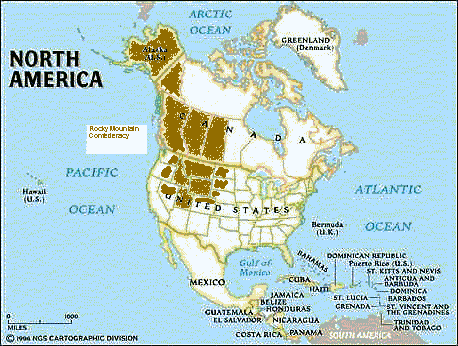
Rocky Mountain Confederacy

Loren's Rocky Mountain Confederacy contains over a trillion barrels of bitumen oil equivalent from Alberta and Saskatchewan's oil sands; over a trillion barrels of kerogen oil equivalent from Wyoming, Colorado, and Utah; large deposits of shale oil in North Dakota, Montana, Alberta and Saskatchewan; huge crude oil deposits in the Arctic; large coal deposits in Wyoming and Utah; and huge deposits of natural gas scattered throughout the region.

The Rocky Mountain Confederacy could easily become the largest energy exporting nation on the planet -- containing far more energy than Saudi Arabi, Iran, and Iraq combined -- except for one thing: it does not exist.

In order for such a nation to exist, something bad would have to happen to Canada and the US. Which means that something very, very bad will have happened to the rest of the world. Which means that the export market for all of that energy will not be very large.

You may consider that to be an extreme example of the "peak demand" theory, which states that demand for fossil fuels will collapse long before supplies are restricted enough to collapse the world economy. When the world economy collapses, it will be for other reasons than because all the affordable fossil fuels have been consumed.

When the fecal matter contacts the rotating blades does it really matter what caused it? Actually, it makes a great deal of difference in terms of re-starting a technological civilisation. If a re-born civilisation has both resources and blueprints available to jump-start technological infrastructure, the resumption of the path to beyond the stars will be that much easier.

Labels:

Bookmark and Share

29 September 2009

Peak Oil Experts Exchange Tips for Coping with Crisis

The foremost peak oil experts in the world assembled in Podunk for intensive discussions on dealing with the collapse of the modern world from Peak Oil. One ingenious solution was to remove the tires from their automobile. Without tires, the car could not go anywhere, and would thus not require fuel. Et, Voila! An automobile instantly immune from Peak Oil!

In a more serious vein, JD at Peak Oil Debunked points out a problem with the "back to the rural land" approach so popular with Peak Oil Believers: rural living is highly dependent on motor vehicles.
Soaring gas prices are a double-whammy for many rural residents: They often pay more than people who live in cities and suburbs because of the expense of hauling fuel to their communities, and they must drive greater distances for life's necessities: work, groceries, medical care and, of course, gas.

...During the last bout of high oil prices, there was some reporting about gas stations closing in rural regions (Fears for rural filling stations, Rural motorists running on empty as pumps close) forcing people to drive long distances for gas. As you would expect, this can turn into a nasty EROEI situation.

...Perhaps the worst threat of all is a vicious cycle of depopulation. High gas prices cause commuting to work/the doctor/school/shopping to be too expensive, so people leave the rural towns/counties and move to larger cities. Govt. revenues decline (people fleeing) while govt. costs rise (gas for the cops, school buses, ambulances, inspectors, garbage collection etc.) Then merchants pull out and gas stations pull out, because there isn't enough population to support them. Govt. services get erratic. More people get fed up and leave etc. etc. Next thing you know, your rural "community" isn't there anymore.
_POD
These are details that Peak Oil Believers caught up in the emotion of their circular logic, may overlook. Not particularly susceptible to deep thinking in the first place, Peak Oil Doomers tend to carry their doom with them, inside their own heads. Simply put, they are doomed, even if no one else is.

Of course, persons who are prepared for EMP or other disaster that results in the collapse of the power system and the transportation system, will have devised workarounds for the absence of fuel trucks and local fuel supplies. Many of those workarounds are discussed at Al Fin Energy.

The utter stupidity of the modern Peak Oil Orthodoxy resides in how they define Peak Oil. Rather than looking specifically at recoverable reserves, the overwhelming tendency is to look at production numbers. Only a fool would depend so heavily on production stats without doing an in depth analysis of all of the factors (besides Peak Oil) that impede production. Yet that is exactly the deficient approach Peak Oil Doomers have taken. Given that prominent deficiency in their analysis, it is impossible for them to arrive at valid conclusions or prognostications.

The claim that the Earth will eventually reach a point of negative returns from the extraction of a presumably non-renewable resource such as oil, is something of a truism. An obvious, rather pedestrian conclusion to a very short chain of logic. The devil is in the details. And detail is what Peak Oil Experts, such as those pictured above, tend to neglect (among other things).

Can readers think of any reasons why oil production happens to be considerably lower than it could be at this point in time? Go ahead. Prove you are better than Peak Oil Orthodox Doom Believers. What relatively trivial alteration in the international oil infrastructure, would almost immediately boost crude production well beyond "peak" levels?

Labels: ,

Bookmark and Share

26 August 2009

Peak Oil: So Stupid It's Not Even Wrong?

[An] argument — that the “easy oil” is gone and that extraction can only become more difficult and cost-ineffective — should be recognized as vague and irrelevant. Drillers in Persia a century ago certainly didn’t consider their work easy, and the mechanized, computerized industry of today is a far sight from 19th-century mule-drawn rigs. Hundreds of fields that produce “easy oil” today were once thought technologically unreachable. _NYT
As the author of the above NYT OpEd points out, peak oil doomists have too much at stake to look at both sides of the production and reserves equation. For peak oil fanatics, every jump in the price of oil is further proof that "the peak has passed!". "Over half the oil has already been pumped, all the easy oil is gone, and prices can only go up!", they keep saying time and again -- only to be proved wrong time and again.

Once an idea has infiltrated deeply enough into a human's thoughtways, it cannot be easily exfiltrated. But if the brain is alive and open to the outside world and its reality, it can happen. Just like oil wells that were once considered exhausted are now frequently found to produce as much or more using improved technologies as they produced originally. This will continue to be the case for most of this century.
Easy oil is probably running out because it was the first to be discovered and burned. But it wasn’t so “easy” when it was discovered. By the same token, the difficult oil of today will be tomorrow’s easy oil, thanks to the learning curve of technology expertise. Overall, “difficult oil” exploitation will be the survival and even prosperity key for many Western oil companies in a world that will be increasingly dominated by national oil companies.

It will take time, but I dare to make a prediction. By 2030 more than 50 percent of the known oil will be recoverable. Also, by that time the amount of known oil will have grown significantly, and a larger portion of unconventional oils will be commonly produced, bringing the total amount of recoverable reserves to something between 4,500 billion to 5,000 billion barrels of oil. What’s more, a significant part of “new reserves” will not come from new discoveries, but from a new ability to better exploit what we already have.

To be sure, by 2030 we will have consumed another 650 billion to 700 billion barrels of our reserves, for a total of around 1,600 billion barrels used up from the 4,500 billion to 5,000 billion figure. Yet, if my estimates are correct, we will have oil for the rest of the 21st Century._ScientificAmerican
Of course the oil markets themselves will remain volatile for as long as oil remains so irreplaceable. The oil markets will move up -- sometimes dramtically -- and they will move down. All of that will be based more upon socio-politico-economic events than upon the accessible supplies of oil in the ground.

The peak oil craze has much in common with the carbon climate catastrophe craze, and the population penetrance of the two fanaticisms tends to overlap significantly. But neither is based upon sound science, and both are largely driven by political and economic undercurrents -- out of sight of most unwitting adherents.

A relatively smooth transition into the post-oil era will require the use of a wide range of fossil fuel reserves -- including offshore oil, shale oil, oil sands, coal, gas, etc. The energy starvation approach of the Obama / Pelosi reich is not benefiting anyone except the prophets, politicians, and profit-takers of doom. The Obama / Pelosi policies are creating and worsening the scarcities the doomseekers have predicted. Political peak oil, political energy choke off.

And while Obama is using scarce US resources to prop up oil companies in Latin America, agents of his own reich are preventing US oil companies from engaging in the same type of offshore drilling that the latin companies are receiving Obama dollars to build up.

At this point, Obama's energy and economic policies are as disjointed as a cubist portrait, and as dysfunctional as an Arab or African government. One might even call the man a clown, if one were feeling particularly prejudicial toward clowns at the time.

Labels: ,

Bookmark and Share

26 December 2007

Peak Oil: The Reallity

The fashionable response to high energy prices is "Peak Oil Panic." But that is reacting to a fantasy scenario--not the reality.
As you can see, large supranational blocks are very different from individual countries. They have a tendency to plateau for extremely long periods of time. For example, North America has been on a plateau of about 14mbd for almost 20 years. Asia-Pacific has been on a plateau of 6-7mbd for almost 20 years. South/Central America has logged a couple of long plateaus, most recently a plateau of about 6.5mbd for 10 years.

The evidence suggests that the world (as the largest supranational unit) will plateau for a very long time -- even decades -- just like CERA says.
POD

Oil and coal are dirty fuels, and we would do well to move away from the pollution of fossil fuels to cleaner and more sustainable forms of energy. But "Peak Oil" enthusiasts are claiming that there is not enough time to transition. They are screeching from their blog rooftops and soapboxes that we are all doomed. They are not trying to create panic--mind you. They merely want to let us know what is coming, then sit back and watch the panic set in. But in reality, what sort of fringe-kookery are they?
Petroleum geologists are pretty sure that there is more than enough oil in the world to meet projected demand for at least the next 25 years. In other words, as I reported in my article “Peak Oil Panic” last year, geologically speaking “peak oil” is at least a generation away.
Reason

What type of apocalyptic visions do the peak oil prophets-of-doom project into our futures?
The most pessimistic of these Cassandras, like American writer James Howard Kunstler, predict nothing less than the wholesale collapse of industrial civilization. In his 2005 bestseller, The Long Emergency, Kunstler envisaged a future in which the survivors of the oil-peak catastrophe eke out a living in an 18th-century-style economy: the great cities are abandoned, almost all production is for local consumption, and the higher technologies have mostly been lost.

Kunstler's great hate is the suburbs, which are mainly an artifact of the cheap-oil era, and one gets the feeling that he would secretly welcome any catastrophe that destroyed them.
Commentary

We are seeing higher oil prices now--although if one corrects for inflation, the prices are not as high as most human-passive-news-receptacles tend to think. And while it is fashionable to say that world oil production will reach a sharp peak, then decline indefinitely down to zero--that is the fantasy of the neo-Malthusians.

Such groups as this and this actually want to see the human population forcibly reduced to about 10% or less of its present level.

But human overpopulation is not Earth's problem. Humans thrive in cities--if the cities are well designed and administered, and if the city's human average population IQ is high enough to support a high tech infrastructure. The population of Taiwan is far denser (636 per km2)--but more prosperous and better educated--than the population of China (137 per km2). China has attained the status of world's biggest polluter and greenhouse gas emitter. Rather than planning a violent invasion of Taiwan, China should be learning to imitate Taiwan's success.

The concept of the arcology--the self-contained city--is a useful one for viewing a population-dense but healthy and thriving population. But far more interesting than studying how many hundreds of billions of humans a healthy, thriving, technologically advanced planet Earth could support, is studying how many humans a healthy thriving technologically advanced Solar System could support.
The asteroid belt contains an estimated 825 quintillion (a billion times a billion) tons of iron -- enough to build shells around planets, gigantic cities in space, and starships carrying entire civilizations. How much is this iron worth? Lewis performs a fanciful calculation: At present prices of around $50 a ton, the asteroids yield $7 billion of the metal per person for everyone alive today, or an affluent standard of living for a population far larger. Moreover, iron is merely one element found in the Main Belt, which also contains gold, silver, copper, manganese, titanium, uranium, and much else.
Reason

As for peak oil, we can see from the graph above that oil production is not likely to reach a sharp peak. What will be seen for the next few decades is a long plateau with slight ups and downs. When oil production truly does peak, it will be due to a precipitous drop in demand caused by alternative sources of energy.

There may be ample reasons for a person to "plan for the Apocalypse", but peak oil theory is not one of the better ones. Still, for people lacking in logical facility and of limited imagination, peak oil belief may be better than selling crack on the street.

For others who actually care whether their thought processes are tracking in at least a rough parallel path to reality, it is important to test hypotheses against real world data points and trends. That is something that the quasi-religious CAGW believers and peak oil believers tend to avoid. For the religious and the quasi-religious, it is beliefs that matter, not reality--to our best approximation.

Peak oil and "global warming" are not existential risks. Rather, they belong to a class of "dysfunctional ideologies" which, if adopted by advanced societies on a broad scale, would contribute to the loss of vigour and resilience that a civilisation must have to survive. So rather than warning of existential risks, they become one component of a civilisational decadence and fatigue that could lead to the loss of a civilisation.


Interesting reading:

Oil Prices going down in 2008?

Why we'll never run out of oil--Discover Magazine

Confessions of Peak Oil (ex)Believer

Don't Panic written by a peak oil believer who does not see it as a problem.

Politics and Reality of peak oil scare

Labels: , , , , ,

Bookmark and Share

26 November 2007

New Sources of Domestic Hydrocarbon Fuels


The technology featured in the video above is but one technology of several that are coaxing large amounts of new oil out of old North American oil wells once thought depleted. The graphic below illustrates how oil wells that have "peaked" may be re-energised to "peak" again.There are a lot of reasons to suspect that "peak oil" has been hyped far beyond any contact with reality.
The U.S. DOE calculates that amount of oil in already discovered U.S oilfields at less than 5000 feet to be more than 218 billion barrels. Keep in mind that just 10% of that equals 10 years of OPEC imports at today’s rates, all of it is enough to run the U.S. economy for 25 years. All of which is just sitting there, in known places, thousands of them that at the 5000-foot and shallower level which exceed the proven reserves of Saudi Arabia. It also leaves out all the oil left behind when wells ran dry – which comes to 300 billion barrels. It’s a resource that the 7000 or so non “Big Oil” U.S. oil companies can bring to market.
New Energy and Fuel

Better drilling and discovery technology is likely to bring in a lot of new conventional oil. What other new petroleum resources are in the pipeline?
In a massive new multivolume report on energy strategy in the United States, a high-powered federal task force puts "peak oil" into perspective. On the one hand, it says, the country has already consumed, in 150 years, 446 billion barrels of its own fossil-fuel endowment. On the other hand, it says, the country has 8.59 trillion barrels left - or more "oil equivalent" than the rest of the world combined. More than 95 per cent of America's oil reserves, in other words, are still in the ground.

Key phrase? "Oil equivalent". Wrap your head around that - "more "oil equivalent" than the rest of the world combined."

For instance - oil shale:

"North American oil shale and [oil] sands alone far exceed all the remaining proven and undiscovered oil resources of the entire world," the task force reports. "They represent 3.5 trillion barrels of oil resources. America's commercial-quality oil shale resources alone exceed two trillion barrels. This shale can be processed to generate ultraclean, high-quality diesel and jet fuels, along with high-value chemicals - with existing technologies under normal economic conditions."
Q and O

Several other interesting technologies for producing new hydrocarbons include energy from garbage (landfills), oil from discarded automobiles (tires, foams, plastics etc.), oil from biowaste (with catalysts, T, P) and oil from synthetic micro-organisms. Many more ingenious energy technologies are in the pipeline. $100 a barrel oil is a powerful incentive for innovation.

As I have stated before, I am a firm believer in photovoltaics, wind energy, micro hydro, OTEC, tidal energy, geothermal, and other clean forms of energy. I am also a proponent of using safe nuclear energy as a way of easing the transition from dirty oil and coal to cleaner, sustainable power.

It is time for the pop media and other influential but unserious voices to stop promoting false images of doom such as CAGW and Peak Oil. We need to outgrow these childish tendencies to promote dishonest scare tactics just to get attention. We need all the brainpower we have to effect a fairly smooth transition to long term clean energy, while also working to bring about the next level.
Hat tip Philosophical Detective

Labels: , , , ,

Bookmark and Share

23 November 2007

Peak Oil: Meet Maugeri's TAO

Only around 2,000 new field wildcats (wells made for exploring the presence of hydrocarbons in the subsoil) have been drilled in the entire Persian Gulf region since the inception of its oil activity, as against more than 1 million in the United States. TAO

Leonardo Maugeri's 2006 book, "The Age of Oil (TAO)," is an indispensable look at the past, present, and future of the role of petroleum. Written in two parts, TAO first looks at the human history of oil along with current events of oil. The second and final section of TAO looks at the question of whether the world is at or near "peak oil."
In April 1977, the Central Intelligence Agency (CIA) delivered a highly influential report stating that the growth of world oil demand would soon outpace production because of constraints on OPEC potential and the impending peak of Soviet Production. By the 1980s, the report argued, oil would be scarce and very expensive....
Maugeri points to three categories of reserves used when referring to future oil reserves.

  • Proven Reserves---defined as the amount of oil and gas in place in known reservoirs that can be estimated with "reasonable certainty" to be commercially recoverable under current economic conditions....profitable recovery of at least 90 percent.
  • Probable Reserves---the probability of profitable recovery falls to 50 percent
  • Possible Reserves---profitable probability of recovery no less than 10 percent.
Maugeri points out that:
During the last 25 years more than 70% of exploration has taken place in the United States and Canada, mature areas that probably hold only 3% of the world's reserves of crude. The Middle East, on the other hand, has been the scene of only 3% of global exploration, even though it harbors 70% of the earth's reserves. In the Persian Gulf, holding 65% of the region's reserves, fewer than 100 exploration wells were drilled between 1995 and 2004. During the same period, 15,700 such wells were drilled in the U.S. Forbes

Future advances in the technologies of production, and refinement--as well as improved efficiencies of utilisation--have the potential to move reserves from the "possible" and "probable" categories up to the "proven reserves" classification. Future advances in discovery technology have the potential to expand all reserves significantly.

A recent declaration by the Energy Watch Group that world petroleum production had peaked in 2006--had passed "peak oil"--was based on an analysis of world petroleum production, without considering either world petroleum reserves or seriously considering the many reasons why world petroleum production might peak from time to time without signaling any type of "peak oil."

Maugeri concludes his book with a look at "resource nationalism," the gloomy reality that most of the world's known conventional petroleum resources exist in territories controlled by dictators and autocrats--Russia, Venezuela, Saudi Arabia, Iran, Libya, etc. For this reason, oil prices are likely to remain quite high--unless market forces arising from new discoveries and production outside the autocratic zone force the dictators of oil to compete once again.

Remember, nationalised resources do not tend to attract the latest technology in discovery, production, and refinement. That means that a lot of resources remain in the ground.
Despite its long history as an oil producing region, the Persian Gulf is still relatively virgin in terms of exploration. Only around 2,000 new field wildcas (wells made for exploring the presence of hydrocarbons in the subsoil) have been drilled in the entire Persian Gulf region since the inception of its oil activity, as against more than 1 million in the United States. p. 221 TAO

More from Maugeri at National Geographic, Forbes, and Foreign Affairs.

Labels: , , , , ,

Bookmark and Share

10 November 2007

Peak Oil: Meet Oil from Wood

It is getting harder and more expensive to find large new reserves of petroleum. While "peak oil" is impossible to calculate without better knowledge of true global oil reserves, it is almost certain that the cost of oil will continue to trend upward--and energy planners should take those higher costs into account.

But while we transition from a fossil fuel dependency to a more sustainable and diversified energy repertoire, what other "tricks" may science/technology hold up its collective sleeve?
The way to make cellulosic biofuels viable, says Bioecon's founder, Paul O'Connor, is to use catalysts to convert biomass into a hydrocarbon biocrude that can be processed into gasoline and diesel in existing petroleum refineries. After decades developing catalysts for the petroleum industry, O'Connor started Bioecon in early 2006 to develop methods for converting biomass directly into biofuels. His first success is a catalytic process that can convert cellulosic biomass into short-chain hydrocarbons about six to thirteen carbon atoms long. Khosla Ventures agreed to provide an undisclosed amount of series A funding to spinoff Kior in order to commercialize the process. Vinod Khosla, founder of the venture fund, believes that converting biomass into liquid transportation fuels is key to decreasing greenhouse-gas emissions and compensating for dwindling petroleum reserves. Khosla is funding a number of biofuels startups with competing technologies and says that Kior's approach is unique. "They have some very clever proprietary catalytic approaches that are pretty compelling," he says. "They can produce relatively cheap crude oil--that's attractive."
Technology Review

Alternative processes for making usable hydrocarbons from cellulose/lignin involves high temperature and pressure processes to produce syngas as an intermediary. This is too expensive at current oil prices. Likewise, previous methods to use catalysts in the conversion have had low yields.

Kior's method would reportedly:
would eliminate the need for the superhigh temperatures and toxic catalysts used in other thermochemical methods for cellulosic-biofuel production. While O'Connor says that he is still improving Kior's catalyst, his first versions are different kinds of modified clays, which are both cheap and environmentally friendly. The product is high quality as well, containing less acid, oxygen, and water. These characteristics make it suitable for burning as heating oil or for use in petroleum refineries, which can use existing processes and equipment to convert it into the longer hydrocarbon chains of gasoline and diesel fuel.


It may take up to five years for this method to prove itself in the marketplace. But it is certainly reasonable to look for technological ways to "speed up" the conversion of bio-waste to hydrocarbons--to use industrial processes to produce in days what nature takes millions of years to produce. Once nanotechnology learns to create more efficient catalysts, the process will be speeded even more--and decentralised as well.

The next 5 to 10 years are the pivot. While peak oil scenarios are being spun for maximum impact on the public imagination, real scientists and engineers are busy creating alternative paths from here to there--paths that do not involve massive death and destruction such as that imagined by peak oil enthusiasts.

Hat tip KurzweilAI.net

Labels: , , , , ,

Bookmark and Share

Using Vinegar to Squeeze Oil from a Stone


Oil shale is an unconventional fossil fuel source that is abundant within the Green River Basin of the US. Physicist Harold Vinegar, of Royal Dutch Shell, is at the forefront of efforts to turn shale oil into usable fossil fuel products.
Vinegar is the energy industry's leading expert on the complex petroscience of transforming solid oil shale into synthetic crude - a liquid fuel that can be refined into diesel and gasoline. The breakthroughs this 58-year-old physicist has achieved could turn out to be the biggest game changer the American oil industry has seen since crude was discovered near Alaska's Prudhoe Bay in 1968.

If that sounds like hyperbole, then consider this: Several hundred feet below where Vinegar is strolling lies the Green River Formation, arguably the largest unconventional oil reserve on the planet. ("Unconventional oil" encompasses oil shale, Canadian tar sands, and the extra-heavy oils of Venezuela - essentially, anything that is not just pumped to the surface.)

Spanning some 17,000 square miles across parts of Colorado, Utah and Wyoming, this underground lakebed holds at least 800 billion barrels of recoverable oil. That's triple the reserves of Saudi Arabia.

..."Companies just aren't discovering new Prudhoe Bays anymore," says Bear Stearns oil analyst Nicole Decker, who thinks Shell has hit on a breakthrough technology. "This could be very significant - certainly bigger, to our knowledge, than any new discoveries that might be available globally."
Fortune

While the combination of shale oil and tar sands will not replace oil from unstable dictatorships such as Venezuela and Saudi Arabia (Russia?), they represent a significant domestic source of fossil fuel that, along with coal, can ease the transition to a post-oil economy. Fossil fuels are dirty and increasingly expensive to extract and refine. The entire purpose of discovering and perfecting new sources of fossil fuel at this time should be to ease the societal and civilisational disruptions that are inevitable in any major transition.

Hat tip, Brian Wang at Advanced Nanotechnology

Labels: , ,

Bookmark and Share

29 August 2007

Peak Oil: You Don't Know Jack!

"Jack" is a recently discovered undersea oil field in the Gulf of Mexico that may exceed 15 billion barrels of oil. Given that water covers 2/3 of Earth's surface, it is not unlikely that more oil reserves exist underwater than under dry land.
The mother lode of oil in the deepwater Gulf is so significant that Tahiti and other successful fields in this region are expected to soon produce enough crude to reverse the long-standing decline in US oil production of about 10 percent per year.

Even better, a recent discovery by Chevron has signaled that soon there may be vastly more oil gushing out of the ultradeep seabeds — more than even the optimists were predicting four years ago. In 2004, the company penetrated a 60 million-year-old geological stratum known as the "lower tertiary trend" containing a monster oil patch that holds between 3 billion and 15 billion barrels of crude. Dubbed Jack, the field lies beneath waters nearly twice as deep as those covering Tahiti, and many in the industry dismissed the discovery as too remote to exploit. But last September, Chevron used the Cajun Express to probe the Jack field, proving that petroleum could flow from the lower tertiary at hearty commercial rates — fast enough to bring billions of dollars of crude to market.

...Technological breakthroughs have, decade after decade, revived the perpetually doomed oil industry. "Predicting peak oil," Siegele tells me as we tour the drilling floor of the Cajun Express, "is almost like predicting peak technology" — an exercise, in other words, that to him seems inherently small-minded. Even absurd.
SourceBesides the "Jack" oilfield and other yet to be discovered Gulf fields, there are also many other undersea fields--including Arctic and Antarctic oil fields--currently unexplored. And then, there is all of that oil shale and oil sands that Canada, the US, and other large countries are sitting on.
And don't get me started on all the coal reserves and uranium/thorium reserves spread out across the globe. And please--never! and I mean never!! get me started on all the resources in the solar system, should humans ever grow out of their prolonged, restless, and generally incompetent adolescence.

Peak Oil doesn't know Jack. Peak Oil will soon meet Jack and a lot of other energy resources that will be developed, sooner or later.

Originally published in Al Fin Energy

Labels: ,

Bookmark and Share

21 August 2007

Peak Oil: Meet Synthetic Micro-Organisms that Produce Petroleum

Creating micro-organisms that can synthesise renewable hydrocarbons for fuels and feedstocks, is one aim of synthetic biology.
The process is the same as making cellulosic ethanol insofar as cellulosic feedstocks are converted into fermentable sugars, and those sugars are placed in a fermentation vat. The difference comes in the microbes doing the fermenting. With ethanol, it's generally some form of yeast. The researchers at LS9 have engineered their own microbes, lifting genes from other microbes and recombining them into an organism that does just what they want. In this way they can precisely tweak the characteristics of the resulting fuel.

Yeast fermentation produces ethanol, which mixes with water and subsequently has to be extracted via distillation. LS9's microbes produce -- via fatty acid metabolism, in a process I won't claim to understand -- hydrocarbons (the building blocks of petroleum). These hydrocarbons are immiscible, i.e., they don't mix with water. Instead, they float to the top of the vat, where they can essentially be skimmed off. That allows LS9 to skip the distillation process, which saves a whole boatload of energy. (That's where most of the claimed 65% energy savings comes from.)
Source

David Berry, one of the brains behind LS9, has won the Young Innovator of the Year award from MIT's Tech Review.
Berry's goal was nothing less than "to develop a novel and far-reaching solution to the energy problem." In col­laboration with genomics researcher George Church of Harvard Medi­cal School and plant biologist Chris Somerville of Stanford University, Berry and his Flagship colleagues set out to do something that had never been attempted commercially: using the tools of synthetic biology to make microörganisms that produce something like petroleum. Berry assumed responsibility for proving that the infant company, dubbed LS9, could produce a biofuel that was renewable, better than corn-derived ethanol, and cost-­competitive with ­fossil-based fuels.

I understand that Chris Somerville -- a leading figure in the plant biology field -- is also at work on plants that are genetically engineered to produce biodegradable plastics. Now if they could just integrate that idea with these petroleum-producing microbes, we'd really have something to celebrate.
Source

If synthetic biologists can create microbes that efficiently create "petroleum" in an industrial environment--out of renewable materials and skipping any energy-wasting distillation process--the economics of the future of energy might change a bit.

Labels: , , ,

Bookmark and Share

16 May 2007

Peak Oil: Meet Nuclear Oil Sands

Nuclear Oil Sands, the next big thing? Another provocative posting from advanced nanotechnology blog.

As long as the price of oil stays above $50 per barrel, oil sands will be profitable for investors. One of the problems with the ultra-thick bitumen mined from the oil sands, is that it requires a lot of heat to process. By combining a nuclear reactor--with its copious waste heat--to oil sands processing, the process of refining useable oil from gunk is expedited.

If the Canadians are able to navigate the regulatory minefields to make this plan work--against the protests of all of the pseudo-environmentalist activists--the same thing may be used for oil shales.

Alberta and Saskatchewan are experiencing significant booms from oil sands construction and production projects. A lot of jobs are available for skilled workers.

Labels: ,

Bookmark and Share

01 March 2007

Peak Oil: Meet Peter Jackson

Peak Oil theory predicts an abrupt fall in oil production, with devastating effects on the oil-dependent world economy. Peter Jackson has studied the issue for CERA Oil Supply, and suggests that the theory is faulty.
There is no evidence that a peak will occur in the next ten to 15 years, nor if we look out to approximately 2030. CERA believes that we will see an undulating plateau of global production starting sometime after 2030, which is likely to last for a number of decades. Towards the end of the plateau period, we envisage that global production will decline more gently compared to the very rapid production decline predicted by the peak oil lobby. Very importantly, CERA believes that the duration of the undulating plateau will be determined by above ground factors – such as levels of investment, economics and geopolitics - rather than the scale of below ground resources.

....I believe we still do not know the scale of the global resource base very accurately. However, including both conventional and unconventional sources such as oil sands and shale oil, I believe that well over 4 trillion barrels of resource remain – that’s about four times as much as has been produced thus far in the history of the world.

....Global oil supply has been relatively tight in recent years, but CERA predicts that productive capacity will grow very quickly in the next few years. Unconventional oils such as ultra heavy oils in Canada and Venezuela are the focus of considerable investment at present. We also see gas-to-liquids projects springing up, in the Middle East for example, and coal-to-liquids projects being planned in quite large numbers in South East Asia and Australia. Interestingly, there’s a lot of biofuel being produced in the US and Brazil at the moment,and the proportion of biofuel is likely to expand quite considerably, over the coming decades.
Source.

It is highly likely that huge undiscovered oil and gas reserves exist in difficult to explore undersea deposits. As the more cheaply extracted reserves are depleted over the next few decades, technology will inevitably make accessible these reserves which are almost impossible to access today, economically.

Peak oil will not happen the way that many radical environmentalists are predicting. But then, a lot of people believed in the inevitability of a Y2K crisis as well. There is something in the human mind that loves to contemplate disasters and catastrophes of apocalyptic proportion. CAGW falls into the same category, and appeals to much the same ideological groupings as Peak Oil--paradoxically enough.

Labels: , ,

Bookmark and Share

20 August 2006

A Diesel Substitute from Coal--Dimethyl Ether vs. Peak Oil

Peak oil disciples want to make you afraid of the future. They say that the world will run out of oil, unprepared, and suffer fatal shocks to the world economic system. Hundreds of millions, perhaps billions of people, will die--by starvation, disease, and war.

Scientists, engineers, and the big investors, are not taking those Cassandra pronouncements seriously. Instead, they are continuing to explore alternatives to oil--as prices rise--while continuing to discover new oil fields.

Coal is plentiful in many parts of the world, and finding ways to substitute refined products of coal for liquid fuels such as gasoline and diesel is important to the industry of many countries. China is developing better ways of producing dimethyl ether--a diesel substitute--from coal.


China is to begin construction of the largest dimethyl ether (DME) project yet with an annual output of 3 million tons. China’s National Development and Reform Commission (NDRC) has banned any coal-based DME project with a design capacity lower than one million tons.

The country’s current annual output is 120,000 tons of DME each year, according to the NDRC.

Participants in the project include power giants China National Coal Group Corporation, China Petroleum and Chemical Corporation and the Shanghai-based Shenergy Group.

Located in Ordos in north China’s Inner Mongolia Autonomous Region, the project will cost 21 billion yuan (US$2.6 billion), according to a report in Shanghai Securities News.

A pipeline will be built to transfer the DME from Ordos to the port city of Tangshan in north China’s Hebei Province.

Earlier in August, the International Finance Corporation (IFC), the private sector arm of the World Bank Group, signed a financing package for China’s Xinao Group to support another coal to dimethyl ether (DME) project that will be one of the world’s largest. That project is expected to come online in 2009. (Earlier post.)

DME can serve as a synthetic fuel that is to diesel what LPG is to gasoline. It is gaseous at ambient conditions but can be liquefied at moderate pressure. With a high cetane number, DME has very attractive characteristics as an alternative fuel for diesel engines. DME can be blended with LPG in a 15 to 20% blend without any modifications to equipment or used as a replacement.

The Chinese government is supporting the development of DME as a possible alternative to diesel.

Source.

With clever chemical manipulation, coal can be refined to produced many chemicals that will substitute for petroleum products.

Peak oil soldiers complain bitterly whenever someone points to coal substitutes as an argument against peak oil. But that is disingenuous, because the whole point of peak oil in the first place--the only reason at all that anyone would take peak oil seriously--is the predictions of severe economic shocks leading to extreme hardship, from peak oil. The failure of logic is not generally an impediment to strong quasi-religious beliefs, however.

Labels: ,

Bookmark and Share

18 August 2006

Improved Oil Exploration Technology for the Coming Oil Glut

Coming oil glut? How can anyone believe that, when all you read these days is "peak oil?" Supply and demand determines whether there is an "oil glut"--like the one in the 1990s that accompanied the great Asian recession. Another large regional or global recession would almost instantly create another oil glut. But I refer to a potential oil glut due to increased supply, not to reduced demand.

Oil exploration technology has been fairly stagnant for several decades now. Large, potentially huge, oil reservoirs are going undiscovered due to the lack of good discovery tools. Here is what Len LeShack, oil exploration maverick, thinks:

"There are still hundreds of reservoirs of conventional oil to be found in Alberta, and thousands to be found in the United States, but they are unlikely to be found with conventional exploration methods," says LeSchack.

The president of the privately owned Hectori Inc. of Calgary observes from his experiences.

"The industry is still basically using exploration techniques I learned at university in the 1950s. We geologists worked a lot on intuition, and then used seismic to back it up. Seismic is fine, but seismic can only find what seismic can find."


LeShack is the coauthor of a book that lays out several revolutionary new oil exploration tools that threaten to hold back peak oil for at least several decades.

MIT mathematicians are developing new algorithms to use for seismic exploration, which promises to give new life to that aging technology. This story is being recycled by tech news websites two months late, which gives you an idea of the laxity involved in reporting new oil technology.

Nanotechnology methods are being utilised to improve the yield at existing pumping sites. Such technology promises to extend the life of current wells for many years.

Here is a story that illustrates the potential of newer electromagnetic imaging for discovering new oil reservoirs quickly.

Oil is not the long term solution for human energy needs. Renewable energy is needed to allow the quality of human life to improve around the globe. But it is obvious that the traumatic shocks predicted by peak oil disciples would do no one any good, and set back the prospects for improved living in the developing world indefinitely. Only people who wish for a massive "die-off" of humans are wishing for huge peak oil shocks.

Realistically, the worldwide oil extraction infrastructure is not prepared to deal with huge new oil sources. Especially in Iran and the arab world, and other nationalised oil industries such as Venezuela, the oil drilling and pumping infrastructure is deteriorating rapidly due to neglect and lack of skilled engineers and technicians. The corrupt leaders of those quasi-dictatorships are neglecting the long term, for political expediencies of today.

In addition, low oil prices now would only set back the development of necessary long-term renewables. Even if huge new oil fields are discovered, which is very possible, their timely exploitation is most doubtful. They will exist in limbo, as a counter-weight to the peak oil limbo.

Labels: , ,

Bookmark and Share

07 May 2006

Panic, Damn You!

Reason magazine has an interesting feature titled "Peak Oil Panic." A lot of persons who are locked into the worst prognostications of peak oil, global warming, etc. etc. appear fixed in a single mode: panic.

The good news is that the peak oil doomsters are probably wrong that world oil production is about to decline forever. Most analysts believe that world petroleum supplies will meet projected demand at reasonable prices for at least another generation. The bad news is that much of the world’s oil reserves are in the custody of unstable and sometimes hostile regimes. But the oil producing nations would be the ultimate losers if they provoked an “oil crisis,” since that would spur industrialized countries to cut back on imports and develop alternative energy technologies.

Apocalypse Yesterday

Predictions of imminent catastrophic depletion are almost as old as the oil industry. An 1855 advertisement for Kier’s Rock Oil, a patent medicine whose key ingredient was petroleum bubbling up from salt wells near Pittsburgh, urged customers to buy soon before “this wonderful product is depleted from Nature’s laboratory.” The ad appeared four years before Pennsylvania’s first oil well was drilled. In 1919 David White of the U.S. Geological Survey (USGS) predicted that world oil production would peak in nine years. And in 1943 the Standard Oil geologist Wallace Pratt calculated that the world would ultimately produce 600 billion barrels of oil. (In fact, more than 1 trillion barrels of oil had been pumped by 2006.)

During the 1970s, the Club of Rome report The Limits to Growth projected that, assuming consumption remained flat, all known oil reserves would be entirely consumed in just 31 years. With exponential growth in consumption, it added, all the known oil reserves would be consumed in 20 years. These dour predictions gained credibility when the Arab oil crisis of 1973 quadrupled prices from $3 to $12 per barrel (from $16 to $48 in 2006 dollars) and when the Iranian oil crisis more than doubled oil prices from $14 per barrel in 1978 to $35 per barrel by 1981 (from $45 to $98 in 2006 dollars).

In response, the federal government imposed price controls on oil and gas in the 1970s and established fuel economy standards to encourage the sale of more efficient automobiles. The sense of doom did not dissolve. In 1979 Energy Secretary Schlesinger proclaimed, “The energy future is bleak and is likely to grow bleaker in the decade ahead.” The Global 2000 Report to President Carter, issued in 1980, predicted that the price of oil would rise by 50 percent, reaching $100 per barrel by 2000.

Most of today’s petro-doomsters base their forecasts on the work of the geologist M. King Hubbert, who correctly predicted in 1956 that U.S. domestic oil production in the lower 48 states would peak around 1970 and begin to decline. In 1969 Hubbert predicted that world oil production would peak around 2000.

Hubbert argued that oil production grows until half the recoverable resources in a field have been extracted, after which production falls off at the same rate at which it expanded. This theory suggests a bell-shaped curve rising from first discovery to peak and descending to depletion. Hubbert calculated that peak oil production follows peak oil discovery with a time lag. Globally, discoveries of new oil fields peaked in 1962. The time lag between peak global discoveries and peak production was estimated to be around 32 years, but peak oilers claim that the two oil crises of the 1970s reduced consumption and thereby delayed the peak until now. Hubbert’s modern disciples argue that humanity has now used up half of the world’s ultimately recoverable reserves of oil, which means we are at or over the peak.

The prophets of oily doom are opposed by preachers of energy abundance. Chief among the latter is the energy economist Michael Lynch, president of the Massachusetts-based Global Petroleum Service consultancy. “Colin Campbell has the worst forecasting record on oil supply,” says Lynch, “and that’s saying a lot.” He points out that in a 1989 article for the journal Noroil, Campbell claimed the peak of world oil production had already passed and incorrectly predicted that oil would soon cost $30 to $50 a barrel. As for Matthew Simmons, Lynch dismisses him with a sneer: “Petroleum engineers know a lot more about petroleum engineering than a Harvard MBA.”

One petroleum engineer— Michael Economides of the University of Houston—calls peak oil predictions “the figments of the imaginations of born-again pessimist geologists.” Like Lynch, Economides, who worked in Russia to boost that country’s oil production in the last decade, rejects Simmons’ analysis. Saudi Arabia, which currently produces about 10 million barrels of oil a day, “is underproducing every one of their wells,” he claims. “I can produce 20 million barrels of oil in Saudi Arabia.”
Much more at the source.

A lot of people just need a catastrophe--any catastrophe--to make their lives feel worthwhile. If the catastrophe fits their political proclivities and prejudices, so much the better.

Most people are tired of this dependence on fossil fuels, and want society to move to renewables as soon as economically and technologically possible. The world will not end during this transition, much to the disappointment of the doomseekers.

Labels: , , , , ,

Bookmark and Share

13 April 2006

Peak Oil: Meet Alan Goldman and his two Friends, Fischer and Tropsch

The conversion of coal to liquid hydrocarbons has a long history. But only recently has the process become clean and efficient enough to make a difference. This Physorg.com newsrelease discusses a breakthrough in the coal to liquid fuel process.

Goldman explained that the breakthrough technology employs a pair of catalytic chemical reactions that operate in tandem, one of which captured the 2005 Nobel Prize in Chemistry. This dynamic chemical duo revamps the Fischer-Tropsch (FT) process for generating synthetic petroleum substitutes, invented in 1920 but never developed to the point of becoming commercially viable for coal conversion.

The FT process recently gained national attention through the efforts of Brian Schweitzer, governor of coal-rich Montana, who has been publicly extolling the potential of Fischer-Tropsch. The Goldman group's innovations eliminate shortcomings in the process that can finally make it a workable solution to dwindling domestic oil reserves.

"The key to energy independence in the next five decades is Fischer-Tropsch chemistry, amended and enhanced," said Goldman, a professor in the department of chemistry and chemical biology at Rutgers, The State University of New Jersey. "The study of catalysts, the little molecular machines that control chemical reactions, is my field. With our new catalysts, one can generate productive, clean burning fuels with Fischer-Tropsch, economically and at unsurpassed levels of efficiency."

This discovery is reported in the April 14 issue of the journal Science by Goldman and his colleagues.
Source.

This link provides much detailed information on the Fischer-Tropsch process. For a briefer discussion, try this Wikipedia article.

The best sources of energy are renewable sources. But in the meantime, while gearing up for biofuels, solar, wind, tidal, OTEC, wave, etc., it is nice to see more evidence that all the doomseeking of the peak oil crowd is circular wrist flexion-extension.

Labels: , , ,

Bookmark and Share

03 March 2006

Peak Oil: Meet Athabasca Oil Sands


The Athabasca oil sands region lies in northern Alberta Province, in Canada. The Chevron oil company has been involved in oil recovery efforts in Athabasca for several years. Now Chevron is moving into the region in a big way, having recently acquired several oil sands leases, for land with over 7 billion barrels of oil in place.

The new leases are approximately 76 miles west of Fort Mackay in northern Alberta, and 24 miles south west of AOSP.

Chevron will use Steam Assisted Gravity Drainage (SAGD), an in-situ technology that uses steam and horizontal drilling to extract the bitumen. Shell Canada and Western Oil Sands will each have the right to elect to acquire a 20% working interest in these leases.

The SAGD process involves drilling pairs of horizontal wells in the oil sands reservoir. Steam is injected through an upper well—about 3 to 10 meters above the lower—and contacts the bitumen. The heated bitumen becomes mobile and flows with condensed water from the steam chamber to the lower well through gravity drainage. Thence it is lifted to the surface for upgrading.

Each well pair is typically 2,500 to 3,000 feet in length, and optimally produces 1,000 to 1,500 barrels per day. Well pairs are drilled parallel to one another, and spaced 300 to 650 feet apart.


Read the full article here.

Oil sands are a heavy oil resource, requiring special refining methods, and not nearly as well suited for gasoline production as sweet crude oil. Along with shale oil, oil sands represent a huge and relatively untapped oil resource.

In addition to oil sands and shale oil, coal is another fossil fuel that can be converted to liquid hydrocarbon fuel form. Cleaner methods of processing and buring coal are a top priority in the industrial nations.

Peak Oil Debunked is an excellent source of information about Peak Oil Hype. Go on over and give them a look.

I am a big fan of renewable energy, having helped install a number of solar and wind home energy systems. Fossil fuels and nuclear fission should be seen as only a stopgap measure until renewable methods of energy production can take over.

One other source of gasoline that I should mention--cow dung! Japanese scientists have learned to make gasoline from the dung of cattle. They are a bit short on details at the moment, but it seems they are in earnest.

Update 6 March 06: Here is an update on the Chevron oil sands venture:

On Friday I was at the Stanford Institute for Economic Policy Research’s Economic Summit (some videos available), where among other things I learned that the oil sands of Canada are, unfortunately, more accurately thought of as “tar sands”. But Chevron has announced a $60 million deal to develop these sands. The Motley Fool’s Jack Uldrich speculates on why they are willing to take this big project on:

“The risky venture could ultimately cost tens of billions of dollars and take up to a decade to develop, since the tar in the oil sands isn’t easily converted to usable oil. But Chevron may have a very tiny ace up its sleeve, thanks to its involvement with nanotechnology…

“Chevron’s work in creating new nanoparticles offers the greatest promise. If the company can produce new nanoparticles with unique catalytic capabilities, it may be able to more effectively and efficiently refine the thick, gooey tar-sands into highly refined — and profitable –oil.

“Headwaters (NYSE: HW) is already developing nanocatalysts to convert heavy oils into higher-yield oils, and I have reason to believe that Chevron is doing the same. If the company succeeds, these powerful new nanocatalysts could make extracting oil from the tar sands profitable, even at prices lower than $35 a barrel. And if oil prices stay high, a cheaper extraction process will only bolster Chevron’s profit margins. It’s yet another small solution to a potentially big risk.”


The use of nanoparticles as catalysts to make the oil sands more productive, is just one timely synergy of technological development. There will be many more, that improve both the economy and the environment. The key is for the active members of society to think like problem solvers, rather than doomsayers.

Labels: , , , ,

Bookmark and Share
Older Posts
Al Fin Main Page
Enter your Email


Powered by FeedBlitz
Google
WWW AL FIN

Powered by
Blogger

``