10 April 2012

A Fear That There Is Enough Oil Left for Centuries More

This article was first published on Al Fin Energy
Rather than running out of oil and/or gas any time soon, I think the bigger danger is that we have more than enough oil and other fossil fuel energy resources to sustain us for quite a few decades if not centuries. Any efficiency and/or conservation of energy, combined with some replacement of fossil fuel energy with renewables than these finite resources, will extend hydrocarbon resources quite a few additional decades. _George Wuerthner, Ecologist
When M. King Hubbert offered his simplistic analysis of regional and global oil depletion back in the 1950s and 1960s, most people didn't know any better. Bestselling books such as "Silent Spring" and "The Population Bomb" were predicting the near-term collapse of the global ecosystem and global civilisation. According to those now-or-soon-to-be decomposing prophets of doom, we shouldn't even be here discussing the topic of our future. And yet, here we are.

The modern doom-equivalents of Rachel Carson and King Hubbert are warning of global collapse of civilisation and the ecosystem, due to peak oil and / or carbon hysteria / climate change. Some things never change, particularly the attraction of humans to doom and predictions of doom.

But why was Hubbert wrong, and why are his modern-day disciples just as wrong?
The problem for anyone trying to predict future resource availability is discerning the initial starting amount of a resource such as oil when one cannot readily see or gauge accurately the resource. This lack of transparency presents huge opportunities for error, in particular, erring on the side of under estimation of the total resource. And time has consistently shown that under estimation of total resource is the most common error, and as we shall see this is exactly the error that Hubbert made with regards to his estimates of our remaining oil and gas reserves. Hubbert can be forgiven because new technology can make previously unavailable resources accessible, even less expensive to exploit. In fact, he even anticipated this to a degree in his paper, another point that Hubbert’s admirers today tend to overlook.

...Hubbert grossly underestimated total oil supplies, and thus his predicted high point of the bell curve deviates significantly from reality. Indeed, there is good evidence we haven’t even reached the top of the bell curve, much less past it in 1970.

...Predicting future oil and gas supplies is fraught with dangers. Many factors influence oil extraction other than geological limits. A rapid shift to renewable energy, a decline in global economies, new technological innovation, energy conservation, a high oil price that dampens consumer demand, political instability and wars all significantly affects energy production, thus when and how “peak” is achieved. Many believe a more realistic model rather than a bell curve is a rapid run up in production to a spike or series of spikes followed by a long drawn out plateau and production decline with ultimately more oil production occurring after the apparent peak, but less rapidly than prior to the “peak” which of course wouldn’t really be a peak in the traditional sense of the word.

...Hubbert estimated that the “ultimate potential reserve of 150 billion barrels of crude oil for both the land and offshore areas of the United States.” Hubbert’s estimate was based on the crude oil “initially present which are producible by methods now in use.” Using the 150 billion barrel estimate he predicted US Peak Oil occurring in 1965. But to be cautious, he also used a slightly higher figure of 200 billion barrels which produced a peak in oil production around 1970—the figure that Hubbert advocates like to use to demonstrate that Hubbert was prophetic in his predictions. However, by 2006 the Department of Energy estimated that domestic oil resources still in the ground (in-place) total 1,124 billion barrels. Of this large in-place resource, 400 billon barrels is estimated to be technically recoverable with current technology.

...Obviously if Hubbert were correct, and we had reached Peak Oil in 1970 (point where we had consumed half of our oil) and we started out with only 200 billion, we could not have nearly 200-400 billion still left to extract—and total resources are likely even higher than this figure.

It’s also important to keep in mind that “technologically recoverable” resources are not the “total” amount of oil thought to exist in the US, so the total in-place reserves are much, much larger. It does not take a lot of imagination to predict that many of these oil resources will eventually be unlocked with new technological innovation thus added to the total “proven reserves.” _Counterpunch
Read the entire piece, for a better understanding of the author's claims that planet Earth has at least several decades of oil remaining. [Note: The author of the piece suffers from carbon hysteria, and is quite worried that there may indeed be enough oil left for centuries of use.]

Everything in the piece above has been discussed on Al Fin Energy at one time or another. But the Counterpunch article is an interesting refresher piece, counter-acting much of the daily drone of doom coming from peak oil cathedrals and seminaries.

What attracts otherwise normal people to these religions of doom and catastrophe? You may as well ask what attracts otherwise normal people to smoking, excess drinking, drug abuse, or overeating. Humans are just barely advanced apes. They are apable of language and rudimentary reasoning but are often not capable of overcoming innate weaknesses and counterproductive instincts.

Doomers will feed relentlessly on doom, at the cost of problems that might have been solved, and essentials that might have been produced. The rest of us have work to do.

Labels: , ,

Bookmark and Share

13 November 2010

US Oil Production Gearing Up


WSJ

The de facto Obama moratorium on oil well drilling in the Gulf of Mexico has spurred new exploration and production on the US mainland. Local economies are beginning to experience boom times never experienced before. It is a phenomenon that may well spread across the US, as the oil & gas mania locates useful hydrocarbons wherever they are to be found.
For much of this decade, energy companies pioneered new drilling technologies that allowed them to recover natural gas from a subterranean rock called shale. By drilling down and then out laterally, companies were able to exploit greater areas of the shale. And by injecting massive doses of water, sand and chemicals into the ground, they could crack open the gas-bearing rocks, allowing gas to flow to the surface.

...The shale boom won't begin to end American dependence on imported oil, but industry experts say it is driving a significant and potentially enduring shift in the way oil is produced domestically.

"It's a game-changer for U.S. oil production," said Bill Durbin, head of global markets research at Wood Mackenzie. "The U.S. has always been perceived to be a very mature oil province with relatively little prospect for growth. Now we're seeing the declines in production being arrested by the increase in unconventional oil."

Nationally, the balance between oil and gas exploration onshore has tilted heavily toward oil. The number of oil-seeking rigs has nearly tripled since June 2009, and now makes up 42% of all rigs in use, a prevalence not seen since 1997, according to data compiled by oilfield-services company Baker Hughes Inc.

Among states, Texas has seen the greatest increase of rigs in the past year, adding 300, a 73% increase. North Dakota added 83 rigs in the last year, Oklahoma gained 71, and Colorado picked up 30. Analysts at IHS Cambridge Energy Research Associates have identified 20 significant shale prospects across North America.

Industry executives and analysts say the growth is likely to continue, at least as long as oil prices remain over $70 a barrel. _WSJ

Yes, this boom is likely to continue for as long as oil prices remain over $70 a barrel. In other words, as long as demand continues, the supplies will be located -- sometimes where you least expect them.

The Obama - Holdren - Salazar - Boxer coalition of energy starvation will not control the US government indefinitely. When the left-Luddite Malthusians are finally swept from power, a wider array of energy options will be placed upon the table for consideration.

When the energy markets are opened up, it is possible that demand will be insufficient to maintain oil prices at current inflated levels. Sure, the value of the dollar will continue to decline as long as US debt expands exponentially -- which drives the price of commodities higher, when priced in US dollars.

But other, more stable measures of value will come into more widespread use. When priced in more stable currencies, the price of oil is likely to fall in the long run, rather than rise.

Cross published to Al Fin Energy

Brian Wang has more on North Dakota, Alberta, and large global shale energy plays

More 14Nov10: Tim Worstall makes a very good point about the proliferation and expansion of new production technologies.   The same type of rapid expansion of exploitability of resources occurs on many levels -- from the most rarified and abstract theory to the most rudimentary and basic in-the-field innovation. Between those extremes lies a multitude of fertile levels for innovative change.  Here is an interesting article that Tim points to, reinforcing Brain Wang's point above.

Labels: ,

Bookmark and Share

29 April 2009

Natural Gas Says: Fracc You Peak Oil!

Brian Westenhaus reports some good energy news from the natural gas front. It involves a method of enhancing natural gas wells called "fraccing", or fracturing rock layers to provide better gas access. North America has abundant natural gas resources -- particularly if you include the methane hydrates of the far North.
...oil and gas service businesses have invented a rock fracturing technique for deep below the surface. Called fracing for short, the technique quite simply uses raw power to force water, sand and specialized chemical solvents, binders and lubricants into the wells so they open and fill cracks that can allow the natural gas to flow out.

...[Along] with methane hydrates and new biomass sources, natural gas has a bright future. There is an existing infrastructure for moving gas; a huge installed base of users and it’s the least contentious fossil carbon fuel. Its pretty good stuff, and the cost to use it isn’t threatened by anyone but the U.S. Congress with its Cap and Trade suicide pact.

There are careers here that will last for decades. Of all the fossil carbon sources natural gas is the least risky for U.S. production of fuels. Oil and particularly coal are in danger with grave consequences in store for consumers as the hysteria over global warming from CO2 continues to drive politics, muckraking ands profiteering by its promoters. Even if Congress abandons the common welfare for the perceptions and subversions of special interests, natural gas will be the least affected. _NewEnergyandFuel
Brian Wang also reports some encouraging energy news: a new technique of oil recovery promises 400 billion more barrels of Alberta oil at a cost of $26 per barrel!
ET Energy's Electro Thermal technology could be used to pump out 600 billion barrels of Alberta's oil sands bitumen. That's more than triple the Alberta government's best guess at what's currently recoverable from the oil sands, and enough to satisfy total global demand for twenty years.

Saudi Arabia has 260 billion barrels of oil reserves, so the additional 421 billion barrels would be close to double the oil in Saudi Arabia.
_NextBigFuture
Cross posted to Al Fin Energy

Labels: , ,

Bookmark and Share

22 October 2008

Oil Supplies and Costs Impact National Security

OPEC is meeting this week to decide how much to reduce production, to support falling oil prices. Different OPEC members have different expectations for the meeting.
Saudi Arabia needs oil prices of less than $30 a barrel to balance its government budget, according to Merrill Lynch & Co. estimates. The United Arab Emirates requires $40 a barrel and Qatar $55.

Iran, with double the population of Saudi Arabia, has a breakeven point of about $100 a barrel, according to Edward Morse, managing director and chief economist at Louis Capital Markets LP in New York. In Venezuela, where President Hugo Chavez's government is spending oil revenue on social programs, the figure is about $120, he said.

.....Oil options trading shows the probability that crude will fall below $50 a barrel by June has more than doubled in 10 days, Deutsche Bank AG said in an Oct. 17 report. There is a 9 percent likelihood that June 2009 crude oil contracts will expire below $50, up from 4 percent, Deutsche said.

The world's industrialized economies will expand next year at the slowest pace since 1982, the International Monetary Fund said Oct. 8. Growth will weaken to 0.5 percent in 2009, from 1.5 percent this year, sending U.S. unemployment to its highest level in 16 years, the agency said.

Oil demand may fall for the first time in 15 years this year as the worst financial crisis in decades tips economies into recession, according to the Centre for Global Energy Studies, a London-based consulting company. _Bloomberg
Naturally the tyrants of Iran and Venezuela wish to push prices as high as possible. But with the slow global economy, and the potential for an Obama depression in the works in the US if the baby Illinois Senator is elected, the natural direction for oil prices would be downward even further.

Last summer, Mr. Fin assured me that the final repercussions of near $150 a barrel oil would be profound. He suggested that by the time the impact of such prices rebounded down the global business markets, a recession could easily be triggered. The lingering effects of overpriced oil on world business, the huge money losses by financial markets over-invested in oil and commodities, the credit crunch caused by US Democratic Party failure to address the subprime mortgage market in a timely manner, etc combined with other cyclic factors to create the current global slowdown.

When Obama, Boxer, and Pelosi work to starve the US of oil and energy, they are making the nation far more vulnerable to outside threats. Many of these threats originate within oil producing countries, whose product the US is forced to buy when Obama, Boxer, and Pelosi prevent the US from using clean alternatives--coal, oil sands, oil shale, heavy oils, etc. Current price levels are hurting oil tyrannies which are also state sponsors of terrorism. Sponsoring terrorism is expensive work for Iran, Venezuela, and friends. You might even think that Obama, Boxer, and Pelosi want to help the poor, cash-stressed terror sponsors?

How quickly can the US and world markets rebound? As the threat of world socialism hangs like a pall over world economies should Obama be elected, few people are suggesting reasons for short-term economic optimism. George Gilder is one of the exceptions. In this Forbes article, Gilder looks at several new technologies that might trigger important new economic activity. It is good to see an optimist when the news media is so universally gloomy in its presentation.

We will need to transition from fossil fuels to renewable energy. That transition will take a few decades. Fortunately, the world supplies of coal, oil sands, oil shales, and heavy oils will allow those decades, and more if necessary. In addition, nuclear energy should provide an even wider margin of safety for transitioning to renewables such as nuclear fusion, enhanced geothermal, and nano-enhanced solar options with utility scale storage.

Even better, technology for making biofuels from algae, other microbes, and biomass are progressing even faster than Al Fin previously expected. Significant (10 to 20%) amounts of transportation fuels should be provided by biological means by 2025, with an ever increasing capacity after that. In fact, if one were looking for a good investment in gloomy times, agrochemicals represent a good prospect.

Needless to say, these would be good times to limit your debts and protect your assets. A socialist revolution in the US would definitely dim your prospects for rapid wealth creation, but there is no reason for you to share your wealth more than you really want to, despite what Obama and his wife Imelda er, Michelle might wish.

Labels:

Bookmark and Share

17 September 2008

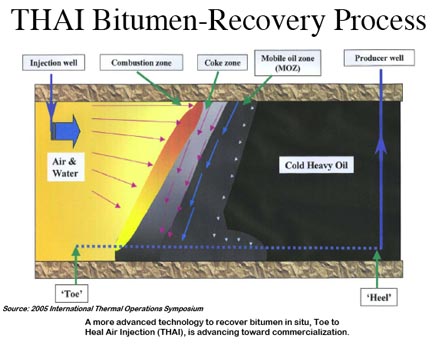
More Hot THAI Takeout for Canadian Oil Men

Trillions of barrels of oil equivalent sits in Canadian oil sands, waiting for better extraction methods. Brian Wang thinks this method may be what the oil doctor ordered. Better methods of extracting the trillions of barrels of oil equivalent sitting in US and Canadian oil shale are also in the pipeline.
If the Capri/Thai processes are successful then Canada's oilsands, other oilsands and heavy oil deposits around the world will have higher recovery rates using a more economic process and the oil will be upgrading in the ground to a higher and more valuable quality. This would be the technology that would crush peak oil for several decades and allow an orderly transition to a post oil world. The processes would enable trillions of barrels of oil to be economically accessed. In a few months the Capri process could be proven out and the energy world would be changed. Oil technology would change the world by unlocking the oilsand and heavy oil around the world. Trillions of barrels of oil would become economically feasible. It [will be a (AF)]world and game changer. _NextBigFuture
The profitability of oil shale and oil sands extraction processes depend upon oil prices being above $80 a barrel. With rapid advances in algal and biomass biofuels, along with more nuclear, better industrial heat recovery, higher efficiencies, and shifting to an electrical vehicle fleet, high oil prices for the indefinite future are a bad bet.

Labels:

Bookmark and Share

10 April 2008

Resurrected Oil Wells Come Back from the Dead

According to oil microbiologist Lewis Brown, 2/3s of oil in US oil wells remains in the ground, for lack of advanced enough technology to extract it. Brown is learning how to take oil wells that have been declared dead, and bring them back to life.
Before Brown began his Alabama experiment, analysts had predicted those wells would stop producing in 1998. After Brown had applied his method, follow-up analysis indicated the wells could still produce--and might continue to do so until 2015...To date, the Alabama project has recovered more than 400,000 additional barrels. "This process has us talking about potentially recovering much of the now unrecoverable oil," Brown said. "This will help give us more time to develop replacements for our major energy source."

...By feeding only indigenous microbes in the oil-bearing formations, Brown avoids problems that can plug the wells. While limiting the amount of environmentally friendly nutrients limits their growth, it successfully alters the paths of injected water used to sweep the hiding oil from previously untouched areas.

In addition to being environmentally friendly, the process is cost-effective, Brown observed. In a recent field trial, the additional cost of the process was just $1.32 per barrel of new oil...Though there are limits to the depths at which microbes can be expected to grow, Brown has been able to isolate microbes at depths of more than 14,000 feet, and some can even grow at temperatures above 100 degrees Celsius.

"This certainly extends the number of oil fields where this methodology could be applied," Brown said proudly.

While Brown continues to work with petroleum industry leaders in removing additional oil from the ground, he has launched a second project in Wyoming to revive depleted natural gas wells located in coal beds. As with the liquid product, he's using indigenous microflora in these wells to produce more methane. __Source__via__NextEnergy
Enhanced oil recovery methods are yet another factor that Peak Oil Prophets had not counted on. Peak Oil collects a ragged and pathetic following, that seems to revel in the imagined collapse of civilisation.

But scientists such as Brown can not waste their time on such absurd fantasies. He has work to do. After all, the oil won't pump itself.

Previously published in Al Fin Energy

Update: Dennis Mangan provides a stock pick. He may well be on to something.

Labels: , ,

Bookmark and Share

31 March 2008

A Lot More Oil Where That Came From

Huge quantities of oil lie in sediments that have been covered by volcanic activity over hundreds of millions of years of geologic upheaval. New methods of "seeing through" lava flows on the ocean floor--to the rich sediments below--are bringing previously hidden regions of the planet's undersea surface into the oil exploration game.
The scientists, led by Professor Robert White, FRS at the University of Cambridge (UK), also developed a new method of seeing through the thick lava flows beneath the seafloor to the sediments and structures beneath. The technique is now being employed to further oil exploration of the area which was previously restricted by the inability to image through the lava flows.

The research was funded by a university-industry research group, which included Cambridge and Liverpool Universities, Schlumberger Cambridge Research Ltd and Badley Geoscience Ltd, with major funding input from WesternGeco, the Natural Environment Research Council, the Department of Trade and Industry, and eight oil companies.

...The researchers’ findings [...] have implications for oil exploration in the region. Large volumes of oil have already been discovered (and are being extracted) in the sediments under the seabed between the Shetland Islands and the Faroe Islands. If these same sediments extend westward towards the Faroe Islands, as geological models suggest they do, there may be more oil to be found.

Conventional exploration techniques have not been able to penetrate the thick layers of lava flows that poured over them at the time the North Atlantic broke open. Techniques developed in conjunction with the mapping research enable the penetration of the molten rock layer to the sediments and structures that lie beneath them.___GCC
Peak Oil theory is based upon ignorance: Ignorance of the true extent of oil formations under most of the surface of the Earth. Only North America has been fairly well explored for oil, and even there, large new fields are still being found. The age of oil is far from over.

Which is a good thing, since neither renewable energy nor nuclear energy are ready to provide the fuels and power currently being provided by oil and gas. Oil will be absolutely necessary during the next few decades, to bridge into the new era of renewables, safe fission, and hopefully controlled fusion.

Labels: , ,

Bookmark and Share

23 February 2008

Peak Oil: Meet PIP

Discovering new oil and gas deposits is expensive and time-consuming. But new exploration technologies are making it easier to find deposits that were almost impossible to find with traditional seismic technology. One of these technologies is PIP: Passive Induced Polarization.
Eldorado Exploration (Pink Sheets:EDEX) announced today that it expects its Passive Induced Polarization “PIP” technology to locate hundreds of undiscovered commercial oil and gas deposits. ‘PIP’ can be used to survey large areas and find large and small targets that traditional 3D Seismic technology used by the major oil and gas companies couldn’t find or were judged cost prohibitive. The potential commercial value of these undiscovered oil and gas reserves if successfully located and drilled is in the billions.

...The process helps eliminate geological prospects that will be dry holes. Strong signals indicate commercial potential of discovering oil and/or gas. No signal or weak readings indicate low probability for a successful find. The cost of evaluating prospects is a small fraction of 3D Seismic and takes much less time. 'PIP' technology takes days instead of months or years for 3-D Seismic.___Source
The amount of oil still in the ground, undiscovered, is no doubt far larger than all the oil that has been extracted or discovered to this time. It would be absurd to assume otherwise, given the miniscule proportion of the Earth's crust that has actually been explored--in any meaningful way.

This year is projected to be an active year for oil exploration and production startups.
The number of start-up oil and gas exploration and production companies in the U.S. is on pace to match the high volume seen in 2007, according to Oil and Gas Investor This Week, the online weekly e-letter of Hart Energy Publishing.

Oil and Gas Investor This Week recently published its annual round-up of 2007 E&P start-ups, showcasing 36 new companies.

“The past year saw no shortage of new energy companies, with high equity commitments helping to form new E&Ps and the promise of long-term benefits inspiring an explosion of MLP IPOs. Already, 2008 is looking to continue the previous year's trend,” remarked Stephen Payne, editor of Oil and Gas Investor This Week....Oil and Gas Investor This Week is the most authoritative news source on new financings in North America. Fifty times a year, the e-letter features news on company formations, moves by key industry personnel and comprehensive lists of new financings and insider trading.____Source

The huge untapped petroleum resources that remain in the ground, will be of benefit as a bridge between present non-sustainable energy methods, and the more sustainable energy that humans are just beginning to master. When humans abandon petroleum, it will not be due to peak oil, or the lack of more oil to pump. It will be due to cleaner, sustainable, less expensive fuels that are readily available.

Labels: , ,

Bookmark and Share

27 January 2008

Peak Oil: Meet Bakken Formation

The Bakken geologic formation straddling the border of the US with Canada, contains a lot of oil shale, and sweet crude. Brian Wang at NextBigFuture looks at the possibility that there may be another "Saudi Arabia's worth" of oil under the plains of Saskatchewan and North Dakota.
Estimates are anywhere from a conservative 25 billion barrels of oil in place, to a high estimate by the United States Geological Survey of 400 billion barrels of oil in the Bakken formation. Not only is the oil plentiful, but it's high quality too, 41 degree light sweet crude. The Bakken formation is a formation of black shale, siltstone, and sandstone. The formation lies beneath the Mississippian formation, Saskatchewan's current source of light sweet crude. The Bakken formation is situated beneath southeastern Saskatchewan, southwestern Manitoba, and North Dakota.

In 2007, EOG Resources out of Houston, Texas reported that a single well it had drilled into an oil-rich layer of shale below Parshall, North Dakota is anticipated to produce 700,000 barrels of oil.____>Brian Wang (much more with links)
No one expects such regional oil deposits to give North America independence from the "dictator's oil" of Russia, the Persian Gulf, Africa, or Venezuela any time soon. Industrial economies necessarily draw their energy from a wide variety of sources--particularly in the age of a booming India and China, with their huge, growing energy demands.

It is interesting to note that Saskatchewan has huge deposits of tar sands farther north, in addition to the potentially enormous deposits of oil shale and sweet crude within Bakken. Will Regina and Saskatoon begin taking on some of the more affluent aspects of Dubai?

Here is a pdf document looking at the estimate of oil within Bakken

It is important for those who truly wish to understand the current energy situation, to know that there is a tremendous shortage of skilled and trained manpower to develop all of the reserves known to exist--and a much greater shortage of trained and skilled manpower needed to explore and discover the huge oil fields likely to exist, but remaining undiscovered. Peak oil is actually a euphemism for the shortage of trained and skilled workers.

Labels: , , , , ,

Bookmark and Share

23 November 2007

Peak Oil: Meet Maugeri's TAO

Only around 2,000 new field wildcats (wells made for exploring the presence of hydrocarbons in the subsoil) have been drilled in the entire Persian Gulf region since the inception of its oil activity, as against more than 1 million in the United States. TAO

Leonardo Maugeri's 2006 book, "The Age of Oil (TAO)," is an indispensable look at the past, present, and future of the role of petroleum. Written in two parts, TAO first looks at the human history of oil along with current events of oil. The second and final section of TAO looks at the question of whether the world is at or near "peak oil."
In April 1977, the Central Intelligence Agency (CIA) delivered a highly influential report stating that the growth of world oil demand would soon outpace production because of constraints on OPEC potential and the impending peak of Soviet Production. By the 1980s, the report argued, oil would be scarce and very expensive....
Maugeri points to three categories of reserves used when referring to future oil reserves.

  • Proven Reserves---defined as the amount of oil and gas in place in known reservoirs that can be estimated with "reasonable certainty" to be commercially recoverable under current economic conditions....profitable recovery of at least 90 percent.
  • Probable Reserves---the probability of profitable recovery falls to 50 percent
  • Possible Reserves---profitable probability of recovery no less than 10 percent.
Maugeri points out that:
During the last 25 years more than 70% of exploration has taken place in the United States and Canada, mature areas that probably hold only 3% of the world's reserves of crude. The Middle East, on the other hand, has been the scene of only 3% of global exploration, even though it harbors 70% of the earth's reserves. In the Persian Gulf, holding 65% of the region's reserves, fewer than 100 exploration wells were drilled between 1995 and 2004. During the same period, 15,700 such wells were drilled in the U.S. Forbes

Future advances in the technologies of production, and refinement--as well as improved efficiencies of utilisation--have the potential to move reserves from the "possible" and "probable" categories up to the "proven reserves" classification. Future advances in discovery technology have the potential to expand all reserves significantly.

A recent declaration by the Energy Watch Group that world petroleum production had peaked in 2006--had passed "peak oil"--was based on an analysis of world petroleum production, without considering either world petroleum reserves or seriously considering the many reasons why world petroleum production might peak from time to time without signaling any type of "peak oil."

Maugeri concludes his book with a look at "resource nationalism," the gloomy reality that most of the world's known conventional petroleum resources exist in territories controlled by dictators and autocrats--Russia, Venezuela, Saudi Arabia, Iran, Libya, etc. For this reason, oil prices are likely to remain quite high--unless market forces arising from new discoveries and production outside the autocratic zone force the dictators of oil to compete once again.

Remember, nationalised resources do not tend to attract the latest technology in discovery, production, and refinement. That means that a lot of resources remain in the ground.
Despite its long history as an oil producing region, the Persian Gulf is still relatively virgin in terms of exploration. Only around 2,000 new field wildcas (wells made for exploring the presence of hydrocarbons in the subsoil) have been drilled in the entire Persian Gulf region since the inception of its oil activity, as against more than 1 million in the United States. p. 221 TAO

More from Maugeri at National Geographic, Forbes, and Foreign Affairs.

Labels: , , , , ,

Bookmark and Share
Older Posts
Al Fin Main Page
Enter your Email


Powered by FeedBlitz
Google
WWW AL FIN

Powered by
Blogger

``