23 October 2011

Is This the State of the Earth, Prior to the Collapse?

Globaia.org has compiled a set of maps which reveal much of the "human layer of planet Earth." The energy map above reveals pipelines, powerlines, and other parts of the planetary energy infrastructure.
This map reveals the cities, the roads, the airways, the shipping ways, and more. Note where most of the action takes place, and consider why that may be so.
This map reveals where humans are procreating the most rapidly, and where future population growth is likely to occur. This is particularly important, as the United Nations ramps up overpopulation fears this week at a highly publicised event.
This map reveals the per person GDP of selected nations, as well as the estimated average population IQ by nations. Note that it is the poorest and least intelligent populations which exhibit the highest fertility. As we have learned recently, these are also some of the world's most violent populations.

So, is it time to panic? The global hysteria bandwagon and PR machine appears to be mobilised for an all out panic blitz via the skankstream media. The rather sleazy media release of partial and preliminary conclusions of the BEST Project has tipped the hand of the backstage manager -- particularly when combined with this coming week's UN population report extravaganza. More on BEST Project from Steve McIntyre.

According to our overlords, it is time to panic. According to our masters, we have no choice but hand total control of our lives over to those who know best. The alternative, you see, is total devastation of the entire planet. A race of conquering extraterrestrial invaders could not craft a more stark ultimatum: Surrender, or your planet will be destroyed!

The clear -- but unintentional -- message from this ramping up of public hysteria and alarmism, is that the overseers are beginning to see their grand plans falling apart in their hands.

What has changed over the past year, for the UN to suddenly warn that the world population may grow to 15 billion by the year 2100 -- when the message from the UN last year was that the most likely number in the year 2100 would be 10 billion or fewer? This appears to be a re-cycled prediction from the 20th century of population angst, brought back to life to suit a particular purpose in time and place.

Large portions of the populations of North America, Europe, and Oceania, have begun to move away from this mass hysteria over climate, population, resource scarcity, and environmental doom. Suddenly, a tempered optimism is gaining ground in the public sphere. We have grown emboldened enough to ask ourselves: "Would the world end if we became more optimistic?".

But this optimism is unacceptable, so we are being told to panic by the UN, the climate orthodoxy, the multi-billion dollar Green power block, and by powerful members within our own governments. We are being pressured to give up and let our betters take over the planning and operations of virtually every detail of our lives. We are being told that we have no choice in the matter.

But if we truly had no choice in the matter, I suspect that the public relations machine of the movement -- in conjunction with the skankstream media -- would not be resorting to these dishonest and frantically thuggish methods of influencing public opinion.

Question authority.

All of this renewed drive toward a grand global public hysteria is oriented toward upcoming elections. Many of the politicos who are favoured by the movement, are in danger of losing power, causing the movement to lose precious momentum. This momentum must be maintained at all costs. Thus the rush to panic the herd.

But when things are rushed, mistakes are made. These mistakes allow clearer glimpses into the machinations of the movement's coalition. That is when the weak points can be noted, and studied.

Pay close attention to what happens next.

Labels: , , ,

Bookmark and Share

17 June 2011

Incorrigible Doomseekers Profit from Your Fears

In the late 1990s author James Howard Kunstler argued that Y2K would bring civilization to its knees. That didn’t happen, but that didn’t lead Kunstler to rethink his views on the end, just the means....Stanford biology professor Paul Ehrlich and his wife Anne, who in their 1968 book The Population Bomb predicted massive global starvation due to overpopulation in the 1970s and ’80s. Was there starvation in those decades? Yes [There always is _ed.]. Was it massive and global? No. Were the Ehrlichs chastened? Not so much. While they concede their scariest doomsday scenarios were “way off,” on the larger question of looming disaster they say they were “too optimistic.” _Cecil Adams @ CityPaper
Incorrigible doomers glom onto doom-causes du jour such as carbon hysteria, Y2K, overpopulation, peak oil, etc. The cause is not important, it is the hovering doom that counts.
A couple decades ago climatology consultant Iben Browning predicted a huge earthquake centered on New Madrid, Mo., a well-known earthquake zone where seismologists have long predicted a future cataclysm. However, they’ve never given an exact date, because to do so is beyond the grasp of current science. Public reaction to these open-ended prognostications: yawn. Browning’s innovation was to assert flat out that the earthquake would happen on Dec. 3, 1990, backing up his claim with a convincing pseudoscientific spiel. Result: a media frenzy, but no quake.

...How do doomsayers cope when their predictions go south? There’s a common thread regardless of how delusional they are. In When Prophecy Fails, a landmark 1956 study of cultists awaiting a world-ending flood, psychologist Leon Festinger proposed his theory of cognitive dissonance, which describes how people rationalize their continued adherence to disproven claims.

The shrewder doomsayers do this too, but their rationalizing is often something like: all in the service of the greater good. You can’t blame them, really. They’re just making practical use of the paradox known to every politician who ever walked the earth: people will listen when you lie to them, and ignore you when you tell the truth. _Cecil Adams
The hucksters of doom have learned how to profit from your fears and your gullibility. They always have a book, a seminar, a newsletter, or other means by which to transfer your wealth into their pockets.

But don't be too complacent. When your government is run by fools who disregard the well-known hazards of excessive debt and demographic decline, hard times are waiting right around the corner.

The pseudo-intellectual fools who currently run governments, academia, the media -- the parasitic classes -- have over the decades bred and trained a large following of drones unable to think or act for themselves. When the true catastrophes eventually come around, there will be fewer competent persons to deal with them than there should have been. Thanks to trumped up worries over fantasies, combined with the studious obfuscation of potential problems that have been steadily building in seriousness within populations of the advanced world, there is a real danger.

But you will have to face it alone, or with small groups of like-minded persons who took the trouble to prepare. Most important of all, you will need to learn to conceal your preparations from the parasitic classes while at the same time recruiting as many persons from among your friends and family as you can.

The pseudo-panics caused by grifting doomseekers are just part of the rampant parasitism that thrives under corrupt governments and decayed cultures. We must take them in stride along with the rest, while stocking up appropriately for what may truly come.

Labels: , ,

Bookmark and Share

29 September 2010

Would the World End if We Became More Optimistic?

We are living in an apocalyptic age. We have been living in the apocalyptic age for many decades -- even centuries and more. Humans are strangely attracted to the apocalyptic mindset. Perhaps the doomer mentality is an intentional but subconscious talisman, meant to protect against genuine doom. But what would happen if the media, academia, politicians, big environmental lobbies, NGOs, and the rest of the doom industry were to take a break every now and then? At least on topics such as carbon hysteria, peak oil doom, overpopulation apocalypse, and the other faux dooms that line so many pocketbooks?
Indur M. Goklany has taken a look at the state of the world, and has come to the conclusion that, overall, things are improving.
**Key points from the book** * The rates at which hunger and malnutrition have been decreasing in India since 1950 and in China since 1961 are striking. By 2002 China’s food supply had gone up 80%, and India’s increased by 50%.

Overall, these types of increases in the food supply have reduced chronic undernourishment in developing countries from 37 to 17%, despite an overall 83% growth in their populations. * Economic freedom has increased in 102 of the 113 countries for which data is available for both 1990 and 2000. * Disability in the older population of such developed countries as the U.S., Canada, France, are in decline. In the U.S. for example, the disability rate dropped 1.3 % each year between 1982 and 1994 for persons aged 65 and over. * Between 1970 and the early 2000s, the global illiteracy rated dropped from 46 to 18 percent. * Much of the improvements in the United States for the air and water quality indicators preceded the enactment of stringent national environmental laws as the Clean Air Act of 1970, Clean Water Act of 1972, and the Safe Drinking Water Act of 1974. * Between 1897-1902 and 1992-1994, the U.S. retail prices of flour, bacon and potatoes relative to per capita income, dropped by 92, 85, and 82 percent respectively. And, the real global price of food commodities has declined 75% since 1950. _WUWT

Matt Ridley's recent book, The Rational Optimist, dares to contradict most of the modern "dooms du jour" of modern media, academia, faux environmentalism, and popular culture.
Julian Simon was the ultimate optimist, and his most famous book -- Ultimate Resource II -- is available to read free online.
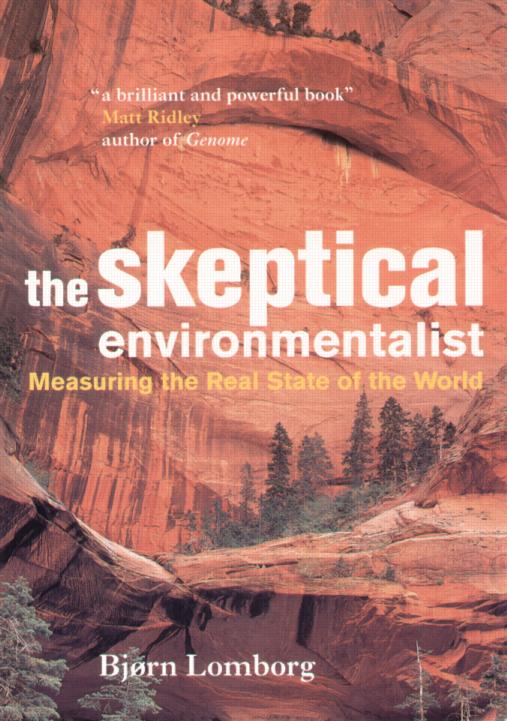
Bjorn Lomborg's The Skeptical Environmentalist, was far too optimistic for the taste of faux environmentalists and the corrupt scientific : faux environmental industrial complex. Rather than jumping on the bandwagon of the popular and mythical dooms favoured by the media, academia, and politicians, Lomborg calmly and rationally looked at the real problems of the environment -- and finds them soluble.
Stewart Brand is the grand old man of 60s environmentalism, whose basic wisdom and honesty have led him to reject the doomerism of the faux environmentalists and the modern media. Brand has not escaped the dogmas of faux environmentalism entirely -- he lives in the San Francisco bay area -- but he promotes nuclear energy and other scientific and technological solutions to the problems that do exist.

Full disclosure: Genuine dooms exist. The Earth has suffered through several extinction episodes where life was nearly wiped out -- and perhaps events where life actually was wiped out and had to re-start from scratch.

But we need to focus on the real problems which need solutions, and do it in a systematic and dispassionate manner.

Doomers, with their constant full-volume blare of apocalypse, do not deserve to monopolize our time.

Labels: , ,

Bookmark and Share

19 July 2010

White House Panics Over Natural Oil Seep

Officials had worried that the seep — usually a flow of hydrocarbons from the seafloor — could have been evidence that oil, gas or both were escaping from the well up to the seafloor, forcing the government to order BP to remove the cap and resume oil collection.

But seeps also occur naturally, and in a briefing for reporters Monday afternoon, BP said that government and company scientists were coming to the conclusion that the seep was probably of natural origin and unrelated to the well. _NYT

Image Source
BP's Kent Wells reports that pressures at the well head continue to rise -- a good sign -- and are now above 6811 psi. But the discovery of a natural gas seep on the seafloor -- located roughly 2 miles from the Macondo well head -- almost caused the White House to order the re-start of a nearly 1 million gallons a day oil spill into the Gulf of Mexico. Just when Gulf residents had begun to hope their long nightmare was nearly over, the squirrelly Obama administration threatens to start it all up again.

Officials in the Obama administration have become so jumpy that the presence of tiny amounts of oil and gas leaking around the new sealing cap have them on the phone to BP nearly around the clock, seeking constant reassurance.
Some thoughts on all the oil spill handwringing this afternoon. The government says seeps have been spotted within two miles of the site of the blowout. So what? Does that mean it's time to be panic that oil from the Macondo well is finding a new path to the surface, and is set to burst open through the seafloor in a new, unstoppable gusher? Probably not....Natural seeps occur constantly in the Gulf of Mexico, and had been spotted around the blowout well by NOAA's science ship Thomas Jefferson long before this recent capping maneuver. The good news is that according to BP, pressure readings from the well continue to climb roughly 2 psi per hour, to 6,811 psi as of late afternoon. Climbing pressure is a good sign. If the oil were to pop a new hole in the seafloor, we would see pressure plunge. _Forbes
So it looks as if the sealing cap will remain -- despite the panic at the White House -- for at least another 24 hours.
Leaks in the valve stack atop BP Plc’s Macondo well and seepage at the base of the blowout preventer are “inconsequential,” so valves that prevent it from gushing oil will remain closed for now, National Incident Commander Thad Allen said.
Pressure inside the well is 6,811 pounds per square inch and rising, a “positive” sign that there’s no leakage that could accelerate into another gusher of oil and gas, Allen said today at a press conference in Washington.
The well will be shut “day to day,” starting with the next 24 hours, so long as BP continues monitoring the seeps of methane as directed by the government there’s no sign of significant leaks, he said.
The seeps consist of methane, or natural gas, he said. A seep found 3 kilometers (1.9 miles) away was not from the BP well, he said. _BW
President Obama was quite eager to claim credit when it looked as if the sealing cap was successfully closing off the well. But all it took were a few bubbles to shake the White House to the foundation.
From the beginning, authorities said that if the pressure hit 7,500 psi it would indicate that the well was intact. If it went below 6,000 psi, it would indicate that cracks or other damage to the well was allowing oil to escape. So far, the pressure has remained in the indeterminate range between those two numbers. On Monday afternoon it was 6,811 psi, and gradually rising a pound or so every hour, Allen said.

The fact that it's increasing slightly over time -- rather than decreasing -- is a good sign that there's not a leak, says David Rensink, incoming president of the American Association of Petroleum Engineers. _PBS
The possibility remains that the well will lose integrity before the first relief well -- now only 4 feet from the Macondo bore, horizontally -- is able to finally secure the well. If that happens, BP will be forced to resume containment efforts to surface ships such as the Q4000 and the Helix Producer. In that case, some additional oil would spill into the Gulf, during the changeover.

But can you imagine how Obama would be seen in the Gulf and the US as a whole, should he decide to re-open the oil spill into the Gulf based upon a few bubbles of methane from a natural seep? You may suppose that Obama could not appear any more inept than he already does, but he may surprise you over the next few months and years.

More: 5 Wild Technologies used to clean up Macondo spill The problem with "A Whale" may have been that the underwater dispersant used was too efficient. The surface slick was simply too skimpy for the huge supertanker--skimmer.
Causes of marine oil pollution: notice that "extraction" (such as the BP spill) represents a relatively small contributor to ocean oil contamination -- particularly compared to natural seeps and everyday rain runoff from land.

Labels: , , ,

Bookmark and Share

02 May 2010

Media and Intelligentsia Panic, Problem Solvers Get to Work

ImgSource

BP has initiated the process of drilling a relief well, to allow access for stopping the flow of pressurised hydrocarbons through the original well. One oil expert expects the oil flow to taper off on its own, without need for a relief well. The relief well could take from 6 weeks up to 3 months to complete.
ImgSource

In the meantime, BP is planning to create a containment vessel of some type to fit around the oil spill at the seafloor. This would limit the ultimate size of the oil slick at the surface. Captured hydrocarbons would then be pumped for storage.
ImgSource

Floating oil booms on the surface will allow for retrieval of some floating oil perhaps via Dracone barge, and a controlled burn of trapped oil that cannot be retrieved. Concurrently, large quantities of chemical dispersant and biological degradation agents will be applied to the spill from the air and sea. The current oil spill is light crude, a large portion of which tends to evaporate into the air.

The US Coast Guard, the US Navy, and the Louisiana National Guard will all be involved in slick control efforts and environmental remediation, as well as other agencies of the US government.
ImgSource

The above image illustrates some of the natural processes that occur after an oil seep or spill.
Natural dispersion: If there is no possibility of the oil polluting coastal regions or marine industries, the best method is to leave it to disperse by natural means. A combination of wind, sun, current and wave action will rapidly disperse and evaporate most oils. Light oils will disperse more quickly than heavy oils.
Booms and skimmers: Spilt oil floats on water and initially forms a slick that is a few millimetres thick. There are various types of booms which can be used either to surround and isolate a slick, or to block the passage of a slick to vulnerable areas such as the intake of a desalination plant or fish farm pens or other sensitive locations.

Boom types vary from inflatable neoprene tubes to solid, but buoyant material. Most rise up about a metre above the water line. Some are designed to sit flush on tidal flats while others are applicable to deeper water and have skirts which hang down about a metre below the waterline.

Skimmers float across the top of the slick contained within the boom and suck or scoop the oil into storage tanks on nearby vessels or on the shore.

However booms and skimmers are less effective when deployed in high winds and high seas.

Dispersants: These act by reducing the surface tension that stops oil and water from mixing. Small droplets of oil are then formed which helps promote rapid dilution of the oil by water movements. The formation of droplets also increases the oil surface area, thus increasing the exposure to natural evaporation and bacterial action.
Dispersants are most effective when used within an hour or two of the initial spill. However they are not appropriate for all oils and all locations. Successful dispersion of oil through the water column can affect marine organisms like deep water corals and seagrass. It can also cause oil to be temporarily accumulated by subtidal seafood.

...Most of the components of oil washed up along a shoreline;can be broken down by bacteria and other micro-organisms into harmless substances such as fatty acids and carbon dioxide. This action is called biodegradation. The natural process can be speeded up by the addition of fertilising nutrients like nitrogen and phosphorous which stimulate growth of the micro-organisms concerned. _OilSpills

ImgSource

Only a small fraction of all petroleum spilled into marine waters comes from oil drilling activity.

The Deep Horizon disaster should not be brushed off or minimised. And yet, the news media and the Obama administration appear to be milking the tragedy for every ounce of profit and power-grabbing opportunism imaginable. And just wait until the lawyers start to show up!

FlickrSlideshow Source

Accusations that BP was too slow to react
More favourable description of BP's early response
Command center website and latest news
List of recent news articles from Offshore Mag
Futuristic swarm suction robot designed to suck up oil spills
Wikipedia article on oil well blowout

The distinction between the problem-solvers and the swinish opportunists has never been clearer. The next level will not allow the complete avoidance of disasters and catastrophes. But next level humans will not sit around and whine over a disaster. They will devise and implement imaginative yet competent solutions. That is the type of focus we should aim for.

Labels: , ,

Bookmark and Share

27 April 2009

Sure, We Still Kiss the Same Way as Always -- But We Use Protection When We Have Sex

With more than 100 people dead in Mexico and almost 30 infected in the US and Canada, the threat of a flu pandemic is gripping the world. Although there had been hopes that the emergency could be contained to the North American continent, Europe saw its first confirmed case on Monday. _Spiegel
A world-wide panic over swine flu is on, and the news media is primed and ready to pump up the panic to the popping point. Suddenly bird flu is out and swine flu is in? If I were a bird I would think about suing CNN for neglect. Nothing excites journalists so much as people dying unexpectedly.

In the real world, people die of flu, cancer, heart disease, pneumonia, diabetes, accidents, violence ... in large numbers every day -- but in "newsworld" all deaths are unexpected. They have to be unexpected to be news. Several "unexpected" deaths attributed to the same cause will make a newsroom positively giddy for days on end. Especially if the media can paint the cause of death as a threat to viewers and readers. That kind of threat has the makings of panic, and panic sells papers.
With the first case of swine flu confirmed in Europe, the world is gripped by fear of a global pandemic. German newspapers on Monday examine the measures taken to contain the disease and some warn against the spread of panic. _Spiegel
Global markets are down on swine flu fears -- at least partially. Of course, in an Obama depression global markets need little reason to be down. Coincidentally, Felipe Solis, an archeologist in Mexico who recently shook Obama's hand, and spent a great deal of time in close proximity to the narcissist in chief, died of swine flu shortly thereafter.

Panic, damn you! We're the government-media complex. We're here to help you. And we can't really help you unless you are thrashing about helplessly, gripped by an uncontrollable panic. So panic, already!

Labels: , ,

Bookmark and Share

05 January 2008

Panic, Damn You!!! 2

What does it take to bring you to the verge of panic? Global Warming? Peak Oil? Muslim terrorism? Threats of economic recession? The thought of [you fill in the blank] in the US White House? Whatever it takes, the mainstream media is determined to push your panic button. The media has no scruples about crying "fire" in a crowded theatre.

Popular panic, or collective panic, typically happens when the fear of being trapped in a dangerous place sweeps through a large group of people. This often leads to a mass stampede with some number of persons being trampled underfoot.

In the case of Peak Oil or Global Warming, panic may take the form of a fearful "hunkering down." When an entire society "hunkers down", it fails to plan for and invest in the future. In such a situation, predictions of recession become self-fulfilling prophecies, as investment capital for economic growth is pulled out of the productive economy and placed in more fear-based "investments."

The most knowledgeable voices on oil supplies at this time are Leonardo Maugeri and Daniel Yergin. If you have not read their respective books, The Age of Oil, and The Prize, you need to do so quickly so as to be informed on this issue. "Peak Oil" is a relatively cut and dried issue compared to "Climate Change." By reading Maugeri's book in particular, you will have a much better handle on Peak Oil.

To better understand the panic and hype over "Catastrophic Anthropogenic Global Warming" (CAGW), will take more time, thought, reading, and getting your hands dirty with a calculator. But it will be worth it if you can face the future with more confidence, rather than being at the mercy of climate grifters such as Al Gore.

Start with Warren Meyer's (Skeptical) Layman's Guide to Man-Made Global Warming. Warren also produced a free online climate video. The best website for an open discussion of technical climate issue (without climate orthodoxy censorship of ideas) is Steve McIntyre's Climate Audit. Just as good--but not allowing comments--is Roger Pielke Sr.'s Climate Science blog. Roger's blog is full of scientific articles that expand the climate discussion beyond the narrow issues considered important by Al Gore's Nobel partner, the IPCC.

For staying informed on issues of Islamic terrorism, I recommend a select group of journalists and blogs that work overtime to accumulate reliable information.
The Long War Journal
Michael Totten
Strategy Page
Robert D. Kaplan
Small Wars Journal
Belmont Club

Any readers who wish longer reading lists for any of the above topics, contact me at alfin2100@hotmail.com

A panicked populace is a populace in a state of involution or atrophy. The problem is a reluctance to invest in the future. That reluctance includes a reluctance to procreate to replacement--which is a huge problem for the western world and Japan.

Symptoms of this destructive pathology of the human spirit includes the rise of organisations calling for massive cutbacks in world population including dieoff.org, the human extinction movement, and other groups including those privately endorsed by academics like Eric Pianka. The fact that a large segment of leftist, postmodernist academia and media supports this human "die-down" and reversal of the scientific and technological progress of the western world, should cause parents to seriously consider the educational paths of their children. Unless they actually want their children to have this deep-seated pessimism instilled deeply in their children's developing minds.

The best antidote to panic is to be both informed and prepared. There will no doubt be some large bumps in the road over the next few decades, getting from our present "between-levels" state to the next level. The best "shock absorber"for those bumps is knowledgeable preparation.

Hundreds of thousands are without grid power in California currently, from Pacific storm damage. Obviously everyone needs stored clean water, food, and provisions for alternate heat, refrigeration, and power. Fire extinguishers. Emergency lighting. Medicine kit stocked for at least a month. Extra cash. (ATM's not working) Optional barter supplies.

Here are Popular Mechanics' lists for survival kits. The Al Fin sidebar has more sources for survival information and supplies in the lower 1/4th of the sidebar.

If you are not willing to panic, be prepared.

Labels: ,

Bookmark and Share

26 December 2007

Peak Oil: The Reallity

The fashionable response to high energy prices is "Peak Oil Panic." But that is reacting to a fantasy scenario--not the reality.
As you can see, large supranational blocks are very different from individual countries. They have a tendency to plateau for extremely long periods of time. For example, North America has been on a plateau of about 14mbd for almost 20 years. Asia-Pacific has been on a plateau of 6-7mbd for almost 20 years. South/Central America has logged a couple of long plateaus, most recently a plateau of about 6.5mbd for 10 years.

The evidence suggests that the world (as the largest supranational unit) will plateau for a very long time -- even decades -- just like CERA says.
POD

Oil and coal are dirty fuels, and we would do well to move away from the pollution of fossil fuels to cleaner and more sustainable forms of energy. But "Peak Oil" enthusiasts are claiming that there is not enough time to transition. They are screeching from their blog rooftops and soapboxes that we are all doomed. They are not trying to create panic--mind you. They merely want to let us know what is coming, then sit back and watch the panic set in. But in reality, what sort of fringe-kookery are they?
Petroleum geologists are pretty sure that there is more than enough oil in the world to meet projected demand for at least the next 25 years. In other words, as I reported in my article “Peak Oil Panic” last year, geologically speaking “peak oil” is at least a generation away.
Reason

What type of apocalyptic visions do the peak oil prophets-of-doom project into our futures?
The most pessimistic of these Cassandras, like American writer James Howard Kunstler, predict nothing less than the wholesale collapse of industrial civilization. In his 2005 bestseller, The Long Emergency, Kunstler envisaged a future in which the survivors of the oil-peak catastrophe eke out a living in an 18th-century-style economy: the great cities are abandoned, almost all production is for local consumption, and the higher technologies have mostly been lost.

Kunstler's great hate is the suburbs, which are mainly an artifact of the cheap-oil era, and one gets the feeling that he would secretly welcome any catastrophe that destroyed them.
Commentary

We are seeing higher oil prices now--although if one corrects for inflation, the prices are not as high as most human-passive-news-receptacles tend to think. And while it is fashionable to say that world oil production will reach a sharp peak, then decline indefinitely down to zero--that is the fantasy of the neo-Malthusians.

Such groups as this and this actually want to see the human population forcibly reduced to about 10% or less of its present level.

But human overpopulation is not Earth's problem. Humans thrive in cities--if the cities are well designed and administered, and if the city's human average population IQ is high enough to support a high tech infrastructure. The population of Taiwan is far denser (636 per km2)--but more prosperous and better educated--than the population of China (137 per km2). China has attained the status of world's biggest polluter and greenhouse gas emitter. Rather than planning a violent invasion of Taiwan, China should be learning to imitate Taiwan's success.

The concept of the arcology--the self-contained city--is a useful one for viewing a population-dense but healthy and thriving population. But far more interesting than studying how many hundreds of billions of humans a healthy, thriving, technologically advanced planet Earth could support, is studying how many humans a healthy thriving technologically advanced Solar System could support.
The asteroid belt contains an estimated 825 quintillion (a billion times a billion) tons of iron -- enough to build shells around planets, gigantic cities in space, and starships carrying entire civilizations. How much is this iron worth? Lewis performs a fanciful calculation: At present prices of around $50 a ton, the asteroids yield $7 billion of the metal per person for everyone alive today, or an affluent standard of living for a population far larger. Moreover, iron is merely one element found in the Main Belt, which also contains gold, silver, copper, manganese, titanium, uranium, and much else.
Reason

As for peak oil, we can see from the graph above that oil production is not likely to reach a sharp peak. What will be seen for the next few decades is a long plateau with slight ups and downs. When oil production truly does peak, it will be due to a precipitous drop in demand caused by alternative sources of energy.

There may be ample reasons for a person to "plan for the Apocalypse", but peak oil theory is not one of the better ones. Still, for people lacking in logical facility and of limited imagination, peak oil belief may be better than selling crack on the street.

For others who actually care whether their thought processes are tracking in at least a rough parallel path to reality, it is important to test hypotheses against real world data points and trends. That is something that the quasi-religious CAGW believers and peak oil believers tend to avoid. For the religious and the quasi-religious, it is beliefs that matter, not reality--to our best approximation.

Peak oil and "global warming" are not existential risks. Rather, they belong to a class of "dysfunctional ideologies" which, if adopted by advanced societies on a broad scale, would contribute to the loss of vigour and resilience that a civilisation must have to survive. So rather than warning of existential risks, they become one component of a civilisational decadence and fatigue that could lead to the loss of a civilisation.


Interesting reading:

Oil Prices going down in 2008?

Why we'll never run out of oil--Discover Magazine

Confessions of Peak Oil (ex)Believer

Don't Panic written by a peak oil believer who does not see it as a problem.

Politics and Reality of peak oil scare

Labels: , , , , ,

Bookmark and Share

07 May 2006

Panic, Damn You!

Reason magazine has an interesting feature titled "Peak Oil Panic." A lot of persons who are locked into the worst prognostications of peak oil, global warming, etc. etc. appear fixed in a single mode: panic.

The good news is that the peak oil doomsters are probably wrong that world oil production is about to decline forever. Most analysts believe that world petroleum supplies will meet projected demand at reasonable prices for at least another generation. The bad news is that much of the world’s oil reserves are in the custody of unstable and sometimes hostile regimes. But the oil producing nations would be the ultimate losers if they provoked an “oil crisis,” since that would spur industrialized countries to cut back on imports and develop alternative energy technologies.

Apocalypse Yesterday

Predictions of imminent catastrophic depletion are almost as old as the oil industry. An 1855 advertisement for Kier’s Rock Oil, a patent medicine whose key ingredient was petroleum bubbling up from salt wells near Pittsburgh, urged customers to buy soon before “this wonderful product is depleted from Nature’s laboratory.” The ad appeared four years before Pennsylvania’s first oil well was drilled. In 1919 David White of the U.S. Geological Survey (USGS) predicted that world oil production would peak in nine years. And in 1943 the Standard Oil geologist Wallace Pratt calculated that the world would ultimately produce 600 billion barrels of oil. (In fact, more than 1 trillion barrels of oil had been pumped by 2006.)

During the 1970s, the Club of Rome report The Limits to Growth projected that, assuming consumption remained flat, all known oil reserves would be entirely consumed in just 31 years. With exponential growth in consumption, it added, all the known oil reserves would be consumed in 20 years. These dour predictions gained credibility when the Arab oil crisis of 1973 quadrupled prices from $3 to $12 per barrel (from $16 to $48 in 2006 dollars) and when the Iranian oil crisis more than doubled oil prices from $14 per barrel in 1978 to $35 per barrel by 1981 (from $45 to $98 in 2006 dollars).

In response, the federal government imposed price controls on oil and gas in the 1970s and established fuel economy standards to encourage the sale of more efficient automobiles. The sense of doom did not dissolve. In 1979 Energy Secretary Schlesinger proclaimed, “The energy future is bleak and is likely to grow bleaker in the decade ahead.” The Global 2000 Report to President Carter, issued in 1980, predicted that the price of oil would rise by 50 percent, reaching $100 per barrel by 2000.

Most of today’s petro-doomsters base their forecasts on the work of the geologist M. King Hubbert, who correctly predicted in 1956 that U.S. domestic oil production in the lower 48 states would peak around 1970 and begin to decline. In 1969 Hubbert predicted that world oil production would peak around 2000.

Hubbert argued that oil production grows until half the recoverable resources in a field have been extracted, after which production falls off at the same rate at which it expanded. This theory suggests a bell-shaped curve rising from first discovery to peak and descending to depletion. Hubbert calculated that peak oil production follows peak oil discovery with a time lag. Globally, discoveries of new oil fields peaked in 1962. The time lag between peak global discoveries and peak production was estimated to be around 32 years, but peak oilers claim that the two oil crises of the 1970s reduced consumption and thereby delayed the peak until now. Hubbert’s modern disciples argue that humanity has now used up half of the world’s ultimately recoverable reserves of oil, which means we are at or over the peak.

The prophets of oily doom are opposed by preachers of energy abundance. Chief among the latter is the energy economist Michael Lynch, president of the Massachusetts-based Global Petroleum Service consultancy. “Colin Campbell has the worst forecasting record on oil supply,” says Lynch, “and that’s saying a lot.” He points out that in a 1989 article for the journal Noroil, Campbell claimed the peak of world oil production had already passed and incorrectly predicted that oil would soon cost $30 to $50 a barrel. As for Matthew Simmons, Lynch dismisses him with a sneer: “Petroleum engineers know a lot more about petroleum engineering than a Harvard MBA.”

One petroleum engineer— Michael Economides of the University of Houston—calls peak oil predictions “the figments of the imaginations of born-again pessimist geologists.” Like Lynch, Economides, who worked in Russia to boost that country’s oil production in the last decade, rejects Simmons’ analysis. Saudi Arabia, which currently produces about 10 million barrels of oil a day, “is underproducing every one of their wells,” he claims. “I can produce 20 million barrels of oil in Saudi Arabia.”
Much more at the source.

A lot of people just need a catastrophe--any catastrophe--to make their lives feel worthwhile. If the catastrophe fits their political proclivities and prejudices, so much the better.

Most people are tired of this dependence on fossil fuels, and want society to move to renewables as soon as economically and technologically possible. The world will not end during this transition, much to the disappointment of the doomseekers.

Labels: , , , , ,

Bookmark and Share

30 December 2005

Philosophy of Fear

Here is an incisive analysis of popular fear mongering by the pseudo-intelligentsia over the past few decades. It is immensely humorous and revealing at the same time. The signal is fear, although the carrier wave may change, and the amplitude is always at full blast volume. Read it all, and enjoy all the great graphics.

"...David Brinkley once said, “The one function TV news performs very well is that when there is no news we give it to you with the same emphasis as if there were.”"

The dismaying thing is that students in government schools are being taught by the same type of pseudo-intellectuals who thrive on the climate of faux fear. In Running Screaming from Phantoms I briefly touched on similar issues.


credit to Rand Simberg at Transterrestrial Musings.

Other clear minded social commentary can be found at this link.

Labels: ,

Bookmark and Share

01 October 2005

Running Screaming From Phantoms

Only a tiny proportion of humans are directly involved in pushing human evolution forward. Billions will eventually benefit from the work of a mere thousands. When contemplating the future, nothing is more important than lifting up humanity's capacity to think and live completely. For some reason most people are otherwise occupied.

What are all of these people doing? Most people in the world are too poor to do much more than subsist. Try to find food, maintain shelter, provide for a family, avoid suffering as much as possible. Life is hard, then you die.

People in the developed world are also otherwise occupied. They are hanging on the words of media reports, drowning in crass entertainments and chemical numbing agents. Are they alive? They imagine they are. Their fear makes them think so. They are afraid much of the time, their culture is based on fear and insecurity.

The propagation of fear, combined with moral outrage, is the standard staple of the news media organisations in the developed world. The hugest achievement for news media executives and producers is to create a mindless stampede, to drive the public into mass action. To do this, to create mass panic that leads to mass action, they must create objects of fear and loathing. Then they must shove these feared objects into the faces of the viewing public, in every shape, manner, and permutation possible.

There is a political force at work, a thirst for power and the collusion with the powerful. News company executives are humans, with human biases and weaknesses. They want their "team" to win. They developed the tools of inciting fear, hatred, and loathing for a reason. You cannot expect them to abstain from their use, when so much power is on the table? The executives recruit the producers, anchors, reporters, researchers, who will play on their team, by their rules. The purpose of the entire team is to use the tools of fear creation to move the public to act in ways that cause the team to win. That is what dictates the content and the flavour of the news.

Be afraid. Be very afraid. Emerging viruses, climate change, corporations, globalisation, modern science, George Bush, americans, nuclear energy, western civilisation, european males, pollution, rationality, mathematics, automation, nanotechnology, artificial intelligence, genetically modified foods, genetic engineering, Israel, Jews, the rich, Halliburton, oil companies, mining, space exploration, drug companies, the US military, fossil fuels, automobiles, insurance companies, biomedical research . . .

Run screaming from the phantom fears. It gives one a purpose, albeit a purpose originating first in the mind of a propagandist, and filtered through the propaganda machines. Mass insanity is the salvation of the modern news media. This mass media propagated delusion apparatus may or may not have an effect on the effort to lift humans into a more conscious and fruitful life. Only a few are doing the work for the benefit of the many.

When it is time for people to begin making the transition, the mass media will portray the change as a great threat to the masses. For a critical time period next levels will become another phantom, perhaps the top phantom. The mass media needs all the phantoms it can get. It is constantly on the move, seeking out new phantoms to feed the machine, to manufacture fear, to make the people scream.

Labels: ,

Bookmark and Share
Older Posts
Al Fin Main Page
Enter your Email


Powered by FeedBlitz
Google
WWW AL FIN

Powered by
Blogger

``