18 May 2009

You Can Train a Monkey to Do Surgery

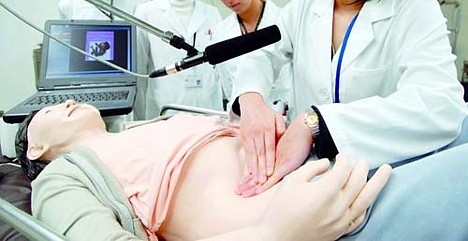
You can train a monkey to do surgery! That's what one of my anatomy professors used to say -- and he is a surgeon himself, so he should know. And now, with improved surgical simulator trainers, you can teach monkeys to operate even more quickly, and with better surgical technique!
The researchers put the obstetrics and gynaecology medics in two groups - one which had the traditional training of working alongside doctors and tutoring and another which supplemented this with seven hours simulator training.

They found that those that used the computer simulators were twice as quick, taking just 12 minutes to complete the operation on a patient. They also carried out better procedures, according to a points system used to judge the quality of the work.

Lead researcher Christian Rifbjerg Larsen said: "Simulator training should be incorporated into the curriculum for all surgical trainees before they embark on patient procedures..."This can potentially improve patient safety and improve operation room efficiency." _BBC_via_FierceHealthcare
Just like flight simulators, surgical and OB simulators can provide a wider range of surgical complications than most surgeons-in-training might typically see. This will make them better surgeons -- monkeys or human. ;-)

Labels: ,

Bookmark and Share

31 March 2009

Google Wants to Have Sex With Your Brain

Google wants to hurry up the brave new world. Google is not only involved in X Prize promotion of new technology, including the Google Lunar X Prize, but is also starting its own venture capital company to boost new ideas with direct capital involvement.

One intriguing idea is to take atmospheric CO2 and turn it into methane, like this group at Penn State is doing. There are oodles of similar bioenergy projects that Google Ventures might consider boosting.

I suspect Google is also interested in extending its search function beyond the internet into the human brain itself. To achieve "brain search", Google will need to better understand the human brain's "inference engine."

But one of Google's ultimate aims is almost certainly the development of a reliable brain-machine interface allowing seamless interaction of humans, computers, and robots.

Of course, with humans linked to the virtual and robotic worlds via new Google brain-machine interfaces, several areas of human productivity and creativity will skyrocket -- including machine design, architecture, various new art media, drug design, and a great deal more. Putting the human mind inside powerful machines will make a huge difference to many fields.

But then, the natural tendency is for humans to want to play games with their new toys and new powers. And one of the favourite games that humans play is the game of sex. Humans will no doubt learn to play that game with robots and virtual worlds as soon as possible.

Millions of people are addicted to their computers as it is. Imagine the situation when virtual worlds and robotic interaction and proxy allow persons to travel around the world instantly, or to experience life on the moon via robot proxy? How many humans will fall in love with their real or virtual robots (sexual or otherwise)? It will happen in many ways.

And Google wants to be there when it does. Google wants to have sex with your brain. Because after that, you will have a difficult time refusing it anything at all.

Labels: , , ,

Bookmark and Share

04 March 2009

Virtual Reality Cocoon Promises All 6 Senses

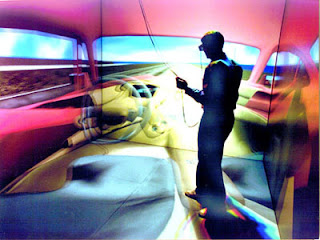
Called a Virtual Cocoon, the round-room device provides a far more realistic delivery of virtual experiences via total sensory input. This device positions the occupant in a chair before a nearly 360 degree screen where s/he becomes completely immersed in not only a visual and audio presentation encompassing almost the full view, but also one where the occupant has skin sensations, smells and tastes. _TGDaily
Alright, perhaps I exaggerated by one sense. But a 5-sense VR chamber is impressive enough, even without the ability to see tomorrow's lottery numbers. If the developers of the technology from the Universities of York and Warwick can actually bring a quality product to market within a reasonable time at a reasonable price, the economically downtrodden consumers of Planet Earth may well jump through hoops for a short interval of realistic escape.
The team is working on enhancing the interaction of the five senses, so that they mimic real life more closely. No one sense should be over- or under-stimulated, and while this device is impressive the scientists acknowledge there is much room for improvement. _TGD
The most promising technology for VR is the "utility fog" concept from Josh Hall. But it may be several years yet before that technology is proven safe and convincing. In the meantime, several techniques have been invented to allow someone in VR to walk or run significant distances in a small space, using treadmills, moving floors, or large rotating spheres.

Haptic gloves and suits would allow someone in VR to experience touch and feel, which if convincing could go a long way toward driving the acceptance of VR in the marketplace. Haptics so advanced as to transmit a light "feather touch" from one participant to another via electronic link might be the first step toward the electronic bordello and house of sin. The addition of smell and taste to sight, sound, and touch, might be either a bonus or a turnoff, depending upon the quality of the experience.

The ultimate in VR may come when safe brain interfaces are developed which can bypass the external senses. The ability to create a vivid "waking dream" experience without actually moving, would require technology significantly beyond what today's gaming industry can produce. But at this point, I doubt they will stop trying.

Labels: , ,

Bookmark and Share

30 June 2008

Never Send a Man to do a Robot's Job

Robots are more suitable for many jobs than are humans--once robots achieve the same degree of decision-making competence that expert humans acquire through experience. But since it will probably be a few decades before machines acquire human-level or better intelligence and mental adaptability, another approach called "telepresence" will be quite useful. Telepresence allows a human operator to become immersed in a virtual or real-remote environment, using robotic manipulators and sensors as his eyes, ears, arms and hands.
Telexistence is fundamentally a concept named for the general technology that enables a human being to have a real-time sensation of being at a place other than where he or she actually exists, and being able to interact with the remote environment, which may be real, virtual, or a combination of both. It also refers to an advanced type of teleoperation system that enables an operator at the control to perform remote tasks dexterously with the feeling of existing in a surrogate robot working in a remote environment. We have developed "TELESAR" for realization of the telexistence. Telexistence in the real environment through a virtual environment is also possible. __Tachilab_via_Gizmowatch
The robot pictured above is the TELESAR2 robot for use with the telexistence system at Tachilab. It does not look or act like a real person, but allow for improvement in future robot design and someday it might. Having a real person in control of a remote robot that looks and acts exactly like him/her should provide an imaginative person with some fascinating opportunities. But I digress.

Remote manipulation is already becoming common in the surgical suite, in research labs, on space stations, and on the battlefield. UAVs and UGVs are increasingly being used to patrol battle zones, border areas, and potential crime scenes. It is only a matter of time before human passengers are ferried about by remotely piloted and operated vehicles. Or maybe the human "passengers" will send their robots instead in their place?

With ubiquitous wireless internet coverage over the globe, it will become possible for ordinary persons to go to the highest peaks and the deepest undersea trenches remotely, with the reality of the experience limited only by the bandwidth and reliability of the data link, along with the quality of the hardware at both ends.

David Brin's SF thriller Kiln People describes a world where we can send intelligent copies of ourselves out into the world to perform tasks we may not have time for, or may not wish to do personally. Telepresence is not the same thing, because it would be difficult to control more than one robot at a time. Still, a clever person might find a way to take advantage of "down time" at one location to put in an appearance at another location.

Labels: ,

Bookmark and Share

31 October 2007

Automatic Learning--It Came to Me in a Dream


Jeff Lieberman had a dream about ways of learning skillful physical movements without verbal coaching--pure tactile feedback. He went on to help develop a "haptics feedback suit" to study tactile learning. It is an intriguing idea.
MIT researchers Jeff Lieberman and Cynthia Breazeal have published the results of the study in a recent issue of IEEE Transactions on Robotics. The study presents a proof-of-concept wearable robotic system that provides real-time tactile feedback over every joint simultaneously.

“Oddly enough, the idea for the robot suit initially came from a dream,” Lieberman told PhysOrg.com. “The dream involved people who weren't physically able to express themselves, but who were mentally normal, who used a machine that aided them to get their inner feelings out. This ranged from people with muscular difficulties to even toddlers and 'untrained' people who do not know how to wield a paintbrush. Upon waking and thinking about that idea for about an hour, the idea for this project was born, and I started doing research that day; the overall project was about six months for software and hardware development.”

In experiments with arm motions, the researchers found that the suit increased students’ learning rates by up to 23%, and reduced errors by up to 27%, as well as enabling students to learn movements “more deeply” by affecting their subconscious learning of motor skills. The latter can be especially important for patients with neurological injuries who have lost the ability to form new long-term memories, but can still build new motor skills.

The suit works by optically tracking body markers for the teacher’s movement (or a pre-recorded ideal movement) and the student’s movement with a Vicon motion capture system, which has millimeter accuracy. The tracking data is fed to software that compares the teacher’s and student’s movements, and generates feedback signals to the suit.
Physorg

Imaginative persons can easily think of many uses for such a tactile feedback learning system. A large part of the widespread incompetence in society comes from the lack of practical skills with the hands and body. A sedentary society--forced to sit inactive for one third of the day from childhood to young adulthood, spending countless hours sitting watching television, texting, chatting, playing video games, etc--learns inactivity early, and neglects the body and the skills the body is capable of exhibiting.

The part of the mind that deals with banal, everyday things, or with abstract ideas, is well exercised by most children, teenagers, and adults. The parts of the mind that guide the body in skilled activities that make life more enjoyable, more workable, or more prosperous, are generally neglected.

Traditionally, fathers taught sons physical/tactile skills, as mothers taught tactile skills to daughters. Modern parents often do not have the time or spend the time to teach children practical skills. Such teaching requires patience and energy that may be lacking--not to mention the required skills that parents may never have been taught themselves. Now, these skills can be taught from tutorials online or on disk.

But the learning opportunities from such tactile feedback suits extends far beyond practical skills of modern life's technologies. Surgeons in training could learn from the deft, precise movements of the best surgeons. Pilots would learn firm, timely responses to unexpected emergencies in simulators.

It is one thing to teach the mind a skill. It is quite another to teach the body. Modern education neglects the body. (it also neglects the mind, but that is another story)

A deeper meaning behind such training is the fact that much of the cognitive strength of the mind derives from being "embodied." Our verbal and pre-verbal conceptual languages rest upon metaphors of embodiment. The sensory feedback from the body, as interpreted through embodiment metaphors, drives much of our thinking. More on this later.

The MIT research discussed in the Physorg article above promises important advances in a field of research that is not exactly brand new. But qualitative improvements in a pre-existing field can make the field seem new again.

Tactile feedback may just hold the conceptual key that has been missing from stonewalled efforts in machine intelligence, cognitive enhancement, and ultimately brain emulation and downloading. Stay tuned.

Labels: , , ,

Bookmark and Share

20 October 2007

Toward a Better Virtual Reality

For a virtual reality environment to be convincing, it should simulate as many of the human senses as possible. Tactile feedback, known as haptics, is a key component of realistic virtual reality. Physician Mark Ombrellaro has designed a vest that transmits the sense of physical blows to the gamer wearing it.
A vest designed by doctor Mark Ombrellaro uses air pressure and feedback from computer games to deliver pneumatic thumps to the spots on players' torsos where they would have been struck were they actually on the battlefields.

The "3rd Space" vest will make its US debut in November at a price of 189 dollars. It will be launched with the first-person shooter game "Call of Duty" and a custom-made title.

"It was originally designed as a medical device," Ombrellaro told AFP while letting gamers try the vest at the E for All video game exposition in Los Angeles.

"To give medical exams via the Internet to prisoners, the elderly, those in rural communities and other isolated people."

The medical version of the vest is more sophisticated, enabling doctors sitting at their computers to prod, poke and press patients' bodies from afar and get feedback on what they are virtually feeling, according to Ombrellaro.

That model is pending approval by the US Food and Drug Administration, which wants to be assured that diagnosis made using the vests are reliable.

"You can teleconference with patients but you are missing the hands-on," the vascular surgeon said. "Being able to do that is the last step to tele-health."

A 3rd Space vest that mimics the feeling of G-forces and turning pressures for flight and car games is to be launched early next year, after Ombrellaro's company TN Games finds exciting titles to match it with.
Physorg

A total body haptics suit would be even more convincing than simple vests, gloves etc. Combining total body haptics with environments that allow the player to walk in any direction--including up and down--add even more realistic sensation to games that require ambulation.

It is no accident that such gaming technology can occur as a spinoff from medical research. The pressing need for accurate telepresence for remote medical diagnosis offers similar challenges as the goal to achieve realistic game simulations.

Eventually, the combination of remote telepresence with robotic surgeons will allow complex surgeries to be done by surgeons located a significant distance from the patient. Such fine hand--machine control, with haptics technology, would have many spinoffs for not only gaming, but many areas of industry and recreation. (think of the "world's oldest profession", for example)

Labels: , ,

Bookmark and Share

29 April 2007

The Story of Second Life: Google Tech Talks Looks at the Metaverse


Are you curious about where Second Life came from, who is behind it, how it works, how big it can possibly get? Check out this talk at Google by two insiders from Linden Labs.

You want to hear something scary? The stats these guys are giving here are from over a year ago. Since then, Second Life has grown exponentially.

Updated news on Second Life from Reuters.

Labels: ,

Bookmark and Share

28 April 2007

IBM Says--Hey Babe, Walk on the Wild Side

IBM is building the most powerful supercomputer on earth, called Roadrunner. It is being built at Los Alamos, and you know what that means.

But IBM is using many of the same powerful chips that are going into Roadrunner, to build mainframe servers to use for 3-D virtual environments such as Second Life.
The mainframe is an ideal platform for virtual environments, particularly online gaming, because of its ability to run multiple processors for computing-intensive applications, while also handling millions of simultaneous users, according to IBM. "As online environments increasingly incorporate aspects of virtual reality -- including 3-D graphics and lifelike, meaningful real-time interaction among many simultaneous users -- companies of all types will need a computing platform that can handle a broad spectrum of demanding performance and security requirements," Jim Stallings, general manager for IBM System z, said in a statement.

By running Cell processors, along with up to 336 RISC processors, the mainframe can parcel the workload to deliver higher computing performance for companies building virtual worlds similar to the popular Second Life online videogame. Second Life also has grown into a place for virtual retail stores, and many large corporations, such as IBM, have set up shop there.
Source

IBM's mainframe sales are growing steadily, just when everyone thought the mainframe was dead. But IBM's system Z mainframes are far from dead--particularly at a time when virtual environments such as SL are growing exponentially.

Labels: ,

Bookmark and Share

23 April 2007

Virtual Learning: Getting an Education in Second Life

Second Life is an alternate reality virtual environment where ordinary people can go to be extraordinary. Second Life is an education in itself, but soon a person may be able to go to Second Life universities to get an education, and perhaps a valid degree.

You can learn about genetics in Second Life, you can visit the doctor or hospital in Second Life, and eventually will probably be able to go to "medical school" in the virtual environment.

There is the Second Life library. There is also a Second Life medical library and a health library.

Second Life (SL) can function as a "mirror world", where real world people and organisations function normally in a virtual environment, or it can serve as a fantasy world escape from reality. Such a large scale virtual environment can serve as a superset of virtual environments. Any number of virtual games such as WOW could occur within SL. In fact, if I were WOW, I would hurry to establish a presence on SL before SL begins running competitive environments that draw WOW players.

Hat tip Neurophilosophy's Gene Genie bioscience carnival

Labels: , , ,

Bookmark and Share

08 April 2007

How to Play All the Stars in Your Own Star-Studded Video!


Using motion capture combined with video rendering magic, one actor could play many parts in a video or ultra-realistic cinema animation. This Business Week article looks into the possibilities of motion capture for entertainment, medicine, the military, and more.
The technology then spawneda slewof computer-generated creatures, including Gollum, the gurgling, wispy-haired ring thief in Peter Jackson's Lord of the Rings trilogy, and King Kong, by the same director. British actor Andy Serkis spent hours scampering around on set in sensor-studded suits to create Gollum's scuttling and Kong's signature grimaces. For such scenes in the past, animators might draw each new movement by hand, frame by frame. And that's not the only giant expense motion capture could address. During a movie shoot, "the cost of a day on set can range from $50,000 to $1 million," says Gary Roberts, a vice-president at House of Moves Inc., a Los Angeles motion-capture lab. "Motion capture shaves days off the overall production time." And the process could get even simpler. In Cameron's current film project, titled Avatar, sophisticated software may eliminate the need for sensor dots on actors' faces. Instead, one tiny camera on an actor's head cap tracks and interprets every twitch.

Companies that come up with such innovations stand to make small fortunes. "There is an arms race in entertainment," says Phil Sparks, an analyst at Evolution Securities Ltd. He's bullish on Vicon, part of Oxford Metrics Group, the largest company making motion-capture systems for entertainment and now many other clients. "They're no longer just mapping out an orc and a hobbit having a fight. They're now doing the expressions on dozens of actors' faces." Motion Analysis Corp., another motion-tracking player, built systems that were used for Kong and one of the Rings films and also outfitted Lockheed's lab.

Capturing actors' movements is potent stuff, says Cameron: "The technique frees performers from the limitations of body type, age, race, and gender. The essence of their spirit as actors can be infused into any physicality they or the filmmakers dream up."
Source

Go here to view some videos made with available motion capture software. Or check out these Stanford workshops on life simulations and VR.

Motion capture will allow one person to play all the roles in a computer generated video. Advances in video rendering and video/audio editing combined with sophisticated motion capture would allow one person to play a character of either sex, of any ethnicity, and of any age.

Labels: ,

Bookmark and Share

27 March 2007

Fast, Flexible Computer Chips and Optical Chipsets

MONARCH is a new "supercomputer on a chip" capable of 64 Gigaflops with memory bandwidth of 60 Gbps and off-chip data bandwidth of 43 Gbps.
Granacki is director of the Advanced Systems Division at ISI, and Research Associate Professor of Electrical Engineering Systems and Biomedical Engineering in the USC Viterbi School of Engineering.

"What we have been creating is essentially a supercomputer on a chip," he said, "and not just a supercomputer, but a flexible supercomputer that reconfigures itself into the optimal supercomputer for each specific part of a multi-part task."
Source

Meanwhile IBM has created the world's fastist optical chipset.
Measuring 3.25 by 5.25 millimeters, IBM's new optical chipset contains both driver and receiver circuits, and was built using industry-standard complementary metal oxide semiconductor (CMOS) technology. Optical-grade plastic fibers are used to transmit data, and optical components use indium phosphide (InP) and gallium arsenide (GaAs).

Because of the large number of communication channels as well as the very high speeds for each channel, IBM said the chipset provides the highest record ever of transmitted information per unit of physical space.
Source

These very powerful chips will soon be available in large quantities, which makes one wonder how they will be used. The IBM optical chip has enough data throughput to run a medium sized war--ground, sea, air, and space (data equivalent to four million simultaneous telephone conversations). All on a chip roughly the size of a dime.

The MONARCH supercomputer-on-a-chip has the ability to reconfigure itself to adapt to different computing tasks on the fly.

If you consider these powerful chips to be mere building blocks of a more powerful system, or networks of systems, you may begin to see the potential for systems designers.

Most people will probably just want better video gaming and more realistic virtual reality effects. Computer hobbyists will want to build extremely fast custom systems to impress their friends. Financial and security interests will want more advanced systems to provide better data security. Domestic and international criminals and terrorists will likewise want the features of these advanced chips.

With the rate of advancement in chip processing power and data bandwidth, it becomes more difficult for the holders of wealth and power to keep the wolves at bay. I recommend diversifying.
;-)

Labels: , ,

Bookmark and Share

24 February 2007

Medical School Online Part II


Medical school online? It sounds preposterous on the surface. How can you create a realistic clinical and laboratory environment online? As a previous posting illustrated, it may not be long before the first two years of medical school--and part of the last two--can be provided online.

Online patient simulators can be useful, but are currently limited in realism. But because life and death situations are stimulating, the simulations will improve. Medical Schools are beginning to understand the potential usefulness of electronic medical simulators.
Simulation, which has become an integral component of training in the aviation industry, is now recognized as a valuable tool for training medical professionals and improving patient safety. Full-scale patient simulators help a wide variety of practitioners and students learn the diagnosis and management of clinical problems without risk to real patients.

....The Rochester Center for Medical Simulation is located near the Surgical Suite at the University Medical Center, and officially opened in 1998. The core of this specially constructed facility is a computer-controlled full-body patient simulator that incorporates mathematical models of the cardiovascular and respiratory systems as well as models of human responses to drugs. The patient presents realistic vital signs and responds appropriately to clinical management. Physiological parameters and disease processes can be pre-programmed, or changed at any moment during the simulation by the operator.
Source.

Medical simulations using haptics allow the tactile feedback that is necessary for performing medical and surgical procedures.

Although traditional medical schools are using various types of medical simulators more frequently, even state and provincial medical licensing and credentialing boards and agencies are planning to use simulators for evaluating competencies of licensed professionals. If medical simulators and simulations are approaching that level of realism--why not an online medical school?

Realistically, what we are talking about is the decentralisation of medical training--and most other forms of high level education. Small regional medical simulation centers located far from the huge medical mega-centers can provide most of the necessary training for paramedics, nurse practitioners, physician assistants, general practitioners--even some subspecialty medical and surgical training.

But when medical and surgical training can be decentralised through advanced online simulations and teleconferencing, is there any possible form of education that cannot be presented online to a significant extent?

Currently, many university students are forced to receive academic lobotomies, for lack of enough good alternatives. In the future, that will be less true.


Also read Anders Sandberg's article at Andart blog.

Labels: , , , , , ,

Bookmark and Share

30 June 2006

More Realistic Virtual Humans

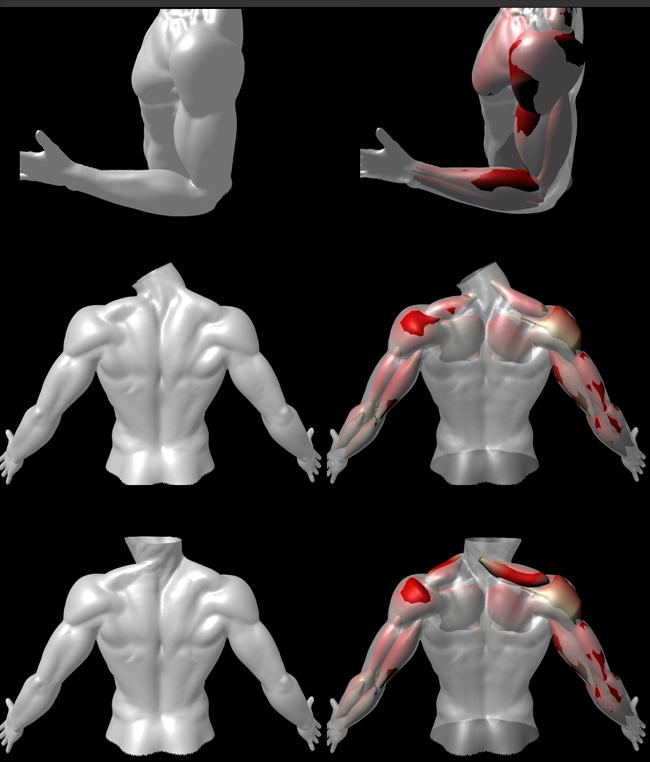
Researchers at the National Center for Computer Animation have devised a computer program that automatically adds realistic muscle shape to simple wire frame and skeletal figures. These virtual muscles will move and change shape realistically, under skin and clothing, when the figures are animated. From the NewScientist article:

Zhang and his colleague Xiaosong Yang have developed a system that takes the outward appearance of a character and automatically generates a skeleton and muscles to fit inside.

"It works by using geometric processing of the still character to determine where muscles should go," he told New Scientist. "If there's an important muscle it will show through the skin so the tool can infer where the major muscles should be."

The software guesses at a suitable skeleton to attach the muscles to by adapting a standard humanoid skeleton to fit the character's overall shape. With skeleton, muscles and skin all in place, the character can be made to move in more realistic ways.

The software simulates how the muscles affect the outward appearance as they contract, relax and slide in relation to joints and other muscles.
Other mammals

"Our method could also be applied to characters based on other mammals," says Zhang. As long as the basic shape of an animal's skeleton is known and the skin is designed, it would work just as well, he says.

But the team first plans to improve the technique's accuracy in generating human-like characters. "We plan to add detailed knowledge of the human anatomy," he explains. "We hope to be able to take a character and fit a very accurate anatomy to it."

This could even have medical applications, says Zhang, allowing doctors to infer the biomechanics of a patient's anatomy from their outer appearance.


Initially you will see this approach used in computer gaming and entertainment animations. Then you will see this improved realism utilised in virtual reality programming, such as virtual surgery tutorials, and other technical tutorial programming.

Judging by the illustration at the top of the page, it may not be long before Chippendale's creates an animated showcase using virtual male strippers. Virtual female strippers and more erotic virtuality is inevitable, given the money flow.

Labels:

Bookmark and Share

07 June 2006

Teledildonics, Nanotechnology, Cyber Sex

Most people have heard of teledildonics, the family of technologies that allows people to sexually stimulate each other from a distance. Presently the technology is limited to remote controlled vibrators and other simple machine stimulators. Eventually, the technology is going to get much more sophisticated. Science fiction can give us some ideas how it might be done.

Take the Star Trek shows featuring a "holodeck". You may have wondered how in the world solid objects could appear from empty space--even convincing simulations of walking, talking, touching, human beings. More than one crew member had to be reprimanded for fornicating with holodeck "beings." Well, at least one, and you can imagine how the stress of crewing a starship might lead to that kind of thing . . .

Anyway, you do not have to wonder any longer about the technology involved. There is a type of nanotechnology that has been theorised called "utility fog." Utility fog can sit in a room, invisible to the naked eye, then when activated it can simulate solid objects. Here is a list of links for learning more about utility fog and how it might be made and used.

There is quite a gap between a bluetooth controlled vibrator or role-playing cybersex, and a fully animated touch-realistic holodeck partner using utility fog. No doubt remote controlled realistic sex robots incorporating haptics sensors and actuators will attempt to fill the gap in the near future.

One related area where some progress is being made, is virtual reality. Check out this amazing video that demonstrates a virtual reality interface that actually allows you to move in any direction! Here is a short news article about this fascinating device called the VirtuSphere. With an interface like this, a haptic sensor/actuator suit, and advanced software, you would be set for a fairly convincing virtual experience--sexual or not.

The economic potential is there. Sexual programming propelled the home VCR market and continues to help drive internet commerce. Add in the population of game addicts and general escapists in the population, and you have a huge market potential.

Long distance relationships have always been very challenging to maintain, but with the coming of new virtual reality technologies, staying together while apart might become easier. Some couples might even prefer a "virtual" relationship, after trying it both ways. With virtual reality, you can change your appearance, or change the appearance of your partner, if you wish.

But be sure to keep your anti-viral software updated. Stay safe. :-)

Labels: , , , ,

Bookmark and Share

04 June 2006

Free Online Courses and Texts: Educating Yourself

Is there some subject you have always wanted to learn, but never had the time to devote to it? Are there topics you would like to know better, but cannot take the time off work, travel long distances for seminars, or devote big chunks of your budget for libraries of texts and references and class fees?

There are a lot of online class, text, and reference resources available free on the internet. Here are a few places to start looking:

Textbook Revolution--This site links to many different texts and educational resources for a wide variety of academic subjects, from math to sciences to engineering to health professions, economics, computers, and general education. Some of the resources are surprisingly good, some are only average. They update their holdings fairly regularly. Here is the official blog that updates and augments Textbook Revolution.

Open Educational Resources Wiki Repositories--This Wiki site links to several "mega-sites" full of tutorials, class materials, audio and video lectures, and many other types of educational resources. If you want to investigate these links thoroughly, set aside the better part of a day or more. This site links to some huge collections of fine links. Highly recommended.

Directory of Open Access Journals--This Directory links to 2265 free, full text journals on many topics, including Agriculture and Food Sciences, Arts and Architecture, Biology and Life Sciences, Business and Economics, Chemistry, Earth and Environmental Sciences, General Works, Health Sciences, History and Archaeology, Languages and Literatures, Law and Political Science, Mathematics and Statistics, Philosophy and Religion, Physics and Astronomy, Science General, Social Sciences, and Technology and Engineering. If you are not affiliated with a large institution, it can sometimes be hard getting access to reasonably up to date findings in a field of interst. Open Access Journals can be very helpful.

Like I say, these are only good starting points. You will quickly discover just how vast are the educational resources available free online, once you start looking.

The current system of education is obsolete, whether it knows it or not. The multi-media environment of the modern broadband internet just keeps getting better. As we get closer to "virtual reality" online environments, with haptic sensory interfaces, there will be very little in the way of course material that cannot be served over the net.
It may be that teledildonics will be the driving force financing broadband virtual reality on the net, but there is really no limit on the types of software and interfaces that can be connected. Then when nanotechnology finally provides a true "holodeck" environment, the fun and the learning will just be starting.

Labels: , , , ,

Bookmark and Share

09 May 2006

Did Your Surgeon Graduate from an Online Medical School?

Probably not, at least not yet. It may not be long before technology allows that to happen, however. The decentralisation of learning began with correspondence courses and is accelerating with online education. Virtual Reality technology may just complete the transition. Patient simulators will allow budding students to make inevitable early mistakes on machines, instead of living people, similar to student pilots learning on flight simulators. If medical school education can be provided through distance learning, supplemented by patient interaction under local physician instructors, is there any type of education that requires a large onsite concentration of buildings, students, and instructors?If you have always fancied yourself a shark--wanted to go to law school but cannot take the time or uproot yourself and your family? Check out these online law degree programs from findlaw. What if you always wanted to be a shrink, a clinical psychologist? You can get an accredited PhD in Clinical Psychology online, staying where you presently live and work.

Opportunities for online graduate degrees in Engineering, Nursing, Education, Information Sciences and many others are available. In fact, Canada has a Virtual University system, and so might your home state.

There are many free classes available online, some from Stanford, MIT, Brigham Young, and others. Class notes, slides, supporting materials, are available online for thousands of university courses worldwide. Several of these are linked to on the sidebar of this blog.

Conventional universities may not be the best places for an education these days. Alternatives are showing up just in the nick of time. Employers complain about the low quality of college graduates, because conventional universities often spend more time indoctrinating students in political correctness, than in teaching them to learn and think for themselves, and instilling necessary skills and knowledge. Too many university departments have been taken over by academic maos and pol pots.

If you or your children are more interested in an education than an indoctrination, alternatives on the horizon are expanding rapidly.

Labels: , , , ,

Bookmark and Share

03 March 2006

Virtual Humans--The Reality

Now we are ready to take a closer look at virtual humans, and what is being done with them. The Virtual Human Project grew from research staff discussions at the US Oak Ridge National Lab (ORNL). This review article from ORNL provides a useful history.

....The beauty of a computer model of a human is that it can be customized for a specific person at any point in time. At least, that's the long-term vision shared by Easterly and his colleagues. Customization is important because of evidence that men, women, and children respond differently to various drugs, drug dosages, and other treatments, as well as environmental insults.

"From our earlier work in modeling children's organs," Ward says, "we see the need to build human models for different ages, sizes, and sexes. By using equations and changing some parameters, we can make the heart smaller or larger. We can make a human model or phantom grow with age." Use of a customized model—a computerized clone of you that includes your genetic makeup—will make it possible to predict how you might respond to different doses of radiation, chemicals, and drugs, or what damage you might suffer if you were in an automobile accident or airplane crash.


Researchers are using virtual humans to monitor human response to drugs, other chemical stimuli, and physical stimuli. The US National Institute for Occupational Safety and Health (NIOSH) is using virtual humans to study hazardous interations, as between an operator and a machine. Toyota uses virtual humans to predict injuries from various types of accidents, so as to design safer vehicles. The University of Pennsylvania has developed a Virtual Human Testbed for studying the ergonomics and kinematics of various work environments.

The Visible Human Project has spawned the Virtual Human, a set of CT scan images from cadavers, showing the whole body inside and out, making the images available to researchers for use in computer models.

The US Defense Advanced Research Projects Agency (DARPA) has developed the Virtual Soldier Project,

The DARPA Virtual Soldier Project will investigate methods that will revolutionize medical care for the soldier. The project will produce complex mathematical models to create physiological representations of individual soldiers. These holographic medical representations (known as Holomers) can be used to improve medical diagnosis on and off the battlefield.

The Holomers coupled with predictive modeling software, will facilitate a new level of integration in medical procedures. The Virtual Soldier will provide multiple capabilities, including automatic diagnosis of battlefield injuries,prediction of soldier performance, evaluation of non-lethal weapons, and virtual clinical trials.


Links to affiliated projects of The Virtual Human Project can be found here.

Simulations of humans are now used for medical training of future physicians and surgeons, for entertainment, in advertising, in research as substitutes for using human or animal subjects, even as substitutes for physical dummies in automobile crash research. Police departments are using virtual humans for training police officers.

In a previous posting, I took a more light-hearted view of virtual humans. In reality, simulated humans are now mainstream technology in several fields. How real can the simulations get? Some of them are going to the cellular and molecular levels. In the other direction, simulating the actions of groups of humans might also be enlightening.

It is important to understand that the model is not the real thing. The map is not the territory. Computer modelling is still relatively primitive, and it is always best to confirm the predictions of a model whenever possible.

Labels:

Bookmark and Share
Older Posts
Al Fin Main Page
Enter your Email


Powered by FeedBlitz
Google
WWW AL FIN

Powered by
Blogger

``