05 June 2009

Online Mental Health Therapy Puts You to Sleep

A study in the June 1 issue of the journal SLEEP demonstrates that online cognitive behavioral therapy (CBT) for chronic insomnia significantly improves insomnia severity, daytime fatigue, and sleep quality. Online treatment also reduces erroneous beliefs about sleep and pre-sleep mental arousal. _SD
81% of study participants received at least mildly improved sleep after the 5 week online program. 35% slept much better. And online psychotherapy is not just for sleep disorders.

For almost 10 years now, online mental health therapies have been providing everything from online sex therapy to online crisis therapy to routine counseling and life coaching. Take a look at some case studies of online therapies and other assessments of online therapeutic efficacy.

You can find online therapists via websites such as Etherapistsonline, Headworks, MyTherapyNet, PsychCentral, and many other sites.

Expect online health and mental health services to expand beyond the current basic level, as broadband internet speeds improve, physiological and virtual reality interfaces get better and more widespread, and as government medicine forces lower cost medical care methods to the forefront.

Government health care cannot afford traditional-style health and mental health care services for everyone. The well-intentioned drive to give mental health treatments equivalent reimbursement status to medical care treatments is seriously flawed. Rationing is guaranteed under such a plan -- and under any government health care. Far better to use advanced technologies such as virtual reality haptics and physiological interfaces, expanded training and licensing of providers, and a "stepped" system of access -- from online to higher levels of personal care -- for all but the most emergent of situations.

With online therapies, a therapist living in Tiburon could counsel inmates in the Bakersfield City Jail. She could live in a desirable therapist-saturated neighborhood, yet still have access to plenty of clients -- and be paid! A surgeon living in Seattle might diagnose a potentially life-threatening condition for a patient living in Birmingham. He could not do the surgery, but a medical center local to the patient could take care of the problem, once diagnosed.

If you allow the client or patient to talk long enough, they will often give the clinician the diagnosis. Online therapies and diagnostic encounters allow the client / patient far more time to interact with a caregiver. As methods are improved, efficacies will improve.

Labels: ,

Bookmark and Share

04 March 2009

Virtual Reality Cocoon Promises All 6 Senses

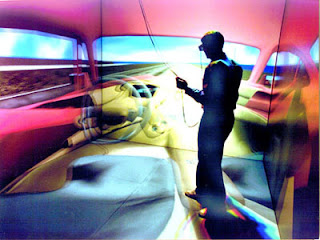
Called a Virtual Cocoon, the round-room device provides a far more realistic delivery of virtual experiences via total sensory input. This device positions the occupant in a chair before a nearly 360 degree screen where s/he becomes completely immersed in not only a visual and audio presentation encompassing almost the full view, but also one where the occupant has skin sensations, smells and tastes. _TGDaily
Alright, perhaps I exaggerated by one sense. But a 5-sense VR chamber is impressive enough, even without the ability to see tomorrow's lottery numbers. If the developers of the technology from the Universities of York and Warwick can actually bring a quality product to market within a reasonable time at a reasonable price, the economically downtrodden consumers of Planet Earth may well jump through hoops for a short interval of realistic escape.
The team is working on enhancing the interaction of the five senses, so that they mimic real life more closely. No one sense should be over- or under-stimulated, and while this device is impressive the scientists acknowledge there is much room for improvement. _TGD
The most promising technology for VR is the "utility fog" concept from Josh Hall. But it may be several years yet before that technology is proven safe and convincing. In the meantime, several techniques have been invented to allow someone in VR to walk or run significant distances in a small space, using treadmills, moving floors, or large rotating spheres.

Haptic gloves and suits would allow someone in VR to experience touch and feel, which if convincing could go a long way toward driving the acceptance of VR in the marketplace. Haptics so advanced as to transmit a light "feather touch" from one participant to another via electronic link might be the first step toward the electronic bordello and house of sin. The addition of smell and taste to sight, sound, and touch, might be either a bonus or a turnoff, depending upon the quality of the experience.

The ultimate in VR may come when safe brain interfaces are developed which can bypass the external senses. The ability to create a vivid "waking dream" experience without actually moving, would require technology significantly beyond what today's gaming industry can produce. But at this point, I doubt they will stop trying.

Labels: , ,

Bookmark and Share

20 October 2007

Toward a Better Virtual Reality

For a virtual reality environment to be convincing, it should simulate as many of the human senses as possible. Tactile feedback, known as haptics, is a key component of realistic virtual reality. Physician Mark Ombrellaro has designed a vest that transmits the sense of physical blows to the gamer wearing it.
A vest designed by doctor Mark Ombrellaro uses air pressure and feedback from computer games to deliver pneumatic thumps to the spots on players' torsos where they would have been struck were they actually on the battlefields.

The "3rd Space" vest will make its US debut in November at a price of 189 dollars. It will be launched with the first-person shooter game "Call of Duty" and a custom-made title.

"It was originally designed as a medical device," Ombrellaro told AFP while letting gamers try the vest at the E for All video game exposition in Los Angeles.

"To give medical exams via the Internet to prisoners, the elderly, those in rural communities and other isolated people."

The medical version of the vest is more sophisticated, enabling doctors sitting at their computers to prod, poke and press patients' bodies from afar and get feedback on what they are virtually feeling, according to Ombrellaro.

That model is pending approval by the US Food and Drug Administration, which wants to be assured that diagnosis made using the vests are reliable.

"You can teleconference with patients but you are missing the hands-on," the vascular surgeon said. "Being able to do that is the last step to tele-health."

A 3rd Space vest that mimics the feeling of G-forces and turning pressures for flight and car games is to be launched early next year, after Ombrellaro's company TN Games finds exciting titles to match it with.
Physorg

A total body haptics suit would be even more convincing than simple vests, gloves etc. Combining total body haptics with environments that allow the player to walk in any direction--including up and down--add even more realistic sensation to games that require ambulation.

It is no accident that such gaming technology can occur as a spinoff from medical research. The pressing need for accurate telepresence for remote medical diagnosis offers similar challenges as the goal to achieve realistic game simulations.

Eventually, the combination of remote telepresence with robotic surgeons will allow complex surgeries to be done by surgeons located a significant distance from the patient. Such fine hand--machine control, with haptics technology, would have many spinoffs for not only gaming, but many areas of industry and recreation. (think of the "world's oldest profession", for example)

Labels: , ,

Bookmark and Share

10 October 2006

Second Life: What Can You Do With It?

Second Life is an interactive online environment where you can spend all of your time if you want. Some people make their living in the real world from what they do on Second Life.

"Second Life" now has more than 800,000 denizens, of whom more than a hundred are earning a real-world, full-time living there, selling things like virtual land, clothes, jewelry, weaponry and pets, or by offering virtual services, notably sex.

Yes, people pay real money for things they can only use in Rosedale's world, which is created on powerful servers and accessed through the Internet. Hundreds of thousands of real dollars change hands in "Second Life" daily, and it would have an annual gross domestic product of around $150 million if it were to stop growing today.

But Rosedale forecasts it will pass a million users this year. A rush to be part of the "new new thing" is on, and organizations like Major League Baseball, Harvard University, American Apparel Inc., and CNet.com are among the many opening operations in "Second Life," while musicians like Duran Duran and Suzanne Vega have broadcast virtual concerts there using the world's lifelike animated characters.

Find much more information about SL, particularly from the creator's point of view at the source.

The best article that I have found describing Second Life is this one. There you can find interviews from several Second Life addicts, and links to a variety of YouTube clips from SL.

The intriguing thing to me about Second Life is how dedicated the creators/operators of the enterprise seem to be toward improving the simulation and making it more realistic.

Second Life has a lot of potential to grow. Other virtual environments such as World of Warcraft could conceivably become mere subsets of the Second Life world. As interfaces grow more and more realistic--including sensory body suits and haptics--most forms of human interaction will become possible. If you imagine a total sensory experience combined with ultra-wide bandwidth, you begin to see the future of networked interaction.

I recommend reading the two articles linked to above, and view a couple of the YouTube videos at the Phoenix site. Unless you are already familiar with SL, you will probably be amazed by what is there, and blown away by the possibilities for the future.

Labels: , ,

Bookmark and Share

07 June 2006

Teledildonics, Nanotechnology, Cyber Sex

Most people have heard of teledildonics, the family of technologies that allows people to sexually stimulate each other from a distance. Presently the technology is limited to remote controlled vibrators and other simple machine stimulators. Eventually, the technology is going to get much more sophisticated. Science fiction can give us some ideas how it might be done.

Take the Star Trek shows featuring a "holodeck". You may have wondered how in the world solid objects could appear from empty space--even convincing simulations of walking, talking, touching, human beings. More than one crew member had to be reprimanded for fornicating with holodeck "beings." Well, at least one, and you can imagine how the stress of crewing a starship might lead to that kind of thing . . .

Anyway, you do not have to wonder any longer about the technology involved. There is a type of nanotechnology that has been theorised called "utility fog." Utility fog can sit in a room, invisible to the naked eye, then when activated it can simulate solid objects. Here is a list of links for learning more about utility fog and how it might be made and used.

There is quite a gap between a bluetooth controlled vibrator or role-playing cybersex, and a fully animated touch-realistic holodeck partner using utility fog. No doubt remote controlled realistic sex robots incorporating haptics sensors and actuators will attempt to fill the gap in the near future.

One related area where some progress is being made, is virtual reality. Check out this amazing video that demonstrates a virtual reality interface that actually allows you to move in any direction! Here is a short news article about this fascinating device called the VirtuSphere. With an interface like this, a haptic sensor/actuator suit, and advanced software, you would be set for a fairly convincing virtual experience--sexual or not.

The economic potential is there. Sexual programming propelled the home VCR market and continues to help drive internet commerce. Add in the population of game addicts and general escapists in the population, and you have a huge market potential.

Long distance relationships have always been very challenging to maintain, but with the coming of new virtual reality technologies, staying together while apart might become easier. Some couples might even prefer a "virtual" relationship, after trying it both ways. With virtual reality, you can change your appearance, or change the appearance of your partner, if you wish.

But be sure to keep your anti-viral software updated. Stay safe. :-)

Labels: , , , ,

Bookmark and Share
Older Posts
Al Fin Main Page
Enter your Email


Powered by FeedBlitz
Google
WWW AL FIN

Powered by
Blogger

``