16 October 2012

Abolishing College: No More Academic Lobotomies?

Alternatives to conventional higher education are experiencing explosive growth. Coursera offers free online courses from at least 33 respected universities worldwide. And EdX recently added the entire University of Texas system of institutions, to join Harvard, MIT, and UC Berkeley.
The shift to online college-credit courses is occurring three to five years faster than expected because of demand from students and universities, said Anant Agarwal, president of Cambridge-based EdX and an MIT professor.

The University of Texas System plans to put up $5 million to join the EdX online venture, started by Harvard University and the Massachusetts Institute of Technology, to help meet demand for low-cost college courses.

...Most universities realize major structural changes are needed, though moving lectures online doesn’t go far enough, said Jeff Sandefer, a Perry adviser who taught entrepreneurship courses at the University of Texas and started the Austin-based Acton School of Business, which offers graduate management degrees. EdX and Coursera, another university group offering free online studies, “will hasten the flight of full-price customers to less-expensive alternatives, accelerating the demise of traditional academia,” Sandefer said by e-mail. _BusinessWeek
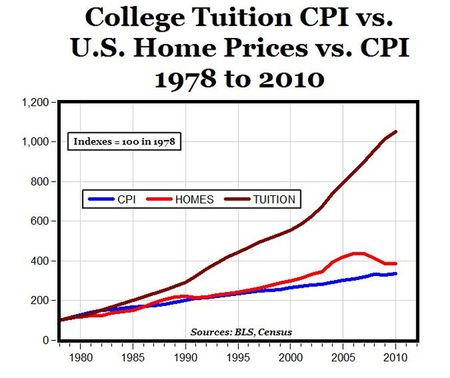
Modern universities are known for their antagonism to students' freedom of speech rights, and for an intolerance to diverse points of view. The steep rise in tuition rates over the past few decades has skyrocketed, driving student debt above $1 trillion, and rising. Administrative bloat is out of control, and the quality of education on campus is suffering as a result.


If any institution deserves to be made obsolete -- besides big media and big govenment -- it is the big college bubble. The EdX, Coursera, and Khan Academy approaches to free online education will not result in the actual abolition of college indoctrination and intolerance. Making a destructive institution obsolete is far quicker and cleaner than going to the trouble of abolishing it.

Imagine a world with free speech for everyone, no more academic lobotomies, no more academic intolerance / indoctrination. A world of self-directed learners, with the entire universe of knowledge available to pursue.

It sounds like a very dangerous world! ;-)

And remember: It is never too late for a dangerous childhood.

Labels: , ,

Bookmark and Share

12 August 2012

Free College Textbooks to go with Free College Classes

Top ranked US universities such as Harvard, MIT, Stanford, etc. are now offering free courses through websites such as Coursera, EdX, Udacity, and more. To go along with these high quality, free online course offerings, more websites are offering free textbooks. But the new generation of free textbooks can also be used for conventional, on-campus courses -- saving students as much as $1000 per session.

“There’s a crisis of access in this country,” says Richard Baraniuk, a computer and electrical engineering professor at Rice University. He’s talking about the rapidly increasing cost of college education, which includes not only tuition, but also room and board, class fees and, yes, textbooks. Estimates of how much students spend on textbooks in a given year vary widely, but most colleges’ financial aid websites peg the cost at about $1,000.

Baraniuk thinks that cost should be reduced to zero. He’s been part of the open-source educational movement since 1999, when he grew frustrated with the book he was using in his electrical engineering class. He considered writing a book himself but had an epiphany as he learned more about the open-source operating system Linux. “I realized that we could take the same ideas–namely, modularity…and open-sourcedness, making it free and remixable–and apply that not just to software but to textbooks.” _Business.Time

Here are some websites devoted to providing free college textbooks:

OpenStax College

Flat World Knowledge

Open Textbook Catalog (meant as an open review of free textbooks)

Textbook Revolution

Web Directory dedicated to access to free textbooks, lecture notes, and classes

Apple Textbooks -- Not free, but a hint of what future textbooks may be like

The main problem with all of these free online materials is that that all of this effort and energy is being applied at least 10 years too late in a child's life. Modern child-raising and early childhood education have already destroyed most of a child's potential by the time he reaches college age.

But at least someone is trying. Many self-directed learners from precocious teens to adults are likely to benefit from these opportunities. Now, if these disruptive ideas would only percolate downward into the morass of corrupt government education . . . .

Labels:

Bookmark and Share

16 June 2012

EPIC 2020: The Complete Transformation of Higher Education


The higher education bubble is nearing its limits. There is more college loan debt in the US than credit card debt -- more than $1 trillion.

The above video (via EPIC 2020) presents a higher educational timeline scenario from now through the early 2020s. What it describes is nothing less than total revolution in higher education.

More: 2012 as the breaking point in "business as usual" in higher education

The following video is 24 minutes long, with more detailed information on the education revolution than the above video.

via EPIC 2020

Links to articles discussing the concepts featured in the above videos

Is this a last-ditch effort for mainstream universities to save themselves?

Labels: ,

Bookmark and Share

02 May 2012

Announcing edX: Harvard/MIT Free Online Courses

The courses offered through edx will incorporate video lessons, online quizzes, and real-time feedback. Students will receive a certificates of mastery for their efforts. In recent years, there has been a massive groundswell in online learning—enabled by high-speed Internet connections, ubiquitous computers, and back-end technology like cloud computing. Edx is just the latest—and most prestigious—endorsement of that phenomenon.

It's interesting to see technology being used to make teaching more efficient. But platforms like edx could also help institutions such as MIT and Harvard identify and nurture the smartest students from anywhere in the world. _MIT Technology Review

Video streaming by Ustream
edX Press Conference


Not wanting to be left behind by Stanford and MIT, Harvard is rushing to join the free online course revolution.

A high quality online education can never be free. The amount of time and effort a student must put into the project of gaining a difficult, life-changing learning experience can be a daunting challenge and expense to that student.

Courses, quizzes, lab simulations, feedback -- and even certificates of mastery -- are not enough. Most students will also need tutoring and remedial education, in order to take full advantage of what is being offered.

Labels:

Bookmark and Share

27 April 2012

First MITx Course Has 120,000 Students Worldwide

The first offering — a course dubbed 6.002x, or “Circuits and Electronics” — is running from March 5 through June 8, modeled after one of the introductory courses taught in MIT’s Department of Electrical Engineering and Computer Science (EECS).

Some people taking 6.002x are students at other universities who are using the course to supplement their own educations; others are professionals whose long-running interest in the subject has been fired anew by the course. MIT News recently canvassed students from around the world who are enrolled in 6.002x to see what their experience has been like — so far, at any rate. _MIT
MITx offers MIT credit for online courses, for a fee. The fact that its very first course enrolled 120,000 students around the world suggests that the demand for high quality online engineering training is immense -- and likely to grow.
...As the MITx website notes, students hoping to succeed in 6.002x must have taken an advanced physics course in electricity and magnetism, must know basic calculus and linear algebra, and must have experience working on differential equations. There is an optional portion of 6.002x, during the first half of the course, in which students can do remedial work in differential equations.

All told, the expected time commitment for 6.002x is about 10 hours per week. “Students are putting a lot of effort into the course,” Agarwal says. “Some are putting in 20 hours a week.”

For his part, Muñoz Coronel, who is in his eighth semester of studying electrical engineering, calls 6.002x “rigorous academic study.” And Murray Pearson, a software engineer from Montreal, notes that the coursework “strongly encourages students to actively calculate and think and perform the steps, rather than passively browsing information.” _MIT
The demand for such an education is quite large, but not infinite. There is a limit to the number of people who can assimilate this type and level of knowledge -- even from the best teachers and with the most skilled assistance.

But talented engineering students and tinkerers around the world will indeed benefit from MIT's efforts. Remote engineering schools that could not possibly recruit this level of instructional talent, will be able to offer credit to their better students for successful documented completion of MITx courses. Working engineers long out of school will be able to brush up on rusty knowledge or even break into entirely new areas of engineering.

For now, the possibilities are not endless, but they are broad. For young and lifelong learners around the world, "this could be the beginning of a beautiful friendship."

In order for the possibilities to be endless, we will need to perfect ways to make people smarter.

Labels: ,

Bookmark and Share

25 April 2012

Harvard Dropout Bill Gates Takes Online MIT Course, Discovers a new Investment Opportunity

It is never too late to have a dangerous childhood, and it is never too late for a dropout such as Bill Gates to go back to school -- even if for only one online course.
According to Phil Giudice, the CEO of a battery startup called Liquid Metal Battery, his company found their most high profile investor, Bill Gates, through a more unusual way: the classroom.

...Gates started taking a class from Liquid Metal Battery founder and MIT Professor Don Sadoway via MIT’s online open-course program. Gates took Sadoway’s 34-lecture series on batteries and contacted Sadoway by email to meet with him and learn more, said Giudice.

“At first Don thought it was a joke,” said Giudice, “but then realized it was actually Gates and that Gates was serious,” said Giudice. Soon after, Gates invested in Sadoway’s new battery venture Liquid Metal Battery, and has also invested in at least four other battery startups. _GigaOm

GigaOm

It will be at least two years before the new battery will be ready for commercial application, but the episode does illustrate the idea that it is never too late to re-open at least some chapters of one's life.

MIT Open Courseware

This vial containing three immiscible liquids – that is, liquids that cannot be mixed – demonstrates how the chemical components of a liquid metal battery can self-assemble. When the vial is shaken, the liquids separate after a few seconds. (Photo by Lee Moshurchak, courtesy of Donald Sadoway.)


Introduction to Solid State Chemistry is a first-year single-semester college course on the principles of chemistry. This unique and popular course satisfies MIT's general chemistry degree requirement, with an emphasis on solid-state materials and their application to engineering systems. _MIT OCW
MIT Open Courseware

Udacity

Coursera

Free Video Lectures

Academic Earth

YouTube Edu

Labels: ,

Bookmark and Share

22 April 2012

MITx: Another Disruptive Educational Technology

Besides the revolutionary educational startups Udacity and Coursera, MIT's new educational platform MITx is designed to disrupt and evolve education itself. MIT professor Anant Agarwal is in charge of MITx development -- and Agarwal intends for MITx to "change the world."
MITx is not just a tool for democratizing education; it’s also a tool for education research. “I want to disrupt how education is done,” Agarwal says — not just online but on campus as well.

For instance, he says, if lectures and grading could be automated, professors and TAs would have more time for working directly with students, perhaps on open-ended research projects that mimic — much better than problem sets do — the way in which science and engineering are done in the real world. Similarly, web tools developed through MITx could enable students to learn in a more interactive fashion, at their own pace — and on their own schedule. “There’s no way I would get up for an 8 a.m. class,” Agarwal says. “But I do a lot of work at night.”

Ultimately, Agarwal says, part of the appeal of working on MITx is that “no one knows how it’s going to evolve. But it has the potential to change the world.”

_MITNews
Blogger Brian Wang is also starting to look at this phenomenon

Labels: ,

Bookmark and Share

18 April 2012

Coursera: New, Hardcore Free Online University Courses


Coursera is both a platform for developing free online university level courseware and a website for accessing already developed online university courses. The courses come free of charge from top universities such as Stanford, Princeton, U Penn., U Mich., and UC Berkeley.
The Coursera courses -- which total 39 across all the universities -- will be interactive, with perhaps hundreds of thousands of students completing exams and assigned work that will be graded, either by intelligent software or by their peers. The universities will own the courses.

These include six courses in the humanities and social sciences, including History of the World Since 1300, Introduction to Sociology, and Modern & Contemporary American Poetry. That is uncharted territory for the new breed of MOOC -- which focuses on scale, assessment and certification -- that emerged last fall at Stanford and has since taken hold at the Massachusetts Institute of Technology.

...Princeton, Penn and Michigan will join Stanford University and the University of California at Berkeley as partners of Coursera, a company founded earlier this year by the Stanford engineering professors Daphne Koller and Andrew Ng. Using Coursera’s platform, the universities will produce free, online versions of their courses that anyone can take.

...There are “100 wrong ways” to do online education, and Penn has been "looking for years” for the right way, Amy Gutmann, Penn's president, said in an interview.
Gutmann said she doesn’t care if Penn eventually makes money from its MOOC experiment, noting that the cost for Penn of taking its courses online with Coursera -- which is buoyed by $16 million in venture capital -- has so far amounted to “a rounding error in my budget.”
The Penn president also said faculty have leaped at the opportunity to teach MOOCs, even without major incentives (participating professors may get some summer release time to create courses, she said).

...“There are no definite plans yet for what courses, if any, might have certificates and, if they exist, how much might be charged for them,” wrote MacCarthy via e-mail. “That said, if there were to be some monetization and revenues in the future, universities would partner with Coursera in determining any future structure or pricing for certificates.”
Ng, one of the Coursera founders, said “no firm decisions have been made yet” on how the company’s university partners might recognize the achievement of their non-enrolled students. “We've had informal discussions with the partner universities about different certificate options, but the final decision will be made on a per-university and per-course basis,” Ng wrote via e-mail. _IHE
Coursera will join a growing list of free online university courseware providers. It appears as if different universities may come to endorse particular courseware platforms, such as Coursera vs. Udacity vs. Open Courseware etc. It would seem preferable, however, for different departments or professors within any given school to make such choices between various course development platforms on his or her own.

Labels:

Bookmark and Share

16 April 2012

Revolutions in Online Learning

Memrise -- A fun new way to learn. Visit the site to play around a bit with the unique memrise approach.
Our recipe for effortless learning has 3 simple ingredients:

The first is Science. We're obsessed with using brain science to help you learn faster. This isn't a marketing ploy- we're really experts in this stuff. And from day one we've built Memrise to embody the very best knowledge about how your brain works, and so help you learn as quickly and effortlessly as possible.

We use 'mems' to help you form vivid, sensory memories. We test you continuously, always making sure to give your brain just the right workout. We remind you of what you've learned at scientifically optimized times so your memories are always growing stronger, and never forgotten.

The second is Fun. We want to make learning your favourite playtime activity. That's how it should be: we learn best when we're relaxed, curious and confident, and, after all, the world is a very interesting place.

So we've turned learning facts and language into a game where you grow a colourful garden of memory. You grow and water your memories in a garden of memory, you zoom up the leaderboards, and you learn alongside your mempals. It's like a guiltless video-game.

The third is Community. We believe learning should be as rich and varied as the world you're learning about. So with our community we're building a kind of multimedia wonderland of learning, where videos, audio, usage, mnemonics, etymologies and much more bring your learning to life.

We believe that every learner is partly a teacher, and we hope that once you get started, you'll soon be supplying little nuggets of wit and wisdom to help the rest of the community as they learn! _Memrise
h/t Wired

Here are some other relatively new approaches to online learning:
Udacity
When Stanford professor Sebastian Thrun posted a free AI course online last year, it attracted more than 160,000 students from 190 countries. The experiment prompted Thrun and two other roboticists to launch the for-profit online "college", Udacity. Courses offered include Building a Search Engine and Programming a Robotic Car.
udacity.com

Codecademy
Launched by Y Combinator graduates Zach Sima and Ryan Bubinski in August 2011, Codecademy teaches people how to program in multiple computing languages quickly, easily and for free. Their approach teaches by talking students through the processes -- you write code while being led through the basic principles.
codecademy.com

OpenLearn
UK-based distance-learning institution the Open University joined the democratic education wave in 2006 with OpenLearn, a website that provides free global access to the OU professors' learning materials. This includes more than 600 courses divided into topics spanning from Body & Mind to Money & Management. open.edu/openlearn

TED-Ed
TED wants its ideas to spread even further, to "brains that aren't fully wired yet", according to curator Chris Anderson. The TED-Ed hub combines instructional videos with interactive content and lesson plans designed by educators. Teachers can submit audio lessons to the site: the best recordings will be turned into new videos and win their maker $1,000.
education.ted.com

The Khan Academy
The Khan Academy was founded by MIT engineering graduate Salman Khan in 2006. The website supplies free first-person tutorials on subjects as varied as economics, art history and computer science. Financial donors to the academy include the Bill & Melinda Gates Foundation, Google and the O'Sullivan Foundation.
khanacademy.org

...The idea that new technology could open up higher education to a mass audience is not a new one. In 1926, John Stobart, director of education at the BBC, wrote a letter to the corporation's director general, John Reith, describing a new idea that he called "the wireless university". Stobart started with a question: "Are we to place broadcasting at the disposal of the various existing universities, or are we going to break out on a new trail of our own?" He complained that those current courses had "grown out of various historical sources such as the medieval trivium in the older universities". Citing the "ubiquity" of radio, Stobart wrote that the "wireless university, working under its different conditions, should, as far as possible, break away from tradition."

...[Sebastian] Thrun, inspired by the ubiquity and interactivity of the web, would set about turning Stobart's fantasy into reality. Back at Stanford after TED, he dusted off a PowerPoint presentation he'd put together in 2007. Back then he had begun envisioning a YouTube for education, a for-profit startup that would allow students to discover and take courses from top professors. In a few slides, he'd spelled out the nine essential components of a university education: admissions, lectures, peer interaction, professor interaction, problem-solving, assignments, exams, deadlines and certification. Although Thrun admired MIT's OpenCourseWare -- the university's decade-old initiative to publish online all of its lectures, syllabi and homework from 2,100 courses -- he thought it relied too heavily on videos of actual class- room lectures. That was tapping just one-ninth of the equation, with a bit of course material thrown in as a bonus.

Thrun knew first-hand what it was like to crave superior instruction. When he was a masters-degree student at the University of Bonn in Germany in the late 80s, he found his AI professors to be lacking. He spent a lot of time filling in the gaps at the library, but he longed for a more direct connection to the experts. Thrun created his PowerPoint presentation because he understood that university education was a system in need of disruption. But it wasn't until he heard Khan's talk that he thought he could do something about it. He spoke with Peter Norvig, Google's director of research and his CS221 coprofessor, and they agreed to open up their next class. _Wired
Read the Wired article for more links and references to online learning approaches.

It may be fortuitous that we are entering such a fertile period of online learning revolutions at the same time that the higher education bubble in the US is reaching critical proportions.

Labels:

Bookmark and Share

31 January 2012

Open Courseware and Online Learning: A Dynamic Flux

The Indian Institute of Technology (IIT) has agreed to join Massachusetts Institute of Technology‘s (MIT) OpenCourseWare community...MIT’s OpenCourseWare currently has over 250 universities onboard and the prominent members include Indian Institute of Management, Bangalore; Yale University; Peking University; Harvard Law School; University of Notre Dame; Tufts University; University of California, Irvine and Utah State University. The consortium claims to have published materials from more than 13,000 courses in 20 languages, available through its website. MIT had reportedly invited IIT to join its OpenCourseWare consortium in 2007 but IIT had apparently declined the invitation then, stating that their initiatives are still young to join the Open Source learning bandwagon, as stated by TOI. _Source
Udemy is a new addition to the list of online open courseware providers. Some courses are free, and others require a fee. Udemy provides something called "The Faculty Project" which aims to provide a wide range of free university level courses to online learners, as well as providing a technology platform for professors to create new courses.

The infographic below, from onlinecollegecourses.com, provides a quick snapshot of the rapidly changing entity known as open courseware. A year from now, the entire project is likely to have grown appreciably.
The State of OpenCourseWare
Via: Online College Courses Blog

More sites for free video courses and lectures:

Freevideolectures.com

Academic Earth

Lecturefox

LearnersTV

Some emerging tech trends for online classes

Remember: Anything that moves education toward the open source model, is probably a good thing. Anything that moves education toward increasing dependency upon government and a highly centralised, top-down sanctioning of education, is probably a bad thing.

Labels: ,

Bookmark and Share

25 January 2012

The Udacity of Hope: Just Say No to Tenure

Sebastian Thrun, a [tenured] research professor of computer science at Stanford, revealed today that he has departed the institution to found Udacity, a start-up offering low-cost online classes. _Chronicle Higher Ed
Thrun will continue to work at Google while starting up the online learning website, Udacity, with fellow computer scientist David Evans.
One of Udacity’s first offerings will be a seven-week course called “Building a Search Engine.” It will be taught by David Evans, an associate professor of computer science at the University of Virginia and a Udacity partner. Mr. Thrun said it is designed to teach students with no prior programming experience how to build a search engine like Google. He hopes 500,000 students will enroll. _Chronical Higher Ed
Free world-class online education sounds like a great idea, until you get around to asking, "Who will pay for it?"
Udacity looks great, and I can’t wait for it to be a revolutionary success, educating and empowering students around the world, especially in places like Africa and India, and, in those places, especially women.

...Stanford was willing to spend hundreds of millions of dollars building a new physical campus in New York City — but it isn’t willing, it seems, to help Thrun build a free virtual campus which could reach the whole world. That’s a dereliction of its educational duty. But where Stanford has failed, surely some other elite university will step in. Thrun is taking a bold step here. Let’s hope he soon gets the support, if not of Stanford, then of some other college. Like Harvard, or Yale, or Oxford, or Cambridge. They’re exclusive places now. But they don’t have to be, in the future. _Reuters
It may be asking too much to demand that Harvard, Yale, or Oxford contribute to the seeds of their own demise. But somewhere out there, someone must be interested in fanning the flames of the education revolution. I suppose that Google may kick in a few pennies, and perhaps the Bill and Mel Gates Foundation will toss in a dime or two. But they are already helping to support Khan Academy, as well as all of their other projects.

What would be great is if some of the oil sheikhs of the Persian Gulf were to stop funding the terrorist madrasas, and start funding some positive revolutions, meant to lay the groundwork for a peaceful and productive future.

Labels: ,

Bookmark and Share

23 January 2012

"Free Online Higher Education as a Force for Human Progress"

MITx is the next big step in the open-educational-resources movement that MIT helped start in 2001, when it began putting its course lecture notes, videos, and exams online, where anyone in the world could use them at no cost. The project exceeded all expectations—more than 100 million unique visitors have accessed the courses so far.

...Now MIT has decided to put the two together—free content and sophisticated online pedagogy­—and add a third, crucial ingredient: credentials. Beginning this spring, students will be able to take free, online courses offered through the MITx initiative. If they prove they've learned the materi­al, MITx will, for a small fee, give them a credential certifying as much.

...The Internet is a very different environment than the traditional on-campus classroom. Students and employers are rightly wary of the quality of online courses. And even if the courses are great, they have limited value without some kind of credential to back them up. It's not enough to learn something—you have to be able to prove to other people that you've learned it.

...Already, the elite Indian Institutes of Technology has announced plans to join MIT's open-education consortium. Building MITx on an open platform could make the university the global nexus of online higher education, which is the way most people are likely to access higher learning in the future. In the hunt for the best and brightest students around the globe, MIT won't need to guess who's in the top 1 percent of 1 percent—it can simply pick them out of the millions of students who will enroll in MITx. _Chronicle Higher Education
Not everyone can single-handedly use freely available materials in a way to master difficult material. Many people will need assistance with sticky concepts and mental blocks at certain points in particular courses. This need for additional coaching and tutoring will open the door to private coaching -- both personal and online, both for-profit and non-profit. An entire new industry is likely to arise to help facilitate the online education revolution that MITx is helping to spawn.

H/T Carpe Diem

Labels: ,

Bookmark and Share

05 September 2010

Khan Academy: Evolving to Define the Future of Education


Khan Academy is a rapidly growing set of online learning videos. Microsoft's Bill Gates has enrolled himself and his son, Rory, in Khan's free online school, heaping praise on Salman Khan's online labour of love.

The above video describes some of Khan's future goals for his ambitious project, and how it may well change the future of education.

Unlike overpriced university programs, Khan omits the indoctrination and focuses strictly on the education. Even better, he makes subjects easier to learn -- even the very difficult subjects such as differential equations. Khan is expanding the number of videos and video courses on a regular basis. And as you can see from the video above, he never stops planning for the future.

Check out Khan Academy and the Khan Academy YouTube Channel to learn something you didn't know before.

Hat tip to News Alert

Bonus!: The following video is a delightful 1 hour 23 minute inside look into the origins and future of Khan Academy, presented by MIT alumnus Salman Khan to the MIT Club of Northern California.

Labels: ,

Bookmark and Share

25 August 2010

Homeschooling Becoming Just Another Option

The increase in homeschooled students, has given rise to two major things: more educational resources for homeschoolers and more support for their parents.

Several publishers, museums, parks and communities are capitalizing on the need for homeschooling curricula and programs. And parent-formed support groups that provide social interaction and opportunities for shared learning for homeschooled children are sprouting up in diverse communities. _ImpactLab
Homeschooling in the US has doubled over the past 10 years, with well over 2 million active homeschooling families. The resources to assist a parent to provide quality schooling to children have never been more widely available or of such high quality. And an ever-larger number of institutions of higher learning are catching on to the fact that homeschooled students are often among the best applicants available.
Back-to-school time for Heidi Pair of Milford means enrolling her two children in online classes, scheduling 4-H meetings, karate classes and Lego League, picking out math curricula and planning field trips. Pair, 40, is a homeschooler -- one of an estimated 2.3 million in the U.S., a number that has doubled during the last 10 years, according to the National Home Education Research Institute.

With a sea of available resources and a ballooning network of supporters, homeschooling is becoming more mainstream.

...A report in the summer 2010 edition of the Journal of College Admission showed that homeschooled students had higher ACT scores, GPAs and graduation rates when compared with traditionally educated peers.

Cotter said that it might be because of the homeschooling mastery philosophy -- with time and autonomy, students can keep at a subject or topic until they fully grasp it.

Although most of the past homeschool applicants have typically used a religious curriculum, Cotter said, the recent applicant pool of homeschoolers is split between religious and secular backgrounds.

...Pair said her kids are constantly around other children of all ages, from different backgrounds. They also are often out taking field trips and classes in the community.

"Teachers often work to create activities that teach kids about life," Pair said. "Homeschoolers do the same -- it is just easier for us because our kids are already in the real world observing adults in real-life situations. It is fairly easy to add in classroom experiences and test deadlines." _FreeP _via_ImpactLab

Government education is becoming a high priced ticket to perpetual failure for more and more attendees. While unionised teachers go on strike for ever higher wages, benefits and pensions -- which threaten to bankrupt municipalities, counties, and states -- students are at the mercy of a system which cares more for its own size and political clout than for the future of the children entrusted to it.

For parents who are working from home or fortunate enough to not have to go away from home every day to work, the options available for homeschooling in the internet age are making the process much easier, and not so very expensive. For parents who go that route, at least they have an excellent idea what their kids are being taught and how they spend their time during the day. Opportunities for building close family ties in such a situation are much more frequent. And if you want to teach your children practical competencies which you suspect will stand them in good stead -- but which government schools are not teaching these days -- teaching them at home would offer a good opportunity.

Labels: , , ,

Bookmark and Share

28 June 2010

Updated List of Links for Free Online Lectures and Learning

It is possible to get a world class education free online, using web resources provided by the best universities and educators in the world. How much longer will parents pay universities tens of thousands of dollars a year and more, to provide their children with a world-class indoctrination and a slum-class education, when parents themselves could provide a top class education online for free -- and skip the crippling indoctrination (academic lobotomy) altogether?

Most of these links lead to university level lectures and entire courses available at no charge online from some of the best universities in the world. Some links go to a wide range of other multimedia learning materials, and some lead to online academic texts and notes. Most lectures are in video, some in audio, and a few in slideshow format. This is not an exhaustive list for free online higher ed. lectures and learning, but as of this date you can be sure that all links are active.

MIT Open Courseware courses with A/V materials

Tufts Open Courseware Medical, Dental, Veterinary Courses

Free Video Lectures Nice set of complete video courses

Learners TV More complete video college courses

Cosmo Learning 360 courses, plus series, seminars, documentaries, random learning videos and lectures

Home Education Open Courseware Page Nice set of links to courses and open courseware sites

Academic Earth Video lectures plus online degree info

Lecture Fox Thousands of lectures on wide range of topics

World Lecture Hall Vast searchable lecture resource.

Khan Academy Good prepping and home ed materials.

MERLOT.org Phenomenal range of multimedia learning materials and topics.

Textbooks Free.org Nice link list of free online educational materials.

Take any college class for free Links to open courseware collections and a lot of other learning resources

Open Culture.com list of 250 free online courses

VideoLectures.net A focus on computer science, but a wide array of other lecture topics as well.

YouTube Edu Not very useful in terms of academic content, but contains a lot of video material peripheral to what goes on at universities. Not for hard-core information junkies.

Labels: ,

Bookmark and Share

How to Build an Online Video Education Empire


First, obtain a solid education in computer science, math, engineering, finance, business, and banking. Obtain the use of a large closet, for a production studio. For basic production equipment, get a $200 Camtasia Recorder, $80 Wacom Bamboo Tablet and a free copy of SmoothDraw3 on a home PC. DO NOT take education classes, and do not go through the teacher certification process and above all, DO NOT join a teachers' union!
"I'm starting a virtual school for the world, teaching things the way I wanted to be taught," explains Khan, 33, the exuberant founder and sole faculty member of the nonprofit Khan Academy, run out of his small ranch house, which he shares with his wife and infant son.

...every day, his lectures are viewed 70,000 times -- double the entire student body of UC Berkeley. His viewers are diverse, ranging from rural preschoolers to Morgan Stanley analysts to Pakistani engineers. Since its inception in 2006, the Khan Academy website has recorded more than 16 million page views.

At a time when conventional education is under stress, his project has caught the attention of educators and venture capitalists such as John Doerr, who just invested $100,000 to help pay Khan's salary.

Jason Fried, CEO of tech company 37signals, said he invested in Khan's nonprofit because "the next bubble to burst is higher education. It's too expensive. It's too much one-size-fits-all. This is an alternative way to think about teaching -- simple, personal, free and moving at your own pace."

...His approach is learn-as-you-go. Students can start anywhere in the curriculum. Stumped? Simply stop the video, and repeat. He's off camera and conversational. Lessons are bite-size. The modules offer immediate feedback -- what's right, what's wrong. There's conceptual progression.

...Khan's mother is from Calcutta; his father was a pediatrician from Bangladesh. His parents divorced when he was 3, and his father died when he was only 13. By high school, he was growing up in a New Orleans suburb with a hardworking single mother and a fiercely protective elder sister.

Valedictorian of his high school class, with a perfect math SAT score, he always regretted the way educators failed to show the beauty of what they taught. He dreams of a world free of dense textbooks, crowded lecture halls and bored students. Even children in developing nations can learn on a $200 refurbished PC. "There's no higher social return on investment," he said. "We can educate a million kids, for all time. We can build a lecture library that continues to deliver.

"This is the operating system for a whole new school." _Physorg
Salman Khan is driven to build his online educational system. He quit his well-paid financial job to devote full time to Khan Academy. If you hope to achieve comparable or better results, you will need to exhibit similar enthusiastic commitment to your own online education empire.

Current bloated bureaucracies of "education" are not focused on the education of students, and focus more on indoctrination than on education. Clearly a student-centered approach is necessary -- one that provides an education rather than an indoctrination.

Labels: ,

Bookmark and Share

05 May 2010

Free, Massive Open Courseware Project Boosts Profit Enterprises

The king of all free online learning sites is Open Courseware Consortium (OCW). The OCW Consortium includes over 200 institutions offering over 13,000 courses. The course materials -- and often the entire series of lectures in video and/or audio -- are free online. (see Utah State University's OCW site for example) But now, other for-profit institutions are popping up, providing extra services -- including tutoring, professor consultation, testing, and academic credit -- which use free OCW materials as a starting point.
The OpenCourseWare Consortium, which grew out of the M.I.T. project, now includes over 200 institutions worldwide and offers materials from more than 13,000 courses. OpenCourseWare makes it possible to profit from some of the content that comes with $50,000 annual tuition at an Ivy League school, without paying that hefty price tag.

The idea driving the movement is that information should be freely shared. Still, someone must pay for these materials, and with the recession squeezing university budgets, open course programs are vulnerable.

For an annual cost of $125,000, or a mere 0.05 percent of the university’s $226 million budget, Utah State’s four-year-old OpenCourseWare program attracted 550,000 page views last year, making it one of the most popular in the United States, according to Marion Jensen, its former director.

Former, because in July the university unceremoniously cut off financing for the program, citing budget constraints. The OpenCourseWare content is now being hosted on the DigitalCommons@USU Web site, the Utah State University branch of a digital content repository that allows various institutions to share cutting-edge research and knowledge.

Still, an entire ecosystem of commercially oriented organizations, like the open course aggregator Academic Earth, has sprung up around open course materials. On a philosophical level, the idea of making money from something available free might seem questionable. But Joi Ito, chief executive of Creative Commons, which issues the licenses defining user rights to most OpenCourseWare materials, supports the mixing of free and for-profit: “I think there’s a great deal of commercial infrastructure that needs to be created in order for this to be successful,” Mr. Ito said: “It can’t all just be free.”

...[On the other hand ...]Mr. Carson, the M.I.T. external relations director, likened the institute’s O.C.W. program to National Public Radio, the U.S. public broadcaster. “We’re putting information out there for the public good, and we think the sources of support are going to be very similar,” he said. M.I.T. has seen a roughly 70 percent year-on-year growth in funding over recent years, which Mr. Carson said was a good gauge of the site’s public value.

Freely sharing materials over the Internet creates an incentive for universities to improve themselves, said Catherine Casserly, former director of the Open Educational Resources Initiative at the Hewlett Foundation, which finances many OpenCourseWare projects. _NYT_via_ImpactLab
By adding value to the freely available OCW materials, the new for-profit enterprises hope to provide a streamlined a la carte education that is precisely focused upon what the student wants and needs to learn -- rather than being oriented around a mandatory ideological indoctrination as many mainstream university curricula tend to be.

In fact, the re-packaging of free information for re-sale has a long history. The internet only makes it easier. Many books that are in the public domain, for example, have been scanned or downloaded from the internet, then cleaned up and dressed up, then sold to the public via either CD or paid download. Some people make a fairly good living doing just that.

The for-profit schools who use the free OCW materials are doing something similar, and as long as their final product is attractive enough and of sufficient utility to the student, they should do fairly well.

At least until the government decides to regulate or tax them out of existence for providing students a viable alternative to university academic lobotomy. Government simply cannot abide a free thinking person.

Labels: ,

Bookmark and Share

16 January 2010

Online Medical School Coming Soon


High quality lectures, notes, texts, and other learning materials are freely available online to the aspiring medical homeschooler. The only thing lacking to qualify an ambitious and determined student to pass the basic sciences medical boards is to have the material organised properly, to provide an online forum for medical homeschoolers to interact with each other and with more medically knowledgeable persons, and to provide a method of testing the knowledge learned. All of those things will come.

There are even methods of providing expert lectures and training in real time -- using Skype and Dimdim.  Here is how:
Table 1: Ten Cookbook Steps
1) Make sure you have a relatively recent (3-4 years) old desktop or laptop PC or less, hardwired to a DSL or cable broadband internet connection. WiFi may not work. FIOS would be a dream! Macs  have worked as an attendee computer, and they have worked as a host computer also.
2) Make sure you use the MSIE (Explorer) browser. Firefox will work, Chrome will not work. Safari has worked.
3) Download the latest version of Skype (currently 4.1), and learn how to use it. Have one of your of your student attendees CALL the entire group, including you, preferably the student with the fastest internet connection. It is important that the Skype initiator be DIFFERENT from the Dimdim  presenter, for bandwidth preservation purposes. Having a DIRECT microphone input for the presenter, rather than an open mike, might improve quality, and having the student attendees DISCONNECT their mikes (TOTAL disconnect, switch off or pink plug unplugged) while not talking IS NECESSARY! Of course they can switch ON to talk anytime. If you do not feel comfortable using Skype, this project will fail.
4) Go to www.dimdim.com and register for their FREE service option, and then click the button to HOST a meeting.
5) Make sure in Dimdim, under "Preferences", that you set the audiovisual option to "NONE"
under the "Features" tab in Preferences, and switch off the "Auto Microphone" and "Auto HandsFree" options also, then "SAVE" these options. These three items are the only differences you will need from the default settings. Failure to do this will have catastrophic results.
6) When the Dimdim meeting starts, it will prompt you to select one of these options:
a) "COMPUTER SCREEN" [ORANGE]
b) "SHARE WHITEBOARD" [GREEN]
c) "SHARE A PRESENTATION" [BLUE]
Select the "COMPUTER SCREEN" [ORANGE] option.
7) Then, when you are finally in the classroom by yourself, you will see your Dimdim user name on the top of the Dimdim window (which is your "ROOM NAME"). If you click on this "Room Name" it will automatically "copy" the URL of the meeting into your clipboard.
8) "Paste" this URL into your multiuser Skype 4.1 window for all your attendees or students to see, whom you have already been talking to (voice) freely, so they can all click on this link and enter the meeting room in a few seconds. They should best be using the MSIE browser also, and Firefox might be  OK too, but Chrome will currently fail.
9) Once they are all in the room, start your class, remembering that EVERYTHING you now see on your computer screen, they will also see, e.g., powerpoints, web pages, OFFline virtual microscopy viewers (online java viewers, like the one at the University of Iowa, may work, but it will probably not  allow the presenter to navigate the microscope for the students, and they will have to do it by  themselves). There is a way of fixing this, but it is horribly complex. OFFLINE viewers however, such as "Live Pix Deluxe" displaying FPX files, WILL work fine! All students will hear you and each other perfectly clearly.
10) So far, I have tried this technique dozens of times and hosted classes on 4 different continents simultaneously (not South America, Australia, or Antarctica), with up to 10 separate student attendees. IT WORKS ALL THE TIME, as long as all participants are using the latest Skype (4.1 is best), the latest MSIE, and a hardwire connection to a DSL or cable internet connection, NOT WiFi. Macs have worked as attendees and hosts. WiFi connections might be unstable. I can EASILY increase my class size to 20. Not a single student, so far, has had a technical problem, after we laid down the ground rules! _PDFMedSchoolPathologyPDF


Such low-cost, high throughput methods of teleconferencing lectures could allow one lecture location to service an entire world of students -- interactively.  Here are the lecture notes in pathology and histology from the Skype - using professor above.  Here are his YouTube videos on the same topics, of about 10 minutes length apiece.

It is possible to prepare a student to pass the clinical section of medical school boards without ever touching a human patient, using online means.  But in order to effectively teach the second half of medical school, one would require actual human patients. More on how to do that, and how to use simulators to work around the problem, in later posts.

Course lectures for a subset of medical school classes

Human Anatomy dissection lectures

Another subset of medical school classes

Extensive list of online free medical texts

Medical Matrix free online textbooks

University of Iowa Virtual Hospital

Medical Student.com

Nice set of online medical ebooks from ncbi

Free books 4 doctors online (for anyone)

If you think you may be interested in going to a bricks and mortar medical school, check out these pre-med courses to get ahead of the competition.

Or, consider going to a Caribbean medical school, mon!

It can be a challenge sometimes to transfer from a Caribbean school to the US or Canada, but some friends of Al Fin made the transition with minimal angst.  Al Fin often regrets not having gone to a Caribbean school himself.   Alaska is nice, but the scuba diving is much better in the islands.  ;-)

Labels: ,

Bookmark and Share

10 December 2009

Want to Learn? Avoid School!

Most schools do everything but allow kids to experience life. If kids want to learn about what goes on in the real world, they have to go out into the real world, play some role in it, and have that motivate learning. Errors in learning by doing bring out questions, and questions bring out answers.

What kids learn in high school or college is antilearning....The problem is that schools want everyone to be in lockstep: everyone has to learn this on this day and that on that day. School is a wonderful baby-sitter. It lets the parents go to work and keeps the kids from killing each other.

Learning takes place outside of school, not in school, and kids who want to know something have to find out for themselves by asking questions, by finding sources of material, and by discounting anything they learned in school as being irrelevant. _Roger Schank Chapter 9 "ThirdCulture"
I disagree with Dr. Schank about one thing: school is not a wonderful baby-sitter. Kids do indeed kill each other in schools. They also get each other addicted to drugs and delinquency. Kids (often with help from teachers) get each other knocked up, dumbed down, stoned, and socialised into an infantile group psychological neoteny. Kids succeed despite school, when they succeed at all.

University schools of education -- where schoolteachers are trained -- are little more than indoctrination centers for politically correct mind-melting and reagglutination. The average IQ of schoolteachers is less than 110. For African Americans, that is almost 2 standard deviations above the mean for AAs, but for Euro-Americans it is less than 1 standard deviation above the mean for EAs. In other words, a significant number of non-black school children will be more intelligent than most of their teachers -- often much more intelligent.

Government schools spend large sums of money on special education -- educating students with learning deficits and developmental disorders. But these state schools spend very little on educating gifted students, the future innovators and leaders of society.

If one were the parent of a gifted child -- but could not afford to send the child to a private school equipped to provide an accelerated education -- it might be better to give the child a library card and a general "curriculum" for reading, rather than to send them to government school. Of course that isn't practical for very young children, or for children of an age where the parent might be sent to jail for taking that approach.

Such a parent may be forced to send their children to government schools. But they must be prepared to provide extra-curricular compensatory training and guidance in self-directed reading, research, and learning. The real learning will take place away from school.

Most schools are scams of one type or another. Such is true all the way to university graduate levels. Exceptions to that rule would include "hard" engineering, "hard" sciences, medical and dental schools, and a few other fact, skill, and research oriented areas. Law school is half scam and half value, so take it for what it is worth.

A library card and an internet connection can give you far better value, educationally speaking, than most schools. But everyone needs some guidance. "Great Books", "Harvard Classics", etc etc . The brain must be fed some grist for the mill. It needs high value content -- factual and rhetorical.

Practical learning can be a bit harder to come by, although it shouldn't have to be. There is a lot of work to be done in that area by those who want to see a more competent population and workforce.

The Al Fin website provides a "basic reading" section at the top of the sidebar. Almost all links are to online books and papers that are freely available for download. But Al Fin also wants to provide a curriculum of sorts. A variable curriculum that could be plugged into at various points for virtually any stage of life.

We actually do live in an Idiocracy. That needs to be changed.

Labels: ,

Bookmark and Share

17 October 2009

Online Learning Displacing Bricks and Mortar

Online learning...“has been growing very fast,” Dr. Poley says. Students appreciate the flexibility to be able to take courses whenever they want, allowing them to keep their jobs or avoid paying baby sitters or commuting to campus as often.

What’s holding back more online courses, she says, is the lack of good broadband Internet options in some places, especially rural areas.

What may be evolving, Poley says, is a “home institution model,” in which students take introductory courses online but come on campus for work in their major field and for graduate study.

....A study of 12 years of online teaching by SRI International on behalf of the US Department of Education [ATTN: PDF]concluded earlier this year that “On average, students in online learning conditions performed better than those receiving face-to-face instruction.”

What’s more, this wasn’t true only of lower-level courses. “Online learning appeared to be an effective option for both undergraduates … and for graduate students and professionals … in a wide range of academic and professional studies,” the study said. __ CSM
The cost of higher education is skyrocketing much faster than inflation. Universities increasingly view their mission as one of indoctrination rather than education. Diversity training, speech codes, groupthink cult indoctrination etc. have become a central part of a modern university experience. This leaves less time to expose students to the broad range of great ideas of human science, art, history, and thought. Rather than helping students learn to navigate the turbulent thoughtways for themselves, universities attempt to stamp the mindset of professors and staff onto the plastic minds of young students. [see FIRE]

Parents and students can easily spend hundreds of thousands of dollars on a bricks and mortar education that leaves the student less prepared to deal with the real challenges of the future than when he began -- and financially in debt. For most of these, a better investment would be to skip the expensive indoctrination and plot their own course to competence, often using online educational resources.

Labels: , ,

Bookmark and Share
Older Posts
Al Fin Main Page
Enter your Email


Powered by FeedBlitz
Google
WWW AL FIN

Powered by
Blogger

``