19 August 2009

Only 4% of American Blacks Qualified for College
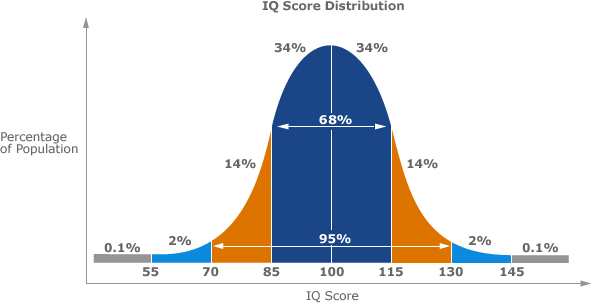
Image Source

If one assumes that a person needs an IQ of 115 to qualify for a rigorous university degree, roughly 4% of American blacks would qualify.

The average IQ of American blacks is 85, with a standard deviation of 15. (you will have to shift the curve one standard deviation to the left) An IQ score of 115 is 2 standard deviations above the African American IQ mean. A brief glance at the diagram above (shifted 1 STDV leftward) reveals that over 96% of American blacks would find themselves below the 115 IQ level, leaving only about 4% qualified to meet the challenge.


A look at recent ACT scores of US high school graduates suggests that only 23% of all US HS graduates are qualified to succeed in college with at least a "C" average. The study included graduates of all races and ethnicities, including high scoring East Asians and Jews of European ancestry.If one looks at the SubSaharan African population, with an average population IQ of roughly 70, it is clear that the proportion qualified to succeed in college would be less than 1%. Closer to 0.1%. Consider that, when you foresee the longterm future of SubSaharan Africa without assistance from China, Europe, or the Anglosphere.

IQ is less important overall than Executive Function (EF), for life success. But both qualities are highly heritable, and the most potent training window for EF has passed by the age of 7. The best training windows for other cognitive traits that affect one's IQ score have not been precisely determined. In other words, if the best educational systems in the world neglect the training of their young, what expectations can you have for African schools?

Many communities of American blacks have become pockets of the third world, with all the crime, corruption, and inherent dysfunctionality that is included. Not only are heritable IQs and EFs lower than in surrounding communities, educational systems and societal role models and institutions are also deficient -- so that training cannot make up for whatever inherited deficiencies are present. A large proportion of students will never graduate HS, and of those who do, a very low percentage will go to college. If society decides to promote these HS graduates to schools above their level of preparation and innate talent, failure is virtually guaranteed.

A multicultural society containing population groups of varying talent and functionality, will always suffer from civil dissatisfaction and disorder. How the society reacts to the inherent inequality and resulting dissatisfaction depends upon the society's own level of wisdom and maturity. Preferential treatment and promotion beyond qualification is one of the least wise and mature approaches.

Addendum: Can the average IQ of Subsaharan Africans really be as low as 70?
Critics of the finding that the average African IQ is 70 say that it simply must be wrong. They insist that biased testing procedures must have been used, even though dozens of separate studies have corroborated the results from East, West, Central, and Southern Africa. For Example, one 1992 study carried out for the World Bank reported that a random sample of 1,639 adolescents in the West African country of Ghana had an average IQ of 60.

In 1998, I went to Johannesburg, South Africa, to initiate a 5-year series of IQ studies in the university system to determine whether such a low IQ was accurate. I, too, wondered how well all the previous data had been collected, if sufficient care were taken in giving instructions, ensuring motivation, having a quiet room for testing, or giving enough time to complete the tests.

First, I contacted psychologists in the Faculty of Education at the University of the Witwatersrand (all anti-apartheid liberals) and together we tested hundreds of students of African, East Indian, White, and East Asian backgrounds, along with those of mixed ancestry, under optimal testing procedures, using culture reduced tests. We used a large, quiet, well-lit, well-ventilated examination room with desks spaced far enough apart to prevent copying or feeling crowded. As I walked up and down the aisles watching the students diligently at work, it was plain to see they were well-motivated.

We used the Raven’s Matrices, one of the best known, well researched, and most widely used of all the culture-reduced tests. Consisting of 60 diagrammatic puzzles, each with a missing part that the test taker attempts to identify from several choices, it is an excellent measure of the non-verbal component of general intelligence. Typically, the test is so easy for university students that they do it in less than 20 minutes. We set no time limit for the test. All those being tested were allowed to complete it.

We found African university students averaged an IQ of 84. In some studies, by other researchers, they have scored lower (IQ = 77). In still others of our studies, highly-selected engineering students who took math and science courses in high school scored higher (IQ = 103).

Assuming that, like university students elsewhere, the African university students on average score 15 points above the general population, the African general population average of about 70 would appear to be corroborated. _VDare

Labels: ,

Bookmark and Share

18 August 2009

As Unemployment Grows, So Do Foreclosures

The country's growing unemployment is overtaking subprime mortgages as the main driver of foreclosures, according to bankers and economists, threatening to send even higher the number of borrowers who will lose their homes and making the foreclosure crisis far more complicated to unwind.

Economists estimate that 1.8 million borrowers will lose their homes this year, up from 1.4 million last year, according to Moody's Economy.com. And the government, which has already committed billions of dollars to foreclosure-prevention efforts, has found it far more difficult to help people who have lost their paychecks than those whose mortgage payments became unaffordable because of an interest-rate increase. _WaPovia_News Alert
Unemployment is growing, and it is driving the steady rise in home foreclosures across the US. What started as a financial crisis driven largely by defaulting subprime mortgages, is turning into something deeper and much harder to repair.
Last year, about 40 percent of borrowers who sought help at NeighborWorks, a large housing counseling group, cited unemployment or a pay cut as a primary reason for their delinquency. Now it is about 65 percent. The number citing a subprime loan fell significantly.

"Rising unemployment, for the sake of this downturn, has magnified things considerably," said John Snyder, manager of foreclosure programs for NeighborWorks. "It's less about the payment adjustment."

When a subprime borrower becomes delinquent because of a hefty payment increase, the fix often involves lowering the interest rate to its original level. Unemployment poses a more difficult challenge, industry officials and consumer advocates said. During extended periods of joblessness, the borrower accrues large late fees that drive up monthly payments. And a new job often comes with lower pay, making it more difficult to catch up. _WaPo
Wags will try to dispel worry by telling you that "unemployment lags the stock market in a recovery." What they say is generally true -- unless, of course, it is unemployment itself which is driving the recession. In that case, it may be the stock market that lags unemployment -- on the way down.

Banks and financial institutions across much of the US are already in trouble, sucking up hundreds of billions of dollars of US government hijacked funds. And that sucking noise? It could be getting louder soon.

We are seeing what happens when investors and speculators use stimulus and bailout money to try to artificially jump-start markets -- and secondarily the economy. The great "recovery" appears to be fizzling out, for now. As ever more funds and resources are diverted from the private sector to the politically connected sectors (Obama supporters), the sucking sound keeps getting louder. And jobs continue being lost.

When a country is ruled by clowns and incompetent fools, the fundamentals of a sound economy are forgotten and ignored. A healthy economy is healthy from bottom to top. Artificial bubbles of the type Obama has been attempting to inflate, look good on paper if you can pull them off, but tend to suck wealth from the middle class and convey it to political insiders on the way to the upper class.

Labels: , ,

Bookmark and Share

17 August 2009

Saving Our Crumbling Urban Landscape

Cities of the western world are beginning to collapse from the inside out. As criminal and other non-productive classes displace the productive classes, large cities across the developed world are watching their inner cores crumble. Inner city redesign, refurbishing, and gentrification can only be successful in the long term if the city's tax base can be maintained -- and its crime and unemploment rates kept under control.
One answer is to build a new industrial city focusing on small scale craft and specialty manufacturing with high value added. We're seeing a precursor to this in the rise of [urban] organic farming and artisanal products of all kinds. TV shows featuring hip young carpenters renovating homes or gearheads tricking out cars and motorcycles make these professions seem glamorous. Magazines targeted at the global elite like Monocle scour the world in favor of the finest handcrafted products from old school workshops, building demand for these products. The New York Times Magazine recently did an article making the case for working with your hands, and also noted how digitally oriented designers are rediscovering the use of their hands. Perhaps it is no surprise that sociologist Richard Sennett turned his attention to the idea of the craftsman. In short, making things, craftsmanship, and quality are back in fashion.

The challenge for urban economies is to develop [a new industrial city] and put it on a sound industrial and economic footing. One key might be to inspire people to start these craft oriented businesses by tapping into people's desire to purchase ethical and sustainable products. We increasingly see with foods and other items that people want to understand their provenance, to know who made them, how, with what, and under what conditions. Often today businesses catering to this desire are small scale “Mom and Pop” type operations, but there is no reason they can't be done at greater scale, or expanded into areas like organic food processing, not just organic farming. American Apparel has done just that by manufacturing low cost, stylish clothing “Made in Downtown Los Angeles. Sweatshop Free.” at scale, for example.

Beyond craft products, reinvigorating small scale, specialty fabrication and other businesses, to rebuild an American version of Germany’s Mittlesand, creates another, often ignored option for urban economies. Quality, flexibility, responsiveness, and a willingness to do small runs are keys. These businesses can also underpin product companies higher in the value chain. They start building an ecosystem of local companies and expertise that can be useful for related or spin-off businesses. Jane Jacobs, and before her the great French historian Fernand Braudel, noted how cities could incubate many new enterprises because all the diverse products and services they needed were available locally. If you need to scour the globe looking for custom parts and services, it can quickly overwhelm a small business. _NewGeographic
The developed world is learning that outsourcing all of its manufacturing and production may not be the best idea. While China has built a large cash surplus by acting as the west's surrogate manufacturing sector, many regions of the western world have gone from prosperous to quasi-impoverished.

City planners and managers need to begin thinking in terms of "city-state" operations. Helping to develop local and regional sources for raw materials, food, and manufactured goods can improve the bottom line for both the city and the surrounding countryside.

One of the less considered products for local and regional production, is energy. But with the coming of bioenergy, more of a region's energy supply may well be accessible at close range.

Food, energy, housing, sanitation, education, medical care, entertainment, recreation, manufactured goods, large construction . . . Most cities are better suited for some of the above than others. But with a bit of imagination and better technologies, cities may be able to supply a larger portion of their own needs -- and boost their faltering economies at the same time.

The demographic problem -- the shrinking numbers of the innately talented with the rising numbers of the less talented -- will continue to be a challenge for Europe and North America. But persons of lower innate talent (lower IQ and EF) can be much better educated and trained than at present. By completely transforming and reforming our outmoded educational system and replacing it with a 21st century approach free of union thugs and government bureaucrats, the crime and unemployment figures can be improved even in the face of the ongoing demographic transition.

Labels: , ,

Bookmark and Share

16 August 2009

Always the Doom You Don't Expect That Gets You

Synthetic biology involves the production of novel living organisms that are self-replicating and potentially uncontrollable if something goes wrong.....

QUEST on KQED Public Media.
A .... concern is the deliberate construction and release of a pathogen more virulent and transmissible than anything in nature. The perpetrator might be a malevolent individual with a knowledge of synthetic biology or a terrorist group seeking the ultimate bioweapon. Fuelling such fears is the rapidly growing availability of BioBricks and other “standard biological parts”, which enable even undergraduates to engineer their own microbes.

We probably have at least five years grace before synthetic biology has reached the point... FT
.... where it can destroy our current gullible faith in the safety of the commons. We may have five years. Sooner or later, resentful child-men and child-women will have the power to turn the life-giving air, water, food, and biosphere of the planet into agents of certain death -- or worse.

Synthetic biology will have to learn how to manipulate much more than DNA and genomes to become truly dangerous, of course. Without the epigenome and other components of life, the genome is an empty shell.
Epigenetics, a relatively new endeavor in science, refers to the control of the patterns of gene expression in cells, which gives rise to the necessary differences responsible for creating the complex and interacting tissues in the body.

Scientists globally have begun working on a Human Epigenome Project in a bid to compile detailed data documenting, within a person, the epigenetic changes in different types of cells and tissues, something that will complement the already-completed Human Genome Project. _Source
Links and video via Machines Like Us

We are accustomed to breathing from a common air supply, drinking from a common water supply, eating from a common food supply, and immersing ourselves in a common biosphere. In the not-so-distant future, humans may have to jettison this childlike faith in the safety of the bio-commons, and take steps to assure the safety of our own food, water, and air supplies. On a local -- even household -- level. Mass society could become a thing of the past, as multiple existential threats simultaneously sever the threads of trust that presently hold cultures and societies together.

Who will prevent this dissolution of trust and safety? Not the clueless clowns of the present US governmental reich. They are too busy destroying political enemies and grabbing as much political power as possible, to even consider attending to real world existential threats. The type of competence required to anticipate, interdict, and prevent such threats, is in very short supply -- and little valued in the current political / academic / media climate.

It is up to individuals and groups working outside the mainstream, to devise protective solutions to these somewhat probable threats. Fortunately, many genuinely useful preventative measures apply almost equally to a wide range of existential threats.

Labels: , , ,

Bookmark and Share

15 August 2009

Al Fin's 2009 Small Vehicle Survival Award Winner


The HovPod personal hovercraft is built for durability and versatile travel on all types of terrain. From water to mud to sand to ice to snow to pavement, this little package is not just for exhilaration and mirth. It can get you places few other craft can take you, quickly and economically.

If you need a quick evac out of a gridlocked city that is located on a river, coastline, or harbour, this little airboat is the next best thing to a personal helicopter that can put down on land or water.

Al Fin engineers are working on a fairly simple modification which will allow the HovPod to fly, using inflatable wings. Put simply, it will require more power, and hull materials with more favourable strength to weight characteristics. More on that option as developments allow.

Labels: ,

Bookmark and Share

14 August 2009

Drink a Drop of Caution With That Financial Bullshit

via SimoleonSense

The New Bull Market Fallacy (via SimoleonSense)

Not So Green Shoots (via Instapundit)

Equities Market a Mess

Toxic Loans Threaten US Banks

Government Drunk, Destructive, and Belligerent on Public Spending
The government can either: (1) adopt fiscal discipline, (2) default on its debts, or (3) use the printing press to inflate away the debt. Given the particularly undisciplined nature of the current reich, expect first inflation and then default. Discipline will not return to government until after a radical re-structuring of Obama / Pelosi's radical restructuring can take place.

Labels:

Bookmark and Share

10 August 2009

40 Million Years of Uranium, at 10X Current Use

Image Source
And there is more than 3X as much Thorium as Uranium in Earth's crust. According to Brian Wang, there is an estimated 40 trillion tons of Uranium in Earth's crust, and over 120 trillion tons of Thorium. Only 67,000 tons of Uranium are "consumed" yearly. If rational fuel enrichment and re-cycling is incorporated into the fission cycle, Earth would never run out of fissionable uranium.

The Thorium cycle is safer and less prone to weapons proliferation. Fortunately, we have over 100 million years worth of Thorium.

But talking about millions of years of nuclear fission is simply silly, considering the likelihood that scalable nuclear fusion will be practical sometime in the next 20 to 30 years. How much would the world change in the face of abundant nuclear fusion energy?
Fully developing the capabilities of nuclear fusion and nanofactories and accessing these resources in the solar system is the end of scarcity scenario. _BrianWang's NextBigFuture
Brian is quite correct: the combination of abundant fusion energy with perfected molecular nano-assemblers would mean the end of scarcity in the human world -- for a period of time.

But the mean human IQ of planet Earth is now less than 90. In 40 years Earth's mean IQ is likely to be in the middle or lower 80's, if current demographic trends continue. The combination of abundant energy, abundant wealth, hyper-advanced technologies, AND LOW AVERAGE INTELLIGENCE, is a deadly mix. Unscrupulous politicians -- similar to those now ruling North Korea, Russia, Venezuela, or Iran -- would find a way to control access to energy, wealth, and technology. The politically connected would live better than any king or emperor throughout human history. The great masses of common people -- those who are not imprisoned in work camps, psychiatric institutions, or torture facilities for dissent or thinking disloyal thoughts about the great leader du jour -- are likely to suffer, as they always have.

Human nature is not likely to change in the world at large. Humans are not going to grow more intelligent, on average. New technologies of wealth and power will be controlled by insiders, in most countries. They will be used to enrich the inner circle, and to control everyone else.

If the dieoff.orgiast gang of militant greens happen to be in control of the countries where cornucopian technologies are developed, they will find themselves -- at last -- in a position to correct all the evils of man about which they have bitterly complained for so long.

Read Brian's article carefully and you will see that he has included warnings and cautions, along with optimism. Brian's blog is one of the resources of the Lifeboat Foundation, after all. The Lifeboat Foundation is all about keeping human civilisation going in the face of the wide range of existential threats of the future -- manmade and otherwise.

With great opportunity comes great danger.

Peak oil catastrophe is for dummies, to be sure. Like climate catastrophe, it is a political contrivance. But sometimes abundance can be a greater threat than scarcity. We need to be prepared.

Labels: , ,

Bookmark and Share

Higher Education Overinflated

According to a Forbes.com article, college tuition has increased by more than three times the rate of inflation over the last 20 years, despite flat-lining U.S. wages. The average tuition at a private four-year school is up 6.6% yearly in 2007 to $23,712, according to the College Board. . .

And it could haunt students and America for years to come. _WealthDaily
According to the College Board in early 2009, total student loan borrowing more than doubled between 1998 and 2008. The numbers are staggering. We're talking about $85 billion in loans, as compared to $41 billion ten years ago.

Privately funded student loans have risen, too, from 7% in 1998 to 23% of all student loans in 2008. It makes for quite a brew for cash-strapped Americans this year, who are already saddled with unemployment and loss of income. Sallie Mae, for example, had a delinquency rate of 9.4% in Q3 2008, as compared to a rate of 8.5% just a year earlier.

I'm willing to bet that rate gaps higher as the months go by.

The student loan market has been, is, and will be riddled with trouble. Expect higher default rates, as students can't pay back these loans. Still, we'll look to profit from their demise. _WealthDaily
College education is a multi-faceted scandal, crying for alternatives and correctives. Rather than a place to prepare students to meet life's challenges, universities have become dumbed down indoctrination centers and refuges from responsibility -- where students learn and teach dysfunctionality on a grand scale. An educational system fit for a crumbling civilisation, to be sure.

What are the alternatives? Independent certification agencies, which can certify knowledge and expertise across a wide array of professional, vocational, and academic / scholarly / research areas. Universities practise grade inflation, social promotion, affirmative action, and other non-meritocratic policies, which destroys the credibility of many university degrees in the eyes of employers and the public.

University has become bad, overpriced theatre. Farce, if you will. As the cost of university explodes, the value shrinks. All of society participates in this expensive and destructive farce.

Labels:

Bookmark and Share

06 August 2009

Peak Oil: Meet North Dakota Oil

North Dakota as an oil patch state? Yes, probably in a decade or less. The state’s Three Forks-Sanish formation could rival nearby Bakken Play, a vast oil shale field. Together they could hold 200 billion barrels of oil, about four times Alaska’s entire oil cache. That’s enough black gold to provide the equivalent of 30 years’ worth of U.S. oil needs at current usage levels, without having to import one barrel from abroad. _Kiplinger_via_NewsAlert
We have heard a lot about North Dakota's Bakken Play -- particularly from Brian Wang's NextBigFuture. But larger oil fields wait to be tapped as the technology of oil discovery, exploration, and extraction is improved. Peak oil catastrophe dogma relies upon ignorance of remaining oil reserves, for credibility. As long as the profit motive is allowed to function in free societies, however, energy technologies will improve to exploit the abundant reserves of energy that wait unseen in the world around us.

Universities, the media, and the green political-industrial complex are united in the goal of energy starvation and industrial choke-off, along with population die-off. All of the policies of the Obama / Pelosi reich revolve around that underlying theme. Under the policies of the ruling reich, businesses will die, employment will plummet, home ownership will continue melting away, and power will continue to consolidate to the politically connected.

Peak oil catastrophe and climate catastrophe are two useful facades to facilitate the agenda. North Dakota is an awkward counterpoint to the talking points. There will be more -- many more. This is a time for those persons who have escaped the academic and media camps with their intellectual curiosity intact, to start paying attention. Things are soon to become interesting.

Labels: ,

Bookmark and Share

05 August 2009

Can City-States Save the Third World?


Paul Romer (via A Thousand Nations) describes a system of "Charter Cities" distributed about the third world, modeled after Hong Kong and Singapore. These chartered city-states would be "in the third world but not of the third world." In other words, the rule of law and economic dynamism in these city-states would provide an environment of living and choice distinctly different from the squalid and corrupt living conditions currently prominent across the third world.

In fact there is a Charter Cities blog that provides much more information about this topic. If you are interested in the concept of city-states and how cities drive the economies of the world, check out the blog and the video above.

Trying to save the third world is well and good. But at this time, the first world itself is in a quite precarious position. Demographically, the populations that fueled the rapid improvement of living conditions in the developed world are shrinking. Social programs that are dependent upon large numbers of younger generation taxpayers appear to be losing their financial support. Educational systems that once provided vital grist for the mills of progress, have been corrupted into special interest bureaucracies of indoctrination. Vital resources that should be invested in future technologies and industries are being squandered on phantom crises created from fudged data and faulty models.

If the vital core of the developed world is to survive current suicidal tendencies by the majority of its citizens, it may well need to learn some vital lessons from the charter cities movement. For example, what type of "charter" would protect a city from being carried away in a lemming's rush by all too frequent "popular delusions and madness of crowds"? Such chaotic fads and fashions of disaster and quasi-suicide are all too frequent.

Romer's vision of saving the third world with charter cities is bold and courageous in comparison to the dieoff.orgiasts of the left who dominate large parts of the developed world's governmental, academic, and media infrastructures. It is a vision worth observing to see what comes of it. But it contains elements of wisdom that first worlders could learn from in their own planning for the future.

Labels: ,

Bookmark and Share

04 August 2009

Executive Function, Intelligence, Talent, and Grit

“I’d bet that there isn’t a single highly successful person who hasn’t depended on grit,” says Angela Duckworth, a psychologist at the University of Pennsylvania who helped pioneer the study of grit. “Nobody is talented enough to not have to work hard, and that’s what grit allows you to do.” _Globe
The linked Globe article above takes a fascinating look at "grit", the human trait of setting goals and persisting in finding a way to achieve the goals against all obstacles. The successful application of grit is virtually indistinguishable from well-tempered "executive function."
Goal-setting, planning, organizing, attending, sequencing, problem-solving, and self-monitoring are all aspects of something called "executive function." This part of our cognition is primarily housed in the frontal lobes of the brain. _Examiner
Executive function (EF) has been found to be at least as important to life success as a person's IQ. Some overlap exists between EF and IQ, but they are not the same thing.

Given the significant heritability of both EF and IQ, one might be excused for believing that mental talent is largely innate. But it is impossible to separate genes from environment. Much "innate talent" is never developed. And sometimes sheer energy and persistence can compensate for shortcomings in innate talent.
We are not a world cruelly divided between the innately-gifted and the destined-to-be-mediocre. Rather, every human being is a reservoir of talent waiting to be successfully tapped.

"Compared to what we ought to be, we are only half awake," declared the 19th century American philosopher William James. "...We are making use of only a small part of our physical and mental resources." _Genius Blog
It is certainly not true that a person can do anything he wants to do -- particularly a person with an IQ less than 90 and poor executive function. But persons of lesser intelligence may accomplish significantly more than a person of greater intelligence -- if they learn to set goals, and have the grit and imagination to reach the goals despite obstacles.

If the K-12 educational system taught nothing else but goal-setting and grit, the quality of its graduates would improve immensely over the tremendous underachievement currently seen.

It is quite possible, however, that grit and EF can be better taught at home by parents, or by playing videogames or role playing games, than by attending school. It is quite possible that generations of Americans living before mandatory schooling were significantly grittier than subsequent generations who were confined indoors several hours a day with age-cohorts, at the mercy of the "pedagogy du jour".

The demographic trend of US and Canadian society is quite clear. European ethnicities are declining, and non-European ethnicities are growing via immigration and differential birthrates. If we do nothing to increase the EF and "grit" of non-European residents, it is unlikely that the US and Canada will be able to field the talent necessary to fully bridge the gap between the age of scarcity and the coming age of technology fueled cornucopia. East and South Asians have demonstrated high skills in science, technology, and commerce / industry -- but the majority of new immigrants are from elsewhere. Their innate talents do not measure up to those of their European predecessors or their Asian co-immigrants.

If the limits of innateness are to be overcome, a prodigious amount of effort must be expended by many areas of society, including schools, families, popular media, and other facets of mainstream culture. Without that effort, the limits of innateness will be impossible to ignore and disregard.

It is too early to tell how successful we may be with improved methods of imparting grit and EF, along with better ways of teaching competencies and knowledge. We have a long way to go on all fronts. But we should have gotten started correcting these shortcomings long ago, if we wanted to reverse some quite catastrophic trends.

We need technologies that allow us to accomplish these things without the help of Education Departments, and teachers' unions. Those vested interests care only for power and bureaucratic longevity. They make our jobs harder, for all the resources wasted on them. It is an opportunity for us to demonstrate our own grit.

Labels: , , ,

Bookmark and Share

03 August 2009

Upcoming Conference on Electromagnetic Pulse


A man-made Electromagnetic Pulse (EMP) is caused by a nuclear weapon detonated in the atmosphere. This threat is a realistic possibility in this day and age. In fact, two Congressional Commissions have recently warned that America could suffer catastrophic consequences from a nuclear EMP attack by terrorists or rogue states. Their reports also point out that the U.S. can be protected if we act quickly. A House Homeland Security subcommittee is currently meeting and considering legislation, but very little has been done so far. According to the Abstract of the original Report of the Commission to Assess the Threat to the United States from EMP Attack, U.S. Congress, 2004: “Several potential adversaries have or can acquire the capability to attack the United States with a high-altitude nuclear weapon-generated electromagnetic pulse (EMP). A determined adversary can achieve an EMP attack capability without having a high level of sophistication.” Read the full report _EMPACTAmerica
EMP attack by rogue states or by independent actors supported by rogue states, is increasingly likely. Whether a successful paralysis of the US electrical grid would require the extra-atmospheric detonation of a single nuke or multiple nukes, is irrelevant. More than enough nuclear material can be made available by enemies of the US to cause untold hardship and tens of trillions of dollars in infrastructure damage.

While the US military may be sufficiently hardened against such an attack to continue functioning, the US at large is not. The loss of US economic productivity caused by a large scale EMP attack would force the US military to withdraw from foreign activities on land, sea, and in the air in order to assist in the recovery and defense -- if necessary -- of the far-flung regions of the US proper.

EMP, dirty bombs, biological attacks, and soon nanotechnology attacks are becoming easier and more realistic by the year. While resources and attention are diverted to phantom climate fears, genuine threats are going unmet.

It is clear that the Obama / Pelosi reich is uninterested in anything but the consolidation of power, and elimination of all potential centres of opposition from government and the private sector. It is up to individuals, private groups, and state / county governments to prepare for real threats, essentially without help from the federal government.

Labels: ,

Bookmark and Share

01 August 2009

Partial List of Online University Lecture Sites

Al Fin blog will soon be returning to its original purpose: providing access to the tools and information needed to survive to the next level. The central tool is one's self -- one's body and mind. Self development and self education are crucial. Never has higher level education been more economical or available than now. Below is a partial list of websites devoted to online lectures. You can find more such sites on the Al Fin sidebar dealing with specific subject areas, as well as many links to tutorials, free textbooks and journals, and specific online courses.

Lecture Fox: This site links to thousands of lectures in video, audio, and text formats, from top universities around the world.

Academic Earth: Previously covered here, this website appears to be growing into what may be come the go-to site for video lectures online.

Free Science and Video Lectures Online: This is a blog that covers a different subject area of online lecture videos in each post. The archives are extensive.

World Lecture Hall: This site contains a large searchable list of online lecture topics in a wide range of subjects.

Cosmolearning: Wide range of course topics particularly in science and computer science.

LearnersTV Nice selection of lectures, animations and notes on the sciences, engineering, computer science, medicine, and management. (added 7 Aug 09)

There are many more such sites available, and I will be mentioning more as I become more familiar with them. Also check out the Online education category below.

More:

Video Lectures Net

Online Neuroscience Lectures

Theoretical Physics Talks and Conferences

101 Lectures on Open Source educational technologies

NPTEL: Engineering, Technology, and Computer Science course lectures from IIT

Khan Academy lectures on math, science, banking, and finance (added 6 Aug 09)

FreeVideoLectures.com (added 7 Aug 09)

http://www.lecturesarchive.com/5726.html (added 30 Oct 09)

Open Courseware Finder -- Expansive Search Engine (added 30 Oct 09)

Take Any Class for Free (added 30 Oct 09)

Update: You Tube Edu: This You Tube channel contains entire video courses from about 100 different prominent (mainly) US universities. You Tube Edu has been downgraded by Al Fin to a non-essential resource. The idea was sound, but it has been mishandled and badly botched. You can still find some useful videos at the site, but it deserves to be last on the list rather than first.

Labels: , ,

Bookmark and Share

29 July 2009

Academic Earth: Lectures from Scholars

Academic Earth is proud to announce that it received more than one million visits in the first three months since its January 18 beta launch, with more than 50% of users coming from outside of the US. You can see more details and learn about the most popular subjects, courses, and lectures over that time frame in this presentation. _Academic Earth


Academic Earth is but one of many online sites offering high quality academic lectures on demand at no cost. In The Impending Demise of the University (h/t Simoleon Sense), Don Tapscott looks at many reasons why current incarnations of the university are likely to grow extinct, due to competition from the internet and other technologies.
Universities are finally losing their monopoly on higher learning, as the web inexorably becomes the dominant infrastructure for knowledge serving both as a container and as a global platform for knowledge exchange between people.

Meanwhile on campus, there is fundamental challenge to the foundational modus operandi of the University — the model of pedagogy. Specifically, there is a widening gap between the model of learning offered by many big universities and the natural way that young people who have grown up digital best learn.

...These universities are vulnerable, especially at a time when students can watch lectures online for free by some of the world's leading professors on sites like Academic Earth. They can even take the entire course online, for credit. According to the Sloan Consortium, a recent article in Chronicle of Higher Education tells us, "nearly 20 per cent of college students — some 3.9 million people — took an online course in 2007, and their numbers are growing by hundreds of thousands each year. The University of Phoenix enrolls over 200,000 each year." _Edge

Labels:

Bookmark and Share

26 July 2009

Economic Tidbits

China may not be ready to spark the international economic recovery. Many informed observors are looking at China's economy and seeing a big bubble. More on China Bubble

Even worse, China appears intent on inflating its bubble to encompass the rest of the world.

Instead of investing in China, you might consider Japan. Although Japan's population is shrinking, sometimes quality can trump mere quantity.

The near and middle-term outlook for the global economy still rests upon the US' shoulders. This is unfortunate, given the current inept and clueless leadership of the former American colonies.

Labels: , ,

Bookmark and Share

24 July 2009

Obama Stimulates Bomb Shelter Economy

Although Obama has been unable to improve US employment and business formation, the clown president of the US has had quite a salutary effect on other parts of the economy. Gun and ammunition sales, for example, have skyrocketed into record territory. The survival business has also been doing quite well, including bomb shelter sales. Popular Mechanics has a feature on fallout shelters that you can buy now:
The bomb shelter business is booming. At least that's the consensus of the men and women who design, construct and install underground sanctuaries. They attribute the growth in business to Kim Jong Il's erratic missile lobbing, the intransigent Iranian clerics hell-bent on getting nuclear weaponry, the impending total collapse of the global financial system, and the end of the world in 2012, as predicted by the Mayan Calendar.

"For whatever reason—and we're not totally sure ourselves—but business is incredible," Brian V. Camden, an engineer at high-end shelter builder Hardened Stuctures, says. "Twenty-twelve, the financial collapse: I just had to hire a new architect Tuesday. Right now we're doing a lot in Tennessee, Kentucky, Pennsylvania. All through Appalachia, it's people who share a similar mind-set." _PM
Of course everyone understands why the survival industry is growing at rates not seen since the Jimmy Carter malaise. Most of the people who are spending large sums of money to make themselves and their families secure, do not understand what they are doing. They are not competent to meet the likely challenges that an extended Obama depression and catastrophe would force them to meet.

Truly competent persons can build or design far better plans for surviving hard times than are available from most vendors in the survival industry. Unfortunately, competence is a vanishingly rare commodity in the age of psychological neoteny and academic lobotomy.

The most effective survival strategies involve cohesive groups of like-minded and competent persons working together toward a common goal. The information and tools for survival are available to any insightful persons or groups. In libraries and on the internet, you can find all the info you will need. Consult the Al Fin sidebar, or check out the "survival" category link below.

The Society for Creative Apocalyptology is working on providing its expertise in syndicated form to local chapters. Stay tuned, since the wheels of progress sometimes roll slowly.

Labels: ,

Bookmark and Share

20 July 2009

Electromagnetic Pulse Basics


William R. Forstchen is the author of One Second After, a best-selling novel that looks at a post - EMP US. Without the electrical power grid, modern civilisation would be in danger of collapse. If your power utility breaks down, the world around you will grow very dangerous, and life very precarious -- quickly.
This is a terrifying aspect of an attack that no government report has publicly discussed along with the potential casualty rate in the first seconds after an attack. Commercial airliners today are all computer driven. In fact, from lift off to landing, a pilot no longer even needs to be in the cockpit, a computer can do all of it if need be. When the pilot pulls back on the "stick" it is no longer connect by wires stretching all the way back to the tail and the elevator assembly. Instead, his motion is read by a computer which sends a signal to an electrical servo - motor in the tail, which then moves the tail. In short, the entire plane is computer driven. It is estimated that at any given moment during regular business hours, somewhere between three to four thousand commercial airliners are crisscrossing the skies. (There is a fascinating site you can find via Goggle that shows typical air traffic around the world during a twenty four hour period. From dawn til way after dusk, the entire USA is one glowing blob of commercial flights crisscrossing our sky). All of them would be doomed, the pilots sitting impotent, staring at blank computer screens, pulling on controls that no longer respond as the plane finally noses over and heads in.

Somewhere between 250,000 to 500,000 people will die in the first few minutes...more than all our battle casualties across four years of World War II

AREN"T WE PREPARING? ISN'T THERE REPLACEMENT EQUIPMENT IN PLACE AND TRAINED PERSONNEL READY TO REACT?

The frightening answer is no. This author has spent over four years researching this topic, interviewing scores of personnel from Congressmen and Generals, to your local police chief and sheriff. At your local level, since 9/11, first responders have received hundreds of hours of training and briefings on all sorts of terrorist scenarios. Only a few have told me that they even discussed the topic for more than a few minutes at an official level. As to emergency stockpiles of supplies and crucial replacement parts, there is nothing in place.

WHY NOT?

EMP, has managed to "stealth" its way on to the highly dangerous list and few, except for a small number of personnel in the Pentagon, various research labs, and men like Congressman Bartlett (R., MD) who heads the Congressional Investigative Committee on EMP, are aware of it. For one it has a certain "sci - fi" sound to it, which makes many dismiss the potential before the discussion has even started. Second, the only way to truly evaluate the threat and demonstrate it is to detonate a nuclear weapon, something we have not done since the full test ban went into effect decades ago. It is therefore not "visible" to us, the way another airliner smashing into a skyscraper is now forever imprinted on our national psyche, feared, and prepared for. Next, with all the competing issues and threats in the world, EMP simply does not have a "constituency" of influence. Only a few members of Congress, our military and scientific community are issuing the warnings. There are no Hollywood stars placing themselves in front of cameras with this as their cause, the few times it has been used in popular movies, it has been portrayed inaccurately, often absurdly.

And finally, the impact is so overwhelming - that it triggers a psychological sense of helplessness, and therefore why bother, since if it happens we are finished. It is the same response that happened between the 1950s - 60s. When first confronted with the threat of a nuclear attack, tens of billions was spent to prepare, in fact our Interstate Highway system was initiated in the mid 1950s as a national defense effort to provide avenues of escape from cities in the event of nuclear war, a means to bring in emergency supplies and to move our military. Plans were issued to citizens on how to build bomb shelters and all children were drilled in what is seen now as the absurd "duck and cover."

Something happened though by the mid - 1960s. The threat was no longer fifty to a hundred small atomic bombs dropped from bombers, it was now a rain of thousands of hydrogen bombs, delivered within minutes by ballistic missiles. In this atmosphere of overkill, attempting to prepare seemed ridiculous, futile. The standard phrase became "the living will envy the dead," so why bother? Civil defense finally became an object of derision, the realm of a few survivalist nut cases.

That threat is still there, and to this day our nuclear forces stand ready to respond, which has indeed been the only defense left..."if you nuke us, we'll nuke you," a policy known as "mutual assured destruction," a zero win game.

EMP is different, it is not a rain of thousands of bombs, needing a vast and powerful military to deliver it, which means Russia and China are the only real threats in that realm...but unless seized by madness, their leaders know such an attack, within minutes would be met with thousands of bombs annihilating their country as well. It is a balance of terror that has now endured for nearly sixty years.

An EMP attack is different since it only requires but one nuclear weapon, detonated 300 miles above the middle of the United States. One bomb. The launch could even be done from a container ship somewhere in the Gulf of Mexico and in that instant, the war is already over and won.

_Forschen
Read the whole thing.

If you are an Obama zombie, brain-dead and blindly trusting in the benevolence and wisdom of the clown in the White House, there is nothing here that will interest you. Life goes on according to the "talking points", and life will always go on according to the talking points. To think anything else is to wander off the reservation, onto dangerous and uncharted territory.

But if you can think for yourself, you will see the threat of EMP as just one out of many threats that can throw the modern, oblivious way of life out of its convenient and affluent path.

Labels: ,

Bookmark and Share

18 July 2009

Can You Survive the Mean Streets?


Surviving the wilderness can be a cinch compared to many parts of a large city. As the Obama depression spreads and deepens, a lot of people currently living on the edge will begin to get desperate. Desparate people do desparate things. If you happen to find yourself in the path of desparate persons, you may wish that you had spent more time preparing. Because, when the time comes, it is unlikely that your pleas or excuses will help you.
It's a sticky Saturday morning and I'm handcuffed in the back seat of a Jeep Grand Cherokee parked on the side of a Philadelphia street. On one side of me is my boyfriend, Bruce, and on the other his best friend, Nick. Both of them are also cuffed—and like me, sweating like pigs. I reach into my hair and pull out a bobby pin that within seconds I've fashioned into a simple device I use to jimmy open my handcuff locks. Our assignment now is to evade 12 professionally trained trackers in a 25-square-block area for the next eight hours.

It may be hard to believe, but we asked for this. Actually, we paid for it: $550 apiece.

Today is the final day of a three-day "Urban Escape and Evade" course offered by onPoint Tactical LLC, a New Jersey-based company that teaches soldiers, police officers, and, increasingly, civilians urban survival skills.
_Source
Urban survival, escape, and evasion courses are popping up across US cities, as more residents of the US begin to understand where the Obama reich is headed. Under a regime of corruption and fascist social corporatism, large numbers of unfavoured and unconnected people will be left to fend for themselves.

Anyone who has lived in Mexico and other parts of the third world understands the fear of kidnapping and drug violence. Soon those living in the US will learn what living in the third world is like, courtesy of Brocko Bomba, aka "The Messiah", and "The Godfather."

Labels: , ,

Bookmark and Share

14 July 2009

Outer Space Colony for Geosynchronous Orbit


The space colony Asten, named after the Egyptian god of balance is 1.6 kilometer-high structure made up of a series of habitation rings stuck in the shape of a cylinder. The entire structure rotates on its axis, simulating Earth-like gravity for its inhabitants. _NewLaunches
Image Source
The design for this space colony comes from Eric Yam, high school student from Toronto. Eric was a co-winner of the 2009 NASA Space Settlement Contest.
"He basically built a Utopia from scratch," said math and physics teacher Gillian Evans, staff advisor on the project.

Yam's innovative design, built as a series of stacked rings resembling a cylinder, would house a self-sustaining colony of 10,000 people and up to 300 visitors, including paying tourists, in the year 2050.

A hotel section would include a panoramic outer gallery with transparent walls, perfect for watching the earth, moon and stars.

Yam called his design Asten, another name for the Egyptian god Thoth, master of divine and physical law.

A pdf of the design can be viewed at: http://www.tdsb.on.ca/wwwdocuments/about_us/media_room/docs/ASTEN.pdf _Star

Labels: , ,

Bookmark and Share

11 July 2009

Rough Waters Ahead for Economy, Society

Controversial futurist Gerald Celente does not have a high opinion of President Obama's competence as leader of the world's largest economy. In the following video, Celente describes some of the problems resulting from electing a president who is not quite up to the task. Unfortunately for the US, it does seem that virtually every policy decision of Obama's that involves the economy, is wrong.
Gerald Celente on YouTube

Gerald Celente's Trends Research Institute

http://www.infowars.com/celente-predicts-revolution-food-riots-tax-rebellions-by-2012/

H/T Neil Craig

Nouriel Roubini looks at the US government's dishonest jobs numbers and sees reason to expect things to get worse. Again.

More:
Top Morgan Stanley economist sees economic and financial instability

Economic indicators from international shipping data send ominous signal

Inflation vs. deflation

H/T Survival Blog

One of the most ominous signposts for the future is the rapid growth of government employment and government spending in the face of rapid contraction in the private sector. The government employee pension fiasco is already becoming the focus of widespread discontent that could easily morph into societal discord. Deep fault lines between persons tied to the public sector and persons invested in the private sector could deepen and lurch violently in the near future. Public perception is growing that the new outfit in Washington is stripping the private sector like a junked automobile, for the benefit of Obama's financial backers and political allies.

Prepare for the worst. Hope for the best. In that order.

Labels: , ,

Bookmark and Share

10 July 2009

Connecting Aerodynamic Seasteads in Clusters

Image Source
The SESU seastead design won the recent Seasteading Institute's design award for "most aesthetic." As you can see, the seastead is mostly enclosed by transparent panels. This design protects the inhabitants from ever-present winds, sea spray, and splash in high seas, while allowing for daylight illumination. The above image demonstrates a cluster of 3 SESU 'steads, along with a docked super-yacht. In reality, the best dock designs for yachts and passenger ships are yet to be created.
Image Source
The SESU design is Al Fin's favourite of the recent seastead design contest winners. The semi-enclosed design protects inhabitants and interior structures from many of the hazards of the open sea, in comparison to the other designs.

Better methods for loading and unloading supplies and personnel -- from the sea and from the air -- will be most important for any such facility that intends to put to sea long term.

The vertical 4-spar design is meant to minimise wave impact on the structure. But traveling through the water will be slow, which means that it will be difficult for such seasteads to move out of the way of large storms. The structure would have to be able to adapt and transform itself to meet and survive strong storms at sea.

The walkways connecting the 3-stead cluster, as pictured, would likely snap like toothpicks in any significant storm. Should that happen, the 3 seasteads would be far too close for safety in a free-floating configuration. There are many things to be taken into account, before this design is actually inhabited and tested at sea.

What would you change or modify?

For more information, read Reason Magazine's 20,000 Nations Above the Sea for an interesting look at the founding fathers of the Seasteading Institute and on some of the non-technical problems seasteading faces.

For seasteading to be successful as a movement, it will have to solve a long list of problems. Only a few of them are technical or engineering problems. Most of them will be tougher because they will involve human psychology, politics, and legality.

Labels:

Bookmark and Share

08 July 2009

Bottom Up Brain Building: The Missing Links

There is a way to build thinking machines that might work. Use as your model the only proof of concept of higher intelligence known to the universe: the human brain / mind. Start by developing a machine nano-architecture that can do almost as many things that the human brain can do. To do this, you must understand the brain and you must invent new machine tools for imitating what the brain does.

Berkeley professor of electrical engineering Leon Chua, has made a good start. His "memristor" devices have gotten a lot of people excited about the possiblity of designing a working machine brain from the bottom up.
When two metallic wires are separated with a few nanometers of memristive material (such as certain transition metal oxides), an electronic device is formed that acts much like a nonlinear resistor, but with a twist. The resistance varies over time as a function of the currents flowing through it. In other words, it is a resistor with memory.
The rate at which their resistance changes is extremely nonlinear in the voltage applied. Small voltages hardly perturb the resistance at all, while somewhat larger voltages can induce fast changes. _Memristor Cortical Computing
Because memristor devices are able to change their electronic characteristics based upon their electronic history, they can be seen as analogous to neuronal synapses, which change their characteristics based upon their synaptic firing history. This dynamic adaptation on the nano scale presents the possibility of building very dense self-organising electronic networking chips far beyond anything previously possible.

Intelligence is not an algorithm. It cannot be "programmed." But given the proper "neural architecture" and appropriate experience, intelligence can be evolved over time. The memristor needs to be joined by other advanced memory-electronics in order to provide for machines the extremely subtle learning that the human brain can do.
The electronic brain will be a time coming. "We're still getting to grips with this chip," says Williams. Part of the problem is that the chip is just too intelligent - rather than a standard digital pulse it produces an analogue output that flummoxes the standard software used to test chips. So Williams and his colleagues have had to develop their own test software. "All that takes time," he says.

Chua, meanwhile, is not resting on his laurels. He has been busy extending his theory of fundamental circuit elements, asking what happens if you combine the properties of memristors with those of capacitors and inductors to produce compound devices called memcapacitors and meminductors, and then what happens if you combine those devices, and so on.

"Memcapacitors may be even more useful than memristors," says Chua, "because they don't have any resistance." In theory at least, a memcapacitor could store data without dissipating any energy at all. Mighty handy - whatever you want to do with them. Williams agrees. In fact, his team is already on the case, producing a first prototype memcapacitor earlier this year, a result that he aims to publish soon. "We haven't characterised it yet," he says. With so many fundamental breakthroughs to work on, he says, it's hard to decide what to do next. Maybe a memristor could help. _NS
It should have been obvious that the tools for creating machine intelligence were inadequate to the task. Just as it should have been obvious that the models used to predict climate over multi-decadal scales are completely inadequate to the task. Many things become obvious once one throws off the blinders of conventional groupthink. If one allows oneself to think outside the box, the possibilities suddenly multiply wildly.

More: The image at top is of a slime mold, which is sometimes a single-cell organism and sometimes a multiple cell organism, depending on environmental conditions. Each biological cell is in essence an incredibly complex computing machine. Multicellular organisms possess unbelievable biological computing power, compared to non-biological computers. Imagine the computing power of a human being, complete with brain and nervous systems. It is literally beyond the power of human made hardware to emulate. But as humans develop more subtle technologies of computation, they will be able to build -- from the bottom up -- machines that have the intelligence first of insects, then of higher and higher animals.

Will humans eventually be able to evolve machines with the intelligence of humans and higher? Of course. It is also true that if humans do not choose to become more intelligent themselves, that they are finished on this planet, long term. How humans go about the enhancement of their own intelligence will make for some interesting work in the not so distant future.

Brian Wang provides more quotes and images on this topic

Labels: , ,

Bookmark and Share

05 July 2009

Freedom For the High Seas and Beyond


The Aeroyacht 110 has been dubbed “the world’s most innovative super catamaran” by its designers and, while that’s a pretty big claim, it’s certainly an audacious concept. Capable of speeds of over 32 knots but able to cruise effortlessly at 20, boasting a superbly-appointed 32ft wide salon with 360º sea views and with its own fold-up amphibious plane as a tender, the Aeroyacht 110 looks to be the ne plus ultra of luxury sailing.

Designed from scratch by Gregor Tarjan, founder of Aeroyacht International, together with naval architect Pete Melvin, of the world-renowned Morrelli & Melvin multihull architects, the Aeroyacht 110 was designed from the outside-in. Tarjan started with the concept for a “pure sailing machine” and, once its streamlined shape was established, only then worked out how many people it could and should accommodate

The ICON amphibious craft on deck adds a completely new dimension of freedom to the maritime ensemble. All that is lacking is a small submarine. The decks appear ample for both a mini-sub and the small amphibious flier.

Perhaps the Aeroyacht people can correct that oversight by the time the super cat hits the market. The ability to roam on the sea, under the sea, and above the sea, is an absolute minimum of freedom for the advanced between levels human. For exploration on shore and throughout inland estuaries, a hovercraft may need to be included.

Labels: , , ,

Bookmark and Share

03 July 2009

Be There Or Be Stuck on this Dirt Ball Forever!

Update: The NewSpace 2009 conference on July 18-20th at the NASA Ames Research Center in Mountain View, California, will be another space related conference worth attending. Focusing on private and commercial space ventures, the SF Bay area conference will be sponsored by the Heinlein Trust, DNK Co., Ltd, NASA Ames Research Center, National Space Society, Space Investment Summit, Space Angels Network, Tetra Wine, SEDS, and of course the Space Frontier Foundation.
Denver in an Ice Age Summer

From 2-5 August, 2009, in Denver Colorado, the 7th Annual International Energy Conversion Conference and the 45th Joint Propulsion Conference will explore a wide range of topics of interest to readers of the Al Fin blogs:
The 7th IECEC will explore the future of clean energy systems through a series of panel discussions and technical paper presentations. This year's hot topics include:

* Alternative power systems – such as fuel cell technology and solar system technology
* Biofuels, including biodiesel fuels and fuels created from food-waste
* Electric power systems which would replace traditional fossil fuel based propulsion systems
* Nanotechnlology applications for solar power systems, among many others. There will also be a discussion of future energy policy needs to answer the demand for “green” energy systems. _IECEC
In a special joint conference with the "Joint Propulsion Conference" the IECEC will also be taking a look at biofuels as the source of rocket propulsion fuel for space launch.
The 7th IECEC is sponsored by Battelle Memorial Institute and the Japan Aerospace Exploration Agency. The 45th JPC is sponsored by Lockheed Martin Space Systems Company, Lockheed Martin Aeronautics Company, and Lockheed Martin Missiles and Fire Control.
The design of our next generation flight and space systems will be dependent more than ever on high performance, increasingly efficient, reliable and affordable propulsion systems. Our ability to incorporate new technologies into aircraft and spacecraft will have far reaching impacts to the evolutionary roles these complex systems play in our everyday lives. Lockheed Martin Space Systems, Lockheed Martin Aeronautics, and Lockheed Martin Missiles and Fire Control invite you to Denver and be a part of the exciting future of the aerospace propulsion industry. _AIAA
This joint conference is a great opportunity to rub shoulders with other innovation-oriented people. Denver in early August can be quite hot, but you will be spending most of the day in conference anyway. Evenings can be very pleasant. A number of beautiful summertime destinations are just a short hop from Denver.

Labels: , ,

Bookmark and Share

02 July 2009

Why Asians Can't Think (Outside the Box)

The higher average intelligence of East Asians compared to Europeans is well documented. The question is: why do East Asians -- despite their intelligence -- lag behind Europeans in measures of creativity, particularly over the past millenium?

Dennis Mangan recently looked at differences between thought styles of Asians and Europeans in this posting. Satoshi Kanazawa of the London School of Economics and Political Science provides the grist for discussion:
The first four Euro-American nations are overrepresented among the Nobel laureates by a factor of 5 to 10; Switzerland is overrepresented by a factor of 28! In sharp contrast, all Asian nations are underrepresented among the Nobel laureates. Japan, for example, has been a major geopolitical and economic power for most of the 20th century (Small and Singer, 1982). Yet it has produced only 12 Nobel laureates, the same number as Austria, which has one-sixteenth of Japan's population.

This problem has long been known to East Asian specialists as the "creativity problem" (Eberts and Eberts, 1995, pp. 123-127; Taylor, 1983, pp. 92-123; van Wolferen, 1989, pp. 89-90). Some argue that the ideographic Asian languages curb abstract thinking and creativity among Asians (Hannas, 2003).....Whatever the reason, it is evident from Table 1 that some combinations of cultural, social, and institutional factors combine to stifle basic science in Asia.
_Kanazawa (PDF)
A similar story is told in Charles Murray's classic compilation "Human Accomplishment." While Murray went to great lengths to include as strong an Asian componentas possible in the history of human accomplishment, the cumulative list of Asian accomplishments up to the present fell short.
Q. You pay a surprising amount of attention to Asian culture. Does that stem from the six years you lived in Asia beginning as a Peace Corps volunteer?

A. Put it this way: There are aspects of Asian culture as it is lived that I still prefer to Western culture, 30 years after I last lived in Thailand. Two of my children are half-Asian. Apart from those personal aspects, I have always thought that the Chinese and Japanese civilizations had elements that represented the apex of human accomplishment in certain domains.

When I began the book, I actually hoped to give Asian accomplishment a still larger place than it wound up getting.

Q. Why did you end up with mostly Dead White European Males in your inventory of 4,002 significant figures?

A. That's what happens when you employ the methods I used. And as I spend many pages in the book describing in perhaps excessive detail, those methods are not skewed by Western sources that are unfairly oblivious to non-Western accomplishment. _Charles Murray Interview
So, how does one explain the lagging of East Asians behind Europeans in the creativity race? La Griffe du Lion suggests that East Asians have such high visuospatial ability, that their overall IQ score is lifted higher than all others except for Ashkenazi Jews. But while visuospatial / mathematical ability is quite important in many fields of hard science, mathematics, and engineering / technology, deep creativity and radical innovation appear to spring from yet other parts of the cognitive neural assemblage beyond mere visuospatial ability.
Part of the reason why Asians cannot think for themselves and make original and creative contributions to science is because they are too conformist. One of the factors that Miller identifies as a possible obstacle to the Asian future of evolutionary psychology ("academic conservatism") is actually fatal. Scientific revolutions happen by challenging the established paradigms. No conformists have ever brought about a scientific revolution. _Kanazawa PDF
A conformist culture will certainly lend toward an anti-innovative conservatism, which can leave life-long imprints in the brain of a growing child. On the other hand, culture does not spring out of nothing. Culture is strongly influenced by the genetic complement of a population. For example, communist totalitarian conformity was forced onto several nations of Eastern Europe at roughly the same time that China was forced into communism by the victory of Mao's PLA. But communism did not last in most of the European populations, whereas in China the CCP is still the locus of one-party rule.

Long ago, inventors in China devised gunpowder, printing, paper money, the magnetic compass, and probably other wonders now lost to history. But even millenia ago, entrenched Chinese conservatism prevented the constructive uses of most of these inventions. It was left to Europeans to expand and innovate on these ancient inventions around the time of the "renaissance." Has there been a fatal "lack of curiousity" in Chinese culture?
This lack of curiosity extended into science. While ancient China was in many ways more technologically advanced than ancient Greece, knowledge for its own sake was never valued. The ancient Greeks in contrast wrote and debated tirelessly about abstract ideas that had no connection to the real world. _HBDBooks
Similarly, Hindu mathematicians devised advanced arithmetic notation and algebraic logic, as well as other advanced mathematical concepts for the times. These ideas moved along routes of trade and conquest to Islamic centers of thought in Persia, Iraq, Egypt, Syria, Andalusia ... where the Hindu ideas were combined with ideas from ancient Greek mathematics, and a synthesis of sorts was created. But it was left to Europeans to take the Hindu - Islamic - Greek synthesis along with rediscovered Greek ideas, and turn them into the modern mathematics upon which modern technology is based.

East Asian scientists and technologists certainly have the brilliance to maintain and advance the modern technologies that Europeans are bequeathing to them. The question remains: what will be the pattern of advance? Will we see a plodding, step by step elaboration and revising of science and technology centered on current fields of study, from the new "Asian renaissance?" Or will we see the sort of radical creation of entirely new foci of science and technology of the sort we have become accustomed to over the past few centuries, from European inventors and researchers?

There is much to be learned about the cultural -- and genetic -- reasons why different populations seen to have different habits of thought. Rather than shying away from such research as somehow "racist" or "not PC", we should get busy understanding all aspects of this universe we live in.

Labels: , , , ,

Bookmark and Share

01 July 2009

Bruce Hall's University Model for High Schools

No matter how hard a person such as Lynn Tilton works to save the US economy, if the American public is uneducated -- or poorly educated for the needs of society -- the society will eventually sink into mediocrity. Bruce Hall has proposed one of the most thoughtful approaches to reforming American secondary education that I have seen.

As you can see in the diagram, Bruce proposes creating a range of "Majors" or areas of emphasis, to match the wide range of available needs and niches in society at large. Most high school students will not succeed at nor benefit from a strenuous four year college program. But most students are capable of matching their unique skills and talents to satisfying work that can provide for their needs -- if they are shown the possibilities and given the skills and competencies they will need.

Adolescence should be considered a critical window of development. It is the time that children should begin to shoulder responsibility, and lay the groundwork for the early stages of their adult experience. Modern American society neglects this period of critical development, resulting in too many adolescents becoming stuck perpetually in quasi-adolescence.

By showing teenagers a more realistic range of possibilities, and by building their aptitude and competence to perform well within that wide range of options, teens become empowered and eager to demonstrate their skills responsibly -- rather than becoming embittered and alienated when the establishment fails to deliver on its promises.

America needs all the Lynn Tiltons it can get. But it also needs the ideas of its Bruce Halls and others capable of penetrating to the heart of America's growing educational deficit.

Labels: ,

Bookmark and Share
Newer Posts Older Posts
Al Fin Main Page
Enter your Email


Powered by FeedBlitz
Google
WWW AL FIN

Powered by
Blogger

``