29 March 2008

Springtime in Switzerland: Booming Economy, Hardworking People, Troubling Future Trends

A century ago, Switzerland was poorer than Argentina. But now, the country is booming, and ranked behind only the US in terms of productivity and competitiveness internationally.
For much of its history, Switzerland was a backward society of farmers and tradespeople. It had scant natural resources and was so poor that many of its young people emigrated to America in order to make a living (Albert Gallatin, Thomas Jefferson’s treasury secretary, and John Sutter, who set off California’s Gold Rush, were two notable examples). Just a century ago, Switzerland was much poorer than Argentina.

Today, Switzerland looms much larger in the world economy than its small size and population of only 7.5 million people would lead one to guess. Its passion for quality has raised global standards worldwide in fields from pharmaceuticals to biotechnology to medical devices. It ranks among the top 20 global exporters. When only services are considered, Switzerland ranks among the top 12 exporters.

...Europe is by far the most important Swiss trading partner, with four-fifths of all imported goods and almost two-thirds of all exported goods being traded with the EU. But the ties between the United States and Switzerland, which share a similar federal democratic structure, are extensive. The United States is the biggest foreign investor in Switzerland, and Switzerland represents the sixth-largest foreign investor in the United States. Indeed, America imports more Swiss goods than any other country except Germany. As a direct investor in the States, Switzerland’s share is greater than all of Latin America, Africa, and Asia (excluding Japan) combined.

...Overall, Swiss financial institutions have an enviable reputation. Zurich is an international center for bond trading; Geneva is both the world’s third-biggest oil-trading center after London and New York and also a renowned center for private banking. “The Swiss are famous for being discrete and service-oriented,” says Kevin Milne, the managing director of the International Capital Market Association Ltd. “Private banking has a long legacy in Switzerland. There is a compelling logic that if you are wealthy, want to minimize your tax, and not display your wealth, you choose Switzerland for your banking.”

But there are warning signs that all is not serene in the Swiss economy. For one thing, immigration has become a hot-button political issue as asylum seekers and guest workers brought in for short-term job assignments increasingly find ways to stay. Evidence of popular discontent can be found in the spectacular rise in support for the People’s Party. Led by Christoph Blocher, the party became the largest in the country during the last few years. It won 29 percent of the vote in the October 2007 parliamentary elections, running in part on a platform of tightening asylum laws and making it easier to deport criminal aliens and their children. Blocher’s electoral success so upset the status quo of Swiss politics that the other parties combined to engineer his departure from the seven-member executive council that runs the country. ___American.com
Apparently, ordinary Swiss people do not want their country taken over by guest workers who refuse to leave. But if Swiss rulers refuse to deport criminal aliens and their children, how long can Switzerland remain for the Swiss?

Obviously, Italy, Spain, Belgium and many other European countries are further down the demographic decline than is Switzerland. But you would think that given the fierce independence of the Swiss people that if any nation was willing to take a stand against the dark forces of intolerance descending over Europe like an locust plague, it would be the Swiss.

Geert Wilders has released his video "Fitna" onto the web, despite numerous death threats against him by religious terrorists, and political threats against him by political terrorists. I have posted the video on Abu Al-Fin. Also be sure to check out this remarkable compilation of sources for Fitna downloads, and other videos and resources on the current worldwide jihad.

Europeans from all parts of Europe need to contemplate the futures of their countries, should they delay in dealing with this problem. Even the Swiss living in their mountain redoubt are under threat.

Labels: , ,

Bookmark and Share

01 June 2007

Europe--Still Holding On

Europe and the United States still act as the twin turbines of the global economy, accounting for 60 percent of all trade and investment flows.

Americans invested five times as much money in Germany last year as they did in China, and U.S. firms in total have poured four times as much money into tiny Belgium as they have into India. Europe provides three-quarters of all foreign investment in the United States, creating millions of American jobs.
Source

The recent elections of Merkel in Germany and Sarkozy in France suggests that Europeans are not ready to give up on themselves completely--not yet. Although tax rates and unemployment rates may be higher on the East side of the Atlantic, Europe still draws breath. Though native European birthrates are below replacement, suggesting a future with insufficient workers and tax revenues to prop up ever more cash-starved welfare mandates, Europeans may be beginning to wake up from a drugged sleep. Though European capital cities are filling with uneducated, untrained, violence-minded and primitive religious immigrants with no love for Europe or her values, Europe's faint vital signs may be starting to strengthen. Perhaps.

Still, Germany, Scotland, France, and other countries are losing some of their best educated professionals to more vibrant countries that offer better opportunities for achievement and advancement.
Figures released by Germany's Federal Statistics Office showed that the number of Germans emigrating rose to 155,290 last year - the highest number since the country's reunification in 1990 - which equalled levels last experienced in the 1940s during the chaotic aftermath of the Second World War.

...OECD figures show that Germany is near the top of a league of industrial nations experiencing a brain drain which for the first time since the 1950s now exceeds the number of immigrants.

Stephanie Wahl, of the Institute for Economics, based in Bonn, said that those who are leaving Germany are mostly highly motivated and well educated.

....Fed up with comparatively poor job prospects at home - where unemployment is as high as 17 per cent in some regions - as well as high taxes and bureaucracy, thousands of Germans have upped sticks for Austria and Switzerland, or emigrated to the United States.
Source

The Netherlands and other Northern European countries are experiencing similar troubles.

There is clearly a marked difference in outlook between Europeans looking for an opportunity to succeed and excel, and those who are just looking to be taken care of by the nanny state. Certainly at this time of declining birth rates, climbing social welfare expenses, and threats to the homeland from primitive religious immigrant bigots, Europe cannot afford to lose her best and brightest.

Interestingly, a parallel brain drain is benefiting Western Europe, at the expense of Eastern Europe, Africa, Southern and East Asia, and the former USSR.

Nations with lower tax rates and higher opportunity levels tend to reap the benefit of the brain drains.

Labels: , ,

Bookmark and Share

24 December 2006

IQ by Country

Hong Kong (PRC) 107 Russia 96 Fiji 84
South Korea 106 Slovakia 96 Iran 84
Japan 105 Uruguay 96 Marshall Islands 84
Taiwan (ROC) 104 Portugal 95 Puerto Rico (US) 84
Singapore 103 Slovenia 95 Egypt 83
Austria 102 Israel 94 India 81
Germany 102 Romania 94 Ecuador 80
Italy 102 Bulgaria 93 Guatemala 79
Netherlands 102 Ireland 93 Barbados 78
Sweden 101 Greece 92 Nepal 78
Switzerland 101 Malaysia 92 Qatar 78
Belgium 100 Thailand 91 Zambia 77
China (PRC) 100 Croatia 90 Congo-Brazzaville 73
New Zealand 100 Peru 90 Uganda 73
United Kingdom 100 Turkey 90 Jamaica 72
Hungary 99 Indonesia 89 Kenya 72
Poland 99 Suriname 89 South Africa 72
Australia 98 Colombia 89 Sudan 72
Denmark 98 Brazil 87 Tanzania 72
France 98 Iraq 87 Ghana 71
Norway 98 Mexico 87 Nigeria 67
United States 98 Samoa 87 Guinea 66
Canada 97 Tonga 87 Zimbabwe 66
Czech Republic 97 Lebanon 86 Congo-Kinshasa 65
Finland 97 Philippines 86 Sierra Leone 64
Spain 97 Cuba 85 Ethiopia 63
Argentina 96 Morocco 85 Equatorial Guinea 59


Table courtesy of Wikipedia
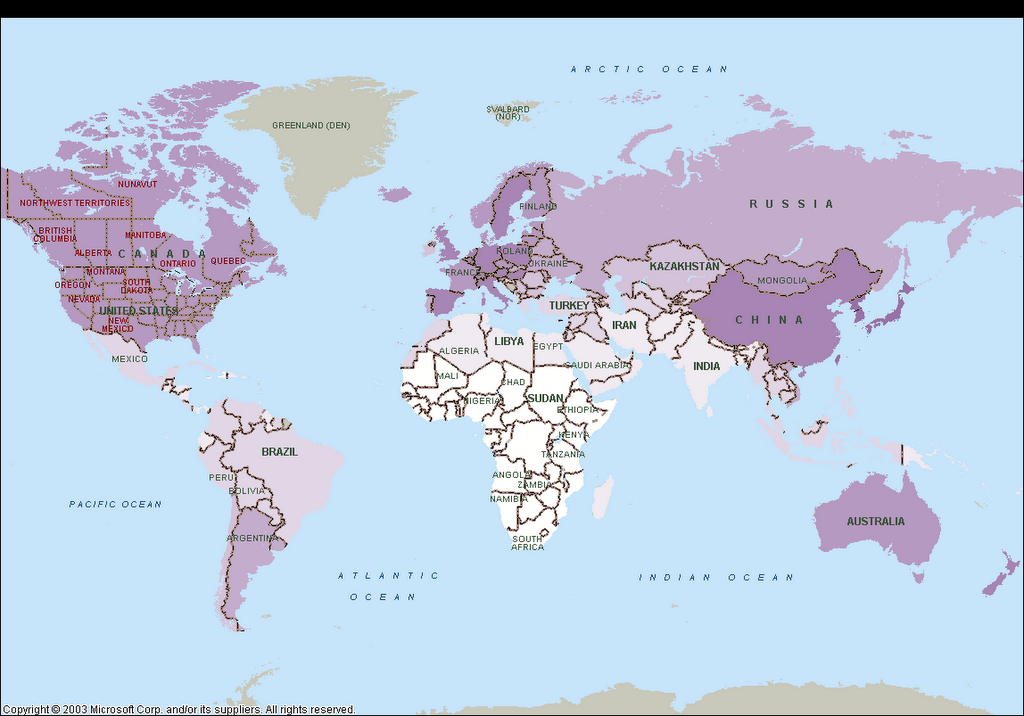
Map courtesy of R. Pongett

The tabular data above comes from Lynn and Vanhanen's IQ and the Wealth of Nations. For a good review of Richard Lynn's more recent and comprehensive Race Differences in Intelligence, look here.
Here is another fine analysis of the concept of GDP vs. IQ--with the element of free market rules thrown in.

Of muslim nations, Malaysia has the highest average IQ, 92. Malaysia's population contains 30% ethnic Chinese. Turkey has the second highest average IQ of muslim nations at 90. All other muslim nations have average IQ's of less than 90--some of them much less.

It is possible that some individual nations are misplaced on the above table, with average IQs either a bit higher or a bit lower than stated. But it is possible to detect trends by looking at different groupings of nations and their average IQ.

Given that population average IQ needs to be at least 90 for a modern technology based nation to function, immigration policy should be oriented toward inviting high value immigrants.

Observing what happened to Zimbabwe's prosperity after Robert Mugabe drove the most prosperous (and presumably most intelligent) farmers from their land, provides a good example of what NOT to do. Idi Amin's actions in Uganda provide another example. Fidel Castro's actions in Cuba provide a third. You don't want to drive out your intelligent and resourceful groups.

Update (26Dec06): Visit this Fourmilab page for a graphic illustration of the change in average global IQ with projected population trends. Accompanying the animated graphic is a thoughtful discussion of some of the issues involved in projecting trends in global intelligence.

Thanks to an Audacious Epigone commenter.

Labels: , , ,

Bookmark and Share

18 May 2006

Underpopulation Bomb: World Turned Upside Down?

Paul Ehrlich's bestseller The Population Bomb (1968) made some dire predictions. . . . hundreds of millions of people are going to starve to death." The earth, he claimed simply could not support the 6 billion people projected to exist by the year 2000. In a 1969 article titled "Eco-Catastrophe!", Ehrlich later stated that "by 1985 enough millions will have died to reduce the earth's population to some acceptable level, like 1.5 billion people." Source. Interestingly, many journalists and university academics are still repeating the same lines, decades after they became obsolete.

Two years ago, Phillip Longman published an article in Foreign Affairs entitled The Global Baby Bust. He convincingly argues that western nations will soon be underpopulated, due to falling birthrates. Longman's article probably helped to jump start the discussion of this topic within the mainstream, although underpopulation had long been a growing concern among western conservatives and independents. After reading Longman's piece, you might consider readingthis article, which is also quite informative.

Japan, Russia, France, Germany, Sweden, Italy, South Korea, and a number of other Western/or European countries will either shrink in population, or experience severe cultural shock as populations are replaced by outsiders. Even China and India will face inevitable problems unique to their populations and economies, due to the slowing of birthrates.

If their populations shrink significantly, current social democratic governments are doomed. There will be no one to pay the pensions. If on the other hand, the indigenous populations are replaced by outsiders, it is by no means certain that the new workers will be willing to pay the pensions of the retired indigenous populations who refuse to emigrate. It is likewise by no means certain that the new populations will have the technical and professional skills to maintain European/Western civilisation at its current level of sophistication.

The problem, put bluntly, is that the productive part of the world is shrinking, and the non-productive parts of the world are expanding, population wise. There is no gentle or PC way to put it, which is why the topic is largely ignored in most social democracies--yet social democracies are certainly doomed by the phenomena unless it is addressed firmly. And if the social democracies are doomed, the third world is also doomed--since the undeveloped world is dependent on the developed world for aid and sustenance.

Today, Glenn Reynolds of "Instapundit" published an article called The Parent Trap in TCS Daily. Reynolds talks about the high costs and low prestige of parenthood in modern western societies. He wonders what it will take to induce young professional adults to have more children. Leaders of industrial nations are worrying about the same thing.

Here's a list of countries that are either decreasing in population or will decrease in population, if current birthrate is continued.
List of countries:

1. Bulgaria 1.13 children born/woman (2003 est.)
2. Czech Republic 1.18 children born/woman (2003 est.)
3. Latvia 1.2 children born/woman (2003 est.)
4. Singapore 1.24 children born/woman (2003 est.)
5. Hungary 1.25 children born/woman (2003 est.)
6. Slovakia 1.25 children born/woman (2003 est.)
7. Spain 1.26 children born/woman (2003 est.)
8. Italy 1.26 children born/woman (2003 est.)
9. Slovenia 1.27 children born/woman (2003 est.)
10. Andorra 1.27 children born/woman (2003 est.)
11. Estonia 1.27 children born/woman (2003 est.)
12. San Marino 1.31 children born/woman (2003 est.)
13. Macau 1.32 children born/woman (2003 est.)
14. Hong Kong 1.32 children born/woman (2003 est.)
15. Russia 1.33 children born/woman (2003 est.)
16. Belarus 1.34 children born/woman (2003 est.)
17. Ukraine 1.34 children born/woman (2003 est.)
18. Greece 1.35 children born/woman (2003 est.)
19. Romania 1.36 children born/woman (2003 est.)
20. Guernsey 1.37 children born/woman (2003 est.)
21. Germany 1.37 children born/woman (2003 est.)
22. Poland 1.37 children born/woman (2003 est.)
23. Japan 1.38 children born/woman (2003 est.)
24. Austria 1.41 children born/woman (2003 est.)
25. Lithuania 1.43 children born/woman (2003 est.)
26. Switzerland 1.48 children born/woman (2003 est.)
27. Portugal 1.49 children born/woman (2003 est.)
28. Liechtenstein 1.5 children born/woman (2003 est.)
29. Georgia 1.51 children born/woman (2003 est.)
30. Sweden 1.54 children born/woman (2003 est.)
31. Saint Helena 1.54 children born/woman (2003 est.)
32. Korea, South 1.56 children born/woman (2003 est.)
33. Armenia 1.56 children born/woman (2003 est.)
34. Jersey 1.57 children born/woman (2003 est.)
35. Taiwan 1.57 children born/woman (2003 est.)
36. Cuba 1.61 children born/woman (2003 est.)
37. Canada 1.61 children born/woman (2003 est.)
38. Belgium 1.62 children born/woman (2003 est.)
39. Gibraltar 1.65 children born/woman (2003 est.)
40. Barbados 1.65 children born/woman (2003 est.)
41. Man, Isle of 1.65 children born/woman (2003 est.)
42. Netherlands 1.65 children born/woman (2003 est.)
43. United Kingdom 1.66 children born/woman (2003 est.)
44. Luxembourg 1.7 children born/woman (2003 est.)
45. Finland 1.7 children born/woman (2003 est.)
46. China 1.7 children born/woman (2003 est.)
47. Bosnia and Herzegovina 1.71 children born/woman (2003 est.)
48. British Virgin Islands 1.72 children born/woman (2003 est.)
49. Denmark 1.73 children born/woman (2003 est.)
50. Moldova 1.74 children born/woman (2003 est.)
51. Macedonia, The Former Yugoslav Republic of 1.75 children born/woman (2003 est.)
52. Northern Mariana Islands 1.75 children born/woman (2003 est.)
53. Anguilla 1.76 children born/woman (2003 est.)
54. Monaco 1.76 children born/woman (2003 est.)
55. Australia 1.76 children born/woman (2003 est.)
56. Serbia and Montenegro 1.77 children born/woman (2003 est.)
57. Trinidad and Tobago 1.78 children born/woman (2003 est.)
58. Seychelles 1.79 children born/woman (2003 est.)
59. New Zealand 1.79 children born/woman (2003 est.)
60. Aruba 1.79 children born/woman (2003 est.)
61. Martinique 1.79 children born/woman (2003 est.)
62. Montserrat 1.8 children born/woman (2003 est.)
63. Norway 1.8 children born/woman (2003 est.)
64. France 1.85 children born/woman (2003 est.)
65. Cyprus 1.88 children born/woman (2003 est.)
66. Ireland 1.89 children born/woman (2003 est.)
67. Bermuda 1.9 children born/woman (2003 est.)
68. Tunisia 1.9 children born/woman (2003 est.)
69. Sri Lanka 1.9 children born/woman (2003 est.)
70. Malta 1.91 children born/woman (2003 est.)
71. Cayman Islands 1.91 children born/woman (2003 est.)
72. Thailand 1.91 children born/woman (2003 est.)
73. Guadeloupe 1.92 children born/woman (2003 est.)
74. Croatia 1.93 children born/woman (2003 est.)
75. Saint Vincent and the Grenadines 1.95 children born/woman (2003 est.)
76. Lebanon 1.98 children born/woman (2003 est.)
77. Iceland 1.98 children born/woman (2003 est.)
78. Mauritius 1.98 children born/woman (2003 est.)
79. Iran 1.99 children born/woman (2003 est.)
80. Dominica 1.99 children born/woman (2003 est.)
Source: CIA World Factbook 2003

It is easy to find academics, journalists, and various other uninformed groups who continue to believe Paul Ehrlich and the Club of Rome. For them, overpopulation is the problem, and they make no distinction between the productive and non-productive worlds. In fact, to those activists favoring the "die-off", disposing of the productive populations of the world appears to be a gift from above.

Many people may discern how "global warming" and "peak oil" have been inserted into the "catastrophe slot" of many of these groups. Catastrophes for many activist groups, are interchangeable. As long as you have a current catastrophe in the works, your noble cause is free to appeal for donations from the gullible.

When a person's predictions fail so badly as did Ehrlich's and the Club of Rome's, there is bound to be a great deal of fancy backstepping and sidestepping. We have the advantage of hindsight, and should not gloat. We should probably keep that in mind in twenty years, when looking back at the failed predictions of the "warmers" and the "peakers." There is far too much to be done to waste time in that way.

Labels: , , , ,

Bookmark and Share
Older Posts
Al Fin Main Page
Enter your Email


Powered by FeedBlitz
Google
WWW AL FIN

Powered by
Blogger

``