06 December 2012

4 Million Switches to Control 20,000 Genes: An Ongoing Revolution in Biology

We are living on a planet that has been transformed by biology into a birthplace and cradle of proto-intelligent life. The biological transformation of our world is still at a very early stage. The true wonders of our ongoing biological revolution have barely been hinted at.
When the ENCODE Project announced that so-called "junk DNA" actually contains millions of gene control switches to control roughly 20,000 genes, the educated public was suddenly made aware of something that working biologists have known for decades: We humans are not in Kansas anymore, Toto.
The human genome is packed with at least 4 million gene switches that reside in bits of DNA that once were dismissed as junk but that turn out to play critical roles in controlling how cells, organs, and other tissues behave. The discovery, considered a major medical and scientific breakthrough, has enormous implications for human health because many complex diseases appear to be caused by tiny changes in hundreds of gene switches.

The findings are the fruit of an immense federal project, involving 440 scientists from 32 global labs. As they delved into the junk — parts of the DNA that are not actual genes containing instructions for proteins — they discovered it is not junk at all. At least 80 percent of it is active and needed. _BG

Protein Transcription Factors: One of Many Factors in Gene Switching

Just when the educated public thought it was beginning to understand how cells work, they are told that the mechanisms of life are orders of magnitude more complex than they previously believed.

The secret to complex life is not just the mechanisms of DNA transcription to RNA, and RNA tranlation to proteins. Complex life is an astounding swirl of circular logic and control circuits of cell signaling. Some genes are constantly being switched on and off, while other genes are silenced permanently or over long periods of time.

But we are discovering ways to alter the natural order of cell signaling and gene switching -- and that ability to change the natural scheme of things amounts to a building revolution in our biological world.

Here is a quick example of a discovery in cell switching which may lead to the ability to quickly repair damage to heart muscle from hear attacks:
MicroRNAs are short segments of RNA whose purpose is to cause genes to switch on and off. To find out which ones are responsible for causing heart cells to divide, the team studied 875 of them taken from a human heart and implanted into rodent muscle. In so doing they found 204 of them that reactivated cell proliferation and 40 and that did so strongly. They then chose the two strongest and injected them into the hearts of live mice that had been caused to suffer damage to their hearts, using a harmless virus as a carrier.

After two weeks, the mice that had been injected with the MicroRNAs showed less damage than prior to the treatment, indicating regeneration had occurred. After two months, the damaged tissue area had been reduced by half. The team also noted that contraction strength improved as did other heart functions that were measured.

The research team concludes by suggesting that their method of using MicroRNAs to induce regeneration of damaged heart tissue might be used someday soon to treat heart attack victims... _MXP
Abstract of study in Nature

Heart disease is the primary cause of death in most developed countries. The ability to rapidly heal heart muscle damage after heart attacks would likely prolong the productive lives of hundreds of thousands of people in the developed world every year.

Cell switching effects of micro RNA and Transcription Factor networks (PDF)

When we consider a world where humans have achieved the mastery of cell signaling and gene switching, we are not necessarily looking at a world of immortal, universally brilliant, and physically powerful humans. We should look at these things in relative terms, rather than in absolutes. Compared to monkeys, humans are longer-lived and quite capable in a broader range of activities and environments.

Likewise, compared to modern humans, those future people who have achieved mastery over biology will live longer lives, and possess a significantly broader range of aptitudes and capabilities over a greater number of environments.

Biology has its shortcomings, of course. We are likely to discover ways of bypassing and substituting for, much of the evolved complexity of biological cells, organs, and organisms for the sake of improved reliability.

But that will have to be done in a carefully considered and cautious manner. We have to be sure that we do not sacrifice too much resiliency for the sake of reliability within a narrow niche of functioning. No one wants to be a Dodo bird.

Labels: , , ,

Bookmark and Share

27 June 2010

Wanted: Crops that Plant, Cultivate, and Harvest Themselves

NextBigFuture

Humans have always dreamed of a Garden of Eden where they could pick their food fresh from the vine every day, without want or toil. One possible step in that direction is the development of perennial grain crops, which survive to grow in the same soil year after year.
Perennial grains would be one of the largest innovations in the 10,000 year history of agriculture, and could arrive even sooner with the right breeding programs, said John Reganold, a Washington State University Regents professor of soil science and lead author of the paper with Jerry Glover, a WSU-trained soil scientist now at the Land Institute in Salina, Kansas.

“It really depends on the breakthroughs,” said Reganold. “The more people involved in this, the more it cuts down the time.”

Published in Science’s influential policy forum, the paper is a call to action as half the world’s growing population lives off marginal land at risk of being degraded by annual grain production. Perennial grains, say the paper’s authors, expand farmers’ ability to sustain the ecological underpinnings of their crops.

“People talk about food security,” said Reganold. “That’s only half the issue. We need to talk about both food and ecosystem security.”

Perennial grains, say the authors, have longer growing seasons than annual crops and deeper roots that let the plants take greater advantage of precipitation. Their larger roots, which can reach ten to 12 feet down, reduce erosion, build soil and sequester carbon from the atmosphere. They require fewer passes of farm equipment and less herbicide, key features in less developed regions.

By contrast, annual grains can lose five times as much water as perennial crops and 35 times as much nitrate, a valuable plant nutrient that can migrate from fields to pollute drinking water and create “dead zones” in surface waters.

“Developing perennial versions of our major grain crops would address many of the environmental limitations of annuals while helping to feed an increasingly hungry planet,” said Reganold.

Perennial grain research is underway in Argentina, Australia, China, India, Sweden and the United States. Washington State University has more than a decade of work on perennial wheat led by Stephen Jones, director WSU’s Mount Vernon Research Center. Jones is also a contributor to the Science paper, which has more than two dozen authors, mostly plant breeders and geneticists. _WSUNews_via_BrianWang

NextBigFuture
Original study in Science (via Brian Wang)

Al Fin would prefer that more effort go into the development of a perennial barley -- rather than wheat. Beer made from barley is infinitely better than beer from wheat, and who has ever heard of a single-wheat Scotch? No, the best whisky is single malt, the malt being made from barley.

We are in the midst of a biological revolution. That revolution will certainly spread to agriculture, and everything else that biology touches. Fuels, chemicals, animal feeds, plastics, and more.

Expect conventional food crops and innocuous ornamentals and wild forage to be modified to produce virtually any chemical, any compound. I think you can see with a little imagination, that things are already well out of hand and soon to be completely out of control. Try to use your brain, because by the time the reality of tomorrow's harvest hits the mainstream, it will already be too late for the dull majority.

Cross-posted at abu al-fin

Labels: ,

Bookmark and Share

12 January 2010

Test Bed for Radical Evolution of Cells

Harvard researchers have devised a novel cell culture platform, which sets the stage for a program of radical designed cellular evolution. The test bed (of nails) provides a surface for cells to grow, but also provide a ready means of inserting a wide array of molecular, genetic, or biological (viruses) elements into the growing cellular machinery. Scientists can then observe the effects of various inserted elements upon the growth and behaviour of the cells.
Author Hongkun Park, a professor of chemistry and physics at Harvard University, says that, in theory, "you can put more or less any molecule in more or less any kind of cell." If the method proves effective, it could greatly speed the ability to manipulate cells in a variety of applications, including stem-cell reprogramming and drug screening.

Park's lab recently discovered that cells can be grown on beds of vertical silicon nanowires without apparent damage to the cells. The cells sink into the nanowires and within an hour are impaled by the tiny spikes. Even resting on this bed of needles, cells continue to grow and divide normally. This setup makes it possible to directly interface with the cell's interior through the nanowires. "Since we now have direct physical access, we can deliver molecules into cells without the restrictions of other techniques that are available," Park says. He adds that while his lab has found that many different types of cells seem to accommodate the tiny wires without negative effects, further studies will be needed to examine whether any important cell behaviors are affected.

To use the nanowires to deliver molecules, Park's team first treated them with a chemical that would allow molecules to bind relatively weakly to the surface of the nanowires, then coated the wires with a molecule or combination of molecules of interest. When cells are impaled on the nanowires, the molecules are released into the cells' interior. The chemical treatment of the wires could potentially be manipulated to control the binding and release of molecules--releasing them more slowly, for instance--and the wires can be constructed at different lengths to reach different parts of the cell. To demonstrate the method's flexibility, the team used the approach to deliver chemicals, small RNA molecules, DNA, and proteins into a range of cell types.

The beds of nanowires can be arranged on microarrays suitable for rapid experiments and imaging cells under a microscope. These microarrays can be "printed" with different patterns or combinations of molecules, making it possible to test many different molecules at once on an array of cells. The authors believe it could be possible to screen 20,000 different proteins or other chemicals on cells within a single microscopic slide.

...Thorsten Schlaeger, a stem-cell researcher at Children's Hospital Boston, is investigating the potential of the approach for reprogramming stem cells. His lab is interested in turning embryonic and induced pluripotent stem cells into blood stem cells like those found in the bone marrow. Currently, this task requires infecting cells with a virus to introduce new genes into their DNA, and, Schlaeger says, "there's no good alternative right now." Schlaeger's team is looking for better ways to manipulate cells, as well as ways to screen stem cells for factors that can transform them from one cell type to another. "It's hard to say what will be possible because it's new, but it's intriguing," he says._TechnologyReview

Early applications of the technology will include micro-arrays for high-throughput drug testing, and other rapid screening applications. But the technology virtually screams "rapid evolution"!

Imagine growing complex neural networks onto such test beds -- which are equipped to inject and extract both a wide range of molecular materials, but also various types of electromagnetic stimuli. The idea would be to grow entire cortical columns on a 3 dimensional implementation, then to connect the cultured cortical columns together one at a time -- all the while closely monitoring every aspect of the chemical, genetic, and electrophysiological functioning of the complex networks.

That is just the beginning. And what a simple idea.

Labels: ,

Bookmark and Share

14 December 2009

Life: Isn't That Like Magic?

To human minds, the molecular mechanisms of life are very much like magic.  Things happen so quickly on the molecular level -- and so far out of human sight -- that by the time we understand what is happening we are often thrown completely off our stride.

We know that an animal's genome changes over time, but we have little idea how animals change and evolve.  Indiana University and University of New Hampshire biologists have made some important discoveries regarding evolution driven by intron formation inside genetic sequences.   Introns are non-coding DNA sequences "inside" genes, that make up much of DNA in cells.   As different introns are inserted into genes of a species, members of the species may begin behaving differently -- genetically speaking.  This discovery could prove extremely important.

Speaking of introns, the cell needs to "edit out" all the mRNA that does not code for a gene's protein, in order to translate only the gene's "message" into protein (not the intron's).   Tel Aviv University researchers have made some pivotal discoveries in how RNA is edited, based upon the way it is transcribed from the DNA.  Their work may have important implications for cancer research as well as basic research in gene expression.

Johns Hopkins University scientists have learned more about particular epigenetic processes that seem to play a special part in an organism's ability to adapt to its environment, in evolution.   The research looks at patterms of methylation of genes, which can have the effect of "randomizing" the organism's response to the environment for different members of the same species -- for example, modifying size, shape, strength, skin tone, disease resistance, etc.   Another way of modifying (in fact, randomizing) gene expression -- methylation, epigenetics.

Korean researchers have learned more about a "growth regulationg" micro-RNA in fruit flies, miR-8, which plays a significant role in determining the animal's size.  Humans have a similar micro-RNA referred to as miR-200, which seems to affect a person's size and weight via affects on insulin.   Yet another gene expression modifier -- micro RNA.

Baylor College of Medicine researchers are looking into "master gene" Math1 , which seems to help coordinate the different nerve centers for hearing, balance, proprioception (position and orientation of body parts), and interoception (the detection of internal body states such as a full bladder).  It has a lot to do with why you can get up in the middle of the night -- half asleep -- and navigate to the bathroom and back, without causing injury to yourself and damage to your household.   Can you believe it?  A gene that controls and coordinates conscious / unconscious behaviour?

McGill University scientists are looking at a protein that influences DNA shape  and gene expression -- helicase protein translation initiator DHX29.  This protein is important in regulating protein synthesis, and cell proliferation.  It is associated with cancer cell growth -- the less DHX29, the less cancer cell growth.  Yet another form of gene expression:  helicase protein translation initiators.

UCSD researchers in La Jolla are studying how atypical anti-psychotic drugs such as olanzepine and clozapine are able to improve a schizophrenic's cognitive function enough to sometimes go back to work and be productive.  Using ingenious bio-sensor "sniffers" they call CNiFERs, they were able to determine that atypical anti-psychotics have a strong blocking effect on the M1 (muscarinic 1) acetylcholine receptor in rats.  They hope to modify their CNiFERs to "spy on" other receptors in pursuing this important research in cell signaling.

You may begin to understand that there is no separation between the molecular / genetic level and the organismic / behavioural level of animals.  That is why it is so important for us to understand the molecular nature of the animal -- because it underlies everything else.

Labels: , ,

Bookmark and Share

20 May 2009

Biodegradable Plastics 3 Different Ways

We are moving from a petroleum world to a biological world. Fuels, plastics, chemicals, and materials that typically are made from petroleum are now being made from biomass and garbage. Combining expertise from microbiology, genetics, chemistry, thermodynamics, nanotechnology, materials science, and other scientific and technical fields, researchers are bringing about a significant transformation of the advanced economies.

1. Mark van Loosdrecht of Delft University of Technology in the Netherlands:
van Loosdrecht has been working on using bacteria to transform this waste into bioplastics known as polyhydroxyalkanoates (PHAs).

PHAs are linear polyesters produced by bacterial fermentation of sugar or lipids (fats). They are produced by the bacteria to store carbon and energy. More than 150 different monomers can be combined within this family to give materials with extremely different properties.

These plastics are biodegradable and are used in the production of bioplastics. However, the high cost of PHA production compared to conventional plastics has limited their use in a wide range of applications.

Using technology derived from wastewater treatment systems, van Loosdrecht and his lab have developed a process using open microbial cultures to convert organic wastes to PHAs.

This new process is able to produce just as much PHA as existing processes at specific rates that are up to three times faster. _TOI_via_ImpactLab

2. Richard Gross from the Polytechnic University in Brooklyn, New York
Richard Gross from the Polytechnic University in Brooklyn, New York, is using bacteria that produce a building block from vegetable oils that can be used to make a plastic that is very much like polyethylene.

However, unlike polyethylene, when it becomes waste, it can be converted by mild enzymatic methods to biodiesel fuel. _TOI_via_ImpactLab

3. Kevin O'Connor at the University College in Dublin, Ireland
O'Connor has found a way to transform traditional plastics into biodegradable plastics.

Using a process called pyrolysis, the waste plastics are heated in the absence of air, causing a breakdown of the molecular bonds.

What's left is an oil that is then fed to natural soil bacteria that use it to produce PHA. _TOI_via_ImpactLab

Labels:

Bookmark and Share

05 May 2009

Pin-Point Precision: Nano-Cell Biology

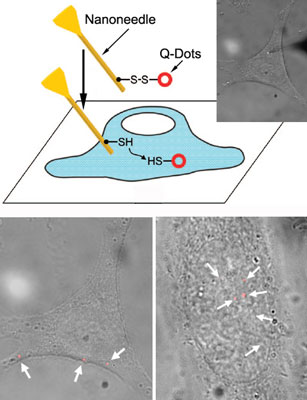
These new gold-plated boron nitride nanotube - nanoneedles from the University of Illinois are a good example of technology convergence. The ability to discover the intimate workings between cell and molecular biology have never been as strong, thanks to the use of these special nano-biotechnological devices. Here is how it works:
To create a nanoneedle, the researchers begin with a rigid but resilient boron-nitride nanotube. The nanotube is then attached to one end of a glass pipette for easy handling, and coated with a thin layer of gold. Molecular cargo is then attached to the gold surface via “linker” molecules. When placed in a cell’s cytoplasm or nucleus, the bonds with the linker molecules break, freeing the cargo.
With a diameter of approximately 50 nanometers, the nanoneedle introduces minimal intrusiveness in penetrating cell membranes and accessing the interiors of live cells.

The delivery process can be precisely controlled, monitored and recorded – goals that have not been achieved in prior studies. “The nanoneedle provides a mechanism by which we can quantitatively examine biological processes occurring within a cell’s nucleus or cytoplasm,” said Yang Xiang, a professor of molecular and integrative physiology and a co-author of the paper. “By studying how individual proteins and molecules of DNA or RNA mobilize, we can better understand how the system functions as a whole.” _Nanowerk
Extremely cool tool. The possibilities are beyond current comprehension. These techniques will no doubt be used in induced stem cell studies, and in all kinds of differentiation - dedifferentiation studies. And that is only the beginning.

The dream is consilience -- the unified study of knowledge in real time. This type of tool allows for one small part of the dream.

Labels: ,

Bookmark and Share

18 April 2009

Forget Stem Cells! Switch Cell Types by Simply Changing the Messenger RNA

"What's new about this approach is that we didn't have to make the host cell pluripotent, that is the ability to develop into any of three major tissue types, we can directly convert from one cell type to another, without the intermediate step," explains Eberwine. _Physorg
This sounds much too easy to be true, so it probably won't be that simple. But something interesting is happening when you can turn a neuron into an astrocyte simply by injecting astrocytic mRNA into the neuron.
By simply flooding one cell type, a nerve cell, with the an abundance of a specific type of messenger RNA (mRNA) from another cell type, the investigators changed a neuron into an astrocyte-like cell, a star-shaped brain cell that helps to maintain the blood-brain barrier, regulates the chemical environment around cells, responds to injury, and releases regulatory substances.

James Eberwine, PhD, Elmer Holmes Bobst Professor of Pharmacology, Junhyong Kim, PhD, Edmund J. and Louise W. Kahn Term Endowed Professor of Biology and first author Jai-Yoon Sul, PhD, Assistant Professor of Pharmacology, and colleagues report their findings online this week in the Proceedings of the National Academy of Sciences. This approach offers the possibility for a new type of cell-based therapy for neurodegenerative and other diseases.

"In some ways, this is akin to what a virus does," explains Eberwine, "When a virus infects a cell it affects the host cell genome and the RNAs that it can make." By putting the RNA of one cell type, in the correct amounts, into another cell type, we were able to change its function."

"This research overturns the notion that all cells are permanently hardwired with little ability to change their physiology," notes Sul. _PO
This is just the beginning, of course. With better tools for manipulating the molecules of life inside living tissues and cells, the learning shifts into warp speed.

Soon, artificially created viruses will be performing these tasks like tiny nanobots, driving cell and tissue development in animals, plants, large-scale tissue vats, etc. It is time for biology to start getting a little respect.

Labels: , ,

Bookmark and Share

05 September 2008

Biology Singularity

Important discoveries in fundamental biology are occurring almost daily. Building discovery on discovery--using revolutionary new tools of research--bio-researchers are opening brave new worlds of knowledge.

Brian Wang presents an array of progress in transgenic animal research

Multiple groups of researchers are closing in on the genetics of cancer

Distinctive patterns of micro-RNA in cells may provide important clues about disease states, for diagnosing pathological conditions.

Small interfering RNA can be sculpted into drugs quickly, and may soon be therapeutically injected into cells via a hollowed-out virus.

Vanderbilt University researchers have developed a nanotech device for detecting cell signaling between different cells of the immune system.

A scientist at UCSD is looking at the basic 68 molecules of life, and how a more intensive study of these molecules might provide basic insights into strategic intervention in disease states.

And so on. We live in a biological world. It is long past time that we understood what that meant.

Labels:

Bookmark and Share

09 April 2008

Escaping Petro City: Living In A Biological World

Today's global economy is based on oil. Petroleum products are used for fuels, plastics, fertilisers, and a large number of other essential products. When oil prices go up, food prices go up--and so does everything else. Even with the 200 billion barrels of oil in the Dakota/Montana/Saskatchewan Bakken play, the days of peroleum are numbered. Smart chemists and industrialists have been looking at a way of using biologicals to replace petroleum for over a decade. The future is looking brighter, in a biological world.
To make biobased manufacturing economically appealing, researchers are also determining ways to reduce the energy costs of transforming hydrocarbon building blocks like sugars and alcohols obtained from biomass into polymers. Dr. Gross and his colleagues at Polytechnic University have been using enzymes for that goal — making, among other things, a biodegradable polyester coating.

Some researchers are exploring renewable feedstocks as a source for novel materials, which could provide another economic incentive to companies to pursue biobased chemical production.

Dr. George John, a chemist at the City College of New York, and others, for example, have designed a polymer gel for drug ingestion using a byproduct of the fruit industry as a starting point. By adding an enzyme to the gel, which breaks it down over a few hours, the researchers can control the release of the drug after it is swallowed.

More players are expected to enter the field as rising oil prices force countries to increase production of biodiesel, providing a bigger supply of the byproduct glycerol.

“It could prove to be a very valuable commodity,” said Keith Simons, a chemist who consults for the Glycerol Challenge, a project started by a group of British companies and universities. The $3.6 million-a-year effort is aimed at developing catalysts and other technologies that will use glycerol as a feedstock “for making various downstream chemicals,” Mr. Simons said.

The payoffs from developing biobased chemicals could be huge and unexpected, said Dr. John Pierce, DuPont’s vice president for applied biosciences-technology. He pointed to DuPont’s synthesis of propanediol, which was pushed along by the company’s goal to use the chemical to make Sorona, a stain-resistant textile that does not lose color easily.

Soon DuPont scientists realized that bioderived propanediol could also be used as an ingredient in cosmetics and products for de-icing aircraft. The high-end grades that are now used in cosmetics are less irritating than traditional molecules, Dr. Pierce said, and the industrial grade used in de-icing products is biodegradable, which makes it better than other options.

“It looks like we found a bit of a gold vein,” he said. ___NYT__via_kurzweilai.net
The learning curve has been steep, but transforming biological feedstocks to replace petrochemicals is beginning to pay off.

The hyper-Luddites who try to obstruct the bio-energy and bio-chemical industries have very deep hooks into the environmental movement and the governments of many countries. But if the market is allowed to work out the technology and the economics, biological solutions for the problems caused by the high cost of petroleum will make believers out of most people.

Labels:

Bookmark and Share

15 March 2008

Genetic Engineering: Drew Endy's Edge Interview

Drew Endy is one of the young and edgy bio-engineers who as an MIT professor is shaping the next generation of bio-engineers to be even edgier. Dizzy times? Even dizzier times coming!
Programming DNA is more cool, it's more appealing, it's more powerful than silicon. You have an actual living, reproducing machine; it's nanotechnology that works. It's not some Drexlarian (Eric Drexler) fantasy. And we get to program it. And it's actually a pretty cheap technology. You don't need a FAB Lab like you need for silicon wafers. You grow some stuff up in sugar water with a little bit of nutrients.

...in 2003 I taught a course at MIT, the Synthetic Biology Lab with some colleagues, and we had 16 students. For the last four years this course has been doubling every year, and it's now taught independently at about 60 schools in 30 or 40 countries worldwide, it's called IGEM, the International Genetically Engineered Machines competition. There are teams of teenagers from Germany programming DNA happily there, as well as Australia, Russia, Japan, China. The competition was won by the team from Peking University this year, and six or seven hundred students participated....How do you recognize this exponential and serve it and bring more people to participate in it?

...the previous generation of people working in biotechnology are scientists, and the ones coming up now are engineers. We're going to have to invent our new world of biotechnology and I suspect we'll learn lessons around biological safety from the past generation, but all the other lessons are up for grabs. The bio-security framework is going to collapse. The IT framework based on patents isn't going to scale, and the questions of playing God or not are so superficial and embarrassingly simple that they're not going to be useful in discussion.

There are some people who understand what's going on, and who are in a position, or who have comfort acting on time scales that are relevant. It is interesting for me to learn how difficult it is for folks to appreciate what an exponential technology really implies. The fact that sequencing goes from approximately zero to human genomes in ten years. The same thing is happening with construction of genomes. And with the parts collection—the standard biological parts doubling every year. And the same thing is happening with the number of teenagers who would like to do genetic engineering; it's doubling every year. How do you actually live in a world where you're surfing that exponential in a way that's constructive and responsible? Very few people get that.___Edge.org

Anyone trying to predict the future beyond the next 5 or 10 years in bio-medicine, bio-energy, bio-weapons, bio-nanotech, etc. is clearly at a disadvantage. Because there is absolutely no way of knowing what this djinn is going to do, now that it is out of its bottle.

New technology is allowing the talented and skilled youth of today and tomorrow entry into worlds of power and performance previously limited to only a few. The need for wise oversight and guidance has never been greater.

Labels: , ,

Bookmark and Share

12 March 2008

Why Wait for Venter? Gene-Engineered Biomass Coming Ready or Not!

The Bio-Energy revolution is coming. As genetic engineering creates plants that need no fertiliser, plants that can thrive in drought conditions and grow well in saline soil--the arguments against biomass and advanced biofuels are sounding rather empty.
By means of genetic modification, Dixit managed to transfer the HARDY gene to rice. The HARDY rice plants also turned out to be tolerant to both drought and salt. To Dixit's surprise, these improved rice plants also performed at least as well in optimal cultivation conditions as ordinary rice plants. The general rule in plant biology is that plants with increased stress tolerance perform worse in optimal conditions than plants without tolerance. This makes the HARDY system even more promising in practical applications.

The HARDY gene encodes for a so-called transcription factor, meaning that a whole chain of genes is regulated. A plant can therefore turn an entire drought or salt tolerance mechanism on or off with a single switch. Dixit also discovered that the SHINE gene, which also encodes for a transcription factor, is capable of making rice tolerant to salt as well.___Source

Using marginal land not considered fit for food crops will open up huge areas of the planet for growing biomass. Another huge breakthrough would be to engineer plants to thrive without fertiliser.
Some plants have the capacity to grow well in nutrient poor soils without additional fertilizers. This is the result of a very efficient symbiosis between either nitrogen fixing bacteria that interact with the plant's roots, or between these roots and mycorrhizal fungi. These symbioses allow plants to strongly improve their uptake of nitrogen, phosphorus and water. Now a team of French and German scientists has discovered [*.pdf French/Spanish] the common genetic mechanism at work that allows the elements of the symbiosis to interact.

Their findings might make it possible to transfer the nitrogen fixing capacity of legumes to a wide range of crops that do not have this ability, including maize and rice. Ultimately, this could lead to a massive reduction of inorganic fertilizer consumption.___Biopact

While governments of advanced nations are content to cause energy prices to skyrocket through their foolish regulatory schemes, and seem to be "waiting for GodotVenter" for meaningful bio-Energy progress, science may be inadvertently pulling the rug out from under dubious government schemes.

Labels: , , ,

Bookmark and Share

24 January 2008

Craig Venter Is Not God! Claims Biologist Helen Wallace -- Venter's Wife Declined Comment

Scientists at the Craig Venter Institute were able to synthetically reproduce the genome of a Mycoplasma bacterium--the simplest of life forms. While not the same thing as actually creating a new life form, the feat did require developing genome assembly techniques that will be very useful later when novel lifeforms are actually created.
A team of 17 researchers at the J Craig Venter Institute in Rockville, Maryland, describes in the journal Science how it has successfully created the largest man-made DNA structure, indeed the largest synthetic molecule, the circular genetic code of an artificial bacterium that it is now trying to breed in the lab.

The scientists led by the human genome pioneer Dr Craig Venter want to create new kinds of bacterium, living chemical factories if you like, to make new types of bugs which can be used as green fuels to replace oil and coal, digest toxic waste or absorb carbon dioxide and other greenhouse gases from the atmosphere....the team specially designed fragments of lab-synthesised DNA to build 101 "cassettes", each consisting of 5,000 to 7,000 letters (base pairs, in the scientific jargon) of genetic code.

Dr Venter's team, notably Clyde Hutchison and the Nobel laureate Ham Smith, also created "watermarks" in the synthetic genome - which had no purpose other than to show it was man made - and knocked out a gene to render it harmless. Essentially, however, the team was trying to make a copy of a natural genome, not design one from scratch.

From here, the team developed novel methods and techniques to assemble the genome, which are the subject of patent applications. "One reason it took so long is that we were trying to develop techniques that were highly robust," says Dr Venter.

They devised a five stage assembly process where the cassettes were joined together in the correct order in sub-assemblies to make larger and larger overlapping pieces that would eventually be combined to build the whole synthetic M. genitalium genome, a ring of DNA consisting of 582,970 letters. At each stage of assembly, the growing pieces were sequenced to make sure they were accurate.
Telegraph

The techniques of genomic assembly that will be patented by the Venter Institute should be the source of lucrative licensing agreements between Venter's Institute and Universities, other labs, and biotech/ chemical /pharmaceutical companies for decades to come.

Other scientists hastened to state that Venter's group did not create new life:
Eckard Wimmer, professor of molecular biology at New York University, said it was clear from Venter's study that the team had not yet created artificial life.... His fears were echoed by Helen Wallace, a biologist and spokesperson for GeneWatch UK, who said that while Venter's team has managed a technical feat, it is some way from being artificial life. "Venter is not God ... He's a long way from creating life," she told AFP.
Source

Here is Venter's first person account.

More from LA Times and NY Times

Labels: , ,

Bookmark and Share

14 January 2008

Programming DNA : Basics -- One Hour Video


This talk will introduce current best practice in biological engineering, including an overview of how to order synthetic DNA and how to use and contribute standard biological parts to an open source collection of genetic functions. The talk will also discuss issues of human practice, including biological safety, biological security, ownership, sharing, and innovation in biotechnology, community organization, and perception across many different publics.
Video's Google Page

If you do not have a technical background, this video may require more than one viewing to get an understanding of most of the basics.

H/T Biosingularity

Once you start to get a feeling for what can be done, what cannot be done--but will be done soon, what cannot be done--and will probably never be done . . . etc., you will begin to understand that a trillion dollars a year is being spent to wage and defend against the last millenium's weaponry.

When the technology described in this video (along with advanced nanotechnology) begins to kick in, all bets will be off. It will be easier for a motivated lone fanatic to commit mass mayhem and murder than it is for you to open a bank account.

In Israel they have bomb shelters and gas masks, because they understand their bad neighbors' tendencies and unneighborly wishes.

We in the west live in a public society, where much is shared commonly. We take such public activity and openness for granted, and assume it is our right. An occasional workplace, school, or shopping mall shooting does not dampen our naive expectation of safety in the public sphere. The new terrorism, when this technology matures, will not allow us this easy confidence. No security force or agency in the world is prepared.


Information about Adventures in Synthetic Biology comic here. Full pdf of Adventures in Synthetic Biology. To view the Adventures in Synthetic Biology Comic go here.

Labels: , ,

Bookmark and Share

28 December 2007

The Deep Genome: Hidden Files--Forbidden Access

Understanding the genome sometimes feels like peeling an onion. Beneath the surface layer, lurks another layer of function and control. And beneath that . . .
...before transcripts can guide protein synthesis or take on regulatory functions, they have to undergo a strict mRNA surveillance system that degrades defective, obsolete, and surplus transcripts. In their study, published in the Dec. 28 issue of Cell, the scientists zoomed in on a specific subclass of transcripts that are under the control of the exosome, a molecular machine in charge of controlled RNA degradation.

“We found evidence for widespread exosome-mediated RNA quality control in plants and a ‘deeply hidden’ layer of the transcriptome that is tightly regulated by exosome activity,” says Joseph R. Ecker, Ph.D., professor in the Plant Biology Laboratory and director of the Salk Institute Genomic Analysis Laboratory.

...Since the common notion is that the exosome plays a central role in bulk RNA turnover, the researchers say, they expected to find the levels of all transcripts increasing when they inactivated the exosome complex. “But not everything is going up, instead the exosome mechanism seems to be very tightly regulated,” says Ecker. “We didn’t see regions that are known to be silenced to go up, instead we found a very specific group of transcripts that are regulated in this way.”

Among them are regular protein-coding RNAs, RNA processing intermediates and hundreds of non-coding RNAs, the vast majority of which hadn’t been described before. “These strange transcripts are associated with small RNA-producing loci as well as with repetitive sequence elements,” says Gregory. “They are under very tight regulation by the exosome, but we still don’t know exactly what this means.”

“It is likely that these RNAs that are usually ‘deeply hidden’ become important for genome function or stability under some circumstances”, adds co-first author Julia Chekanova, an assistant at the University of Missouri-Kansas City. “We need to do more work to figure out what these circumstances are.”
Physorg

Understanding how genes turn on and off is the key to stem cell research, gene therapies, and regenerative medicine. Being able to insert genes into the genome, for example, is easier than making sure the new genes work only as intended. There is still a lot to learn about the deep web of transcriptome control.

In modern biological research, there is no shortage of data or data analysis tools. But the limited human brain is beginning to run into the incredible complexity of not only the data itself, but the data analysis.

Due to the lack of training in "lateral thinking" and creative analysis, many scientists are at a loss when attempting to interpret the mountain of data returned from even fairly simple experiments.

It should not be surprising then to see one conclusion reported in the headlines, only to read a startlingly contradictory claim the next day. You know that if scientists are a bit overwhelmed by the complexity of the task, that journalists are at a total loss.

It is often quite amusing to watch news anchors and talk show hosts interview "science" journalists about the latest findings in science. Like the movie Idiocracy: "it's got what plants crave--electrolytes!" But then, sometimes the simplest explanations are the best.

Labels: ,

Bookmark and Share

18 December 2007

Year of the Plague

I Am Legend topped the box office in a US record-setting December opening box office. Killer plagues make headlines, and attract readers and movie-goers.

A recent set of cautionary nano-revo scenarios from Nanowerk prominently featured biological plagues as significant existential risks. We know it could happen, because it has happened so many times before across the planet's times and places.

One of the reasons that killer plague is likely to hit the modern world, is how easy and powerful the tools of biological creation are becoming. A killer virus must be virulent and readily transmissible.
But the most disturbing news this week is that scientists have created the human killer virus in the lab. The dreaded H5N1 avian flu, as feared, finally mutated last August into a virulent form that can easily spread from person to person, increasing the likelihood of a pandemic that could kill hundreds of millions — much like 1918s infamous Spanish flu.

Luckily, this mutation was the creation of scientists at the National Institutes of Health, in Bethesda, Maryland, and the mutated strain lives — for now — only
in petri dishes. Source

A mass epidemic of killer virus (or bacteria) would initially be seen as a medical problem. As significant numbers of "weight-bearing members" of society fall to the virus, the epidemic becomes a massive social problem. As the medical infrastructure itself falls to the killer microbe, efforts to control its spread become medieval and draconian.

The killer plague scenario is but one of many existential risk scenarios that the Lifeboat Foundation, JG Matheny, Nick Bostrom, Michael Anissimov, Eliezer Yudkowsky, and many other futurist thinkers contemplate.

The risk of a naturally emerging super-killer microbe may be minimal. But given that human researchers have already modified the H5N1 avian flue in the lab to spread from person to person, we are not necessarily dealing with naturally emerging viruses. We will soon be dealing with intentionally created mass killers.

With the loss of the medical infrastructure and most civil security apparatus, the western world would begin to resemble Baghdad or Beirut at their worst. All the predictions of what would happen should George W. Bush be elected would suddenly and finally come true.

Uninfected refugees would flee the "hot zone", inadvertently carrying the killer microbe in their midst. The "wealth" of generations would be abandoned in a millisecond in the mad rush to escape the spreading death.

What I am suggesting is that with the tools of synthetic biology, modern medical tools--antibiotics, antivirals, the entire pharmaceutical R&D infrastructure--would be either ineffective or too slow to help anyone.

The type of proactive prevention that could hold back such threats have little to do with your government or the technological infrastructure of your society.

More later.

Labels: , , , ,

Bookmark and Share

09 July 2007

After Synthetic Biology: Comes the Plague?


Synthetic biologists such as Craig Venter, are optimistic about their future. They believe that once they have mastered the art of forcing nature to do their will, the good life will follow--for everyone.
Synthetic biologists, as they survey all the new genes and control elements whose DNA sequences are now accumulating in data bases, seem to feel extraordinary power is almost within their grasp.

“Biology will never be the same,” Thomas F. Knight of M.I.T.’s Computer Science and Artificial Intelligence Laboratory wrote recently in describing the new engineering discipline he sees as emerging from it.

....“Grow a house” is on the to-do list of the M.I.T. Synthetic Biology Working Group, presumably meaning that an acorn might be reprogrammed to generate walls, oak floors and a roof instead of the usual trunk and branches. “Take over Mars. And then Venus. And then Earth” —the last items on this modest agenda.

Most people in synthetic biology are engineers who have invaded genetics. They have brought with them a vocabulary derived from circuit design and software development that they seek to impose on the softer substance of biology. They talk of modules — meaning networks of genes assembled to perform some standard function — and of “booting up” a cell with new DNA-based instructions, much the way someone gets a computer going.

The first practical applications of synthetic biology may not be so far off. “The real killer app for this field has become bioenergy,” Dr. Collins says. Under the stimulus of high gas prices, synthetic biologists are re-engineering microbes to generate the components of natural gas and petroleum. Whether this can be done economically remains to be seen. But one company, LS9 of San Carlos, Calif., says it is close to that goal. Its re-engineered microbe “produces hydrocarbons that look, smell and function” very similarly to those in petroleum, said Stephen del Cardayre, the company’s vice president for research.

Synthetic biologists are well aware that, like any new technology, theirs can be used for good or ill, and they have encouraged open discussion of possible risks at their annual meetings.

One possible danger is bioterrorism.
Source

Bioterrorism. For western scientists looking for all the good things in life for themselves and others, bioterrorism is not first on their minds. Yet for hundreds of millions of religious fanatics and apocalyptics, the possibility of ending man's reign on earth offered by a perverted synthetic biology must be too strong to resist.

Most of us simply do not want to think about it. Why not simply dwell on all the good things biotech, nanotech, advanced computing, robotics, and molecular fabs will bring to our living rooms and workshops? Why think about a potential hell when we could be thinking about a potential utopia?

Because we like to think about the apocalypse. There is no apocalypse like a "plague apocalypse." Remember 12 Monkeys, or 28 Days Later? How about the classics Earth Abides, No Blade of Grass, or Andromeda Strain?

In a plague apocalypse, the victims can die as long and as painfully as the author desires. Victims can even pass into a zombie state to prey on survivors and the uninfected. Or instead of humans dying from plague, they can die from starvation when diseases attack food crops--destroying the entire food chain from the bottom up.

The White Plague is a revenge tale, about a scientist who loses his wife to terror and embarks on a far more lethal campaign of terror himself. Why not? Scientists are as human as anyone else. Anyone who has not witnessed the passion of a scientist probably just doesn't know any scientists very well.

The point is, synthetic biology makes synthetic plagues--aimed at people or plants--possible. And given the rampant religious apocalyptic fanaticism that possesses the young burgeoning populations of certain countries, it is likely that many of these fanatics will take up biological science as a profession. In other words, it will happen if we let it.

What will our world be like if we get sloppy, and allow the secrets of synthetic plague to slip into the hands of fanatic apocalyptics? To visualize that, you must use your imagination. Reading some of these books might help. Or you may want to read some of these. After all, apocalypses share many consequences among them.

Facing these possibilities is what organisations such as the Lifeboat Foundation and the Society for Creative Apocalyptology are all about.

It is not inconceivable that the future will belong to the city-state, rather than to the nation-state. A city-state can trade with other city-states and with the surrounding countryside, but is more defensible than the nation-state--having shorter borders.

The US-Mexican border will not keep out a deadly plague. Neither will the long border of the Mediterranean Sea between much of the third world and Europe. Chinese military officials have threatened to devastate the US west coast with nuclear weapons, but why bother when a simple microbe will do even more damage?

Round the world cruises and air travel are custom made for spreading deadly plagues. It is quite possible that we will look back on these days as a time of extraordinary freedom to travel and experience the world. In the future, many unknown perils wait.

This is not a time for academic lobotomies or psychological neotenates. It is a time for teaching children basic skills of living and survival, as a matter of course. Think of life in an orbiting colony or on a moonbase. Think of how children would have to be raised in order to deal with the deadly hazards existing right outside the door.

Then start thinking realistically about what life on Earth could easily be like in a decade or two. And stop wasting generations of human life by dooming them to incompetent neoteny and frivolous helplessness.

Labels: , , , , , ,

Bookmark and Share

30 June 2007

Bacterial Genome Transplanted, Next Step--Synthetic Organism?

After replacing DNA in mycoplasma capricolum organism with the chromosome from mycoplasma mycoides, scientists at the Ventner Institute are planning work on a completely synthetic organism.
Scientists at the J. Craig Venter Institute (JCVI), a genomics research facility, transplanted a bacterial chromosome from one type of bacteria into another, and have completely replaced an entire bacterial genome and its expression. The work of Carole Lartigue, Ph.D. and colleagues was published in the latest issue of Science:

The JCVI team devised several key steps to enable the genome transplantation. First, an antibiotic selectable marker gene was added to the M. mycoides LC chromosome to allow for selection of living cells containing the transplanted chromosome. Then the team purified the DNA or chromosome from M. mycoides LC so that it was free from proteins (called naked DNA). This M. mycoides LC chromosome was then transplanted into the M. capricolum cells. After several rounds of cell division, the recipient M. capricolum chromosome disappeared having been replaced by the donor M. mycoides LC chromosome, and the M. capricolum cells took on all the phenotypic characteristics of M. mycoides LC cells.

As a test of the success of the genome transplantation, the team used two methods -- 2D gel electrophoresis and protein sequencing, to prove that all the expressed proteins were now the ones coded for by the M. mycoides LC chromosome. Two sets of antibodies that bound specifically to cell surface proteins from each cell were reacted with transplant cells, to demonstrate that the membrane proteins switch to those dictated by the transplanted chromosome not the recipient cell chromosome. The new, transformed organisms show up as bright blue colonies in images of blots probed with M. mycoides LC specific antibody.

The group chose to work with these species of mycoplasmas for several reasons -- the small genomes of these organisms which make them easier to work with, their lack of cell walls, and the team's experience and expertise with mycoplasmas. The mycoplasmas used in the transplantation experiment are also relatively fast growing, allowing the team to ascertain success of the transplantation sooner than with other species of mycoplasmas.

According to Dr. Lartigue, "While we are excited by the results of our research, we are continuing to perfect and refine our techniques and methods as we move to the next phases and prepare to develop a fully synthetic chromosome."
Source

Synthetic biology is one of many approaches to studying the mechanisms of life. Craig Ventner says that he will create an organism that will solve the energy crisis. Perhaps he will. As long as western civilisation survives the onslaughts of anti-enlightenment thinking, I suspect that organisms that can produce unlimited energy will be the least of achievements from synthetic biology, nano-biology, biologic computing etc.

Because western educational systems do not teach students to use their broad intellectual capacities, most humans--even in the developed world--do not have a clue about the multiple revolutions in scientific discovery that are teetering on the very brink of the activation energy hump. Some students of the singularity believe that the true revolution will require the creation of a friendly superhuman machine intelligence.

Personally, I believe that machine augmentation of human intelligence will be enough--once humans learn to use the intellects they possess. But since the educational establishments are incapable of helping humans learn about their intrinsic capacity, there may be some delay.

Labels: , , , ,

Bookmark and Share

25 March 2007

Radical Synthesis of Natural Substances


Chemists have had a difficult time synthetically creating many important natural substances in the laboratory.

Bioactive compounds found in marine and terrestrial organisms often have anti-cancer, anti-bacterial and other desireable qualities. The cost of synthesizing the compounds can be prohibitive, though.

This is a critical concern, as identification of a reasonably economic means of production for marine and other natural products is typically one of the most challenging hurdles in a potential drug's commercial development. An overly complex and expensive synthesis can even slow or halt the development of an otherwise promising drug candidate.

....A range of drugs from aspirin to the widely used cancer treatment Taxol has been discovered in nature, but the complexity of producing natural products has made some companies reluctant to focus on them.

“There is this far-ranging and damaging perception that natural products are too complex to be used in a drug discovery setting despite their overwhelming track record in medicine,” says Baran. “I think if our work has helped in even a small way to revive the use of natural products, then we've served our purpose.”
Source
Phil Baran and colleagues at Scripps Institute have opened the door to faster and more economical synthesis of natural products by changing the rules.
A radically different approach to constructing complex molecules could help to tap the pharmaceutical potential of natural products. The concept, devised by Phil Baran and colleagues at Scripps Institute, La Jolla, California, promises to generate natural products in much larger amounts than conventional methods, making biological testing much easier for drug discovery scientists.

Most total syntheses, which assemble complicated carbon-based molecules from relatively simple building blocks, make liberal use of protecting groups. These chemical shields prevent completed parts of a molecule being altered while chemists are still tinkering with other sections that are still under construction. However, adding and removing protecting groups can add many steps to a synthesis, cutting overall yields drastically.

Baran's team have now made a collection of marine natural products without using a single protecting group. Instead, they take advantage of the intrinsic reactivity of the molecule's different functional groups.

This unconventional approach delivered several grams of compounds such as ambiguine and welwitindolinone in less than 10 steps. What's more, the reactions were enatioselective - they made only the preferred mirror-image form, or enantiomer, of the molecule, instead of a racemic mixture containing equal amounts of both enantiomers. This is a vast improvement over traditional syntheses, which make milligrams of racemic product in around 30 steps.
Source


Hat tip Biosingularity blog. Biosingularity blog specifically tracks developments on the cutting edge of biology, and is worth a regular look.

Labels: , ,

Bookmark and Share

06 March 2006

Biological Nanomachines--First in their Class

Life as we know it would not exist if not for incredible numbers of tiny bio-machines, molecular sized powerhouses that work at fantastic speeds, and with amazing efficiencies. I recently discovered a fine nano-blog by Will Ware, a software engineer who writes software for nano-engineering and development. This past New Year's Eve morning, Will wrote a fine posting on "Nanomachines in Nature," that I recently discovered. Will lets us know that there are indeed people in the nanotech culture who admire nano-biomachines, and who are willing to learn from them.

Kinesin and dynein are proteins that move along a microtubule and can drag along a mechanical load (another molecule). They are among several molecular motors found in nature. Another example is the flagella that push bacteria around in pond water, driven by a motor that looks like it came from a mechanical parts catalog.

....Some people are using these molecular machines to plan nanotechnology roadmaps, and there has been some laboratory progress. We won't have real nanotechnology any time soon, but these are excellent steps in that direction. Biomechanics hints at a lot of interesting things we can do with available cellular mechanisms.

To people thinking about the long term, as I like to do, these efforts are stepping stones. We'll use them to build tools, and use those tools to build other tools, with the eventual goal of a manufacturing infrastructure that permits us to build large rationally-designed products to atomic precision.


I am encouraged to see such enthusiasm for bio-nano from Will, and others like him. Read Will's entire posting, with great links and a fine graphic, here.

There has been a bit of discussion at The Speculist, and at Responsible Nanotechnology, about two previous postings "Nanotechnology Learns from Biology" and "Holy Grail of Enzymatics." Will's posting adds quite a bit to that discussion.

Update: Here is a link to an excellent set of publications from Bionano.neu.edu. It comes from one of the links obtained from Wills post above. There is far more activity on this front than I previously realised. Thanks again to Will Ware.
For anyone interested in the NSTI Bio Nano conference in Boston this May, here is the website for that event.

Update 13 March 2006: Here is a bizjournal article discussing the explosion of patent applications for bio-nano.

Labels: , ,

Bookmark and Share

23 February 2006

Holy Grail of Enzymatics: Making Enzymes that Make Anything You Want

Berkeley Lab, a US DOE national laboratory located near Berkeley, CA, released this news of significant progress in the intelligent design of enzymes in the lab. Ever since scientists learned they could design new genes--and thus new proteins--in the lab, they have been hoping to gain enough specificity in the design of enzymes to allow the use of artificial enzymes to create new and useful molecules that have never existed in nature. Clearly, that is nano-assembly in an enzymatic form, with potential approaching anything Eric Drexler may have dreamed for his own nanoassemblers.

In nature, the divergent evolution of promiscuous enzymes is achieved through trial and error, similar to the way in which the human immune system works. Multiple combinations of many different amino acid substitutions are tested in promiscuous enzymes until an evolutionary path that achieves a desired result is found. The amino acid substitutions that significantly drive molecular evolution are called “plasticity residues.”

The Berkeley researchers identified the plasticity residues for the Grand fir sesquiterpene synthase, then systematically recombined mutations of these residues through site-directed mutagenesis, based on a mathematical model developed by Yoshikuni. Construction of the seven sesquiterpene synthases was accomplished with the screening of fewer than 2,500 mutants. An alterative approach, called directed evolution or molecular breeding, that is currently being tested at other laboratories, requires the screening of tens of thousands to a million or more mutants.

“The enzyme synthase was there ready to be evolved, and with our methodology, we were able to rapidly and efficiently evolve it down a pathway of our choice,” Keasling said. “We are recapitulating evolution into intelligent design. In the case of this particular Grand fir enzyme synthase, it naturally makes a soup of small amounts of 52 different products. We were able to focus it instead on making large amounts of one of seven of those products.”

While the researchers have not yet reached the point where they can design a promiscuous enzyme to make any kind of product they want, even one that does not occur in nature, this demonstration represents a significant step in that direction. The idea would be to one day be able to design an enzyme synthase that would evolve along a specific functional pathway to yield a desired molecular product, then introduce it into microbes for mass production. In addition to synthesizing therapeutic drugs, other possible applications would include flavors, fragrances and nutraceuticals.

“Our ultimate goal is to be able to put as much chemistry as we can into microbes,” said Keasling, a pioneer and leading authority in the burgeoning scientific field of synthetic biology. “We can use microbes to do a lot of complicated chemistry, and the way in which this will be done is through the use of enzymes. One can imagine where you could take a series of promiscuous enzymes that would make different parts of a molecular compound, and combine them to obtain a final product that could do whatever you needed it to do.”

Since plasticity residues also play other important biological roles, in addition to the evolution of promiscuous proteins, Keasling and Yoshikuni said their technology, with some modifications, could prove useful for designing novel functions into other types of enzymes and proteins, as well as protein ligands and receptors, transcription factors and antibodies.

This research was largely funded through grants by the Bill and Melinda Gates Foundation, the National Science Foundation, and the U.S. Department of Agriculture.


Go here to read the whole report.

Labels:

Bookmark and Share
Older Posts
Al Fin Main Page
Enter your Email


Powered by FeedBlitz
Google
WWW AL FIN

Powered by
Blogger

``