16 October 2012

Abolishing College: No More Academic Lobotomies?

Alternatives to conventional higher education are experiencing explosive growth. Coursera offers free online courses from at least 33 respected universities worldwide. And EdX recently added the entire University of Texas system of institutions, to join Harvard, MIT, and UC Berkeley.
The shift to online college-credit courses is occurring three to five years faster than expected because of demand from students and universities, said Anant Agarwal, president of Cambridge-based EdX and an MIT professor.

The University of Texas System plans to put up $5 million to join the EdX online venture, started by Harvard University and the Massachusetts Institute of Technology, to help meet demand for low-cost college courses.

...Most universities realize major structural changes are needed, though moving lectures online doesn’t go far enough, said Jeff Sandefer, a Perry adviser who taught entrepreneurship courses at the University of Texas and started the Austin-based Acton School of Business, which offers graduate management degrees. EdX and Coursera, another university group offering free online studies, “will hasten the flight of full-price customers to less-expensive alternatives, accelerating the demise of traditional academia,” Sandefer said by e-mail. _BusinessWeek
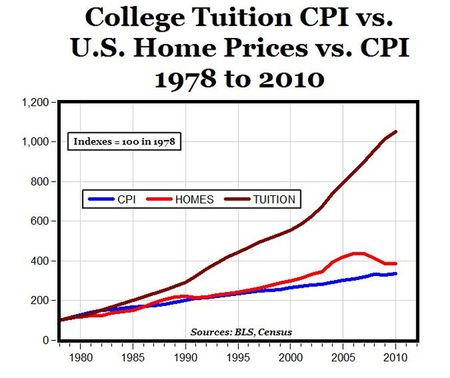
Modern universities are known for their antagonism to students' freedom of speech rights, and for an intolerance to diverse points of view. The steep rise in tuition rates over the past few decades has skyrocketed, driving student debt above $1 trillion, and rising. Administrative bloat is out of control, and the quality of education on campus is suffering as a result.


If any institution deserves to be made obsolete -- besides big media and big govenment -- it is the big college bubble. The EdX, Coursera, and Khan Academy approaches to free online education will not result in the actual abolition of college indoctrination and intolerance. Making a destructive institution obsolete is far quicker and cleaner than going to the trouble of abolishing it.

Imagine a world with free speech for everyone, no more academic lobotomies, no more academic intolerance / indoctrination. A world of self-directed learners, with the entire universe of knowledge available to pursue.

It sounds like a very dangerous world! ;-)

And remember: It is never too late for a dangerous childhood.

Labels: , ,

Bookmark and Share

15 October 2012

"Unschooling" the University

Never Let Schooling Interfere With Your Education


Unschooling is a growing trend among children old enough to attend primary or secondary school. It is a type of homeschooling that is child-directed, taking place both at home and other places where children can learn about the world.
The advantage of this method is that it doesn't require you, the parent, to become someone else, i.e. a professional teacher pouring knowledge into child-vessels on a planned basis. Instead you live and learn together, pursuing questions and interests as they arise and using conventional schooling on an on-demand basis, if at all. This is the way we learn before going to school and the way we learn when we leave school and enter the world of work. _Unschooling: Holt

In the US, with university student dept around $1 trillion, more people want to bring "unschooling" to the university level -- and make it very low cost, sometimes free.
[US] student debt now tops $1 trillion and that a third of college students drop out–with debt and without a degree. Nearly a third of the average 18-to-24-year-old’s income goes toward debt repayment, much of it owing to student loans.

...Yet if [Vivek] Wadhwa is right the student debt problem will take care of itself—at least as it relates to the next generation and those that follow. Online courses will proliferate to such a degree that acquiring knowledge will become totally free. There will still be a cost associated with getting a formal degree. But most universities, he says, “will be in the accreditation business.” They will monitor and sanction coursework; teachers will become mentors and guides, not deliver lectures and administer tests. This model has the potential to dramatically cut the cost of an education and virtually eliminate the need to borrow for one, he says.

...Wadhwa allows that there will always be students able and willing to pay for a traditional college experience and for them it will be a worthwhile investment. But for the vast majority, from a financial standpoint that kind of education makes no sense and is fast becoming unnecessary. He believes the higher education revolution is coming soon and will happen fast—perhaps fast enough to keep the next generation from finishing school with debts they may never be able to pay. _Moneyland.Time

University has become a place for young adults and adolescents to receive a political indoctrination, form bad personal habits, and avoid responsibility while spending "other people's money" for as long into adulthood as possible.

In other words, for a large number of young people, university has become the capstone on an edifice of dysfunctional education and child-raising that leaves the young person incompetent and unfit for taking meaningful responsibility in world growing less friendly to the unskilled by the day.

The problem with "unschooling the university" is that most graduates of primary and secondary public education never learned to be self-directed toward their own education. They and their parents trustingly counted on the government educational system to provide the child's education. And now, here they are, unable to pick up the ball and run with it.

We anticipate that in the future, more and more parents will opt for "The Dangerous Child" approach to child rearing, which is a type of "unschooling" -- although much more dangerous, of course.

The dangerous child learns multiple skills and competencies from an age at which most parents and educators would believe it impossible. But it is not only possible -- it is vital, if the child is to develop his full potential of dangerousness. Dangerous children must achieve high enough skill levels to be able to support themselves financially in at least three different ways by the time they are 18 years old.

Needless to say, the future would look quite different in a world full of dangerous children -- quite unlike the present world full of lifelong adolescents and incompetent psychological neotenates.

And remember, it is never too late to have a dangerous childhood.

Labels: , , ,

Bookmark and Share

13 October 2012

Megacities and the Pandemic of Doom

ON OCTOBER 2nd a British traveller, flying home to Glasgow from Afghanistan, began to feel ill. Within hours he was diagnosed with Crimean-Congo Haemorrhagic Fever, a virus nasty enough for him to be put onto a military transport aircraft for transfer to an isolation hospital in London. Less than 24 hours later he was dead.

This outbreak, on top of another death last month in Saudi Arabia from a previously unknown virus, a cousin of the Severe Acute Respiratory Syndrome (SARS), has set global health agencies on edge... _Economist

Fast global travel brings the people of the world -- and their emerging infectious diseases -- closer together than ever before. Pandemics and plagues are spread by travelers, over distances both long and short. The human consequences of a widespread pandemic involving an emerging and deadly contagion, can be severe:
In the 1500s and 1600s, European epidemics killed perhaps 90% of the aboriginal Americans. In the 1400s, the plague killed one third of the humans in Europe. The worldwide influenza of 1918 killed 30 million, and AIDS had killed at least half that by 2000... newly-arising pathogens rarely seem to extinct their host species even in their initial outbreak. Genetically-engineered pathogens may be different. _Future Global Catastrophes
A pathogen would have to be designed to spread easily from person to person, persist in the environment, resist antibiotics and immune responses, and cause almost 100% mortality. Designing for long latency (e.g. months) might be necessary to ensure wide distribution, but no length may be enough to infect every last human. _Bioterrorism
There are barriers to the spread of epidemics. Airports, seaports, and train stations can be shut down for the duration of an epidemic. Infected travelers can be rapidly diagnosed and whisked into quarantine.

But in the emerging age of megacities, how would you stop an epidemic that has already established a strong foothold inside a city of 50 million people?

Infected persons would seek medical help soon after the outset of symptoms. If the early symptoms are not too severe, cases may be medicated and sent home -- but not before passing the infection on to health care workers and others they may have come in contact with in waiting rooms and in transit.

The contagion would rapidly spread through schools and workplaces across the megalopolis, perhaps infecting millions before the extent of the problem becomes apparent. By then, any modern methods of quarantine would not likely be effective at stopping the pandemic.

There are now 23 megacities in the world, compared with just two 60 years ago. Just over half of the population currently dwells in cities, and with the urban population expected to nearly double by 2050, that proportion is projected to approach 70%. “Almost all this growth will take place in the developing world,” says Jalkanen. _Nature
There is nothing new about large scale devastation and collapse from epidemics and pandemics. But the rise of megacities provides emerging infectious diseases -- to say nothing of engineered pathogens -- with an opportunity for devastation that may be too good to pass up.
Human history has been punctuated frequently by epidemics, and occasionally by pandemics, that have shaped the rise and fall of civilizations and the victories and defeats of warring armies. The outcome of the Peloponnesian War (431–404 B.C.E.) between Athens and Sparta—and the future course of Western civilization—might have been very different had it not been for the epidemic that decimated the Athenians at the beginning of the war. Some epidemic diseases, such as the plague, smallpox, typhus, and influenza, have persisted throughout recorded history. Smallpox was eradicated worldwide by 1980. Cholera appeared along the world's major trade routes in several devastating epidemics beginning in the eighteenth century, and it still causes massive epidemics, most recently in South America in early 1990s. _Timelines of Great Epidemics
If the contagion is sufficiently disabling, megacities will lose their health care systems fairly early on. Soon thereafter, parts of the critical infrastructure will begin to drop off line, one by one, as key personnel are put out of action -- or attempt to flee the pandemic.

Public supplies of necessities will be rapidly depleted -- first lawfully, then by mass looting. Organised law enforcement and fire departments will be among the first to go down, leaving most of the megacity to the mobs. Collapse of any remaining services should follow soon after.

There are inevitable problems when one tries to put all his eggs in one basket. Large systems are prone to chaotic instabilities that tend to grow along with the size of the system. It is possible to design redundancies, workarounds, and other attempts at resiliency. But in the third world and emerging world -- where most megacities are appearing -- few resources will be devoted to resiliency when poverty is already rampant, and open sewers are the norm rather than the exception.

The tendency toward centralisation and hyper-urbanisation appears to be inevitable across most of the world. Yet there are many vulnerabilities to such concentrations of people, resources, and infrastructure. Many people have no choice, if they wish to enjoy some of the many benefits and opportunities of civilisation.

But dangerous children know how to bring civilisation along with them, wherever they go. It is never too late to have a dangerous childhood.

More: Where will the next global pandemic originate?

Even More: The Armageddon Virus

Labels: , , ,

Bookmark and Share

12 October 2012

Going On the Offensive Against Dementia

This article is re-posted from the Al Fin Longevity blog


Rather than fighting a rear-guard action against advancing dementia, some researchers are taking an offensive approach -- a "procognitive" approach. This means that instead of trying to slow down the inevitable decline of dementia, these researchers aim to rebuild brain tissues and brain function. They aim to push back against the decline and reverse it.
Scientists have developed a small peptide that they say can reverse some of the cognitive repercussions of neurodegenerative and potentially trauma-related brain disorders such as Alzheimer’s disease, by increasing synaptogenesis. The peptide, called dihexa, is a stabilized derivative of angiotensin IV (AngIV)...

...Washington State University’s Joseph W. Harding, Ph.D., Alene T. McCoy, Ph.D., and colleagues based their development on prior work demonstrating that the three terminal amino acids of AngIV and its analog Norleucine1-angiotensin IV (Nle1-AngIV) are central to the precognitive activities of the peptides. The team thus set out to develop much smaller, more stable derivatives of Nle1-AngIV that retained the active structure but could be administered orally and cross the blood-brain barrier.

The resulting lead compound, dihexia (N-hexanoic-Tyr-Ile-(6) aminohexanoic amide) not only fulfilled these requirements, but proved to be active at picomolar concentrations, and led to dramatic improvements in the cognitive abilities of a scopolamine-treated rat model of learning deficits, and also aged Sprague-Dawley rats.

Importantly, the treatment was effective whether the animals received it directly into the brain, via injection, or orally. Further analyses indicated that dihexia’s precognitive activity was associated with a drug-induced stimulation of dendritic spinogenesis in the hippocampal brain region, and that the newly formed dendritic spins were creating functional synapses. Encouragingly, dihexia was even more potent than brain-derived neurotrophic factor (BDNF), a growth-promoting protein that is used to create neuronal connections, but which hasn’t yet been developed for therapeutic use.

“At its core dementia results from a combination of diminished synaptic connectivity among neurons and neuronal death in the entorhinal cortex, hippocampus, and neocortex,” the researchers note in their published paper in the Journal of Pharmacology and Experimental Therapeutics. However, previous attempts to develop protein neurotrophic factors as therapeutics has been limited by their inability to cross the blood-brain barrier, and the need to manufacture such agents by recombinant methods, which is costly. “The development of dihexa has seemingly overcome these impediments by virtue of its oral activity, demonstrated pro-cognitive/anti-dementia activity, and anticipated low manufacturing costs.” _Gen Engineering News

Another interesting candidate for procognitive therapy is ABT-288, an H3 receptor antagonist.

Another very interesting class of procognitive drugs is the Ampakines. Ampakine CX546 is a recent drug candidate undergoing study.

Here are two different approaches to procognition in the context of developing novel anti-psychotic drugs:

Egis 11150 which has broad spectrum adrenergic, serotenergic, and dopaminergic antagonist activity
New anti-psychotics with 5HT2C receptor agonist and 5HT6 receptor antagonist activity

It is important for neuropharmacologists to take this fateful step, of taking the offensive in the fight against dementia. Repairing and rebuilding the damaged tissues in the brain will likely get better results than a piecemeal promotion of this neurotransmitter, or combating this protein or another. A procognitive approach holds out the possibility of a return to normal function, rather than a mere slowing of inevitable decline.

The technology of the early diagnosis of future dementia is advancing on multiple fronts, from better brain scanners to genetic testing to two recent interesting developments:

Virtual Reality Functional Capacity Assessment Tool (VRFCAT). Not only does VRFCAT promise to provide early diagnosis of cognitive problems, but it should also prove useful for monitoring of different therapeutic regimens.

New mathematical approaches to model the brain as a complex network of interconnected processing nodes Such mathematical modeling approaches should provide new ways of diagnosing normal vs. impaired brain network activity, as well as new ways to monitor effects of therapies on brain network function.

Eventually, what we will want from procognitive treatments, is for all of us to be able to become capable of clearer and deeper thought. For now, we will be happy to watch dementia sufferers coming back into themselves.

But once we see that beginning to happen, we are likely to want to "spread the wealth around" to include more and more people, maybe even ourselves.

Labels: , ,

Bookmark and Share

11 October 2012

American Decline is Inevitable Only Under Obama

Under Obama, a continuing American decline is inevitable. The same would have been true under President Jimmy Carter, had he been re-elected to a second term in 1980, instead of Ronald Reagan. Certain leaders attract decline like iron to a magnet.

America has been the world leader for many decades, and is unlikely to surrender that status without internal treachery coming from the very top levels.
The basic strengths of America are real, but not immutable. American status does not maintain itself; the actions required to reduce or counteract the risks of decline are numerous and complex. The most critical areas of concern include debt, the deficit, and entitlements, along with health-care and tax reforms, as well as changes in immigration policy and measures to lessen dependence on imported oil...

In the same Gallup survey that found the United States by far the most popular destination for would-be foreign migrants, respondents in more than one hundred countries expressed much higher approval of US leadership than for six other major powers, including, in order, Germany, France, Japan, the UK, China, and Russia.

The American role remains—in the oft-used word—indispensable. With its hard-power resources, it is the ultimate guarantor against aggressive and nihilistic movements and regimes.

...The society’s resilience and adaptability are unusual for a large country, as are its economic competitiveness and entrepreneurship. The United States, thanks to its unmatched research universities, enrolls a higher proportion of the world’s international students than any other country, with some two-thirds of graduate students who study abroad doing so in the United States.

Democracy, the rule of law, liberty, and popular sovereignty constitute fundamental strengths. There is no doubt that the democratic process is often messy and raucous, but it makes the political system responsive to a huge and heterogeneous public. It is well to keep in mind that America’s main peer competitor, China, lacks these vital features. There, the gap between rulers and the ruled could become increasingly untenable for a wealthier, more educated population with access to information and social media and increasingly aware of its own lack of political and civil liberties, not to mention the absence of accountability on the part of those who control political power. Indeed, China may be experiencing as many as one hundred and eighty thousand political, civil, or labor disturbances per year, and without major changes, which the current leadership is unlikely to countenance, social unrest will only continue to grow.

...Beyond the major areas of health-care and entitlement reform, other challenges loom. For the economy as a whole, reducing uncertainty and fostering a climate conducive to investment and economic growth are vital. This is especially relevant for tax reform and rationalization of the corporate tax. The United States has the second-highest corporate taxes in the world, after Taiwan, but because of the complexity of the tax structure and loopholes in the law, some corporations pay little or no tax, while for others the tax structure creates incentives for investment abroad rather than at home.

Excessive bureaucracy and government regulation are closely connected. Some degree of regulation is desirable and necessary in a modern economy, but excesses in bureaucratic structures, tedious permitting processes, arbitrary application of labor, employment, and environmental law, and overlapping federal, state, and local jurisdictions have become legendary.

...Complete energy independence may not be necessary or possible for the US, but the reduction of America’s dependence on imported oil and its vulnerability to oil price and supply disruptions is essential. What is required is a diverse, robust energy mix that includes better efficiency at home coupled with substantially increased domestic energy production, especially of oil and natural gas, along with the safe use of nuclear power. Renewable energy resources, such as wind and solar power, have a useful place in this energy mix, but compared with the vast quantities of energy required to sustain modern American life, their overall impact will remain modest, at least for the medium term. The challenge is to focus on what is practical and effective, rather than on what is fashionable or politically expedient.

...Crisis can be a stimulus to change as well as a warning sign of potential failure, and it is often the case that major problems are not grappled with effectively until they become acute. The debt, deficit, and entitlement issues that currently cloud the American future could well fit this pattern. These problems are by no means insurmountable, despite the formidable political obstacles standing in the way of their resolution. In foreign affairs, the dangers from nuclear proliferation and terrorism are serious, and the rise of regional powers makes it more difficult for the United States to gain agreement on approaches to common problems. Other than China, however, there is no real peer competitor on the horizon.

Our staying power is in our own hands. Whether we maintain it is not a matter of large historical forces beyond our control, but a question of choices, policies, and resolve. _American Decline a Matter of Choice

National decline is a matter of choice. Actually, it is a matter of a large number of choices, many of them made in childhood, adolescence, and early adulthood, at a subconscious level. For a relatively strong and resilient nation such as the US to undergo sustained decline, there must be a collusion of sorts between the national leadership, the nation's institutions, and the population at large.

In other words, Obama cannot be given the total blame for America's ongoing decline. Without the huge and bloated government bureaucracies, government employee unions, a thoroughly corrupted media and academia, and a dumbed down electorate, Obama would have never been given the power to enact his program of indoctrination, so thoroughly ingrained into his young mind in childhood and adolescence.

But Americans do have a choice. Theoretically -- unlike in nations such as China, Russia, Iran, Venezuela, North Korea etc. -- in America, elections are relatively reliable (plus or minus 10 to 15%), and elections have consequences.

Under Obama, American decline is inevitable. If Americans choose Obama (plus or minus 10 to 15%), it will be a sign that they are feeling very lucky indeed.

Labels:

Bookmark and Share

10 October 2012

Hope Above, Deep Concerns Below

The SpaceX Dragon capsule arrived at the International Space Station (ISS), full of ice cream and supplies. The Dragon was promptly captured by the ISS crew, who were already salivating for the treats, and eager to complete the docking procedure.


Carrying over 800 pounds of supplies for the ISS crew — including ice cream for a desert treat — SpaceX Dragon successfully docked at almost 4 AM PST this morning when Japanese astronaut Akihidko Hoshide secured the spacecraft with the station’s robotic arm.

...Dragon’s flight was not uneventful: one of the spacecraft’s nine rocket engines failed during the launch. However, the craft, which is designed to be able to launch with only seven operational engines, recalculated a new ascent profile, relieved pressure in the blocked rocket, and successfully inserted into orbit.

Building a space launch vehicle that can successfully complete missions even when things go wrong is impressive design, and SpaceX says that no other currently operational rockets have the same ability.

In addition, it’s worth noting that, while spaceflight may never be cheap, the cost for SpaceX to deliver supplies and groceries to low-earth orbit are approximately half NASA’s now-shuttered Space Shuttle. Lifting a kilogram of cargo to low earth orbit costs Spacex about $5000; the shuttle burned about $10,000 to accomplish the same feat.

The Dragon will stay at the ISS for an expected two and half weeks, and then return to earth with a cargo from the space station. _VB

Meanwhile, back on Earth, the nations of the planet are making a hash of their world. Things appear to be developing toward A Coming Anarchy -- or A Coming Global Disorder at the very least. The global economy appears to be slumping further into the swamp. The BRICS are crumbling without fanfare, and it seems that the planet may be approaching "a geopolitical phase change" similar in magnitude to that portrayed in Neil Stephenson's 1996 novel, The Diamond Age.

Of course, to achieve the level of global change that Stephenson describes, would require nanotechnological assemblers, capable of providing the basic needs of individuals -- without the need for large governments or nation states (see Eric Drexler's "Engines of Creation")

Unfortunately, we are not close to achieving the molecular assembler "age of plenty," but some of the mechanisms of global economic collapse portrayed in The Diamond Age are apt to come into play over the next decade or three. The difference will be that ordinary people are not likely to have their basic needs met so readily after the likely coming phase change.

Fortunately we do not foresee collapse from resource scarcity or climate catastrophe. What is more likely to occur is a series of local and regional collapses due to warfare, government spurred economic crises, and deadly ethnic clashes as increasing multiculturalism comes face to face with a growing economic hardship. As long as the larger powers do not allow themselves to be pulled into a global nuclear - biological - or chemical confrontation, we do not anticipate a global scale conflagration.

If advanced nations put the lion's share of their investment into the generative technologies of the future, their peoples are likely to emerge from the coming age of disruption in reasonably good condition, into a relatively abundant future.

But if they continue to waste their resources on false promises (intermittent unreliable energy sources) and false threats (carbon hysteria climate catastrophism), as well as on maintaining the status quo (a welfare state mentality), they are likely to be caught flat footed when the feces hits the high speed blower.

It is very hard to predict anything, but particularly the future.

Everything you think you know, just ain't so.

It is never too late to have a dangerous childhood.

Labels: , ,

Bookmark and Share

09 October 2012

Would There Be Outrage if Muslim Terrorists Had Dragged Obama's Body Through the Streets?

After muslim terrorists destroyed the US embassy in Benghazi, and fatally attacked members of the US diplomatic delegation, they apparently dragged the US Ambassador Christopher Stevens into the street where he was brutalised and finally killed.

There was very little initial outrage in the US over the event. President Obama wasted no time in heading out to Las Vegas to raise campaign funds and let off a little steam.

What if muslim terrorists had dragged US President Obama's body into the streets for a bit of religious supremacist fun and pleasure? Would there have been outrage in the US in that event?

What if more Americans had been told by their news media that Obama had removed a US special operations security detail -- against the wishes of Ambassador Stevens -- just over a week before the fatal attack? If they had been better informed by their media, would Americans have felt any outrage?

The whole incident has been fairly well obscured and whitewashed by now, and the media is unlikely to re-open the sorry episode with a ten foot pole, at this late date.

But what if that had been Obama's bloody, abused body out in those streets? Would the news media and the American public have taken notice, and felt outrage?

More:
Less than two months before the fatal attack on the U.S. diplomatic mission in Benghazi, Libya, the State Department concluded that the risk of violence to diplomats and other Americans in Libya was high and that the weak U.S.-backed government in Tripoli could do little about it.

“The risk of U.S. Mission personnel, private U.S. citizens and businesspersons encountering an isolating event as a result of militia or political violence is HIGH,” a State Department security assessment from July 22 concludes.

The department’s former top security officer told the House Committee on Oversight and Government Reform that he had recommended keeping U.S. military and additional State Department security forces on hand through October, documents released by the committee show. _WaPo
In recent days, the public has learned that the Obama administration knew full well the dangers that faced Stevens and his colleagues in Libya and in fact denied requests to provide more security for diplomats in that very hazardous place. On Wednesday, the head of a security team that was ordered home from Libya in August will tell the House Oversight and Government Reform Committee that embassy staff strongly opposed the security cuts. "We felt we needed more, not less ... for the environment we had," Lt. Col. Andrew Wood told CBS News in a hearing preview. ...__Source

Labels: ,

Bookmark and Share

08 October 2012

Without the Genius of the Vital Few, Life Would be Unexpectedly Brutal


Modern human lives have been made easier by scores of innovations of all kinds, made by people down through history who could be referred to as the "vital few." These people were not necessarily liked or celebrated by the masses, but without their contributions, life as we know it would be far more brutal and short than it is.

From a review of the film:

I would... ask why the “vital few” in society would put up with barriers placed in the way of their economy-enhancing achievement by the ankle-biters of the political and regulatory class.

...Atlas Shrugged, Part II, set for wide release in movie theaters this coming Friday, asks that question, and it’s answered in a very uplifting way. Simply put, the talented, from concert pianists to energy entrepreneurs to transportation visionaries, are beginning to shrug.

...Economic growth is so easy, that’s especially true in a country like the United States full of the most talented individuals on earth, yet our economy suffers today and Atlas Shrugged II reminds us that when looking for causes, we need look no further than a political class full of little people who are putting up barriers to productive economic activity.

Readers understandably want a verdict on Atlas Shrugged II in addition to policy analysis. The answer is that the film is a must see because it in a very handsome way describes the world in which we live today whereby the achievers are being shackled by the moochers. _Forbes: Atlas Shrugged II is Must-See Movie
There are several changes in Part II, including a new cast. Those who have read the book will understand the challenge of transforming Rand's written prose into cinema. But given how few people actually read books these days, it is worth trying to bring the words and ideas to the screen, if only in an effort to partially combat the ubiquitous "dumbing down" that is being carried out by schools, popular and news media, politicians, and popular culture in general.
I just finished watching a DVD reviewer’s copy of Atlas Shrugged Part II, the second installment in the promised trilogy, scheduled to open October 12. It’s late and I’m tired. Tired and scared. Tired of standing on the deck of the Titanic, like so many others, shouting “Iceberg, Iceberg!” Scared as I watch the impending train wreck of a global economy that is being recklessly driven toward a fiscal and monetary cliff by its political masters—safety valves welded shut, fuel being poured on the fire, desperately trying to outrun a disaster of their own making. Wondering if I will know when it’s time to start planning a personal escape, or will stay until it’s too late.

...The drip, drip, drip disappearance of the major industrialists, their businesses falling like dominoes, the economy deprived of innovators who did build that, is alluded to but never viscerally experienced. There is no substitute for plowing through the book, night after night in impending dread, much as we are doing today watching the evening news.

I could go on, but I won’t. You’ll have to read the book—which was a big deal, and still is.

This movie, released a mere three weeks before the election, deserves your support. Vote for it with your movie dollars, if nothing else but to protest the statist madness engulfing us. Perhaps it will force some rational dialogue. _Forbes_ Atlas Shrugged II: Ideas that Tower Over Any Movie

I suspect that popular culture in most western countries has decayed too quickly and too extensively to be rescued by any number of thoughtful films, books, documentaries, or articles. But the idea is not to save cultures or populations as a whole -- that would be impossible. The idea is to help fortify pockets of resistance to the extent that they can survive any likely "dark ages" that may occur as a result of this rapid cultural decay.

The future is likely to be a dangerous place, an Idiocracy without the comic relief. You should learn how to make yourself and your children dangerous, so that when the time comes you, too, will be ready to go Galt.

Labels:

Bookmark and Share

Black Males: Falling Behind the Rest

One of the most frustrating problems for modern social engineers, is how to erase the achievement gap between black males and everyone else in the world. If one looks at poverty by nation, worldwide, one discovers that the poorest nations tend to be those populated with and controlled by black males.

42 Poorest Nations of the World

1. Zimbabwe
22. Tanzania (United Republic of)
2. Congo (Democratic Republic of the)
23. Djibouti
3. Niger
24. Angola
4. Burundi
25. Haiti
5. Mozambique
26. Senegal
6. Guinea-Bissau
27. Uganda
7. Chad
28. Nigeria
8. Liberia
29. Lesotho
9. Burkina Faso
30. Comoros
10. Mali
31. Togo
11. Central African Republic
32. Nepal
12. Sierra Leone
33. Papua New Guinea
13. Ethiopia
34. Mauritania
14. Guinea
35. Madagascar
15. Afghanistan
36. Benin
16. Sudan
37. Yemen
17. Malawi
38. Myanmar
18. Rwanda
39. Cameroon
19. Gambia
40. Ghana
20. Zambia
41. Bangladesh
21. Côte d'lvoire
42. Kenya

Infoplease

Even in oil-rich Nigeria, 61% of the population is forced to live on less than $1 a day. You may think that this phenomenon is limited to subSaharan Africa, but it occurs wherever blacks make up a large proportion of the male population.

When black males emigrate to western nations, they inevitably fall behind all other groups -- including black females -- in terms of academic and economic achievement.

The problem certainly exists in Britain, where large numbers of blacks from the Caribbean have migrated. It is a problem that originates within the black community itself.

The problem also exists in the world's wealthiest nation, the US.

Even leftist social engineers are beginning to see the black male achievement gap as "a crisis." And neither poverty nor "special needs" are "the cause" of the problem.
These low achievement levels aren't just the result of poverty. The average black fourth and eighth grade male who is not poor doesn't do any better on the NAEP than white males who come from low-income backgrounds. The data also shows that black males without special education challenges also don't score any higher than white males with special needs.

When it comes to school experience factors like suspension, black males are, "three times more likely than white students, two times more likely than Hispanic and American Indian students, and five times more likely than Asian students to be suspended from school."

Black males who make it to college are half as likely as their white male peers to graduate within four years. And, according to the report, in 2008, black males over 18 accounted for 5 percent of the college population but were 36 percent of the prison population. _Good.is

So, what's a frustrated social engineer to do about this persistent and serious problem?

For one thing, she needs to ditch the political correctness, and open her mind to the full range of possible causes of the problem.

Has she ever considered that the male hormone testosterone may be at least part of the problem that is causing black males to constantly fall behind?

Testosterone significantly increases the neurotoxicity of the amino acid neurotransmitter glutamate, in contrast to estrogens, which work to reduce the neurotoxicity that comes from an over-abundance of glutamate.

Under conditions of transient low oxygen levels or low blood flow conditions to the brain, nerve tissue can be flooded with toxic levels of glutamate. If the brains of black females and black males were put under identical temporary conditions of hypoxia or hypoperfusion, one would therefore expect the brains of black females to emerge from the trial in better working order.

Estrogens similarly protect the brain from mercury toxicity more effectively than androgens. Estrogen also has a protective effect on the brain from strokes, Alzheimer's Disease, and other forms of neurodegeneration.

Is it possible that estrogens and androgens have different protective effects on the brain in the case of lead toxicity? It is something that should perhaps be looked into.

If you examine the table below, you will see that on a statistical basis, blacks have higher levels of sex hormones than whites, who have higher levels than asians, statistically.

None of this is politically correct. But political correctness -- in government, media, and academia -- accounts for a large part of the cultural blind spot which is preventing this problem from being approached honestly, and dealt with effectively.

Special preferences, affirmative action, preferential hiring / admissions / benefits / etc. may all temporarily mask the problem, and prevent a certain degree of violence on the part of frustrated black males. But such programs tend to corrupt and degrade the quality of work, productivity, and innovation in any fields that are affected by them, penalising society at large. There is a limit to how long such programs can be maintained without a serious degradation of the society's capabilities, and without provoking a dangerous backlash on the part of the populations that are inadvertently disadvantaged by the programs.

By the year 2050, as many as 200 million people in the US will be eligible for special preferences under affirmative action law. As US demographics change, it is conceivable that we will see larger populations of "disadvantaged" -- eligible for special preferences -- than there are "advantaged" -- not eligible for special preferences. One would expect a rapid disappearance of the "advantaged" populations, as they suffer from more and more stringent affirmative action rules, regulations, laws, mandates, penalties, fines, and other race based punitive actions by government.

It should be clear that such a society has legislated and regulated itself onto the path toward national poverty. Perhaps such a nation may eventually make the "infoplease global top 42 rankings of impoverished nations?"

Labels: ,

Bookmark and Share

07 October 2012

Big Wind Energy: A Green Fantasy of Destruction

Leftist greens fantasise of replacing all nuclear and fossil fuel power plants with big wind farms and big solar energy arrays. But there is a huge problem with that approach, which if pursued will lead to a drastic reduction in available electric power and a general impoverishment of any society that proceeds too far.

The most that big wind, for example, can safely contribute to a modern power grid, is between 6% and 20%, at the most.
The analysis reported in this study indicates that 20% would be the extreme upper limit for wind penetration...

Very high wind penetrations are not achievable in practice due to the increased need for power storage, the decrease in grid reliability, and the increased operating costs. Given these constraints, this study concludes that a more practical upper limit for wind penetration is 10%.... _Reason Foundation

The Korchinski Report "The Limits of Wind Power" (PDF)

More:
...wind turbines by themselves do not add electrical capacity to a grid. They must be paired with other generators of equivalent power to compensate for wind variations and for the stability of the electricity grid.

This pairing—wind and backup—has limits because of the huge rapid variability of wind that must be compensated for by the backup power source. It is estimated that this pairing can account for only 20 percent of the capacity of the grid. This means that wind can be only 6 percent of the generation (.20 x .3). This limit has already been reached in Europe by countries such as Germany and Denmark. _Ulrich Decher PhD

In addition to Germany and Denmark, other countries under EU environmental laws and regulations -- including the UK -- are in danger of entering the blackout zone via a green dysfunction of faux environmental zeal.

Al Fin began his exploration of energy with a strong a priori belief in support of both big wind and big solar energy. In the course of teaching himself about energy, he assisted a number of installations of home-scale wind, solar, and micro-hydro systems. These projects were educational as well as fun. People who are willing to work to build off-grid small scale power can be fun to be around, and often know how to party.

But there is a huge difference between using wind (and solar) for off-grid residencies, and attempting to use large-scale wind as a large proportion of total energy generating capacity for a finely balanced continental power grid. That is the lesson that Al Fin had to learn, and which modern societies must now learn -- before they destroy themselves in pursuit of impossibilities.

Good intentions can make one feel good about himself, but hard-headed, knowledge-based policy is what will keep a society prosperous and healthy. Green policies -- such as the lefty-Luddite green dieoff.orgiast policies promoted by the US Obama administration, the Julia Gillard government in Australia, or any one of a number of European governments (and the EU in general) -- will eventually destroy a society through energy starvation and impoverishment. Such societies eventually pollute the air, water, and soil in far more damaging ways than societies which were allowed by prosperity to move up the energy technology curve -- eventually arriving at safe, clean, and abundant sources of reliable and predictable power supplies.

Ideological efforts to short-circuit that trajectory of development -- such as modern green leftist ideologies -- will doom any societies which adopt them to ultimate failure.

Wind energy is unpredictably intermittent -- and thus unreliable. It is also enormously expensive in terms of materials, land, money, and other scarce resources.

Big wind will take any problem you are trying to solve -- and make it worse.

The renewable energy industry cannot survive without massive government handouts and stimulus. As economic slowdowns settle over Europe, the US, China, etc., governments can not afford to be as generous to big wind and big solar as in the heady days of economic booms and bubbles. Consequently, the renewables industry is beginning to suffer.

It is fine to hold strong opinions. But make sure that they are backed up with something stronger than good intentions. Parts of this article were adapted from an earlier Al Fin Energy piece.

h/t Anti-Green blog

Labels:

Bookmark and Share

05 October 2012

Most Humans Would Be Happy to Leave Mars to the Robots

The Mars Curiosity Rover robot is preparing to sample and analyse Martian soil. The nuclear powered robot is far more capable of a sophisticated analysis of Mars, than were previous solar powered robots.

As space robots become more sophisticated, more and more humans will begin to question the need to send human explorers into space. And yet it is difficult to deny the attraction of space to humans, and the instinctive desire to expand the horizons of human existence and productive activity. Humans need a challenge, and it is difficult to find many challenges more daunting than the exploration and colonisation of space.

Humans are slowly developing the skills they will need to conduct extended missions in space and on extraterrestrial bodies. Not only national space agencies, but international and private space enterprises are working to extend the reach of humans into space.

The US is the only nation to successfully operate missions on the surface of Mars. But China and Russia have launched a joint mission to explore the moons of Mars, and India is now looking at a mission to Mars itself. In addition, the EU and Japan have each conducted missions to extra-terrestrial space bodies, which demonstrates many of the same skills needed for a Mars mission, and China is intent on operating on the surface of Luna within this decade.

Most of these extraterrestrial missions have been -- or will be -- unmanned robotic missions. But there are ways in which robots can be used to facilitate human space exploration:
Once we have determined the site of the first Martian base, robots will provide logistical support through the transportation of supplies (fuel, oxygen, water, food, etc) and equipment from one place to another within this general area of operations. Robot size and strength will be dictated by the specifics of what it is to be transported, and general-purpose tractors may be used to tow specialized trailers for cargo, liquids, and so forth. Making repeated transits between specific points within the base area of operations will greatly ease the challenges of mobility and navigation, since we can create and follow improved "roads" and leverage navigation infrastructure such as beacons. Manipulation capabilities will be required only for loading and unloading cargo or transferring fuel. Eventually we will need "optionally manned" vehicles to transport humans as drivers or passengers. This suggests that we will need some unmanned ground vehicles with size at least comparable to an All Terrain Vehicle (ATV) or golf cart. The dune buggy sized Lunar Rover Vehicles (LRVs) successfully used on Apollo 15, 16, and 17 provide a good reference point.

Later, robots will be employed to perform physical work in support of the construction of the Mars base: site preparation, road clearing, drilling, excavation (NASA, 2009), manufacture of bricks and/or other materials, construction of structures, and assembly and installation of equipment. These robots will have to be strong, they will require much more power than basic exploration or transportation robots, and they will need the mobility to move about in the "construction zone." For excavation and similar heavy construction tasks a back-of-the-envelope calculation suggests that the obvious terrestrial models – a small Bobcat or forklift – might be overkill, since the excavation of 10x10x10 meters in 800 days (26 months) using 5 robots would require each unit to move only about 1/4 m3 of regolith per day. Well-defined heavy tasks that do not require precision (such as excavation) will be performed autonomously by teams of robotic vehicles working pretty much continuously, day and night. _Jnl Cosmology

Extending the concept of "robot" to include engineered biological organisms, it is likely that engineered microbes will be used to facilitate human habitation and colonisation of extraterrestrial bodies such as Mars.

While more adventurous and ambitious humans may chafe at the many delays hampering the move of humans off the surface of the cradle planet Earth, it is only realistic to accept the need for more advanced tools. We need better and more scalable robotics, we need better bio-engineering, we need better materials, better prototypers and replicators, better nanotechnological assemblers, better computation, and better power sources -- particularly of the nuclear variety.

Nuclear reactors can produce copious amounts of heat and electrical power -- both of which will be needed for ambitious off-Earth projects. Perhaps the first missions in preparation for a human habitat on an extraterrestrial body might be the landing of self-assembling robots which will first build a permanent nuclear reactor, and then other critical machinery for assembling modular habitats and underlying infrastructure.

Once we are assured of ample power and process heat, the way will be open for most of the other things robots and microbes will need to do to facilitate human habitation.

Labels: ,

Bookmark and Share

04 October 2012

Different Rankings of World Universities

Times Higher Education just released its World University Rankings. Compared to other world university rankings such as the QS World University Rankings and the Shanghai Academic Ranking of World Universities, there are a few surprises.

Here is more on how the Times rankings have changed from year to year.

As we discovered previously, such rankings are critically dependent upon their methodologies. In the Times rankings, for example, two different methodologies were employed, which generated two somewhat different rankings.

Going by their best methodology, the Times ranking places the California Institute of Technology, CIT, at the top. Going by academic reputation alone, the Times places Harvard at the top and CIT at #11. That is a 10 position swing, which is fairly significant at such high levels of rank.

We confronted this issue before, when we discovered that the QS World University Rankings methodology was heavily weighted toward academic reputation. The Shanghai rankings methodology utilises a more balanced methodology, similar to the Times rankings.

These differences in rankings illustrate the importance of statistical methodologies. Methodology is important not only in academic rankings, of course, but also in opinion polls, scientific research studies, marketing research, and any other application where numbers are being manipulated for the purpose of drawing a conclusion about the real world.

Labels:

Bookmark and Share

Artificial Intelligence Needs a New Philosophical Foundation

Artificial intelligence has turned into something of a laggard and a laughingstock in the cognitive science community. Human level AI always seems to be "10 to 20 years away," and has been for most of the past 60 + years. Oxford physicist David Deutsch thinks it is long past time for AI to be built upon a better philosophical foundation and superstructure, which is going to require paying much closer attention to what human level intelligence actually is.
The brain is the only kind of object capable of understanding that the cosmos is even there, or why there are infinitely many prime numbers, or that apples fall because of the curvature of space-time, or that obeying its own inborn instincts can be morally wrong, or that it itself exists. Nor are its unique abilities confined to such cerebral matters. The cold, physical fact is that it is the only kind of object that can propel itself into space and back without harm, or predict and prevent a meteor strike on itself, or cool objects to a billionth of a degree above absolute zero, or detect others of its kind across galactic distances.

But no brain on Earth is yet close to knowing what brains do in order to achieve any of that functionality. The enterprise of achieving it artificially – the field of "artificial general intelligence" or AGI – has made no progress whatever during the entire six decades of its existence.

Despite this long record of failure, AGI must be possible. That is because of a deep property of the laws of physics, namely the universality of computation. It entails that everything that the laws of physics require physical objects to do can, in principle, be emulated in arbitrarily fine detail by some program on a general-purpose computer, provided it is given enough time and memory. _David Deutsch
Some of you may have caught one of Deutsch's logical errors in the paragraph just above. By invoking "the universality of computation," Deutsch falls into the "algorithmic trap." He is in very good company, but by falling into such an elementary trap so soon in his essay, he is already on the way to failure.
...why has the field not progressed? In my view it is because, as an unknown sage once remarked, "it ain't what we don't know that causes trouble, it's what we know that just ain't so." I cannot think of any other significant field of knowledge where the prevailing wisdom, not only in society at large but among experts, is so beset with entrenched, overlapping, fundamental errors. Yet it has also been one of the most self-confident fields in prophesying that it will soon achieve the ultimate breakthrough.

In 1950, Alan Turing expected that by the year 2000, "one will be able to speak of machines thinking without expecting to be contradicted." In 1968, Arthur C Clarke expected it by 2001. Yet today, in 2012, no one is any better at programming an AGI than Turing himself would have been.

...Some have suggested that the brain uses quantum computation, or even hyper-quantum computation relying on as-yet-unknown physics beyond quantum theory, and that this explains the failure to create AGI on existing computers. Explaining why I, and most researchers in the quantum theory of computation, disagree that that is a plausible source of the human brain's unique functionality is beyond the scope of this article.

...The lack of progress in AGI is due to a severe log jam of misconceptions. Without Popperian epistemology, one cannot even begin to guess what detailed functionality must be achieved to make an AGI. And Popperian epistemology is not widely known, let alone understood well enough to be applied. Thinking of an AGI as a machine for translating experiences, rewards and punishments into ideas (or worse, just into behaviours) is like trying to cure infectious diseases by balancing bodily humours: futile because it is rooted in an archaic and wildly mistaken world view.

Without understanding that the functionality of an AGI is qualitatively different from that of any other kind of computer program, one is working in an entirely different field. If one works towards programs whose "thinking" is constitutionally incapable of violating predetermined constraints, one is trying to engineer away the defining attribute of an intelligent being, of a person: namely creativity.

Clearing this log jam will not, by itself, provide the answer. Yet the answer, conceived in those terms, cannot be all that difficult. For yet another consequence of understanding that the target ability is qualitatively different is that, since humans have it and apes do not, the information for how to achieve it must be encoded in the relatively tiny number of differences between the DNA of humans and that of chimpanzees. So in one respect I can agree with the AGI-is-imminent camp: it is plausible that just a single idea stands between us and the breakthrough. But it will have to be one of the best ideas ever. _David Deustch

Deutsch's essay above illustrates something important about human intelligence: An intelligent person can detect another person's errors much more easily than he can detect his own.

The example that Deutsch uses to illustrate that solving the problem of the qualitative difference of AGI "cannot be all that difficult," is the difference between the DNA of humans and the DNA of chimpanzees. Deutsch claims that the number of differences between the DNA of the two species "is relatively tiny." But that is wrong.

Human genetics is not even close to understanding the differences in the genes and gene expression between two humans, much less the differences between genus homo and genus pan. Deutsch is minimising the extent of a problem that is still poorly defined. That error is peripheral to his argument, but it is a good example of the human tendency to gloss over problems which lie far outside of one's own specialty.

Deutsch is absolutely correct that human level AI is qualitatively different from anything that has yet been conceived -- or at least published -- by AI researchers. And he is correct that the problem requires an entirely new philosophical approach -- perhaps many new approaches to capture the problem well enough to evolve a working AGI.

Deutsch alludes to Popperian Epistemology, which is key to the philosophy of science. As Popper once stated in the first Darwin Lecture at Darwin College, Cambridge:
My position, very briefly, is this. I am on the side of science and of rationality, but I am against those exaggerated claims for science that have sometimes been, rightly, denounced as "scientism". I am on the side of the search for truth, of intellectual daring in the search for truth; but I am against intellectual arrogance, and especially against the misconceived claim that we have the truth in our pockets, or that we can approach certainty. _Karl Popper

In his essay, Deutsch provides several important insights into mistakes that people make when thinking about and discussing AI. Even in his own basic misconceptions, Deutsch illustrates his own cautions and criticisms quite well, somehow adding validity to his underlying argument that the AI enterprise needs a new philosophical underpinning.

When it comes to humans, we can usually safely say "everything you think you know, just ain't so." What you think you know may have more or less in common with reality -- but usually much less. So it is with the enterprise of artificial intelligence, and the attempt to reasonably emulate human intelligence in a machine. When one starts out with the wrong assumptions and premises, it doesn't take long to become very badly lost in the woods. A display of intellectual arrogance only makes one's "lostness" all the more absurd.

Deutsch understands this, and helps to flag the problem so that other thinkers can provide partial solutions. Perhaps sometime in the future, either humans or machines can take these partial solutions and assemble a suitable workaround.

Labels:

Bookmark and Share

03 October 2012

Global Shale Energy Revolution: It Has Barely Begun

The Earth has barely been explored in terms of its vast energy potential. New sources of energy are cropping up in unlikely places, on an almost daily basis.
Shale and other unconventional gas resources have been identified in France, Germany, Hungary, Italy, Netherlands, Poland, Romania, Spain, Sweden, Switzerland and the UK. Land and license acquisition, and even some early stage exploration, is already underway or foreseen in a number of these countries. _New Shale Frontier

South Africa, for example, is now moving ahead to develop its significant native shale resource.

News from Japan's new shale discoveries
Notice that the map of shale resources above is incomplete, with large areas "greyed out". The map below reveals a broader view of the presently known global shale resource, but even that map is woefully incomplete.

JOHN Howard has warned that the development of the shale gas industry in the US could shake up the global energy scene and have a dramatic impact on China and Australia.

... "I think the potential for gas and oil from shale to transform the world energy scene, including the energy scene in China, is quite significant," Mr Howard said. _Global Shale Shakeup via Australia
Australia is yet another energy-rich country that has just begun to discover its potentially huge shale resource.

We should not forget China, which is thought to possess a gargantuan resource of shale gas. While China is unlikely to ramp up shale production rapidly, it is already using the threat of its shale gas to negotiate much tougher terms with Russian gas company Gazprom.
On Tuesday, Chinese sources told Platts in Astana that price remains the key issue in the negotiations, echoing earlier statements by the Russian side.

Russia wants a price close to that paid by its European customers, while China is insisting on a lower price, similar to what it pays to Middle Eastern LNG suppliers, according to the Chinese sources. _Platts
Left unsaid in most press reports is the profound impact of North American shale oil & gas development on the energy hopes and dreams of other nations possessing large reserves of shale hydrocarbons.

Labels:

Bookmark and Share

"The China Economic Boom Will Cease . . . . . "

A Turning Point for China


After a long run of good luck, modern China is experiencing multiple crises, each of which threatens to topple China from its important role as one of the world's main economic drivers.
China appears to be facing multiple crises, each exacerbating the other. China could have its turn at instigating global recession. The rest of the globe should expect turbulence and uncertainty.

There is a political crisis arising from the fact that the leadership transition is clearly not going as smoothly as planned: The party appears riddled with acute factionalism, heads are falling, but opacity remains. The dramatic fall of the powerful princeling Bo Xilai and his wife and their sordid scandal eroded the party’s legitimacy. The unexplained disappearance of the presumed incumbent to the presidency before his sudden reappearance two weeks later raised serious questions about the secretive party’s mode of operation.

The most profound crisis, one that lies at the heart of all the other crises, is the social crisis. In discussions with Chinese intellectuals in recent weeks, the word that keeps emerging is “anger.” People are angry at inequality, injustice, corruption, pollution, flagrant abuse of privilege, exorbitant prices of real estate driven by speculation. Social unrest is expressed through increasing number of demonstrations over quality-of-life issues, for example recently in Dalian, over a toxic chemical plant, and by a hyperactive blogosphere.

China’s environmental crisis, with the world’s highest levels of pollution and permanent urban smog, fuels the social crisis. The economic crisis arises not so much because of a 2 percent, or more, fall in the growth rate, but in a surprisingly widespread pessimism in respect to the future. The state is too bullying, the financial system is byzantine, the education system fails to provide needed quality, and the goals of innovation and higher value-added set out in the 12th Five Year Plan appear unattainable because of the party’s refusal or incapacity to carry out reforms.

The social and economic crises are rendered more acute by China’s looming demographic crisis as the population rapidly ages and the proportion remaining active in the labor market diminishes.

In some respects perhaps the most dangerous of all the crises is the geopolitical. Needless to say, it’s exacerbated by the simultaneous economic, social and political crises. China is currently in a state of territorial conflict with at least three neighbors – Japan, Vietnam and the Philippines – while relations with a number of major powers, notably India, Russia and the US, are tense. These are further fueled by increasingly strident rising nationalism, now being ramped up with anti-Japanese demonstrations and display of military might. Though war still seems a reasonably remote possibility, by no means can it be ruled out totally.

The world should take notice.... The China economic boom will cease; developing countries should anticipate a possibly steep decline in demand for commodities.

China will likely become more protectionist, reflecting the paralytic state of the global trade agenda and retaliation for likely protectionist measures from others, notably the US. _Asia Sentinel
These are all topics which have been discussed here routinely over the past few years, but are just now making their way into mainstream discussions at think tanks, among academics, and by government analysts.

For example:
... corruption and unreliable economic data is causing growing financial problems in China. There has been massive overbuilding, which has been impossible to hide. All those unoccupied residences and commercial buildings are very obvious. These were all built with loans from state-owned Chinese banks. The government refuses to reveal how badly the banking system has been hurt by all the obvious (and less obvious) bad loans.

There is a lot of corruption in China and several provinces and one major city (Dongguan) are talking about bankruptcy because they cannot borrow enough money to keep their unprofitable operations going. Sort of like what happened in Greece, but on a much larger scale. A major financial crisis could limit the loans needed to keep economic growth going. But it's become clear that much of the economic growth in the last decade was created by building stuff that was not needed and is non-productive. Manufacturing and exports are declining and, despite the absence of government data, there is growing unemployment. The Chinese stock market has declined 20 percent in the last year and the holdings of the richest Chinese have gone down by a third in the same period. _StrategyPage
No one can predict the exact sequence and timing of the coming changes in China, and the resulting consequences for China's trading partners and the global economy. It is safe to say that wise planners and investors will build a good deal of flexibility into their future plans.

Labels: ,

Bookmark and Share

02 October 2012

Zuckerberg, Facebook, and Russia's Brain Drain

Russia is important to Facebook, and Facebook is important to Russia. Russian investors have sunk $billions into the global social network company, and Facebook has played a role in some of the deep underlying social ferment occurring in Putin's Russia.
...Mark Zuckerberg, the founder of Facebook, met Russia’s prime minister and former president, Dmitri A. Medvedev, on Monday.

...Facebook played an integral role in political dissent in Russia last winter, allowing street protests to coalesce when handing out fliers or posting notices on corkboards would not have worked.

Russia is also home to two large and early Facebook investors, Alisher Usmanov, a steel tycoon, and Yuri Milner, an expert on monetizing social network traffic in emerging markets. The two partly cashed out in the initial public offering of Facebook stock earlier this year but still own billions of dollars’ worth of shares.

...Earlier this month, in another step deeper into the Russian market, Facebook made a deal with one of Russia’s mobile phone operators, Beeline, to provide a free application to subscribers. _NYT

Many people in Russia are worried about how Facebook will affect the ongoing brain drain of young technologically savvy Russians to the west:
Facebook has been enticing program developers from Russia, Pavel Durov, founder and General Director of the biggest Russian social network VKontakte, told Vedomosti. “I know for sure that one of the VK Cup [VKontakte developers’ competition] finalists is already working for Facebook,” said Durov. When asked whether VKontakte employees are generally leaving for Facebook, Durov said: “We aren’t fools. It’s a sinking ship.”...

...programmers make $30,000-$40,000 a year in Russia and $70,000-$80,000 in the United States.... Western companies have every reason to be interested in Russian programmers: they are as technically proficient as Indian developers, for example. Russian programmers even surpass others when it comes to creativity and the ability to address unconventional tasks, says Russoft Association President Valentin Makarov. _Indrus

The salary comparisons above may be a bit misleading (and subject to changes in the price of oil & gas): The opportunities to achieve positions for top-level programmers in Russian companies is far more limited than the number of positions for much higher paid programmers in western companies. From Facebook to Google to Microsoft and on and on . . . the appetite of western tech companies for clever engineers and coders is insatiable -- even in the middle of a prolonged Euro-crisis and Obama recession.

Russia herself can be seen as a sinking ship, in terms of demographics and the dull, grey inertia that grows more debilitating to Russian society for every year that the corrupt Putin government maintains control.

Facebook is one symbol among many, of the strong appeal of more balanced economies outside Russia -- foreign economies that are not dependent in a life or death manner on just one industry.

Russia's technology sector has suffered well over a decade of brain drain, and Russia in general has suffered from corruption, capital flight, a crumbling public health infrastructure, a collapse in populations of ethnic Russians at the same time that Muslim immigrants are flooding into the country illegally, and legally.

We can always hope that the Russian people will find a way out of their largely self-made labyrinth of stagnation. But they have no historical guide by which to plot a better course. Perhaps if enough of Russia's best young people leave the country, and learn better ways of doing things, some of them may return to push Russia toward nation-saving reforms.

Labels: ,

Bookmark and Share

Can Affordable Sex Robots Save China?

China is facing an existential crisis. Due to government policy and societal preferences, China has a large excess of unmarried young men -- all juiced up but no women in sight. In fact, China is in extreme danger of a fatal society-wide testosterone poisoning.
It's a tough, competitive life for men in China these days, in part due to the aftershocks of the one-child policy, which has left the country with a gaping gender imbalance of 120 boys for every 100 girls. Author Mara Hvistendahl reports in her book, Unnatural Selection: Choosing Boys Over Girls, and the Consequences of a World Full of Men, that by late 2020, 15 percent (or roughly one in six) Chinese men of marriageable age will be unable to find a bride. She predicts that China will see an increase in what's already happening in Taiwan and South Korea, where men doomed to bachelorhood as a result of gender imbalance are boarding planes to Vietnam. Roughly $10,000 covers their flight, room and board, and the price of a Vietnamese wife, according to Hvistendahl, and this practice has become so common that the imported wives "get a booklet translated into Vietnamese explaining their rights when they get married at the Taiwanese Consulate."

Although instances of bride-buying and bride-napping are often reported in China, men are also turning to the web in the face of increasingly heavy competition to attract a mate.... the most disadvantaged are the country's poor male farmers, who now live at society's rock bottom in rural villages devoid of women their age (as females tend to leave in search of better jobs and marriage prospects)... _FP

None of the conventional approaches to getting a wife are likely to help China's poor and lowly farmers, living in womanless villages, at the bottom of the society's hierarchy. China needs for its farmers to produce food for a vast and still growing population, but the women have all moved to the cities in search of factory jobs. So what's a poor farmer to do, when he can't afford a mail order bride, and is not up to the job of stealing another man's daughter by force, to take as his wife?


Perhaps the answer for China's future, is the development of an affordable sex robot. A sex robot capable not only of satisfying a poor farmer's male urges, but also willing and able to help do the chores around the farm.

Many scholars of sex who have studied the topic now believe that realistic sex robots are inevitable. Most experts assume that sex robots will be used as private sex toys for the financially well off, or as a substitute for prostitutes in the sex trade.
They don't spread disease and they can't be sold into sex slavery.

Those are just two of the advantages of [sex robots], which will be edging out their human competition in the sex tourism market by the year 2050, according to an article published in the journal Futures. _HP

Robots will be taking on quite a wide range of roles in the near future. Robots are spreading from industrial applications to home applications -- cleaning the house, mowing the lawn, serving as robo-nannies and private tutors for youngsters, and yes, serving as intimate companions for lonely hearts.

But such robots are likely to be too expensive for China's poverty-stricken farmers, stuck in China's female-free back country. They need an affordable sex robot, that can also help around the farm.

Humanoid robots may also be able to assist China in dealing with its rapidly developing pensions catastrophe. New robotic workers of all types could help support China's productivity, and boost revenues into China's flagging pensions systems.

Perhaps instead of building new stealth bombers, nuclear submarines, and giant aircraft carriers, China needs to develop and build affordable helpmates for its lonely and long-suffering farmers, and pension-friendly worker robots -- before the entire nation collapses and starves to death.

Cross-posted to Al Fin, You Sexy Thing!!!

Labels: , , ,

Bookmark and Share

01 October 2012

Is Communist China Resilient Enough to Endure?

Despite the many proclamations that the 21st century will be "the China century," China's communist party government (the CCP) is facing a growing number of challenges -- economic, demographic, political, and international. There is no guarantee that the present form of government in China will survive the next decade, let alone the next century.
Having governed China for 63 years, the party is approaching, within a decade, the recorded longevity of the world's most durable one-party regimes — the former Communist Party of the Soviet Union (74 years), the Kuomintang (73), and the Revolutionary Institutional Party of Mexico (71). Like a human being, an organization such as the CCP also ages.

...China's rapid economic development has thrust the country past what is commonly known as the "democratic transition zone" — a range of per capita income between $1000 and $6000 (in purchasing power parity, PPP). Political scientists have observed that autocratic regimes face increasing odds of regime change as income rises. Chances of maintaining autocracy decrease further once a country's per capita income exceeds $6000 (PPP). China's has already reached $8500 (PPP). And nearly all the autocracies in the world with a higher per capita income are petro-states. So China is in an socioeconomic environment in which autocratic governance becomes increasingly illegitimate and untenable.

...Since the fall of the Soviet Union, top CCP leaders have resolved not to repeat the Soviet tragedy. Their policy has been, therefore, resisting all forms of political reform. The result is, unfortunately, an increasingly sclerotic party, captured by special interests, and corrupt and decadent opportunists like Bo. It may have over 80 million members, but most of them join the party to exploit the pecuniary benefits it provides. They themselves have become a special interest group disconnected with Chinese society. If the fall of the Soviet Communist Party (CPSU) offered any real lessons, they are definitely not the official Chinese narrative that Gorbachev's political reforms brought down the party. The sad truth is: the Soviet regime was too sick to be revived by the mid-1980s because it had resisted reforms for two decades during the rule of Brezhnev. More importantly, the CCP should know that, like the millions of the members of the CPSU, its rank and file are almost certain to defect in times of a regime crisis. When the CPSU fell, there was not a single instance of loyal party members coming to the defense of the regime. Such a fate awaits the CCP. _Minxin Pei_in _the Diplomat
Of course, it is not clear that Communist China is technically a "communist" nation, as envisioned by Karl Marx. Referring to China as communist is largely an acknowledgement of how the very corrupt Chinese government chooses to designate itself. But China's government is essentially a "totalitarian" government:
The difference between a totalitarian party and an authoritarian party is that the former is far more deeply and extensively embedded in the state and the economy. The CCP controls the military, the judiciary, the bureaucracy, and the economy to a far greater extent that the KMT or the PRI. Extricating a totalitarian party from a state is far more difficult. In fact, such a feat has never been tried successfully. In the former Soviet Union, it led to regime collapse. In Eastern Europe, democratic revolutions did not give such regimes a chance to try.

So the task for China's new rulers is truly daunting. _Minxin Pei
Daunting? Closer to impossible, in the long run, given the corrupt intransigence of China leadership from the military to Beijing to local governments.

Gold is pouring into China as a repository of wealth. Well-placed Chinese who are able to move capital out of China, are doing so. If China ever allows the ordinary Chinese person to freely invest his assets overseas, watch out for an explosion of capital flight from the middle kingdom.

China is increasingly balanced on the razor's edge. The CCP had best take care not to give the tightly coiled internal unrest and frustration inside the country even the slightest opportunity or excuse to spring forth.

Labels: ,

Bookmark and Share
Newer Posts Older Posts
Al Fin Main Page
Enter your Email


Powered by FeedBlitz
Google
WWW AL FIN

Powered by
Blogger

``