12 February 2010

Would You Chew China Bubble Gum?


BEIJING—China reported a surge in bank lending and sharply rising property prices last month, figures that reinforced growing worries that the world's fastest-growing major economy risks inflating a new bubble. _WSJ

Remember, it is one thing to create economic growth, but it is another thing to truly create wealth. If I commit to building a new commercial property in Shanghai I will undoubtedly contribute to GDP growth. However, if I have no tenants and the city already has a vacancy rate of 20pc, then I am probably destroying wealth. _Telegraph
Is China a safe haven for investment, far away from misguided and suicidal nations-of-debt such as the US and Europe? GDP growth figures and currency reserves suggest that China is capable of riding out very rough global economic storms. And yet there is something about the massive state control apparatus behind the Chinese economy that urges caution before making premature long-term economic commitments to the dragon.

With the collapse of the global economy, demand for Chinese exports has declined badly. Chinese banks have stimulated a nation-wide building spree that has consumed huge amounts of the world's commodities.
China has enjoyed the fastest-growing major economy for the past 30 years with an average gross domestic product growth rate of more than 10 percent annually. After a closer analysis, however, the China story starts to look more like that of Japan shortly before its stock and real estate markets collapsed almost two decades ago. With a skeptical eye toward the economic numbers released by the Chinese government and some investigative work, overheating of the Chinese economy becomes apparent. In my opinion, the country is investing heavily in infrastructure for which there is little demand, creating enormous excess capacity and putting the bubble at risk.

... With a government bent on short-term growth and investors eager to buy into China’s growth, credit is feeding inefficient capital investments in manufacturing, infrastructure and real estate. The declining return on these investments eventually will lead to a pullback in capital spending. Further analysis shows that China already has ample manufacturing capacity and does not require the additional capital spending. China is in line with developing countries with regard to its manufacturing base. It produces a lot more than the light industrials like toys, apparel and electronics that foreigners have come to recognize. In 2008, China produced 500 million tons of steel, more than the European Union, Japan, United States and Russia combined. Even at those levels, China has an additional 160 million tons in idle capacity. Cement production tells a similar story. China has an estimated spare capacity of 340 million tons in cement production, which is more than the consumption of India, the United States and Japan combined.

Easy access to credit in China has been a boon to residential construction activity and the real estate market. These construction projects have boosted GDP numbers while increasing the paper wealth of many Chinese government officials. Affordability ratios suggest that these real estate prices are unsustainable, and that we could see a mortgage meltdown in China on even larger proportions to that of the US. Indeed, since 2003, residential construction has far surpassed household formation. International Monetary Fund statistics note that home ownership is at 86 percent in China, compared to 69 percent in the U.S. at the peak of the U.S. housing bubble... _Cavalier
Most investors base their judgment on a combination of superficial appearances and gut feeling. But both superficial images and emotional intuitions can be manipulated by faked or exaggerated data. It has happened in climate science, and it has happened in economics too many times to mention.
during this new real estate boom, several investigations have discovered that real estate developers, desperate to offload nonperforming properties, have dumped mortgages onto state-run banks that are "facing enormous pressure from Beijing to rapidly increase lending to boost the economy."[9]

Thus, while market forces would have reallocated unused property, pushing prices down, the stimulus has catapulted markets such as Beijing and Shanghai into the top 50 most expensive globally, despite that the average resident earns a fraction of their industrialized peers.[10] _ Mises

Beijing is heavily invested in US debt -- federal, state, and municipal -- at various risk levels. Despite the Obama administration's demolition of any excuse of fiscal discipline in budgeting, Beijing remains reluctant to throw away its ever riskier investment in US securities. With exports continuing low into the distant future, and China's domestic economy building an overpriced infrastructure to nowhere, the shrinking value of US debt instruments may be the last China bubble to pop. Better hang on just in case.

16 Feb 2010 Update: Don't miss this look at the China Bubble from new blogger Crisis Maven

Labels: ,

Bookmark and Share

11 February 2010

Geert Wilders Interviewed in Netherlands Court: Bruce Bawer

Link: Bruce Bawer interviews Geert Wilders


In Europe, freedom of speech does not receive the strong support and respect that it receives in the United States. Dutch Member of Parliament Geert Wilders is on trial for expressing the view that the Netherlands is under threat from radicalised Islamic immigrants -- such as the one who murdered filmmaker Theo Van Gogh, and others who have threatened the lives of Somalian immigrant Ayaan Hirsi Ali and Wilders himself.

In reality it is the whole of Europe that is under threat from Islamic immigrants -- not just the Netherlands. Europe is committing suicide by refusing to defend itself against the onslaught of highly fertile, impoverished and welfare-prone, untrainable, unassimilable immigrants from tribal Islam. And Wilders is being prosecuted for attempting to defend his home country from falling under the control of a fanatical and violent religion hitching a ride on the backs of tribal third world immigrants.

Canada has attempted similar prosecutions against writers and intellectuals, with mixed success. But Europe is truly a land of political correctness gone mad. If the Netherlands convicts Wilders on the charges, it will be the death knell of freedom on the European subcontinent.

H/T Rights

Labels: ,

Bookmark and Share

Knocking Out Sarah Palin: The Challenge

Everyone seems to want a piece of Sarah Palin.  Leftists and Obamists want her to lie down and die.  Tea Partyers want some of her sparkle and sex appeal.  Sedate and aging right wing women such as Peggy Noonan and Heather MacDonald want her to shut up and let them talk.  Some libertarians are jealous of all the attention Palin is getting.  But the news media just wants to knock her out and have her stay down on the mat.

Charlie Gibson and Katie Couric -- using creative editing and the best interview tricks they knew -- tried to knock out Palin during the 2008 campaign.  News agencies actually took reporters off sensitive terrorism cases and flew them to Wasilla, Alaska, to sift through dumpsters and dig up trash on Palin.  It was an all - out war against the little lady from the north, and it helped to elect Obama -- beyond a doubt.  But it failed to knock Palin out of the public eye, or to make her impotent on the national scene -- as the media clearly wished.

So we are back to the media war on Palin, albeit at a lower level of sniping and whining -- somewhat muted from the attempted nuclear attacks against her during the campaign.  Many in the media must be wondering what they have to do to knock out the plucky lady from Wasilla, one of whose nicknames is "Sarah-cuda".
Progressives traffic in the politics of name-calling and character assassination. They have forfeited any goodwill presumption of credibility when it comes to objectively criticizing anyone on the Right, let alone their most vilified American citizen target, Sarah Palin.

...Before the Progressive Left jumps all over that [AF: notes on her hand] as proof of some deficiency, they should consider the teleprompter-in-chief. He consumed almost a BILLION dollars to get elected. He’s been in office for just over a year. That comes to $2,617, 801 per day, or $109,075 per hour. That should be more than enough to get him to appear in a 6th grade classroom without the crutch of Teleprompter-One. _BigGovernment
The critical jabs at Palin fell short because the public does know about Obama's teleprompter dependency -- despite the media's attempts to cover it up. In fact, both Palin and an ever larger portion of the public are becoming immune to the strident but weak punches the media keeps attempting to throw Sarah's way. It is the media that is weakening as the rounds go on.
The polls even in the Republican Party do not correctly speak to the power that Palin brings to the campaign trail—a mix of feverish Reagan myth and pop Fox iconoclasm. She is Annie Oakley; she is Joan of Arc; she is that rare thing in politics, a one-name phenomenon, “Sarah,” like “Ike,” like “the Colonel.” _DailyBeast
While at the edge of Obama fandom, the zombies are beginning to shake their heads and wonder how they were so bamboozled by a fake messiah, fans of Sarah feel a greater affection for her as they read her book, watch her speeches, see their incomes diminish and obligations to government rise, even lose their jobs under the Obama - Pelosi regime, and wonder how an inexperienced clown like Obama who hates the US managed to reach a position of such power to do harm.
As keynote speaker at the [AF: Tea Party]convention, Palin has undoubtedly given the tea party movement a new level of legitimacy and stature. Moreover, her decision to go ahead with the speech even as others pulled out suggested to many that she may be positioning herself as the de facto leader of the tea party movement.

Bolstering that view is Palin’s decision to turn down an invitation to speak at the Conservative Political Action Conference later this month. The conference is widely considered a must-attend event for conservatives and Republicans lining up a run for office. _CSM

All of this is not to say that Sarah Palin should become the leader of any particular movement, or that she should run for any particular office. The news media and the pseudo-intelligentsia of academia will always oppose her with the viciousness of a rabid poodle. Jealousies from right-wing women whose better days are behind them, and from libertarians who could not assemble a crowd larger than thirty persons if they offered to jump from a high building, will add to the drama of the anti-Sarah melee and free-for-all.

Most people when faced with such vitriol and hatred would have shrunk from the public scene, never to be sighted again in the public eye. For some reason, it is not so easy to knock Sarah Palin out of the fight. She has something beyond looks, beyond winks, beyond luck, and beyond the political hucksterism of Washington DC and the Chicago Way, or the phony glitz of Hollywood and the NYC establishment. She has grit and confidence in herself, and is daily adding a wealth of information about using her unique set of assets to achieve what she wants to achieve.

For Palin to win, she simply needs to survive, grow, and learn how things are done on the larger stage. For Palin's opponents to deny her the chance of winning, they have to score a knockout punch. So far, they have not even come close.

Labels: ,

Bookmark and Share

Peak Oil Doom: When You Have Nothing Else to Do

The original concept of "Peak Oil" relates to a mountain peak. You climb and climb until you reach the peak, then it's downhill all the way. That was the idea behind the pre-Hubbert peak theories and remains the idea in the back of people's minds post-Hubbert. Oil production increases until it can't go up anymore, then it falls and falls and falls -- and then the global economy will crash.

That is the simple, original, and largely sub-conscious version of peak oil. A more "sophisticated" version of peak oil claims that oil will never run out and may not even actually peak, but that the world will run out of "cheap oil", and the more expensive oil will grow too expensive for anyone to use -- and then the global economy will crash.

There is another even more "sophisticated" theory of peak oil that states that there is enough oil sands, oil shale, heavy oils, and potential coal to liquids and gas to liquids to replace all petroleum -- except that it will take too long to tool up for the transition, and petroleum supplies will shrink too quickly -- and then the global economy will crash.

You did catch the punchline for all three theories (and several others quite similar)? The global economy crashes. That seems to be a requirement for any peak oil theory that hopes to get a person's blood pumping hard enough for him to be interested in buying books, tapes, seminar tickets, newsletter subscriptions, and whatever else the peak oil proponent happens to be selling at the time.

Any peak oil theory that fails to include a crashing economy and plenty of blood in the streets almost seems too trivial and superfluous to discuss -- much less argue about. So why is there so much argument about "peak oil" when anyone with a brain should understand that the technology and energy feedstocks are there, if the market absolutely has to turn to them (read carefully)?

An interesting concept of "peak demand" has been circulating recently -- and it has a great deal of logic backing it up. In fact "peak demand" has more logic behind it than even Tony Hayward understands.

The demographics of advanced countries in Europe, East Asia, North America, and Oceania is definitely of an imploding nature. Women are having too few babies to maintain populations -- and with populations depleting faster than energy supplies, demand for fuels will fall across the board.  [see Japan]  The US is maintaining its population growth only by virtue of immigration and higher birthrates among the recently immigrated, but even the still-growing US is reducing its appetite for oil.

Along with falling populations, the advanced nations will begin substituting alternative fuels for petroleum -- slowly at first, then at a dizzyingly accelerating rate sometime near the end of the current decade.

The delusional pseudo-scientific theory of anthropogenic global warming catastrophe has held European, North American, and Australian politicians in thrall for over a decade now, but its props are being kicked out from under it by a resurgence of genuine apolitical climate science. With a release from the absurd quasi-totalitarian restrictions on energy use -- with the repeal of "political peak oil" -- modern economies can phase out their petroleum use in a measured and controlled manner.

Believers in Peak Oil DOOM! have no idea how dependent their theories are on the false theories of carbon catastrophe theory. And they probably never will. Because persons who are drawn to peak oil doom are not really looking for solutions to problems. They are looking for exactly what they have found in their books, newsletters, seminars, tapes, and forums: doom. Any doom will do, but a doom from energy starvation is particularly juicy and bound to cause blood to flow.

Why do so many fall for it, besides having nothing important to do?
...when looking ahead more than four years, almost all oil price forecasts over the past 40 years have been wrong, according to Dr Ole Gunnar Austvik, the head of research at Lillehammer University College in Norway.

As it turns out, the flawed forecasts all predicted upwards price trends, whereas inflation-adjusted oil prices actually fell for two decades from the early 1980s.

It was only over the past decade that a seven-year price rally challenged that. A related question, now that oil prices have crashed and partially rebounded, is whether some of the old forecasts are about to be vindicated, or whether the current period of price volatility will run its course, eventually leaving crude lower.

The perennial popularity of forecasts projecting crude prices rising indefinitely reflects the intuitive appeal of the “Peak Oil” theory, which predicts that global oil production will reach a maximum rate and then inexorably decline.

Everyone can grasp the seductively simple hypothesis, which encapsulates deep-rooted insecurities over energy supply. Surely everyone must understand that oil is a geologically scarce resource that must one day run out. _National
Yes, it is a simple idea, easy to grasp, easy to hold ... and hold ... and hold .... in fact, some people have been holding on for forty or fifty years now and show no sign of tiring. Any day now, you'll see, it's all going to fall apart . . . .

Problem solvers look for ways to solve problems. But doomseekers don't want their doom parties spoiled by anyone or anything. Doom is the one thing giving their lives meaning. Don't dare take that away.

Oil pricing is subject to a wide range of forces. But politics should be placed near the top of every list. We all know where Obama, Pelosi, Boxer, Salazar, etc. fall on the politics of energy. "Let them eat cake!" In other words, we'll make it impossible to burn coal, to drill for domestic oil, to use oil shales or oil sands, or any fossil fuel for that matter. If they can't get by on wind and solar, then too bad. Let them eat cake.

Oynklent Green [OTC:OYNK] has some interesting ideas for turning a bad political situation into a net energy plus. You may want to look into investing in OYNK.

Previously published at Al Fin Energy

Labels:

Bookmark and Share

10 February 2010

Peak Oil: Meet SNF Produced Oil Shale

In the western US states of Wyoming, Colorado, and Utah, sit a number of fossil fuel deposits of enormous size -- totaling well over 1 trillion barrels of oil equivalent.  But getting at those barrels of "oil" has not been easy, for economic, technological, and political reasons.  But things may well be getting better on the technological front. The idea of using spent nuclear fuel (SNF) may kill two birds with one stone.
While oil shale is found in many places worldwide, by far the largest deposits in the world are found in the United States in the Green River Formation 6. Estimates of the oil resource in place within the Green River Formation 6 range from 1.2 to 1.8 trillion barrels. Not all resources in place are recoverable; however, even a moderate estimate of 800 billion barrels of recoverable oil from oil shale in the Green River Formation 6 is three times greater than the proven oil reserves of Saudi Arabia. Present U.S. demand for petroleum products is about 20 million barrels per day. If oil shale could be used to meet a quarter of that demand, the estimated 800 billion barrels of recoverable oil from the Green River Formation 6 would last for more than 400 years

...This invention proposes a method of heating in situ a block of the oil shale containing kerogen in an inorganic matrix with nuclear waste to a temperature of about 270° C. The thermal flux of the nuclear waste fractures the formation, alters the chemical and/or physical properties of the kerogen and allows removal of a mixture of hydrocarbons, H2, and/or other formation fluids at a production well. The technology for producing hydrocarbons from oil shale is well known in the industry and does not form a part of this inventive concept. It is an objective of this invention to use the global inventory of SNF as a heat resource for the production of the oil shale deposits shown in FIG. 1. This is the surest way the United States can prevent the plutonium contained in foreign sourced waste from ever being used to construct a nuclear weapon for use against it. _Source_via_BusinessInsider
There are several viable methods for turning oil shales into crude oil. But it is important that the methods used do not deplete or pollute scarce water resources, and do not irreparably destroy the natural beauty of the desert mountains and canyons in the region.
If proven viable, using spent fuel rods to assist in oil extraction could actually be a cheaper and cleaner way to turn the U.S. into an oil production behemoth. It would also financially incentivize nuclear waste away from terrorists, since the price of such waste would rise given the substantially increased economic usefulness.This technology could also unlock cheaper oil from Canadian tar sands. Metal Miner, who alerted us to this technology, highlights how Suncor Energy could, for example, reduce its financial and potential environmental costs by using SNF-assisted extraction:

Metal Miner: Suncor Energy, one of the country’s largest oil sands operators, announced quarterly results, which were a disappointment to its investors. Taking into account the Energy Return on Investment for SAGD extraction techniques at current prices roughly $15 worth of energy is used to produce a barrel of bitumen. If Suncor/Petro-Canada had produced the 318,200 bpd it reported in its last quarter using the Nuclear Assisted Hydrocarbon Production Method they could have increased their profits by some US$430m -almost double what they did make – and would have produced zero CO2 and polluted not one gallon of surface water.

It's further proof that available oil remains more a function of technology rather than physical limitation.

... _BI

Labels: ,

Bookmark and Share

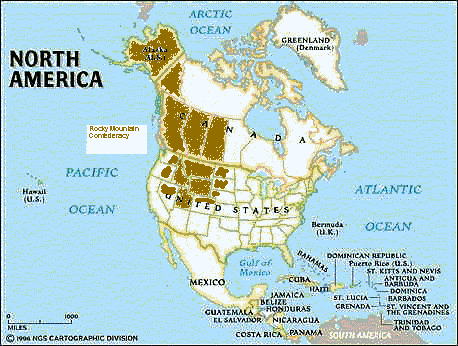
Rocky Mountain Confederacy New Saudi Arabia?


Rocky Mountain Confederacy

Loren's Rocky Mountain Confederacy contains over a trillion barrels of bitumen oil equivalent from Alberta and Saskatchewan's oil sands; over a trillion barrels of kerogen oil equivalent from Wyoming, Colorado, and Utah; large deposits of shale oil in North Dakota, Montana, Alberta and Saskatchewan; huge crude oil deposits in the Arctic; large coal deposits in Wyoming and Utah; and huge deposits of natural gas scattered throughout the region.

The Rocky Mountain Confederacy could easily become the largest energy exporting nation on the planet -- containing far more energy than Saudi Arabi, Iran, and Iraq combined -- except for one thing: it does not exist.

In order for such a nation to exist, something bad would have to happen to Canada and the US. Which means that something very, very bad will have happened to the rest of the world. Which means that the export market for all of that energy will not be very large.

You may consider that to be an extreme example of the "peak demand" theory, which states that demand for fossil fuels will collapse long before supplies are restricted enough to collapse the world economy. When the world economy collapses, it will be for other reasons than because all the affordable fossil fuels have been consumed.

When the fecal matter contacts the rotating blades does it really matter what caused it? Actually, it makes a great deal of difference in terms of re-starting a technological civilisation. If a re-born civilisation has both resources and blueprints available to jump-start technological infrastructure, the resumption of the path to beyond the stars will be that much easier.

Labels:

Bookmark and Share

09 February 2010

After Doombama: Mapping the Former United States

Splitting the US by Facebook
The United States has been trying to fragment ever since it was founded as a patchwork nation in the late 18th century. It has never truly been one homogeneous nation of persons sharing the same religion, the same educational level, the same ethnicity, the same class, or the same outlook. Outsiders sometimes tried to take advantage of the internal divisions. The British Empire never expected the US to last so long, and took many active steps to hasten its disintegration -- to the point of siding with the Confederacy in the US Civil War.
Russian Wishful Thinking

The most powerful disuniting and disintegrating force the US has faced since 1865 is undoubtedly the presidency of Barack Obama -- the president sworn to defend a constitution that he hates. Mr. Obama's most potent weapon against the US is economic doom, created via exponential debt.

The Obama - Pelosi regime is taking budget deficits to an unprecedented level. It is difficult to visualise the end result of this exponential "snowballing" train wreck of deficits -- slippery mixed metaphors cannot even touch it.
Mexican Wishful Thinking

Videogame Simulations
A fragmentation of the US is not impossible. Although Vermont and Louisiana were both explored and developed by French settlers, it is difficult to see them as part of the same country at times. Alaska has little in common with California. Mississippi and Minnesota may be connected by one river, but they are worlds apart in many ways.
Holding the 50 states (57?) together has always been a monumental task -- even for presidents who actually loved the United States and the US Constitution. Imagine how difficult the task will be in the aftermath of a president whose young mind was imprinted with a hatred of the US, and who has managed to leverage that animosity -- concealed behind a thin veneer of aloof "cool" -- into the power to frac and crack at the heart of the republic to his heart's content?

The US is experiencing many powerful fragmentary forces as a result of immigration policy, as a result of affirmative action neo-tribalist faux multiculturalism, as a result of a culture war that simmers when it doesn't burn outright, and as a result of a media and academia that genuinely appears to wish to create greater schisms and divides.

Doombama -- as instantiated in the Obama - Pelosi reich -- has another three to seven years of havoc to wreak upon the American citizen and taxpayer. No one knows what will remain at the end of that time. Draw your own map.

Labels: , ,

Bookmark and Share

08 February 2010

New Seastead Design: The Gyre

The Gyre is an upside-down skyscraper floating on the surface of the ocean. It is like an iceberg in that most of its mass is beneath the surface, but more stable than an iceberg since the underwater ballast will not melt.
The Gyre is essentially an inverted underwater skyscraper, diving down to a depth of 400 m (1,312 ft) and would be about the same height as the Empire State Building. Four arms extend from the center spire (1.25 km in diameter) and act to buoy the structure as well as create a safe inner harbor and port large enough to accommodate the world’s most titanic ships. The center tower starts off at 30,000 sq meters of space and each floor down gets progressively smaller, down to 600 sq meters. The total floor area of the entire structure is 212,000 sq.meters, or roughly 40 football fields. _Inhabitat _ via _ Ecofriend

The center piece of the design features a double-hulled vortex with both hulls being clad in reinforced glass, where each of the floor levels are essentially a layering of concentric rings ranging in size from 30,000 sq.m. down to 600 sq.m. Inclinators riding along the inner structural ribs provide for vertical/diagonal transportation between floors. Total floor area of the entire structure (levels, radial arms, barriers) is approximately 212,000 sq.m. (or roughly 40 football fields). The Gyre’s radial arms feature a pedestrian upper level and a transit system on the lower level to access to the outer protective barriers. The barriers create an inner harbor and port of approximately 1.25 km in diameter, accommodating the needs of even the world’s largest ships.


...The first two levels of the Gyre's vortex are dedicated to circulation, community gatherings, restaurants and commerce. Intermediate levels accommodate long-term residents, oceanic experts, hotel guests and crew quarters totaling as many as 2000 people. The deepest levels are dedicated to a scientific observatory for oceanographic research and an Interpretive Center for public discovery of the depths of the ocean.
_Zigloo

When comparing the designs of the Seasteading Institute with a design like the Gyre, it is important to understand which elements of each design need to be retained, and which need to be jettisoned.   The design from TSI is top-heavy and vulnerable to atypical rogue waves.  The Gyre is bottom heavy and vulnerable to below-surface phenomenon.

Clearly a more balanced design that incorporates as many of the best concepts as possible would be preferable.   The floating radial arms of the Gyre suggest the bare skeleton of a breakwater feature -- which could be extended or retracted on short notice.  A larger design incorporating four, six, or more "Gyres" in formation, might provide both a substantial extended breakwater and a balanced foundation for structures well above waterline.

Al Fin marine engineers stress the point that the "ship's hull" concept has served incredibly well over the millenia.  They are adamant that sophisticated multi-hull structures are more likely to survive the worst of open ocean storms and rogue waves -- more likely to survive than the vertical pontoon styles deriving from oil exploration traditions.  Protected waters are a different story.

The Gyre presents itself as a habitable vertical pontoon supported by a round central "hull" and four radial arm"outriggers."  The TSI design consists of four extensively cross-braced vertical pontoons supporting a well-above-sealevel platform for building habitable structures.  Neither design is suitable, as is.  But neither is a bad starting point.

Labels:

Bookmark and Share

Shocking Climate Scandal Finally Revealed


ImageSource

Hackers have broken into the US Postal Service email servers to discover a shocking conspiracy to coverup the real cause of climate change: inflation in US Postal charges over the past 100 years!

It may take years to sort through the incriminating emails and data files, but an early picture is emerging of bureaucratic malfeasance, government incompetence, and a political manipulation of data and shutting up of objecting voices.

It is clear from the graph above that postal charges are the leading variable, and a clear cause of the climate change which is obviously the dependent variable in the causative correlation.

Al Fin climatologists expect that USPS and other US government officials will deny the obvious truth being displayed by the charts and the hacked computer files. But PostalGate has now acquired a life of its own, and can no longer be suppressed by government flacks or anyone else.

Labels: ,

Bookmark and Share

A Complex Puzzle in Dynamic 3D

Neuroscientists are far from understanding how the brain works. Faulty assumptions are falling like trees in a timber-cutting contest -- but at least in neuroscience, scientists are generally free to do research without politicians-holding-pursestrings looking over their shoulders. And so we learn -- as science is supposed to do -- by testing and destroying the hard-won work of others who came before.

Researchers from the University of Maryland are unraveling more of the seemingly chaotic nature of the cerebral cortex:
All our knowledge of how the brain really works has been based on taking a small sampling of all available neurons and making inferences about how the other neurons respond, Dr. Kanold explains. "This is like showing someone who wants to know how America looks, 'Here is one person from New York City and one person from California.' You don't get a very good picture of what the country looks like from that sampling," says Kanold, originally from Germany.

In contrast, Kanold and colleagues were able to look at the activity of all the neurons in a large region of the auditory cortex simultaneously. To get the highest resolution picture to date of how auditory cortex neurons are organized, the researchers used a technique to fill neurons in living mice with a dye that glows brightly when calcium levels rise, a key signal that neurons are firing. They then selectively illuminated specific regions of the cortex with a laser and measured the neuronal activity of hundreds of neurons in response to stimulation by simple tones of different frequencies. _SD


Scientists from Germany, the UK, and the US worked together to unravel a small piece of the 3D dynamic brain function puzzle:
Tolias, who is also on the staff at with the Michael E. DeBakey Veterans Affairs Medical Center, said, "If you were to eavesdrop on the activity of a neuron in the visual part of the brain while a person is looking at a picture over and over again, the neuron will respond differently each time. In other words, a substantial part of the activity is unrelated to the picture itself. It is this activity that was believed to be common among many adjacent neurons because they are densely interconnected."

"Here is where problems begin to arise," Tolias said. "If the activity that is unrelated to the picture is common to many cells, it would build up from one stage of processing to the next, ultimately dominating brain activity and making information processing impossible -- a scenario called runaway synchrony."

To find an answer to this paradox, Tolias and his colleagues, including Alexander S. Ecker, the paper's first author who is a graduate student in Tolias' lab at BCM and the Max Planck Institute for Biological Cybernetics in Tübingen, Germany developed a new technology that allowed more precise measurement of action potentials. They found that the groups of neurons believed to be reacting in a related fashion actually had a weak relationship. They were reacting on their own, not dependent on each other.

"We measured correlations in awake, behaving primates, allowing us to have control of the experimental conditions. This gave us the chance to eliminate the possibility of a number of artifacts affecting our measurements," Ecker said. "For recording, we used chronically implanted multi-tetrode arrays -- a technique that offered us the chance to monitor many neurons at extremely high recording quality."

...The testing involved a variety of visual stimulation ranging from bars and grating to natural images. The groups of neurons tested were physically close to each other with highly overlapping receptive fields and all receiving strong common input.

One reason Tolias believes the neurons behave without correlation is to allow information to be sent through the brain in the most efficient way possible.

"Such a mechanism that allows the decorrelation might be a crucial prerequisite to prevent small correlations from accumulating and dominating network activity along the visual hierarchy," Ecker said.

The "decorrelated state" may also have other benefits, Tolias added. "Information processing in the brain is much easier if nerve cells' activity is uncorrelated. If one level of the hierarchy wants to know what the previous area is doing, it can simply forget about correlations in this case. Otherwise, it has to perform more complex computations to get to the same result." _ScienceDaily
Interesting looks at "uncorrelated activity" of neighboring neurons in both the auditory and visual cortices. It has been difficult to achieve this level of dynamic resolution in the past, when monitoring neuronal activity in the cortex.

The problem is one of scale: there are too many neurons in the cortex, too tightly packed together, to allow a complete monitoring of even a very small section of cortex. The finding would have been made long ago, if neuroscientists had only possessed a finer means of neuro-electrical monitoring.

Do we want to know how the brain works? If we want to build human-equivalent machine intelligences, we had better want to know. The various gung-ho projects to "reverse-engineer" the brain and to use "biomimetic" approaches to building machine brains, are all walking on foundations of air at this time. And if that is true, you know that the even more ad-hoc approaches being taken by most computer scientists and electrical engineers are even farther off the mark, and less likely to succeed in reaching human-equivalence.

Even the best of tools to study the brain's "connectome" are clumsily crude and inept. But how precise do we need to be? After all, human brains vary wildly in their knowledge, wisdom, intelligence, creativity, and competence. How can we know that we are "copying" a "better brain?" At this time we are not even close to being able to make that distinction.

As to the study described in the newsrelease above, Al Fin Neuroscientists can only say "I could have told them that!" And yet, science has to take these slow, plodding steps in order to make tomorrow's needful paths of study more clear.

If only climate science had been able to avoid a political takeover so early in its infancy. We might have avoided so much of the current popular and political insanity that has gripped Europe, North America, and Oceania. Better to be slow, plodding, and well-supported by observable data, than to be flamboyantly and Nobel Prize winningly wrong.

Modified 10Feb10 with additional content and editing.

Labels: ,

Bookmark and Share

07 February 2010

Why Obama, Gore, Pachauri, Hansen and Hackers Love Carbon Credits So Much

They are easy to manipulate.  In fact, last week unidentified hackers went after carbon credits online and stole credits valued at $4 million. 
The hackers launched a targeted phishing attack against employees of numerous companies in Europe, New Zealand and Japan, which appeared to come from the German Emissions Trading Authority. The workers were told that their companies needed to re-register their accounts with the Authority, where carbon credits and transactions are recorded.

When workers entered their credentials into a bogus web page linked in the e-mail, the hackers were able to hi-jack the credentials to access the companies’ Trading Authority accounts and transfer their carbon credits to two other accounts controlled by the hackers.


Under environmental cap-and-trade laws, there’s a limit to the greenhouse gases companies can emit. Companies that exceed this limit can purchase so-called carbon credits from entities that produce fewer greenhouse emissions than the limit provides them.

The scheme has produced a robust market for the trade of credits. More than 8 million tons of CO2 emissions worth $130 billion were traded in Europe last year. _ImpactLab
Out of that $130 billion carbon trade in Europe, at least $5 billion or more was used for money laundering and other illegal purposes. Another recent carbon credit scam in the UK amounted to a $62 million loss. In fact up to 90% of all carbon trading in Belgium is fraudulent.

What's not to love about a soon-to-be $trillion dollar market that has no careful controls or oversight? It's every scammers dream -- and Mr. Obama and his Chicago friends are no exceptions.

Now, after ClimateGate and the raft of revelations regarding the hoax of climate catastrophe, carbon credit trading scams are an even sweeter deal for a con -- they're fraudulent from top to bottom.

Addendum 8 Feb 10: A reader has pointed out in comments here that James Hansen is on the record as opposing the particular type of carbon credits that are being used currently in the European market.

If only James Hansen had opposed the shameful manipulation and mal-adjustment of GISS climate data, it is far less likely that the entire scam of carbon credits would have ever arisen.

Labels: ,

Bookmark and Share

Gourmet Fare: Bugs and Mushrooms

Can you imagine eating grasshoppers "more savoury than shrimp?" It's easy if you try. Costa Rican scientists at the National Biodiversity Institute are researching insect farming for purposes of food production. It makes sense: insects are high in protein, low in carbs, and produce very high quality fats including omega 3s. And insects can learn to eat a wide range of cheap feed -- even algal carcases left over from the production of algal biofuels!
At the institute, Costa Rican scientists mingle with Bhutan mycology expert Ugyen Yangchen and Elisabeth Zannou, an entomologist from Benin.

Costa Rica and Benin share historical ties, as many slaves were taken from the western African country to Central America during the colonial era.

“Benin knows a lot about insect consumption and Bhutan about eating mushrooms, while Costa Rica is bringing its experience in managing biodiversity,” Marianella Feoli, who manages the foundation coordinating the research program, told AFP.

In Benin, termites, grasshoppers and crickets, as well as butterfly and moth larvae are a common part of people’s diet, explained Zumbado, who traveled with his colleagues to explore the phenomenon in the coastal country.

“In other countries, gourmet restaurants serve insects,” he noted. _ImpactLab
If Obama is US President for much longer, humans will have to learn to eat lower on the food chain. Elections have consequences.

Labels: , ,

Bookmark and Share

Fools Who Once Were Smart

Edge.org
The title is somewhat ironic, since we are all fools in our own way. But some people set themselves up -- via the mainstream media -- as quasi-infallible authorities over topics they could not know very much about. I am referring particularly to such journalists, writers, and intellectuals as George Monbiot, Bruce Sterling, Carl Zimmer, and a host of other celebrities who have used their public platforms and facility with language as a weapon against people who knew more than they (or had a much better perspective) about the complex mechanisms of climate.

Now that the religion of carbon hysteria is collapsing of its own fabrications and contradictions, how will these knowledgeless know-it-alls (on that topic at least) explain their complete and utter mistakenness? Will they apologise to all of those they have derided and accused of being in the pockets of the oil industry? Not likely. More likely they will try to find scapegoats to blame for misleading them, like Monbiot -- who is now demanding ClimateGate's Phil Jones' head on a platter.

Over the past several weeks, several important supports of the climate catastrophe orthodoxy have come crashing to ground. Yet another pillar of the orthodoxy of carbon hysteria has collapsed with a recent publication by Professor Eelco Rohling of the University of Southampton's School of Ocean and Earth Science (hosted at the National Oceanography Centre, Southampton). The study demonstrates that climate scientists are unable to predict anthropogenic effects upon the climate into the future, due to a totally inadequate and incomplete picture of what the climate would be like without anthropogenic impacts.


According to the 'anthropogenic hypothesis', long-term climate impacts of man's deforestation activities and early methane and carbon dioxide emissions have artificially held us in warm interglacial conditions, which have persisted since the end of the Pleistocene, about 11,400 years ago.

...The researchers found that the current interglacial has indeed lasted some 2.0-2.5 millennia longer than predicted by the currently dominant theory for the way in which orbital changes control the ice-age cycles. This theory is based on the intensity of solar radiation reaching the Earth at latitude 65 degrees North on 21 June, the northern hemisphere Summer solstice.

But the anomaly vanished when the researchers considered a rival theory, which looks at the amount of solar energy reaching the Earth the same latitude during the summer months. Under this theory, sea levels could remain high for another two thousand years or so, even without greenhouse warming.

"Future research should more precisely narrow down the influence of orbital changes on climate," said Rohling: "This is crucial for a better understanding of underlying natural climate trends over long, millennial timescales. And that is essential for a better understanding of any potential long-term impacts on climate due to man's activities." _SD
Another study taking a different approach arrived at a similar conclusion: The precise influence of anthropogenic CO2 on long term climate change is currently unkown.

No doubt all of these "slow-to-catch-on" champions of the climate catastrophe orthodoxy of holy warmers are personally competent in some ways. Else, how would they have achieved the influence they have achieved?  Yet, somehow in the act of intentionally and knowingly influencing the views of millions of people, these individuals -- mere journalists (and sometimes politicians) -- set aside the necessary humility that persons of sound judgment require in such circumstances.

By mocking and deriding everyone who disagreed with them -- in front of an audience of millions -- they set themselves up for a fool's pratfall when those whom they mocked were proven right.

No, they are not total fools. Just foolish enough to fall into the hole they dug for themselves. Just try not to repeat their mistakes.

Labels:

Bookmark and Share

06 February 2010

There Will Be Blood: Public Employee Unions

These public-sector unions are flush with cash, politically connected, and unabashedly self-interested. They are an active and growing conspiracy against the public fisc. The states where they are most powerful — California and New York — lumber toward insolvency. The federal government follows not far behind, on the kind of diet geese enjoy prior to becoming foie gras.

Public-employee unions can effectively occupy both sides of a negotiating table. They donate to and elect the politicians who bargain with them at contract time. Understandably, union-backed politicians forget which side they’re on. _RichLowry

Taxpayers are beginning to get tired of being reamed up the a posteriori by politically connected public sector employees' unions. It is too early to determine what type of payback will be planned and executed against the current anti-taxpayer public enemy number one, but now would not be a good time for top level public employee union officials -- at any level -- to let down his guard.
Public-sector unionism is a very different animal from private-sector unionism. It is not adversarial but collusive. Public-sector unions strive to elect their management, which in turn can extract money from taxpayers to increase wages and benefits — and can promise pensions that future taxpayers will have to fund.

The results are plain to see. States like New York, New Jersey and California, where public-sector unions are strong, now face enormous budget deficits and pension liabilities. In such states, the public sector has become a parasite sucking the life out of the private-sector economy. Not surprisingly, Americans have been steadily migrating out of such states and into states like Texas, where public-sector unions are weak and taxes are much lower.

Barack Obama is probably the most union-friendly president since Lyndon Johnson. He has obviously been unable to stop the decline of private-sector unionism. But he is doing his best to increase the power — and dues income — of public-sector unions. _MichaelBarone
Most union members in the US are now working for the government. In some parts of the country, union wages and benefits are skyrocketing at the same time that their private sector neighbors are being laid off and losing jobs due to companies closing their doors.
The fact that government workers were getting better jobs at a time when everyone else was losing theirs does not bode well for labour politically.....From a Hayekian standpoint, public sector unions are the worst kind because they represent rent-seeking in its purest form. If you don't like unions, you can refuse to buy a Chevrolet, but you can't refuse to pay taxes. _Guardian

The US private sector continues hemorrhaging jobs at the same time as public sector employment continues growing -- and keeps getting more onerously expensive for taxpayers.   It should be obvious to residents of failing states such as California, Michigan, Illinois, and New Jersey that a huge part of their budget problems are due to the enormous political power of public sector unions.   More taxpayers in these failing jurisdictions are beginning to wonder what they have to do to cut these exploding union expenses.

The answer is, of course, nothing.  Taxpayers are virtually powerless to stop the government-enabled vampires and zombies who are feeding on their flesh.  The unions are too powerful, they have worked their way too far into the seats of power -- particularly in Democratic Party jurisdictions.

Too often it seems clear that the ultimate goal of today's Democratic Party is to make every citizen totally beholden to one or more government entities.  Perhaps they did not start out on the road to totalitarianism and designed poverty -- not intentionally -- but that is the path too many of them are taking.

Are we heading toward a "great peasant revolt of 2010?"  The US Tea Party movement is just getting organised.   The US Democratic Party will deride, disparage, and seek to ignore that movement at their deadly peril.  The numbers are against the public sector -- even when one includes all the citizens who receive government checks of one type of another.  Why?  Because without the private sector, the public sector has no funds to cover all the generous checks it is writing.

The federal government can pretend that it has the funds -- by borrowing and printing money -- but the whole rotten edifice will come crashing down much sooner than  the current crop of congressional incompetents ever thought possible.  

There will be blood.  The question is:  Whose blood will it be?

Labels: ,

Bookmark and Share

05 February 2010

Knowing Which States and Countries to Sell Short

Source_via_FinancialArmageddon

More information at the links above. Markets will identify the riskiest propositions if allowed to function without heavy-handed government (such as the Barney Frank and Maxine Waters congress putting pressure on lending institutions to loan to unqualified buyers). Once the riskiest institutions are identified, investors, businesses, and residents will vote with their feet and get out -- if they can.

Under Obama, the US (and the world) has a serious problem. Incompetence such as Obama represents is unprecedented, and virtually inescapable anywhere in the world. The fallout from Obama's corrupt payoffs to friends -- in the hundreds of billions and growing higher -- will haunt the US private sector, the US consumer, and all the world's workers and businesses that depend upon income from exports to the US.

Labels: ,

Bookmark and Share

10 Geopolitical and Economic Predictions for 2010

Guest Article from OilPrice

2010: The Short Term Strategic Outlook – Beyond the Statements

A great - and still growing - divergence appeared in 2009 between public statements by leaders and their public performance. The politicized, romanticized theater of increasingly populist “democratic” leaders and media seemed to be of a different planet from activities taking place in the real world.

While a large part of the global population appears still transfixed by words, there is a growing perception that great fissures already rend the global strategic architecture.

This is a trend which will compound during 2010.

There is a widespread belief that the world has “ducked the strategic bullet” of global economic collapse, but this is merely the delusionary euphoria of the severely wounded patient. Severe structural damage has occurred to the key driver of global economic stability, the United States. Most major economies of Western Europe and Asia, although in plight, have been protected in their fall by a complex web of structures and the fact that they were not, in many respects, as leveraged as the US. Britain and Japan, however, remain leveraged in their debt-to-asset ratio, to a death-defying degree.

All of this has been long in coming, and brought to a speedy climax by the unprecedented recklessness of inflationary spending by US Pres. Barack Obama, and, in the UK by Prime Minister Gordon Brown. The modern world (East and West, but prompted by the West) is at a junction point in a long process of constantly growing — but poorly-defined — obsession with “rights” (entitlements). This had its origins with the halting, but consistent, rise in global prosperity which began with the early stages of the Second Industrial Revolution (1700-1900).

Thus, a butterfly flutters its wings in 18th Century Britain and a tsunami engulfs the world in the early 21st Century.

Managing the now-overwhelming sense of entitlement in what we call modern democracies has become, because of the power of a comprehensive, but ill-informed electorate, an exercise in mob control, and an opportunity for populist demagoguery.

Pres. Obama’s statement of January 25, 2010, that he would now curb US Government spending was, like most of the statements of the past year, self-serving and had nothing to do with reality. His plan to push through a State-dominated healthcare system at a reputed cost in excess of $1-trillion (quite apart from other discussions about a new “stimulus package” of spending) makes a mockery of the pre-election posturing of fiscal moderation (that is, his posturing before the 2008 and the 2010 elections). In any event, a review of the statistics of the US shows that his proposed “freeze” on a small part of US Government spending would be, compared with his profligacy and reduction of private sector productivity and capital formation ability, a derisory diversion.

Without dwelling, for the purposes of this estimate, on the cumulative impact of ever-broadening the electoral franchise — which creates an automatic disposition of an electorate to demand increasing benefits without attendant increases in productivity — the Western economies are probably at a point where they must attempt to create fairly draconian, centralized power structures to rule more by diktat than by “democracy”. That is the only recourse to stem the growing dysfunction of government brought about by the “democratic” necessity to pander to a restive populace.

In a report on March 20, 2009, I noted: “the ‘professional politician’ will morph into new forms of Cæsarism or Bonapartism. This is already underway, as ‘leaders’ with no practical experience of the world increasingly fear the uncertainties of markets and the confidence of those who can actually create, manage, and build. Thus, the ‘new socialism’ is a system built by leaders who demand central control of societies and who genuinely fear freedom.”

The new circus includes the pandering to newly-created pseudo-scientific religions, such as “climate change”, which have so greatly distracted governments, the media, and populations from their daily work as to have already hampered the chances for economic viability in the near future. Those, however, who live by the sword of populism — mob rule — must ultimately answer to that same fickle crowd, which, as Elias Canetti noted in Crowds & Power, has no mind, only wants.

Pres. Obama is already facing the turning crowd, which is why, on January 25, 2010, he began his studied portraiture of reasonableness and fiscal moderation, a process to continue in his January 27, 2010, State of the Union address to the US Congress. The policy analyst, however, must look to actions, and the feasibility and context of those actions, and not to the words which attend them.

Let me highlight some of the cautions which I have made over recent years, without merely repeating the ground of the March 20, 2009, report.

1. The decline in Western asset values will likely continue in the broad sense through 2010, which will automatically lead to a compounded reduction in the asset-based credit available. In other words, Western economies will be forcibly “de-levered”, quite apart from the fiscal prudence which will cause a reduction in risk investment;

2. The West will demonstrably not contest dominance of the major oil and gas fields of Iraq, Iran, Nigeria (and elsewhere in the Gulf of Guinea) against competition from the People’s Republic of China (PRC) and, to a lesser extent, India. This will force moves in the US toward natural gas exploitation and — as Obama and the “green left” depart — possible exploitation of US oilfields and new nuclear energy approaches. This would in turn imply a renewed look at nuclear waste disposal. But none of this Western search for alternatives will occur in 2010.

3. The conflict in Afghanistan will become increasingly strained as the US sends out, literally, signals of surrender to the Taliban, who take all calls from the US for a “negotiated settlement” in the wake of a pronouncement of US imminent withdrawal as a sign of weakness and defeat. It is, in fact, such a signal. And while senior US military and security officials “reassure” regional states, such as Pakistan, that the US would, in fact, remain in the area beyond the Obama withdrawal deadline of 2011, the reality is that — absent the removal of Obama from office — this will not happen. Once again, the “long-timers” in the US bureaucracy, including those in Defense and State, believe that they can outwait and outwit the “short-timers”. But the determined short-timer, such as Pres. Obama, can and will wreak havoc and destroy the pillars of the system before he leaves. And when Obama leaves, the money, in any event, will be also gone, and with it the capability and viability for the US to remain in or near Afghanistan. Indeed, the destruction of key elements of the US economic and political framework has already occurred.


4. Quite apart from the US ability to sustain South Asian operations in the manner which the Washington insiders have assured the Pakistanis (and others, such as the Australians), the reality is that India — which the US has been courting as a strategic partner — will of necessity have to re-align with Russia if it is to gain any access to the Eurasian heartland. If it does not, it will never be able to compete strategically in the near future with the PRC, which is pushing ahead with the construction of more efficient overland links to the Indian Ocean through Myanmar and through Pakistan (from the Karakoram Highway down to the Baluchistan Arabian Sea port of Gwadar, which had been offered twice by Pakistan to the US, which refused it).

5. A strategic opportunity is emerging for the West — and possibly for India — in the transformation now occurring in Myanmar as the ruling military leaders take very seriously their approach to elections later in 2010. This could — could, not necessarily will — mean that Myanmar opens to a more Western orientation to the detriment of the PRC, but only if the US can support the notion of providing some measure of post-election security, ideally within Myanmar, for the retiring military leaders. The US lost massive credibility in this kind of undertaking when it lured Liberian Pres. Charles Taylor into exile in Nigeria in 2003 and then broke promises of safe-haven for him, and organized his subsequent extradition to the UN’s International Criminal Court (ICC), to which the US does not even subscribe.

6. As global productivity fades during 2010 (albeit with some pockets of resilience), many Western leaders will turn to sophistry and intellectual distractions, such as an attempt to assert or blame “international law” as the mechanism for remedying their situations. There is, in reality, no such thing as “international law”, but there is an attempt to create it, even absent global acceptance of such a concept. There are norms of international behavior, but, strictly speaking, the United Nations (around which much of the proposed “international law” is being built) specifies the right of nations and peoples to self-determination, free from external interference. But what we are seeing is the creation of a minority-controlled set of structures — such as the “International Criminal Court” and its derivatives — creating laws without any valid legal framework. The ICC derivative judging “war crimes” in the former Yugoslavia, for example, has been making up laws and case law to validate its position. In any event, 2010 will see a stark removal of the media-perpetuated view that “international law” exists. The PRC and India have already indicated that they will not comply with so-called climate change measures; they will not commit their populations to starvation by forcing emission reduction measures on their industries, making them unaffordable or uncompetitive. This, as I have often said, is part of the trend which sees nations moving back toward nationalistic stances and protectionism. “International law”, and the United Nations itself, is heading toward irrelevancy. The feel-good gatherings, such as the World Economic Forum, at Davos, Switzerland and even the Copenhagen conference on “climate change”, become mere distractions from the real issues facing the world.

7. The unease and conflict in the Arabian Peninsula will continue apace, with strong Iranian support and some Russian interest, merely because there is nothing to stop it. Only a total compromise of Yemen Pres. ‘Ali ‘Abdullah Saleh to Iran — something which would greatly antagonize Saudi Arabia — can bring the fighting in the area to a more contained level, and even that would signify an Iranian victory. Inter-governmental talks on the security and stability of Yemen, held in London on January 27, 2010, were essentially cosmetic, and signified the lack of Western commitment to addressing the problem in the Arabian Peninsula and the Red Sea. The most significant unknown factor is the degree to which Oman can stop the spread of unrest into its country, which controls the southern littoral of the Strait of Hormuz. Equally, Oman’s unique culture, and the strength of its leader, Sultan Qaboos bin Sa’id al-Said, is its best safeguard, as well as the West’s best hope for security at the Strait.

8. It is in a climate of profound international distrust in any Western support or ability to protect that we will see the transition of power occurring in places such as Egypt and Nigeria in 2010. Both states are critical to the West, both geopolitically and in energy terms. France has offered a strong degree of support for a stable Egyptian transition, but the rest of the West has been fairly impotent. Similarly, Pakistan is undergoing a constitutional crisis which may see Pres. Asif Ali Zardari removed by the Supreme Court which he, essentially, helped reinstate after the end of the Musharraf Administration. Even if Pres. Zardari can circumvent the mounting constitutional legal case being mounted against him, his powers are being eroded by the National Assembly.

9. It is profoundly unlikely that Israel will militarily attack Iran in 2010, or in the foreseeable future. As a result, the clerical leadership in Iran will move inexorably toward greater consolidation, a process which will occur in diametric contrast to the rising shrillness of US condemnation of Iran’s nuclear position. The reality is that (a) international embargoes against Iran have already failed, and new embargoes cannot be implemented as long as Russia and the PRC guarantee Iranian trade, (b) the US (and Israel) cannot militarily attack Iran with any hope of a positive strategic outcome because the nuclear and National Command Authority targets are too diffuse and there is no capability of a ground-force follow-up, and (c) the Iranian population would, as they have always done, react with great hostility to any foreign attack, rallying around the government of the day, even if they have despised it. The only hope of what the US calls “regime change” in Iran can come if it is at the hands of the Iranian population, and Russian and PRC support for the Administration of Pres. Mahmud Ahmadi-Nejad’s security services has ensured that the Iranian public cannot effectively combine to remove him. Still, mounting internal frustration in Iran could result in a coup by the Iranian Revolutionary Guard Corps (IRGC: Pasdaran).

10. The People’s Republic of China will continue to manage the great internal disparities through 2010, but there is no guarantee that Beijing will not face major hurdles in the year. Moreover, the continuing poor economic performance in Japan and the US will continue to constrain PRC exports and dampen PRC economic options given the extent of Chinese holdings of US securities which grow less attractive by the day.

Originally published at: http://www.oilprice.com/article-10-geopolitical-predictions-for-2010--short-term-strategic-outlook.html


Written By Gregory R. Copley for Oilprice.com who focus on Fossil Fuels, Alternative Energy, Metals, Crude Oil Price and Geopolitics To find out more visit their website at: http://www.oilprice.com

Al Fin's comment: Mr. Copley's analysis appears quite sound overall. The US might well find it easier to partner with Russia on several projects were a different regime in place in Moscow. At this time there is no reason whatsoever for the US to favour either Moscow or Beijing over the other. Strategic alliances between the US and India, Turkey, and the countries of Eastern Europe remain critically important -- not to mention the critical importance of strong alliances with the nations of the Anglosphere, Japan, S. Korea, and increasingly Chile and Colombia.

The US cannot afford to be the world's policeman any longer, but it can also not afford to step back from global shipping and trade routes and strategic regions altogether. It must make wise alliances based as much as possible upon equitable trade relations.

Labels: , ,

Bookmark and Share

When Garbage is Golden

ImageSource

Cities are beginning to find significant energy sources in their own back yard -- garbage and waste! Turning garbage and waste into energy is turning into a billion dollar business for some enterprising businesses.
Huge amounts of money are spent daily buying energy from foreign nations that have no real respect for our well-being. Permitting America to be dependent on such nations can only lead to complications, especially during times of economic crisis or war....

...Turning garbage into energy calls to mind the 1980s film “Back to the Future,” which inspired whimsical images of future cars powered on waste. Since that time, the technology for turning trash and commercial waste into electricity and biofuel has come a long way. In just the past decade, research and experimentation has brought about a cleaner and more efficient conversion system...... _CSM
Companies such as Waste Management are ideally situated to cash in on this new energy bonanza. Several smart city managers across the US are also catching on to this approach to turning garbage to cold. Cities from Milwaukee to Seattle to Rochester to Gibson City and more, are at various stages of taking control of their own garbage and energy destinies.

Solid wastes can be converted to energy by gasification, pyrolysis, incineration, etc. Wastewater can be used to grow algal energy crops, can be digested to methane, or can be converted to energy via other imaginative methods.

Toxic and hazardous wastes can be safely and completely consumed via certain particularly high temperature gasification and incineration methods. In fact, soon there will be almost no type of waste that cannot be conveniently converted into clean energy and benign by-product.

Some types of long-lived radioactive waste materials are resistant to easy conversion and disposal, but advanced methods are being developed to render even those hazards safe.

The nightmare fears of being drowned under oceans of toxic waste are a partial explanation of why "environmentalists" have been driven to lie about "climate change catastrophe" and other faux end-of-the-world crises. Fears about shortages of energy and resources are further explanations. But as Julian Simon showed in his book "Ultimate Resource", the mental energy wrapped up in all of those fears could be better put to use devising creative solutions to problems.

Labels:

Bookmark and Share

04 February 2010

Can Israel Save the European Union?

Guest Article from OilPrice.com

As the Middle East Peace Talks Hit Deadlock, Talk of Israel Joining the European Union Increases

The Middle East peace talks are at a deadlock. Negotiations between Israel and the Palestinians to move ahead with the plan established by the so-called Quartet – the US., U.N., EU and Russia -- have faltered and come to a complete standstill. Continuing with this inertia will have a long-term negative effect on the future of the region both from a political point of view as well as from a business perspective. With the exception of a few risk-takers, what company or business executive would be willing to invest in the Middle East once the region plunges onto the abyss amid renewed violence?

And whenever trouble brews in the Middle East it tends to spill over into other parts of the world. The risk that Mideast violence could spread to nearby Europe might have been one of the reasons that pushed Italian Prime Minister Silvio Berlusconi to say that Israel should be admitted into the European Union earlier this week. Berlusconi made the statement during an official state visit to Israel. Berlusconi, of course, is one of Israel’s strongest supporters.

Regardless of that the question remains does Israel belong in Europe?

Does Israel joining the European Union make any sense? And is this proposal likely to carry any weight? The idea has been floating around for a number of years. And if Turkey feels it belongs in the EU, then why not Israel, where a large portion of the population has direct ties to Europe.

The knee-jerk reaction from much of the Arab world will most likely be to throw a temper-tantrum. There will likely be anti-Italian demonstrations, threats to boycott Italian goods (which will be short-lived given the Middle East’s attraction to pasta) and in the extreme case, some maniacs will attempt to carry out terrorist acts against Italy. But anyone with an ounce of logic should jump on the Italian bandwagon. Support the initiative.

To what end? Why?

Think about it for a minute or two. What would it mean to have Israel join the EU? To begin with, the European Union has very strict rules regulating multiple aspects of how a member country should function. First of all, no prospective partner of the Brussels club can be allowed to join the European Union while it occupies territory that is not legally recognized as part of its own. Israel’s adhesion into the European Union would have to be preceded by a complete withdrawal of Israeli military and civilian forces from all Palestinian territory. That would mean that before such a withdrawal can happen a peace deal will have to be reached beetween the Palestinians and the Jewish State.

Israel’s admission into the European Union would mean that the highways and security roads that Palestinians are not allowed to travel on would have to disappear. It would be inadmissible to have segregated roads in the European Union. Imagine if Italy, France or Germany, for example, banned certain ethnic groups from traveling on its national highways.

The Separation Barrier (official United Nations designation) which Israel calls a “fence,” and Palestinians refer to as an “Apartheid Wall;” in reality a series of segments of a wall resembling the Berlin Wall, ditches and moats, erected between Israel proper and the West Bank to keep potential terrorists out, would have to come down. It would be unimaginable for a member of the EU to maintain such a symbol of segregation. Similarly the situation regarding Gaza would have to be resolved. Again, it is unimaginable for a European country to lay siege to a neighboring territory.

But that is not all. The whole concept of the European Union, the world’s largest economic and political zone, which saw the day shortly after the end of World War II, was to tie the economies of Europe’s countries in such a way that war would simply become unimaginable. Nations that spent centuries fighting each other – England and France, France and Germany, Germany and its neighbors to the east, and so on and so forth – began building the foundation to make those wars a thing of the past and inconceivable in the future. And it worked. Today war between once former foes in Europe is just not possible. To be sure, there may well be disagreements between members of the EU, but the disputes are settled in the European Parliament or at the International Court of Justice in The Hague. Not on the battlefield any longer. This is an example from which the Middle East could greatly benefit.

Israel in the EU would also mean that peace with Syria would have to be attained and the occupied Golan Heights returned to its rightful owners. Going a step further, Israel would have to finalize its withdrawal from the Shebaa Farms and the village of Ghajjar in south Lebanon and find a way to make peace with Lebanon and by default, with Hezbollah.

Is any of this possible? Yes, would say the optimist in me, but with a caveat. Unilateral withdrawal from Arab lands is unrealistic and dangerous for the security of Israel. And Israel’s domestic and foreign policy is driven by its security needs. So the bottom line is this: If Israel wants to become a member of the European Union, even with all the backing of the Italian prime minister, and others, it would first have to negotiate peace with its Arab neighbors. And that is a good thing.

So, Israel in the European Union? Yes, by all means, bring it on. And if Israel joins the EU, why can’t Lebanon be next? With Cyprus now a member of the EU, Europe is but a 20-minute airplane ride from the Middle East.

Originally published at: http://www.oilprice.com/article-as-the-middle-east-peace-talks-hit-deadlock-talk-of-israel-joining-the-european-union-increases.html


Written by Claude Salhani for Oilprice.com who focus on Fossil Fuels, Alternative Energy, Metals, Crude Oil Price and Geopolitics To find out more visit their website at: http://www.oilprice.com

Labels: ,

Bookmark and Share

Dopamine Drives Risk Taking and Status Seeking

The neurotransmitter dopamine plays a vital role in determining an individual's level of drive and ambition, as well as thrill seeking behaviours.  Two recent studies look at important behavioural effects of the monoamine neuro-molecule.
Our need for stimulation and dopamine's action upon the brain are connected, which explains why people who constantly crave stimulation are in danger of addictive behaviour such as drug abuse and gambling. _SD
People have typically viewed the benefits that accrue with social status primarily from the perspective of external rewards. A new paper in the February 1st issue of Biological Psychiatry, published by Elsevier suggests that there are internal rewards as well.

Dr. Martinez and colleagues found that increased social status and increased social support correlated with the density of dopamine D2/D3 receptors in the striatum, a region of the brain that plays a central role in reward and motivation, where dopamine plays a critical role in both of these behavioral processes. _Eurekalert
Both studies were collaborative, representing the work of neuroscientists from several research centers in Europe, Japan, and the US. The research is quite intriguing, as it suggests that dopamine may be a source of exquisite internal conflict -- between the drive to take risks, and the drive to achieve and hold high status. Of course, in a material world, the two drives can also work together.
Many individuals experience the urge to engage in new activities every day, and that's perfectly understandable. However, some are looking for more than that, experiences that will take their senses to a whole-new level. Other than extreme sports and gambling, there isn't very much else that can fulfill that and be legal. Psychologists have been aware of this type of behavior for years, but science has failed to pin down an underlying hormonal activity that triggers it, until now. The international group of scientists in charge of the recent study came from the University of Copenhagen, the University of Aarhus, and the University of Tokyo, in Japan. _Softpedia
Interestingly, patients who take dopamine replacement and dopamine-sparing treatments for Parkinson's Disease also often manifest strong tendencies to take risks -- including pathological gambling.

I wonder how one would program such drives into an artificial intelligence.

Labels: , ,

Bookmark and Share

Black Carbon Update: Up to 90% of Warming

A new study of the effect of black carbon on the melting of Himalayan glaciers demonstrates that 90% of melting is due to aerosols -- not CO2. More than 30% of melting is due to black carbon aerosol, and probably considerably more than 30%.

These findings are consistent with studies that show that significant (over half) amounts of arctic ice melting has been caused by black carbon and other aerosols.
Previous studies have shown that black carbon can have a powerful effect on local atmospheric temperature. “Black carbon can be very strong,” Menon says. “A small amount of black carbon tends to be more potent than the same mass of sulfate or other aerosols.”

Black carbon, which is caused by incomplete combustion, is especially prevalent in India and China; satellite images clearly show that its levels there have climbed dramatically in the last few decades. The main reason for the increase is the accelerated economic activity in India and China over the last 20 years; top sources of black carbon include shipping, vehicle emissions, coal burning and inefficient stoves. According to Menon’s data, black carbon emitted in India increased by 46 percent from 1990 to 2000 and by another 51 percent from 2000 to 2010. _Source

Melting glaciers and ice sheets have been used as an example of the effect of CO2 on climate, when in actuality they are an example of the effect of aerosol pollutants -- largely from China and India.

But then, you did not need this blog to tell you that CO2 hysteria is a scam, right?

Labels: ,

Bookmark and Share
Newer Posts Older Posts
Al Fin Main Page
Enter your Email


Powered by FeedBlitz
Google
WWW AL FIN

Powered by
Blogger

``