18 June 2012

Endless Possibilities at Sea: 650 Abandoned Oil Rigs in Gulf of Mexico; Over 4,000 Worldwide

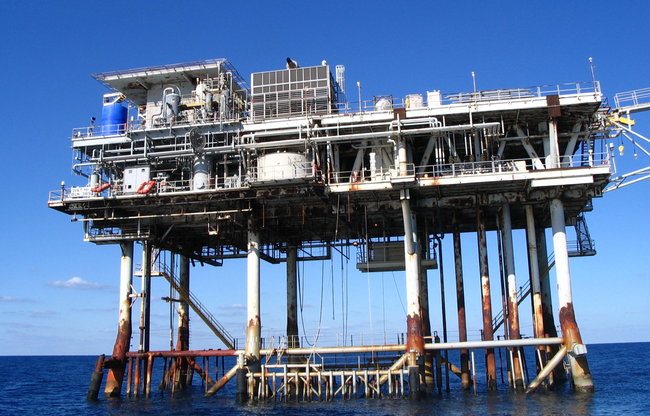
A fight is raging over abandoned oil platform High Island 389-A, pictured below. Obama's Interior Department, led by Ken Salazar, wants to dynamite the structure, killing thousands of fish in the process, and damaging delicate seafloor ecologies -- including coral reefs. But there may be more economical and ecologically sound ways of dealing with abandoned oil platforms.
Now, 30 years after it was built and months after it was abandoned, it is set to be demolished under Interior Department rules governing nonproducing ocean structures. And when it goes, the lush ecosystem that has grown around it will also vanish. There are now about 650 such oil and gas industry relics, known as idle iron, that may meet this fate.

The federal government estimates that the blasts needed to remove one platform kill 800 fish, although others who have observed the process put the number in the thousands. Much of the marine life on or around the structure dies, either from the explosions to separate the platform from its supports or when it is toppled or towed to shore and recycled as scrap metal. _NYT

Texas governor Rick Perry is one of the people trying to stop the Obama-Salazar wanton destruction of ecosystems and fish life. Years ago, President George W. Bush tried to put an end to the bureaucratic rules which make it possible for government to intrude so destructively in offshore waters, proposing to allow abandoned platforms to be used by offshore fish farms.
Oil Rig Conversions

There have been many proposals for ways in which to convert abandoned offshore platforms and rigs to more economic and ecologically sound uses. Here is a rather ambitious and stylish proposal for creating a mini-city from an abandoned offshore rig.

One offshore sea platform originally used as a sea fort, was even declared an independent country -- the Principality of Sealand. But there are many other potential uses for the structures, including as resorts, hotels, diving sites, aquaculture farms, zen monasteries, and more.

Ken Salazar is likely to want to wipe away all traces of oil & gas activity from all US offshore waters. He has done his best to retard and obstruct such activity in the Gulf of Mexico under President Obama's watch. The Obama - Salazar policies toward the Gulf of Mexico waters have harmed the economies of local states far worse than any combination of oil spills could have done. And these policies continue to hurt Gulf economies. Too bad such self-important bureaucrats cannot learn to be more open-minded in their dotage.

Worldwide, there are thousands of abandoned offshore structures, with more likely to become available every year. More recent versions of offshore platforms can even be moved from one location to another. In fact, the Seasteading Institute's main design for an early seastead is derived from the same floating architecture as state of the art floating oil rigs.

Keep an eye on this legal battle over the status of High Island 389-A. It may set a precedent for future policy on abandoned offshore platforms and rigs.

Oil Rig Photos

Labels: ,

Bookmark and Share

03 February 2012

Aerogels Get Tougher to Meet Harsh Real World Challenges


Aspen Aerogel

Aerogel has proven to be a great insulator both on Earth, on Mars, under the oceans, and even in extreme expedition clothing, for use in both very cold and very hot environments.

Aerogels are finding wider use as insulators in the construction market, and have now reached the high end of home construction:
Over 70 years ago, scientists invented aerogel, the least dense solid known to man, and an insulator four times more efficient than fiberglass or foam. Famously, according to Dr. Peter Tsou of NASA's Jet Propulsion Laboratory, "you could take a two- or three-bedroom house, insulate it with aerogel, and you could heat the house with a candle. But eventually the house would become too hot."

Unfortunately, aerogels remained so expensive and unwieldy that only NASA used them with any regularity. However, thanks to recent production advances, aerogel insulation is now available and affordable for consumer purchase.

Even after the price drop, aerogels remain more expensive than common insulating materials. But since aerogels are more plastic than fiberglass or foam, permeable to water vapor, and flameproof, the extra cost may well be worth the investment when insulating masonry, shingles, or curved surfaces. Plus, since they're so light and efficient, aerogels reduce other building costs as well. _PopSci
Aerogel is even used by sculptors as a sculpture medium, but for it to be used to construct very large self-supporting 3D structures on its own, it needs to be toughened up somehow. Chinese and Japanese researchers have collaborated to create a hybrid aerogel using cellulose and silica, which is much tougher than regular aerogels.
The researchers at Wuhan University (China) and the University of Tokyo (Japan) have now developed a special composite aerogel from cellulose and silicon dioxide. They begin by producing a cellulose gel from an alkaline urea solution. This causes the cellulose to dissolve, and to regenerate to form a nanofibrillar gel. The cellulose gel then acts as a scaffold for the silica gel prepared by a standard sol–gel process, in which a dissolved organosilicate precursor is cross-linked, gelled, and deposited onto the cellulose nanofibers. The resulting liquid-containing composite gel is then dried with supercritical carbon dioxide to make an aerogel.

The novel composite aerogel demonstrates an interesting combination of advantageous properties: mechanical stability, flexibility, very low thermal conductivity, semitransparency, and biocompatibility _Nanowerk
A truly tough aerogel would be an amazing material for use in a wide variety of applications. Ultra lightweight, strong, flame-proof, conforming to a wide range of shapes, super-insulating, with fairly good sound insulating properties as well.

Ultralight multi-walled carbon nanotube aerogels:
This material is particularly interesting because it is composed of a dispersion of MWNTs which leave a honeycomb structure with controllable porosity. More-so, the aerogel has a large surface area and conducts electricity very well, but is a thermal insulator. This is an ideal characteristic for electronics.

Notably this is not the first aerogel made from carbon nanotubes (or CNTs for short if you’re hip to the materials crowd), nor is it the first CNT-based aerogel to exhibit amazing elastic properties. But it’s a new pathway to making CNT-based aerogels and the resulting materials are pretty cool. _aerogel.org
Wikipedia Aerogel

Aerogel Blog

Aspen Aerogel Products and Markets

What you see above is a rapidly developing material category which is likely to expand rapidly, once it has toughened up enough to "go the distance."

A monolithic dome insulated with aerogel walls and windows should easily keep a family warm even in polar environs, for very little cost of heating. Similarly, undersea habitats, high altitude lighter-than-air ships, and outer space habitats could be kept comfortable without adding significant weight.

Al Fin seastead engineers have even suggested using future, highly toughened aerogels as insulation for pykrete seasteads, to minimise cooling expenditures for the massive free-floating island habitats. The advanced aerogels would be used in conjunction with layers of supercooled liquid gels and integral perfusion channels for the "counter-current" flow of super-cooled fluids, within the pykrete and liqui-gel layers.

The ability to use inexpensive materials, such as pykrete, to build massive structures such as large seasteads, should make the idea practical much sooner.

Adapted from an earlier article on Al Fin the Next Level

Labels: , , ,

Bookmark and Share

29 December 2011

"Sea Tree," A Seastead for Birds, Fish, and Bats

The Sea Tree would be a tiered structure moored underwater with a cable that serves as the frame for series of layers. The layers above and below water would, over time become their own ecosystems — much like a sunken ship does underwater. Like an oil rig, the structure would rise above water and be self sufficient, but serves nature only.

The Sea Tree is a concept created by Amsterdam-based Waterstudio.nl. What is unique about this concept is that their plan was always to create the structure for nature only rather than retrofitting a green space into an urban structure or create a mixed use building. The idea was meant offset the trend of city sprawl and could be located in any water source — lakes, rivers or oceans. Wherever there is a need to bring some green back to the environment. _DVice
Humans have intentionally created artificial reefs for thousands of years for military purposes, and since the 17th century for purposes of increasing fish yields. Of course, humans have unintentionally created artificial reefs since the first ship sinkings and offshore garbage dumps.

Humans have also created island bird refuges for nesting birds, for some time.

This Dutch creation combines the artificial reef concept with the island bird refuge concept. To top it off, they have included an interior "bat cave" as a bat sanctuary and habitat.
A lush variety of plant life should provide abundant nesting areas for birds, as well as providing food for insects, which in turn provides food for birds, bats, and fish.
Once the multi-level animal seastead is placed off-limits to humans, it is apt to evolve its ecosystem in any number of directions. As an ecological experiment, it might hold more than a few surprises.

Just be sure to locate it away from any onshore or offshore wind farms, and keep feral cats far away. Maintenance would best be carried out by robotic telepresence. Monitoring should be done by webcam and UAV flyover. Keep tourists far away. Shoot to kill, if you must. ;-)

Labels: , ,

Bookmark and Share

02 October 2011

Welcome to Utopia!

Images via Gizmag

Project Utopia has more in common with an oil rig than it does with a yacht, and in the word's of the consultancy, "breaks the traditional naval architectural mould which the market has come to expect and offers a truly unique outlook free from any conventional design constraints."

...Yacht Island Design's Project Utopia measures some 330 ft (100 m) in length and breadth, spans 11 decks and has the equivalent floorspace of a present-day cruise liner - indeed, and I'm sure this will be a draw-card to any aspiring wealthy megalomaniacs, there is enough space to create an entire micro-nation.

First and foremost, the island's design is stable, being based on a four legged platform and designed for minimum motion in the most extreme sea conditions. Each leg supports a fully azimuthing thruster and with four such units, the design can redeploy between desired locations at slow speed. _Gizmag

The Project Utopia seastead design is clearly oriented toward the luxury-loving segment of the population, so it will be more similar to a luxury cruise ship than an independent country. And yet, if it adds to our wealth of knowledge of the different ways of living on the ocean, it could serve to help create a more revolutionary type of seastead.
First published at Al Fin Potpourri

Most of the important commercial opportunities of the sea occur close to the shore, on continental shelves. Oil & gas, fishing, aquaculture, tourism, etc. all tend to occur within no more than a few hundred miles from shore. Most of this area would be within a particular nation's control, and out of bounds for "independent" neo-nations. Deep-sea mining could conceivably support an independent ocean community, if it had the technological expertise and could negotiate international treaties of the sea.

The more speculative industries such as offshore banking, gambling, experimental medical procedures, advanced experimental life extension therapies, unconventional sexual opportunities, etc. would have to provide regular and reliable access to outsiders, both incoming and outgoing. The open ocean -- outside national zones of influence -- can be a very unfriendly and unpredictable place.

A seastead that seemed as safe, solid, and accessible from the outside as an island, but was as mobile as a large cruise ship (to avoid large storm systems), might be ideal. So far, Al Fin marine architects have not seen a practical design that can satisfy those criteria.

Labels: ,

Bookmark and Share

06 April 2011

Offshore Oil Production Moving to Seafloor Robotic Cities: So What Can We Do With All Those Abandoned Oil Rigs?

Neal Asher

There are over 1.3 trillion barrels of untapped oil under the seafloors. But what is the safest way of retrieving all of that oil -- much of it at deadly crushing depths?

Brazil intends to replace its fleet of floating offshore oil rigs with 2,000 metre deep "underwater cities" of robotic oil workers, part automated and part controlled from a remote location by human operators. So far, so good. But what will be done with all the huge, obsolete floating oil rigs? Why not turn them into floating resorts and marine research centres?
Inhabitat

The idea is not new. In fact, the (disputed) world’s smallest country is an old oil platform. In the design by Ku Yee Kee and Hor Sue-Wern, the reclaimed oil rig is layered in rings of habitation units sharing center common and recreation areas. The stacked units share an incredible view of the vast ocean. Beneath the water are circular labs for marine research. The designers looked like they were having some fun, inserting a pleasure boat launch, cantilevered pool, and a huge domed assembly room crowning the rig. _Inhabitat_via_Dvice

Inhabitat

Notice the subsurface marine science research labs -- or are they undersea restaurants or hotel rooms? There is room for flexibility in design, depending upon the outfitters and management.

And there is no reason why serious and progressive-minded seasteaders should not substitute small modular nuclear reactors in place of unreliable and intermittent wind and solar power devices. The last thing you want is to be stuck in the middle of the ocean without enough power to make freshwater, keep the lights on, or to cook your seafood.

Always keep your eyes open for opportunities to go beyond the ordinary.

Labels: ,

Bookmark and Share

28 February 2011

On Taking a More Nitty-Gritty Approach to Seasteading

More Designs Here

Up to this point, seasteading seems to be more about superficial design and "gee-whiz! futurism" than about actually building a seastead as an ongoing concern -- as a self-sustaining alternative to government monopoly. The Seasteading Institute has promoted a number of conferences and has achieved a good deal of media coverage. That is always helpful for raising interest in the general ideas, but when it comes to the nitty-gritty of making a life on the ocean, most of the ideas one finds on the site lack heft. In the end, a seastead will have to pay for itself.

It appears that aesthetics may be playing too great a role -- and economics too small a role -- in many of the themes and schemes thrown around in popular seasteading circles.

There is no need to reinvent the wheel in terms of basic marine structure. Actual commercial enterprises such as the oil & gas industry and marine mining concerns, have made significant engineering advances and continue to do so, in terms of habitable ocean-going vessels which are also working commercial platforms. It is possible that the movement could use the input of more no-nonsense marine architects and engineers, as well as that of more persons familiar with the ins and outs of making a living from the sea.

The early seasteads need to be tough, strong, and relatively inexpensive. There is no need to win a beauty contest. One relatively inexpensive building material which could be used to construct working seasteads is pre-stressed concrete:
Through innovation with precast and prestressed concrete, some latest trends are now focused toward the development and construction of floating ocean platforms used to extract minerals, energy, and other natural resources.

Precast and prestressed concrete platforms have been constructed to support phosphate processing plants, floating liquefied propane gas (LPG) processing and storage facilities, and oil exploration platforms that are transported afloat and grounded for drilling.

For ocean platforms, the size and weight of prestressed and precast concrete construction will provide the greatest dynamic stability due to its large inertial advantage. Long-term durability of concrete construction in an ocean environment has been proven by actual service of existing prestressed precast concrete platforms over the last several decades. _civil-online
If the trend toward more and more offshore drilling and mining enterprises continues, it is likely that a great deal of the preliminary testing of possible designs and materials will be done by industrial concerns.

By taking advantage of the lessons already learned and earned by offshore industries, seasteaders who are serious about pulling their own weight can find starting opportunities and niches. Focusing on "pay as you go" approaches is not nearly as glamorous as a lot of the ideas being thrown around at some popular seasteading sites and forums, but it is an approach that is more likely to work in the long run.

From an earlier article at Al Fin Potpourri

Labels: ,

Bookmark and Share

14 January 2011

500 ft Personal Seastead: "Streets of Monaco" for US$ 1 Billion

Forbes

On the top deck you will notice replicas of the Monte Carlo Casino, Hotel de Paris, Cafe de Paris, La Rascasse, and Loews Hotel, as well as a fully functional go-kart miniature Monaco Grand Prix track.
Other extravagant bells and whistles include multiple swimming pools, a swim-in Jacuzzi bar, a multi-use court for tennis and basketball, a ‘dance hall’, a spa with a hair salon, and enough space to accommodate 16 guests and 70 staff. And don’t forget the submarine and helipad. _Forbes

"The Streets of Monaco" does not appear to be designed for the open seas. Of course, if she is fast enough, she can stay out of the way of the larger storms using state of the art communications.

The yacht may never be built, but every time large and unconventional boat designs are engineered, there is the potential for innovation -- which can then be borrowed for use in more practical seasteads. This yacht is designed to accomodate roughly 85 people (guests plus crew). As a working seastead, similar sized boats could accomodate many more in reasonable comfort -- as long as luxury is not required.

The true breakthroughs in seastead engineering for deepwater living are likely to come from the oil & gas industry, as marine and petroleum engineers look to deeper and deeper waters for new energy jackpots.

Labels:

Bookmark and Share

22 November 2010

An Early Seastead Design

WHEN the continents of the world have become overcrowded and trans-oceanic airplane travel is as common as travel by steamers at present, we may see the establishment of huge mid-ocean cities such as is shown in the above drawing, which illustrates the plans recently made by Leon Feoquinos, a French engineer of Marseilles.

The foundation is to be a network of steel sections, held together with cables, to act as a gigantic breakwater against the heavy seas. In the center there will be a large enclosed harbor that will serve as a landing place for hydroplanes and a port for ocean liners. Later other features will be added, such as a spacious hotel, gaming casino, and four huge towers. _ModernMechanix
A robust design for the breakwater and flotation structures will be the determining physical factor for whether a seastead will survive in an open ocean environment. Economic, political, and military factors may prove more important than issues of physical design and robust resilience to the elements, in the long run, however.

The 1931 French designer envisioned a steel girder and cable design, but it is unlikely that the materials technology of the age would have been capable of standing up to the rigours of the open seas. If nothing else, such a structure would have likely been sunk by the allies during WWII, to prevent German-occupied France from using it as a launch pad for attacks against North America.

It appears to me that the Chinese have missed a gigantic opportunity for building a fleet of seasteads, for purposes of trade and power projection. Sophisticated seasteads would require even more sophisticated shipyards for construction. During the 1990s and 2000s, only the Chinese were growing quickly enough to justify the construction of such a super-shipyard. But once built, such a yard could spin out seasteads like ocean-going frisbees.

With the coming economic and governmental problems soon to descend upon China, it is likely the country has missed its chance.

Labels:

Bookmark and Share

20 September 2010

Converting Oil Rigs to Idyllic Diving Resorts

When you first discover the underwater wonderland of a thriving tropical coral reef, you will understand why people fly thousands and tens of thousands of miles for the experience. Off the east coast of Malaysian Borneo sits an abandoned oil rig that has been converted into a diving resort -- Seaventures. People come from Britain, Japan, China, and a few from the US.
"So far as we know, we're the only ones in the world using an oil rig as a hotel and diving platform," said Suzette Harris, the Singaporean owner. Her father-in-law, a regional Malaysian official, bought the rig in Singapore in 1988 (there, she said, "you can buy a used drilling platform just like you can buy a used boat."). He had it towed into Borneo waters.

No one would confuse the result with a luxury hotel. The 25 tiny guest rooms, although spotlessly clean, resemble those on a cruise ship that has seen better days. A visitor's room had a rusty metal locker without hangers to serve as a closet, and the reading lights and shower water heater didn't work. The air smelled from the oil powering the generators. For recreation, an employee band every few nights blasted rock music into the hours when one might have wanted to sleep. Meals were far from haute cuisine, although fresh and bounteous. A three-day, two-night scuba-diving package for $516, per-person double occupancy, includes room, meals, transfers, equipment rental and guarantees of a morning of three dives at Sipadan Island. _WSJ_via_ImpactLab
Not exactly luxury accomodations, but the surroundings should more than make up for the spartan lodgings.

Similar abandoned oil rigs sit idle around the world, when they could be put to very good use.
For example, in the Gulf of Mexico off the US coast, there are many dozens of abandoned rigs that the Obama administration is demanding be dismantled and hauled away as trash. What a waste -- and by an administration that prides itself on its hope and change! Why not help to institute positive change, and turn the abandoned rigs into thriving ongoing concerns? It is easy to create artificial reefs which attract entire new ecosystems. Why not make it a part of an overall plan to rejuvenate the Gulf economy -- after the Obama Pelosi devastation and mismanagement following the BP oil spill?

Unfortunately, the O-P regime seems to be more concerned with destroying the ability of energy companies to make profits and stay in business, than it is with creating a thriving and prosperous nation. Too, too bad.

Labels: ,

Bookmark and Share

25 June 2010

Submersible Seastead with Human-Powered Commute

Gizmag
Some seastead will be unable to move out of the way of large storms due to their design. If such a seastead were able to safely submerge to a safe depth below the wind and waves, it could solve the problem of storms without the need for a large and expensive floating breakwater.
The Sub-Biosphere is able to float on the surface as a floating seastead, or to submerge to become an underwater habitat. This bi-functionality would serve well for marine research.
By building modules that could separate and either float or submerge as individual components, the Sub-Biosphere could allow for significant exchange between similar seasteads, and provide for flexible changes in size and population.
For underwater movement between modules, submerged seasteads, or seafloor habitats, the Scubster pedal-powered wet sub provides both exercise and undersea mobility.

All of this subsea activity is merely prelude to the coming of Homo Submarinari -- a new subspecies of human which will be able to live virtually its entire life underwater. With gene-engineered gills and partially webbed hands and feet, healthy permanent subsea communities of Homo Submarinari would provide a close watch on the health of the oceans, along with permanent surface seasteads.

Labels: ,

Bookmark and Share

15 June 2010

Shimizu Modular Seastead Tower Concept

This cross sectional view illustrates the full height and depth of the tower, both above and below the sea surface. The apparent top-heaviness may require additional ballast below the center -- such as an inverted tower with adjustable ballast tanks.
This near-aerial view demonstrates the surface extent of the floating island in comparison to the size of the central tower. Such a large surface area allows for significant wave control.
The modular view illustrates the potential for growth when multiple cells and modules are combined. Since greater size will reduce surface mobility, it will be important to enhance wave control to compensate for inability to move away from large storms.
Cross sectional view emphasizes functional components of the design.
Step by step construction is illustrated by this view. The solution to the ballast problem becomes apparent as one proceeds through the steps.

Previously published at Al Fin The Next Level

via Pink Tentacle

Labels:

Bookmark and Share

05 April 2010

Star-Shaped Seastead: Retire and Play Golf

It already has artificial islands, scuba-diving Cabinet ministers and a back-up plan to relocate its entire population if it is swamped by rising seas. Now the Maldives has another scheme to deal with its watery future: floating golf.
The island nation has signed a deal with a Dutch company to investigate building the world’s first permanent floating golf course, along with a convention centre and residential rooms, on a platform on the Indian Ocean. _ImpactLab
The floating hotel and golf course seen above is being designed by Dutch Docklands International for the Maldive Islands. It is meant to be a floating Maldives resort, convention center, and golf club in one. But there is no reason that such recreational resort seasteads could not be propagated to sheltered harbours, bays, and estuaries around the world.

Notice that the "Star Seastead" design could be adapted for the addition of arc-shaped breakwaters at the tips of the star -- similar to the "Gyre" seastead design. Also notice how the arms of the star are terraced, providing a type of tertiary breakwater effect themselves. Also take note of the artificial beach in the webs between the star arms. Such structures when customised could provide a secondary breakwater.

This floating golf club and resort may be the forerunner to a serious seastead design. The devil is in the details. And we know that it will take a real devil of a design to withstand the harsh punishment of the open seas and still provide a livable environment for working, playing, and raising families.

Labels:

Bookmark and Share

14 March 2010

"Waterscraper" Seastead Underwater High Rise

From PopSci via eVolo via Geekologie, comes the idea of the underwater skyscraper called the "Water-Scraper." This design is one of the entrants in eVolo's contest for best futuristic skyscraper design. Water-Scraper received special mention.
Designed by Sarly Adre bin Sarkum of Malaysia, the waterscraper would be about as tall as the Empire State Building, but with only a couple of stories exposed above the surface. The whole building would be a self-sufficient, floating, arcology. Wind, solar, and wave power would provide energy, hydroponics and the green space at the top would provide food and oxygen, and the structure would provide housing, work spaces, and areas for recreation.
Ballast tanks would keep the structure level, like in a submarine, as would the tentacles. The tentacles would also move around in the ocean tides, generating electricity from kinetic energy. _PopSci

Al Fin naval architects state that this design is interesting, but that this single vertical structure would constitute only a fraction of the totality of a workable, large-scale seastead.

The Gyre design was similar in its lower vulnerability to surface waves and storms, but Gyre is more functional due to its outrigger pier and potential breakwater surface structures. The standard Clubstead design from the Seasteading Institute offers other advantages, including a small profile to waves. The half ship / half floating island designs offer the ability to move out of the way of very large storms, and to place your seastead in optimal locations according to the season.

A seastead must be esthetically livable, fully functional economically and commercially, and be survivable in the roughest conditions.

Ultimately, seasteads are likely to provide space launch, duty-free trades, financial services, specialty services for ocean explorers and miners, and Earth-to-space liason services. Every large space colony or mega-industry will probably want to operate a seastead as an independent Earth base.

It is clear that none of the conceptual designs thus far provides for all the needs of an all-purpose seastead. But at least a few people are beginning to think about what will be needed.

Labels:

Bookmark and Share

08 March 2010

Yachts Morphing to Floating Islands, More

The design of the WALLY Yacht above hints at an evolution in yacht design away from traditional forms, and moving closer to the seastead floating island concept.  Such designs will allow a seastead to move out of the way of larger storms.
Meet the WHY 58X38 — a $160 million yacht that's basically an island unto itself.

"Everybody's dream is to live on an island, in complete freedom, without constraint, with the independence that only self-sufficiency can provide. A piece of land with a beautiful villa partly fulfills this aspiration because its static. A yacht offers the freedom to move, but does not have the space of a property. WHY has it all: space, stability, movement, independence, and peace," Wally Yachts President Luca Bassani Antivari wrote.

The WHY 58X38, which measures 58 meters by 38 meters (more than 35,000 square feet), offers three levels of space. The first level has living space with a beach, spa, dining room, music room and cinema. The second level has suites, a lounge and a library. The third level is the owner's space. _DailyNews

These floating islands are bound to be scaled up over time. They will also eventually incorporate heliports and enclosed, protected small boat harbours.   So, from land, you can reach your mobile floating island via small boat, helicopter, amphibious plane --- or jet pack!

The Martin Aircraft (New Zealand) jet pack uses premium gasoline for fuel, and can achieve up to 30 minutes of flight time.  It can fly you to your seastead as long as you do not roam too far away on land.
The Jetpack is constructed from carbon fiber composite, has a dry weight of 250 lbs (excluding safety equipment) and measures 5 ft high x 5.5 ft wide x 5 ft long. It's driven by a 2.0 L V4 2 stroke engine rated at 200 hp (150 kw), can reach 8000 ft (estimated) and each of the two 1.7 ft wide rotors is made from carbon / Kevlar composite.

There is always risk associated with flying so Martin Aircraft has been careful to equip the pack with redundant systems that will take over in the event that the main system goes down. If a crash-landing is required, a pilot-operated toggle will rapidly fire a small amount of propellant deploying a ballistic parachute (similar to a car airbag) which will allow the pilot and jetpack to descend together. It also has an impact-absorbing carriage, patented fan jet technology and 100 hours engine TBO (Time Between Overhaul). Small vertical take-off and landing aircraft (VTOL) are not subject to the same limitations as other helicopters and fixed wing aircrafts but Martin Aircraft have built it to comply with ultralight regulations and therefore suggest it as at least as safe to operate, and claim it is the safest of all jetpacks yet built. _Gizmag

Labels: , ,

Bookmark and Share

20 February 2010

Seastead Basics: Building On a Foundation

Above, you can see the basic "Clubstead" design from Seasteading.org, and one final design using the basic concept as a foundation. Your choice of foundation will pre-determine much of your final design.

The Clubstead is built upon four vertical pontoons, one at each corner. This is similar to many oil drilling platform designs, and seeks to minimise the cross-section to oncoming waves.  Wind exposure can be significant, however.   Failure of the structure can be catastrophic should sustained waves exceed the design parameters.
Above you can see the "Lilypad" design from Vincent Callebaut Architectures of Belgium.  It features a central bowl-shaped hull which is augmented by supporting flotation located about the outer ring -- of an unconventional "multi-hull" variety.  This design presents a significant exposure to wave fronts, and to the wind.  Failure of this design is likely to be less sudden than for Seasteading's Clubstead -- allowing more time for occupants to escape and be rescued.
The Gyre design is an inverted seastead design -- all of the occupied real estate is under the surface. This presents very little exposure to wind and above-surface wave, but may present a greater hazard in the event of a hull breech or abandon ship situation. The deeper the pressure hull, the stronger it must be.

The Gyre offers obvious solutions for floating breakwater protection of an intrinsic harbour. The longer the outrigger arms, the greater the subsequent stresses during sustained storms. Finding the optimal material combining resilience, strength, and probably self-healing of cracks, will require some R&D.

More traditional designs based upon mono-hulls and multi-hulls offer their own advantages and disadvantages. There is a limit to how large a traditional "cruise ship" design can be built, but multiple mono-hulls can be connected in a raft-like design to form a larger structure, as long as proper measures for dealing with large waves are followed.

And then there are the quasi-absurdist designs that are meant to demonstrate an architects ability to think outside the box:


In this case, the tetrahedral New Orleans design clearly wins out over the braced rectangular Boston design, on the basis of stability alone. Imagine the topheavy Boston design dealing with heavy seas and high winds.

Most architects appear to treat the idea of a floating city as a joke, without seriously considering the raw elements of nature that must be dealt with.  It will be fascinating to watch the evolution of designs at the Seasteading Institute, and to watch for any serious competition that may appear on the horizon.

Labels: ,

Bookmark and Share

08 February 2010

New Seastead Design: The Gyre

The Gyre is an upside-down skyscraper floating on the surface of the ocean. It is like an iceberg in that most of its mass is beneath the surface, but more stable than an iceberg since the underwater ballast will not melt.
The Gyre is essentially an inverted underwater skyscraper, diving down to a depth of 400 m (1,312 ft) and would be about the same height as the Empire State Building. Four arms extend from the center spire (1.25 km in diameter) and act to buoy the structure as well as create a safe inner harbor and port large enough to accommodate the world’s most titanic ships. The center tower starts off at 30,000 sq meters of space and each floor down gets progressively smaller, down to 600 sq meters. The total floor area of the entire structure is 212,000 sq.meters, or roughly 40 football fields. _Inhabitat _ via _ Ecofriend

The center piece of the design features a double-hulled vortex with both hulls being clad in reinforced glass, where each of the floor levels are essentially a layering of concentric rings ranging in size from 30,000 sq.m. down to 600 sq.m. Inclinators riding along the inner structural ribs provide for vertical/diagonal transportation between floors. Total floor area of the entire structure (levels, radial arms, barriers) is approximately 212,000 sq.m. (or roughly 40 football fields). The Gyre’s radial arms feature a pedestrian upper level and a transit system on the lower level to access to the outer protective barriers. The barriers create an inner harbor and port of approximately 1.25 km in diameter, accommodating the needs of even the world’s largest ships.


...The first two levels of the Gyre's vortex are dedicated to circulation, community gatherings, restaurants and commerce. Intermediate levels accommodate long-term residents, oceanic experts, hotel guests and crew quarters totaling as many as 2000 people. The deepest levels are dedicated to a scientific observatory for oceanographic research and an Interpretive Center for public discovery of the depths of the ocean.
_Zigloo

When comparing the designs of the Seasteading Institute with a design like the Gyre, it is important to understand which elements of each design need to be retained, and which need to be jettisoned.   The design from TSI is top-heavy and vulnerable to atypical rogue waves.  The Gyre is bottom heavy and vulnerable to below-surface phenomenon.

Clearly a more balanced design that incorporates as many of the best concepts as possible would be preferable.   The floating radial arms of the Gyre suggest the bare skeleton of a breakwater feature -- which could be extended or retracted on short notice.  A larger design incorporating four, six, or more "Gyres" in formation, might provide both a substantial extended breakwater and a balanced foundation for structures well above waterline.

Al Fin marine engineers stress the point that the "ship's hull" concept has served incredibly well over the millenia.  They are adamant that sophisticated multi-hull structures are more likely to survive the worst of open ocean storms and rogue waves -- more likely to survive than the vertical pontoon styles deriving from oil exploration traditions.  Protected waters are a different story.

The Gyre presents itself as a habitable vertical pontoon supported by a round central "hull" and four radial arm"outriggers."  The TSI design consists of four extensively cross-braced vertical pontoons supporting a well-above-sealevel platform for building habitable structures.  Neither design is suitable, as is.  But neither is a bad starting point.

Labels:

Bookmark and Share

08 January 2010

Seamounts of the World, Unite! New Nations Arise

Seamounts are literally undersea mountains rising from the bottom of the sea that do not break the water's surface. Scientists generally define them as as steep geologic features rising from the seafloor with a minimum elevation of 1,000 meters and with a limited extent across the summit. _EncyclopediaofEarth

Seamounts are undersea peaks rising from the ocean's floor. These submerged mountaintops could be used to tether floating seasteads + their floating breakwaters. More interestingly, seamounts could be used as building platforms for giant towers -- part underwater, part above water.
How would you build a tower with a foundation hundreds or thousands of feet under the seafloor? This discussion from seasteading.org looks at a few of the issues involved.  But taking into account advances in undersea construction technology related to deep sea oil drilling, and future advances in nanotechnological construction methods, it is likely that we will be able to build undersea tower-foundations capable of supporting significant above-the-surface tower structures.


Exclusive Economic Zones

As long as you avoid building within the exclusive economic zone (EEZ) of an existing nation, it is unlikely that any existing nation could prove a claim against your structure.

To visualize what a nano-assembled foundation might look like, visualize a gigantic  Eiffel Tower, with about 1/3 of the structure submerged.  The tower would be built molecule by molecule, using materials resistant to the corrosive effects of seawater -- such as  tough hybrid diamond / silicon compounds.   Creative use of floatation would allow for surface level expansions.    An alternative design might look like a fractal pyramid -- a 3-D Sierpinski triangle.  The idea is to provide a strong, broad foundation fixed to the seamount, capable of supporting an appreciable above-surface construction.

Such mid-ocean de novo nations could provide the nucleus for duty free economic zones, experimental medical procedures, mid-ocean space launch, tourism, deep ocean mining and drilling, oceanic research institutes, and a nascent seastead construction industry.

Labels: ,

Bookmark and Share

26 September 2009

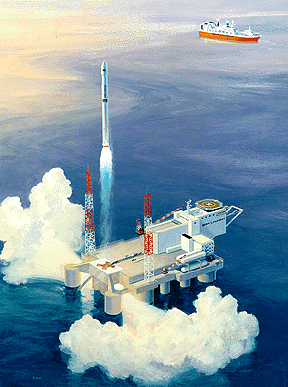
Sea Launch from Seastead? Perhaps the Only Way

We have found a thin layer of water mixed with lunar surface dust -- enough to make a difference to nascent moon colonies and explorers. The problem is that international space treaties prevent private colonies and explorers from using that water -- or any other lunar resources.

At Samizdata.net blog, they are trying to work out some way around the counter-productive international restrictions on the use of lunar and space resources. One commenter even suggested forming a micro-nation on Earth for purposes of space launch. Such a nation could refuse to sign the space treaties, and carry on unhindered by the idiocratic obstructionist tactics of the UN and the international community.

It is interesting that the Seasteading Institute is holding its annual conference in San Francisco on 28-30 September 2009. Because there is no more logical location for a space launching micro-nation than in the mid-ocean, near the equator. A seastead micro-state engaging in space launch, would be the ideal launching pad for a network of independent lunar and orbiting space colonies.

The UN and other international organisations have become a caricature of human ineptitude. The new US president Obama is receiving the praises of bloody-handed dictators, while being mocked by steadier hands, such as French president Sarkozy. Sarkozy is correct, Obama is making a mockery of responsible leadership. Now that the US president has become the friend of third world dictators, there really is no hope for the UN, the G20, or any other international organisation. It is time for independent persons to begin thinking of genuine independence from the Idiocracy.

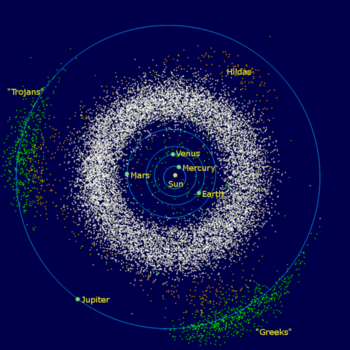
Outer space is full of resources -- including water and mineral riches -- but they are spread out over an expansive volume. The asteroid belt orbiting between Mars and Jupiter contains a mass approximately 4% that of Luna. The belt appears rich in both minerals and volatiles, and is conveniently broken up into many pieces, so that aspiring asteroid miners can have easier access to the riches within.

As soon as we break the constrictive and oppressive bands holding adventurous and ambitious humans to the surface of Earth, we will find that we are desperately short of hands -- human and robotic. To explore the vast regions of space out to the asteroid belt and beyond, we will need many millions of astronauts, cosmonauts, robotic explorers, and virtual reality explorers-by-proxy.

Ideally, we would have intelligent machines capable of making the necessary decisions, technical repairs, and legal agreements that a prosperous gold rush to space would entail. Lacking that, we would certainly want large numbers of artificial wombs for in vitro fertilisation, in order to rapidly grow a population of space explorers and adventurers -- untainted by the perverse indoctrination of stagnancy that is so prominent in Earth universities, in Earth (skank) media, and in Earth international politics.

But lacking both intelligent machines and artificial wombs, we need to find a way to grow intelligent, adventurous explorers of sound mind very quickly. When the desperate need presents itself, we will discover that we have not nearly enough Michelle Duggars to meet the need. And the truth is, one child every 9 months to a year will not be nearly enough, if we want to grow the necessary millions of first wave explorers that we will need.

We are left with two viable approaches: Superfetation, and multiple births, eg twins, triplets etc. Superfetation is the process of getting pregnant while already pregnant -- which is really just a more awkward and more confusing method of having multiple births. Much simpler to just fertilise eggs in vitro, then implant multiple embryos into the (well-paid) volunteer woman's womb. Voila! When the time is right the future astronauts can be delivered, and the now wealthy woman can contemplate a prosperous future -- on Earth or in space if she prefers.

Water and other volatiles will be in short supply initially, even with the newly found water resource on the moon. The best way of solving that problem would be via high frequency electromagnetic space launch. Working out such a launch from a floating platform in mid-ocean may require a bit of ingenious improvisation, but already several ideas are pushing their way into the minds of Al Fin engineers.

The point is, it can all be done -- if we can bust the monopoly currently held by dysfunctional national and international organisations. The Idiocracy, in other words. Think on it. It's only your future.

If you want to contemplate a future ruled by resource dictators of the bloody-handed third world, then you don't need space. Not for that. Obama is clearing the path for that future already.

But if you want an expansive future of "no limits," then you will need to start thinking independently.

Images courtesy of Space Today and Wikipedia

Labels: , ,

Bookmark and Share

10 July 2009

Connecting Aerodynamic Seasteads in Clusters

Image Source
The SESU seastead design won the recent Seasteading Institute's design award for "most aesthetic." As you can see, the seastead is mostly enclosed by transparent panels. This design protects the inhabitants from ever-present winds, sea spray, and splash in high seas, while allowing for daylight illumination. The above image demonstrates a cluster of 3 SESU 'steads, along with a docked super-yacht. In reality, the best dock designs for yachts and passenger ships are yet to be created.
Image Source
The SESU design is Al Fin's favourite of the recent seastead design contest winners. The semi-enclosed design protects inhabitants and interior structures from many of the hazards of the open sea, in comparison to the other designs.

Better methods for loading and unloading supplies and personnel -- from the sea and from the air -- will be most important for any such facility that intends to put to sea long term.

The vertical 4-spar design is meant to minimise wave impact on the structure. But traveling through the water will be slow, which means that it will be difficult for such seasteads to move out of the way of large storms. The structure would have to be able to adapt and transform itself to meet and survive strong storms at sea.

The walkways connecting the 3-stead cluster, as pictured, would likely snap like toothpicks in any significant storm. Should that happen, the 3 seasteads would be far too close for safety in a free-floating configuration. There are many things to be taken into account, before this design is actually inhabited and tested at sea.

What would you change or modify?

For more information, read Reason Magazine's 20,000 Nations Above the Sea for an interesting look at the founding fathers of the Seasteading Institute and on some of the non-technical problems seasteading faces.

For seasteading to be successful as a movement, it will have to solve a long list of problems. Only a few of them are technical or engineering problems. Most of them will be tougher because they will involve human psychology, politics, and legality.

Labels:

Bookmark and Share

27 June 2009

Imagine My Surprise . . . . .


.... to discover that others had happened upon a similar idea for a wave energy conversion / floating platform stabiliser to one that I have played with for over ten years now. My inspiration came from reading the Marshall Savage book, The Millenial Project.The version above was conceived by Joseph George, and is described further here. The idea as pictured needs some modification to provide greater robustness in high seas, but the drawing demonstrates the function of one short row of the devices. In an actual floating platform, many such rows would exist, in arrays.

The next two images portray a similar device which helped win the Rolls-Royce Prize for best Master's Thesis in 2007, and the JEC Innovation Award in 2009. This prize winner is the result of a collaboration between Norwegian and Belgian engineers. As you can see, the "point absorbers" in the second platform converter are not open-bottomed like the absorbers in the Joseph George design at top.

The image above and to the right shows a "wave farm" comprising four of the platforms pictured below and to the left.
The platform design with multiple point absorbers presents advantages that are not available from several other wave energy conversion devices, particularly when incorporated into a seastead design.

The concept of using such point absorbers for both wave energy conversion and for "shock absorbers" to smoothe the platform's ride, appeals to my sense of multi-functionality. For rough seas in the open ocean, some form of "breakwater" would still be necessary to reduce the shock to the platform and the point absorbers.Looking at the most recent prototype design for a seastead from the Seasteading Institute, it is not terribly difficult to imagine the placement of similar point absorbers beneath the platform, given the suitable infrastructure. As I said, however, in high seas the occupants of such a seastead might be grateful to have a sturdy floating breakwater on the job. Al Fin engineers are in the process of designing such a "device."

I am pleased to see that the "point absorber" wave energy conversion idea has been developed to this point by multiple inventors, and hope that such platforms can eventually be used productively.

Labels: , ,

Bookmark and Share
Older Posts
Al Fin Main Page
Enter your Email


Powered by FeedBlitz
Google
WWW AL FIN

Powered by
Blogger

``