31 October 2012

Toward a More Abundant Energy Future: New Nuclear Technology

This article is cross-posted from Al Fin Energy

Intriguing developments in fusion:

Brian Westenhaus takes a fascinating look at Tri-Alpha Energy's approach to Boron fusion:fission. Brian's article complements an earlier piece by Brian Wang on the Tri-Alpha approach.

Tri-Alpha's approach is a hybrid form of fusion:fission, where high energy protons are forced into Boron 11, converting it to Carbon 12 in a highly energetic state. The Carbon 12 decays -- or fissions -- emitting up to 3 high energy alpha particles.
Tri-Alpha’s position is, “We want to know the energy and location of every outgoing alpha particle.” This is important because in a pB11 reaction the harvest is high energy Helium that can be used to directly generate electricity.

The news from Tri-Alpha is the discovery of two high-energy α-particles (alphas) – that will have a huge impact on pB11 fueled reactor designs because the alphas are much easier to extract and convert more efficiently into electricity.

This is quite significant news and powerful information that may apply to the other two leading pB11 fueled efforts, the Lerner Focus Fusion effort and the Bussard Wiffle Ball work. _Brian Westenhaus

79 page PDF document explaining this approach more thoroughly

Brian Wang has more recently discussed a report by Kachan & Co. on new nuclear technologies. Here is the executive summary of the report (PDF).

Kachan & Co. Nuclear Report Exec Summary PDF


In the excellent video below, Mark Halper discusses the future innovations in fusion and fission which he detailed in the full Kachan report. (via Brian Wang):

Advanced fission can provide humans with abundant electricity and heat for tens of thousands of years. Fusion can provide a further abundance of energy and heat for additional hundreds of thousands of years and beyond.

We have barely learned to extract energy from basic matter. It will take us a number of decades to perfect most of the technologies discussed in the video and at the links above. Will current energy technologies give us that much time? That depends upon the energy policies that our governments pursue.

Ideological green faux environmentalists -- who have achieved dominance in the US government, the EU government, the Australian government, etc. -- want us to reject advanced energy technologies, and to rely on intermittent unreliables such as the wind and the sun. Such policies would eventually cause modern societies to revert to primitivist quasi-feudal societies of a subsistence nature. Such an approach, if enacted, would result in the deaths of billions of humans across the planet.

It can be assumed that most intelligent humans -- if properly informed -- would choose an advanced technology approach to a future of abundant energy.

More: How energy from shale can help humans bridge the gap between modern technologies and future technologies...

America's Energy, Economic, and Industrial resurgence

Europe's governments choosing the darkness as the continent grows older and more feeble

North American shale bonanza promises stable global energy prices over intermediate term

Labels: ,

Bookmark and Share

08 May 2012

Surviving in Your Doomsday Bunker with Power to Spare

This semi-satirical article was first published on Al Fin Potpourri blog and subsequently re-published on Al Fin Energy blog:


After the Apocalypse

After the doomsday bell tolls, you will want to have a safe hideaway, packed with your favourite foods, beverages, people, and prescription drugs. But no matter how safely your bunker is designed, you cannot survive long without a source of heating and electrical power.

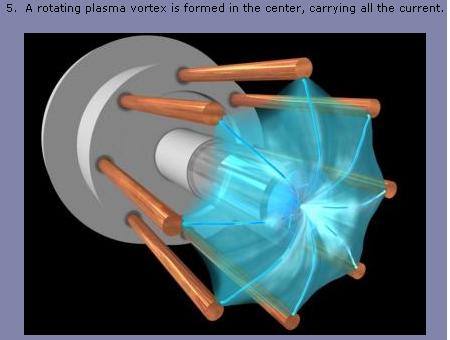
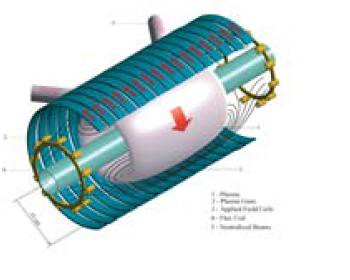
Issues of energy density dictate the need for a nuclear power and heat source -- either fission or fusion. The choice seems to come down to either a small modular nuclear fission reactor -- such as the NuScale or Wilcox and Babcock models, vs one of the new scalable fusion reactor models. The Lawrenceville Plasma Physics focus fusion device pictured below, appears to be the leader of the pack in terms of timeline for proof of concept, prototype, commercial demo, and mass production.
All images below taken from Lawrenceville Plasma Physics Inc (PDF) (via) NBF

Five megawatts baseload power should be enough to supply the power and heat needs of most medium-sized doomsday communities. When living in an underground environment, it is easy to underestimate needs for space lighting and grow-lighting, as well as power for supplying pumps, compressors, blowers, fans, filtration devices, and various electronic devices.

The diagram above attempts to illustrate energy flows and losses in the focus fusion system. Operation of the reactor will be highly automated, but a certain amount of oversight will be necessary, to assure smooth function and to limit the need for unscheduled maintenance shutdowns.

Baseload power generation means that the reactor produces 5 MW at all times. Any heat and power produced above the needs of the doomsday community will converted as needed, and routed to storage or to a sink. Since the reactor utilises hydrogen and boron as fuel, a significant amount of excess power will be used to maintain hydrogen stores. The hydrogen can be used as fuel in either the focus fusion reactor, or in backup fuel cell CHP generators.

The timeline for production of the LPP focus fusion reactors is particularly optimistic, with estimates for mass production as early as 2016.

Keep in mind that US federal and state regulators are unlikely to approve these devices for sale in the US anytime within the next decade. This means that any US citizen wishing to use these reactors as backup power supplies for their home, seastead, polar outpost, or doomsday bunker, will either need to locate outside the US, or will need to find extra-legal ways of installing their nuclear fusion (or SMR fission) reactors within the borders of the US.

In the event of doomsday, it is expected that nuclear enforcement by US federal or state officials will be suspended for a number of years. In such a case, issues of survival are likely to be paramount, over issues of bureaucratic red tape.

Labels: , , , ,

Bookmark and Share

01 December 2011

Revolutionary Nuclear Rice Cooker 1 MW Fusion Reactor

A secretive new fusion startup based in Australia is claiming to have developed a working 1 MW fusion reactor the size of a rice cooker, and is now working on a 10 MW reactor. The company claims to generate a 1 MW output from a 40 W input, and claims to be working with both the Australian and the US military.
... one interviewee, in a face-to-face conversation in an exotic location abroad, told us of a small company he’s involved with that he claims has built a working 1MW fusion reactor the size of a rice cooker (though it’s dubious that approximation includes the requisite shielding, cooling, turbines, etc.) The company is now apparently in the process of building a 10MW version that it plans to trial in 2012.


... Our source, concerned he was telling us too much, initially wouldn’t even reveal its name.


The fission wonder down under?
As mentioned, this company and its story seem to have all the elements of a Hollywood thriller:


Harnessing the power of nature! The analogy most often applied to fusion is harnessing the reaction of the sun. But this company’s fusion reaction, fueled by deuterium and tritium, isn’t nearly as high temperature, our source claims, and is more “rooted in nature.” Specifically, the reaction is said not to require the high temperature, high pressure or accelerated particles of others’ approaches. “The key is not how many neutron hits you generate, but how you sustain them, how well you can control them.” For a 40-watt power input, the reactor is said to be able to generate a megawatt.


Exotic locales! The company is based in Australia. Why? “Everyone’s expecting big nuclear innovations to come out of China, or France,” said our source. But it’s replicated its intellectual property and technology “around the world in case they get infiltrated.”


Self-funded by mad scientist! The technology’s inventor has apparently tinkered with his design for 40 years, and self-funded the company’s early stages, reinvesting income from earlier lucrative inventions. Now, strategic investors are said to include family money, such as a Shanghai real estate baron and decedents of American industrialist John Pitcairn, Jr.

Culture of secrecy! The company’s secrecy about its actual progress makes Apple look sophomoric. In development since the 90s, it has sworn employees and investors not to let on how successful its research has been. It’s said to have retained the former head of Israel’s counter terrorism unit as its chief of security.


No to takeover offers! The company is said to have already fielded a buyout attempt by General Electric (NYSE:GE). The founder apparently didn’t want the invention owned by just one corporation, characterizing it an invention for mankind, apparently.


Requisite military involvement! The company is said to be secretly working with the Australian Air Force and Navy, and the U.S. Department of Defense, and aims to trial a 10MW version of its reactor in 2012 with an Australian utility.


Political and industrial upheaval! If fusion can be made to work at scale, it could indeed affect the world in profound ways. All the ingredients for drama!


More about this secretive company, and other companies working to radically improve nuclear power as we know it today, is available in Kachan’s new Emerging Nuclear Innovations report, just released. This 64-page report rounds up 6 months of looking carefully at the nuclear power industry for companies best placed to usurp big, conventional fission of the type that powers the 432 non-military nuclear reactors that exist worldwide today. _Cleantech
Well that is a lot to take in at once. A natural, immediate skepticism begins to set in early in the description of this Australian wonder-fusion device. And yet, the stakes are so high, that one cannot help but wish to learn more.

Dallas Kachan is the author of the Cleantech story excerpted above. Mark Halper is the author of the Kachan report referred to above, which is offered for $1,295 to single users.

Al Fin energy analysts suggest waiting until more information is forthcoming from conventional channels or press release -- unless you have a burning desire to learn more immediately, and have no better use for the $1,295. The report itself covers a wide range of other issues, and is only likely to mention the Aussie fusion project in brief. At this point, there is no reason to expect any more from the Aussie rice cooker fusion than from Andrea Rossi's LENR device.

But simply hearing about efforts such as this helps to keep us on our toes. Because eventually, one of these breakthroughs will turn out to be real, and revolutionary. And if we have not trained ourselves how to react to such an event, we are likely to be quite lost.

Another interesting nuclear news tidbit

Previously published at Al Fin Energy

Update 3 Dec 2011: Brian Wang follows up this story with information about Australia's Star Scientific, a company working on muon catalysed fusion. (Video below is via Brian Wang)

Labels:

Bookmark and Share

21 August 2011

A Gallery of Small Fusion Startups

General Fusion
General Fusion is a small startup headquartered near Vancouver, BC. The compression of plasma to achieve fusion is accomplished by a coordinated spherical plasma compression, using pneumatics and advanced switching.
Update on General Fusion from NextBigFuture

Helion
Helion Energy is located in Redmond, Washington. It is based on a principle of "colliding plasmas," and like all the rest of the small fusion approaches, it is a long shot.

Bussard IEC Fusion
Bussard inertial electrostatic confinement fusion (EMC2 Fusion) involves an electrostatic plasma confinement to achieve fusion. The history and development of the concept is explained in a video reached via the link above. The Bussard IEC (Polywell) has been financed almost entirely by the US Navy. EMC2 is based near Santa Fe, New Mexico.

Dense Plasma Focus Fusion
Lawrenceville Plasma Physics is based in New Jersey. The dense plasma focus approach uses a special pulsing "spark plug" to ionise a gas, and to form a plasmoid "pinch," with the emission of high energy photons, ions, and fusion neutrons.

HyperV
Hyper V Technologies utilises a spherical array of mini railguns to accelerate plasma beams into a central target of deuterium or deuterium-tritium, to achieve fusion (hopefully).

TriAlpha
TriAlpha is an Irvine, California venture, which has been fairly successful in the venture capital game. TriAlpha is a bit secretive with non-investors, but you can read their patent for yourselves. The concept seems to involve the highly sophisticated evolution of an earlier colliding beam fusion approach.

More on TriAlpha from Brian Wang

Fusion reactors can be prolific neutron generators, and could be utilised for the transmutation of nuclear wastes into harmless compounds. They could also generate a number of different highly energetic particles and high energy photons, and used for a number of purposes -- including as space propulsion. Another potential product of fusion reactions is valuable high temperatur process heat. But what is most desired from fusion reactors at this time is abundant, cheap, clean electrical power.

The energy yield from fusion is higher per unit fuel mass than the energy from fission, so that less fuel mass is required to generate equivalent energies. Fusion is generally safer, with less radioactive waste remaining to be disposed of.

Many billions of dollars have been spent by governments in a vain attempt to master the power of the stars on a more human scale. If one of the small startups manages to achieve with $millions what huge government budgets of $billions could not achieve, a revolution would have been ignited which would likely not stop with just cheap, clean, abundant energy.

Originally published at Al Fin Potpourri, and subsequently published at Al Fin Energy

Labels:

Bookmark and Share

19 July 2011

34 Teams Race to Luna for He-3 Aneutronic Fusion Fuel?

Why are 34 teams of hopeful aerospace engineers competing to be the first to return to the lunar surface? National teams from the US, Russia, China, Japan, and India are shooting for the moon. Besides them, 29 other teams are signed up for the Google X Prize lunar competition, with its $30 million purse put up by Google. It sounds like a lot of work to get to a big lump of airless rock exposed to periodic extremes of hot and cold. Besides the fact "that it's there," why would people risk so much of their lives to make it possible for humans to work on the moon -- either personally or by robotic proxy?
’Some people argue that the first group of trillionaire entrepreneurs will be involved in the commercialisation of space,’ said Michael Potter, leader of the first team to register for the Lunar X Prize, Odyssey Moon.

... The biggest goal for commercial Moon landings is believed to be helium-3, the isotope of the inert gas that could be a useful fuel for nuclear fusion because, unlike the most common form of fusion in research, which forces the hydrogen isotopes deuterium and tritium together, He-3 does not release a neutron when it fuses with hydrogen. Extremely rare on Earth, the main source of He-3 is from maintenance of nuclear weapons. But the Sun produces large amounts of He-3, sending it out into space in the solar wind. Earth’s atmosphere prevents it from reaching the surface of the planet, but the Moon has no such protection its surface has been absorbing the element for billions of years.

It has been estimated that there are 1.1 million tonnes of He-3 absorbed into the first few metres’ depth of the lunar surface, which could be recovered by heating lunar dust; and that 25 tonnes of the element which would fit in a volume the size of the space shuttle’s cargo bay could power the US for a year. This gives it a value of something approaching £2bn per tonne.

This isn’t all, Potter said. ’In the past two years there have been amazing discoveries,’ he said. ’Water on the Moon, large ice deposits, interesting discoveries related to magnetic fields and lunar dust. There’s still a tremendous amount we don’t know about what we’re calling the Eighth Continent. The science community wants to know more and the research dollars will continue to be put in. In a sense, we’re looking at ourselves as selling picks and shovels to goldminers.’ _Engineer

Humans certainly need a frontier -- a challenge -- to keep from turning their restless energies against each other or against themselves. There is still a great deal that humans can learn and do in and around the extremes of the deep oceans and the deep earth, but why settle for just one or two frontiers?

The deep Earth supplied a surprise recently when scientists learned that half of the planet's internal heat is being generated by the radioactive decay of isotopes of uranium, thorium, and potassium. Which reminds me that there is thorium on the moon, making the running of MSR thorium fission reactors on the moon possible for a very long time.

Certainly the Earth has plenty of thorium -- a lot more than it has uranium. It appears to be time that the Earth changed its approach to energy-for-the-future.

Forward thinking humans have a huge problem centered in their political classes. Most advanced nations are under the control of backward looking energy starvationists (and carbon hysterics) -- which puts the future on a very tenuous footing indeed. How humans settle the problem of a neo-Luddite political class, which -- along with its Green supporters -- appears to want to use an agenda of energy starvation to rebalance the human population of the planet, will determine whether all the X Prizes in the world can break the political and ideological logjam holding them back from an abundant future.

Labels: , ,

Bookmark and Share

15 July 2011

Japan Turns to Nuclear Fusion, Post Fukushima

Images via FusionPowerCorporation

After the Fukushima nuclear crisis -- triggered by a massive earthquake and tsunami -- Japan has been strongly divided on nuclear power. Many Japanese will only consider a nuclear future for Japan if the technology is proven to be free of threats of radioactive contamination and runaway chain reaction meltdowns. Nuclear fusion offers the promise of nuclear power without melt-downs or widespread contamination -- even after the worst natural disasters. And so International Professional Networks (IPN) of Japan has turned to Fusion Power Corporation (FPC) to investigate the use of FPC's heavy ion fusion (HIF) for Japan.
With the loss of nuclear facilities at Fukushima, Japan is in need of an alternative set of energy production facilities. As a result of that loss, Japan's prime minister, Naoto Kan recently announced that: “… the country will abandon plans to build more nuclear reactors” and has encouraged Japan to explore other forms of energy production. “Fusion power production using the techniques incorporated in the Fusion Power Corporation HIF design should be one of the systems under consideration,” said Mr. Saruta.


Dr. Charles Helsley, President of Fusion Power Corporation, is very confident that FPC's fusion power system is a good fit for Japan's needed power development. It is carbon free and generates no radioactive problems while producing hydrogen for synthetic fuels and ample electricity using known technologies. Dr. Helsley said, “FPC's HIF process can provide many benefits to the world. It is an inherently safe system and cannot 'run away' nor ‘melt down'. It can stabilize the cost of energy to industry while meeting the need for liquid fuels and electricity in a clean, green and safe way.” And he further said, “I am very pleased with FPC's association with IPN and look forward to assisting in Japan's development of safe fusion power as a replacement for the problem laden fission power generation systems.” Mr. Saruta added, “It will be one of the best alternatives for the solution of Japan's current energy problem and should be part of Japan's long term plan.”


FPC is a California Corporation established to create a new 'clean green … and safe' power system using Heavy Ion Fusion energy to supply the energy needs of the US and the world _Benzinga
FPC utilises a deuterium - tritium cycle, with the tritium being generated by neutron - lithium reaction.
More information on Fusion Power Corporation's HIF technology

The isotopes of hydrogen have specific names, unlike the isotopes of other elements, namely deuterium and tritium. Deuterium(2H) is naturally present in all water and thus seawater is our primary source of fuel. Tritium(3H), the other component of fuel in a fusion power source, is of very low abundance in nature. This is in consequence of tritium being an unstable isotope with a relatively short half-life, 12.3 years. Tritium to start-up the first of our fusion systems will come from stores extracted from fission power plants, where it serves no useful purpose and is unwanted. Containment of tritium is virtually the sole radiological safety issue for fusion power. The difficulty of achieving zero release of tritium in fission power plants comes from having water both in contact with the core and to drive steam turbines. Fusion does not have this challenge, and zero release is a practical goal.


Although an external source of tritium is needed to start our operations, we will produce it for long-term operations via a feature of the D-T reaction. Like all D-T fusion systems, we will use the neutron from the fusion reaction to produce tritium from neutron-lithium reactions. Lithium is consumed in the D-T fuel cycle. As discussed in the last section (below), the lithium needed to start-up the first fusion system will come from conventional, land-based sources. However, the oceans contain large quantities of lithium, and FPC’s overall system includes extraction of lithium from seawater to produce the energy the world needs. Thus resources for our two long term fuel needs for deuterium and lithium are found in the oceans. We will extract our fuel in processes that are sensitive environmentally, and these resources are enough to last millions of years.


The FPC system has a unique potential to breed substantially more tritium than it burns. This is an important asset to the start-up of the additional HIF power sites needed around the world for two reasons. First, because it uses the more plentiful lithium isotope (7Li) as well as 6Li (7.5% of the total), it reduces the net amount of lithium that will ultimately be consumed over time in the fusion fuel cycle. Second, the excess tritium will supply the startup needs of successive fusion plants, avoiding a potential bottleneck due to limited tritium from non-fusion sources. Most of the excess tritium will be sold for this purpose, but some may be securely stored and allowed to decay to 3He, a valuable substance with extraordinary physical properties as well as being a fusion fuel. _FPC Technology

Heavy Ion Fusion Tutorial from VNL

...in fast ignition a separate, very sharp pulse (high peak-power and less than 1/10 the duration of the compression process) is used to ignite only the desired mass of fuel after it has been compressed. The “fast ignited” fuel sets off the rest of the fuel much like a blasting cap sets off a stick of dynamite. The great importance of this feature of FPC’s driver (also a feature of the Russian design) is that the required fuel compression has been within the state of the art for some years already....


The space in which the fusion reactions take place is called a reaction chamber. Three factors influence its design. First, the chamber needs to hold a good vacuum to enable the heavy ions from the accelerator system to reach the fuel pellet and to provide a secure containment vessel for the capture of the tritium that is generated after the reaction takes place. Second, the chamber must be able to withstand the pressure generated by the fusion reaction. And third, the reaction chamber must contain a liquid that can be heated to a high temperature as part of the energy extraction process.


...There is a fourth factor that must also be considered in the design of the reaction chamber. As stated earlier, the neutrons produced by the fusion reaction carry 80% of the reaction’s energy. The energy must be captured as thermal energy, for downstream conversion to electricity and other energy products, and the neutrons must be prevented from degrading the structural properties of the chamber materials. FPC’s chamber concept accomplishes all the required missions, and much more. The numerous advantages of the chamber’s configuration include a unique combination of long chamber life and the high temperatures in working fluid that are needed for efficient energy conversion. Ultimately, the set of advantages results in very large economic benefits. _FPCTechnology

Cross-posted to Al Fin Energy blog

Clearly FPC's heavy ion fusion design still needs a lot of work to prove itself, before Japan can generate fusion power this way. HIF is not a small-scale design, and as described by FPC it is meant to form the nucleus of a large industrial complex for the production of electrical power, heat, fuels, chemicals, seawater desalination, and so on -- depending upon particular needs.

Such a project is well within the ability of Japan's industrial and engineering expertise, as long as the central HIF technology can be made to work sustainably.

Labels:

Bookmark and Share

22 June 2011

Spotlight on Helion Energy's Colliding Plasma Fusion

Using Sandia National Laboratories data, Helion calculates 50 fusion engines could incinerate the entire U.S. stockpile of nuclear waste in 20 years.

_PM
Helion Colliding Plasmas

Many billions of dollars have been spent on large scale fusion efforts such as the National Ignition Facility in Livermore or ITER in France. But if the best use of fusion in the intermediate term is to burn up non-recyclable nuclear waste from fission reactors, perhaps the smaller-scale, cheaper approaches might be better? Small efforts such as Bussard IEC fusion, Focus Fusion, General Fusion, Tri Alpha etc. are the sentimental favourites, because they are the work of relatively small groups with low budgets. Their reactors would be small enough to mass produce in factories. And maybe they could even provide the heart of a deep space fusion rocket propulsion system one day.

Regardless, the teams of scientists and engineers are out there giving it their best. Here is a quick look at Helion Energy's fusion project, based in Redmond, Washington:
Helion is among a handful of fusion startups, such as Tri Alpha Energy in Foothill Ranch, Calif., and General Fusion in Vancouver, British Columbia, all striving for the same grand goal as their outsize government counterparts: remaking the global energy landscape by proving that fusion power is feasible. A few forward-looking venture-capital firms have provided funding to get them off the ground; Tri Alpha, for instance, has attracted more than $50 million from a variety of prominent firms, including Goldman Sachs and Vulcan Capital.

Helion's technology was developed for about $5 million by MSNW, a company owned by University of Washington research associate professor John Slough. To see a full-scale component of the reactor, which Slough calls a fusion engine, I meet him at an industrial building a few minutes' drive from Helion's headquarters and walk past a conference table to a room filled with giant metal parts.

Inside the 26-foot-long prototype, two plasmas—clouds of hot ionized gas containing hydrogen isotopes—hurtle toward each other. The clouds collide inside a burn chamber, merging into a single entity. An electromagnet surrounding the chamber squeezes the plasma tighter and tighter, creating the high temperature and pressure conditions needed for fusion—a milestone MSNW first passed in 2008. "The idea," says Slough, who has the white hair and slightly disheveled appearance of a modern-day Einstein, "is to have the energy that comes out of the plasma exceed the energy that goes into it for a brief period of time."

...With its pulsed magnetic field design, the Helion team claims it has found the elusive sweet spot in the fusion landscape: a reliable, cheap reactor that doesn't require fine-tuned optics or complicated plasma confinement. In Helion's reactor, electric currents flowing inside the plasma reverse the direction of a magnetic field that's applied from the outside; the new, closed field that results effectively confines the plasma. "Compared to the tokamak and NIF, Helion's reactor is relatively compact and low-cost," says Richard Milroy, a physicist at the University of Washington who isn't affiliated with Helion. "Utilities don't need to invest billions for the first test reactor to see if things will work out." Plus, he says, the plasma-formation area is separate from the burn chamber in Helion's reactor, so its expensive components may last longer.

...While Helion's reactor is much simpler than those of ITER or NIF, it's also not yet powerful enough to be useful to a utility. Slough says his team will need to increase the size of the reactor's magnetic confinement field and boost the acceleration rate so that the plasmas will be traveling about twice as fast by the time they crash into each other. Those refinements will require at least $15 million to $20 million in development costs, money Helion does not currently have. Even if the funds materialize, there's no guarantee the reactor will work as projected when scaled up, or function consistently over long periods of time.

...fusion might be most useful—at least in the near term—as a means of destroying waste from nuclear fission. University of Texas physicist Swadesh Mahajan and his colleagues are developing a hybrid fusion–fission reactor that shunts neutrons produced during fusion to a fission blanket that burns nuclear waste as fuel. "Producing energy by fusion is at best a very long-term project," Mahajan says, "but through this intermediary, we can become useful to the energy sector."

NIF's projected LIFE power plant will be designed to burn waste, too, and Helion is considering adapting its reactor to do the same in order to provide revenue from utilities sooner. It's easier from a technical standpoint than using fusion to produce energy, because achieving break-even is not necessary—and it could potentially help solve a long-standing problem. Using Sandia National Laboratories data, Helion calculates 50 fusion engines could incinerate the entire U.S. stockpile of nuclear waste in 20 years. _PM

The R&D work and expense would be worth it, just to be able to safely dispose of non-recyclable nuclear waste (and any other toxic waste). If in addition to that, any of the small-scale fusion projects actually succeeds in producing large scale electric power safely and sustainably from fusion, the world will have changed overnight.

Cross-posted from Al Fin Energy

Labels:

Bookmark and Share

13 June 2011

Carnival of Nuclear Energy #56 at NEI Nuclear Notes

The 56th edition of the Carnival of Nuclear Energy is being hosted at NEI Nuclear Notes. (h/t Brian Wang) Here are some excerpts:
To start, Rod Adams at Atomic Insights has a piece describing what’s happening between the NRC, the AP1000 and Friends of the Earth. According to Rod, the NRC appears to be wavering in its commitment to its own established process because some believe that receiving 14,000 emails on the AP1000 design certification indicates a high level of general public opposition. Rod notes that the emails are mainly from a single group, the FOE, who have professionally opposed nuclear energy for 40 years. The group claims credit for orchestrating nearly every one of those emails as part of a campaign against nuclear energy in general, not against the AP1000 in particular. The FOE sources who have identified the cited "technical issues" have questionable professional backgrounds, long histories of antinuclear activity, and little credibility.
Dan Yurman at Idaho Samizdat discusses the NRC Inspector General’s report on the NRC Chairman’s use of budget guidance on the review of the Yucca Mountain license. According to media summaries of the leaked IG’s review in the Wall Street Journal and New York Times, the Chairman issued controversial budget guidance to his staff to stop the work and brushed off complaints from other commissioners about it.
Rick Maltese at Deregulate the Atom pointed out that the NRC should not get all the credit for nuclear energy's decades of safety.
The Institute for Nuclear Power Operations in the US and the World Association of Nuclear Operators deserve a lot of the credit for improvements in safety and other design improvements. They are the Nuclear Industry’s self regulating bodies. And most of the accomplishments were made within the 10 or so years after the Three Mile Island accident. I point this out to set the record straight about who and how the excellent record of safety that has come about in the nuclear industry is not at all understood.
Alan Rominger and Steve Skutnik at Neutron Economy have two posts to mention. Alan explains the connection between the recent idea for "charter cities" where small modular reactors located at the bottom of the ocean can provide sustainable, independent power for such efforts. And Steve explains why he ultimately went from being a physicist to a nuclear engineer. Steve encourages other nuclear professionals and advocates to tell their stories of how they came to be involved in nuclear energy as well (I’m reminded of this example).
Charles Barton at Nuclear Green asks: Why Is Renewable Energy So Expensive, While Molten Salt Reactors will be So Cheap? He finds that an examination of input materials for wind generation systems and solar PV generation is greater than the input materials for an Advanced High Temperature Reactor. The study he cites reveals that the AHTR, a near relative of the Molten Salt Reactor, has big advantages by the little amount of resources needed. MSRs can potentially offer the same material input advantages over renewables, and thus may generate electricity at very competitive costs.
Brian Wang at Next Big Future reports that Lawrenceville Plasma Physics’s (LPP) research team has sorted out several issues on their dense plasma focus fusion project which should enable them to substantially increase power.
_NEI Nuclear Notes
Despite the Obama administration's overarching policy of energy starvation and the Nuclear Regulatory Commission's blatant obstructionism, small modular reactors are being developed rapidly -- the B&W reactor being a prime example.
The concept behind mPower, and small modular reactors designed by B&W competitors, is to let electric utilities add nuclear generation in small blocks. While most reactors on the market today generate more than 1,000 megawatts of power, an mPower module would provide 125 megawatts. A utility could order just enough modules to meet its needs, Halfinger said.

“There are places in the world where they need 1,000 megawatts, (but) one size does not fit all,” he said. “A lot of places need 200 megawatts.”

The nuclear industry has been abuzz about small modular reactors. Westinghouse, NuScale Power and Holtec International also are working on modular designs.

Cross-posted to Al Fin Energy

Labels: , ,

Bookmark and Share

11 May 2011

Who Really Wants to Solve the Energy Problem and Who Really Wants Most Humans to Simply Disappear?

An important difference in philosophy toward energy divides future oriented persons from faux environmentalist lefty-Luddite dieoff.orgiasts:
"If this machine [EMC2 Bussard IEC fusion device] works as we hope it will work, it will probably establish a firm technical foundation," he said. "People may say, 'It's a big jump and you shouldn't be doing this.' But every year that the energy problem doesn't get solved ... costs tens of billions of dollars. Sometimes waiting too long is not a good thing. If you look at the solutions, you might say, 'Can we afford to wait?'" _CosmicLog
CosmicLog

The energy starvation approach taken by Obama, lefty-Luddite faux environmentalists, and the European greens, aims to drastically reduce human agriculture and industry -- and consequently, the human population. But rational, forward-thinking groups and persons are working hard to "solve the energy problem." Such rational, future-oriented persons are the enemies of everything the modern political and environmental left is dedicated to.
Although fusion is the process behind the power of the sun and an exploding H-bomb, physicists have never been able to achieve a net energy gain in a controlled fusion reaction. But based on the experiments so far, Park thinks there's a chance that it could be done in a sufficiently large Wiffleball reactor, costing on the order of $100 million to $200 million. That sounds like a pretty good deal, especially in comparison with the $3.5 billion that's been spent so far on fusion research at the National Ignition Facility and the $20 billion expected to be spent on the international ITER fusion project.

...Don't expect weekly updates about EMC2's progress. "Currently all our funding comes from the Navy," Park said. "That's our customer. Our customer desired that we keep most of our progress confidential. ... They're somewhat concerned about making too much hype without delivering an actual product."

But if WB-8 and the follow-up studies are successful, the Navy won't stand in EMC2's way.

"Our understanding is they want us to be successful," Park said. "They want us to provide something for our sponsors. They also want us to do well commercially as well, as long as we remain US-owned and control the technology."_CosmicLog

Canada's BC-based General Fusion recently received a capital boost from Amazon's Jeff Bezos

Mainstream fusion approaches have been ongoing since World War II, but in practise have been bulky, overpriced, overstaffed, impractical, and probably never actually meant to accomplish more than milking research funds out of government coffers.

China is planning to mine Helium-3 from the surface of the moon to use as fuel in future nuclear fusion devices.

M. Simon's IEC Fusion Technology blog, and Brian Wang's NextBigFuture blog do a good job of following progress in IEC fusion and other alternative fusion technologies.

Nuclear energy (fusion, advanced fission, and other forms of nuclear energy not yet well-defined or developed) is the best approach to large scale reliable energy into the distant future. As the technology becomes more portable, humans will be able to carry their powerplants and "artificial suns" with them wherever they go.

But if you are like the greens who populate the Obama administration and governments/intergovernments of the western world, you want humans to slash energy production to the bare bone. The end result of such a reactionary lefty-Luddite policy would be a slow but accelerating return to a "dark ages" of science and technology, with an inevitable mass die-off of individuals at the margins. Not coincidentally, most current inhabitants of Earth are living at the margins.

Cross-posted at Al Fin Energy

Labels: ,

Bookmark and Share

12 April 2011

A Closer Look at Rossi's Numbers for his LENR / "Cold Fusion" Device

NewEnergyandFuel

Both Brian Wang and Brian Westenhaus have been following the progress of the Rossi / Focardi low energy nuclear reaction device.

Rossi claims that the reactor is able to obtain large amounts of heat energy from the low energy nuclear transmutation reactions that transform Nickel into Copper. Here is a more detailed look at the energy numbers involved in such a transmutation:
MeV for each Ni transformation

Starting from Ni58 we can obtain Copper formation and its successive decay in Nickel, producing Ni59, Ni60, and Ni62. The chain stops at Cu63 stable.

For simplicity I assume all the Nickel in the reactor in the form Ni58.

For simplicity I suppose for each Ni58 the whole sequence of events from Ni58 to Cu63 and as a rough estimate I calculate the mass defect between (Ni58 plus 5 nucleons) and the final state Cu63.

Ni58 mass is calculated to be 57.95380± 15 amu

The actual mass of a copper-Cu63 nucleus is 62.91367 amu

Mass of Ni58 plus 5 nucleons is 57.95380+5=62.95380 amu

Mass defect is 62.95380-62.91367=0.04013 amu

1 amu = 931 MeV is used as a standard conversion

0.04013×931 MeV=37.36 MeV

So each transformation of Ni58 into Cu63 releases 37.36MeV of nuclear energy.


Nickel consumption
One hundred grams of nickel powder can power a 10 kW unit for a minimum of six months.

How much of Ni58 should be transformed, in six months of continuous operation, in order to generate 10 kW?

10 kW is thermal or electrical power. The nuclear power must be larger. Assume a nuclear power twice:
20 kW = 20,000 J/s = 1.25 x 10**17 MeV/s.

Each transformation of Ni58 into Cu63 releases 37.36MeV of nuclear energy.

The number of Ni58 transformations should thus be equal to (1.25 x 10**17)/37.36 = 3.346 x 10**15 per second.

Multiplying by the number of seconds in six months (1.55 x 10**7) the total number of transformed Ni58 nuclei is 5.186 x 10**22.

This means 5 grams.

The order of magnitude is not exactly the same but seems to be plausible. This means also 5 grams of Nickel in Rossi’s reactor transmuted into (stable) Copper after six months of continuous operation at the rate of 10 kW. _NextBigFuture


This may seem incredible to most persons who know how many tons of coal are required to provide the same amount of power as 5 grams of nickel. But nuclear energy is on a far different level of scale than chemical energies, such as combustion energy.

But if you consult this table of energy densities provided at Transtronics Wiki, you can clearly see the difference in scale between the energy of nuclear reactions and the energy from chemical reactions -- roughly 7 or 8 orders of magnitude, depending on the method of comparison.

Imagine the savings in fuel transportation costs alone!

Will this sparkling new form of energy prove to be true gold, or just a fool's flash in the pan? Time will tell.

Labels: , ,

Bookmark and Share

12 March 2011

Use the Strong Force, Luke -- The Strong Force

Images from Wikipedia "forces" and "quarks"
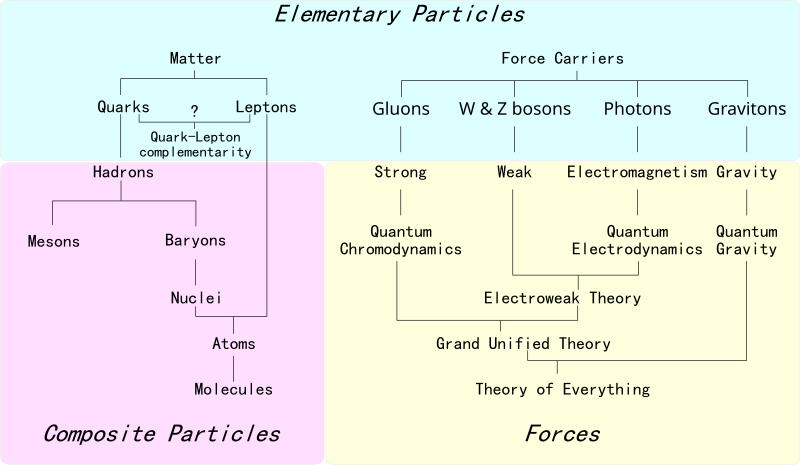
The image above portrays 3 "quarks", particles which when combined make up larger particles such as neutrons and protons. Quarks come in different varieties, and are bound together to form larger particles by "gluons." Gluons moderate the so-called "strong nuclear force," which may hold one answer to a limitless source of energy.
Humans get most of their energy from chemical reactions, moderated by the electromagnetic force. Such chemical energy is far less potent (less dense) than nuclear energy -- either fission, fusion, or LENRs (low energy nuclear reactions). The forces moderating nuclear reactions are far more powerful than the electromagnetic forces moderating chemical reactions -- which is why smart fission can provide humans with abundant energy for thousands of years, and fusion power is essentially limitless in human terms. But to truly take best advantage of fission, fusion, and LENRs, we need to understand the nuclear forces better.
...Despite many hundreds of well-functioning nuclear power plants, our understanding of nuclear forces is only empirical, and empirical knowledge is always imperfect.

For example, in producing nuclear energy, the decay reactions repeat many times, with the imperfections of every repetition resulting in a loss of predictive power of computations. This hampers the optimisation process, and is one of the main reasons why several large projects investigating energy production using more abundant uranium-238 or thorium (fast breeder reactors) were closed in Europe and the United States before they achieved the expected level of performance.

Another problem is the nuclear waste that emerges when energy is produced in the decay process. The waste can be substantially, or even completely, reduced if we could use an alternative form of nuclear decay that is triggered by externally accelerated particles. Here, too, however, we need more precise knowledge of the properties of nuclear processes.

The force binding atomic nuclei is a special case of the "strong force", one of the four fundamental forces in nature, and is extremely difficult to investigate, because it acts very quickly and violently. Around 50 years ago, it was proposed to study the strong forces by firing protons at each other at very high energies.

...Several large accelerator research centres were built, and the scattering of particles at high energies revealed a fascinating structure of matter. New particles, called gluons, were found to mediate the strong force. Their discovery should provide a clue to precise knowledge of the strong force.

At short distances, gluons create an attractive force that is pretty weak and well understood. But, at larger distances, comparable to the proton radius, the force becomes really strong, and a very large number of gluons is involved, forming complicated structures that are not well known today. Therefore, for some time, it was not expected that the properties of the strong force could be directly derived from the properties of gluons.

In the last few years, however, experiments at the HERA accelerator in Hamburg, Germany, have observed the strong interaction effects in slow motion, which could open a way to a precise understanding of the strong force.

...The appearance of such clear gluonic structures was unexpected; the experiments at HERA were not designed to study them. But the precision experiments required to measure the strong force can be designed and built with known technology. So two large groups of physicists - one concentrated around the Brookhaven and Jefferson National Laboratories in the United States, and the other around CERN in Geneva - are proposing to restart the investigation of electron-proton interactions.

The study of these interactions should provide a precise understanding of the strong force....A precise understanding of the strong force could be just as important, opening new ways to use nuclear-energy resources while solving the problems of safety and nuclear waste. _AlJazeera

Humans are slightly advanced monkeys, swinging from meager knowledge trees, flinging gobs of shite at each other and hooting into the night. It's going to take some time, discipline, and work to move forward.

Taken from an earlier article published at Al Fin Energy

Labels: , ,

Bookmark and Share

08 February 2011

A Novel Approach to Nuclear Fusion

HyperV Technologies Corp. is taking a novel approach to small fusion, using mini-railguns to accelerate multiple supersonic plasma beams into a central target of deuterium or deuterium-tritium.

According to the FocusFusionSociety website:
... the approach is geared towards deuterium and/or deuterium-tritium fusion, as opposed to advanced fusion fuels, but success there would of course remain a huge accomplishment. Some of the links on HyperV’s site are under construction, but the technical materials show a well-credentialed academic/industry team, a talk at the 2009 International Conference on Plasma Science, and a publication calculating gain from their design published in Physics of Plasmas. The work has also received funding from the DOE Office of Fusion Energy Science. _FocusFusionSociety
A spherical array of minirailgun plasma accelerators is a potential driver for forming imploding spherical plasma liners that can reach HEDP-relevant ( about 0.1 Mbar) pressures upon stagnation. The liners would be formed via merging of 30 or more dense, high Mach number plasma jets (n about 10^16−17 cm−3, M about 10–35, v about 50–70 km/s, rjet about 5 cm) in a spherically convergent geometry. The small (typically 1-2 cm square bore x 15-50 cm length) parallel-plate railguns with ceramic insulators would use pulsed injection of high-Z gas at the breech via fast opening valves to produce high density plasma jets with velocity in the 50-100 km/s range. Recent tests at HyperV using a single pulsed capillary discharge injecting into the minirailgun breech have achieved plasma densities in the bore approaching 10^18 cm−3, with densities in the jet plume exceeding 1017 cm−3 at velocities above 50 km/s. Total plasma jet mass in these 1 cm square bore tests has not yet been determined, but similar tests of an earlier 6 mm square bore 13 cm long device, with a roughly 3 μs, 100 kA current pulse using an aluminized mylar fuse starting from rest, yielded 90 μg of plasma at 50 km/s, and about 40 μg at 63 km/s. A modest scaleup of the railgun to a 2 cm square bore operating at longer pulse widths of 200-300 kA should be capable of accelerating a few thousand micrograms of high-Z gas (e.g. xenon) to above 50 km/s. This performance should be sufficient for reaching HEDP-relevant pressures. _HyperV Presentation_quoted at NextBigFututre
HyperV Technologies is a US Virginia-based research group that aims to achieve "tunable" nuclear fusion power on the 100 MW and up scale. Its approach is to utilise a spherical array of magnetic railgun supersonic plasma jet injectors aimed at a central "magnetic fuel" target.
NextBigFuture HyperV


Brian Wang has more at NextBigFuture including graphics.

HyperV PDF Presentation on Mini-Railgun Plasma Injectors

More Technical Papers about HyperV's research

Several fusion approaches have studied the "colliding beam" approach, without success. The conventional laser inertial technique used at Livermore is another type of targeted energy approach, which has mainly succeeded in eating up many billions in research grants so far. General Fusion's approach to target-focused fusion involves a hybrid combination of magnetic confinement and pneumatic compression.

HyperV attempts to focus multiple plasma jets onto a magnetically confined central target, in a switched-pulse fashion. At this time -- like most of the other small fusion projects -- it appears to be purely in the research proof of concept stage.

Taken from an earlier article at Al Fin Energy

Labels: ,

Bookmark and Share

27 March 2010

Thoughts on Fusion Power for Space Travel

BrianWang

Brian Wang presents a wealth of materials dealing with the use of fusion power for propelling spacecraft. A sufficiently light and compact nuclear fusion reactor -- such as a dense plasma focus reactor -- would provide an excellent source of power and propulsion for intermediate-range solar system missions. As the technology improved, humans could even begin thinking of longer missions -- to the Oort clouds and beyond.
ADVANCES IN DENSE PLASMA FOR FUSION POWER AND SPACE PROPULSION, with George Miley, Ph.D.
Al Fin Energy provided a group of dense plasma focus videos in a short online film festival, to provide a quick introduction to the basic concepts. Abundant, clean energy is one thing. An unlimited passport to the local universe is something else again.

Labels: , ,

Bookmark and Share

04 October 2009

Polywell Fusion Reactor News

M. Simon announces that the EMC2 Polywell project has received an award of $10 million for continuing experiments on Polywell fusion. Simon feels that this award indicates that more progress than was expected has been achieved by the team. More information about the justification and award in this PDF document. (via M. Simon)

Compilation of links to Polywell fusion

Talk Polywell forum

IEC Fusion Technology blog

A good rundown of ongoing fusion projects from ECN

Labels:

Bookmark and Share

30 September 2009

Nuclear Fusion via Muon Catalysis

(1) A beam of negatively charged muons is produced and injected into a mixed fuel of deuterium and tritium, (2) resulting in the creation of many muonic tritium atoms (tµ). As muons are 207 times heavier than electrons, the muon orbits the nucleus at a much closer distance to the nucleus than electrons. Thus, tµ atoms are extremely small. (3) As the tµ atoms have no electric charge, they readily collide with deuterium atoms without being affected by repulsive electrical force. These collisions produce dtµ molecules, which consist of a muon, a deuterium nucleus and a tritium nucleus. (4) Similar to tµ atoms, dtµ molecules are extremely small. When d–t nuclear fusion occurs in these small molecules, large amounts of energy are released, accompanied by the production of α particles (helium nuclei) and neutrons. (5) The muon is freed and recycled in subsequent nuclear fusion reactions. (6) About 1% of the liberated muons, however, become stuck to helium nuclei.
Image from NextBigFuture
Researchers in Japan are developing a form of Deuterium - Tritium fusion that is catalysed by the injection of a stream of muons. Brian Wang has the details:
Muon-based nuclear fusion is conducted using negative muons. A mixed gas of deuterium and tritium is cooled to temperatures below around −250°C, causing the gas to form a liquid or solid. The injection of a beam of muons (µ) into the medium then generates muonic tritium atoms (tµ), which are similar to hydrogen atoms. As muons are 207 times heavier than electrons, the muon orbits the nucleus at a distance much shorter than that for electrons. Thus, tµ atoms are extremely small, and because the tµ atoms have no charge, they collide with deuterium atoms without being affected by repulsive electrical force. This process produces muonic deuterium–tritium molecules (dtµ), which are also similar to hydrogen atoms, and which have a nucleus consisting of a muon, a deuterium nucleus and a tritium nucleus. Similar to the tµ atom, the dtµ molecule is extremely small, which allows the deuterium and tritium nuclei to come into very close proximity, thus inducing d–t nuclear fusion.

After the occurrence of d–t nuclear fusion, the muon in the dt molecule is liberated and becomes available for the creation of a new dtµ molecule. Thus a chain of nuclear fusions occurs. This reaction is called 'muon-catalyzed nuclear fusion' because the muons act like a catalyst that drives nuclear fusion. _NextBigFuture

More links and information at NextBigFuture.

Labels: ,

Bookmark and Share

13 September 2009

Nuclear Fusion Alive and On the Prowl

For those of you who thought that human controlled nuclear fusion was 50 or 100 years away, M. Simon reports a new $8 million contract awarded to EMC2 to extend their research on the Bussard Polywell IEC fusion approach. (via Brian Wang)
From the descriptions it is clear that the IEC fusion devices are far simpler than the ITER tokomak fusion devices. It is also simpler than nuclear fission reactors. So success would mean faster transformation, but it would still take five to ten years for big infrastructure impact to the point that oil would start to be significantly displaced. Plus it would first hit coal for electricity. Unlike current fission reactors which take 4-6 years to build, these IEC fusion reactors might be buildable in 1-3 years. There is still the issue of licensing and regulatory approvals. It is not clear what that licensing/regulatory process would be but it should be shorter than nuclear fission licensing as the IEC fusion is easier to shutoff and does not have nuclear fuel or waste.

The full scale IEC fusion reactors would be about 4 meters in radius and weigh about 14 tons and generate 1GW and 8 meters for about 128GW. Power will be 5-20 times cheaper. _NextBigFuture
This is small science at its best, where individuals can make a difference for the better.

More links from IEC Fusion Technology Blog:
An Introduction to Fusion Energy for Students of Science and Engineering

Bussard's IEC Fusion Technology (Polywell Fusion) Explained

Basics of fusion from American Thinker

The Google Talk from Bussard himself, explaining to Google techs and engineers the history of IEC and his own hopes for the technology:


Update 14Sept09: Brian Westenhaus presents more information and comments on new IEC funding

Labels: ,

Bookmark and Share

17 December 2008

One Step Closer to Scalable Fusion Power

Both Brian Wang and Brian Westenhaus are reporting that the Emc2 polywell fusion project (Bussard) has passed a crucial test on its way to proving itself as a workable path to fusion power. Just one more step on the way to clean, abundant, sustainable power. And in the case of polywell fusion, it is a modular approach that could be easily carried on ships, large planes, and spacecraft.
A little background for newcomers. Dr. Bussard, whose name you may recognize from as wide of a base as the Bussard Collector concept to harvest fuel in space that was incorporated into Star Trek scripts to Assistant Director of the Thermonuclear Reactor Division of the old U.S. Atomic Energy Commission. At some point Dr. Bussard got the idea to take the Farnsworth principles from vacuum tube technology and seek a method and design to form his own theory using velocity of atoms instead of heat and pressure to compel a nuclear fusion. With decades of experience at the very top of the U.S. atomic energy industry Dr. Bussard sensed that ideas such as the tokamak, a “gift” from the former Soviet Union and other ideas that sought to create center of a star like conditions to be impractical if ever possible.

Bussard’s idea evolved into a cube formed by electromagnets that when charged up make a ball of electromagnetism or a sphere shaped magnetic field. At the center of the cube is a point of intensity, which is negatively charged. When a fuel that has a positive charge is injected it descends to the center and may collide with another fuel atom. If the fuel misses, the negative charge slows and sends the positive charged fuel back again to the center. All this happens at incredible speeds. The descending is actually acceleration and will repeat until the fuel fuses. _NewEnergyandFuel
The latest experiment demonstrated the ability of the polywell design to contain the fuel against leaks long enough to sustain useful fusion to provide usable power.
If Polywell pans out, nuclear fusion could be done more cheaply and more safely than it could ever be done in a tokamak or a laser blaster. The process might be able to produce power without throwing off loads of radioactive byproducts. It might even use helium-3 mined from the moon. "We don't want to oversell this," Nebel said, "but this is pretty interesting stuff, and if it works, it's huge."

...Nebel and his colleagues have already drawn up a plan for the next step: an 18-month program to build and test a larger fusor prototype. "We're shopping that around inside the DOD [Department of Defense], and we'll see what happens," he said. _CosmicLog _ via BW and BW
Be sure to check out the videos on Polywell-Bussard Fusion from Brian Wang. Don't miss the cornucopia of links and information on Bussard Fusion available at Power and Control blog.

Despite economic pessimism over the global credit collapse and the depressive effect of the new US administration on private sector recovery prospects, science and technology R&D are progressing on many important fronts.

The key obstacle to human progress is the general stupidity of the human species. But even as ways are discovered to "tweak up" the cognitive power of humans, the threat of economic collapse and ideology-driven suppression of private enterprise and initiative threaten a new "dark ages". Several things must happen simultaneously for self-selected humans to step up to the next level. Clean, abundant, scalable power production is only one of those things.

Labels:

Bookmark and Share

13 December 2008

Focus on Fusion: Energy for the Long Run

The long shot solution for human energy/power needs is nuclear fusion. The same type of power that lights the sun and the stars has the potential to light the nighttime cities of Earth and power its industry, for the indefinite future. Brian Wang presents a useful update on Focus Fusion -- a clever, small-scale fusion approach from Lawrenceville Plasma Physics.
Focus Fusion operates using a dense plasma focus (DPF) with hydrogen-boron fuel. The fuel is in the form of decaborane (H14B10), a solid at room temperature which sublimates into a gas when heated to moderate temperatures of around 100 C. As in any fusion reaction, when the hydrogen nuclei (protons) and boron-11 nuclei collide at high enough velocities, a nuclear reaction occurs. In this case, three helium nuclei (also called alpha particles) are produced, which stream off in a concentrated beam, confined by powerful magnetic fields produced by the plasma itself. _LPP


Brian's report comes soon after a finding from MIT that high power radio waves have the potential to "focus" plasma in a fusion reactor, such as the ITER reactor.

M. Simon has an imbed video of the likely incoming US DOE Secretary, Steven Chu, discussing fusion -- including a brief mention of the Polywell Fusion approach.

Here is an interesting look at a hybrid "fission / fusion" reactor,which would help to deal with the problem of radioactive waste from the world's fission reactors.
Creating commercially useful power with fusion, in which small atoms are combined to produce energy, always seems to be decades away — and too costly. But physicists at the University of Texas at Austin have come up with a reactor design that would provide a second purpose for fusion: destroying long-lived nuclear waste arising from the splitting of atoms — or fission.
Both the Polywell Process and the Focus Fusion approach are considered dark horse candidates. But success in either camp would completely overturn our present conceptual views of world energy dynamics.

Low cost, lightweight, modular fusion power reactors would be ideal for remote and extreme environments on Earth, under the ocean, at the polar regions, and for outer space outposts on the lunar surface and beyond. Fuel for sustainable fusion can be found on Earth, on the moon, and throughout the solar system.

Taken from an article previously published at Al Fin Energy

Labels:

Bookmark and Share

27 March 2008

Progress in Plasma Confinement at MIT Fusion LDX

Using a unique levitating magnet approach, MIT researchers have made progress within the past week at confining plasma with the goal of producing controlled fusion reactions.
Begun in 1998, the Levitated Dipole Experiment, or LDX, uses a unique configuration where its main magnet is suspended, or levitated, by another magnet above. The system began testing in 2004 in a "supported mode" of operation, where the magnet was held in place by a support structure, which causes significant losses to the plasma--a hot, electrically charged gas where the fusion takes place.

LDX achieved fully levitated operation for the first time last November. A second test run was performed on March 21-22 of this year, in which it had an improved measurement capability and included experiments that clarified and illuminated the earlier results. These experiments demonstrate a substantial improvement in plasma confinement--significant progress toward the goal of producing a fusion reaction-- and a journal article on the results is planned. ___MIT__via__NextEnergy
MIT's LDX fusion approach confines plasmas by a more natural and controllable "pulling flux" as opposed to the "pushing flux" being attempted by Tokamak approaches such as ITER.

Novel approaches to fusion such as LDX and other new approaches to fusion described by Brian Westenhaus and Brian Wang, may very well break the tape ahead of much more expensive approaches such as ITER.

Technological breakthroughs in superconducters, nanotech materials, and optical-electronic process controls should allow the materials and infrastructural costs for alternative fusion approaches to drop considerably, over time.

Previously published at Al Fin Energy

Labels:

Bookmark and Share

15 February 2008

Nuclear Fusion: Behind the Scenes Plays to Commercial Fusion:--Before ITER Gets Off the Ground

Two of my favourite blogger Brians--Brian Wang and Brian Westenhaus--have recently posted articles about Bussard Fusion, and nuclear fusion in general. Today's post from Brian Westenhaus includes some interesting quotes about the future of fusion energy:
...Bussard’s technology is different. It and many others concepts are different in that in some cases the process will be aneutronic or direct conversion from nuclear fusion to electricity with no heat production. The heat conversion and other massive installations to handle the atomic heat output and electrical generation are expected to be unnecessary. In the Bussard system there is just electricity and a trickle of radiation, which stops the moment you turn the fueling off or over fuel it. It just fizzles out like the old vacuum tubes. And they’re small, such as fitting on ships, inside office buildings and even airplanes.[SF Author Karl Schroeder]

...""Within five years, large companies will start to think about building fusion reactors," Wal van Lierop, CEO of Chrysalix Energy Venture Capital, said in an interview at the Clean Tech Investor Summit taking place here this week. In three to four years, scientists will demonstrate results that show that fusion has a 60 percent chance of success, he said."[Venture Capitalist Wal van Lierop]___NewEnergy
Brian goes on to discuss van Lierop's venture play with Canadian company General Fusion, a company aiming to build small 100 MW fusion reactors providing power at a competitive cost of US $0.04 per kwh. There is much more at the NewEnergyand Fuel link above.

Brian Wang at NextBigFuture took a look at progress in Bussard Fusion last month, and more recently looks at the other small fusion projects that venture capitalists are backing--including General Fusion mentioned above. He describes the General Fusion approach:
GF will build a ~3 meter diameter spherical tank filled with liquid metal (lead-lithium mixture). The liquid is spun to open up a vertical cylindrical cavity in the center of the sphere (vortex). Two spheromaks (magnetized plasma “smoke ring”) are injected from each end of the cavity. They merge in the center to form a single magnetized plasma target. The outside of the sphere is covered with pneumatic rams. The rams use compressed steam to accelerate pistons to ~50 m/s. These pistons simultaneously impact the outside of the sphere and launch a spherical compression wave in the liquid metal. As the wave travels and focuses towards the center, it becomes stronger and evolves into a strong shock wave. When the shock arrives in the center, it rapidly collapses the cavity with the plasma in it. At maximum compression the conditions for fusion are briefly met and a fusion burst occurs releasing its energy in fast neutrons. The neutrons are slowed down by the liquid metal causing it to heat up. A heat exchanger transfers that heat to a standard steam cycle turbo-alternator to produce electricity for the grid. Some of the steam is used to run the rams. The lithium in the liquid metal finally absorbs the neutrons and produces tritium that is extracted and used as fuel for subsequent shots. This cycle is repeated about one time per second.___NextBigFuture
Very creative, in my humble opinion. Brian then goes on to discuss other approaches to MTF--Magnetized Target Fusion . He also provides links for further reading and research.

Here is Ecogeek's interview with SF Author Karl Schroeder and News.com's look at Venture Capitalist Wal van Lierop.
(via NewEnergyand Fuel)

Here is a blog run by M. Simon dedicated to the IEC Bussard Fusion approach.

Here are links to much more material on Bussard and Polywell IEC fusion.

More IEC Fusion links.

Recent Hobbyspace look at low budget fusion ventures

ITER may not even be running before the year 2020. What if one of the long-shot venture capital approaches pays off--and makes ITER look like yet another obsolete mega-government dinosaur, before it is even completed?

Labels:

Bookmark and Share
Older Posts
Al Fin Main Page
Enter your Email


Powered by FeedBlitz
Google
WWW AL FIN

Powered by
Blogger

``