19 August 2012

Bigger and Smarter Brains: What Makes the Difference?

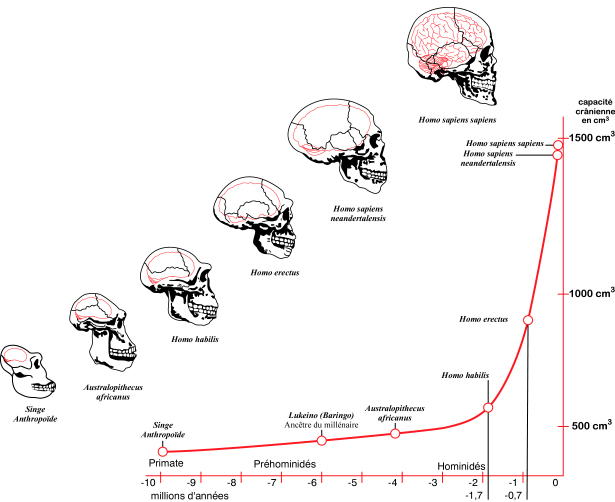
If you look at brain size across the evolutionary tree, it seems clear that larger brained creatures demonstrate greater intelligence, for the most part, when corrected for body size. What is the evolutionary driving force behind increasing brain size?

Researchers found that protein domain called DUF1220 may explain why humans have bigger brains. Humans have more than 270 copies of DUF1220 in their genome whereas chimpanzees have 125, gorillas have 99 and mice have just one. The number of copies of DUF1220 shows how close an animal may be to humans.

"This research indicates that what drove the evolutionary expansion of the human brain may well be a specific unit within a protein – called a protein domain -- that is far more numerous in humans than other species," said Sikela. _Medical Daily
Article abstract
Wikipedia article on "Protein Domain"
Something has been driving the evolutionary increase in the size and sophistication of the brain. DUF1220 repeats may well be a part of the story, but are not likely to be the entire explanation.

Besides an increase in overall brain size, the relative size of particular brain components have changed. The frontal lobe size in homo sapiens, for example, is thought to be significantly larger than the frontal lobes in homo neanderthals, while the temporal and occipital lobes were larger in the Neanderthal. So although overall brain size was comparable between the two species of homo, actual brain function would likely have been quite different.
Data from Beals, et al, Oregon State University

Even in the modern extended breeding families (races) of homo sapiens sapiens, we find statistical differences in group brain sizes.
The definitive study of race differences in brain size was carried out on approximately 20,000 crania by Professor Kenneth Beals and his colleagues at Oregon State University. Their results for endocranial volume, measured in cubic centimeters for the major races were as follows: North East Asians (Chinese, Japanese and Koreans): 1,416 cm; Europeans: 1,369cm; Native American Indians: 1,366cm; Southeast Asians: 1,332cm; Pacific Islanders: 1,317cm; South Asians: 1,293cm; Sub-Saharan Africans: 1,282cm; Bushmen: 1,270cm; Australian Aborigines: 1,225cm. These brain size differences correspond with intelligence differences derived from IQ tests given by Prof. Richard Lynn, who finds IQs of 105 for North East Asians,100 for Europeans, and so on downwards to 62 for Australian Aborigines and 54 for the Bushmen of the Kalahari desert. _China Daily Forum

Kenneth Beals PDF Download paper

We find that the gross statistical differences in average brain size appear to correlate with the statistical differences in average IQ.

This would not necessarily be the case, given that changes in the organisation of the brain structures and connections themselves could lead to more efficient brain function. The same is true for changes in molecular and genetic efficiency within brain cells -- a smaller brain does not necessarily mean a less functional brain.

At this time it is best to consider these correlations to be curiosities, rather than reflecting any deeper meaning.

But at least we are slowly stumbling upon some of the answers to our questions. As long as we do not allow our science to be perverted by a misplaced sense of political correctness, we should eventually obtain a fairly clear picture of how larger and more intelligent brains evolved.

Labels: , , ,

Bookmark and Share

15 March 2012

Not Out of Africa? A Question of Origins

[A] distinctive skull...was unearthed in 1979 in Longlin cave, Guangxi Province, but has only now been fully analysed. It has thick bones, prominent brow ridges, a short flat face and lacks a typically human chin. "In short, it is anatomically unique among all members of the human evolutionary tree," says Darren Curnoe at the University of New South Wales in Sydney, Australia.

The skull, he says, presents an unusual mosaic of primitive features like those seen in our ancestors hundreds of thousands of years ago, with some modern traits similar to living people. _New Scientist
Original scientific report at PLoS

More from National Geographic
Artist's Conception of "Red Deer Human" from Longlin Cave in China

The anthropologist Dienekes suggests that these findings of relatively recent archaic humans in China rules out China as the origin of the first modern humans. Dienekes uses similar reasoning to rule out subSaharan Africa and Europe as birthplaces of modern humans.

Dienekes' basic idea is that if modern humans had originated in China, Europe, or subSaharan Africa, that archaic humans would have been replaced by modern humans there, much earlier than was apparently the case. By a process of elimination, Dienekes proposes either extreme northern Africa or Arabia as the original birthplace of modern humans. From there, homo sapiens would have dispersed in all directions, displacing archaic humans as they went.


Discussion of Pre-Sapiens Discoveries in Dmanisi, Georgia


The question of the origins of modern humans is an intriguing and controversial topic. The "Out of Africa" theory has been so deeply engrained into the political consciousness of modern academics and intellectuals, that any contradictory hypotheses must be over-supported by the evidence in order to be accepted by even a small proportion of anthropologists and archaeologists.

The scientists at Longlin cave and other similar sites in China are working diligently to extract DNA from their skeletal specimens, in an attempt to discover where the "Red Deer Humans" may fit in the human evolutionary tree.

Labels: ,

Bookmark and Share

27 January 2011

More Earlier Migrations of Homo Sapiens

...an international team of researchers led by Hans-Peter Uerpmann from Eberhard Karls University in Tübingen, Germany suggests that humans could have arrived on the Arabian Peninsula as early as 125,000 years ago -- directly from Africa rather than via the Nile Valley or the Near East, as researchers have suggested in the past. _SD
Hans-Peter Uerpmann

"Scientific consensus" regarding when modern humans began moving out of Africa has come in for some serious pounding from archaeologists and anthropologists recently. The latest find comes from the Arabian peninsula, from University of Tubingen's Hans-Peter Uerpmann.
The findings, based on a dig that continued from 2004 until 2010, are at odds with results from DNA testing and other archeological finds that put the "out of Africa" migrations much later.

The southern route out of east Africa proposed by the new research is also significantly different from the northern route across the Nile River and into the Sinai that has been traditionally accepted as most likely.

Addressing those very different scenarios, Uerpmann said that their archeological findings offer a new interpretation and that the advanced method of determining the age of the tools gives them great confidence in their results.

Team member Anthony Marks of Southern Methodist University, an anthropologist, said the tools were made in ways consistent with the 125,000-years-ago time period and therefore raise the inevitable question of how they got to the area near the Persian Gulf.

"Either these people came out of East Africa or they came from nowhere," he said.

The dig is being conducted about 40 miles from the Straits of Hormuz, the entry point into the Persian Gulf. The tools were found in a small limestone mountain range in the U.A.E. province of Shuja. _WaPo

Recent findings of modern human fossils in Israel dating well over 100,000 years ago had earlier shaken the complacency of the embattled "Ouf of Africa" consensus. As research findings continue to come in contradicting some of the most treasured beliefs of mainstream anthropology, a significant restructuring or modification of the "consensus" may become unavoidable.
This new research, placing early humans on the Arabian Peninsula much earlier, will appear in the 28 January issue of Science, which is published by AAAS, the nonprofit science society.

The team of researchers, including lead author Simon Armitage from Royal Holloway, University of London, discovered an ancient human toolkit at the Jebel Faya archaeological site in the United Arab Emirates. It resembles technology used by early humans in east Africa but not the craftsmanship that emerged from the Middle East, they say. This toolkit includes relatively primitive hand-axes along with a variety of scrapers and perforators, and its contents imply that technological innovation was not necessary for early humans to migrate onto the Arabian Peninsula. Armitage calculated the age of the stone tools using a technique known as luminescence dating and determined that the artifacts were about 100,000 to 125,000 years old.

...Uerpmann and his team also analyzed sea-level and climate-change records for the region during the last interglacial period, approximately 130,000 years ago. They determined that the Bab al-Mandab Strait, which separates Arabia from the Horn of Africa, would have narrowed due to lower sea-levels, allowing safe passage prior to and at the beginning of that last interglacial period. At that time, the Arabian Peninsula was much wetter than today with greater vegetation cover and a network of lakes and rivers. Such a landscape would have allowed early humans access into Arabia and then into the Fertile Crescent and India, according to the researchers.

"Archaeology without ages is like a jigsaw with the interlocking edges removed — you have lots of individual pieces of information but you can't fit them together to produce the big picture," said Armitage. "At Jebel Faya, the ages reveal a fascinating picture in which modern humans migrated out of Africa much earlier than previously thought, helped by global fluctuations in sea-level and climate change in the Arabian Peninsula." _ArchaeologyNews
Significantly more evolutionary divergence has occurred within the human species than mainstream PC anthropology has been willing to admit. A de facto PC censorship over several politically sensitive areas of science is becoming more and more difficult to maintain.

Labels:

Bookmark and Share

30 December 2010

We Are All Israelis Now: Reframing the Right of Return

In what could change the whole picture of human evolution, archaeologists claim that modern man may have evolved in the West Asia, rather than Africa, after they discovered remains said to be 400,000 years old.

A team, led by Prof Avi Gopher and Dr Ran Barkai of the Tel Aviv University, has found eight human-like teeth in the Qesem cave near Rosh Ha’Ayin, 10 miles from Israel’s Ben Gurion airport.

The teeth were 400,000 years old, from the Middle Pleistocene Age, which would make them the earliest remains of homo sapiens yet discovered... _DeccaChronicle
JPost
The discovery of 400,000 year old teeth in Qesem Cave inside Israel, suggests that modern humans may have evolved in the middle east -- not in Africa as most anthropologists believe. This discovery can be added to a host of others which contradicts the common belief that all modern humans are descended from a branch of the human tree which evolved inside Africa.
Long before the land was called Israel and the residents Jews, Homo sapiens lived here twice as long ago as was previously believed, the researchers wrote in the latest (December) edition of the American Journal of Physical Anthropology.

The cave was uncovered in 2000 by Prof. Avi Gopher and Dr. Ran Barkai of TAU’s Institute of Archeology. Later, Prof. Israel Hershkowitz of the Department of Anatomy and Anthropology at TAU’s Sackler School of Medicine and an international team of scientists performed a morphological analysis on the teeth found in the cave.

The examination included CT scans and X-rays indicating the size and shape of the teeth are very similar to those of modern man. The teeth found in the cave are also very similar to evidence of modern man dated to around 100,000 years ago that had previously been discovered in the Skhul Cave on Mount Carmel and the Qafzeh Cave in the Lower Galilee near Nazareth.

The Qesem Cave is dated between 400,000 and 200,000 years ago, and archeologists working there believe that the findings indicate significant changes in the behavior of ancient man. This period of time was crucial in the history of mankind from cultural and biological perspectives, and the fact that teeth of modern man were discovered indicates that these changes are apparently related to evolutionary changes taking place at that time, they maintained. _JPost

If these findings are confirmed, they will throw a monstrous monkey wrench into anthropological discussions. One of the reasons the "out of Africa" viewpoint has been made official dogma, is that it unifies all of the branches of modern humanity. This makes it possible for educated people to say with a straight face that there is no difference in average intelligence or developmental potential between different populations of humans -- even though the best of modern science demonstrates very real differences.

Science moves forward, even when powerful interests wish otherwise.

Labels:

Bookmark and Share

23 December 2010

Does Homo Erectus Walk Among Us?

There is a lot of discussion about a recent Nature article which looks at DNA from an ancient group of humans found in Denisova Cave in Russian Siberia.
Fossils found in the Russian republic of Altai belong to a previously unknown branch of human development.

Researchers at the University of California who were conducting the study found that the remains belong to a little girl, who died 30,000 years ago.

According to experts, she was not of the Neanderthal species, as a tooth similar to the structure Homo Erectus teeth was discovered. _Ruvr.ru

Some modern-day people carry Denisovan genes. Through genetic comparisons Pääbo’s team found that some people from Melanesia — an assemblage of islands off Australia’s east coast, including New Guinea — share 4 to 6 percent of their genomes with the Denisovans. This probably indicates that the Denisovans interbred with anatomically modern humans despite the split between our lineages over a million years ago. _Wired

ImageSource
The most significant finding in the paper is the demonstration that some living humans trace significant fraction of their ancestry to the population represented by the Denisova genome. As in the case of Neanderthals, different human populations show significantly different levels of similarity to the Denisova sequence. For Neanderthals, the similarities indicated between one and four percent Neanderthal ancestry for living people outside of Africa. In the case of the Denisova sequence, the greatest similarities are with living people in Melanesia – in this paper, represented by genome samples from Papua New Guinea and Bougainville. The similarities are consistent with approximately 4% contribution of a Denisova-like population to the ancestry of these living Melanesians.

The paper estimates that together, the Denisova and Neanderthal-derived genes account for 8% of the ancestry of these living people. _JohnHawks
...the evidence now suggests that an ancestral group of early humans left Africa up to 400,000 years ago and diverged, with one branch heading to Europe and becoming the Neanderthals and a second moving east and becoming Denisovans.

When modern humans left Africa - some 80,000 years ago - they came into contact with first the Neanderthals before another group interbred with Denisovans, the traces of which now exist in Melanesia. _Telegraph
Wired

John Hawks' Denisova FAQ

Interesting discussion of implications for anthropology and the "Out of Africa" thesis

Greg Cochran suggests in comments that Denisovans are likely an Asian Homo Erectus.

Erectus Walks Among Us -- a free-wheeling, highly speculative and imaginative look at an alternative anthropological theory contesting "Out of Africa" in a most strenuous manner.  Unintentionally humorous in many ways.  Not Safe for Work

Apparently, due to the Denisovan findings and the recent Neandertal genome findings, a lot of anthropological data will need to be re-sorted and reclassified. It does not help matters when issues of "political correctness" which are so rampant in the field of "cultural anthropology" are allowed to intrude upon the far more scientific branch of "physical anthropology."

Unfortunately, modern science is so corrupted by political constraints and politicised funding and publishing, that an objective study of many areas of science is practically prohibited. Time may erode the stranglehold of political correctness on science, eventually.

Labels:

Bookmark and Share

07 May 2010

We Are All Neanderthals Now

Update 9 May: John Hawks provides a good analysis of the findings here and here
Remember when it was an insult to be called a Neandertal? Scientists at Max Planck have learned that most of the people of the world are descended from Neandertals -- at least partially. So who's the Neandertal now? You, that's who!
Researchers sequencing Neandertal DNA have concluded that between 1 and 4 percent of the DNA of people today who live outside Africa came from Neandertals, the result of interbreeding between Neandertals and early modern humans. _SciAm

They are so closely related that some researchers group them and us as a single species. "I would see them as a form of humans that are bit more different than humans are today, but not much," says Svante Pääbo, a palaeogeneticist at the Max Planck Institute in Leipzig, Germany, whose team sequenced the Neanderthal genome.

The common ancestor of humans and Neanderthals lived in Africa around half a million years ago. After that, the ancestors of Neanderthals moved north and eventually made it to Europe and Asia. Our ancestors, meanwhile, stuck around Africa until about 100,000 years ago before eventually conquering the globe. Neanderthals died out around 28,000 years ago. _NewScientist

The scientists used just half a gram of bone powder, collected from the bones of three individual Neanderthals excavated from the Vindija Cave in Croatia. The data they provide tells a story not just of migration but physical evolution, and allows researchers to isolate what makes humans unique. "The Neanderthals are our closest evolutionary relative," says Svante Pääbo, the project's leader and director of genetics at the Max Planck Institute for Evolutionary Anthropology in Leipzig, Germany. He notes that now scientists can begin to ask what genetically differentiates us from our closest living relative--the chimpanzee--and our closest extinct one....

...The group's combined findings required an immense technological effort, one that spanned six years and multiple high-throughput sequencing technology platforms. It involved finding ways to differentiate Neanderthal DNA from modern human DNA contamination, eliminating microbial DNA that had invaded the bones, and determining how the Neanderthal sequences had chemically changed over time. But the ultimate result, says biological anthropologist John Hawks, of the University of Wisconsin, is "5.3 billion pieces of information about Neanderthals." And that, he says, is something worth waiting for. _TechnologyReview

All humans except those who never left the African continent until the modern age, contain at least a small portion of Neandertal genes. But then, Neandertals were said to have evolved in Africa too, and to have migrated to Europe before modern Homo Sapiens.

It should be obvious that anthropologists are largely guessing at the timeline involved, and the exact locations of important evolutionary transitions. If it has taken us this long to learn that Homo Sapiens interbred with Homo Neandertal, then clearly we are not exactly on top of things.

Nevertheless, this is one more piece of the puzzle. Africans typically lack Neandertal genes, which may mean nothing -- or it may point the way toward significant genetic ---> behavioural differences between Africans and non-Africans. It will take time to sort it all out, assuming the PC Police allow it. Not that you could understand any of this, you Neandertal!
WhyEvoIsTrue

The diagram above is somewhat speculative, but it does describe one possible way in which the genomic admixture could have occurred.

A skeptical look from the sometimes credulous science writer carl zimmer

A skeptical look from the Richard Dawkins (also sometimes credulous) site

Labels:

Bookmark and Share

10 September 2009

Out of Africa? Out of Europe? Whence Came Homo?

Conventional theory of human origins shows homo sapiens evolving in Africa, and emerging to populate all other large landmasses except Antarctica. But evidence has been accumulating  that suggests that homo erectus evolved outside of Africa -- in the Eurasian landmass. From there, homo sapiens may have evolved from homo erectus either outside Africa, or back in Africa following an erectus migration south.
Received wisdom that modern humans emerged in Africa then dispersed across the rest of the globe is being challenged by skulls found in Dmanisi, a site in Georgia to the south of Russia.

Analysis of the skulls suggests that instead, small numbers of very early ancestors of modern-day humans may have migrated to Europe, where they evolved into Homo erectus, the immediate predecessor of modern Homo sapiens. _NewScientist
An even more extreme counter-point theory to "Out of Africa", is the theory laid out in the free online e-book Erectus Walks Among Us. According to Erectus Walks Among Us, not only did homo erectus evolve in Eurasia, homo sapiens and homo neanderthalis also evolved in Eurasia. Be aware that most anthropologists accept the conventional view of early human migrations, and consider most alternative theories to  be not only unfounded, but also racist.A word of caution: It is impossible to avoid charges of racism whenever one wanders onto this territory. If you are of a squeamish and fastidious sort when it comes to being accused of racism, you had best avoid this topic altogether. But do not bother to complain to the blog proprietors about your own hyper-sensitivity. They will not be moved.

But if you care more about understanding origins and how things became the way they are, than about the screeching censors of the PC Idiocracy, you may find some of the ideas at least marginally interesting. Perhaps even stimulating.  And probably wrong, for the most part.

Still, humans have an inbuilt compulsion to hold strong opinions -- even when they can not possibly know enough about the topic to know the facts, one way or the other. This is true about human origins and migrations, just as it is true about catastrophic climate religion, catastrophic peak oil religion, or any other fanatical belief whose foundations are more imagined than real.

As humans, we cannot help wondering and discussing our speculations.

Update:  Here is another look at the fossil findings from HBDBooks

More here
Here is an interesting look at the pre-historical peopling of Europe via Race / History / Evolution Notes blog

Labels: , ,

Bookmark and Share

06 February 2009

The Settlement of the South Pacific

Dienekes Anthropology Blog looks at the evidence behind different theories dealing with the populating of the South Pacific by Austronesians. Anthropologists can use genetic evidence along with linguistic evidence to study the migrations of groups over long periods of time. The current consensus is that this vast migration began in Taiwan, and spread southward, then eastward, and branched to all points of the compass, eventually settling the Philippines, Indonesia, parts of New Guinea, and most of the South Pacific including New Zealand, Hawaii, and Easter Island (almost to South America).

Where else might these intrepid sea migrants have gone? Could they have formed settlements along the Chilean coast? If so, the evidence has not turned up yet.

One thing is clear, the old myth that the South Pacific islands were settled from South America is all but destroyed. Thor Heyerdahl's idea was adventurous enough and excited many romantic hearts, but doesn't seem to have proven out in the end.

The idea of the "lost civilisation" is persistent throughout the volumes of human myths and tales. When humans brave so much and travel so far to establish a home, it is likely that many promising starts ended up badly. There is a basis in fact for the "lost civilisation." Probably a much vaster basis than we can imagine.

Labels: ,

Bookmark and Share

31 March 2008

This Is War, This is Man

Humans have a long tradition of war. Is it possible that war is so deeply bred into us that we can never outgrow it? This Discover article (via Dennis Mangan) asks a number of anthropologists, archaeologists, and biologists to answer the question.
The anthropologist Richard Wrangham is one of several scientists at Harvard who pre­sent a much darker view of human nature than Fry does. In his 1996 book, Demonic Males: Apes and the Origins of Human Violence (co­authored with Dale Peterson), Wrangham argues that “chimpanzee-like violence preceded and paved the way for human war, making modern humans the dazed survivors of a continuous, 5-million-year habit of lethal aggression.” Natural selection has favored combative, power-hungry males, he contends, “because with extraordinary power males can achieve extraordinary reproduction.”

...[archaeologist Steven] LeBlanc contends that researchers have unearthed evidence of warfare as far back as they have looked in human prehistory, and ethnographers have observed significant levels of violence among hunter-gatherers such as the !Kung. In his book Constant Battles: Why We Fight (with Katherine E. Register), he espouses a bleak, Malthusian view of human prehistory, in which war keeps breaking out as surging populations outstrip food supplies. Warfare, he writes, “has been the inevitable consequence of our ecological-demographic propensities.”___Discover__via__DennisMangan
One theory of war--the youth bulge theory--looks at societies that possess an excess of young males. Young males possess a surfeit of testosterone, which lends to aggressive behaviour. This aggression can be channeled toward domestic targets, or it can be channeled outwardly toward state-defined "enemies."
Gangland slayings in the Palestinian territories this week have pitted the Islamist gunmen of Hamas against the secular forces of Fatah. The killings defy civilised norms: in December even children were targeted for murder. But the killings also defy political common sense. Ariel Sharon's wall cuts terrorists off from Israeli targets and what happens? The violence – previously justified with the cause of a Palestinian homeland – continues as if nothing had changed, merely finding its outlet in a new set of targets. This makes it appear that Palestinian violence has never really been about a "cause" at all. The violence is, in a strange way, about itself.

Gunnar Heinsohn, a social scientist and genocide researcher at the University of Bremen, has an explanation for why this might be so. Since its publication in 2003, his eccentric and eye-opening Sons and World Power* (not available in English) has become something of a cult book. In Mr Heinsohn's view, when 15 to 29-year-olds make up more than 30 per cent of the population, violence tends to happen; when large percentages are under 15, violence is often imminent. The "causes" in the name of which that violence is committed can be immaterial. There are 67 countries in the world with such "youth bulges" now and 60 of them are undergoing some kind of civil war or mass killing. ___FinancialTimes
While peace-loving bonobos and boskops are close primate relatives of homo sapiens, the closest surviving primate relative of man is the common chimpanzee. And common chimps are familiar with war. And so are we.

Ancient Chinese general Sun Tzu, and 19th century Prussian soldier and military strategist Karl von Clausewitz, are two men who made a study of war in an attempt to advise leaders on more rational war-making. Neither man could be consider a war-monger. Both men assume that there exist barbarism and violence in the world, that would surely force itself upon more civilised peoples if the civilised peoples made no provision for deterrence or counter-violence.

Just the preparation for war can sometimes bankrupt a society and lead to the overthrow of a government. The actual execution of a war is even more likely to lead to financial hardship in the society waging war. War is dangerous to all concerned. More than one ruler has been killed by his own guards--even relatives--for pursuing a war beyond all reason.

Yet not knowing when to prepare for war can be even more lethal--for entire societies. From time to time, societies have arisen that considered themselves evolved above the level of war. Their leading citizens could not justify the expense of the provisioning and training of a full-time or part-time military force. Consequently, we know very little about these societies other than that they were overrun by other groups--presumably more barbaric than themselves. Archaeologists sometimes dig up traces of their vanished way of life.

Modern Europe and Japan may be falling into that particular mindset--the "post-war civilisation" mindset. Europe is being overrun by illiterate and untrained immigrants rushing to fill the vacuum left by the failure of Europeans to procreate. A large portion of these illiterate and unassimilable immigrants are drawn to religious extremism and violence. Europe is not prepared, and has insufficient young males to form a credible defense of any type.

Japan faces a rapidly arming China across the water. A China that is growing rabid for resources and maneuvering room. Hemmed in by the Philippines, Taiwan, and the Japanese islands, China's rapidly growing blue water navy is looking for forward bases of operation. Japan no longer has the population of young males to draw from, in formulating a large defense force.

One theory of warfare promoted by Dennis Mangan, is that prosperity is an obstacle to war-like thinking. If a people grow prosperous, they want to enjoy leisure pursuits and pleasures. They adopt more of a "live and let live" attitude. This is very much what has happened to Europe and Japan, in fact. Certainly Canadian residents largely have adopted that attitude, and a large proportion of US residents likewise. War is expensive, and costs precious lives. Prosperous societies are less likely to produce large numbers of skilled military-capable men who are also considered expendable.

So countries such as the US have begun to invest in robotic instruments of war. Unmanned flying vehicles for reconnaissance and attack, unmanned ground and sea vehicles for attack, defense, reconnaissance, and explosives dismantling/demolition. Such an approach may eventually reduce the direct involvement of human members of advanced societies in actual warfare and peacekeeping.

But until these societies learn to segregate themselves from the violent-natured, often unintelligent perpetrators of religious, ethnic, and ideological warfare and terror, no amount of robotics equipment will make them safe from the other-than-advanced world which is always there, even if sometimes out of sight and mind.

Centuries will pass, and more, before civilised humans no longer need to study war and violence. Civilisation is equally endangered by leaders who ignore nascent threats in their midst as by leaders who go to war much too easily. Given the many problems faced by the western world that refuse to simply go away, facing the threats while reacting in measured and effective ways, will be a continuing challenge to people who would rather not have to deal with it.

Labels: ,

Bookmark and Share

21 February 2008

The World Genome: By SNP and by CNV

The image above provides a graphic display of various genomic characteristics of certain ethnic groupings of Earth. A recent Nature letter looked at ethnic genomes by SNP (single nucleotide polymorphism) and CNV (copy number variant). The authors found some fascinating genomic distinctions not previously thought to exist.
A new letter in Nature combines data from single nucleotide polymorphisms (SNPs) and copy number variations (CNVs) across 29 human populations. STRUCTURE results from the paper are below based on SNPs, haplotypes, and CNVs. Note in particular the Green cluster, which was not seen in some previous studies that did not include Oceanian populations, the differentiation between African farmers and hunter-gatherers, and the differentiation between northern and southern Mongoloids evident in the bottom row___Dienekes Anthropology

This is a fascinating beginning to a fuller understanding of who we are, and how we came to be this way. There is a reason why some population groupings are more prosperous, and peaceful than others. Part of the answer lies in the genes. Not just the genetic sequences, but all of the variations within the genome including CNVs and epigenetic mechanisms that vary. It is time to do the work.

The point is, you cannot possibly know until you look. Leftist multicultural obscurantism--denial of cultural and genetic differences--is the largest threat to science at this time. Much larger than creationism, intelligent design, global warming heresies, big oil and coal, George W Bush, or any other of the usual boogey-man "threats to science." Why? Because the leftist multicultural saboteurs of science are already on the inside. They are destroying science from the inside out--which is always a greater threat than the threat from outsiders.

The brains of men and women are different. That is reasonable, given the significant physical differences between men and women. We also see significant physical differences between different ethnicities. Is it possible that there exist subtler differences that affect brain function? Can cultural differences be caused, at least partially, by heritable brain differences?

Labels: , ,

Bookmark and Share

06 September 2007

Naked Glacier Dwellers In Danger of Extinction from Global Warming


A tribe of naked glacier dwellers was recently discovered in the middle of a mass trans-glacial migration, by wildlife photographers high in a remote portion of the Swiss Alps. The ice-dwelling tribe comprises almost six hundred naked members, who apparently speak only body language for communication.

Highly trained anthropologists from Greenpeace were rushed to the scene in an attempt to discover the tribe's history and customs, before the glaciers vanish and the tribe goes extinct. The Greenpeace scientists quickly shed their own clothes, in a desperate attempt to establish communication, as the clock ticks down on global warming.

As of our last radio transmission, all attempts at establishing body language communication had been unsuccessful--perhaps because the proximity to the glacier induced uncontrollable shivering and shrinkage of certain body tissues of the researchers. The message conveyed to the tribe by the shivering shrinkage apparently repulsed all members of the tribe, who significantly turned their backs on the scientists. At that very moment, an eerie yodeling sound echoed from the surrounding peaks, as if the glaciers themselves had cried out in pain.

Al Gore, James Hansen, Bono, Laurie David, and Leonardo di Caprio announced a joint filmmaking expedition to explore and preserve this courageous tribe in the fight for its very existence. "For at least three long ice ages and inter-glacials this care-free tribe led an idyllic existence among the clouds," said Gore. "We hope that their sad story will shame all of those who deny the global warming holocaust, those traitors to the children of Gaia."

All of us can only echo Mr. Gore's sentiments, and wish the very best for the naked glacier dwellers in the sky. Even after they are extinct, we will never forget the ice people and their brave struggle.

Hat tip Lubos

Labels: , , , ,

Bookmark and Share

10 March 2006

Collapse of Jared Diamond: A Modern Eco-fantasy

Jared Diamond is a talented writer who has had some success in the publishing world. His recent book Collapse, chronicles the rise and fall of the unfortunate Polynesian tribes of Easter Island, off the coast of Chile. Diamond's sad tale of eco-collapse has been taken up by Peak Oilers and other modern prophets of eco-doom as a cautionary tale for our own time. There is just one problem--Diamond's story may be turning out to be more fantasy than fact.

JD at Peak Oil Debunked Blog has looked into the story behind the story, and suggests the whole thing is a myth. JD links to this article from yahoonews:


Crucial to the conventional account of events on Easter Island is the time when settlers first arrived. If colonization didn't begin until 1200 AD, then the island's population wouldn't have had time to swell to tens of thousands of people.

"You don't have this Garden of Eden period for 400 to 800 years," Hunt said in an accompanying Science article. "Instead, [humans] have an immediate impact."

Also, the few thousand people Europeans encountered when they first arrived on Easter Island might not have been the remnants of a once great and populous civilization as widely believed. The researchers think a few thousand people might have been all the island was ever able to support.

"There may not have actually been any collapse," Lipo told LiveScience. "With only 500 years, there's no reason to believe there had to have been a huge [population] growth."

Europeans and rats to blame

The researchers also dispute the claim that Easter Island's human inhabitants were responsible for their own demise. Instead, they think the culprits may have been Europeans, who brought disease and took islanders away as slaves, and rats, which quickly multiplied after arriving with the first Polynesian settlers.

"The collapse was really a function of European disease being introduced," Lipo said. "The story that's been told about these populations going crazy and creating their own demise may just be simply an artifact of [Christian] missionaries telling stories."


The story of European disease causing disaster in a naive population is very familiar to any student of world history. Diamond himself thoroughly discussed the phenomenom in his bestseller, Guns Germs and Steel.

In science, it is only natural for theories to be proposed, then receive challenges, then either overcome the challenges--or be discarded as wrong. When politics gets caught up with science, the stakes widen and the participants are less likely to let go of a bad theory. The story of Easter Island is still being scrutinized, but it would not be surprising for Diamond's Collapse to be a modern anthropological fantasy, much as Margaret Meade's Samoan tales.

Labels: ,

Bookmark and Share

21 January 2006

What are these Humans? From whence came they?

TalkOrigins

Talkorigins.orgprovides a good introduction to the scientific study of human origins.

If you have a high speed connection, this website will give you an interactive experience through four million years of human evolution.

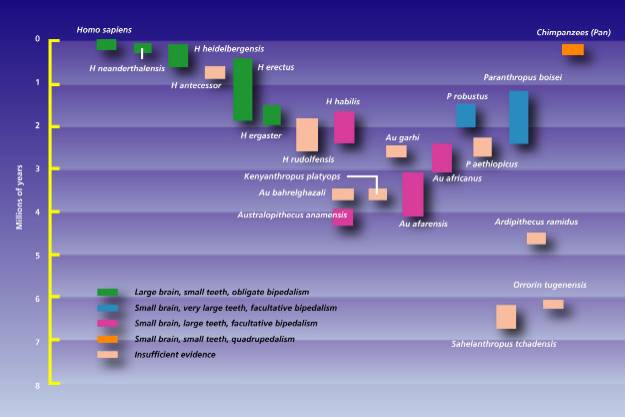
Wikipedia has a good article about human origins. Homo Sapiens has been around for over a quarter of a million years, since the last inter-glacial period. Homo sapiens sapiens, or modern humans, came on the scene sometime in the past 100,000 years. When humans developed language and technology, things began to happen.

After the Ice by Steven Mithen covers the period of time between 20,000 B.C. and 5,000 B.C. During that time, a great deal of human migration occurred. As the weather warmed, plant life and animal life exploded. Human populations multiplied and overfilled the islands of thaw. Tribes were pushed outward in all directions. The ice had not melted, sea levels were low, and many present day islands were accessible to migrating humans and animals. When the ice melted, sea levels rose, islands formed, and hundreds of human populations were cut off. At the same time, the western hemisphere was populated by migrating tribes from Siberia.

The Human Web, by John Robert McNeill and William Hardy McNeill, picks up where "After the Ice" leaves off, at the dawn of agriculture. From Publishers Weekly
The spread of agriculture, the growth of world religions and the rise of European civilization to world dominance are some of the themes explored in this engrossing addition to the distinctive McNeill brand of broad-brush macro-history. The motor of history this time is the growing "web" of interactions-weaving together hunter-gatherer bands, then civilizations and finally the whole world-by which people, goods, diseases and ideas spread. As it binds ever more people ever more tightly, the web both brings them into conflict and lets them share and build on each other's achievements; thus Columbus's extension of the web to the Americas led to conquest but also to the exchange of New World potatoes and maize for Old World horses and smallpox. The father-son historian duo also revisit ideas from William's previous books, discussing the co-evolution of humans and microbes, the uneasy symbiosis between warrior elites and the farmers they protect and exploit, and the social solidarity imparted by group singing and dancing. More ecological than humanistic, the McNeill outlook sees conflict and cooperation as twin outcomes of the struggle for survival that drives developments in technology, political organization, social habits and even religious beliefs. This approach can be reductionist (Europe's vibrant civil society is said to spring from its use of mold-board plows); and as impersonal historical meta-agents go, the trendy "web" conceit is less substantive and fertile than other McNeill brainstorms. Still, this concise and beautifully written synthesis brims with revealing insights that make history comprehensible and enthralling. 25 illus., maps.
Copyright 2003 Reed Business Information, Inc.


Human Accomplishment by Charles Murray, looks at human accomplishments in the sciences and the arts. The leading names are predictable: Galileo, Newton, Einstein, and Darwin in the sciences, Beethoven and Bach in music, Shakespeare and Schiller in literature, Michelangelo in painting, Euler in mathematics, and so forth. Murray is at pains to eliminate Eurocentrism in his analysis: there is separate coverage of Chinese and of Indian philosophy to match Western philo- sophy, Chinese painting, Japanese art, Japanese literature, Arabic literature, and Chinese literature. These include, at a level he views as comparable to Aristotle and Mozart, such names as Gu Kaizhi, Basho, al-Mutanabbi, and Kalidasa. Murray’s goal is not, however, merely to make a list of 4002 all-time greats. He wants to build up a general view of the historical conditions that allow for the flourishing of artistic and scientific innovation and discovery.

Speaking of cultural histories, Jacques Barzun's "From Dawn to Decadence" is a useful addition to the list. Barzun looks specifically at the last 500 years of western culture.
From Dawn to Decadence, [1] Mr. Barzun’s overview of the last five-hundred years of Western cultural history, is a magnificent summa of his concerns as a thinker and historian. It synthesizes as well as summarizes a long lifetime’s reflection about the fate of those distinctive energies that define Western culture: “the great achievements and the sorry failures of our half millennium.” The first thing to be said about From Dawn to Decadence is that reading it is an exhilarating experience. I mention this partly to reassure those intimidated by the book’s length, partly to mollify those put off by its admonitory title. At nearly nine-hundred closely printed pages, From Dawn to Decadence certainly is long, but it is also a rich tapestry of a book—the product, Mr. Barzun remarks, of accidents like “insomnia and longevity,” as well as of immense scholarship. Despite the book’s intimidating girth, I suspect that many readers will, like me, come to feel about it the way one feels about certain long novels. For the first hundred pages or so, a mixture of wariness and anticipation predominates: will the book really repay the time and effort it demands? These feelings give way, as one settles into the story, to eager excitement. Finally, as the end approaches, one finds oneself madly trying to prolong the experience and delay coming to the final page.

National Geographic's Atlas of the Human Journey website is a fascinating glimpse at the sweep of human pre-history. The graphics are exceptionally good.

The New Geneva Center website presents an engaging discussion of human culture from ancient to modern, including cultures from east and south asia, the levant, africa, pre-columbian america. The author discusses both secular and spiritual aspects of culture which shaped ancient and modern civilisations.

This website is packed full of links about western civilisation.

To understand where humans are today, you must understand western civilisation. No other civilisation has created such an environment so conducive to learning, scientific and cultural freedom, and societal ferment. It is almost certainly from western civilisation that the next level will grow.

Labels: , , ,

Bookmark and Share
Older Posts
Al Fin Main Page
Enter your Email


Powered by FeedBlitz
Google
WWW AL FIN

Powered by
Blogger

``