09 July 2012

Good Genes and Educational Achievement: The Straight Dope

Well, actually straight dopamine, to be honest. More specifically, how particular genes of dopamine transport and dopamine receptors relate to educational achievement. The study in question, by Kevin M. Beaver et al (PDF), was recently published in Developmental Psychology. (H/T HBD Chick)

Here's more:
Researchers have identified genetic markers that may influence whether a person finishes high school and goes on to college, according to a national longitudinal study of thousands of young Americans. The study is in the July issue of Developmental Psychology, a publication of the American Psychological Association.

“Being able to show that specific genes are related in any way to academic achievement is a big step forward in understanding the developmental pathways among young people,” said the study’s lead author, Kevin Beaver, PhD, a professor at the College of Criminology and Criminal Justice at Florida State University.

The three genes identified in the study – DAT1, DRD2 and DRD4 – have been linked to behaviors such as attention regulation, motivation, violence, cognitive skills and intelligence, according to the study. Previous research has explored the genetic underpinnings of intelligence but virtually none has examined genes that potentially contribute to educational attainment in community samples, said Beaver.

...The genes identified in this research are known as dopamine transporter and receptor genes. Every person has the genes DAT1, DRD2 and DRD4, but what is of interest are molecular differences within the genes, known as alleles, according to Beaver. Subjects who possessed certain alleles within these genes achieved the highest levels of education, according to the findings.

Dopamine transporter genes assist in the production of proteins that regulate levels of the neurotransmitter dopamine in the brain, while dopamine receptor genes are involved in neurotransmission. Previous research has shown that dopamine levels play a role in regulating impulsive behavior, attention and intelligence.

The presence of the alleles alone did not guarantee higher levels of education, the study found. Having a lower IQ was more strongly associated with lower levels of education. Also, living in poverty and essentially “running with a bad crowd” resulted in lower levels of education despite the genetic effects.

Even though the genetic variants were found to be associated with educational levels, having a specific allele does not determine whether someone will graduate from high school or earn a college degree, according to Beaver. Rather, these genes work in a probabilistic way, with the presence of certain alleles simply increasing or decreasing the likelihood of educational outcomes, he said. _APA.org

Dopaminergic Polymorphisms and Educational Achievement . . . Developmental Psychology July 2012

Data Source Used in Study

There is more to achievement in life than good genes, of course. A benevolent and sensory-rich upbringing and a solid social support structure are extremely helpful. But there is no better support upon which to build than good genes.

There is much more to be mined from data sources such as the one used by the authors of the study. The study looked at only three genes out of at least hundreds which are likely to influence intelligence, attention, impulsivity, future orientation, and other determinants of cognition and executive function. There is so much more to be learned, and the tools to do so are becoming more widely available and affordable -- even to the amateur scientist.

The problem seems to be access to reliable population data, and unfettered random access to different population groups which might well be compared in order to answer some questions of great importance both to science and to society.

But this type of study -- limited and cautious, to be sure -- makes a good starting point.

Labels: , , ,

Bookmark and Share

15 February 2012

You're So Special!

In the past few years the two of us and our colleagues have come on especially intriguing suspects that seem to operate more in the brain than in other tissues: jumping genes. Such genes, which have been found in virtually all species, including humans, can paste copies of themselves into other parts of the genome (the full set of DNA in the nucleus) and alter the functioning of the affected cell, making it behave differently from an otherwise identical cell right next to it. Many such insertions in many different cells would be expected to yield subtle or not so subtle differences in cognitive abilities, personality traits and susceptibility to neurological problems. _SciAm

This animation by Muotri and Marchetto shows the higher rate of activity of the jumping genes in the Rett-afflicted cells (more green dots) than in the WT (wild type) ones. (The olfactory bulb is shown in red, the striatum in magenta and the cerebellum in cyan.) _SciAm

Jumping gene transposons are capable of inserting significant differences in the gene expression of identical twins. When these differences are inserted into brain cell DNA, they can cause identical twins to behave and perform differently from one another. Scientists have barely begun to understand how important this mechanism is to both long term evolution and rapid short term variation.

Nature to scientists: "Everything you think you know, just ain't so!"
Retrotransposons make up as much as half of the nucleotides, or DNA building blocks, in the human genome. In contrast, the approximately 25,000 protein-coding genes we possess make up less than 2 percent of mammalian DNA. The jumping genes are descendants of the first primitive molecular replication systems that invaded the genomes of eukaryotes (organisms having cells that contain a nucleus) long ago. A group led by Haig H. Kazazian, Jr., at the University of Pennsylvania showed in 1988 that retrotransposons, which were once thought of as nonfunctional junk DNA, were active in human tissues.

...Retrotransposition often fails to run its course, which produces truncated, nonfunctional copies of the original L1 DNA. Sometimes these snippets (or the whole L1 copy) have no effect on a protein-coding gene. Other times, though, they can have any of several consequences, both good and bad, for a cell’s fate. They may, for instance, drop into and thus alter the protein-coding region of a gene. This maneuver can lead to creation of a new variant of the protein that helps or harms an organism. Or this positioning may stop a given protein from being made. In other instances, the newly pasted DNA may fall outside of a coding region but act as a promoter (a switch that can turn on nearby genes) and alter the level of gene expression—the amount of protein made from the gene—with, once again, good or bad results for the cell and the organism. When LI retrotransposons end up in many places in neurons or in many cells of the brain, or both, the brain will be very different from the one that would have formed without their influence. It stands to reason that such genetic mosaicism could affect behavior, cognition and disease risk and could also help explain why one identical twin may remain disease-free when a sibling is diagnosed with schizophrenia, for example.

...The continuing research into jumping genes in the brain could potentially challenge an entire academic discipline. Behavioral geneticists often follow groups of identical twins over long periods to control for the effects of genes and determine the environmental contributions to such disorders as schizophrenia. The new findings showing that jumping genes actively revise genomes after an embryo forms question the assumption that “identical” twins are genetically alike. Indeed, the new discoveries will make it ever harder to disentangle the relative effects of nature and nurture on our psyches.

The question remains: Why has evolution not destroyed these vestiges of ancient viruses from within our cells, given that jumping genes have a high chance of introducing potentially fatal genetic flaws? To answer the question, we should acknowledge that humans have always been under attack by viral parasites and other invaders that expand the size of our genomes with jumping DNA. The bodies of humans and our evolutionary forebears may not have been able to fully eliminate the interlopers, but they have adapted to at least coexist with the invaders by silencing them through a variety of clever mechanisms that mutate and disable them. It also appears that, in some cases, our genomes have commandeered the genetic machinery of L1 retroelements to enhance our own survival, which is one reason that cells may sometimes allow, or even encourage, L1s to jump around the genome under carefully controlled conditions. _SciAm
Evolution has always been something of a crap shoot. The wider the range of variation that can be generated, the more likely to find suitable fits for various environmental niches.

What does this mean for the genetics of behaviour and intelligence differences? It means quite the opposite of what the authors above suggest. In the past, behavioural differences in identical twins have been attributed largely to differences in non-shared environment. Now we know better. Rather than detracting from the importance of the genes in influencing behaviours and aptitudes, this research intensifies the importance of genes and gene regulation.

Labels: , ,

Bookmark and Share

30 June 2010

Yet Another Source of Human Genetic Variability

The genetic difference between individuals and between groups of related individuals, just keeps getting larger. Wikipedia lists 7 types of genetic variation, but of course there are more. Probably many more.

The latest type of genetic variation to be acknowledged comes as a startling revelation that roughly half of the human genome is made up of "transposons", or jumping genes.
Transposons, or "jumping genes," make up roughly half of the human genome. Geneticists previously estimated that they replicate and insert themselves into new locations roughly one in every 20 live births.
New results suggest that every newborn is likely to have a new transposon somewhere in his or her genome.

...Transposons resemble e-mail spam: short repeated sequences that have no obvious function other than making more of themselves. The full name for the type of transposon that is most abundant in the human genome is retrotransposon.

The "retro" term comes from how they replicate: first, the DNA is transcribed into RNA, and the RNA is reverse-transcribed into DNA again. This process normally only happens during very early in development, when the cells that will become eggs and sperm have not turned down a separate path of differentiation.

...While working in Devine's lab as a graduate student, first author Rebecca Iskow, Ph.D. devised a technique for "amplifying" the stretches of individual genomes that border transposons and reading thousands of the junctions with advanced sequencing techniques, then comparing them to the reference human genome.

"The basic problem was that a new insertion can be anywhere within three billion base pairs – how do you find it compared to all the other ones?" Devine says.

Ninety-seven percent of genomes the team surveyed had at least one rare insertion of the L1 variety of transposon that was present in only a single human in the study, and some genomes had several. Since the study surveyed 76 genomes, "rare" insertions could still be shared by large groups consisting of thousands of people. Rare insertions corresponded to the most recent transposons, which are less likely to have their jumping abilities impaired by other types of mutations.

Devine's team also showed that transposons frequently jump to new locations during the process of tumor formation. Surveying 20 lung tumors and comparing their genomes against the normal tissues they came from, the team found that six tumors had new transposons insertions that were not present in the normal adjacent tissues.

"This indicates that transposons are jumping in tumors and are generating a new kind of genomic instability," Devine says.

Transposons can inactivate tumor suppressor genes and can facilitate rearrangements that involve large stretches of chromosomes. Geneticists have already identified many transposons that interrupt genes and cause human diseases, including neurofibromatosis, hemophilia and breast cancer.

...The research was initiated at Emory University School of Medicine, where Devine was in the Department of Biochemistry. Iskow, (now a postdoctoral fellow at Brigham & Women's Hospital in Boston) was a graduate student at Emory. The findings were published in the June 25, 2010 issue of Cell. Two other papers on human transposons appear in the same issue of Cell. _ScientificComputing

More at Eurekalert.

Wikipedia lists these forms of human genetic variation:
2 Measures of variation
The transposon variation would need to be added to the list, perhaps at this year's meeting of the Human Genome Variation Society in November.

There is a reason why clans and tribes spring up so easily, and can maintain their identities for such long periods of time. Behaviour arises to a large extent from the genes. It is easier to understand -- and therefore trust -- someone who may tend to act and react in similar ways to oneself. Such tribal societies tend to marry and keep the wealth within the tribe.

Multicultural countries such as the US are attempting to accomplish on a national scale what has generally only been successful in large polyglot trading centers and imperial capitals, in the past. The low-trust interfaces found within ethnic, cultural, and religious heterogeneity can lead to higher rates of crime and vandalism.

Leftist postmodern multiculturalists tend to take exactly the wrong approach in this situation, by accentuating the differences in cultures and religions -- and trying to mould the law around these differences. In fact the opposite should be done. Each culture and / or religion must be forced to adhere to the same set of laws if a multicultural society is to be successful. That is one reason that Kagan and Sotomayor were such abysmally bad choices -- reflecting badly upon Obama's judgment. Both Kagan and Sotomayor are likely to pursue the leftist postmodern multiculturalist approach, which will result in deeper societal schisms, reduced trust, and increased violence.

Labels:

Bookmark and Share

01 June 2010

Human DNA to Geneticists: "You Don't Know Me"

“Our new technology quickly analyzes huge DNA molecules one at a time, which eliminates the copy machine step, reduces the number of DNA jig-saw pieces and increases the unique qualities of each piece,” Schwartz says. “These advantages allow us to discover novel genetic patterns that are otherwise invisible.” _Newswise
Human geneticists are learning a hard lesson in science: what you still don't know will almost always dwarf what you have learned. Human DNA is far more variable than geneticists have realised. Which means that science journalists and the general public are completely in the dark on the vast magnitude of human genetic variability.
Genetic abnormalities are most often discussed in terms of differences so miniscule they are actually called "snips" -- changes in a single unit along the 3 billion that make up the entire string of human DNA.

...“There’s a whole world beyond SNPs — single nucleotide polymorphisms — and we’ve stepped into that world,” says Brian Teague, a doctoral student in genetics at the University of Wisconsin-Madison. “There are much bigger changes in there.”

Variation on the order of thousands to hundreds of thousands of DNA’s smallest pieces — large swaths varying in length or location or even showing up in reverse order — appeared 4,205 times in a comparison of DNA from just four people, according to a study published May 31 in the Proceedings of the National Academy of Sciences.

Those structural differences popped into clear view through computer analysis of more than 500 linear feet of DNA molecules analyzed by the powerful genome mapping system developed over nearly two decades by David C. Schwartz, professor of chemistry and genetics at UW-Madison.

“We probably have the most comprehensive view of the human genome ever,” Schwartz says. “And the variation we’re seeing in the human genome is something we’ve known was there and important for many years, but we haven’t been able to fully study it.”Newswise_via _SD

This means that as the technology of DNA analysis improves, more and more of the variability of human behaviour and development is likely to be attributed to genetic and epigenetic variability. Environment will continue to be important, since environment can strongly influence gene expression, among other important variables.

But the vast variability of the human genome is becoming more obvious to even the most stubborn denier of HBD (human biological diversity). The best approach for these "deniers of the genes" would be to now focus on how to best use the environment to influence gene expression for optimal development and health.

Labels: ,

Bookmark and Share

15 April 2010

Understanding the Massive Complexity of Inheritance

"We know in the human genome there are 20,000 genes, but I can't ask someone to point out to me which genes account for most of the variation in human height, for example, because we just don't know," Kruglyak said. "The underlying goal of what we are trying to do is both understand how complicated these patterns are and try to come up with some concrete examples where we can take some traits and nail down most of the variations, as opposed to only finding a small percentage." _SD
Deciphering Genetic Complexity

Simple genetic traits such as eye and hair colour are relatively easy to understand, and trace through generations. More complex traits such as intelligence and the capacity to postpone gratification in order to achieve a greater reward, have a pattern of inheritance that is less well understood. A recently published (in Nature) Princeton study may point the way to better understanding how complex but critically important traits such as intelligence and executive function are transmitted via the genes.
"One of the important insights gained from research enabled by the sequencing of the human genome is that, rather than being obvious, the connections between genes and most traits are very complicated," Kruglyak said. "Our results show, however, that it is possible to identify many of the factors underlying complex traits using straightforward techniques."

The Princeton team's finding could help illuminate the answers to the current difficulties inherent in tying traits to genes, known as the "missing heritability problem," Kruglyak said.
There are some cases, he said, where scientists have identified mutations in single genes that produce a specific trait, such as a susceptibility to cystic fibrosis or Huntington's disease.

In most cases, however, scientists believe that large numbers of genes working in concert produce trait variation. Some genes play a major role while others are more "quiet" but still are important. Scientists want to know all of the genes involved in producing a given complex trait, but they have not been able to find these groupings, leading to the "missing" problem.

... "In many cases, the effects of genes are so small that detecting them is extremely difficult," said Ian Ehrenreich, a postdoctoral research fellow who is the first author on the Nature paper. "Under conventional methods, we just don't have the power to identify many of these genes. We knew we had to find a different way."... _SD

In other genetics research, scientists at Uppsala University have developed better ways of identifying genetic variation in active genes.

Researchers at Virginia Tech and the Virginia Bioinformatics Institute are developing computer tools to help find small genes that are too easily missed by conventional gene sequencing of microbes.

Huxley's "Brave New World" is coming to reality with the increasing use of "gene swaps" in human eggs -- to prevent the perpetuation of genetic diseases.

The ability to compare genetic sequences for both normal and cancer cells in the same patients can open the door to a better understanding of the vulnerabilities of specific cancers.

Genes are information that is transmitted and instantiated in complex ways. They determine much of who you are and what you can become. The deep and honest study of gene expression is one of the keys to a better future for everyone.

Labels: ,

Bookmark and Share

13 April 2009

Genetic Diversity Where None Was Expected

Most scientists had believed until recently that silent mutations had no effect on an organism. Thanks to researchers at the Univesity of Pennsylvania, we have learned that "silent mutations" -- although they do not change the encoded protein product of the gene -- can change the quantity of the encoded protein that is produced.
The silent mutations changed the amount of fluorescent protein by as much as 250-fold, without changing the properties of the protein. Codon bias, the probability that one codon of three adjacent nucleotides will code for one amino acid over another, was previously thought to be the cause for protein expression variance, but it did not correlate with gene expression in these experiments.

"At first we were stumped," Plotkin said. "How were the silent mutations influencing protein levels? Eventually, we looked at mRNA structure and discovered that this was the underlying mechanism." MedNewsToday
The number of ways that humans can vary by gene expression, yet still possess almost identical genomes on superficial inspection, is immense and growing larger.

Non-coding RNAs are a large part of the reason why. "Junk DNA" that isn't really junk. The surface of gene expression and gene switching is barely being scratched, and now we find yet another source of subtle variation in gene expression.

These are exciting times for geneticists and for anyone with an interest in gene expression, and potential gene therapies.

Labels: ,

Bookmark and Share

21 February 2008

The World Genome: By SNP and by CNV

The image above provides a graphic display of various genomic characteristics of certain ethnic groupings of Earth. A recent Nature letter looked at ethnic genomes by SNP (single nucleotide polymorphism) and CNV (copy number variant). The authors found some fascinating genomic distinctions not previously thought to exist.
A new letter in Nature combines data from single nucleotide polymorphisms (SNPs) and copy number variations (CNVs) across 29 human populations. STRUCTURE results from the paper are below based on SNPs, haplotypes, and CNVs. Note in particular the Green cluster, which was not seen in some previous studies that did not include Oceanian populations, the differentiation between African farmers and hunter-gatherers, and the differentiation between northern and southern Mongoloids evident in the bottom row___Dienekes Anthropology

This is a fascinating beginning to a fuller understanding of who we are, and how we came to be this way. There is a reason why some population groupings are more prosperous, and peaceful than others. Part of the answer lies in the genes. Not just the genetic sequences, but all of the variations within the genome including CNVs and epigenetic mechanisms that vary. It is time to do the work.

The point is, you cannot possibly know until you look. Leftist multicultural obscurantism--denial of cultural and genetic differences--is the largest threat to science at this time. Much larger than creationism, intelligent design, global warming heresies, big oil and coal, George W Bush, or any other of the usual boogey-man "threats to science." Why? Because the leftist multicultural saboteurs of science are already on the inside. They are destroying science from the inside out--which is always a greater threat than the threat from outsiders.

The brains of men and women are different. That is reasonable, given the significant physical differences between men and women. We also see significant physical differences between different ethnicities. Is it possible that there exist subtler differences that affect brain function? Can cultural differences be caused, at least partially, by heritable brain differences?

Labels: , ,

Bookmark and Share

04 September 2007

Still Not the Same: Human Genetic Variation on the Rise

In a fascinating collaborative look at Craig Venter's genome, scientists at four institutions looked at SNP (single nucleotide polymorphism) and non-SNP DNA variants.

In doing so, the scientists estimate that humans generally share 99% of the genome, rather than the 99.9% of the genome that is traditionally claimed to be held in common. This PLOS Biology study appears to be quite detailed and comprehensive, in terms of what the scientists were looking for.
Comparison of this genome and the National Center for Biotechnology Information human reference assembly revealed more than 4.1 million DNA variants, encompassing 12.3 Mb. These variants (of which 1,288,319 were novel) included 3,213,401 single nucleotide polymorphisms (SNPs), 53,823 block substitutions (2–206 bp), 292,102 heterozygous insertion/deletion events (indels)(1–571 bp), 559,473 homozygous indels (1–82,711 bp), 90 inversions, as well as numerous segmental duplications and copy number variation regions. Non-SNP DNA variation accounts for 22% of all events identified in the donor, however they involve 74% of all variant bases. This suggests an important role for non-SNP genetic alterations in defining the diploid genome structure. Moreover, 44% of genes were heterozygous for one or more variants.
Full text here

Previous CNV mapping has suggested that human genomes may vary by as much as 10% (rather than the above estimation of 1% from the PLOS study).

UPDATE: The authors did take a cursory look at CNVs in the assembly. But they were looking for more "micro-variations" rather than CNV variations at a higher level of analysis. This difference in "logical levels" of ways of grouping data can be confusing. Future research should clarify any confusion, however.


Comparing the method behind the 10% estimate with the method behind the 1% estimate is like comparing apples to oranges. But in terms of real world significance in describing behavioural and other phenotypic differences between populations (and within populations), it will almost certainly be fruitful for future research to look at all sources of variation.

Human civilisations and cultures vary significantly from population to population. The underlying reasons for these significant differences are a matter for debate. All of the many conflicting books, articles, theses, etc. seeking to explain the relative prosperity and productivity of different cultures and populations illustrates the huge distances between premises and philosophies of the humans who attempt to explain "why some populations are wealthy and intellectually prodigious, and why some are impoverished and intellectually moribund."

Labels: ,

Bookmark and Share

23 November 2006

Surprise! New Genetic Map Shows We are Not All the Same Genetically, After All

Recent research published in Nature, Nature Genetics and Genome Research shows that humans can be significantly different from each other, genetically--a fact that has been strenuously denied by social scientists for decades. The new genetic map, a Copy Number Variant (CNV) map, indicates that instead of being 99.9 per cent identical, humans can vary genetically by up to 10%.

One person's DNA code can be as much as 10 percent different from another's, researchers said on Wednesday in a finding that questions the idea that everyone on Earth is 99.9 percent identical genetically.

They said their new version of the human genetic map, or "book of life," fills in many missing pages and chapters to explain how genes are involved in common diseases.

"This important work will help identify genetic causes of many diseases," Dr. Mark Walport, director of Britain's Wellcome Trust, said in a statement.

Instead of showing single variations in human DNA that make people unique, the map looks at differences in duplications and deletions of large DNA segments known as copy number variants or CNVs, which can help explain why some people are susceptible to illnesses such as AIDS and others are not.

"We're a patchwork of DNA sequences, gains and losses," Dr. Charles Lee of the Brigham and Women's Hospital and Harvard Medical School in Boston, Massachusetts told a news conference.

Scientists from more than a dozen centers around the world identified about 3,000 genes with variations in the number of copies of specific DNA segments. The changes can affect gene activity, including susceptibility to diseases.

The Human Genome Project mapped the billions of letters that make up the human genetic code. Scientists later refined the map by looking for single variations called SNPs or single nucleotide polymorphisms.

The CNV map gives researchers a different way to look for genes linked to diseases by identifying gains, losses and alterations in the genome.

"We estimate this to be at least 12 percent of the genome, similar in extent to SNPs. This has never been shown before," said Dr. Matthew Hurles of Britain's Wellcome Trust Sanger Institute.
Source.

CNV mapping is a different way of looking at the human genome which can more powerfully elicit genetic differences between humans and between humans and other animals.

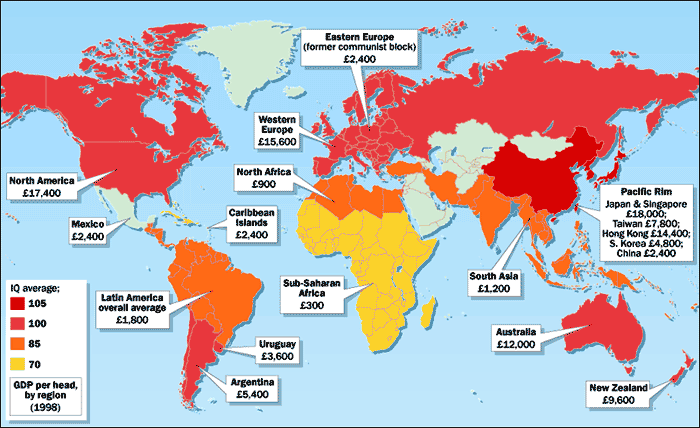
This new approach casts a new light on recent research that reveals IQ differences between human groupings. IQ and other genetic differences between nation populations and groups might go a long way toward explaining different behaviours. With these new tools for studying the genome, far more genetic differences between human groups should be revealed.

Hat tips to Fatknowledge blog and Intelligence Testing blog.

This will place even more stress on western liberal values of egalitarianism, but as long as the primary focus of equality is equality of opportunity and equality before the law, the problems can be worked out. Only when society attempts to guarantee equality of outcomes does egalitarianism become completely unworkable--given the genetic differences in aptitudes and interests between groups of people--even between genders.

Labels: ,

Bookmark and Share
Older Posts
Al Fin Main Page
Enter your Email


Powered by FeedBlitz
Google
WWW AL FIN

Powered by
Blogger

``