29 July 2012

Why Do Males Continue to be Superior at Math?

Despite shoddy pseudo-scholarly attempts by feminist ideologues to disprove the obvious statistical sex differences in math reasoning and advanced math ability, males continue to be over-represented in fields requiring advanced mathematical abilities.
Proportion Female in Various Fields _HBD Chick _via_ Complexity Simplified


So, why are males superior at math? Let's be more specific, since the reality is a bit mixed:
In late elementary school, females outperform males on several verbal skills tasks: verbal reasoning, verbal fluency, comprehension, and understanding logical relations (Hedges & Nowell, 1995). Males, on the other hand, outperform females on spatial skills tasks such as mental rotation, spatial perception, and spatial visualization (Voyer, Voyer, & Bryden, 1995). Males also perform better on mathematical achievement tests than females. However, gender differences do not apply to all aspects of mathematical skill. Males and females do equally well in basic math knowledge, and girls actually have better computational [arithmetic _ ed.] skills. Performance in mathematical reasoning and geometry shows the greatest difference (Fennema, Sowder, & Carpenter, 1999). _Education

In fact, recent research shows that males begin to take a qualitatively different approach to math thinking from an early age:
In a University of Missouri study, girls and boys started grade school with different approaches to solving arithmetic problems, with girls favoring a slow and accurate approach and boys a faster but more error prone approach. Girls’ approach gave them an early advantage, but by the end of sixth grade boys had surpassed the girls....

“Developing mathematical skill may be part ‘practice makes perfect’ and part ‘perfect makes practice,’” Bailey said. “Attempting more answers from memory gives risk-takers more practice, which may eventually lead to improvements in accuracy. It also is possible that children who are skilled at certain strategies are more likely to use them and therefore acquire more practice.” _MU News

The greater boldness exhibited by boys in math class is likely a testosterone effect, which is exhibited in so many other behavioural differences between males and females in childhood, adolescence, and early to middle adulthood.

The male superiority in spacial skills tasks and advanced math reasoning is likely to derive from far more subtle changes in the brain than those that lead to greater male boldness. But those more subtle changes are also largely due to testosterone effect.

These brain changes occur over time -- slowly in childhood, and at a faster rate in adolescence. All levels of brain activity -- from gene expression to physiological parameters to brain structure to cognitive function -- are involved.

Recent feminist-inspired studies which compare male : female math skills in childhood or very early in adolescence are unable to detect the most significant brain transformations, and are thus likely to fail to detect very real differences. Likewise, studies which focus upon comparisons of basic arithmetic skills, fail to detect the male advantages in spatial skills and in advanced mathematical reasoning.

Fortunately, better tools for detecting brain activity and differences at all levels -- from gene expression to fine brain structure to the neurological correlates of cognition -- are all in development.

A fascinating new brain imager which combines MEG (magnetoencephalography) with MRI (magnetic resonance imaging) will allow an unprecedented degree of simultaneous spatial and temporal imaging of brain structure and activity.

Functional brain imaging has already developed to the point where it can be used as an objective, culture-free test for cognitive function and speed. It is only a matter of time before such crude objective measures of cognition can be fine-tuned to look at distinct types of cognition, including mathematical and spatial reasoning.

When it comes to brain, cognition, and behaviour, hormones have consequences. The sooner human academics can grow beyond their political correctness to look at these issues objectively and honestly, the sooner we can find ways for all of us to move ahead.


More from La Griffe du Lion

More on math sex gap at secondary level (PDF)

Lubos Motl provides colour commentary on the La Griffe du Lion article linked above, paying particular attention to cross-cultural views of the math sex gap.

Labels: , ,

Bookmark and Share

21 January 2012

Girls Suck at Math; But True Grit Can Help Sum

World class psychologist David Geary looked into the issue of why girls suck at math, and came to the conclusion that you cannot blame "stereotype threat" or any of the other usual suspect excuses.
There is a large body of research about why more girls aren’t at the top of the spectrum in math skills. One study in 1999 blamed poor self-image for underachievement in math among girls. The theory was popular, Geary said, “because it gives a sense that you can do something about it easily, so it’s taken off as an explanation.”

Geary, a curators’ professor of psychological sciences, and Gijsbert Stoet from the University of Leeds in the United Kingdom examined 20 influential replications of the original study and found serious scientific flaws. Among the most concerning was a lack of a male control group: Researchers told girls who were getting ready to take math tests that females typically don’t do well on the exams but did not give the same message to boys who took the tests. When Geary and his team adjusted the findings based on the lack of a control group and statistical flaws in other studies, they found little to no significant effect on performance based on stereotypes. _ColumbiaTribune
There are far more males at the top end of math ability than females, and that discrepancy tends to widen during the passage through puberty, into adulthood. Most knowledgeable cognitivists understand that the male hormone testosterone plays an important role in this notable and enduring discrepancy.

But for girls who are truly determined to succeed in fields where top level math skills are needed, besides a bit of math talent, there is nothing quite like "true grit."
“Grit entails working strenuously toward challenges, maintaining effort and interest over years despite failure, adversity, and plateaus in progress.”


...What differentiates kids who are gritty from kids who are not gritty is not just the hours of work they are putting in, (but) they’re putting the hardest kind of work in.


...Grit is also distinct from […] self-control, in its specification of consistent goals and interests. An individual high in self-control but moderate in grit may, for example, effectively control his or her temper, stick to his or her diet, and resist the urge to surf the Internet at work—yet switch careers [frequently]. As Galton (1892) suggested, abiding commitment to a particular vocation [..] does not derive from overriding “hourly temptations.” _Source

But of course, if you are practising the wrong things or the right things the wrong way, there is no amount of practise which will turn out right. Take as an example the way that some psychologists attempt to teach people about risk -- by using probability. How stupid is that? Risk is not a cerebral topic, it is visceral. If psychologists are too stupid to understand that fact, they should probably be working as janitors or parking attendants.

Here is an interesting study that looks at the effect of "make believe" personas in a virtual environment.
Video games constitute a popular form of entertainment that allows millions of people to adopt virtual identities. In our research, we explored the idea that the appeal of games is due in part to their ability to provide players with novel experiences that let them “try on” ideal aspects of their selves that might not find expression in everyday life. We found that video games were most intrinsically motivating and had the greatest influence on emotions when players’ experiences of themselves during play were congruent with players’ conceptions of their ideal selves. Additionally, we found that high levels of immersion in gaming environments, as well as large discrepancies between players’ actual-self and ideal-self characteristics, magnified the link between intrinsic motivation and the experience of ideal-self characteristics during play. _PsychologicalScience
As we approach the promise of virtual reality games and total sensory immersion environments, the ability to take on virtual identities which are either significant variations of our real selves, or even totally alien to our true selves, should prove to be a powerful learning tool -- not to mention a diagnostic and evaluative tool.

Along with grit and intelligent practise, one should also try to enhance one's own creative abilities. To that end, here is a useful infographic provided as a bonus, for no extra charge. Good luck.


Labels: , , ,

Bookmark and Share

07 February 2011

Women Choose Their Destinies in Science

Since 1970, women have made dramatic gains in science. Today, half of all MD degrees and 52% of PhDs in life sciences are awarded to women, as are 57% of PhDs in social sciences, 71% of PhDs to psychologists, and 77% of DVMs to veter-inarians.* Forty years ago, women’s presence in most of these fields was several orders of magnitude less; e.g., in 1970 only 13% of PhDs in life sciences went to women (1). In the most math intensive fields, however, women’s growth has been less pronounced (2–4). Among the top 100 US universities, only 8.8–15.8% of tenure-track positions in many math-intensive fields(combined across ranks) are held by women, and female fullprofessors number ≤10%. _PNAS Ceci, Williams
Famous Women in Science
Is the relatively low number of women professors in math-intensive fields due to discrimination, or do women choose their destinies in their field of choice? A recent study published in PNAS suggests that the choice depends on the woman, and how she interprets her ensemble of personal and professional needs.
It's not discrimination in instances of different hiring, but rather differences in resources attributable to career and family-related choices that set women back in science, technology, engineering and math (STEM) fields, say Stephen J. Ceci, professor of developmental psychology, and Wendy M. Williams, professor of human development and director of the Cornell Institute for Women in Science, both in Cornell's College of Human Ecology.

The "substantial resources" universities expend to sponsor gender-sensitivity training and interviewing workshops would be better spent on addressing the real causes of women's underrepresentation, Ceci and Williams say, through creative problem-solving and policy changes that respond to differing "biological and social realities" of the sexes.

The researchers analyzed the scientific literature in which women and men competed for publications, grants or jobs in these fields. They found no systematic evidence of sex discrimination in interviewing, hiring, reviewing or funding when men and women with similar resources – such as teaching loads and research support – were compared.

"We hear often that men have a better chance of getting their work accepted or funded, or of getting jobs, because they're men," Williams said. "Universities expend money and time trying to combat this rampant alleged discrimination against women in the hope that by doing so universities will see the numbers of women STEM scientists increase dramatically over coming years."

The data show that women scientists are confronted with choices, beginning at or before adolescence, that influence their career trajectories and success. Women who prioritize families and have children sometimes make "lifestyle choices" that lead to them to take positions, such as adjunct or part-time appointments or jobs at two-year colleges, offering fewer resources and chances to move up in the ranks. _WomenInScience
From the abstract to the study:
Explanations for women's underrepresentation in math-intensive fields of science often focus on sex discrimination in grant and manuscript reviewing, interviewing, and hiring. Claims that women scientists suffer discrimination in these arenas rest on a set of studies undergirding policies and programs aimed at remediation. More recent and robust empiricism, however, fails to support assertions of discrimination in these domains. To better understand women's underrepresentation in math-intensive fields and its causes, we reprise claims of discrimination and their evidentiary bases. Based on a review of the past 20 y of data, we suggest that some of these claims are no longer valid and, if uncritically accepted as current causes of women's lack of progress, can delay or prevent understanding of contemporary determinants of women's underrepresentation. We conclude that differential gendered outcomes in the real world result from differences in resources attributable to choices, whether free or constrained, and that such choices could be influenced and better informed through education if resources were so directed. Thus, the ongoing focus on sex discrimination in reviewing, interviewing, and hiring represents costly, misplaced effort: Society is engaged in the present in solving problems of the past, rather than in addressing meaningful limitations deterring women's participation in science, technology, engineering, and mathematics careers today. Addressing today's causes of underrepresentation requires focusing on education and policy changes that will make institutions responsive to differing biological realities of the sexes. Finally, we suggest potential avenues of intervention to increase gender fairness that accord with current, as opposed to historical, findings. _PNAS
People tend to do what they are good at. A great deal of research demonstrates that at the most elite levels of math performance men outnumber women by as much as 7 to 1 or higher. Not only do math-proficient women tend to find themselves badly outnumbered by men in fields which are math intensive, but the higher testosterone levels of men in those fields tends to drive them to work harder over longer hours in order to achieve success -- even at the sacrifice of the men's personal and family lives. For men, it is a biological imperative to compete and excel.

For many women who happen to be good at math, other motivations and needs take precedence over the academic rat race. For women in fields dominated by other women -- such as psychology -- the competition is against other women who have lower testosterone levels like themselves. Stress levels are consequently not as high in terms of competitive performance anxiety -- although staff meetings may occasionally take on the ambience of a screeching cat fight. ;-)
Women who prioritize families and have children sometimes make “lifestyle choices” that lead to them to take positions, such as adjunct or part-time appointments or jobs at two-year colleges, offering fewer resources and chances to move up in the ranks. These women, however, are not held back by sex discrimination in hiring or in how their scholarly work is evaluated. Men with comparably low levels of research resources fare equivalently to their female peers. Although women disproportionately hold such low-resource positions, this is not because they had their grants and manuscripts rejected or were denied positions at research-intensive universities due to their gender.

Also, females beginning before adolescence often prefer careers focusing on people, rather than things, aspiring to be physicians, biologists and veterinarians rather than physicists, engineers and computer scientists. Efforts to interest young girls in these math-heavy fields are intended to ensure girls do not opt out of inorganic fields because of misinformation or stereotypes.

Also, fertility decisions are key because the tenure system has strong disincentives for women to have children — a factor in why more women in academia are childless than men. Implementation of “flexible options” to enhance work-family balance may help to increase the numbers of women in STEM fields, the researchers say. _SB
Women should be free to choose the nature of their careers, and not be pushed into career tracks which they feel do not suit them, by political feminists.

There is far too much denial of human biodiversity (HBD) inside politics, the media, and the academy. By denying the natural statistical diversity of human biology in the genders and other population groupings, these HBD deniers do untold amounts of damage to generation after generation of young people -- and to society at large.

Labels: , , , ,

Bookmark and Share

31 January 2011

Is Wikimedia Dumbing Down the Idiocracy?

NYT

Several areas of commerce, enterprise, and science remain the province of mainly-male participation. Physics, mathematics, advanced computer science, technical engineering, math-intensive sciences, aircraft test pilots and combat pilots, commercial sea captains, and so on. Most informed people understand that research is dominated by males, but few people realise that technical information intensive areas -- such as highly demanding reference information providers -- are also dominated by males. A lot of politically involved feminists would like to change that situation, but is there a danger in moving too forcefully from the top down when changes may adversely affect critically important services?
...surveys suggest that less than 15 percent of [Wikipedia's] hundreds of thousands of contributors are women.

About a year ago, the Wikimedia Foundation, the organization that runs Wikipedia, collaborated on a study of Wikipedia’s contributor base and discovered that it was barely 13 percent women; the average age of a contributor was in the mid-20s, according to the study by a joint center of the United Nations University and Maastricht University.

...The notion that a collaborative, written project open to all is so skewed to men may be surprising. After all, there is no male-dominated executive team favoring men over women, as there can be in the corporate world; Wikipedia is not a software project, but more a writing experiment — an “exquisite corpse,” or game where each player adds to a larger work.

...The public is increasingly going to Wikipedia as a research source: According to a recent Pew survey, the percentage of all American adults who use the site to look for information increased to 42 percent in May 2010, from 25 percent in February 2007. This translates to 53 percent of adults who regularly use the Internet.

Jane Margolis, co-author of a book on sexism in computer science, “Unlocking the Clubhouse,” argues that Wikipedia is experiencing the same problems of the offline world, where women are less willing to assert their opinions in public. “In almost every space, who are the authorities, the politicians, writers for op-ed pages?” said Ms. Margolis, a senior researcher at the Institute for Democracy, Education and Access at the University of California, Los Angeles.

...Ms. Gardner said that for now she was trying to use subtle persuasion and outreach through her foundation to welcome all newcomers to Wikipedia, rather than advocate for women-specific remedies like recruitment or quotas.

“Gender is a huge hot-button issue for lots of people who feel strongly about it,” she said. “I am not interested in triggering those strong feelings.”

Kat Walsh, a policy analyst and longtime Wikipedia contributor who was elected to the Wikimedia board, agreed that indirect initiatives would cause less unease in the Wikipedia community than more overt efforts.

But she acknowledged the hurdles: “The big problem is that the current Wikipedia community is what came about by letting things develop naturally — trying to influence it in another direction is no longer the easiest path, and requires conscious effort to change.” _NYT
The Wikipedia world is indeed a rough and tumble world of competitive edits and re-writes. If a person cannot withstand criticism and competition, they will not likely last long in that world.

The male hormone testosterone shapes the human brain in multiple ways not yet fully comprehended by science or society at large. Much of what science has learned about the influence of hormones such as testosterone on the gender differences so prevalent in society, is considered not politically correct -- and thus essentially unmentionable in left-leaning tabloids such as the New York Times, quoted above. Testosterone makes males more interested in objects than people, more competitive, have generally superior spatial and higher math skills, physically larger and stronger with greater stamina, tending to greater independence, and generally more logically determined and less emotional in the face of distractions.

Charles Murray's fascinating book, Human Accomplishment, provides a historical reflection of the phenomenon that Wikimedia's executives and critics are struggling with. Males have tended to achieve the lion's share of discoveries, inventions, and masterpieces of art, music, and literature as far back as history can tell.

A population shrinkage is occurring among the more intelligent people of the world -- Europeans and Northeast Asians -- while an explosive growth of population is occurring among the less intelligent people of the world. The average intelligence of the human population is inexorably dropping from near 90 points of IQ, downward -- close to the mid-80s and below. That qualifies as an Idiocracy.

In order to dumb down the Idiocracy, one must institute foolish rules of arbitrary and counter-productive governance, while educating the populace to accept dumbed-down groupthink rather than to think for themselves. It is easier than you might think. What Wikimedia is contemplating -- and what many western governments have done, and called affirmative action -- is an excellent example.

Labels: , , , , ,

Bookmark and Share

23 August 2009

Shocker! Boys Still Better at Math, Girls at Reading

Image Source
Recent test scores from the NAEP (National Assessment of Educational Progress) re-affirms the important differences between male and female brains. By the middle of puberty, males show superiority in math and technical science, whereas females demonstrate superior language skills.
Male high school students outperform female high school students for economics, math and science; and female high school students outperform males students in reading and writing. Additionally, the variability of male test performance (and probably intelligence) is greater than the variability of female test performance, and this applies to ALL of the five subjects. In other words, there will probably always be more male than female geniuses (3-4 standard deviations above the mean) and more male than female idiots (3-4 standard deviations below the mean). _MJPerry
Elite male mathematicians and scientists outnumber female elites in those fields by roughly 10:1. To understand more about this question, consult "Sex Differences in Mathematical Aptitude."

Politically connected feminasties such as Nancy Hopkins, Liz Spelke, Donna Shalala etc. may scream from dusk till dawn about the inequity, but the underlying brain differences between male and female have not changed significantly for thousands of years. The government can extend Title IX penalties to science, as it has to athletics, but unless government is prepared to expose female fetuses and infants to male steroid hormones, and expose male fetuses to female hormones, the gap will remain.

Labels: ,

Bookmark and Share

24 December 2008

Math Gender Gap Persists Everywhere

Two recent publications (Science 320, 1164 (2008), and Science 321, 494 (2008)) have celebrated the purported "absence of a gender gap" in math ability. These 'findings' were celebrated by feminist academics, politicians, and journalists. But most informed observers immediately found the papers suspect, in that they contradicted a huge body of scientific evidence. Now perennial fact-checker and ne-er do well, La Griffe du Lion, takes a look at the two studies and declares them wanting in logic, reason, and hard facts.
In brief, we have seen tonight that the gender gap in mathematics has been stable for at least half a century; that sex differences in ability-distribution means and variance ratio are independent of race, culture and geography; that female math performance is closest to that of males in high-IQ countries; that culture plays a role in math performance, albeit small; and that the theory of Everyone accounts for all of the above. If these results are unsettling, take comfort knowing that no presentation of fact, regardless how compelling, will keep the gap buster from her noble calling. _LaGriffeduLion via Dennis Mangan
To follow the reasoning that leads to LGdL's conclusions, you will need to read his article at the link above. It is accompanied by a large array of graphs which aid an intuitive grasp of the statistics involved.

The gender gap is ubiquitous geographically and culturally, and is persistent over time. The gap is somewhat narrower in societies with higher average IQs, such as Europe, North America, East Asia, and Oceania, but still quite undeniably present and persistent.

The continuing effort of feminists in academia and journalism to deny what is obvious to anyone who looks at the issue scientifically, undermines the credibility of feminists on a wide range of issues which straddle both the scientific and political spheres.

See Dennis Mangan and Half Sigma for other observations on du Lion's recent article.

The simple and obvious mistake that feminists make when trying to deny the math gender gap, is to make comparisons between boys and girls up to puberty, and ignoring any differences that develop after that point. Since the brain development and maturation of youth continues throughout puberty and into young adulthood to the age of 25 or 30, such premature halting of data collection and comparison appears suspiciously political in motivation. Particularly since the "math behaviour" differences that are pertinent in the discussion, are those differences that occur in career preparation and performance in adulthood.

The same absurd faux comparisons were made by Liz Spelke in her famous debate with Steven Pinker. Boys and girls are not yet men and women. The dynamic process that converts the brain of the young child to the quite different brain of the mature adult should not be neglected in any serious analysis of adult differences in math aptitude.

Parenthetically, James Flynn makes very much the same mistake in his own analyses of IQ score gaps between population groups. Such infestation of science by politics is unlikely to be rooted out for generations. The most we can hope for is that the underlying research continues and the results preserved for a more rational era.

Labels: ,

Bookmark and Share

10 October 2008

Males 3 X More Likely to be Highly Talented at Math Than Are Females, Although Most Promising Talent is Destroyed by US Schools

A new study in Notices of American Mathematical Society (PDF), reveals that a large number of potentially highly talented in mathematical individuals are diverted from mathematics by the US school systems, their talents largely wasted. While the article takes the politically correct stance that females are being particularly victimised, a careful reading reveals that the majority of children who are highly talented at math (by roughly 3:1) are males. If one looks further at the extreme upper end of the curve of mathematical ability, the ration of males to females is closer to 10:1. The farther out on the math ability curve one cares to look, the greater is the advantage of males over females.

Huge amounts of money are spent every year in expensive outreaches to female students, to encourage females to pursue careers in mathematics, science, and engineering/computer science. Nothing even remotely similar in magnitude is devoted to the vastly larger numbers of boy students whose talents in math and science are being squandered by a dysfunctional government school system.
Very few USA high schools teach the advanced mathematical skills, such as writing rigorous essay-style proofs, needed to excel in the USAMO. Most USAMO award winners acquire this knowledge by a combination of self -study and participation in summer mathematics camps. ...Several summer mathematics camps aimed at exposing children to numerous areas of pre - calculus mathematics not typically taught in schools have been started in the USA during the past decade. AwesomeMath is one such program, begun in 2006 for seventh through twelfth-graders who can demonstrate a high-level interest in learning areas of mathematics needed to perform well in the AIME and USAMO. It is run by the same instructors who direct the MOSP and coach the USA IMO Team. Of the ninety-three USA students who participated in the camp in 2006, fourteen (15%) were girls.

...Girls and boys with mathematical ability, whether profound, gifted, or merely above average, should be identified and encouraged to study mathematics beyond the high school level so they may pursue careers in STEM fields because these jobs are plentiful, well-paying, challenging, interesting, and beneficial to society. Their doing so is vital to the future of the USA economy... _NAMS(PDF)
Of course the authors of the study commit two errors of PC--denying differences in math aptitude due to gender, and ignoring differences in math aptitude due to underlying ethnic populations. If one believes in the discredited "blank slate hypothesis", then one is subjected to this type of error famously committed by ideologically bound academics such as Liz Spelke, Nancy Hopkins, and Donna Shalala.

Even so, it is good to have the data collected and analysed, so that in a future and more open-minded age, it can be looked at more impartially. PC bias reduces the IQ of research, academics, and public policy in a similar way that CAGW bias reduces the FQ of industry and the economy. Society must muddle through until it can throw off the ideological chains of PC, and other leftist hysterias.

Labels: , ,

Bookmark and Share

28 July 2008

New York Times Screws Up Again: Yes, Virginia, There Certainly Is a Gender Gap

A recent NYT report falsely claimed that there is no gender gap in mathematics between males and females in the US. The Wall Street Journal report on the same research was far more accurate and informative.
The researchers, from the University of Wisconsin and the University of California, Berkeley, didn't find [a difference in average scores AF] between girls' and boys' scores. But the study also found that boys' scores were more variable than those of girls. More boys scored extremely well -- or extremely poorly -- than girls, who were more likely to earn scores closer to the average for all students.

One measure of a top score is achieving the "99th percentile" -- scoring in the top 1% of all students. Boys were significantly more likely to hit this goal than girls. _WSJ_via_StatModeling_via_MarginalRevolution
In fact, the higher in difficulty you choose to look, the higher is the ratio of males to females.

As Alex Tabarrok at Marginal Revolution shows, apart from the WSJ report, the media coverage of this research is abysmally inaccurate and misleading. Research looking at gender or racial differences in aptitude is often mis-reported in this way in the public media, due to overt bias among journalists, and the willingness of many scientists to play along with that bias out of politically correct multicultural hyper-egalitarianism.

There is no Nobel Prize for mathematics, but according to Wikipedia, the Fields Medal, the Wolf Prize, and the Abel Prize, the top international prizes granted for mathematical achievement, have never been awarded to a woman, although over 100 men have been honoured with the various prizes since the Fields Medal was first awarded in 1936.

The Nobel Prize in Physics, the closest thing to a Nobel Prize in mathematics, has seen only two female prize winners--in 1963 and 1903. As you can see, although access to physics and mathematics departments is unrestricted, and large sums of money are spent yearly to steer women in that direction, there does not appear to be a trend toward more women at the extreme upper levels of achievement in either mathematics or physics.

H/T to Aschwin de Wolf

Labels: ,

Bookmark and Share

06 March 2008

Why Jenny Flunks Math 55

Math 55 is supposed to be the hardest math course in US higher education. "Honors Calculus and Linear Algebra". Classes meet three hours a week, and class homework requires up to 60 hours a week. Few women take Math 55. Fewer still ever pass.
Math 55 does not look like America. Each year as many as 50 students sign up, but at least half drop out within a few weeks. As one former student told The Crimson newspaper in 2006, “We had 51 students the first day, 31 students the second day, 24 for the next four days, 23 for two more weeks, and then 21 for the rest of the first semester.” Said another student, “I guess you can say it’s an episode of ‘Survivor’ with people voting themselves off.” The final class roster, according to The Crimson: “45 percent Jewish, 18 percent Asian, 100 percent male.”

Why do women avoid classes like Math 55? Why, in fact, are there so few women in the high echelons of academic math and in the physi­cal sciences?

Women now earn 57 percent of bachelors degrees and 59 percent of masters degrees. According to the Survey of Earned Doctorates, 2006 was the fifth year in a row in which the majority of research Ph.D.’s awarded to U.S. citizens went to women. Women earn more Ph.D.’s than men in the humanities, social sciences, education, and life sciences. Women now serve as presidents of Harvard, MIT, Princeton, the University of Pennsylvania, and other leading research universities. But elsewhere, the figures are different. Women comprise just 19 percent of tenure-track professors in math, 11 percent in physics, 10 percent in computer science, and 10 percent in electrical engineering. And the pipeline does not promise statistical parity any time soon: women are now earning 24 percent of the Ph.D.’s in the physical sciences—way up from the 4 percent of the 1960s, but still far behind the rate they are winning doctorates in other fields.

...So why are there so few women in the high echelons of academic math and in the physical sciences? In a recent survey of faculty atti­tudes on social issues, sociologists Neil Gross of Harvard and Solon Simmons of George Mason University asked 1,417 professors what accounts for the relative scarcity of female pro­fessors in math, science, and engineering. Just 1 percent of respondents attributed the scarcity to women’s lack of ability, 24 percent to sexist discrimination, and 74 percent to differences in what characteristically interests men and women.___American__via_SteveSailer
But the truth may be a bit less politically correct. La Griffe du Lion looks at sex differences in mathematics and concludes:
Mathematics is a man's game. A gender gap appears early in life, blossoms with the onset of puberty and reaches full bloom by mid-adolescence. It indelibly shapes women's prospects for doing significant mathematics. In this account of cognitive sex differences, Prodigy shows how sex-differentiated ability in 15 year-olds accounts for the exiguous female representation at the highest levels of mathematical research. A female Fields Medalist is predicted to surface once every 103 years.
Another look at women and minorities in science concludes:
Prospects for women and minority doctoral scientists in engineering and other math-intensive areas are examined. A calculation of the ethnic-gender profile of this segment of the workforce is made for U.S. citizens and permanent residents. Rank ordering on mathematical reasoning ability predicts that women will top off at approximately 27 percent of this market. Similarly, rank ordering predicts almost 99 percent of math-intensive doctoral jobs will go to whites and Asians of primarily Chinese, Japanese, Korean and South Asian descent. Asians will continue to be represented in these fields well beyond their numbers in the general population. A study of the math-intensive academic marketplace predicts that women will top off there at about 22 to 23 percent.
In fact, women are already topping off at roughly 24% in the physical sciences which are more math intensive. If you read the Christina Hoff Sommers article you will find that politically, this lack of gender equity is simply unacceptable. Regardless of how many other academic fields and professions that women may be coming to dominate, if even a few fields remain where male dominance appears unchallenged, political feminists will cry foul. And when that happens, billions of dollars suddenly change hands, department heads and college deans will fall, and congress suddenly shakes a leg to please.

This is simply power politics for high powered feminist heavyweights, such as those mentioned in the article. But for academia, it sounds more like the death knell of minimally politicized science and math. The further entrenching of ideology into every aspect of academic thought and training. Make the world conform to your insular views, at all costs. Regardless of who is finally elected US President in November, there is no doubt who is at the wheel. PC--a cold and killing dogma.

Labels: , , ,

Bookmark and Share

18 February 2008

Math and Sex: Aptitude vs. Discrimination

There are far more men who are talented at math, than females who are talented at math. Researchers Camilla Benbow, David Geary, and others have established that claim quite well.
In the 1980s one of us (Benbow), along with the late psychologist Julian C. Stanley, who founded this study at the John Hopkins University Center for Talented Youth, observed sex differences in mathematical reasoning ability among tens of thousands of intellectually talented 12- to 14-year-olds who had taken the SAT several years before the typical age.

Among this elite group, no significant differences were found on the verbal part of the SAT, but the math part revealed sex differences favoring boys. There were twice as many boys as girls with math scores of 500 or higher (out of a possible score of 800), four times as many boys with scores of at least 600, and 13 times as many boys with scores of at least 700 (putting these test takers in the top 0.01 percent of 12- to 14-year-olds nationwide).

...The ratio of boys to girls, first observed at 13 to 1 in the 1980s, has been dropping steadily and is now only about 3 to 1. During the same period the number of women in a few other scientific fields has surged. In the U.S., women now make up half of new medical school graduates and 75 percent of recent veterinary school graduates....This period coincides with a trend of special programs and mentoring to encourage girls to take higher-level math and science courses. And direct evidence exists that specifically targeted training could boost female performance even further. A special course created by engineering professor Sheryl A. Sorby and mathematics education specialist Beverly J. Baartmans at Michigan Technological University, for example, targeted improvement in visuospatial skills.

...Decades of data from studies of different animal species show that hormones can play a role in determining the cognitive abilities that males and females develop. For example, during typical prenatal male development, high levels of hormones such as testosterone masculinize the developing brain and result in male-typical behaviors and probably male patterns of cognitive performance...More recent studies have shown that hormones continue to play a role in cognitive development throughout life. Such changes have been observed in individuals receiving large quantities of male or female hormones in preparation for sex-change surgery. Researchers found, for example, that people undergoing female-to-male hormone treatment show “masculine” changes in their cognitive patterns: improvements in visuospatial processing and decrements in verbal skills.

The human brain is shaped by these hormones, as well as by our genetic inheritance and a lifetime of experiences, so it should not be surprising that numerous differences appear in female and male brains. In general, females have a higher percentage of gray matter brain tissue, areas with closely packed neurons and fast blood flow, whereas males have a higher volume of connecting white matter tissue, nerve fibers that are insulated by a white fatty protein called myelin. Furthermore, men tend to have a higher percentage of gray matter in the left hemisphere, whereas no such asymmetries are significant in females.

Imaging studies assessing brain function support the notion that females perform better on tasks such as language processing that call on more symmetric activation of brain hemispheres, whereas males excel in tasks requiring activation of the visual cortex. Even when men and women perform the same task equally well, studies suggest they sometimes use different parts of their brain to accomplish it.__SciAm_Benbow,Geary, etal

The article above mentioned an improvement in the number of women scoring above 700 on the SAT corresponding to special (and expensive) outreaches to women, to help them improve math and visuo-spatial skills. Other research has shown that when both men and women are provided with the supplemental training, that the gender gap remains unchanged--even widens. Thus, it appears that it may be important to continue to deprive boys and men of special training, while continuing to provide such training to girls and women--if we want to narrow the gap.

Wiser societies would focus upon the need for better scientists and engineers--of whatever gender. But our society appears to be fixated upon the concept of "gender equity", which is unknown to biology and mother nature. If gender equity requires a type of "brain-binding" of males, to achieve equity--or even female superiority--so be it.

It appears that the journal Nature is under attack by gender-equity feminists, for supposedly discriminating against female scientists and/or technologists. For hyper-egalitarians, any statistical inequity is de facto evidence of discrimination. Logically, such hyper-egalitarians are an shaky ground, but in a post-modernist world, logic carries far less weight than it once did.

Labels: , ,

Bookmark and Share

15 February 2008

Politically Correct Engineering

There is a huge problem with schools of engineering. They are overwhelmingly dominated by male students. This gender discrepancy is not politically correct. Even in women's colleges, engineering has been absent--women's colleges have not offered engineering degrees, until now.

The problem is THE MATH!!! Yes, engineering math is apparently too hard for most women to deal with, so something had to be done about THE MATH!!! Clever Smith College professor, Glenn Ellis, decided he would be the one to bring Engineering to women's colleges--starting with Smith. Ellis decided to do something about THE MATH!!!
The first women's college to offer an engineering degree, Smith is forging new paths in a field that's eager to swell its ranks in the United States. Women receive only 20 percent of bachelor's degrees in engineering, according to a new report by the National Science Board (NSB). Like a handful of other liberal arts colleges, Smith is producing graduates who've had a different type of engineering education – one that goes beyond technical training to focus on a broader context for finding solutions to humanity's problems; one that emphasizes ethics and communication; one so flexible that about half the students study abroad, which is rare, despite the multinational nature of many engineering jobs.

...He encouraged the diverse group to "play around" as they graphed how their distance from the sensor changed over short bursts of time. Anna Lorenz amused the class as she tried a moonwalk to keep her line as straight as possible. "That's a Smith first!" Ellis declared gleefully.___CSM

There is nothing wrong with using intuitive methods to teach the underlying concepts of calculus and mechanics. I highly recommend incorporating intuitive methods into math, engineering, and science myself. But you cannot leave out THE MATH!!!
I'm no expert, but I'm not clear on what you can engineer with "context, ethics, and communication." I hope the Chronicle is wrong in saying that this engineering curriculum emphasizes sociology and philosophy "as much as," um, engineering.

To be sure, if teaching in this way improves women's performance on actual engineering tasks, as opposed to just luring them into enrolling and sticking around, I'm all for it. But I find it hard to believe such distractions would improve on a focused curriculum, and I can't seem to find any information on (A) how these students compare to those who got into sex-integrated engineering programs and (B) how these women do when they graduate. Certainly, were the program working well, it wouldn't need affirmative-action deals like this:

Students who maintain an overall GPA of 3.5 and a GPA of 3.5 within the major are automatically admitted to graduate study in an engineering discipline at Dartmouth College, Johns Hopkins University, Tufts University, the University of Notre Dame, and the University of Michigan.___Source

We know that women and men have different aptitude curves for math and verbal ability. Test scores for males are higher in math, scores for females are higher in verbal ability.
Approximately 1.3 percent of the Medalists will be women. Since the prize is conferred quadrennially, we expect a female Fields Medalist to emerge approximately once every 103 years, that is, every 4/[3(0.013)] years. None has yet surfaced.


Rather than PC dumbing down engineering to fit more women and minorities, perhaps it would be better to invest our scarce resources in the persons who are best suited for the particular field of study. Do not select by race, gender, sexual orientation etc. Select by ability to learn and perform.

Labels: , ,

Bookmark and Share

18 January 2008

Limits to Matriarchy

Women are making gains in science, engineering, and virtually every area of higher education and the professions.
So what we are talking about, in all likelihood, is an America where women are better educated than men and where education matters more than ever. Put those facts together, and you get some implications worth pondering....Look for that gap to widen. A generation from now, the female lawyer with her male assistant will be the cliché. Look for women to outnumber men in many elite professions, and potentially in the political system that the professions feed.

Women's superior education will increase their earning power relative to men's, and on average they will be marrying down, educationally speaking....Many tradition-minded cultures in the Middle East, Africa, and parts of Asia already regard the Western economic and social model as emasculating. Radical Islam, in particular, abhors feminism. As the United States and Europe continue to feminize, will the anti-modern backlash, already deeply problematic in the Muslim world, intensify? As sex roles and expectations diverge, might hostility and misunderstanding mount between the West and the rest?

Women will...lead. Think about this: Not only do girls study harder and get better grades than boys; high school girls now take more math and science than do high school boys. If there is a "weaker sex," it isn't female. Reason
In a high technology society--dependent upon cutting edge scientific discovery and technological invention and innovation--females who wish to achieve the very highest levels in certain fields are at a distinct disadvantage. Not because of sexism, not because of marriage and child-rearing. Because of the female brain.
Female babies react more to facial expressions, males to moving objects. By adolescence these behaviors have morphed into girls' interest in social relationships, and boys' interest in machines and devices. Obviously, such divergence of interests influences career choices. Girls lean more toward fields like psychology, while similarly talented men incline toward engineering or physical science. A study6 by Lubinski and Benbow followed the careers of mathematically precocious youth from age 13 to 23. All were in the top 1% of mathematical ability. At age 23 less than 1% of the girls were pursuing doctorates in mathematics, engineering, or physical science, while almost 8% of the boys were. Equal aptitude not withstanding, girls pursued doctorates in biology at more than twice the rate of boys, and in the humanities at almost three times the rate of boys. For all these reasons, we should regard 29% as an upper bound to the percentage of women in the technological work force. La Griffe du Lion
IQ tests are specifically designed to achieve male-female equivalence in overall IQ scores. The sex differences are largely in specific areas of problem solving.
On average, men perform better than women at certain spatial tasks. In particular, men seem to have an advantage in tests that require the subject to imagine rotating an object or manipulating it in some other way. They also outperform women in mathematical reasoning tests and in navigating their way through a route. Further, men exhibit more accuracy in tests of target-directed motor skills--that is, in guiding or intercepting projectiles.

Women, on average, excel on tests that measure recall of words and on tests that challenge the person to find words that begin with a specific letter or fulfill some other constraint. They also tend to be better than men at rapidly identifying matching items and performing certain precision manual tasks, such as placing pegs in designated holes on a board. Kimura SciAm
The IQ curves above illustrate an even more important phenomenon--men are overrepresented at the extreme right extreme of the curve. Above 130, the ratio of males to females is 2:1. Male superiority increases as you move farther along the tail to the right. At the highest levels of math intelligence, the male advantage is 10:1 over females. That is why to this point, no women have won the prestigious Fields Medal in mathematics.
The talent required to do mathematics at the level of a Fields Medalist is extraordinary. The pool of competitors spans the adult population of the world not yet turned 40 on January 1 of the year Medals are awarded -- approximately 2 billion. (Again, the precise number is not important.) On average, there are three Fields winners per award year, so that the ratio of competitors to slots, N /NS is approximately 7 x 10⁸. From this we estimate the minimum mathematical ability of Fields Medalists to be an incredible 5.8 SD greater than the male population mean. Approximately 1.3 percent of the Medalists will be women. Since the prize is conferred quadrennially, we expect a female Fields Medalist to emerge approximately once every 103 years, that is, every 4/[3(0.013)] years. None has yet surfaced.
La Griffe


We have reached the place where women can impregnate other women, without the use of male sperm. Theoretically, a society of women, without men, is possible. Certainly women can perform in virtually any profession or occupation. But without men--without the male brain and brawn--could a female society compete against outside societies of males and females?

Male superiority at top levels of math-intensive fields of science, engineering, computer science, and other fields important to a competitive high tech society, suggests that although women are soon to out-graduate men by 3:2 in higher education, within small but important enclaves--at elite levels--men will continue to dominate. The discoveries, inventions, and innovations that a society without males would have to forego, would hamper their competition against outside societies.

Even in areas of near-equivalent intelligence and ability, the males' greater aggressiveness from higher testosterone levels, can lead him to persist longer and against higher odds. Male competitive drive can often be the deciding factor in a contest against other males, or against females.

Even in the age of robotic weaponry and long range energy weapons, a society needs large strong men to defend it against the outsider males who would like to kill all its men and possess all its women. A society made up of only women, would lack that aggression, competitiveness--that killer instinct--that more gender-balanced societies possess.

Males are being systematically disadvantaged in North American education from the earliest age. Males learn differently than females, but a female-dominated educational system is unable and unwilling to accomodate the males' different needs. Christina Hoff Sommers made that point in War Against Boys, but her message fell on the deaf ears of an increasingly feminist establishment that lacks even basic sympathies for the males in decline.

This is an ongoing saga, which is apt to grow a bit intense. Stay tuned.

Labels: , , ,

Bookmark and Share

14 June 2007

Still No Gender Equity in Physics

It has long been known that at the elite levels of math and physics, women lag men badly. While Harvard University fired Larry Summers for hinting at the mere possibility of gender inequity at elite levels of math and physics, people who actually work in the field have known about the disparity for many years.

Harvard researchers recently claimed to be able to narrow the gender gap using improved interactive teaching methods, but a newer, larger, more definitive study done at CU Boulder suggests that better teaching methods may actually widen the gender gap!
Interactive classes don't necessarily solve the performance imbalance between the genders in physics classes, according to a new study that stands in stark contrast to previous physics education research. In fact, while students as a rule benefit from interactive classrooms, the teaching technique may even increase the imbalance in some cases.

The conclusion comes from research at the University of Colorado at Boulder where physics professors attempted to duplicate an earlier Harvard study. The researchers in both studies looked at interactive teaching methods, which can include online homework systems, help-room sessions, student discussions, and other methods that have not typically been part of science classes in the US.

Unlike the Harvard study, which showed significant narrowing in the performance gap between male and female students, the CU Boulder study indicated that the gap stayed roughly the same in both partially and fully interactive classrooms. There were some instances where the gender gap got worse, particularly in the partially interactive classrooms.

On the bright side, both male and female students performed better in the interactive classes than students laboring in traditional lecture-based classes. Overall, however, male students benefited as much or more than females, which doesn't help to narrow gender-based performance gaps.
Source

While Harvard researchers under new President Drew Faust appear committed to gender equity in physics (whether it actually exists or not), the intelligence research community at large has had no success in finding a way to narrow the gender gap.

Labels: ,

Bookmark and Share

07 March 2007

In a Free Society, Women Do What they Want

Over the ten year period from 1994 to 2004, female graduate students in the US have continued to make substantial gains in proportion of total enrollment across the board, in science and engineering.

This is to be expected in a free society. What is most interesting is the particular areas where women have broken through the 50% enrollment barrier--making them the majority of graduate students in those fields. In Psychology, Biological Sciences, and Social Sciences, women constitute the majority of graduate students.

In the math intensive fields, women remain less than 40% of total graduate enrollment. As detailed in this La Griffe du Lion essay, the curve for mathematical aptitude is different in women vs. men. Given that most people choose to do what they are good at, it is not surprising that more women graduate students choose fields with less math emphasis.

At the very highest levels of achievement in math-intensive fields--the Fields Medal in math, or Nobel Prizes in the physical sciences (chemistry, physics)--one does not expect to find a large proportion of women.

Over time, one would expect more women to enter fields that had been excessively skewed in favour of men historically. Such has happened in Psychology--where women constitute nearly 75% of all graduate students in the US. Such has also happened in medicine and law. They certainly should be entering those fields--huge and expensive outreaches to attract women to these fields have been ongoing, and expanding rapidly, for decades.

At this point, it is most important that both men and women are allowed to enter the field that interests them the most. Trying to force women into certain fields, as a recent NAS committee attempts, besides being massively expensive, is both illiberal and unwise. In a free society, women do what they want.

Labels: ,

Bookmark and Share

05 January 2007

New LGdL Essay on Intelligence

La Griffe du Lion has a new essay on intelligence guaranteed to burn the thong off any self-respecting professor of Women's Studies. Liz Spelke and Nancy Hopkins may have trouble with occasional dizzy spells if they are unwise enough to read it. Donna Shalala should likewise maintain her distance.

The world of data can be cruel to one's ideological conceits.

Thanks to iSteve.

Update: This article in the Independent goes even further in claiming that there are twice as many men with IQ > 120 than women with IQ > 120.

Dr Paul Irwing is a senior lecturer in organisational psychology at Manchester University. He claims that men are more intelligent than women.

All the research I've done points to a gender difference in general cognitive ability. There is a mean difference of about five IQ points. The further you go up the distribution the more and more skewed it becomes. There are twice as many men with an IQ of 120-plus as there are women, there are 30 times the number of men with an IQ of 170-plus as there are women.

I don't know why this is, all I can say is that we have a huge amount of data.

In my 2005 paper in the British Journal of Psychology we looked at 22 surveys sampling 20,000 university students. In 21 out of the 22 studies males always had an advantage.


Hat tip Fatknowledge Blog.

The above research appears to fit with work by J. Phillippe Rushton, Richard Lynn, and Helmuth Nyborg. In addition, such research should exonerate Larry Summers, if not for the perverse bias caused by radical political correctness in academic circles.

Labels: , ,

Bookmark and Share

27 November 2006

Shortchanging Students: Boys Need Male Teachers, Girls Need Female Teachers

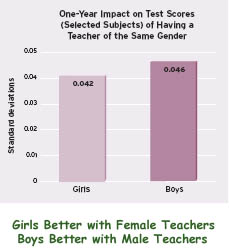
Boys learn better from male teachers, and girls learn better from female teachers. That should not be surprising, given that statistically males and females use different thinking strategies to perform the same mental tasks. A male teacher can teach boys male thinking strategies better, and a female teacher can better teach girls female strategies. Eide Neurolearning blog looks at the improved performance of students when schools provide teachers of their own gender.
What to do about this? There probably will be no quick fix, as gender differences among teachers are fairly steady. It might be that the gender divide among teachers might make it more difficult for students to buck gender predictions - like girls in math and science, or boys in language arts. Parents would do well to be on the alert for this - and if appropriate, search for tutors, mentors who could help.
Source.

Male teachers are becoming an endangered species. According to this CS Monitor story:

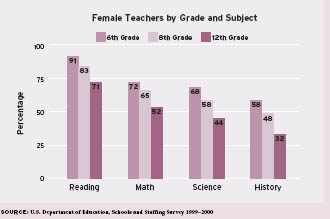
There seem to be fewer than ever these days. Just 21 percent of the nation's 3 million teachers are men, according to the National Education Association (NEA). Over the past two decades, the ratio of men to women in the classroom has steadily declined. Today it stands at a 40-year low.

"The teaching profession is definitely dominated by females," says Donald Washington, senior program analyst for the NEA.

The shortage of male teachers is most pronounced in elementary school, where men make up just 9 percent of teachers, but middle schools and high schools also suffer from a male-female imbalance.

Currently, in secondary schools, about 35 percent of teachers are men - the lowest level ever for the profession.


There are many ways that government schools fail students and their families, and the gender imbalance--whether from anti-male bias or no--adds significantly to the injury that society suffers from its schools. If you want a reason why the proportion of males in universities in North America is dropping, this gender disparity is one important one.

Labels: ,

Bookmark and Share

19 September 2006

National Academies of Science Report Recommends Forcing Women Against their Will

A recent report from the National Academies of Sciences (NAS) can find no "good" reason why women are deciding not to go into tenured university positions in upper level science, math, and engineering. The committee of "experts" nevertheless recommends broad, sweeping and massively expensive changes to the way that the US federal government, large foundations, and universities deal with the issue of women in the sciences.

A committee of experts looked at all the possible excuses -- biological differences in ability, hormonal influences, childrearing demands, and even differences in ambition -- and found no good explanation for why women are being "locked out".
Source.

Women have made astounding gains in education in North America, the committee admitted. But since women are not choosing to go into science and math PhD teaching positions in elite universities at the same rates as men, they should be forced to make other choices than they would choose for themselves, the report implies. If women with top level mathematics and scientific skills are making other career and life choices, such as private industry labs, think tanks, or government labs--then society needs to spend massive amounts of money to force them to change their minds.

Forty years ago, women made up only 3 percent of America's scientific and technical workers, but by 2003 they accounted for nearly one-fifth. In addition, women have earned more than half of the bachelor's degrees awarded in science and engineering since 2000. However, their representation on university and college faculties fails to reflect these gains.
Source.

Well, of course, if women have different goals for themselves than the goals that this particular NAS committee has for them, the women should be forced to change--there is no other conclusion to be drawn.

Women make up over 70% of psychologists with graduate degrees. Women are achieving parity (and greater) in most law schools and medical schools. Women make up almost 60% of recipients of bachelors degrees in North America, and since it takes time for the wave of women graduates to roll through higher education and university faculties, one can expect even greater gains in those areas for women. There is nothing that motivated women cannot accomplish in the free atmosphere of North America and Europe.

Yet, for political reasons, a NAS committee has recommended massive overhauls to the operation procedures for government funding, large foundation grants, and university policy, so that women can be favoured in science, math, and engineering--even if women by themselves would make other career and life choices.

There are some women who are clearly as good as the highest level of male scientists and mathematicians, and who should have the opportunity--if they choose--to go to the highest levels of those fields, within universities or any other system that employs scientists and mathematicians. Some of them are choosing to go into other areas of employment than tenured PhD university employment. This seems to distress Donna Shalala and other highly politicised members of the NAS committee.

This topic should enjoy an interesting discussion on the web. I see that Gene Expression blog already has posted on this report. Of course, anyone interested in the underlying science in this issue should read this La Griffe du Lion essay on women in science and this essay on women in mathematics.

This NAS report is an expensive "Ode to Cluelessness." Not so much on the part of the committee members, who clearly know what their own ambitious goals are, as on the part of anyone who takes it seriously.

Labels: , ,

Bookmark and Share

24 April 2006

IQ by Gender and Race: An Appeal to End the Practise of Brainbinding

We begin with a study comparing "g" of males and females, from 100,000 SAT scores. This article will appear in "Intelligence" and is reported by Dienekes Anthropology Blog. The following is the study abstract:

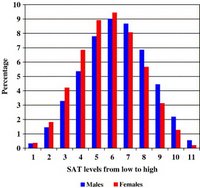
In this study we found that 17- to 18-year old males averaged 3.63 IQ points higher than did their female counterparts on the 1991 Scholastic Assessment Test (SAT). We analysed 145 item responses from 46,509 males and 56,007 females (total N = 102,516) using a principal components procedure. We found (1) the g factor underlies both the SAT Verbal (SAT-V) and the SAT Mathematics (SAT-M) scales with the congruence between these components greater than 0.90; (2) the g components predict undergraduate grades better than do the traditionally used SAT-V and SAT-M scales; (3) the male and the female g factors are congruent in excess of .99; (4) male–female differences in g have a point-biserial effect size of 0.12 favoring males (equivalent to 3.63 IQ points); (5) male–female differences in g are present throughout the entire distribution of scores; (6) male–female differences in g are found at every socioeconomic level; and (7) male–female differences in g are found across several ethnic groups. We conclude that while the magnitude of the male–female difference in g is not large, it is real and non-trivial. Finally, we discuss some remaining sex-difference/brain-size/IQ anomalies. Source.

This is not significant, societally, although it is consistent with Lynn's and other researchers' previous results, inconsistent with others, and very politically incorrect. Individuals do not follow statistical distributions and should not be judged by them. You should notice the difference in this distribution from population distributions, due to selection from the pool of SAT takers, rather than the general population.
The second part of this posting deals with Lynn's new book, Race Differences in Intelligence. This comes courtesy of iSteve.com, and Sailer's article discussing the book is worth reading. After discussing Lynn and Vanhannen's IQ and the Wealth of Nations, Sailer moves to Lynn's new book:

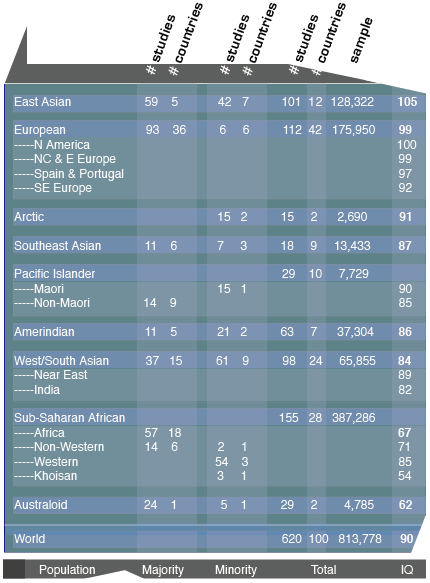
Now, Lynn has a new book out, Race Differences in Intelligence, which tabulates 620 separate studies of average IQ from 100 different countries with a total sample size of 813,778. That's nearly four times the number of studies summarized in his book with Vanhanen. (Here is J.P. Rushton's review on VDARE.com, and here is Jason Malloy's review on GNXP.com.)

This profusion of data allows us to do analyses of important issues that haven't been feasible before.

Source. Be sure to read James C. Bennett's reply and objections at the source above. There are places on the net where discussions are freewheeling and relatively unrestricted, as long as you are civil and intelligent. If there is anything to Lynn's theory of "IQ and the Wealth of Nations," immigration policy planners might reconsider their policies.
You see what I mean about not politically correct? Most conventionally educated students and graduates are not prepared for anything so far out of the mainstream. Just like the ancient Chinese tradition of footbinding, the brains of modern students are bound by politcally correct restrictions on what they can read and discuss. How uncomfortable for them, then, when the cognitive dissonance of the real world sets in. Brainbinding--what a comfort, eh? How much better to confront the student with the ideas in all their wickedness, and discuss them honestly to the best of scientific knowledge--understanding that science does not stand still?

The professors are themselves victims of brainbinding, often self-inflicted. Universities should be places where minds are unbound, and introduced to the complex inter-dynamics of a broad range of ideas. That is presently a lost ideal, but one worth pursuing.

Labels: ,

Bookmark and Share

26 March 2006

Gender Difference: The Gap that Will Not Close

At the elite levels of sports and athletics, the gender gap is prominent and resists closure. There is an approximate 15 minutes difference in the best times of elite male marathoners, and elite female marathoners. Other sports show similar differences at the elite level.

Remember when it was predicted that intensive training for women in athletics would close the gender gap in performance? Some years ago, when the marathon was first becoming a competitive event for women, the rapid improvement in female times led some to predict that female performances would soon equal those of men in the marathon. This has not happened, and it won't. The current world record for women is 2:21, compared to 2:06:50 for the men, a difference in speed of about 10%. This same 10% gap is present across the distance running performance spectrum The reason for the performance gap is not that women don't train as hard as men. There are some important physiological differences between the sexes that can't be overlooked or overcome.

....The "typical" young untrained male will have an absolute VO2 max of 3.5 liters/min, while the typical same-age female will be about 2 liters/min. This is a 43% difference! Where does it come from? Well first, much of the difference is due to the fact that males are bigger, on average, than females. Us humans are all (sort of) geometrically similar, so heart size scales in proportion to lean body size . If we divide VO2 by bodyweight, the difference is diminished (45 ml/min/kg vs 38 ml/min/kg) to 15 to 20%, but not eliminated.

....It is important to make note of the fact that these differences are "on average". In reality, there are many women with significantly higher VO2max values than average men. However, if we look at the "best of the best", the differences persist. Using XC skiing as an example from here in Norway, the highest reliable values for VO2 max recorded in national team XC skiers are about 90 ml/min/kg. The very best Norwegian woman has been measured at 77 ml/min/kg, a 17% difference. So, while this woman will outperform 99.9% of all men, she will not out-perform the national team level males.


Read more here.

A number of studies have demonstrated that boys inherit a performance advantage in athletics, for both pre-puberty, and even more so in post-puberty.
The stopwatch does not lie, and whether in swimming, running, weightlifting, shot put, bicycling etc. the superior VO2 max and muscle mass of males prevents the gender gap in athletics from closing. The only way to narrow the gap is to train the elite athlete girls and confine the elite athlete boys in restraints to encourage muscle atrophy and loss of VO2 max.

In the cognitive realm, you see a similar phenomenon in the measures of spatial ability and mathematical ability at the elite levels. Although hope springs eternal that training will narrow the gap, as in athletics, sometimes it seems that the only way to narrow the gap is to train the elite girls and prevent the elite boys from training somehow.

One can be excused for wondering why all the excitement about male superiority in a small area of elite cognitive performance? The number of jobs involved is minimal. Certainly an intelligent businesswoman, female physician, or female lawyer, can make much more money than an elite mathematician, physicist, or engineer. What is all the near-hysteria about?

Average intelligence levels of men and women test virtually identical. A 1995 study examined the performance of more than 100,000 American adolescents on various mental tests. The study found that on average, females performed slightly better than males on tests of reading comprehension, writing, perceptual speed, and certain memory tasks. Males tended to perform slightly better than girls on tests of mathematics, science, and social studies. In almost all cases, the average sex differences were small.

And here is how developmental psychologist David C. Geary puts it:

There was no sex difference on the IQ test, but males showed significantly higher mean scores on the arithmetical computations, arithmetical reasoning, and spatial cognition measures. A series of structural equation models indicated that individual differences in arithmetical reasoning were related to individual differences in IQ, spatial abilities, and computational fluency. Moreover, the results suggested that the male advantage in arithmetical reasoning is mediated by the male advantages in both computational fluency and spatial cognition.

Women are graduating from schools of higher education at a rate of 6 to 4 vs. men. Women have achieved virtual parity in schools of medicine and law, and make up about 70% of graduate psychologists. Women are achieving phenomenally in the modern world, and if any gender should be worried about current trends, it is the males. A few men are holding on under siege, to a small sliver of cognitive excellence, and all that many psychologists can think of doing is to try to eliminate the small gap within that tiny sliver of cognitive performance.

It is a fascinating study in academic frustration--the data will simply not behave in a politically correct fashion. Many more research studies and outreach programs will be mandated, however, to erase that gap. But I can tell the gender psy-sers exactly how to erase the gap, and I will not charge for the valuable information. Simply prescribe pro-androgenic drugs that cross the placental barrier, to pregnant women in their second trimester, who are carrying female fetuses. Some additional androgenic supplementation may be necessary at different time periods after birth--and there will be potentially unpleasant side effects. Hirsutism, deep voice, skin blemishes, a certain manly aggressiveness, etc. But all of that would be a small price to pay to erase the gender gap in this one small remaining area of academics, no?

Just as there are elite women athletes who can defeat 99% of males in their sport, there are women mathematicians and physicists who are better at their trade than 99% of males. But they are not competing against those 99%. They are competing against the elite males, a very small number, but a significantly greater number than the number of elite females in those vocations. That is the hump that the gender Procrusteans are incapable of leveling. The relatively tiny number of male elites in a relatively tiny number of fields who will simply not go away.

Lawrence Summers paidwith his job, for making a very timid suggestion about possible biological gender or sex differences in that very small, elite sliver of academic professorship in a few top rank schools. The politics of this subject are absolutely deadly to anyone in a public position who lets down his guard for even a moment.

But why? I will deal with the real reasons for the excitement in a later posting.

Labels: , ,

Bookmark and Share
Older Posts
Al Fin Main Page
Enter your Email


Powered by FeedBlitz
Google
WWW AL FIN

Powered by
Blogger

``