08 January 2013

Global Flow of Human Resources

When we think of a global brain drain, we typically think of third world countries in Africa, and emerging nations in Asia and South America. Despite some recent boom years, even Russia and China are losing significant numbers of their best and most ambitious scientists, engineers, and professionals.
More than 150,000 mainlanders [Chinese] obtained overseas citizenship last year, meaning they have made a new home, or an alternative one. The report says the rich and educated elites are becoming the main force in the latest round of emigration, and that many had left in search of a more democratic society, a cleaner environment and better educational opportunities. The main beneficiaries were the US (87,000), Canada and Australia (30,000 each) and New Zealand (6,000).

Li Xiaogang, a research director of the Shanghai Academy of Social Sciences, says the elite are leaving because China's social and political development has not kept up with the economic environment in which they achieved their success. _Chinese Emigration
Even plucky Israel, with a loyal and vibrant, hardworking and intelligent population, loses educated and skilled people to lands with perceived greater opportunity.
Most Israelis who are headed abroad in search of economic opportunities or furthering their professional careers have their sights set on the United States, although the ultimate destination is largely a function of educational achievements. Emigrants from Israel to the United States tend to be more educated or professionally qualified than those choosing other destinations,...

...Among emigrant families where both spouses were born in Israel, 64% went to the United States, 18% to central or western Europe, 3% to eastern Europe and 15% to other destinations.

...Of the emigrants with undergraduate degrees, 60% went to the United States and 20% to Europe, while for those with a master's degree these figures were 62% and 19%, respectively. Among the Israeli emigrants with a medical degree, 72% chose the United States and 7.6% headed to Europe. For those with a Ph.D., these numbers were nearly 80% and 13%, respectively. _Haaretz
Even highly skilled and educated professionals and scientists from the UK and Europe are leaving for better opportunities in Canada, the US, Australia, and Switzerland. (PDF)

Of course, under US President Obama, US economic prospects continue to be tenuous -- with large numbers of business leaders complaining about the Obama administration's anti-private sector bias, and a high level of uncertainty as to crucial future economic policies in the US. Such dissatisfaction with the economically incompetent US president has kept US employment levels and new business startups suppressed far beyond what would have occurred in a normal recovery.

The prolonged Obama recession has led to what many in the media have labeled a "reverse brain drain" back to countries of origin for many educated emigrants and persons on educational visas. But in the larger scheme of things, such a "reverse brain drain" constitutes more of an eddy current than a genuinely significant counter-current -- at least so far.

Give Obama enough time to wreck the US economy, and such a reverse brain drain may well develop in earnest. That would require rational economic policies to be instituted in other countries, of course, which is not typically seen these days.

Labels: , ,

Bookmark and Share

12 December 2012

Out of All the Possible Futures . . .

The future is not set in stone. There are always a number of possible futures -- strange attractors -- ceaselessly battling each other for the opportunity to evolve into a transient reality and instantiation.

Mega-Egali-Dystopia

As crucial elections pass and the world moves more deeply into a narrowing set of futures, a few things become more clear. Almost none of the possible futures which have been predicted by pundits, bureaucrats, visionaries, and speculative writers, are likely to come about. That is because the future cannot be created deliberately in the manner of conventional construction. Instead, the future must be facilitated and channeled by the erection of specific, well-placed constraints, keeping in mind the natural forces underlying the movement of humans through time.

The set of constraints being erected by the great powers as of today, combined with apparently inexorable demographic forces at work across the globe, increase the likelihood of a global dystopia of poverty, low intelligence, and constant, low-level violence.
The world’s urban population is expected to grow by 2.6 billion people between 2011 and 2050, bringing the total number of urbanites to 6.3 billion. This urban expansion will be especially burdensome for developing countries, where 82 percent of the world’s population currently lives...

Slum populations are expected to grow significantly in the future, and UN HABITAT projects that 6 million more people live in slums every year.

The World Health Organization identifies the rapid increase of urban populations, especially slum populations, as the most important issue affecting health in the 21st century. The agency cites overcrowding, lack of safe water, and improper sanitation systems as the primary factors contributing to poor health among the urban poor. Slums often become breeding grounds for diseases like tuberculosis, dengue, pneumonia, and cholera, and slum dwellers contract water-borne or respiratory illnesses at much higher rates than people in rural areas do.

Cities and their slums will continue to grow as long as rural populations continue to migrate to cities to find economic and other opportunities, such as access to cultural amenities, education, and health care. _Worldwatch_via_GCC
Across the more developed world -- from North America to Europe to Oceania to East Asia -- populations are aging, fertility is falling far below replacement, and these generally more intelligent and accomplished societies of the world are embarking upon a grand experiment of group extinction. These populations which accomplished so much over a fairly short period of time, appear to have chosen to fade away.

Decline of Average Global IQ Over Time

...nearly all of the world's annual demographic growth - close to 95 percent - is occurring in less developed regions. Top seven contributing nations are India, 22 percent; China, 9 percent; Nigeria, 5 percent; Pakistan, 4 percent; Indonesia, 3 percent; Brazil, 2 percent; and Ethiopia, 2 percent

...African birthrates... stand at more than 4 children per woman, with some countries, such as Mali, Niger and Uganda, continuing to have rates above 6 children per woman. Such fertility rates, though expected to decline, translate into rapid population growth for most sub-Saharan African countries for the coming decades. For example, with a current fertility rate of 5.5 children per woman projected to decline to 3.5 children per woman by 2050, Nigeria's population of 162 million more than doubles to 390 million over the next 40 years.

...The consequences of these major demographic changes affect every aspect of human society, including food, natural resources, economic well-being, security, revenue, politics, employment and healthcare. Neither political rhetoric nor wishful thinking can dispel the enormous impacts. _Demographic Trends Shaping the World


Of those who are left after the depopulation of the advanced world -- the primitive tribal societies of Africa and Asia along with the emerging nations -- only China is likely to have the wealth, resources, technological expertise, and infrastructure to persist in creating grand visions of great futures.

And China is virtually certain to split at the seams into competing factions -- some of them based in modern China, others based overseas in Africa, Latin America, and areas that were formerly part of Russia, Oceania, and Europe.

Already we see the beginnings of "the coming anarchy" across the middle east, central Asia, and sub Saharan Africa. The fault lines for civil wars are setting up across a number of countries in Latin America. The forces of secession are erupting from the UK, across Europe, penetrating deeply into the US and Canada, and are likely to grow in intensity as global instability builds. The schisms -- both old and new -- are building, reaching well into the emerging BRICS -- Russia, China, India, Brazil -- and throughout the first and third worlds.

Up until now, the US has been an anchor to which Europe, Oceania, and Latin America could grudgingly hold -- and an oppositional brace against which Russia, China, and their satellites and hangers-on could orient. But it is clear that the US cannot sustain its role as world-policeman, world financial guarantor, world guardian of the trade lanes, world rescuer in times of war and natural disaster, or world anchor.

The US is now undergoing a designed stealthy undertow and dissolution of internal cohesion and external power that is slowly releasing more and more parts of the world to their own fates. A slow destruction which was already occurring through blind corruption and ambition is now taking place by craft and planning. That intentional process of dissolution of cohesiveness and strength can only accelerate with the re-selection of the current US president for yet another 4 year rule.

The moderating powers of Europe, North America, and Oceania on world affairs are dissipating.
Things fall apart; the centre cannot hold;
Mere anarchy is loosed upon the world,
The blood-dimmed tide is loosed, and everywhere
The ceremony of innocence is drowned;
The best lack all conviction, while the worst
Are full of passionate intensity. _WB Yeats . . . The Second Coming
There is no need for peak oil, climate catastrophe, resource collapse, global overpopulation, and all the other bugaboo tools of leftist scare-mongering -- all of those meant only to facilitate the grab of power and resources, after all.

Violence, Fertility, and Low IQ Most Prevalent Among Third World People

Everything needed for a collapse of civilisation after the style of Mao, Pol Pot, or Kim, is contained within the weaknesses of human nature combined with the demographic forces at work around the globe.

Parts of the "civilised world" are likely to cohere and fortify themselves against the coming anarchy. Other parts will ally themselves with the anarchy, in an attempt to bring down the remaining foci of a livable future. Much will depend upon where one happens to be when the camels' backs begin to break.

This is where I am supposed to write: "And then I woke up, and it was all a dream."

But was it really? The shape of the shakeout above is only one out of all the possible futures. Yet the forces of dissolution and anarchy are certainly hard at work. They have always been and always will be as long as humans are what they are. Pax Americana was never meant to last forever, just as Pax Romana and Pax Brittanica could not last.

Those periods of transition can be a bit difficult, and quite unpredictable. You have choices: You can choose to fight a courageous holding action, a la The Tea Party movement and the like. You can take your chances and try to profit from the turbulent volatility in markets around the world. You can sit on your laurels and accept whatever comes. Or you can find a good place to hunker down. If you choose to hunker, be advised that there are no guarantees as to how long you will have to wait for TEOTWAWKI. You may find yourself hunkered for quite some time. ;-)

Hope for the best, prepare for the worst.

Labels: , , , ,

Bookmark and Share

25 November 2012

When Exploding Debt Meets Collapsing Demography

Most developed nations have become trapped in a hopeless situation. Their populations are ageing rapidly -- reducing their tax and investment base -- while the government's size and level of debt are exploding out of control. There is no easy answer.
Financial Times

The 1982-1999 bull market was driven by the post-war baby boom, which resulted in a bulge in the numbers of working-age adults and the core savings group. That has ominous implications. Facing current trends in birth rates and rising life expectancy, a growing body of economic research suggests that the rates of stockmarket growth enjoyed by investors during the 1980s and 1990s are gone for at least a generation - and possibly forever.

But another factor was at work, too: demography. The 1982-1999 bull market was driven by the post-war baby boom, which resulted in a bulge in the numbers of working-age adults. Those adults are now retiring, having spent too much time working and not enough time procreating.

Falling birth rates and rising life expectancy have left the industrialised world with a demographic profile very different from that of the 1950s. There is a growing body of evidence to suggest that sharply ageing populations will weigh on both economic growth and asset values for years, if not decades to come. _FT
Japan demonstrates the phenomenon most clearly, but most of Europe is following close behind. South Korea also has low birthrates and is experiencing societal ageing.
If one wanted to look at asset values in the industrialised economy most representative of population ageing, that would be Japan. It has sharply declining fertility rates, net immigration of virtually zero and the longest-lived population of any large economy. Its stock market peaked in the late 1980s – at about the time the size of its working age population did – and has atrophied ever since. _FT
Japan has very restrictive immigration policies, and is attempting to replace as much of its vanishing workforce as possible using robot labour and other types of automation. Europe has attempted to immigrate its way out of its looming disaster of debt and demography -- but has not been able to find sufficient high quality and culturally assimilable immigrants to replace the vanishing Europeans.

The Anglosphere -- the US, UK, Canada, Australia, New Zealand, Ireland etc. -- present a mixed picture, but are following on the same general path as Europe and Japan, complicated mainly by very mixed patterns of immigration.

The FT article quoted above looks mainly at the affect of ageing on investment and asset classes. In reality, the problems faced by rapidly ageing societies with the additional burden of deeply indebted and bloated national governments, go far beyond problems of investment.

Not only does the productive workforce population shrink in an ageing population, but the military age population likewise shrivels away. The numbers of creative and inventive people will diminish even more quickly -- since the contemporary pattern is for the most intelligent and ambitious men and women to remain childless, or to have perhaps one trophy child.

It is not entirely a coincidence that a catastrophic ramp-up of public debt is occurring in most of these countries at the same time as these societies age and lose their ability to pay back the debt. But the results of the coexisting destructive trends will be much worse for having occurred contemporaneously.

There is nothing that anyone can do for these societies as a whole. But if one is particularly attached to one small piece of one of these countries, there are preventive steps that one might take to make his community more resilient to the challenges that are coming.

In subsequent postings, we will look at some thoughts on why some communities commit to the idea of a future, while other communities have difficulty looking past a very narrow and limited view of the present.

Labels:

Bookmark and Share

12 November 2012

Is Entire Human Race -- Not Just US Voters -- Getting Stupider?

Stanford University genetics professor Gerald Crabtree, thinks humans have been dumbing down for some time now. He may be right, but not necessarily for the reasons he thinks.
...rather than getting cleverer, human intelligence peaked several thousand years ago and from then on there has been a slow decline in our intellectual and emotional abilities.

Although we are now surrounded by the technological and medical benefits of a scientific revolution, these have masked an underlying decline in brain power which is set to continue into the future leading to the ultimate dumbing-down of the human species...

...Life as a hunter-gatherer was probably more intellectually demanding than widely supposed, he says. “A hunter-gatherer who did not correctly conceive a solution to providing food or shelter probably died, along with his or her progeny, whereas a modern Wall Street executive that made a similar conceptual mistake would receive a substantial bonus and be a more attractive mate,” Professor Crabtree says. _Independent
Our Fragile Intellect -- PDF article by Gerald Crabtree discussing his theory

From a newsrelease on the study:
"The development of our intellectual abilities and the optimization of thousands of intelligence genes probably occurred in relatively non-verbal, dispersed groups of peoples before our ancestors emerged from Africa," says the papers' author, Dr. Gerald Crabtree, of Stanford University. In this environment, intelligence was critical for survival, and there was likely to be immense selective pressure acting on the genes required for intellectual development, leading to a peak in human intelligence. From that point, it's likely that we began to slowly lose ground.

With the development of agriculture, came urbanization, which may have weakened the power of selection to weed out mutations leading to intellectual disabilities.

Based on calculations of the frequency with which deleterious mutations appear in the human genome and the assumption that 2000 to 5000 genes are required for intellectual ability, Dr. Crabtree estimates that within 3000 years (about 120 generations) we have all sustained two or more mutations harmful to our intellectual or emotional stability. Moreover, recent findings from neuroscience suggest that genes involved in brain function are uniquely susceptible to mutations.

Dr. Crabtree argues that the combination of less selective pressure and the large number of easily affected genes is eroding our intellectual and emotional capabilities. _MXP
On the other hand, there is the 10,000 Year Explosion hypothesis, which outlines how modern Ashkenazi Jews evolved into the most intelligent and productive -- in a scholarly sense -- of all modern populations.

According to the 10,000 Year Explosion, civilisation actually accelerated human evolution in good ways.

And don't forget the "Lynn - Flynn Effect" (first discovered by Richard Lynn, but grand-standed by James Flynn). According to Flynn's interpretation, in some ways, modern humans are becoming more intelligent than their immediate ancestors, in terms of IQ test scores, at least.

But if we step back from the more focused viewpoints of Crabtree, Cochran & Harpending, and James Flynn, and look at the species as a whole, we see that the global IQ actually is decreasing -- but for different reasons than given above.


Because of differential birthrates between persons of high intelligence and persons of low intelligence, offspring from low IQ matings are much more numerous than offspring from high IQ matings -- and becoming exponentially more so over time.

There is nothing mysterious about this mechanism for the dumbing down of the species, although there is a great deal that is politically incorrect about it -- which is why you will not see it being taught in government schools anytime soon.

If you haven't seen the film Idiocracy, consider looking it up. It would be worth it just for the first 5 or 10 minutes. Here is a preview:


Pay attention to the family tree for the two featured family groups. Notice how the one family tree grows exponentially, while the other withers away.

Regardless, those who are concerned about the intermediate and long term future of the human species will need to pay attention to all levels of demographic change, from the molecular to the national and global.

And then there is the concern over a decline in the number and quality of human sperm -- popularly depicted in the book and film, The Children of Men. While recent Danish research tends to have refuted the idea of a decline in human sperm, males who produce prolific amounts of high quality sperm may be able to supplement their incomes as sperm donors. BTW, at the blog Al Fin, You Sexy Thing!, our writers take a look at the phenomenon of Semen Therapy, a new way for young men to pay their way through college.

The most significant force which is likely to counter-act any natural decline in human intelligence, is the fact that a lot of smart people want to become smarter. And since the genetics of cognition is approaching the stage where humans may be able to intervene to make new generations of humans more intelligent, the possibility of the "engineered evolution of cognition" is becoming a bit more probable as western science progresses.

There are many forces at work shaping the evolution of humans on planet Earth. We should not assume that evolution naturally leads to greater fitness or sophistication. Natural selection would be just as happy to see humans dumbed down as to see them grow smarter. Most corrupt politicians would prefer to see them dumbed down -- they are easier to manipulate that way.

Labels: , , ,

Bookmark and Share

10 November 2012

A Grim Destiny Hidden Beneath the Glitter

The destiny of Japan -- and all modern nations including those of the west -- is obscured by the gee-whiz! glitter of modern technology and media. Everything at surface level is meant to distract the attention of moderns from what is happening under the surface. For example, look under the glitzy surface of Tokyo and what will you find?
One cause of depopulation, which is likely to lead to the downfall of Japan if it is not reversed, is a collapse in the total fertility rate (TFR) for Japanese females in their child-bearing years (from 15-49). This TFR fell precipitously from 5.10 in 1925 to an exceptionally low 1.39 by 2010 (compared to a UN world average of 2.52 for 2010). [5] The replacement rate for a population is two children per woman. With its TFR not just below 2 but now under 1.5, it is not surprising that Japan’s population is shrinking and getting older. The CIA World Factbook ranks Japan 202 out of 222 countries in its country comparison table for TFRs. [6] Japan’s net reproduction rate fell by over half from 108.2 in 1925 to 44.0 by 2010.

Ominously, such a depletion of population will be accompanied by an equally significant fall in economically active citizens (those in the working age bracket of 15-64).

This shrinking population with its declining workforce will also be ageing. Sadly, the only aspect of Japan’s population which will continue to grow relative to other age groups will be its senior citizenry (those aged 65 and over).

The mean age of the Japanese is expected to rise from 45 years old in 2010 to 54.6 years old by 2060. [7] We are looking at the world’s oldest society. [8] _Demographic Sunset of Japan
Fewer productive workers and builders -- combined with more sick and elderly dependent upon government social benefits -- will lead to a more impoverished nation. Robots can compensate for a portion of this worker deficit, but anyone who believes that robots can keep Japan wealthy in the face of such a monumental demographic change, has an impoverished and dysfunctional mental model of how societies evolve.
The pyramids in the chart shows Japanese demographic spreads in 1950, 2008 and the projected in 2050, with Age on the vertical axis and Millions of People on the horizontal. You can see the huge increase in the Over 65’s over the three charts and the huge decline in the under 14’s. Japan’s population is shrinking and ageing rapidly.

What are the implications of this?

As the population ages, the greater the reliance will be on government welfare and aged services. This means that there will be even greater strains on government debt as less and less people are contributing to wealth through income tax and more and more people rely on government hand-outs.

In a nutshell, the Japanese economy has been in systematic decline since its peak in 1990, and the government has tried everything in the Keynesian book of economics with little or no effect except the racking up of massive debt for 20 years now. _Japanese Meltdown
What is happening in Japan is also happening in Europe, South Korea, North America, and Oceania. The decline is masked somewhat by immigration. A very small proportion of immigrants to Europe and the Anglosphere are cracker-jack entrepreneurs and professionals who add to national productivity and GDP. Unfortunately -- due to dysfunctional government immigration policies -- a large number of perpetual social welfare dependents are also immigrating, leading to a significant net depletion in productivity and prosperity over the long run.

The demographic decline that we see clearly in Japan due to a lack of immigration, is happening at ramming speed in the modern west, within their core populations. The core populations of a prospering society, are the central ethnic and cultural populations which have fostered the underlying prosperity. When doing demographic projections, if you look mainly at the core populations, you will see exactly the same phenomenon across the western world, as you see in Japan.

OECD sees global growth slowing as a result of ageing populations

Many readers have suggested that we at Al Fin spend too much time on demographic issues. Perhaps some would rather be distracted by the glitter-news of new iPads, Androids, or any number of "technological wonders" with which modern media obscures disastrous underlying trends in society.

You should know by now that the writing staff here at the Al Fin Blogging Syndicates will write about whatever they think is interesting and important, regardless of expressed reader preferences. There are more than enough media sluts out in the skankstream media.

Hope for the best. Prepare for the worst. And remember that it is never too late to have a dangerous childhood.

Labels: , , ,

Bookmark and Share

31 October 2012

Europe is Facing a Moment of Truth Largely Unawares

Europe is growing older, but not wiser. Debt is piling on top of debt, unemployment is rising, and workforces are ageing rapidly.
Pension and other welfare benefits, promised long ago when the workforce was expanding quickly, are at the heart of Europe’s current fiscal convulsions, which are perhaps a harbinger of worse to come. In David Canning’s view, the 2008 crash and its aftermath have merely moved up a long-inevitable implosion by 10 to 15 years. European nations “had unrealistic systems that were eventually going to cause a crisis,” he told me. _Megan McArdle
Low birthrates and a rapidly ageing workforce are not compatible with the European welfare state. There are not enough bailouts in the world to compensate for such a self-made decline.
In the European Union, how many nations will fall into irretrievable debt before Mario Draghi or Angela Merkel suggest that Europe’s 20th-century entitlement systems are incompatible with 21st-century demographics? And how many more G-8 and G-20 summits will pass without mention that two people turn age 60 every second of every minute – with an obvious impact on core questions of fiscal sustainability unless profound social and economic changes put in place that align with our new century’s demographic realities? _Fiscal Times
European unemployment is rising for a number of reasons, among them high taxes, burdensome EU regulations, and a policy of energy starvation from the top down.
Unemployment in the 17-country eurozone hit a record high of 11.6 percent in September, official figures showed Wednesday, a sign the economy is deteriorating as governments struggle to get a grip on their three-year debt crisis. _MiamiHerald
The European middle class is under assault, according to some sources. Certainly the old regime of guaranteed employment and early retirement is under assault by the harsh realities of the global economy, as exacerbated by European demographic decline.

Moving into this turbulent dynamic, to fill the demographic gap which reluctant European women are creating, are large numbers of immigrants from Africa and Asia. Many of these immigrants are untrained, uneducated, do not speak European languages, and are culturally unable and unwilling to assimilate.

One possible demographic scenario for the future of Europe, would be the significant replacement of native European populations with less advanced populations from the outside. These abundant newcomers may be antagonistic to an ageing Europe's cultural norms.

The video above presents a broad outline of one possible scenario of demographic change. As you will see if you view it completely, the video approaches the problem from the viewpoint of one religion being displaced by another. But the concept also applies to cultural and civilisational replacement, via demographic change.

Europe faces a moment of truth, largely unawares. Her people are being told everything else except what they need to know to preserve themselves, their families, and their cultures.

The end result may not be pretty.

Labels: , ,

Bookmark and Share

20 October 2012

Going Extinct? President Obama and the Childless Women Who Adore Him So


Childless Unmarried Women Look to Obama as their Prince

...Unmarried women (along with ethnic minorities, the poor and the workers in the public bureaucracy) are rapidly becoming a core constituency of the Democratic party, in a sense replacing the ethnic white working class.

In the short term at least, the president and his party are seizing a huge opportunity. Since 1960, the percentage of the population that is over age 15 and unmarried increased by nearly half, 45 percent from 32 percent. Since 1976, the percentage of American women who did not have children by the time they reached their 40s doubled, to nearly 20 percent.

...There are now more houses with dogs than houses with children. _Joel Kotkin
DB: Obama Adored by Childless Women

In 2008, singles helped put Obama over the top, something widely recognized by party leaders. This summer’s surge in Obama’s ratings also derived largely from his growing appeal to single voters, and particularly women.

This reliance on single and childless voters could transform the Democratic party in the years ahead.

...But the Single Nation’s grip on power may not be sustainable for more than a generation. After all they, by definition, will have no heirs. This, notes author Eric Kauffman, hands the long-term advantage to generally more conservative family-oriented households, who often have two or more offspring. Birth rates among such conservative populations such as Mormons and evangelical Christians tend to be twice as high than those of the nonreligious. _Joel Kotkin

Obama Baby Bust

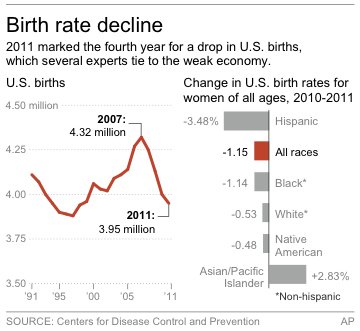
President Obama's reign has had a depressing effect on US birthrates -- much like the depressing effect it has had on the US economy as a whole.
U.S. births fell for the fourth year in a row, the government reported Wednesday, with experts calling it more proof that the weak economy has continued to dampen enthusiasm for having children. _Baby Bust

Women choose not to have marry and have children for a variety of reasons, including a lack of faith in the future. A depressed sense of the future may be due to economic or environmental beliefs, personal /emotional forebodings, radical feminist ideology, or to a vague spiritual void in the lieu of anything real to believe in.

Many of these women will grow to regret their current ideological stubborness and blind faith. But a significant number of them will simply grow old, embittered, and shrivel into ugly husks of their younger, more promising selves.

Dead end or no, they too are a part of the larger circle of life and death. Just hope that they do not cast too many votes for Obama in the coming November US elections. Zombies, as we know, do not understand the concept of honour.

Labels: , ,

Bookmark and Share

25 September 2012

The Destiny of the World, As Told by Demography

According to a leading demographic researcher, Russia, Japan, and Germany are finished as world leaders.
Demographics is destiny, the theme of [David Foot's] Boom, Bust & Echo books, and national outcomes are therefore predictable by charting population mixes...

Among large economies, Germany, Russia and Japan are aging so rapidly they will not be major powers in the future. In all three, deaths will continue to rapidly outpace births every year.

Europe’s exceptions are France and Scandinavia, where social policies have encouraged higher birthrates through generous family benefits, day-care subsidies, lengthy maternity leaves, among other policies.

Southern Europe is hopeless, in terms of birthrates and economic activity. Interestingly, even though Germany ages, the country has overcome its demographic decline by aggressively automating, thus enhancing productivity and economic growth through exports.

_Financial Post
These are the words of David Foot, a Canadian demographer and author.

Foot captures some of the aspects of "demography as destiny," and badly misses other crucial demographic factors. But no one is perfect.
For a country to successfully replace its aging workforce, it needs a birthrate of 2.2 children per family, Foot said. He added that Canada is only managing a rate of 1.7 per family and that means Canada's labour woes are going to get even worse.

"Canada is significantly older than the U.S. and Mexico, with a much bigger percentage in the older-age brackets and ever fewer numbers of young people being born in Canada," said Foot.

...Canada is in better shape than many other countries around the world, said Foot. Italy, Spain and Greece have the oldest populations in Europe, while former powerhouses such as Germany, Japan and Russia have been watching their populations decline significantly.

"These are three countries that are never coming back as global powers. Germany, Russia and Japan are powers of the past ... not the powers of the future."

Foot said the future superpowers include China, India and Brazil while Turkey is emerging as the future power within Europe.

"Within five years a Muslim country will be the biggest market in Europe." _Canadian Business

Russia's immigrant population is growing, and is responsible for recent rises in Russian birth rates.
Russia is now an immigrant society. In Moscow and other major cities, migrants from the ex-Soviet states of Central Asia, the Caucasus and Eastern Europe do the work that natives turn down. Tajiks sweep the streets, Moldovans wait tables and Uzbeks work on construction sites. The metro flutters with flyers stuck inside carriages hawking the mobile numbers of professional forgers -“We Make Your Moscow Permit.”

Russia has become the second most popular destination for migrants in the world after the USA. In St. Petersburg hour long queues snake round the migration bureau where hundreds of migrants nervously swap cigarettes for job tips as they wait to register. Magadan on the Pacific has several Georgian restaurants and even on the dirt tracks of northern Siberia, Uzbek cafeterias are not uncommon.

...In 2009 the Russian Migration Service claims over 10 million migrants entered the country. They add that as many as 5 million illegals“are living in the shadows.” Many experts agree that the migrant population is over 8.5 million, although off the record, some diplomats suggest the real figure may be over 15 million. That would be roughly 8 million more workers that the 6.7 million drop that Russia has recorded since 1991. _Immigrant Russia
Russia has been trying hard for several years to boost its program of legal immigration. At the same time, the Russian government has not been able to stem the ongoing collapse of the ethnic Russian demographic.

The ongoing loss of highly educated and accomplished segments of the population, continues to deal the wounded bear severe demographic blows at the highest levels. And like Japan, Russia's working-age population is destined to shrink precipitously -- particularly in the ethnic Russian demographic.

Ethnic Russians are disappearing particularly quickly in the most resource-rich parts of Siberia, while ethnic Chinese and other non-Russian populations are growing in size and influence.

If one believes Russian government statistics -- and smart people probably shouldn't -- Russian birth rates have "skyrocketed" while Russian death rates have "plummeted." But those statistics -- even if honest -- are rarely if ever stratified by ethnicity for public consumption. It is likely that just as demographer Foot says, Russia's (and Japan's) glory days are in the past.

Unfortunately for Foot's other predictions, the Canadian demographer neglects crucial factors such as average national IQ, market dominant minorities, particular influences of specific political economic ideologies, levels of violence in particular populations, and other devastatingly important factors that affect the wealth or poverty of a nation.

Demographics is indeed destiny. But sometimes even the best demographers fail to understand the full spectrum of demographic influence on societal success.

Try not to make that mistake.

And remember: It is never too late to have a dangerous childhood.

Labels: ,

Bookmark and Share

11 September 2012

Surviving a Modern Race War Part I

Since the Soviet days, Russian intelligence agencies (see Mitrokhin Archive) and other groups have sought to incite racial hatred and violence in western countries. Isolated outbreaks of semi-organised racial mob violence has occurred in the US and Canada for more than 50 years.

Now, under US President Obama, racial antagonism has grown significantly worse. When the president of the United States tells all black audiences that "we've got to stick together," it is clear that racial divisions and antagonisms are also being stoked from the inside.

Humans are territorial animals, and history shows that it doesn't require a great deal of encouragement for racial, ethnic, religious, and cultural groups to resort to violence against one another.

In the US under Obama, one sees a growing malaise among people who have been forced out of work, or have been forced to work in areas other than ones for which they were trained or are better suited. One sees growing frustration among entrepreneurs and businessmen when they are restricted or prohibited by arbitrary government regulations from building and growing businesses and jobs. Greater malaise leads to greater frustration which may eventually lead to violence -- under extreme circumstances.

An example of how a limited, local, modern race war might develop in an inner city location, might help to visualize ways in which the reader might escape the violence before it begins:
The results of these clashes will frequently resemble the intersection of Florence and Normandie during the Rodney King riots in 1992, where Reginald Denny was pulled out of his truck’s cab and beaten nearly to death with a cinder block. If you don’t remember it, watch it on Youtube. Then imagine that scene with the mob-making accelerant of texting and other social media technology added to stoke the fires. Instead of a few dozen thugs terrorizing the ambushed intersections, in minutes there will be hundreds.

Rioters will throw debris such as shopping carts and trash cans into the intersection, causing the more timid drivers to pause. The mobs will swarm the lines of trapped cars once they have stopped. Traffic will be forced into gridlock for blocks in all directions. Drivers and passengers of the wrong ethnic persuasions will be pulled from their vehicles to be beaten, robbed, and in some cases raped and/or killed. It will be hyper-violent and overtly racial mob behavior, on a massive and undeniable basis.

Some of those trapped in their cars will try to drive out of the area, inevitably knocking down MUY pedestrians and being trapped by even more outraged MUYs. The commuters will be dragged out of their cars and kicked or beaten to death. Other suburban commuters will try to shoot their way out of the lines of stopped cars, and they will meet the same grim fate once they run out of bullets and room to escape.

The mob will be armed with everything from knives, clubs and pistols to AK-47s. A bloodbath will result. These unlucky drivers and their passengers will suffer horribly, and some of their deaths will be captured on traffic web cameras. Later, these terrible scenes will be released or leaked by sympathetic government insiders and shown by the alternative media, which continue to expand as the traditional media become increasingly irrelevant. _How America's Cities May Explode into Violence
Such "flash riots" will be facilitated by tweets, instant messaging, cell calls and texts, and other tools of modern communication -- making them more agile and targeted than earlier race riots that most cities may have seen in the past.

It is unlikely that police forces will be able to act quickly or effectively to such agile riots -- deadly though they may be. A citizen reaction -- in the face of ineffective police response -- is highly likely.
When word is received that a flash mob is forming at one of their pre-reconnoitered intersections or highway interchanges, the SAV team will assemble. Sometimes cooperating police will pass tactical intel to their civilian friends on the outside. Some clever individuals will have exploited their technical know-how and military experience to build real-time intel collection tools, such as private UAVs. Police will have access to urban security camera footage showing MUYs moving barricade materials into position—a normal prerequisite to a flash mob riot intended to stop traffic. Tip-offs to the vigilantes will be common, and where the networks are still functioning, citizens may still be able to access some video feeds. Sometimes, police will even join the SAV teams, incognito and off-duty, blurring the teams into so-called “death squads.”

The operation I will describe (and it’s only one of dozens that will be tried) uses two ordinary pickup trucks and eight fighters. Two riflemen are lying prone in the back of each truck, facing rearward, with removable canvas covers concealing their presence. Their semi-automatic, scoped rifles are supported at their front ends on bipods for very accurate shooting. A row of protective sandbags a foot high is between them and the raised tailgate.

In the cab are a driver and a spotter in the passenger seat who also serves as the vehicle’s 360-degree security. The two trucks don’t ever appear on the same stretch of road, but coordinate their movements using one-word brevity codes over small FRS walkie-talkie radios. Each truck has a series of predetermined elevated locations where the intersection in question will lie between 200 and 500 yards away. Each truck is totally nondescript and forgettable, the only detail perhaps being the non-MUY ethnicity of the suburbanite driver and spotter driving relatively near to a riot in progress.

By the time the two SAV pickup trucks arrive at their firing positions on different streets and oriented ninety degrees to one another, the flash mob riot is in full swing. A hundred or more of the rampaging youths are posturing and throwing debris into traffic in order to intimidate some cars into stopping. The riflemen in the backs of the pickups are waiting for this moment and know what to expect, trusting their spotters and drivers to give them a good firing lane. The spotters in each truck issue a code word on their radios when they are in final position. The tailgates are swung down, and the leader among the riflemen initiates the firing. All-around security is provided by the driver and spotter.

Lying prone and using their bipods for support, the shooters have five to ten degrees of pan or traverse across the entire intersection. Individual rioters are clearly visible in the shooters’ magnified optical scopes. Each of the four snipers has a plan to shoot from the outside of the mob toward the middle, driving participants into a panicked mass. The left-side shooters start on the left side and work to the middle, engaging targets with rapid fire, about one aimed shot per two seconds. Since the two trucks are set at ninety degrees to one another, very complete coverage will be obtained, even among and between the stopped vehicles.

The result is a turkey shoot. One magazine of thirty aimed shots per rifle is expended in under a minute, a coded cease-fire is called on the walkie-talkies, and the trucks drive away at the speed limit. The canvas covering the truck beds contains the shooters’ spent brass. If the trucks are attacked from medium or close range, the canvas can be thrown back and the two snipers with their semi-automatic rifles or carbines will add their firepower to that of the driver and spotter.

Back at the intersection, complete panic breaks out among the rioters as a great number of bullets have landed in human flesh. Over a score have been killed outright, and many more scream in pain for medical attention they will not receive in time. The sniper ambush stops the flash mob cold in its tracks as the uninjured flee in terror, leaving their erstwhile comrades back on the ground bleeding. The commuters trapped in their vehicles may have an opportunity to escape. _American Cities Explode in Violence
More theoretical background behind the above author's thinking

As the violence heats up on both sides, those who wish to remove themselves from the cauldron of killing may discover that they have waited too late. This website is full of lessons for survival for those who find themselves caught on the front lines due to failure to plan ahead... via Forward Base B

Under circumstances developing in the US under Obama, limited race war in multiple US inner city locations is not out of the question. Such a limited race war -- if it received enough publicity -- would likely spread to the cities in other western nations beyond the US, including Canada, the UK, and France.

This unfortunate aspect of modern demographic change in the western world should be faced head on, if you wish to maximise the survival chances of yourself and your loved ones. h/t Forward Base B

Labels: , ,

Bookmark and Share

04 September 2012

Can Oil Prices Rise Indefinitely Without Strong Economic Recovery in Europe and the US?

Clouds of recession hover over Europe and are threatening the US, unless significant policy changes are enacted from those existing now. Most advanced nations also suffer from both exploding debt and a demographic decline of their core populations.

Unless the world's wealthy nations resume the buying spree of the "economic bubble period" of the 1990s and early 2000s, rapid economic growth in exporting nations of the emerging world and third world nations remains in doubt.


What would be the effect of such a "top-down economic stagnation" on global oil and commodities prices?

The article below, which considers that question in an oblique fashion, is adapted from an article previously published on Al Fin Energy blog


Why are oil prices so much higher now than they were prior to the 2000s? Much of the difference has to do with the steady stealth devaluation of the US dollar, reflecting the US government's massive debt and deficit spending practises.

Compared to the price of oil in 2010 dollars -- or to the price of oil in gold -- prices prior to the year 2000 were not so much lower as we might think. Two price spikes prior to the year 2000 were comparable to -- or higher than -- our current inflated oil prices.

But there is more to the story than the pitiful performance over time of the US dollar. An explosion of demand for oil from emerging nations -- from the late 1990s to the present -- explain a great deal of the ongoing oil price bubble. Particularly when one takes into account government subsidies for oil which hold the cost of oil use artificially low from Mexico to Venezuela to many MENA countries, China, India, and beyond.

This explosion in demand was the natural result of exploding populations in those countries combined with an emerging consumption sense within those populations fed by global media and a subsequent growing sense of entitlement.
Oil in Nominal vs 2010 Dollars


Comparing oil prices in "dollars of the day" vs. oil priced in either standardised 2010 dollar or gold, brings out more aspects of the dynamic than are generally discussed.
Oil in Dollars vs Gold

In addition to the ongoing stealth dollar devaluation and the demand explosion from the emerging world, oil has become a deeply emotional repository of value for many investors -- reflecting a widespread belief in oil scarcity -- or "peak oil". Savvy traders have exploited this superstition by helping to bring about multiple whiplash spikes and troughs of oil price -- which in the aftermath often leave the smart traders richer, and the superstitious true believers that much poorer.

Of the three drivers of higher oil prices mentioned above, the most likely candidate for the "largest" contributor, is demographic change. Let's look at why this "largest contributor" may not end up being the most important long term contributor to changes in oil prices.

We all know that commodity prices depend upon both supply and demand, as well as a number of somewhat arbitrary and changeable government policies, mandates, regulations, taxes, prohibitions, and other caprices of the generally clueless political class.

Demographic change affects both supply and demand, but demand is the more immediate factor affected by the type of population growth we have seen recently. The explosion of both populations and demand in emerging nations shook the ability of national oil companies to respond -- in large part due to a corrupt failure to pay for necessary maintenance and technological upgrades in oil production. And since most conventional oil reserves fall under the control of corrupt national oil companies, the demand explosion was not immediately accompanied by an equivalent explosion in supply. This mismatch pushed oil prices upward.

But population growth without the ability to pay for more commodities, will not necessarily convert to higher demand, and higher prices. If the regions of population growth cannot pay for more commodities, they will either go without or will be the recipient of unearned aid from wealthier countries.

This is what we are beginning to see across Africa, much of Asia, and other parts of the third world and emerging world. As advanced world demand for the products of emerging and third world nations drops, the ability of third world nations to pay for imported commodities likewise drops.

It so happens that the prospects for advanced world economies is looking more and more dim, while the other bubble -- the demographic bubble -- deflates.
More:
Between the Baby Boom of 1945-1964 and the “baby bust” that followed it, the result is a projected ballooning in the relative numbers of the elderly. From 12% of the population today, the proportion of those over the age of 65 is forecast to rise to 25% by 2030 — and stay there for decades afterward.

We are about to be hit by a double whammy, in other words. On the one hand, a rapid escalation in public spending — not so much for pensions, though that is part of it, but for health care. Not only will more of the population be over 65, but a greater proportion of them will be living past 80, 90 and beyond. And the longer they live, the more they tend to cost. _NP

Old people do not typically use as much oil and other commodities, they do not build as many houses, or buy as many cars -- as a rule.

Demographics are economics. The advanced countries with the worst demographics problem and the advanced countries with the most uncertain economic futures are often the same. High social spending promised to aging generations that aren't supported by enough young workers leads to the kind of debt crises, economic stagnation, and political upheaval that we can see sweeping Europe -- and might yet lie ahead for a country like Japan. This is ironic, in a way. Two centuries ago, Malthus said that growing populations would tax growing economies. In fact, it's stagnating populations that constrain economic growth in rich countries. _Atlantic

With the contraction of demand from economies in the advanced world, comes a reduction in ability to pay for both luxuries and necessities -- including commodities -- in the emerging and third worlds.

That is not the worst of it. Piling on top of the debt and demographic problems of the sinking nations of the advanced world, is an amazingly destructive dysfunctional energy ideology which threatens to sink many of these nations -- both individually and in groups -- beneath the waves.

Intelligent people understand that the intermittent unreliable energy sources such as big wind and big solar, cannot supply more than a small portion of grid power, without destabilising the grid itself.

Nations of the advanced world -- the ones that thrive -- will discover and develop more sources of energy, and will learn to do more with less at the same time. Improved efficiencies and productivity will contribute to the declining demand for imported commodities which will also be driven by the declining demographic.

Increasing use of robotics and other automation will help to raise productivity, even as core populations decline. But energy will always be key. Newer, cleaner, cheaper, safer generations of nuclear energy will be a long term solution, but we will need to utilise our large supplies of conventional and unconventional hydrocarbons to get us there.

Which is why the energy starvationists -- from Merkel to Obama to Gillard and beyond -- will have to be moved out to make way for a better future.

Labels: , , , ,

Bookmark and Share

22 August 2012

No Children: The Legacy of Obamanomics

The recession [is having] a disproportionate impact on people of child-bearing age, who suffered higher unemployment and steeper income declines than their elders. In the process, the U.S. fertility rate dropped from over 2.1 births per woman in 2007 to 1.9 last year, below replacement rate for the first time since the mid-1980s. The 2010 Census found that the number of households that have children under age 18 was 38 million, unchanged from 2000, despite a 9.7% growth in the U.S. population over that period.

Of course many environmentalists would celebrate these numbers, and some nativists as well. But the problem is not that we need more people per se — we need an increase in younger, working-age people to make up for our soon to be soaring population of retirees. Young people are the raw capital of the information age and innovation, and new families are its ballast and growth market. _Joel Kotkin
Billions of people once looked at the US as the land of opportunity. America displayed a relentless spirit of optimism, innovation, and productiveness which many people found appealing, worldwide. As long as America's people were free to pursue dreams and opportunities in the private sector, the possibilities seemed boundless.

By attacking the private sector, Obama is destroying the hope and opportunity not only of millions of young Americans, but of hundreds of millions who live overseas and once viewed America as an example of what their countries might become.

...many developed countries are facing dramatic labor force deficits. By 2050, according to Census projections, there will be 40% fewer workers in Japan then there were in 2000, 25% less in Europe and 10% fewer in China; only projections of higher birthrates and immigration allowed demographers to suggest the U.S. workforce would keep growing.

Without these future workers our already tottering pension system will become even more untenable, as is occurring in Europe and Japan. The bad part about slow population growth is that it depresses the economy, which in turn works against family formation. _Joel Kotkin
It is not just about the quantity of young workers, of course. It is also about the quality of future workers. If American children are being dumbed down and neotenised by dysfunctional systems of education and child-raising, they will only contribute but a fraction of what they would have been capable of contributing otherwise. And if the shrinking numbers of young Americans are replaced by third world immigrants with lower aptitude to maintain and improve a high technology infrastructure, the entire society will have taken giant steps backward.

Everything rests upon the senses of optimism and opportunity, which under Obama are being submerged under a great malaise. So long as a society chooses to be sabotaged by corrupt and dysfunctional leaders, it has only itself to blame for the consequences.

Labels: , ,

Bookmark and Share

04 July 2012

Demography is Destiny

The human population of planet Earth is expected to approach 10 billion sometime between 2050 and 2100. The number itself is not nearly so disturbing as the places where the greatest population growth is expected to occur.


As seen on the graphic above, most of the growth within the 10 most populous nations, is expected to occur in nations which are already impoverished, corrupt, and in some cases seminal hotbeds of global terrorism.

Since the above graph only includes the 10 most populous nations as of now, it does not provide a glimpse into the rapid population growth of Africa.

Data summary

World population by country

All figures in 000s. Click heading to sort table. Download this data
Country
1950
2011
2100
% change, 1950- 2011
% change 2011- 2100
% change, 1950- 2100
Africa229,8951,045,9233,574,141354.96241.721,454.68
Asia1,403,3894,207,4484,596,224199.819.24227.51
Europe547,287739,299674,79635.08-8.7223.30
Latin America and the Caribbean167,368596,629687,517256.4815.23310.78
Northern America171,615347,563526,428102.5351.46206.75
Oceania12,67537,17565,819193.2877.05419.27
World2,532,2296,974,03610,124,926175.4145.18299.84

Table Source


The table above provides a broad global overview of regional population growth over the next several decades. The table below looks exclusively at expected growth in the ten currently most populous nations.

But in a few decades, we should see changes in the ten most populous nations, just as we have seen such a change over the past several decades. Different populations wax and wane depending upon a large number of factors.
Table
10 Most Populous Nations: 2000-2011: Population Trends
Rank Nation 2000 2011 Change % Change
1 China 1,278.0 1,348.0 70.0 5.5%
2 India 1,071.0 1,241.0 170.0 15.9%
3 United States 285.5 313.1 27.6 9.7%
4 Indonesia 216.2 242.3 26.1 12.1%
5 Pakistan 147.1 197.4 50.2 34.2%
6 Brazil 176.9 196.7 19.8 11.2%
7 Bangladesh 131.9 150.5 18.6 14.1%
8 Russia 146.1 142.8 (3.3) -2.3%
9 Japan 125.9 126.5 0.6 0.5%
10 Mexico 97.0 114.8 17.8 18.4%
Population in Millions
Population data from UN, except for Pakistan (from Pakistan census)
2000 Pakistan population estimated from 1998-2011 growth rate.


Table Source

1850

1. China 429,931,000

2. India 203,415,000

3. Russia 64,903,000

4. France 35,783,000

5. Japan 33,111,000

6. Germany 29,800,000

7. Turkey 26,636,000

8. Italy 25,017,000

9. U.S. 23,192,000

10. U.K. 20,817,000 __Most Populous Nations in History Source

The above list looks at the most populous countries in 1850. Follow the link to observe the metric changing over multi-decadal intervals from 1800 to the latest available up to publishing.


Since the most rapid population growth is occurring in the most impoverished tribal areas of Earth, in populations with some of the lowest average IQs and highest homicide rates measured, the Earth is in store for what could easily be a wild and violent ride downward into rapid impoverishment.

This coming anarchy is developing at the same time that populations in more advanced nations of the world are beginning to shrink, while the governments of the most advanced nations of the world are themselves sinking into a quagmire of debt -- due to social policies of promoting dependency upon the state, and due to government strangulation of private sector economies.

Wiser persons will make preparations for this coming anarchy. Such preparations will go well beyond preparation for peak oil doom, EMP catastrophe, or simple economic collapse from any number of widely anticipated causes.

To meet the coming anarchy with a chance to survive and prosper on the other side, you will need to step out of the common herd, escape your indoctrination and conditioning, and consider the problem without preconceptions or moral judgments as best you can.

Hope for the best. Plan for the worst. And plan wisely, without expectation of wise action on the part of anyone else -- particularly your government.

Labels: , ,

Bookmark and Share
Older Posts
Al Fin Main Page
Enter your Email


Powered by FeedBlitz
Google
WWW AL FIN

Powered by
Blogger

``