12 May 2012

The Ultimate Zombie Apocalypse Escape Vehicle?

The following article is cross-posted from Al Fin Potpourri blog


When the zombie apocalypse hits, you may not have much warning to get out of town. Freeways and surface roads will be jammed to a standstill, and walking out of the city with zombies on the loose could be extremely dangerous. In such an event, you will want a method of urban exfiltration. Helicopters are generally considered the best method of fast evacuation, but a flying car or flying motorcycle ranks high on the list. The Pal-V personal flying road vehicle is an auto-gyro and a three-wheel motorcycle all in one. Here's more:
On the ground this slim, aerodynamic, 3-wheeled vehicle has the comfort of a car with the agility of a motorcycle thanks to its patented, cutting-edge, ‘tilting’ system. It can be driven to the nearest airfield and take off just like any other airplane. The single rotor and propeller are unfolded to make the PAL-V ONE ready to fly. When airborne, the PAL-V usually flies below 4,000 feet (1,200 m), the airspace available for uncontrolled Visual Flight Rules (VFR) traffic; so there will be no interference from commercial air traffic. Furthermore, the PAL-V is powered by a very robust, flight certified aircraft engine. It runs on gasoline. It can reach speeds of up to 180 km/h (112 mph) both on land and in the air. The PAL-V ONE has a very short take off and landing capability, making it possible to land practically anywhere. When not using controlled airspace, you can take off without filing a flight plan. Flying a PAL-V is like a standard gyrocopter. It is quieter than helicopters due to the slower rotation of the main rotor. It takes off and lands with low speed, cannot stall, and is very easy to control. The gyroplane technology means that it can be steered and landed safely even if the engine fails, because the rotor keeps auto rotating. _PAL-V
Escaping a Zombie-Infested San Francisco
The PAL-V One can reach speeds up to 112 mph. On the road, the PAL-V One has a range of 750 miles from its gasoline engine and in the air it has a range of up to 315 miles. It runs on gasoline like a conventional car, but there will also be versions that use biodiesel or bio-ethanol. _Inhabitat
In a world of zombies, there are very few second chances. Best to plan ahead.

Labels: , , ,

Bookmark and Share

03 May 2012

Jesus and the Jet Man

Jetman Yves Rossy recently had an up close and personal encounter with Rio's Cristo Redentor (Christ the Redeemer), one of the most famous landmarks in the world. The encounter was made possible by Rossy's rocket-powered wing, his own creation.

Jetman Yves Rossy and Cristo Redentor

This morning PopSci’s favorite Jetman, Yves Rossy, strapped on his four-engine rigid wing, took a helicopter up into the skies above Rio de Janeiro in Brazil, and once again let it rip. Leaping from the helicopter over Lagoa Rodrigo de Freitas, Rossy zipped around the skies over Rio for more than 11 minutes, taking in some famous Rio landmarks along the way...

... Moving between roughly 120 and 180 miles per hour throughout the flight, Rossy circled Corcovado (home of the iconic “Christ the Redeemer” statue pictured above) before turning south to snap photo with other well-known locales like Ipanema, Copacabana, and Sugar Loaf Mountain before parachuting directly onto Copacabana beach. _PopSci
Such dangerous adventure toys are not for everyone -- only for dangerous children such as Yves Rossy. But such toys do extend the reach of the humans who are capable of making and using them. From the atmosphere to the deep sea to boundless space -- the dangerous children of Earth aim to meet their maker, one way or another.

Labels:

Bookmark and Share

14 November 2011

Rumours of Rutan: Design Revolution in Retirement?

Aircraft designer Burt Rutan is working on a new aviation project in the Idaho lake house where he retired only seven months ago after a 45-year career that produced SpaceShipOne, Voyager and dozens of other ground-breaking air vehicles.

"I found after working on 40 airplanes in 40 years it probably is impossible to stop," Rutan said in an exclusive interview. "So I'm working on a new one." _FlightGlobal
Burt Rutan is one of the few winners of the coveted "Al Fin Portrait of Competence Award." When such a person retires from his day job, he is not likely to sit around twiddling his thumbs. There are rumours that Burt Rutan is working on a new design for a flying boat.
There’s been plenty of speculation within the aviation world about whether Rutan would stop designing airplanes now that he’s retired from Scaled Composites. Imaginative and prolific, Rutan has been at the leading edge of aerospace design since the 1970s, and few thought he would simply play golf all the time. True to form, Rutan is working on a new aircraft design.

Rutan is famously secretive about designs that have yet to fly, though now that he is “retired” he is letting out a few more details than usual. The engineer told the Experimental Aviation Association he is tinkering with a design influenced to some extent by the lakes and rivers of Idaho, where he now lives after spending more than 40 years in the Mojave Desert. He also mentioned being influenced by the unusual Russian air/watercraft, like the MD-160 Lun-class ekranoplan, he saw shortly after the fall of the Soviet Union.

...What Rutan did say is he hopes to design a very efficient winged boat that could be used on a major body of water like Lake Coeur d’Alene and converted into a seaplane to navigate the small lakes and rivers nearby. There are a few other designs out there that use ground effect to “fly” just above the surface of the water, but no one’s seen anything like the design — known simply as 372-3 — Rutan is hinting at. _Wired
Coeur d'Alene is certainly a beautiful lake, but Al Fin prefers Pend d'Oreille, and points north. Regardless, if one has a flying boat, his selection of lakes, rivers, bays, coves, inlets, estuaries, and lagoons becomes quite enlarged.

Rutan is not likely to be wasting his time. Whether he emerges from his present project with a salable product or not, he is likely to be learning a great deal. What a pity that it could not be easier to transfer lessons learned -- and the motivation to learn them -- from one person to another.

Cross-posted from Al Fin Potpourri

Image Source

Labels: ,

Bookmark and Share

27 October 2011

Escaping the Zombie Apocalypse By Air

Zombie Safe House Contest

The above entry in the "Zombie Safe House Contest" presents a way of being above it all, sustainably. The project even utilises zombies as an energy and fuel source.
Slashgear
In the image above, you can see a mass airborne exodus from the zombie zone, enabled by the massive 3,000 passenger nuclear mother-ship. The advantage of the nuclear mothership is its ability to stay airborne for years at a time, acting as a shuttle between zombie-safe zones. Lesser aircraft are able to land on the deck of the mothership, dropping off and picking up passengers to and from safe landing zones.
Here you see a large airship arriving at a safe zone, far from the zombie infested cities. It is ready to discharge freight and passengers, in preparation for another rescue mission to the danger zone.
Here you see a smaller escape vehicle, meant for both personal and family escape. It can also be used as a short and intermediate range scouting craft, to provide advance warning to the safe zones, in case of possible zombie incursions.
Here you see the Eurocopter flying car, currently only available to upper level EU officials, for rapid zombie escape. The EU hopes to be able to make the escape vehicle available to ordinary Europeans before it is too late.

Originally published on Al Fin Potpourri

Labels: , , ,

Bookmark and Share

18 July 2011

Burt Rutan's BiPod Roadable Aircraft

Images via AviationWeek
Just as Terrafugia's roadable aircraft is receiving government approval for driving on the highway, Burt Rutan is experimenting with a twin-cockpit version of his own roadable aircraft: the BiPod.
The Model 367 BiPod is a two-seat, hybrid-electric roadable aircraft. Originally conceived as a rapid, low-cost electric testbed, the effort evolved into a flying car and was accelerated to allow Rutan, a long-time advocate of personal electric aircraft, to see the vehicle completed before his retirement.

The BiPod was brought from preliminary design to its first flight on 30 March 2011 in just four months. So far, the aircraft has made several short hops along the main runway at Mojave, California, each time propelled briefly into the air by building up speed using the battery-powered driving wheels. The electric-powered propellers are not yet installed. _AviationWeek

These views are images of what the roadable aircraft is likely to look like at a more advanced stage of development. You can see the engine placement most clearly in the image below.
The photographs are from an exclusive provided to Aviation Week magazine by Scaled Composites, Rutan's company.

Roadable aircraft are likely to be popular with multiple groups of people, from small business owners and salespersons who need to travel medium distances regularly for work, to ordinarily affluent persons who want a quicker and more trouble-free way to get to the beach or lake cabin, to longer-distance commuters, to the status seeker and early adopter who just wants another notch on his belt. And don't forget the survival advantages of being able to get out of a dying city when all the freeways and suface streets are gridlocked.

An EU attempt to clear up city streets and take commuting to the sky is called the myCopter. The US Defense Department's DARPA is also trying to get into the roadable flyer market, on a different level.

Once one roadable aircraft has succeeded, expect many more to try to push into the market. And how long before a Chinese flying car hits the virtual skies? Stay safe up there.

Labels: ,

Bookmark and Share

02 July 2011

Revolutionary D-Dalus Rotor Craft Debuts for Royal Society

The revolutionary Austrian hovercraft design -- D-Dalus -- was recently exhibited at the Royal Aeronautical Society. The craft is still early in the development stage, but the claims flying around the future capabilities of the future craft are astronomical.
At the heart of D-DALUS is a revolutionary propulsion system containing a number of patented inventions, including a friction free bearing at the points of high G force, and a system that keeps propulsion in dynamic equilibrium, thereby allowing the guidance system to quickly restore stability in flight.

The propulsion consists of 4 sets of contra-rotating disks, each set driven at the same rpm by a conventional aero-engine. The disks are surrounded by blades whose angle of attack can be altered by off-setting the axis of the rotating disks. As each blade can be given a different angle of attack, the resulting main thrust can be in any required direction in 360° around any axis. This allows the craft to launch vertically, remain in a fixed position in the air, travel in any direction, rotate in any direction, and thrust upwards thereby ‘gluing down’ on landing. _D-Dalus Detail
Austrian research company IAT21 has presented a new type of aircraft at the Paris Air Show which has the potential to become aviation's first disruptive technology since the jet engine.

The D-Dalus (a play on Daedalus from Greek mythology) is neither fixed wing or rotor craft and uses four, mechanically-linked, contra-rotating cylindrical turbines, each running at the same 2200 rpm, for its propulsion.

The key to the D-Dalus' extreme maneuverability is the facility to alter the angle of the blades (using servos) to vector the forces, meaning that the thrust can be delivered in your choice of 360 degrees around any of the three axes. Hence D-Dalus can launch vertically, hover perfectly still and move in any direction, and that's just the start of the story. _Gizmag_via_NextBigFuture
This propulsion system may eventually scale from the microscopic to the size of large freight haulers. I suspect it will be pursued initially as a spy and surveillance platform, and as an insertion and extraction method for special ops teams. Also as remotely-operated stealthy substitutes for attack helicopters such as the Apache. Eventually, it may provide the platform for flying cars and flying boats, among other consumer and adventure toys.
The most obvious and immediate application for D-Dalus is as a little flying spy robot that can fly in doors and windows and snoop around indoors. Larger versions would be perfect for search and rescue missions, and the designers even think that in the long term, vehicles based on this technology might be what you use to commute to work. That's right — flying cars! _Dvice

I suspect that these toys will prove quite expensive to buy, operate, and maintain, but I would like to be proven wrong about that. At this point, they are at the prototype stage, and may not become reliable enough for even military use for quite some time.

Adapted from an article previously published at Al Fin, The Next Level

Labels:

Bookmark and Share

03 November 2010

Halo Interceptor Multi-Functional Vehicle w/Attachments


The Halo Intersceptor is a concept vehicular hub, which begins as a sports car. With attachments, the Halo can be converted to a helicopter, a catamaran speedboat, or a jet aircraft. Conceivably a submarine attachment could be designed as easily as the cat speedboat or jet flyer.
Each attachment must be carefully maintained and stored until needed. Of course the attachments could be stored in different locations of maximum anticipated need. Attachments could even be shipped by boat or rail to the next location of use -- or you could have multiple attachments ready at several locations if you have the budget for it.
H/T Brian Wang

Al Fin operatives prefer a single vehicle which is self-modifiable without attachments, to serve multiple functions. But it is easy to imagine larger organisations such as the US military incorporating a HumVee hubbed multi-functional vehicle that can act as either helicopter or hovercraft, besides its basic land function.

Labels: , ,

Bookmark and Share

20 October 2010

Fast Helicopters and Flying HumVees

DARPA aims to power its flying humvee with a diesel engine, giving it extra range.
According to a company statement, Pratt & Whitney Rocketdyne are going to model the Transformer engine on their EnduroCORE, a diesel engine that generates a “high power-to-weight ratio comparable to gas turbines.” It’ll need to. Darpa’s specifications for the flying Humvee require the Transformer to stay in the air carrying up to 1000 pounds for up to 250 miles without refueling. Diesel’s energy efficiency apparently satisfied Darpa’s suggestion that the Transformer be at least somewhat green. _DangerRoom
Meanwhile, Brian Wang brings us up to date on the speed duel between the EurocopterX3 and Sikorsky's X2 supercopter.
The X3 has so far only flown once, in a 35-minute flight that tested its hovering behaviour and Billig says it performed as designed. It won't be going for any high speed attempts until late 2011, but they are initially aiming to bust 400 km/h.

Sikorsky is already well on the way to achieving its speed aim of over 500 km/h. In a test flight in September, the X2 unofficially broke the previous record of 400 km/h, which was set by the Westland Lynx in 1986. The X2 achieved 463 km/h, but due to its propellers, it is unclear if the craft will be recognised in the same category by the FAI, the world's air sports federation based in Lausanne, Switzerland, that oversees aviation records. _BrianWang
EurocopterX3
Vertical takeoff and landing (VTOL) aircraft provide crucial functionality for both military and civilian applications. The race for more speed and maneuverability is likely to continue for some time.

Combining land travel with VTOL capability in the same vehicle makes sense for military and expedition-type enterprises. Land travel uses much less fuel, and allows you to take advantage of land-based fuel caches which may not be accessible directly by air. Being able to hop over rivers, canyons, and other obstacles expedites progress toward an objective.

The advantage of a craft that combines the ability to fly, to travel over the surface of water, and to travel over all terrain land surfaces should also be obvious to any would-be Galtist or survivalist.

Labels: ,

Bookmark and Share

21 September 2010

Homemade High Voltage Coilgun: When Timeout Is Not Enough


Raising a bright and willful child is not always easy. For the times when a timeout does not convince the little tyke to conform to the plan, a shock from a high voltage coil will often do the trick. And if not? A rubber-tipped metallic projectile fired from this homemade coilgun will almost certainly induce compliance. Particularly if you emphasise that the rubber tip can always be removed. ;-)
Oh, about the unconventional child-rearing practises above? Just kidding. I have always been more of a Montessori custodian myself.

From Makezine via Popsci

Labels: ,

Bookmark and Share

17 September 2010

Faster than a $20 Hooker and At Least Twice as Fun

The X2 is an experimental helicopter being developed by Sikorsky, an American company, at a test-flight centre in Florida. It recently flew at more than 430kph (267mph), according to a report in Spectrum, published by the Institute of Electrical and Electronics Engineers. _Economist

Sikorsky's X2 experimental prototype is being developed in order to bring speed to the commercial helicopter industry. The X2 has already flown faster than the official speed record for helicopters, but not officially.
To make an official attempt on the record, Sikorsky will need to have the flight monitored by the Fédération Aéronautique Internationale, which compiles airspeed records. But that is unlikely to happen until the X2 is going even faster. Later this year, Sikorsky hopes it will be zipping along at more than 460kph. The company, however, is interested in more than just breaking speed records. It plans to use the technology developed for the X2 in commercial helicopters.

...it uses two counter-rotating rotors that spin around the same axis, one positioned above the other. So in forward flight each rotor can produce an equal amount of lift on each side, thus providing balance. The idea has been around for some time, but it proved difficult to make it work properly.

What has changed are technological advances in aircraft engineering and control systems. Now, vibrations can be reduced using “active control”, which involves placing sensors around the helicopter to detect the onset of vibration and then using force generators on various parts of the frame to vibrate in such a way that they cancel out the original tremors. Advanced computer modelling has also made it possible to design more efficient rotors. A pusher propeller has been fitted at the rear of the X2 to provide extra oomph. According to the engineers, this propeller can also be used to slow the helicopter snappily. And computerised “fly-by-wire” controls allow the X2 to be flown relatively easily.

Sikorsky reckons that future helicopters built using the X2 technology would be extremely versatile machines. They would dash to and from a medical emergency a lot faster. They would also be very agile in flight, which would increase their capabilities in combat. Sikorsky has already produced a simulator so that potential customers can experience what these fast helicopters will be like to fly. Plenty of whirlybird pilots will be keen to get their hands on the real thing. _Economist

It may be some time before ducted fan technology is able to match the new capabilities of the X2. But I have a feeling that VTOL flying is going to become a lot more exciting.

H/T Bruce Hall

Labels: ,

Bookmark and Share

31 July 2010

Be Your Own Top Gun with the Maverick Sport Flying Car


This two-seater, push-prop puppy looks like an extended thrill ride waiting to happen. A light weight, high performance dune buggy that can also fly -- using its inflatable wing and intrinsic telescopic mast.
As a car alone, the vehicle’s performance is pretty impressive. Its 140 hp, fuel-injected, 16-valve Subaru EJ22 engine sends it from 0 to 60mph in 3.9 seconds, it has a top speed of 90 mph (145 km/h), and the whole rig weighs less than 1,000 pounds (454 kg).

When it’s time to fly, the Maverick’s central telescopic mast raises and acts as a wing spar for its chute, properly known as a ram-air wing. The flip of a switch diverts engine power from the rear wheels to the rear-mounted five-blade propeller, which propels the car across the ground, up to its take-off speed of 40mph (64km/h). Thanks to its ram-air wing design, the Maverick can take flight in only 300 feet (91 meters).

Once in the air, the vehicle’s electronic fly-by-wire system allows the pilot to steer it with the steering wheel, just like they would on the ground. According to I-TEC, existing sport pilots can learn to fly the Maverick within 12 hours. A dash-mounted Garmin GPS allows for both aerial and ground-based navigation. In flight mode, it has a maximum payload of 330 pounds (150 kg). _Gizmag

Mounting pontoons to the basic unit should be a snap, providing airboat capabilities using the push-prop. Water takeoffs and landings should be within reach, once you tweak the aerodynamics and weight balance of your flotation.

Watch the video, and then tell me you're not in love. I like this inflatable wing flying car better than the Parajet.

Available within a year, price unknown. Designed and built by missionaries. ;-) Really.

Labels:

Bookmark and Share

13 July 2010

Another Entry in DARPA's Flying HumVee Competition

Just after the new year, DARPA put out a broad agency announcement requesting a flying car, specifically a one-to four-person, vertical takeoff and landing-capable vehicle that can negotiate off-road conditions as well as take to the skies. Today, Fort Worth-based AVX Aircraft has responded with a proposal, releasing some mock-ups of a dual-rotor, ducted-fan driven aircraft that’s also road-ready.

AVX says the four-seater will be able to carry a 1,040-lb. payload 250 miles on a single tank of fuel, peaking at 80 miles per hour over land and 140 miles per hour in the air. It’s coaxial rotor design would certainly satisfy the vertical take-off and landing requirement, and at least the sketches make it look off-road rugged. Unfolding the rotor blades for flight should convert the vehicle from road warrior to aircraft in just one minute. _PopSci
The Fort Worth-based company says the four-seat vehicle will carry a 1,040lb payload, reach 80mph on the road (using the ducted fans to augment electric wheel drive) and 140mph in the air, take off and land vertically, cruise at 10,000ft altitude at max gross weight and travel 250 miles on one tank of fuel.

Conversion from road to flight mode will take 60 seconds, says AVX - basically unfolding the rotor blades. The design certainly looks simpler than Logi AeroSpace's Tyrannos, which has a foldable wing and tilting shrouded propellers. _AviationWeek

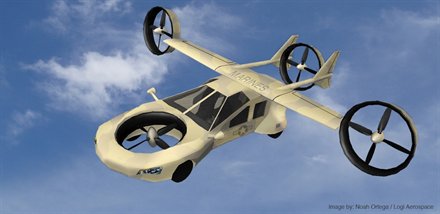
The AVX design is competing with the Logi Aerospace Tyrannos design pictured below. The Logi design relies entirely upon relatively unproven ducted fan propulsion units, whereas the AVX design is based upon a more conventional counter-rotating helicopter prop design.
The Tyrannos is a four-seat vertical take-off and landing roadable aircraft powered by a supercharged racing engine driving a generator and a battery pack. These drive electric motors on the wheels for road use and four variable-pitch shrouded propellers for flight. On the road, the wings fold back against the tail booms. The ducted prop in the nose is fixed at -12deg incidence while the other three pivot from horizontal for vertical flight to vertical for forward flight. _AviationWeek

Roadable aircraft and flying cars (or HumVees) provide a more versatile mobility for sportsmen and survivalists, in addition to their potential military applications. Adding the ability to land and take off on water as well as land, provides an even greater mobility.

Some of the competitors for the DARPA contract may eventually decide to build a civilian model, once they prove the concept and establish that a market exists. The likely success of Terrafugia should provide a positive example on that account.

Labels: , , ,

Bookmark and Share

06 July 2010

Can A Stealthy Flying Submarine Escape the Madness?


Seaplanes and flying boats have been around for some time. But a flying boat that can also run submerged, is a bird of another feather. Multiple teams are now attempting to design such a bird ... er, fish ... er, loon. Loons, for example, are excellent swimmers, and can fly long distances at up to 70 miles per hour, and dive to 150 feet, staying submerged for several minutes (up to 15 minutes).

This is a DARPA project, in progress. Designers have been forced to abandon the deep dive capability of the flying sub, due to the excessive weight of the batteries necessary to maintain undersea life support and ship's functions. This may only be a temporary setback, however.

...rather than using electric power, the Auburn team favours propelling the vessel with a gas turbine fed by air drawn in through a 10-metre snorkel. That means the sub will have to stay close to the surface. While DARPA has yet to specify at what depth the flying sub should operate, being restricted to a limited depth might not matter. "As long as it is not visible, there's not much reason to dive far below the surface," says Bob Allwood, engineer and chief executive of the Society for Underwater Technology in London. "The problem is that the craft has still got to be slightly denser than water to submerge."

Hawkes, however, does not see this as a problem. In fact he doesn't accept that the craft has to be made heavier to sink beneath the waves, any more than a normal aircraft has to become more buoyant to take off. "You can't build an aeroplane that is also a balloon, and an aeroplane can't go under water in the same way a sub does. You're mixing two fundamentally different modes of operation."

Hawkes already builds submarines that are lighter than water (New Scientist, 12 February 2000, p 36). To overcome their natural buoyancy and keep them below the surface, they are equipped with wings that generate downward "lift". "Think about it as flying under water," he says. "It can be done. It just needs a lot of work."

...To operate below the waves as well as above them, these wings will have to be a bit out of the ordinary. "One important thing is that the craft's wings will need a symmetrical aerofoil, unlike the asymmetrically curved wing that gives aircraft lift," he says. So when the craft is airborne, the wing will need a positive "angle of attack": in other words, it will need to be angled upwards relative to the airflow. To achieve this, the craft will have to fly in a nose-up attitude. Conversely, when under water it will need a negative angle of attack, so the craft will travel nose-down...

... Hawkes foresees jet engines playing a dual role, propelling the plane through the water as well as through the air. There's no reason why the compressor and turbine blades in a jet engine can't be driven by an electric motor to generate thrust under water, he says. It should be possible to build an engine that runs on kerosene in air and switches to electricity when submerged.

Others are already thinking along these lines. Last year, aircraft manufacturer Airbus patented a hybrid electric jet engine for airliners which can be powered by both conventional kerosene and electricity. Most jet engines have an electric starter motor, and this motor could spin the turbine's shaft under water, Hawkes suggests. The blades would rotate more slowly than normal, he says, and the engine won't be particularly efficient. "But I believe this could work perfectly well."_NewScientist

Al Fin engineers (submarine, marine, and aerospace) have taken a look at the project, and believe that the vessel simply begs to be nuclear powered. A potentially viable nuclear powered airplane was designed -- but never built -- by the US government. The tricks will be to make the engine design compatible with high velocity flight and deep sea diving in saltwater.

Stay tuned.

Labels: , ,

Bookmark and Share

02 July 2010

The Adventure of Ducted Fan Flying Machines

Ducted fans can allow for a greater payload and better efficiencies than open propeller systems.
The core technology, around which we have designed our products, looks deceptively simple. It consists of a set of counter-rotating fans, inside a set of ducts, attached to a central gearbox and drive train, and then to a power plant. Our proprietary advantage is that we know the proper combinations of these items, and have developed the software which operates the computerized fly by wire system, which makes this combination of items able to deliver the power and control necessary for this genre of powered-lift vehicle to fly.

Ducted Fans

The shape of the duct and its mated fans is critical for optimal performance. It is our advanced proprietary CFD model, which allows us to develop the optimal combination for nearly any application. We have designed ducts with weight as one of the primary concerns. We have been able to build ducts from composite materials with extremely tight tolerances to produce the proper combination for optimal thrust. _Trek
Logi Aerospace is using the Trek design for ducted fan propulsion, in an attempt to win a lucrative DARPA contract.
The real magic of this vehicle lies in the Shrouded Propellers developed by Trek Aerospace. This is not just an ordinary shroud or nacelle around the propellers. This shroud has been specifically designed to optimize airflow. The result – at takeoff, nearly half the lift is provided by the shroud and not the propellers. This means the propellers cover only half the area of a helicopter and still lift the same amount of vehicle weight.

This also means the propellers are lighter and smaller, so too, are the wings and structures making the vehicle lighter. A lighter vehicle can be flown with a smaller propeller, which makes the wings, the structure and the whole vehicle lighter. It has an iterative effect on the design and scales the vehicle down in size. This scale reduction means our vehicles can often be built for less than half the empty weight, and cost, of other vehicles that don’t have our shroud technology. This also means, that on average, our vehicles have around 1/3 of the propeller area of other vehicles that carry our payload using non-optimized shrouds. This is because our shroud is more efficient and the vehicle at takeoff is lighter. _Logi

The ducted fan design also lends itself to exoskeleton designs for single person flying with light payloads.
The Dragonfly is an imaginative design from Trek.

H/T Brian Wang

DARPA's design specs PDF for their military flying car (50 + pages) via NextBigFuture

It is likely that some version of ducted fan flier will be viable. The versatility and superior safety characteristics of the ducted fan will lend itself to new types of flying machines for a wide variety of tasks. Just as important as the fans, are the engines and drive trains that will be required, as well as the fail-safes.

Ducted fans could easily power hovercraft, ground effect hovercraft, helicopter-type craft, amphibious boat / VTOL planes, and other designs not yet conceived.

Labels: , ,

Bookmark and Share

15 June 2010

Escaping the Apocalypse In Style

When everything falls apart at once, you do not have time to transfer from one type of escape vehicle to another. You need a vehicle that can move quickly out of the danger zone, and covertly past those who might want to appropriate your assets, or do you personal harm.
The U-010 Undersea Yacht is designed to travel submerged or on the surface, depending upon the needs of the moment. Surface travel is by diesel. Simple controls allow you to switch to electric power for undersea movement.
Luxurious fittings allow you to forget that the world is falling apart around you. Just pack plenty of provisions and fuel so that you can get where you are going.

More photos

Via Impactlab

Labels: , , ,

Bookmark and Share

08 March 2010

Yachts Morphing to Floating Islands, More

The design of the WALLY Yacht above hints at an evolution in yacht design away from traditional forms, and moving closer to the seastead floating island concept.  Such designs will allow a seastead to move out of the way of larger storms.
Meet the WHY 58X38 — a $160 million yacht that's basically an island unto itself.

"Everybody's dream is to live on an island, in complete freedom, without constraint, with the independence that only self-sufficiency can provide. A piece of land with a beautiful villa partly fulfills this aspiration because its static. A yacht offers the freedom to move, but does not have the space of a property. WHY has it all: space, stability, movement, independence, and peace," Wally Yachts President Luca Bassani Antivari wrote.

The WHY 58X38, which measures 58 meters by 38 meters (more than 35,000 square feet), offers three levels of space. The first level has living space with a beach, spa, dining room, music room and cinema. The second level has suites, a lounge and a library. The third level is the owner's space. _DailyNews

These floating islands are bound to be scaled up over time. They will also eventually incorporate heliports and enclosed, protected small boat harbours.   So, from land, you can reach your mobile floating island via small boat, helicopter, amphibious plane --- or jet pack!

The Martin Aircraft (New Zealand) jet pack uses premium gasoline for fuel, and can achieve up to 30 minutes of flight time.  It can fly you to your seastead as long as you do not roam too far away on land.
The Jetpack is constructed from carbon fiber composite, has a dry weight of 250 lbs (excluding safety equipment) and measures 5 ft high x 5.5 ft wide x 5 ft long. It's driven by a 2.0 L V4 2 stroke engine rated at 200 hp (150 kw), can reach 8000 ft (estimated) and each of the two 1.7 ft wide rotors is made from carbon / Kevlar composite.

There is always risk associated with flying so Martin Aircraft has been careful to equip the pack with redundant systems that will take over in the event that the main system goes down. If a crash-landing is required, a pilot-operated toggle will rapidly fire a small amount of propellant deploying a ballistic parachute (similar to a car airbag) which will allow the pilot and jetpack to descend together. It also has an impact-absorbing carriage, patented fan jet technology and 100 hours engine TBO (Time Between Overhaul). Small vertical take-off and landing aircraft (VTOL) are not subject to the same limitations as other helicopters and fixed wing aircrafts but Martin Aircraft have built it to comply with ultralight regulations and therefore suggest it as at least as safe to operate, and claim it is the safest of all jetpacks yet built. _Gizmag

Labels: , ,

Bookmark and Share

04 March 2010

Skyaking: When You Must Be First in the Water

When the need to kayak the whitewater or the surf hits, you really do not want to suffer the long ride in the car, or taking the time to tie the boat down to the rack then take it back off again. You want to be the first to hit the water when the surf's up or when the river flow hits optimum.

Miles Daisher is a 40 year old adventurer from Twin Falls, Idaho, who is polishing the fine art of skyaking on the free falling slipstream.


Over the years father-of-two Miles and his team have slowly perfected the art of skyaking.

‘There are a lot of things that can go wrong in skyaking and so you have to be prepared,’ he said.

‘In skyaking I usually put the chute quite high. With skydives I will pull at 2,000 ft above the ground whereas with skyaking I will pull at 5,000 ft above the ground incase anything starts to go a little crazy.

‘That way I have a time to sort things out, get out of the boat and then pull the chute for the kayak.’ And he has noted some strong differences in regular skydiving. ‘The rate at which you fall is a lot different,’ he said.

‘Instead of falling flat on your belly you are sitting up right in an L position. I liken it to sitting on a space hopper, balancing front to back and side to side.

‘It does take some decent balance skills. And because the boat has such a big surface area your fall rate is a lot slower.

‘If you are lying on your belly, a normal sized human will fall at 120 mph.

‘If you go into a stand up or a head down then you can build the speed up to 160-180 mph.

‘But with this boat, that has so much surface area and weighs 35 lbs, meaning that I fall at only 98 mph. _ImpactLab

You can see Miles "ditching" his craft next to the runway.  Notice the beginning of wing stall as the kayak transfers energy to the water rather smoothly, but abruptly.

Next, Miles needs to put an engine on his craft in order to add range and time aloft.   At that point, he should be able to take off from water as long as he can keep his wing inflated while picking up speed.

Labels: ,

Bookmark and Share

03 March 2010

Kiwi Hoverwing Invention Takes You Higher

Al Fin has discussed the need to add ground-effect capability to hovercraft. Now a clever New Zealand inventor has done just that!
New Zealand mechanic Rudy Heeman spent more than 11 years of his spare time (and tens of thousands of dollars) building the hoverwing, a wing-in-ground-effect vehicle that flies on a cushion of pressurized air created between the wing and the water's surface. Hoverwing can reach an optimum height is 1.5m (4-5ft) above the water and has a current top speed of 98kmh (61mph).

Heeman told the The Nelson Mail that the "hoverwing", which is almost complete, has drawn local residents from their houses and cars to watch test flights over the Haven in the town of Nelson, at the northern tip of New Zealand’s south island.

Heeman is no stranger to hovercraft – he’s built and sold them for some time. But the hoverwing is his most ambitious project. So ambitious that an early test flight just prior to Christmas last year resulted in a crash landing. But it wasn't enough to deter him from completing the project.

The hoverwing is powered by a modified Subaru car engine while the body comprises most fibreglass. _Gizmag_via_TheNelsonMail

A hovercraft can cross land, water, sand, mud, ice, etc. but it cannot fly over obstacles above a certain size. Adding a "ground-effect" capacity to the vehicle allows it to travel over walls, ditches, larger waves, and other surface disruptions that could stop a mere hovercraft.
"This machine is fast and furious, it roars like a lion, and is not for the faint hearted. It is adrenalin pumping and exciting."

With a 1.8-litre engine and a range of more than 225 kilometres, the hovercraft cruised at 90kmh when flying, and had a smooth ride above the waves, he said.

"The fuel economy is far better than a boat of the same size and speed."_TheNelsonMail

Labels: ,

Bookmark and Share

23 January 2010

Adrenaline Hunters Seek to Move Beyond

Humans need to move out of their coddled infancy -- out of their addiction to security and eternal comfort. The only eternal comfort is death, and not many want that. Evolved primates will have to leave their cradle planet, and become good at surviving unimaginable hazards. Adrenaline hunters are the humans who show traces of the instinct to go beyond. There is no safety, no security. There is only competence to face the inevitable hazards coming our way. We have to find that competence.


Beyond the thrill-seekers, the explorers, and the adventurers, human societies must be able to produce the pioneers -- people who move permanently out into the danger zone. People able to adapt and prosper using their own resources.


The tools needed to make the remaining frontiers on Earth (the oceans, polar regions, the high atmosphere) safe for human habitation are very close. The tools needed to make outer space and planetary surfaces safe for human living are not much farther behind. For such hazardous environments, competence is always the central tool for survival.

Labels: ,

Bookmark and Share

20 January 2010

Stealthy Personal Flyer Half Airplane, Half Helicopter


This pretty little personal flyer lets you take off and land vertically (VTOL) in a stealthy manner, using electric motors. Called the "Puffin", it is NASA's answer to the US Marines' Osprey VTOL airplane.
In theory it can cruise at 150 miles per hour and sprint at more like 300 miles per hour. Since the craft is electrically propelled it doesn't need air intake, so thinning air is not a limitation, meaning it can reach — again, in theory — 30,000 feet before limitations on battery power force it to descend...

...Aside from the military applications (super-stealthy troop insertions with very low thermal signatures?) the quiet, uncomplicated, low-powered electric lift — just 60 horsepower gets pilot and craft airborne — shows how a world in which everyday folks get around modern cities via personal aircraft may not be as sci-fi as was once thought. _Gizmodo


Al Fin was unable to convince Jack Bauer to give up his priority position in line to test fly the Puffin. But just as soon as he can, he will provide a personal test flight report.

Labels: , , ,

Bookmark and Share
Older Posts
Al Fin Main Page
Enter your Email


Powered by FeedBlitz
Google
WWW AL FIN

Powered by
Blogger

``