01 July 2010

Flying Cars and Motorcycles Set You Free


Larry Neal's motorcycle / autogyro kits have been sold and flown for several years. Watch it drive around town, and fly above town, in the video above.

Terrafugia's Transition is now certified as a Light Sport Aircraft by the US FAA, which makes it much easier for novice pilots to get licensed to fly it. Watch it fly in the above video. The company is taking deposits for new planes, and plans to begin delivering finished models to new owners next year.

The Parajet Automotive Skycar is expedition tested. Watch it fly above the desert in the video above.
The Ramphos flying boat can also travel awkwardly on land.

An optimal escape craft would allow travel on all surfaces -- mud, sand, water, pavement, ice, snow -- plus provide full flight capabilities. Submersible travel safely down to 300 metres would be a big plus.

Hovercraft with flight and submersible capabilities would be ideal.

Check out Gizmag's roundup of flying cars and cycles

Labels: , , ,

Bookmark and Share

19 March 2009

Terrafugia Transition Flies

Image Source
Brian Wang provides a good update of the Terrafugia Transition flying car. Brian's article includes a good assortment of photos of the winged wonder. It does look extremely cute pulled up to the pumps at the gas station.

The versatile vehicle has made its first flight test at Plattsburgh (NY) International Airport, and is taking orders with deposits of $10,000 for the $194,000 multifunctional vehicle.

If Terrafugia can succeed at this venture, expect other versions of the Transition to be developed, including one that lands on either water or land. People want the freedom to go almost everywhere. They are willing to pay for that freedom.

Labels: , ,

Bookmark and Share

18 January 2009

Terrafugia Transition: Virgin Flight in 1 Month


The Terrafugia Transition flying automobile is scheduled for initial flight testing in February of this year -- next month.
Carl Dietrich, who runs the Massachusetts-based Terrafugia, said: “This is the first really integrated design where the wings fold up automatically and all the parts are in one vehicle.”...The Transition...is powered by the same 100bhp engine on the ground and in the air.

Terrafugia claims it will be able to fly up to 500 miles on a single tank of petrol at a cruising speed of 115mph. Up to now, however, it has been tested only on roads at up to 90mph.

Dietrich said he had already received 40 orders, despite an expected retail price of $200,000 (£132,000). _Times
This design has a good chance of being successful. The wing folding and unfolding will need to be foolproof, and driving visibility cannot be obstructed by airfoils. The engine must be of highest quality and highly reliable.

Al Fin's requirements for a full function vehicle remain the same: it must be able to fly above the weather, cruise on a water surface, travel submerged like a submarine, move swiftly over highways or all off-road terrain. It should be able to land on either water or firmer surfaces including sand, salt flat, snow, and ice. And the vehicle should provide for comfortable overnighting in virtually any climate. Is that really asking for so much?

Labels: , ,

Bookmark and Share

10 May 2008

Drivable Airplane: Carl Dietrich's Terrafugia

Carl Dietrich's company Terrafugia has come a long way since the last time Al Fin took a look at the "flying car" project.
Between now and late July, the 10 employees of angel-funded startup Terrafugia will be spending “a lot of long days, nights, and weekends” in that shop, says CEO and founder Carl Dietrich. That’s because they want to show off their concept vehicle at AirVenture—the world’s largest aviation festival, held annually in Oshkosh, WI—and there’s a lot of work to finish first.

...And the work won’t end after Oshkosh. Terrafugia wants to deliver the first Transition to a customer by the end of 2009 and go into large-scale production by 2012. If you were just building a new type of plane or a new type of car, that schedule would be ambitious enough. But the Transition is both—and if, as the company intends, pilots are to land the vehicle on an airport runway, fold up the wings, and tool right out onto public highways, then this hybrid-of-a-different-color will have to meet federal standards for both aviation safety and highway safety.

...In other words, there are a thousand practical obstacles to achieving the flying-car dreams Deitrich says he’s had since he decided to become an aerospace engineer at the age of 8—-to say nothing of actually making a bit of money along the way. “The old joke is that the best way to make a small fortune in aviation is to start with a large one,” says Dietrich. But while he admits that building a plane that you can also drive “sounds off the wall,” he says “there is a real business case for investing in its success. I’m personally invested, as are a lot of the people here. I don’t see any way we’re not going to get this done.”

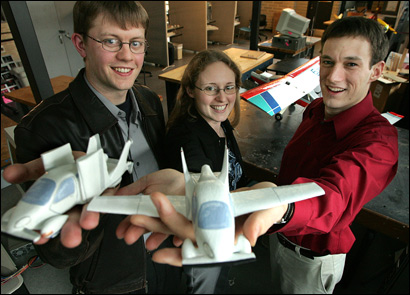
Terrafugia CEO Carl DietrichThere’s plenty of reason to take Dietrich seriously. The 30-year-old earned his bachelor’s, master’s, and doctoral degrees in aeronautics and astronautics from MIT, and was awarded the $30,000 Lemelson-MIT Student Prize in 2006 in recognition of his groundbreaking designs, including a desktop-sized fusion reactor, a pumpless rocket engine, and a blast-safe pick for removing land mines. Dietrich put the prize money into Terrafugia, which he co-founded with fellow MIT aero-astro grads Samuel Schweighart and Anna Mracek (now his wife) and two former MBA students from MIT’s Sloan School. Their plan to manufacture a road-ready airplane was the runner-up in the business venture category of the 2006 MIT $100K Entrepreneurship Competition—winning the company a $10,000 check that still hangs on the wall of Terrafugia’s “prototype development facility,” a modest space formerly used to manufacture garage doors. __Much more at Xconomy
Dietrich and company have chosen a very tough business--the flying airplane/drivable car combination. A lot of people have spend many decades of their lives pursuing the same quest, only to find themselves unable to deliver on the promise.

Dietrich hopes to take advantage of 2004 FAA rule changes that created a new category of small aircraft called the "special light sport aircraft (S-LSA)."
In a nutshell, if a company can manufacture a plane that weighs less than 1,320 pounds, carries no more than two people, and flies no faster than 138 miles per hour, it can get the craft qualified as an S-LSA, meaning that owners need only a sport pilot certificate to fly it. Getting a sport pilot certificate involves only about half as much flight training as qualifying for private pilot certificate, the license previously required for most general aviation flyers.

...The nifty thing about the Transition, of course, is that it’s designed to change from a plane into an automobile in about thirty seconds—meaning pilots will be able to drive right off the tarmac and onto the roadway without even having to get out. (The half-hour process of manually refitting the Aerocar for roadway driving was part of what killed Moulton Taylor’s dream, according to Dietrich.) At the flip of a switch, the Transition’s wings will fold up and the license plates will rotate into view. The vehicle’s engine, manufactured by Rotax, has a continuously variable transmission and a dual shaft that can power either the rear propeller during flight or a pair of front wheels on the road (top speed: 80 miles per hour).

...The idea of a flying car that could lift drivers out of traffic jams will probably remain a standing joke—a monument to an antique brand of technological enthusiasm. But a drivable airplane is a different proposition. And it’s probably safe to say that Terrafugia has assembled more brainpower, and more MIT degrees, around that proposition than any previous organization. “I think this is a fantastic opportunity—not just from a business perspective and a career perspective, but to work on something where we could make history,” says Dietrich. “I wouldn’t want to be doing anything else.”
The customers are there, the expertise in design and manufacturing are there. The investment funding is there and more is on the way. The largest barrier that Dietrich and Terrafugia face is the federal government, and its army of bureaucrats armed with truckloads of bureaucratic regulations. Only the stoutest hearts would brave such a battle.

When you look at how few there are who are willing to take up such challenges--in comparison to the many who forsake challenge in favour of security--you may begin to understand what 2 or 3 generations of dumbed down government schools and popular culture have done to the population base of North America. When you add the burden of university faculties who too often inculcate students into a brain-bound political correctness--rather than initiating them into the marvel of human initiative, drive, creation, and productivity--you understand more of the comprehensive nature of the problem. It is not just big bureaucracies, malignant litigation, and high taxes that drag North American initiative and economies down. It is the whole drone-creating system that has enmeshed entire generations.

Carl Dietrich is fortunately one of those--like Burt Rutan, Dean Kamen, Ray Kurzweil, and a few others--who is putting his own ingenuity and initiative up against the smothering effect of big bureaucracy. Good luck to Dietrich and company!

H/T Peswiki

Labels: , , ,

Bookmark and Share

26 February 2006

Flying Cars, Swimming Planes--I Want One that Does Them All

JW Bats of Our Technological Future Blog reports on the "Flying Car Project" at MIT. Here is the link to the newspaper article describing the project. Carl Dietrich is a 28 year old aerospace engineer with a record of innovation.

''People tend to smirk when you say you're trying to make a flying car: 'Oh, you're one of those guys.' " But, he insisted, ''This isn't just another flying car concept. We're very serious about producing a flying car and selling it."

Few who know Dietrich would bet against him. Even by MIT's standards, he is considered a standout -- so much so, in fact, that today he will be announced as the winner of the $30,000 Lemelson-MIT Student Prize. An outside panel of scientists and technologists chose Dietrich for his ''portfolio of novel inventions," including not just the flying car but also a desktop-size fusion reactor and a lower-cost rocket engine.


I wish Dietrich and his team the best of luck, since they plan to begin manufacturing the flying car in 2009. This other fellow has been trying to get his flying car ready for production and marketing for a long time.

CNN.com has an interesting story about a swimming plane that will be launched from a submarine 150 feet below the ocean's surface. The plane will swim to the surface and take off for its flight. At the end of its flight, the plane will land on the ocean and wait to be picked up by a robotic underwater vehicle..

The Cormorant, a stealthy, jet-powered, autonomous aircraft that could be outfitted with either short-range weapons or surveillance equipment, is designed to launch out of the Trident missile tubes in some of the U.S. Navy's gigantic Cold War--era Ohio-class submarines.

....The tubes are as long as a semi trailer but about seven feet wide -- not exactly airplane-shaped. The Cormorant has to be strong enough to withstand the pressure 150 feet underwater -- enough to cave in hatches on a normal aircraft -- but light enough to fly.

....The craft is made of titanium to resist corrosion, and any empty spaces are filled with plastic foam to resist crushing. The rest of the body is pressurized with inert gas. Inflatable seals keep the weapon-bay doors, engine inlet and exhaust covers watertight.


The Cormorant does not shoot out of its tube like a missile. Instead an arm-like docking "saddle" guides the craft out, sending it floating to the surface while the sub slips away. As the drone pops out of the water, the rocket boosters fire and the Cormorant takes off.

After completing its mission, the plane flies to the rendezvous coordinates it receives from the sub and lands in the sea. The sub then launches a robotic underwater vehicle to fetch the floating drone.


Here is the thing: I would like a car that can function as a camper, can swim on the water's surface, can dive like a submarine, and can fly like a plane. Engineers are beginning to think out of the box--just a little. But not nearly enough.

It is not a good sign that engineering enrollment in North America has declined. Although India and China can certainly produce top notch engineers, the jury is still out as to whether engineers trained in Asia are as innovative as European and North American trained engineers. We will all hope so, given the trends.

By the way, I have posted on the issue of declining engineering enrollments here, here, here, and here. It is one thing to wish nature had done things differently, it is quite another to base the future of your society on that wishful thinking, when you know it is not true.

Labels: ,

Bookmark and Share
Older Posts
Al Fin Main Page
Enter your Email


Powered by FeedBlitz
Google
WWW AL FIN

Powered by
Blogger

``