20 October 2010

Fast Helicopters and Flying HumVees

DARPA aims to power its flying humvee with a diesel engine, giving it extra range.
According to a company statement, Pratt & Whitney Rocketdyne are going to model the Transformer engine on their EnduroCORE, a diesel engine that generates a “high power-to-weight ratio comparable to gas turbines.” It’ll need to. Darpa’s specifications for the flying Humvee require the Transformer to stay in the air carrying up to 1000 pounds for up to 250 miles without refueling. Diesel’s energy efficiency apparently satisfied Darpa’s suggestion that the Transformer be at least somewhat green. _DangerRoom
Meanwhile, Brian Wang brings us up to date on the speed duel between the EurocopterX3 and Sikorsky's X2 supercopter.
The X3 has so far only flown once, in a 35-minute flight that tested its hovering behaviour and Billig says it performed as designed. It won't be going for any high speed attempts until late 2011, but they are initially aiming to bust 400 km/h.

Sikorsky is already well on the way to achieving its speed aim of over 500 km/h. In a test flight in September, the X2 unofficially broke the previous record of 400 km/h, which was set by the Westland Lynx in 1986. The X2 achieved 463 km/h, but due to its propellers, it is unclear if the craft will be recognised in the same category by the FAI, the world's air sports federation based in Lausanne, Switzerland, that oversees aviation records. _BrianWang
EurocopterX3
Vertical takeoff and landing (VTOL) aircraft provide crucial functionality for both military and civilian applications. The race for more speed and maneuverability is likely to continue for some time.

Combining land travel with VTOL capability in the same vehicle makes sense for military and expedition-type enterprises. Land travel uses much less fuel, and allows you to take advantage of land-based fuel caches which may not be accessible directly by air. Being able to hop over rivers, canyons, and other obstacles expedites progress toward an objective.

The advantage of a craft that combines the ability to fly, to travel over the surface of water, and to travel over all terrain land surfaces should also be obvious to any would-be Galtist or survivalist.

Labels: ,

Bookmark and Share

17 September 2010

Faster than a $20 Hooker and At Least Twice as Fun

The X2 is an experimental helicopter being developed by Sikorsky, an American company, at a test-flight centre in Florida. It recently flew at more than 430kph (267mph), according to a report in Spectrum, published by the Institute of Electrical and Electronics Engineers. _Economist

Sikorsky's X2 experimental prototype is being developed in order to bring speed to the commercial helicopter industry. The X2 has already flown faster than the official speed record for helicopters, but not officially.
To make an official attempt on the record, Sikorsky will need to have the flight monitored by the Fédération Aéronautique Internationale, which compiles airspeed records. But that is unlikely to happen until the X2 is going even faster. Later this year, Sikorsky hopes it will be zipping along at more than 460kph. The company, however, is interested in more than just breaking speed records. It plans to use the technology developed for the X2 in commercial helicopters.

...it uses two counter-rotating rotors that spin around the same axis, one positioned above the other. So in forward flight each rotor can produce an equal amount of lift on each side, thus providing balance. The idea has been around for some time, but it proved difficult to make it work properly.

What has changed are technological advances in aircraft engineering and control systems. Now, vibrations can be reduced using “active control”, which involves placing sensors around the helicopter to detect the onset of vibration and then using force generators on various parts of the frame to vibrate in such a way that they cancel out the original tremors. Advanced computer modelling has also made it possible to design more efficient rotors. A pusher propeller has been fitted at the rear of the X2 to provide extra oomph. According to the engineers, this propeller can also be used to slow the helicopter snappily. And computerised “fly-by-wire” controls allow the X2 to be flown relatively easily.

Sikorsky reckons that future helicopters built using the X2 technology would be extremely versatile machines. They would dash to and from a medical emergency a lot faster. They would also be very agile in flight, which would increase their capabilities in combat. Sikorsky has already produced a simulator so that potential customers can experience what these fast helicopters will be like to fly. Plenty of whirlybird pilots will be keen to get their hands on the real thing. _Economist

It may be some time before ducted fan technology is able to match the new capabilities of the X2. But I have a feeling that VTOL flying is going to become a lot more exciting.

H/T Bruce Hall

Labels: ,

Bookmark and Share

13 July 2010

Another Entry in DARPA's Flying HumVee Competition

Just after the new year, DARPA put out a broad agency announcement requesting a flying car, specifically a one-to four-person, vertical takeoff and landing-capable vehicle that can negotiate off-road conditions as well as take to the skies. Today, Fort Worth-based AVX Aircraft has responded with a proposal, releasing some mock-ups of a dual-rotor, ducted-fan driven aircraft that’s also road-ready.

AVX says the four-seater will be able to carry a 1,040-lb. payload 250 miles on a single tank of fuel, peaking at 80 miles per hour over land and 140 miles per hour in the air. It’s coaxial rotor design would certainly satisfy the vertical take-off and landing requirement, and at least the sketches make it look off-road rugged. Unfolding the rotor blades for flight should convert the vehicle from road warrior to aircraft in just one minute. _PopSci
The Fort Worth-based company says the four-seat vehicle will carry a 1,040lb payload, reach 80mph on the road (using the ducted fans to augment electric wheel drive) and 140mph in the air, take off and land vertically, cruise at 10,000ft altitude at max gross weight and travel 250 miles on one tank of fuel.

Conversion from road to flight mode will take 60 seconds, says AVX - basically unfolding the rotor blades. The design certainly looks simpler than Logi AeroSpace's Tyrannos, which has a foldable wing and tilting shrouded propellers. _AviationWeek

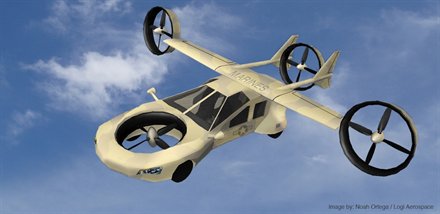
The AVX design is competing with the Logi Aerospace Tyrannos design pictured below. The Logi design relies entirely upon relatively unproven ducted fan propulsion units, whereas the AVX design is based upon a more conventional counter-rotating helicopter prop design.
The Tyrannos is a four-seat vertical take-off and landing roadable aircraft powered by a supercharged racing engine driving a generator and a battery pack. These drive electric motors on the wheels for road use and four variable-pitch shrouded propellers for flight. On the road, the wings fold back against the tail booms. The ducted prop in the nose is fixed at -12deg incidence while the other three pivot from horizontal for vertical flight to vertical for forward flight. _AviationWeek

Roadable aircraft and flying cars (or HumVees) provide a more versatile mobility for sportsmen and survivalists, in addition to their potential military applications. Adding the ability to land and take off on water as well as land, provides an even greater mobility.

Some of the competitors for the DARPA contract may eventually decide to build a civilian model, once they prove the concept and establish that a market exists. The likely success of Terrafugia should provide a positive example on that account.

Labels: , , ,

Bookmark and Share

02 July 2010

The Adventure of Ducted Fan Flying Machines

Ducted fans can allow for a greater payload and better efficiencies than open propeller systems.
The core technology, around which we have designed our products, looks deceptively simple. It consists of a set of counter-rotating fans, inside a set of ducts, attached to a central gearbox and drive train, and then to a power plant. Our proprietary advantage is that we know the proper combinations of these items, and have developed the software which operates the computerized fly by wire system, which makes this combination of items able to deliver the power and control necessary for this genre of powered-lift vehicle to fly.

Ducted Fans

The shape of the duct and its mated fans is critical for optimal performance. It is our advanced proprietary CFD model, which allows us to develop the optimal combination for nearly any application. We have designed ducts with weight as one of the primary concerns. We have been able to build ducts from composite materials with extremely tight tolerances to produce the proper combination for optimal thrust. _Trek
Logi Aerospace is using the Trek design for ducted fan propulsion, in an attempt to win a lucrative DARPA contract.
The real magic of this vehicle lies in the Shrouded Propellers developed by Trek Aerospace. This is not just an ordinary shroud or nacelle around the propellers. This shroud has been specifically designed to optimize airflow. The result – at takeoff, nearly half the lift is provided by the shroud and not the propellers. This means the propellers cover only half the area of a helicopter and still lift the same amount of vehicle weight.

This also means the propellers are lighter and smaller, so too, are the wings and structures making the vehicle lighter. A lighter vehicle can be flown with a smaller propeller, which makes the wings, the structure and the whole vehicle lighter. It has an iterative effect on the design and scales the vehicle down in size. This scale reduction means our vehicles can often be built for less than half the empty weight, and cost, of other vehicles that don’t have our shroud technology. This also means, that on average, our vehicles have around 1/3 of the propeller area of other vehicles that carry our payload using non-optimized shrouds. This is because our shroud is more efficient and the vehicle at takeoff is lighter. _Logi

The ducted fan design also lends itself to exoskeleton designs for single person flying with light payloads.
The Dragonfly is an imaginative design from Trek.

H/T Brian Wang

DARPA's design specs PDF for their military flying car (50 + pages) via NextBigFuture

It is likely that some version of ducted fan flier will be viable. The versatility and superior safety characteristics of the ducted fan will lend itself to new types of flying machines for a wide variety of tasks. Just as important as the fans, are the engines and drive trains that will be required, as well as the fail-safes.

Ducted fans could easily power hovercraft, ground effect hovercraft, helicopter-type craft, amphibious boat / VTOL planes, and other designs not yet conceived.

Labels: , ,

Bookmark and Share

20 January 2010

Stealthy Personal Flyer Half Airplane, Half Helicopter


This pretty little personal flyer lets you take off and land vertically (VTOL) in a stealthy manner, using electric motors. Called the "Puffin", it is NASA's answer to the US Marines' Osprey VTOL airplane.
In theory it can cruise at 150 miles per hour and sprint at more like 300 miles per hour. Since the craft is electrically propelled it doesn't need air intake, so thinning air is not a limitation, meaning it can reach — again, in theory — 30,000 feet before limitations on battery power force it to descend...

...Aside from the military applications (super-stealthy troop insertions with very low thermal signatures?) the quiet, uncomplicated, low-powered electric lift — just 60 horsepower gets pilot and craft airborne — shows how a world in which everyday folks get around modern cities via personal aircraft may not be as sci-fi as was once thought. _Gizmodo


Al Fin was unable to convince Jack Bauer to give up his priority position in line to test fly the Puffin. But just as soon as he can, he will provide a personal test flight report.

Labels: , , ,

Bookmark and Share

01 May 2009

Foldable Helicopter: Perfect for Urban Survival!

If you live in a high rise apartment, deep inside a large city, you may have wondered how you could escape the unruly urban jungle, should the fecal matter hit the fan. Here is your answer: the Hummel Helicopter, which can be folded up and kept in a closet until it is needed. Simply roll the folded vehicle down the hallway to the elevator, go up to roof level, unfold the machine, and fly off to your retreat. Having a birds-eye view of miles of vehicles backed-up on the panic clogged freeways below, is an added bonus.
The “Hummel” (”bumble bee”) is a light helicopter for [a total of] two passengers. It can be used for passenger transport (air taxi), as well as for e.g. emergency transports like organs or units of stored blood and of course for conventional tasks of a helicopter like monitoring (e.g. coast guard, police, army, scientists) and to be mobile. The tandem rotor design guarantees a more efficient aircraft performance as the main-tail rotor design, without wasting fuel. _ImpactLab_via_dVice_via_Zoobota_via_DesignBlog
Terrafugia's Transition "driveable airplane" is another possibility, if you can find a long enough open stretch of pavement to use for a runway. Another alternative for those who live near a river, lake, or bay, is to keep an amphibious plane handy that can take off and land on either water or solid surface.

If you have ever been caught up in a large-scale evacuation of a large city, you will immediately understand the seriousness behind the silliness. In the past, such an evacuation might have been prompted by the approach of a hurricane. In the future, growing numbers of potentially predictable and emergent threats might trigger such an outrush of people.

Imagine if the current Swine Flu had been genengineered for maximum contagion and lethality? Just a few cases in the local emergency room might have been enough to trigger wide-scale panic and impromptu evacuation. A simple radioactive "dirty bomb" could accomplish the same mindless stampede without so much as a single fatality. As earthquakes and volcanoes become more predictable, evacuation plans will grow apace. Face it: getting out of a city in the midst of full-scale panic would not be easy or risk-free.

Check in with Survival Blog regularly, for a wide array of commentary on this and other survival topics.

Labels: , , , ,

Bookmark and Share
Older Posts
Al Fin Main Page
Enter your Email


Powered by FeedBlitz
Google
WWW AL FIN

Powered by
Blogger

``