14 December 2012

High Tech Date Rape: The World Warps Strange

As women have become more educated, more sophisticated and worldly wise, they have come to demand more wealth, accomplishment, and sophistication from their men. These increased demands have proven burdensome to the majority of men, who have been put at a relative disadvantage in terms of education and work, due to affirmative action and other government mandates. In addition, most men do not find it within themselves to be classy dressers, suave charmers, or masters of smooth seduction.

In the old days, a smooth serenade, or a moving poetry recitation, might have worked -- even if the man were struggling above his pay grade, so to speak. But the modern woman does not give in so easily, as her more sentimental forerunners might have done. And besides, most modern men are neither musically talented nor poetically gifted.

Due to these and other disadvantages, many men have been driven to the use of date rape drugs, including copious quantities of alcohol. But there is nothing particularly memorable or satisfying about taking advantage of a woman lost in a deep stupour. In addition, the legal penalties can be severe and lasting.

A safer and more sophisticated approach to taking control of an inauspicious mismatch, involves the use of conversational trance induction -- or hypnosis. This is a very effective approach, but it requires a certain amount of training, in addition to innate talents of empathetic sensing and projection, along with exquisite control of one's voice and body language. Only a relative few men can be masters of these techniques.

This brings us to a rapidly developing field of neuroscience known as transcranial magnetic stimulation (TMS). With TMS, one can place an electro-magnetic coil over a particular area of the forehead of an attractive but dismissive woman, instantly turning rejection into ready compliance. TMS is capable of disrupting the normal inhibitory and behavioural control and decision-making of the pre-frontal cortex (PDF) and associated regions.

Yes, I can already hear you asking: "How can I get her to hold still long enough to place the coil over the exact location required to get her to submit?"


Now, thanks to clever scientists in Spain, you don't have to. Utilising advanced theories of meta-materials, these Barcelona physicists have devised a way to turn materials formerly thought of as "invisibility cloaks" into devices capable of projecting electromagnetic fields over a distance.

You may begin to see the potential. Concealed within the obscure physics are the makings of an electromagnetic field projector, with the potential to initiate limited behavioural control over a distance.
Beyond energy transmission, the researchers suggest the ability of the shell to concentrate magnetic fields into a small space could enhance the accuracy of magnetic sensors. This could extend the reach of a medical research technique called transcranial magnetic stimulation, in which parts of the brain can be temporarily activated or deactivated by magnetic fields. _PhysicsWorld
Of course, the implications of this type of remote brain control go far beyond the trivial example of "date rape." In fact, this type of control over the impulses and inhibitions of other people -- even large groups of people simultaneously -- is exactly the tool that politicians, advertising companies, community organisers, religious prophets, college professors, and other shady characters have longed for since the coming of homo sapiens.

In the age of meta-materials and other counter-intuitive technologies, the world is beginning to warp strangely odd. And yet, none of us are given a pass to sit out these developments and await a later, safer, less startling technological environment. It would likely be a long wait, regardless.

New technologies work out of sight, out of mind, beyond our conceptual grasp, for the most part. And even in the face of widespread economic disaster, such technologies -- and even stranger ones -- will continue to be developed somewhere, by some organised group or another.

It sounds as if we will need to become more dangerous than ever just to live in the coming world -- but in a good way, of course.

H/T NextBigFuture

Labels: , ,

Bookmark and Share

07 December 2012

All Cyborgs Now: Hippocampal Pacemaker in Alzheimer's


This article is adapted from an article published on Al Fin Longevity


Johns Hopkins researchers are implanting electronic "pacemaker" devices in the brain fornix -- the nerve input to the hippocampus -- in Alzheimer's patients. This study is a follow-on to an earlier Canadian study which showed promising results for such a procedure.
The surgery involves drilling holes into the skull to implant wires into the fornix on either side of the brain. The fornix is a brain pathway instrumental in bringing information to the hippocampus, the portion of the brain where learning begins and memories are made, and where the earliest symptoms of Alzheimer’s appear to arise. The wires are attached to a pacemaker-like device, the "stimulator," which generates tiny electrical impulses into the brain 130 times a second. The patients don’t feel the current, Rosenberg says.

For the trial, all of the patients will be implanted with the devices. Half will have their stimulators turned on two weeks after surgery, while the other half will have their stimulators turned on after one year. Neither the patients nor the doctors treating them will know which group gets an early or later start.

"Deep brain stimulation might prove to be a useful mechanism for treating Alzheimer’s disease, or it might help us develop less invasive treatments based on the same mechanism," Rosenberg says.

By 2050, the number of people age 65 and older with Alzheimer’s disease may triple, experts say, from 5.2 million to a projected 11 million to 16 million, unless effective treatments are found. _Johns Hopkins _via_ ExtremeLongevity
The actual deficit in Alzheimer's involves multiple breakdowns in both neural pathways and processing centres of the brain. A "brain pacemaker" which keeps the hippocampus primed and healthy, should help tremendously in the early and middle stages of the disease. It may even prolong the early and middle stages -- postponing the final decline of mental function.

But to actually cure Alzheimer's disease, scientists will need to understand the underlying processes and predispositions much more clearly.

In the meantime, any route to improvement and mitigation is likely to be welcome, by most sufferers and their families.

Daily Mail report on this story

Labels: , ,

Bookmark and Share

10 March 2012

tDCS Kit and OTS Machines: Learn More Faster Be Awesome?


Kooky Video via Technology Review

It sounds like quackery, but it's not. A growing body of evidence suggests that passing a small electric current through your head can have a profound effect on the way your brain works. Called transcranial direct current stimulation (tDCS), the technique has already been shown to boost verbal and motor skills and to improve learning and memory in healthy people - making fully-functioning brains work even better. It is also showing promise as a therapy to cure migraine and speed recovery after a stroke, and may extract more from the withering brains of people with dementia. Some researchers think the technique will eventually yield a commercial device that healthy people could use to boost their brain function at the flick of a switch. _biotele.com
The article excerpted above was published in 2006, but it seems that the increasingly popular activity of home brain-boosting via tDCS is just getting started -- perhaps due to the feature film "Limitless" having stimulated the public imagination regarding the possibility of becoming smarter than you are?

Regardless, tDCS appears to have an undeniable effect, and if it can prove itself in the marketplace, we may see the beginning of "a smart revolution."

A $99 tDCS kit, the GoFlow Beta1, is due on the market. It will compete with tDCS machines that range in cost from $350 up to €3000 (about $4,000US). Do it yourself tDCS hacks can be made for anywhere between $30 down to the cost of a 9V battery, a couple of wires, and two saline soaked gauze pads. Of course, the cheapest devices are not necessarily the safest or most reliable.
Basic tDCS Schematic

Some of the uses to which tDCS therapy is being put:
- NEUROLOGICAL DISEASES:

Chronic pain (Fregni et al., 2006; Fregni et al., 2006; Antal et al., 2010)
Stroke (Fregni et al., 2005; Monti et al., 2008; Shlaug et al, 2008; Lindenberg et al., 2010; Williams et al., 2010)
Movement disorders:

- Parkinson disease (Fregni et al., 2006; Benninger et al., 2010)

- Tourette syndrome (Mrakic-Sposta et al., 2008)

- Dystonia (Quartarone et al., 2006)

Epilepsia (Liebetanz et al., 2006)
Alzheimer disease (Ferrucci et al., 2008; Boggio et al., 2008)

- NEUROPSYCHIATRIC DISORDERS:

Depression (Fregni et al., 2008; Rigonatti et al., 2008; Brunoni et al., 2010)
Craving:
-Alcohol (Boggio et al., 2008)

-Food (Fregni et al., 2008)

-Smoking craving (Fregni et al., 2008) _Newronika
Video on tDCS electrode positioning and basic protocol

Scientific review article on tDCS (PDF) Reviews a large number of studies

Interesting overview of tDCS by someone who develops brain stimulation devices (PDF)

Brain Hacking: Homebuilt tDCS and More, recent article on Al Fin, the Next Level
Home Built tDCS Project

OpenStim is a wiki for development of The Open Noninvasive Brain Stimulator. The community seems to focus on transcranial magnetic stimulation (TMS), but also includes members interested in other types of neural and brain stimulation.

Brian Wang is also beginning to look at this burgeoning movement

Labels:

Bookmark and Share

25 November 2011

Electro-Brain Stimulation Better than Smart Drugs: USAF

Air Force researchers were delighted recently to learn that they could cut training time in half by delivering a mild electrical current (two milliamperes of direct current for 30 minutes) to pilot's brains during training sessions on video simulators. The current is delivered through EEG (electroencephalographic) electrodes placed on the scalp.

...Remarkably, MRI brain scans revealed clear structural changes in the brain as soon as five days after TDCS. Neurons in the cerebral cortex connect with one another to form circuits via massive bundles of nerve fibers (axons) buried deep below the brain's surface in "white matter tracts." The fiber bundles were found to be more robust and more highly organized after TDCS. No changes were seen on the opposite side of the brain that was not stimulated by the scalp electrodes. _SciAm

High Voltage DC Brain Stimulation


"I don't know of anything that would be comparable," McKinley said, contrasting the cognitive boost of TDCS with, for example, caffeine or other stimulants that have been tested as enhancements to learning. TDCS not only accelerated learning, pilot accuracy was sustained in trials lasting up to 40 minutes. Typically accuracy in identifying threats declines steadily after 20 minutes. Beyond accelerating pilot training, TDCS could have many medical applications in the military and beyond by accelerating retraining and recovery after brain injury or disease.

...Subjects definitely register the stimulation, but it is not unpleasant. "It feels like a mild tickling or slight burning," says undergraduate student Lauren Bullard, who was one of the subjects in another study on TDCS and learning reported at the meeting, along with her mentors Jung and Michael Weisend and colleagues of the Mind Research Network in Albuquerque. "Afterward I feel more alert," she says. But why?

Bullard and her co-authors sought to determine if they could measure any tangible changes in the brain after TDCS, which could explain how the treatment accelerates learning. The researchers looked for both functional changes in the brain (altered brain-wave activity) and physical changes (by examining MRI brain scans) after TDCS.

They used magnetoencephalography (MEG) to record magnetic fields (brain waves) produced by sensory stimulation (sound, touch and light, for example), while test subjects received TDCS. The researchers reported that TDCS gave a six-times baseline boost to the amplitude of a brain wave generated in response to stimulating a sensory nerve in the arm. The boost was not seen when mock TDCS was used, which produced a similar sensation on the scalp, but was ineffective in exciting brain tissue. The effect also persisted long after TDCS was stopped. The sensory-evoked brain wave remained 2.5 times greater than normal 50 minutes after TDCS. These results suggest that TDCS increases cerebral cortex excitability, thereby heightening arousal, increasing responses to sensory input, and accelerating information processing in cortical circuits. _SciAm
Since the brain is based upon electro-chemical principles, it should not be so surprising that careful, mild electrical stimulation could have a beneficial effect on normal brain function.

Of course, if mild DC electrical stimulation boosts learning and brain power in adults, one must wonder what would happen in younger individuals, whose brains are still developing? Researchers should consider gradually working with younger subjects -- starting with young adults, then working with older adolescents, and so on, younger and younger, in a careful and systematic manner -- while thoroughly evaluating the effects of brain stimulation from as many standpoints as possible.

Brave new world? Ready or not.

Labels:

Bookmark and Share

24 November 2011

Reversing Alzheimer's Disease w/ Deep Brain Electro-Stim

BRAIN shrinkage in people with Alzheimer's disease can be reversed in some cases - by jolting the degenerating tissue with electrical impulses. Moreover, doing so reduces the cognitive decline associated with the disease. _NS

NS

Alzheimer's disease is an increasingly common cause of total disability in the ageing population. One of the manifestations of Alzheimer's is a shrinking and shutting down of activity in multiple centres of the brain which are critical to memory function. Cells die and crucial brain tissue is lost, as part of the disease process. Now scientists at Toronto Western Hospital in Ontario, believe they may have found an effective approach -- for some.
The group inserted electrodes into the brains of six people who had been diagnosed with Alzheimer's at least a year earlier. They placed the electrodes next to the fornix - a bundle of neurons that carries signals to and from the hippocampus - and left them there, delivering tiny pulses of electricity 130 times per second.

Follow-up tests a year later showed that the reduced use of glucose by the temporal lobe and posterior cingulate had been reversed in all six people (Annals of Neurology, DOI: 10.1002/ana.22089).

The researchers have now begun to investigate the effects on the hippocampus. At the Society for Neuroscience annual meeting in Washington DC last week they announced that while they saw hippocampal shrinking in four of the volunteers, the region grew in the remaining two participants.

"Not only did the hippocampus not shrink, it got bigger - by 5 per cent in one person and 8 per cent in the other," says Lozano. It's an "amazing" result, he adds.

Tests showed that these two individuals appeared to have better than expected cognitive function, although the other four volunteers did not.

Though Lozano is not sure exactly how the treatment works, his team's recent work in mice suggests that the electrical stimulation might drive the birth of new neurons in the brain. Deep brain stimulation in mice also triggers the production of proteins that encourage neurons to form new connections _NS

This approach is worth pursuing further. It is too invasive to be used on a wide scale, but it is likely that there will be no shortage of volunteers for the procedure. What is learned from this research can be used to devise less invasive approaches which will be more appropriate for use in larger populations.

In the meantime, research into the use of pharmaceuticals, growth factors, and stem cell therapies for Alzheimer's will continue.

Cross-posted from Al Fin Longevity

Labels: ,

Bookmark and Share

24 April 2011

Non-Invasive Electromagnetic Brain Stim On the Way

Neuroscientists at the University of New Mexico asked volunteers to play a video game called “DARWARS Ambush!”, developed to help train American military personnel. Half of the players received 2 milliamps of electricity to the scalp, using a device powered by a simple 9-volt battery, and they played twice as well as those receiving a much tinier jolt. The DARPA-funded study suggests direct current applied to the brain could improve learning.

This type of brain stimulation, called transcranial direct current stimulation (tDCS), is controversial but could show promise for treatment of various neurological disorders and cognitive impairments _PopSci
ImpactLab

The wide field of electromagnetic brain stimulation is likely to prove to be a fertile area of research. Because the brain itself runs on electrical currents -- with it corresponding magnetic fields -- anything that might influence or interfere with these electrical and magnetic fields are likely to influence brain activity. But many of these researchers are discovering ways to selectively augment or inhibit particular parts of the brain, reversibly. Being able to do that safely provides an incredibly powerful research tool.
The technique, which has roots in research done more than two centuries ago, is experiencing something of a revival. Clark and others see tDCS as a way to tease apart the mechanisms of learning and cognition. As the technique is refined, researchers could, with the flick of a switch, amplify or mute activity in many areas of the brain and watch what happens behaviourally. The field is "going to explode very soon and give us all sorts of new information and new questions", says Clark. And as with some other interventions for stimulating brain activity, such as high-powered magnets or surgically implanted electrodes, researchers are attempting to use tDCS to treat neurological conditions, including depression and stroke. But given the simplicity of building tDCS devices, one of the most important questions will be whether it is ethical to tinker with healthy minds — to improve learning and cognition, for example. The effects seen in experimental settings "are big enough that they would definitely have real-world consequences", says Martha Farah, a neuroethicist at the University of Pennsylvania in Philadelphia. _Nature

And certainly, the cognition-boosting techniques will not be used only in research and therapeutic situations. They will also be used by students, bankers, lawyers, salesmen, recreational mind trippers, sex fiends, and a wide range of individuals wanting to make more or less of themselves, depending upon their particular inclinations and needs.

Here is a look at what Eric Wasserman's lab at the National Institutes of Neural Disorders and Strokes is looking at:
We study the brain systems underlying learning, executive function, and behavioral regulation, using noninvasive stimulation and imaging techniques an innovative behavioral tools. Our main clinical interest is in the physiological and neuroanatomical basis of excess mental and physicial fatigue after brain injury...Using noninvasive brain stimulation techniques and structural and functional MRI, and MR spectroscopy, we are investigating the mechanisms of rewarded behaviors, for example, learning and sustained effort, in the human brain. _NINDS
Dr. Cohen Kadosh at the University College London Institute of Cognitive Neuroscience, is using brain stimulation which he feels will improve mathematical ability, among other brain functions:
By stimulating the parietal lobes, Dr Cohen Kadosh has shown that he can actually boost mathematical skills in people who are normally less good at sums. The electric current triggers the area to produce chemicals that cause brain cells to develop or change. This process — ‘neural plasticity’ — is essential to learning (our brains change structure when we take on new information).

When Dr Cohen Kadosh’s subjects had their parietal lobes stimulated for 30 minutes every day for a week, they were able to pick up maths skills through conventional lessons far more quickly and effectively than they could before.

‘It’s completely safe. The electric current is one thousand times lower than anything that could cause damage,’ he says.

Tests have shown that the subjects’ maths abilities remain boosted six months after the treatment. To someone as numerically illiterate as me, the prospect of growing a ‘maths brain’ is exciting. But Dr Cohen Kadosh’s work is at the vanguard of a medical revolution.

It heralds a high-tech world of brain medicine where electronics will be used to repair deep faults, such as depression and Parkinson’s, modify problem personalities and boost everyone’s ability to learn, remember and think creatively. _DailyMail
Neurologists have grand hopes for clinical applications of these -- and other -- electromagnetic technologies.
...brain stimulation techniques tailored to modulate individual plastic changes associated with neurological diseases might enhance clinical benefits and minimize adverse effects. In this Review, we discuss the use of two noninvasive brain stimulation techniques—repetitive transcranial magnetic stimulation and transcranial direct current stimulation—to modulate activity in the targeted cortex or in a dysfunctional network, to restore an adaptive equilibrium in a disrupted network for best behavioral outcome, and to suppress plastic changes for functional advantage. We review randomized controlled studies, in focal epilepsy, Parkinson's disease, recovery from stroke, and chronic pain, to illustrate these principles, and we present evidence for the clinical effects of these two techniques. _Nature (abstract)

Here are some specific uses for transcranial magnetic stimulation (TMS):
Magnetic stimulation is being used, or evaluated, in many applications. These include areas as diverse as creating 'virtual lesions' in psychology in order to investigate information processing within the human brain; treatment of depression and schizophrenia in psychiatry using stimuli at either convulsive or sub-convulsive levels; aiding the diagnosis and charting the progress of disease or mechanical damage in central and peripheral nerve pathways; stimulating cortical plasticity; and functional stimulation applications such as the treatment of incontinence, artificial respiration and the induction of speech arrest. Particularly active areas at present are investigating whether magnetic stimulation can be used as an alternative to electroconvulsive therapy (ECT) to treat severe depression, and stimulation of the motor cortex using novel pulse paradigms to encourage plasticity as an adjunct to post-stroke rehabilitation. _Scholarpedia
TMS (like tDCS) can be used to either stimulate or inhibit specific parts of the brain. When used in conjunction with behavioural therapy or sophisticated forms of feedback, these technologies can accomplish amazing therapeutic results in a rather short period of time. Keep in mind that they are still in the research and developmental stage, and may present serious hazards (seizures etc) to certain individuals.

We are surrounded by an often foolish and dysfunctional world. But there is no reason why parts of the world cannot wake up and discover how to make themselves more rational, prosperous, and fulfilled.

Adapted from an article at Al Fin, The Next Level

Labels:

Bookmark and Share

27 September 2010

Micro-Electronic Brain Implant Supervises Brain Re-Wiring

When the human brain is damaged from trauma, stroke, infection, or tumour etc., the damaged tissue does not re-grow itself spontaneously. Instead, the person must learn to compensate for the loss of function. Some brain plasticity may occur, as undamaged parts of the brain take responsibility for some of the functions which the destroyed parts previously carried out. But damaged brain does not heal.

Researchers at Case Western Reserve University intend to change that, by using implanted electronics devices which can help teach the brain how to re-wire itself to allow disconnected parts of the brain to become connected -- and functional -- again.
Pedram Mohseni, a professor of electrical engineering and computer science at Case Western Reserve University, and Randolph J. Nudo, a professor of molecular and integrative physiology at Kansas University Medical Center, believe repeated communications between distant neurons in the weeks after injury may spark long-reaching axons to form and connect.

Their work is inspired by the traumatic brain injuries suffered by ground troops in Afghanistan and Iraq.

...Mohseni has been building a multichannel microelectronic device to bypass the gap left by injury. The device, which he calls a brain-machine-brain interface, includes a microchip on a circuit board smaller than a quarter. The microchip amplifies signals, called neural action potentials, produced by the neurons in one part of the brain and uses an algorithm to separate these signals – brain spike activity - from noise and other artifacts. Upon spike discrimination, the microchip sends a current pulse to stimulate neurons in another part of the brain, artificially connecting the two brain regions.

...During the next four years, they expect to understand the ability to rewire the brain in a rat model and to determine whether the technology is safe enough to test in non-human primates. If tests show the treatment is successful in helping recovery from traumatic brain injury, the researchers foresee the possibility of using the approach in patients 10 years from now. _Eurekalert
Here is an abstract of a paper published by Mohseni in an IEEE publication from 2008:
This paper reports on the design, implementation, and performance characterization of a high-output-impedance current microstimulator fabricated using the TSMC 0.35 mum 2P/4M n-well CMOS process as part of a fully integrated neural implant for reshaping long-range intracortical connectivity patterns in an injured brain. It can deliver a maximum current of 94.5 muA to the target cortical tissue with current efficiency of 86% and voltage compliance of 4.7 V with a 5-V power supply. The stimulus current can be programmed via a 6-bit DAC with an accuracy better than 0.47 LSB. Stimulator functionality is also verified with in vitro experiments in saline using a silicon microelectrode with iridium oxide (IrO) stimulation sites. _IEEEXplore
The technology for such interventions is in the early stages. The researchers are also working on devices which can be used for a broad range of neurological and psychiatric conditions, and in conjunction with neurosurgery and standard post-surgical rehabilitation.

Eventually such devices will probably be implanted into a damaged area of brain, along with an artificial matrix seeded with a person's own stem cells and growth factors. The devices will be wired to "bridge" from healthy brain on one side of the lesion to healthy brain on other sides of the lesion (corresponding to interrupted pathways). The electronic signals will not only help guide a re-wiring of the brain, but they should also guide the re-growth of new replacement brain tissue of specific replacement types.

Anyone who has read the science fiction novel "Old Man's War" by John Scalzi, should recognise some of the intent behind the early stage, rudimentary devices being developed at Case Western -- and to see where the technology may be heading.

More on a related topic from Brian Wang

Labels: , , ,

Bookmark and Share

08 August 2010

Being Dustin Hoffman, as Rain Man

Update 14Aug10: Brian Wang discusses other modalities of brain stimulation which have analogous effects on various brain functions as TMS. For now, we are limited to such crude tools as described, but we are actually not that far away from genuine targeted brain augmentation. Needless to say, we are also not far from targeted brain disruption.
DailyMail

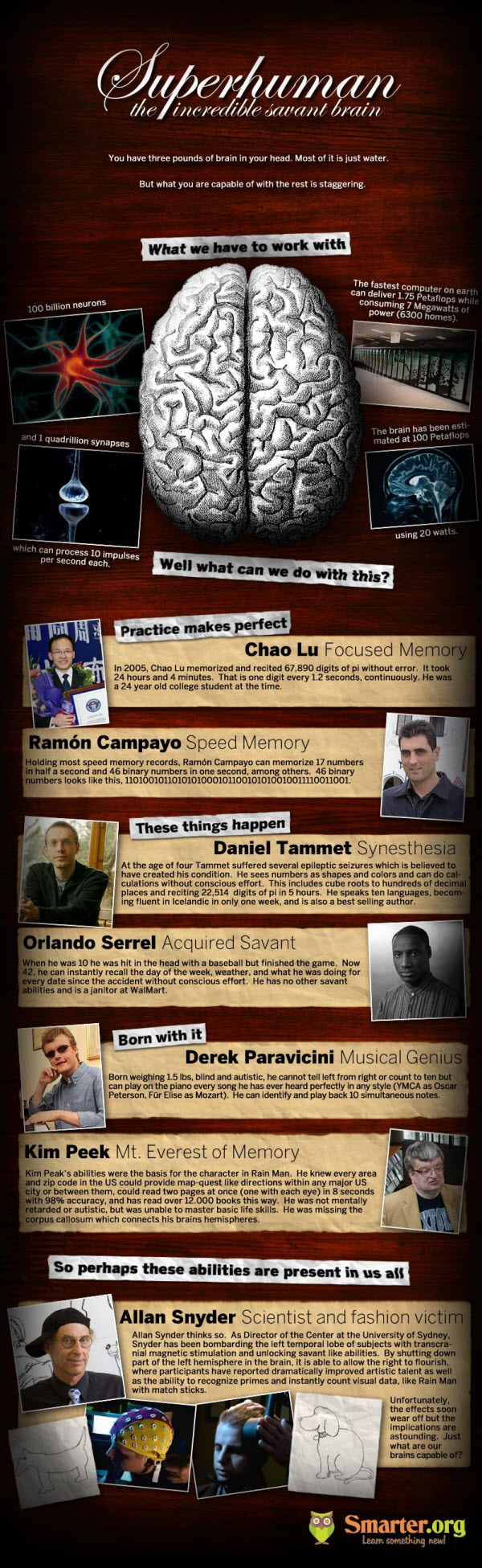
According to scientist Alan Snyder, autistic savant skills are latent inside everyone's brain. But the way to bring out these skills is by suppressing -- or damping down -- normal activity in certain parts of the brain, using magnetic pulses.
... the extraordinary skills of savants are latent in us all and that they can be induced artificially owing to the inhibiting influence of low-frequency rTMS, that is, by turning off part of the brain, not by exciting it. _RoyalSociety

DailyMail

In a recent publication in Royal Society Transactions, Biological Sciences, Snyder elaborated on techniques of artificial production of savant skills using transcranial magnetic stimulation.
Low-frequency rTMS temporarily inhibits neural activity in a localized area of the cerebral cortex, thereby creating ‘virtual lesions’ (Hilgetag et al. 1999; Walsh & Cowey 2000; Hoffman & Cavus 2002; Steven & Pascual-Leone 2006). As discussed below in §4, the LATL is implicated in the savant syndrome for both autistic savants as well as savants who emerge late in life as a result of frontotemporal lobe dementia (Miller et al. 1998, 2000; Hou et al. 2000). _RoyalSociety
Snyder was able to use localised low frequency TMS to induce a number of savant skills, including induced drawing skills, induced proofreading skills, induced numerosity (see graph below), and reduced false memories.
Snyder_RoyalSociety

TMS is applied from outside the brain, unlike deep brain stimulation (DBS). The effect of TMS on the brain depends upon several factors, including the frequency and amplitude of the pulses, and the proximity to particular parts of the brain. High frequency TMS over the frontal lobes, for example, has been beneficial in improving the language memories of Alzheimer's patients. So you see that TMS can be used to temporarily block neural activity, or to temporarily augment neural activity -- in chosen locations of the brain.

There are many approaches to using electromagnetic stimulation for brain research and therapy, which are quite promising "top-down" research approaches. Combined with the many "bottom-up" (example) approaches to the study of brain development and function, the future of brain research is very bright.
Superhuman: the Incredible Savant Brain.
Infographic by Smarter.org
You may someday be wearing an electromagnetic cap which can be switched to different settings, depending upon the task you want to accomplish. Such brain augmentation devices will have the ability to simultaneously dampen some parts of the brain while boosting the activity of other parts -- depending upon which mental skills, attitudes, or emotions you wish to emphasise or minimise at the moment. But whatever you do, do not allow anyone else access to the remote control!

H/T Singularity Hub via Impact Lab

Labels: ,

Bookmark and Share

29 June 2010

We Are All Cyborgs Now:

The idea that a chip can interface between inputs and outputs of certain brain area is a very new concept in scientific circles, Prof. Mintz notes, although movies and TV shows about bionic humans have been part of the popular culture for decades. _ReNaChip
The chip sits just below the skin, on top of the skull. It senses brain activity via implanted electrodes, and it knows when to fire stimulatory pulses to the precise parts of the brain where they are needed -- to restore the desired brain function.
For now, the chip, called the Rehabilitation Nano Chip (or ReNaChip), is hooked up to tiny electrodes which are implanted in the brain. But as chips become smaller, the ReNaChip could be made small enough to be "etched" right onto the electrodes themselves.

For therapeutic purposes, though, only the electrodes will be inserted into the brain. "The chip itself can be implanted just under the skin, like pacemakers for the heart," says Prof. Mintz, who is currently conducting experiments on animal models, "ensuring that the brain is stimulated only when it needs to be."

One of the challenges of the proposed technology is the size of the electrodes. The researchers hope to further miniaturize deep brain electrodes while adding more sensors at the same time says Prof. Mintz. His Tel Aviv University colleague and partner Prof. Yossi Shaham-Diamond is working on this problem.

The international multidisciplinary team, includes other researchers from TAU — Prof. Hagit Messer-Yaron and Dr. Mira Kalish — and partners from Austria, England and Spain, regularly converge on the TAU campus to update and integrate new components of the set-up and monitor the progress of the chip in live animals in Prof. Mintz's lab. _Source


More here, here, here, and here.

The ReNa chip would function as a type of "nano-controller", riding herd over specific brain centers -- depending upon the person's needs. Initially, the chips will be used for brain rehabilitation and to modulate the effects of various neuropathologies. Eventually, the chips will be used to treat behavioural problems. Climate change deniers and the like. You will be assimilated. Resistance is futile.

Labels: , ,

Bookmark and Share

10 June 2010

There's More than One Way Home

The ability to diagnose and treat brain dysfunction without surgery, may rely on a new method of noninvasive brain stimulation using pulsed ultrasound developed by a team of scientists led by William "Jamie" Tyler, a neuroscientist at Arizona State University. The approach, published in the journal Neuron on June 9, shows that pulsed ultrasound not only stimulates action potentials in intact motor cortex in mice but it also "elicits motor responses comparable to those only previously achieved with implanted electrodes and related techniques," says Yusuf Tufail, the lead author from ASU's School of Life Sciences. _Physorg
PLoSOne

Scientists are developing better methods for using ultrasound to diagnose brain disorder, to treat serious brain pathologies such as tumours, and to stimulate more optimal brain function in diseases such as Alzheimer's and epilepsy. There are so many possible uses for ultrasound in the brain, that a person could get lost trying to get a mental grasp all of them.
"Scientists have known for more than 80 years that ultrasound can influence nerve activity," observes Tufail. "Pioneers in this field transmitted ultrasound into neural tissues prior to stimulation with traditional electrodes that required invasive procedures. Those studies demonstrated that ultrasound pre-treatments could make nerves more or less excitable in response to electrical stimulation.
"In our study, however, we used ultrasound alone to directly stimulate action potentials and drive intact brain activity without doing any kind of surgery," Tufail says. _Physorg
Ultrasound can also affect growth factors -- such as BDNF -- and patterns of nerve discharge. This opens the door to cognitive therapies using ultrasound.
In addition to advancing hope for noninvasive treatments of brain injury and disease, the groups' experiments in deeper subcortical brain circuits also revealed that ultrasound may be useful for modifying cognitive abilities.

"We were surprised to find that ultrasound activated brain waves in the hippocampus known as sharp-wave ripples," Tufail says. "These brain activity patterns are known to underlie certain behavioral states and the formation of memories."

The scientists also found that ultrasound stimulated the production of brain-derived neurotrophic factor (BDNF) in the hippocampus -- one of the most potent regulators of brain plasticity.

Tyler says the fact that ultrasound can be used to stimulate action potentials, meaningful brain wave activity patterns, and BDNF leads him to believe that, in the future, ultrasound will be useful for enhancing cognitive performance; perhaps even in the treatment of cognitive disabilities such as mental retardation or Alzheimer's disease. _SD


PLoS study (2008) by William Tyler et al looks at some basic science of the technology.

Technology Review article on brain ultrasound therapeutics

An IEEE Spectrum look at using ultrasound for brain stimulation

Short review article describing ultrasonic deep brain stimulation

Synsonix, tech startup which includes William Tyler among its founders.

More information from Brain Stimulant

Ultrasound is only one of many technologies for intervening safely in brain dysfunction and pathology. Other methods include transcranial electromagnetic stimulation and the implantation of electrodes and transducers deep within the brain itself -- intracranial stimulation. Ultrasound has the advantage of being fairly well studied in most body tissues, so that the limits of diagnostic and therapeutic uses of ultrasound are fairly well known in general.

Getting approval from the ethics committee to study ultrasonic brain stimulation is much easier than getting permission to implant electrodes and transducers into deep brain tissue -- or even just under the dura.

That is one of many reasons why the study of ultrasonic brain stimulation should advance fairly quickly. Stay tuned.

Labels: ,

Bookmark and Share

05 May 2010

Transcranial Magnetic Stimulation Lightens Depression

A recent Medical University of South Carolina study of transcranial magnetic stimulation (TMS) to treat depression, supports the use of TMS in medication-resistant depression. A large number of depressed persons do not respond to medical antidepressant therapy, leading to significant disability and suffering.
A sample of 190 patients who had previously failed to respond to antidepressant medications received at least three weeks of randomized, controlled magnetic stimulations on weekdays for three weeks, with the rTMS magnet aimed at their brain's left prefrontal cortex. Those who showed improvement received up to an additional three weeks of such blinded treatment.

Thirteen (14 percent) of 92 patients who received the active treatment achieved remission, compared to 5 (about 5 percent) of 98 patients who received the simulation treatment. Patients who received active rTMS were significantly more likely to reach remission, particularly if they had been moderately, rather than severely, treatment resistant. The remission rate climbed to nearly 30 percent in an open-label phase of this study in which there was no simulation control. George said this is comparable to rates seen in the STAR*D medication studies. However, the researchers note that "the overall number of remitters and responders was less than one would like with a treatment that requires daily intervention for three weeks or more, even with a benign side effect profile."

Patients who responded to active treatment received up to three weeks of additional blinded, controlled rTMS until they achieved remission or stopped showing a meaningful response -- so the number of responders did not differ significantly from the number of remitters. These patients who remitted then received a combination of medications intended to help maintain the treatment effect. Despite failing to respond to medications in the past, most remained in remission for several months.

Study participants who failed to improve during the blinded phase entered a course of open-label rTMS. Among those who had been in the active rTMS group, 30 percent achieved remission during this second phase. This suggests that some patients might require as many as 5-6 weeks of daily rTMS treatment, according to George. Most patients who remitted required 3-5 weeks of treatment.
"For treatment resistant-patients, we found that rTMS is at least as good as current medications or anything else we have available, except ECT," said George. "Our current antidepressants do not work for many people."

Since the rTMS treatment did not trigger any seizures or notable side effects, the researchers propose that higher levels of magnetic stimulation be used in future studies, as evidence suggests antidepressant effects of such stimulation are dose-dependent. Higher remission rates might also be attainable if rTMS were combined with medications, they suggest.
Using magnetic resonance imaging (MRI) scans of patients' brains showing exactly where the magnetic coil was positioned, the researchers hope to confirm earlier findings suggesting that a more forward and to-the-side placement produces a larger therapeutic effect. They plan to report the results of the MRI analysis at the American Psychiatric Association meeting in late May. _SD

Large number of links to more information on TMS

TMS should not be confused with deep brain stimulation (DBS) or electroconvulsive therapy (ECT). DBS requires implanting electrodes inside the brain, and ECT involves electric shock under anesthesia, designed to trigger short term seizure activity.

The field of electromagnetic stimulation of the brain for therapeutic purposes is still in its infancy. As better forms of real-time imaging of brain activity are developed, innovations in brain stimulation will allow for real-time monitoring of the effects of the stimulation on the physiological level. In other words, the stimulation will be "dialed in" to a physiologic and subjective "sweet spot" of effect. Stimulators and monitors will be lightweight and small enough to be carried unobtrusively, and easily available for situational adjustments and calibration.

And that will be just the beginning. The danger to humans will be the temptation to succumb to "easy bliss" while neglecting some of the more difficult lessons and transitions which are absolutely necessary for living a full and satisfying life. Of course, we are a long way from that concern -- at least using this technology -- for the masses of humankind.

Labels:

Bookmark and Share

08 April 2010

Deep Brain Stimulation Mechanisms in Depression

DBS involves continually delivering high-frequency pulses of weak current to a particular region via stimulators that are surgically inserted into the brain. Although invasive, it works so well for Parkinson's disease and other movement disorders that it is now mainstream, with tens of thousands of patients implanted.

In the last decade, researchers have tested DBS on a variety of other conditions. It has proved effective at reducing some symptoms of bipolar disorder and Tourette's syndrome (see table). It was recently approved by the US Food and Drug Administration to treat obsessive compulsive disorder. _NS
The effect of deep brain stimulation (DBS) on a depressed brain is turning out to be more complex than at first thought. DBS is not merely affecting the part of the brain near the electrode. DBS appears to be affecting entire circuits of brain interaction -- performing a type of fine-tuning or calibration of the circuitry.
The researchers implanted the stimulators into the subgenual area, which is involved in emotion, in six severely depressed patients for whom all other treatments had failed, including several types of antidepressant drugs and electroconvulsive therapy. Four reported vast improvements (Neuron, vol 45, p 651).

The region was selected because brain imaging studies had shown it to be hyperactive in many people with depression. Most researchers thought that DBS worked by silencing activity in that area. This would explain why so many patients responded as soon as their stimulators were switched on: many said the operating room looked brighter than when they had gone in, for example, a sign of a changed outlook on life. It was as if "something painful had suddenly stopped", Mayberg said at a recent lecture on her work at the Massachusetts Institute of Technology.

That wasn't the whole story, however. PET scans revealed that while DBS damped down activity in the subgenual area as expected, other regions appeared affected too, particularly parts of the nearby prefrontal cortex, which is involved in decision-making and evaluating emotions. "We got lucky," says Mayberg. "It worked, but probably not for the reason we thought."

...His [Thomas Schlaepfer] team used DBS on the nucleus accumbens, an area involved in assessing pleasurable stimuli that is known to behave abnormally in depression (Biological Psychiatry, DOI: 10.1016/j.biopsych.2009.09.013).

PET scans of seven of the patients revealed that the implant didn't seem to affect activity in the nucleus accumbens itself, but instead suppressed the subgenual area - also called Brodmann's area 25 - just as with Mayberg's team (see diagram). It also had reverberations in parts of the prefrontal cortex.

"There are clear connections between area 25 and the nucleus accumbens," Schlaepfer says. He suspects that the three areas are part of a brain network that his and Mayberg's teams both tapped into.

The experiments also raise the question of why DBS doesn't work in everyone. While all of Schlaepfer's patients felt their lives had improved a year after having the stimulator implanted - be it returning to work, taking up a hobby or making new friends - some fared much better than others.

...That's where Mayberg's most recent results, which she presented at the MIT lecture, come in. To see if there were any pre-existing differences in the brains of DBS responders and non-responders, which might predict who should go to the trouble of getting a DBS implant, Mayberg's team turned to functional MRI, which allows you to see which regions light up at the same time - indicating that they are "connected".

In depressed patients who went on to respond to DBS, a part of their prefrontal cortex tended to light up in conjunction with the subgenual area. This did not happen in non-responders. In these patients, the amygdala, which is involved in fear and other emotions, tended to be connected to the subgenual area - not the case in responders. _NS

One of the aims of psycho-neurologists at the Al Fin Institutes of Psycho-Neurology, is to place the diagnoses of mental disorders on a sound scientific foundation. The demonstration of physical changes in brain circuits as a result of successful treatment would go a long way toward making the treatment of mental disorders more respectable within medicine and society.

Labels: ,

Bookmark and Share

30 May 2009

Growing New Brain Cells Using Deep Brain Stim

Deep brain electrode stimulation can lead to a doubling of production of new brain neurons in mice. Such therapies will likely be used in humans for persons suffering from brain injury and degenerative disease. Later, it will be used in order to boost performance for persons with particularly demanding jobs.
During the study, the researcher placed electrodes inside the rodent's limbic system, a formation inside the brain, and stimulated it with low-intensity current for about an hour. Knowing that the average mouse brain produces a few thousands of new neurons each day, Stone waited for the results of the stimulation. Three to five days after the procedure was completed, he noticed that the animals' brains were producing twice or more the number of neurons they usually generate, Nature News reports.

The finds were presented on May 25, at the annual meeting of the Canadian Association for Neuroscience, in Vancouver by Paul Frankland, one of Stone's supervisors, based at the Hospital for Sick Children, in Toronto.

After the electro-stimulation therapy, they injected the mice with iododeoxyuridine, a substance that allows experts to analyze which neurons are active, and which are not. After training the animals to a simple task, Stone looked at their brains, searching for a protein called Fos. This protein is associated with learning, and takes only 90 minutes to form. He learned that the Fos levels in both natural and artificially-produced neurons were the same. “These new neurons aren't just sitting around doing nothing,” he concluded. _Softpedia
Images of "wireheads" walking around in an electric haze will colour many persons' opinion of this phenomenon a certain shade of bilirubin. But electrical stimulation apparently works through normal pathways of gene expression, like other environmental cues such as drugs, hormones, and calorie restriction.

More brain cells do not automatically make a brain smarter. But more brain cells in the right place, organised properly, certainly will. If it is too late to program a person's genes to make him smarter, who will deny him the opportunity to utilise other means to that end? We will have to find many ways of boot-strapping ourselves to the next level.

The next level is not just about living 500 vital years with an IQ of 200 or more. It is about having the wisdom and competence to make the most of that time and mental capacity. Just a small number of next levels working in small labs and workshops scattered around the globe, would be enough to cancel most of the harmful effects of the Obamas, the Putins, the Kims, and the Ahmedinejads of the world. Without such an injection of wise competence over time, humans are apt to bury themselves.

The smart-wise machine fantasy of singularitarians is no substitute for extending human potential.

Labels: ,

Bookmark and Share

15 May 2009

Smaller Than a Grain of Rice, Tiny Implants Buzz Away Pain and Someday Perhaps Sorrow

These tiny implantable nerve stimulators are meant to stimulate peripheral nerves to treat chronic pain and other neurological disorders. But eventually, devices this small -- or smaller -- will fit near or within the brain, to deliver tiny currents of healing and eventually pleasure.
Like some cochlear implants and other medical devices, the implant is powered with radio-frequency transmission: radio waves transmitted by the external coil generate a magnetic field in the internal coil, which powers the electrodes. Adopting technologies from the rapidly advancing RFID world has allowed the researchers to further shrink the device. "Instead of trying to transfer energy from two coupled antennas to do telemetry, which is a common approach for medical devices, RFID is geared to have very small transponders, so you don't need a large coil," says Joseph Pancrazio, a program director at the National Institute for Neurological Disorders and Stroke, a government funding agency, in Bethesda, MD, that has given the company small business loans.

The research is still in a very early stage. Researchers have developed a prototype device, which they are testing in rats. The device can effectively stimulate peripheral nerves in rats, although it's not yet clear whether the electrical stimulation alleviates chronic pain. (Scientists assess chronic pain in rats by recording how much the animals eat; a rat in pain won't eat as much.)

Some scientists are skeptical that the device will be powerful enough to deliver a therapeutic level of stimulation. "The main limitation of any electronic device small enough to be injected into the body is that it must receive enough power to operate its circuitry and provide the required stimulation parameters," says Gerald Loeb, director of the Medical Device Development Facility at the University of Southern California, in Los Angeles. Loeb has also developed an injectable radio-powered microstimulator, which he says has encountered substantial limitations in range and power.

"We believe we can do it with less power," says Scott Armstrong, MicroTransponder's chief technical officer. However, he declined to give further details of the technology for proprietary reasons. _TechnologyReview
If not now, soon. It is quite clever of the researchers to use RFID technology for implantable nerve stimulators. Such an approach could be easily transferred to intracranial implants-without-antennas, as long as the power signal was able to safely penetrate the skull without damaging intervening tissues. Otherwise, antennas that are colour-matched to the person's hair could transmit the power signal to the implant. Advances in biocompatible materials will make such long-term implants viable.

Needless to say, technology that allows for miniaturisation of implants should also allow for simultaneous placement of multiple, strategically-placed implants that could communicate with each other, and coordinate for sophisticated neuro-stim routines.

Cross-posted at Al Fin Longevity

Labels:

Bookmark and Share

14 May 2009

A Brave New World of Custom Brain Augments

How do you want your brain customised? With a brain-machine interface? With genetic treatments? With smart drugs? With implanted nano-circuits? Or with stem cell colony implants ready to repair any damage or deficit?

All of those modifications are on the doorstep, ringing the front bell. The world's neuroscientists and philosophers are finally taking this reality seriously. A group of interested persons met in Berlin recently to discuss the implications of the brave new brain technologies.
The next stage of brainpower enhancement could be technological - through genetic engineering or brain prostheses. Because the gene variants pivotal to intellectual brilliance have yet to be discovered, boosting brainpower by altering genes may still be some way off, or even impossible. Prostheses are much closer, especially as the technology for wiring brains into computers is already being tested (see "Dawn of the cyborgs"). Indeed, futurist and inventor Ray Kurzweil believes the time when humans merge with machines will arrive as early as 2045 (New Scientist, 9 May, p 26).

It won't be long before "clip-on" computer aids become available for everybody, says Andy Clark, a pro-enhancement philosopher at the University of Edinburgh in the UK. These could be anything from memory aids to the ability to "search" for information stored in your brain. "We'll get a flowering of brain augmentations, some seeping through from the disabled community," he says. "I see them becoming fashion items, a bit like choosing clothing." Clark says that even today, devices such as head-up displays on spectacles or simply being adept at using computer programs like Photoshop come close to being physical extensions of people's minds.

...There are, however, simple alternatives to technological enhancement that would achieve many of the same goals, says Dupré: education and child-rearing. Moreover, he thinks such changes can be heritable via epigenetics - the reprogramming of gene expression in offspring by exposure to cultural, maternal and environmental influences. Dupré points to a study in rats showing that good maternal care was passed on largely because it permanently altered gene activity in the brains of the pups. _NewScientist
There is a wide range of potential brain mod even without using invasive implants, stimulators, and genetic alterations. Humans have always had access to meditation techniques (including laughter) which may well build useful brain circuits. More recent developments such as neurofeedback expand the options for creative brain modification immensely. Combining brain machine interfaces with nano-implants, crafted meditative techniques, and neurofeedback offers some quite sophisticated possibilities for supercharging specific brain circuits.

Genetic modification (combined with creative stem cell therapies) is the long term goal, once the techniques are improved. The mainstream intent will be to provide a level playing field for all the world's people -- including those populations that seem stuck at average IQs around 70 to 80 points. These people have no hope of developing or maintaining a technological civilisation, and depend upon outsiders and market dominant minorities for their advanced goods and services.

Eventually, advanced germ cell line genetic brain augmentation techniques will be applied to persons who are already above average intelligence. Soon afterward, clear separations in group proficiencies will develop and begin to widen.

It is not likely that such separation will begin along racial lines, but rather along other affiliative lines such as professions or special interest groups. Societies whose more functional and accomplished members work well together regardless of race, ethnicity, or religion etc will probably be the most creative in terms of applying the new technologies.

If such quasi-elites -- by competencies -- have experienced enough societal shocks they are likely to jump beyond today's ethically queasy resistance to brain augmentation in the interest of survival. The threat of a new dark age brought on by incompetent world governments would be enough to focus even the most bleeding heart.

The horses are already out, and they are just now talking about closing the barn door. Someone take them some coffee.

Labels: , , , ,

Bookmark and Share

06 May 2009

Brain Implants a Gentler Form of Electroshock

Results of a recent Harvard study using brain implants to treat medication resistant depression were reported to a conference of American neurosurgeons in San Diego yesterday.
"Imaging and transcranial magnetic stimulation studies have demonstrated that the left dorsolateral prefrontal cortex (DLPFC) area of the brain plays a critical role in patients with major depressive disorder (MDD). These findings prompted research in which we used an investigational epidural cortical stimulation system to deliver targeted stimulation to the left DLPFC in 12 patients with MDD," stated Dr. Eskandar.

The 12 patients were randomized to single blind active or sham stimulation for 8 weeks, and then all subjects received active stimulation. One patient was excluded from analysis due to a protocol deviation. During the procedure, the electrodes were placed epidurally, outside the dura, through a small craniotomy. Outcome assessments included the Montgomery-Asberg Depression Rating Scale (MADRS), the Hamilton Depression Rating Scale (HDRS), and the Global Assessment of Functioning (GAF). _MNT
This form of brain stimulation is more invasive than strong external electroshock (electroconvulsive ECT), but involves a much gentler electrical stimulation. Results from the study are encouraging:
-- In all patients, continued improvement was seen at 6 months (average HDRS: 20 percent) and 12 months (average HDRS: 33 percent).

-- At 12 months, patients whose electrodes were implanted >20 mm from the precentral sulcus averaged a 59 percent improvement in HDRS compared to a 12 percent improvement in patients (n=6) with electrodes <20mm _MNT
This study involves fairly timid electrode placement -- outside the dura, over the left dorsolateral prefrontal cortex. Such locations are quite safe, since by avoiding direct brain contact, neural scarring should be completely avoidable. In other words, the procedure should indeed be completely reversible -- unlike ECT and unlike many types of deep brain electrode placement.

An extension of this technique to allow simultaneous stimulation and inhibition of multiple areas of cortex should be the next step -- after confirming the result with larger numbers of medication-resistant depressed patients.

The extradural placement of the electrodes should also allow for creative "sheet-electrode" designs. This is where biocompatible materials and conductive polymers will earn their salt.

Labels: ,

Bookmark and Share

26 April 2009

All Zombies Now

MIT researchers have genetically programmed specific types of cells -- fast spiking interneurons -- in mouse brains to respond to pulses of laser light. The researchers can expose these cells to laser pulses at specific frequencies, causing the cells to produce gamma oscillations.
Gamma waves are fast, high-frequency, rhythmic brain responses that have been shown to spike when higher cognitive processes are engaged. Research in adults and animals suggests that lower levels of gamma power might hinder the brain's ability to efficiently package information into coherent images, thoughts and memories. _Source
The MIT researchers can cause the mouse brains to produce gamma waves "on demand", allowing for much easier study of the phenomenon in animal models of perception, memory, and even "conceptualisation."
The trick for inducing gamma waves was the selective activation of the "fast-spiking" interneurons, named for their characteristic pattern of electrical activity. When these cells were driven with high frequency laser pulses, the illuminated region of cortex started to produce gamma oscillations. "We've shown for the first time that it is possible to induce a specific brain state by activating a specific cell type" says co-author Christopher Moore, associate professor of neuroscience and an investigator in the McGovern Institute. In contrast, no gamma oscillations were induced when the fast-spiking interneurons were activated at low frequencies, or when a different class of neurons was activated.

The authors further showed that these brain rhythms regulate the processing of sensory signals. They found that the brain's response to a tactile stimulus was greater or smaller depending on exactly where the stimulus occurred within the oscillation cycle. "It supports the idea that these synchronous oscillations are important for controlling how we perceive stimuli," says Moore. "Gamma rhythms might serve to make a sound louder, or a visual input brighter, all based on how these patterns regulate brain circuits." _MIT
This merging of expertise from molecular genetics and neuroscience, permitted the production of specially designed mice whose brain activity could be controlled by laser -- to a certain extent -- for study of gamma waves.

Before long, it should be possible to genetically program the brains of humans to respond to certain environmental cues -- light, ultrasound, microwave etc. -- to control behaviours in far more sophisticated ways. The ability to influence gamma waves alone should be sufficient to influence normal perception, conceptualisation, and coherent thought. In other words, persons whose brains were programmed to respond to pulsed energy could be made to appear schizophrenic, or could have their short-term memories blocked at specific times. And a lot more besides.

If you want to be able to force persons to think specific thoughts, or believe particular assertions, you would need to use a sophisticated form of conditioning from behavioural psychology. In fact, these newer tools of "brain control" might very well bring about a startling renaissance in behavioural studies in certain research labs that accept government funding.

The combination of bio-nanotechnology, molecular genetics, stem cell technology, neuroscience, and some even more surprising technologies in cell and molecular biology, are opening the doors of perception and deception wider than ever. Can these technologies be used to accomplish good things? Of course they can and of course they will. But there is always a dark side to every discovery.

But think of this timely application: Who would need to torture someone to divulge information, when they could re-program the person's motivational structure -- leaving his memories intact for voluntary extraction.

Of course, if you were the sort of politician who looks at masses of people, and sees only zombies to be recruited into your personality cult and private army of adulation, this technology might have application to your needs as well.

All zombies now.

More information on MIT study, along with another study from Stanford with parallel findings

Update on the Swiss Blue Brain project (via TechNutNews)

Labels: , , ,

Bookmark and Share

21 February 2009

We Are All Cyborgs Now: Photoelectrode Control

A fascinating new type of brain stimulating electrode is being developed at Case Western Reserve University. This new electrode can be triggered by light, yet it triggers a nerve action potential at the brain implantation site.
The team led by Ben W. Strowbridge and Clemens Burda coated the interiors of extremely finely drawn-out glass micropipettes with lead selenide nanoparticles. Lead selenide is a semiconductor that is activated by IR light. As in solar cells, irradiation “catapults” firmly bound electrons out of the valence band and into the conduction band of the semiconductor, where they can move freely. This leads to charge separation and thus to an electrical potential. With a suitable laser, defined processes elicited by short light pulses set off corresponding electrical pulses in the micropipette. An electrical field is thus formed around the pipette, which can then be used by the researchers to stimulate neurons in rat brain samples with a high degree of time-resolution.

...By using these new photoelectrodes, the cooperation of nerve cells can be studied. However, therapeutic applications are also possible: the probes could be used to activate individual regions of the brain or damaged or cut nerves to restore function - without the need for disturbing wires. _Physorg
Fascinating! The laser pulses are transmitted down the glass electrode to the special implanted semiconductor material, where it is transduced to an electrical potential. This potential then triggers nerve impulses -- apparently on a very fine time resolution scale.

Think about it for a moment. A cyborg could wear a fiberoptic receiver "cap", which can be activated with finely aimed laser light from some distance away, to provide the desired brain stimulus. Would it be possible to control a human brain with any degree of multi-sensory "conscious" awareness using this technique? Eventually, perhaps.

Although lasers require line of sight control, which restricts their use vis a vis RF controllers, the lack of need for surface electronics and power supply would seem to be a significan advantage for many purposes.

Cyborgs and Grobycs appear to offer far more promise than pure robotics, at this point in time. One normally thinks of military or law enforcement applications when thinking of a "six million dollar man" with external neural triggers or shutoffs. But as more is learned about the effect of brain stimulation, we are more likely to discover ways of enhancing normal brain function. At that point, the range of applications will broaden, and the waiting line of humans desiring augmentation is apt to grow rather long.

Labels: , ,

Bookmark and Share

22 December 2008

Something Tells Me It's All Happening in the Brain

The brain is the most important sex organ we have. Billions of dollars are spent every year on phone sex, internet video sex, internet porn, and other relatively crude ways of stimulating the sexual parts of the brain. Why not skip the middle men and shoot directly for the pleasure centers of the brain?
Scientists are developing an electronic 'sex chip' that works by stimulating the pleasure centres in the brain.

The technology, which creates tiny shocks deep in the brain, has already been used in America to treat Parkinson's disease.

Now researchers are focusing on the orbitofrontal cortex, which is associated with feelings of pleasure caused by eating and sex. _DailyMail
Tiny shocks deep in the brain? Tiny, nipping little teasing shocks, so deep, deep in the brain? Hmmmm, it might work.

Carbon nanotubes may be just the electrodes to make it all possible. Metal electrodes tend to slip and move around, and collect subcellular debris that causes the interface to degrade over time. Carbon nanotubes may well provide the flexibility and bio-compatibility for a more permanently intimate connection.
The new carbon nanotube-based interface technology discovered together with state of the art simulations of brain-machine interfaces is the key to developing all types of neuroprosthetics — sight, sound, smell, motion, vetoing epileptic attacks, spinal bypasses, as well as repairing and even enhancing cognitive functions. _i09
The potential dangers of "wireheading" should be obvious -- dissociation from reality, total focus on self-pleasuring to the neglect of responsibilities and personal health. But the combination of neuro-stimulation with a face to face interaction, might present certain advantages in terms of "jump-starting" a relationship. And make no mistake, these brain chips would be a killer app for the teledildonics industry. It will not be long before they are connected to a wireless interface.

Just be careful who you lend the remote control to.

Cross-posted at Al Fin, You Sexy Thing!

Labels: , , ,

Bookmark and Share

11 December 2008

Wishing You A Well - Washed World

There is the story of a woman whose world literally became brighter—looked newly washed—as soon as the electrode was activated. Other depressed patients said their sensations of “painful emptiness” disappeared. These changes abruptly vanished when patients’ electrodes were switched off. _Sciam
We are quite simply at the mercy of our brains -- its limitations, its aptitudes, its habits good and bad. We are learning more good news about the incredible plasticity of our brains. Brain plasticity can be utilised to intentionally alter some of our brain defaults, using neurofeedback, pharmacology, meditation, and other up and coming psycho-neuro-modification techniques.
In the late 1980s surgeons found that if they stimulated either the thalamus or the globus pallidus (a part of the basal ganglia) with fast pulses—up to 180 times per second—they could override the faulty connections. Scientists do not completely understand how deep-brain stimulation works, but we do know that the pulses sent to the electrode sometimes drive and sometimes inhibit the natural activity of neurons. Faster pulses, such as those used in Parkinson’s patients, tend to overwhelm and thus inhibit activity, whereas slower pulses tend to drive it by creating a tempo that the neurons strive to meet.

...Until now our best view of the living human brain has been through imaging studies such as MRI and positron-emission scans, but what we get from them is vague, along the lines of “When a person does such-and-such or thinks such-and-such, there are changes in blood flow or oxygenation in certain parts of the brain that are likely related to changes in neural activity.” With deep-brain stimulation, on the other hand, what you essentially have is an on-off switch located in a specific part of the brain. By observing what happens to the brain as a whole when that switch is activated, you can glean detailed information about how various brain structures interconnect. One particularly exciting avenue that we have pioneered is to combine deep-brain stimulation with an imaging technique called magnetoencephalography (MEG). MEG tracks neural activity on the scale of milliseconds (MRI, in contrast, gives average brain activity over a six-second period and PET over a scale of minutes), providing an exceedingly accurate, moment-to-moment report.

When we used this technique on Matthews, the phantom-limb patient, we saw that the electrode in his brain stem appeared to drive activity in many other brain regions. Among the most active when he felt pain relief was the midanterior orbitofrontal cortex. This structure, located just above the eyes, has been shown in other studies to play a pivotal role in pleasurable (or rewarding) activities such as eating, using drugs and sex. Thus, cessation of pain is an intense form of pleasure, along the lines of snorting a line of cocaine or devouring a delicious pastry. This finding confirms that the orbitofrontal cortex might be an effective new stimulation target for people suffering from anhedonia, a lack of pleasure, which is common to depression and other mental illness. _Sciam


Deep brain stimulation is an order of magnitude more dramatic than most other neuro-mod techniques. It is like an "on-off" switch, influencing whatever brain circuits it may be tapped into at the moment. By tracing the reverberating echoes of a neural stimulus down the labyrinthine interconnections of brain circuits, neuroscience will achieve greater flashes of insight into brain function, conscious sensation, and cognition.

Labels: ,

Bookmark and Share
Older Posts
Al Fin Main Page
Enter your Email


Powered by FeedBlitz
Google
WWW AL FIN

Powered by
Blogger

``