26 October 2012

America's Haute Noblesse: Living Well on Other People's Money

Haute Noblesse to Citizens:  Back in the soup line, little people!

The following article is adapted from a piece first published on abu al-fin

The US is a nation struggling with economic uncertainty and cultural decline. While real unemployment is well above 10% and underemployment approaches 25%, America's new political nobility provides itself a lavish lifestyle in which previous president's and their families never thought to indulge.

President Obama has spent far more lavishly on White House state dinners than previous chief executives... current and former government officials said the documents obtained by The Examiner point to an unprecedented upsurge in White House spending on such events.

...A knowledgeable government official who made the documents available to The Examiner said the extravagant spending seemed unfair with so many Americans out of work.

"It just kind of takes your breath away to see the expenditure of money that has occurred since 2009," the official said.

Gary Walters, who ran presidential household operations for 21 years during Democratic and Republican administrations, before retiring in 2007, told The Examiner the costs reflected in the documents were "excessive. They are high." _Examiner
Not surprisingly, the government agency responsible for paying for these extravaganzas of the haute noblesse, is run by a US State Department official who also happens to be a business partner of the man who caters these exorbitantly costly events.

Of course, that is but one side of the story. The very costly vacations taken by the nouveau haute noblesse would make a billionaire blush -- if his vacations were taken at taxpayer's expense.

But to the nouveau haute noblesse, such costly pleasures are considered minimal perquisites, for the many duties required of them as official and unofficial figures of state. "If you cannot live well on other people's money, what good is becoming involved in government?" they are likely to ask.

And America drifts backward toward the autocratic rule which the founders of the original republic had tried to hard -- at such a high cost -- to escape. Welcome to the Idiocracy.

More: The following is just a partial list of some of the pleasures taken by the haute noblesse at the expense of other people, while the citizens were struggling to get by --
– March 19, 2012, The elder daughter, is spending her springbreak in Mexican city of Oaxaca in the company of 12 friends, Malia Ann Obama, are staying at a downtown hotel in this city famous for its colonial architecture and well-preserved native American traditions. Malia and her friend are guarded by 25 US Secret Service agents as well as Mexican police.
President’s Day 2012, Michelle and the first daughters in Aspen, Colorado to ski. Michelle Obama and her daughters are on a ski trip to Aspen, Colo., the White House confirmed to POLITICO. The first lady and the Obama daughters are on a private family trip to Colorado.
– Christmas 2011, the first family in Hawaii for an extended vacation. The Obamas celebrated the holiday by attending a Christmas service at the Kaneohe Bay Chapel on Marine Corps Base Hawaii, followed by a visit with military families at Anderson Hall.
Summer 2011, in Martha’s Vineyard, Mass., for the annual beach break. the first family, their Vineyard haven is taking on the flavor of a summer White House. President Obama, for the third straight year, is planning to return to Martha’s Vineyard for vacation this summer, according to a White House official. The Obamas are scheduled to spend seven to 10 days on the island in mid- to late August, according to the official, who spoke on condition of anonymity because of security concerns.
June 2011, the first lady, her mother and daughters traveled to South Africa and Botswana. Michelle Obama, her family and her staff to South Africa and Botswana. Judicial Watch received mission expense records and passenger manifests for the Africa trip that described costs of $424,142 for the flight and crew alone. Other expenses, such as off-flight food, transportation, security, etc. were not included.”
In the past two weeks, we have:
-$800,000 for the GSA’s lavish Las Vegas vacation
-$470,000 for Michelle Obama’s Spanish getaway
-95+ Rounds of golf played by Barack…during a recession.
-$850,000 for Defense Secretary Leon Panetta’s $32,000 round trip tickets home to see his family.
-Secret Service Agents involving themselves with prostitution
-Barack Obama seen in a video telling a crowd part of his job is to scout out vacation spots for Michelle
President’s Day 2011, the first lady and first daughters travel to Vail to ski. Michelle Obama and her two daughters are spending the Presidents Day weekend on the ski slopes in Aspen, Colo., a newspaper reports. Obama arrived Friday.
– Christmas 2010, in Hawaii. The Obama’s go back to Hawaii for what is expected to be a 17-day vacation. The total cost for a 17-day round trip vacation to Hawaii for the President and his family and staff and security is estimated at around $4,113,038.. Obama’s $4 million Hawaii Christmas vacation,
August 2010, the first family traveled to Panama City Beach, Fla., for some sun and fun at the beach.
August 2010, Obama spent the weekend alone in Chicago for his 49th birthday bash. Barack Obama is coming home to celebrate his 49th birthday. Obama will be in Chicago on his birthday– August 4. The White House said he is looking forward to spending the night in his family’s home in Hyde Park on the city’s’ South Side and gathering with friends.
August 2010, the first lady and daughter Sasha traveled to Spain for a mother-daughter vacation. Michelle Obama and her daughter Sasha, 9, are vacationing at a lavish resort in Spain. The first lady and her entourage landed at Malaga, on Spain’s Mediterranean coast, at 10:30 a.m.
August 2010, summer vacation again at Martha’s Vineyard. Obama and his family arrived August 19 for a 10-day visit. The President and Me, we invite you to post photographs of your encounters with the first family, whether you’re dining with the leader of the free world, swimming or golfing with him, playing a game of Horse, or just offering advice.
July 2010, the first family went to Mount Desert Island, Maine. President Obama and his family are arriving Friday for the weekend. The summer playground of the Astors, the Rockefellers and the Morgans – as well as newer social titans like Martha Stewart.
May 2010, the first family had a four-day trip to Chicago. Obama in Chicago working out Sunday morning. Obama Secret Service agents in Chicago in sort of “standoff” with Farrakhan’s Fruit of Islam guards
March 2010, first lady and daughter spend Spring Break in New York City. Obamas arrived in New York on Saturday, when they visited Dylan’s Candy Bar and caught a performance of Blue Man Group. Before seeing “Memphis” on Sunday, they ate brunch at Mesa Grill. After the show, they got a private tour of the Empire State Building, devoured cupcakes at Magnolia Bakery in the West Village and ate at the Russian Tea Room.
Christmas 2009, Hawaii again for the annual break. The president, first lady and their daughters came to the island of Oahu for a more-than-weeklong vacation away from Washington. The Obamas have no public schedule and are expected to celebrate the holidays in private at a rented compound in Kailua.
August 2009, at Yellowstone National Park and the Grand Canyon for a short vacation. the president, First Lady Michelle and the kids are heading west on Aug. 14 for a long weekend to visit Grand Canyon and Yellowstone National parks. Just days later, the First Family travels to Martha’s Vineyard, off the coast of Massachusetts. On Friday, Aug. 14, the First Family will visit the Bozeman, Mont., area. On Aug. 15 they will travel to Yellowstone, Wyo., and Grand Junction, Colo. They will then travel to the Grand Canyon and Phoenix, Ariz., on Aug. 16, and return to Washington, D.C., on Monday, Aug. 17. The First Family’s visit to the national parks occurs during a free weekend for our national parks. Mrs. Obama and her daughters have already made two overseas trips this summer.
August 2009, their first summer vacation as first family at Martha’s Vineyard, Mass. The 28.5-acre Martha’s Vineyard estate where President Obama, his family and, of course, the Secret Service will spend part of the president’s summer vacation. Caroline Taylor, another Martha’s Vineyard realtor, estimated that the property would go for $35,000 to $50,000 a week. The Obamas will pay for at least a portion of the rental, but taxpayer funds will be used to pay for Secret Service and staff housing on the property.
_EmptySuit
American politicians often become very wealthy either while in office, or soon after leaving office -- regardless of the prior state of their finances. Is it corruption? Hush! That kind of talk is for the little people, softly and behind closed doors.

La haute noblesse to the little people: Apres nous, le deluge!

Labels: , , ,

Bookmark and Share

03 October 2011

Grow -- Or Die; Get Busy Livin' or Get Busy Dyin'

Grow or Die as Applied to a National Economy

Under current leadership, Europe and America are busy dyin'. Dynamic innovative attitudes and thinking have given way to a stagnant, steady state, dieoff.orgy bureaucratic liquidation of western civilisation. We are being crowded by our overlords into a tight, descending chute, forced down into an abattoir of stasis where civilisations go to die.
Grow or Die Applies to the Living and Business Worlds Also

"Grow or die," is a natural imperative. " ...all living systems are either growing or dying, there is no sustainable stasis...There is accretive, replicative and transformational growth." (Source) We can choose how we are to grow, but we cannot choose not to grow. Not if we want our civilisations and our bloodlines to survive.

Respected science fiction author Neal Stephenson laments the loss of innovativeness in modern American society:
This summer, at the age of 51—not even old—I watched on a flatscreen as the last Space Shuttle lifted off the pad. I have followed the dwindling of the space program with sadness, even bitterness. Where’s my donut-shaped space station? Where’s my ticket to Mars? Until recently, though, I have kept my feelings to myself. Space exploration has always had its detractors. _WorldPolicy


An Unusual Situation from The Farsight Group on Vimeo.

Matt Ridley laments the fact that even today's innovative optimists appear to be contaminated with an overlay of "culture noir," a subconscious acceptance of too much of the modern gospel of stasis. Small wonder that our shrinking number of modern innovators sometimes appear schizoid about progress, when they are so beseiged by the culture of defeat that surrounds them in academia and society.

Obama did not set American culture down this greased rail of pessimism and malaise, but he has accelerated the rate of despair and futility. In Obama's America, there is very little reason to push for growth, when the bureaucratic culture of stasis is standing by to penalise any such efforts. Electing such a person once can be written off to frustrated desperation. Re-electing such a person is a certain sign of the impending death of the society as a going concern.

We are living on a finite Earth, which is floating in an infinite universe. The Earth is our cradle, the universe is our rightful home. Until humans shake off the infantile desire to remain in a comfortable sustainable cradle until it becomes a sustainable grave, stasis will have the upper hand.

But that mainly applies to the part of human civilisation that remains under the guidance of the mainstream, bureaucratic governments of steady state stasis. For those who choose to step outside the mainstream and make their own plans for the future, more positive choices can be made.

Labels: , ,

Bookmark and Share

31 December 2010

Choking on Affluence: Decline of Western Ambition

The difference in ambition can be seen clearly at airports, which now serve as the entry halls of the global economy. A traveler to John F. Kennedy Airport, Heathrow, Charles De Gualle LAX or Dulles passes through decayed remnants of fading late 20th century buildings and technology. In contrast, airports in Dubai, Hong Kong and Singapore offer clean, ultra-modern facilities with often impressive design.

The West’s retreat from space exploration further underscores its metaphysical poverty. Today, Europe and the U.S., the world’s historic leader in the field, are cutting back on plans to explore the cosmos, which has included a manned operation to the moon. President Obama wants NASA to focus more on issues regarding climate change instead. In contrast, the rising countries of Asia, notably China and India, have begun plans for manned flights to the moon and beyond. _JoelKotkin

The decline of the western world has been discussed since the days of Oswald Spengler in the first half of the 20th century. Under the new left leaders of Europe and the US, the decline has accelerated to alarming speeds.
Europe, particularly the U.K., suffers acutely from metaphysical angst. Once touted as the new great power by its leaders and their American claque, the E.U. is quickly dissolving along cultural and historical lines; this is especially evident in the division between the resilient countries of the north (something like the Hansa trading states of the late Middle Ages) and the weaker countries along the periphery. For the most part, Europe no longer seems capable of doing much more than finding ways to control an unaffordable welfare state without tearing about its social net. The once cherished notion of a multi-racial “new” Europe largely has dissolved as immigration has devolved from a source of demographic and cultural salvation to a widely perceived threat to the E.U.’s economic and social health as well as security.

Such defeatism usually has less success in the United States. But America’s “progressive” left increasingly resembles its European cousins. Obama’s science advisor, John Holdren, has been a long-time advocate of the idea of “de-development,” the purposeful slowing of growth in advanced countries in order to protect the environment. The critical infrastructure needed to accommodate upward of another 100 million Americans — new dams in the west, intelligent development of our vast natural gas reserves and building new cities, airports and ports – are not at the center of either party’s platforms. These could be financed largely with private sources, given the right incentives. _JoelKotkin
The imminent bankruptcy of several European nations and US cities and states reveals just a hint of early collapse of western dysfunctionality. [As usual, public sector unions play a pivotal role.]

As the Obama administration and the EU progressively starve the US and Europe of reliable energy supplies, and choke off private economic initiative via ruionous taxes, regulations, penalties, etc. the underlying foundation of the nations and regions crumble.

The trend cannot be reversed, because its source is the lack of substance and realism -- along with a lack of ambition -- of the underlying human populations of Europe and the Anglosphere. Two of the most important reasons for the decline in human substrate are dysfunctional schooling and errant childraising. It is not just the children of the very wealthy who suffer from affluenza -- the "Paris Hilton" syndrome. Compared to most children of the world, almost all American and European children are affluent, with much idle time on their hands to be filled with dysfunctional thought patterns.

The emphasis is on "de-development" and on not giving any offense to those who would like to destroy western culture altogether. The ruling ethic of the modern west is not only dysfunctional, it is actively suicidal. And since all of these nations are "democracies," the human substrate actually elected the figureheads of the ruling classes.

Labels:

Bookmark and Share

28 December 2010

Debt, Power, and Revolution: In Media Res

Image Source

We are living in interesting times, and any attempt to predict exactly how our world dynamics will resolve is doomed to fail. Here are some things that are happening around the world.

The Western World


The western world is looking at massive and growing debt combined with an enormous demographic transition. That particular combination points to a coming of potentially cataclysmic change in the everyday existence of most of the region's residents.
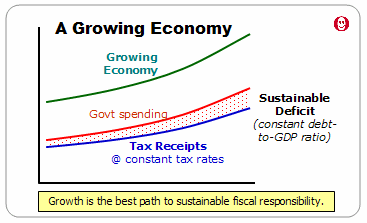
...once the fatal spiral begins, how can a state escape disaster? There are only eight options: (1) higher taxes; (2) less spending; (3) more growth; (4) more lenient interest rates; (5) worse inflation; (6) war; (7) external aid; or (8) default. All eight options have been used in the past, but only one of them is both plausible and desirable today: growth. A growing economy (which raises tax revenue) permits the absorption of debt and restores sustainable public finances. Then borrowing can resume—if it will encourage further growth. Responsible governments do not finance their everyday expenses by borrowing, and they keep their investments at a level they can repay.

History offers one final lesson. The power of sovereign states can foster a sense of impunity that encourages excessive debt. In the past, sovereign states have sometimes rid themselves of creditors by simply driving them out (as they did repeatedly with Europe’s Jews), by tormenting them, or by simply refusing to pay. When modern states borrow from a range of anonymous investors on global markets, sovereign immunity protects their assets against seizure—China cannot seize the White House as collateral for U.S. Treasury debt. But creditors can still negotiate, even with sovereign debtors. When a state loses the market’s confidence, the threat of a financial cutoff is a jolt back to reality. Just ask Greece, as its leaders scramble to reduce its public deficit as quickly as possible. The West needs to wake up now, shake off the yoke of public debt, and take the path of liberty. That path is long and difficult. It means balancing budgets and stabilizing the financial sector. But the great reward will be a return to confidence and growth—for those who put in the effort, and for those with the audacity to see it through. _Newsweek


Russia


The recent second conviction of former Yukos head Khodorkovsky opens a window on what may be one of many potentially fatal dynamics at the core of Russian power.
the real meaning of the Khodorkovsky case is that the authorities are weak, and scared. If the first trial of Khodorkovsky was a kind of perverse victory for Putin over the once-powerful oligarchs, the second trial shows that the Kremlin is afraid of showing what it sees as weakness. More, the ham-handedness of the charges themselves, and the heavy police presence and mass arrests at the trial today, betrays a dangerous amateurishness. Totalitarianism is scary. Incompetent totalitarianism is actually scarier.

For evidence of just how totalitarian – and now incompetent – Russia’s authorities are, look no further than the desperately eloquent scene in the courtroom during the trial, day in, day out. On one side sat the state prosecutors in their 1980s-style uniforms, surrounded by stacks of paper bulging out of Victorian-style ledgers. They mumbled their evidence in a monotone. At several points in the trial their accusations were so absurd that even the judge burst into laughter (my favorite prosecution malapropism – “The defendant is doing an excellent impression of being a normal person.”) On the other side sat the Khodorkovsky defense team, smartly dressed, each with a laptop. In a glass cage behind them, looking more at ease and in a strange way freer than anyone in the room, sat Khodorkovsky and Lebedev, taking turns to follow the documentary evidence on a large Mac screen set up in front of their box while the other made notes. It was as though two Russias were sparring in the courtroom, one mediocre, nervous and browbeaten, the other smart, modern and surprisingly relaxed. As Khodorkovsky himself said last year, a country that plunders its best companies and jails its brightest businessmen and instead puts its trust in the secret police and bureaucrats has its priorities seriously wrong.

The oligarchs were, unarguably, bad for Russia. They used their money to buy political power, and in the process corrupted the Duma, the press and the government. But the bureaucrat-kleptocrats who succeeded them are far worse. Khodorkovsky, in his years of incarceration in a Siberian labor camp, has transformed himself from a symbol of the hated oligarchy into a bellwether for a different sort of Russian rottenness. The oligarchs abused their money, the Kremlin now abuses power to silence opposition and to cover up the mass theft by the bureaucratic class of what has been estimated as a third of Russia’s GDP, annually. Medvedev is right that Russia is rotting from within; he’s even put his finger on exactly how. But the second conviction of Khodorkovsky shows that Medvedev, with all his brains and talk of reform, hasn’t made a whit of difference. _Newsweek

China


China is widely celebrated as the economic success story for the 21st century. The rapid growth of China's economic and military power suggests that the world may be approaching a change of hegemons. But is it possible that both China's military power, and its economic prospects, may be somewhat overstated?
When a government loses control of monetary policy, inflation follows. A few months ago, only the scariest "China bears" predicted 6% inflation for next year; now the People's Daily is admitting it may reach those levels "in some months."

The nonindependent People's Bank of China, staffed by reform-oriented technocrats, is being allowed to raise interest rates a few basis points. But allocating credit on the basis of its cost threatens the whole political economy. The state-owned companies have become accustomed to negative real interest rates. If the price of capital rises, many of the Communist Party elite will face a crunch. _WSJ
When one looks beneath China's Potemkin facade, one is apt to see enormous corruption, infrastructure overbuild, massive misallocation of resources, and a shockingly shoddy level of construction and impending collapse of poorly-built structure.

Emerging Markets


There is a lot of money to be made in emerging markets, if one understands some of the hazards involved.
...there is evidence of growing state involvement in both the economy and corporate sector across many emerging markets. This could hurt investors in a number of ways, most notably by governments forcing companies to prioritise social or geopolitical objectives over economic returns.

From an economic perspective, the main issue facing investors in emerging market equities is currently the degree of overheating, which is evident across a number of economies in the form of rising inflation and/or current account deficits.

Commodity price increases in particular have had a more inflationary impact on emerging than developed economies, because of their higher weightings in price indices and – more importantly – the narrower output gaps. _FT
There are more reasons for caution in the linked FT article.

One Ring to Bind Them, ... To Rule Them All

The United Nations' Intergovernmental Panel on Climate Change (IPCC) aims to write the rules and set the standards which the entire world will live and work under. The goals of the IPCC are ambitious: a massive transfer of resources from the developed world to the undeveloped world. As justification for this resource transfer, the IPCC claims to be saving the world from a cataclysmic collapse resulting from anthropogenic greenhouse gas-caused climate change. How good is the IPCC's record?
Remember all the media brouhaha about global warming causing hurricanes that commenced following the devastating U.S. 2004 season? Opportunities to capitalize on those disasters were certainly not lost on some U.N. Intergovernmental Panel on Climate Change officials. A special press conference called by IPCC spokesman Kevin Trenberth announced "Experts warn global warming likely to continue spurring more outbreaks of intense activity."

But there was a problem. Christopher Landsea, a top U.S. expert on the subject, repeatedly notified the IPCC that no research had been conducted to support that claim--not in the Atlantic basin, or in any other basin. After receiving no replies, he publicly resigned from all IPCC activities. And while the press conference received tumultuous global media coverage, Mother Nature didn't pay much attention. Subsequent hurricane seasons returned to average patterns noted historically over the past 150 years, before exhibiting recent record lows with no 2010 U.S. landfalls.

Much global warming alarm centers upon concerns that melting glaciers will cause a disastrous sea level rise. A globally viewed December 2005 BBC feature alarmingly reported that two massive glaciers in eastern Greenland, Kangderlugssuaq and Helheim, were melting, with water "racing to the sea." Commentators urgently warned that continued recession would be catastrophic.

Helheim's "erratic" behavior reported then was recently recounted again in a dramatic Nov. 13 New York Times article titled "As Glaciers Melt, Science Seeks Data on Rising Seas." Reporters somehow failed to notice that only 18 months later, and despite slightly warmer temperatures, the melting rate of both glaciers not only slowed down and stopped, but actually reversed. Satellite images revealed that by August 2006 Helheim had advanced beyond its 1933 boundary.

According to two separate NASA studies, one conducted by the Jet Propulsion Laboratory, and the other by the Langley Research Center, the oceans now appear to be heading into another natural periodic cooling phase within a typical 55- to 70-year dipolar warm/cool pattern. Although Greenland has recently been experiencing a slight warming trend, satellite measurements show that the ice cap has been accumulating snow growth at a rate of about 2.1 inches per year. Temperatures only recently began to exceed those of the 1930s and 1940s when many glaciers were probably smaller than now. (We can't be certain, because satellites didn't exist to measure them.)

A recent study conducted by U.S. and Dutch scientists that appeared in the journal Nature Geoscience concluded that previous estimates of Greenland and West Antarctica ice melt rate losses may have been exaggerated by double. Earlier projections apparently failed to account for rebounding changes in the Earth's crust following the last Ice Age (referred to as "glacial isostatic adjustment").

Nils-Axel Morner, head of the Paleogeophysics and Geodynamics department at Stockholm University in Sweden, argues that any concerns regarding rising sea levels are unfounded. _Forbes
The same abysmally misleading alarmism as was applied to glacier melting and sea level rise has been applied to "ocean acidification" and "polar bear extinction". Polar bears are thriving, and ocean pH continues within normal historical ranges -- except in specific third world harbour and river delta areas where dumping of waste will continue regardless of what the IPCC says or does.

It is time for thoughtful humans to understand that they must use their own judgment when evaluating the future prospects of nations, regions, and intergovernmental alliances. Everything is now in a state of flux, due to the collapse of leadership in much of the Anglosphere and in the EU. Debt and demography are combining and building to a coming chaos.

The forces of dissolution have been loosed, consequently. Temptation to revolution, secession, and violence on national & international scales will grow as economic and social conditions deteriorate.

The one counter-trend which can be glimpsed across Europe and the Anglosphere are the popular and grassroots movements -- still small and in minority status -- which are opposing the damning trends of debt and demography. It is possible that these groups will provide a mitigating force, at least in particular regions and countries.

Locate the islands of stability which will provide the safest harbours for you and your families. Hope for the best. Prepare for the worst.

Labels: , , , , , ,

Bookmark and Share

27 December 2010

Abandoning Western Civilisation: Views of an Evolving Professor

Professor Bruce Charlton is a complex person. Having first trained in medicine and psychiatry, over the years, Charlton has lectured on Theoretical Medicine, Evolutionary Psychiatry, Psychology, Epidemiology, Anatomy, and Physiological Sciences. Charlton has published a large number of articles, several books, has championed some original ideas in the area of "psychological neoteny", and most recently has been involved in controversy as editor of "Medical Hypotheses", a speculative medical journal.

One recent article in Charlton's blog, Bruce Charlton's Miscellany, caught my eye: Should Western Civilization be Saved? In the article, Charlton expresses the view that since western civilisation contains the seeds to its own destruction, it can probably not be saved regardless of what is done.

Since much of the Al Fin enterprise is devoted to saving just enough of western civilisation to jump-start "the next level," Charlton's warnings of the impending demise of the west are not taken lightly in the planning offices of the Al Fin Consolidated Syndicates.

Charlton is not the first thinker to declare that the west is doomed. And he will not be the last. But he is a thinker and blogger of considerable depth, and his ideas should be taken seriously.
The self-destroying aspects of the West have always been there, and they permeate or are woven-into the whole.

Western Civilization has always been changing - not merely superficially, but deeply. It has never been stable - not even for two generations in a row.

The West is continually becoming more abstract, more specialized, less Christian.

There is no evidence that The West ever could be stable - and everything suggests the opposite. _BCM
Notice the reference to Christianity. Such thoughts will prove important to understanding his meanings. Charlton was once an atheist, and his change of heart to religious belief casts his ideas under a fascinating lighting scheme. All the same it is best to take a person's words at "face value" (as you interpret the term), and shade the meanings appropriately as you learn more.
The West is perpetually in transition: it has no essence: it is evolutionary.

Those who set out their stall on defending 'Western Civilization' are therefore either defending a process (markets, democracy, 'the Open Society'), and an evolutionary process which might lead anywhere, including to self-destruction of Western Civilization (as, in my opinion, it already has)....

Or else they are really defending some other bottom line entity that is not Western Civilization and would quite likely dispense with Western Civilization at some point in the future: e.g. a nation or group of nations, a race, a ruling lineage (e.g. of monarchs, or castes)... the preservation of which might well necessitate at some point dispensing with what are currently 'Western values'.

In other words, if you favour a process (like democracy, sexual freedom) you must be prepared to sacrifice an entity (like a nation or a race): if you favour an entity you must be prepared to dispense with processes.

So, I am saying that it is strictly nonsense - and destructive nonsense - to claim to be defending Western Civilization.

...The West cannot be saved.

There is nothing to save; and anyway The West has self-destruction built-in, woven-in, pervasive.

How can you save something which so much wants to kill itself?

Take your eye off Western Civilization for just a moment and it will be swinging from the rafters with its own belt around its neck... _BCM
The suicidal references, coming from a psychiatrist who has himself suffered considerable recent tumult, are no doubt very meaningful.

The west is certainly full of contradictions and mutually destructive movements of variable and cyclic vitality. But is it true that "there is no there, there?" Certainly the west can be quite difficult to define and pin down in a comprehensive way. Is the modern west, for example, similar enough to the civilisations of ancient Greece, Rome, and middle ages Christianity, to consider it the same civilisation that is a bit futher along in evolutionary time? Perhaps, perhaps not.

Can you not ask the same questions about any particular human mind? We are full of contradictions, and we all carry the seeds of our own destruction. Each living human is evolving in both constructive and destructive ways.

Civilisations can survive the deaths of any number of its members, of course, so the evolutionary stream of a civilisation is much more interesting to observe.

It is true that a civilisation can destroy itself, or evolve "away from itself." But there are particular essences within a civilisation which can be worth saving, even if such essences are capable of creating instabilities within the system. If you try to remove all sources of instability from a civilisational system, you are left with a stagnant system which will choke on its own offal. At that point, competing civilisations will take over the territory, or a new civilisation will rise from the grave of the old.

The urge for stability can be taken too far, with fatal results for dynamic systems of all kinds -- from human brains to civilisations.

It is absolutely crucial that humans who are capable of doing so should learn to think "one level up" from Charlton's fascinating discussion. I am certain that Charlton is capable of such meta-thought. But many people who choose an orthodox ideology later in life (or at any time in life) can be resistant to lines of thought which may compel change.

Suffice it to say that Al Fin Futurologists conceive of a next level civilisation which owes a great deal to modern western civilisation -- particularly to western thought, from the European renaissance through the writing of the US Constitution.

Given the significant changes in the human substrate of the next level, the resulting civilisation will "feel" different, and will derive much of its stability from the underlying agreed-upon principles of outlook. But the next level as conceived by the Al Fin Syndicates contains far more dynamism than conventional western thinkers can typically imagine.

You must have that tension between stability and dynamism.

More from Charlton's blog later.


More: This short essay by French Philosopher Andre Glucksmann should be read alongside the short article by Charlton. By looking at "the original birth of freedom" in Athens, it is perhaps possible to see more clearly some of the strengths and weaknesses of western civilisation. Glucksmann admits the instability inherent in freedom, but accepts the risk:
Athens did not perfectly succeed, and it eventually collapsed—just as our own democracies may someday collapse. I do not believe in the eternity of systems, even our own. Those founded on the attempted negation of chaos and the suppression of freedom will, I hope, collapse sooner. But those founded on freedom may be destroyed by the imbalance inherent in their constitutions, an imbalance that animates and sometimes consumes them. _CityJournal

Labels: , ,

Bookmark and Share

23 December 2010

Governments are Not Forever: The Coming Idiocracy

Think of Prichard, Alabama, as the preview of coming attractions. Mayor Ronald Davis, pictured at left, is the face of Prichard's government. Prichard's government is like many local governments across the US deep south and California, except perhaps a bit advanced in its progression toward a corrupt inability to meet its obligations.
the declining, little-known city of Prichard is now attracting the attention of bankruptcy lawyers, labor leaders, municipal credit analysts and local officials from across the country. They want to see if the situation in Prichard, like the continuing bankruptcy of Vallejo, Calif., ultimately creates a legal precedent on whether distressed cities can legally cut or reduce their pensions, and if so, how.

“Prichard is the future,” said Michael Aguirre, the former San Diego city attorney, who has called for San Diego to declare bankruptcy and restructure its own outsize pension obligations. “We’re all on the same conveyor belt. Prichard is just a little further down the road.”

...The city’s rapid decline began in the 1970s. The growth of other suburbs, white flight and then middle-class flight all took their tolls, and the city’s population shrank by 40 percent to about 27,000 today, from its peak of 45,000. As people left, the city’s tax base dwindled.

...The city had already taken the unusual step of reducing pension benefits by 8.5 percent for current retirees, after it declared bankruptcy in 1999, yielding to years of dwindling money, mismanagement and corruption. (A previous mayor was removed from office and found guilty of neglect of duty.) The city paid off its last creditors from the bankruptcy in 2007. But its current mayor, Ronald K. Davis, never complied with an order from the bankruptcy court to begin paying $16.5 million into the pension fund to reduce its shortfall.

A lawyer representing the city, R. Scott Williams, said that the city simply did not have the money. “The reality for Prichard is that if you took money to build the pension up, who’s going to pay the garbage man?” he asked. “Who’s going to pay to run the police department? Who’s going to pay the bill for the street lights? There’s only so much money to go around.”

Workers paid 5.5 percent of their salaries into the pension fund, and the city paid 10.5 percent. But the fund paid out more money than it took in, and by September 2009 there was no longer enough left in the fund to send out the $150,000 worth of monthly checks owed to the retirees. The city stopped paying its pensions. And no one stepped in to enforce the law.
_NYT
When the human capital of a municipality, state, or country is allowed to decay -- when unqualified people rise to positions of responsibility and power -- why should anyone be surprised when complex systems decay and collapse?

Across large parts of North America, Europe, and Oceania, human competence is being lost over time, and replaced by persons who are less than competent. Sometimes the explanation for a human system's failure lies in the corruption and lack of integrity of the system's leaders and operatives. In many cases it is not actually the fault of the persons placed in positions of responsibility -- it is the Peter Principle at work.

The problem is widespread and growing rapidly. If you have been unaware of the phenomenon, the wakeup call can be a bit of a shock.

Labels: , ,

Bookmark and Share

21 December 2010

How Much Crap Will Americans Take from Their Governments?


Before the US could become an independent country, it had to fight a bloody revolution in order to force Britain to release its claim on the colonies. The US experienced its ups and downs, over the centuries, but other than a brief civil war its people have remained relatively loyal to the crown government. But things do tend to change over time, and we may soon see just how far royalty-imitating US governments can push their subjects before the people decide to rebel.

Many members of the ruling classes suffer under the delusion that "The Tea Party Movement" is as bad as rebellions in the US are likely to get. Consequently these pseudo-intellectual twits tend to direct their most concentrated bile against people such as Sarah Palin or Sharron Angle. These complacent fools have a lot to learn, and a long way to fall.

The US federal government is spending its way into oblivion -- but the US government can have new money printed to make up its deficits. US states, cities, and counties, are likewise spending themselves into perdition, but they cannot print their own money. Consequently, they must issue bonds and otherwise borrow money to operate. But as these local governments continue to spend beyond their means, eventually even bond investors begin to wise up. Their bonds lose value, and such governments must pay more to borrow more.

When governments reach the end of their ability to borrow, they will be forced to cut services and other obligations. But even cutting services and all obligations except for public sector union contracts will not save the cities, states, and counties. These profligate spenders are going to have to do the unthinkable -- declare bankruptcy and slash their union contracts to the bare bones.

Even that will not be enough. They will have to go back on their word to workers and retirees, and in many cases dump public sector union contracts altogether -- and make public sector unions illegal for many occupations such as police and fire.

The unions will not sit still for this, in fact they will become even more violent than we are accustomed to seeing them become. In addition, when police and fire departments go on strike, let the public beware. Many cities, counties, and states have already begun cutting back on essential services, so when law enforcement and fire departments go on strike, a lot of people may not notice very much difference.
The Pew Center on the States estimates $1 trillion of underfunding for the pensions and health benefits of states.

Economists Robert Novy-Marx of the University of Rochester and Joshua Rauh of Northwestern University have higher totals for pensions alone; their gaps are about $3 trillion for states and almost $600 billion for localities.

Underfunded health benefits for states and localities together are reckoned by different studies between $500 billion and $1.5 trillion, report economists Robert Clark and Melinda Morrill of North Carolina State University.

Whatever the ultimate costs, they threaten future levels of public services. The generous benefits encourage workers to retire in their late 50s or early 60s after 25 years of service. The health benefits typically provide coverage until retirees qualify for Medicare at 65.

To pay for unfunded benefits, either government services must be cut or taxes must be raised. _Samuelson
Here is the public union problem in a nutshell: Union members lobby vociferously for untenable wages and benefit packages. Greedy politicians willing to accept bribes to get reelected, go along. On any threat of reduction in benefits, union organizers get out the vote with massive fear-mongering campaigns promising ruin if they do not get what they want. At election time unions donate massively to candidates willing to back union sponsored agenda. Over time, school boards, city halls, and legislative bodies in general get packed with politicians accepting bribes (campaign contributions) from the unions. _Mish
Like homeowners, states and cities splurged on debt and found inventive ways to get around borrowing limits to finance projects they couldn’t pay for otherwise. And recently the federal government encouraged investors to pour their money into the coffers of these less-than-creditworthy borrowers.

Now some of those investors, like the few lonely mortgage-industry short sellers in 2005–06, have started betting against the borrowers. Time reports that some of them “are jumping into the credit default swap market to bet against cities, towns and states.” A CDS is an insurance contract that protects a bond holder against default. But there’s a difference: You don’t necessarily have to be exposed to the underlying bond to buy a CDS. They can be bought or sold, and are priced depending on the market’s perception of bond default probability. If the risk increases, it is likely that the demand for CDSs will too, leading to an increase in their price. Brian Fraser, a partner at the law firm Richards Kibbe & Orbe LLP, told Time, “The spreads on CDSs have been growing, and the dollar amount of CDSs on municipals has grown in the last year. That’s a clear warning sign that people are effectively starting to short the muni market.”

The state and municipal debt crisis could culminate in a request for the third near-trillion-dollar bailout of the last two years. That much federal borrowing on top of the current debt could very quickly have an impact on interest rates and on the dollar. And at that point, we can just forget about the recovery. _ReasonMag
The last quote above suggests that once the repercussions from state and municipal defaults and overspending percolate through the federal government bailout process, we can forget about any economic recovery.

But that is just the author's optimism speaking. In reality what you can forget about is any kind of domestic harmony between government worker and taxpaying citizen.

What should you expect, ultimately? When all of the money-grubbing corruption at the state, municipal, and federal levels impacts the total economy and sinks through the thick skulls of the average citizen, producer, employer, and investor, there will be more anger and hostility within the citizenry than can be contained by traditional and legal means.

Anticipating this, the federal government and many states have tried for several decades to strip US citizens of their US Constitutional Bill of Rights 2nd Amendment right to own firearms equivalent to weapons used by average soldiers in the national infantry. Since most Americans do not own or practise with firearms regularly, the reaction against such rights-limiting moves have been only sporadic and limited. But some people have been paying attention.

Americans tend to think in narratives -- stories -- so the stories that are passed from parents to children and from peer to peer are significant, in terms of how Americans will act in the public sphere. The more oppressive and "lordly" governments and government employees tend to act toward ordinary citizens, the more often stories such as "Unintended Consequences", "Let Us Prey," and the long list of similar narratives will be passed from person to person.

Such ideas will not likely captivate the majority of Americans' minds, but compared to the number of Americans who sit at the controls of the corrupt governmental enterprises, the number of persons who become indignant at the growing tyrrany of the ruling classes is likely to be significant.

The problems of debt and corruption are not unique to American states, municipalities, or federal governments. Governments in Europe are facing the same problems -- with the added problem of a growing underclass of third world Muslims who are apt to generate bloody uprisings of their own.

The bond markets do not look good in the intermediate term, as all of this excrement contacts the rotating fan blades. The economic picture in general does not look good, which means that demand for economic goods such as commodities -- other than food -- does not look good.

How all of that will play out on the international stage -- who will be tempted to launch a war against whom, and so on -- must be left to your imaginations.

In the opinions of Al Fin economists and sociologists, it is public sector unions and their political partners in the US and other nations in the west who will bear a huge amount of blame for the economic brittleness and lack of flexibility which may ultimately (over decades) lead to governmental collapses across Europe and the Anglosphere. These public sector unions artificially inflate the sizes of governmental agencies to enhance their own power and income -- and prevent all governments and their agencies from downsizing during the inevitable, cyclic economic downturns which occur in any economic system.

As the next economic downturn develops long before we recover from the current one, the underlying dysfunctionality of politically correct, non-assimilated multiculturalism will manifest themselves in a very unpleasant manner.

You must know that those who are forewarned will more likely ride out the storm to reach the other side safely.

Labels: , , ,

Bookmark and Share
Older Posts
Al Fin Main Page
Enter your Email


Powered by FeedBlitz
Google
WWW AL FIN

Powered by
Blogger

``